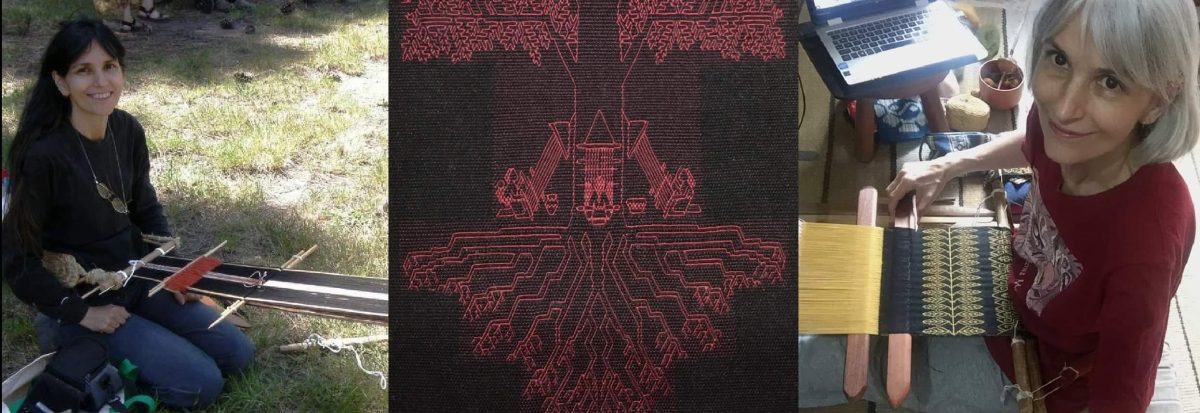
I joined a team for this year’s Tour de Fleece event. This is a spinning event that always runs at the same time as the Tour de France. It’s a chance to set yourself a goal and spin along with others, watching their progress, celebrating the completion of their goals, proudly showing off your own work, and learning a heck of a lot about the spinning of all kinds of fiber along the way. There are prizes but I would say that not all that many people are interested in or motivated by that particular aspect. I have made two attempts to play along in a team in the past and have never lasted more than a week, I am embarrassed to say. I got bored!

This year, I am trying to spin all the Sea Island cotton that I was given by my friend Betty. I spin a little on my takli spindle after breakfast every day. I feel very motivated and I think it’s because I have specific uses in mind for this cotton thread. That, and the fact that I am pretty new to spinning cotton and am constantly learning, make it more interesting. I also don’t have that nagging need to get as much weaving done as I possibly can, as I used to do, when I would have to drop everything to prepare workshop materials and pack to leave for an extended trip away. Don’t get me wrong…I LOVED those trips away.

Life has slowed down. I pretend that I am one of those lucky people that go away to escape distractions so that they can spend an extended amount of time focusing on their art. They choose a peaceful or exotic place and do an artist’s residency, drawing inspiration from their new natural and cultural surroundings. That’s me, except that I get to do it in the comfort of my own home and draw inspiration from the internet, lol. I followed along during the several weeks that a Facebook acquaintance recently spent painting in the Shetland Islands on such a residency.

The projects that I have in mind for the spun cotton thread are also “firsts” which I think is another motivating factor. While I spin, my mind runs through the steps that I will take to get those projects off the ground. I try to imagine all the things that could possibly go wrong in the hope that I can avoid them. I am pretty sure that all this will have me sticking with the Tour de Fleece for its entire duration this time. I write down the steps for the new projects in my Weaver’s Journal only to erase or amend them the following day when I figure out a better way.
I had come to the conclusion that I cared very little for the process of spinning and that I am one hundred percent motivated by the product. Now I am not so sure. I have a dismantled Ashford Traditional wheel in my closet that would enable me to spin a whole lot faster, yet I ignore it and stick with my takli for cotton and my good ol’ Cusco drop spindle for wool and alpaca. They somehow just seem to be more “me”. I guess that there are some aspects of the process that I really love after all. I am certainly not purely after finished product as I had once thought.
I had the experience of buying raw cotton, de-seeding it, fluffing it by hand, and then beating it on a sack of grain to prepare it for spinning when I stayed with a family of spinners and weavers in coastal Ecuador. I do understand that all of that is really the most essential part of the process. Being given a large coil of beautifully prepared Sea island sliver to spin is not quite the same, is it?


Afternoons and evenings are for weaving and this is what has been keeping me occupied in my “artist’s residency”. The weaving part of the Finnweave piece with its foliage pattern is finished . I have yet to wet-finish it. If this works as something that I can use to keep my neck covered, I will be pleased. As I mentioned in a past post, I don’t really enjoy wearing the scarves that I have woven. The length and ends and fringe annoy me. I just want something that I can button around my neck (I love the pieces that I knitted that I can just stretch and pull over my head but that doesn’t work so well for woven cloth).

My sampling paid off (it always does). It enabled me to maintain the eight-inch width effortlessly the whole way. This is something that I find challenging when doing a balanced structure without a reed. The sett varies, though! The warp threads between the motifs get a bit a crowded sometimes but then open up again as the positions of the motifs change. I learned from a previous project not to weave motifs in columns because of that crowding problem. I am interested to see how things change after wet-finishing.

I got the basic idea for the irregular leaf shapes from one of Svetlana Rogatykh’s crochet patterns. The lines in her designs are particularly suitable for Finnweave. The proportions, however, will be quite different and need adjustment. I just took her idea of irregular leaf shapes and went on my own from there. I think that any shape pretty much works. I don’t think that there’s a single “leaf” shape there that actually looks like a leaf on its own. I added butterflies along the way to connect the two layers of the double weave and chose to make them solid rather than outlined shapes. The poor butterflies are flitting about looking for something colorful in that flower-less garden.

And so, while I continue spinning cotton, another project has come to mind. I am really enjoying this exercise of picking through my stash and coming up with projects as opposed to coming up with projects and then shopping for yarn. Years ago, I bought a cone of 20/2 white UKI cotton. I have just finished scouring a good amount of it (I learned the hard way some years ago, that this needed to be done before attempting to dye it) and am planning a warp-ikat project. I want to use the finished fabric to construct something this time…so, no wall hangings, scarves or neck wraps…there will be cutting and hand-sewing involved. Maybe I have become cocky after my successful bag project! It’s been many years since I created an ikat piece with cotton.

My goodness, the water was soupy after scouring the UKI cotton. Any of you that have UKI in your stash will know about the spinning oil that it carries. I suppose all thread has it but I seem to be more aware of its presence in this particular brand.

In my last post, I said that I was gong to talk more about the backstrap loom in this one. I got carried away talking about other stuff. Let’s see if I can manage it next time 🙂
.

I so enjoy when you post pictures of your travels. I spent I don’t know how much time a few years ago reading a lot of your older posts that had information about your teachers and the processes that you learned. It is so fascinating to me.
I love the fact that you are using your beautiful journals. It has to feel great to pick them up and use them.
I am so glad that you enjoy that aspect of my blog posts. I forget that there may not be that many people who have read or remember some of the older posts in which I talked about that kind of thing. I was going through the notebooks that I wrote describing the techniques I had learned on the my return. I pasted photos into them and it was fun discovering some photos that I don’t think I have ever posted to my blog. I forget that they are there sometimes.
The weaving journal is actually a sketch book and has beautiful, thick, high-quality paper. I fear that I may fill it quickly but that will give me an excuse to weave another cover and I don’t mind that at all!
The naturally colored cotton from coastal Ecuador is a beautiful reddish-brown. Much darker than the ‘coyuche’ cotton from Mexico.
Yes, it’s a gorgeous color. I was told that the local name for it, “mico”, is the name of monkeys that have fur of a similar color (although Google search results for that word indicate that it is a word used for a diverse range of species with fur of various colors.)
Your leaf project looks wonderful! And it will be fun to see how your cotton spinning progresses…this coming winter I plan on going to Ecuador to visit my sister in Cuenca, and I will definitely look for some already spun mica, as I am not a spinner. I agree that the color is quite beautiful.
Hi Marilyn. Thank you!
Cuenca is beautiful! You’ll enjoy meeting backstrap weavers who weave ikat shawls in the neighboring towns. I don’t like your chances of finding hand-spun brown cotton there but you never know. I hope you get lucky and find some.
Gorgeous pieces. And yet another technique of spinning I’ve never seen.
I’m glad you enjoyed the post, Berna. Thank you.