Backstrap Weaving – Elementary Stuff!

I don’t have any finished projects to show you in this post. That’s because I have been too busy learning new stuff. It’s not anything that most people will get excited about because it is what experienced cotton spinners, sewers and “conventional” loom weavers will consider really elementary stuff. But it’s all new to me and I am having a blast learning and using it.

First of all there’s the cotton spinning. I just finished spinning up a tiny ball of what I will call version 4 and am telling myself to stop there and weave a sample. I wove two samples with version 3 in the kind of sheer open weave that has drawn me to trying to spin and weave with my own hand-spun cotton singles.

This is what I wove with a Guatemalan spinner’s hand-spun cotton. I would like to do more of this with my own hand-spun.

I boiled version 3 to set the twist but found that it was still a bit too lively when I wove my samples. I can only assume that I am putting in way too much twist which boiling simply cannot settle. Hence, version 4.
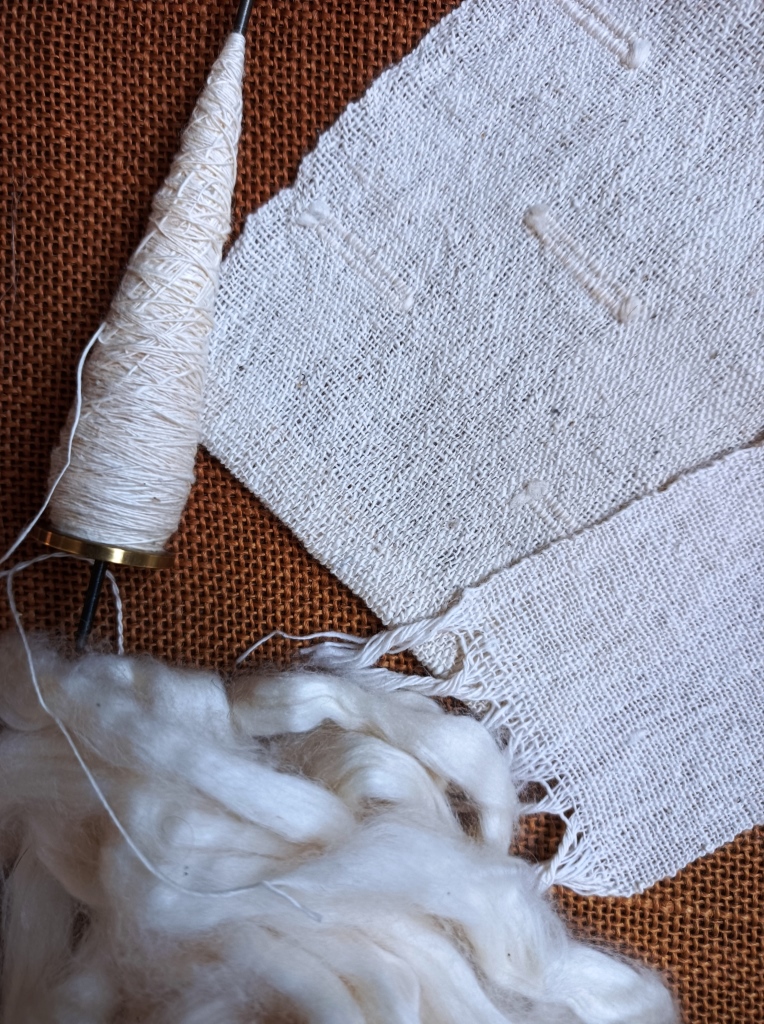
Above, you can see version 3 woven without a reed on the left and with a reed on the right. Neither is as sheer as I would like it to be. In version 3 I experimented with different thicknesses of inlay. The thickest one wins. The finer ones virtually disappeared after washing and pressing. So, I will be trying a more open sett next time and hoping that I have less wobble in the weft shots.

It’s a bit of a head-scratcher as I spun this natural brown cotton several years ago and used it as singles in a similar sheer-cloth experiment. I didn’t boil the cotton singles yet it behaved so differently when woven. Perhaps the brown cotton just has different characteristics. There’s so much to learn! I saw a post on Facebook the other day where someone had made a study to find which breed of sheep has the best wool for knitting cables. How amazing to have learned so much about the unique characteristics of all those different kinds of wool. Why should cotton be any different?

My hand-spun brown cotton,

In weaving news, I have been weaving with my finest bamboo reed which I believe has 23 dents to the inch (makes me crazy trying to count those things!). This is nothing new. I have used my bamboo reeds a few times in the past including the time that I used it for the original sheer cloth experiment with the Guatemalan spinner’s hand-spun. What was new to me was doubling threads in dents. Elementary stuff, right? But new to me!

My improvised threading hook.

I first tried a bent piece of wire as a threading hook which was very tedious and I was willing to persevere with it until online weaving friends suggested cutting a hard plastic card. Those with experience will immediately understand why a wire hook is not ideal…elementary stuff, right? I would happily buy a proper hook if only I could find one here. I can’t say that I am big fan of reed-threading. ‘Use one of those annoying shopping cards”, someone said. I don’t have a single one but managed to dig up this card from one of my visits to Australia.

I like the view through the reed and the swirl pattern optical illusion that creates. It gives me ideas for ikat patterns.

I am using doubled 20/2 cotton and, after sampling, found that it needed to be sett at 27 for tabby. That meant that I needed to double some of the doubled 20/2 cotton in some dents. Elementary stuff, but I had never done this before. I know that floor loom weavers do this all the time. Yes, I understand why and I understand that the each thread in the pair will be in a different heddle and performing a different role in the structure of the cloth. What I was never able to fully understand is how two threads that are supposed to be separated can remain so when with every beat of the reed, they are being squeezed back together again. How does that not show up in the cloth? Well, I did it and yes, of course it works. When I held the cloth up in front of the window I could make out evenly spaced stripes. I guess that is evidence of the dent sharing but I wouldn’t say that it is at all noticeable when just looking at the cloth in normal conditions.

It’s ridiculous how excited I am about this “new experience” :-).

Doubled 20/2 cotton tabby in a color called Old Gold. I lightly tacked down a doubled hem before wet-finishing.
Finnweave in 20/2 cotton

If you have read my most recent posts you will know about the bag project which grew from the fact that I had woven a strap in a 3-color reversible pebble weave structure.

This gold cloth is part of that project. Using the gold thread that I was given by my friend Betty is a stash-busting project by someone who does not typically accumulate stash. Betty gave me a large cone of luscious Old Gold and a much smaller one of black. The went together beautifully for a Finnweave cowl that I wove.

Pieces of the bag project coming together.

But now I am pretty much out of the black thread and with nothing else in my stash to combine with the gold, I decided to use it to weave the lining for the bag. Let’s get one thing straight first…I am pretty much always looking for a reason/excuse to weave. I don’t need any of this stuff. I just like to weave, especially if it gives me the opportunity to learn something new. With dwindling stash, long drawn-out projects are good value. So, I decided to weave the lining which no one will see once it’s inside the bag except me. Yet, I know that I will feel very happy every time I open the bag and that glow of gold greets me. This also gives me a chance to learn about “drop-in” linings….elementary stuff for sewers…totally new to me! Also, I have only ever cut my own dense warp-faced cloth. Cutting into this tabby will also be a new experience.

I also wove a wrist cuff in Finnweave using the gold and black 20/2 cotton. I love being able to wear and carry small samples of the structures and techniques I use this way.

And I have been able to add “fusible interfacing” to my Spanish vocabulary (entretela adhesiva) and enjoy the excuse to poke around the little hole-in-the-wall fabric shops and stalls in one of the nearby street markets. It’s always amusing getting the vague directions to the right stall from the various vendors who don’t carry the item in question…a vague wave of the arm accompanied by más allá, al frente, or a la vuelta. Finally, one gentleman, seeing the look on my face after having already received several no hay responses and a half dozen directions that had led me nowhere, told me to go to the store with the red pick-up truck parked outside. Bingo!

An intermesh strip of cloth which will be the sides of the bag. It sits on top of the Old Gold lining.

It was also interesting to learn from renowned weaver Bonnie Tarses via a Facebook post that she likes to use doubled warp and weft in tabby because it makes for cloth that is more supple. And there…I learned another “something new”(after I had already woven the cloth). Bonnie kindly gave me permission to share her photo of the beautiful tabby cloth that she has just taken off the loom in doubled 8/2 cotton warp and weft.

Bonnie Tarses

And so, it’s back to boiling my hand-spun cotton singles and hand-stitching this bag together. Both activities are a combination of online research, video classes on cotton spinning and a good ol’ dose of “make it work”.

See you next time.

Backstrap Weaving – The Plan

Spinning cotton had certainly not been part of The Plan for how I was going to spend my time during this Bolivian summer. I spend a fair bit of time when I am away sitting in airports, or on planes, trains and buses, and that is when I like to get out my notebook and create sketches and notes on the projects I would like to attack when I get home. Cotton spinning was not one of them. However, the seed had kind of been planted, although it had not quite taken hold, when I was in Australia. Elizabeth, who came to weave with me, gave me a lovely gift of prepared cotton, a tahkli and a pretty dish in which to place the spindle tip. She had taken classes with Joan Ruane earlier that year and gave me a little demonstration one lunch break. We were so absorbed and I was so swept up in her enthusiasm that we forget to eat!

I had learned to spin cotton in 2007 in coastal Ecuador when I stayed with a family of spinners and weavers along with anthropologist Kathleen Klumpp, but had not taken it much further. I practiced a little when I got home but never spun any useful kind of amount. I certainly couldn’t imagine using the clunky kind of thread I was producing in my weaving and I didn’t have the will to practice more in order to refine and perfect the skill.

                                                                        Photo by Kathleen Klumpp.

I had brought back some of Trini’s prepared cotton and still have it sitting in the closet. Now there is a good chance that I will spin it.

This cotton had passed through the hands of the many grandchildren in the family who would sit on the floor after dinner and pluck out the seeds. Mariana, Trini and I had taken turns in pounding it. I had even made myself a miniature stand from a tree on their property on which to drape the cotton while spinning it.

I simply couldn’t see any reason to spin my own cotton. I didn’t feel that the cotton I was buying was lacking in any qualities that I needed for my weaving….until now. I want cotton singles that can come somewhere close to the fine thread that the weavers in Guatemala use for their sheer cloth. They are able to buy skeins of the commercially-spun cotton singles that they use.. Some weavers in Mexico, who also create this kind of sheer cloth, go to the trouble of splitting the ply of commercially produced cotton if they want to weave the finest pieces. Can you imagine? The seed of interest that Elizabeth had planted in me in Australia started to sprout when Deb in North Carolina showed me the amazing piece of sheer white cloth that she had bought in Guatemala. I actually own a small sample of this cloth. I have taken it out of the closet many times to admire.

There is a wonderful article by Cherri M Pancake and Suzanne Baizerman in the 1980-81 issue of the Textile Museum Journal on the production of Guatemalan gauze textiles. The article states that Handspun single-ply (Z-spun) cotton of varying fineness and degree of twist was used to produce some of the historical textiles. This is referring to textiles that were produced prior to the last decades of the nineteenth century. It seems that the weavers now only use commercially-spun thread.

Kathleen Vitale of Endangered Threads has produced a video on these sheer textiles that are being produced in both Guatemala and Mexico. If your mind boggles at the idea of splitting the ply of your already fine two-ply cotton, take a look at the technique used by the ladies in Mexico in this video!

I brought back a big ball of hand spun doubled cotton singles from Guatemala. I don’t know for what style of weaving that thread had been intended. I separated the strands and used the singles in my experiments in weaving the sheer cloth. My cloth is heavy next to the Guatemalan work! So far my own attempts at spinning cotton is producing thread that is only ever so slightly finer than the Guatemalan thread I bought but, even so, I know that I will enjoy weaving with it.

In the meantime, I decided to try weaving a small sample without a reed. I only wish I had used my own hand spun for this experiment. If I had done so, I could have killed two birds with one stone…testing the strength and suitability of my own thread as well as experiencing the difficulties of maintaining consistent sett without a reed. The sample was very small….just over four-and-a-half inches wide.

After all my talk of temples in my last blog post, I didn’t end up using one. I did find it very useful to use the comb, pictured above, to beat rather than my usual sword/beater. I used a coil rod at the start to help establish the sett. I took measurements from the scarf I had woven. If you are familiar with the ”twisty sticks” that I like to use in my backstrap loom set-up, you will understand what I mean when I tell you that I also used a coil rod in place of the far stick in the twisty stick pair. I think that was helpful. There was much time spent keeping a close eye on warp threads that might be threatening to wander out of position, probably way more time than was necessary. I was happy with the way the width remained consistent but won’t get too carried away with happiness. This was, after all, a really small sample.

And then, I wove a sample with the same number of ends using the reed. It takes time to thread the reed but then you can just relax and weave.

These experiments are preparing me for the time when I can either get hold of much finer singles, or spin my own.

Do I then abandon my 24dpi reed which won’t be fine enough, or thread multiple ends in each dent?

I have been asking some online weaving friends about the very common practice of threading reeds with multiple threads per dent to achieve a finer sett on their floor looms and have been hearing about their experiences with the ”reed marks” which can sometimes result. Apparently, they quite often disappear in the wash and one needs to sample to see if they will do so according to the material and structure that is being used. I think that reed marks would annoy the heck out of me! However, it’s good to know that these marks sometimes do remain in the cloth even after washing and that their occurrence is pretty much normal.  I need to get over that if I am to going to be able to enjoy the ease of weaving this kind of cloth in fine thread with a reed. What about you…do you have any thoughts on how having multiple threads in the reed dents will affect the kind of open cloth I am weaving?

So, I have been spinning. I have a surprising amount of prepared cotton to spin in a big box in my closet. Back in 2009 and 2010, I was swapping llama bone tools and Bolivian drop spindles by mail with folks in Australia, the USA and Europe for various bits and pieces. Quite often I was sent cotton as a swap from generous people…way, way more than I had initially bargained for! I have natural green and brown cotton ready to spin and all sorts of other natural tones as well as dyed stuff. The picture above shows just a small sampling. And then, there’s the Indian charka that my friend Lisa gave me in 2010 and all kinds of useful tips in the book that Stephanie Gaustad gave me when she came to weave with me on one of my U.S visits a couple of years ago.

I can’t spend my time only spinning. I need to be weaving too. So, I prepared a warp for anther bag with built-in pocket. Both this new bag and its pocket are bigger than the green example I recently wove and decorated.

And, this latest example is far less colorful…black and white and that’s it. I am working my way up to a shoulder bag that will will have a large built-in pocket and pick-up patterns. I am done with sampling for this larger project now. I think I have remembered and put into practice all I need to review for the creation of the pocket and am ready to move on to the real project.

Here’s the warp set up with its longer pocket section. I actually remembered to take a photo of this part of the process.

I edged the pocket with a patterned tubular band this time instead of cross-knit looping. And then, I edged the entire bag, including the mouth, with the same kind of patterned tubular band. The pocket is just the right size for my Bolivian ID card.

I added a snap to close the pouch, rather than a zipper, as well as a decorative button.

It looks a little dull in the picture above and so I stuffed the pouch and the wee pocket with bits and pieces to give it some life.

It needs a strap and I’ll most likely weave a pebble pattern into it as the bag itself is so plain. The back of it is pretty unusual. I wove the back with a window so that I could place my little sheer woven cotton sample within. I even lined that side of the bag. That’s a big deal for me with my limited sewing skills! It’s a quirky combination 🙂

Now, I would like to show you what a couple of my weaving friends have been doing with the bamboo reeds that they made with Bryan Whitehead at the ANWG conference in 2017. I will show just one project from each of Tracy and Kristin for now (so hard to choose) so as not to overload you with all that beauty! I’ll show more in future posts as the reed topic continues….

Here’s Tracy’s work using the 22dpi reed that she made herself with natural 10/2 cotton from Lunatic Fringe. It looks so awesome on the loom with that lovely roll of finished cloth on the front beams!

Here she is working on it during my visit earlier this year…

And here’s the finished cloth…so gorgeous!

You can read Tracy’s blog post about the making of her reed at the ANWG pre-conference workshop with instructor Bryan Whitehead here.

One of the reeds that Kristin made in the same workshop is 25dpi. She used it on her backstrap loom with natural and blue 16/2 hemp from Hemp Traders that she combined to weave fabric for several towels….

The finished cloth…

These ladies also do some awesome work on their backstrap looms with their hand spun yarn and reeds. I’ll be showing you more from time to time.

Here are a couple of cool warp-faced projects from online weaving friends…

This if from Penelope in the UK. She says that the hat is nalbinded in Oslo stitch using some unknown chunky grey wool…..Felted down to size. I created the chart for the pick-up pattern for her. It is based on a motif that is often seen in tablet-woven bands. Penelope says that the pattern is based on a 10thC viking find from Dublin that many call ‘Little Dragons’. 

Marie Paule in France is weaving Andean Pebble Weave patterns on her inkle loom using the two-heddle technique that I teach in my first book, Andean Pebble Weave…

The same pebbly patterns can be created without the use of the additional heddles as Marsha is doing here….

Marsha is using the technique that I teach in my third book, Complementary-warp Pick-up. If you don’t think you would like to deal with the additional heddles that Marie Paule is using, or if you don’t think that your particular loom will comfortably accommodate them, my third book teaches a method that does not use them. It is a slower method, but it suits a very wide range of looms and can be used for other complementary-warp structures besides Andean Pebble Weave..

And here’s some of Bradie’s work. I wove with her in Vermont a few months ago. She was using an inkle loom but is already wondering about going on to weave wider pieces. I feel a backstrap loom coming on! This and other Andean Pebble Weave patterns can be woven with two sets of heddles, as Marie Paule does, or without them, as Marsha does.

So, it’s back to my spinning and maybe I will get the silk on the loom this week. I have already put together my pre-warping project notes and all is set to go unless I decide to go with the wool pocket shoulder bag instead. And there’s always a chance that something else will come along to have me throwing The Plan out the window…..

Until next time………..


Backstrap Weaving – Summery Cloth

With the temperature around 91 F and a broken air conditioner, it’s just as well that I have decided to weave something light and airy as my first big project for this season. I usually find myself at this hotter time of year weaving something totally inappropriate, like a wool lap blanket. Silk thread is not pleasant stuff either in sweaty fingers. I do, in fact, have plans for both wool and silk projects for the next few months but hopefully my a/c will be up and running again by the time I get around to them.

I threaded the reed for the project for which I am using some hand spun cotton that I picked up from this lady in Guatemala in 2008.

It was a little worrying while re-tying the cotton ends to have some of them untwist  and break as I attempted to pull and tighten the knot. Breakages?! I hadn’t even started weaving yet! I did not want to have to size this warp and I am glad I didn’t panic and do so as, so far, I have only had one thread break while weaving. This same thread has broken multiple times and so I guess and hope that it was just one section of this particular strand that was more loosely twisted than the rest.

Of course, I first wove a small sample for this open and airy balanced-weave that I want to do. You can just catch of glimpse of it at bottom right in the picture above.

I am trying to replicate the structure used by weavers in the Alta Verapaz region of Guatemala…a base of open balanced weave into which they place patterns using supplementary weft. The thread they use is much much finer than the cotton singles that I have. I was told that in some communities in Chiapas, Mexico where this kind of cloth is also produced, some of the weavers divide 20/2 commercially-spun cotton into singles and use that as their warp threads. What a job! Not everyone can manage it and those who can’t will pay someone to convert a cone of thread into singles. In the Alta Verapaz region, some weavers use commercially-spun 20/1 cotton thread is used which perhaps explains why the thread in the sample piece that I bought at the International Folk Art Market in Santa Fe a few years ago is so incredibly white. This information comes from Kathleen Vitale. I also read that other weavers use a 30/2 mercerized cotton which isn’t split and which is available in local markets. The hand spun cotton that I am using is off-white (and much thicker!) as you can see below.

But, I am happy to have this piece of fabric from Guatemala and these balls of hand spun singles so that I can at least try this out and practice creating the patterns. The finer thread can come later!

Here’s a look at the little piece I bought in Santa Fe still on its loom. I would love to know how it changes after washing but I don’t want to cut it off its little loom. Or…did they somehow wash it in order to sell it?

Here’s my tiny sample on the loom, and then after washing (sitting on top of my latest knitted cowl…still very excited about picking up knitting again!)

The more open sett at the start of the sample is what I was aiming for but I unconsciously allowed the piece to narrow and deepened my beat which gave me consistent width and neater selvedges. However, in doing so, I almost lost the translucent quality that I had been wanting.

So, here is the large piece underway. I was so doubtful about the success of this project that I very uncharacteristically did not bother to plan out and chart a pattern. I just started winging it. So, I have to say that I am not entirely pleased with the layout of the figures. I am just practicing various basic lines and shapes. It’s another ”sample”, albeit a very large one!

I would call it successful because I have only broken one thread so far. That had been my biggest concern.

Un-weaving is quite the thing. The fluffy warp and weft threads meet and grab hold and do not want to let go! However, it is this ”gripping”quality that seems to allow the Guatemalan weavers to simply cut off the start and end tails of supplementary weft right at the edges of the pattern rather than leave some length and make an attempt to bury the ends within the pattern. I am guessing that washing the fabric will further reinforce this. I suppose I’ll find out! This is after all a sample, right? I haven’t cut the tails very short yet.

I was eventually able to coax out one of the ends of supplementary weft in the unwashed Guatemalan sample so I could count the number of strands the weavers were using.

It’s a very relaxing technique for me. I can sing, listen to podcasts…it doesn’t require the heavier amount of concentration that most of pick-up work involves. And, it sits light as a feather on top of my legs. It is certainly the fabric with highest amount of drape that I have created on my backstrap loom. There’s a long way to go. The warp measures something like eighty inches. which means that there is plenty of room left to play with patterns.

I am so thankful for these reeds that I managed to buy in the vendor hall at Convergence in 2010. They have just the right spacing for this open structure in the weight of cotton I am using. When the time comes to use finer thread, I will have to figure out something else. Or, not use a reed at all. The Guatemalan weavers don’t. I only want to handle one challenge at a time!

I think the only other time I used one of these reeds is when I did a four-shaft shadow-weave piece a few years ago…

My backstrap weaving friends, Christine, Kristin and Tracy made their own bamboo reeds in a workshop with Brian Whitehead at ANWG 2017. Here’s Christine with hers…I know that Kristin and Tracy have put theirs to use multiple times with both commercially and hand spun fibers and have created some truly awesome pieces of fabric. I’ll have pictures and details in future blog posts.

A much simpler project that came off my loom last week was the piece on which I had been demonstrating at recent fiber events. It is now a backstrap to add to the collection of straps that my weaving friends use when we get together. It is sitting here with a couple of my bone tools. The one on the right was given to me by a gentleman in northern Chile. He had found it in the Atacama desert. It has a beautiful shape and point.

And, here’s the latest from some of my online weaving friends and students…

It’s lovely to see patterns from my books appearing in Marsha’s beautiful band projects. She is using the Gilmore Mini and Big Wave looms as well as a Handywoman treadle tape loom with a variety of materials…cotton, silk and tencel.

Maxine combines colors so beautifully on her inkle loom. How inspiring is this? It’s nice to see these patterns from my first book being used in such an awesome way.

This is Caroline Sargisson’s first band using an inkle loom and a pattern and instructions in my Complementary-warp Pick-up book.

Julie Beers finished a really long band of the playful kitties patterns in my latest pattern book. She wove this on one of the Gilmore looms.

Tara’s making a pouch from fabric she wove using a backstrap loom. She may use some of the finishing techniques I teach to decorate it.

And Tracy has edged her bag with the ñawi awapa tubular band. She wove the bag itself using a backstrap loom and her own hand spun wool. The strap is currently underway.

Penelope made bands for her living history top hats using a Jonathan Seidel card loom with a Vav kompaniet heddle.

And, yarndragon made some keyfobs using 10/2 cotton. Because she thought 10/2 cotton too lightweight for fobs, she neatly backed them with denim.

Patrick finished the double weave band he started with me. The pattern is his own creation…

And, last of all, I will leave you to gasp at a picture of the amazing pikb’il cloth that really inspired my current project. It was one of the last things I saw on my recent trip away but became the item that jumped to the top of my to-do list on my return. I couldn’t get it out of my mind. Many thanks to Deb who showed me this scarf that she had bought on a recent trip to Guatemala. It looks like it would float away in a summer breeze………