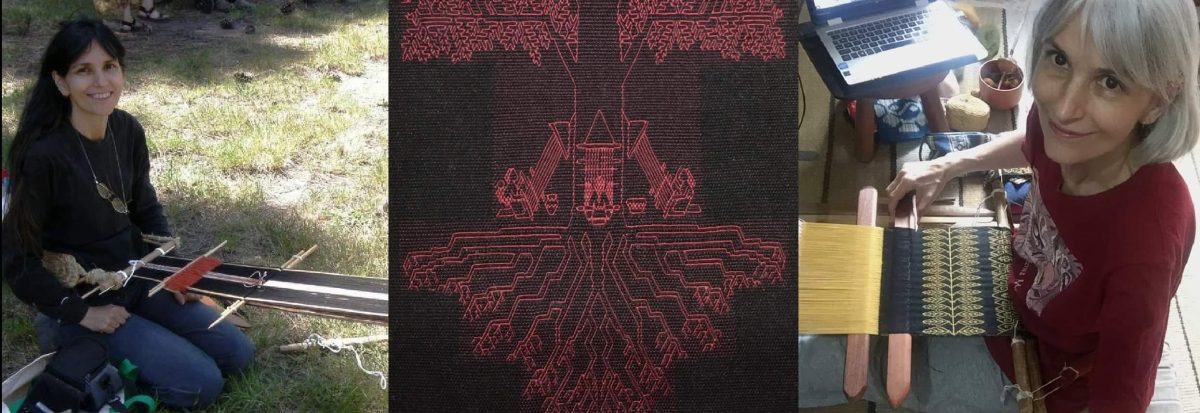
Many years ago an online acquaintance told me that she could instantly tell which of the images of woven pieces that had been posted to one of the online groups were mine. I thought that was fun…wow, it seems that I’ve developed a “style”. However, as I think back to some of the things I have woven over the years I’m sure that’s not true at all.
I’m thinking that perhaps my work was so easily identifiable back then because it stood out as being warp-faced in a group where the vast majority of work wasn’t. Also, in those days I did seem to weave a lot of patterns that could be described as big-and-bold and decidedly “ethnic-looking” at a time when replication was a big part of my learning process. The products were hardy belts, straps and shoulder bags. The thread I used was locally-sourced 8/2 cotton which was almost all I had access to here for this kind of work.
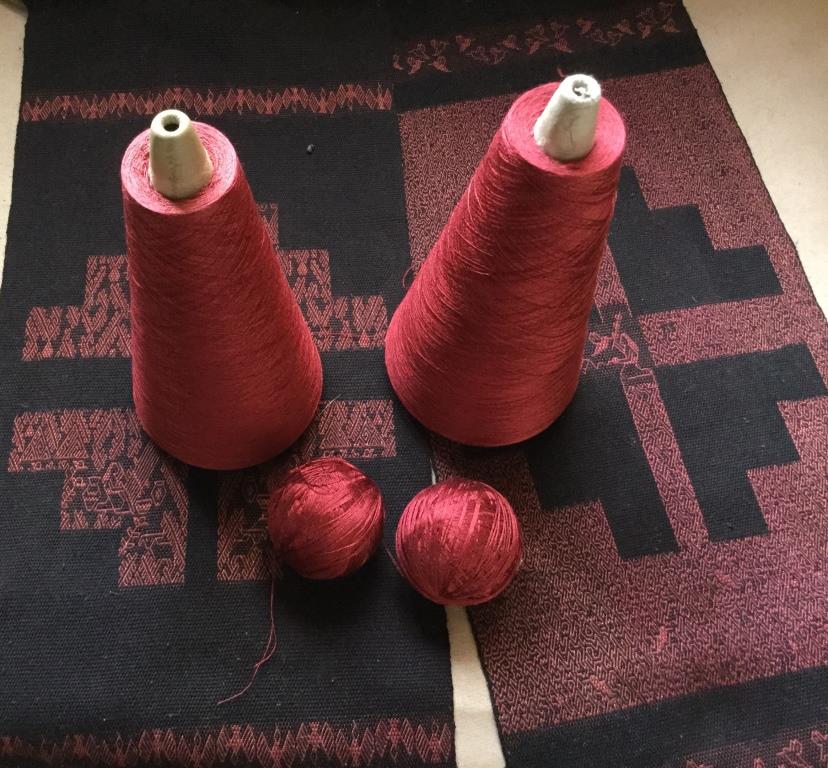
Now, I’m not quite sure that I want my work to be so easily recognized. It feels like that would mean I was not branching out and trying new things or heading in new directions. And that might very well have been the case if I hadn’t been given so much yarn by weaving friends over the years….yarn that I probably never would have chosen on my own…like the cones of 140/2 silk I was given by two friends, eeeek! Who would ever contemplate weaving with that? It was offered to me, gratefully accepted, and eventually I used it (and loved it!). I can only hope that I wove something worthy of the lovely gift.
I suppose that if there had to be something that somehow categorised what I do, or my “style” of weaving, I would like it to be the fact that I use a backstrap loom. For me, the process in most cases is more notable than the product. I’m rambling on about this a bit because of a couple of things that I have seen in my online groups recently. One was a comment on a photo of my latest warp…

The commenter asked me to make sure to eventually post the finished project because she is fascinated by “backstrap weaving”. The thing is, once the fabric is off the loom, there’ll be nothing to indicate that it was woven on a backstrap loom. It could have been woven on any kind of loom that allows one to create 18- 1/2″-wide warp-faced cloth. For me, the product isn’t “backstrap weaving”….the act of creating it is.
What I’m trying to say is that I think that the term “backstrap weaving” is suitable for describing the act of weaving on a backstrap loom…. I’m out in my back yard today backstrap weaving, for example. I don’t think it works as a word to describe the cloth that comes off the loom and I have a feeling that this is the way many people use the term. I suspect that the person who asked the question is interested in seeing the cloth (and of course that’s fine) thinking that somehow it’s exclusive to the backstrap loom. If she had been interested in “backstrap weaving”, the activity, I think she would have asked to know more about the loom, my set-up, how it all works etc..
It makes me wonder, as I have often done in the past, what people think “backstrap weaving” is. And it makes me regret not having made it clear when I decided to name this blog Backstrap Weaving almost fifteen years ago. Maybe I was unclear about how the term should be used myself back then or at least unaware of how it might cause misunderstandings. I know that in the past I have been guilty on my many occasions of referring to my cloth as “my backstrap weaving” as a quick way of saying “pieces I have woven on my backstrap loom”.
One clear indication of misunderstanding was when someone posted that they were doing backstrap weaving on their inkle loom (simply because they were using a pick-up patterning technique that is often used by weavers who use backstrap looms in the South American highlands).

The fact is that, with will and skill, so many different kinds of fabric can be woven on a backstrap loom (with obvious width limitations, of course). The fabrics don’t have any particular characteristic that make the backstrap loom the only possible piece of equipment. The product could be weft-faced, balanced, warp-faced. It could be cloth where all structural and pattern elements are created by pick-up, or the loom could have been set up with multiple sets of string heddles and other aids to make those elements completely loom controlled, or a method that lies somewhere between those two could have been used.


By the way, I seem to have been asleep the last few years as far as rigid heddles go. I had no idea that they’re now available in 15 dpi. Sharon says that unlike other weavers who tend to have shaft envy, I on the other hand have dent envy.

The other thing that had me pondering what is meant by “backstrap weaving” was a question in another group: “What is the best book on backstrap weaving for beginners?” It leaves me wondering if they’re referring to the activity or the product. Do they want to know how to make, set-up and use a backstrap loom or do they already have one and just want to learn the patterning structures that are most often associated with this kind of loom? Are they looking at “backstrap weaving” as the process or the product? I haven’t asked but I am curious to see what other people reply as I think it will give a good indication of how others understand the term.
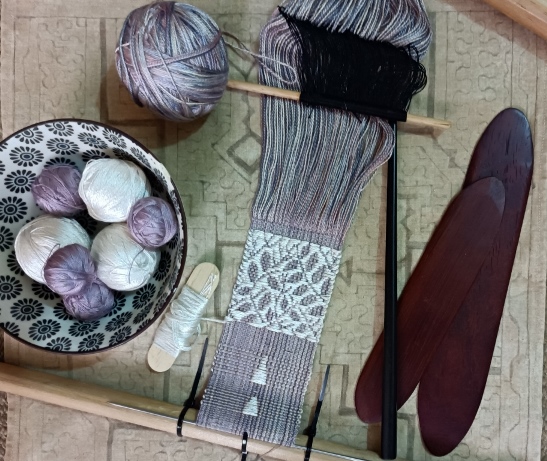
Anyway, let me get on with what’s currently on my loom…..I’ve been working on my latest project with the latest gift of yarn from my friend, Will, in Australia….some lovely variegated 10/2 silk which sits alongside some luscious white 20/2 silk that Susan had given me many years ago. I have admired work done with variegated thread but never thought to branch out and buy any because I really had no idea what to do with it. With the gift of this lovely mother-of-pearl thread, I’ve been given the push that I needed to come up with something.
My piece is all kind of soft and feminine-looking which might shock you if you’ve come to think of my style as big and bold. This is another example where gifts are ensuring that I don’t fall into any particular style box in terms of product. The common factor is the loom. It’s all about the loom.
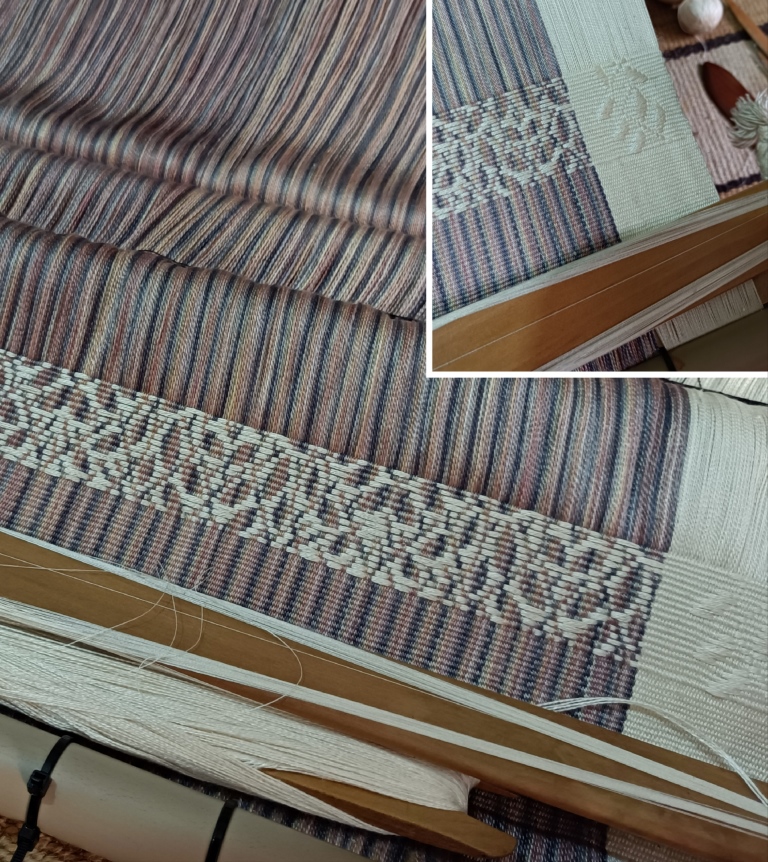
The colors in the variegated thread have aligned themselves quite differently from the way they did in my much shorter sample. In the sample there was less space between the darker threads across the warp which meant that there was higher contrast between the leaf shapes and the surrounding white supplementary weft. The effect in this longer warp is much softer. I’m doing some white-on-white patterning with supplementary weft on the sides. (This isn’t the “mad” idea I mentioned in my last post. I decided I wasn’t going to take a chance on trying that in this “real”project).

I’ve had to keep an eye on the width because I broke one of my rules and didn’t sample the doubled 20/2 silk on the sides to get a width reading. That’s the price I pay. I guessed how those threads would want to settle and now I have to keep an eye on them in case they decide otherwise.

I’ve just joined a hummingbird group on Facebook and it’s so much fun seeing the joyful posts as people announce the return of their friends after their winter away.
Before I switch off the bedside lamp at night, I take a quick look over the edge of the bed to see my loom with its limp warp lying on the floor. I love the way this looks in the soft yellow light. I wonder if I can get silk thread in these colors?

I’ll leave you with this photo that Kate sent me after having read my post last time which touched on the subject of width. Kate recently returned from a trip to Mexico in which she was able to visit with backstrap loom weavers and received permission to share this photo. As I sit at my loom quite pleased with my eighteen-and-a-half inch warp, I am in awe of the forty-eight inches (by Kate’s estimate) this weaver is managing…..and that’s wool! The fabric she produces is used for a very unique kind of cloth which is used as a man’s garment about which I’ll tell you more in my next post.