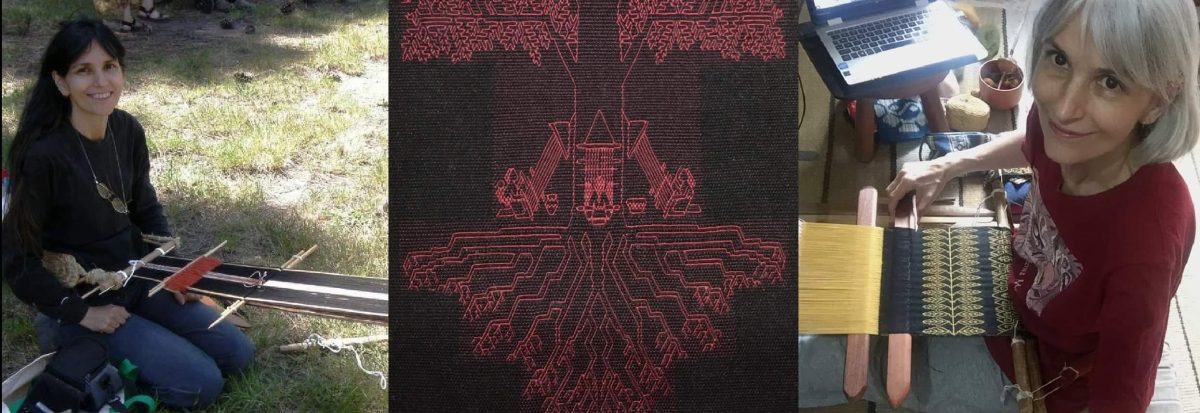
Backstrap Weaving – Between Science and Magic

Between Science and Magic….I have copied the title of this week’s blog post from the title of an article by Maria Popova that my friend Susan sent me on a new publication about the amazing and magical hummingbird…a subject which has been dear to my heart as I weave my way through my series of panels called Within These Walls. The article is accompanied by beautiful pieces of artwork such as this one created by John Gould in 1861 and states that…

There is, indeed, something almost magical to the creaturely reality of the hummingbird — something not supernatural but supranatural, hovering above the ordinary limits of what biology and physics conspire to render possible.

The magically larger-than-life hummingbirds that I created for my first three panels played a fantasy role as messengers, friends, guardians and helpers as I wove my way through pandemic maze and, while poking around online, I found that it is not unusual to assign magical qualities to these little creatures.

I found an article which described the role of a single hummingbird in Andean textiles as being a messenger between the three levels of Andean existence…..the underworld, the heavens, and all that lies between. Hummingbirds are often depicted in pairs in highland textiles with their beaks connected and are said in this case to represent nurturing and new life.

Which makes me even happier when I think back to 1996 and the fact that the very first motif I was shown by my backstrap weaving teachers was a hummingbird….although I had not recognized it as such at the time. It also amazes me that I first came to see it as a individual figure flying straight towards me in its role as messenger and that only years later I was able to also recognize it as two mirror-image figures with beaks connected. I find it magical that this one figure can, at least to my eyes, be seen in both these ways.

In 1997, I returned to Peru where I learned to make sling braids with a gentleman in Yanque in the Colca Canyon. He later introduced me to a weaver friend of his in Cabanaconde. She taught this bird figure to me along with others in a supplementary-warp structure. This is the actual band that I wove with her. I wonder if this too is meant to be a hummingbird.

Here’s another excerpt from Maria Popova’s article…

Essential as pollinators and essential as muses to poets, hummingbirds animate every indigenous spiritual mythology of their native habitats and are sold as wearable trinkets on Etsy, to be worn as symbols — of joy, of levity, of magic — by modern secular humans across every imaginable habitat on our improbable planet.

In the first panel in my Within These Walls series the magical hummers are valiantly fighting their way through the chaos to bring me (caught in a window between worlds….do I try to get back to Australia or stay here in Bolivia?) messages of comfort and solidarity as well as practical items….yarn and sticks for my loom.

In the second, they help me build the walls of my safe space and create a new normal within, planting saplings as a way of bringing pieces of the natural world inside. They even warp my loom for me.

In the third, while I remain safe within the walls, they stand as guardians hard at work trying to maintain some kind of a connection between the four disjointed pieces.

Which brings me to the fourth and final panel in the series which the drawing at bottom right in the image represents.

This one is my vision of a post-pandemic world and one in which the hummingbirds’ work is done. I figured that they should shrink back to what could be called a “scientifically acceptable” size in this final panel.

I got out my sampling band to see if I could create a tiny, yet still recognizable, hummingbird figure. The tiniest that I could create was still the length of the little weaver figure’s face and that was okay because I read that the largest species of hummingbird, the Patagona gigas, grows to eight inches (in some reports 9.1″) in length and is native to western South America. Perfect!

In the fourth panel all the pieces are connected into one smooth shape. This shape, which I create using ikat techniques, is filled with a tree around which three tranquil backstrap weavers sit at their looms.

In my last post, I showed you the root system of the tree. It is unusual for me to weave a newly-created pattern without first having sampled it. I paid the price by having to un-weave and make several adjustments to those roots. I didn’t sample the foliage either but got luckier this time and only unwove to fix mistakes.

A big part of the challenge is fitting all the pattern into the ikat-created shape, not allowing any parts to overflow and disappear into the solid black areas. I wanted the shape of the foliage and the roots to still give the impression of the stair-stepped figures that I used in the other three panels without having them look like hard-edged confining walls.

I enjoyed designing a baby and placing it on the back of one of the backstrap weavers. The hummingbirds are yet to be seen in this image. They are flying high being normal hummingbirds doing hummingbird stuff.

I love how the sheen of the unwoven warp has been captured in this picture. I am again using doubled 140/2 silk for this one. Three threads broke this time…one mysteriously and the other two through my own carelessness. I am impressed by the way this fine silk stands up to this warp-faced structure on my backstrap loom.

Here’s the finished tree. You can see the hummingbirds in this one. I had been wondering just how high hummingbirds fly off the ground in their search for nourishment and read that they have been known to fly as high as the balcony of a 14th-floor apartment to sip at a feeder.

Pale-bellied Hermit Hummingbird. John Gould 1861.

This fourth panel is still on the loom as I have yet to weave the horizontal band of pattern across the top. Of course this leaves me wondering what comes next. First of all, I will get out the good camera and see what I can do to get better photos of these pieces. So far, I have been using my tiny iPod. My good camera has never much liked red so we’ll see how that goes.

My internet wanderings in search of information on hummingbirds have taken me to unexpected places. In one such place I found inspiration for a possible future project in three-color Andean Pebble Weave. If that materializes, I’ll tell you more. One of my online weaving contacts suggested I weave a wrist cuff with my hummingbird figures and the new backstrap weaver. That might happen too. Perhaps the hummingbird is becoming another signature pattern for me. It might be fun to combine my favorite leaf pattern (another I consider a signature pattern) and the hummingbird in one piece.

Thank you for following the progress of this project. I hope that you have enjoyed the developing story. I’ve been working on it for several months now and it is not something I would have considered taking on if I had still been traveling three times a year.

Until next time, I’ll leave you with this beautiful image by Australian-born photographer and filmmaker, Christian Spencer. You can see a whole ballet of his hummingbird photos if you chase him up online.

Backstrap Weaving – Unraveling

No, I am not the one who is unraveling. I am still riding the pandemic roller coaster with all of you and my grip is still good and firm. In the title of this post I am referring to the unraveling of parts of the chaos and uncertainty that these last eighteen months have brought to our lives. This is something that I wanted to represent in the second of my four-part series of panels called Within These Walls in which the hummingbirds are busy unraveling the chaos lines that I had woven into Panel 1.

This Unraveling image showed up in my Facebook feed recently. It had been shared and shared again and although I followed it back for some way, I was unable to find the original source of the image, a title or even the slightest hint as to what its creator might have been trying to convey. (Edit: Pamela in New Zealand wrote tell me that she has tracked down the image to Rebecka Carléns. She has a Pinterest board that she has named Surreal Photography and an Instagram account. Thanks, Pamela!)

It shows lines being unraveled and wound into a ball of yarn carried by birds…the similarities to some of the activity in my second panel made me smile. I guess we can interpret it any way we please. Which reminds me of the little hummingbird motif that I included in one of my posts a while back. I posted a picture of it on Facebook recently without revealing what my teachers called it and asked people to comment on what they saw. Here are some of the answers…..

a devil with horns, a dog, a fox, a bat, an alien being, a folding chair, a butterfly, a spider, a mouse, an angel, a bird (only one person said it!), a bear, a jedi master with a double light saber, Princess Leia with puffy sleeves, a six-legged insect, a person in ceremonial dress, pizza, a hyena, a chalice on a stand.

I mentioned in my last post that I had decided to add a fourth panel to the series. Panel 3 shows me settled within my walls and making what I can of this new normal. All the while I am able to think about how we are all in this together and imagine other weavers seated at their looms in the very same way within their own walls in other parts of the world.

But I didn’t want to leave things there. I wanted to show that I believed that there will be a way out eventually.

I got my first dose of vaccine yesterday. It’s the Chinese Sinopharm one. It’s not the most effective one but it is the one that Bolivia has been able to acquire and that’s the end of that. It helps me feel that a few more strands of suffocating uncertainty have been unraveled. I have not experienced any side effects. The jab site is not even sore. Members of an ex-pat group that I am in will tell me, in their typical cynical and joking style, that this means that what I got was probably a fake! The markets here are full of cheap big-brand rip-offs of all kinds of products. I remember getting someone to try and fix my Toshiba air conditioner. He looked at it and said “Wow, it’s an original. Okay, this is worth trying to fix”.

So, I added the layout of Panel 4 to the drawing that I had initially put together to roughly plan out the Within These Walls series….

In Panel 4 the pieces of the main shape are no longer disconnected. Disconnection is certainly something that we have all felt during the pandemic. The shape is now connected and extended. The central bar is the trunk of a tree. The lower shape will contain the root system of the tree and the upper one the crown. And there will be three backstrap weavers sitting around the tree at their looms.

I went one step further in designing one of the three backstrap weaving figures. In my last post I showed you version 4. I decided to beef up her arms a little. I have been working out during the pandemic and am up to forty-five full body pushups now. I think I deserve those sturdier arms! Version 5 is the one on the right. It requires a tiny bit of tweaking.

Here’s the root system taking shape….

I am actually beyond this point and have added the backstrap weavers. They look very sweet sitting around the tree. The one on the left has a baby on her back. I’ll show them to you next time when I have finished the tree. In the meantime, here’s a picture to celebrate backstrap weavers gathering to weave together on the island of Flores in Indonesia…

This was another picture that was shared on Facebook with absolutely no information to give it context. Fortunately, Sue Richardson, who is an expert in Indonesian textiles, was able to help out. Sue knew that this picture had been taken at a special event in 2015 when over 1000 backstrap weavers gathered to celebrate the textile traditions of the Sikka Regency and attempt to create a record. This is the translated information from an article that Sue found:

“Due to its high historical and selling value, the Sikka Regency Government is very supportive of all its development and preservation efforts. One proof of this government’s support is by holding a national event of the 2015 Ikat Weaving Muri Arts Record and winning because it can be represented by a thousand Sikka district female weavers. This victory was announced and the certificate was handed over by Mrs. Mufidah Yusuf Kalla on November 11, 2015 in Sikka Regency.” Although, according to another source that Sue also provided there were 1057 weavers.

I am currently back to paper and pencil, charting the crown of the tree. I charted but didn’t sample the tree roots and so there was a certain amount of unweaving that had to be done while I adjusted the chart. I always unweave and then walk away from the loom to engage in a completely different activity. That way, I can return and pretend that the unweaving never happened! It somehow helps. Hopefully the crown of the tree won’t involve that many adjustments.

I am happy that weaving friends and guilds, while getting more confident and occasionally meeting face-to-face, are continuing to offer opportunities to meet via Zoom. Zoom time has become my time for spinning and plying while watching and/or listening to programs on topics such as the ikat textiles of Borneo, textile travels through Indonesia, mathematics and sacred geometry in weaving, and warp-faced bands of Iran.

While enjoying these programs I have a produced a nice bowl of singles which will be plied. I still have a lot more spinning to do. The wrist cuff on the right was a sample I wove with this plied yarn to see how well it stands up to warp-faced weaving on my backstrap loom. Even though this was just a short sample, I could tell that the yarn would do well in larger projects. The annual Tour de Fleece spinning event has been creating chatter on Ravelry. I might have a project that will allow me to participate this year although I usually get tired of it after a week.

And so, with the topic of trees on my mind as I once again get down to the enormous sheet of charting paper, I will leave you with some tree-related images.

It’s fall here in Bolivia but in the tropical lowland part of Bolivia in which I live, the change of season is barely noticeable. Today’s temperature is 29 degrees Celsius/ 84 degrees F and the Toborochi trees are in full bloom across the city….not the kind of thing that immediately springs to mind when one thinks about fall or autumn. Last weekend I took a picture of this gorgeous Toborochi which is just a half block from my home…

One thing that happens in the fall that distinguishes this season from summer is that every now and then we get a wave of cooler dry air that comes up from the south. With that, the normally humidity-hazed sky turns a deeper blue. This shot comes from my rooftop on one such day. I love the sharpness of the lines of the buildings against the sky. On this day I was in the sun getting some Ds because the cooler temperatures made that possible. This rooftop is my nightly star-gazing spot (cue The Drifters and James Taylor). There’s a ladder that allows me to sit up even higher on top of a water tank.

And finally, I’d like to share with you another fabulous bag project by Allyne Holz. This one is tree-themed. She creates her bags using a tapestry crochet technique and has used leaf patterns to decorate it. She then weaves a strap on an inkle loom with a similarly-themed pattern for the strap. This time she has used one of the patterns that is charted in my Warp-faced Double Weave on Inkle Looms book and it makes me so happy to see the book being enjoyed and used this way. I also love Allyne’s use of a Dorset button on the end of the drawstring.

Here’s hoping that some of the uncertainty is also unraveling in your world. I am resolved not to get carried away by over-confidence. Santa Cruz is actually in a third wave right now. I guess that means that the Chinese vaccine will be put to the test.

Take care and continue to stay safe, please.

Backstrap Weaving – Come Fly With Me

Let’s do a little armchair traveling.

I have been enjoying talking to my weaving friends in the USA via Zoom and hearing about the little freedoms that they are now experiencing in their small post-vaccination worlds. Bubbles seem to be expanding to allow some people to feel comfortable in gatherings of vaccinated friends. Here in Bolivia as in many countries around the world, some of which are deemed wealthy, poor or somewhere in-between, we are still waiting. Thankfully, the internet allows us to travel to far off places from the safety of our homes.

First stop: the Tibetan Plateau. Daniel Miller allowed me to share this photo that he took of a backstrap weaver who is part of a nomadic group of people that lives on the high Tibetan plateau. The tent has been constructed from panels of woven yak fiber that are woven on a ground loom. The piece that the lady is weaving in this picture is more likely destined to be a saddle bag. She has found the perfect rock against which to brace her feet and make the operation of the loom a little easier on her back. The rock seems to be deeply embedded in the ground. However, I have to wonder if a rock of such perfect shape and size is a favorite that she transports on the back of a yak from from place to place so that she can quickly set up and weave more comfortably. Cheese made from yak and goat milk lies on the surrounding sheets of cloth.

I like to stare at this picture and imagine the sounds that might accompany this weaver…a gust of wind passing across the plain that causes the panels of the tent to billow and flap, the gentle clacking of the sticks as she changes sheds, the rasping sound of the sword against the handspun wool, perhaps the snorting, stamping or sighing of the yaks or a burst of bleating from the goats. I have a recently-formed habit of thinking sounds into pictures.

Tent panels of woven yak yarn. Photo: Daniel Miller

I have been listening to a BBC Radio program called Ramblings in which Clare Balding walks paths in urban and rural Britain while chatting with friends and other personalities. As beautiful as all that countryside must be, there’s something very special about only being able to listen to the sounds of Clare’s ramblings and her descriptions rather than being able to see it all. There’s the squelching sound of her feet on wet turf, the patter of hooves along a bridle path, the gurgling of a stream….

On a recent episode she walked with a sound recordist who introduced me to the words “geophony”, which covers sounds that are made by wind and water, for example; “biophony” which covers the sounds of animal life; and “anthropophony”, the sounds that we humans produce. It made me think of roughly this time last year when we were in our very tight lockdown and the way I had suddenly become aware for the first time of the sounds of our fall season in the form of the rustling leaves traveling over the cobbled yard as well as the birds that sounded like party whistles. It was weird and just a little difficult to adjust to at first.

Enjoying the sounds of lockdown from my third-floor window.

Sadly, one year later, that has all been drowned out now by the typical sounds we humans make as we go about our daily lives. Some are not necessarily unpleasant. Others are disturbing on many levels.

Just this morning I became aware of a new and unusual sound…a strange grinding metallic scraping followed by a heavy thump which was repeated at least twenty times. Leaning out the window, I came to discover that it was the sound of one man struggling to transport a large green oxygen bottle down four flights of stairs and into a truck. Apparently someone in one of the downstairs apartments has been suffering with Covid. The fact that the bottle was being removed and not replaced by another is hopefully a good sign.

But, back to the backstrap weaver seated at her loom far away on the Tibetan plateau. I would like to share a link of more of Daniel Miller’s spectacular photos that accompany an article that he wrote about these nomadic peoples. He has also published several books that are available on Blurb.

From the Himalaya, a video of a backstrap weaver preparing her warp and weaving her cloth has been making the rounds in the various online forums. Here we get to enjoy the sounds and don’t need to imagine them. The clacking of the sticks is my favorite part and makes me smile every time I watch this precious video. I like hearing her whispered mutterings to herself as she works and try to imagine from my own experience with warping what she might be saying. I love listening to her counting her threads while roosters crow and chickens fuss.

How wonderful that she separates the threads into the various sheds that she needs to weave her houndstooth pattern right there on the warping stakes. I marvel at the weaver’s confidence as she removes the warp from the stakes with her shed rods floating in the warp. I would have them all tied off with additional safety strings in place and still feel nervous about losing one!

And now, let’s fly over to the Outer Islands of Micronesia. Unfortunately, this very low-resolution map image is the only one that I could find. I hope that it gives you some idea of the location of Yap which is written in red on the map.

From visityap.com

I met Emily Robison when she came to weave with me on one of my visits to the USA. She told me about her experience learning to weave with backstrap weavers when she was living In Micronesia and allowed me to share some of her pictures in a blog post I published some time ago. This is the loom that Emily built and set up for her own use in the style that she was taught by the weavers of the Outer Islands of Yap state.

This and the following three photos are from the website of weavingconnections.org

An organization called Habele found Emily via my blog post and contacted her for help on one of their projects called “Weaving Connections. Habele describes itself as…

a 501c3 nonprofit promoting educational access and accomplishment among Micronesian communities.

“Weaving Connections” an initiative of Habele established in 2020 to support Remathau women in the mainland United States. “Weaving Connections” helps in sustaining and continuing their distinctive weaving traditions that keep and maintain cultural identities and can provide means for economic support.

On their website you can find detailed instructions with plenty of step-by-step photos on how to build one of the typical looms as well as tutorials on constructing a warping board and making a sword.

An interesting feature of these looms which I find quite unusual is the use of a board as the cloth beam. Instead of a rod, a broad board is used as the near beam and it is to this piece of shaped wood that the backstrap is attached. I can see the advantage of this in that it raises the top layer of the circular warp high above the lower layer. I have often found the closeness of the cloth to the unwoven warp ends in the lower layer of a circular warp to be distracting, particularly when I am using supplementary weft.

You wll find more pictures of this broad beam in use on the loom on the website.

Emily writes:

I’m super excited to share a project I’ve been working on to support the preservation of indigenous Outer Island Yapese backstrap weaving. One of our major goals is to help young Micronesian women living in the US get access to the tools they need to learn their craft while going to school and such, but this website is a great resource for any backstrap weaver interested in Pacific Island technique, including plans for building tools.

Other articles on the website talk about the lavalava which is the typical garment that is made from the cloth woven on the backstrap loom. You can also read about what weaving means to the women who live on these Outer Islands.

When thinking about sounds, I like to add those of the ocean, tropical birdlife and breezes blowing through tropical vegetation as I imagine these women seated at their backstrap looms.

In my next post, I’ll take you to visit the Boruca people of Costa Rica via the pictures that Constance Lee generously shared with me. Constance traveled to Costa Rica from her home in the USA to stay with a family in a Boruca village in the Talamanca Mountains. She was shown the process of preparing, spinning and dyeing cotton with natural plant dyes so that it could be woven into cloth on a backstrap loom. I had no idea that backstrap loom weaving was still practiced in Costa Rica and was so grateful that Constance organized an invitation for me to attend a program that she gave on her experience via Zoom. Here’s a taster…

As for my own backstrap loom, it currently sits as a pile of sticks on my bedroom floor while I plan Panel 4 in the Within These Walls series. Yes, I have decided that a fourth panel is a must and I would like this one to represent what I imagine my post-pandemic world will look like. I am skipping the post-vaccination stage as I have absolutely no idea what that world might look like. Does anyone?

The panel that I just finished is the transition between the chaos of Panel 1 and the relative harmony of my new normal within the walls of Panel 3.

The hummingbirds will unravel the lines of chaos from the first panel and help build a space of safety and harmony.

I won’t explain this in detail. Everyone has had their own pandemic experience and I have actually been enjoying hearing how others are interpreting this series. As I have said before, it is a combination of literal story-telling and symbolism. You can make of it what you will. 🙂 Yes, I am still struggling to get decent photos of it.

So, I see a definite need to weave a fourth panel so that I can end the story on a note of hope as well as create a match for Panel 1 in terms of layout.

I would like to include several weaving figures in the fourth panel and have been working on designing another backstrap weaver in the Andean Pebble Weave structure. This one is viewed from the back rather than in profile. That way I can place several weavers sitting around a tree weaving together.

This is my fourth attempt on this sample band to get this weaver right and I am pretty pleased with. It does include some floats that are longer than ones that I would normally tolerate in this structure but I think that I can get away with them in 60/2 silk. I just need to add a heddle rod and shed rod to the warp. That part is easy. The stick that is currently in the warp is a sword sitting within a shed. The hard part was creating a weaver in the same scale as the other weaver figure that I have been using in the other panels so that they can happily sit side by side.

So, launching into another warp of doubled 140/2 silk that needs to be tied and dyed before I can even begin weaving gives me a lot more time to spin yarn for the projects that will follow this Within These Walls series. There won’t be a fifth panel! I have been devoting all my Zoom time to spinning and that’s coming along nicely.

As I type these final lines, the sounds I hear are those of the birds raucously finishing their day with the setting of the sun. And then one of them gives a signal, or so it seems, and they all stop at once. There’s a moment of hush.

Until next time…..

Backstrap Weaving – That Inevitable Question

If you are a maker, I think that you know the question to which I am referring in the title of this post….”How long did it take?”

I find that I am being asked that a lot when I show people the completed second panel in my Within These Walls series. I actually have to look back through my photos and find dates to be able to at least remember when I started this second one. I was shocked to see that the first picture that I had taken with the warp on what I call the ikat frame was taken on January 2nd. I am not able to process that! I can’t remind myself that…oh yes, I was doing that when a certain event occurred. I can’t tell myself that I was tying the heddles the day after I went to such-‘n’-such a place or that I dyed the warp on the afternoon after I hung out with a certain friend. I am sure that you can all relate. I am not doing anything or going anywhere to set the landmarks through which I can meander and mark the passage of time.

However, it’s strange that I can remember the song I was listening to when I wove the first hummingbird as that marked a change in pace. I recall the episode of the BBC comedy show I was listening to when I was roughly an inch into the chaos section because it had taken an inch of weaving that pattern to convince me that this idea was going to work. I know which re-run episode of The Gilmore Girls I was watching when I reached the main blacked-out section of the design because that blacked-out section reduced the amount of pick-up I had to do in each row….it was an event! 

I just don’t know WHEN those things were happening. Were they two weeks ago, a month ago? Not that it matters. I really have settled into this sort of timeless existence and I am sort of okay with that. I had wasted a lot of head space getting anxious about Carnival and its associated disruption. It didn’t happen. It was DEAD QUIET…seriously, not a peep! So, I can’t even associate part of the weaving process with Carnival craziness. Not that I am complaining! 

I have to say that I enjoyed every step of the process….the drawing and charting, the warping, bundling, wrapping, soaking, dyeing, drying, unwrapping, heddling and weaving! Even a broken thread didn’t phase me. However, there was a jolt when I realized, at some distance into the  weaving, that I had neglected to wrap one part of one bundle of twenty threads. How to quickly become an expert in replacing broken threads…replace twenty of them in a row! I had to tie and dye a bundle of twenty ends so that they would match the color changes in the warp and then cut out the offending threads and replace them, carefully matching the black and red sections along their lengths.


A big part of the enjoyment in every step came from the fact that there had not been anything nagging and telling me that I need to hurry up because I’ll be traveling soon and will need to stop weaving to spend weeks winding literally hundreds of warps for up-coming workshops. But, having said that, gosh, I miss the traveling and weaving with friends! Thank goodness for Zoom.

A weaving party at Janie’s!

Anyway, here’s the finished second panel (which is actually Part 1 of the story told by this series)…

If you know the Bob Marley song Three Little Birds, you might know the message of hope that the little hummers in this piece are bringing me along with yarn and sticks for my loom.

Here are two of the three panels….

The third panel will soon be underway. I’ll be using doubled 140/2 silk for it in a different tone of red. It will be the center panel and for that reason I think that I can get away with it looking a little different color-wise. You might ask what in the world am I doing with 140/2 silk. Allow me to drop some names! These cones were given to me by Betty Davenport and Sara Lamb who had decided that they certainly were not going to put them to any use. They have sat in my drawers for quite a few years and now out they come to rescue my project. It’s a different kind of silk and I hope that it takes the black dye as well as my 60/2s does.

And now I have realized that I really need to weave a fourth panel.

The third one in the series, which is the one on the left in the photo above, shows me in my present timeless state…happily weaving away within my walls in my own little world with everything outside the walls being a big black unknown. I think I need to finish the story with a panel that shows that I am actually able to imagine myself in a future post-pandemic world. I had a dream recently in which I could hear magpies singing outside my window which is a very Australian sound to me. It was so real. Birds seem to be carrying messages to me lately.

If you are unfamiliar with the sound of magpies, here is a little clip that I made the last time I was in Australia in 2019.

In this break between working on the panels, I decided to try out an idea for the fourth panel using some 20/2 cotton and warp-faced double weave.

I was inspired by Japanese braids that had been created on a takadai braiding stand that I had photographed at the Braids 2012 conference in Manchester, England. Yes, it has taken me this long to get around to taking a closer look at them.

What attracts to me them is the way the motifs are not contained within the width of braid. Sometimes you only see half the motif or even less lying along the edge. The motifs roll off the edge and then reappear later. If you understand that I want this fourth panel to represent the opposite to being confined within walls, you might see where I am hoping to go with this. 

My double weave sample is in black and gold 20/2 cotton with flowers that I saw on the Japanese braids just to see if I could create the same kind of effect using a totally different structure. The real project will naturally be in red and black 60/2 (or, more likely, doubled 140/2) silk and the motif will be humming birds. I am in the very early stages of getting this idea sorted.

So, that’s what I have been up to. Now I can show you what some of my weaving friends and online acquaintances have been doing…

Jessica used a band lock and rigid heddle in a backstrap set-up to weave this beautiful band in which the pattern is created by supplementary warp threads. You can see the brown belt that she uses to secure the warp to her body.

Susan Bratt is keeping all her friends supplied with her beautiful guitar straps. She uses a backstrap loom with dowel rods like I do and the patterning structure is Andean Pebble Weave. 

This beauty is by Rosita Scheidt using a pebble structure that doesn’t have regularly repeating pebble sheds. This is one of the classic Andean hook patterns which is charted in my More Adventures with warp-faced Pick-up Patterns book.

Here’s another classic Andean hook pattern that Joanne Teague wove on her inkle loom. This one appears in Andean Pebble Weave on Inkle Looms as well as in Complementary-warp Pick-up. That hook shape is the base of so many larger and more intricate Andean patterns.

This one was woven by Sally Backes. I love her beautiful dense twisted fringe. these kinds of knotwork patters work really well in Andean Pebble Weave. This is one that was designed by Louise Ström for tablets. She allowed me to adapt it to Andean Pebble Weave for my books. It’s in the More Andean Pebble Weave Patterns book.

I have shown Shilpa Nagarkar’s work here before. She combines bands and constructs the most amazing bags. There’s that classic Andean hook again in black and white. These patterns are in the pebble weave structure. She also weaves and includes bands that use supplementary-warp techniques and plain weave. Her piece is on one of the Windhaven double-sided band looms. You can see more of her work on Instagram.

Anyone for more hooks? The options seem endless and this is one of my favorites of the Andean hook patterns in the Complementary-warp Pick-up book. This was woven by Jennifer E Kwong.

To finish I want to show these five little dragon patterns in Andean Pebble Weave that I don’t believe I have shown before. Several years ago, I was asked to translate a popular historic double dragon figure that is traditionally woven using tablets to the Andean Pebble Weave structure. An online friend wanted to weave it on an inkle loom without using tablets. It’s the second one from the left. Of course, the chart I created is for a simplified version of the original and the structure is totally different. I liked the little dragons and looked for more tablet-woven bands that included the dragon heads. So, here are five of them.

The charts for these are included in my More Andean Pebble Weave Patterns book.

I am really excited about the fact that I have been invited to attend a presentation next Saturday by a lady who traveled to Costa Rica to learn about the preparation of cotton for weaving and the creation of cloth on a backstrap loom. I had no idea that the backstrap loom was still being used in Costa Rica by the Boruca people. I hope to have something to share with you about that next time.