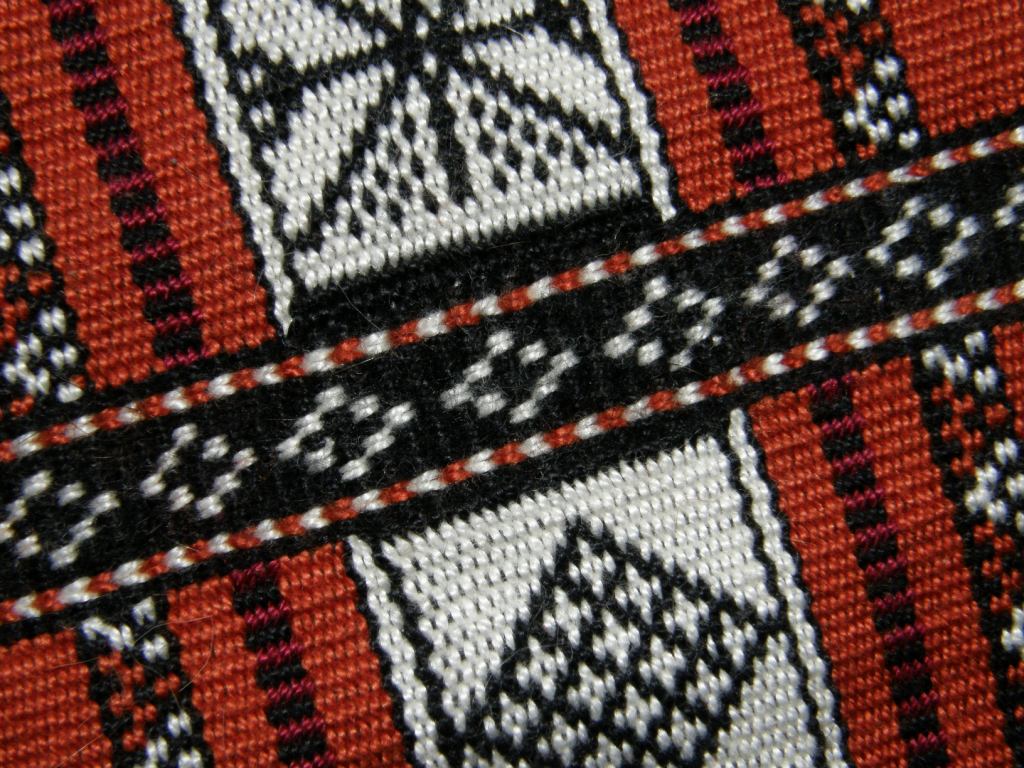
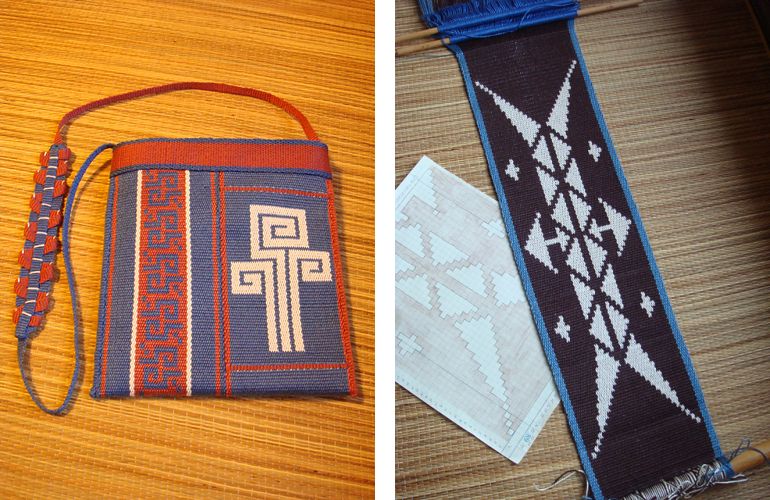
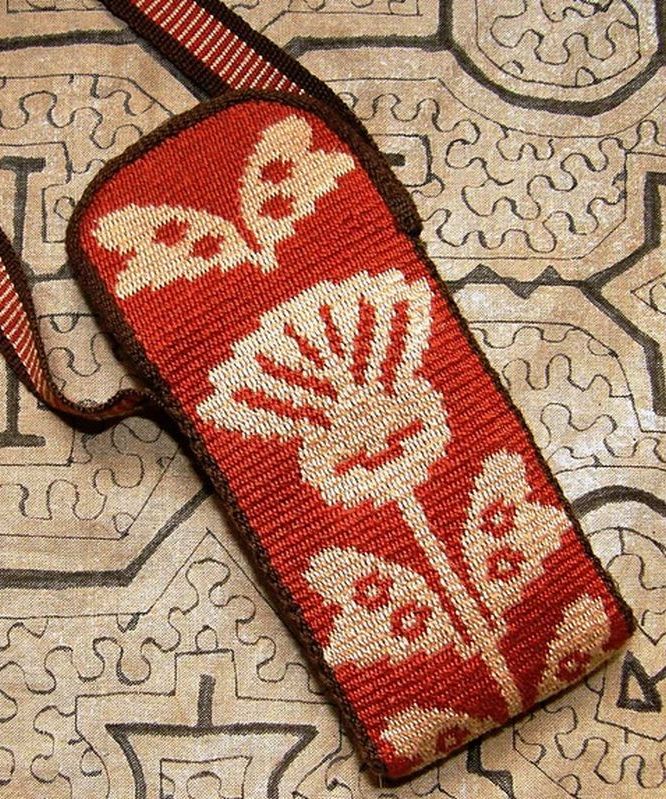
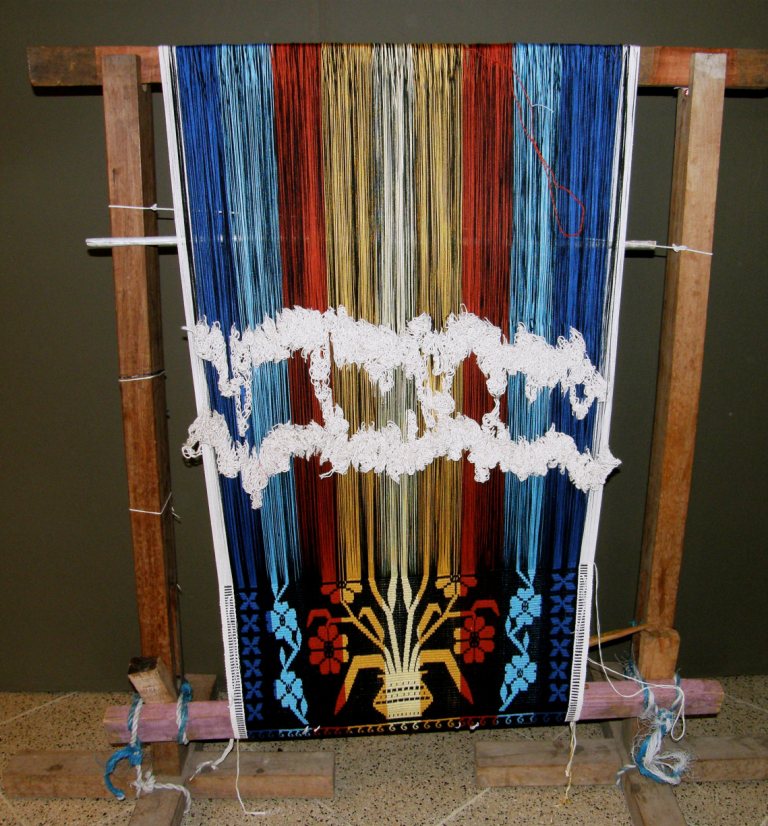
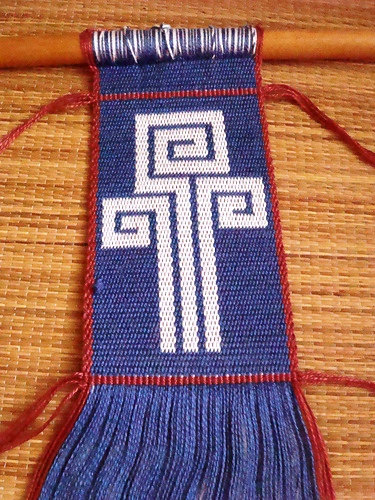
The change of seasons is barely noticeable here in Santa Cruz. There is a drop of perhaps a few degrees of temperature between summer and fall but nothing else here tells me that fall is on the way. That isn’t happening today as we rapidly make our way up to 30 degrees centigrade. I remember when I was teaching English here, the text books would use the classic pictures to represent the four seasons….snow, sun and beach, falling leaves and spring flowers….somewhat like the motifs I used on my Four Seasons ticlla piece. They meant nothing to my students. They found it especially hard to grasp that fall would be the “opposite” season to spring in the northern hemisphere. I couldn’t blame them.
As my departure date for my US trip draws nearer, I am wondering if anything in the northeast is telling people that spring is on the way. Please, say “yes”! My friend in Massachusetts told me to bring boots presumably for stomping about in snow. I don’t own a pair! So, I am just about ready to do some kind of dance in order to try and will that northern winter away and bring on the spring.
Maybe I should fill this post with lots of spring imagery and put a springy vibe out into the universe instead. A change of season and cooler temperatures would be apprecited down here. Okay, so here goes…
Leaves could represent the new growth of spring or the dying leaves of fall…either way, a change of season.
I suppose that blue leaves could be either!
The leaves on my wall hanging, which were inspired by the chamantos woven in central Chile, are rather spring-like or even summery, I think. The motifs woven into the chamantos represent the agriculture and horse culture of that Chilean region. They are covered in patterns such as wheat stalks, flowers, horse hooves, grapes and vine leaves.
There is nothing cold or wintery about Guatemalan textiles with their flower and bird motifs in bright colors…
My Guatemalan teacher with whom I worked on the piece pictured below, taught me to just dip my hand into the basket of threads, pull out a color and go with it. You can see the rows of plants with their happy multi-colored leaves…
Those little plants and flowers are always fun to weave with supplementary weft even if my color choices once I was back home on my own were a lot more planned and conservative…
Crocheted hats and hat bands produced in the highlands, an area which can be quite colorless and bleak at times, provide a splash of colorful flowers and birds….
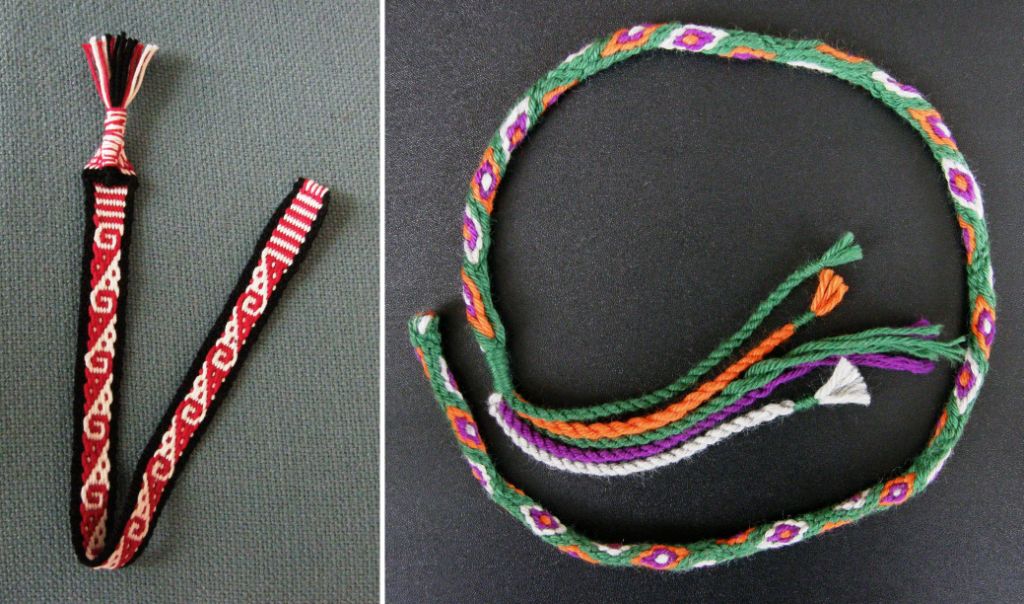
The flowers on the hatband from Calcha, Bolivia inspired the design on the fourth of my red, black and white wall hangings…
The Guaraní weavers who live in the eastern lowlands of Bolivia may not always use bright colors but their work certainly shows the rich plant and bird life of this region….nothing wintery about this…
The above pieces were woven using what the Guaraní weaves call the moisy structure. They also use the kara pepo structure which we know as pebble weave.
Julia, from the Ravelry group has been weaving a piece for her guild’s color challenge. She is weaving Guaraní star motifs in pebble weave. It is always exciting or me to see people using the charts in my books. These star patterns are charted in my second book and the outline is a traditional Guarani pattern.. The basic star outline has its center filled with different shapes and it is an interesting exercise in designing to explore how many different kinds of “fillers” you can come up with for the space in the center of the stars. The Guaraní repertoire of star patterns is fairly small. While the patterns they weave using the moisy structure seem unlimited, the star is one of only very few motifs that they weave using the kara pepo structure. I came up with quite a few filler patterns for the star for my book and Julia, of course, has been very creative in inventing some of her own.
My Guaraní teacher, Angela, buys the same Brazilian Clea brand thread as I do for her weaving. It was shocking seeing how suddenly and how quickly the price of this cotton went up as it did all over the world and sad knowing how it would effect the weavers and their ability to buy thread.
I am sure that they must be as happy as I am to find that cotton crochet thread is now being produced by TextiCruz here in Santa Cruz. While Santa Cruz used to be a major cotton producing region, cotton hasn’t been grown here for a long long time. I have no idea from where the raw material is coming. But, whatever the source, they are able to sell the finished product much more cheaply than the Brazilian thread!
“Camba” is the nickname for people from Santa Cruz and the label shows the sombrero de sao, straw hat, which is part of the typical festival costume for this area. I bought one ball to try out. You can see it here among a chaos of sample bands that I am gathering for my trip. I am little suspicious about the color fastness. It sounds terrible but I have to say that things produced here tend to be of inferior quality. They are well presented but you only have to scratch the surface and…..It is wise to be suspicious of something that seems too good to be true. That goes for everywhere, right? I notice that the label has the typical words of advice on buying from one dye lot to complete a project, yet there is no dye lot number to be seen anywhere.
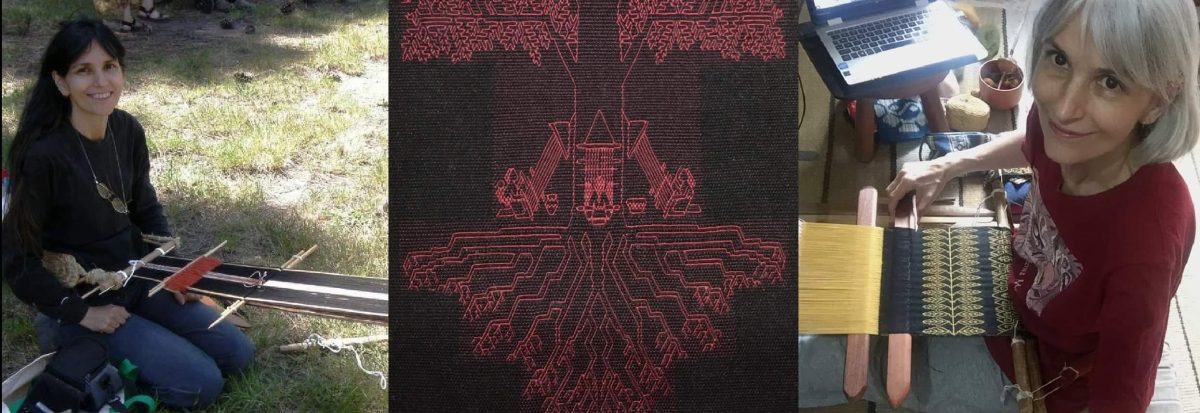
Let me briefly slip back into the somber tones of winter as I would like to show you my progress on the squiggly Shipibo- inspired wall hanging panel. I would like to thank those who commented last week with words of encouragement. This week’s work on this included four hours of unweaving and re-weaving. I had forgotten to start one of the squiggles and I mistakenly thought that it wouldn’t matter so much. I was wrong. There was a large gaping hole of black space that I simply couldn’t live with. Four hours later I was back to where I had left off but much happier for it!
When I was at the Encuentro de Tejedores in Cusco in 2012, a presentation was given on Shipibo art. We were told that parts of the patterns the Shipibo people paint and embroider represent their borders and rivers. One of the few times that I flew over Brazil in daylight on my way to Miami and could enjoy the view over the Amazon jungle from a cloudless sky, the
rivers below looked very much like the squiggles I am weaving. I tried to guess which one of the squiggles might be the Amazon itself until I was completely blown away by the massive body of brown water that appeared and curved its way off to the horizon.
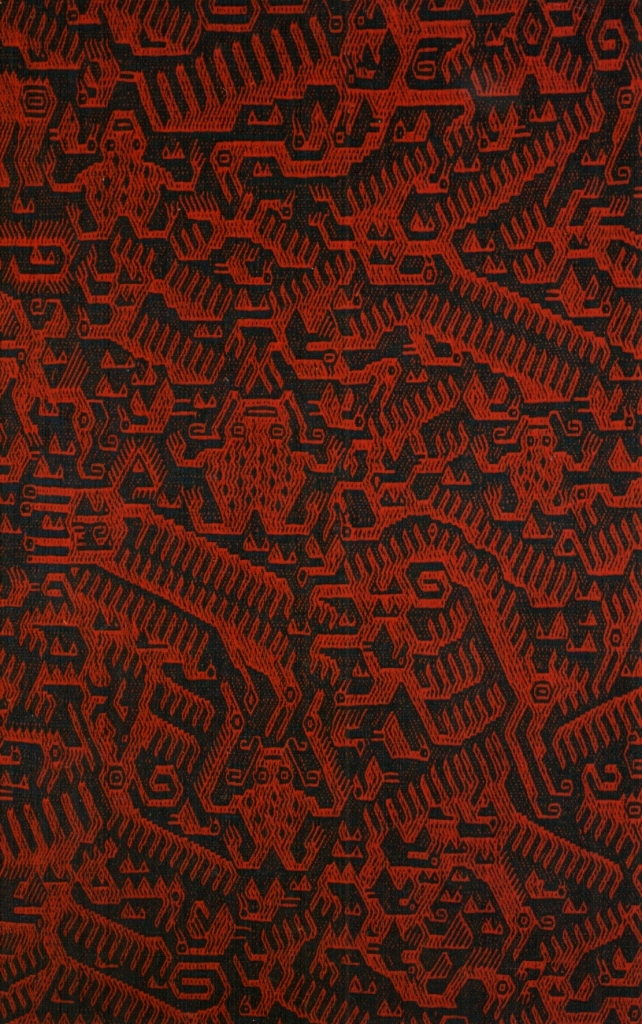
I have always been in complete awe of the weaving of the Jalq’a people of Potolo, Bolivia (at left). A complex mass of figures fills just about every space on the cloth. There is no break….no plain weave with which to relax between the concentration of pick-up patterning….a few rows to sit back and just open sheds, beat and pass weft…no, none of that. While halfway through one motif, the weaver is finishing another nearby and starting the next. Small motifs are even woven within larger ones. Plus there are warp floats to consider. The weaver must ensure that she ties down each and every one of the threads at just the right moment before the floats become too long. And pattern charts, of course are not used. It’s mind boggling.
Although I am not weaving a warp-float structure and my patterning, therefore, is much easier, my current weaving with its squiggles starting and stopping and turning this way and that has given me an even greater appreciation of the work of the Jalq’a people. I have to remember to start the next squiggle while in the midst of one and finishing another.
Let me return to something bright and spring-like to finish this post and blow away the winter blues…
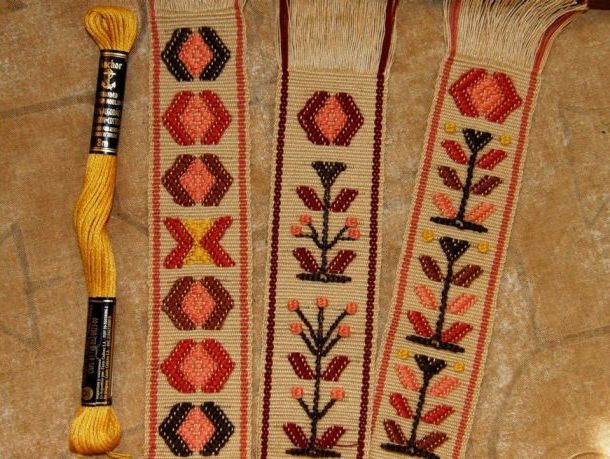
Here are some of the beautiful bands woven with naturally-dyed handspun yarn from PAZA in Cochabamba. Cochabamba city is one of many I have come across in my travels in South America that is named a city of “primavera eterna”…eternal spring.
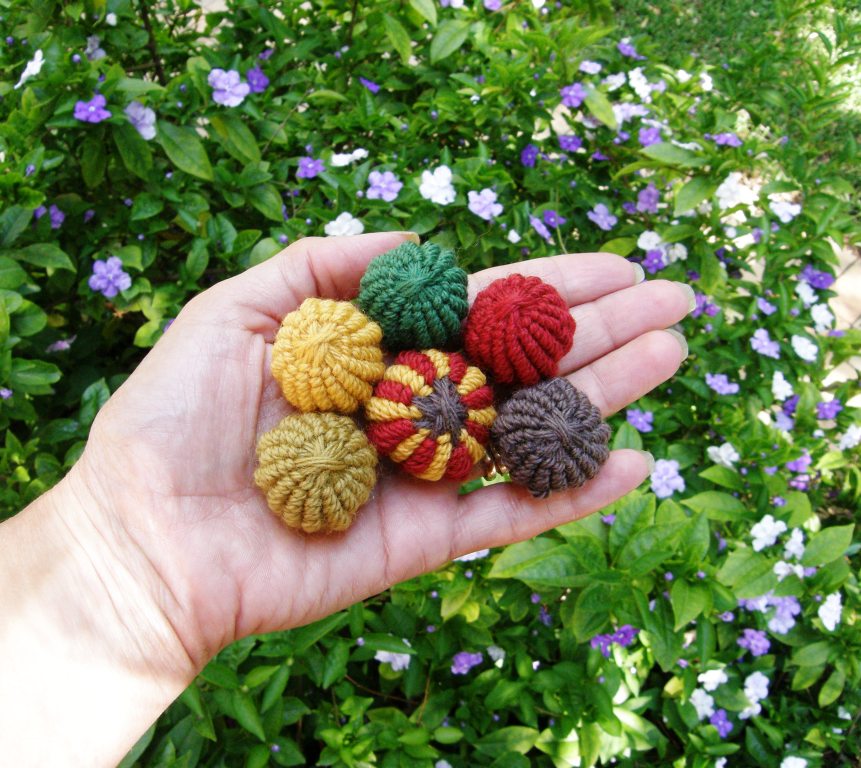
Ah, the Australian summer….while my weaving friends in North America and Europe post pictures of snow drifts and talk about extremely low temperatures…swathed in sweaters and blankets with snow falling outside in the -25 degree cold….the Australian cricketers are out in the field in their whites under the summer sun winning back the Ashes and I get to enjoy a little lakeside barefoot weaving…. I stole a little time to warp and weave a band down on the shores of Lake Burley Griffin in Australia’s capital city, Canberra. Behind me, athletes were competing in a half-Ironman event in which my nephew won the amateur section and placed 6th overall. Having finished in just over four hours, he took a cooling dip in the lake while I wove and the other 1600 or so competitors continued to strain and sweat in the summer sun running along the lakeshore. They must have hated seeing me there as they ran on by. I was weaving a wool tubular band on which to hang the little button baubles I recently learned to make . I think I will turn them into a Christmas tree decoration and leave them behind on my brother’s tree as a memento of my visit.
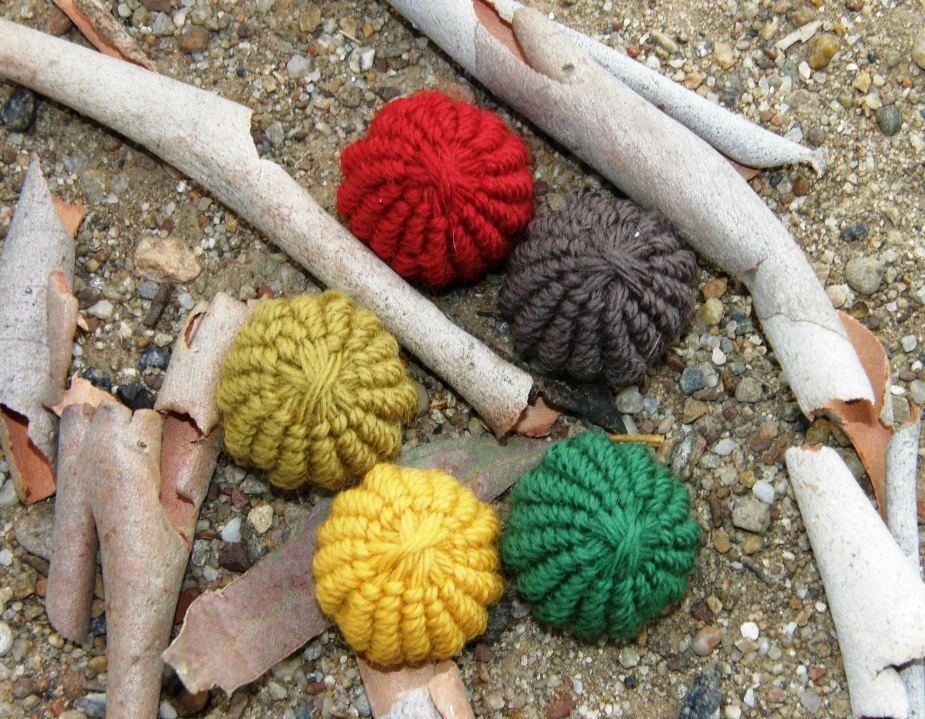
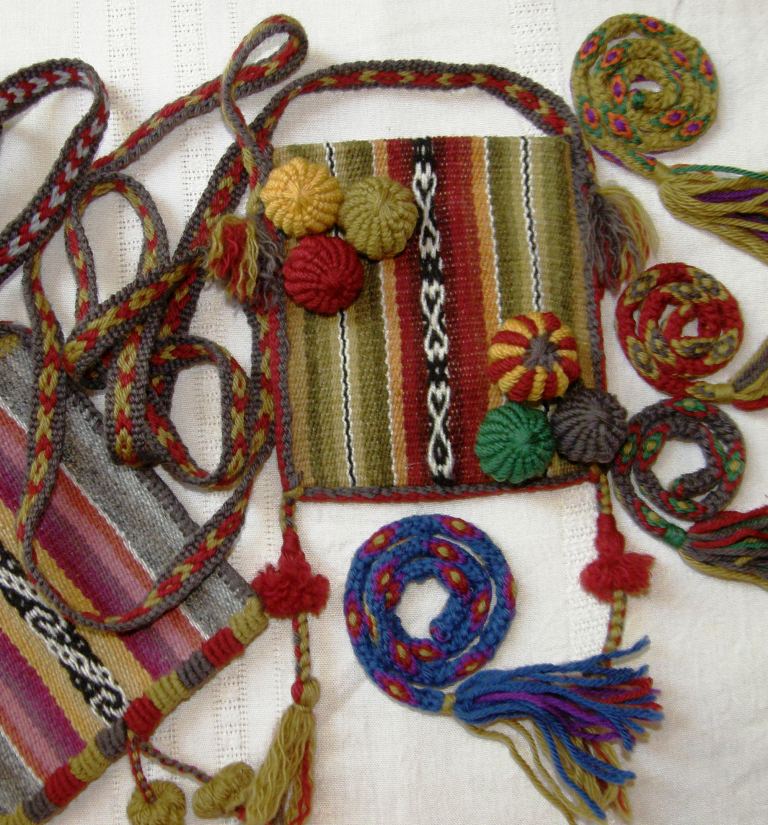
Here they are nestled amongst some gum tree bark.In keeping with the Australian theme, I decided to try a two-color version inspired by the native Australian flower, the scarlet banksia. The banksia has the same ridged appearance as my wee baubles. I had red wool but no white so, yellow would have to do.Use your imagination and you might see a resemblance in the two-color bauble in the center 😉I will add these little guys to my repertoire of finishing techniques for woven pouches. Smaller versions of these will make cute dangling pom poms.
After the race and back at our Canberra trailer park, we stepped out for a walk and found these guys happily grazing just meters from our door….there’s a mumma with her joey crammed into her pouch…white cockatoos screeched by in the soft evening light and kookaburras “laughed” unseen in the distance.
Of course, it was only at the end of our three-day stay that I discovered two amazing exhibits that were on in Canberra…darn! Well, you can’t have everything.Now I am back in Sydney and I need to get to work and weave a cell phone pouch for my sister-in-law. I hope she doesn’t read my blog as it is supposed to be a surprise. I can just scrape together enough wool left over from my travel stash to make this work.
I have used this wool before for very narrow band projects and loved how well it worked straight off the skein without having to respin it. I wasn’t sure, however, how it would stand up to a wider warp so, here is my chance to test it. Would it be too sticky for warp-faced weaving? Would it be too weak and break with the abrasion from the heddles and the scraping of the beater?
Here’s the simple pebble weave pattern taking shape. So far, so good! There is no sign of weakness and the sheds open quite easily. This is enough for today…Deb will be home from work soon and I am doing this in secret.
Back in 2008, I wove a pebble weave bag for her and was surprised to return to see it still going strong. It is her favorite travel bag and has been to Dubai, Egypt, Turkey, Spain, India and Switzerland with her. Next year it will go to China where my nephew will represent Australia in the World Long Distance Triathlon Championship. Look out for him! I wish I could go too. I would love to take the train from Beijing to Lhasa.I also got to see some hangings that I had made for family members some years ago on previous visits…The one on the left is an embedded double weave piece with typical bird motifs of Potosi, Bolivia and the other one has pebble weave Guaraní patterns of lowland Bolivia in the center and a highland design on the edges. I had made that for my mum. It has inspired me to start planning a double weave piece for my red, black and white wall hanging series but first I want to weave a triathlon banner for my nephew’s bedroom wall.
And now for some more inspiration….
A new Facebook friend of mine from India sent me a picture of this piece of textile which he tells me was woven on a backstrap loom.
It looks like twining or soumak in the middle of a piece of warp-faced weaving.It is part of women’s costume from the ADI tribe of Arunachal Pradesh in northeast India. And this makes me keen to get into the soumak book that I recently bought and experiment with embedded designs like these. I have tried embedded twining in Bedouin design work that I have done, as in the example below.
Julia has been “intermesh-ing’ and inspiring the Ravelry group members with her beautiful projects. As always her pieces are beautifully finished.
The piece on the left has both Mexican and Japanese influenced patterns which work so beautifully together. The piece on the right has a motif that I recognize from Bhutanese weaving. Julia has adapted it to the intermesh technique. It is a very elongated and slightly different version of one that I chose to weave with supplementary weft some time ago.
I learned the intermesh structure from the weavers in Peru who taught me Andean Pebble Weave. They used it to weave single-color borders for their pebble weave patterns.
It was only when I had spent time with my Guaraní teacher much later, that I discovered that the two-color patterning technique that she called moisy was actually the same intermesh structure woven with two colors.
At left you can see the first piece I wove after this discovery with Angela, my Guarani weaving teacher. It is a fun technique and realtively fast as it uses two sets of string heddles…every second weft pass is a free ride!, that is, no pick-up is required.
Now, I have an exquisite piece of wood working, precision, balance and engineering to show you. My friend Barbara was given the gift of a new spinning wheel and stool to celebrate the completion of her Master Weaver certificate. This was created by Tom Golding…anyone who is into spindles must know this name and must have drooled over his fine pieces of work at some point! Tom’s wife and sons all had their hands in the finished product.
I will leave you with one of my friend, Annie MacHale’s latest creations. I never get tired of looking at the straps that Annie produces on her inkle loom. She never weaves two the same and has the knack of creating just the right custom pieces for her clients.
This one one is stunning!
Let’s see if I can make it back to Bolivia before the next blog post. As much as I hate to leave, all good things must come to end and there are wall hangings to be woven, a long list of things to research, patterns to be charted and books to be read. Keep your fingers crossed for me that I make it back home without too many interruptions. Goodness knows where I will be spending Christmas Day!
I love that “big picture” feeling you get from the airplane window. It’s been a long time since I have been able to get a window seat on a coast to coast USA flight in daylight to enjoy the view. The picture below was taken somewhere between Dallas and San Francisco last week.
The view reminded me of the months in the early 90s when I would be sometimes rambling about on top of the Sangre de Cristo Mountains on a peak bagging trip or dropping by rope into the depths of the Utah canyons. From the air you feel so carefree floating over the ever changing landscape like a bird while trying to imagine the thousands of specks of people down there below like ants and what they might be up to.
In a similar way, I made myself step back and admire the big picture before zooming in on the details when Ute brought in a piece of Uzbek silk ikat cloth for me to examine and admire during a visit with her in Northampton.
I got to see the exhibit of Uzbek ikat robes at the Textile Museum in DC a few years ago. Of course, that was a strictly “hands off” affair. And even though I had the opportunity to touch similar fabric from Uzbekistan at the International Folk Art Market in Santa Fe this year, the market simply had far too many interesting things to be able to stop and focus on any one item for any meaningful length of time.
Thanks to Ute, I had time alone with the cloth at left and could examine it to my heart’s content although I found it difficult to capture its true colors on camera.
Ikat fabric I saw at the Santa Fe International Folk Art Market
When I then zoomed in to get an ant’s persepective, I saw what I had named many times, in despair and frustration, during my own ikat experiments on my backstrap loom, the ” dreaded railroad tracks”…
I took extreme measures to keep my warp threads aligned on this piece…that was my goal at the time.
I am talking about those horizontal bars that show that the warp threads have shifted from the original positions into which they had been locked during the tying and dyeing process.
It was always so disheartening for me to be weaving and approaching with excitement the first wrapped area on my ikat warp, eagerly waiting to see how my carefully tied and dyed pattern would appear only to see first, the little specs and then the growing rows of lines of un-dyed thread appearing….those dreaded railway tracks. They told me that the threads had been displaced too much and that my design had been ruined.
But, walk away to the other side of the room and look again at the Uzbek cloth. What do you see? A beautiful pattern with the soft blurry outlines that give ikat its charm and character. Look at the big picture!
I will be trying ikat again when I get back to Bolivia and reminding myself to think like a bird and not an ant!
The same goes for one of my current favorite structures as woven by the Guarani weavers of the lowlands of Bolivia…intermesh.
Stand back and admire the crispness and clarity of the design woven by my teacher Angela.
Closer inspection of motifs on another piece show the feathering that characteristically appears along the edges of diagonal lines.
This has me adjusting and readjusting my pattern charts in an effort to reduce the feathering as much as possible which can sometimes distort the original shape I was striving to create.
Stop fussing and thinking like an ant! The GuaranÍ weavers, as far as I have seen, make no such (unnecessary) effort…they think like birds.
Speaking of intermesh, let me show you Julia’s latest creation in progress in this structure….
Julia tells us that the design comes from a book entitled Japanese Design Motifs. Designs like these with horizontal and vertical lines are ideal for learning this structure and are the kinds of motifs that I have provided with the tutorial in my second book. I used Bhutanese and Mexican patterns for inspiration. The horizontal lines have “saw-tooth” edges and the verticals are crisp and smooth plus the cloth is double-faced!
This trip is drawing to its close. I can look back over the last weeks of weaving with friends, new and old, from a bird’s eye and ant’s eye view and benefit greatly from both perspectives. The ant asks what details can be improved. The bird hovers above to see patterns appearing on bands and cloth, the weavers’ reactions – their smiles and frowns and “aha” moments, changes in their energy levels and receptiveness which their body positions often reveal….and listens to the fluctuating levels of concentrated silence and relaxed chatter.
Here’s a quick whiz through some of the days I spent weaving both east and west on this trip….
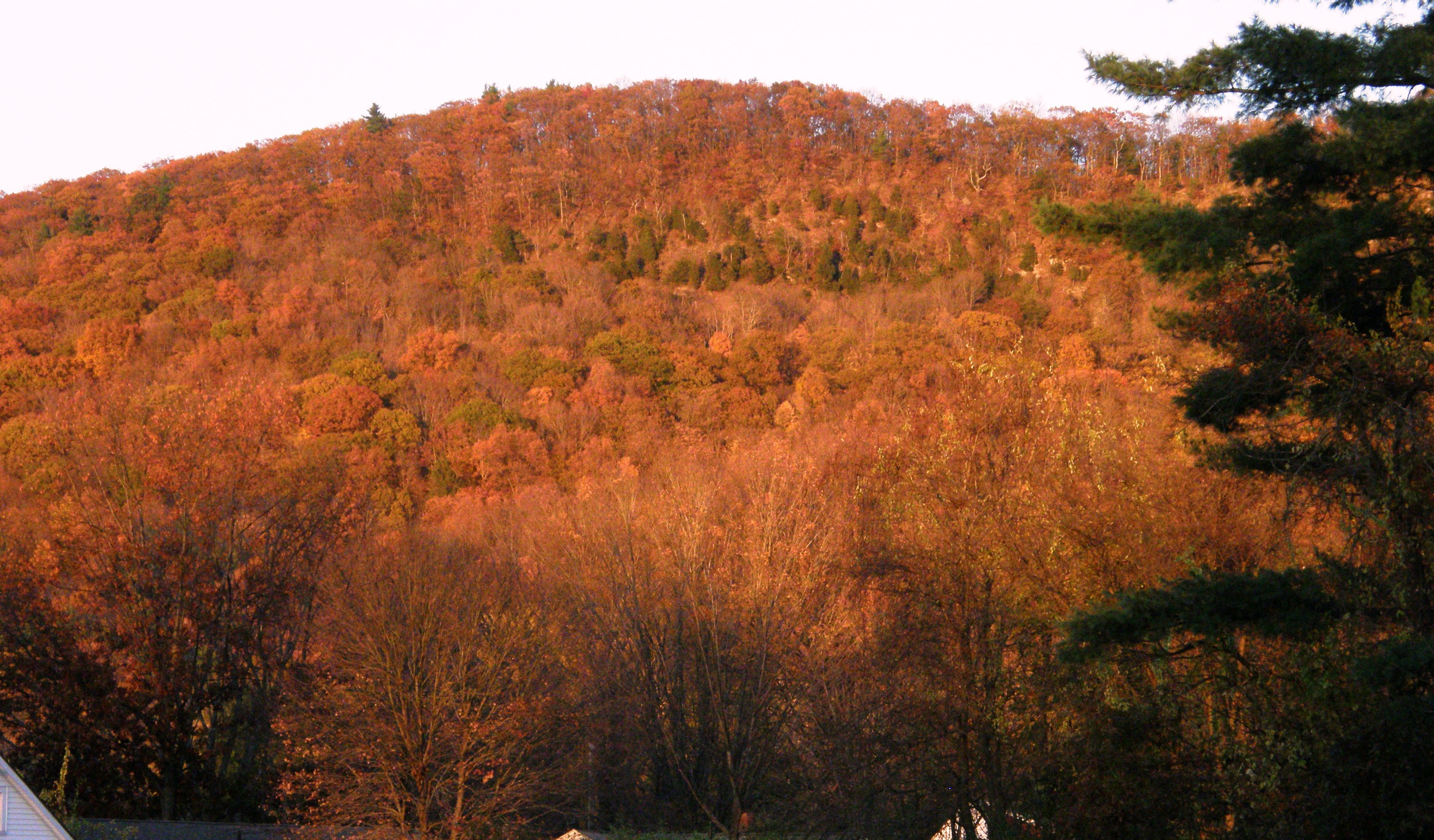
Backstrap weaving with ladies at Yale University…. They have a wonderful weaving room for free time weaving. It is full of floor, table and rigid heddle looms which meant standing room only. Many thanks to Barbara who took me to visit with these ladies. Here they are finding the cross in their warps so that they can make simple heddles.Massachusetts turned on its fall colors for me as we drove home each evening after some weaving in the glow of the setting sun. Here is a shot of what Lausanne in Vermont has dubbed “cinnamon hills”.
And winter was definitely in the air with frosty mornings. Only the brave sat outside for lunch! I was one of them for about 5 minutes.
The round table was a perfect set-up among Liz’s natural yarns and fibers, locally made scarves and shawls and crafts. It was a sweet space in which to weave.
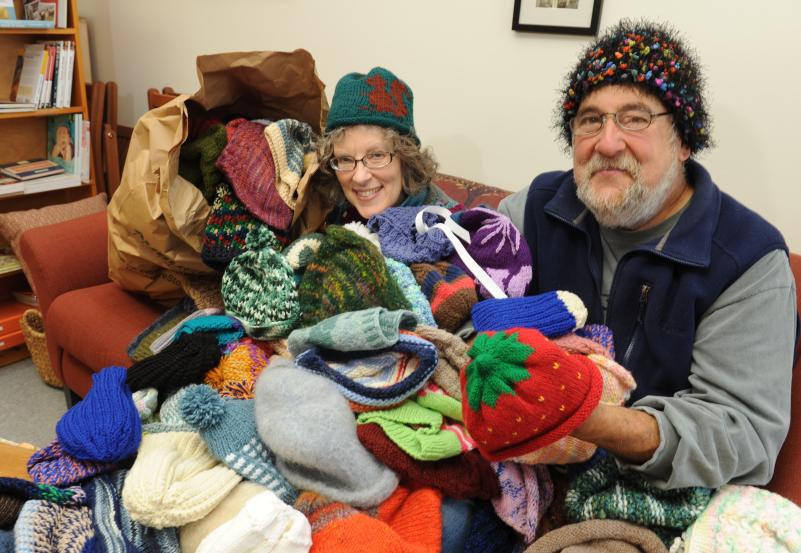
RIght now Liz and her partner John are involved in the 500 Hats event which John came up with to celebrate the 75th anniversary of the Dr Seuss book. You can read more about the project here…there are over 1600 hats so far in their living room.
Moving over to nearby Northampton….here are a couple of things that Chris worked on..
Here you can see her pick-up band finished and decorated with a triangular braid (which I now know how to do….yay!, thanks Chris) as well as her ñawi awapa piece on which she has just about finished twisting and binding the warp ends.
It was a second time weaving with these friends and we did some more pebble weave, made tubular bands and sewed them to pouches which we later dressed up with decorative stitching.
The mouth of a Bolivian woven pouch is decorated, after having been edged with a tubular band, with cross knit looping which is a sewn technique.The hands above belong to Lisa, on the left, seen here weaving a complementary-warp band alongside Mary-Lou. Lisa is wearing one of her own gorgeous deflected double weave scarves.
Barbara invited friends to her home in Connecticut and her fabulous weaving studio for another gathering where we all wove together….
Claudia and Susan decorate a warp-faced band with both single and double-faced patterning techniques.
And here in California yesterday, we gathered to practice setting up for wider projects. Some people in this group were weaving with me for their their third and fifth times while others were on their second time.
Picture by Ruth TempleCookie’s finished piece will be folded into a long narrow bag for a small backstrap loom that she was recently given.
So, we had a group with a variety of experience levels. I think that “experience level” is often most evident in the kind of warp a weaver can create in terms of evenness of tension. Here is where the “short and narrow” mantra comes into play.
Perfect your warping techniques winding short and narrow warps over and over again! SHORT, because you will weave off your project quickly and get another valuable chance to warp again soon. NARROW, because there are different tips and tricks yet to be learned for creating successful wide warps once winding narrow ones with consistent tension has become natural.
The idea was to go wider without necessarily going longer. You can see Ruth’s pretty warp above made from Tahki Cotton Classic onto which she is putting her first set of string heddles. The strip of orange and purple down the middle will be used to create a pattern in the Andean Pebble Weave structure.
She is going to weave the other plain parts using the “thick border” technique described in my first book. This will cause the plain parts to narrow and thicken to match the thickness of her pebble section. Therefore, her finished band will be a lot narrower than the warp appears in this picture. This might become her backstrap.
We needed to refresh some things that are necessary for creating wider pieces, such as putting the string heddles on a stick instead of tying them in a little bunch.
Picture by Ruth Temple. Kathy gets a refresher in heddle making for wider warpsKathy chose to make a backstrap using Plymouth Yarn Fantasy Naturale and a double- faced warp float pattern.Kathleen chose to use overtwisted wool that she got in a class with Jacquetta Nisbet many years ago. She has already made a beautiful backsrap with this wool and knows how it behaves. She wants to make a small pouch with a pebble weave motif and wrote to me about how this warp feels “alive” after having used cotton for some time. As you can see we were in a soothing environment in Betsey’s home surrounded by textiles that she has collected in her travels.Dorothy’s project in Tahki cotton classic is so beautifully arranged. It will have three strips of pebble weave pattern and the color combination is so gorgeous! I am wondering when she will have time for it as she is off to the Tinkuy in Peru this Friday!! We are all so excited for her. Goodness knows what kinds of inspiration she will bring back with her. By the way, Dorothy’s loom is made by Terri at Magical Moons. I hadn’t seen one of these before made by Terri. The loom bars are silky smooth….beautiful work!!
Betsey’s project was the narrowest but with by far the finest thread and I neglected to photograph it, unfortunately. She warped for a pebble weave pattern using the thick borders and her piece will do nicely as a cellphone pouch.
Somewhere in-between all that, Barbara took me to Shelburne Falls Ma to visit Vavstuga Weaving School. That’s a name that constantly comes up in the weaving groups on Ravelry and I was excited to finally be able to see it and meet the staff. I was surprised to find Cindy, one of my backstrap weaving friends, apprenticing there.
What a beautiful location right next to the Bridge of Flowers which even at this late time of year is full of color against its backdrop of cinnamon hills.
Color inspiration anyone? This was in the bridge garden…never seen anything like it!
Becky Ashenden along with her newest apprentice and other Vavstuga staff showed me around. As we chatted at the table, Becky pulled out one gorgeous textile after another to spread on the table.
Not that I know much about Scandinavian weaving, but the textiles were everything I expected and more…rep weave, white on white, linen, crisp and clean, simple, classic, impeccable!
Becky opened a door to a closet which housed hundreds of samples. More samples were draped over loom beams for further inspiration, instruction and guidance but, most importantly, gorgeous handwoven textiles were everywhere to be seen and touched and used in in the house and studio….not just sterile samples to be taken out and studied and then put away. They added warmth and comfort and a lovely sense of home and familiarity. This must be a lovely place in which to learn to weave!
This hanging adorned the wall of Vavstuga student dining room which overlooks the river. I had heard it all before in the online groups…everything at Vavstuga is handwoven. It was wonderful to see it all…. from curtains to hand towels and floor coverings and hangings.
And then there was the band weaving with the typical Scandinavian backstrap set-up…(look at the piece of fabric under the backstrap…that was one of my favorite pieces)
Becky wove that backstrap. Isn’t it gorgeous? She wove one end of the waist band as a tubular band in order to more easily hook on the clever wooden device that holds the warp . Look at that sweet rigid heddle and there is also a lovely wooden smooth shaped sword that completes the set-up. I guess that I just couldn’t hide the smile and delight I felt at seeing all this as, when Barbara and I were about to leave, I was given this mystery package….
No prizes for guessing what was inside!!
Some of the other textiles I met along the way….
Many thanks to Ruth who brought this along to share with me. It is warp-faced double weave cloth, although in many places the warps are quite spread and reveal the weft. A band has been cut into strips and sewn to make this bag. We don’t know its origin but I really appreciated the opportunity to look at it.
Ute always keeps me supplied with textile goodies to photograph and examine. Here is a beautiful presentation of some of her own tablet-woven bands…
And here is a bag from Tibet, owned by Ute, that was made by sewing pieces of a tablet-woven belt together….fabulous motifs for intermesh.
And here I am today in the home of inkle weaver, guitar strap and sash maker Annie. While she is at work I get to rummage through baskets of her colorful bands and sashes and samples….no two alike, so every visit brings forth something new!
Thank you to Kathleen who took me down to ground level to be an ant last weekend. Kathleen is a marine biologist and took me to the beach to go tide pooling…super fun!…While swathes of slumbering and interesting seaweed waited out lowtide above water, we peered into pools and found whole worlds of life and variety and movement and color and cleverness within.
And when we got home, Kathleen’s husband had made this…
I had remarked to Kathleen earlier that day that the vertical pieces of rebar sticking out of the top of the wall would make great warping stakes. It was too bad that they were soon to disappear within another row of blocks. I then told her about the woman in Peru who had warping stakes embedded in the wall of the hall of her house. She would stroll up and down the length of her hall creating her warps. And so, an idea was born.
Those metal pieces of pipe will be locked into place when concrete is poured into the blocks. Then, dowel rods will be placed within the pipes…..a wall warping board. I am jealous! Next will come hooks in the wall to which Kathleen can attach her backstrap. Warm, sunny days outdoors weaving….lovely!
Jennifer Moore, DY Begay and I in Santa Fe in July
Tinkuy is next week!!! I am not going… what will keep me from pining is the fact that I will be over the ocean thinking like a bird on my way to Australia on the14th.
My weaving friends Dorothy and Karen are going. A few of my Argentinian Facebook friends will be there and Jennifer Moore, with whom I backstrap wove in Santa Fe this year, will be going to teach the Peruvian weavers balanced double-weave pick-up. Jennifer wrote to me this morning to tell me that we will be roomies at CNCH next year. There will be some stories to tell!!
I hope that if you go, you will send me stories, reports and pictures that I could share on this blog or links to your own sites that I can include here. Have a wonderful time all of you!!!
Dorinda from PAZA Bolivia (no link as the website is temporarily unavailable.) and my weaving teacher, Maxima, will be going again. Last I heard, Dorinda was also going to take one of the teenagers. Dorinda met her funding needs with many generous donations from a variety of sources. Look out for Dorinda and Maxima there. I wonder if Maxima will outspin the Peruvian ladies in the speed spinning competitions again this time!
Dorinda and Maxima were my roomies at Tinkuy 2010
Jasmin Pitt of Sustainable Bolivia was recently in Independencia with Dorinda and her weaver friends and made a documentary about the weavers. Here is Dorinda’s description from her PAZA newsletter:
Making a documentary with the weavers of Huancarani became reality last April after over a year of talking about the possibility. Thanks to Sustainable Bolivia’s artist in residence Jasmine Pitt, most of the footage was shot in Huancarani in a day. Jasmine directed, filmed, and edited the documentary. The women were ready with their thoughts, comments, and stories about the past, present, and future of their millennium long weaving tradition. More interviews were held in Independencia and Jasmine and Dorinda walked miles so Jasmine could capture the breathtaking landscape on film. The musical group Sacambaya generously granted permission for use of their music. It was a collective volunteer effort. Through Jasmine’s lens you will gain insight into the personalities and lives of the weavers and their concerns for the future of their weaving tradition.
While doing some house keeping in my album of weavings on Facebook, I came across a picture I took of the first red, black and white wall hanging I made entitled “Starry Night”. My caption read that I was weaving this in order to push myself beyond my current width comfort zone. That was a nice reminder as I am now on the third piece of similar width in this series and I have to say that I feel very comfortable with this width now! Seems that I need to go wider.
The first two pieces in the wall hanging series.
Here is where I stand with piece number three. That snake continues to slither its way up the cloth.
The pick-up is a piece of cake now…really! There’s nothing like repetition to firmly embed a design in your head and fingers. It began with lots of tedious chart reading which was made a lot easier with the use of removable highlighter tape. Then I played a favorite game…read the cloth and guess what comes next. Then, before passing the weft, sneak a peek at the chart to see if you are correct. Next comes reading the cloth, deciding what comes next and going for it. Beat, pass the weft and then look at the cloth, not at the chart, to see if you were correct. Eventually you reach that chart-free happy place.
But then….you finish the weaving, you start something entirely new with a totally different structure and the fun begins again!
As for going wider….there are still quite a few more pieces I want to make in this current series, but when I do get to the point when I am ready to break out of the old comfort zone, I will need some new equipment…longer loom bars for a start. I already have some pretty long swords. I would also love to have the kind of backstrap that some of the weavers in Peru use.
With its two sets of straps, it was designed to accommodate different widths of weaving.
And, I would like to weave longer pieces. The scarf that I recently made had me extended to the limits of my weaving space. I rolled up part of the warp at the far loom bar but I really prefer to have the warp unrolled at full stretch.
There was just enough space to put my cushion and sit with my back against the closet door. So, if I am to go longer, it is a simple matter of using a circular warp. I have woven on these kinds of warps on a few occasions. Anyone who does inkle weaving certainly knows about circular warps.
The pictures above show a band on which I was working on my inkle loom. The warp is a complete circle. The black band next to it has been warped in a single plane in the same way as the long black scarf warp. Once weaving is finished, the circular warp is cut apart and the band can be extended to its full length.
The Montagnard weavers with whom I studied use circular warps for their long blanket and skirt panels.
You can see Ju Nie above weaving the top part of her circular warp.
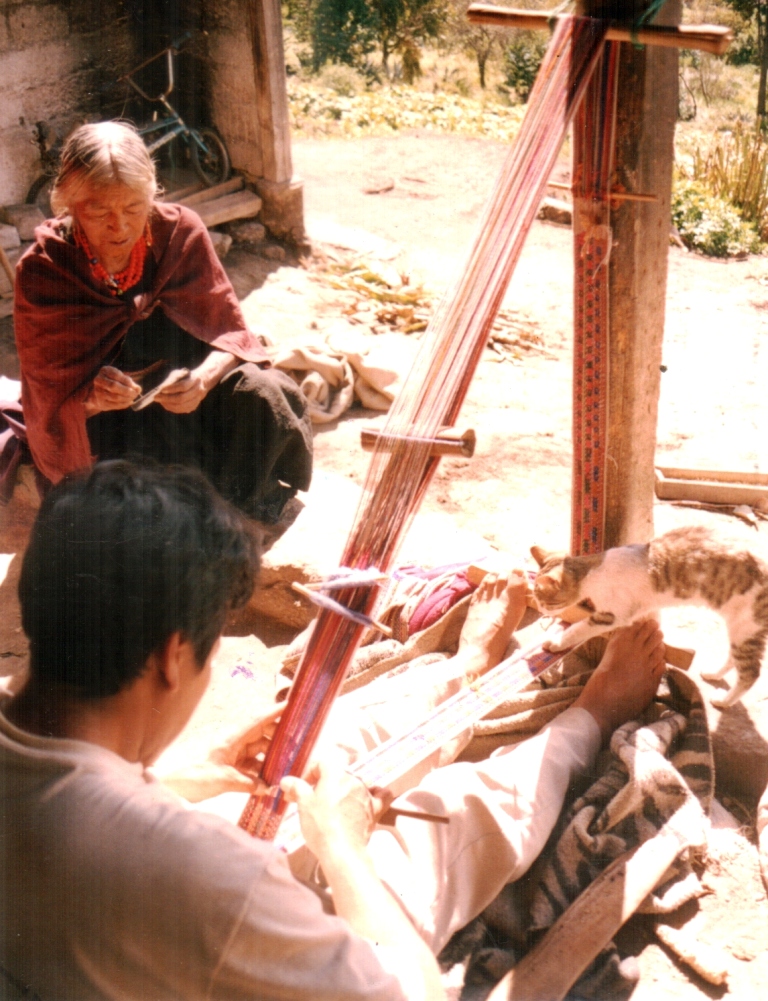
Probably the most time I spent weaving on a circular warp was when I learned to weave the typical belt of Salasaca, Ecuador. My teacher, Felipe, wove on his narrow front porch and his way of setting up a circular warp allowed him to sit and weave the very long belt even in that small space.
Felipe’s belt will not have to be cut once the weaving is finished. He has warped in what is known as “dovetail” fashion.
The following diagram will show you how he is using five of the six sticks you can see in the above picture to wind the warp for the white ground weave. The stick marked with the red arrow is the one around which the warps “dovetail”. When weaving is finished, the stick will be removed and the belt can be opened out. You can see the dovetail stick in the photo of Felipe weaving. It is in the section of band that lies along the porch post.
And, if you are wondering about the sixth stick…that stick is used to hold the colored supplementary warps. Salasacan belts are woven in a supplementary-warp technique.
The diagram above shows the path of the white warps in the ground weave. The following diagram shows the path of the colored supplementary warps. In Salasaca, the supplementary warps all go together in a heddle of their own rather than being split between the two ground weave sheds.
You can see that when the dovetail stick or cord is removed, the end loops of the warp will stay intact. The loops can be very useful for finishing the woven item.
Guaraní hammock weavers here in Santa Cruz use the dovetail warping method and use the intact end loops for attaching the cords from which the hammock will be suspended.
So, longer warps are on the drawing board for me which will mean building a new warping board or modifying my existing ones.
I would really like to have a set-up like Felipe’s. Too bad I don’t have a porch on which to sit (and, yes, the view was lovely from there). I have seen pictures and videos of many Asian weavers with similar “triangular” set-ups. I will have to see into which wall I can drill holes in a place where I can still get good light! The idea of raising my bed way up high to give myself more space is gaining more and more merit.
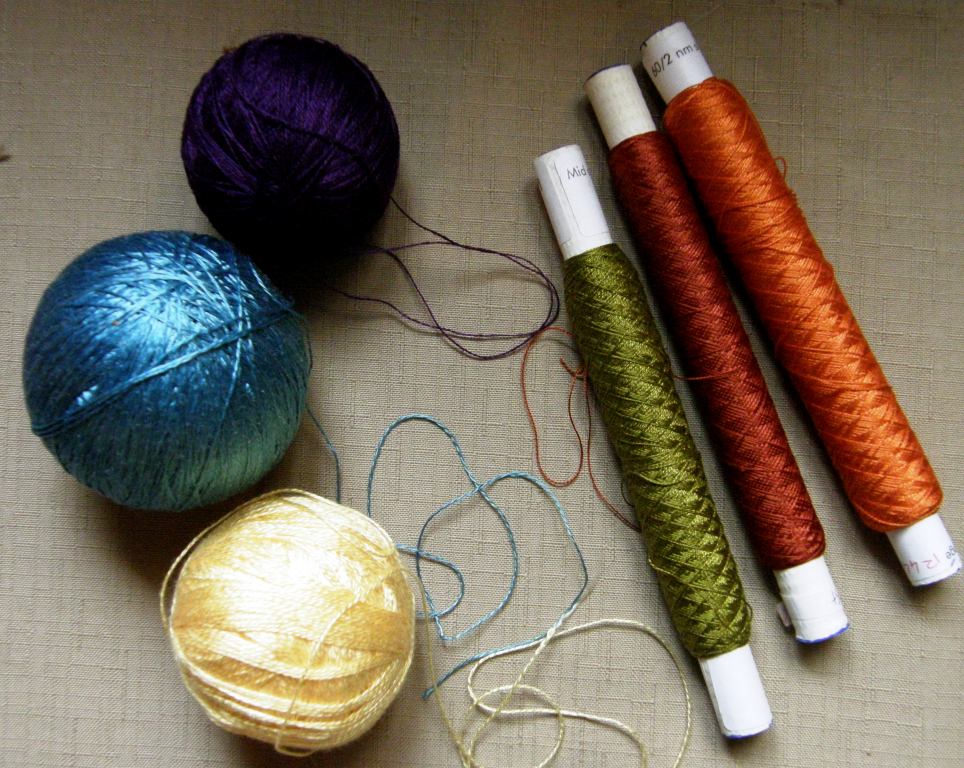
The third challenge is to use finer yarn and I am already in training for that with my scarf projects made from Guatemalan cotton. I have a ball of fabulous indigo-dyed silk that an English teaching colleague brought back for me from Japan years ago. It is heavier than the 60/2 silk that I have been using as supplementary weft and I think that it is a good weight for a first large silk weaving experiment.
Light blue Japanese silk, spools of 60/2 silk, yellow 8/2 tencel and purple Guatemalan cotton.
However, this doesn’t mean an end to band weaving! I love weaving bands just for the pure fun of it and don’t care if I don’t have a particular use for them.
Narrow bands are a good way to test new yarn or check the proportions of a newly charted motif.
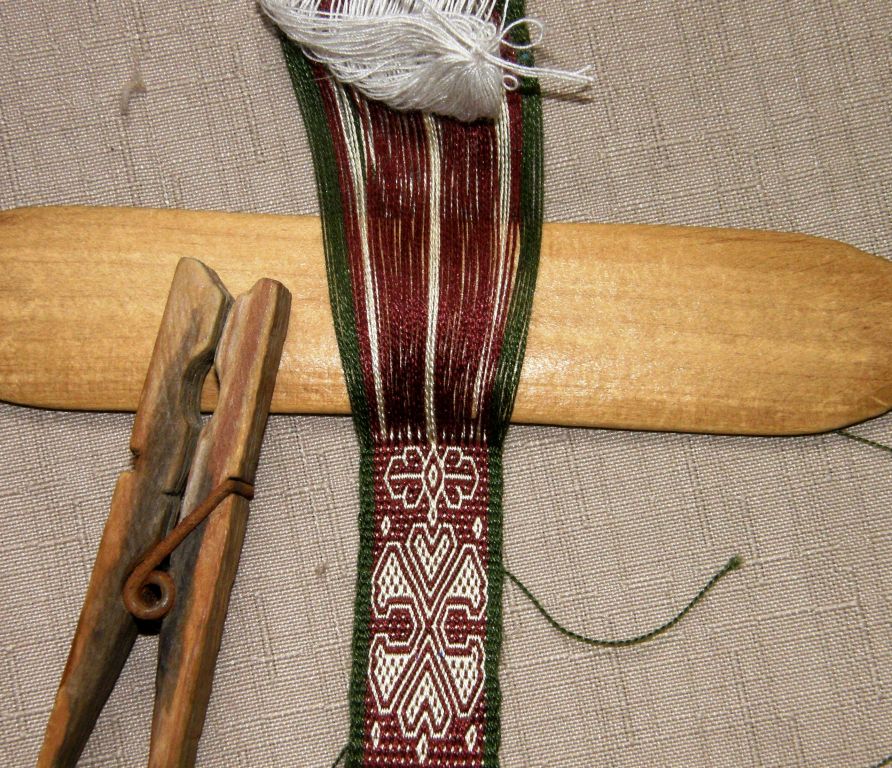
I love weaving miniatures too and have already used the 60/2 silk in a small pebble weave band (at left) to test the yarn, check how difficult it might be to see for doing pick-up as well as to try out a new pebble weave motif.
Band weaving for me is also a nice way to take a break from large pieces on which I might be working…only 16 threads to pick up rather than the 286 in my current project and I can attach to a toe and weave on the sofa.
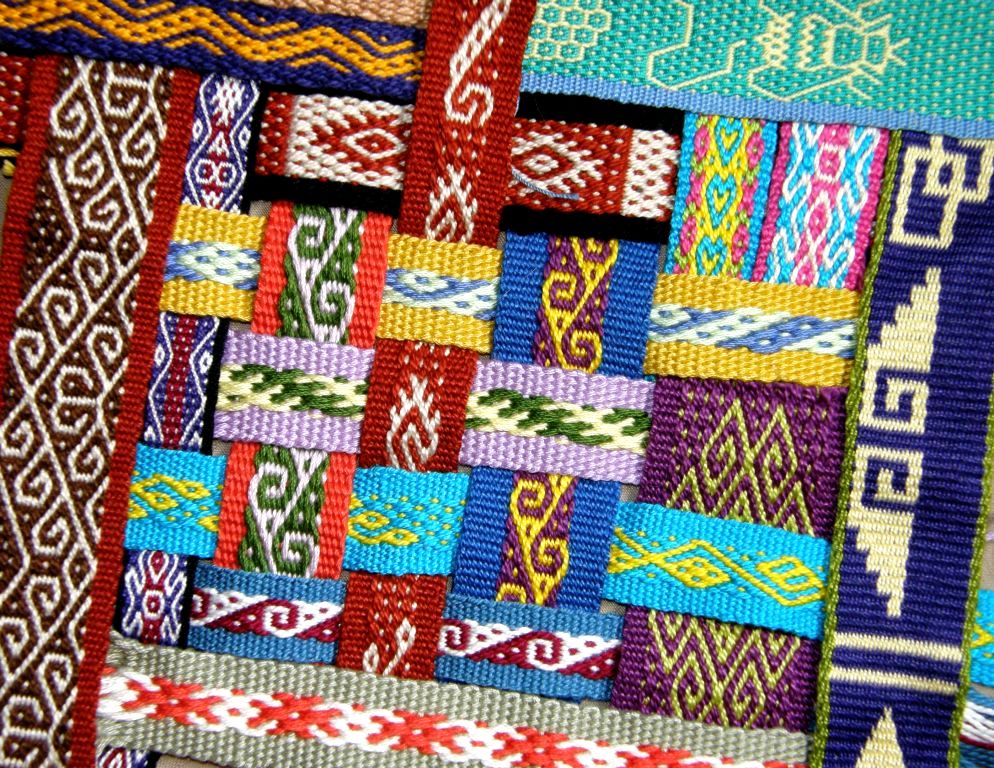
Much of last year was spent finishing my second book which involved a lot of weaving of samples… mostly bands and a few larger pieces. I have buckets of bands here! They won’t be made into anything. Some of them are very useful in that they travel to my workshops and make good teaching tools.
I took this next idea from my friend Yonat who put together a display of her inkle bands to photograph. I put together a few of the bands that went into my book last year. They are of different widths and lengths…some barely two inches long… and so, my display is not as pretty and uniform and Yonat’s.
The resulting book with yet more bands on the cover…
The North West Weavers Conference, which will be held in Bellingham, Washington this June, recently opened its registration. I am going and hope to see you there!
To finish, here are some great projects from members of the Ravelry group…
Carrie wove this warp-faced band using the frame of her rigid heddle loom on which to extend her warp. She used string heddles and a shed rod rather than the rigid heddle. The patterns were created with supplementary warps. Gorgeous! We all love the soft colors she chose.
Amanda kindly shared part of her band with her first attempt at creating patterns with supplementary wefts. She shows the difference that applying less tension to her warp made to the amount of coverage she achieved with the supplementary weft. She is using #10 crochet cotton for warp and embroidery floss as her supplementary weft.
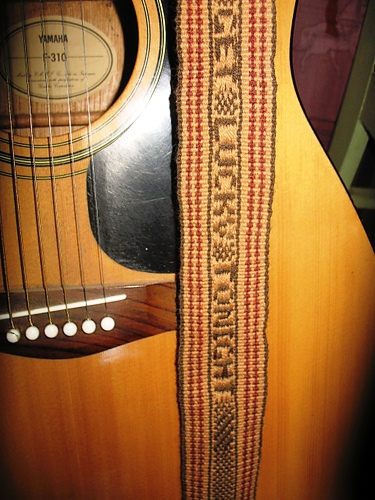
Janet wove this guitar strap for her husband with her own hand-spun and dyed wool. She used instructions for the pick-up patterns from Anne Dixon’s inkle weaving book. She included words from a song which her husband wrote in the design and used guitar strap hardware made by our friend Annie MacHale to put it all together.
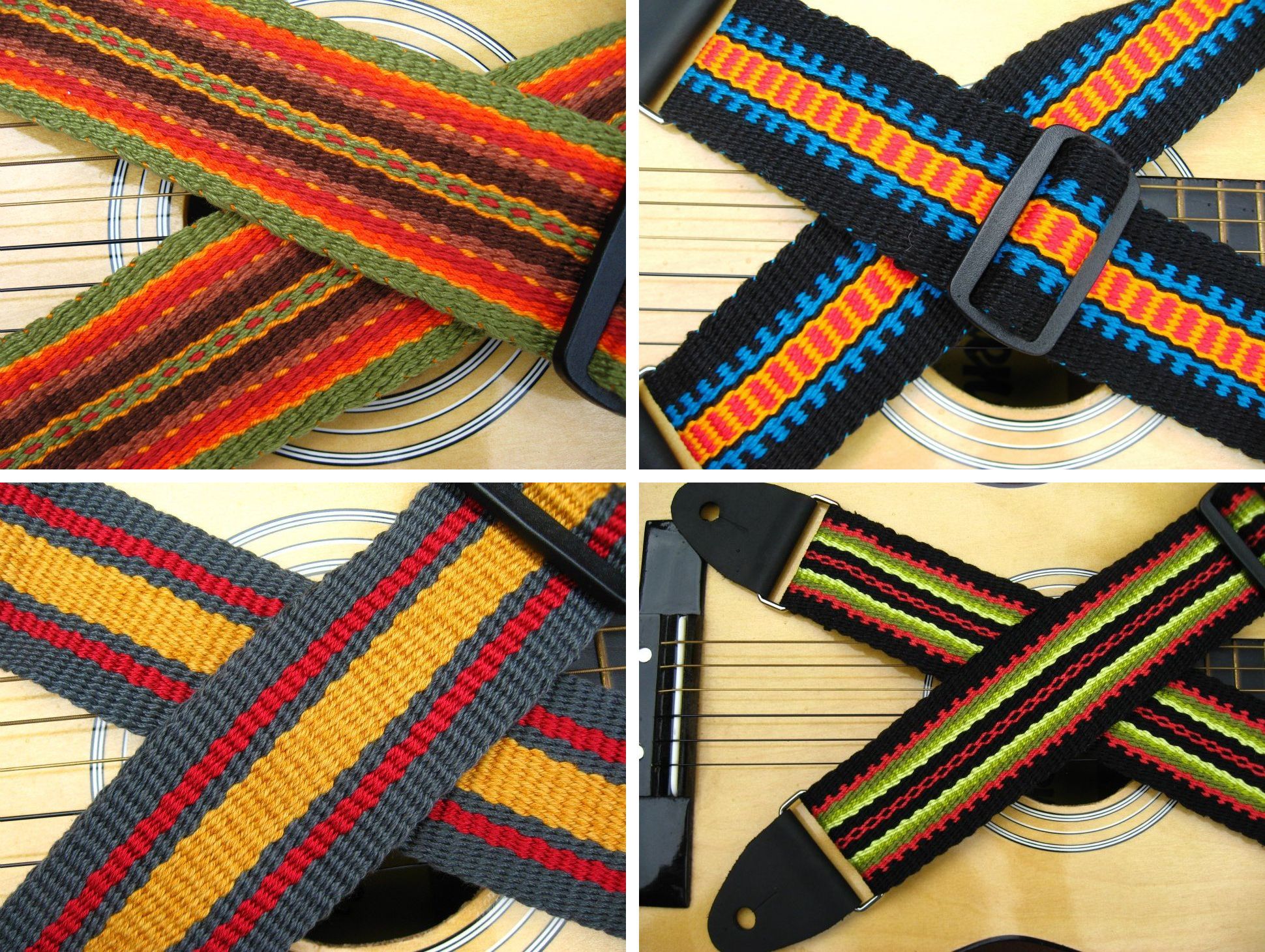
Speaking of Annie, she has been dazzling us on Facebook with the gorgeous straps she has been making on her inkle loom to sell at a big guitar show this weekend in California. Annie is all about color…I will leave you with just four examples of the more than forty guitar straps she will have for sale!
So, my challenges are longer, wide, finer. What are yours?
A “snaky” start to the new year….”Snaky” isn’t one of those words I find myself writing very often and when I typed it into the title of this post, it was bugging the heck out of me…just didn’t look right. Spell-check wasn’t touching it, yet I wasn’t going to be happy until I had Googled it to make sure. It was then that I read that “snaky” in informal English in Australia and New Zealand apparently means angry or bad-tempered.
So, I want to make it clear to the Aussies and Kiwis out there that I did not start this year angry or bad-tempered as the title of this post might imply. (This also reminds me that I am in my twentieth year here in South America…that’s a long time to have been away from Australia and any of the new expressions that may have been adopted into the local lingo.)
When I say “snaky” here, I am referring to the fact that the Chinese New Year, which will start on February 10, will herald the beginning of the Year of the Snake.
And why do I know this? Well, a Facebook friend shared the above image from a page called “The Journey to the Revelation of my Soul” and I saved it simply because….. I like the COLORS!
I am thinking that I must weave something with this color combination some time. Well, I kind of did in my sampler pictured above… but not quite. I want that rich burnt red background and that special shade of blue. Whoa…is this the structure and process person speaking?… now getting all excited about color?
Another reason the snake image appeals to me is that I happen to be starting the new year weaving a snake-like motif into my latest wall hanging project. I like to think of it as a boldly-patterned snake winding its way back and forth across the cloth.
The pattern is based on one of the designs that Wayuu weavers work into their belts. Imagine my surprise when I got Mirja Wark’s book off the shelf, in which she describes and names the designs, to find that the particular pattern that I have been using as my inspiration is called pasatalo’ ouya which means “like the intestines of a cow”!
Okay…so, I am weaving a wall hanging with representations of cows’ noses and intestines. But, since I adapted the basic motif a lot so that it would be big and bold enough to fit the space in which I am working, I think I could allow myself to call it snaky instead. What do you think?
Sloooow going. I am not achieving the four finger widths which my teachers tell me is a good day’s work. Some days I am lucky if do three. It is, however, very exciting watching the pattern slither its way up the fabric.
It is giving me both a mental and physical workout, I can tell you! It is an extremely dense two-heddle complementary-warp structure and opening the heddles is hard work. While the tiny elements of pattern within the main shape are very repetitive and easy to read, there are just so many warps to handle! I feel that I deserve to get up and go eat mango after every pick!
I like to think of the figures on this sash that I wove a long time ago as snakes. I copied the design from a textile from pre- Colombian Peru. Who knows what the weavers of the original fabric were seeing when they created these motifs on their cloth.
The snake is an important figure in Guaraní weaving legends. My teacher tells me that it was a snake that appeared in the dreams of the first weaver and taught her the weaving designs. When Guaraní weavers of the Izoceña group weave the zig-zagging snake skin patterns in their cloth they are also representing the Isoso river along which they have settled. The snake and the river are one.
I wove Guarani inspired snake skin designs into this guitar strap.
The Mayan Goddess of Weaving, Ixchel, is most often depicted with a snake or snakes on her head or entwined in her hair…
I was told that this is one of the reasons why many Guatemalan women weave richly colored sashes to wrap about their heads and around their hair. The sashes vary enormously, in width, length, color, design and weaving technique from place to place. It is also interesting to see the different ways they are worn….
 As my departure date for my US trip draws nearer, I am wondering if anything in the northeast is telling people that spring is on the way. Please, say “yes”! My friend in Massachusetts told me to bring boots presumably for stomping about in snow. I don’t own a pair! So, I am just about ready to do some kind of dance in order to try and will that northern winter away and bring on the spring.
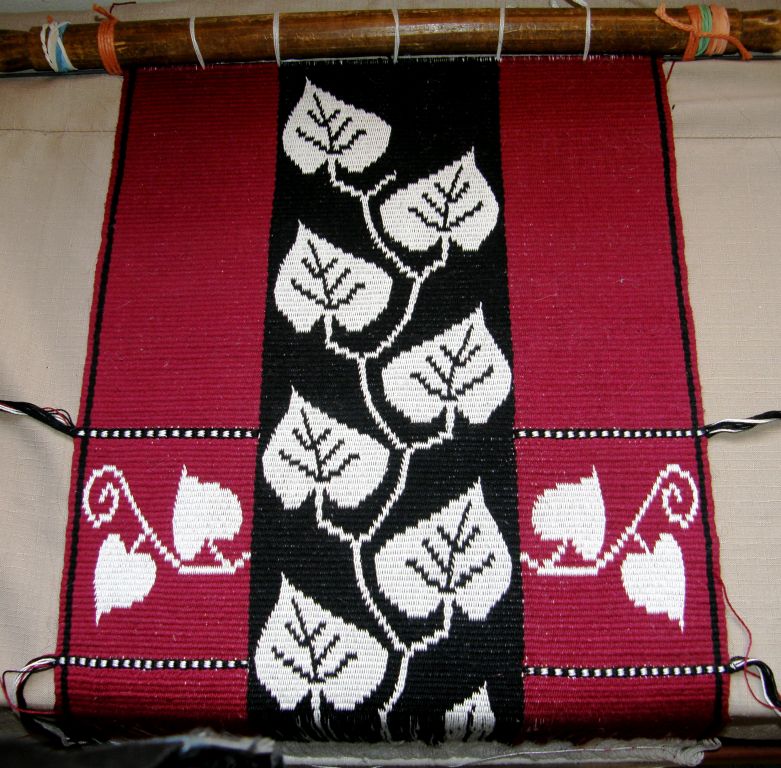 The leaves on my wall hanging, which were inspired by the chamantos woven in central Chile, are rather spring-like or even summery, I think. The motifs woven into the chamantos represent the agriculture and horse culture of that Chilean region. They are covered in patterns such as wheat stalks, flowers, horse hooves, grapes and vine leaves.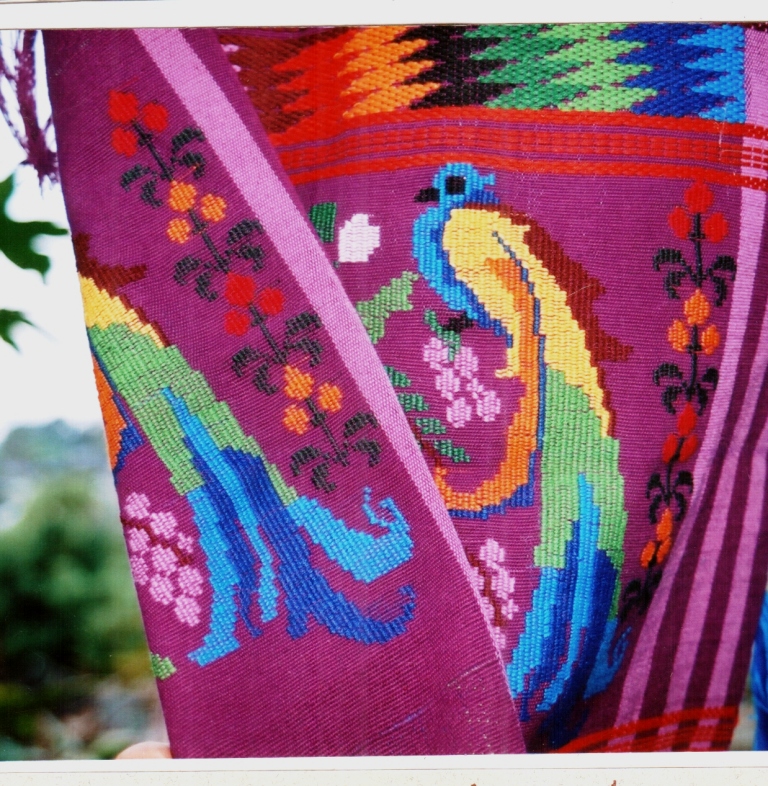


 The flowers on the hatband from Calcha, Bolivia inspired the design on the fourth of my red, black and white wall hangings…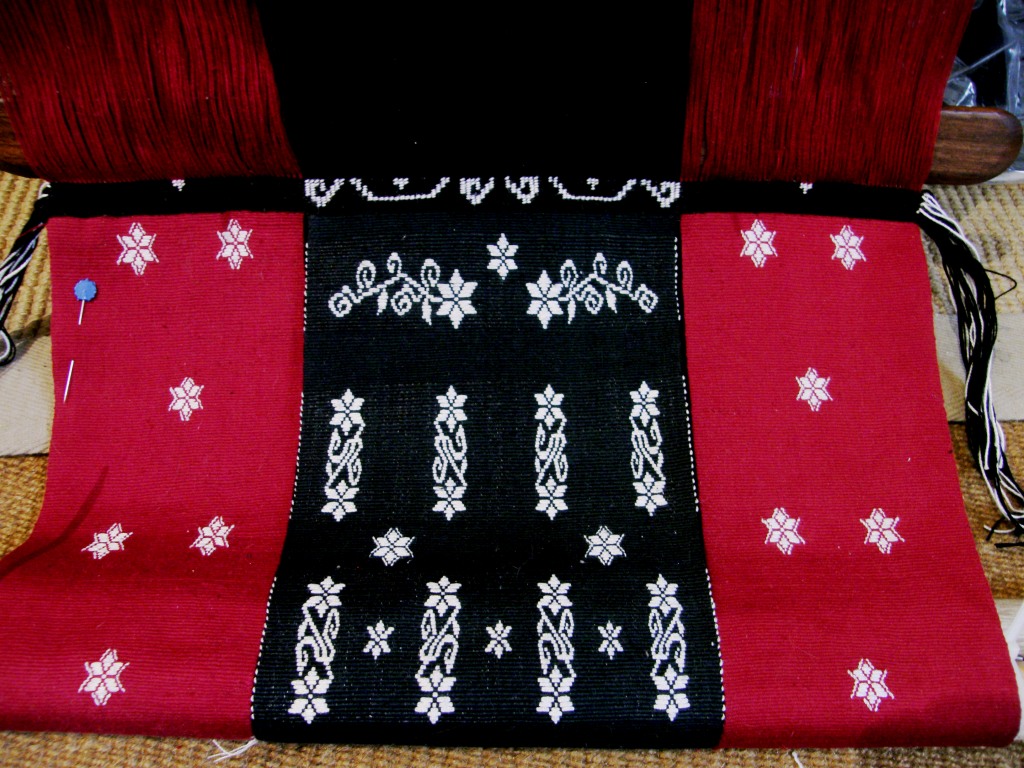
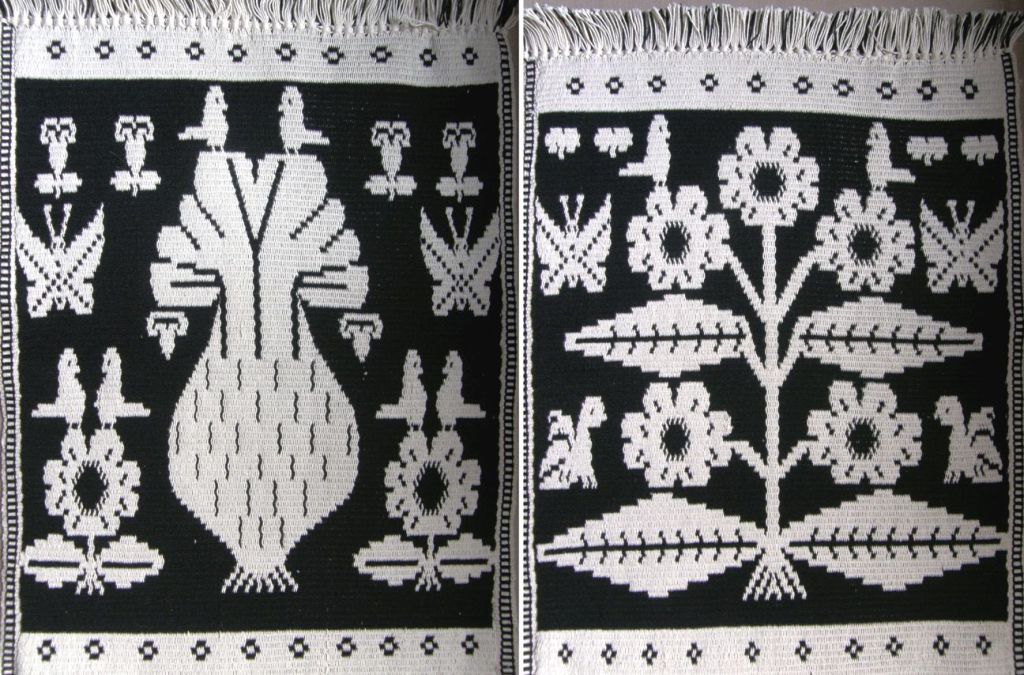
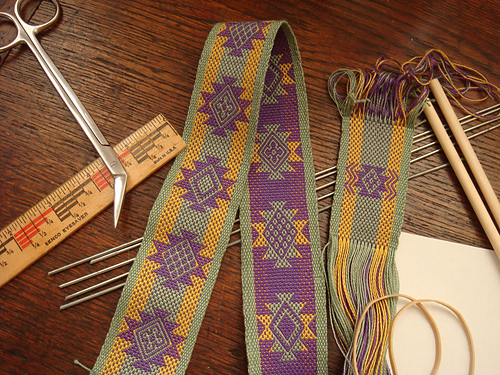
 My Guaraní teacher, Angela, buys the same Brazilian Clea brand thread as I do for her weaving. It was shocking seeing how suddenly and how quickly the price of this cotton went up as it did all over the world and sad knowing how it would effect the weavers and their ability to buy thread.
 When I was at the Encuentro de Tejedores in Cusco in 2012, a presentation was given on Shipibo art. We were told that parts of the patterns the Shipibo people paint and embroider represent their borders and rivers. One of the few times that I flew over Brazil in daylight on my way to Miami and could enjoy the view over the Amazon jungle from a cloudless sky, the
  rivers below looked very much like the squiggles I am weaving. I tried to guess which one of the squiggles might be the Amazon itself until I was completely blown away by the massive body of brown water that appeared and curved its way off to the horizon.
 Here are some of the beautiful bands woven with naturally-dyed handspun yarn from PAZA in Cochabamba. Cochabamba city is one of many I have come across in my travels in South America that is named a city of “primavera eterna”…eternal spring.