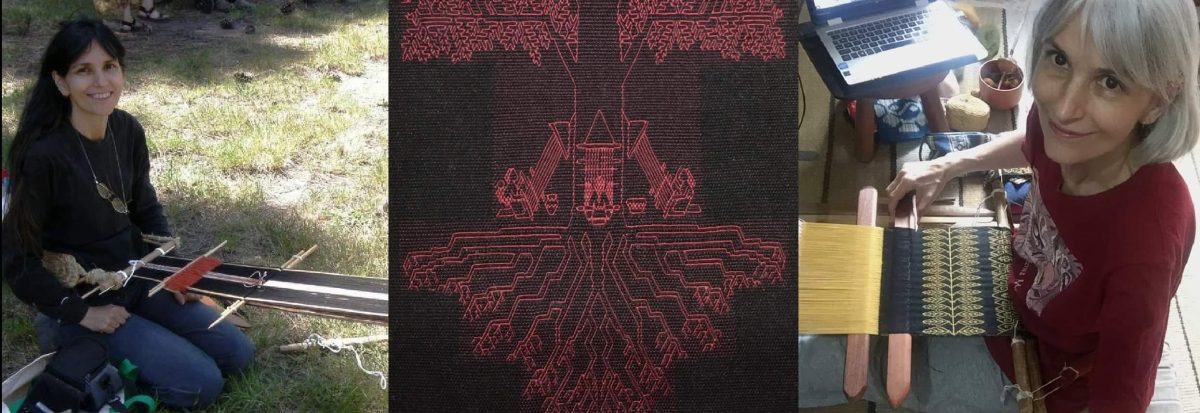
Backstrap Weaving – Seasons

I wove this with handspun cotton singles that I’d bought in Guatemala back in 2008. I used my bamboo reed to achieve the sheer open look and used the same cotton as supplementary weft to weave in patterns. It’s a style that I had been wanting to try ever since I bought a sample from the Coban area of Guatemala.
While I love spinning with a drop spindle, I can’t say the same for plying. I find it downright tedious and I just wanted the task to finish. I’d ply at my craft group gatherings, on the train, at the Arts Society gatherings, at the spinning and weaving group….it just seemed to go on and on.
I managed to squeeze in some time at the loom between hiking trips. It took two attempts to wind a warp to my liking from all those fabulous natural dye colors but I had to face the fact that I just wouldn’t be able to get them all into the one piece.
Four seasons motifs in progress. The heddle arrangement may look awkward but it works well. I had seen weavers in Bolivia use similar arrangements for their double weave pieces.
The figures as well as the colors are meant to represent the four seasons. The yarn I had dyed with cochineal just didn’t belong here. It can wait along with the greens for another project.
I didn’t want to use the handspun wool as weft for either of these pieces and used instead some unidentified soft and very loosely spun ”stuff’ that a friend had given me. It worked well except for the fact that it was somewhat slippery and wanted every now and then to slip out of the shed at the edges rather than lie there snugly. I’d had that very same experience with luscious alpaca yarn that I’d spun once upon a time.
The two faces.
I somehow always find myself on the floor at the planning stage. I didn’t have a choice in Bolivia but I’m in a bigger place now with table space. I still end up on the floor.
I’m in a couple of hiking groups and get to go out at least twice a week.
The “real” project will be much wider than this.
I couldn’t believe that after having admired the Indonesian ikat textiles for so many years, particularly the ones from Sumba, that I should run across these in an op shop?!
This photo was taken after one week. It has developed even further since.

Backstrap Weaving – My Books!

If you’ve purchased the PDFs that come with supplemental video clips, you don’t need to do anything either. You will continue to have access to the videos by clicking on the link to the folder of clps that you’ll find in the chapter titled Videos. Access to the clips will continue after the Taproot Video website closes.

ACTION NEEDED FOR THE FOLLOWING:

  • Clck on the link.

This a celebration of connections made in what I’ve left behind and where I now find myself. The images depict the four seasons considering that now that I live in a place that truly experiences all four. We had two at best in my tropical home in Bolivia! I’m going to make this into a bag so I can carry those connected memories with me.

Bye-bye Taproot Video and thank you.. Thank you to all those who have purchased my publications over the years and supported me through following my blog as well as leaving me kind comments and reviews here and on my other social media pages.The blog will continue. I have a lot saved up to post! You’ll be hearing again from me soon.

Backstrap Weaving – Dyeing to Weave

Trying to stir and poke more fabric into the pot.
On top of a stunning color, it gave such an intense aroma of eucalyptus. Beautiful!
The smell of the peppercorn leaves in the pot evoked a lot of memories.
Some results. You can see the indigo that we dyed up in the highlands last year. I added a natural white skein to this photo for comparison.
At last I get to keep some notes in the book with my handwoven cover.
I love these three together.
Playing with different color combinations. I have plans for this wool in my weaving but first I have to get out a spindle and ply. I’ve dyed skeins of doubled singles and have yet to twist the two single strands together. We’ll see how my wrist feels about that.
My two boxes of jewelry-making bits and pieces made it over to Australia. I spent ten days house-sitting for a friend at Shelly Beach and needed an activity.
While this strangling fig isn’t being very kind to this tree, it makes a very fascinating and eerie sight.
Other things that got refreshed and updated…my garabata pouch pendant and wrist cuff. I didn’t make the earrings. I bought those from an Ayoreo artisan.
It was never a good idea to wear jewelry in the streets of Santa Cruz. I learned that the hard way in a couple of incidents during my first months there. Anything was fair game. I’m enjoying being able to feel confident about wearing my things out and about here.
I based it mostly on silver dollar leaves.
There lies within my life’s possessions!
The brooch that I got in the Christmas exchange on the left…..and the result of another Christmas exchange in a different group on the right. In that exchange we were presented with materials and asked to stitch a Badge of Honor with a word that describes another person in the group. We drew names from a hat. I stitched Vivacious for Francie and Present was chosen for me.

Backstrap Weaving- Back to Black…..and Red

I’m going to keep this post quite short as I am house and cat-sitting at the moment without my laptop and am attempting to write this post on my phone. I am a fast two-finger typist on my laptop but a very slow single-digit writer on my phone due to lack of practice. I don’t even try the dual thumb thing that everyone seems to do.

The cat in question. This blue-eyed 19-year-old lady lived with me until I sadly had to re-home her due to the amount of travel I was doing. Now I get to keep her company while her carer is away.

We are on Day 27 of the citywide general strike with no end in sight. At least now the authorities announce the plan for the week for permitted supermarket opening hours so that we can all be better organized. Before this, it was mass panic when the stores were allowed to open with the whole city out getting supplies….only to have another shopping morning announced just two days later.

I got out on one of the mornings and managed to pick up more cochineal from the ladies that sell home remedies in the street market. The bugs only come in tiny packets as they are sold here as remedies rather than for dyeing. The last time I bought some, they were sold by the teaspoonful out of a large jar.

I also managed to find a store that sells cream of tartar to use as a color-shifting agent for my cochineal dyeing but had to buy a minimum quarter kilo.

My projects have been rather blue lately. I wanted indigo blues for my ikat experiments and have had fun using synthetic dyes for silk and cotton to create different blues. I can’t get hold of natural indigo here. Now I would like to try my hand at using a natural dye for an ikat project and cochineal is a convenient thing with which to start.

I even used blues for my recent silk hummingbird cuff bracelet but that was more about just making do with what was available in my stash of 60/2 silk.

This is what’s on the loom now and I found this red and black kind of shocking after all those cool and calming blues.

But I do need to remind myself that red and black has always been a great favorite combination of mine and something that I have used time and time again over the years and as recently as 2020 when I wove my four-part Within These Walls series.

The first ever motif I wove with my backstrap loom teachers in Peru back in 1996 was in red and black.

My latest project is a request from a friend….a woven sleeve for his quena flute. I had to scratch around in my stash for suitable yarn and decided to go with chunky Omega Sinfonia cotton. This yarn is from my workshop stash for creating warps for my beginner students. I have a lot of this standing by for the day I can teach in-person classes again. I knew that I could create something big, bold and striking with this thread.

But, as always, I wove a width sample first. My eyes just seemed to naturally go for blues for the sample. I got the information that I needed from it and I hope to make something useful from it. It’s a good size for a case for sunglasses.

The pattern request for the quena case was for something snake-like. My Guaraní weaving teacher many years ago showed me one of the motifs that she weaves using the structure that the Guaraní people call karakarapepo. I call it Andean Pebble Weave. She explained the role of the snake in Guaraní legend and added that the zig-zag pattern also represents the life-giving Parapetí River along which her community lives.

This zig-zag motif is woven in many different ways. It doesn’t seem to have a single fixed form and it has been interesting to see the various forms it takes during the years I have been here. It’s hard to find any two that are exactly the same. My zig-zag pattern is a modified and embellished version of the one that my first teacher had shown me.

I never lose the thrill I feel when seated at a new warp all heddled up and ready to go. I am using the very efficient two-heddle method that my backstrap loom teachers from Ayacucho showed me.

In this chunky yarn, the inches quickly accumulate.

I got this far and then it was time to pack up some things for the two weeks of house sitting. My plan had been to go back and forth each day but the strike has made it less than pleasant to be walking around the deserted streets alone. It wasn’t something I was going to feel safe doing twice a day. And so I faced the fact that I would have to just stay put at my friend’s place which meant packing up my weaving . Hooray for the portability of the backstrap loom.

Sticks, yarn, swords, shuttle, string and cable ties to help attach the far beam to something all went into the tote bag. After completing the first pattern repeat, I didn’t need a chart any more. But darn…I forgot to bring the backstrap…and I have at least twelve of them at home!

But guess what…the tote bag makes a pretty good backstrap in an emergency. I love the idea of a loom carry bag that doubles as a backstrap. However, I would create a thicker cushier one if I were to make something like that in the future.

You make do with what you have and this tote bag has been working just fine as a backstrap.

This weaves up so quickly! I will have to sneak back home on one of the supermarket mornings (when there are more people out and about and it feels less creepy) and put together another warp. Once off the loom, I will figure out how to put this flute sleeve together. I am weaving the two sides of the sleeve as separate bands so that each can have its own third selvedge. That will save a bit of hemming.

I found table legs that I could attach the far beam to at just the right height, piled a bunch of heavy things on top of the table, threw a cushioned chair seat on the floor, and was good to go.

I am very much used to the red and black now. How did I ever feel that it was shocking?

There was some hope that the strike would end today but it hasn’t. Today was a permitted shopping morning and so I walked home to pick up my dyeing stuff.

These are the colors I have so far on silk using cochineal, my hard tap water, and alum mordant. A bit of lemon juice produced the orange tones.

I am hoping that the cream of tartar will give me reds. This is what the pot looked like when I added the cream of tartar. Looks promising, right?

I have hung the skein to dry without having rinsed it. I am thinking that maybe the color needs time to “cure”. When I rinsed the first lemon-juice-induced orange skein in tap water (it was shockingly orange), all the orange color disappeared and I was left with purple! The only way that I found to save the color was by adding a bit of lemon juice to the rinse water. I am wondering, therefore, if I should rinse this latest skein in water that has a bit of cream of tartar in it. Well, it’s all about experimenting, isn’t it? I have yet to get hold of distilled water. That will have to wait until after the strike, I guess. It’s not a supermarket item here.

Well, I have managed to write this by pecking away at the phone keyboard while not making myself too crazy.

Hopefully the next time I write, I will be back home, we will be strike free, I’ll have beautiful red silk skeins to show, and a successfully completed quena sleeve.

Backstrap Weaving – The Right Stuff

We’re standing still as we enter the sixteenth day of a city-wide strike but I have been pretty busy and entertained during this latest of the stay-at-home situations. It’s nowhere near as anxiety-ridden as the last time we did this for twenty-one days at the end of 2019.

This is what I have been up to:

SILK: soaking, scouring, squeezing, steeping, stirring

COCHINEAL: squashing, sifting, soaking, steeping, straining

DYEING: Sighing (over the dull colors), squealing (over the lovely ones), searching (for the right additives)

Dyeing experiments on silk with cochineal and alum mordant have kept me entertained during the strike.

But I don’t have the right stuff if I want to get the gorgeous reds normally associated with cochineal. Never mind, I’ll just pop out and get some. But of course everything is closed due to the strike. What I would like to have is cream of tartar and distilled water. The former is supposed to push the color towards a cherry red. Yum. My tap water is far too hard. I have read that dye molecules tend to adhere to the minerals in the water and not so much to the fiber. And that’s where the distilled water comes in.

Citric acid shifts the color to a strong orange.

The supermarkets have been allowed to open on two mornings a week from 6am to 11am. Imagine the whole city out trying to shop in those two time slots especially since the Day of the Dead fell right in the middle of it all. You would think that it would be a simple matter of getting some cream of tartar at the supermarket. I went to three and didn’t find it. I don’t have an oven and, therefore, don’t bake. I have never had a reason to look for it before. I found a place on Facebook that supplies commercial kitchens. Of course, it’s not open during the strike. I suppose I will have to buy a bagful! The distilled water will have to wait until the end of the strike too. In the meantime, I’ll just make do with what I’ve got and have fun.

This is the kind of red-ish purple that I got on my handspun llama with an alum mordant and tap water many years ago. I was really pleased with it. Many years ago, I used to have a softening attachment on my tap and I don’t remember if I still had it when I was dyeing this llama fiber. The company that supplied the cartridges for the attachment closed and that was the end of that. I know for sure that I hadn’t used cream of tartar.

In a way it’s a lot of fun making do with what you have on hand. Using coffee filters was suggested as a way to strain the bug particles out of the cochineal liquid. I don’t have any but I found that cutting two of the three layers out of one of the disposable surgical masks made a pretty good strainer. I could hang the elastic straps over two bottles to suspend the mask over a bowl. I had a little re-usable draw-string sack that can be used for tea leaves or yerba mate. That worked well for containing the crushed cochineal while the color was being extracted.

I got a few different purples…nothing terribly exciting….but adding lemon juice to the bath brought on a powerful zing of orange. Wow. Almost too powerful. I learned that I had to rinse the orange skeins in water that had a few drops of lemon juice. My first orange skein, rinsed under the tap, released a lot of orange liquid in the first rinse, a rosy quite attractive orange in the second, and then the skein magically turned purple before my eyes… and a very dark purple at that! Not a trace of orange left. How bizarre. I rinsed the others in lemon-y water after that and got some pretty colors.

Purple and orange and pink tones in silk from cochineal.

So, that’s what I have so far. I am looking forward to getting some reds when things are back to normal and I can get the right stuff. In the meantime I can start skeining and scouring and mordanting the next lot of silk. I have a new even greater appreciation for the person who prepared all these tiny sample silk skeins from natural dye experiments using all kinds of mordants and color-shifting agents.

Skeins of naturally dyed silk that were gifted to me.

I had so much fun combining those small skeins to weave book covers…

Hopefully I can get colors that work well enough together for a future ikat project.

As you can imagine, when doing this kind of thing there is a lot of time spent waiting for yarn to dry or soak or steep. I had to keep myself busy with other fiber pursuits so that I would stop impatiently poking at things in the pot. I am still spinning the brown cotton that is labeled as Cinnamon and am about to start experimenting with boiling small quantities of it for different lengths of time to see how that affects the resulting deepening of color. I first soaked one lot and allowed it to dry to see if the color changes at all from simply being thoroughly wetted. It doesn’t. Now it’s time to start boiling.

The color labeled Cinnamon is the uppermost one in this picture.

The other thing I did was weave a band in 60/2 silk to experiment with making jewelry…wrist-cuff bracelets and possibly pendants. I enjoy wearing these when I travel but am also thinking about possible income sources when I eventually return to live in Australia.

I added a hummingbird cuff bracelet to my collection of blue ones….

And then I unearthed a sample I had woven in indigo-dyed fine cotton from Guatemala. It will make a nice storage bag for the blue bracelets.

I finish my cuff bracelets in a number of ways. Sometimes I add a button to one end and a loop to the other. This involves finishing the raw edges of the band in some way. Usually the material is fine enough to turn under twice and hem. If not, I turn once and sew down after having sealed the edge with diluted PVA glue. This is not my favorite way as the dried glue can sometimes be scratchy against the skin. A more complicated but enjoyable way is to edge the perimeter with a woven tubular band. Using metal ribbon crimps and some sort of clasp takes care of the raw edges. However, cuffs with clasps like these are the hardest ones to do up. I have had lots of practice, though!

A tubular edging added to a wool band encloses and protects the edges.

Apart from enclosing and protecting the cut raw edges, ribbon crimps also allow you to wear the bracelet showing either of the two faces.

I wove my hummingbird design in warp-faced double weave. I love the smooth, solid color look of this structure. There are no floats and no spotted background. If you think that you would like to try double weave yourself, I have written a book which gives instructions via dozens of step-by-step photos, detailed explanations and video clips for those who like to weave bands on standard inkle looms. I think that it is a technique for those who have already tried and decided that they like the slower pace of weaving bands with pick-up patterns. It’s not the first-ever kind of pick-up patterning that I would recommend trying. I learned this structure in the highlands of Bolivia way back in 1997on a horizontal ground loom and have adapted the method to the inkle loom. Warp-faced Double Weave on Inkle Looms is available as a PDF or as a spiral-bound book at Taproot Video.

I made the most of every piece of this short band…

My friend Dorinda is back in the States now after visiting Maxima and all her other friends in the Bolivian highlands. Maxima runs a small grass roots weaving co-op made up of women from her town and neighboring rural communities far, far away from tourist trails. Pre pandemic, I was able to take and show examples of the ladies’ work that I own using their handspun wool and natural dyes and generate a lot of orders for them. The profits would go towards simple needs like buying supplies for their children at the start of the school year. If you were reading my blog during those years you will know that I got around a lot and there are now folks from Florida to Washington state who own some of the beautiful woven cloth. Although the ladies do sew the cloth into useful products, most of my weaving friends were interested in buying lengths of cloth that they could use in their own sewing projects.

Here are some of the youngest and newest members of the co-op who have recently graduated from the body-tensioned band loom to the leaning vertical frame loom on which they weave wider pieces. The youngest one has yet to graduate but will do so next year. Look at those lovely reds they get on the wool from cochineal. I need to get some of that good highland water!

Maxima’s sister, Narciza is one of my weaving buddies and is here showing the 4350 meters of yarn that she spun during the Spinning Week competition that Dorinda helped organize in October by seeking out funding for prizes.
Two groups of spinners competed for prizes. The first prize winners on the right are wearing their new skirts and the second prize winners received a knitted cardigan. Donated funds were used for the purchase of the skirt fabric and yarn and the skirts were sewn and cardigans machine-knitted by members of the co-op. 89, 887 meters of yarn were spun in the week! There’ll be plenty to go into the dye pots next season.

These ladies were the participants in the Spinning Week competition in the first week of October. It’s a very humble group of ladies living a simple rural existence deep within the highlands, growing vegetables for the Sunday market and raising livestock. There are no passing foreign tourists and no local interest in their woven goods in the nearest city nine hours away (it’s a spectacular bus journey!) Please do take a look at Dorinda’s blog, PAZA Bolivia, to read her fascinating stories about the lives of these women and their efforts to keep their spinning and weaving traditions alive. You might think about subscribing to automatically receive notification of her future posts. I hope that I can travel soon to promote their work and help out in my own small way as I used to. In the meantime, I’ll do my best via my blog.

I’ll leave you here with an idea for using ribbon crimps to make some tree ornaments. I show these every year! The bands don’t necessarily need to be holiday themed. I think any pattern looks good.

These are all woven using the structure that I call Andean Pebble Weave. If you would like to learn how to weave Andean Pebble Weave on an inkle loom. I have written a book that teaches just that: Andean Pebble Weave on Inkle Looms. If you use any other kind of loom to weave bands you can still learn the method that enables you to weave these kinds of double-faced bands in this book: Complementary-warp Pick-up. The advantage of the inkle loom book is that it includes instructional video clips in both its digital and physical versions.. Both these books teach the method that enables you weave all the patterns in my two follow-up pattern books.

Hopefully, the strike won’t last too much longer and there will be a peaceful end and a solution to satisfy all concerned. Until next time…..