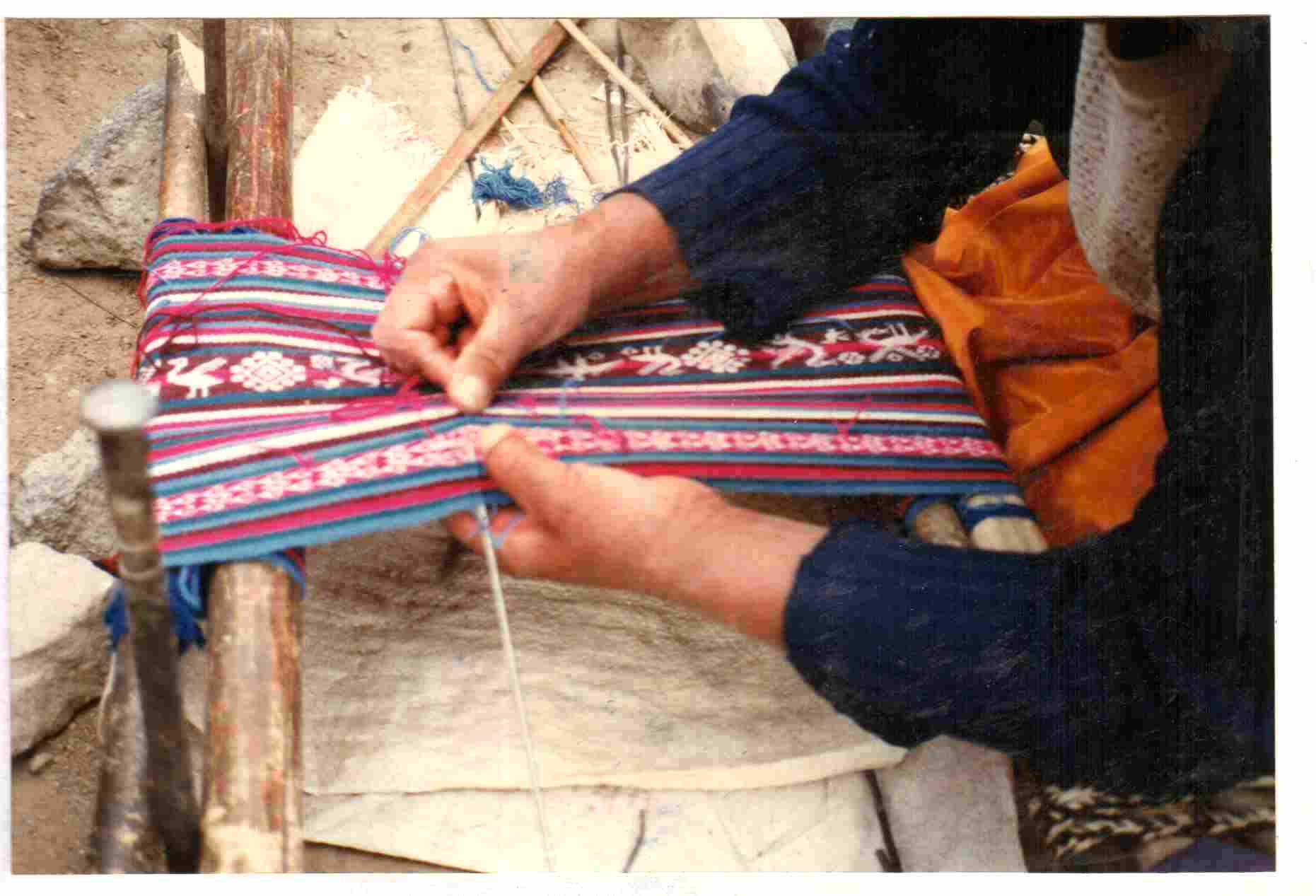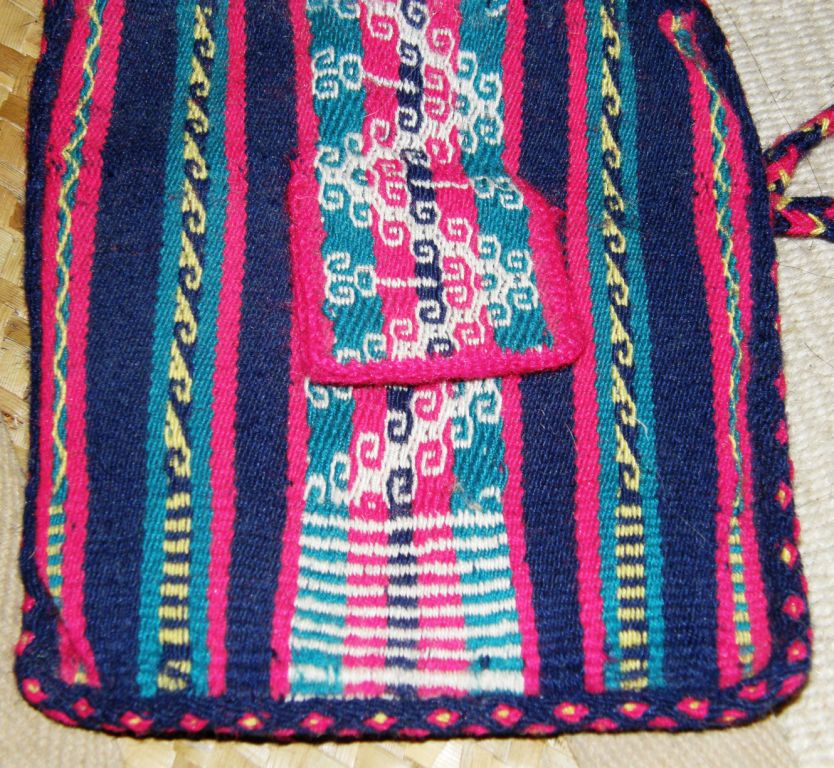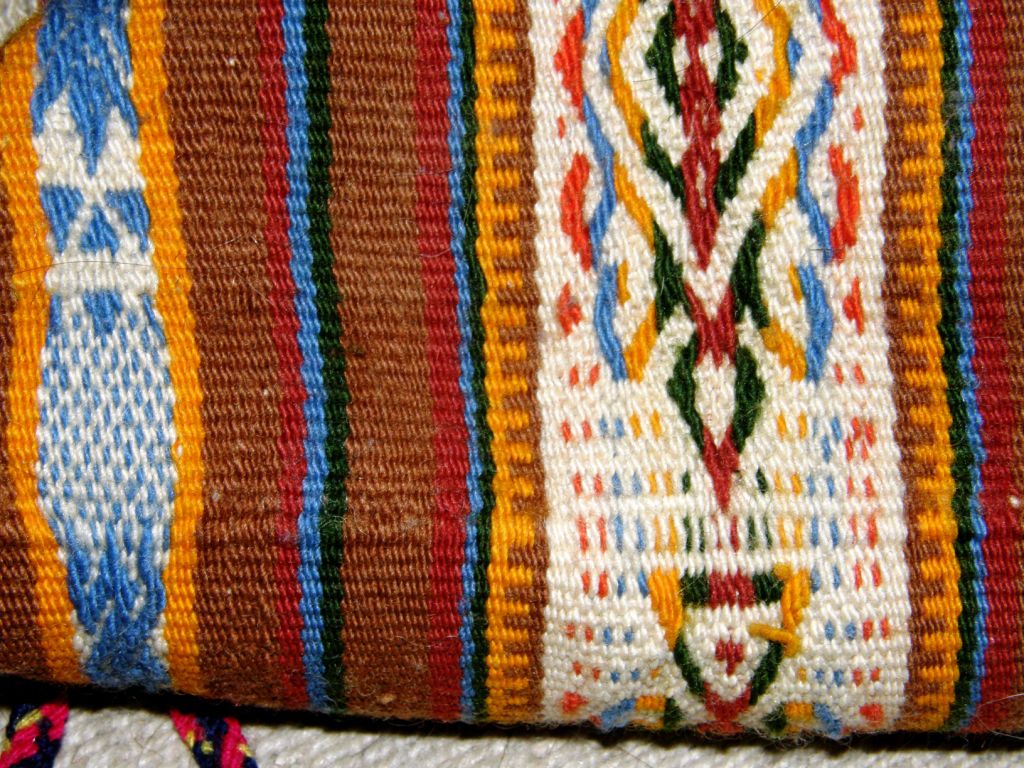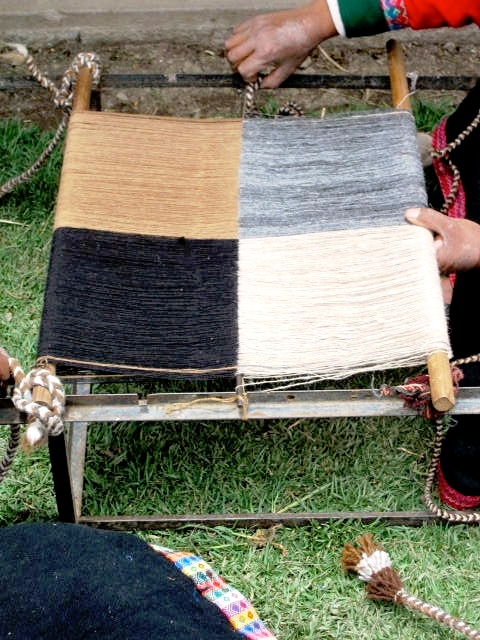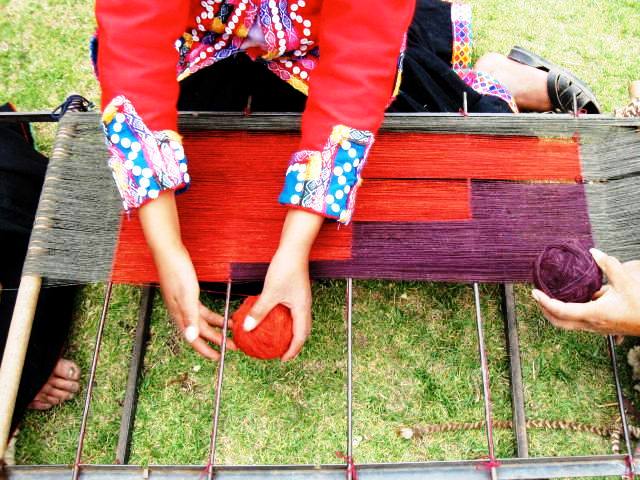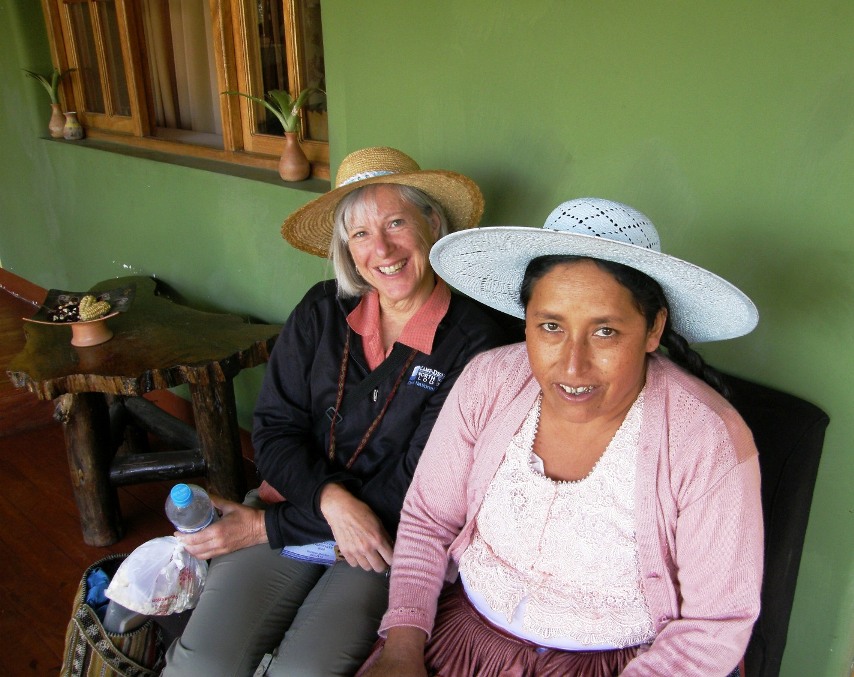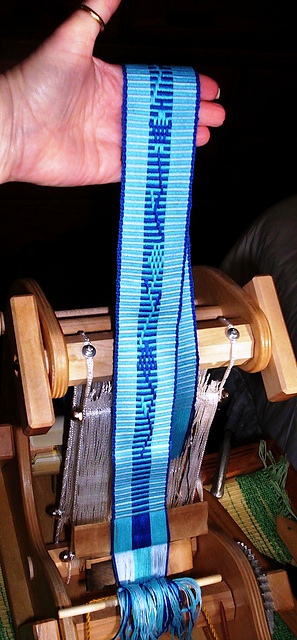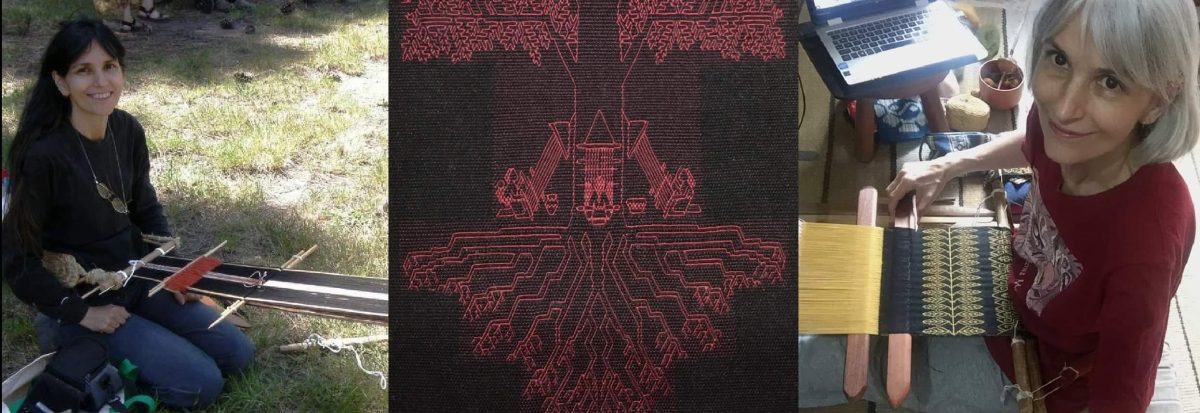

Backstrap Weaving – Weft twining with the Montagnard backstrap weavers.


But first a look at gorgeous rural Maryland where I am currently staying with  friends on the first day when it has felt really cold out. There has been talk of snow on Friday…I hope so as we are putting up the Christmas decorations here that day! while Santa Cruz Bolivia in the meantime experiences a “cool” change with temperatures dipping below 30C  (86F). Most of the leaves have fallen here and it’s interesting to see the turkey vultures perched in the gaunt leafless tree across the street every morning.

Last week I was down in North Carolina where the weather was mild and the neighborhoods were still awash with red, gold, yellow and brown.

I was down there revisiting the Montagnard (Vietnamese hill tribe) weavers whom I had met on a visit last August about which I wrote in this previous post. I had discovered Betsy Renfrew’s videos and photos on her blog about the group of Montagnard people in her community and her project to help them integrate and find sources of income by teaching them English and making it possible for them to gather the materials and resources necessary to build looms, buy thread and practice their traditional weaving skills. Betsy was more than willing to extend an invitation to visit. She has also allowed me to use some of her photos in this blog post.
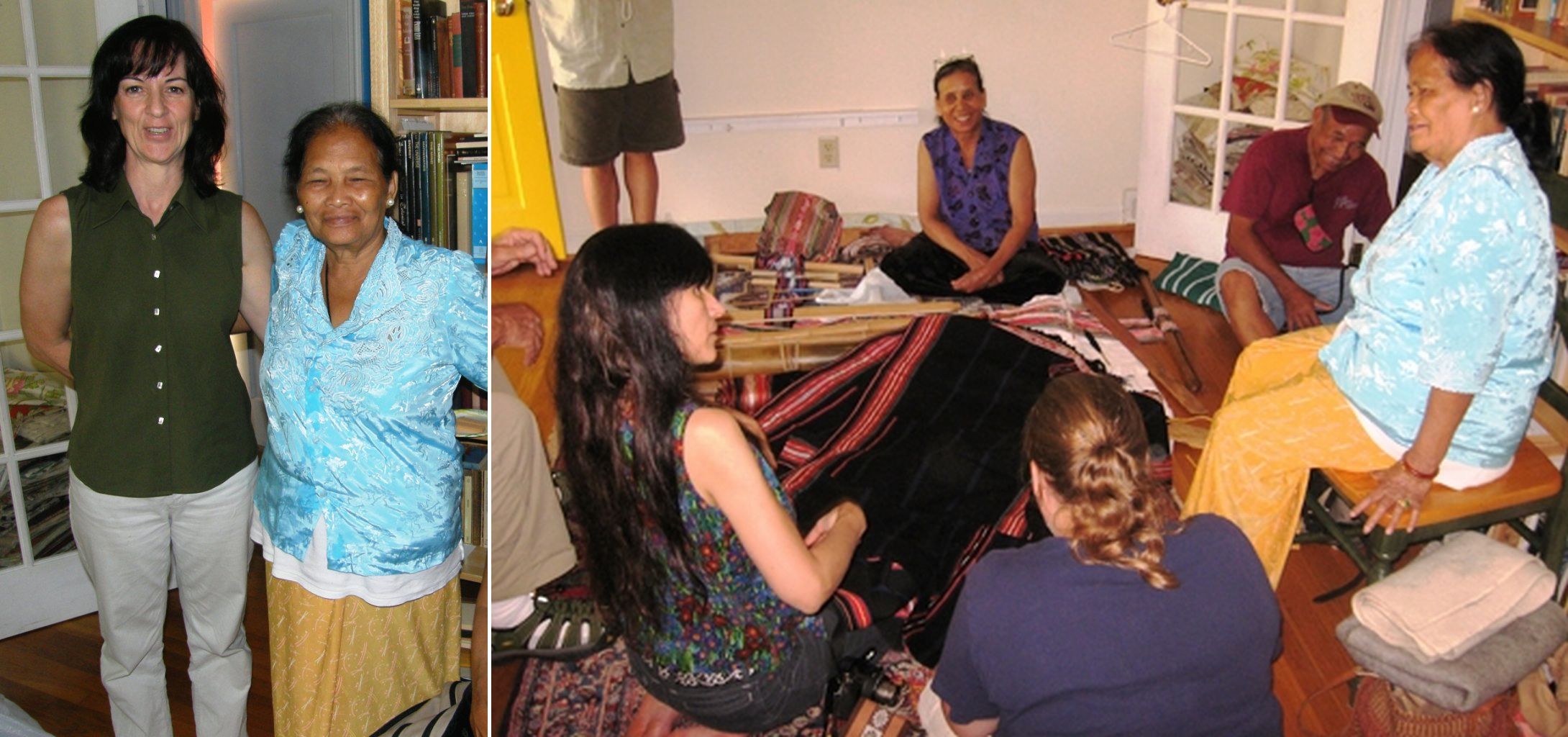
 

Betsy and weaver Ngach together on the left during my first visit. On the right a scene from my first visit with Lisa and Maurice in Betsy’s home with weavers Ngach, Ju Nie and her husband Thomas. It was a chaotic afternoon with lots of chatter, sharing and interaction which cleared away all  language barriers.  Backstrap looms and textiles covered the floor of Betsy’s front room and, as this was my very first encounter with these kinds of textiles, it was impossible to wade through and take it all in during our short visit and I left with many unanswered questions knowing that I would simply have to return one day.
We got to see Ju warping and setting up her loom and Lisa and I both got to try out her warping technique where she adds string heddles as she winds the warp as well as weave on her backstrap loom. I tried to photograph as many woven pieces as I could – skirts, blankets, baby carriers bags and belts so that I could figure out the woven structures when I got home. Ngach put on skirts for us and Ju modeled the baby carriers. Many of the structures I immediately recognized and it was fun to show Ju and Ngach pieces woven with the same techniques in South America. In fact that was the most fun part of the visit…comparing and sharing our different experiences with the textiles, patterns, tools and looms and seeing for what purpose the textiles were intended. I was able to study and figure out some of the other less recognizable techniques when I got home.

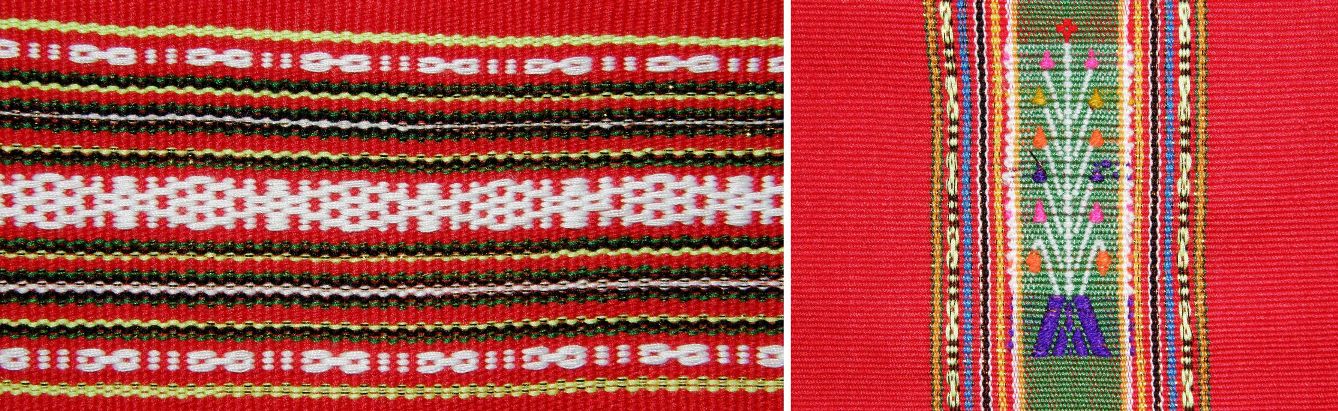
Some of the different patterning techniques which include simple warp floats, cross knit looping, supplementary warp and weft can be seen below…
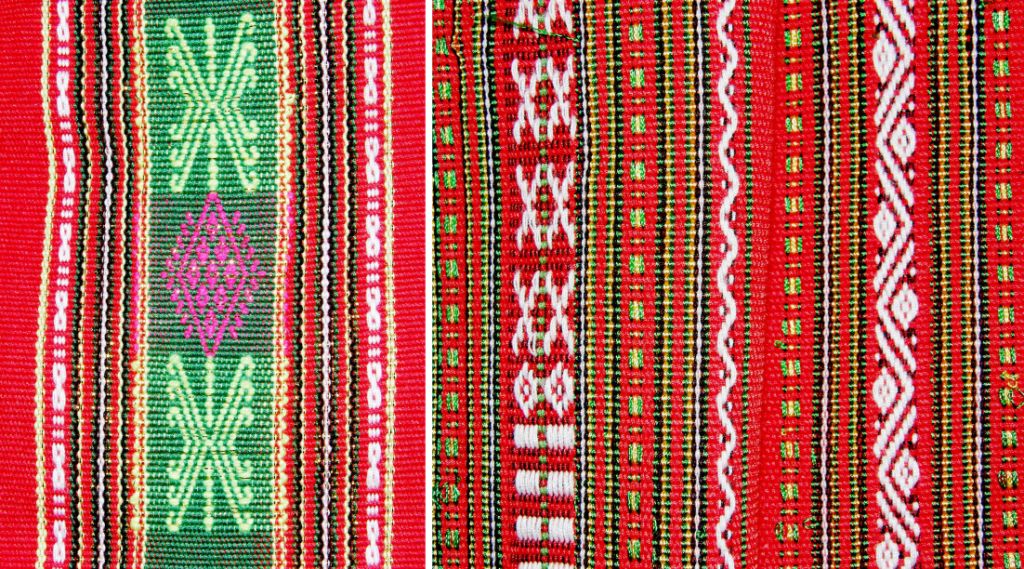
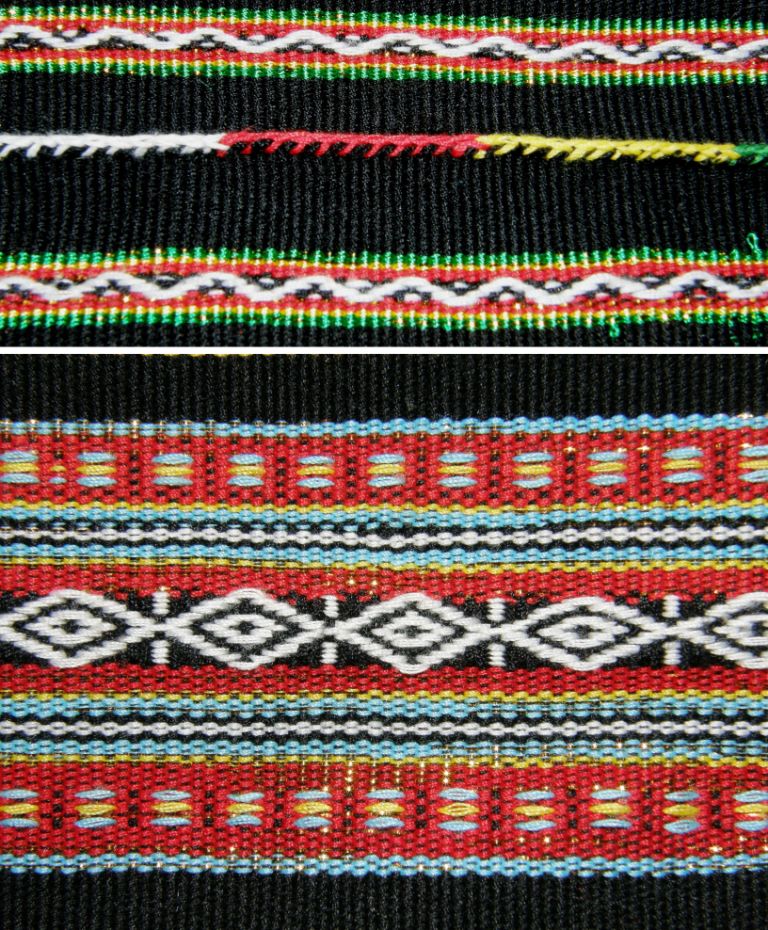
I like the supplementary weft patterned piece on the right as it reminds me very much of some flower motifs that I recently wove using Guatemalan supplementary weft and warp wrapping techniques. The similarities in the designs across cultures are astounding.

If you have been following my blog, you will know that the technique which really grabbed my attention was the following one which both Ju and Ngach, who are from different tribes, call kteh.
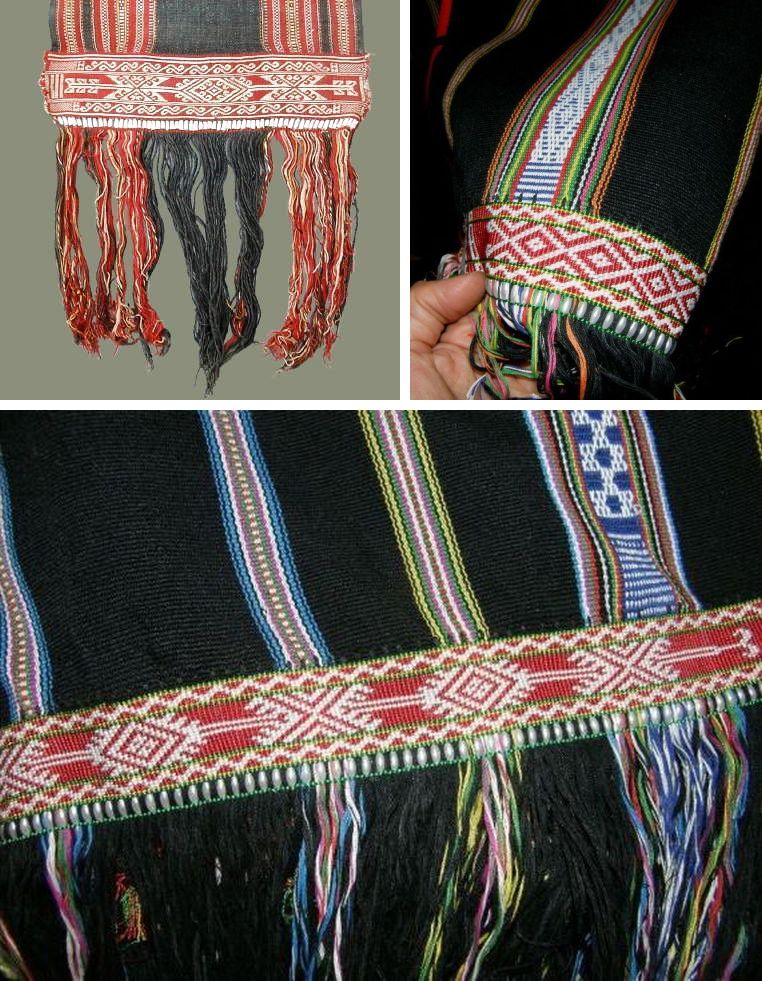

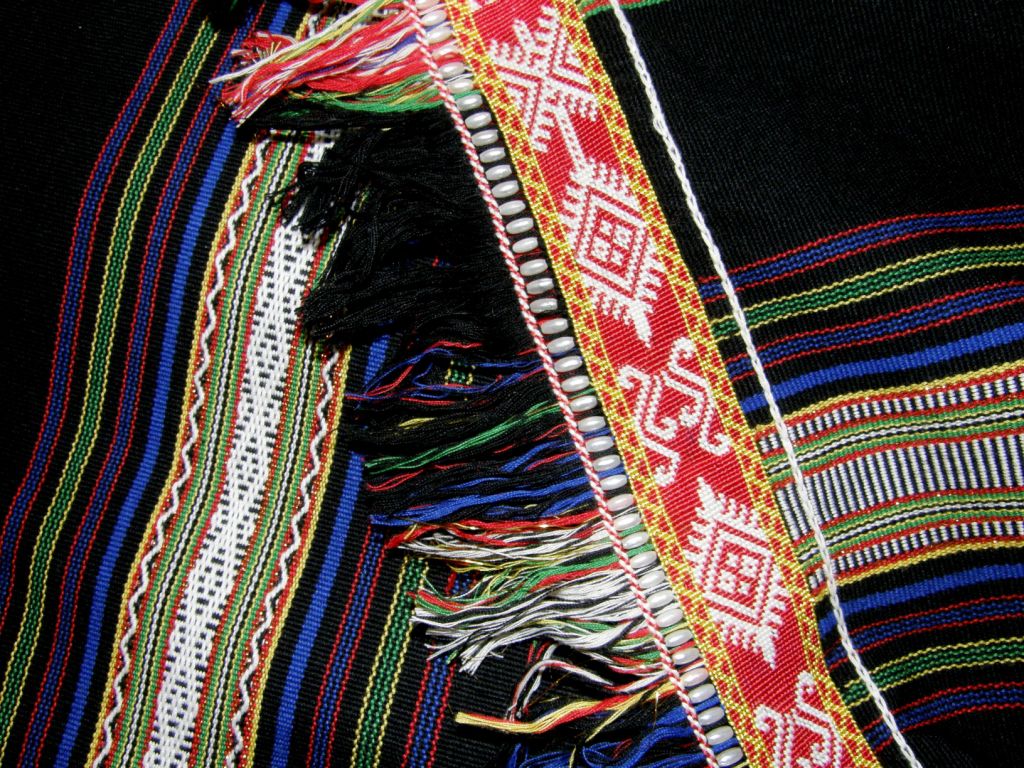
Above you can see two pieces with the kteh weft twining technique that Ngach has worked around the warps on the edge of  her woven blankets. The upper left picture is a loin cloth which Susan Stem showed me when I made inquiries about this technique on the Tribal Textiles forum. I think that Ngach’s pieces are every bit as fine as the example photographed by Susan.

So this was the technique that I really wanted to learn more about and I got to see even more amazing examples on this most recent visit.

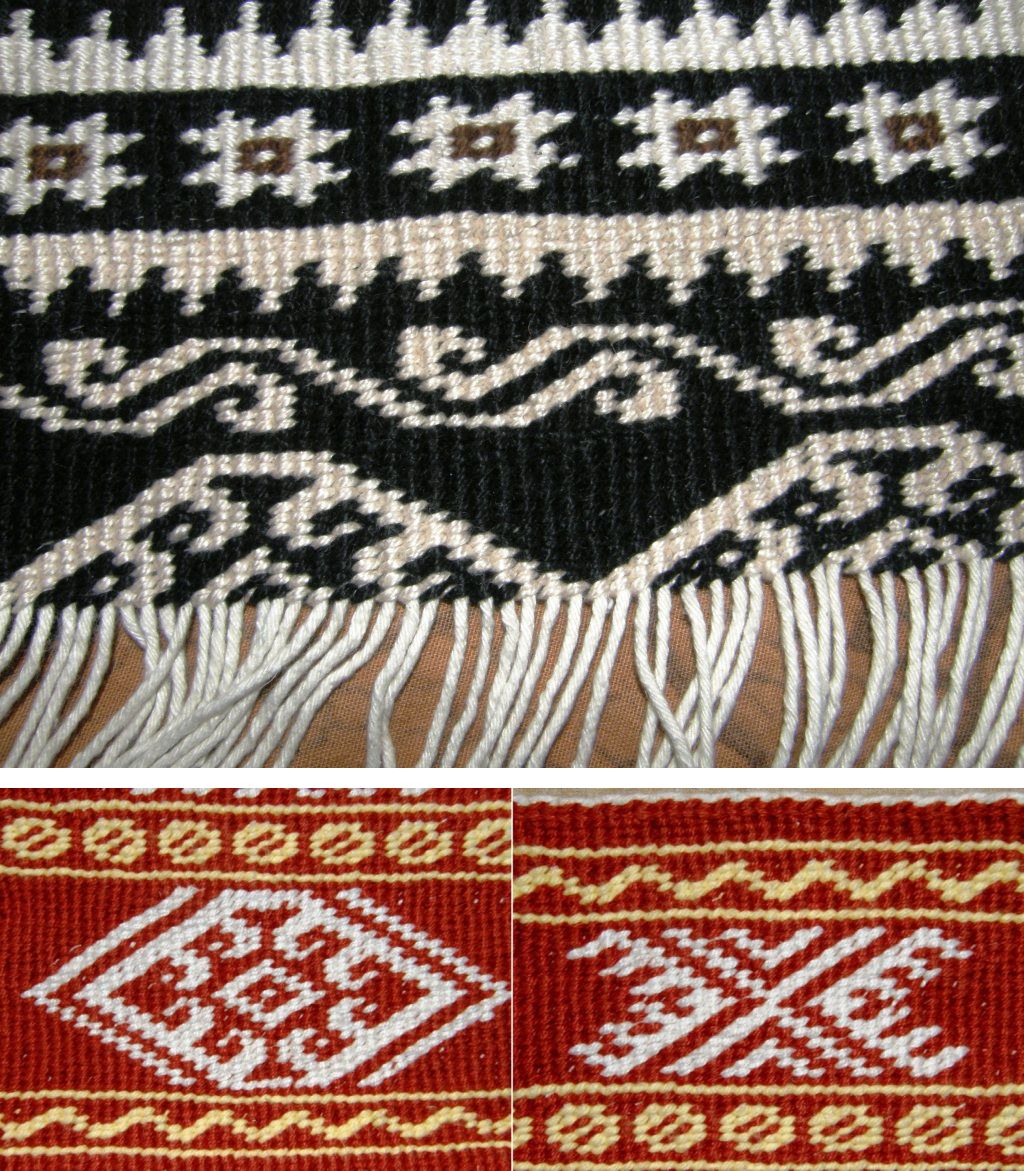
When I got home I was keen to try weft twining and made examples in different colors using Montagnard designs that I had photographed and seen online. (at left)

I learned a twining technique from books on Maori Taaniko..You can read more about this here and here.

I was surprised on my visit last week to see the use of yellow in the main design in one of the pieces as, by coincidence, I had chosen it to use in my own experiments at home.

All the pieces I had seen on the previous visit as well as in books and online had been patterned in only red and white with only the stripes done in green and yellow.

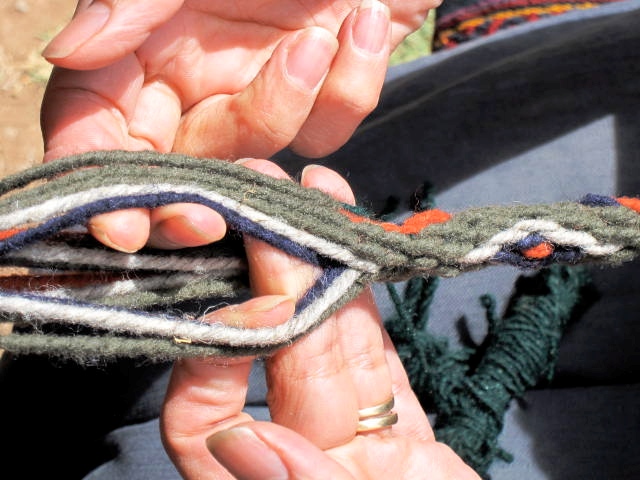
In weft twining, strands of “weft” are twisted around warps. When weft strands of two colors are used, patterns can be formed by controling which of the two colors appears on the upper surface of the piece after each twist.

Here are some more examples of Ngach and Ju’s work in kteh technique.
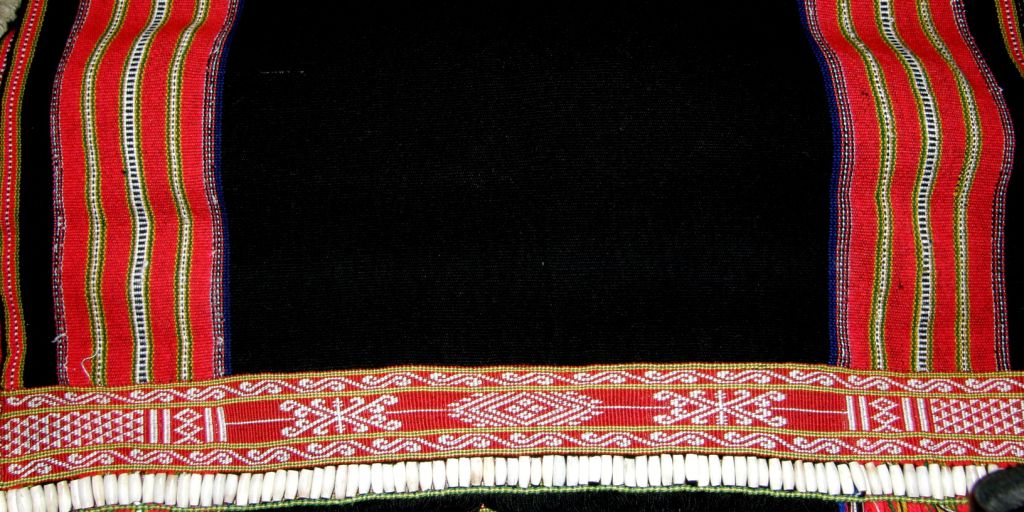
The above piece of kteh adorns the edge of an extremely fine skirt which Ju wove and which H Ni Buonya modeled for me.

Instead of being wrapped and tucked as traditional skirts are, this skirt had hooks sewn into its waist band which held the folds in place.

The twining was flawless and the selvedges impeccable. I think this was the finest of all the pieces I saw.

Eventhough I was able to reproduce the designs in my bulky cotton thread, I couldn’t feel convinced that I was on the right track until I could compare the reverse of the kteh pieces to my own twined work.

Besty sent me a picture of the back of a piece and  I was finally able to see for myself on my visit.


What I really wanted to do was learn how to do the twining alongside Ju and Ngach and Betsy was able to organize classes for me with both ladies. Ju and Ngach, as I said before, are from two different tribes, the Rhade and the Jarai and both Betsy and I thought that it would be interesting to see differences in the way the two ladies did their twining.

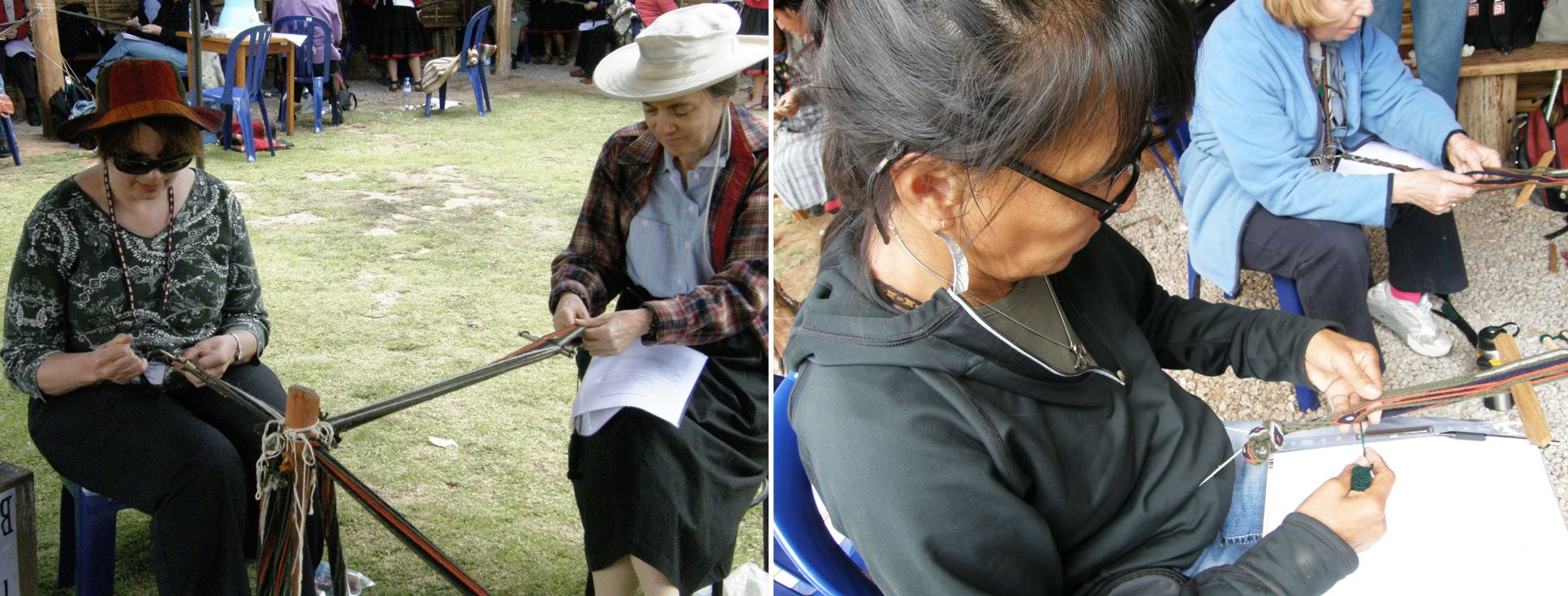
LEFT: Twining class with Nagch at Betsy’s house. At right, Ju shows me how she gathers the warps in groups and sizes them before twining.

I first met up with Ju at Betsy’s house where a collector was coming to see and possibly purchase one of Ju’s woven pieces. Ju, who I gather never likes to have idle hands, had brought along a finished piece of weaving that was to be sewn into a bag. She was busy twisting the fringe dragging the warps through a wad of sticky cooked rice that she carried in tissue and then rolling them on her leg to set the twist. She would select four warp ends, divide them into two pairs and then, with one quick movement, roll the two pairs away from her on her leg and then swiftly roll the two twisted strands back toward her to unite them.

She used this same kind of sizing to twist and group the warps ends together for twining which, as a beginner, I found very helpful . Ngach on the other hand does not size the warp ends.

The first class was with Ngach. After having seen pictures of Ngach warping outdoors on Betsy’s blog it was nice to see the enormous tree where she does it in her front yard right on the edge of a very busy street.


Here you can see the different set ups that both ladies use. Both fold and tack the woven cloth so that it can be suspended on a rod or bar with the weft ends, or fringe hanging down.  Ju, at left, has a lovely stand built by her husband especially for twining. Ngach suspends her work on a metal rod which she has supported on two chairs. Ngach is twining the end of a child’s skirt while Ju is twining  the ends of two small bags, something which she is only doing in order to be able to teach me on a small piece.

Here are pictures of Ngach twining on warmer and brighter days courtesy of Betsy. The pictures we took this time around tended to be somewhat darker unfortunately.

The wefts are stored and carried on bobbins. Ngach says that they are made of clay in Vietnam while Ju used to use wooden ones. Both ladies have had to improvise their bobbins in their new homes.

Ngach has lovely bobbins fashioned from cement.
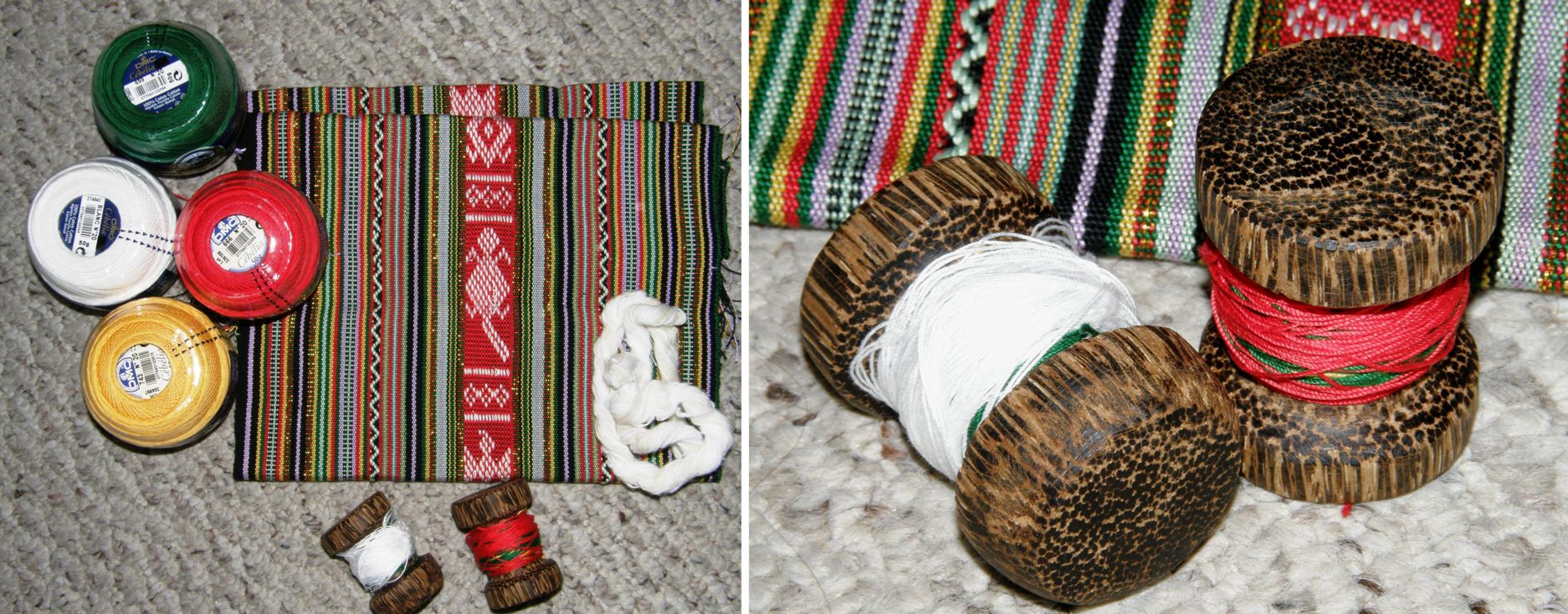
Ju’s were heavier and made from wood. Her husband bought a pestle from a Laos store from which he carved them. I bought a pair from her. Both use Cebelia size 20 thread.

Below you can see Ngach at work holding the warps under tension with her left hand while she twists the wefts on their bobbins with her right…one twist to change color in the pattern and two twists to continue with the same color.
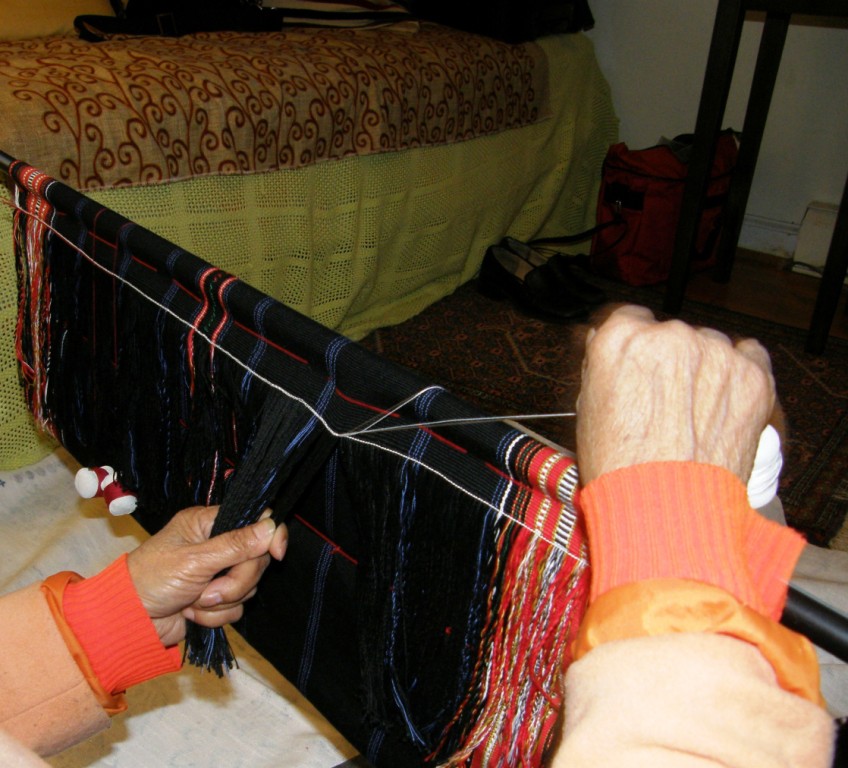
Her movements are so fluid, graceful and rhythmical and she uses her one long thumb nail to separate each group of warps around which to twist the wefts. This was the part that really slowed me down…separating the warps into correct groups of three. What was nice was that Ngach and I could sit side by side and work together. I would struggle along trying to match her rhythm. We could both work simultaneously on different rows of pattern.

Here is a rather dark piece of video which will at least give you an idea of the movements. Ngach is making a pattern in red and white. Her movements are very graceful and I love the soft “clack clack” of the bobbins as she works. You will see her doing double twists when she wants to continue with the same color and a single when she wants to change colors. I have brighter but longer videos which need to be edited when I get home so I can upload in another post.
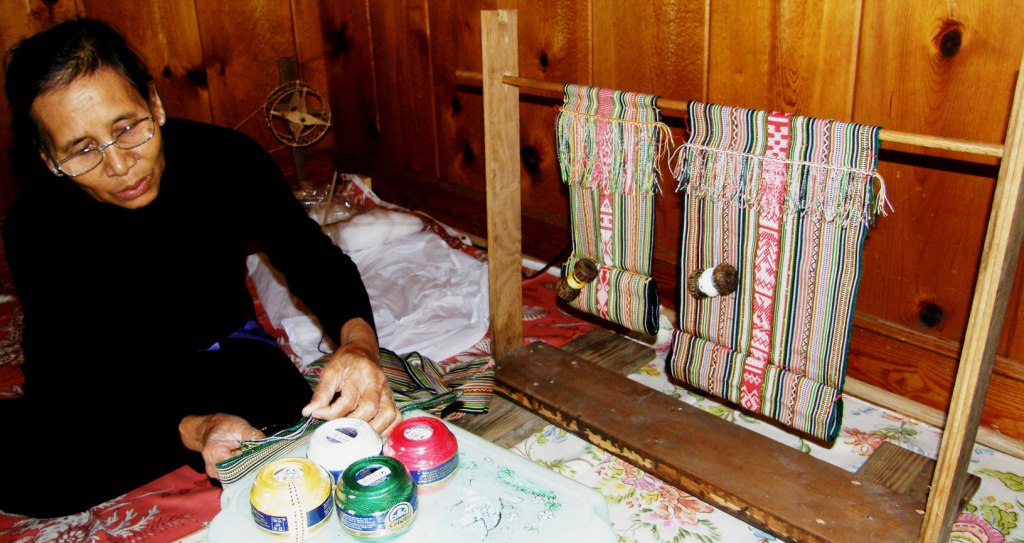
Above, Ju is twisting warps on a piece so that I can take it home and practice. I really think both my teachers enjoyed showing me this. Ju, even with her very limited English, was very talkative and eager to show me the entire process while Ngach was very keen to make sure that I learned it just right, constantly correcting and adjusting the way I was holding the warps and not letting me get away with anything. At one point when I had made a mistake and untwined to fix it, I asked her if she always undid her errors. She looked at me over the top of her glasses and said “no mistakes!”. I am not sure if that means that she doesn’t tolerate them or that she doesn’t make them but there was definitely a twinkle in her eye. I liked Ngach!

Results:

We finished a tiny design on Ju’s small piece but didn’t get as far on Ngach’s larger one. However, I enjoyed working more on Ngach’s piece for some reason. I think sitting and working alongside Ngach made all difference as I was able to watch closely and try to follow her movements and rhythm.

Each twined row always starts on the left and moves to the right. When the right edge is reached, the weft ends are knotted and cut leaving a small “fringe”.  This was something I had been very curious about as the instructions in my Taaniko book indicated that one needed to ambidextrous and twine in both directions back and forth across the piece.

Ju’s enthusiasm for showing me all about the weaving arts from her home in the hills of Vietnam didn’t stop at twining. After I had become tired from twining and the concentration it required, she brought out a wonderful spinning wheel that she had had sent over from Vietnam.

What a sweet little spinning wheel this is. It is made from simple bamboo wood and wicker and all held together with hand carved wooden pins.

Ju set to spinning cotton, which had also been sent over from Vietnam, with her foot thrown over the beam of the spinning wheel to anchor it down. She really seemed to be enjoying showing this to us.

Once she had finished with her small quantity of prepared cotton, she brought out a funny little tool that looked much like an archer’s bow to prepare more. Below you can see this tool and Ju skeining on a niddy noddy.

The following video will show you how it works. I would love to show this to the cotton spinners that I stayed with in coastal Ecuador.

On another day, I got to see a bit more of Betsy’s work with the Montagnard ladies. A few weavers gathered with their looms in a local church. Its congregation has kindly allowed its space to be used for possible weaving demonstrations. The idea was to see what would be required to enable the weavers to set up their looms in those facilities . Not only would they need a strong and stable place to tie up their looms but also a way to set up the foot braces against which the weavers push to tension their warps as they weave.

Ju and H Ni attended and finally managed to get their looms set up and foot braces in place. While I find a foot brace nice to work with, I am glad that I am not dependent on one and, therefore, have more freedom to set up my loom easily in different places.

H Ni is weaving two bands at once on her loom which will be straps for shoulder bags. Weaving two straps at once helps balances out the very wide loom.

H Ni’s set up was a bit awkward. We had to improvise adding books and bits to her bamboo poles in order to have her foot brace within reach.

I am thinking that one of those wonderful ergonomic benches designed by Synergo Arts with its built in foot rest/brace would be a solution to this problem. I wonder if they break down in pieces for transport.

A close up of H Ni’s two straps.

Ju was weaving a narrow pick up patterned piece which will be  a scarf – not one of her typical woven pieces but it has occured to her that scarves may be popular small items that visitors to her demonstrations may like to buy as opposed to skirts and blankets.

Ju and H Ni enjoyed seeing pictures of the designs from various Montagnard tribes in books that Betsy brought to the meeting.

The other purpose of the meeting was to give the weavers booklets which Betsy had put together with pictures and weaving vocabulary in English.

Khin attended the meeting to act as translator and it turns out that she too is a weaver. The problem is that many of the ladies in the community who have these weaving skills simply do not have the means to have looms made and buy thread to get started.

Betsy also made tapes for each weaver to go along with the booklets with the pronunciation of the English words for them to listen to and practice at home.

The idea is to have the weavers eventually feeling confident enough to be able to give presentations and demonstrations of their weaving to small groups in the future. I would love to return for the day when that happens and see these ladies enjoying sharing their skills with even more people with same good humor, generosity and enthusiasm that they showed me.

###########################################

Back to what I like to call the World Wide Cyber Weaving Guild….

It seems that the cold weather has brought on a flurry of weaving activity and so I am able to show you some finished projects from online friends who have visited my blog.

Anna (who is cycling from Alaska to Ushuaia and who is currently in Santiago Chile) sent me this picture of her latest pebble weave bands and Kim, whom I met at Convergence wove the pebble weave keyfob on the right. Both used the instructions from my Andean Pebble Weave book.

These are more of Kim’s bands on the left, again in pebble weave with one in simple warp floats in the middle, and Lavitaaj made this amazing supplementary weft sampler on the right using the pattern charts from my blog. There is also a section with a yurt band design in simple warp floats.

And finally, here is Marsha Knox’s band made with simple warp floats using two color combinations in the same piece while Helena in Brazil has taken the Bedouin patterning one step further with a large strip of diamond pattern bordered by the classic triangle motif. I will definitely add a tutorial on this technique to the blog soon.

UPDATE: Marsha uploaded a picture of her finished band. She reversed the scrolls and did them in brown. It looks super!
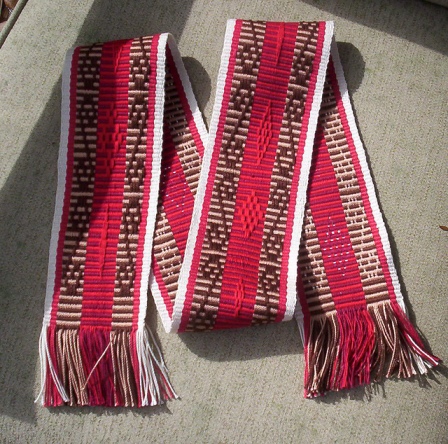

Last Sunday I got to quickly pass through the Central Asian ikat exhibit, which was stunning, at the Textile Museum in DC before attending Ann Rowe’s talk on ikat rebozos and ponchos in Latin America.

I hope to return next Saturday to take the guided tour of the exhibit, use the library where I want to look at David Fraser’s book on weft twining, and maybe pick up a few more Textile Museum journals in the gift shop.

There is hardly a journal there that doesn’t have something of interest to me. I think that eventually I will own them all.

This week Claudia and I had  skills exchange. I taught her to make the tubular woven bands that I learned at the tinkuy and she introduced me to the wonderful Weavette. Yep, this was the first time I had ever seen one of these little marvels and Claudia even has an old Jiffy Loom in its original box and a plastic Weave-It. My eye was immediately caught by the cool long weaving needles that come in the kit. Aha…just the thing for weaving in the wefts for my four-selvedge warp faced pieces and so I ordered some online.
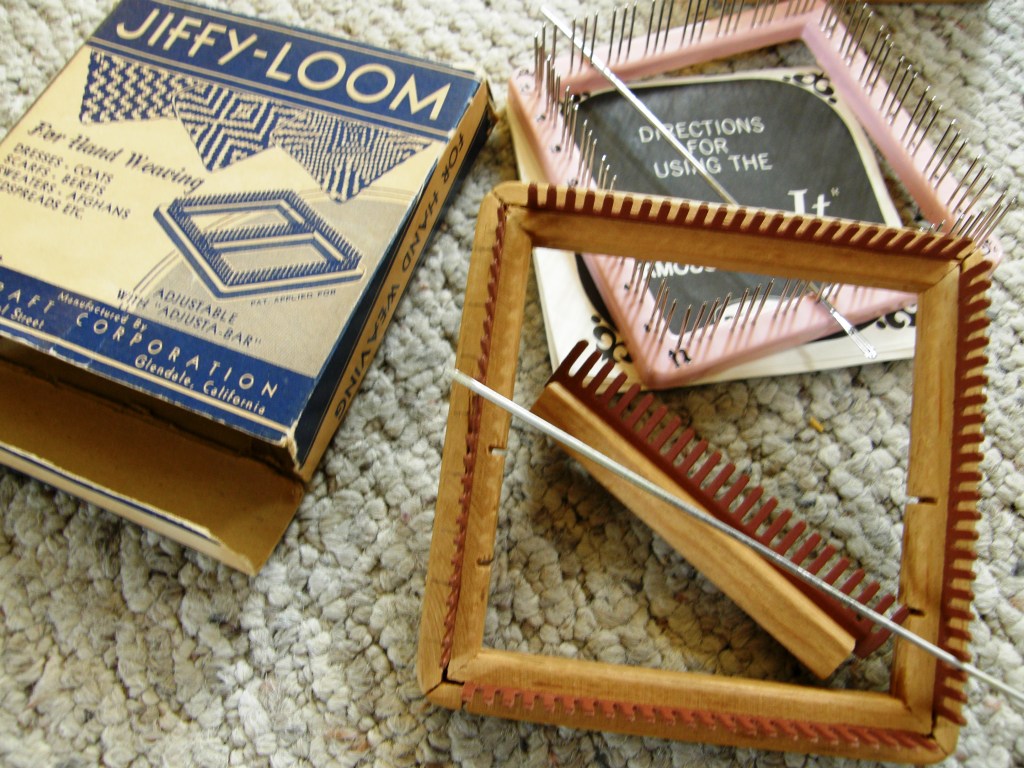
These would be just the thing for making little amulet bags…love them!

And speaking of learning new skills, here is DY, still in Peru, picking up some new techniques – drop spindling and backstrap weaving. I think she has been taking Spanish classes too.

Finally, a very happy Thanksgiving to all. I spent it Claudia and family and friends…only the third Thanksgiving I have ever had. We watched the Macy’s parade this morning and  I declare the sweet potato casserole with butter, brown sugar and pecan topping my favorite dish of the day.

Backstrap Weaving – The tail end of the Tinkuy tale.

MORE FROM THE TINKUY DE TEJEDORES

I have been busy since the last post on the tinkuy – weaving, packing and traveling! Yep, I am on the road again…can you guess in which country?

Golden leaves and pumpkins…a common sight for many of you I am sure but certainly not something we ever see in Bolivia especially not as we roll into summer. More about this trip in next week’s post.

For now I will finish off my tinkuy report and show you what I managed to get up to on my loom in my brief stopover at home in Bolivia.

I arrived home with tubular woven bands and discontinuous warps on my mind. I finished off the tubular band that I had started in the tunkuy workshop with Nilda. Nilda was an excellent no-nonsense teacher, commanding our attention and clearly demonstrating and explaining the moves to her twenty-eight participants!. She prepared excellent handouts and got us all up and running on what was a fairly complex sequence of moves which involved, picking up, twisting and diverting warps. We were turning out lovely tubular bands by the end of the session and enjoying ourselves.

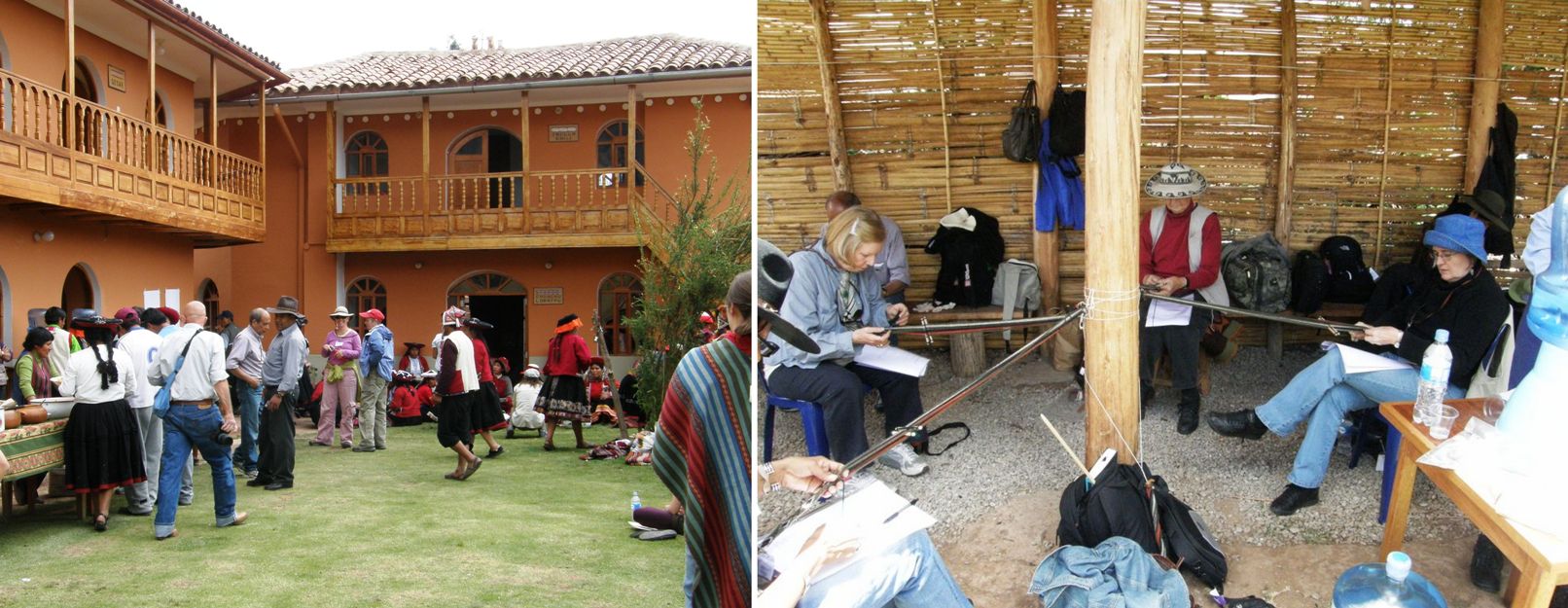
The CTTC has a beautiful center in Chinchero with large courtyards for weaving, warping and dyeing displays, workshop rooms, a store and exhibition area. We were blessed with a gloriously sunny morning and entertained by a sudden and violent change of weather in the afternoon as a storm converted the grassy courtyard to a blanket of white hailstones.
The courtyard where we worked was also alive with the colorful skeins of yarn which had been dyed in the previous day’s workshop.

With the aid of four helpers from the Chinchero weaving community, we all hitched ourselves to posts in the lovely courtyard of the CTTC Chinchero complex and wove away with always someone on hand to help if we got ourselves into trouble and, believe me, we did! Despite Nilda’s clear instructions I managed to start with my warp upside down but, with Jessica’s help, soon got that sorted out and then it was just a matter of following the steps in the well prepared handout.

All were quiet at first as we concentrated on our work only interrupted now and then by pleas for help but, as we became more familiar with the moves and, more importantly, understood better why we were making them, we could relax, chat and compare our progress.

Linda Ligon gets a few tips from one of our good humored helpers.

We started out making bands with very thick yarn – easy to see and handle while we learned the moves. D Y Begay took this picture of me at work and sent it to me.
Some of the weavers from Guatemala and Bolivia were among the participants.

Above left you can see our thick practice band and at right a finer one which we warped  in the afternoon session. After lunch we had the choice of weaving a finer tubular band, which I did, or learning to weave and sew a much simpler tubular band to a piece of fabric. The simpler band’s design was contained in its warps and so did not require any pick up, twisting or warp diversion. This was an excellent sample to use for learning how to manage the simultaneous weaving and sewing. Nilda was wise to give everyone a simpler task in the afternoon with all of us feeling a wee bit snoozy after the delicious lunch spread. The storm woke us up though!

Anita Osterhaug, Ann Rowe, Judith Crosbie and DY Begay at work on their bands. 
Betty Davenport was one of my “pole buddies”.

As for the previous day’s dyeing workshop, I saw the dyestuffs, the drying skeins and all the gorgeous colors and that is about all I can tell you for now…sorry! I am hoping that Dorinda will be able to fill me in on what they used to achieve that beautiful collection of colors. Each participant took home seven skeins.

My roommates Dorinda and Maxima participated in the dye workshop as this is precisely something on which Dorinda has been working in Cochabamba in her PAZA project.
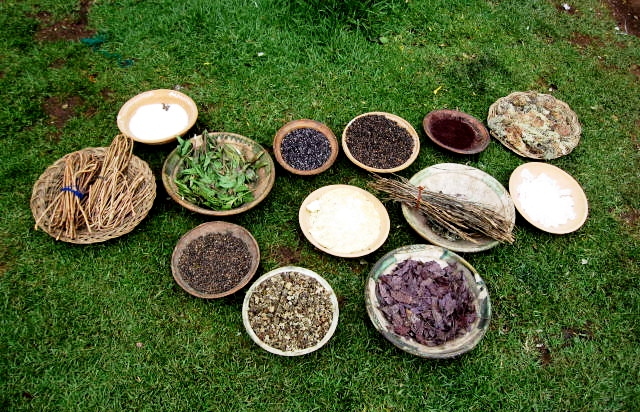
And here are the principal dyestuffs that were used.

Another interesting part of the workshop day for me was seeing different warping methods.

I was tickled to see this warping board which is the same as the one I have built for myself at home. This is the one we used for warping our tubular bands.

I was tickled to see this warping board which is the same as the one I built for myself at home. We used this one to warp our tubular bands.

This lady is warping a narrow band around nails driven into to the ground. I noticed that she had the two outer nails leaning very noticeably to the outside to compensate, I would say, for their tendency to lean in as the warping progresses. That is the problem with this kind of warping set up. I am sure that from her vast experience she knows exactly how much to angle the nails when she drives then into the ground.

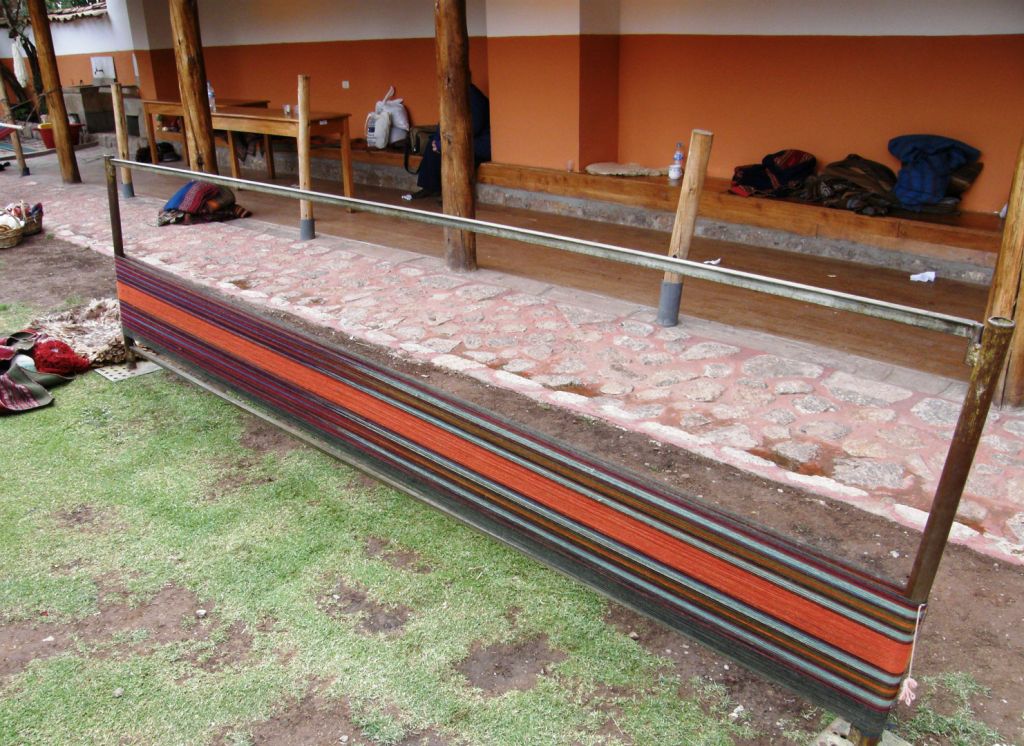
And then there was this large warping set up. Notice the metal bar which extends from one post to the other to stop any possible leaning as the warp is wound up the posts. Judith was watching the weaver warping on this set up and called me over to look. She drew my attention to the fact that the weaver was turning the warps at each end post around a piece of thicker plied yarn. In this way the warps were locked into position and this thick piece of yarn I imagine would be lashed to the loom bars in order to create the third and fourth selvedges.

Judith had been watching long enough to learn how to do it and was then able to help the weaver. I was able to make a short video where Judith shows and explains how it is done.

I am thinking that this would be a great way to wind a warp for ikat.

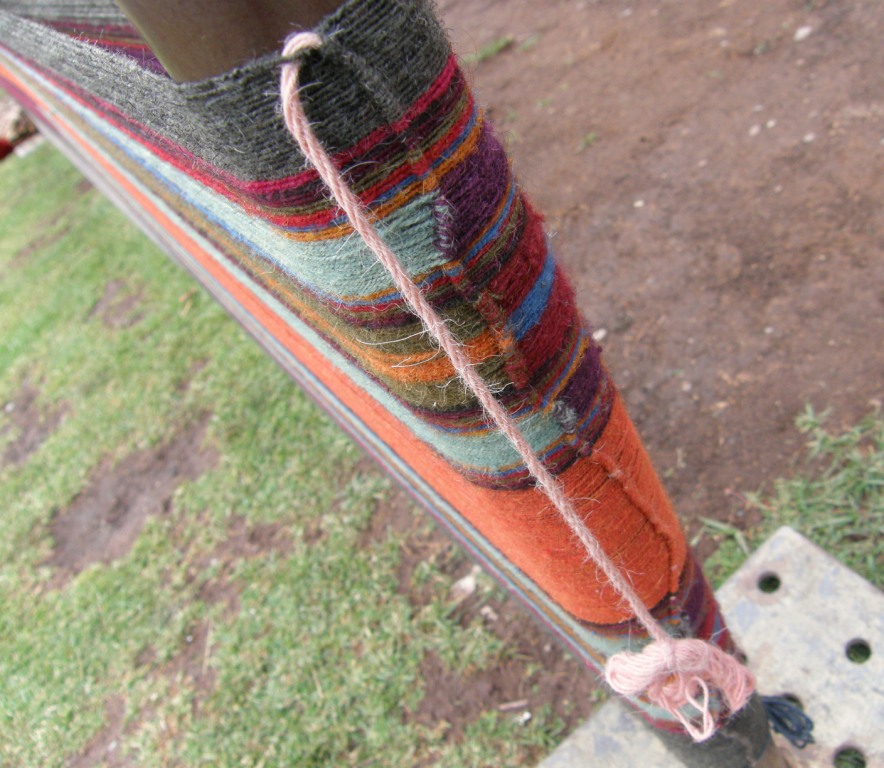
Here’s a shot of what the warps look like wrapped around this “starter” cord.

So, tubular bands were one item on my weaving list this week and I warped up a few to take away with me. These require nothing more than a string to attach it to your waist while the other end could easily go around a toe. You don’t even need to make string heddles as you work directly from the original cross.

The other thing I was determined to do before I hit the road again was experiment with the discontinuous warp technique. You may have seen the amazing piece being woven by a weaver from Pitumarca in last week’s blog post. She had warped panels of four different warp colors.

I wonder if this technique was born from weavers’ boredom with their warp colors in long pieces. I know what it is like being locked into certain limited colors for the entire length of a warp-faced piece. That is why supplementary weft patterning can be so much fun as you get to change colors as you please.

I got a pretty good idea about how this was warped by looking at the above piece. I also got a good look at Antonia’s piece at Convergence which you can see below and got to talk to her a little about it. This piece is an absolute marvel! She has panels within panels.

This, combined with a very nice photo of warping in progress in Nilda Callañaupa’s book, gave me just enough information to get a project started.

I just happened to have this rough wooden framed which had been abandoned on the terrace of my apartment block about two years ago. Stashed behind the fridge all this time it has finally found its calling! I put nails in it behind which I lodged and then tied the loom bars. I cut a groove into the wooden frame into which I could place a metal rod. This looks very roughly like the frame shown in Nilda’s book. From there it was just a matter of winding two separate figure-of-eight warps which dovetailed around the metal rod. Two people were shown warping in the picture and I must say that I could have done with an extra pair of hands.

Above is my two-panel warp with crochet cotton.

D Y ,whom I met at the tinkuy, went to Pitumarca to check out the warping process after I left Cusco (how I wish I had stayed longer and gone with her!!) and, knowing how interested I am in this, sent me pictures and has kindly allowed me to use them here.

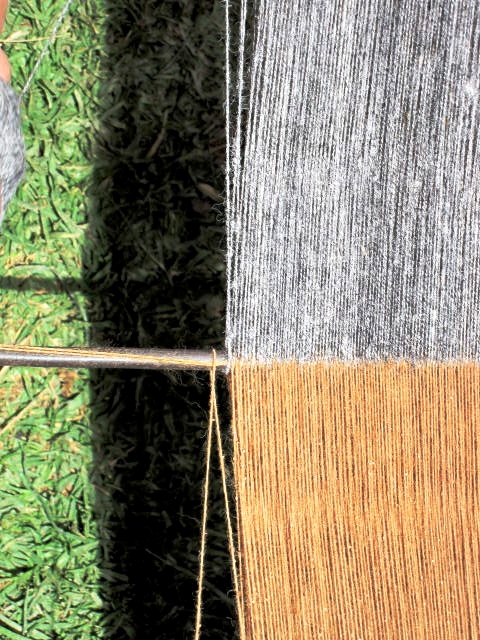
Her picture shows a wool warp in natural colors. You can clearly see how the two yarns take turns encircling the metal rod.

Now here is my piece on the loom…

I was just fumbling around trying to figure it out as I went. It turns out that the winding of the discontinuous warp was not really difficult. What was hard was creating the four selvedges, something which I have not done in years and I have to tell you right now…DON’T EVEN THINK ABOUT DOING IT with cotton!! Creating four selvedges with cotton is horrid!

Just to make clear what this entails, I have made a rough sketch….This is the way I was taught by my teacher in Potosi.

A: You have your loom set up with heddles and shed rod in place.

B: You lash your warps to the two loom bars. I always put a metal rod through the warp ends and lash that to the loom bars.

C:  Weave half to two thirds of the piece.  I have found that the amount woven varies a lot from place to place.

D & E: Turn the loom around so you can start weaving from the other end. You will have to move your shed rod to the other side of the heddles before you do this.

F: Keep weaving with the heddles and shed rod until the space is too small to allow you to continue. Then remove the shed rod and use the heddles to form one shed and needle weave in the other shed. Eventually you will have to remove the heddles and needle weave the last few weft passes.

G: Phew! Finished! Make that a double “phew” . Those last few weft passes are agony!

I had forgotten that the only three times I have ever woven a piece with four selvedges I used hard spun acrylic and wool yarn. These yarns can take the abuse of having the heddles wrenched around when trying to squeeze in weft passes in those tiny spaces and these warps are not so easily pierced and shredded by the needle. Using cotton was a disaster with serious pilling, shredding and breakages. I managed to finish it but it wasn’t pretty. A friend has since told me that over twisted and hard spun wool tends to relax once you take tension off the piece and this better fills out the spaces in the terminal area. Lessons learned.

So, at left is a photo showing only the pretty parts…!! My terminal area is rolled under the loom bar. You can see that I have removed the metal rod and have yarn in its place.

I wove in a pattern using a supplementary weft – a bird which is standing on its head in the picture. The bottom panel has been finished and I have started on the upper one. Of course I didn’t have to make this a four selvedge piece. I could have woven it with fringe at either end. This is perfectly possible with only two panels. With three panels or more you have no choice but to make the center panel/s with four selvedges.

Let’s look at the other more successful four selvedge pieces that I made in the past with sensible hard spun yarns.

My teacher in Potosi is putting in the final wefts in this piece that I wove under her instruction. This was a particularly difficult piece to finish as it had bands of double weave which meant that we had twice the regular number of warps to needle weave. I wove this with the brightly colored overspun acrylic which is the yarn of choice in this area.
The next project with this teacher was a chuspa, again in overspun acrylic, and I stopped weaving the pattern early in order to make the finishing process a bit easier. The horizontal bands show where I started to close the two ends of the weaving. My teacher left me on my own with this one!

My Bolivian teachers told me that the skill of a weaver is evident in how small she can make the terminal area. The challenge is to continue weaving the pick up patterns as long as possible before having to resort to those final rows of plain weave. My terminal area on the chuspa is enormous. I have seen pieces with mind bogglingly small terminal areas. Weavers in Tarabuco, on the other hand, often weave only one side of their chuspa with pick up design and leave the entire other side in plain weave.

The example above was woven with tightly spun Navajo wool warp. I was weaving a supplementary warp technique. It is a looser weave and was a little easier to finish.

Okay, lessons learned….the next discontinuous warp piece I do will be in cotton with two panels and only two selvedges! It will have fringed ends. Then I will get down to spinning some llama fiber or respinning some commercial wool in order to attempt a four-selvedge piece. Maybe I will do three panels with only the center one having four selvedges. I will ease into to the process this way. For now I will stick to plain weave and supplementary weft patterning and slowly build up to do doing warp pick up patterns.

I would love to do a sold color panel with a pick up patterend panel within it as Antonia was doing above.

Here are some more of the pictures that D Y sent me…

The finished two panel warp with natural wool colors.
A gorgeous warp with multi-level panels.
A closer look.

The metal bars around which the warps dovetail are removed at some point leaving a thick piece of yarn in their place.

D Y told me that the yarn lies alongside the metal rods during the warping process so that when the rod is removed the yarn is there to take its place. You can actually see this in the photo in Nilda’s book. I also received a comment on my blog from Janet Willoughby from Ends of the Earth who made a dvd documenting the discontinuous warp process and other weaving in the Cusco area and she also confirmed that this is the way it is done.

I used the umbrella ribs pictured above (yes, I destroyed my umbrella for this) to pull the yarn through as I didn’t know at the time how else to achieve this.  I also used them to help pull the wefts through the sheds in the needle- woven finish. My umbrella wasn’t destroyed in vain. The umbrella ribs have convenient holes on their ends through which you can thread yarn. I just have to taper the ends somehow so that they are more needle-like and then they will be very handy tools. (Thank you to Gladys Miller who told me about using umbrella ribs years ago).

Of course my visit to Cusco area would not have been complete without a trip to the city to visit the CTTC store and museum. The store is a feast of color and gave us yet another opportunity to watch weavers at work at their backstrap looms.

D Y and I spent a day in Cusco together visiting the CTTC, the plaza and the market to buy spindles as well as strolling around the relatively quiet Sunday streets.  The museum at the CTTC is nicely put together and there we got to see the textiles that had been woven as reproductions of the garments worn by the famous Ice Maiden, the young girl whose frozen body was found in the mountains near Arequipa in 1995. It is believed that she was sacrificed and buried on top of Mount Ampato around five hundred years ago. The story of the weavers’ quest to reproduce these textiles was told in detail  at the tinkuy. A tremendous amount of work went into that project and the weavers told of often being reduced to tears as their early attempts to reproduce the structure of the weave failed. They persevered and succeeded and it was amazing to see the results in the museum. There are pictures of these pieces in Nilda’s book.

And now to finish with a few more videos. There probably isn’t anything here that you haven’t already seen in several YouTube videos but I have edited a few snippets together just to give you an idea of the variety of skills we got to see in action during the course of the tinkuy. They are very short as I was concerned about eating up my memory card.

SPINNING AND PLYING…The first group of women is from Patabamba. In the second and third sequences you will see spinners from Chinchero.

MAKING TUBULAR BANDS AND OTHER WOVEN FINISHES AND A SEVEN STRAND BRAIDED ROPE…. The first weaver from Tarabuco is weaving and sewing a plain weave band to the edge of a chuspa. There is no pick up patterning in this band and so she is simply alternating her heddle and shed loop sheds. You can see that one half of the chuspa is decorated with pick up patterns while the other half has simple stripes.

The second weaver is weaving and sewing a patterned tubular band to a finished weaving. She works from a cross which is held on a forked stick where she picks up, twists and diverts the warps to form the designs. She also uses an auxiliary shed stick which you will see in the video. Look at the speed with which she moves the warps!

The third segment shows a lady braiding a rope using seven strands.

DOING PICK UP…three weavers are seen here showing the different ways they pick up their warps to form patterns. The first weaver from Accha Alta picks up warps to form her patterns at the weaving line. She picks with her fingers to help transfer the warps to a stick as she progresses across the warp.

The second weaver from Potolo, Bolivia creates a temporary picking cross at the weaving line. She has a stick under all the black warps and has opened the shed with all the red ones. She picks up the warps using a stick while reading the pattern right at the weaving line.

The third weaver from Tinkipaya, Bolivia works at a permanent cross which is held by cords up beyond the heddles. She picks using her hands while glancing down at the weaving line to read her pattern.

So many different ways with so many beautiful results!

And last of all, here’s ten-year old Juan Miguel weaving next to his grandma. I love this sequence and like to try to imagine the conversation. I imagine grandma is giving her little grandson some tips which he doesn’t seem to be heeding! I love the obvious amusement and pride in her expression and attitude.

In the second sequence, everyone around Juan Miguel is packing up to go into the conference room and I imagine grandma telling Juan to pack up too. Maybe his response is…”Just one more row abuelita, the lady is filming”.  Juan Miguel continues to concentrate and weave away with a quick glance up at me – a true weaver enjoying his work!! At the very end you hear a commanding voice just as I stop filming. That was mom and, at the sound of her voice, Juan Miguel drops everything and hurriedly packs up.

Helena (Telarahna on Weavolution) in Brazil has been weaving yurt band designs following the tutorials here and here and pattern charts here on my blog. She has put the red and blue, as the yurt band weavers do, very nicely together. Helena never ceases to amaze me. English is not her first language but she has searched the net, bought books and used the information on my blog to teach herself to weave. Most of her resources are  in English and she has been a great source of information on indigenous weaving in Brazil for me too.  I hope she will inspire you all!

Part One of this Tinkuy Tale can be seen here.

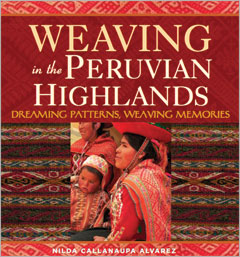
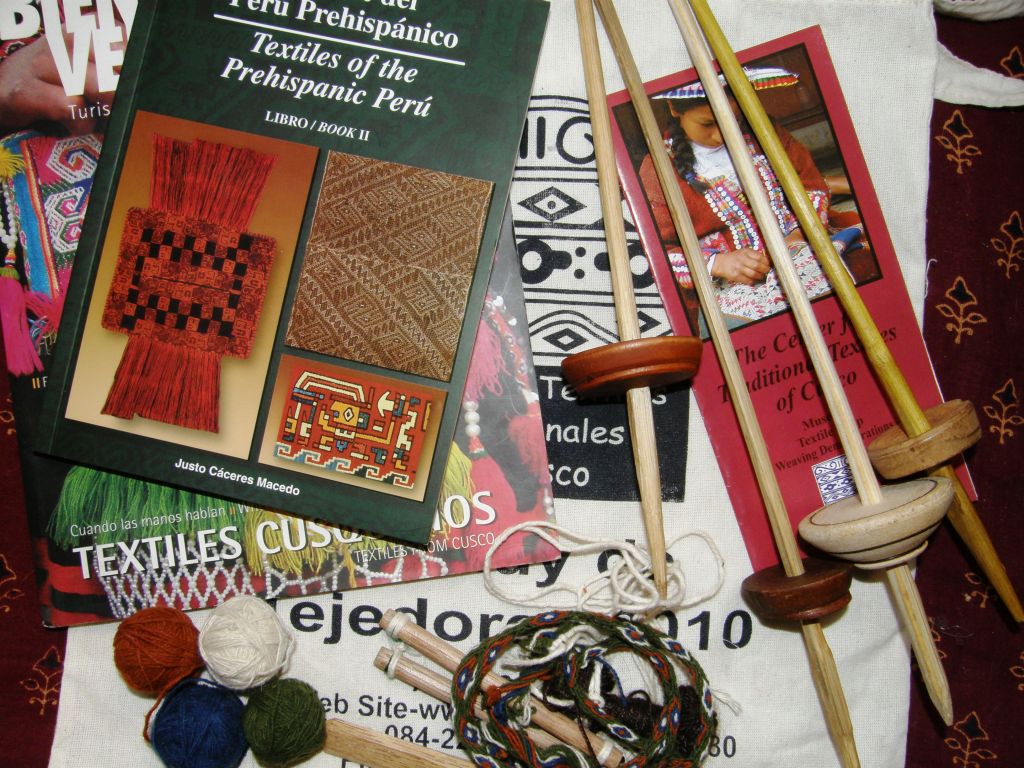
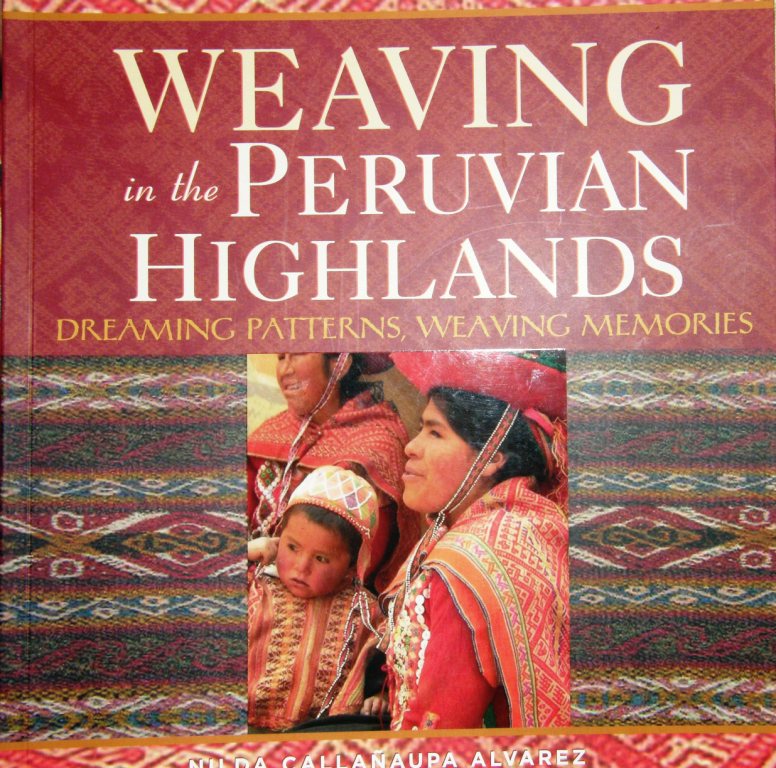
If you have enjoyed reading about the artisans in the Cusco region of Peru in my report on the Tinkuy de Tejedores and are interested in the work of the Centro de Textiles Tradicionales de Cusco, I urge you get a copy of Nilda Callañaupa’s book….

Backstrap Weaving – Tinkuy de Tejedores 2010

TINKUY DE TEJEDORES 2010 URUBAMBA, PERU

The Tinkuy de Tejedores 2010 is over and I am back home in Bolivia wondering what hit me! There were four intense days of colors, sounds and new experiences… meeting up with old acquaintances, putting faces to online user names and making new friends while trying to absorb everything around me and learn as much as I could with a head spinning from a combination of altitude and information overload.

I didn’t bring back much in the way of physical souvenirs…the shoulder bag which was part of our registration package, a couple of spindles that I got in the Cusco market, two more which I swapped for one of my amulet bags with Maxima, a Bolivian weaver from Cochabamba, a locally published book on textiles which I bought at the airport while trying to use my leftover Peruvian Soles and some balls of handspun yarn left over from the workshop I took.

I didn’t buy any textiles but I did come back with a new weaving skill and lots of ideas about making textiles with discontinuous warps. I plan to warp for a very narrow  plain warp faced piece with discontinuous warps in the next few days which I hope to decorate with supplementary wefts as this will be the easiest technique to start with. If that is a success, I will attempt a complementary warp technique. It was great having the opportunity to get a close look at some of the discontinuous warp pieces on the loom being woven by the ladies of Pitumarca. From what I can tell, the grey and brown warps dovetail around a metal rod when the loom is being warped. The pick-up pattern appears to cover the entire length of the grey panel with no terminal area – mind boggling, really! I wish I had spent more time with this weaver. This was the most amazing thing I saw at the tinkuy.

This piece has one of its four color panels complete. Done in all natural wool colors it is going to be spectacular. The unfinished areas are those that have been rolled up on the loom bar nearest the weaver.

It’s interesting that she has woven the grey panel, turned the loom around, and now seems to be working her way back. She has just started the bottom of panel three. Perhaps she will then turn the loom around once again to weave the other end of this panel and then go filling in the space in between. There are so many questions that I forgot to ask this weaver, like, at what point the metal bars around which the discontinuous warps dovetail, are removed and replaced with yarn. Well I shall just have to experiment and see for myself.

I am constructing a warping board for myself for my piece based on a picture in Nilda Callañaupa’s book pictured above.

So, as far as weaving skills go, I brought back ideas about the aforementioned discontinuous warp pieces  and I learned the tubular woven bands of Chinchero and Patabamba in the workshop I took. If you have read my last two blog posts  you will know that I recently learned how to make these tubular bands or ñawi awapa from instructions in Adele Cahlander’s book. I strongly suspect that Adele Cahlander figured these bands out by pulling them apart and studying the structure rather than by learning from the weavers themselves and she has been able to give instructions so that one can reproduce them.

EDIT:  I have since been pointed to an article which says that Cahlander based her instructions on a partly woven specimen that had a complex arrangement of string heddles and shed loop so obviously the tubular woven bands were or are woven somewhere using this set up. As I said recently in a previous post…”There is no one “right” way”.

I find it amazing that she was able to analyze the specimen, compile excellent instructions for its reproduction and share all that with those who can’t travel to Peru and learn it themselves from the weavers.

However, the way we were taught in Chinchero by Nilda is SO MUCH easier!!

I took a partly woven band which I had warped up according to the Cahlander instructions with its string heddles to show the weavers and they were quite astonished by this strange set up. The green band above is the one I started in the workshop and finished at home. The red one was a gift for the workshop participants.

Another thing I took away from the tinkuy for my own weaving was lots of inspiration for color and design as well as a new respect for supplementary warp patterning (a technique of which I have never been a big fan) after having seen the amazing ponchos of the Chahuaytire and Accha Alta communities. A weaver from Accha Alta with her piece profusely patterned with supplementary warp patterns can be seen below. She is rolling the heddle stick towards her while pushing down on the warps behind in order to open the heddle shed.

I can’t believe that I am sitting here now at home in the tropical heat of the Bolivian lowlands while just one week ago I was making my way to Urubamaba at 2863 meters in the Peruvian highlands. I would say that of all the trips made by international visitors to the tinkuy mine was probably the shortest…just a one-hour flight from Santa Cruz to La Paz with enough time to stroll around outside the airport and take pictures of impressive Mount Illimani. In La Paz I met up with Dorinda and Maxima who were to be my roommates in Urubamba. I had met Dorinda Dutcher through WARP connections over a year ago and had corresponded with her by email. This was our first face-to-face meeting. Dorinda founded PAZA (Project Artesania Zona Andina) in the town of Independencia, Aypopaya province, an organization which she describes as  “a Peace Corps project which became life’s calling”. She raised funds to be able to bring master weaver and PAZA coordinator Maxima Cortez with her to the tinkuy. The non-profit organization KURMI in Cochabamba also provided funding for a group of weavers to attend so we traveled from La Paz to Urubamba as a group of fourteen.

Witnessing the group’s reactions to all they experienced on this trip and at the tinkuy was another wonderful aspect of this whole journey. Please read Dorinda’s reports on the PAZA  blog to learn more about her goals, challenges as well as volunteer opportunities with PAZA.

These ladies had been traveling literally for days! First, an eight-hour bus trip to Cochabamba followed by an overnight bus trip to La Paz before they could even get on the fifty-minute flight to Cusco. Then came the inevitable mess of paperwork on landing in Peru but no one’s spirit was dampened.

Are we there yet?

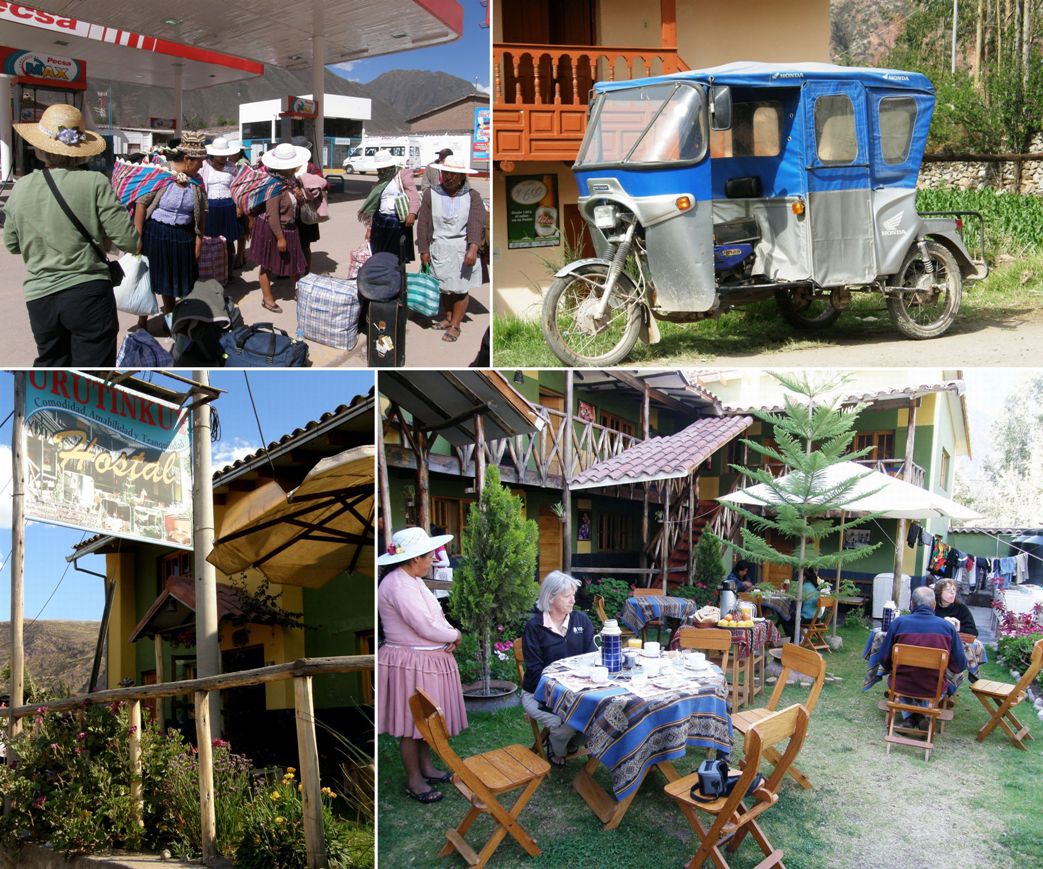
So when we got to Urubamba and made the mistake of getting off the bus too early, the ladies just took it in their stride, wrapped their luggage in their carrying cloths, hauled them onto their backs and took off up the road while I struggled along with bags in hand and dangling off my shoulder. Below you can see us lost at the gas station at the wrong end of town.

A hot, dusty and wind-tousled group finally arrived at the Hostal Urutinkuy that afternoon.

At the hostal I met lovely D.Y Begay, a Navajo weaver who had been invited to present at the conference. D.Y and I had been corresponding by email for some months and it was great to finally meet her. She was slated to be the first presenter of the conference and was a little inconvenienced by the fact that her luggage had not shown up.

The tinkuy comprised two days of conference with an incredibly heavy schedule of talks and presentations with breaks for drinks and snacks and weaving demonstrations. Lunch was followed by more weaving demonstrations and opportunities to buy textiles. If you were wise enough to arrive early in the morning you had the chance to mingle in a bit more leisurely way with the local weavers and spinners and avoid a bit of the chaos.

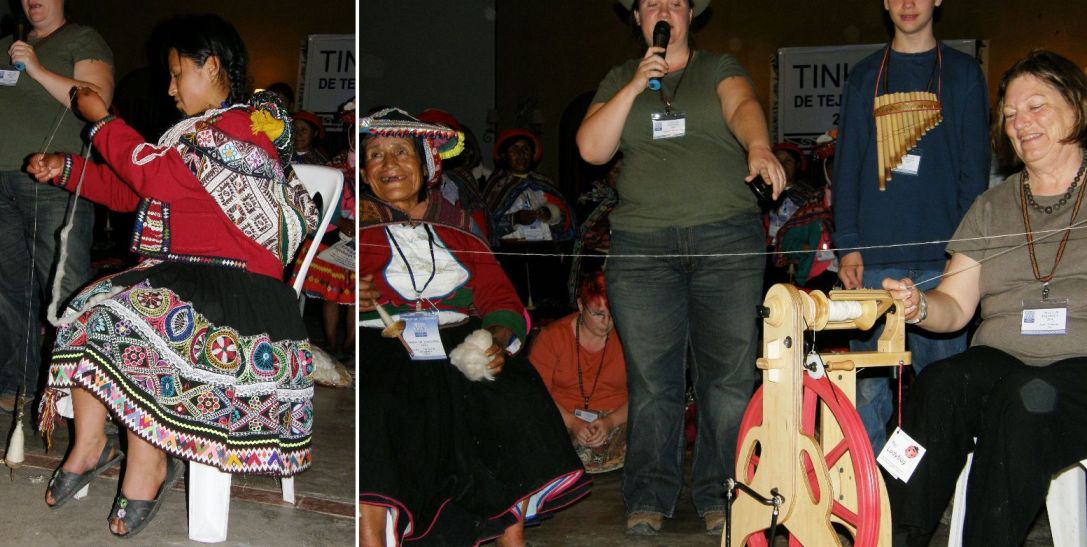
We gathered in the evenings in the conference auditorium for dancing, music, singing, spinning competitions, which were narrated  by Abby Franquemont, and lots of laughter. Beth’s (of The Spinning Loft)  young daughter competed on her wheel with a local spinner on a  drop spindle as did Judith MacKenzie. I honestly don’t remember who won but I do remember that the Bolivian ladies from Cochabamba really strutted their stuff in speed spinning the following night and my roommate Maxima took home a prize having spun over six meters in two minutes.

I am just going to show you here now a selection of captioned photos which, I hope, will give you a feel for what went on in those two days and just how much we managed to pack in!

It all started with a ceremonial offering to Pachamama performed by an Andean priest accompanied by the sounds of the pututus, (conch shells), which were also blown to announce the start and finish of each guest speaker’s presentation. Everything was translated into three languages – Quechua, Spanish and English and the Quechua translator with his strong, clear dramatic tone of voice was a joy to hear.

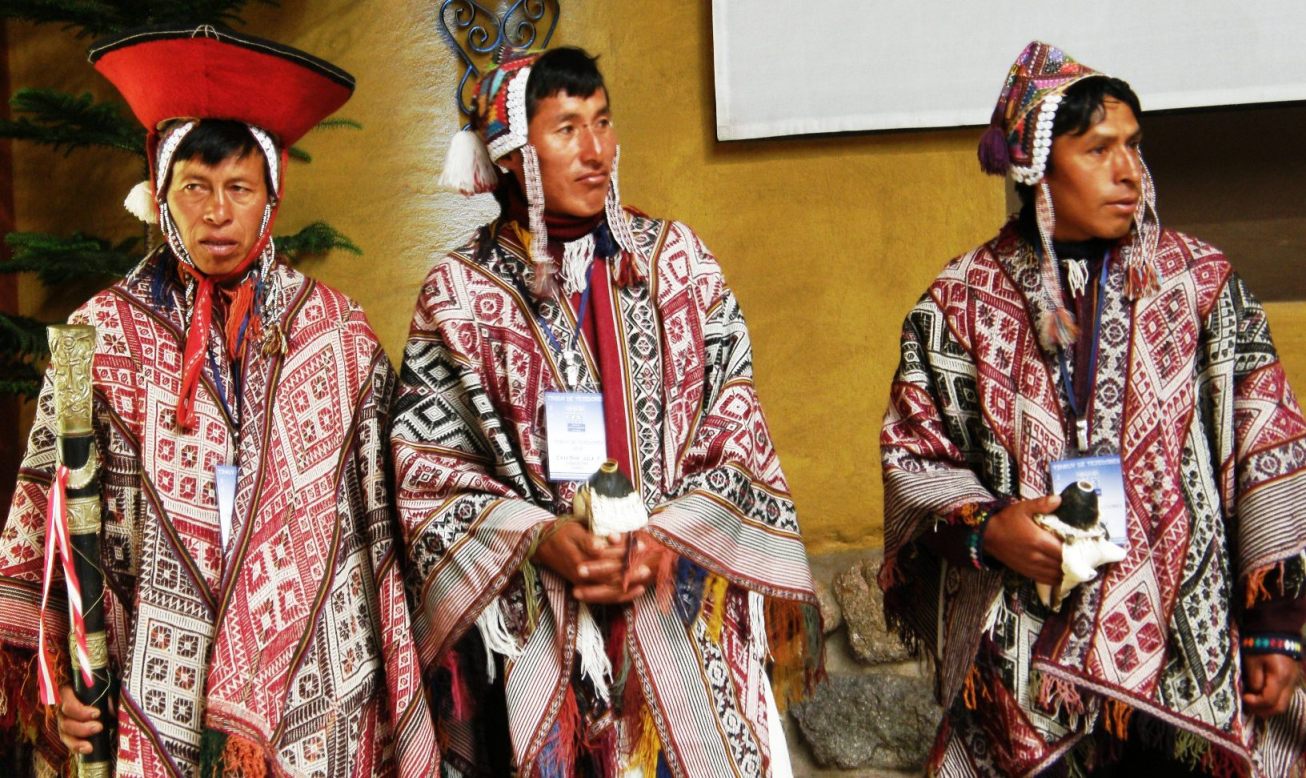
High-ranking community members with conch shells in hand took part in the opening ceremony.
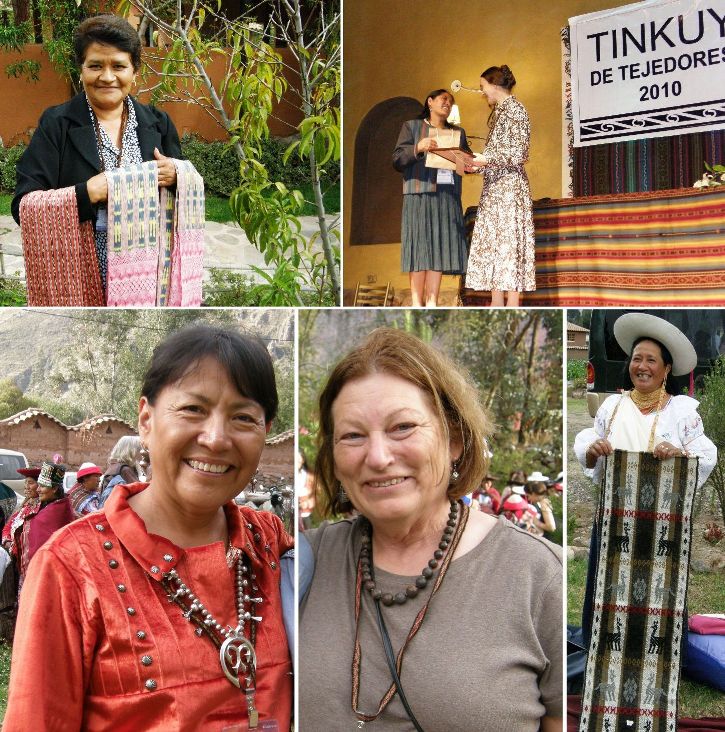
Just a few of the foreign invited guest speakers: Luisa Govea of San Luis Potosi, Mexico, weaver of fine silk ikat shawls using designs from the 17th, 18th and 19th centuries. Ann Pollard Rowe - I met her in 2007 at the Textile Museum in Washington, a meeting which led me to a wonderful weaving and spinning adventure in coastal Ecuador and it was lovely to have the opportunity to see her again. She gave a presentation entitled "Looms of the Americas". D.Y Begay who spoke on the traditions and practices of Navajo weaving. Judith MacKenzie's talk was entitled "Fibers of the Americas". Luz Maria Andrango of Otavalo, Ecuador demonstrated the Great Wheel and brought textiles to show from the workshop of her famous father, Miguel Andrango.

There were at least two dozen national and international presenters over the two days. I was especially pleased to have been able to meet Mary Frame who spoke about Inca geometric figures called tukapu. I am determined to learn three color double weave so I can use some of those designs in my pieces.

In the talks we were taken on journeys from Mexico and Guatemala to Bolivia and around Peru from pre Incan and pre Hispanic times to present and taught about techniques from weaving and dyeing to administration and marketing.

Maiwa Productions showed us a wonderful video on indigo dyeing in India.

Some of the presentations I most enjoyed were those by the weavers in the communities that are involved in the Centro de Textiles Tradicionales de Cusco (CTTC). They spoke of their lives before and after their experience with CTTC, their struggles, successes, accomplishments, frustrations and failures while trying to revive their lost weaving traditions. The talk I enjoyed most of all was that given by a group of weavers who described the impact of weaving competitions on their motivation to continue weaving and improving, their self esteem and ability to solve problems and work as a team.

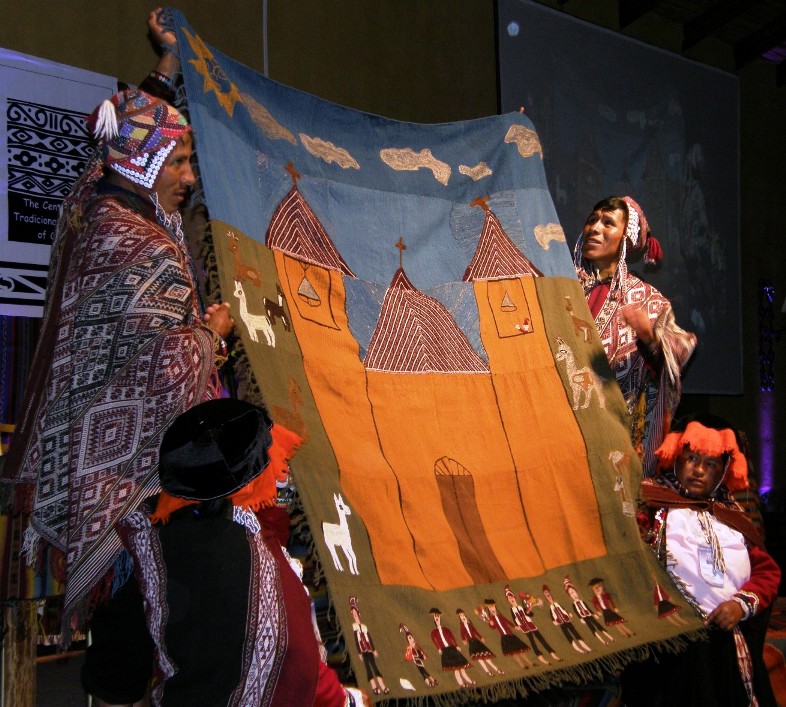
We witnessed the winning weavings and the prize-giving ceremony for the 2010 weaving competition.


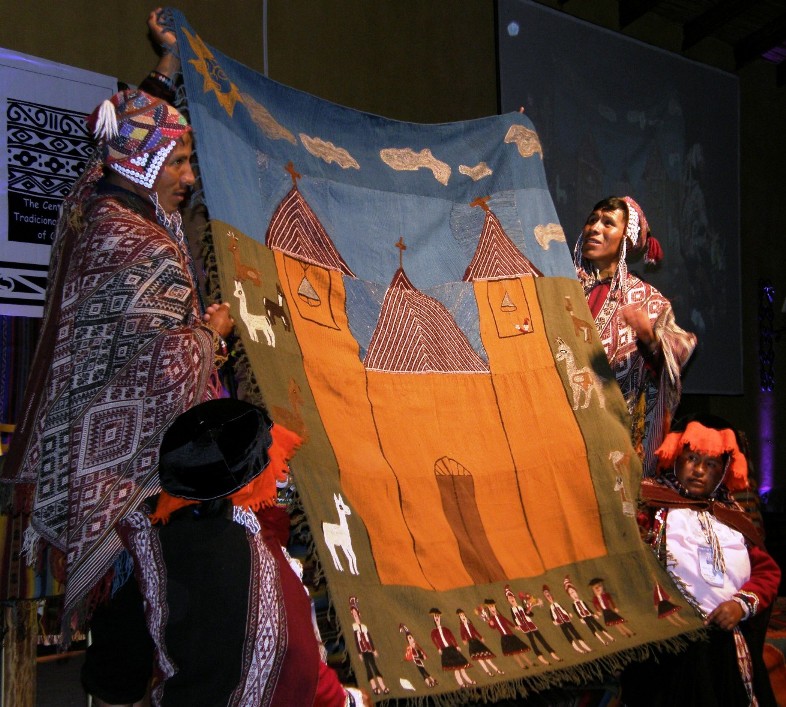
This is the winning piece by the weavers of Chahauytire community and is entitled "matrimonio". I have to admit that this had me scratching my head at first wondering about something so relatively plain from weavers renowned for their intricate pick up patterns until I realized that this piece is made up of thirty-six individual squares of thirty by thirty centimeters, each woven by a different weaver. Imagine!! I can't even begin to imagine how difficult it would be to create a four-selvedge piece that came out exactly thirty cm long. And thirty-six weavers had to turn out pieces with the same level of exactitude so that they could be pieced together with no puckering or stretching...AMAZING!! How difficult it must have been to match the diagonal lines on the two panels that form the church roof!!

Two other prize-winning pieces are shown below. All pieces had to meet the same requirements and have their thirty six panels of thirty centimeter squares. Every weaver has their own tension which means that no standard warp length can guarantee a thirty-centimeter finished length. The weavers who gave the presentation about the competitions let us in on some of the difficulties and disappointments they had to deal with in these projects and the problems they faced and overcame working as a groups rather than as individual weavers.

The following pictures were taken during the coffee and lunch break demonstrations and first thing in the morning when the weavers would be arriving early from their communities.
There was plenty to fascinate everyone...not only the foreign visitors but also the local Peruvian weavers. During this lunch break many couldn't take their eyes off the loom and weaving of a Bolivian weaver from Tinkipaya, near Macha, in Potosi, Bolivia. They stood and watched her from every possible vantage point and some were just as camera happy as we were.
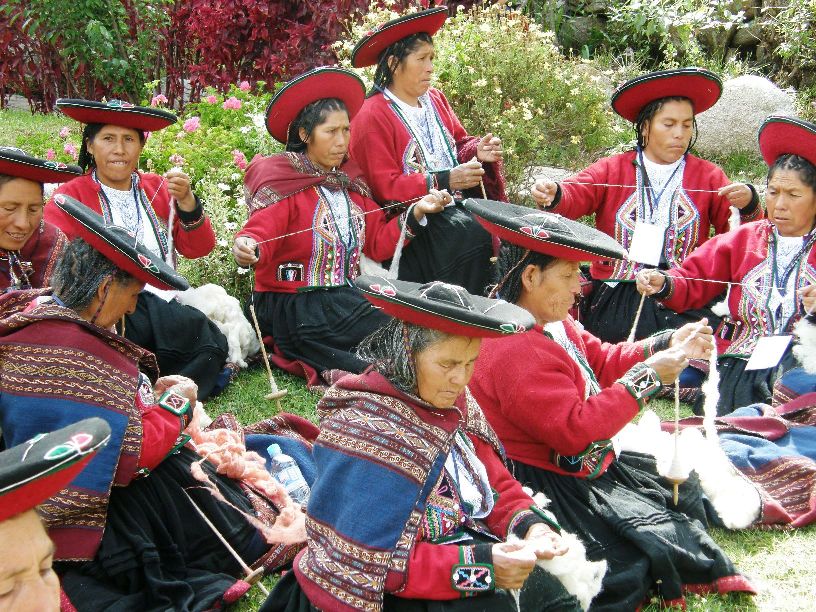
The weavers, spinners and knitters would arrive by bus early in the morning, some coming from communities as far as five hours distance from Urubamba (and some maybe even further). Time was easily passed by sitting in groups spinning, knitting and chatting.
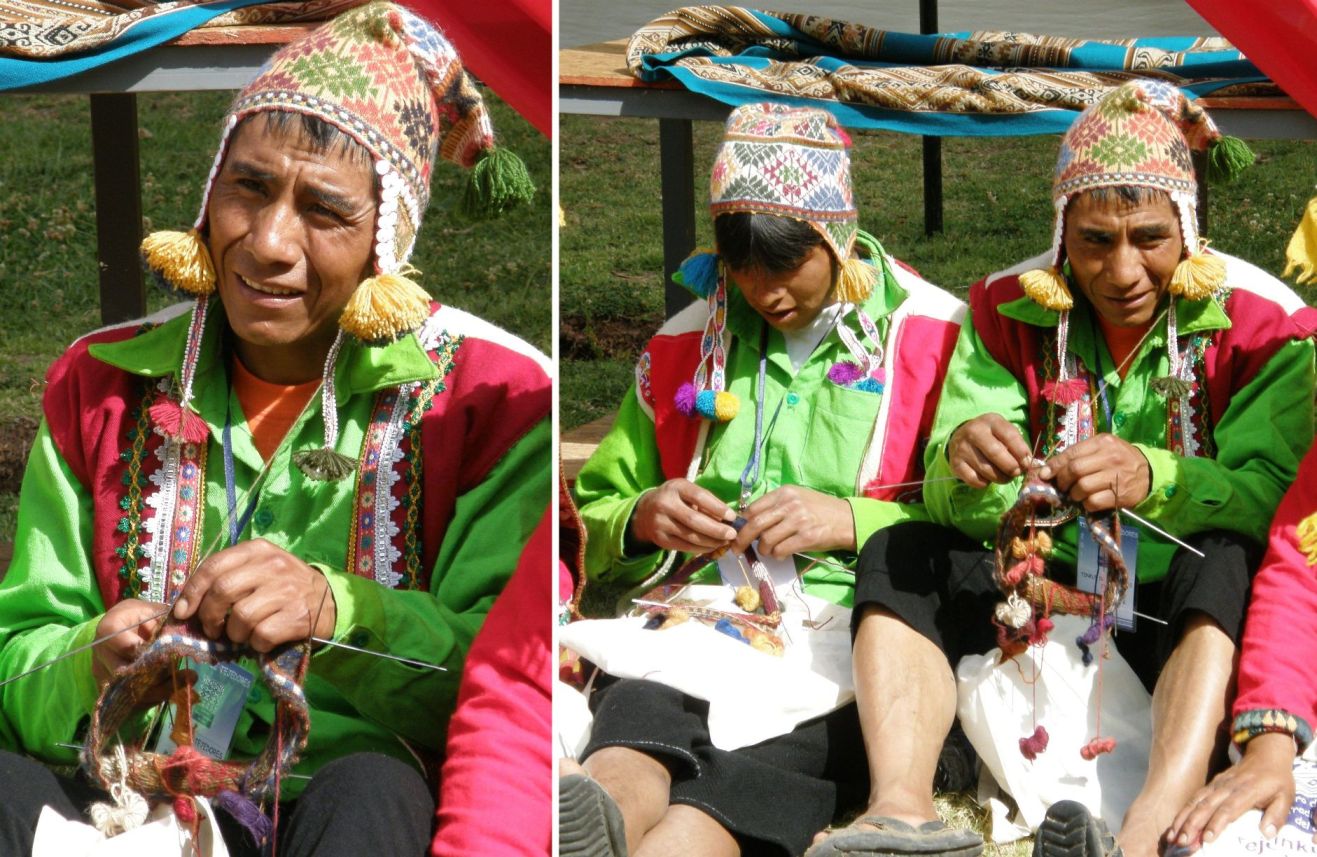
Knitters from Sallac community pass the time before the start of the conference.

There were many kinds of looms and weaving techniques to be seen….

A Guatemalan weaver from Santiago Atitlan on the left makes designs with supplementary wefts and a Bolivian weaver from AAA, la Asociacion de Artesanos Andinos from Cochabamba, Bolivia props her loom against a low wall to weave complementary warp pick up patterns.
A group of weavers who work with ASUR in Sucre came including this Jalq'a woman from Potolo. At right is a weaver from Accha Alta weaving a supplementary warp technique.
Tapestry techniques from South and North America. I am sorry that I didn't find out which community this gentleman is from but it was wonderful seeing him weaving tapestry on a backstrap loom. At right, D.Y Begay demonstrates Navajo weaving on her vertical loom.
Weavers from Accha Alta on the left and Santo Tomas on the right. While the weaver from Accha Alta uses a stick to pick up his warps I noticed that quite a few weavers pick up the threads with their hands as I prefer doing.
I have just updated this post to add this photo not originally included as I did not know from which communities these two weavers are from. Now I see in a magazine that I picked up in a street book fair in Cusco that the lady on the left is most likely from Ccachin. I don't know about the weaver on the right. The colors in their outfits are so intense!
Luz Maria Andrango of Otavalo, Ecuador created a lot of interest with her demonstration of spinning on a Great Wheel (walking wheel?).
Ten year-old Juan Miguel of Acopia community started weaving in August and is doing pebble weave here while his grandma watches. The wee girl on the right is even younger I think and is weaving a tapestry on a floor loom where her little legs can barely reach the peddles.
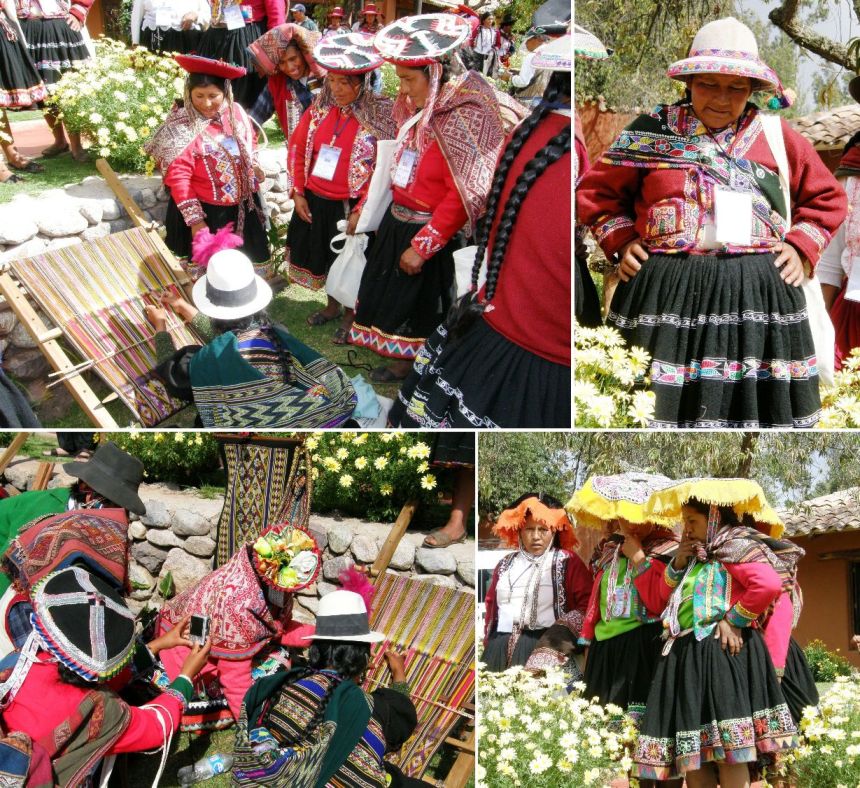
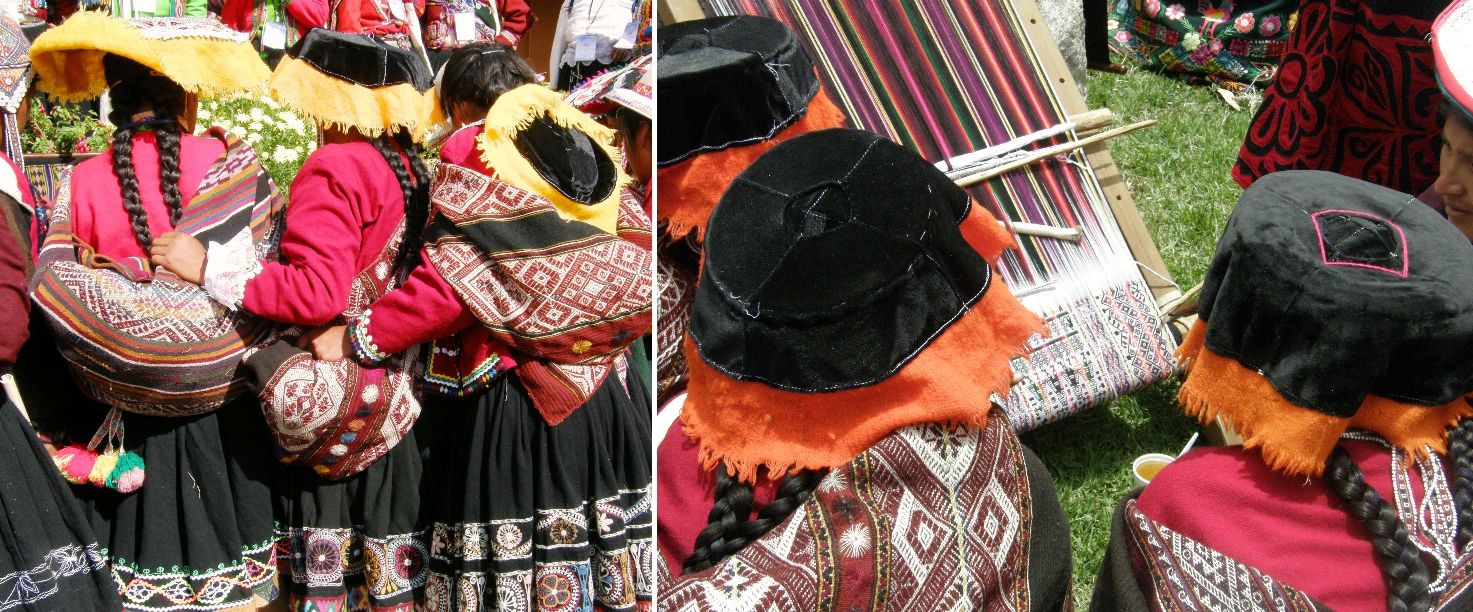
Watching the watchers...while the weavers gathered around to watch the demonstrations, I stood back and admired their gorgeous outfits. On the left is a group of ladies from Sallac community and on the right from Chahuaytire.
Bolivian textiles...a jalq'a weaving with its strange khurus, double weave belts in handspun and naturally dyed yarns made by the weavers of PAZA, Cochabamba, a weaver from Tarabuco adds a woven edging to a finished weaving, a bag made with the typical zig zag and "eye" motif of Tinkipaya and Macha in the Potosi area.
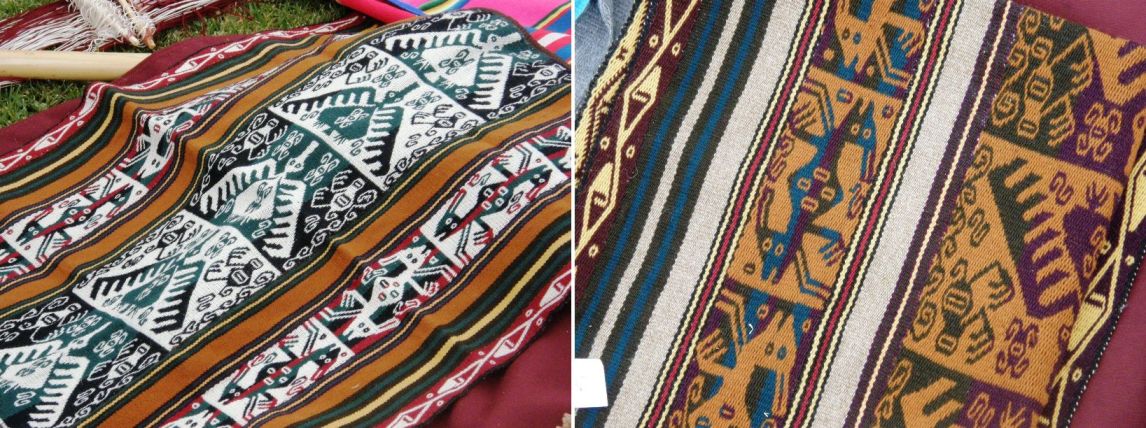
Rosa Choque, an Aymara weaver, gave a presentation at the conference on projects in which she is involved which aim to preserve the textile traditions of Moquegua, Peru. I think that these are some of the textiles which she brought but I could be mistaken. I would love it of someone would confirm this for me.

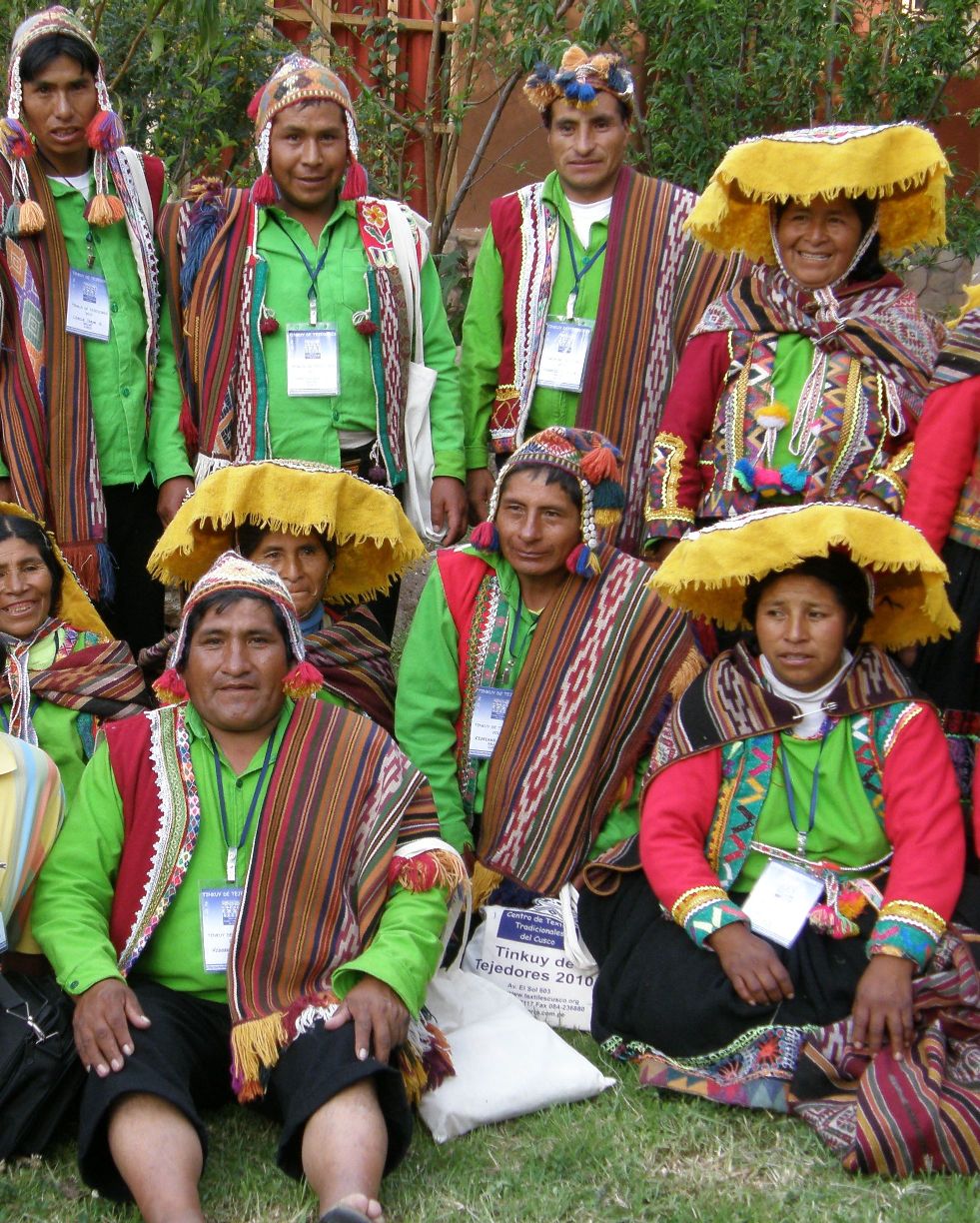
On both days during the afternoon break, the local weavers gathered in groups which gave us all plenty of nice photo opportunities as well as a good chance to learn the names of the different communities and, therefore, be better able to recognize their members by their outfits.

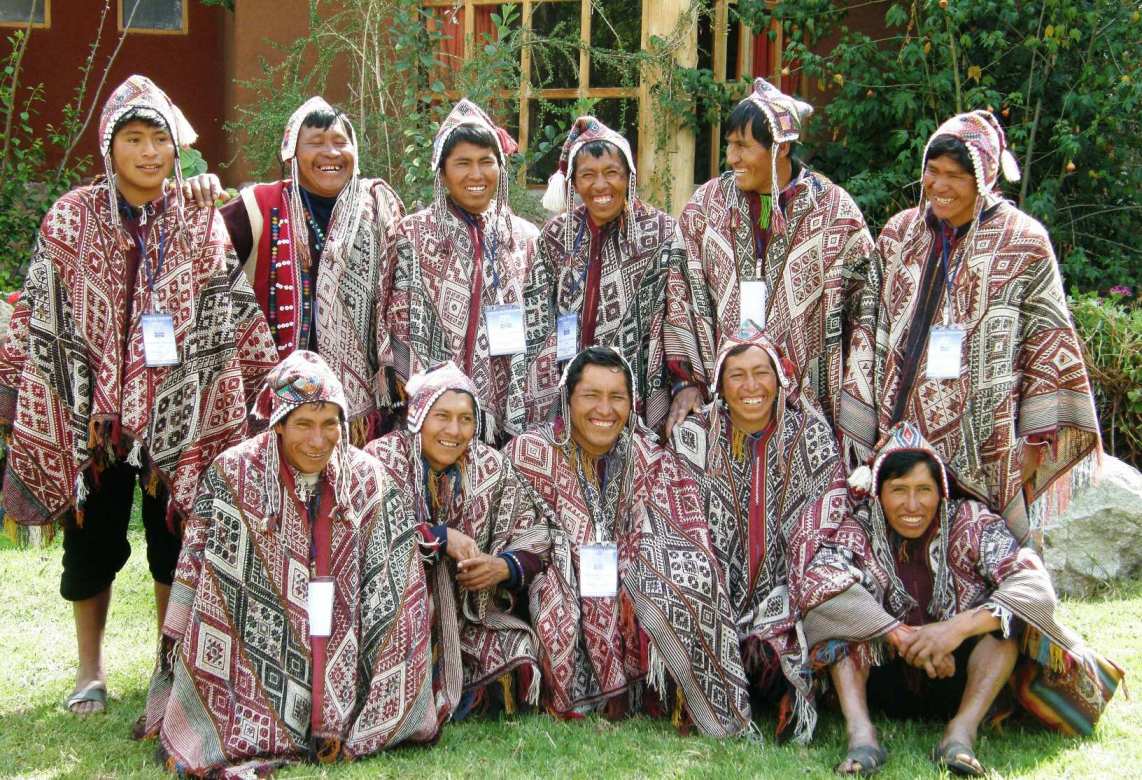
Men from Chahuaytire.
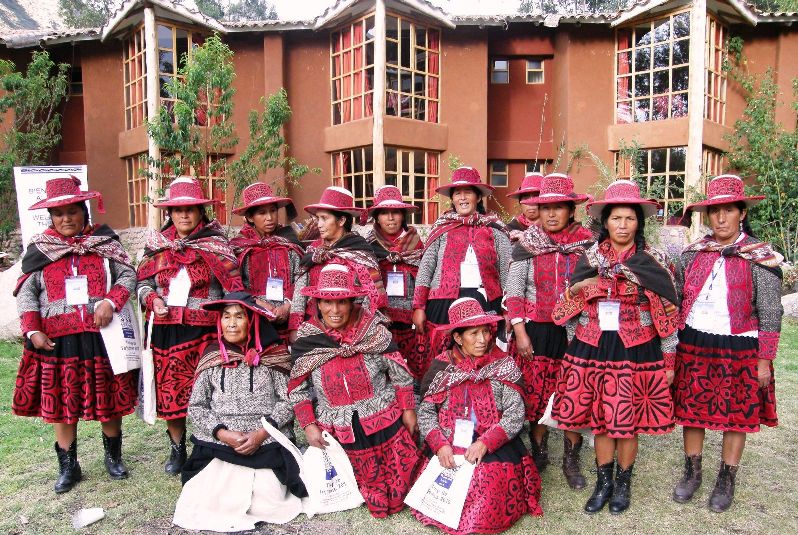
Women from Santo Tomas - we all loved their boots.
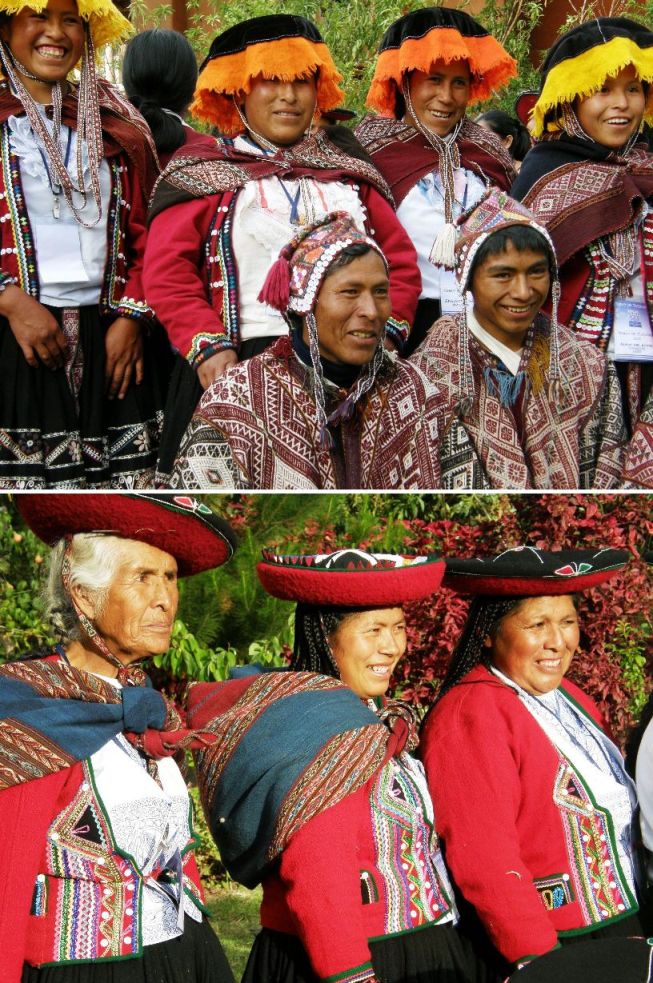
A group from Chahuaytire above and from Chinchero below. I believe, but I could be mistaken, that the distinguished lady on the left is Nilda's mother, Doña Guadalupe.
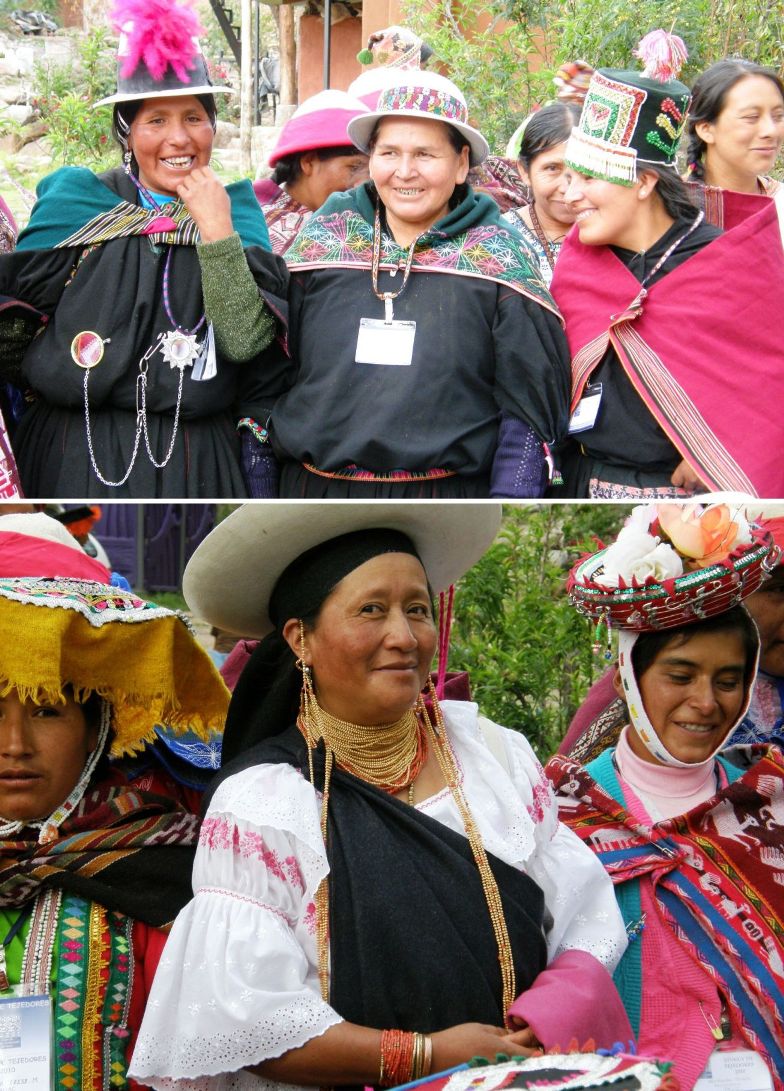
Three weavers from Bolivia above. Luz Maria Andrango of Ecuador below with two Peruvian ladies.

Artisans of Sallac. Their ponchos include panels of patterns created with resist dyeing techniques.

A young weaver-to-be and a little fellow with his pututu

Well that was a “taste” of the daytime activities. The nightime dancing and spinning competitions were a little harder to capture on film with the dim lighting but I did get some video. All the video I shot of weaving, spinning, braiding and dancing will be on next week’s blog.

The conference closed with a very emotional ceremony which served to honor all the elders of the various communities who were given certificates and medals of recognition as well as gifts.

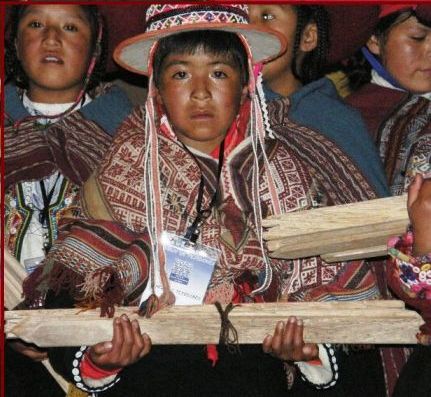
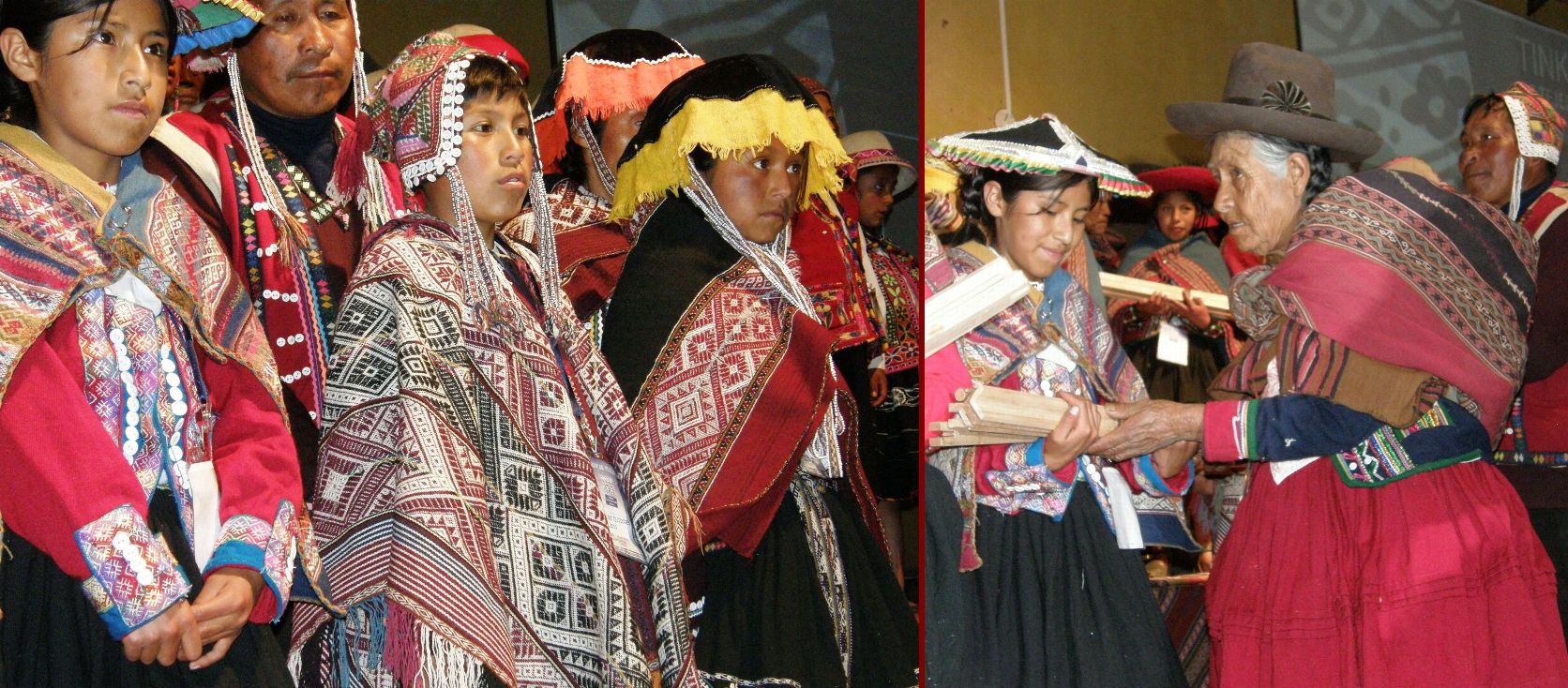
This was preceded by another ceremony in which the elders were invited to hand over sets of weaving tools to the youngsters in their communities.

Youngsters lined up waiting to receive their weaving tools. An elderly weaver passes a set of new weaving tools to a young girl in her community. The young girl's smile says it all.

So that was the two days of conference. Then came the workshops which I am saving for next week’s blog post along with the videos. And next week I will tell you about the other folks I met up with, some of whom I have been corresponding with by email or through my blog and others whom I met at Convergence. Betty Davenport, who is always lots of fun, was my companion in the little “down” time we had and we took the same workshop. Folks from Interweave were there too. The workshop days were more intimate and gave a lot of us a chance to chat and catch up. More about that next week.

And here is the amazing woman with the brilliant smile who is behind this unique event. It was not an ideal situation to meet Nilda for the first time. She was so busy and I don’t believe she stood still for a moment. Yet I learned a lot by watching her in action and seeing the warm affection she has for those who are lucky to be her friends, her passion for the CTTC and its goals and her love for her country and her people. Hopefully I will be able to go back one day to meet her again.

Part Two of my Tinkuy Tale can be seen here

#########################################

One last message…

My Backstrap Basics article is now on the WeaveZine site in Spanish. The videos remain in English but are, hopefully, self explanatory.

Mi articulo “Backstrap Basics” (El Telar de Cintura) ya se puede leer en español en la pagina de WeaveZine. El audio de los videos sigue en ingles pero las imagenes son suficientes para entender.


Backstrap Weaving – What IS backstrap weaving?

What isbackstrap weaving”?

I have been weaving on my backstrap loom way too long now to be able to remember what my ideas about backstrap weaving were before I actually started doing it. For me now “backstrap weaving” is just that: weaving on a backstrap loom, and it doesn’t matter what size, shape or form the finished piece of fabric takes.

For some people it may bring forth visions of narrow warp-faced bands decorated with pick-up patterns. Others may think of the white airy gauze weaves of Mexico or the brightly colored supplementary weft patterned pieces of Guatemala,  fine Asian silk inlay or the heavy woollen ponchos of Ecuador.

Many of the weaving techniques I have learned here in South America were taught to me by weavers who use backstrap looms while with others I learned on either vertical, oblique or staked-out ground looms. I adapt all the techniques to my loom of choice – the backstrap loom.

So, “learning to backstrap weave” to me is all about learning to warp, set up and operate a  loom which uses the weaver’s body as the tensioning device rather than being defined by or confined to any one technique.

Whether it be narrow or wide, plain or patterned, balanced, weft faced, weft twined or warp faced, heavy or fine, made of wool, silk or cotton…it’s all backstrap weaving to me. I even did a tapestry piece once on my backstrap loom (the brown square purse with the orange, red and green figures in the upper right corner – not in a hurry to do more of that! and I know of someone who did knotted pile on hers.)

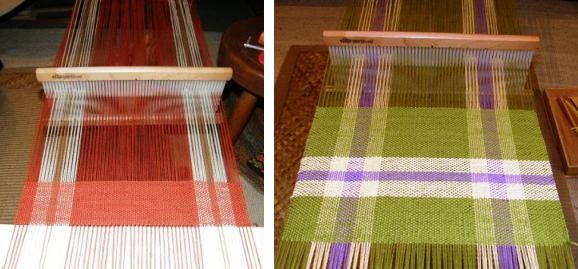
Being in online weaving groups got me interested in trying some of the more “conventional” weaves (for want of a better word) and so I tried some simple color and weave balanced-weave things like log cabin and shadow weave. I had fun doing the red and white pinwheel and the rosepath patterns using a rigid heddle, string heddles or both on my backstrap loom.

What has me thinking about all this is the arrival of a new non-weaving member to the Backstrap Weaving Group on Ravelry. She was gifted a LeClerc “Mayan” backstrap weaving kit and is looking for tips on how to get started.  If you had been thinking that backstrap weaving is all about narrow warp-faced bands you would have gotten quite a shock on opening the box.

The loom is surprisingly wide, around 24″ I am told, and comes with a rigid heddle.

Here are some ladies at Convergence having their first backstrap weaving experience using the Harrisville Designs kit that also comes with a  rigid heddle. Dawn is on the left and Kim on the right. I have shown some of the bands that Kim has gone on to weave here in previous posts.

So I am hoping that all of us there in the group on Ravelry can help our new weaver to decide on a suitable first project on her Le Clerc loom and give her some tips on yarn choices for the rigid heddle she has (not my area of expertise due to limited yarn variety here in Santa Cruz!) . I take it that the loom comes with a booklet that will show her how to warp it. So it is not only a case of what she perceives backstrap weaving to be but also what ideas she has about weaving as this will be her first adventure with warp and weft.

This is not my first encounter with a new weaver jumping into a backstrap loom. Esmecat showed up in the Backstrap weaving Group on Weavolution last year after having been given a rigid heddle and all the bits necessary to set up a backstrap loom. Her friend helped her get warped up and ready to go. She was well underway with her weaving when she joined the group and her first project, which is gorgeous, was a loom bag made from sock yarn.

You can see the first post about esmecat’s experience with this on her blog and follow on from there. It wasn’t all smooth sailing – most first projects aren’t –  but look at the beautiful result.

Nancy Peck wrote to me recently about her own experiences using a rigid heddle on a backstrap loom. Of course Nancy is by no means new to weaving!!

She shared some pictures with me of one of her projects with this set up.

So you can see that it is fun and intriguing for both new and experienced weavers. Weaving in an armchair…how nice is that?! And I enjoy using the rigid heddle on my backstrap loom too. It is a nice change of pace from doing pick-up and beating away at warp-faced pieces, inching my way along from day to day. Weaving with the rigid heddle zooms along!
All the rigid heddle loom manufacturers that I know of sell rigid heddles separately or you can buy small rigid heddle segments here. You can make your own…Alaa (weave2 on Rav and Weavo) gave me a link to some instructions for making your own. Ruth MacGregor makes what she calls  a semi rigid heddle which you can see at left and read about here.

I have two Ashford ones that were given to me and a Schacht which I bought.

As far as warping goes, as I said last week, there is no one “right” way. I just did what seemed logical and comfortable to me given the small space that I work in but there are most likely much better ways to go about this.
I wound a narrow piece on my warping stakes just to show you what I do.


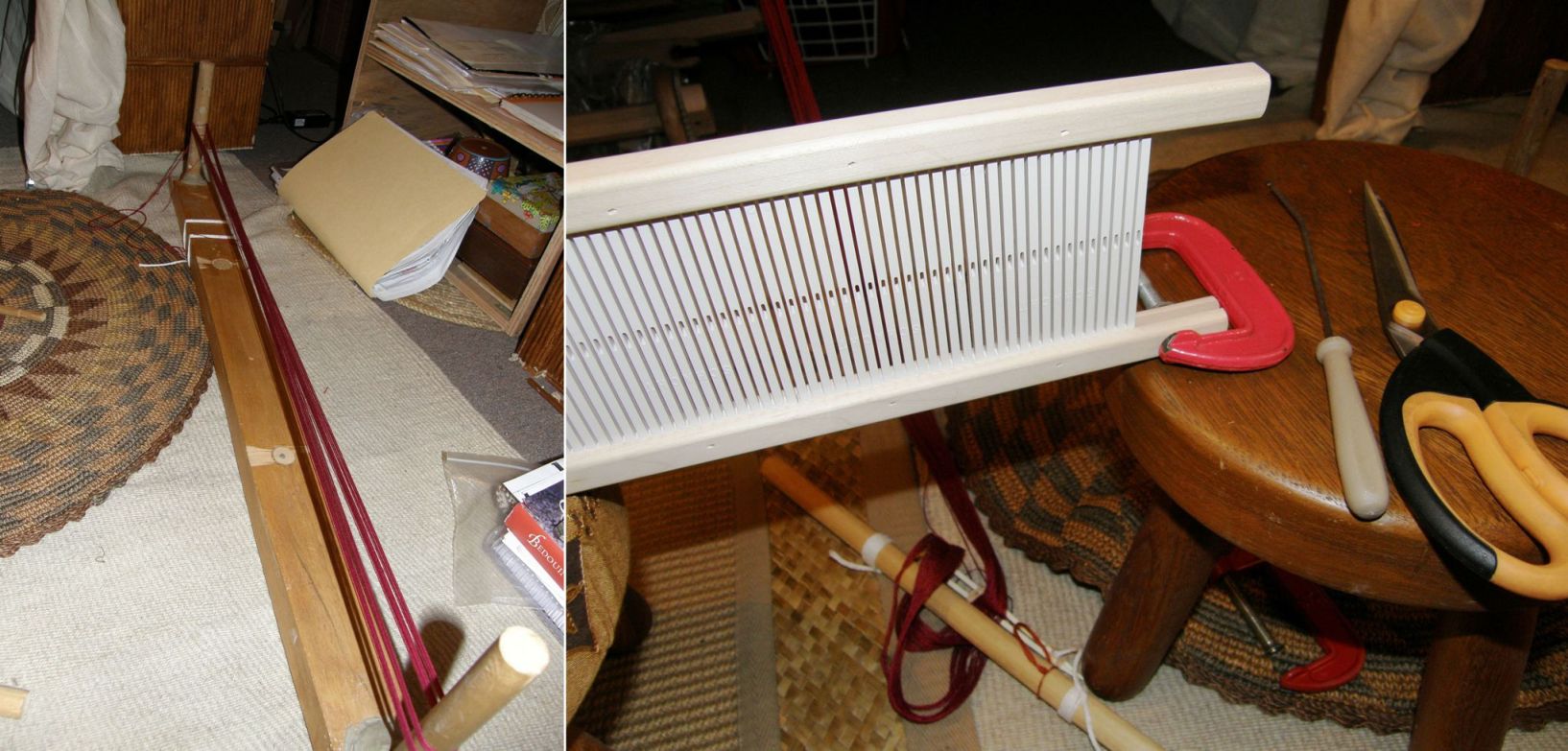
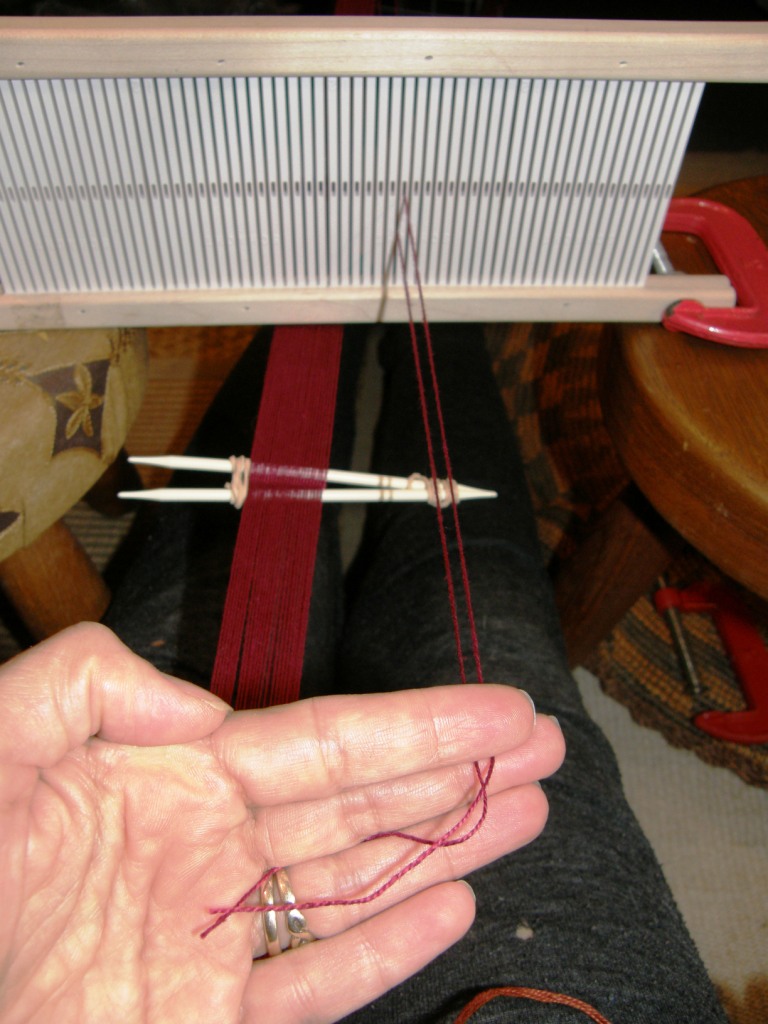
So I warp up as usual on my warping board, transfer the warp to my loom bars and get into my backstrap to tension the warp. I have the rigid heddle suspended over the warp within easy reach. It sits on two small stools and is propped up with a clamp. I use the threading tool that came with my rigid heddle loom but I have also used a needle when I couldn’t find the tool (not so nice that way).

From here I cut an end loop on the loom bar in front of me, and thread the pair of ends, one thread through a hole and one through a slot. Call me crazy, but I like to tie each pair of threads together with a  knot as close to the end as posssible and then transfer it to another loom bar on the floor beside me. Most weavers will tie a group of ends together. Actually I usually put the knotted threads on a steel knitting needle which I later lash to a loom bar.


There’s the first pair of threads in their hole and slot.

So this is my way.
It is probably a whole lot easier laying the whole thing out on a table but I don’t have this luxury!

Besides I am very comfortable there on the floor in my backstrap.
I used to work in ski resorts and spent nine months of the year for 5 years on skis. Those long planks used to feel like they were part of my feet and that is how my backstrap loom feels now – a part of my body.

And away it goes…

And some of the results…

But I always go back to my great love –  warp faced, pick up patterned pieces and ethnic themes. Speaking of which…I finished the amulet bag I was working on last week with a crossed warp band for the strap.

I started looking at the different finishes on the various chuspas (coca leaf bags) that I have and decided to try one out on another amulet bag.


I may have used too much yarn for my version on the right. The weaver had woven and sewn a tubular band with diamond or “eye” patterns along one side of the chuspa. When she got to the bottom of the bag she continued weaving and sewing but, at the same time, lodged strands of yarn between the woven tube and the bag before passing the weft and sewing the tube to the cloth. So I did the same. The strands of yarn form a fringe.

I noticed that the weaver wove the tubular band in plain weave where it was covered by fringe…wise move… why spend all the time making the pattern when it was only going to get covered. Actually I was surprised how nice the plain weave band looked when I wove it due to the unusual arrangement of the warps for the diamond pattern. Silly me forgot to photograph that part.

When finished, the tufts of fringe are bound, sewn to the tubular band and then trimmed. It is a nice finish.

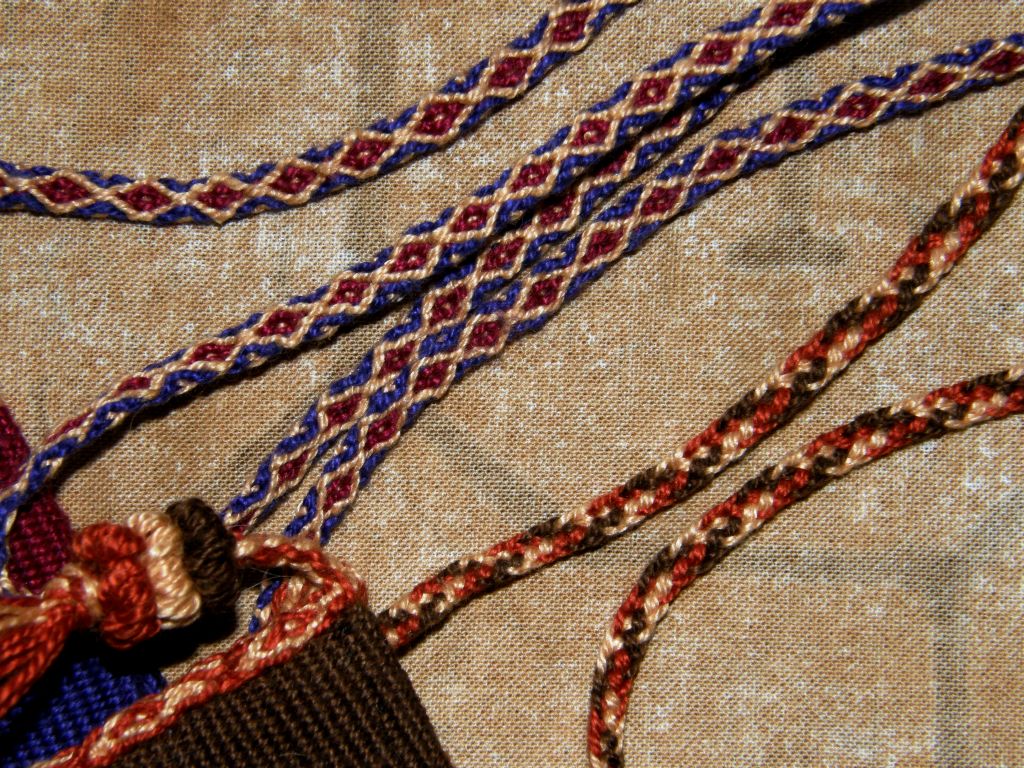
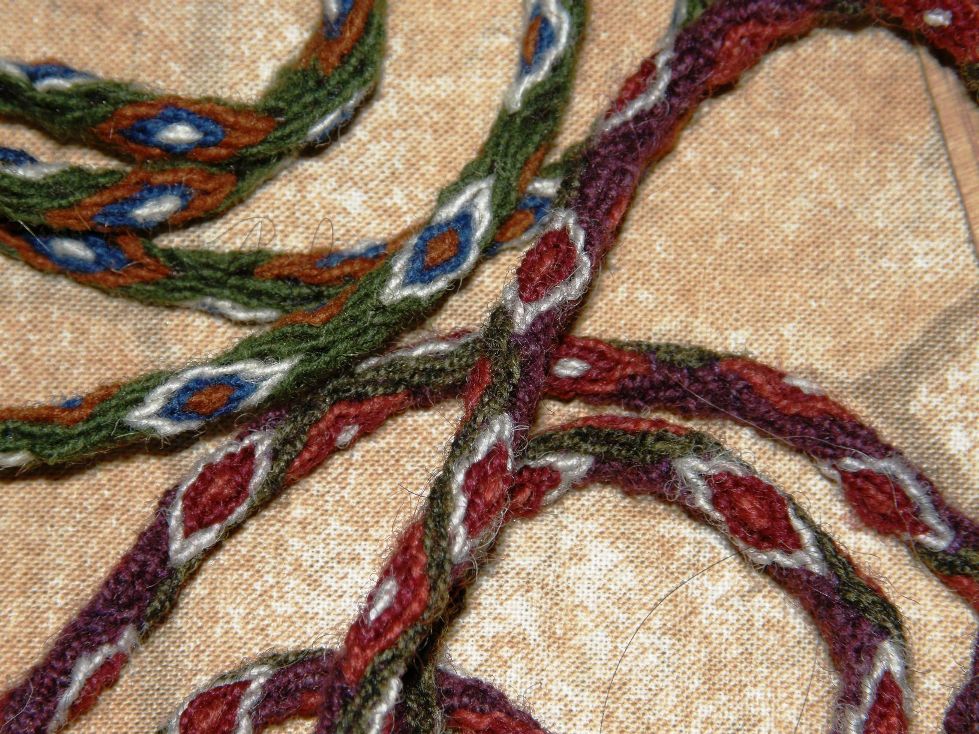
For this amulet bag I wove the tubular band in only two colors just to see how that would look and made a braided rather than woven strap. The braid is a six-strand finger loop braid that my weaving teacher in Potosi taught me. It looks very different on its two ”faces”.


Done! Tiny projects like these are good for practicing new techniques. I have more chuspas to examine and more finishes to try.

As you are reading this I should be in Cusco or Urubamba attending the tinkuy, the gathering of handweavers organized by Nilda Callañaupa and the Traditional Textiles Center in Cusco (CTTC). It runs from November 5th -8th with presentations and demonstrations on the 5th and 6th followed by workshops on the 7th and 8th. I know I will be able to catch up with some people I met at Convergence and I know that at least three people I have met through this blog will be there too and then there will plenty of new weavers to meet…all in such a short time!

Navajo weaver D.Y Begay was here in Boliviarecently and I was disappointed to have missed her. Just last weekend we discovered that we will both be at the tinkuy and will be in the same hostel.  She has been exchanging weaving know-how with indigenous weavers in Guatemala and Bolivia and maybe other places too that I don’t know of. She will stay on in Peru for some weeks working with the CTTC.

Here’s someone I met through this blog and if you are a regular visitor you will have already met her here a couple of times…”Cycling Anna” is still on the road in Argentina and heading south and I have a picture to show you of her braiding the ends of her double weave band while taking a break in Chile. Recognize those llamas? She has picked this up super fast.


Marsha Knox has been moving along with her experiments in simple warp floats, floating both colors and getting more and more creative with her patterns.

One last piece of news: I have just submitted the Spanish translation of my Backstrap Basics article to WeaveZine and hopefully that will go up on the site soon.  Only the videos will remain in English. That, combined with the tutorials I am slowly translating here on the blog, will hopefully make information about backstrap weaving and the weavers of Latin America accessible to even more people.

See you all after tinkuy. I’ll be back with cracked lips (super dry air up there) and bleary eyes (my reaction to the altitude is insomnia) and ready to weave after all the amazing things I saw and heard there. I’ll be back on the 11th to answer comments and emails.

EDIT: Yay I have wifi in my hostal in Urubamba and so am able to post this picture that Helena sent me of the band she made using one of the Bedouin techniques that I used in my wall hanging.

She used the threading from the last page of this article that she found by Joy Totah Hilden. It is a simple and very effective design which has long floats on the back.

And here’s a view from the plane somewhere between La Paz and Cusco today….