Backstrap Weaving – Inspiring Ikat

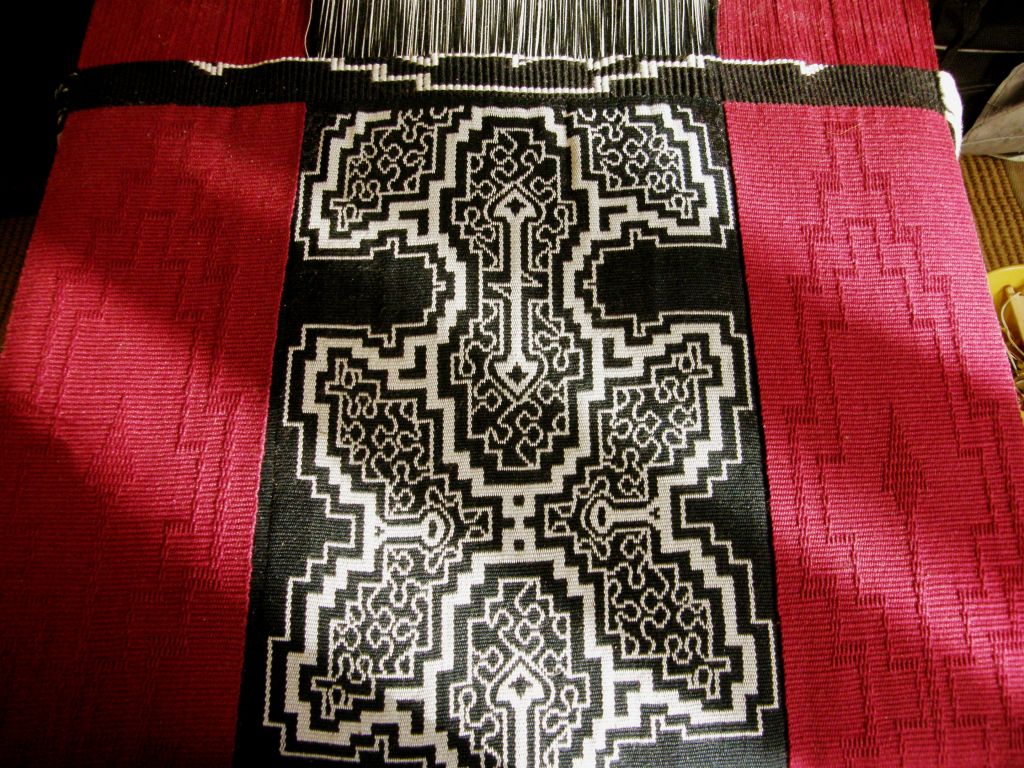
sunlight on red panels backstrap weaving“Question of the Week” on the Warped Weavers Forum asked us if our finished projects always measured up to what we had envisioned. It is interesting for me to think about this and see how my ideas about the larger projects on which I have been working lately have evolved during the long process of weaving.

I have been spending months planning and weaving these wall hangings, often interrupted by a break of several more months while I travel.

I look back at my notebook with its sketches and glued-in pictures and can see how far the finished pieces sometimes stray from the original idea.

Sometimes it is a technical hitch that does not allow me to create what I had envisioned. For example, I had wanted the Shipibo-inspired piece to comprise only curves but could not manage to form nice smooth curves with the thicker solid lines in double weave. That had almost caused me to abandon the idea. But, I went with a strong angular outline filled with finer curves instead and I really like that contrast.

backstrap weaving Bhutan bagSometimes, in the middle of a project something will catch my eye online, or someone will show me something and I will want to add those ideas to the mix.

That is what happened with my Tales of the Sub-Continent fabric which started with a Bhutanese-inspired motif and spread to Afghanistan, Nepal and beyond.

Sometimes it works, sometimes it doesn’t. When it doesn’t, it goes into the closet. And this is one of the many cool things about backstrap weaving…my half woven projects can be easily removed, still on their metal rods, from the loom bars and stored. I can discover a project months later, pull it out and wonder why on earth I hadn’t liked it! Then it can be easily lashed back onto the loom bars and continued..

It’s like in the old days before digital cameras. I never wanted to process my rolls of film until at least three weeks after my trip. If I got impatient and processed them straight away, I would always be disappointed with the shots. They didn’t live up to my fresh memories of the things I had seen on the trip. The colors would not be as brilliant and they wouldn’t have captured the mood.

However, just a few months later, they would look fantastic as my memory of how things had looked and felt faded.
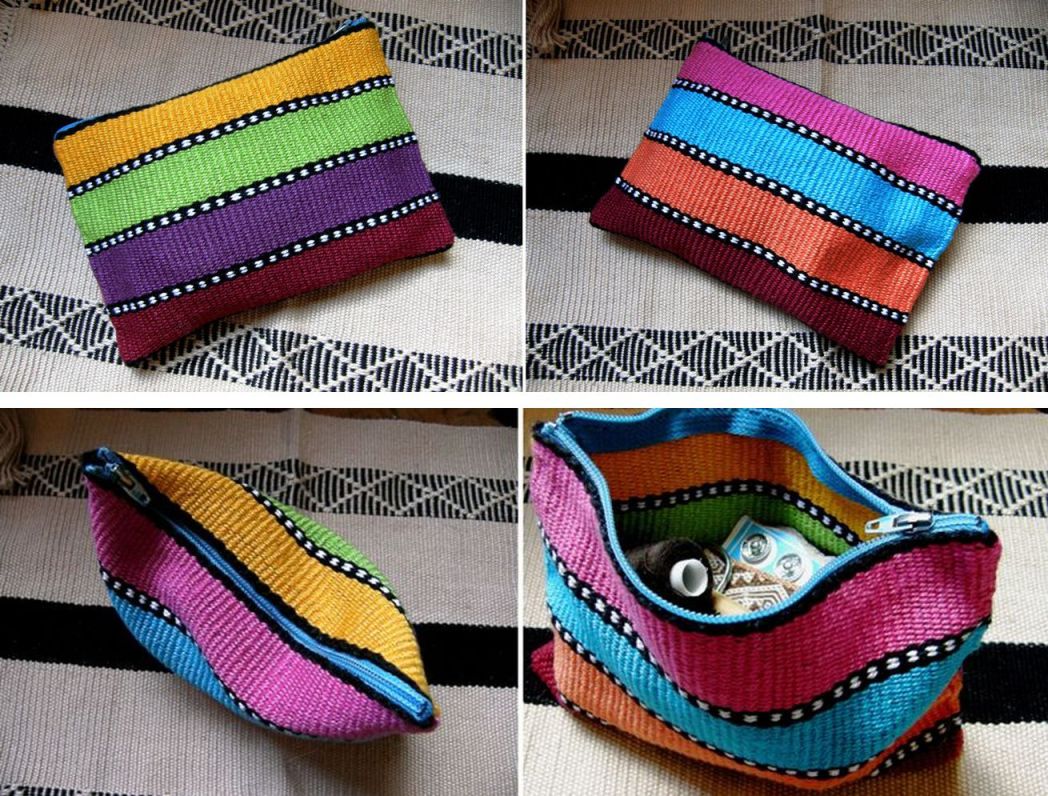
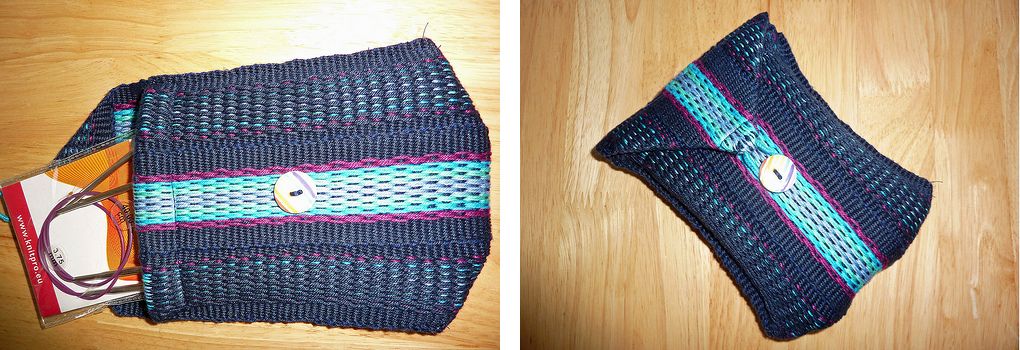
striped-pouch-x-4I detested the above fabric when I first wove it. It was a demo warp that I had hastily put together before a trip. I wanted something fun, bright and cheery in place of the black that I am so often using. It didn’t come out as I had envisioned and I didn’t even take it out of my bag to show anyone as I thought it was so ugly. Now I love the fabric, the original idea has been long forgotten, and the little sewing kit pouch is really useful.

Guatemalan supplementary weft sampler overviewThis fabric has also been living in the back of the closet for the longest time. I wove it to practice what I had learned in Guatemala shortly after returning way back in 2008. Now I love it and need to make something from it.

There have been a few things that simply didn’t work as far as I was concerned and those things got tossed. But, I have to wonder how I would feel about them if I were to uncover them in the closet today. If there isn’t even a picture of it, it means that I must have really hated it!

All this is leading up to my telling you that I have been walking by last week’s forlorn, rejected ikat piece, which has been sitting on a bench in my bedroom all week, and finding myself eventually wondering why I hadn’t liked it. Of course, there’s a whole blog post dedicated to why!  But, I finally decided that I could unweave some parts and improve it somewhat. So, here I am weaving away on that piece again…and not just to get it of the loom and learn more lessons…no, it’s because I actually like it now despite its flaws.

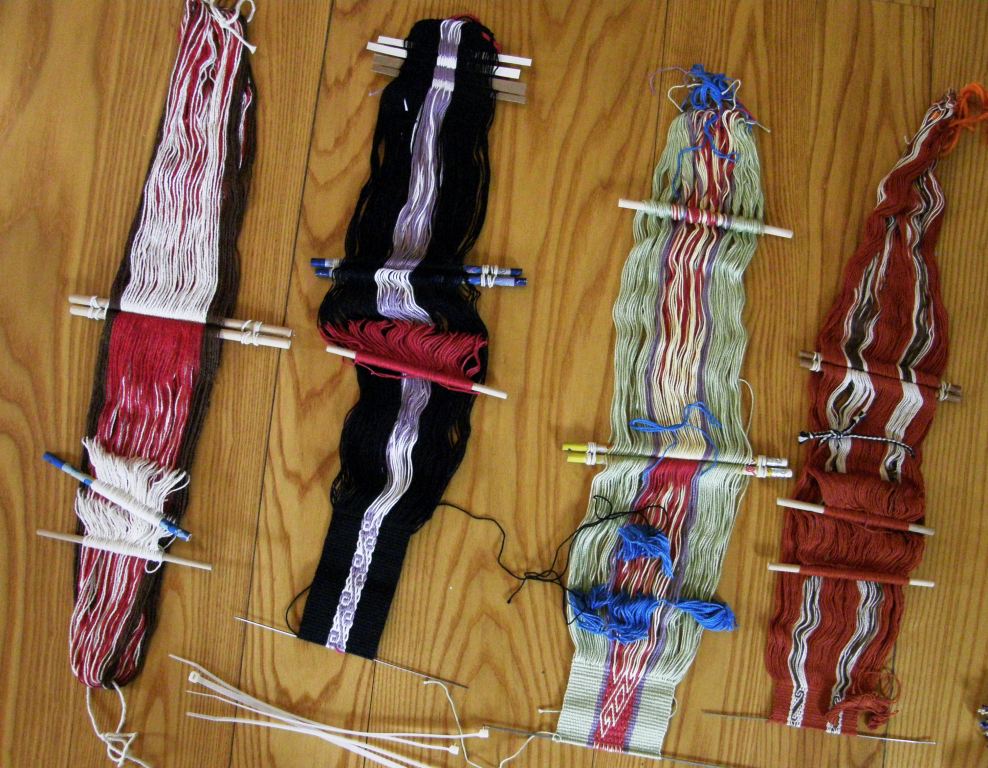
I spent most of the week washing yarn to take of the wax finish, setting it up on a frame and wrapping it for a new slightly larger ikat motif.latest ikat projectI was very excited about this new larger motif and really wanted to weave it. However, I had to face the fact that I didn’t have any black cold water dye left. In the end, I couldn’t resist trying to achieve black by mixing  colors.

Well, it looked black in the bath and even looked black while it hung to dry. However, the rinse water certainly wasn’t black and the dry cloth has a purply reddish glow.  It is kind of like the color of those big, fat, juicy, ripe mulberrries on the tree. They look so black and shiny but your hands and lips stain purply-red (which is why my brother and I could never get away with eating from the forbidden tree in our backyard as kids). I almost unwrapped it but I will wait until I return from my next US trip with fresh supplies of dye and I will overdye this warp black. That warp has to go on the back burner for now. What will be interesting, will be seeing what colors have already seeped under the wraps.

Here’s some online inspiration for more and more ikat experiments…lots of reasons to keep at it!

Photo used with the permission of the Ministerio de Cultura de la Nación Argentina. The ikat poncho was woven by Guillermina Cabral.

Ponchos on and off the runway….

Don Juan Millain shows a ponch woven by Norma Millain. Photo from the Facebook page of MATRA - Ministerio de Cultura de la Nación Argentina.
Don Juan Millain shows a ponch woven by Norma Millain. Photo from the Facebook page of MATRA – Ministerio de Cultura de la Nación Argentina.

And on the loom….

Graciela Salvatierra's work in Catamarca, Argentina from the Facebook page of Ponchos Artesanales  Salvatierra ll
Graciela Salvatierra’s work in Catamarca, Argentina from the Facebook page of Ponchos Artesanales Salvatierra ll

And here’s my wee, wobbly project being slowly fixed…straightened on one side, and now with white embroidery floss for supplementary weft which looks so much better than the creamy colored silk I was using last week.

ikat

Chris Buckley, in Beijing, has shared many images with me over the years from his vast collection of textiles. I was happy to find his Art Southeast Asia page on Facebook recently, via a weaving friend, and see the picture of Li ikat weaving that he had posted. He has just had an article on these pieces published in the September issue of Textiles Asia (I have a copy coming my way). There were a lot of tiny wrapped sections in his piece! and the seeping of the indigo into the white has created a nice effect. Using handspun cotton…now that’s a whole other trip.

chris buckleyHere is his description that accompanies the picture:

The September 2014 issue of Textiles Asia (www.textilesasia.com) includes my article on ikat made by the Meifu Li people of Hainan. The Li make dense, complex and beautiful ikat, using locally grown handspun cotton and natural indigo dye. The designs are tied on the warp threads with small strips of resist, before the yarn is dyed. The dyed threads are woven on a simple backstrap loom, so that the designs appear in white on a deep blue background on the finished fabric. Motifs include geometric forms, human figures and amphibians, such as those in the photo here, which shows a detail of a large sarong. These were mainly for ceremonial use (weddings and festivals). The Textiles Asia magazine is excellent and I recommend it to anyone with an interest in this area.

You can watch a short Youtube video here showing the ikat process with string and masking tape used by some weavers in Argentina.

I think they are very brave to use that heavy marker pen! I tried using a fine-tip marker and the ink bled into the yarn. Now I use faint pencil marks.

A booklet that I have on Guatemalan ikat, known there as jaspe,  says that the person tying the knots marks with a pen the parts that need to be reserved. Most likely they are less prone to making mistakes than I am!

A Guatemalan jaspe warp ready for weaving
A Guatemalan jaspe warp ready for weaving.

Leaving ikat aside for now, let’s look at some other kinds of backstrap woven beauty. Gwen shared with us pictures of the beautiful pick-up weaving that she saw on a recent visit to the Cusco area of Peru.

10305594_10203495499921874_8779412477090214824_nThis is one of the textiles that has inspired her to take up backstrap weaving and she has already woven her own backstrap. Her enthusiasm and obvious enjoyment of the whole process has me remembering the simple pleasure of just sitting at the loom and working the sheds, listening to sticks clack while watching the warp and weft interact and the fabric appear…

gwendolyn facebook (2)I appreciate her having taken this next picture of the process of braiding the ends of the backstrap and inserting the cord. I didn’t use a picture of this in my article and I know that Gwen’s picture will make the process very clear to those who may be unsure.

gwendolyn facebook (3)Some more simple pleasures…

10570318_770325679684468_7800201937456857640_n…weaving outdoors on a warm sunny day. Oscar Vasquez tells me that he doesn’t live in a part of Mexico where backstrap weaving is practiced and so, he has been following the same WeaveZine article that Gwen used (the Spanish translation) to weave a narrow band while out and about.

This coming week, I hope to warp the two red panels that will accompany the central  ikat panel of my planned wall hanging. I will create another red-on-red pattern using simple warp floats. The motif will have elements of that used in the ikat panel.

See you next week.


Backstrap Weaving – Venturing Outside the Comfort Zone

Venturing Outside the Comfort Zone

???????????????????????????????It’s always nice in my travels to return to known places. There is something very comforting in the midst of all the “what-ifs” and unknowns of travel to meet once again familiar faces and landscapes.

However, there are always new people and places to add and I have enjoyed visiting new guilds and new US states on this trip. This was my first time visiting New Jersey, for example, and now I am about to venture into Nevada for my first ever visit there. There are new experiences, like trying to navigate the New York Port Authority with loads of luggage for the first time, going flying in a Cessna over Cape Cod on a perfect spring day, and being made very much aware of the rather “shaky” nature of the California coastline! (see picture above).

The mysteries and trepidation of going to new places are always short-lived. The new landscapes are exciting and the new weaving groups without exception are warm and welcoming.

The western part of this trip has take me through a variety of landscapes….from the beaches of lovely Santa Cruz to the big cityscape of Oakland and the forested high passes and lakes of the Sierra Nevada range.

Walking the paths of West Cliff Santa Cruz was a wonderful way to unwind after a day of teaching. We watched surfers, pelicans and sea otters at play in the light of the setting sun.
Walking the paths of West Cliff Santa Cruz was a wonderful way to unwind after a day on the move. We watched surfers, pelicans and sea otters at play in the light of the setting sun.
The view from the 19th floor room that I shared with Jennifer Moore at CNCH 2014.
This is the view from my 19th floor bedroom at CNCH 2014 last weekend. It was fun sharing with Jennifer Moore whom I had met and spent time with backstrap weaving and at the opera in Santa Fe last year.
One of the beautiful peaks on the way to Truckee California.
One of the beautiful peaks of the Sierra Nevada on the way to Truckee California.
Yonat weaving amongst the Redwoods in my Santa Cruz class.
Yonat weaving among the Redwoods in Santa Cruz.
A new venue and new faces in Grass Valley California...backstraps in position and ready for action!
A new place and new faces in Grass Valley California…backstraps in position and ready for action!

I like to call my Santa Cruz group my “firsties and besties”. As it was my fifth time visiting and weaving with them, I decided that it was time to push ourselves outside our comfort zones. The challenge was to take one of the structures that we had woven together on the last four visits and use it in something wide and/or fine. Some group members warped up something much wider than anything they had attempted before while others used much finer thread than they had ever used on a backstrap loom. The results were wonderful!

First we tried different ways to set up warps for wider projects, for example, using multiple swords for creating picking crosses instead of fingers.

Jane uses a mulitple sword technique to pick up a pattern for her backstrap project.
Jane uses a multiple sword technique to pick up a pattern for her backstrap project.

Jane is not actually one of the original “firstie-bestie” group but she has put in so much time and effort since her very first time weaving with us, that she was able to fit in perfectly with the skill level of this group. She has woven an impressive array of Andean Pebble Weave bands since we met only six months ago.

Jane makes exquisite baskets and brought along one of her creatios filled wih her Andean Pebble Weave bands. Ripples the cat had to get in on the act.
Jane makes exquisite baskets and brought along one of her creations filled with her Andean Pebble Weave bands. Ripples the cat had to get in on the act.

Here’s a closer look at the pretty bands and Jane’s basket without the giant cat-head distraction!….

Jane Milner's basket and pebble weave bands.
Jane Milner’s basket and pebble weave bands.

Jane has tried patterns from both my first and second books…

Andean Pebble Weave bands woven by Jane using Omega Sinfonia yarn.

The upper band is an adaptation of a pattern that was woven by Louise Ström using tablets. Many tablet weaving motifs can be easily adapted to the Andean Pebble Weave structure and I have charted some of these in my second book. The lower motif is a doodle I made in the second book where I am showing how people can go about creating their own pebble weave patterns. The hook motifs placed in various diagonal arrangements are, of course, classic Andean patterning.

On the first day at Yonat’s place, I found myself just “hanging out” as my weaving friends wove and planned their projects with increasing independence.

weaving at yonats place

In the afternoon, we did a little “round robin” activity on my prepared warps to brush up on structures and techniques that we seen in other gatherings and help in the decision making and planning process for the next days’ projects…

round robin backstrap weaving

Dorothy's wode project included three columns of Anean Pebble Weave motifs. As she was only able to take two of the three-day workshop, she had to leave with her heddles installed and just a handful of picks in place. As she is heading to Peru to study with tapestry master Maximo Laura this summer, I am wondering when she will find time to sit and finish her project.
Dorothy’s wide project included three columns of Andean Pebble Weave motifs using Tahki Cotton Classic yarn. As she was only able to weave with us for two days, she had to leave with her heddles installed and just a handful of picks in place. As she is heading to Peru to study with tapestry master Maximo Laura this summer which will lead to a whole new world of weaving, I am hoping that she will find time to sit and finish her project soon.
Peggy used Reynold's Saucy yarn (now discontinued) to create a warp for a backstrap . She liked my "Rolls Royce" backstrap...the thick and cushy one and so, chpse a pebble weave motif along with the intermesh structure to produce thick fabric.
Peggy used Reynold’s Saucy yarn (now discontinued) to create a warp for a backstrap. She liked my “Rolls Royce” backstrap…the thick and cushy one…. and so, chose a pebble weave motif along with the intermesh structure to produce thick fabric. Anne went the other way and used fine thread to make a cell phone pouch. She will use two sets of string heddles to make the process partly loom-controlled and decorate the pouch with an Andean Pebble Weave motif.
Here is Yonat's backstrap warp rolled up at the end of the day with just a couple of inches left to go. Yonat found taht weaving outdoors seated on the ground with her warp angled steeply was much more comfortable for her.
Here is Yonat’s backstrap warp rolled up at the end of the day with just a couple of inches left to go. Yonat found that weaving outdoors seated on the ground with her warp angled steeply was much more comfortable for her.
Barbara's challenge involved weaving her favorite "viscacha" motif in fine thread (Aunt Lydia's #10) and swapping the colors for the motif and background while creating beautifully straight edges.
Barbara’s challenge involved weaving her favorite “viscacha” motif in fine thread (Aunt Lydia’s #10) and swapping the colors for the motif and background while creating beautifully straight edges.

The following day, after having looked at images and watched online videos of the cute Andean viscacha, Barbara brought in a tapestry piece  which had been woven on a backstrap loom in Pitumarca, Peru. She had just realized that the critter at the bottom of the piece was the same as the one which she was weaving into her fine backstrap band.

??????????????????????

When not weaving, there was also lots of fun to be had. Yonat and I looked at experiments that the late Nora Rogers, former member of the Santa Cruz guild,  had been performing on backstrap looms. Here is another kindred spirit and it was amazing and almost eerie to see how closely my backstrap weaving experiments have been following the path of her own carried out years before I came to be involved in this.

Here is Nora's experiment in the white-on-white patterning technique using supplementary weft on a light, open cotton ground cloth. I bought a piece like this at the Santa Fe International Folk Art Market last year in the hope of studying and trying to replicate it myself.
Here is Nora’s experiment in the white-on-white Guatemalan patterning technique using supplementary weft on a light, open cotton ground cloth. I bought a piece like this at the Santa Fe International Folk Art Market last year in the hope of studying and trying to replicate it myself.

And then there were various beauties to be examined created by Yonat’s own hands…from tapestries to handmade beads to Ravenstail twining. I saw one of this set of Ravenstail leggings finished on my last visit. This time I got to see the completed pair….

???????????????????????????????Yonat and I also went to a local store that buys and sells ethnic textiles from around the world. We had a super time digging through loads of pieces to find some special treasures. Some pieces were long and large and required no digging at all….

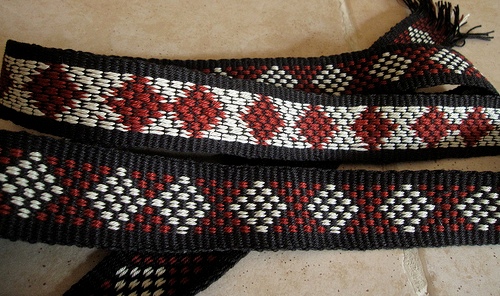
It seems so long agao now since my friend Lisa sent me a picture of a yurt band she had bought and I becane fascintaed with the simple warp-float technique thathad been used to create it. Here in the store was a gorgeous example in those lovely sun bleached reds and blues that I adore!
It seems so long ago now that my friend Lisa sent me a picture of a yurt band she had bought and I became fascinated with the simple warp-float technique that had been used to create it. Here in the store was a gorgeous example in those lovely sun bleached reds and blues that I adore! This technique produces a pattern of warp-floats on one face and areas of exposed weft on the other.

The warp-substitution technique is another one on which I have spent some time experimenting. We had to resist completely unrolling this band to see how the motifs changed along its enormous length. The designs are crisp on the upper face in warp-faced plain weave. Colors are warped doubled and the weaver simply substitutes one for the other to create the patterns. The unused colored warps float on the reverse side of the textile until they are once again called into use.

???????????????????????????????

Here are three bands from across the globe….from Bhutan patterned with supplementary weft….a three-color double weave belt from Bolivia and a supplemental-warp patterned band from Mexico.

???????????????????????????????

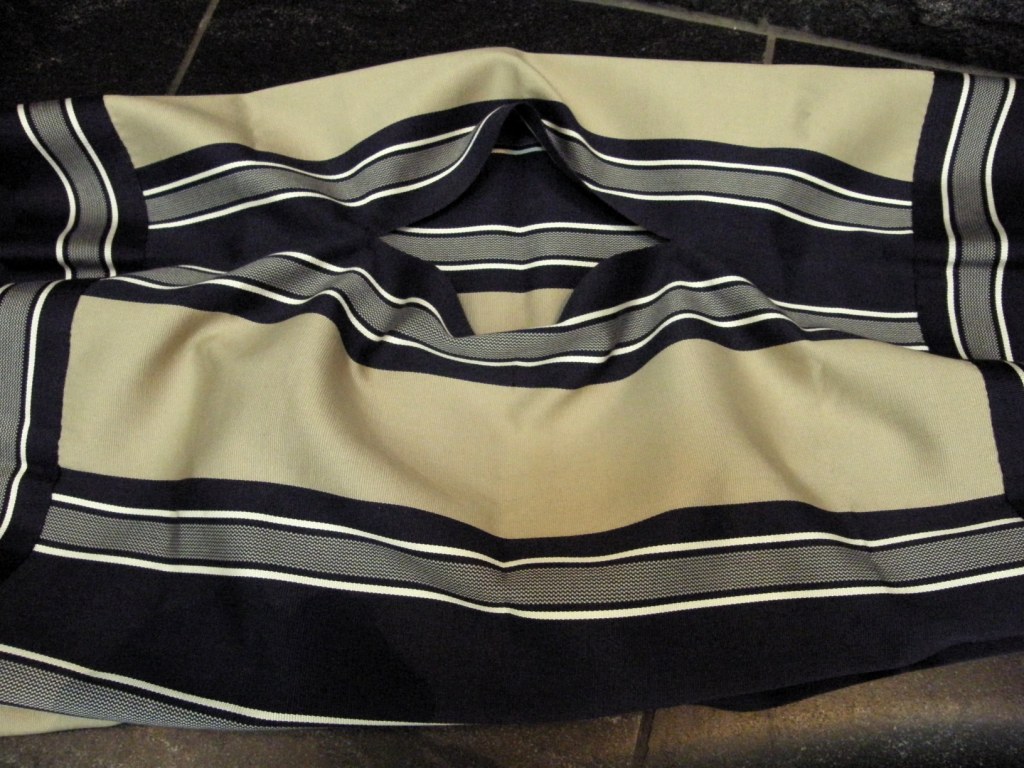
But the jaw-dropper as far as I was concerned was this poncho from Bolivia (see below) patterned with strips of warp-faced double weave. Yonat uncovered this one at the bottom of a pile of mixed textiles on a shelf.

I call this technique “embedded” double weave as the strips of double weave with pick-up patterning are flanked by warp faced plain weave. The yarn is very fine synthetic thread and the weaving was superb! It is a beautifully finished four-selvedged poncho. I know from experience how maddeningly difficult it is to finish a double weave piece with four selvedges and the thread used in this piece does not have the advantage of the springiness of wool which can make the task somewhat less difficult. How I would love to sit by the weaver who created this!!!

???????????????????????????????


???????????????????????????????The visit to Santa Cruz also included a few get-togethers with my dear friend Annie.

If you are a regular reader of this blog, you will know Annie as creator of guitar straps and custom bands and sashes on inkle looms. She gave me the lovely strap, at left, to use on my camera bag.  It is as much fun seeing what wonderful combination of colors she has come up with for her one-of-a-kind pieces as hearing the personal and inspiring stories behind her custom projects.

One of her latest challenges is to create a sash similar to one used by Johnny Depp in the Lone Ranger movie!

I shall leave you here for now. I am in Truckee now and grateful to my friends Suzanne and David for their patience while I bury my head in photo editing and blog writing. I’ll be weaving by the shores of Lake Tahoe in a couple of days and can’t wait to see it!

I shall probably write from Portland, Oregon next with further tales of  the Grass Valley group, the CNCH conference in Oakland and weaving at Lake Tahoe. Bye for now!


Backstrap weaving – Staying on Track

I have been trying to resist the urge to warp up for an al’ouerjan project and join in on the fun in the Ravelry group. You may remember that a couple of weeks ago, after having posted the warping tutorial for these traditional Bedouin patterns, Tracy suggested a weekend warp-along. Now we are seeing the increasingly large and impressive results of all that warping practice. Take a look at the bag strap that Tracy made at left.

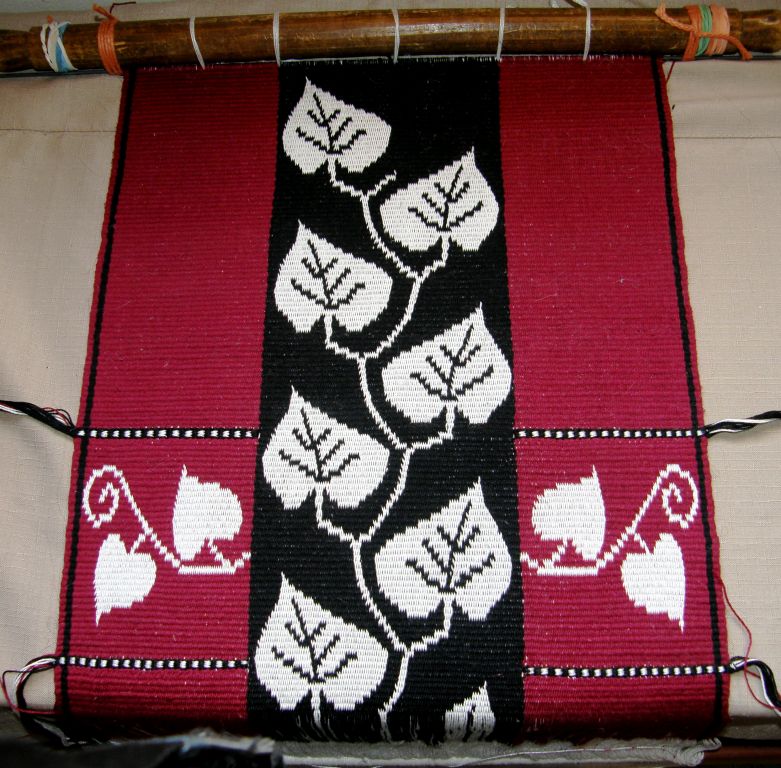
But…I am staying on track which means that I am sticking to my chamanto-style leaf-patterned wall hanging (although I couldn’t resist throwing in a bit of weft twining). I finished the first pebble weave hanging in this set with weft twining and so I decided that, apart from the common color scheme, the weft twining would be another theme that would tie all my planned wall hangings together.

While I sit and pass the shuttle, strum the warps, beat and coax the sheds open I think about what will be next in this series. I have no problem whatsoever in coming up with ideas…the problem is that I want to weave them all at once!

I stand back and look at this piece and I still can’t get used to it.

It’s not quite like anything I have done before but I have to say that I am having fun with it especially adding in that twined section with the motif within. I had to stop for a bit to chart those smaller leaves on their vine, sample them etc…It took a while to get them right.

I think that all my planned red, black and white pieces will look pretty nice when hung all together. The question is….where? Although I have been doing some major cleaning out, I still haven’t managed to uncover any significant amount of wall space.

Next on the clean up list is my dear old Ashford traditional wheel. Yes, I have a spinning wheel…who knew? It has been sitting there so long unnoticed, dusty and in desperate need of oil…poor thing. It was born in New Zealand and made its way all the way over to the Falkland Islands before finding its way into my home in southern Chile. I left a lot of stuff behind in Chile but the spinning wheel came up to Bolivia where it has sat in the corner for almost 14 years…shameful! I won’t take a picture of it now in its pitiful state. I will clean it up and get it back into shape. I have room to use it now!

I only had it for four months before leaving Chile and just got into using it and being able to turn out something consistent. I did, however, spin enough yarn to construct a vest, knitting the natural colored front and weaving the dyed brown back. The edging has been worked in cross knit looping.

This, too, sits neglected here in this hot steamy climate. It is a souvenir at least of the Patagonian sheep.

But, back to the al’ouerjan and let’s see what else the Ravelers have been up to…

So, there’s the strap that I showed you earlier on the gorgeous bag that Tracy made. She will line the bag  to protect the warp floats on the inside. She used an additional weft to secure the floats on the strap. You can see details about how that is done here. One of Tracy’s other warp-along products is the pillow cover which includes some tapestry-style twining in  the lower left hand corner and a striking and beautifully executed joining stitch.

Aunt Janet’s piece above left is in her own handspun wool. She has three sets of al’ouerjan patterning and that blue looks amazing.

Traudi so loved Tracy’s piece that she got into the act too using brown instead of black which looks fantastic. She twined along the bottom of the piece too. We are seeing more and more twining in this group…cool. Here is the tutorial for basic weft twining.

Jennifer did some charting and planning for the shajarah patterns before warping a wide piece that also includes an al’ouerjan design.

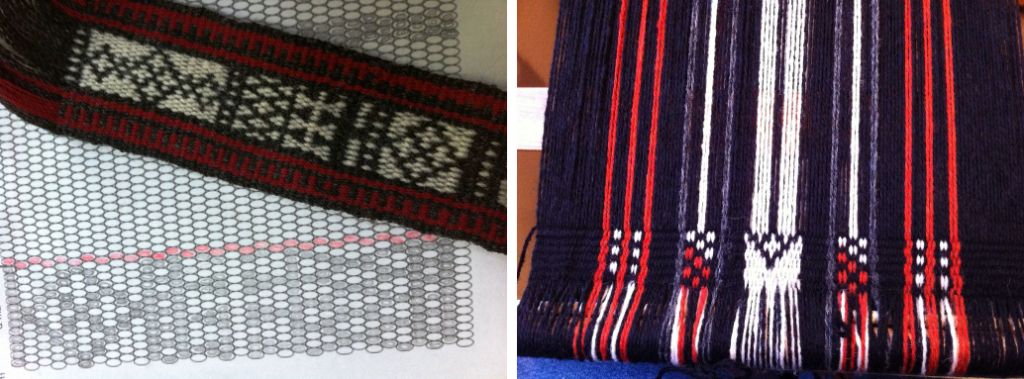
The charting paper with ovals which is useful for double weave, warp substitution and supplementary weft patterns can be found here. A tutorial for weaving these kinds of warp substitution patterns is here.

So, January has gotten off to a great start in the Ravelry group! Pantoffels has been wrangling with what she calles an ancient inkle loom and still managed to make this pretty needle pouch with plain pebble weave patterning.

And then she got a new inkle loom under the Christmas tree and will now try the pebble weave patterns in my book Andean Pebble Weave.

While I have been weaving my “leaf” piece based on the Chilean ponch known as a chamanto, I have been getting out other pictures of ponchos that I have to study the design layout that weavers use on these large pieces.

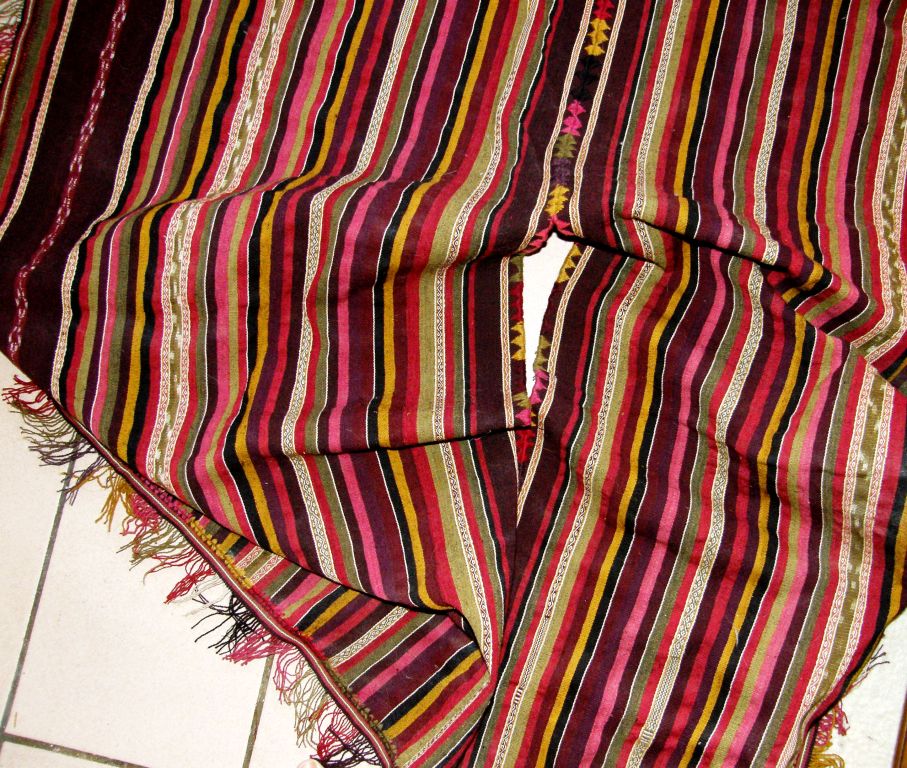
I own one poncho which I bought in Calcha, Bolivia many years ago. It is made from very fine handspun wool which has been colored with natural dyestuffs. It is patterned with simple stripes, some very narrow and simple ikat bands as well as several very narrow strips of pebble weave.

It has been woven as two panels with four selvedges each and a woven band has been sewn around the four edges with an added fringe. Don’t you love that decorative stitch that has been used to join the panels?

There is definitely an art to stripes. You can see the clever placement of fine white stripes to break up some of the richer colors.

 An extremely fine and simply patterned manta from Chile. It is always interesting to see how the colors and stripes are distributed. As is typical, a broad band has been woven and sewn to the four edges of the piece and there is no fringe.

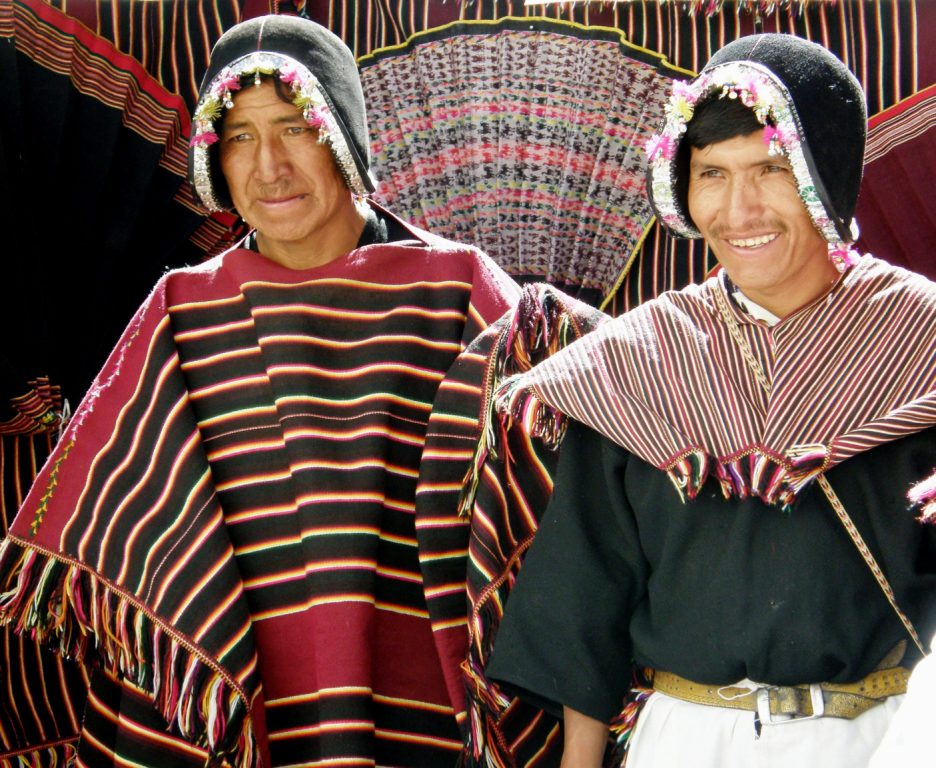
The typical poncho of Tarabuco and the smaller version known as unku can be seen above.

At a handcraft fair in Tarabuco I saw weavers making the long poncho panels. My friend, Anna, showed me the unku on the right that she had bought in Tarabuco when she came to visit me.

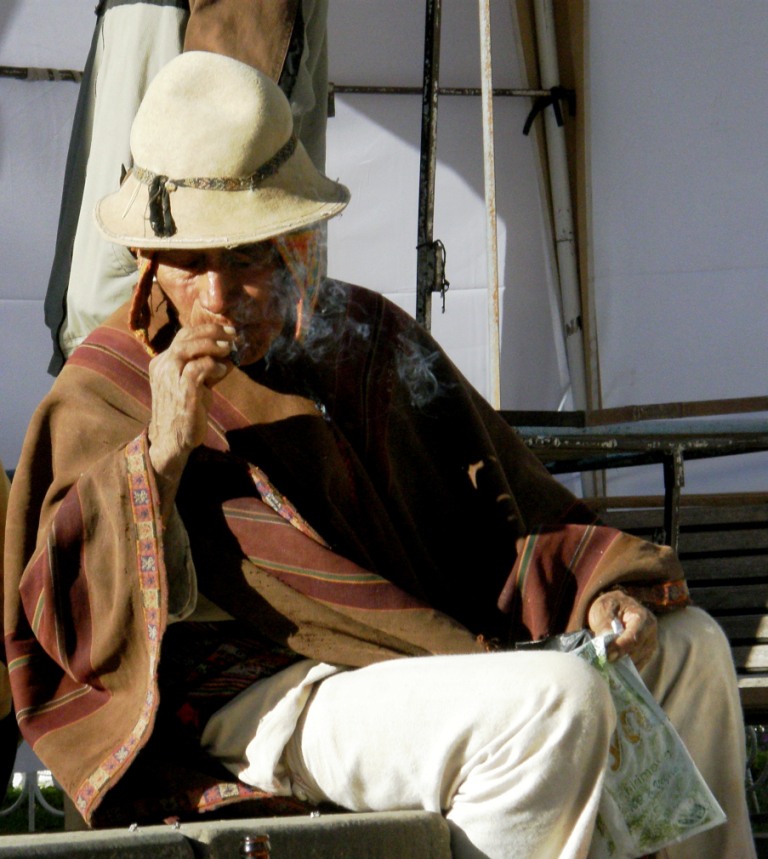
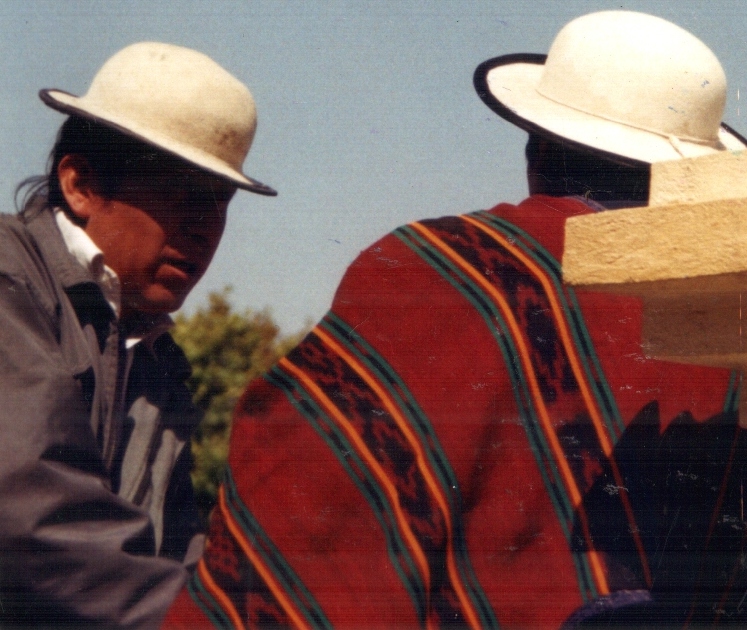
I spotted this gentleman in his much more subdued woolen poncho in a small plaza in Sucre. He was performing an offering to Pacha Mama in the early morning. How wonderfully simple and light the poncho looks although I am sure it is extremely warm and virtually waterproof.

And then you have the incredibly intricately patterned calf-length ponchos woven and worn by the men of Chahuaytire in the Cusco area of Peru.

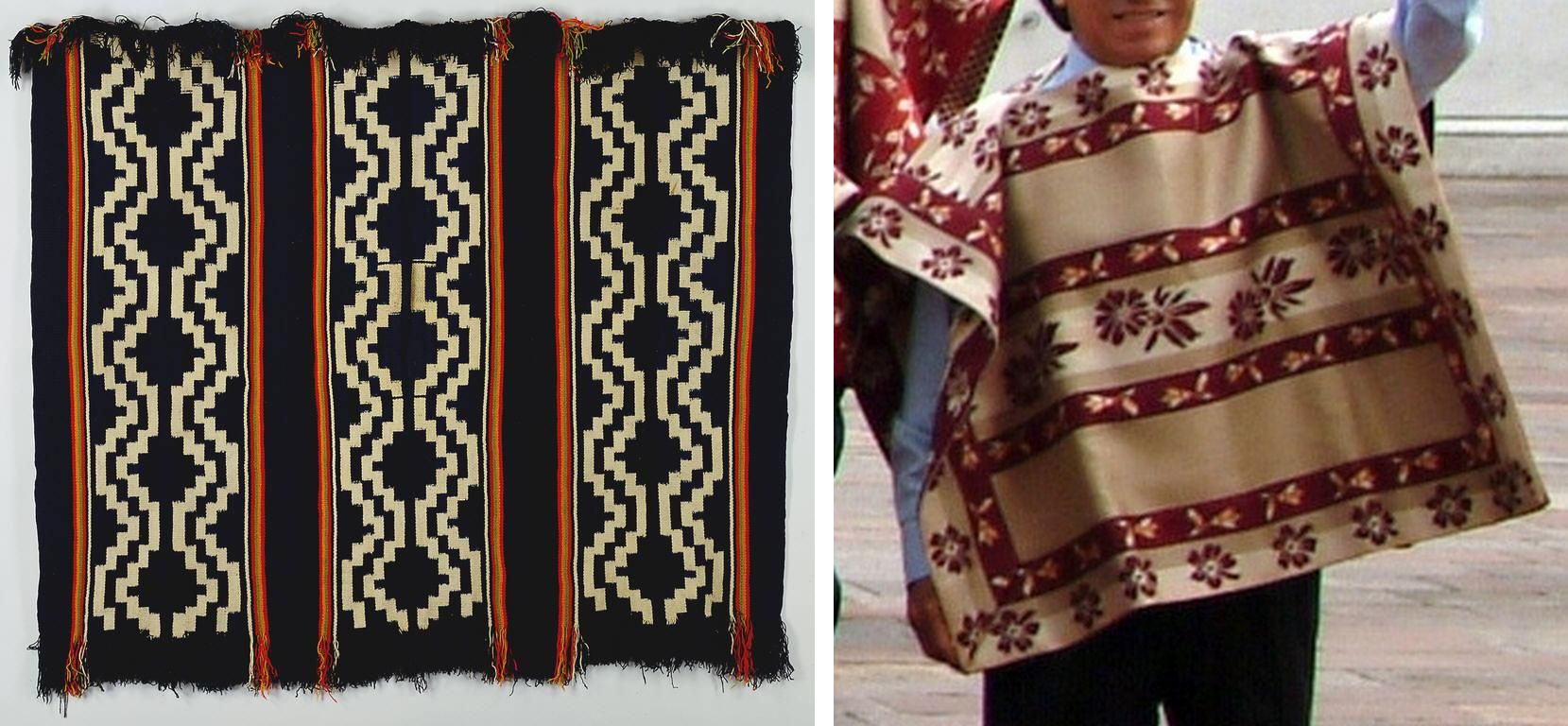
From Argentina and Chile we have the Mapuche makuñ with its ikat patterning technique executed in such a way that there is virtually no blurring of the design. The popularization of the poncho, from what I have read, is generally attributed to the Mapuche who wove them for their own use as well as for barter. On the right you see the chamanto of the Chilean huaso, with its leaf, fruit and floral motifs, which are said to have both indigenous and Spanish roots.

I have  a few pictures from Ecuador too…scans of old prints…

This is the “jijon” poncho which is factory-made in Quito and worn by those men who can afford one in Otavalo. You can see it being worn with its grey plaid face showing by the gentlemen on the left and with its darker face outward on the right. These men were wearing their ponchos to the market on a regular day. Apparently there is a much more costly blue double-faced poncho which is woven on the backstrap loom made-to-order. The ownership of one of these special ponchos indicates wealth and high social status.

On Sunday, which was both market day and church day in Cañar, a very social time around the main square and surrounding streets, I saw quite a few ikat-patterned ponchos being worn.

And finally there’s Juan below, (my pebble weave student!) with his mother and neighbor. Juan put on his  narrow, black fringe-less poncho and felt hat especially for this picture. On another visit during a festival all the men were wearing their ponchos for the occasion.

You can see the backstrap looms on which I was teaching Juan and Natalia pebble weave tied to the pole. In exchange Anita introduced me to her cousin on my next visit and he taught me to weave the typical supplementary warp patterned belts of Salasaca.

Okay, so I promised you some double weave edge samples this week, right? I am sorry, I didn’t get those done. I was busy trying to stay on track and not get “dis-track-ted” by all the goings-on in the Ravelry group. I want to finish my leafy hanging. but I must say that I have a bowl of tencel calling to me wanting to be made into a scarf…

That blue ball is indigo-dyed Japanese silk…a fabulously thoughtful gift brought to me from Japan by one of my old teaching colleagues here.

Hopefully I will get the leaf piece off the loom this week, plan and warp the next hanging, play a little with my tencel, get the Ashford Traddy up and running and do those double weave samples for the tutorial too….phew!

Oh, and I have started a new page for RESOURCES. You will see the tab for that on the header and I am slowly extracting all the links to interesting sites, articles and products that I have linked to in my 105 posts so far. This is quite a job but I hope to add two or three links to the page every week. I hope you find it useful.
.