My patient piano-playing friend will be waiting for his music-themed bookmark. He’ll have to wait a bit longer. What I have ended up with is a band that is too long to be a bookmark but not long enough to be anything else. It will go on my table of samples next time I teach a workshop on warp-faced double weave. It was a lot of fun to weave and I would really like to weave more music notation with more complex figures while aiming to create something a bit more useful.
The piano keys wove up quickly and the whole process was made easier with the use of four sets of string heddles and some thread markers. Using markers helped me to quickly pick up the right number of threads for the black keys without having to do any counting or rely on eye-balling. I have used marker threads before in other projects. I just tie a colored thread around the heddles that raise certain warp threads in that shed or around the threads themselves if they happen to be in the other shed.
 In my last blog post I had just finished the piano keys and started on the bass clef and key signature. I knew that I wouldn’t be able to fit a treble clef in the space in which I was working.
 I chose a simple piece of music written for “easy piano”. I wasn’t sure about being able to represent rests well and so I chose something that didn’t include them.
Charting out the notes was fun. Because I was weaving with 60/2 silk, I had a lot of threads to work with in a small space and could produce quite a good impression of curves.
But then, I started running out of room and I wasn’t sure if I could squeeze in the last measure. I had, after all, only measured out enough warp to be able to comfortably weave a bookmark.

But, I did manage to squeeze it all in…phew…enough to be make the melody recognizable. Do you know it?

While still in “band mode”, I decided to resurrect an old project that had never been properly finished. This was one of two lap blankets that I had woven two years ago. The brown one has been completed. The two panels were first aligned, ready to sew together…

The patterned edging band was woven. About 110 inches were needed…
 Then the band was hand-sewn to the perimeter…
 The other lap blanket, the purple one, has been on standby awaiting is edging band. The problem is that the lap blanket is just as warm to use without its edging. It was not the weaving of the band that had me procrastinating. It was the hand-sewing to the edge of the blanket that had me pushing it to the bottom of my “to-do” list.

I set up a warp to weave the 110 inches of band with a very simple pattern in the center. The blanket itself is quite busy with pattern and so I wanted the edging band to be relatively quiet. It was a pattern that could be set up with four sets of string heddles. Rather than just have the four heddles in the center for the pattern, I set them up all the way across the band. I find that sometimes little bunches of heddles in the middle of a piece can get sort of swallowed up by and entangled in the rest of the warp threads. Then they are just annoying rather than helpful.
 Here’s the band as I approach the end. The last sheet of paper has just rolled off the end beam.
 Now I need to wash and press it before sewing it along the edge. Luckily we are having cooler temperatures in what passes for a winter here in the Bolivian lowlands and it will be pleasant having the blanket on my lap as I sew.
And then, another sort of music-related project came to mind. I had woven a zippered pouch for my iPod and charger and decided that I really needed a neck pouch for only the iPod when I want to carry it around to use as a camera. I should mention that I don’t have a single piece of music on this iPod. I bought it for taking photos and for being able to access Instagram.
The need for a neck pouch was apparent when I took the Maid of the Mist boat trip at Niagara Falls on my last visit to the USA. I wasn’t able to get to my pockets under the big plastic poncho that we were given and I was fearful the whole time that my wet hands would drop the iPod overboard. It would have been nice to have been able to pull out a neck pouch and deposit the iPod, which I was using as a camera, safely within.
 I set up an Andean Pebble Weave warp in 20/2 wool with plain-weave borders. I added the yellow wraps to the tiny heddles to keep help stop them from getting swallowed and messed up by the neighboring warp threads, as I mentioned earlier. They worked beautifully. It is an idea I got from looking at a picture I took in Peru of a warp with several bunches of heddles that controlled various patterning structures within the one warp.

 I used the Weaver 2 pattern from my latest book of patterns, Complementary-warp Pattern Book. It can be woven by doing pick-up using two basic sheds…one that holds all the dark threads and one that holds all the light ones. This makes the method ideal for inkle looms, rigid heddles and other kinds of band looms. Or, it can be woven using additional sets of string heddles as I have done here.
Maja in Germany had designed the patterned called Weaver 1 and contributed it to my book. She allowed me to make small changes to her original pattern to make a new Weaver 2 pattern so that I could include two options in the book.
I had never woven the pattern in wool. All my samples for the book had been woven with cotton. The figure on my sample warp came out more elongated than I had expected.
Well, that’s the purpose of sampling and I was able to adjust my beat for the real project in purple and teal 20/2 wool. I also widened the pebble area and reduced the width of the border.
I swapped the plain-weave border structure for the ”thick border” that I teach in my Andean Pebble Weave book. I felt that the pouch needed that kind of sturdiness across its width. However, I have to confess that now I am just confused and am not sure which of the two motifs I prefer…the long one or the more squat one. The band has a selvedge at its start which will be at the mouth of the pouch.
  I will leave you with some pictures of bands that were woven on other kinds of looms by online friends using the instructions and patterns from my Complementary-warp Pick-up book…
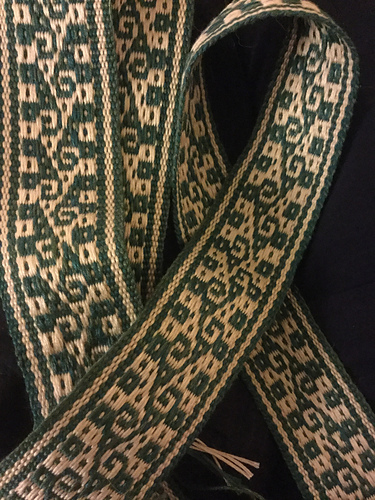


And, of course, there are backstrap weavers too. Sonja has been learning to do complementary-warp pick-up and use a backstrap loom while making a series of key fobs as gifts…


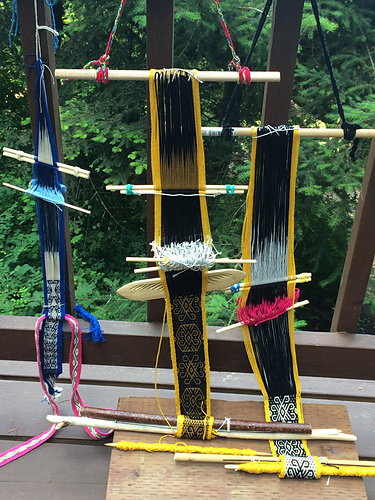
It’s nice to see the patterns on Tracy’s black warps that now feel like “old friends” to me, published way back in 2010…two of three of a set of original patterns I created for my Andean Pebble Weave book.
Martina has been doing some striking plain weave using a backstrap loom to make her own backstrap using the instructions in the WeaveZine article I wrote that dates back even farther than my Andean Pebble Weave book…all the way back to 2009.
 It’s so interesting to see all the different kind of looms and set-ups people are using to enjoy creating patterns in the complementary-warp structure.
I am heading back to my backstrap loom now to weave the other face of my iPod neck pouch. The patterns have a sort of weaving theme. The other face will have cats and balls of yarn which seem to be a fairly common theme among weavers. 🙂
Until next time….


