Spinning cotton had certainly not been part of The Plan for how I was going to spend my time during this Bolivian summer. I spend a fair bit of time when I am away sitting in airports, or on planes, trains and buses, and that is when I like to get out my notebook and create sketches and notes on the projects I would like to attack when I get home. Cotton spinning was not one of them. However, the seed had kind of been planted, although it had not quite taken hold, when I was in Australia. Elizabeth, who came to weave with me, gave me a lovely gift of prepared cotton, a tahkli and a pretty dish in which to place the spindle tip. She had taken classes with Joan Ruane earlier that year and gave me a little demonstration one lunch break. We were so absorbed and I was so swept up in her enthusiasm that we forget to eat!

I had learned to spin cotton in 2007 in coastal Ecuador when I stayed with a family of spinners and weavers along with anthropologist Kathleen Klumpp, but had not taken it much further. I practiced a little when I got home but never spun any useful kind of amount. I certainly couldn’t imagine using the clunky kind of thread I was producing in my weaving and I didn’t have the will to practice more in order to refine and perfect the skill.
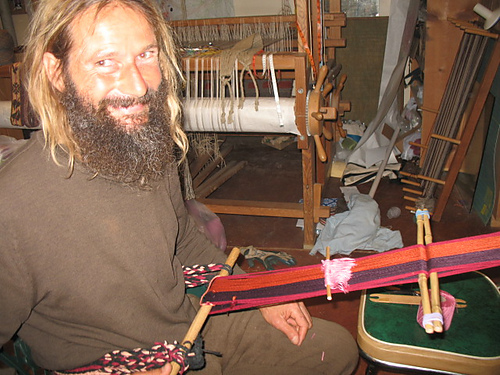
 Photo by Kathleen Klumpp.
I had brought back some of Trini’s prepared cotton and still have it sitting in the closet. Now there is a good chance that I will spin it.
 This cotton had passed through the hands of the many grandchildren in the family who would sit on the floor after dinner and pluck out the seeds. Mariana, Trini and I had taken turns in pounding it. I had even made myself a miniature stand from a tree on their property on which to drape the cotton while spinning it.

I simply couldn’t see any reason to spin my own cotton. I didn’t feel that the cotton I was buying was lacking in any qualities that I needed for my weaving….until now. I want cotton singles that can come somewhere close to the fine thread that the weavers in Guatemala use for their sheer cloth. They are able to buy skeins of the commercially-spun cotton singles that they use.. Some weavers in Mexico, who also create this kind of sheer cloth, go to the trouble of splitting the ply of commercially produced cotton if they want to weave the finest pieces. Can you imagine? The seed of interest that Elizabeth had planted in me in Australia started to sprout when Deb in North Carolina showed me the amazing piece of sheer white cloth that she had bought in Guatemala. I actually own a small sample of this cloth. I have taken it out of the closet many times to admire.
 There is a wonderful article by Cherri M Pancake and Suzanne Baizerman in the 1980-81 issue of the Textile Museum Journal on the production of Guatemalan gauze textiles. The article states that Handspun single-ply (Z-spun) cotton of varying fineness and degree of twist was used to produce some of the historical textiles. This is referring to textiles that were produced prior to the last decades of the nineteenth century. It seems that the weavers now only use commercially-spun thread.
Kathleen Vitale of Endangered Threads has produced a video on these sheer textiles that are being produced in both Guatemala and Mexico. If your mind boggles at the idea of splitting the ply of your already fine two-ply cotton, take a look at the technique used by the ladies in Mexico in this video!
I brought back a big ball of hand spun doubled cotton singles from Guatemala. I don’t know for what style of weaving that thread had been intended. I separated the strands and used the singles in my experiments in weaving the sheer cloth. My cloth is heavy next to the Guatemalan work! So far my own attempts at spinning cotton is producing thread that is only ever so slightly finer than the Guatemalan thread I bought but, even so, I know that I will enjoy weaving with it.
In the meantime, I decided to try weaving a small sample without a reed. I only wish I had used my own hand spun for this experiment. If I had done so, I could have killed two birds with one stone…testing the strength and suitability of my own thread as well as experiencing the difficulties of maintaining consistent sett without a reed. The sample was very small….just over four-and-a-half inches wide.
 After all my talk of temples in my last blog post, I didn’t end up using one. I did find it very useful to use the comb, pictured above, to beat rather than my usual sword/beater. I used a coil rod at the start to help establish the sett. I took measurements from the scarf I had woven. If you are familiar with the ”twisty sticks” that I like to use in my backstrap loom set-up, you will understand what I mean when I tell you that I also used a coil rod in place of the far stick in the twisty stick pair. I think that was helpful. There was much time spent keeping a close eye on warp threads that might be threatening to wander out of position, probably way more time than was necessary. I was happy with the way the width remained consistent but won’t get too carried away with happiness. This was, after all, a really small sample.
And then, I wove a sample with the same number of ends using the reed. It takes time to thread the reed but then you can just relax and weave.
 These experiments are preparing me for the time when I can either get hold of much finer singles, or spin my own.
Do I then abandon my 24dpi reed which won’t be fine enough, or thread multiple ends in each dent?
I have been asking some online weaving friends about the very common practice of threading reeds with multiple threads per dent to achieve a finer sett on their floor looms and have been hearing about their experiences with the ”reed marks” which can sometimes result. Apparently, they quite often disappear in the wash and one needs to sample to see if they will do so according to the material and structure that is being used. I think that reed marks would annoy the heck out of me! However, it’s good to know that these marks sometimes do remain in the cloth even after washing and that their occurrence is pretty much normal. I need to get over that if I am to going to be able to enjoy the ease of weaving this kind of cloth in fine thread with a reed. What about you…do you have any thoughts on how having multiple threads in the reed dents will affect the kind of open cloth I am weaving?

So, I have been spinning. I have a surprising amount of prepared cotton to spin in a big box in my closet. Back in 2009 and 2010, I was swapping llama bone tools and Bolivian drop spindles by mail with folks in Australia, the USA and Europe for various bits and pieces. Quite often I was sent cotton as a swap from generous people…way, way more than I had initially bargained for! I have natural green and brown cotton ready to spin and all sorts of other natural tones as well as dyed stuff. The picture above shows just a small sampling. And then, there’s the Indian charka that my friend Lisa gave me in 2010 and all kinds of useful tips in the book that Stephanie Gaustad gave me when she came to weave with me on one of my U.S visits a couple of years ago.
I can’t spend my time only spinning. I need to be weaving too. So, I prepared a warp for anther bag with built-in pocket. Both this new bag and its pocket are bigger than the green example I recently wove and decorated.

And, this latest example is far less colorful…black and white and that’s it. I am working my way up to a shoulder bag that will will have a large built-in pocket and pick-up patterns. I am done with sampling for this larger project now. I think I have remembered and put into practice all I need to review for the creation of the pocket and am ready to move on to the real project.
Here’s the warp set up with its longer pocket section. I actually remembered to take a photo of this part of the process.
 I edged the pocket with a patterned tubular band this time instead of cross-knit looping. And then, I edged the entire bag, including the mouth, with the same kind of patterned tubular band. The pocket is just the right size for my Bolivian ID card.

I added a snap to close the pouch, rather than a zipper, as well as a decorative button.
 It looks a little dull in the picture above and so I stuffed the pouch and the wee pocket with bits and pieces to give it some life.
 It needs a strap and I’ll most likely weave a pebble pattern into it as the bag itself is so plain. The back of it is pretty unusual. I wove the back with a window so that I could place my little sheer woven cotton sample within. I even lined that side of the bag. That’s a big deal for me with my limited sewing skills! It’s a quirky combination 🙂

Now, I would like to show you what a couple of my weaving friends have been doing with the bamboo reeds that they made with Bryan Whitehead at the ANWG conference in 2017. I will show just one project from each of Tracy and Kristin for now (so hard to choose) so as not to overload you with all that beauty! I’ll show more in future posts as the reed topic continues….
Here’s Tracy’s work using the 22dpi reed that she made herself with natural 10/2 cotton from Lunatic Fringe. It looks so awesome on the loom with that lovely roll of finished cloth on the front beams!

Here she is working on it during my visit earlier this year…

And here’s the finished cloth…so gorgeous!

You can read Tracy’s blog post about the making of her reed at the ANWG pre-conference workshop with instructor Bryan Whitehead here.
One of the reeds that Kristin made in the same workshop is 25dpi. She used it on her backstrap loom with natural and blue 16/2 hemp from Hemp Traders that she combined to weave fabric for several towels….

The finished cloth…
 These ladies also do some awesome work on their backstrap looms with their hand spun yarn and reeds. I’ll be showing you more from time to time.
Here are a couple of cool warp-faced projects from online weaving friends…

This if from Penelope in the UK. She says that the hat is nalbinded in Oslo stitch using some unknown chunky grey wool…..Felted down to size. I created the chart for the pick-up pattern for her. It is based on a motif that is often seen in tablet-woven bands. Penelope says that the pattern is based on a 10thC viking find from Dublin that many call ‘Little Dragons’.
Marie Paule in France is weaving Andean Pebble Weave patterns on her inkle loom using the two-heddle technique that I teach in my first book, Andean Pebble Weave…
 The same pebbly patterns can be created without the use of the additional heddles as Marsha is doing here….

Marsha is using the technique that I teach in my third book, Complementary-warp Pick-up. If you don’t think you would like to deal with the additional heddles that Marie Paule is using, or if you don’t think that your particular loom will comfortably accommodate them, my third book teaches a method that does not use them. It is a slower method, but it suits a very wide range of looms and can be used for other complementary-warp structures besides Andean Pebble Weave..
And here’s some of Bradie’s work. I wove with her in Vermont a few months ago. She was using an inkle loom but is already wondering about going on to weave wider pieces. I feel a backstrap loom coming on! This and other Andean Pebble Weave patterns can be woven with two sets of heddles, as Marie Paule does, or without them, as Marsha does.

So, it’s back to my spinning and maybe I will get the silk on the loom this week. I have already put together my pre-warping project notes and all is set to go unless I decide to go with the wool pocket shoulder bag instead. And there’s always a chance that something else will come along to have me throwing The Plan out the window…..
Until next time………..