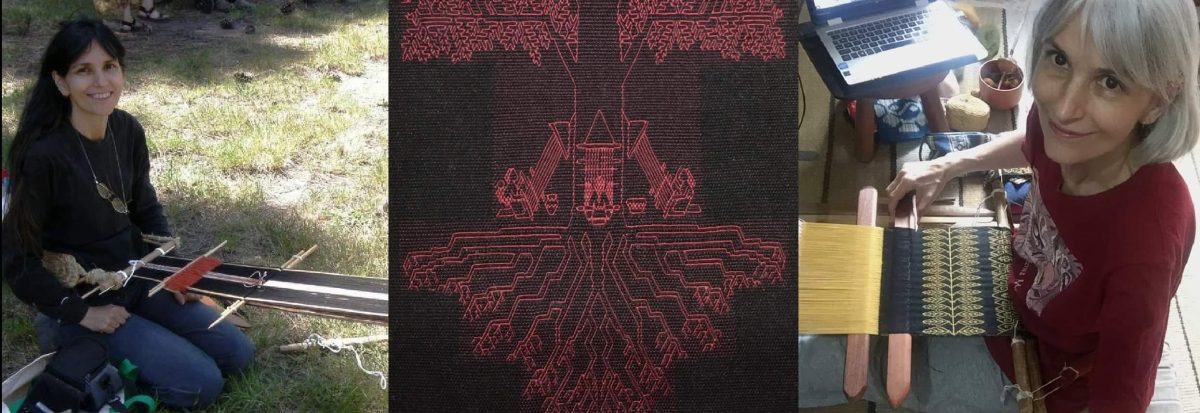
 With the temperature around 91 F and a broken air conditioner, it’s just as well that I have decided to weave something light and airy as my first big project for this season. I usually find myself at this hotter time of year weaving something totally inappropriate, like a wool lap blanket. Silk thread is not pleasant stuff either in sweaty fingers. I do, in fact, have plans for both wool and silk projects for the next few months but hopefully my a/c will be up and running again by the time I get around to them.
I threaded the reed for the project for which I am using some hand spun cotton that I picked up from this lady in Guatemala in 2008.

It was a little worrying while re-tying the cotton ends to have some of them untwist and break as I attempted to pull and tighten the knot. Breakages?! I hadn’t even started weaving yet! I did not want to have to size this warp and I am glad I didn’t panic and do so as, so far, I have only had one thread break while weaving. This same thread has broken multiple times and so I guess and hope that it was just one section of this particular strand that was more loosely twisted than the rest.
 Of course, I first wove a small sample for this open and airy balanced-weave that I want to do. You can just catch of glimpse of it at bottom right in the picture above.
I am trying to replicate the structure used by weavers in the Alta Verapaz region of Guatemala…a base of open balanced weave into which they place patterns using supplementary weft. The thread they use is much much finer than the cotton singles that I have. I was told that in some communities in Chiapas, Mexico where this kind of cloth is also produced, some of the weavers divide 20/2 commercially-spun cotton into singles and use that as their warp threads. What a job! Not everyone can manage it and those who can’t will pay someone to convert a cone of thread into singles. In the Alta Verapaz region, some weavers use commercially-spun 20/1 cotton thread is used which perhaps explains why the thread in the sample piece that I bought at the International Folk Art Market in Santa Fe a few years ago is so incredibly white. This information comes from Kathleen Vitale. I also read that other weavers use a 30/2 mercerized cotton which isn’t split and which is available in local markets. The hand spun cotton that I am using is off-white (and much thicker!) as you can see below.
 But, I am happy to have this piece of fabric from Guatemala and these balls of hand spun singles so that I can at least try this out and practice creating the patterns. The finer thread can come later!
Here’s a look at the little piece I bought in Santa Fe still on its loom. I would love to know how it changes after washing but I don’t want to cut it off its little loom. Or…did they somehow wash it in order to sell it?
 Here’s my tiny sample on the loom, and then after washing (sitting on top of my latest knitted cowl…still very excited about picking up knitting again!)

 The more open sett at the start of the sample is what I was aiming for but I unconsciously allowed the piece to narrow and deepened my beat which gave me consistent width and neater selvedges. However, in doing so, I almost lost the translucent quality that I had been wanting.
So, here is the large piece underway. I was so doubtful about the success of this project that I very uncharacteristically did not bother to plan out and chart a pattern. I just started winging it. So, I have to say that I am not entirely pleased with the layout of the figures. I am just practicing various basic lines and shapes. It’s another ”sample”, albeit a very large one!
 I would call it successful because I have only broken one thread so far. That had been my biggest concern.
Un-weaving is quite the thing. The fluffy warp and weft threads meet and grab hold and do not want to let go! However, it is this ”gripping”quality that seems to allow the Guatemalan weavers to simply cut off the start and end tails of supplementary weft right at the edges of the pattern rather than leave some length and make an attempt to bury the ends within the pattern. I am guessing that washing the fabric will further reinforce this. I suppose I’ll find out! This is after all a sample, right? I haven’t cut the tails very short yet.
I was eventually able to coax out one of the ends of supplementary weft in the unwashed Guatemalan sample so I could count the number of strands the weavers were using.
 It’s a very relaxing technique for me. I can sing, listen to podcasts…it doesn’t require the heavier amount of concentration that most of pick-up work involves. And, it sits light as a feather on top of my legs. It is certainly the fabric with highest amount of drape that I have created on my backstrap loom. There’s a long way to go. The warp measures something like eighty inches. which means that there is plenty of room left to play with patterns.
I am so thankful for these reeds that I managed to buy in the vendor hall at Convergence in 2010. They have just the right spacing for this open structure in the weight of cotton I am using. When the time comes to use finer thread, I will have to figure out something else. Or, not use a reed at all. The Guatemalan weavers don’t. I only want to handle one challenge at a time!
 I think the only other time I used one of these reeds is when I did a four-shaft shadow-weave piece a few years ago…

My backstrap weaving friends, Christine, Kristin and Tracy made their own bamboo reeds in a workshop with Brian Whitehead at ANWG 2017. Here’s Christine with hers… I know that Kristin and Tracy have put theirs to use multiple times with both commercially and hand spun fibers and have created some truly awesome pieces of fabric. I’ll have pictures and details in future blog posts.
A much simpler project that came off my loom last week was the piece on which I had been demonstrating at recent fiber events. It is now a backstrap to add to the collection of straps that my weaving friends use when we get together. It is sitting here with a couple of my bone tools. The one on the right was given to me by a gentleman in northern Chile. He had found it in the Atacama desert. It has a beautiful shape and point.

And, here’s the latest from some of my online weaving friends and students…

It’s lovely to see patterns from my books appearing in Marsha’s beautiful band projects. She is using the Gilmore Mini and Big Wave looms as well as a Handywoman treadle tape loom with a variety of materials…cotton, silk and tencel.
Maxine combines colors so beautifully on her inkle loom. How inspiring is this? It’s nice to see these patterns from my first book being used in such an awesome way.
This is Caroline Sargisson’s first band using an inkle loom and a pattern and instructions in my Complementary-warp Pick-up book.


Julie Beers finished a really long band of the playful kitties patterns in my latest pattern book. She wove this on one of the Gilmore looms.

Tara’s making a pouch from fabric she wove using a backstrap loom. She may use some of the finishing techniques I teach to decorate it.
 And Tracy has edged her bag with the ñawi awapa tubular band. She wove the bag itself using a backstrap loom and her own hand spun wool. The strap is currently underway.
Penelope made bands for her living history top hats using a Jonathan Seidel card loom with a Vav kompaniet heddle.

And, yarndragon made some keyfobs using 10/2 cotton. Because she thought 10/2 cotton too lightweight for fobs, she neatly backed them with denim.

Patrick finished the double weave band he started with me. The pattern is his own creation…

And, last of all, I will leave you to gasp at a picture of the amazing pikb’il cloth that really inspired my current project. It was one of the last things I saw on my recent trip away but became the item that jumped to the top of my to-do list on my return. I couldn’t get it out of my mind. Many thanks to Deb who showed me this scarf that she had bought on a recent trip to Guatemala. It looks like it would float away in a summer breeze………


