Sometimes I am fooled into thinking that just because I am in several online weaving groups, whose forums I read, contribute to, or simply lurk in on a fairly regular basis, I am seeing a good representation of what is going on in weaving in the USA , Europe and other regions of the developed world. Of course, what I am seeing online are mere drops in the ocean. Consider this blog post a peek at a scattering of drops in the ocean as I try to gather the bits and pieces that have come my way, both online and off, whilst on the road.
Let me first show you some pictures of beautiful textures of ocean currents and sand alongside quilt-like patches of color in the Massachusetts landscape. I went flying with my friend Pam’s husband in his Cessna to Cape Cod, over Nantucket and Martha’s Vineyard on a perfect spring day. We had hoped to do such a flight on my visits in previous years but the weather had always been against us.
Drops in the ocean….a corridor of islands stretch along a bed of blue and green ocean. Those patches of deep red are the cranberry bogs amongst the various tones of green in forests, lakes and fields.
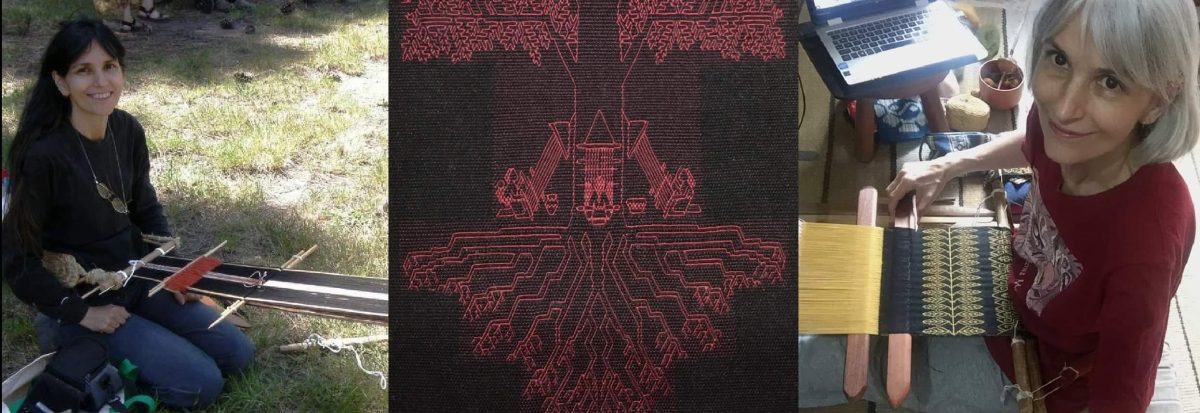
Squiggly lines on the ocean floor and across the land make me think of my “Shipibo songs” woven piece at home on my backstrap loom which is awaiting my return.
I have managed to visit three fiber guilds so far on this trip. Some are devoted to all kinds of fiber arts while others are exclusively about weaving. I see the items in the Show and Tell sessions and am astounded by the variety and beauty of the cloth and the humility of their creators.
Many of the weavers simply do not use the internet as a way to connect with other weavers. Their guilds provide a wealth of kindred spirits with whom they can share their projects, ask questions and supply answers. …more drops in the vast sea of weaving.
I like to hear the personal stories behind the woven items from people who are more at ease with sharing within a small group of people with whom they have become well acquainted over many years rather than posting things online for all the world of friends and complete strangers to see. And, of course, the added bonus at the guild meetings is that we all get to touch and examine the pieces.
We heard the story of Pam’s wool/silk tallit, or should I say, tallits. You can see two being passed around in the picture. It was only after having twisted the fringe and completed the piece that she realized, on folding it, that the stripes didn’t match on the two halves. One colored band had been woven slightly differently and had, therefore, thrown all the others off. I can imagine that sinking feeling in her gut as she discovered the error. It was back to the warping board to start all over again. She told us of the kindness of the person for whom she had woven the piece and why it was so important to her to have the piece come out just right. He received it in its handwoven bag in tears and says that it wll now be a family heirloom.
At the same Show and Tell session I was pleased to see a piece of warp and weft ikat from Thailand that a member had brought along just after I had mentioned this technique in a blog post.
Again, I wonder how many lifetimes I will need to try out these techniques. I may perhaps try weft ikat one day when I am done with experimenting with the warp version and then, if I have a decade to spare, I might get to try warp and weft ikat!
It was nice to see another kindred spirit of mine, Ute, at the Springfield meeting. Ute is part of a group with whom I have woven in Northampton and her sharing of her collection of Bhutanese textiles and her encounter with Bhutanese backstrap weaver Leki Wangmo were great sources of inspiration to me.
Meanwhile, back in the internet world, with its blogs and weaving forums, my friends Claudia and Janet showed off their latest custom designed handwoven baby wrap, the colors of which were based on a photograph of a Hawaiian sunrise supplied by the mom. Unlike most internet encounters with beautiful cloth, I have been able to touch this piece ansd heard the story about its creation from concept to fulfillment when I visited with Claudia a couple of weeks ago. Janet took the picture. I think that yardage is difficult to photograph and Janet has found a very effective way to show off the cloth.
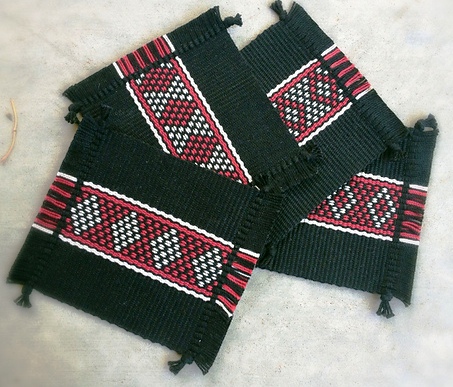
Ravelry friends have been at their backstrap looms. Kim is currrently exploring the world of the Bedouin weavers using their striking red, black and white al’ouerjan patterns for a set of mini rugs. These designs are traditionally woven using a warp-substitution technique which means that the back of the cloth will have very long warp floats. One of our group members, Tracy Hudson, showed us Bedouin examples where the weavers had cleverly used an extra weft to tie down the excessively long floats and create a much neater, more attractive and practical “wrong” side. I have tutorials on the technique and these kinds of patterns hereandhere on this blog.
And, while on the subject of red black and white, from which I never seem to stray too far, I got to see once again the stunning looped bag made by the Ayoreo people of lowland Bolivia that I had given to Pam some years ago. I often visit the co-operative store which sells the work of the various indigenous artisans in the region of Santa Cruz where I live and I have yet to find another example of the looped bags where the work is quite as fine as this one. Perhaps the best pieces are being taken to the International Folk Art Market in Santa Fe (although, I have to say that I don’t remember seeing pieces this fine there either). I am hoping that the quality of the work is not deteriorating as older more skilled artisans die and younger ones sacrifice a little quality as they strive to produce pieces quickly for international markets.
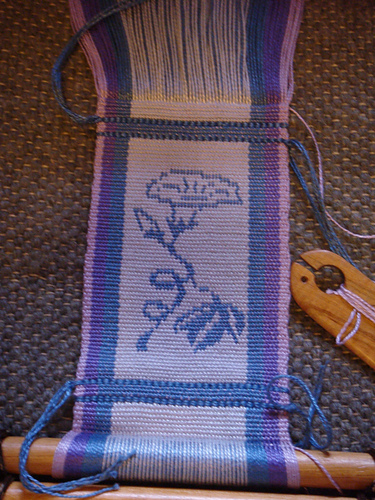
More from the Ravelry group…Julia is celebrating the arrival of spring (although rumor has it that it will snow here tomorrow as I make my way to California) with a double weave piece inspired by her blossoming garden.
She has framed the flower with vertical stripes and weft twining and I can’t wait to see where she goes from here. I am wondering if she will create a series of flowers, each within a little frame.
Here in Pennsylvania, the daffodils are in full bloom. It got warmer and warmer as I traveled from Massachusetts to Pennsylvania, staying with Susan, then Beth along the way and now with Ron and Carol.. It was interesting to attend the guild meeting in Boston….more like a mini conference than a guild meeting with four well attended workshops running side by side in the morning followed by a guest speaker after lunch.
Founded in 1922, it is the oldest guild in the USA and the book that they published to celebrate their 90th anniversary is a treasure. The meeting was the largest I have attended with a surprising amount of familiar faces…online backstrap weavers and people I have met at other guilds. It was nice to see Laurie Autio again and meet Deb Watson.
On the way to the Mannings I spent an evening in Beth’s home accompanied by the work of Jason Collingwood….well, what do you know….red and black! (with some white wall space between to complete the favorite color combo)….
I had a fun weekend with a group of backstrap weavers…
Laura is a natural and quickly found that “sweet spot” where the sword would sit up nicely in the shed without constantly clattering to the floor. You can see how she is practicing controlling the edge warps to make nice even edges.
Julia was back for a second time. Jeanne, whom I had met at the Spinning Seminar last year, was there too as was Karthika..
Julia has a lovely collection of old Guatemalan textiles that she collected in the 1970s. It was very nice to have these textiles on hand to look at. They show examples of both single and double-faced techniques.
This panel from a huipil of San Antonio Aguas Calientes is well used and very faded. The bird motifs were executed in the double-faced technique and the colors on the reverse are bold and bright.
This piece, which is covered in double-faced motifs, would have been a baby’ cap. A string along the top would have been drawn to close the top. What is most likely the baby’s name has been worked in. It is so incredibly fine!
This hair sash is a lovely example of single-faced techniques. The back of the sash is solid red with a few very fine stripes. We don’t know the exact origin of this sash.
I had two days to wander the Mannings store, see what’s new and catch up with staff including resident weaving instructors Tom Knisely and Sara Bixler. The ladies from Just Our Yarns came in to give a two-day class on weaving with their fabulous hand painted tencel.
I have been using one of their handpainted varieties as supplementary weft for years…a little goes a long, long way… and now I have several more of their color combinations to add to my stash. The first was given to me by my friend Lisa before I even knew what tencel was. Using it for weft inlay creates motifs that look as if they were made from mother of pearl.
There was also work to be seen by other past instructors and I discovered that rug hooking is not the same as latch hooking…
Debra Smith, editor of Rug Hooker’s magazine teaches at the Mannings and has created a small gallery of her work amongst the tools and other supplies for this craft that the Mannings sells.
This last piece ,with its colored vertical lines on black, reminds me of the reverse applique molas of Panama and Colombia…
So, I am off to California tomorrow. It has been a wonderful visit meeting new people and old on this east side of the US. It is always sad to leave the Mannings. This visit was too short.
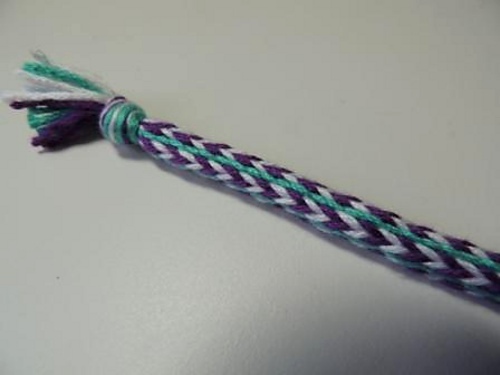
I got to play around with some of my tubular bands trying to devise ways to finish the ends. I found that I could make a neat blunt finish on the blue band and I could also finish the end with a sizeable knob, as on the gold band,which could be used along with a loop to close the band into a bracelet. I am still working on making that as neat and compact as possible. I need to keep practicing.
I will leave you here with a beautiful video that showed up in my Facebook newsfeed. I mentioned this to Karthika, who was born in India like me, and she knew straight away about the famed Jamdani weaving of Bangladesh. The incredibly fine and almost transparent fabric is woven on traditional looms with two weavers seated side by side. It is decorated with supplementary wefts. Watch as they prepare the yarn, warp, thread the fine yarn through the reed and then watch the speed with which they create string heddles!
The problem with not blogging…stuff builds up!! But not as much stuff as you might think this time.
Not blogging indicates that I have been way too busy having too much fun.
But that also means that I haven’t been able to take as many pictures as I would have liked. Can you believe it? There I am with camera in hand ready to shoot anything that moves but, on this trip, I have been moving too much to keep up.
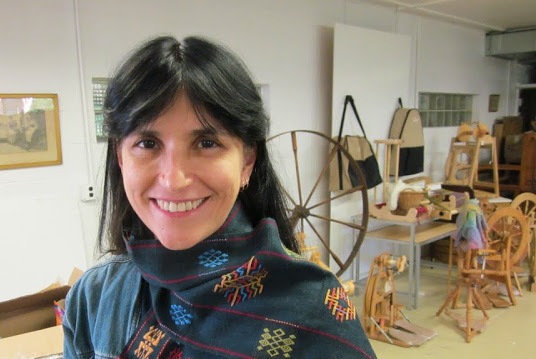
Fortunately people have sent me pictures and allowed me to use theirs. The one above was taken by Marge on a visit. I am modeling the Bhutanese inspired scarf that I wove recently using supplementary wefts to create the patterns.
EAST AND WEST…the title of this post.
This refers to the fact that I started “back east”, as people in here on the west coast say, in Pennsylvania and then headed over to the west coast, or the “wet” coast, as some people say, to Washington and now, California.
It also refers to the flow of wonderful eastern textiles that has occurred during this trip into my western hemisphere area of study…textiles from Timor, Laos and Indonesia as well as Central Asia. I have pictures of amazing textiles to show. They have me thinking about tripping off to Asia when next I visit Australia but, every time I think about that, one word pops into my head
:MEXICO:
and I realize that there is a lifetime’s worth of things yet to be seen on this side of the world.
Above is a picture of a backstrap-woven ikat (yes! that’s ikat) piece from Indonesia, a shoulder scarf from Batuisi, West Sulawesi from friend Judith’s collection. That is just a wee tease and hint of things to come in my next post.
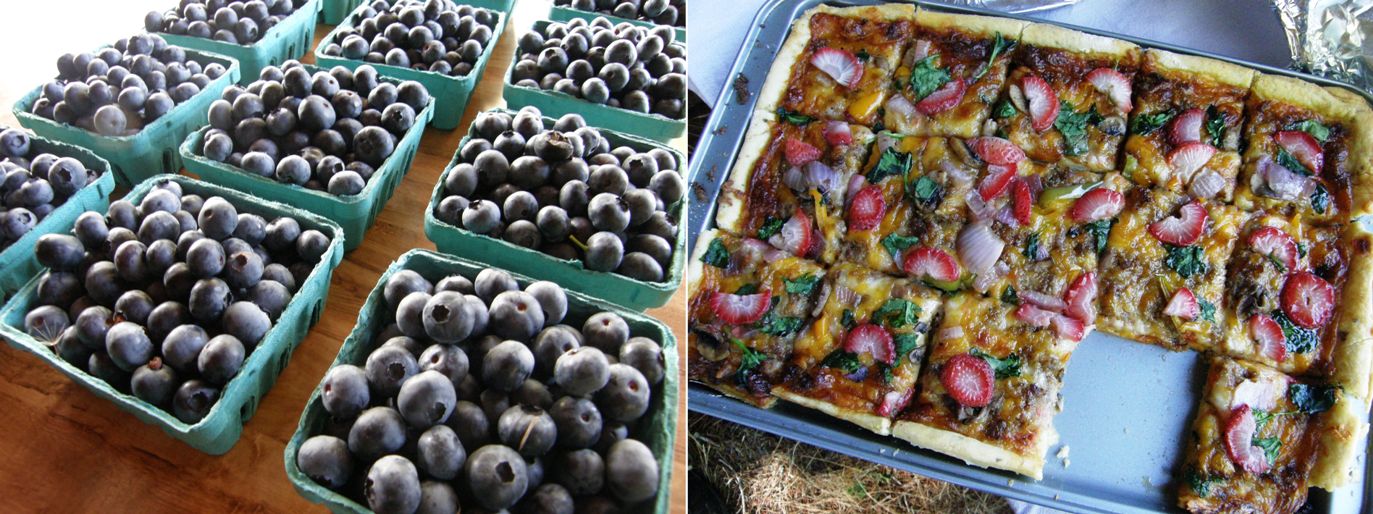
So, here I am in a west coast heat wave on my backstrap weaving friend Janet’s berry farm…
Blueberries! Lovely to be out picking in the cool of the morning. Yes, those are strawberries on top of that pizza. That was brought to the recipe competition by a neighbor who attended the annual Strawberry Jam party that Janet and husband Larry throw. I arrived just in time for that. As you can imagine, there was lots of strawberry based foods and lots of jamming by local musicians. But… more about all that in the next post.
For now, let’s stay EAST.
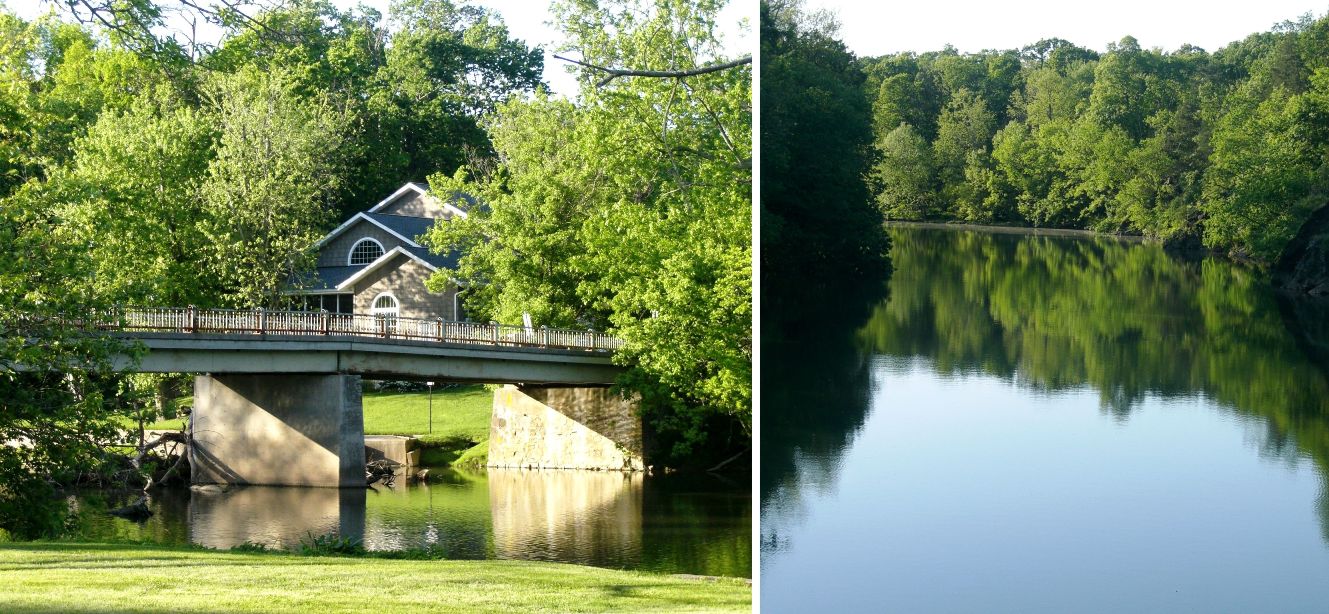
It all started at the Mannings in Pennsylvania with their annual Spinning Seminar…the 45th one, no less!! I have been to the Mannings in the spring….ah, idyllic!
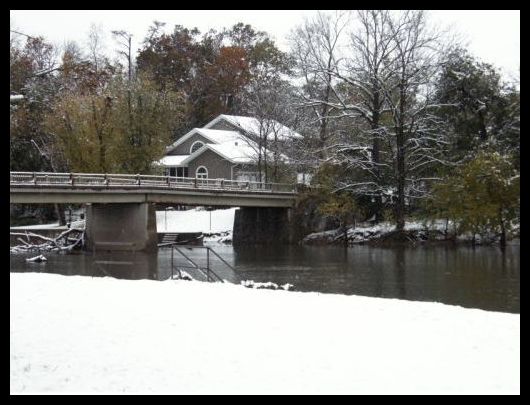
and in the fall….
woven inside and outside on the beautiful lawn down by the creek…
Here was a first…a chance to set up my backstrap loom in a shady spot down by the creek on a lovely summer’s day and just hang out chatting with people.
Ravelry and Weavolution friends dropped by. I have known Trisha, aka Coolsticks, from the early days of Weavolution back in 2009 and we finally got to meet…
There is Trisha on the left with guild buddy April .
Down by the creek things were pretty laid back! I had lots of time to spend with people.
That’s Amanda having a go at the basics of backstrap loom operation on a narrow band. The tree was adorned with straps and bands and one of my wide projects. Several people could be weaving with warps extended spoke-like from the tree. l liked over-hearing hushed comments while I wove on the big warp…”she isn’t using a chart!” (I smile thinking how I have woven items with that particular motif at least 50 times and goodness knows how many repeats of it there are in this one piece I am currently weaving!) And then there was…”Oh. So, it’s slooooow!”
Spinners set up camp, grabbing shady spots by the cool water to enjoy a day of spinning and conversation.
Picture by Pinar Miski
And for those who wanted to be in the heart of all the action, there was room to park a whole gaggle of wheels on the shaded front porch of the Mannings store.
One of my sample tables. Picture by Pinar Miski
And, at his point, I am going to hand over to the pictures of Pinar Miski who got to visit almost everybody and took the most wonderful pictures. She has allowed me to share them here. It was late in the day when I finally managed to make my way uphill to the shop to see what was going on. Shadows were long over the outdoor demo area at that hour and the crowds had thinned in the dying day. My pictures didn’t come out well. So, thank you, Pinar for sharing your shots!
Things were anything but laid back up at the store…happy shopping and browsing in yarn paradise. Pinar subtitled her photo album …”and then I died and went to heaven”! I think that says it all.
But, apart from the shopping, there were oodles of things to be touched, explored, and experienced with a wonderful selection of fiber artists and educators both indoors and out. I demand a do-over! I didn’t get a chance to see much of it!! But, I was having a lot of fun chatting with people about my passion…the backstrap loom.
It all starts with fiber. There was this…
Photo by Pinar Miski
Ron Bostek demonstrated sheep shearing. He brought Border Leicester and Cormo sheep to the Seminar.
Picture by Pinar Miski
Here is cotton spinner and teacher (and my fun roommate), Joan Ruane, showing one of many implements with which she spins cotton with ease. For me, who goes to the store to buy cotton for my backstrap weaving, Joan’s comment when she saw me at work at my loom was pretty funny…”oh my god, it’s WORSE than tapestry!”…a comment on the slowness of my weaving. And there she is patiently creating cotton thread!
Pictures by Pinar Miski
Yet another fiber on display ..Mandi Elliott Bird used antique tools to show how to process flax to the point where it can be spun.
Picture by Pinar Miski
Ron Tyler spun wool on a Great Wheel or, Walking Wheel, hoping to encourage people to take the beautiful inherited piece that may be sitting and simply decorating a corner of a room and actually use it.
Picture by Pinar Miski
One of my neighbors creek-side was Carol Ireland with her hip spindle.
Picture by Pinar Miski
This table was a-buzzin’ at day’s end when I went for my walk. It seemed that folks were invited to grab a bit of this and that and create their own batt. That looked like lots of fun. It was Sally Jenkins who demonstrated fiber blending with drum carders.
And boy, does this look like fun. I bet there were people jostling to get a position for this…
Picture by Pinar Miski
I am copying and pasting the description from the Mannings’s newsletter for this one…
Tartan, Tweeds & Waulking the Wool – When wool tweed or blanketing comes off the loom, it is not yet ready to use. The traditional Scottish method of finishing woolen cloth was a social occasion involving a group of neighbors, a large table and probably a little whiskey! The cloth was wetted and passed from hand to hand in a thumping rhythm kept going by suitable songs. We will skip the whiskey at our wool waulking but have lots of songs! Melissa Weaver Dunning will also have a display of her many woven tartans and tweeds.
Apparently it takes three songs to finish the process. Here is inspection time after the first song…
Picture by Pinar Miski
Again, Pinar captures a great moment!
Picture by Pinar Miski
Ah, now here is something a little closer to my heart. Susan Weaver brought along a large selection of tape looms on which she encouraged people to weave. I believe that all the tape looms for sale in the Mannings store went home with new owners that day. Susan and I know each other. She wove with me a while ago and lent me a Mexican band to study from her collection. So, I was eager to connect with her to catch up and return the band.
Picture by Pinar Miski
Mushroom dyeing! Hmmm…wondering what kind of aroma is coming from that pot. This is fascinating. Who knew that you could get such a range of colors from mushrooms and now I know that someone who studies mushrooms is called a mycologist. Susan Hopkins’s interest expanded from mushroom identification to dyeing.
Look at the colors…
Picture by Pinar MiskiPicture by Pinar Miski
Susan’s face says it all…she’s passionate about dyeing with mushrooms. Check out her t-shirt.
Anne Marie Decker was probably not around at the particular moment when Pinar went by. As Pinar says in her album caption, she still doesn’t know what nalbinding is, and neither do I! I have to say that it looks like something I would enjoy.
Picture by Pinar Miski
Indoors, Ron Woolcock gathered spinners to tell them how to keep their wheels happy and there was a display of the stages of silk production and processing. Thanks again, Pinar for the use of your pictures! Take a look at the entire album here. Pinar’s concise captions are fun.
One day to rest, and then my Ravelry friend, Julia, came by to weave and sew..
We wove a lot!. I was starting to crash by 4pm with all the things we got into. It’s so much fun putting those finishing touches on things!
We wove tubular bands, sewed and wove tubular bands to edges, sewed coiled stitches, edged and lined pieces with decorative stitches, warped for more bands….phew!
But, rather than get into all that now that she is home, Julia has been practicing the supplementary-weft inlay techniques which I show in tutorials on this blog.
Here are a couple of her projects…
The butterfly is one that I charted from an inlay motif on a Huave weaving of Mexico. The pattern on the right is one that I adapted from a motif woven with weft substtution, if I remember correctly, on a textile of Central Asia. I think that it is charted here on my blog. Loving the soothing colors Julia used.
Caroline also used weft inlay techniques to decorate her backstrap. I love how people are taking to this technique!
I adapted this particular motif from one on an Indonesian piece of fabric. The backstrap itself is beautifully woven and put together!
More fun weaving with friends that I have met online…Bands got finished with ends braided and all. Here’s Kathy practicing the four-strand braid on her warp ends.
If you have been following my blog, you will know about my recent experiments with weft inlay where I have been filling negative spaces with weft to outline patterns in the ground cloth. Some of the weavers were keen to try this. Another fun thing was combining strands of different colors for the supplementary weft which created interesting effects. Kathy and Bettes put together blues and other jewel-like colors while Nancy put together a very festive, sunny Mexican type of combination.
Marge came over for a day to weave and try a bit of double weave on her inklette and a touch of intermesh on the backstrap loom…
She brought her band box to show some of the things that she has been weaving on her inkle loom…straps for her musician friends. She plays in a band called Tater Patch and gave me a cd!
There’s the double weave band that we started on the inklette next to a nice knot-work pattern in pebble weave. And then we did a wee bit of intermesh.
Marge went home to finish that double weave sampler with some of her own designs. Guess what instrument she plays in Tater Patch?!
Meanwhile over in Tom Knisely’s Mannings teaching studio, there was lots of overshot loveliness coming off the looms. Here are a few examples. It is nice to be able to stay on the premises and get to see the weavers working late at night on these pieces.
Speaking of Tom, he gave me a wee gifty. You may have seen this before on this blog. Tom showed me this on one of my visits last year and has now decided that it really needs to belong to me :-)!!
I finally got to meet Cindy on this trip. More about that next time…that’s a “west side story”.
Laura has been practicing pebble weave…
I love the color flips and how she has joined the three single motifs into one long continuous one.
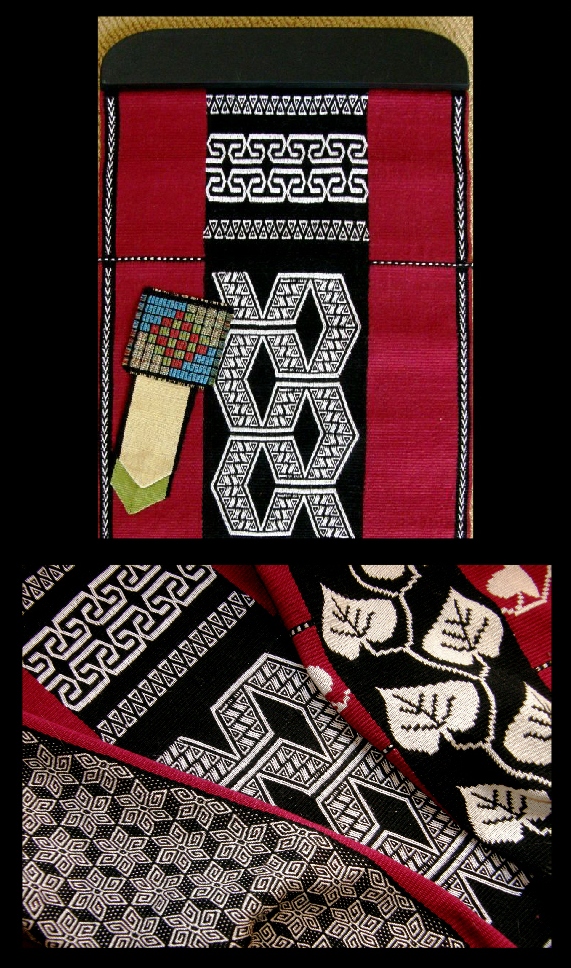
And just to finish and lead into Chapter 2: “West Side Story”, which is largely based on the ANWG conference in Bellingham, Washington followed by fun with my friend Betty at her home in WA and then with my friend Janet in northern CA, let me show you the weavings that I submitted to one of the conference exhibits.
This series is a work in progress. I have many more panels in mind to add. It is entitled “Textile Trails” and each has its little “traily” story to tell. It won the Committee’s Choice Award at the conference. I was thrilled! Thank you to Linda for taking this picture. The beautiful black wooden hangers were made by Terri of Magical Moons. Terri makes the custom swords and other implements that I often show on my blog. By the way, she is making spindles now. They look exquisite.
The fact that I am wearing a black top and a red jacket is just a happy coincidence, I swear!
Here’s the lovely handwoven ribbon…
See you next week. I am back on top of the blogging now…I hope!
 Drops in the ocean….a corridor of islands stretch along a bed of blue and green ocean. Those patches of deep red are the cranberry bogs amongst the various tones of green in forests, lakes and fields.
 Squiggly lines on the ocean floor and across the land make me think of my “Shipibo songs” woven piece at home on my backstrap loom which is awaiting my return.
 I have managed to visit three fiber guilds so far on this trip. Some are devoted to all kinds of fiber arts while others are exclusively about weaving. I see the items in the Show and Tell sessions and am astounded by the variety and beauty of the cloth and the humility of their creators.





 So, I am off to California tomorrow. It has been a wonderful visit meeting new people and old on this east side of the US. It is always sad to leave the Mannings. This visit was too short.