Backstrap Weaving – Long, flowing, luxurious….sashes.

I have had belts on the brain after my post last week where I was thinking about which examples of my weaving I can manage to take away with me on my trip next week given the very limited space that I have for such things in my luggage.

I had my woven cell phone pouches, cosmetics bags, computer cases, pouches for sewing kits and passport and tool bags on my list…all handy things for travel which could be useful as well as serve as examples of different pick-up techniques when I meet people and tell them about my weaving….certainly not the kind of things that weavers here in South America are making for their own personal use. Then there were my colorful woven backstraps…would you believe I have only met one or two indigenous weavers here who have actually woven their own backstrap? It’s just not the done thing.  Generally, a flour or rice sack with rope on its ends will do as a backstrap. Sometimes a piece of leather or some braided fiber like agave is used.

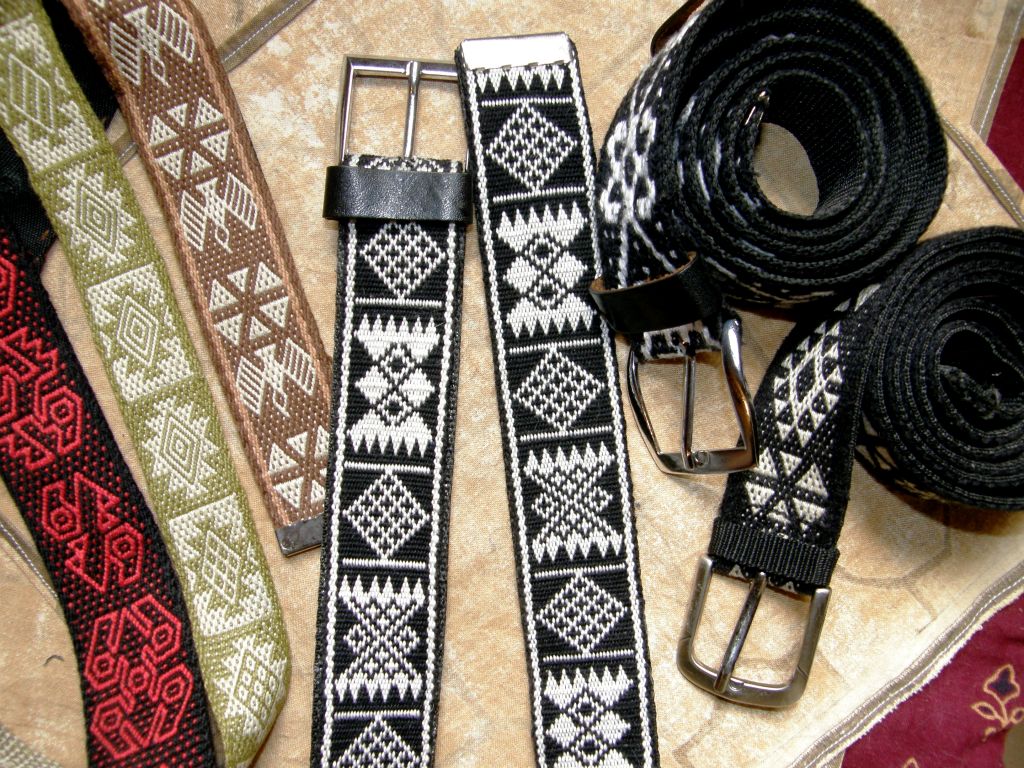
And then there were belts…something I can wear AND show as a woven examples. Belts and sashes are certainly things that indigenous weavers weave for themselves. There are few weavers that I have worked with that have not had belt weaving as part of their textile tradition. They can sometimes have symbolic significance, perhaps a purely ceremonial use or they can be simply practical.

So, I thought I would take a look at some of the belts and sashes that I have gathered over the years and I was surprised at how many examples I have given that I have made a conscious effort to stop purchasing these things when I travel…sometimes you just can’t resist, you know, but I really do try these days to just take photos and move on. I will include some of the beautiful things I have photographed too.

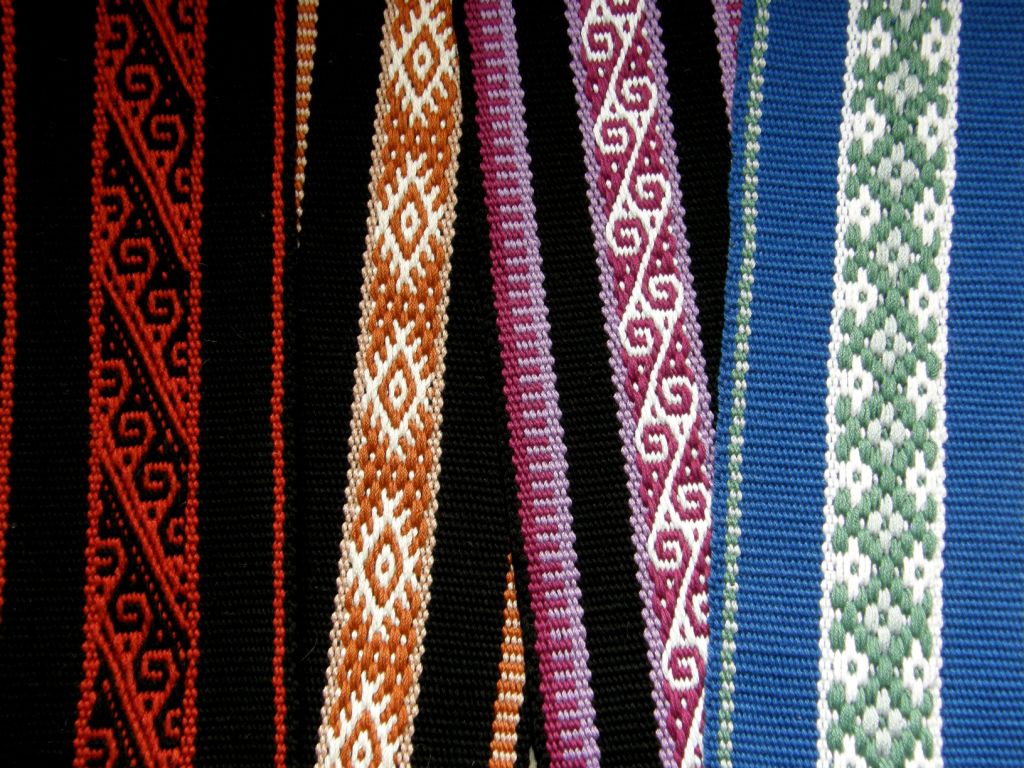
These are not belts but rather, hair sashes. I am thinking that one of these years I will let my hair go completely grey, keep it long and wear spectacular hair sashes like these!

These are all from Guatemala.

The one at the top is from Zunil and I learned that style of weaving there.

The center one is from Jacaltenango and is the style about which Carol Ventura has written a book. The lower one is from Aguacatan. It is wide, long and has the most amazing tassels on the end. I was only in Aguacatan for a day and I didn’t feel that I could ask any of the ladies to pose for a picture. I would so like to show you what this sash looks like when it is worn. I have read that women wear these hair sashes in imitation of Ixchel the Mayan goddess of weaving who has coiled snakes holding up her hair.

I love sashes. I love their length, their drape. I like pulling them through my fingers or laying them in a crazy coil of color on the floor.

From the very same town of Aguacatan comes this complete contrast in a simple black and white belt.

This is my weaving teacher Clara at her hybrid four-shaft/backstrap loom wearing and weaving one of the typical hair sashes of Zunil.

This belt still on its backstrap loom from Viques, Peru is probably one of my favorite things. It is made with yarn that wraps about sixty times to the inch and is covered in fine patterns. The weft is tripled and the belt has been beaten to an incredible stiffness. This belt is the main reason I have stopped buying these things. I have had this piece for almost sixteen years and the yarn is now so fragile that it is difficult to touch the piece now without having threads break. These things need to be stored and cared for in ways that I am not able..

I can hear voices saying “Well, bring it here to me, I’ll take care of it!” Maybe I will….

This belt is worn by the men of Cañar in Ecuador and is made with what looks to me like sewing thread. It is wonderfully smooth and slinky. Hanging out in the plaza of Cañar on a Sunday morning is a great way to see men and women out and about in their best clothes. When I was there many of the men were wearing ponchos with ikat patterned sections and these gorgeous belts most of which had far more motifs than the example that I purchased.

These sturdy double weave belts worn by women in Potosi, Bolivia seemed to be very fashionable as far away as Otavalo in Ecuador. When I was there in 2005 I saw a few young ladies wearing these instead of the chumbis that are typical of their costume. I wonder if they are still a fashion trend now. Quite likely something else will have taken over in popularity by now.

This one with its bold, beautiful design isn’t mine and was shown to me by a gentleman in the US who had spent some years on the Argentinean pampa working as a gaucho (Argentinean cowboy). He told me that it was probably woven by a Mapuche weaver and that it forms part of the traditional gaucho costume.
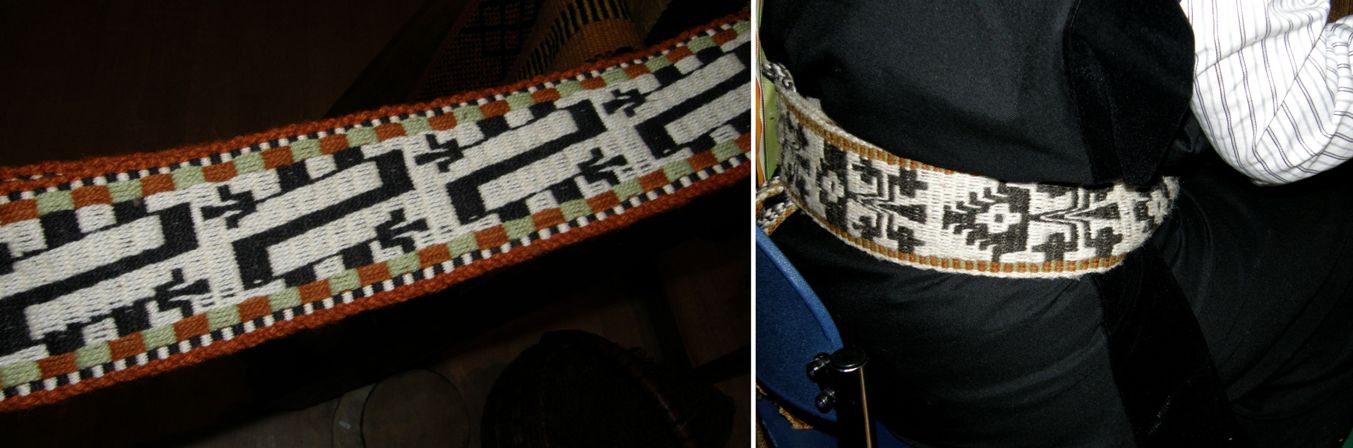
The Mapuche women themselves weave and wear a belt called ñimintraruwe as seen above.
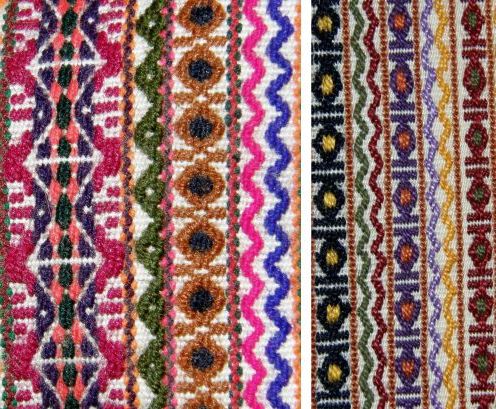
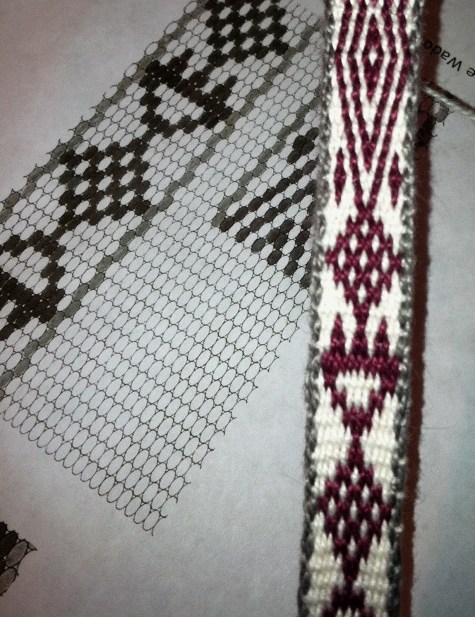
This is the belt woven by men and worn by the ladies of Salasaca, Ecuador. A Salasaca belt is on the left and my reproduction of one of the designs on the right.

I tried very hard to buy one of these belts as I had learned to weave them and wanted a sample of all the designs. There simply wasn’t one to be had although I noticed that the family with whom I had been staying had their pig tethered with an old belt! So, I took lots of pictures instead. Some of the younger ladies were keen for me to make them a pebble weave belt. Like the ladies from Otavalo, they were interested in having something different in order to stand out from the crowd. They took the little photo album that I carry with pictures of my weaving and used it as a shopping catalog pointing out the designs and colors that they wanted!

I ended up teaching one of the ladies and another young fellow pebble weave instead…now you can make your own belt!!
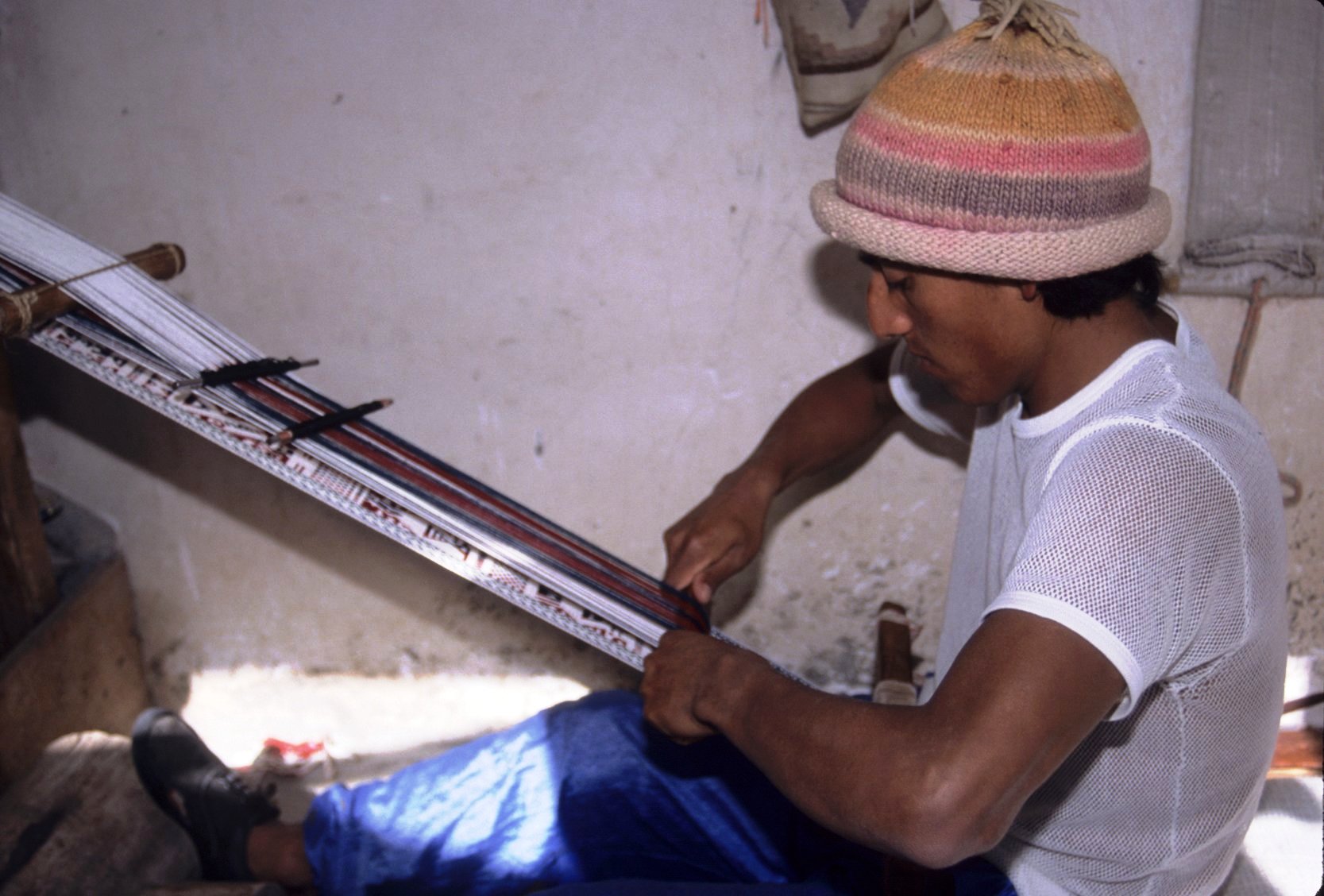
A belt weaver of Salasaca at work at his loom. (this picture courtesy of Teyacapan)

These belts are woven and worn by the Tarahumara people of Mexico. I was lucky to be able to see and photograph them when an anthropologist showed me her collection at Convergence in 2010. The one at bottom right belongs to Annie MacHale who has a large collection of sashes which she loves to wear.
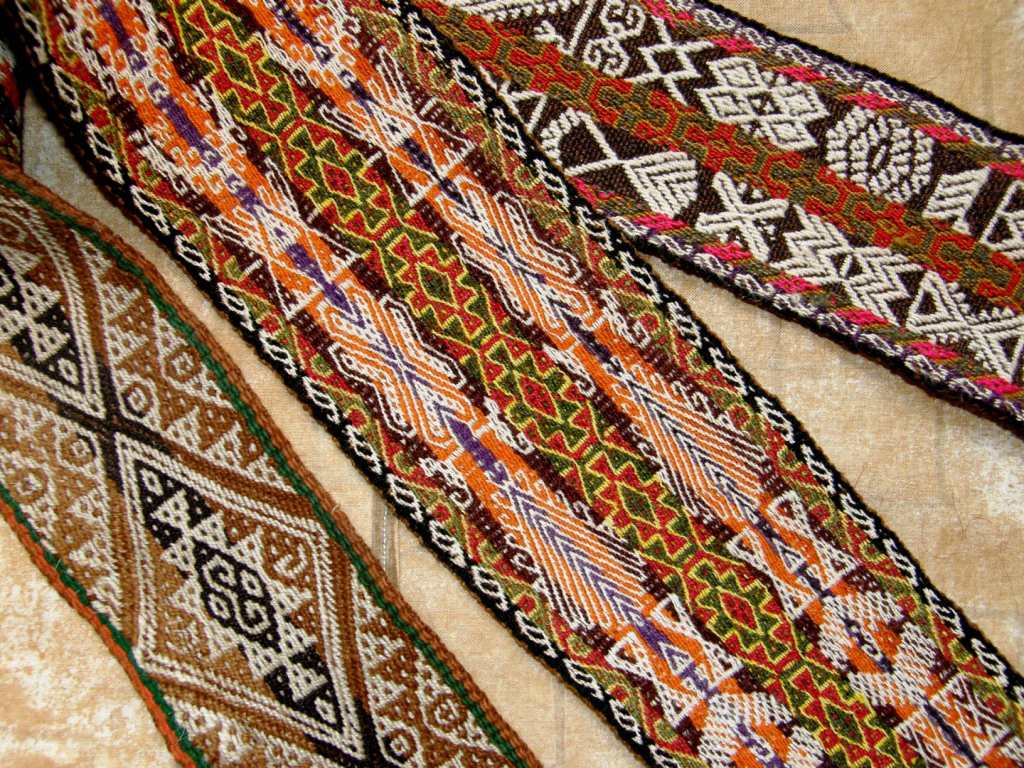
These pieces from the Cusco area have a mind-boggling amount of pick-up patterning.
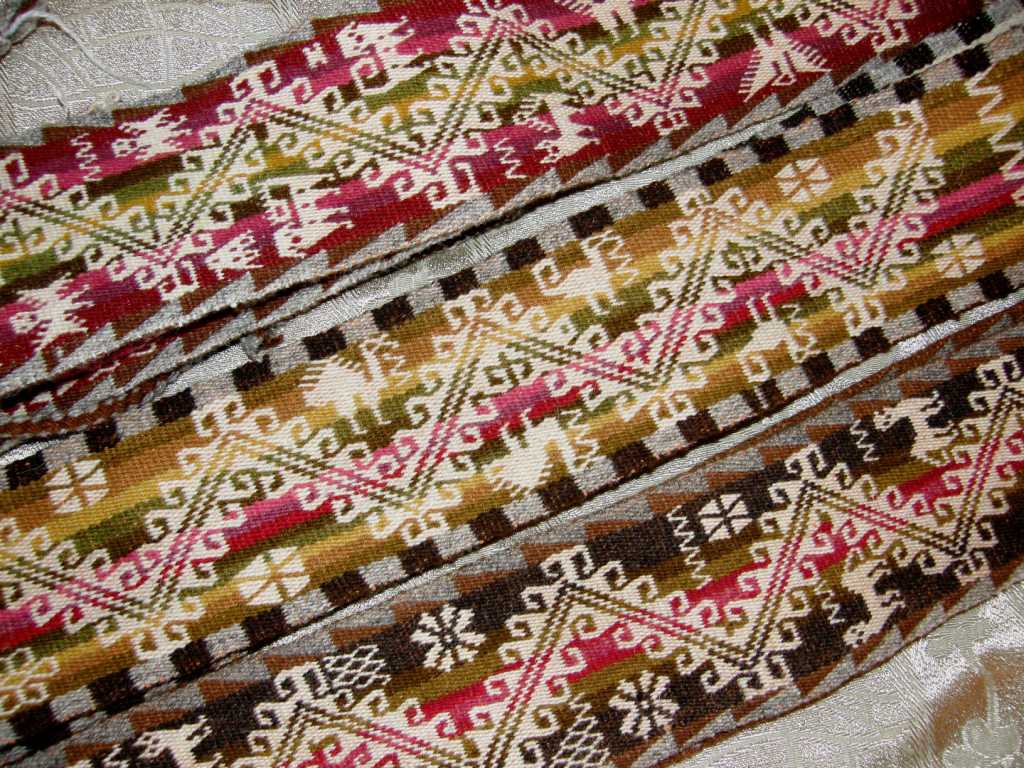
These broad double weave belts from the central Bolivian highlands show the progress that organizations such as PAZA Bolivia are making in helping weavers to recover natural dyeing techniques. These wool belts have a distinctive smell that I can only describe as campo (the country).. a mixture of wool, the natural dye material and smoke….I love it!

I love this sash that I bought on my first trip to Peru before I even knew what pebble weave was. You may recognize a couple of motifs from my book.

Here’s a beautiful three-color belt of the northern Chilean highlands. I may not want to buy the textiles, but think I will always want to buy tools as I will definitely use those. Isn’t that beater wonderful slick and shiny with use?!
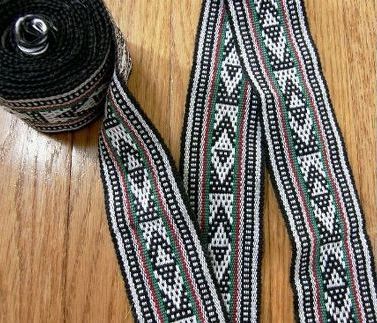
Knowing my love of pebbled things, Pam Nadjowski gave me this belt at Convergence. It is one that she collected from the Dong minority group of China. It is very long and must wrap at least three times around the waist.

These are part of Kathe Todd-Hooker’s extensive collection of belts of the Russian old Believers. Taking plenty of pictures, albeit not particularly sharp ones, has enabled me to reproduce some of the designs. Kathe says that the belt around the body has the symbolic purpose of creating a visual cross as well as representing the encircling arms of the church.

So, we weave bands to encircle our waists and then some people weave them to encircle their homes…

Yurt bands! I love them but what would I do with all forty-eight feet of one? My friend Lisa’s owns this beauty and owns a yurt on which to use it.
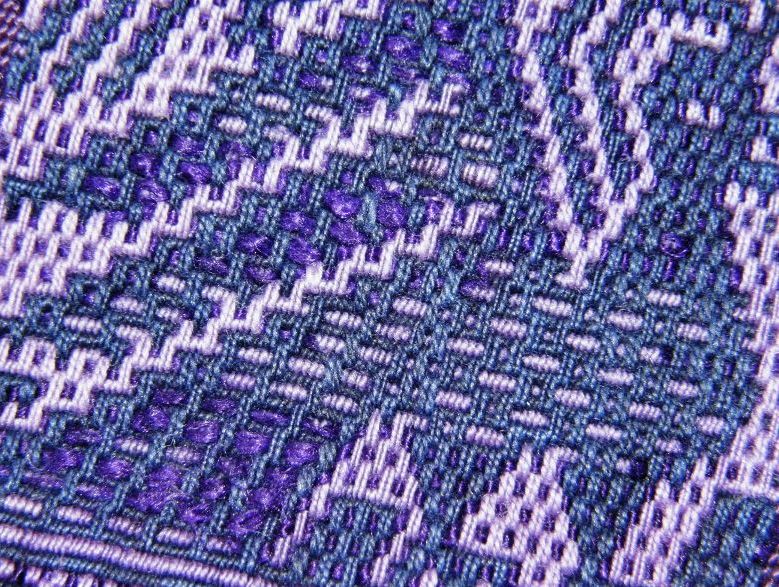
Sometimes just photographing a small part of a belt is enough to get me motivated for the next experiment. This belt with its combination of simple warp floats and supplementary wefts was very intriguing.

This Huichol belt that I originally photographed in the National Museum of the American Indian back in 2007 has been on my mind all these years and has influenced a few projects. Then I finally learned how to do the balanced double weave technique in which it is made.

I love sashes and belts…the long flowing loveliness!. They have prompted me to make a few of my own. These would be pretty dull wrapped around my hair. I must make some much more colorful ones.

This next one is more like it. It has been with me for years. It is a sample I wove when I still lived in Chile and I intend to make a full sash with this design one of these days…

And more sash inspiration and ideas come along every day…
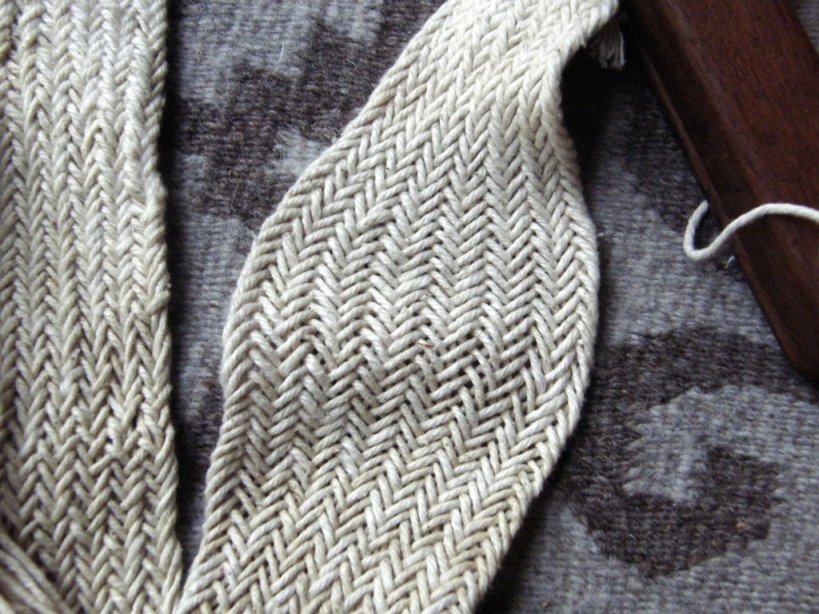
This study sample of the sprang technique used to make Hopi wedding sashes made by the late Nora Rogers was given to me last year.

There’s more! But that’s enough don’t you think? Just think…I will be  at sash-weaver Annie MacHale’s home next week swimming in long gorgeous sashes…not only the beautiful ones that she has collected but the fantastic ones that she weaves herself on her inkle looms.

I will finish with a quick report on what I have been up to on the loom.

Apart from samples for my next book which I am not showing yet (!), I have launched  the second ikat experiment. This means that I didn’t actually spend that much time at the loom. It was more about tying cassette tape to form the design, dyeing and re-dyeing as I wanted to have three colors. I chose terracotta and navy blue after hearing about the chocolate and blue ikat textiles of Guatemala that Karen from the Ravelry group likes.

Tied and ready to be dyed…. I am afraid that I am not being very brave as this is the first experiment with dyeing two colors and so I only wrapped one motif on each of the three sections.

Dyeing done. There will, hopefully be white diamonds on blue with terracotta centers on the two outer sections with a white diamond on terracotta with a blue center on the middle one. Like I said before, this for me is the easy part. Now to weave and have it all stay more or less together. I have woven the first two inches of plain weave and am about to hit the wrapped section and will show you next week how it went. I am using a fine weft again as I really like the way the resulting fabric looks and feels.

This next piece started off as an experiment but now I think it will be one of the key fobs for my muddle of luggage keys on the trip…Too bad I didn’t start it with a third selvedge.
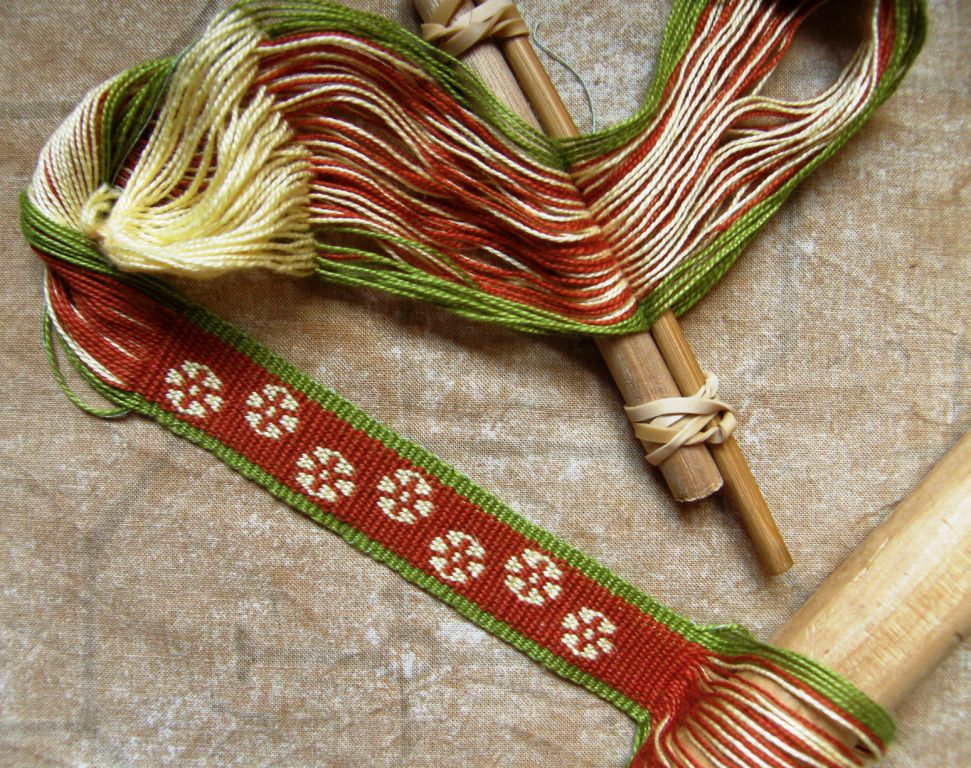
I am weaving this in what I call the “embedded double weave” technique, that is, plain weave alongside double weave. The green borders are plain weave. This is the technique I learned in Potosi, Bolivia and this way of including strips of patterned double weave in plain weave fabric is used in a few places in Bolivia. Two wefts are used. I have, however, been trying something new in the material I use for the second weft and in the way I handle the two wefts and I love the way it is turning out.

The new way I am trying makes the transition from double weave to plain weave on the upper face less obvious and harsh and on the lower face it is, amazingly, not apparent at all…completely smooth! I will fill in the details next week. I thought I would save something for next blog day as I will be just arriving in California with perhaps not a whole lot of time to put things together to post. My posts will probably start getting erratic.

For next week I am also saving pictures of Bobbie’s progress on the gorgeous naturally dyed Guatemalan warp that I showed you last week.

We can take a look at the pattern she is weaving and see how she set up her loom to create it.

Naseen on Ravelry has finished a sash (in my favorite colors of the moment) and shared her pictures with the group…
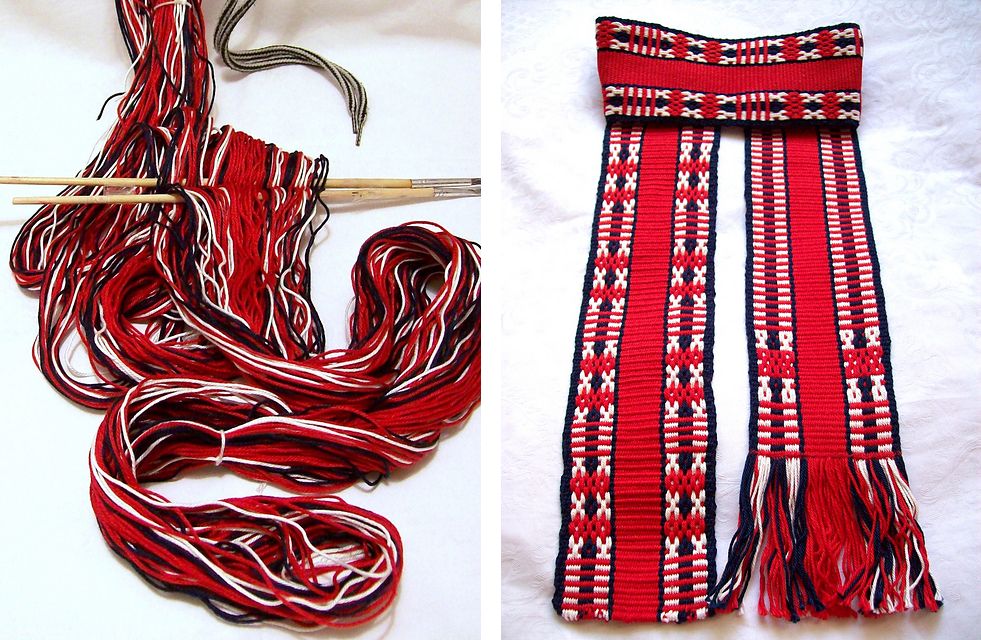
She used the tutorial on the yurt band border pattern here.

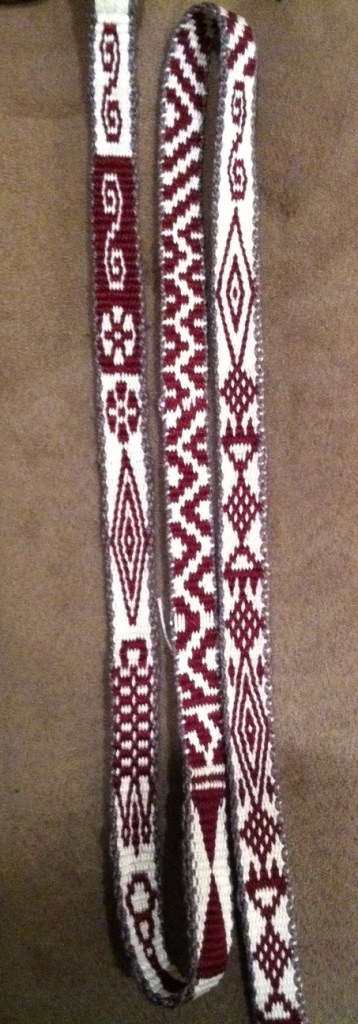
Yonat has been playing with the double weave technique she learned in our workshop last fall on her inkle loom. The technique transfers perfectly to this kind of loom and you will find pictures of the set-up on the inkle loom on the tutorial page here. Here’s her sample band with Andean and Bedouin motifs as well as others that she invented herself.
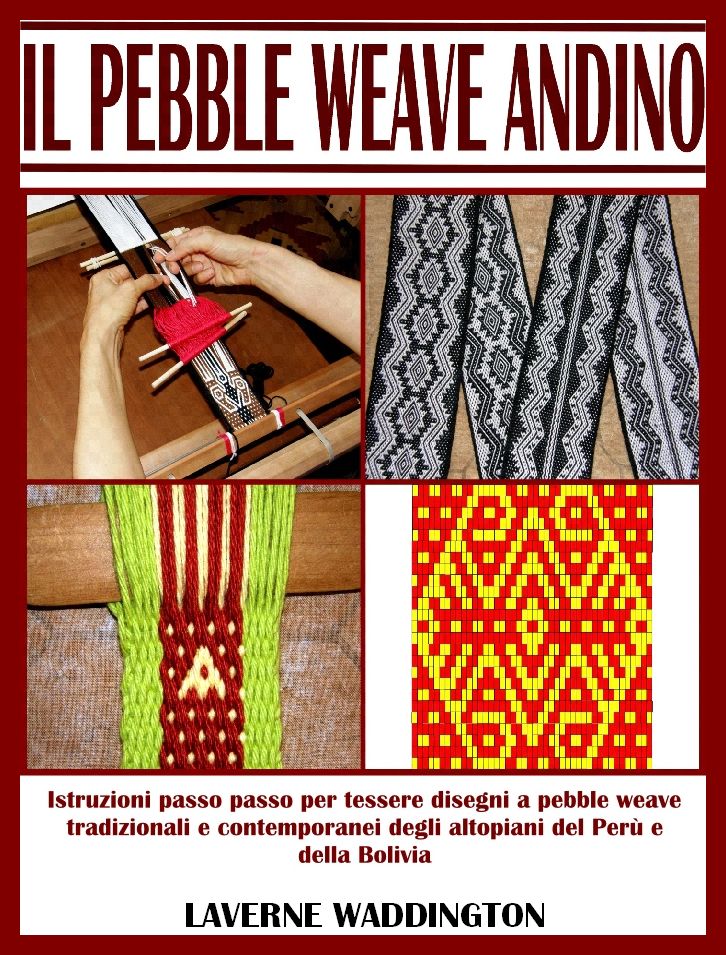
Andean Pebble Weave is now available in Italian on the Patternfish website. Many thanks to Lidia Guffanti who did the translation.

Now that it’s in four languages, I can tell you:

Happy weaving! Buona tessitura! Bon tissage ! Viel Spaß beim Weben!

See you next week in California!
Backstrap Weaving – All that Weaving in a Nut Shell

I stopped buying textiles when I travel a long time ago. Firstly, I simply don’t have room to hang or display them and I hate having them stuffed in boxes in my closet.

Secondly, I don’t live in a climate that is friendly to textile preservation…the humidity!…and there is no escaping that now that I have decided I am never using an air conditioner again.

And thirdly, I would rather spend my money on getting places, taking classes and taking a lot of pictures which I can more easily store, enjoy, share and study. I think my digital camera was a far better purchase than any of the textiles I have brought home over the years. Too bad I left it until 2009 to go digital.

Oh, and one more reason…some of the things I have left out have been chewed by my cat. Above you can see some of the bits and pieces I took out for a profile picture I needed.

This means that I can’t take a case full of gorgeous handwoven textiles of Bolivia and other countries I have visited when I go to the US or elsewhere and want to tell people about the weaving I have seen. Even my own backstrap woven pieces are staying home now after seeing how they emerge in an ugly crumpled state from the bottom of my backpack. There  just isn’t a way to carefully pack these things. How do I capture all that weaving in a nut shell without packing and taking half the house with me?

As far as all the amazing indigenous textiles of South America are concerned, I am slowly building a nice digital collection of those and I carry it with me at all times to show on a space-efficient, crumple-proof, cat-resistant disc.

And, if I do take anything at all of mine, it has to have a dual purpose…something that is pretty to look at or which serves as an example of a structure that I am showing, as well as being useful while I am on the road.

Something like these backstraps… I can’t believe that it was this time last year that I was weaving these in preparation for my spring trip to the US. How time flies! They show some simple and complementary-warp structures as well as being useful to people who want to weave along with me. They are sturdy and  roll up nicely for packing.
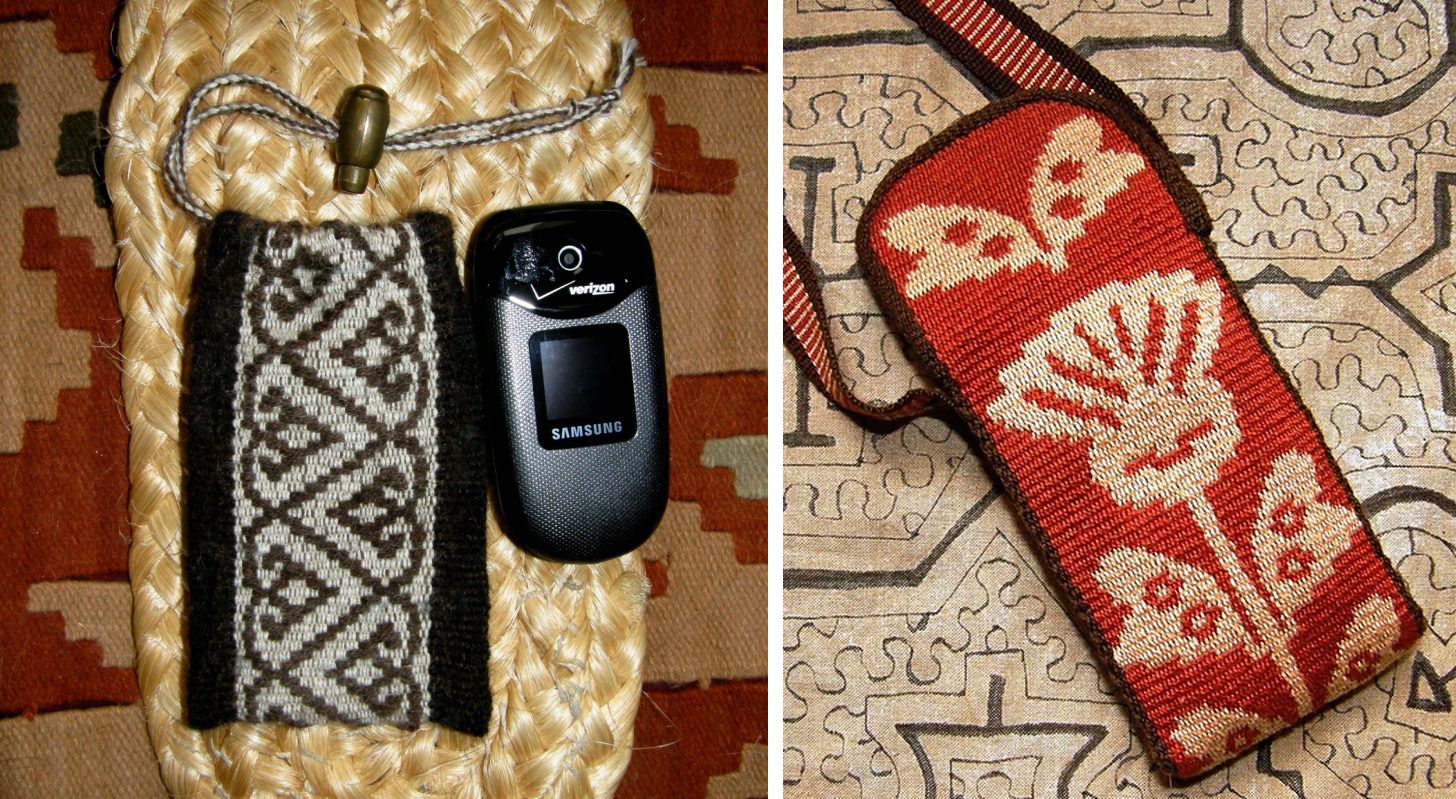
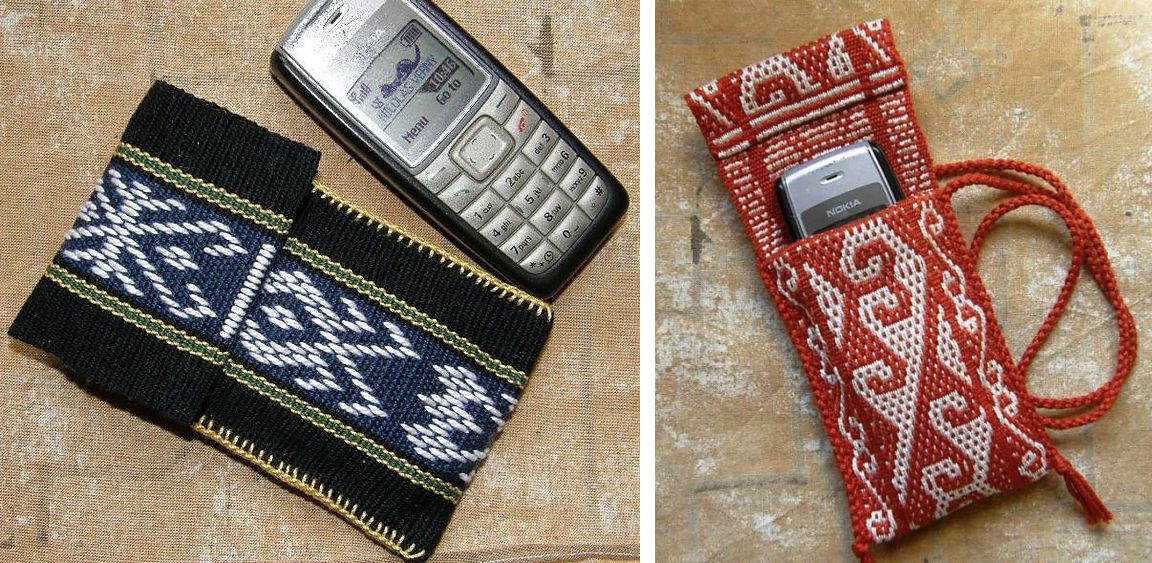
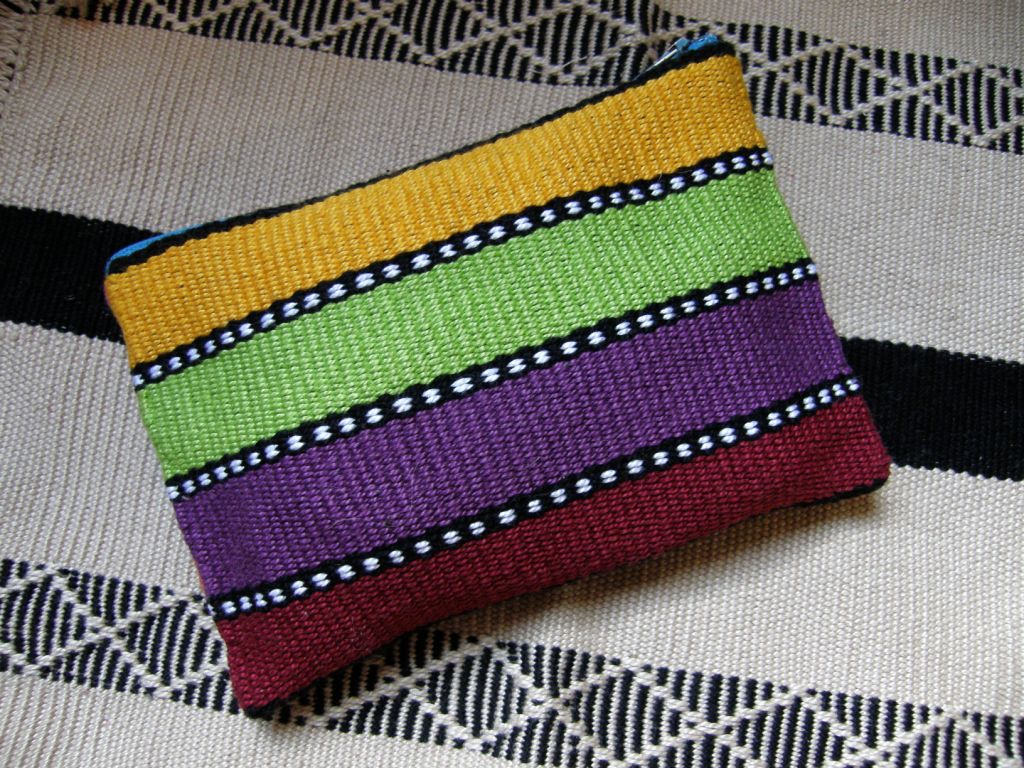
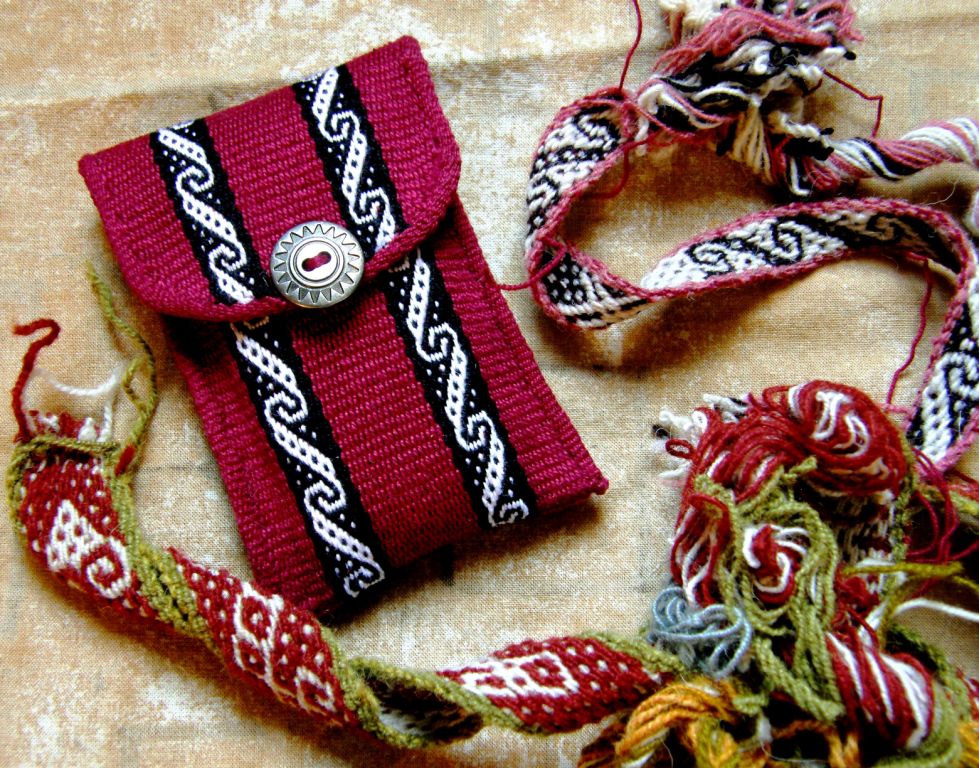
I don’t have a cell phone here in Bolivia but I find I really need to use one in the US for airport pick ups and that sort of thing. And it is just as well as I have quite a few cell phone pouches to choose from. I take one pouch for the phone and one for the charger.

Here are a few of them…

I should choose the ones that show structures that are not part of the backstraps. So, I could use the finnweave examples above or the supplementary weft patterned handspun alpaca one below or….

the one below left with the Van Dyke stitching that the Montagnard weavers use on the edges of their bags or….

…the one above that has a tubular woven band finish on the shaped flap. These little pouches are also handy as business card holders when I travel.

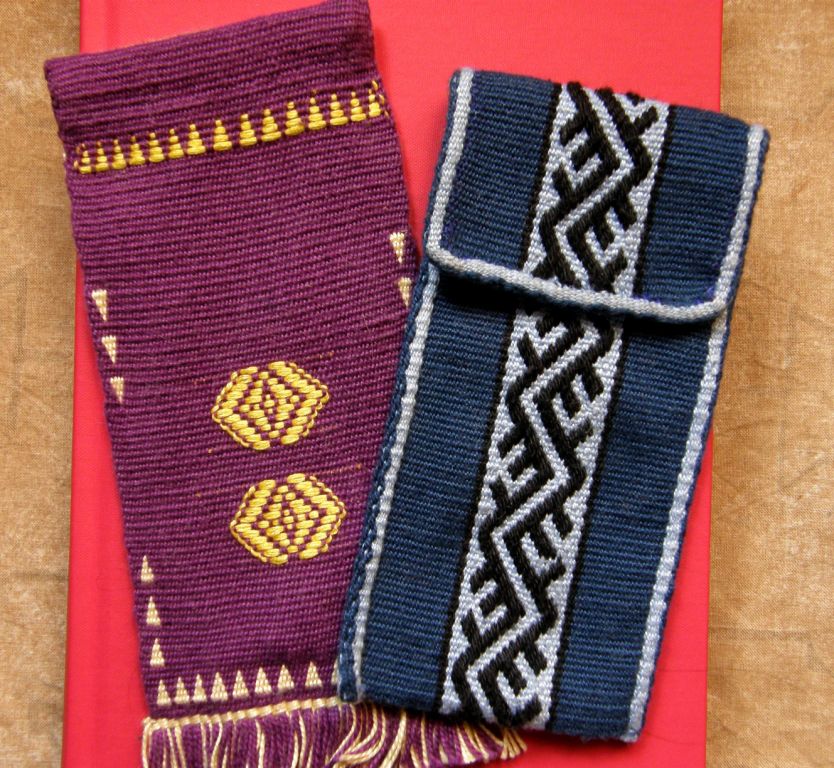
Then the glasses need to be accommodated. Ah, as the years go accumulating, so do the eyewear needs…reading, long distance, over contact lenses etc….What ever happened to the days of traveling light?

With the wool one above I can show people the theory behind the technique for making the discontinuous warp textiles that has being revived in Pitumarca, Peru.

At left I have a seamless tubular case made in double weave with a little supplementary weft patterning.

The blue case has a supplementary warp patterned strip and has been edged with a pebble weave tubular band.

These are all just samples that got made into things that now have the dual purpose of showing structures and techniques in a nice compact form as well as protecting my glasses while on the move.

If only I would use them here at home too, I might be able to locate my glasses more easily before I end up sitting on them!

Key fobs are useful for quickly locating all those keys to the TSA approved locks. Yes, I finally got some of those after getting tired of finding my broken locks inside my open luggage with an explanatory note. Would you believe that I don’t have a single woven fob right now? I always end up giving them away. I shall add that to the pre-trip “to-do” list. They are particularly good for showing lots of different structures in a very compact form.

I usually take a couple of projects on the loom so I can demonstrate backstrap weaving. I don’t warp with anything in particular in mind and the purpose is just to show how the loom works. Those projects usually suffer a lot as the loom gets tied up in different places at different angles and under different tension and the projects often are not looking quite their best by the end of the trip.

Fortunately, on the my last two trips the projects survived and I was able to make them into something on my return which are handy items to take on the road….

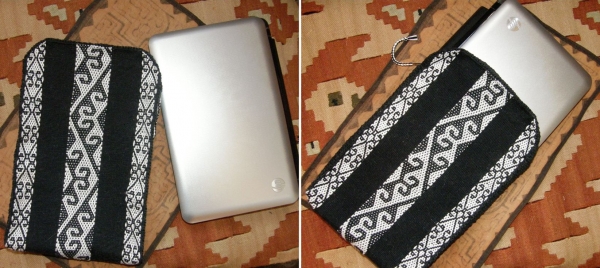
A dust cover for my notebook computer in two-color simple warp floats,

…a good sized pouch for my sewing materials in good ol’ plain weave,

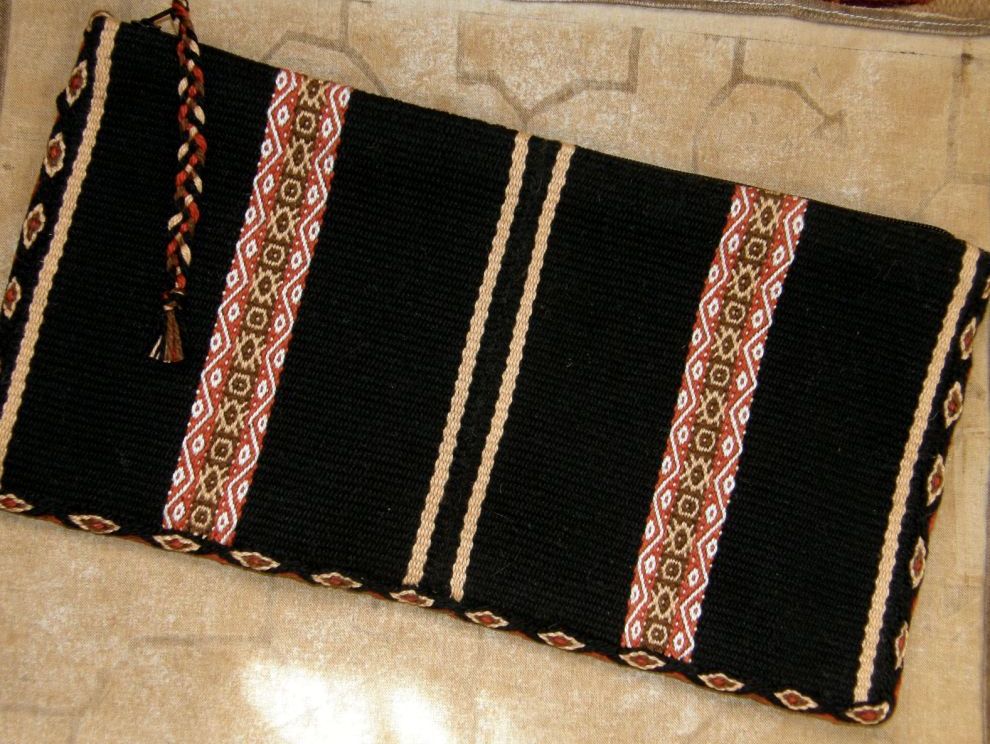
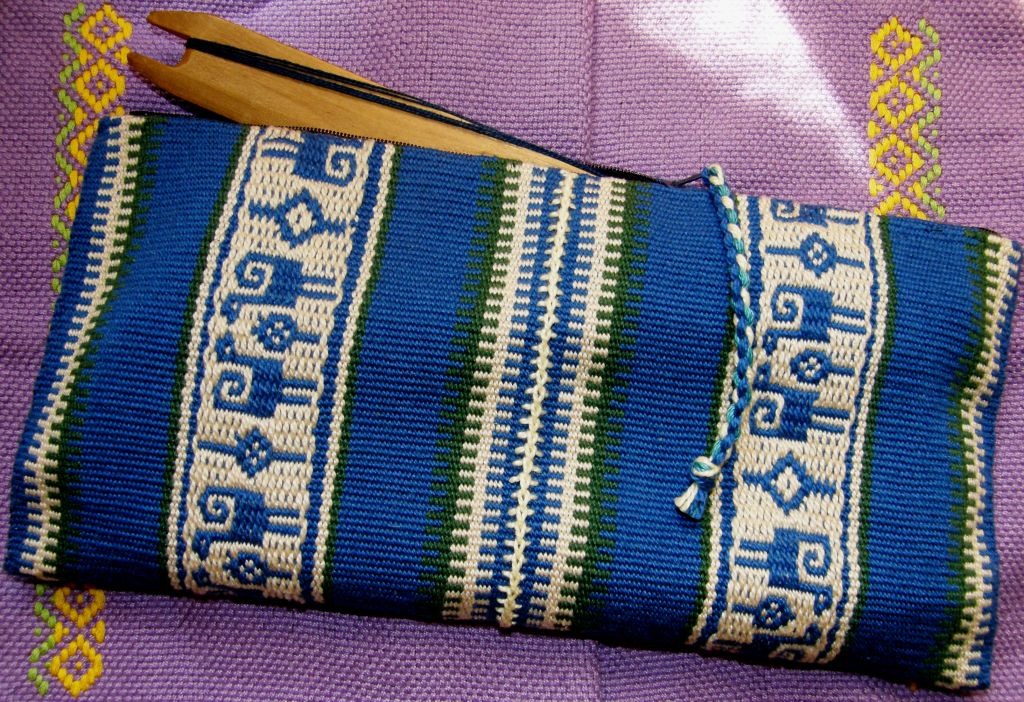
…a nice large size tool bag to show a ñawi awapa band. It goes along with this next one (can’t have enough tool bags!)

…which shows the Van Dyke stitch used for joining pieces of cloth.

Oh, and there are a bunch of other pouches and purses that I use for coins, writing materials and documents, like this handspun alpaca passport pouch…

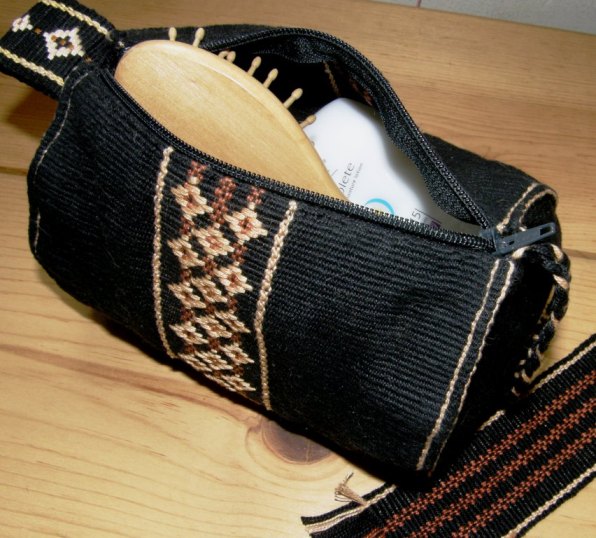
This little sausage pouch makes a great cosmetics bag and it shows how supplementary weft patterns can be used on top of warp patterns rather than just being woven into single-color cloth.

I love being able to take these things with me but, sadly, I have to admit that clear plastic bags are often much better. It is maddening sometimes trying to remember which pouch holds which items!

I almost forgot belts! You can’t get more efficient than that…I can wear the woven structure example that I want to show. Belts, however, are an added pain when going through airport security.

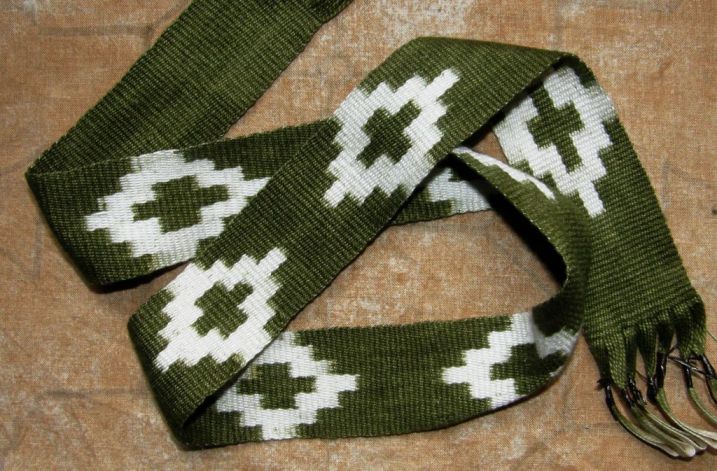
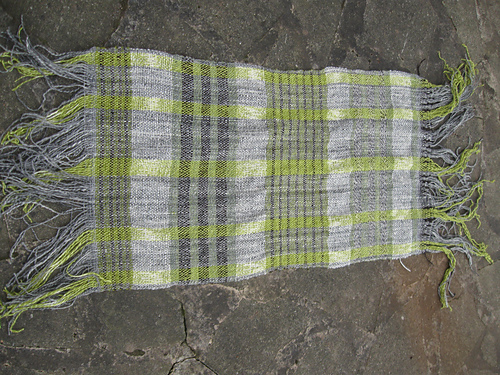
I finished my wee ikat sample and I am thinking of making it into a belt somehow.

It’s a bit on the short and flimsy side but maybe some added leather might work.

That’s all I managed to weave for myself this week. I did find the time to warp up for the next ikat project and on this one I am hoping to dye two colors.

Oh boy, this experiment is bound to give me a very much increased appreciation of and respect for the  Guatemalan, Indonesian and Central Asian ikat artisans and the textiles they create with multiple colors.

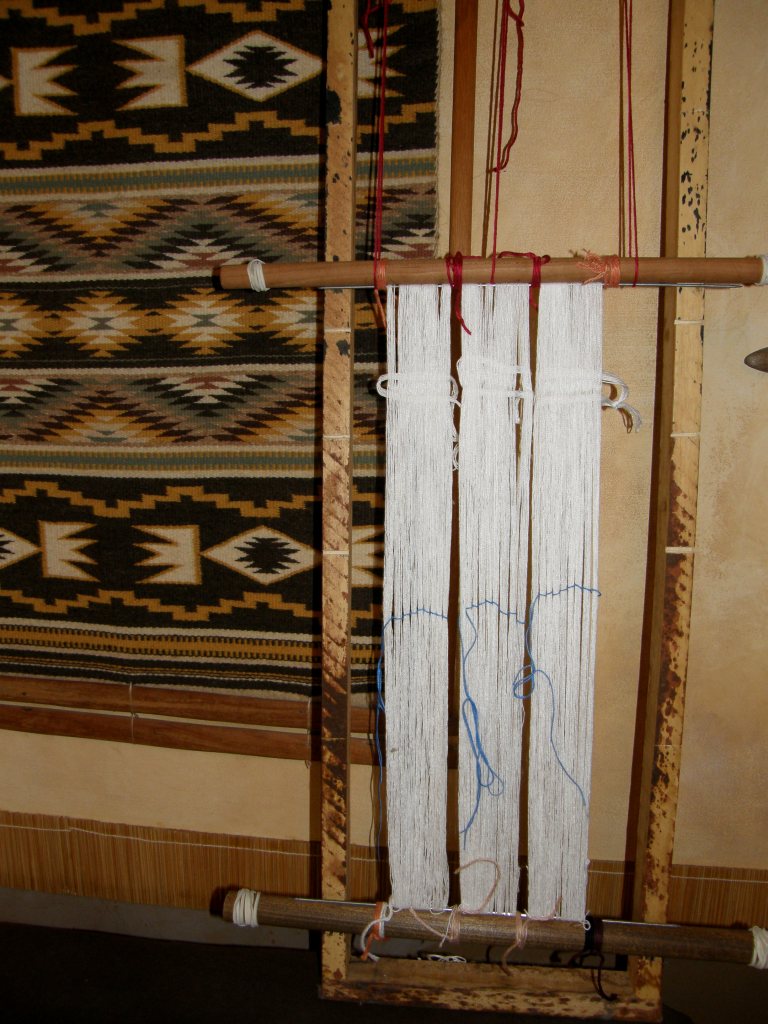
Here’s the warp on a frame ready to be tied. There are three panels but each panel will only have one motif. I am not going to get crazy with this! Let’s just see how this one turns out and I will take it from there.

In the Ravelry group Blomster joined in on our ikat weave-along using her rigid heddle loom. We decided that this WAL would be all about ikat on any kind of loom and I love what she made in a balanced weave. The ikat patterning is very subtle and she is pleased with the way it turned out.

Bobbie has been working on her simple warp float piece which has been inspired by a Guatemalan weaving she saw on the Education and More website. She bought naturally dyed cotton from Education and More for this project.

We don’t get a good look at the actual fabric in this shot but I will show you in the weeks to come. I just love looking at that gorgeous warp!!…the colors, the smoothness! I will tell you a little more about the process for this pattern too as Bobbie makes progress. I hope she will keep us supplied with pictures as it comes along. I am hoping to get together with Bobbie and other north-westerners from the Ravelry group when I am up that way next month.

Yonat, who weaves with me when I visit Santa Cruz California, has been practicing double weave..

She is using Bedouin shajarah motifs which are traditionally woven in a warp substitution technique. As that technique produces very long floats on the back of the fabric, weaving it in double weave as Yonat has done will produce a textile with identical faces in reversed colors and no long floats.

I am looking forward to going back to California and the ocean and some cooler temperatures…remember that it is summer down this way. 

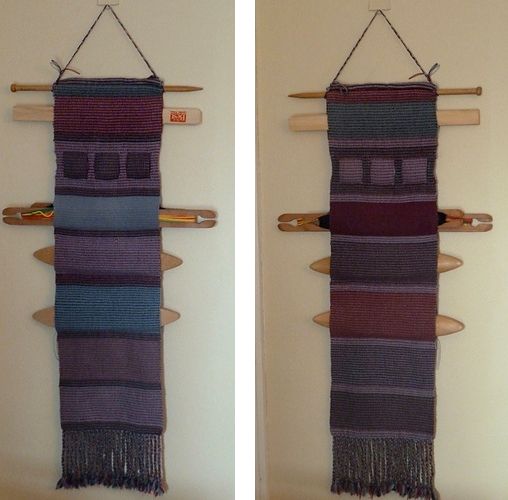
I loved seeing this project that Akknitter posted on Ravelry in the Warped Weavers group…nothing to do with backstrap weaving but I just really like this idea. It is from a project in the Nov/Dec 2008 Handwoven. It is being used for shuttle storage. I can see my loom bars nicely nested within something like that. It is double weave and so has two differently colored faces.

So….let’s see what I can accomplish weaving-wise in my last week of pre-trip madness. I am trying to put together the Italian version of Andean Pebble Weave and get some weaving done for myself. I can’t complain as all is going very well.

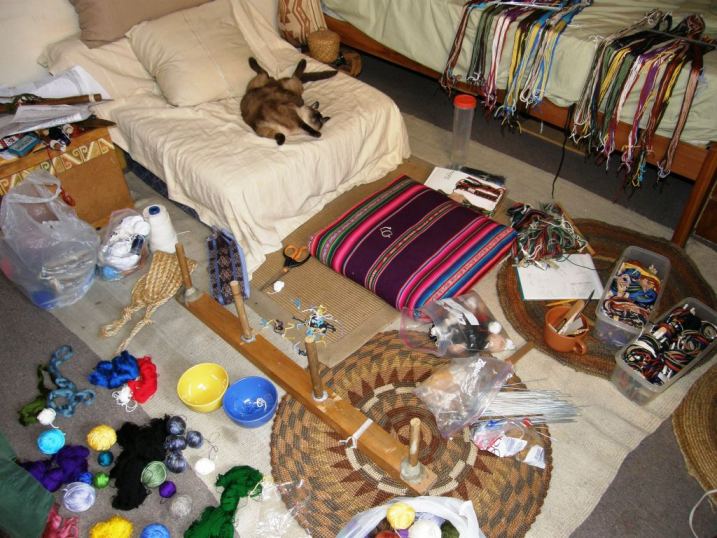
I will leave you with a picture of the organized chaos that is my bedroom these days. You can see that my cat doesn’t think much of it…

Coming soon courtesy of translator Lidia Guffanti…..

Backstrap Weaving – Teachers

I was reading Anita Osterhaug’s post in the weekly Weaving Today letter about teachers and the knowledge they impart. She quoted ” When the student is ready, the teacher will appear“. I had not heard that before. She then added, “Sometimes you carry a teacher in your head until you are ready“.

This was amazing to me as it is the very thing that has been going through mind this week as I work on my new book. Almost sixteen years ago I learned backstrap weaving with my first indigenous teachers in Peru and I find that even after all this time has passed, certain things they taught me which I have been performing mechanically since then, are suddenly taking on a whole new meaning.

I can take certain processes which I now clearly understand and apply to them to other situations and create things I had not been able to previously envision.

It is hard to explain and I know that this all sounds a little vague but I am much more explicit in the book. It is nice to know that I have been carrying those teachers around in my head, as Anita said, all these years and can still benefit from what they showed me. I wonder how many of my other past teachers will make an appearance as the years go by and what seeds of knowledge are sitting in my head waiting for just the right conditions in which to sprout.

So, I thought I would dedicate this blog post to some of my weaving teachers and say just one or two things that I took from my experience with them.

This is Hilda, my teacher in Potosi, Bolivia who taught me “once a weaver, always a weaver”. How must it feel to have been raised a weaver, as Hilda most likely was, having this activity become a part of your very being and identity only to have to abandon it at a relatively young age.

Hilda started out in my lessons by sitting by my side and pointing or calling out the warps that I needed to pick up for my design. Apart from warping with me and setting up the loom, she never once actually sat at the loom and showed me how to weave so there was a lot of “no, not like that” as I was not being given a model to follow. She complained that her eyesight was too poor and her back too weak to weave anymore. Besides, she said that she had forgotten most of the patterns.

However, I started to notice that my piece was growing somehow from the time I left it in the evening to the time I arrived the next morning to pick it up again. Hilda simply couldn’t resist unrolling my work and weaving when I was gone but still felt somewhat shy about weaving in front of me. I am sure that weaving in the low evening light was not helping her. Eventually, she gathered the confidence to start weaving together with me on her own projects in broad daylight leaving me to figure out the pattern for my own work on my own. Happily, I was well on my way by that time.

The other thing I took from Hilda (although it didn’t stick for long) was the idea that cloth should have four selvedges. This is the most natural thing in the world for weavers in Hilda’s world and a weaver finishes her piece without any fuss. Hilda sighed and muttered only because of her poor eyesight.

One doesn’t choose, as I do, whether to have fringes or three selvedges with a fringe at one end. There will be four selvedges and that is that. It gave me the confidence to go straight home and weave a few pieces like that in wool, although, as I said, it didn’t stick, and once I started weaving with cotton, I stopped weaving four-selvedged  fabric.

Felipe in Salasaca, Ecuador has been my only male weaving teacher so far. I was most impressed by the fact that Felipe has taught all four of his sons to weave (one son is absent from the picture) and that they all approach it with such enthusiasm and pride in a world where fewer and fewer youngsters in indigenous communities show any interest in learning to weave. I wondered what Felipe’s secret was.

Although the boys didn’t yet have the skill to warp well, they could certainly tell me exactly what was going on as their father demonstrated it to me. Felipe told me that he was self taught and has created some of his own variations of the traditional Salasaca “frutilla” pattern. His bands are cut into pieces to decorate sandals which are made by a local shoe maker.

He is obviously an innovator with plans for the future and perhaps this optimism is what he has passed to his boys.

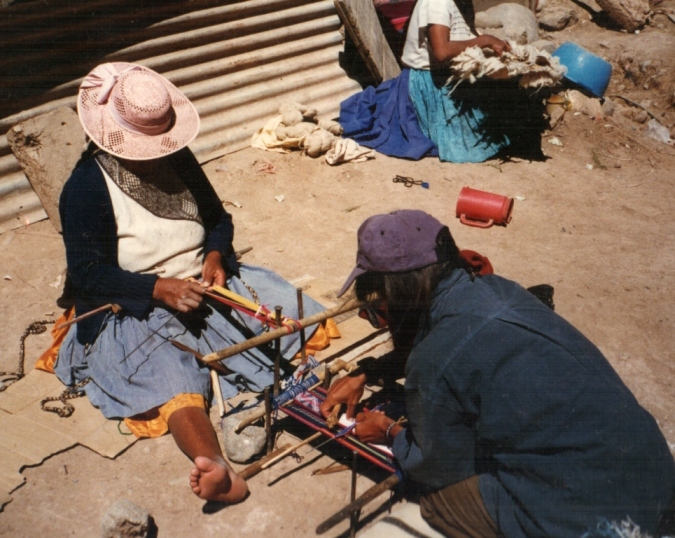
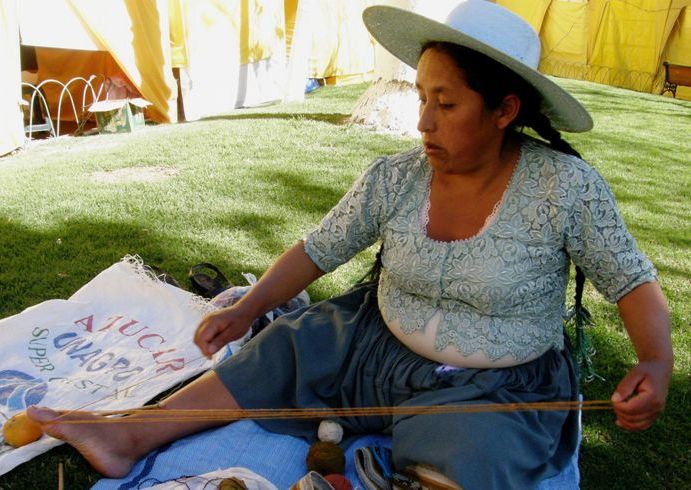
As I prepare to travel and pack my portable warping board, loom bars, dowels, metal rods, beaters and shuttles I remember Maxima in Cochabamba and the ease with which she wound warps on her finger and toe.

All we had a was a pleasant shady spot outdoors, a few balls of yarn and we were able to spend several lovely afternoons producing pebble-patterned and tubular bands.

Yarn was used for cross sticks, fingers formed picking crosses and a hand moved with a slicing action beat the weft into place…the wonderful simplicity of it all. I went home and looked at my buckets of loom bars and beaters for all occasions! Of course they are needed for wide pieces but I tend to depend on them very much even for the narrowest of bands.

I also took home a new pattern which I used on a cell phone pouch and the knowledge of a new way to do pebble weave.

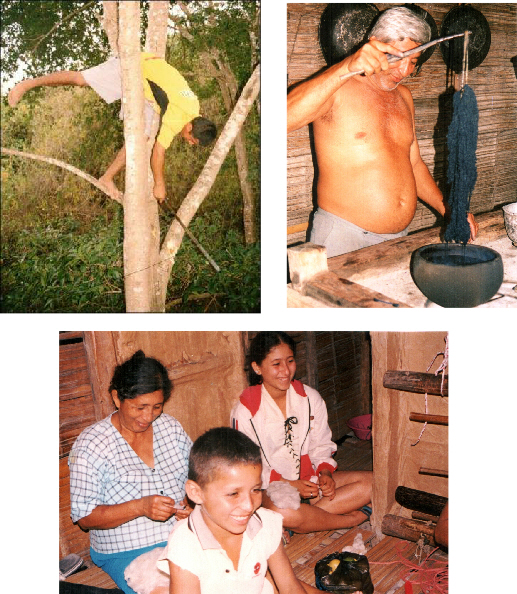
Learning to weave with a family in coastal Ecuador showed me just how much an entire family can become involved in every aspect of the process from cotton boll to finished project….together most of the time sharing the tasks or at least keeping company with the person doing the work with lots of chatter and laughter. I tend to think of weaving as a very solitary process. Don’t speak to me when I am warping for goodness sake! and I can’t even listen to songs let alone chat while I am doing pick-up.

Trini made mistakes while she warped but the discovery of her mistakes only led to teasing and laughter rather than frustration.

Trini is the main weaver but there are plenty of other family members involved in other parts of the process.

A nephew cuts material for dyeing, a brother tends the dye pot and everyone helps to remove seeds from the cotton after the evening meal.

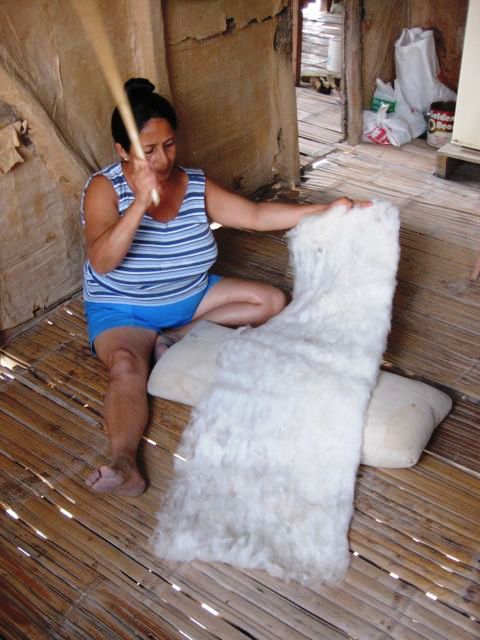
Trini and one of her sister’s share the task of beating the cotton to prepare it for spinning. (photo by K Klumpp)

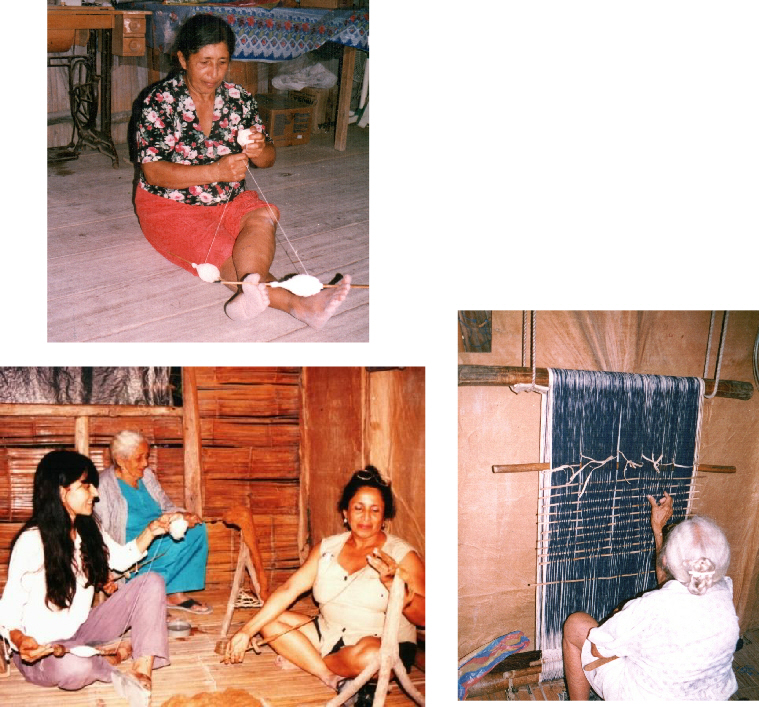
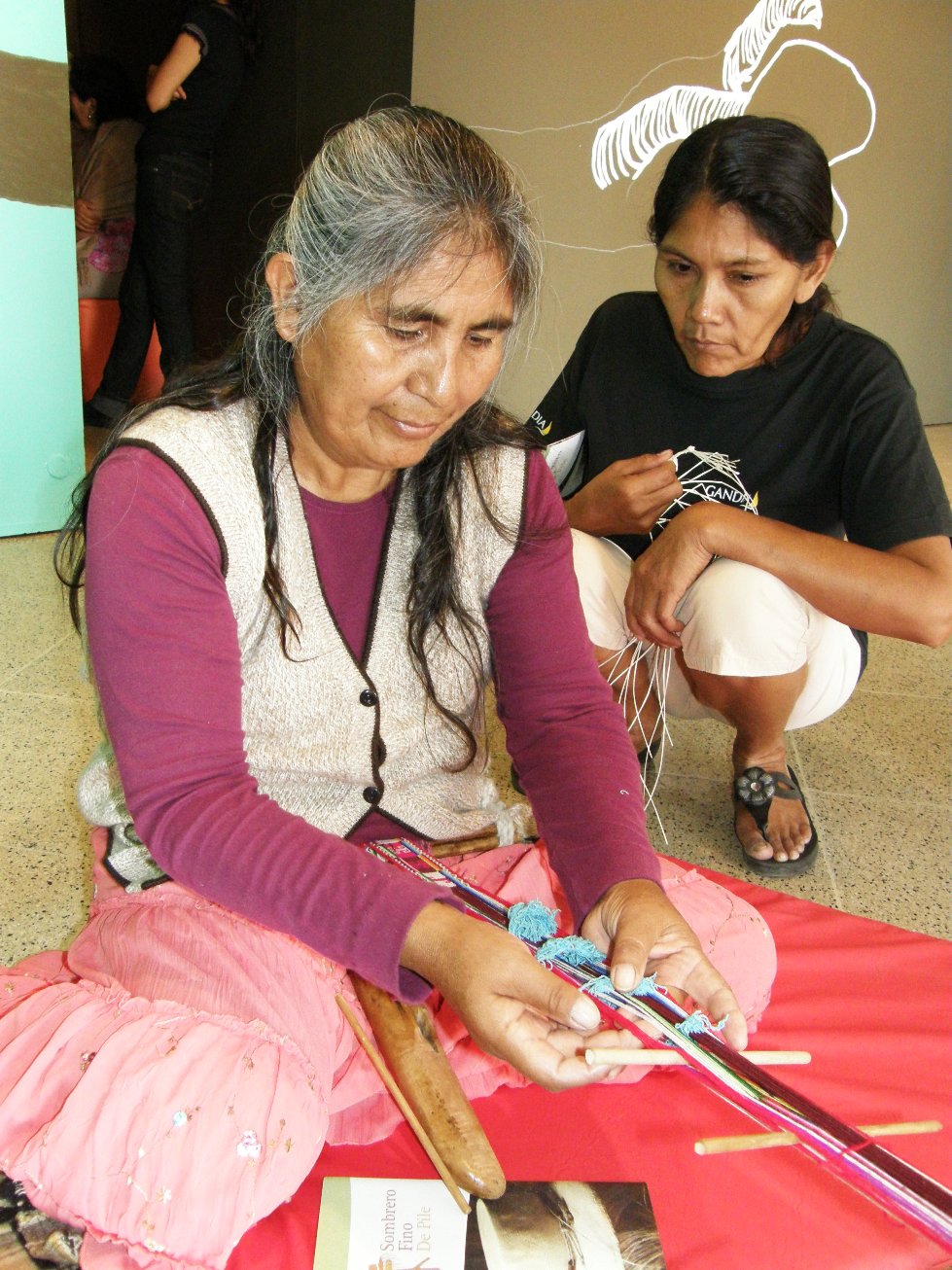
A sister doubles the handspun cotton singles, all the adult women spin and Mother checks that the pattern-shed warps have been correctly selected.  I am trying out spinning on this occasion. How nice it was to be sitting with this group of ladies and spinning the evening away. You can see that pretty much everything takes place on the floor. Wooden chairs hang from nails on the wall but Trini’s mother is the only person who sits in one. Maybe it was this experience that has me now so comfortable doing everything related to my weaving on a small square of bedroom floor.

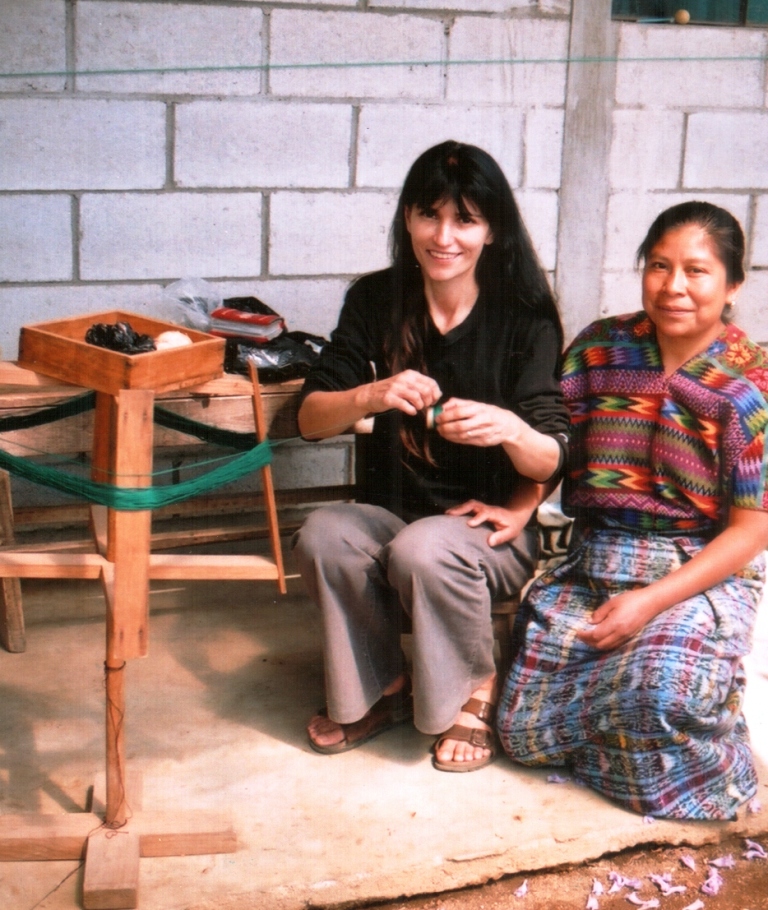
My first Guatemalan weaving teacher, Lidia impressed me with the amount of care and time she took preparing her warp. She is a quiet, calm and graceful person and this all carries over into her weaving. Every single warp thread was patiently and delicately lifted on the tip of a pointed stick and placed in its correct position on the loom bar. She didn’t treat it as the tedious thing that one has to do before the weaving begins. After weaving with Lidia, I started to take everything slowly and really enjoy every part of the process devoting as much time to warp preparation as I am willing to spend selecting the threads to create the patterns.

I loved how Lidia would have me un-weave mistakes. That is just what I like. I have had many weaving teachers who have gotten annoyed at my insistence on fixing errors. In Potosi I would sometimes take my warp home at night to fix an error I had made early in the day that Hilda had not let me un-weave! I have to say that Lidia had a way of spotting a mistake about to happen! She was quite amazing like that and saved me a lot of un-weaving.

I also learned about the efficient use of materials. I have never met a weaver who knows how to measure so precisely the amount of supplementary weft she needs to complete each of the different motifs in a piece.

Angela, my Guaraní weaving teacher, blew me away from day one. She was warping a hammock on a vertical loom and I watched in awe how she passed the warp thread thousands of times up and over the loom, bending down low to pass the thread under the bottom beam and then reaching behind to pass it around the dovetail cord. And then there were the thousands of heddles! Not just one set but three.

Many years later, I got together with Angela again and now she impresses me in other ways with her appetite for learning new techniques and looking for new ways to do things. I could sense that my teacher  Maxima in Cochabamba wanted to learn double weave from me but was shy to come right out and ask. She doesn’t know how to do the “eye” pattern tubular band either but did not seem interested in learning that.

Angela saw my string heddles on a stick on day one and, recognizing that knowing how to make them could be useful, said “Teach me that”. She is willing to learn any new method or skill that comes her way.

And I know that she will teach others in her community to make them too if she thinks that they will help make weaving more efficient. I have come across strong competitiveness in weavers between and sometimes within communities where information like this would not be shared. Don’t get me wrong…I am not condemning that. Everyone likes to have that “edge”, right, especially if weaving is putting food on the table.

I taught a young man in Ecuador to do pebble weave. When I returned eighteen months later to see how he was getting on (very well), I had his brothers begging me for lessons as Juan was refusing to teach them!

Below you can see Angela talking about Guaraní weaving at a gathering of highland and lowland weavers. School children were able to try weaving on a small warp that she prepared.

Angela is one of a group of people and institutions responsible for the spread of knowledge and the growing appreciation here in Santa Cruz of Guaraní weaving and culture. Even the institute where I used to teach English is now teaching the Guaraní language.

You know I could just go on and on. There are many more teachers to talk about. I carry them all about in my head, as Anita says. I write up all the techniques that I learn in journals when I get home and weave samples and paste in step-by-step pictures. What I don’t write in the journals are the little bits and pieces that I have mentioned here and it is kind of nice to have this blog in which to remember and record such things.

Hopefully I will write a future blog post about some of my other weaving teachers from other parts of Ecuador, Peru, Bolivia, Chile and Guatemala as well as the Asian ladies with whom I have studied more recently in the US. You have already met most of them here.

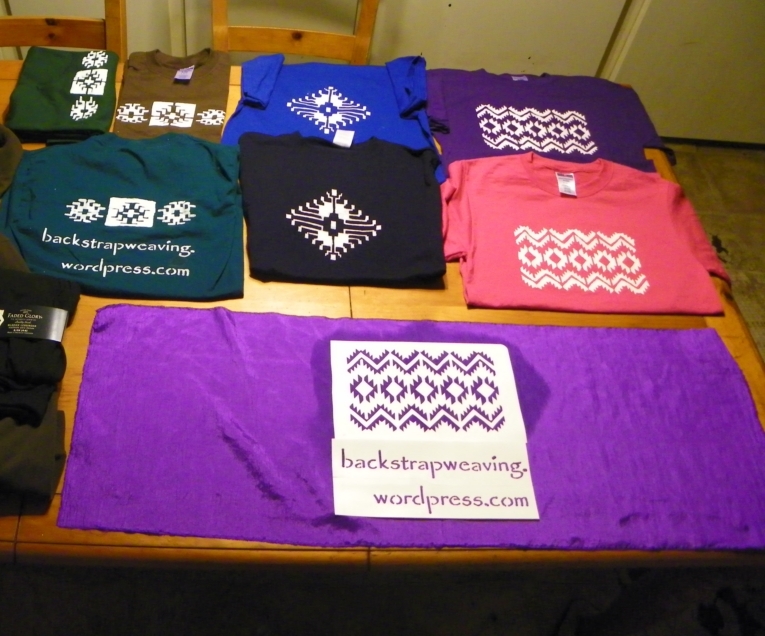
I have one thing to show you before I go. An online weaving friend of mine in Florida made me some t-shirts. She cut the stencils and painted them herself using some motifs from weavings that I have done. One of the designs is the Guaraní snake motif. These are so cool! I look forward to wearing them on my next trip.

Backstrap Weaving – Announcing….Events, Books, Resources!

It’s been one of those weeks again…hands occupied at the computer keyboard and eyes peering through the camera lense with plenty of small projects going on and off the loom bars but no “real” weaving getting done.

It is sample-weaving time for my next book and, as always, I just love my backstrap loom when it comes to knocking out wee samples for photographing. I can have several going at once on my twenty-six loom bars and even the smallest scraps of yarn can make enough warp to make my test successful.

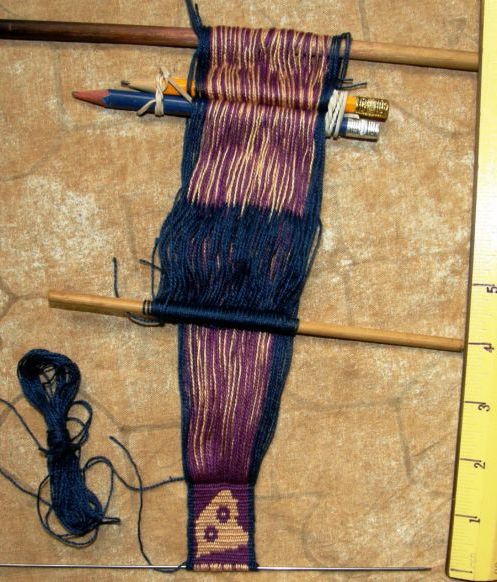
At left you can see an old sample I made to check the proportions of the motif I was charting in double weave. I could put some safety strings in that warp, roll it up and put it in my pencil pouch.

The only real weaving I did this week was one more motif on my ikat band but then, that really is just another sample.  I do plan to use it for something when it is done. I made some sketches for the next ikat experiment and would like to get that going this weekend as an incentive to finish the sample band.

Karen in the Ravelry group told us about how blue and chocolate colored ikat pieces are her favorites from Guatemala and I have had that color combination in my head ever since. I have terracotta brown and navy blue dyes and I think I shall have to try something with those.

So while I have been tapping away at the keyboard and doing gymnastics with the tripod and self-timer on my camera, (12 seconds is NOT long enough!) one corner of my mind has still been occupied with new ideas for the my next weaving projects.

While I don’t have any new weaving to show you, I do have a few nice announcements.

Firstly, David K Barker’s first volume and first part of his third volume of textile designs of Bhutan are now available as downloads in addition to the second volume which I wrote about here some months ago.

The links are on the RESOURCES page. What will we do with all these motifs?! I have a few ideas. 🙂

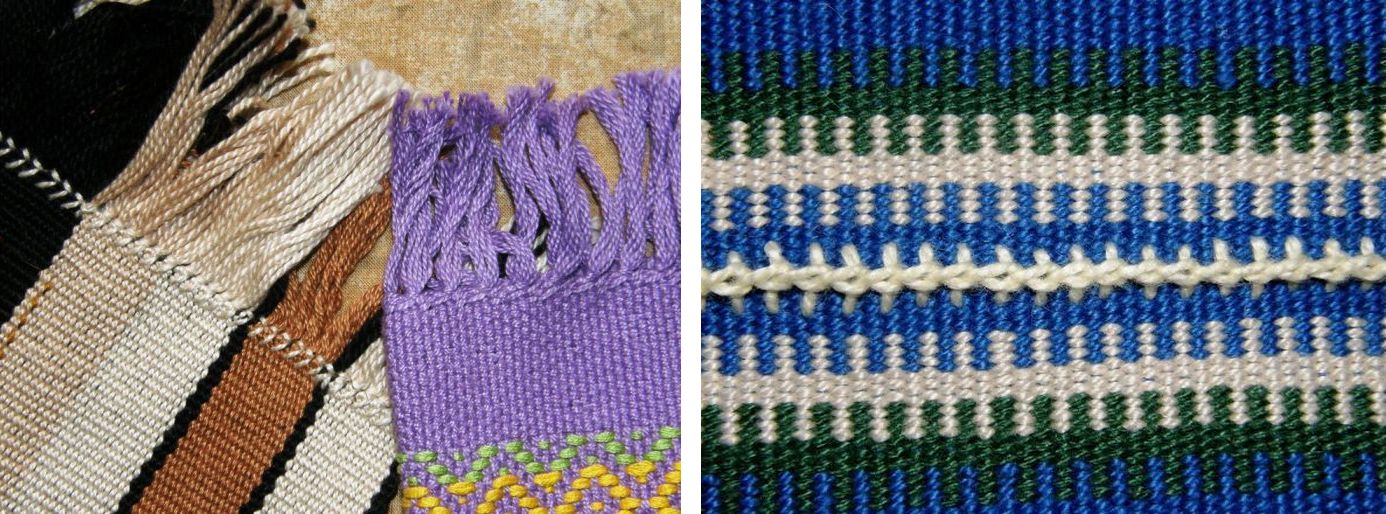
I have also included on the RESOURCES page links to videos on a couple of my favorite finishing techniques for my backstrap woven pieces. Thanks to Tracy for this idea. She was just mentioning today how hard it is to find the video for the Van Dyke stitch that I embedded in a post a long time ago.

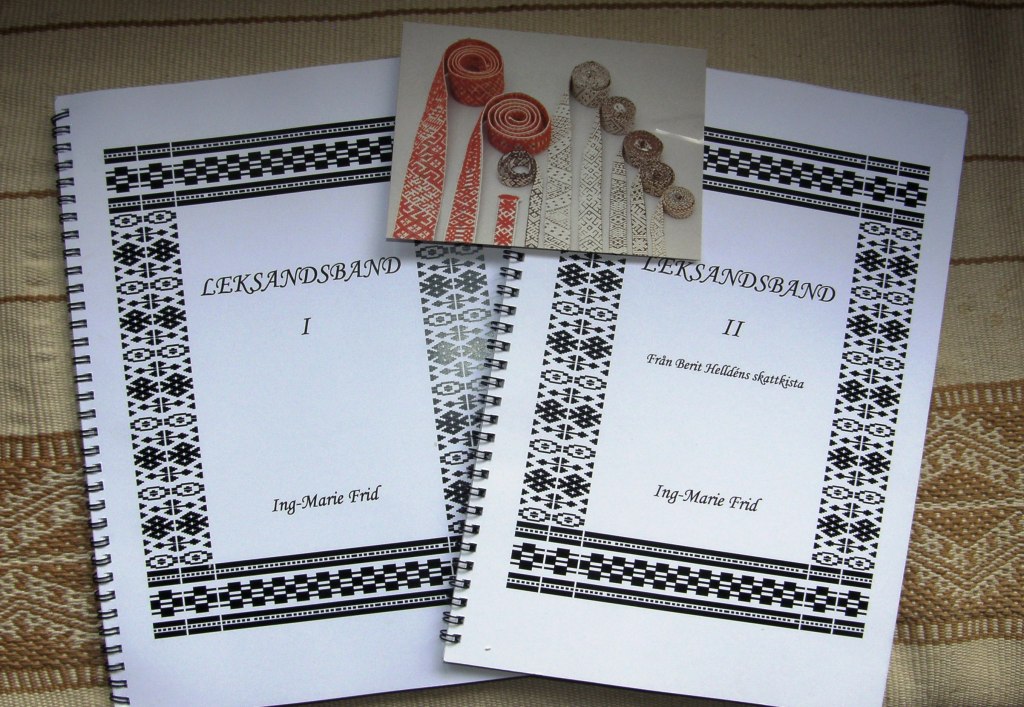
A couple of weeks ago, I showed two books on Leksandsband by Ing-Marie Frid which were sent to me by a weaving friend in Sweden. Some people have asked me about how to buy these books and I have put this information on the RESOURCES page too. Ing-Marie was kind enough to write a comment on my blog with a contact email address.

The books are not about teaching the band weaving technique, but are catalogs of patterns which have been beautifully and meticulously charted alongside photos of the original bands.

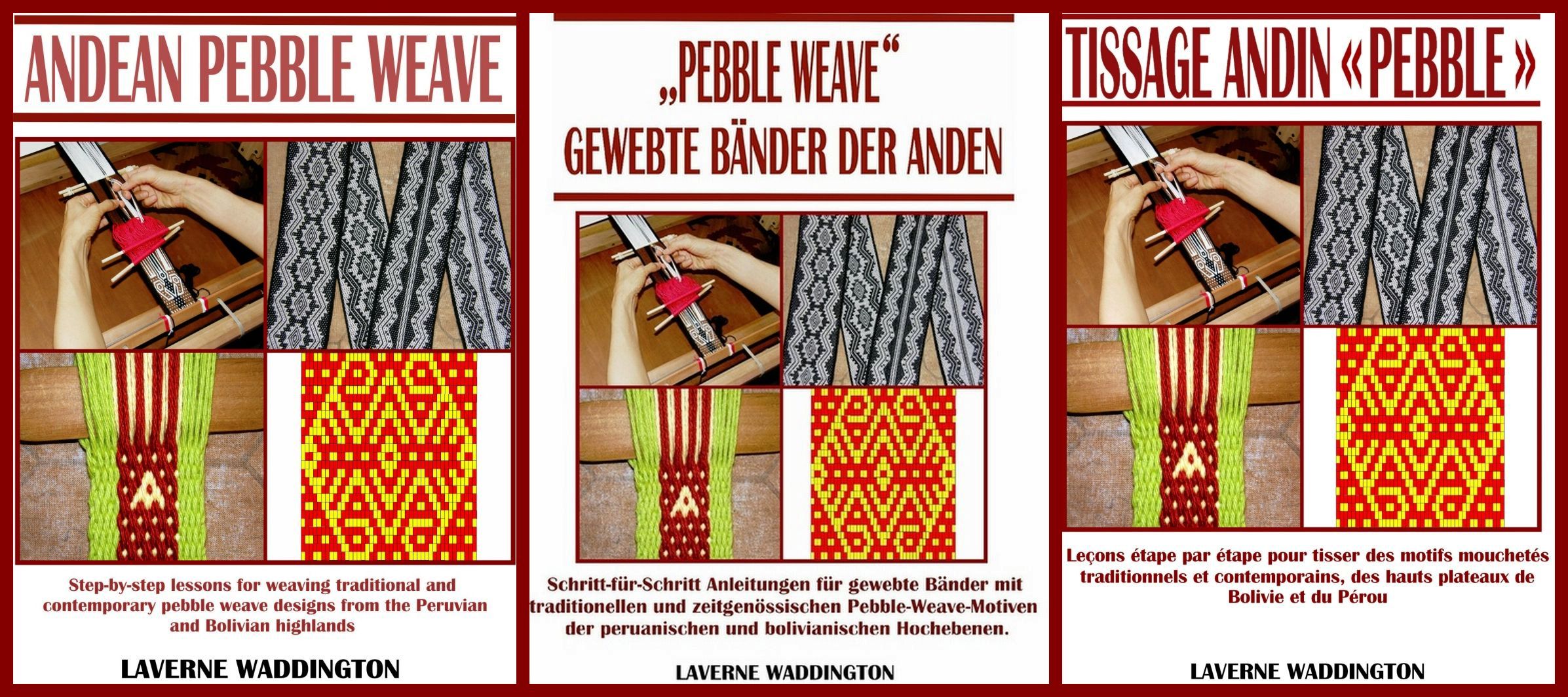
And, speaking of books…my e-book  Andean Pebble Weave is now available in French as Tissage Andin < Pebble> on Patternfish.com.  It went up on the Patternfish site a couple days ago and has been bought by two people in France and another in Switzerland so far….exciting! It will be fun to see how many French-speaking countries it reaches.

I guess I feel I have a small connection to France and Switzerland having spent five entire ski seasons in Val d’isere with my French boyfriend at that time as well as having done some wonderful summer hiking in the Pyrenees. And then there’s my aunt who left India as a young girl to work taking care of an elderly woman in Italy. She met and married a Swiss man and has lived in Switzerland ever since. We tend to wander about a bit, my family!

I am very grateful to Sandrine de Tricofolk who translated the book for me. Sandrine created the online forum for French-speakers known as forum filage for enthusiasts of all textile crafts. She also blogs about her various textile hobbies. And she also translated the following for me:

Je suis heureuse de vous annoncer que le livre “Andean Pebble Weave” a > été traduit par Sandrine de Tricofolk, et qu’il est maintenant > disponible en version française ici. Sandrine est à l’origine du forum 
 filage, un forum francophone pour tous  les passionnés d’artisanat textile, et partage également ses diverses > réalisations textiles sur son blog.

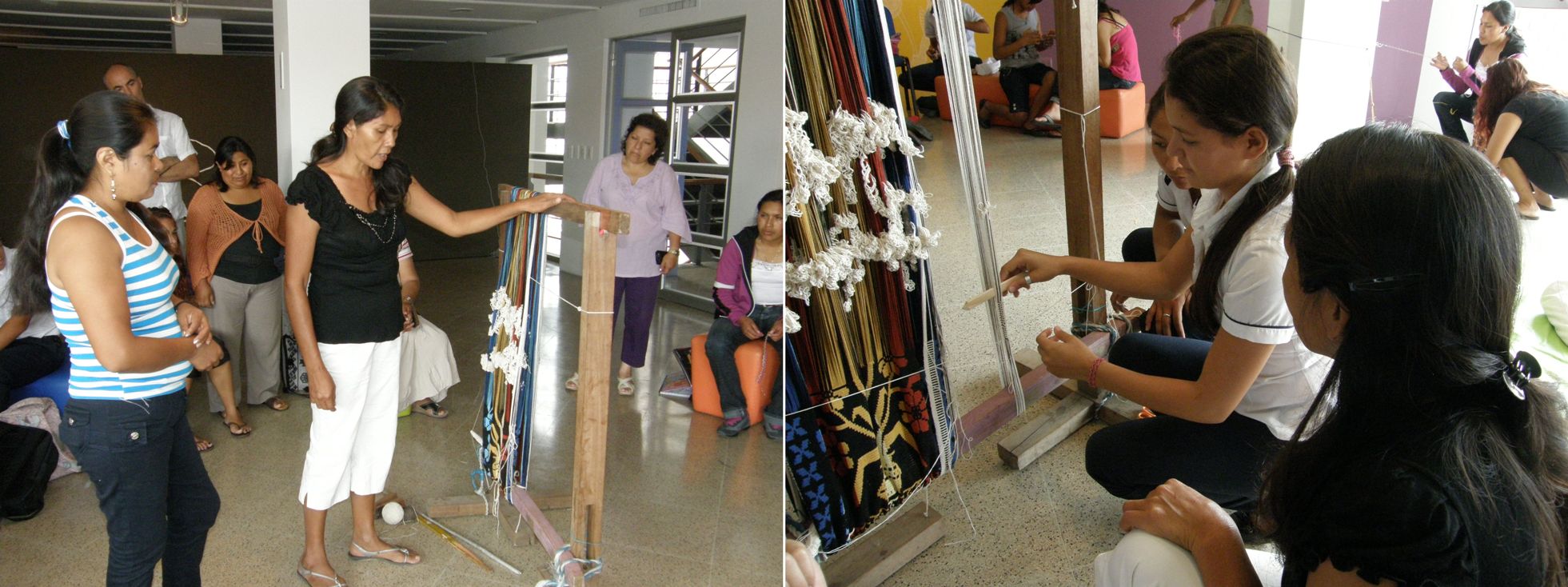
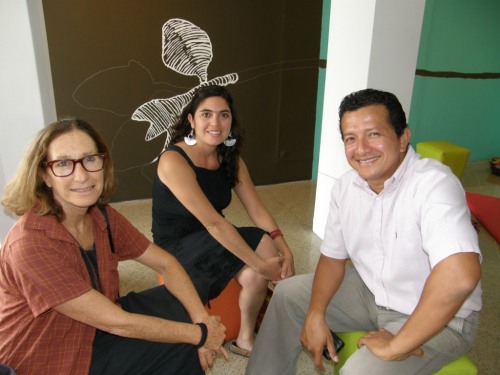
This week brought an interesting email to my inbox from Maria Elena Del Solar a Peruvian anthropologist whom I met at a weavers’ gathering that took place here in Santa Cruz, Bolivia last year.

That’s Maria Elena on the left with two other participants at the gathering from Chile and Ecuador.

Maria Elena is a member of an association called ANDESMANTA which is organizing what they call the first Meeting of Weavers of the Americas, ETAM2012, in the city of Cusco Peru October 1-4, 2012. 

She has asked all the recipients of her email to circulate this information and direct people to the website which has been set up with the first announcement.

I do not know very much about the exact nature of this gathering. The Tinkuy de Tejedores that was held in Urubamba, Peru in 2010 (in blog posts here and here) and the Encuentro de Portadores de Tradición del Universo Textil Andino y de Tierras Bajas (in blog posts here and here) which Maria Elena attended and which took place where I live in Santa Cruz, Bolivia were two quite different events. For one thing, the former was conducted in Quechua, Spanish and English and had a large attendance of people from outside Latin America. The latter was conducted entirely in Spanish, was a much smaller affair, and was attended only by residents of Latin America. However, the web page for the proposed ETAM2012 conference has a version in English.

Early morning pre-conference activities at the Tinkuy de Tejedores in Urubamba, Peru in 2010
Guaraní weaver, Angela, from lowland Bolivia meets and learns from Celinda, an Aymara weaver from highland Chile at the Encuentro held in Santa Cruz in 2011.

I will be staying tuned for more information and am very relieved to see that my calendar is clear for those dates.

Well, I think that that is it for the announcements. For this week there is just one more thing I would like to share with you.

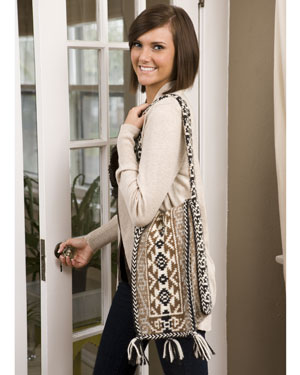
A Facebook friend sent me a link to a Knitpicks knitting kit for an Altiplano Satchel which is described as having been inspired by Peruvian motifs.

Isn’t that gorgeous? My friend sent it to me as she thought that it might inspire a weaving project for me. I love, LOVE how people keep me in mind for these things! She said that she thought that it would look even better as a weaving. Actually, I doubt it. I think the bag as it is is pretty hard to beat!

I was tickled to see the “S” motif along the bottom and the sides which I have actually already woven.

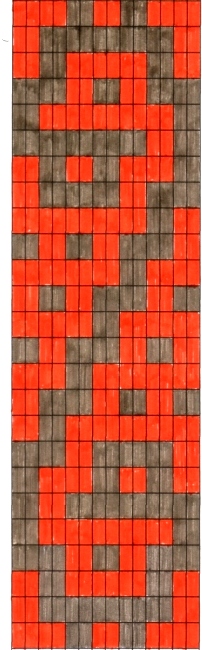
I didn’t find that motif in Peru but rather on a yurt band from Central Asia. In fact it is charted and appears in its own tutorial here on my blog (sorry, but this one is not for beginners).

So, I have a head start on that part of the pattern! Certainly I could replicate the layout of that satchel design in weaving and would probably choose warp-faced double weave to do so. I have had success with translating warp float patterns to double weave before but I like that knitted bag just the way it is and envy knitters who will be able to sit on a train (or at a tribute concert to Frank Zappa as a friend of mine did!) or ANYWHERE with their two sticks and create something so beautiful!

Here is the “S” pattern doubled and mirrored on a belt I wove using the same technique as that used on the yurt band that inspired it.

We talk about the wonderful things that can be created with the backstrap loom with its simple sticks and a few weeks ago I blogged about the lovely Wayuu bags in tapestry crochetlike the one at left, made with one simple stick with a hook on its end.

Now, what about two simple pointed sticks otherwise known as knitting needles? According to the Knitpicks page, the body and strap of the bag are knitted in the round and steeked (steeked?! I know as little about knitter-speak as I do about crochet terminology).

I have some more gorgeous knitted things to show you including some images of stunning traditional outfits from Sweden made in twined knitting that a collector sent me with some background information which is really interesting (I say that as if I know what twined knitting is…I don’t really!). Of course there is a Ravelry group for twined knitters. The traditional outfits are red with gorgeous black motifs. You know I am a sucker for red and black and I am sure that those knits will inspire a weaving project!

I am going to save all that for another post.

So, I will close this page early for this week and use the extra time to dive back into my book. Hopefully, I will be able to make time for my weaving projects this coming week.