Backstrap Weaving – Material Gains

Tippity-tap at the computer for the most part this week trying to move some projects along before I go traveling in a couple of weeks….finger-dancing at the keyboard rather than at the loom but I have a couple of little things to show…
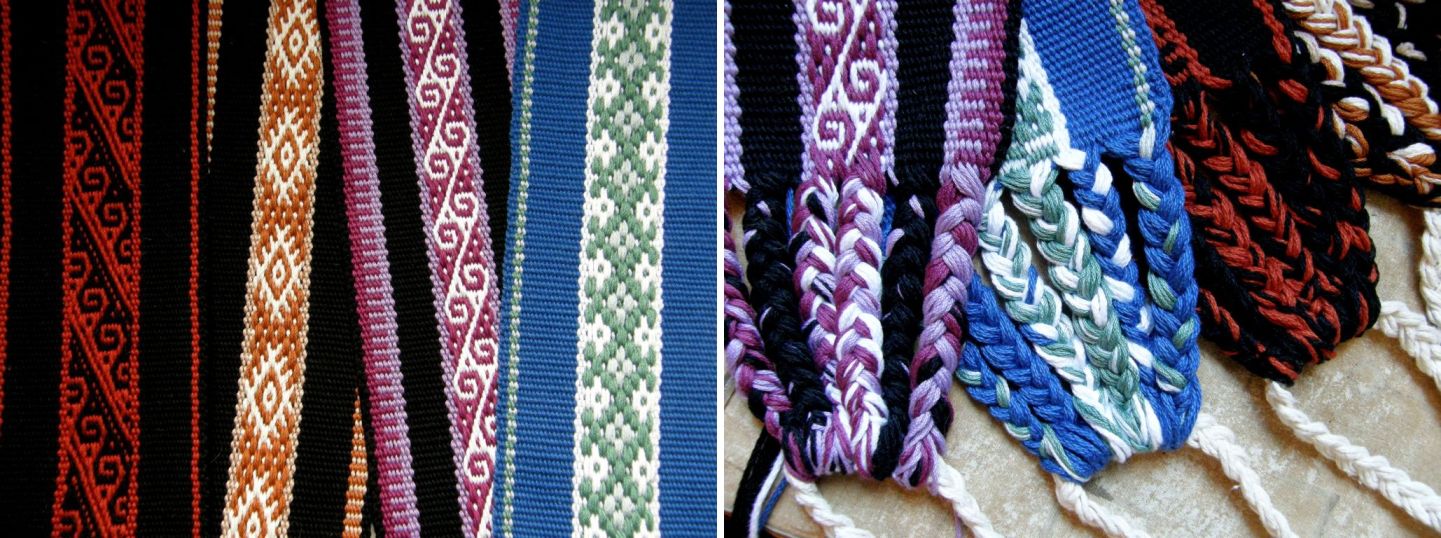
Well, I am cheating here…this is not loom work. I braided the friendly ends of my recent backstrap projects. Now I have to do the nasty ends…the other end with all the knots from the color changes.
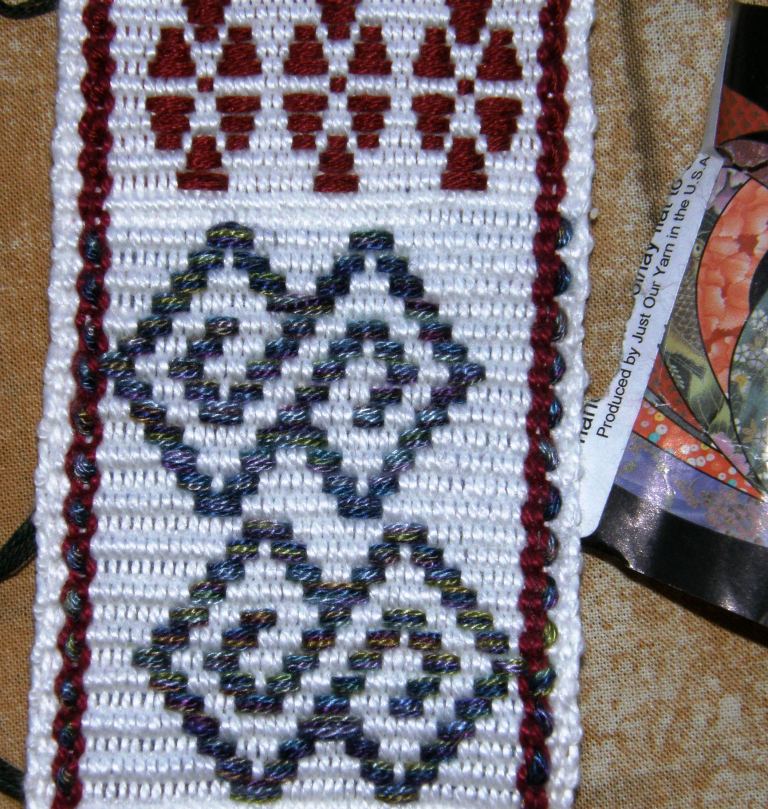
I also played a little with some tencel that my friend Lisa gave me last year when I was visiting her in North Carolina.

It is a multi-colored 10/2 from Just Our Yarn labeled “almaza” and it shimmers with mother-of-pearl colors!

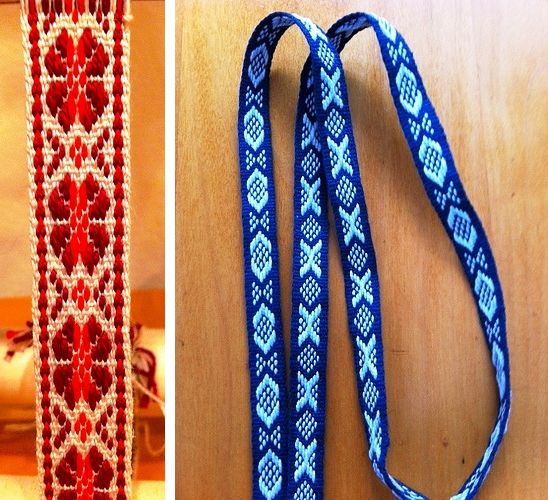
I suddenly had the idea that this may make really nice supplementary weft for some of the inlay designs I have been doing lately and so I warped for a white band in my 24wpi cotton and tried it out.

I used six strands and I love the way it came out. I warped four ends of red in the band on either edge and turned the supplementary weft between the two red warps on the left side and then on the right of the two reds on the right to see which way looked nicer.

The red supplementary weft above this is doubled strands of embroidery floss. I would like to make something now using the tencel on a band of my #10 cotton. You can’t see it so much in the picture but the tencel almost looks like beads on the cloth from a distance. The multiple strands bunch together and give a more raised effect unlike the embroidery floss which tends to lie flat.

Now listen to me getting all goofy about textures and such things. This is very unlike me! Maybe it’s because at the weaving event I attended last week I was determined to pay more attention to the materials with which we were working rather than solely the techniques and so have been able to make what I am calling some “material gains” in my weaving data bank. Discussion in the Spin-Along that has been running on Ravelry has also turned my thoughts this way.

So here are some of the materials that we got to play with at the weavers’ gathering last week…
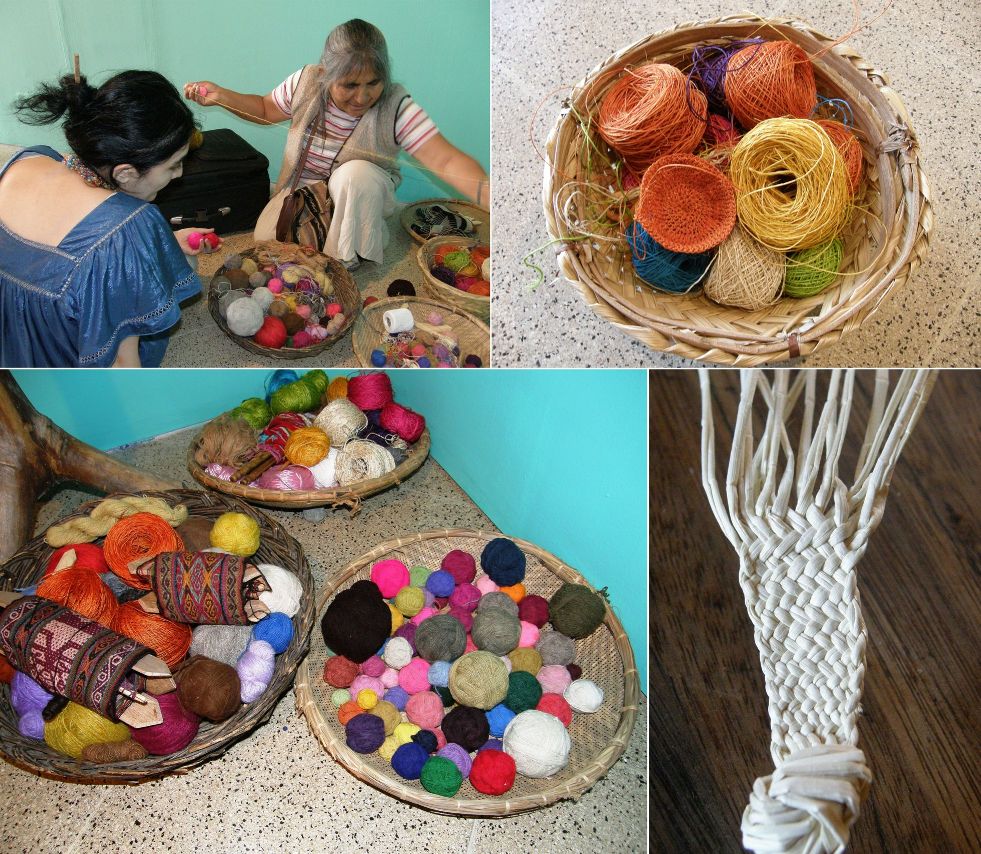
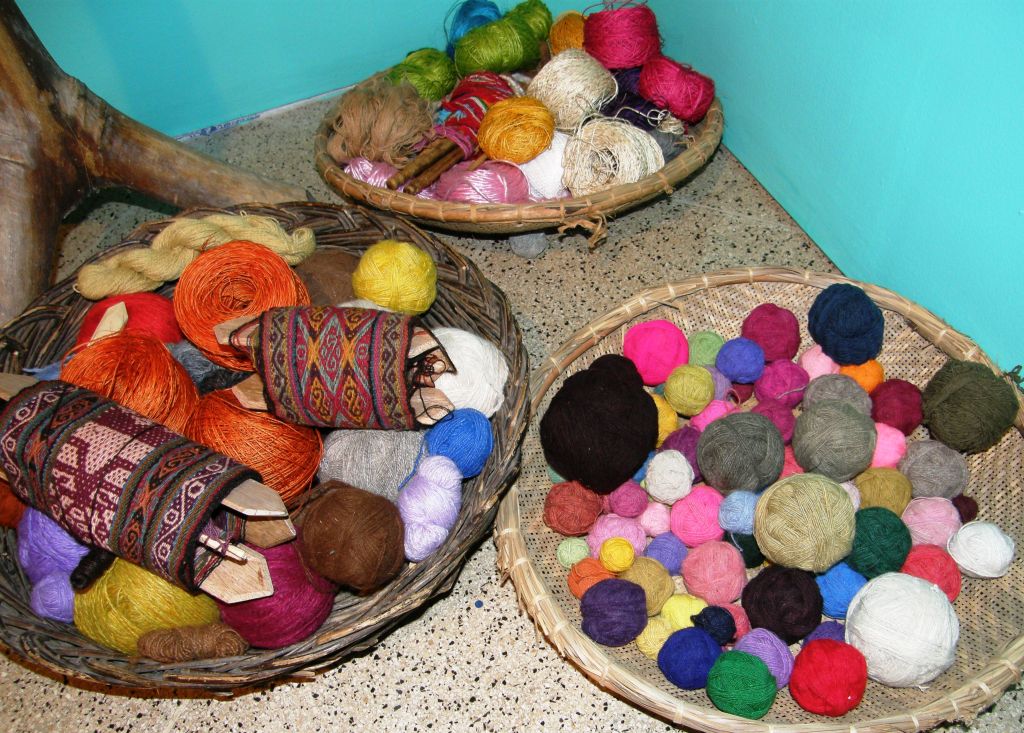
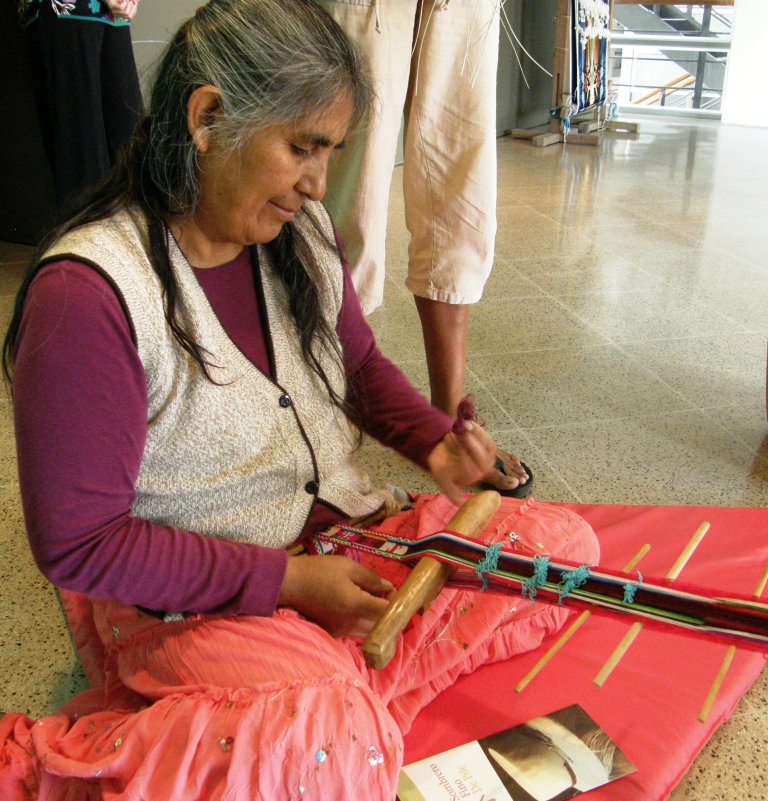
Celinda, an Aymara weaver from the northern Chilean high plains, is showing one of the participants handspun wool which she dyes with bright aniline colors. She also brought her handspun alpaca fiber in natural colors and I was able to keep some by swapping a couple of my handwovens. Zenaida and Sonia brought handspun wool from Chinchero which they left for educational purposes at the cultural center which sponsored the event. I noticed, however, that they use alpaca for weft in their wide weavings.

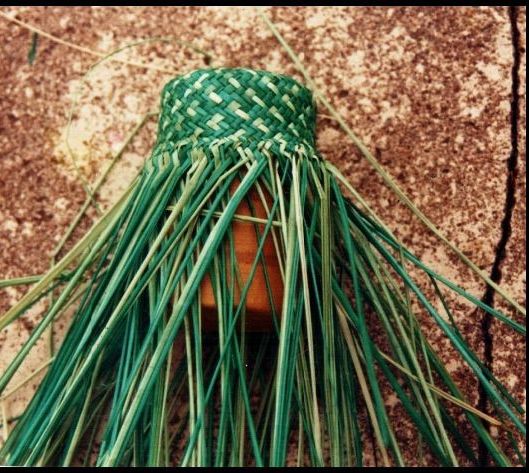
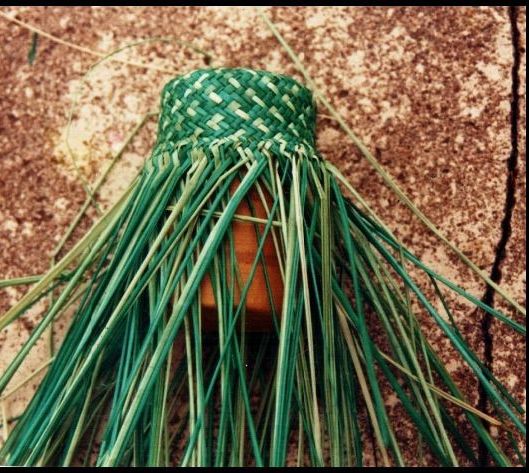
Domingo, a master weaver of the famed Panama hats of Ecuador brought the straw “paja toquilla” (above lower right) from which they are made. Maritza, from Colombia taught us how to work with the “cabuya” fiber that is extracted from the penco plant. (above upper right).

The Guarani weavers who attended, from the area in which I live in the Bolivian lowlands, are now using industrial cotton, the very same type that I use myself in my weavings.
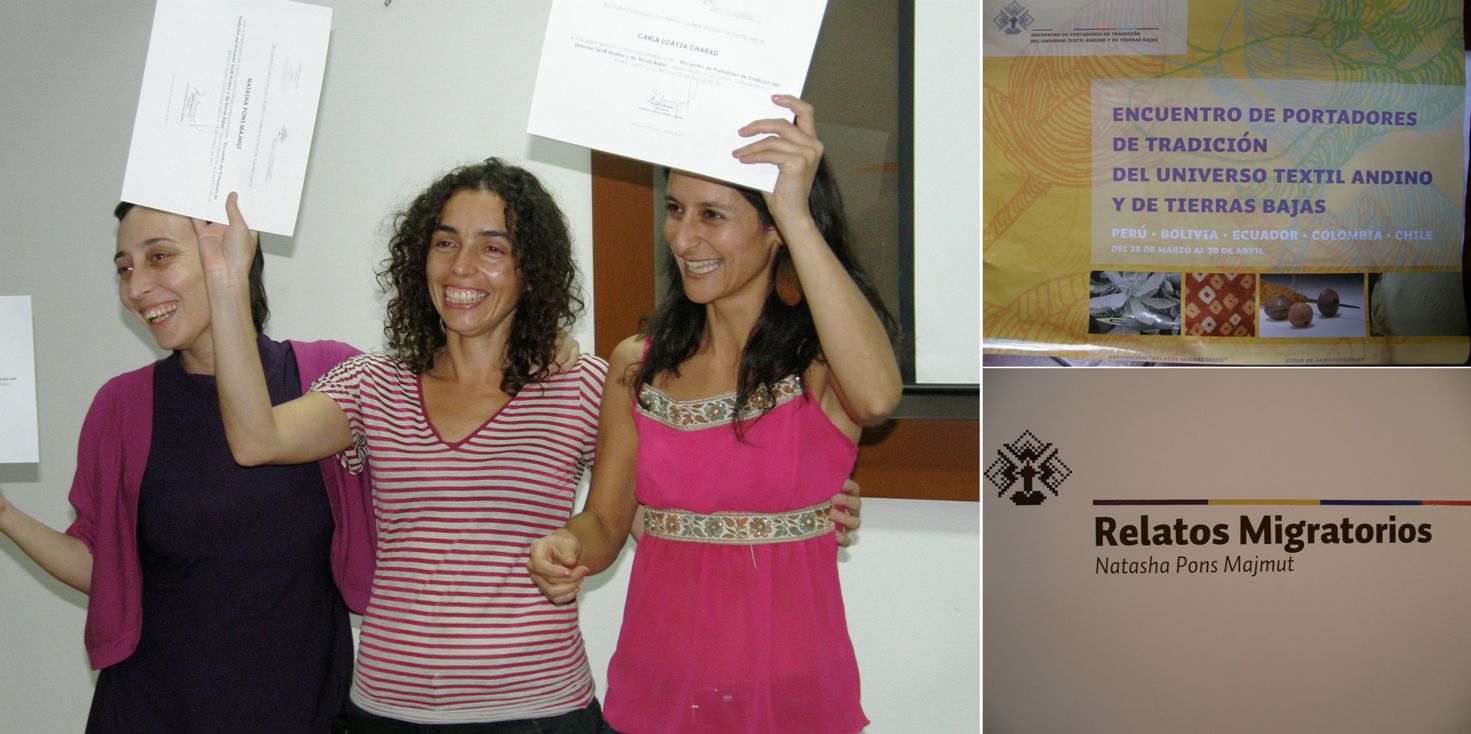
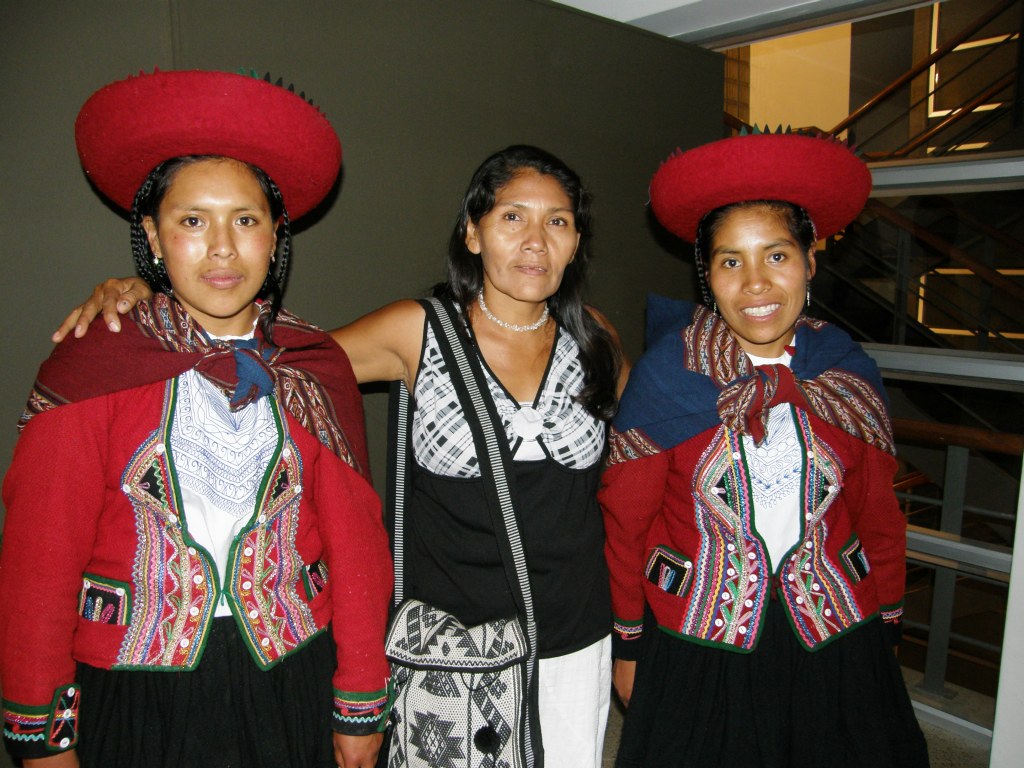
The event was organized and coordinated by the three Chilean ladies above…Cristina, Natasha and Carla who can be seen celebrating the end of a successful three days of interaction and sharing. Artisans from Colombia, Ecuador, Peru, Chile and Bolivia came together to show their work and exchange ideas and I was lucky to be a part of it.
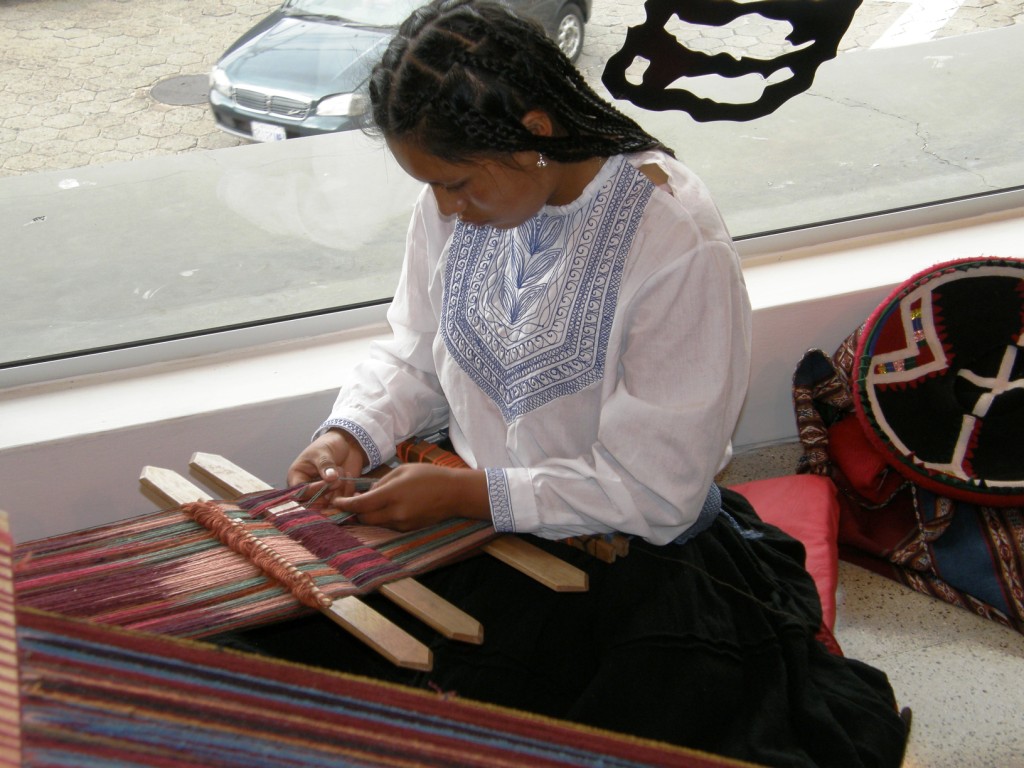
Day one had most of us barefoot and on the floor learning the fundamentals of backstrap weaving.

Okay, so I have already been backstrap weaving for fifteen years (which probably isn’t much in backstrap weaving terms) but there is always something to learn, right?

You can learn about the weaving traditions from a country, a region, a town, a community as well as from each and every individual weaver and this very small scale event was the perfect venue for sitting right by and having very close connection with the weavers themselves. And this interaction was not only possible as they showed and taught us their craft but also as they learned right alongside us the crafts of the other attending artisans.
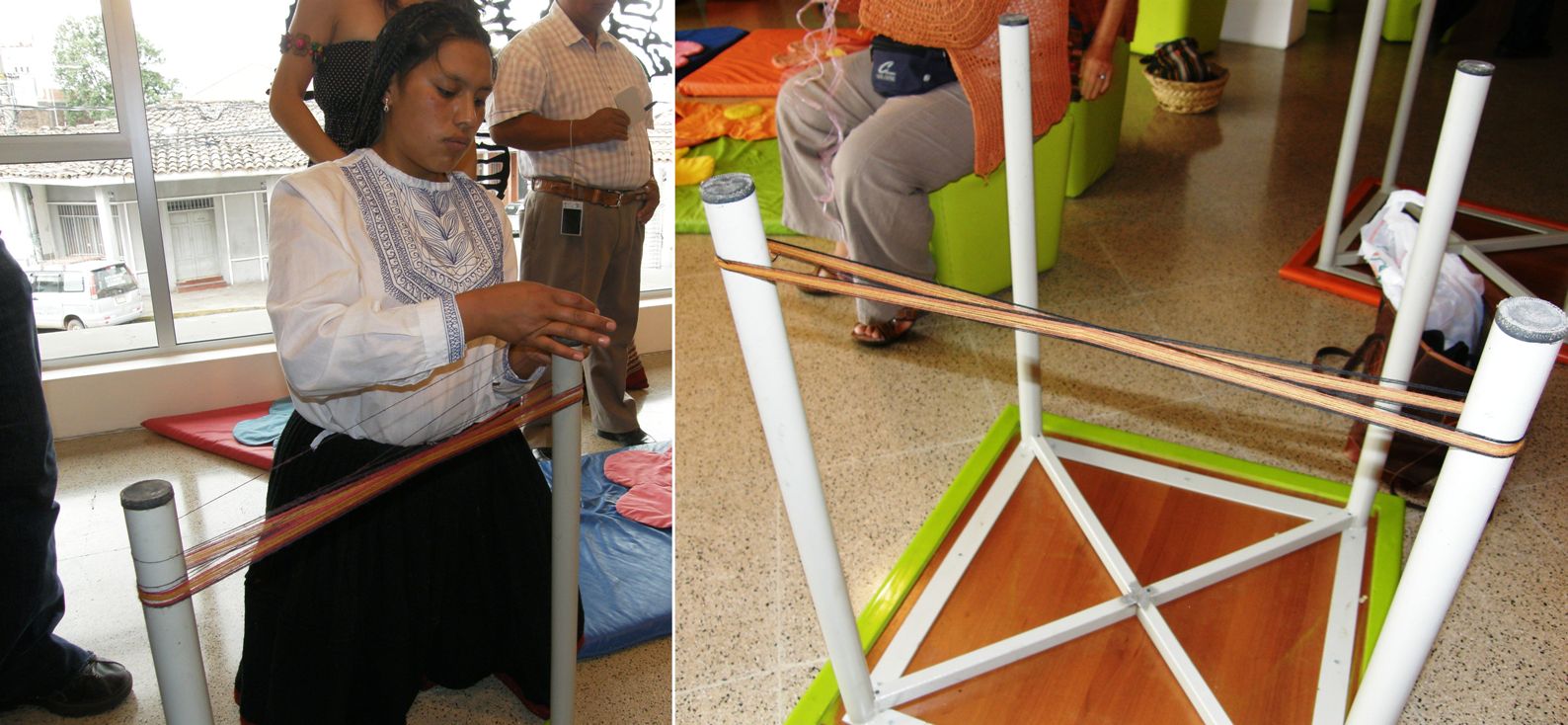
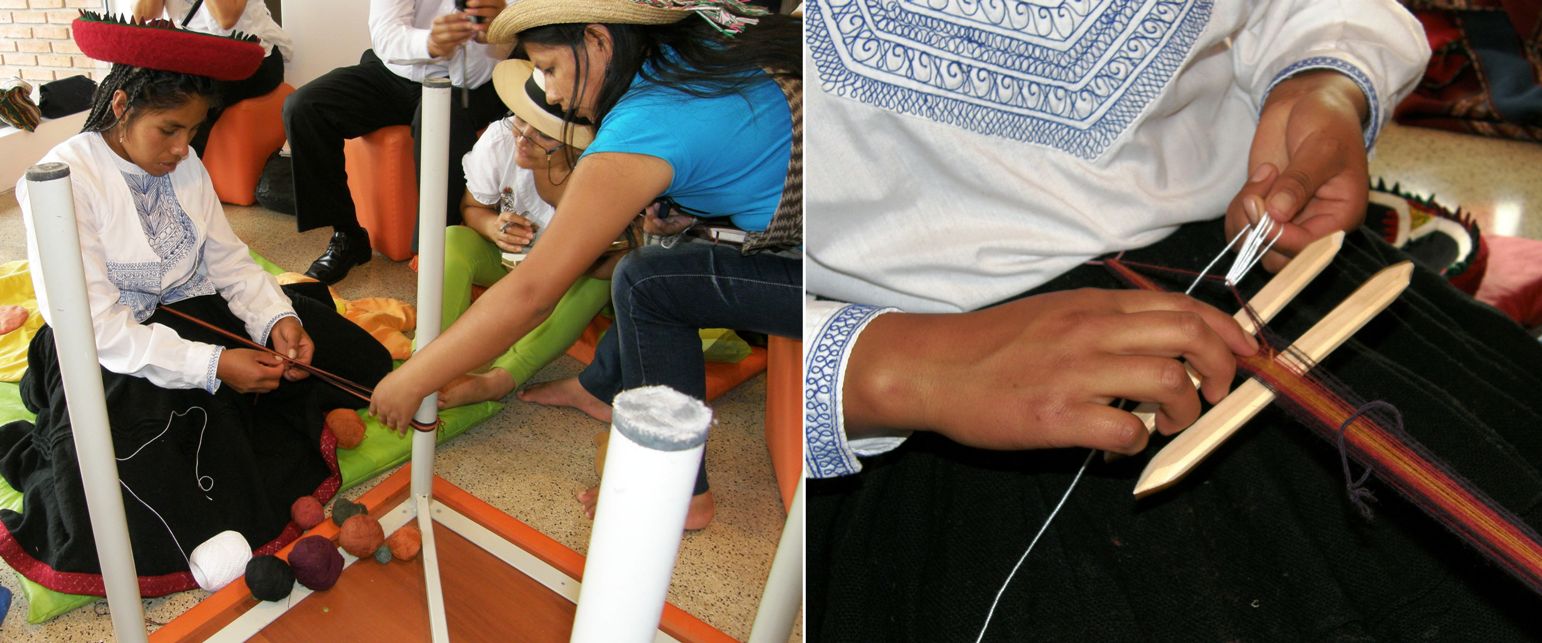
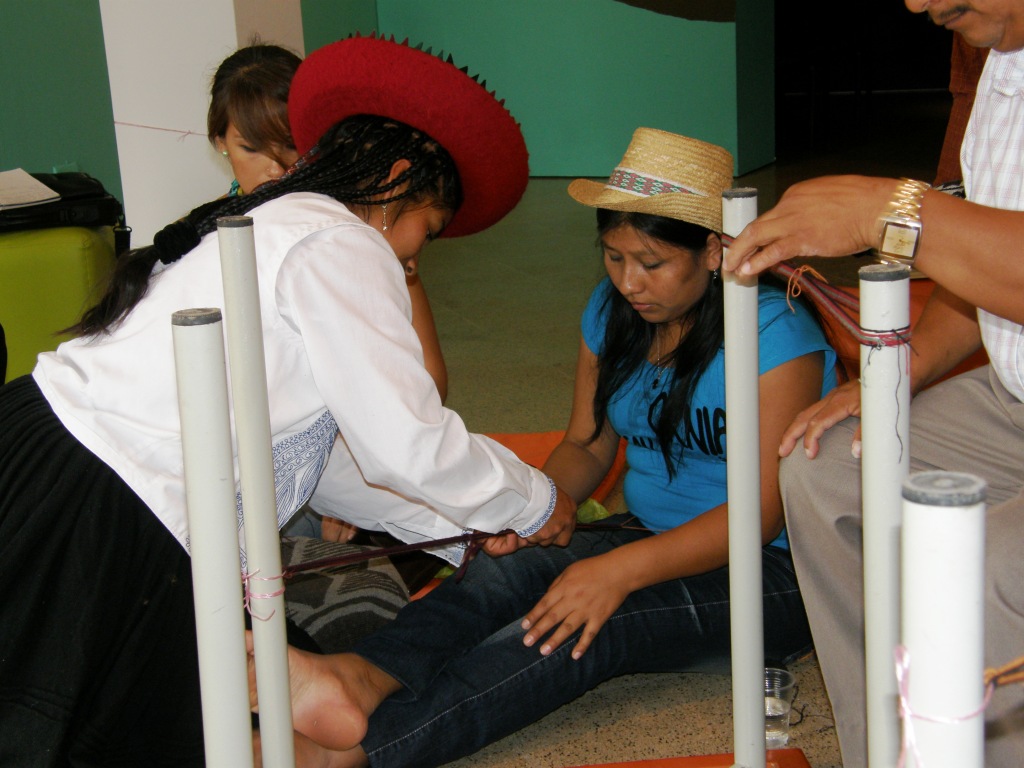
A lesson in warping…if your “stakes” are close together as these table legs are, you can simply hold your warp end against the stake (don’t tie a loop around the stake) and wind your figure-of-eight. When you are done with that narrow stripe of color, tie the end to your start end and then start your next color the same way. The advantages I can see of this…if one color has wonky tension, you can untie the knot and adjust without affecting the rest of the warp. If you warp a color that you decide later you can’t live with, you can chop it out easily without affecting the rest of the warp as it has been wound independently. Mind you, we were only warping narrow bands here of about 40 ends in five stripes of three colors and the warps were short which meant it was easy to anchor the warp end with one hand while winding with the other.

Next came strapping in, shed loop and heddle making, a demonstration of shed openings and weft management and then we all set about warping and weaving our own bands. Most problems arose, as can be expected, with opening the sheds smoothly and keeping the edges even.
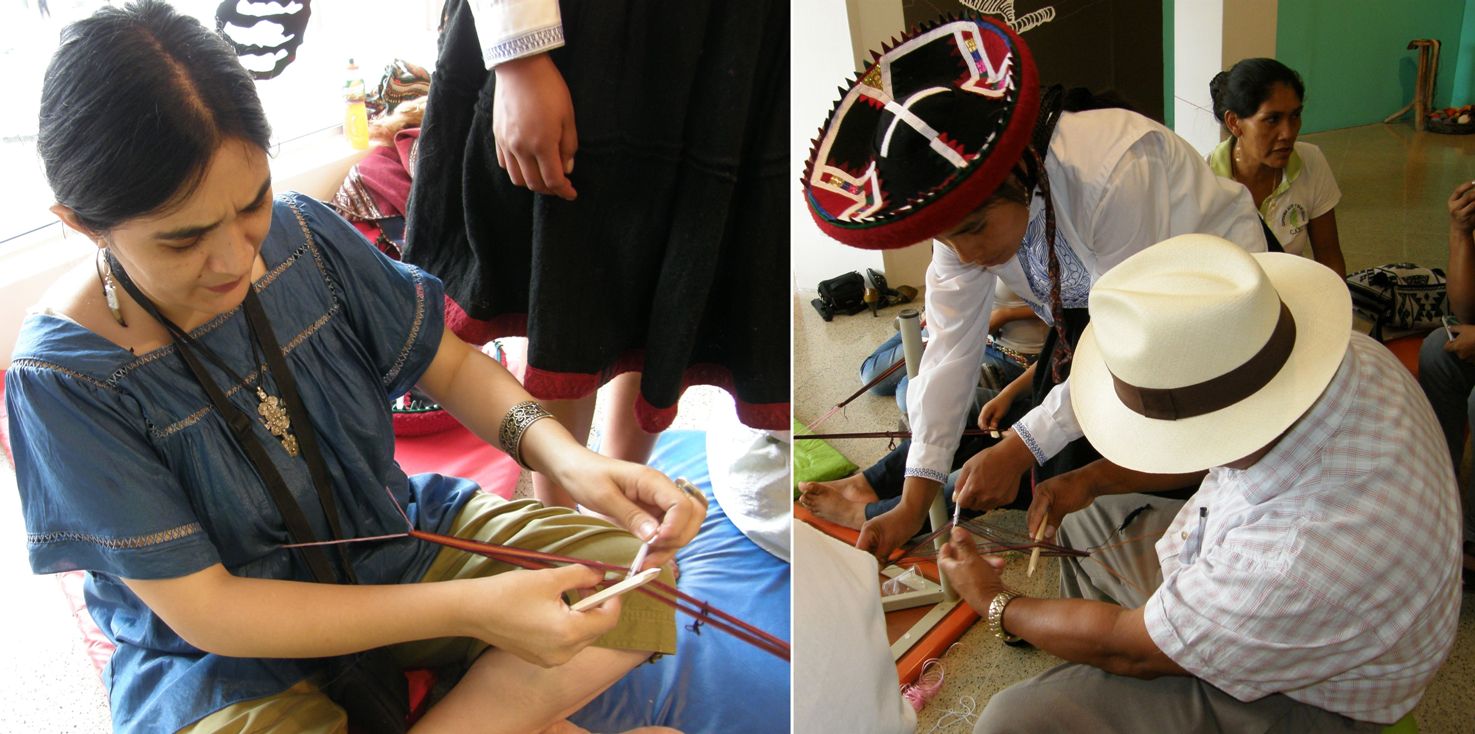
As usual there is a certain period of silent concentration in the beginning interspersed with pleas for help. You can always identify the Ecuadoran contingent by their Panama hats! That’s Domingo, the Panama hat master, on the floor getting his first backstrap weaving lesson. This silent period is soon followed by excited chatter and cries of victory as everyone starts to get the hang of it and relax.
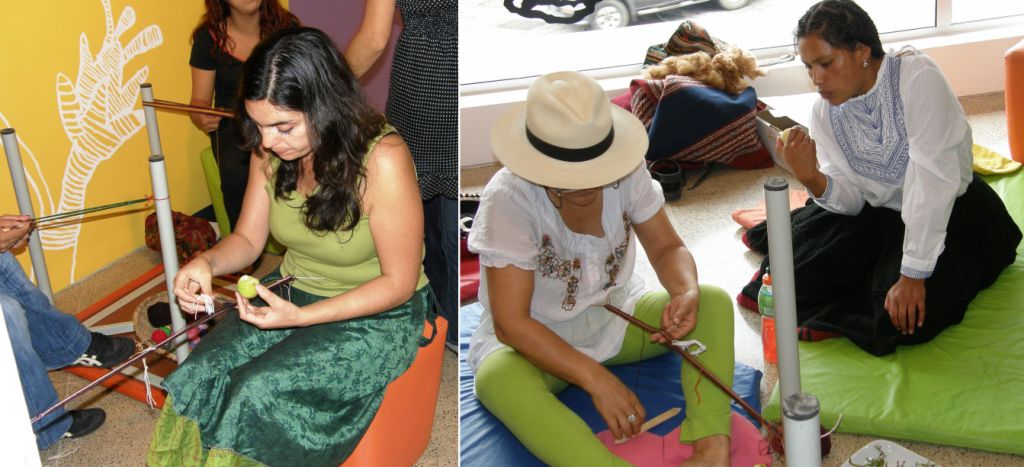
Snacks provided by the center….some participants are now so relaxed they figure they can even eat a peach and backstrap weave at the same time! That’s Mercedes from Mexico. Sonia has her students working away happily and can sit down too but is always keeping an eye on things as you can see. There she is watching over Libertad from…well, I don’t need to tell you where she’s from, do I!
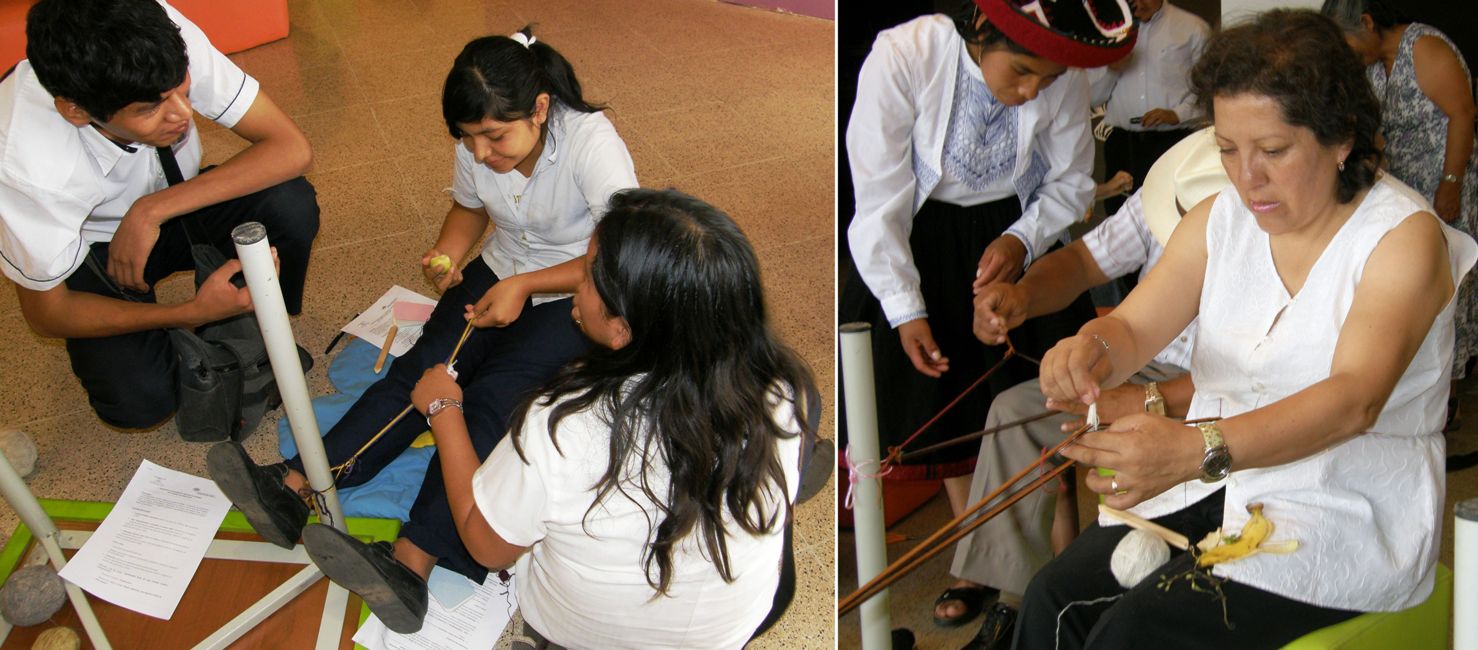
Some school kids dropped by and had some fun and there you can see Zenaida with members of her group getting acquainted with that tricky heddle shed. That’s Liliana from La Paz representing an organization called Nicobis which produces educational and cultural videos to promote intercultural dialog.

On the other side of the room, Aymara weavers Celinda and daughter Isobel were teaching backstrap weaving to another group.
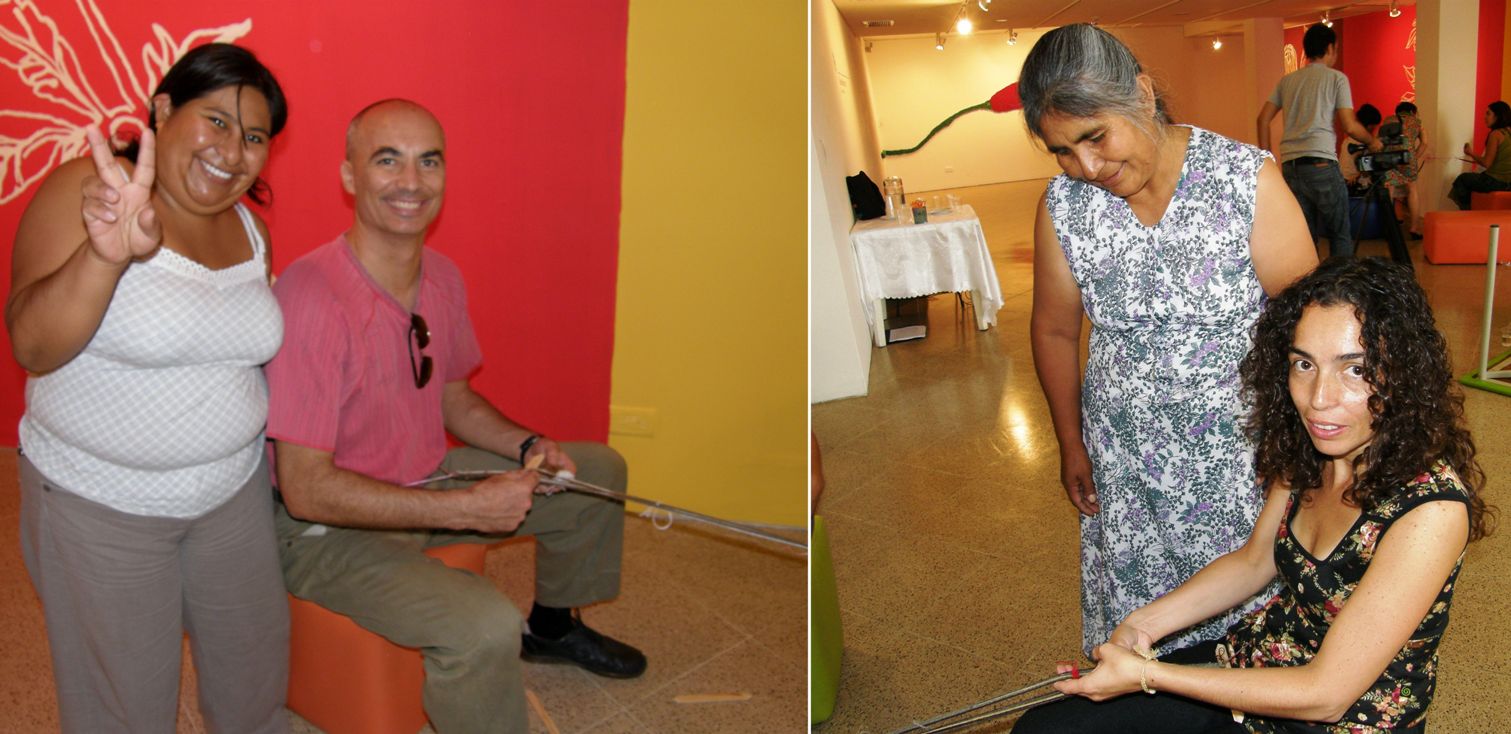
Isobel, always smiling and sharp as a tack, tells me that she does not have much patience for teaching. It’s hard to believe!
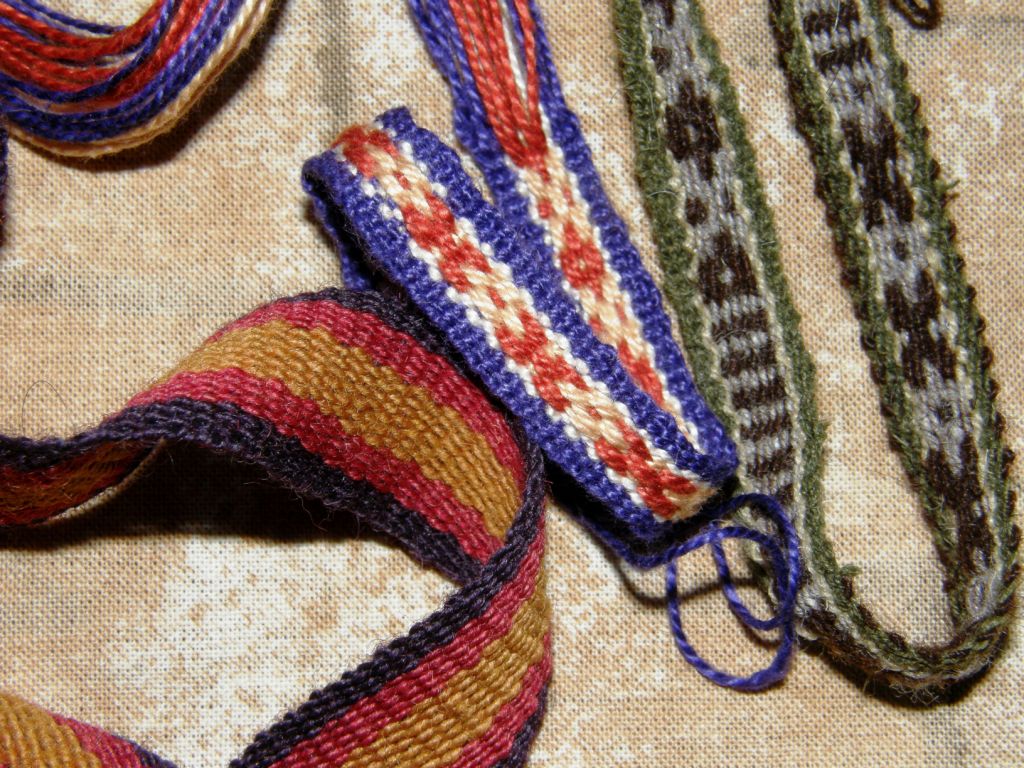
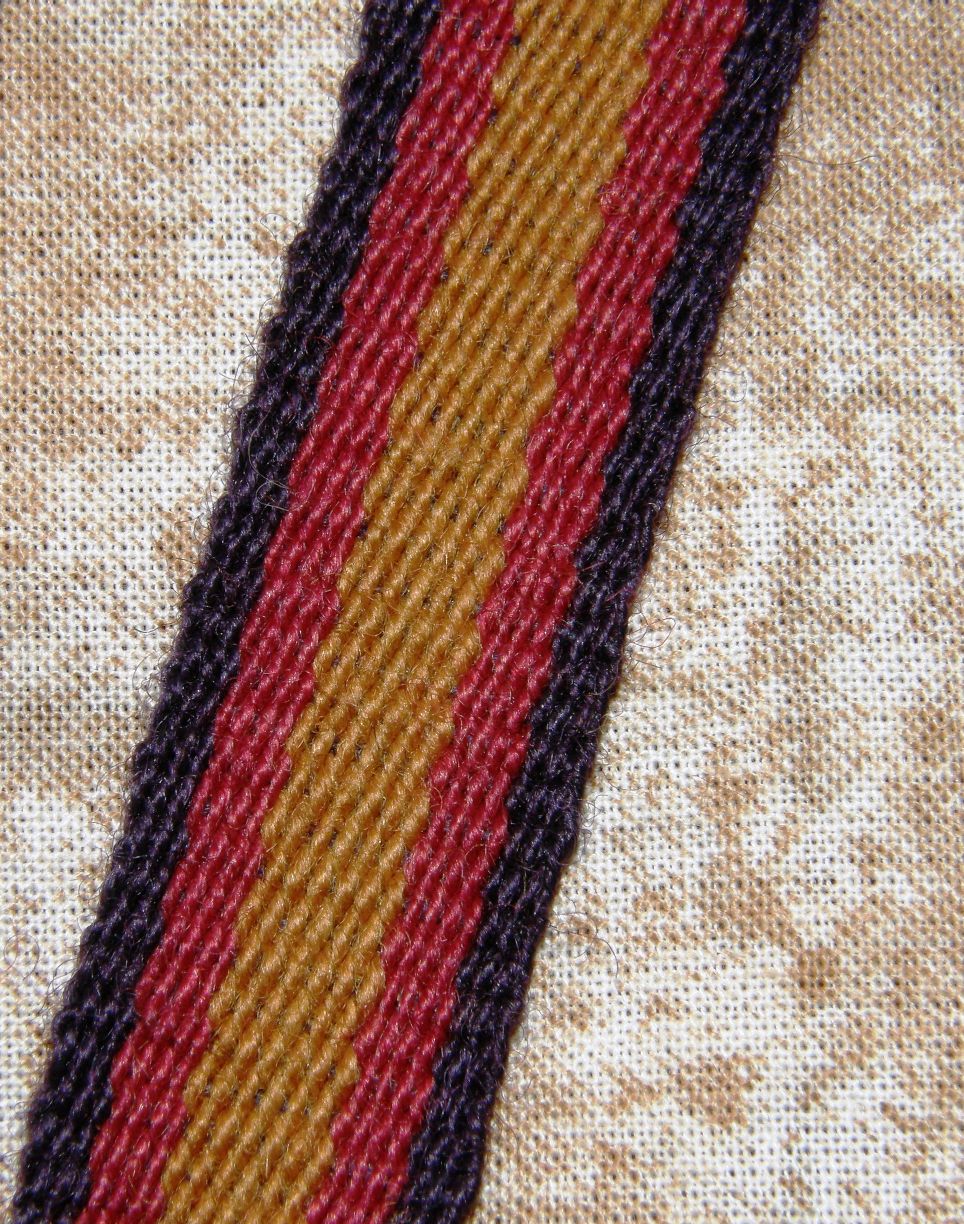
Materials!!

The twisty band above left is the one I made in Sonia’s class with the high twist wool warp and weft.

The one on the far right, I made with Celinda’s handspun alpaca fiber as both warp and weft. The green border is my own handspun llama fiber.

And of course, I wanted to have something made during the event from the material that the other group of weavers from Santa Cruz was using, Clea crochet cotton.

You can see the texture of the high twist wool on the surface of my little band at left which  gives a slanted look which I quite like.

All the while, a table was set up with various woven products made by the participating artisans and the groups that they represented.

Here you can see cotton goods made by the Guarani weavers using the kara pepo, moisy and simple warp float techniques (I don’t know their name for this technique, in fact, this was the first time I had seen anything made by the Guarani weavers with it).
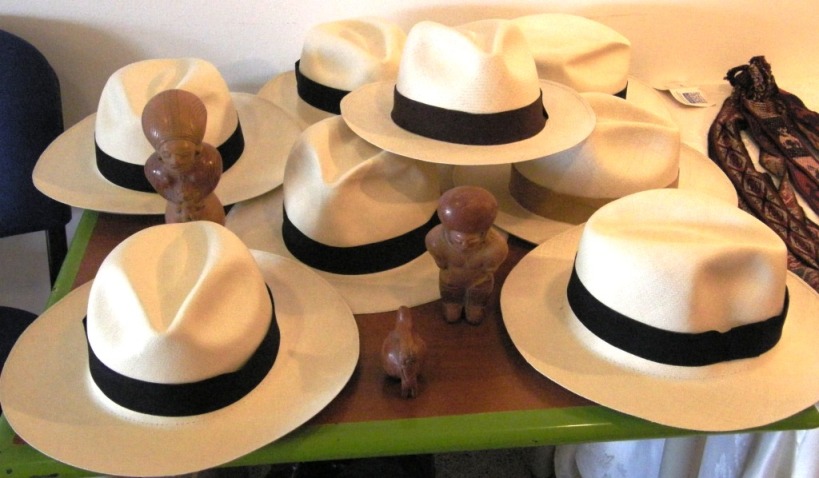
The next day was another of frenzied activity as we moved the focus to plant fiber…the paja toquilla and cabuya.

Domingo showed us how to produce the basic weave that is used in the spectacularly fine Panama hats which have their origin in Ecuador.

We soon learned that the basic weaving moves, while taking some time to grasp, were not all that difficult.

What was hard was maintaining good tension and Domingo patiently spent a lot of time trying to have each student position their hands as he does in order to produce a good tight weave.
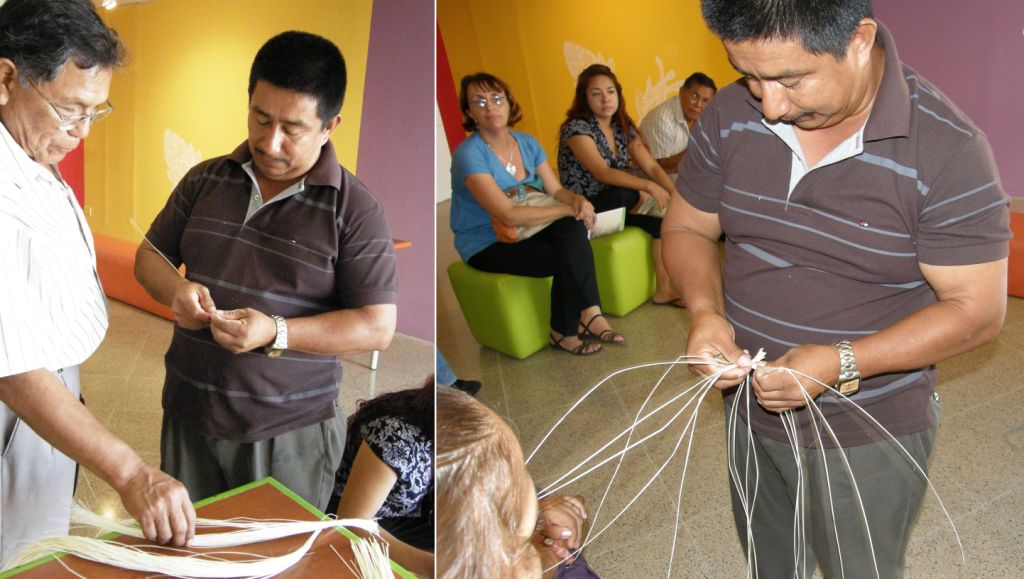
Bundles of twelve pieces of straw were prepared for the students. “Es facilito” (it’s really easy) Domingo kept saying referring to the weaving moves but admitted that weaving with correct tension was something that could take one years to perform at an acceptable level let alone the master level at which he does it.
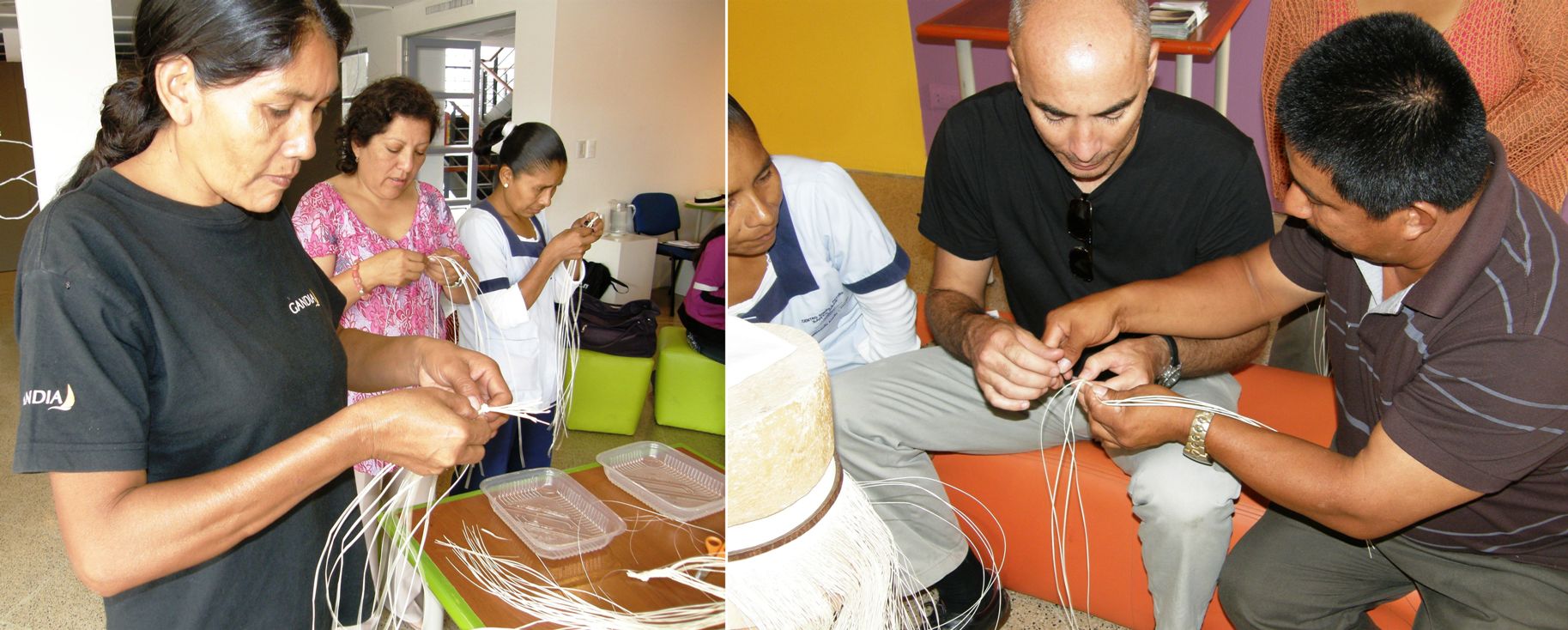
My Guarani weaving teacher, Angela was very keen on learning this. We have the paja toquilla here in Santa Cruz too where it is called “jipijapa” and so it made more sense to her to learn this craft rather than the cabuya work.

And here is the master at work…
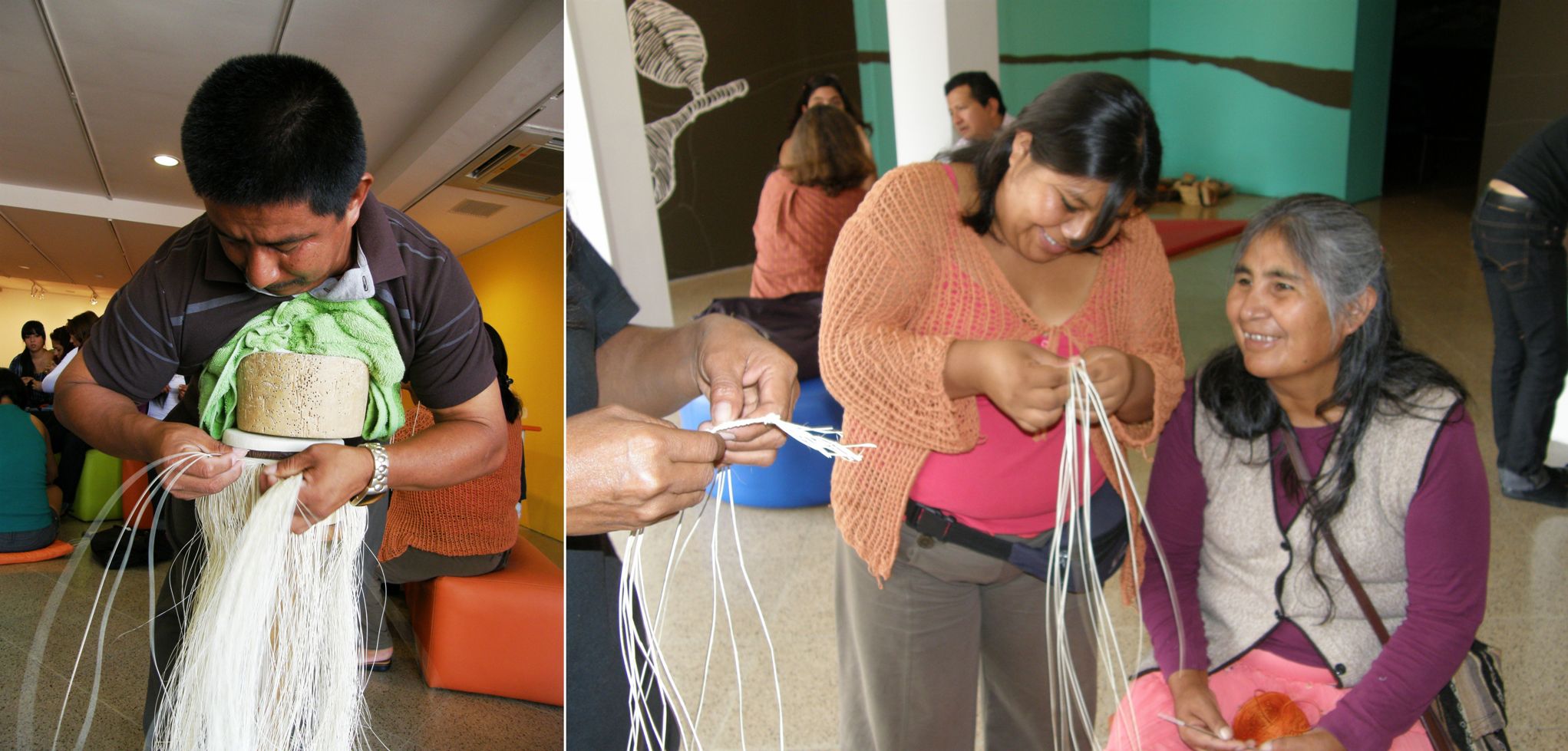

Above, you can see that Domingo, after weaving the flat top of the hat, is now weaving it down and around a mold to give it shape.

The picture at left of a miniature hat being worked over a mold will give you a clearer view of this. I spent an afternoon with a paja toquilla weaver in Gualaceo Ecuador and she showed the me whole process of making a hat in miniature.

Domingo stands bent over a post on which the mold and hat are propped, leaning on a wooden block and working with incredibly fine strands of straw. Maybe you thought sitting on the floor strapped into a backstrap loom looked a wee bit uncomfortable….

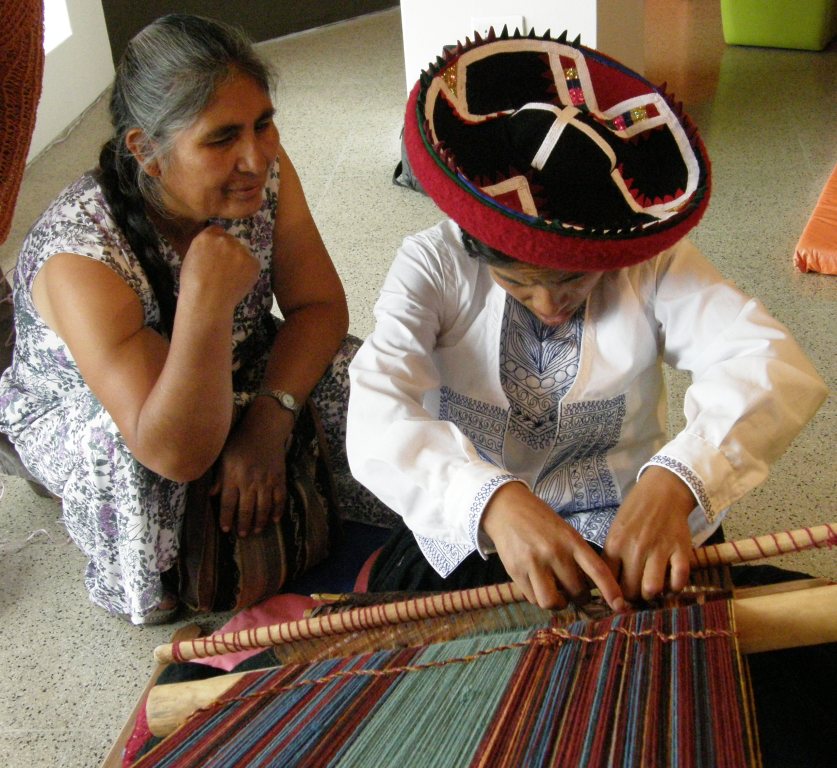
Above right, you can see Isobel, whom I told you is super sharp, working her fiber and showing her mum while exclaiming how “facilito” it is!

A few women in the Intag Valley in Ecuador still hand spin cabuya fiber.

Meanwhile, the ladies from Chinchero, Sonia and Zenaida, not in their traditional clothes this day, opted for cabuya fiber classes. With Maritza from Colombia they learned to crochet bags. This cabuya fiber is machine spun and chemically dyed in bright and lively colors and Sonia really took to this and got to finish her bag, made in black, neon pink with all kinds of glittery additions which Maritza had brought, in one day. It pretty well matched the colors in her outfit.

This cabuya fiber is much finer than the fiber that I worked with when I stayed with members of a cooperative in Ecuador. There the fiber was dyed with natural substances, was coarser and all together more rustic looking.

The women in the cooperative, crocheted, knotted and wove the fiber into mats, bags and other accessories.

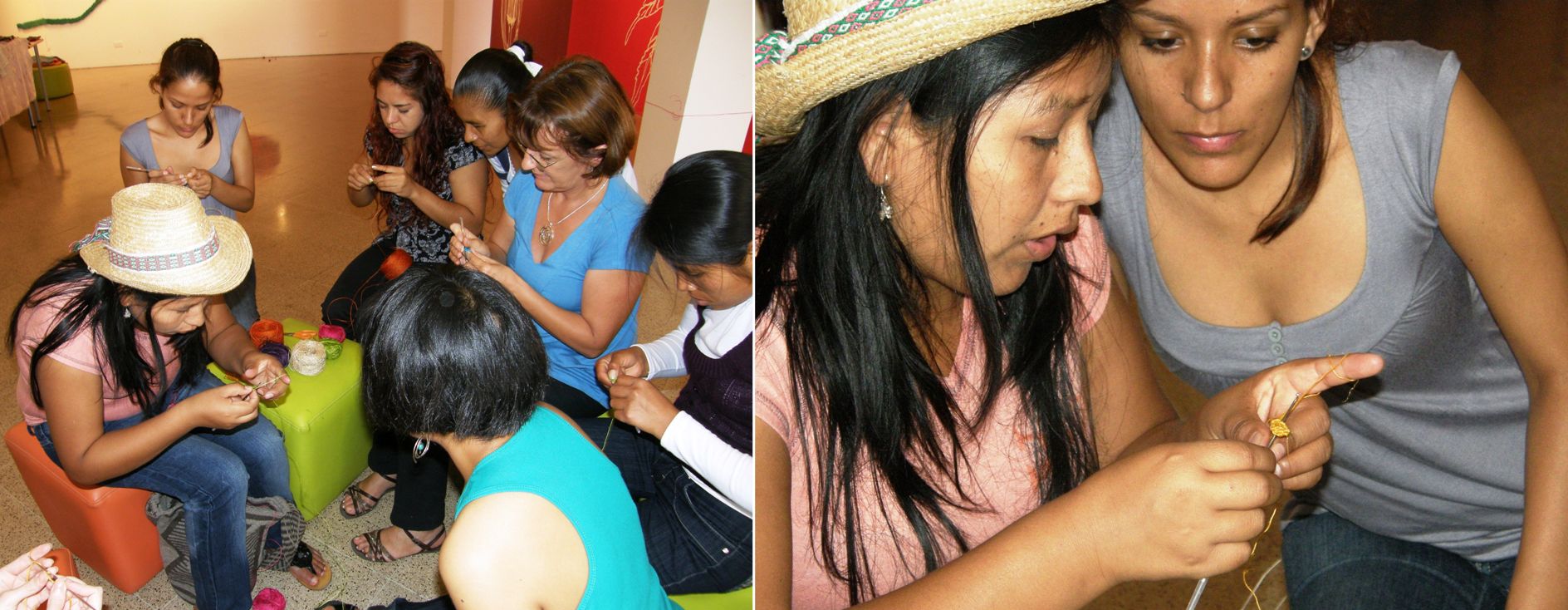
On the left is a crocheted mat I bought from the co-op, a woven bag that I was taught to make during my stay in Ecuador, and a piece I wove at home on my backstrap loom. All these colors are from natural substances.

The cabuya fiber brought by Maritza is fine, smooth and consistent, lovely to work with and the colors sing!

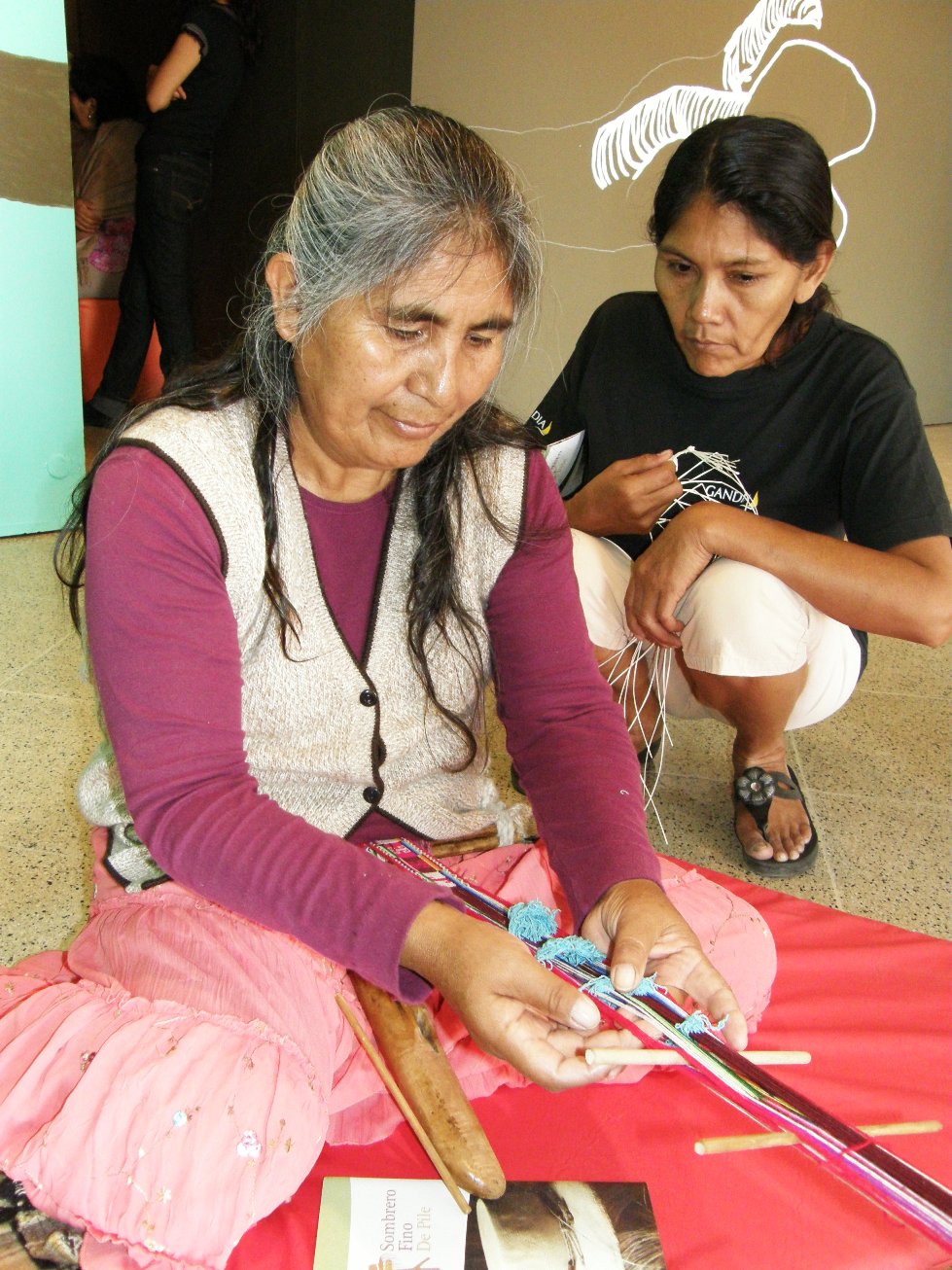
So, day two’s workshops were intense. In the midst of the madness, Ayamara weaver Celinda quietly took up her loom and started to weave and of course, I was immediately drawn to her as was Angela.
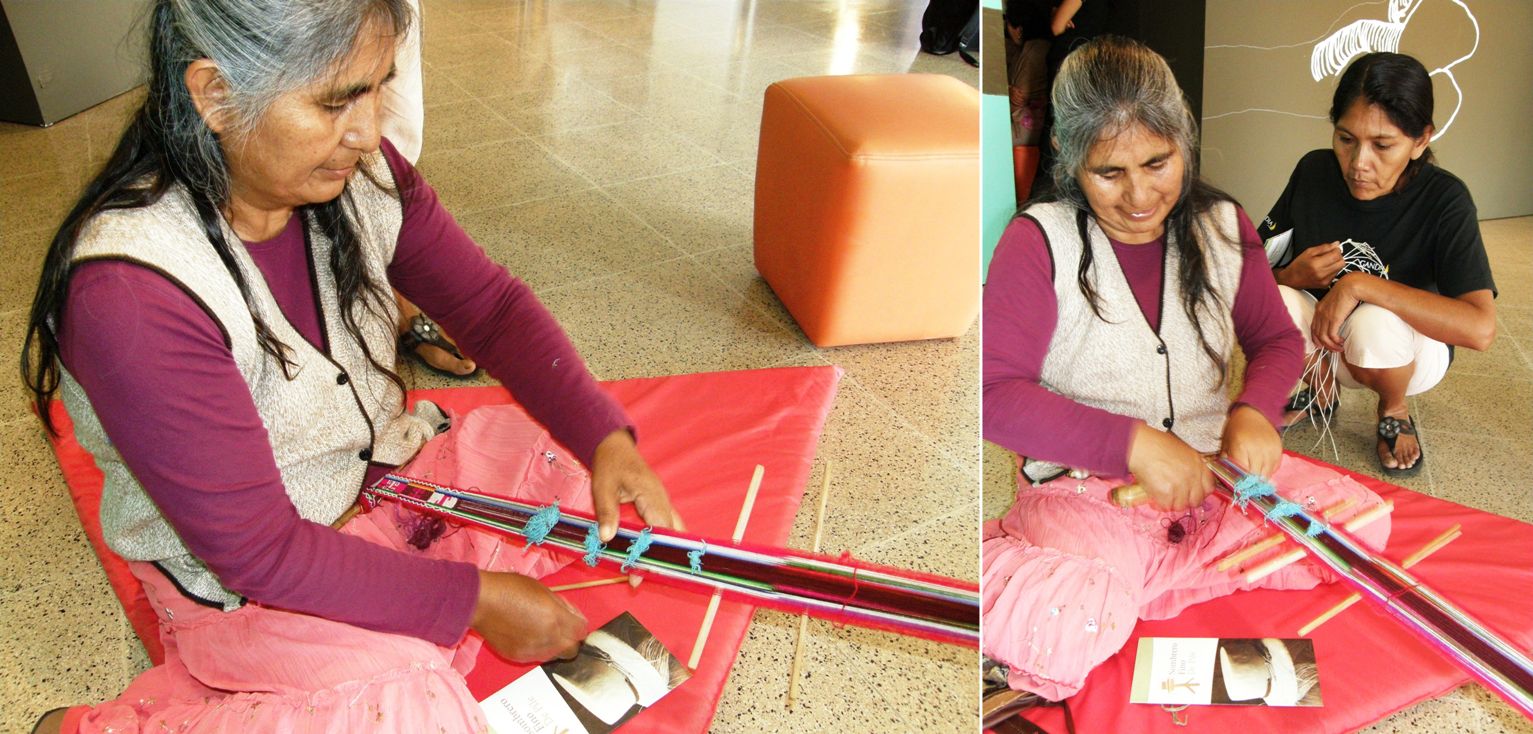
We got some nice relatively quiet time with Celinda and I got some good video of her on which you can hear all the noisy fun of the cabuya and paja toquilla weavers in the background!

Two of Angela’s new skills…weaving straw and weaving a triple color band. The afternoons of this conference were reserved for interaction between the artisans and, that afternoon, Angela spent more time with Celinda and learned her triple color technique. The Guarani weavers have a very special way of making their string heddles joined by a chain and you can see Angela’s signature heddles on this Aymara style band….two cultures joining hands in the one piece.

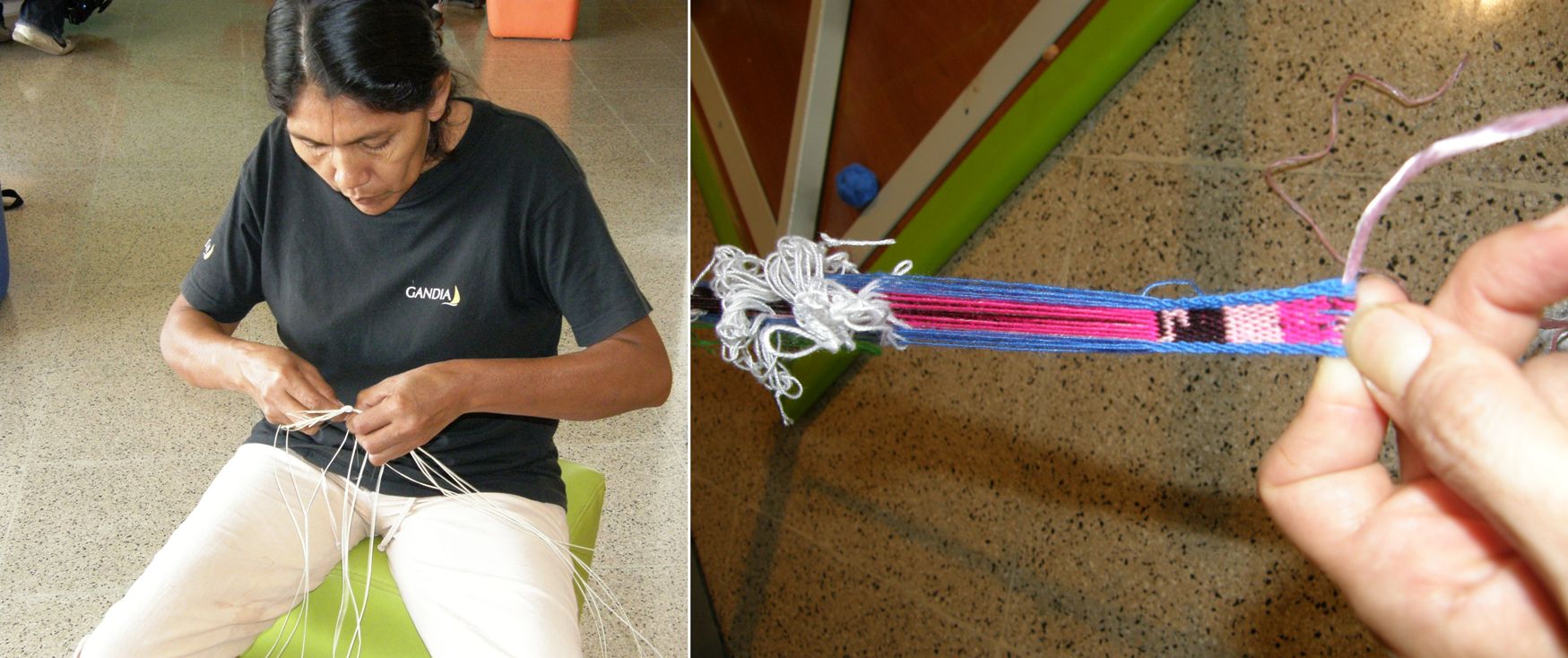
On day three, it was Angela’s turn to present and a class of teenagers was invited to see one of Santa Cruz’s own indigenous artisans at work. First, as a warm-up, Carla taught finger-loop braiding that she had learned in Chile. This was the first time that everyone participated in the same activity at once and, with all the enthusiastic kids there, it was explosive! This was a new braid for Sonia and Zenaida and I hope they will have fun teaching it to their friends in Chinchero.

Domingo particularly enjoyed the braiding and was braiding all evening during the conference presentations.
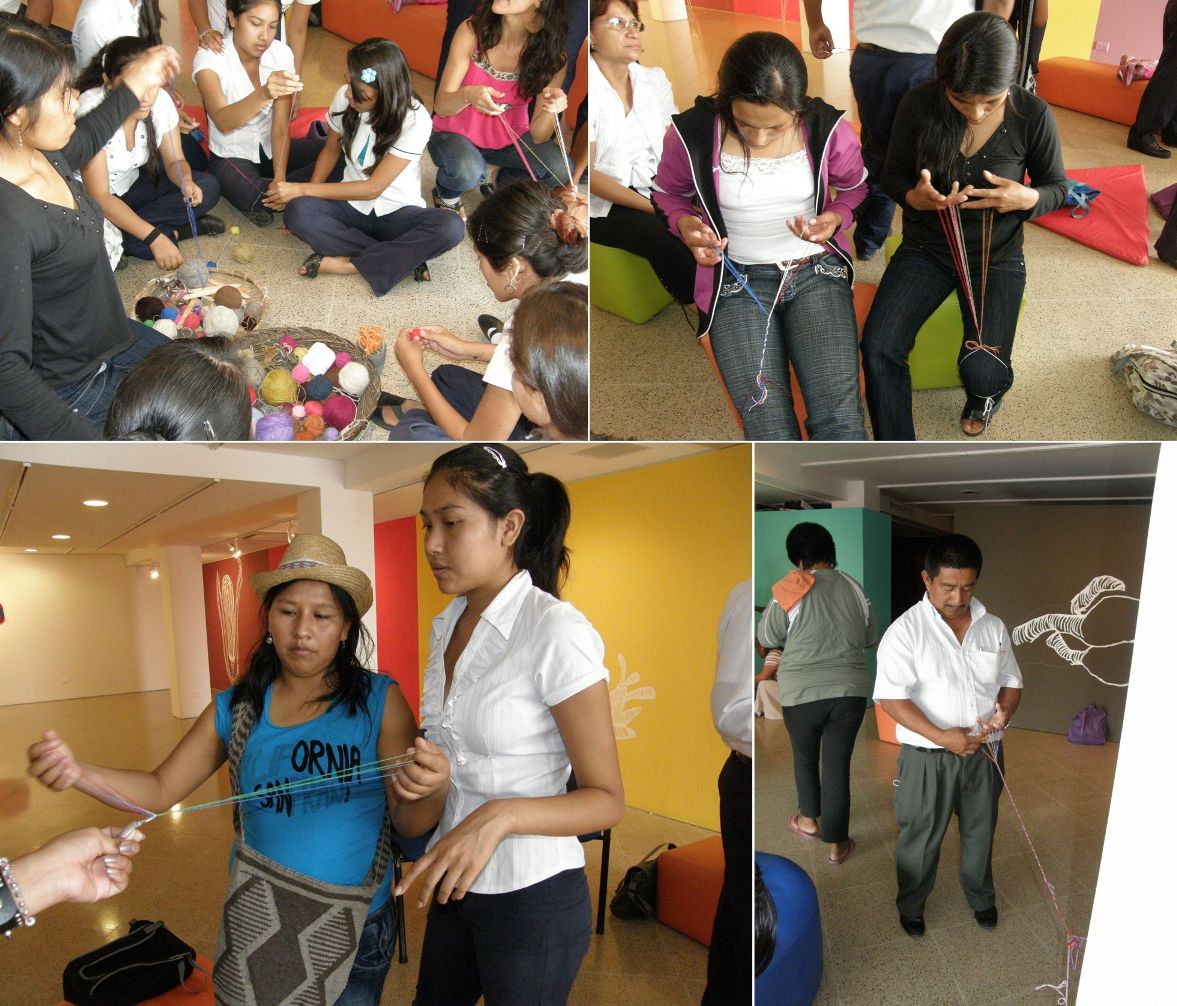
Then it was Angela’s turn  to show how she warps a band using the dovetail warping method and the school kids were keen to try their hand at weaving.
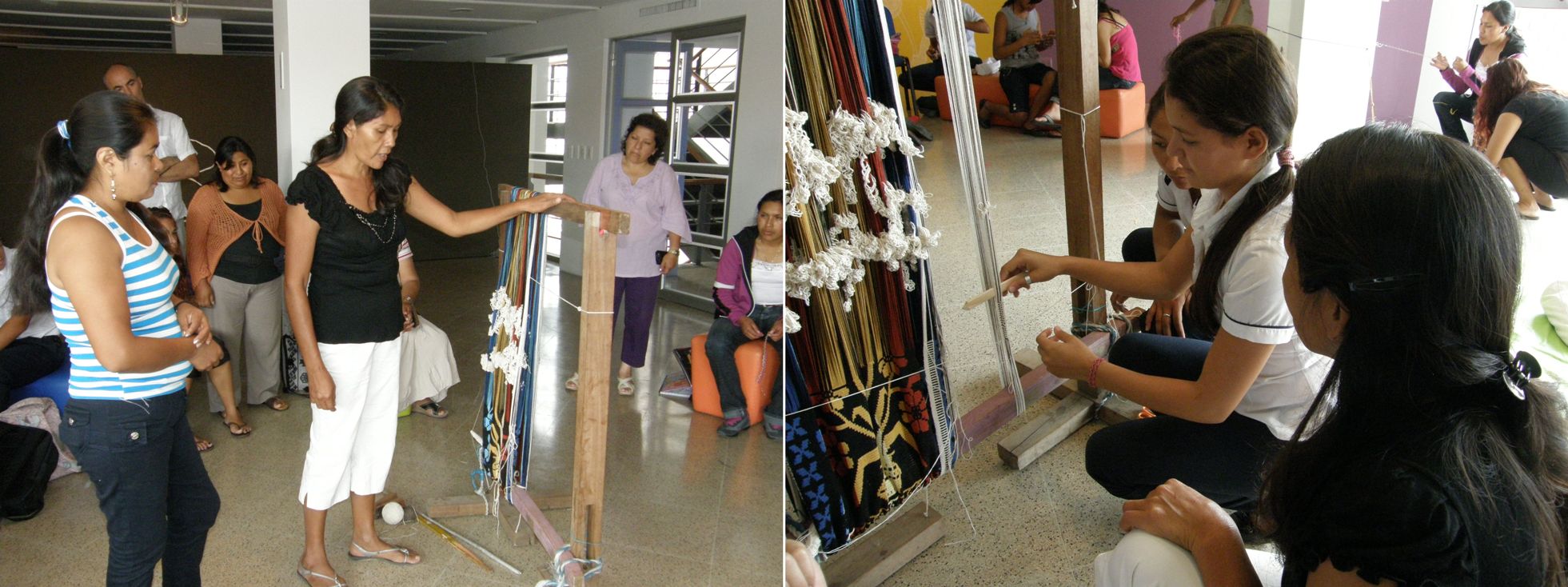
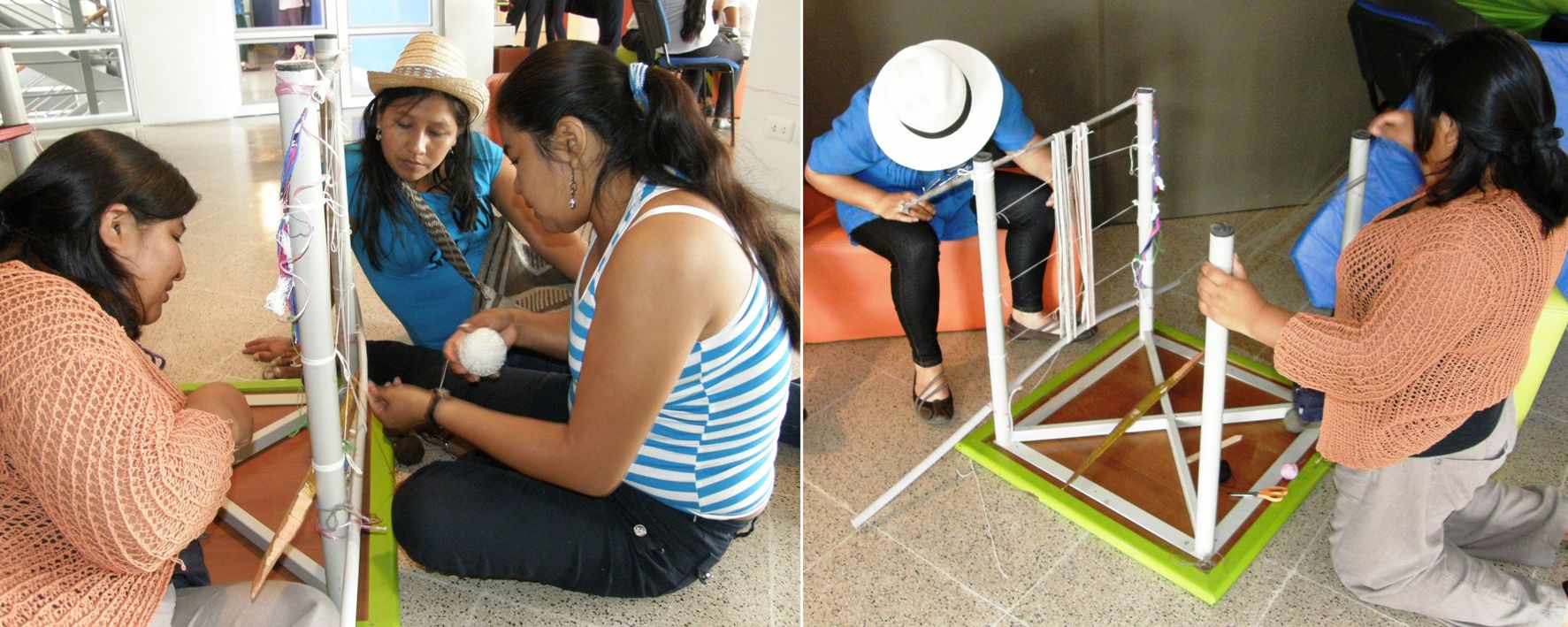
Over in the corner and away from all the riotous enthusiasm, Guarani weaver Marioly showed Maritza from Colombia and Isobel from Chile the dove tail warping system using  the table legs as an improvised vertical loom.
Maritza is from the Nasa ethnic group of Cauca in Colombia. It is terrible how little I know about Colombia. After Maritza’s evening presentation at least I can say that I know that in Colombia there are 102 indigenous groups and 64 languages amongst them. One of the most important woven  items for the Nasa woman is the chumbe, a belt which is used amongst other things to strap a baby to its mother’s body so it can be carried about and/or comforted. Maritza herself is not a weaver of cloth but has dedicated herself to working with the cabuya  fiber instead.

A new online friend, who is from Colombia, shared this link with me for a page of  beautiful images of people of the Guambiano ethnic group of Colombia who are from the same area of Cauca as Maritza. I really need to adjust my mental image of Colombia!
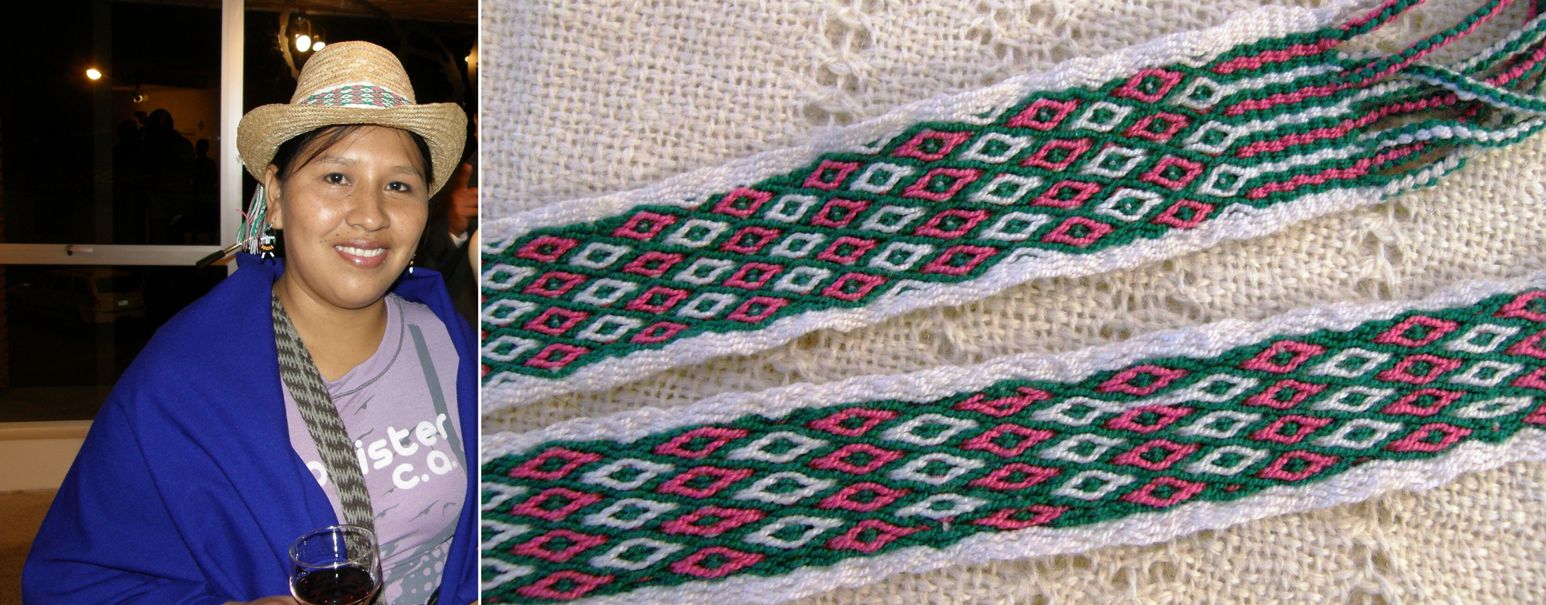
She told me that many narrow items, like the band which adorns her hat, are woven on a very simple loom which comprises little more than a forked branch.

Business and pleasure…it was all pleasure for me! Sonia and Zenaida took to the podium on the final evening to tell us about the work of the CTTC (Centro de Textiles Tradicionales de Cusco) and answer questions. Jean Paul of Ecuador and Mercedes of Mexico serenaded us with harmonized Cuban songs.
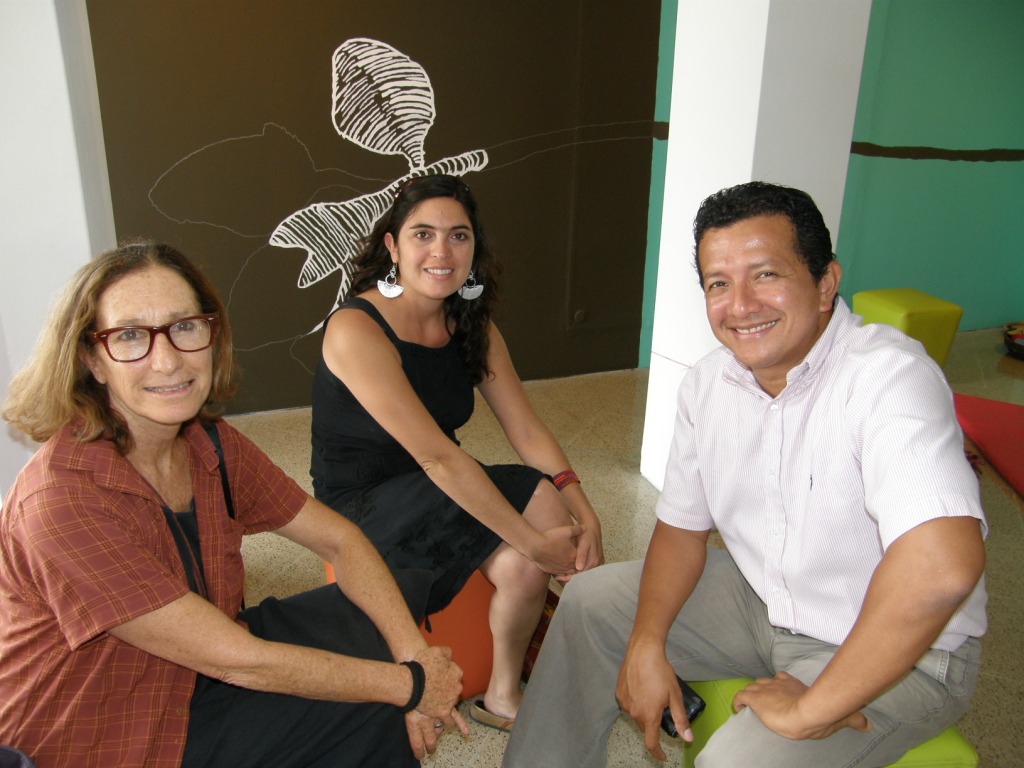
I really enjoyed meeting Maria Elena, above left, from Peru, who gave a lecture on her research into the bags made from garabatá fiber in Peru (a fiber that is also used by the Ayoreo people here in Santa Cruz). We discovered we have some mutual acquaintances in the weaving world.

A last look at some of the textiles…
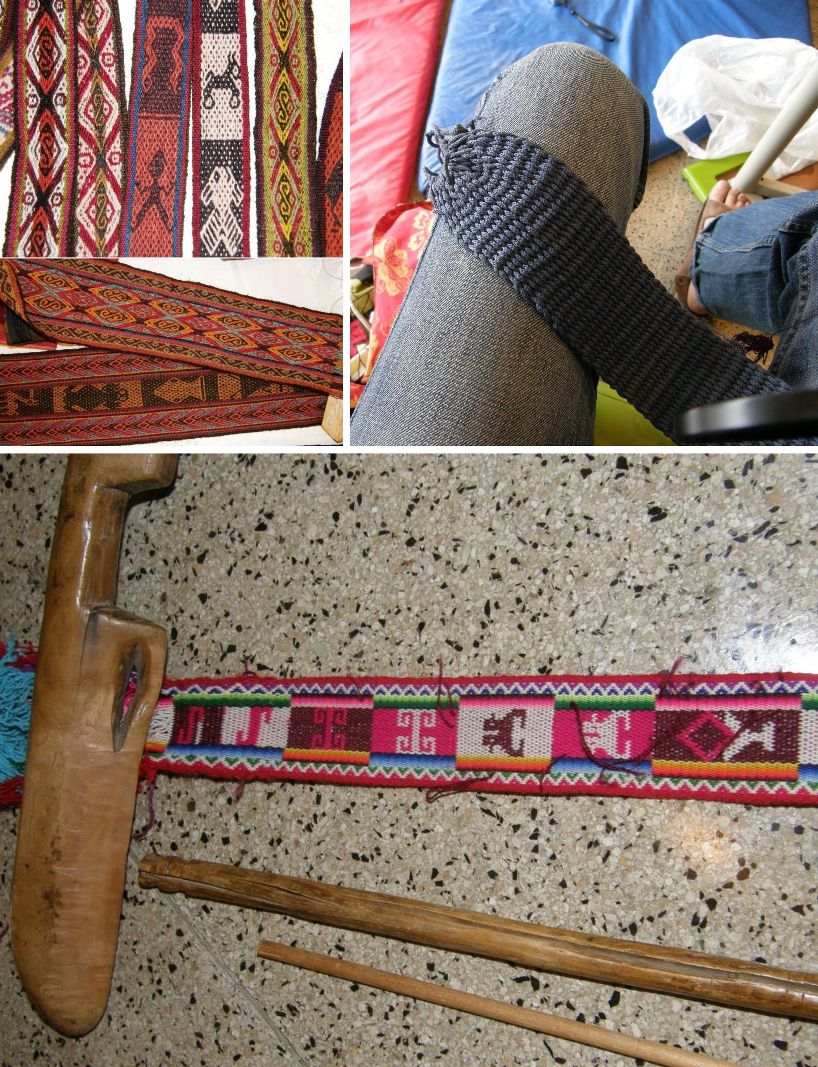
Chinchero textiles at top left, an Aymara triple color belt below and Sonia’s simple and practical backstrap! Of all the textiles there, the backstrap is the one I would have liked to have bought! I would USE it.

So now I am wondering… Will a finger loop braid or two soon be adorning a Panama hat!?…just a fun thought…but, more importantly, will some school kids in Santa Cruz now be able to recognize a Guarani woven bag if they see one in the street and will they be able to tell people something about how they are made? And this I don’t need to wonder about…I know for a fact that Angela will have a three-color band underway on her loom and most likely finished the next time I see her!

######################################################

The Weave-Along is over on Ravelry, the Spin-Along is going but, naturally, is slower to give results. In the meantime we are all still weaving along and finding it hard to drag ourselves away from the loom!
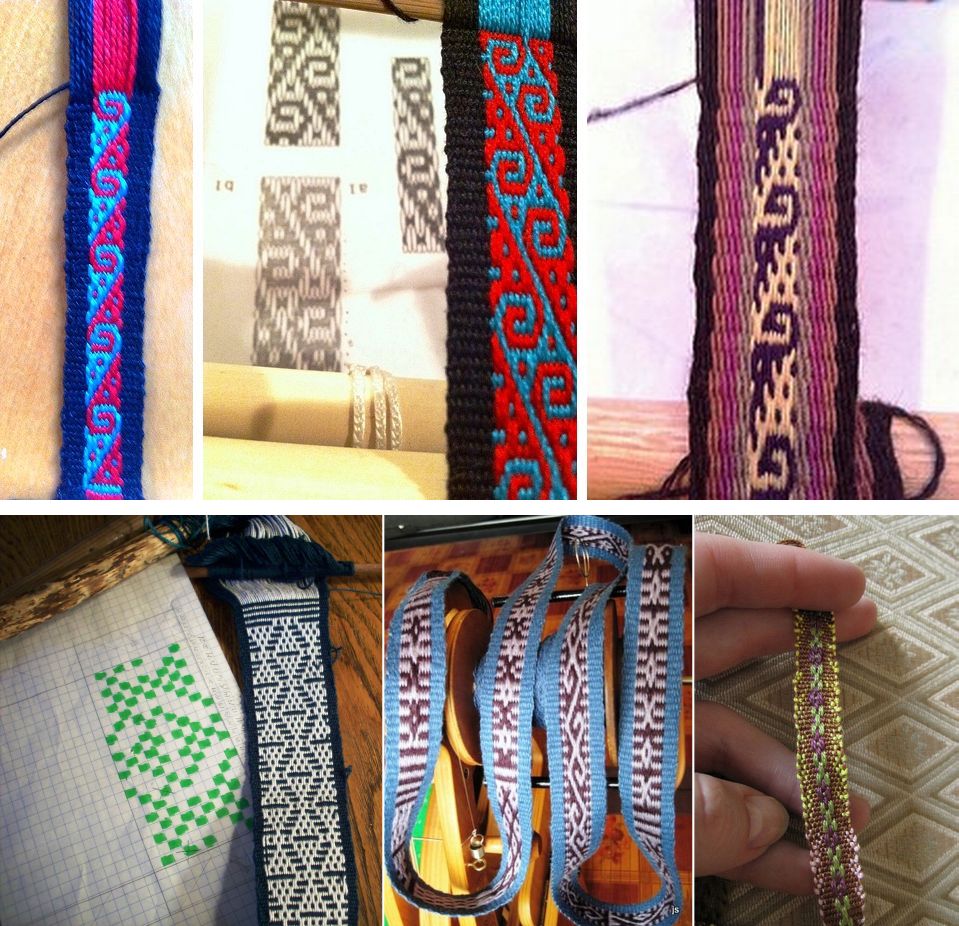
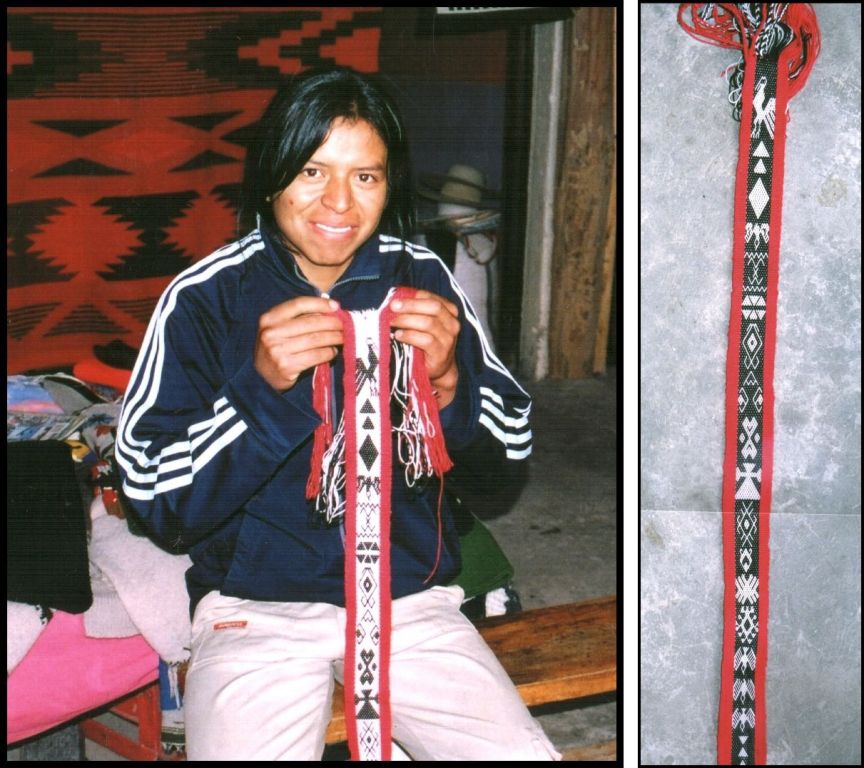
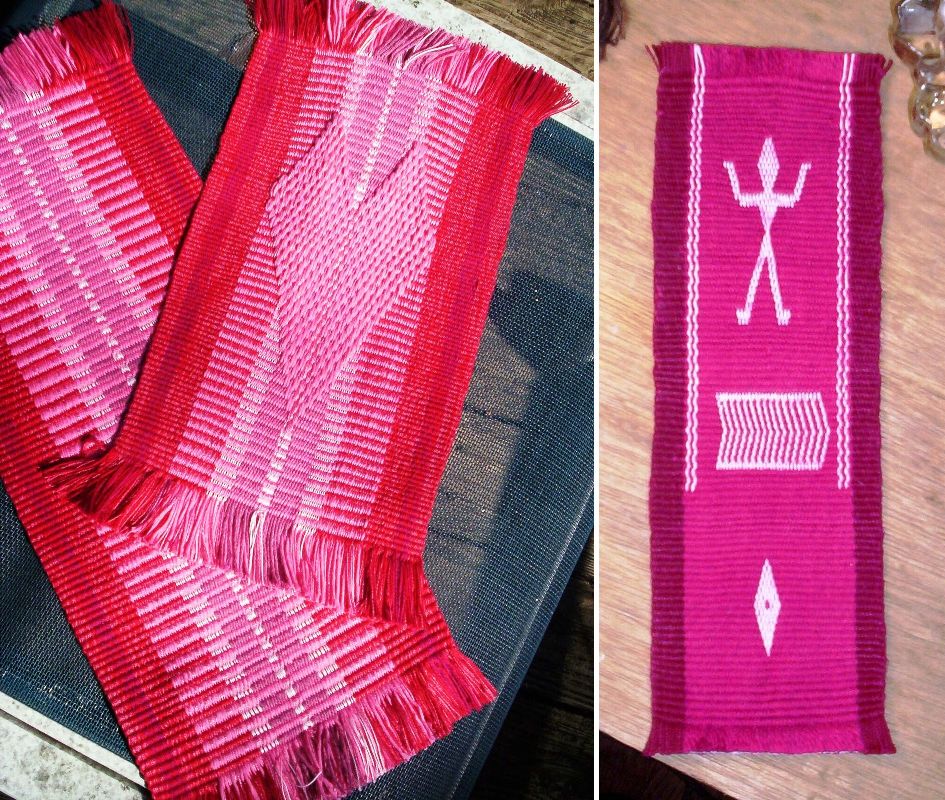
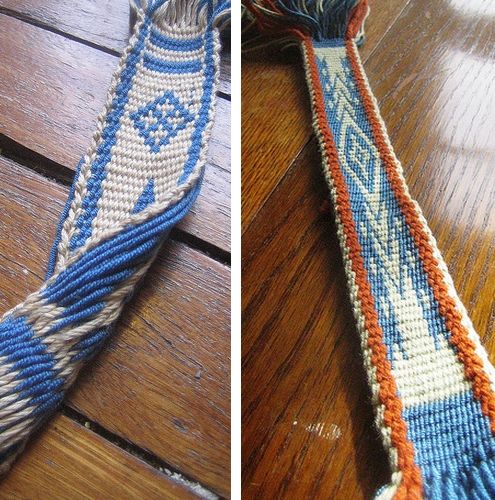
At the top, Jennifer has been producing swirls and curls of traditional, as well as her own, design. Linda wove a traditional design of coastal Ecuador into a bookmark using simple warp floats. The chart is here. Both popsicletote and Tracy have been exploring the tanka choro motif of Chinchero Peru. And I know that there is a lot of spinning going on there behind the scenes too.

My apologies to those to whom I promised some information on links and articles on the woven belts of the Russian Old Believers this week. I think this week’s post has gone on long enough and I would rather do the topic more justice in a separate post next week. See you then!
Backstrap Weaving – A Surprising Encounter

A SURPRISING ENCOUNTER

I have been kept from my loom at home this week. Normally this would have left me very agitated but it has been for a very good reason.

I spent my Friday goof-off day and all weekend working on a slide presentation and then woke up on Monday morning to my boyfriend reading to me from the newspaper over breakfast about an Encuentro de Tejedores (gathering of weavers) that was going to happen right here in my home Santa Cruz.

Oh darn I thought with a sinking heart, I bet it’s on when I am due to be away in the US. So, when does it start? I asked, dreading what would surely be a disappointing response.

TOMORROW!

was the shocking reply. Maybe we just missed all the previous announcements. I really had no idea and so there was a mad rush to gather information and make sure that I could be a part of it. The conference is officially entitled…

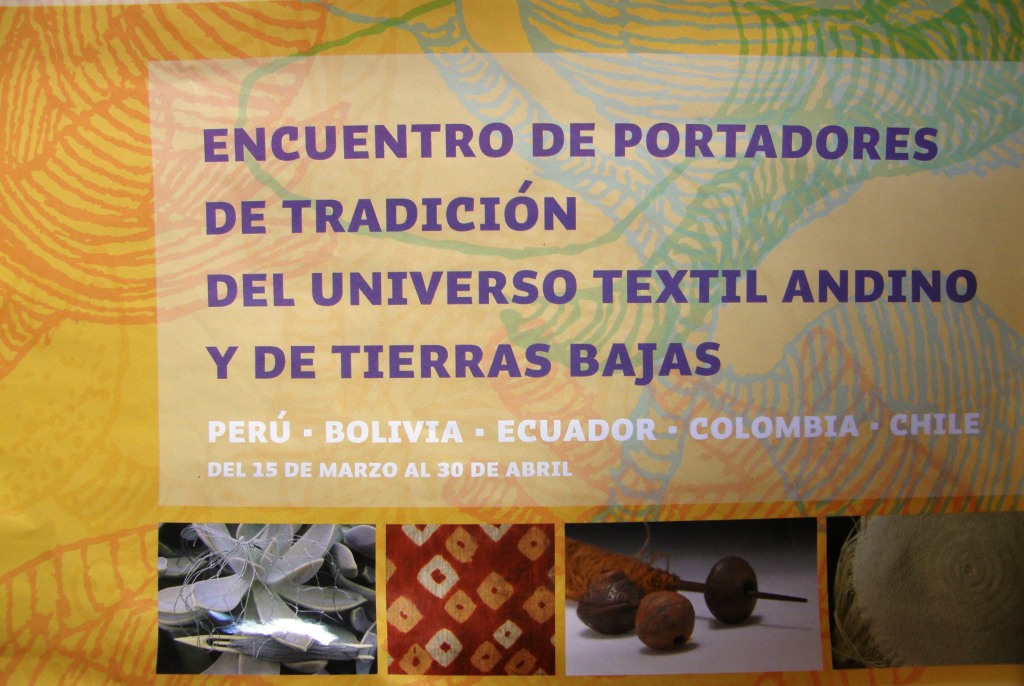
ENCUENTRO DE PORTADORES DE TRADICION DEL UNIVERSO TEXTIL ANDINO Y DE TIERRAS BAJAS

(A meeting of the bearers of the traditions of the Andean and lowland textile universe)

which brought weavers, artisans, anthropologists and academics from Colombia, Ecuador, Peru, Argentina and other parts of Bolivia to my lowland home. Now this sounds like an enormous gathering but it wasn’t really. Only two to four people came from each place which has made it an extremely intimate experience with plenty of space and time to spend chatting with and getting to know people.

Only a handful of outsiders such as myself have attended which makes me feel even more privileged but at the same time alarmed and saddened although not totally surprised by the apparent lack of local interest in this event. Perhaps it wasn’t widely advertised in order to preserve this intimacy and make it more possible for the weavers themselves to interact more closely. Either way I feel extremely blessed to have been able to participate.


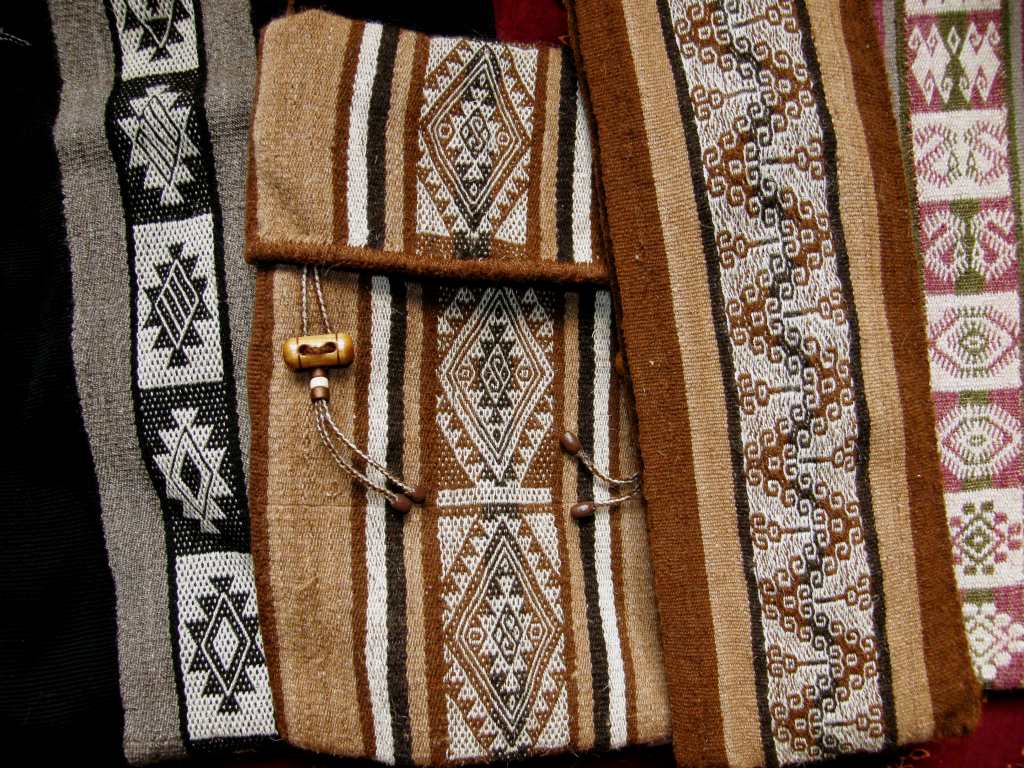
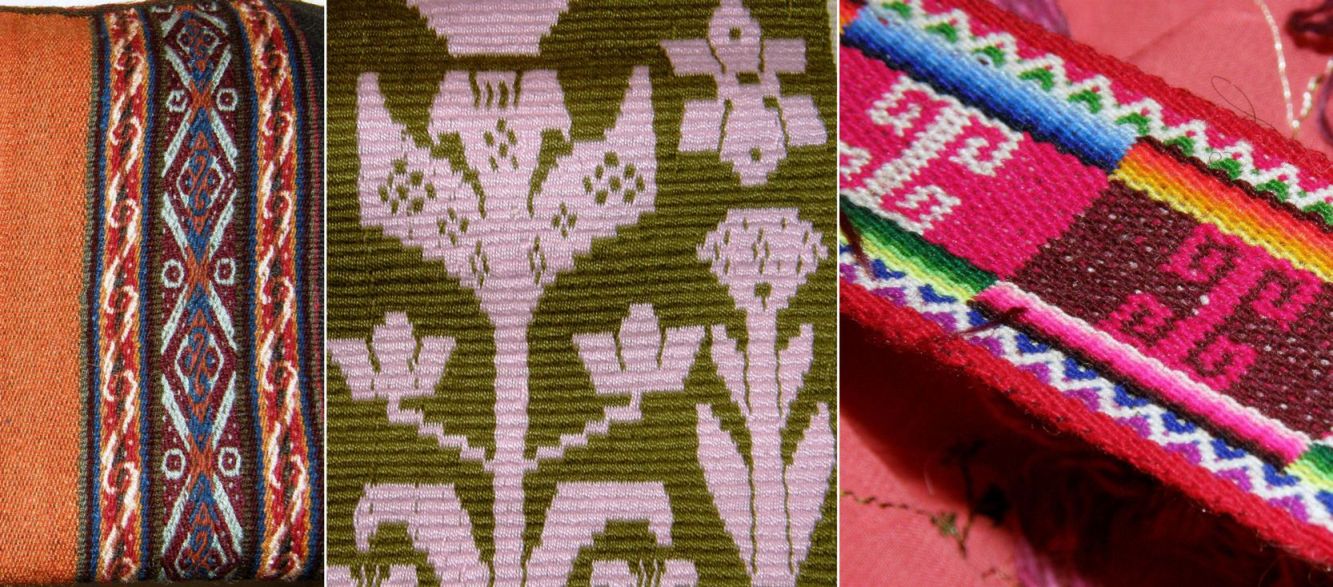
Weavings from highland Peru, lowland Bolivia and the Chilean high plains.


So, this means that this week’s blog post will be rather short as there are still two more evenings and one more day of conference to go. I will give you a few tidbits here to whet your appetite for a full report next week. I am still in the process of gathering information, facts, etc…and would hate to get anything wrong and I apologize if I have misspelled names.

I will tell you now that this whole event was organized by three wonderful Chilean ladies, the idea for which had its roots in an exhibit by Chilean artist Natasha Pons, which will run here for a month, called “Relatos Migratorios”. The Centro Cultural Simon I Patiño made it possible for people like me to experience all this for free. I still haven’t gotten over this fact!

Angela Suarez, a Guarani weaver of the Bolivian lowlands met Chinchero weavers Sonia and Sanaida(sp) at the inauguration gathering.

The inauguration of the conference and exhibit took place on Tuesday. I went along and met up with my Guarani weaving teacher Angela. Walking up the stairs at the cultural center, my heart skipped a beat when I saw two ladies from Chinchero, Peru right behind me.

Last November after a little weaving class with Angela we had to part for some time as I was leaving for the Tinkuy de Tejedores in Peru and she was going to her home of Isoso to organize the weavers to make an enormous order of woven Christmas cards. I had told her about the exciting event in Cusco all the time wishing that I could have gotten my act together and taken her with me although I doubt that she would have gone with the extra responsibilty she was carrying at that time to fulfill the Christmas weaving orders.

So, here now was a little part of Peru coming to her instead! along with Colombia, Chile and Ecuador. And, on top of the beautiful pebble weave bag that she is carrying in the picture above, she brought one her wonderful works-in-progress in the Moisy technique to show to the highland weavers.

The program comprises three mornings of four-hour workshops along with audio-visual presentations and conferences in the evenings. The first day’s workshop was backstrap weaving which was offered by the ladies from Chinchero along with Celinda and daughter Isobel, Aymara weavers from the northern Chilean highlands.

Organizer Cristina  introduced the workshop and put it very well when she explained that there are many roads that can lead to a single destination and many ways of achieving the same objective. The warping, set up and weaving techniques used by the Aymara and Quechua weavers teaching us here side by side have their differences but our goal, she explained, would be to learn to weave narrow bands, called jakimas in the Quechua language of Chnichero, and what the Chilean weavers call cintillos.

 Aymara weaver Celinda watches with fascination as Chinchero weaver Sanaida works on her pick up weaving. 
Cabuya fiber artisan Maritza from Colombia receives help from Sanaida while one of the Ecuadoran gentlemen prepares his warp around a pair of table legs.
Well, you can imagine that this had me wanting to hop from one group to the next so as not to miss a thing! but I settled finally with Sonia and wove my first flat band with the gorgeous Chinchero handspun (I had used this fiber before to make tubular bands at the tinkuy).
My experience with my own handspun has been almost exclusively with llama fiber and so there were quite a few interesting things to note about this wool warp, the behaviour of the weft, the appearance of the woven surface from the high twist yarn and the different kinds of weft that Sonia and Sanaida were using.
Having the backstrap weaving moves down, I was able to focus very much on the material rather than on the technique. So, I did get to weave this week after all.


Cabuya fiber from Colombia and handspun wool from Chile and Peru along with other random bits of cord and twine that we used to tie up the warps.

The artisans from Ecuador, Colombia and Oruro in Bolivia joined in enthusiastically as well as a small group of outsiders such as myself and staff from the cultural center. Most outsiders were non weavers and were terrified to beat hard and pull at the warps fearing they would break. The handspun wool was of course wonderfully resistant which was a good thing as there was the usual amount of beginner heddle-sawing going on.

I didn’t have to worry too much about missing out on Celinda and Isobel’s (the Chilean weavers) instruction on day one as today Angela and I got to spend a lot of time with Celinda as she wove.  I found her very tranquil and lovely to watch. Daughter Isobel, on the other hand, is a live wire! You will see and hear more about her next week.

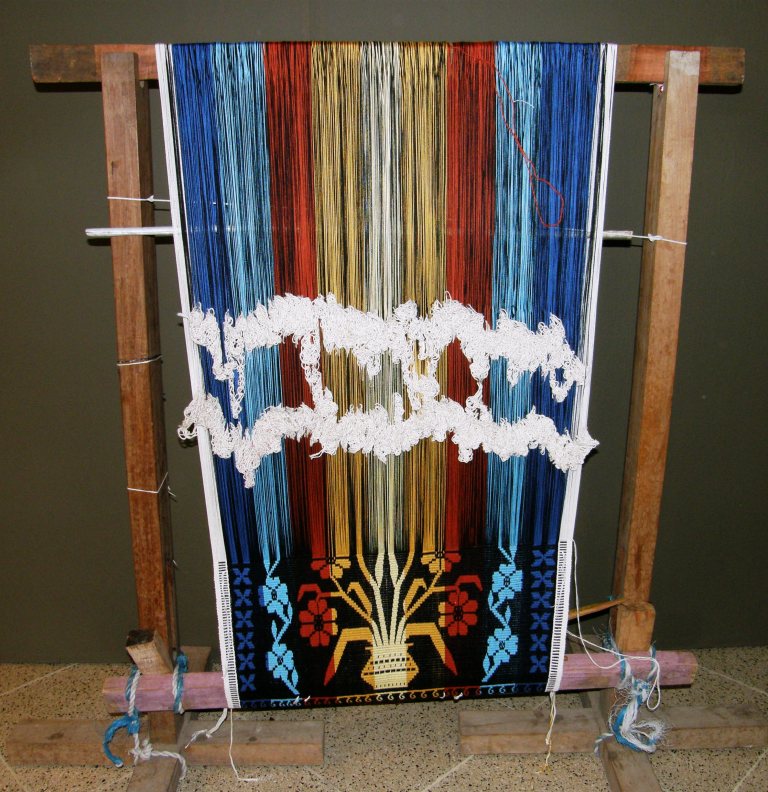
The technique that Celinda was demonstrating is a variation of the Moisy that Angela weaves except with three patterning colors which requires a fourth set of string heddles to manage. This does not create a double faced textile but there are no long floats on the back of the band either.

Angela noted that Celinda’s heddle order arrangement was quite different to hers and asked many questions. I could see her soaking it all up.

Finally she wasn’t asking questions but rather pointing things out to confirm that she did indeed understand.  I wouldn’t be surprised to see her adding this to her repetoire and you can be sure that if she believes that any of Celinda’s ways are better she will adopt them. She is already using a stick for her lower set of heddles on her narrow bands after asking me to teach her how to make them on a stick – something she said she had always wanted to learn.

Well, I really must stop here as there are more events to attend tonight and one more day of this conference to go. No doubt there will be much to tell and show next week.

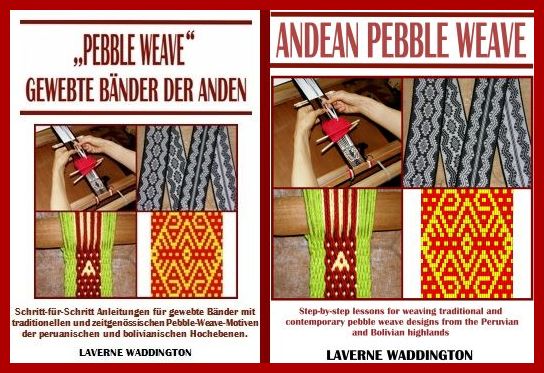
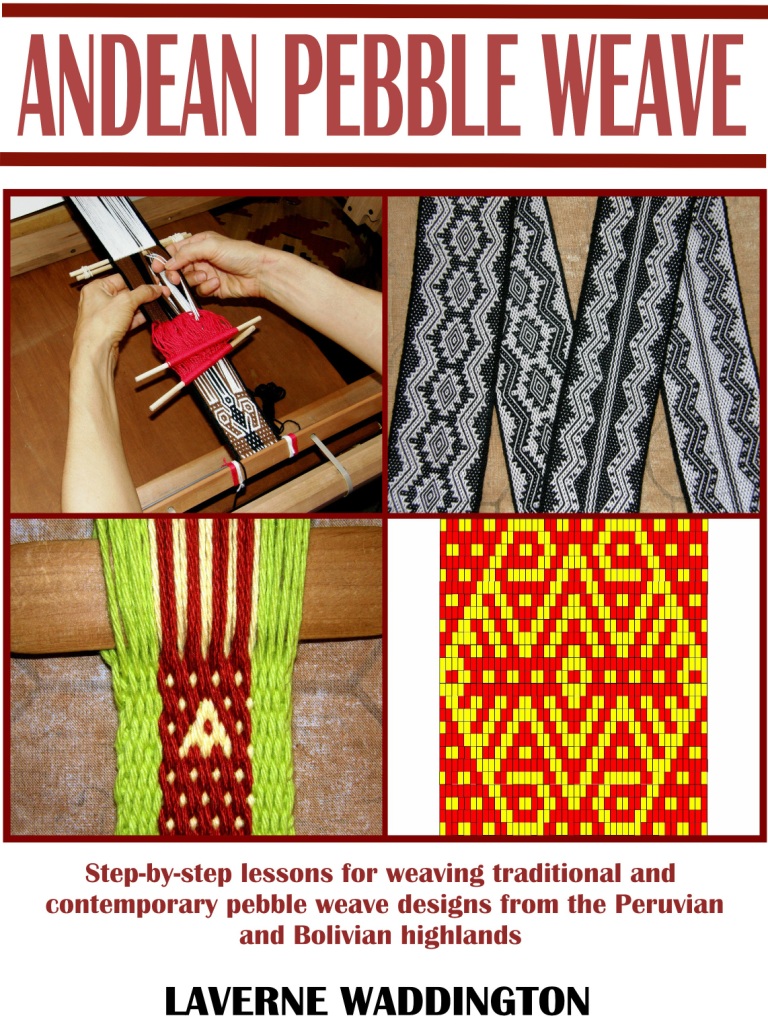
I can’t go without giving my thanks to my online weaving friend Kristina Krenzer who has worked hard to translate my e-book Andean Pebble Weave to German. It is now available on Patternfish. It looks so weird and, at the same time, so great in another language! Of course you can get the English version on Patternfish too.

Ich danke Kristina Krenzer für die Übersetzungsarbeit. Meine Monographie über die Stippenweb-Technik der Anden, auch bekannt als “Pebble Weave”,  ist nun auch in deutscher Sprache bei Patternfish erhältlich .


Backstrap Weaving – Big Bang and Big Thread

BIG BANG AND BIG THREAD

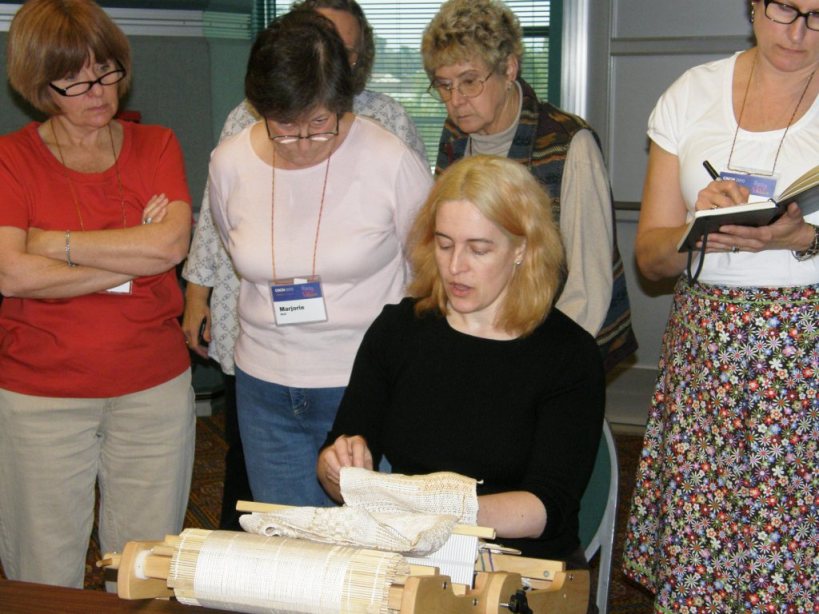
Syne Mitchell teaching her rigid heddle class at CNCH 2010

Time is running away and in the not-too-distant future I will be on the road again for another US spring visit (US spring, my fall).

Last year, at my friend Janet’s suggestion, I signed up for CNCH, the Conference for Northern California Handweavers, and had a great time taking classes with Robin Spady and Syne Mitchell as well as demonstrating backstrap weaving at the education booth along with Annie MacHale and Yonat Michaelov on their inkle looms.

I met so many fun people, online friends from Weavolution and Ravelry as well as made new friends with people like Kathe Todd-Hooker and Pat Spark who shared all they knew with me about the weaving of the Russian Old Believers.

I will be going back to hang out with Annie, Yonat and other southern Californians and then heading up to see the northerners in Janet Finch’s

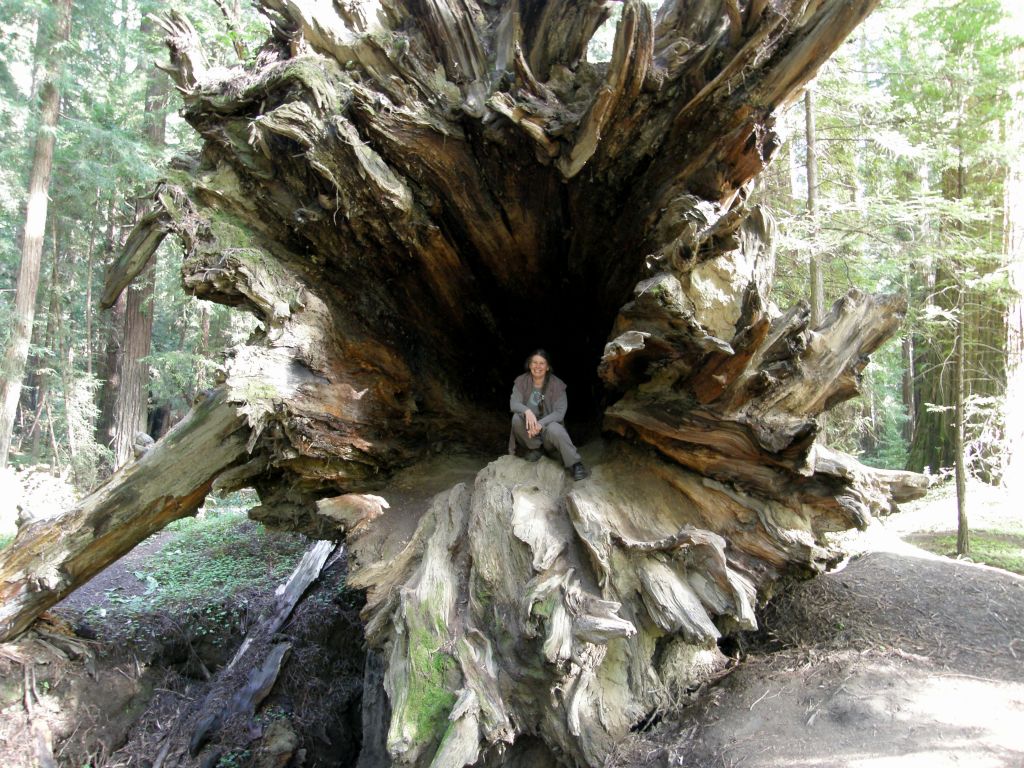
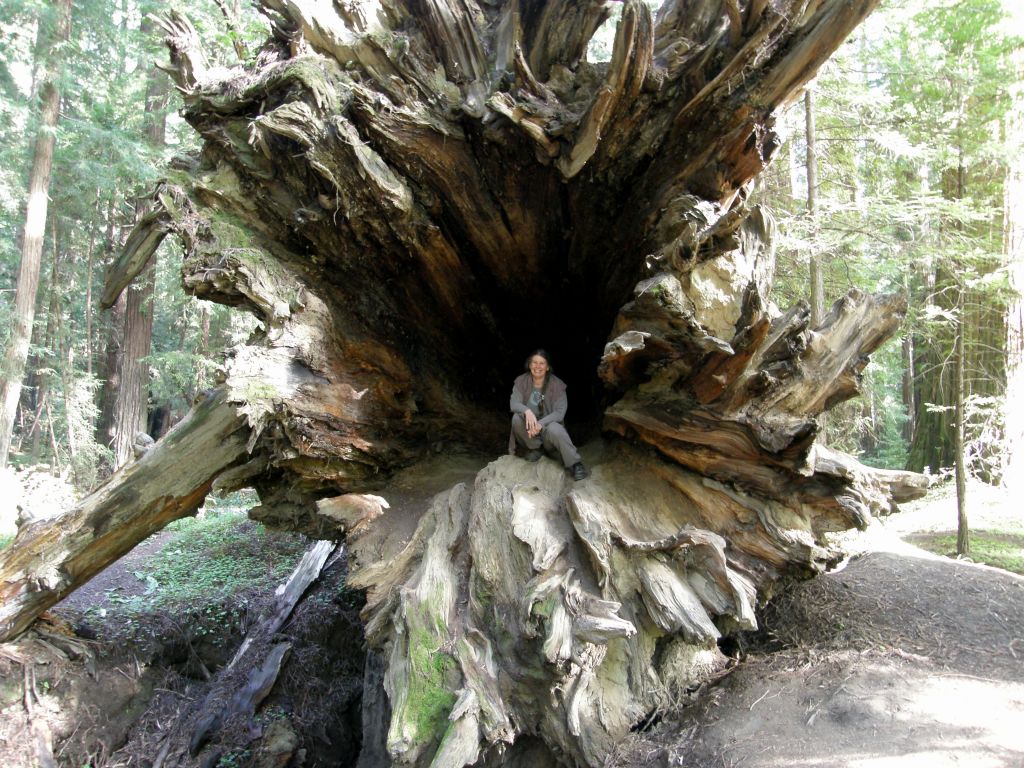
My friend Janet’s organic farm and mill is in Redwood country in Humboldt County


territory amongst the majestic Redwoods and on further north to spend some time with some weave-along buddies as well as Betty Davenport and Linda Hendrickson.

Then I will zip over to the east side which I also visited last year with a memorable two days at the Maryland Sheep and Wool Festival.

Unfortunately, the festival is not in my plans this year but I will be seeing my good friends in Maryland and doing lots of backstrap weaving along the way.

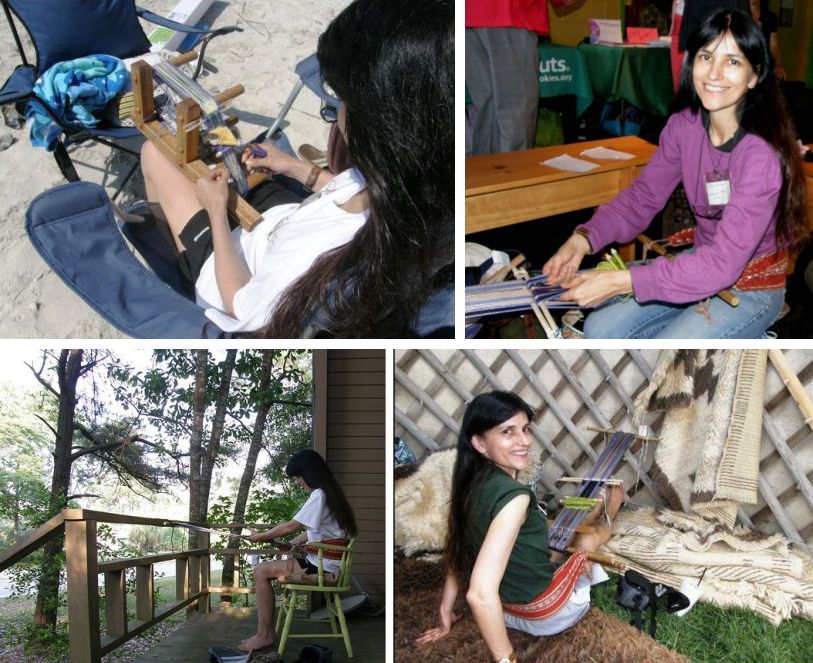
Last year had me weaving pebble weave on an inkle loom at the beach, demonstrating backstrap weaving at an Earth Day event, backstrapping on the porch of Lisa’s beach house as well as escaping the heat to weave in the yurt at Maryland Sheep and Wool. I wonder where my loom will find itself this time around.

During the spring visit last year, my e-book Andean Pebble Weave went up for sale on WeaveZine. It was a very exciting event in the middle of this wonderful trip. Almost a year later, the time for change has come as Syne Mitchell has had to scale back her online activities to make way for a new day job. Andean Pebble Weave had to hit the road and with the help of Syne has now set up camp on Julia Grunau’s Patternfish site along with Syne’s bookmark patterns.

I couldn’t have hoped for a smoother and easier transition and I want to thank Julia and especially Syne for making this happen. This has kept me very busy behind the scenes updating all my links!!   Facebook, Flickr, Ravelry, Weavolution, Yahoo, Weaving Today….you name it!!

You may have noticed that I try to sneak in a link or two to the book in every blog post.. Well, all those links need to be changed. Thankfully Syne once again came to my rescue and put together a redirect page and link on WeaveZine with the whole story which will smooth things over until I can go through every blog post and update.

So here I present (click on the following text) Andean Pebble Weave’s new home.

You will find the logo and more links on the sidebar and at various places on my blog.

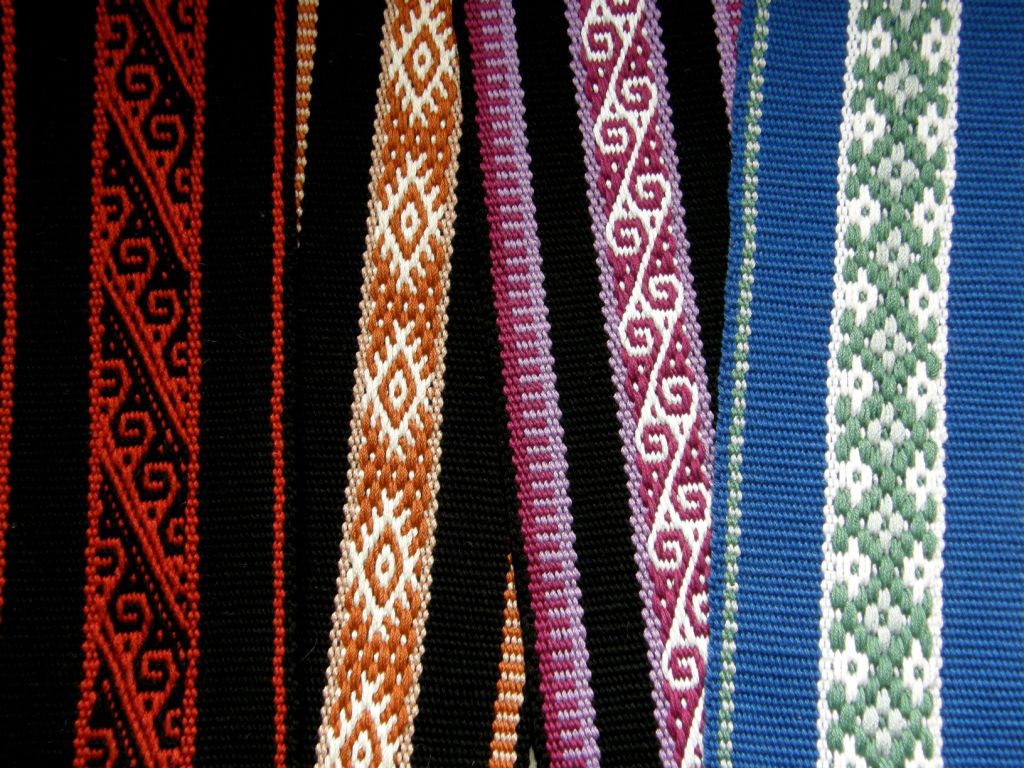
Well, the extra online time kept me away from the loom a bit this week but I still managed to get four things off the loom and have started a fifth. How did I manage that? By using BIG thread, that weaves up super fast.

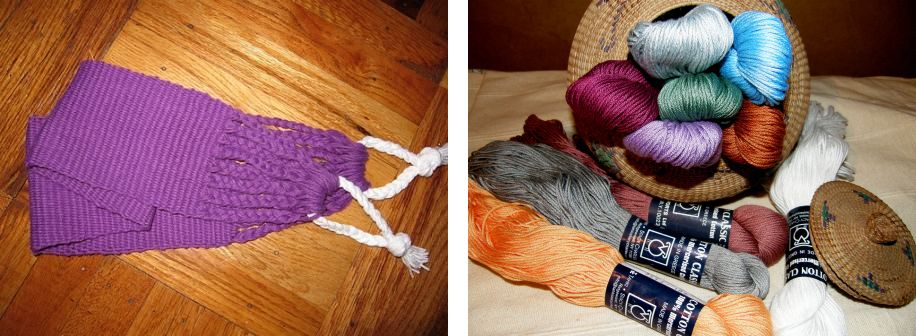
Cathyz on Ravelry wove her backstrap using Tahki Cotton Classic and said she loved this thread. So, when I was in the US in November and WEBS announced a sale of grab bags, my friend Claudia and I ordered a twenty-piece bag. I must say I was a bit nervous about how we would divide up the colors. I was imagining a frantic grabbing session in keeping with the item’s name but, as it turned out, our taste in color is vastly different and we chose our colors in a very orderly fashion!
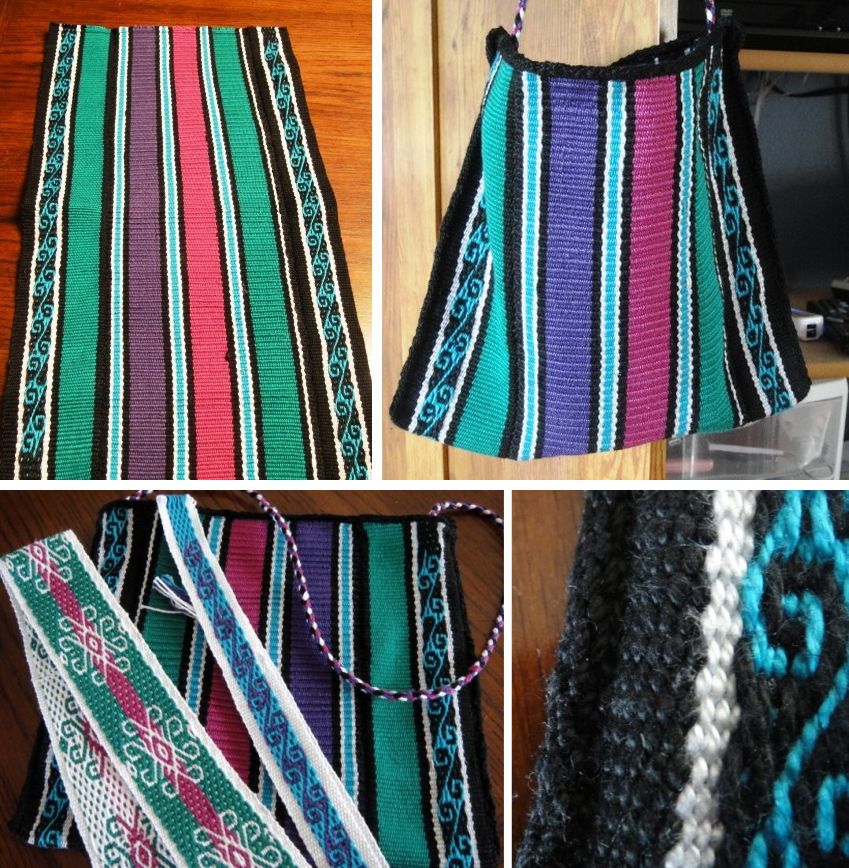
So, with the new trip looming I decided to weave up some stuff that I had promised to friends on my last trips to the US, that is, some backstraps. They should weave their own…isn’t that what you are thinking? Well they are mostly into very narrow bands and so I offered to make them backstraps. The Tahki cotton is actually roughly half the weight of the cotton that I normally use for backstraps and so I doubled it.

First I did a couple of pebble weave bands. I can get loads of black and white thick mercerized cotton here in Santa Cruz and so I combined that with the Tahki colors. The Tahki skeins are small and once you double the thread there is not a whole lot to work with.

Then I made one with alternating colors of simple warp floats. This is the yurt band border design that I included in a tutorial here. The blue thread is from Plymouth Yarn Natural which is exactly the same as the thread I get here. I got this one skein to sample from the Mannings last summer.

Next came another complimentary warp pattern with a twill-like rather than pebbled background.

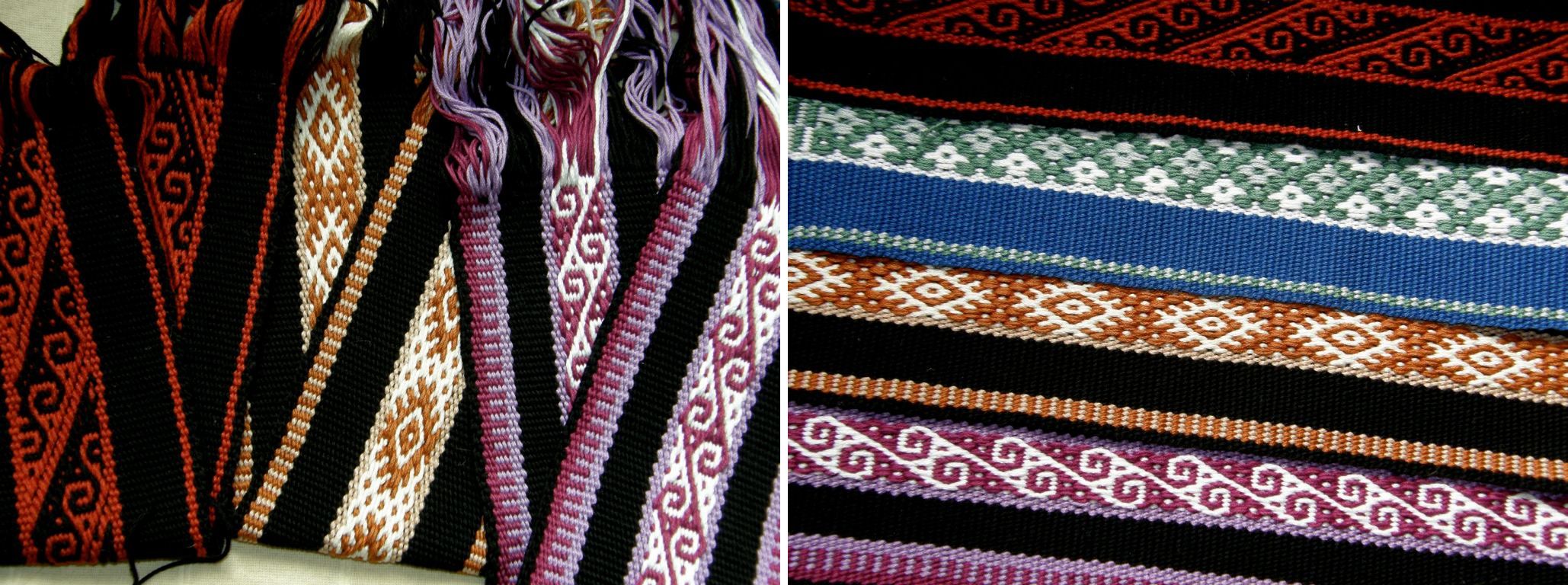
Here they are all together. I haven’t braided any of the ends yet. I am leaving that for Friday which is my official goof-off day!

They will end up looking like these…

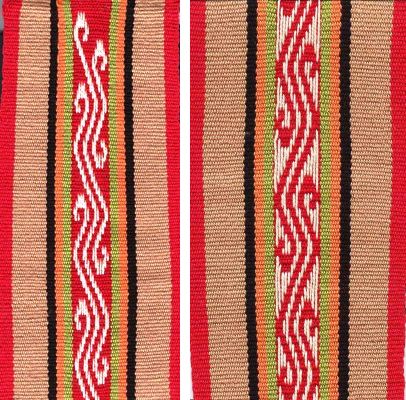
I was running low on the blue at this point as well as colors to combine and so the fifth backstrap is narrower. I also didn’t have enough light green for weft and am using white. The little white spots on the edges look okay. There is a little trick to hiding that white dot that appears on the right hand side of the pattern area but, as I only warped three ends for the blue border next to the pattern rather than four, I can’t use that little trick (poor planning there). This technique is the one used in the Tarabuco area and is the one that was taught to me when I stayed in Candelaria. A short story about that visit is here.

The weavers in Tarabuco use a very fine thread for their background color and a heavier one for the pattern. I prefer to use the same weight for both threads.

Here is a larger version of the same motif in a 24wpi thread. Here I got to hide the spots on the sides.


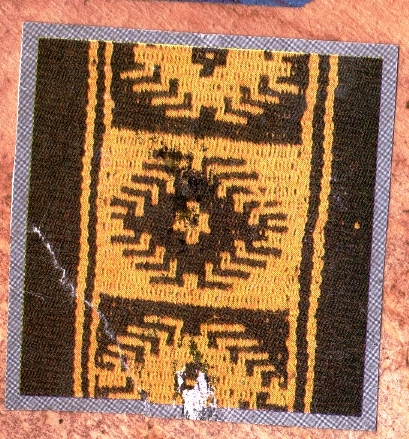
This motif has been with me for years! Way back when I was living in southern Chile and knew little to nothing about weaving, I built myself a wooden frame, hammered in some nails and made a cardboard rigid heddle to mess around with. The first woven piece looked like an hour glass and through trial and error I managed to improve on that.

I was making little tapestry pieces just adding in colors here and there with the ends left hanging out the back. I made it up as I went along as there was no one to ask, no books to consult and no internet. As I got better I yearned to be able to do some kind of ethnic motifs. And then I found a picture of a Mapuche belt in an Argentinean knitting magazine and I adapted and wove the motif in tapestry technique. I so wish I still had those little experiments from all those years ago. They got left behind when I moved up here.

I still have the little scrap which I cut from the magazine, now quite battered. My motif is a much smaller version of this. Imagine how excited I was when I got to learn the technique used to weave it.

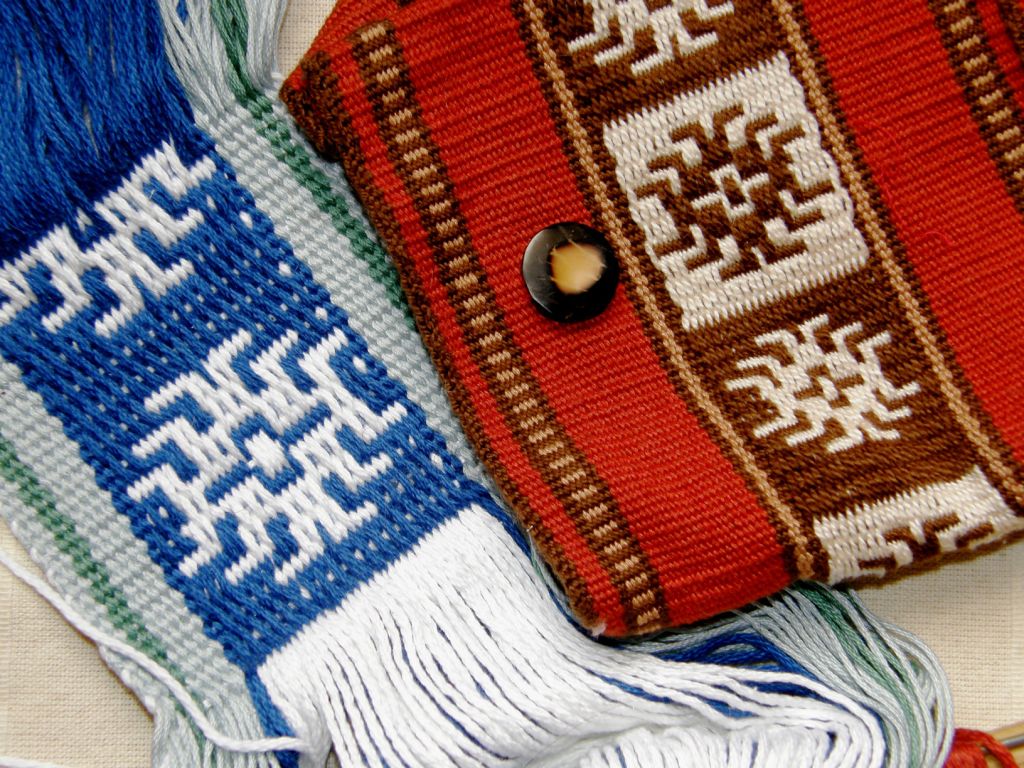
The only problem with these complimentary warp weaves is deciding which side you like best when you are done. Weaving alternating blocks as I did on the red bag helps with that problem!

There is no need to choose  a side for a backstrap. The blue simple warp float band is not double faced as the weft shows on the back.

##############################################

From big thread to big bang…the Backstrap Group’s Weave-Along came to its end last Sunday. We called the final day the “big bang” wanting to end with a bang rather than a whimper, you see. Here are some products…


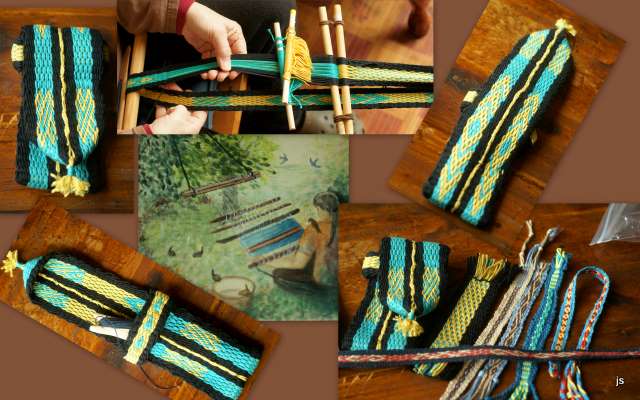
Jennifer, after having made several pebble weave and a double weave project during the course of the weave along, chose to use a colorful plain weave band to make a zippered pouch. She got to learn and practice several finishing techniques this way, such as, the single cross knit looping/Van Dyke stitch to cover the place where her two panels joined, braiding for her zip pull and a plain weave tubular band for the edges. Among many other things Popsicletote contributed this fun picture of her loom bar lodged behind her feet.
Bobbie learned and practiced pebble weave, simple warp floats and supplementary weft patterning during the weave-along. She made a bag from one piece of colorful plain and pebble weave and added a braided strap. She also used a tubular plain weave band to edge it.
Barry focused on pebble weave for this weave along after having made himself a backstrap. He is sampling a new-to-him yarn called Patons Smoothie which I believe is acrylic and hopes to make a belt. I like the way he has sewn the end on the diagonal to finish it.

We agreed that the bird motif, which I charted in my book from a band I bought on Taquile Island, Peru, looks like a rocket- powered Warner Bros. roadrunner on roller skates.

Marsha is weaving on her Gilmore Mini-Wave loom and completed this beautiful band with some motifs from here as well as many of her own. She even adapted a double weave motif that I used on one of my mug rugs to simple warp floats.

Popsicletote put together this lovely set of photos showing what she learned on this weave-along. She did the watercolor painting in the center many years ago as it has been her dream to learn backstrap weaving. She says that even though the person in the painting has dark hair and hers is now white, she is happy to be able to finally call herself a backstrap weaver. I love the shuttle pouch she has made.

Tracy didn’t finish her big bang project but she made a very special contribution with a couple of videos of herself at the loom instead.

Outside the weave-along, Helena in Brazil sent me pictures of her latest work. She took one of the designs from the weft twining that the Montagnard weavers use to finish their pieces and adapted it to the warp float technique that they use. This technique can create some long-ish warp floats on the back. The technique is shown in this lettering tutorial. I am so happy that someone has used the instructions in this tutorial. Helena is the first one that I know of to have done so and she has been very creative with it.


I asked Helena about the thread that she uses. As the thread I use here is from Brazil, of course I wasn’t surprised to find that she uses the same. The brand is Circulo and I use the Clea variety, which is about 35wpi and Anne which is about 24wpi. The heavier thread that I use for backstraps and tutorials in the same brand is called Naturale. I found out recently that this brand is available in the UK as well as in Canada and the US through a site located in Vancouver. I guess I am really lucky as I didn’t have to go around here trying all sorts of thread to conclude that I liked the Circulo thread the best. The Circulo is pretty much all we get here and it just happens to be really good stuff.

We were all a little saddened by the end of the weave-along and then Tracy came along and got us all swept up in the idea of spinning for warp-faced backstrap projects and it turns out that most of the people in the group have a whole lot to say about spinning.

This has led to a SAL…Spin-along for warp faced weaving and popsicletote is leading the way already with this contribution today…this gorgeous photo at left.

Some people are spinning cotton and Lisa is joining in spinning yak.

I, on the other hand, do not have a whole lot to say about handspun for my backstrap weaving. I have stuff to show but lack the jargon to explain to people online what I do so I am looking forward to following this spin along and acquiring the relevant vocabulary. I know how my handspun yarn should look and feel if it is to behave well on my backstrap loom and that’s pretty much all I can tell you!

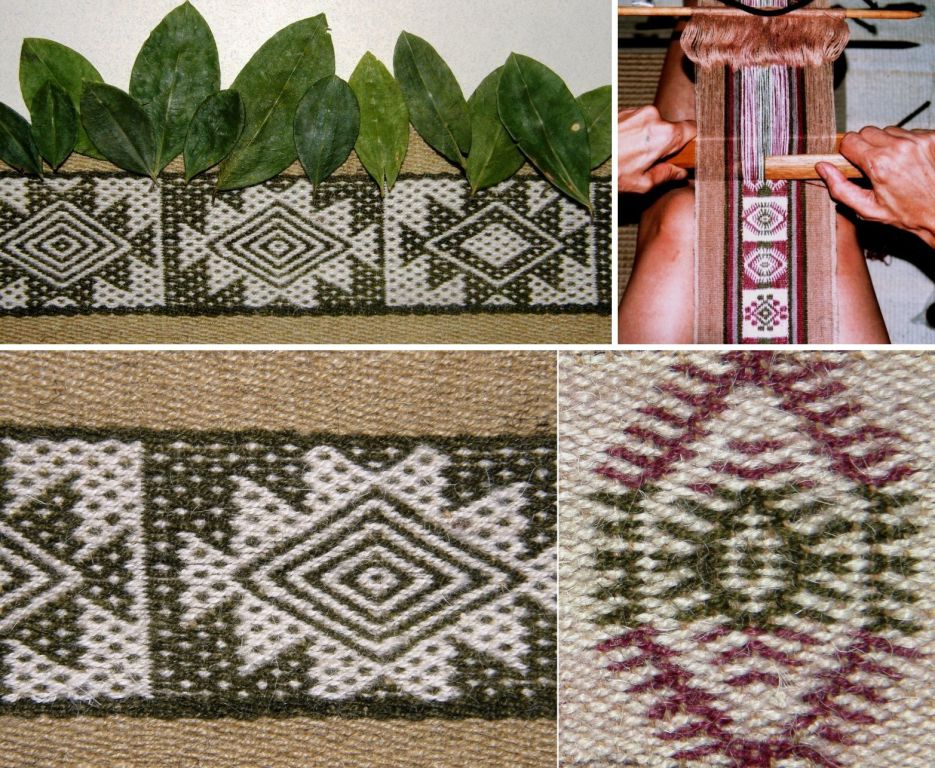
So let me show you some things I have made with my handspun llama fiber…

I used natural dyes in these next ones…coca leaves, spearmint leaves and cochineal.

Not a whole lot considering all the years I have been backstrap weaving. My first pieces made with my own handspun are actually in little frames on my living room wall! – so proud was I of this first attempt. Now with Tracy’s spin-along proposal maybe I will get more done. I should make Friday goof-off day a spinning day.

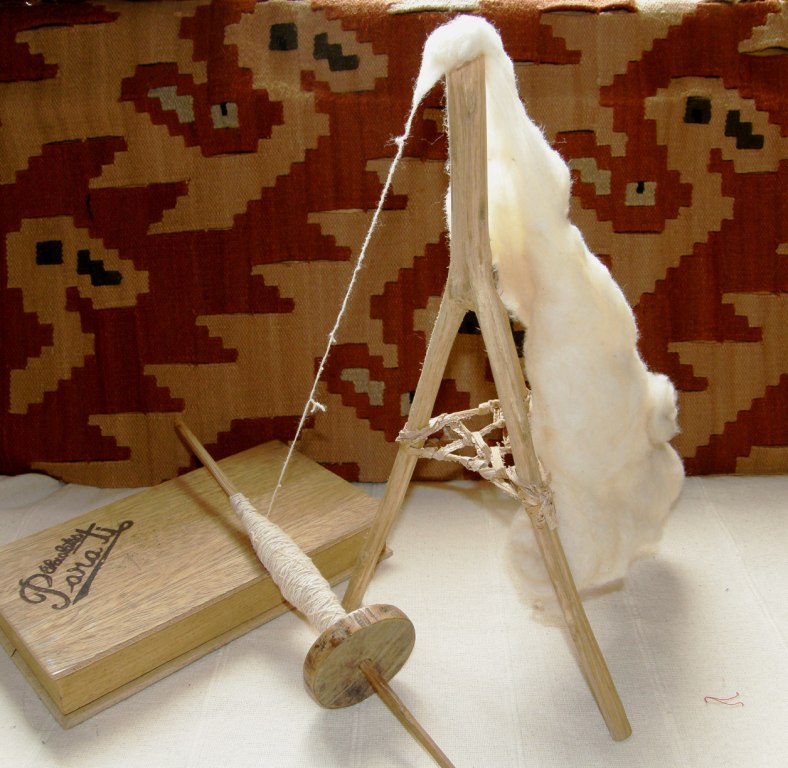
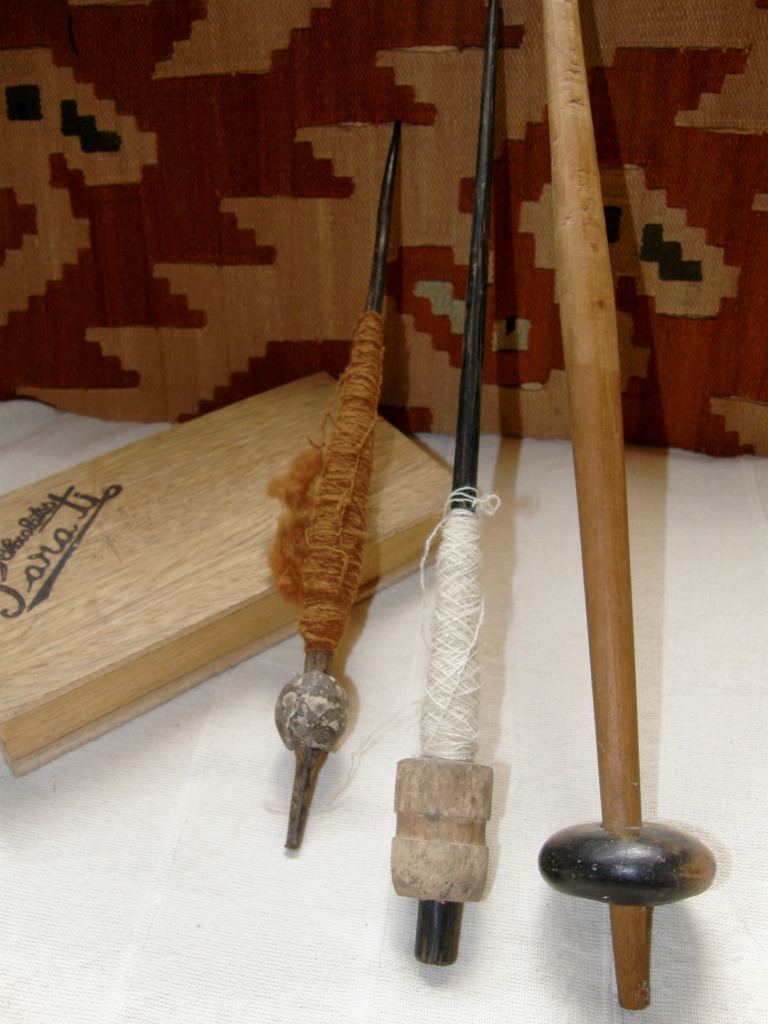
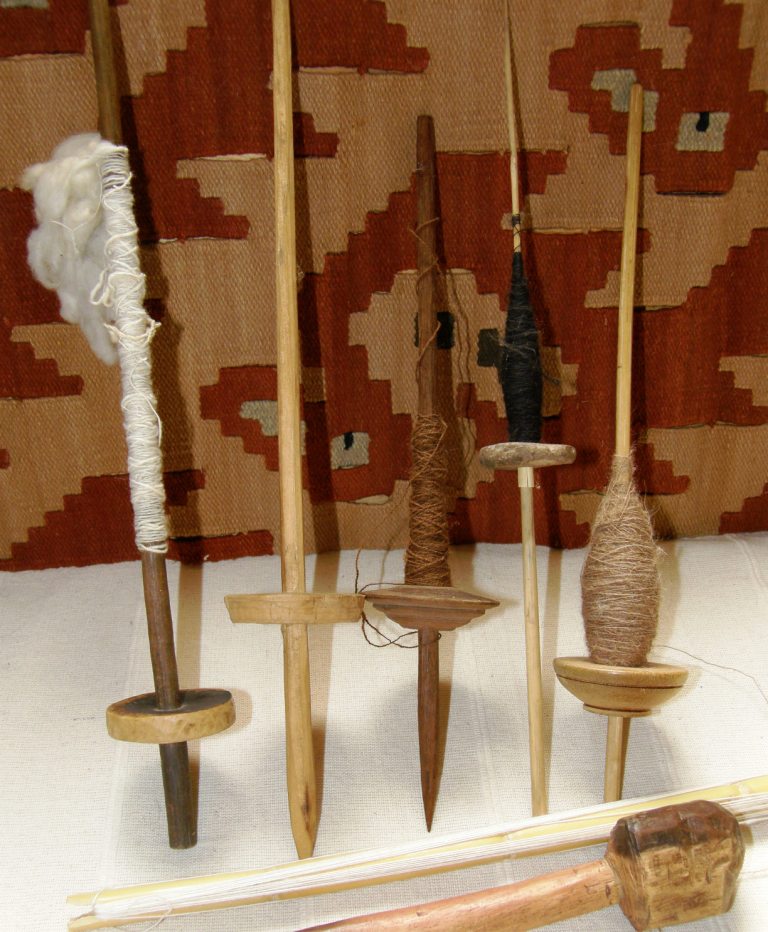
As we are on a spinning theme, I thought I would show you some of the spindles that I have gathered over the years in my travels here.

This is a spindle and rueca that I brought back after my stay in coastal Ecuador with cotton spinners. The rueca is a miniature one which we made while I was there. The spinners use a much larger and heavier version of this. I put a big weight in the little basket underneath to hold it down while I spin.

From left to right, a Guatemalan spindle with some of the highly prized natural brown cotton called cuyuscate, the spindle from one of the walking wheels in Otavalo Ecuador and a Mapuche spindle.

From left to right, a spindle used by the Guarani people here in lowland Bolivia for spinning cotton, two Bolivian spindles from the highlands, a spindle made from the sigsig (pampas grass) stem from Salasaca in Ecuador and one from Cusco. The Cusco one is my favorite for wool and llama fiber. The Bolivian ones have sharp tips and, as I tend to rest the tip against my belly as I wind on, they can be kind of “ouchy”.

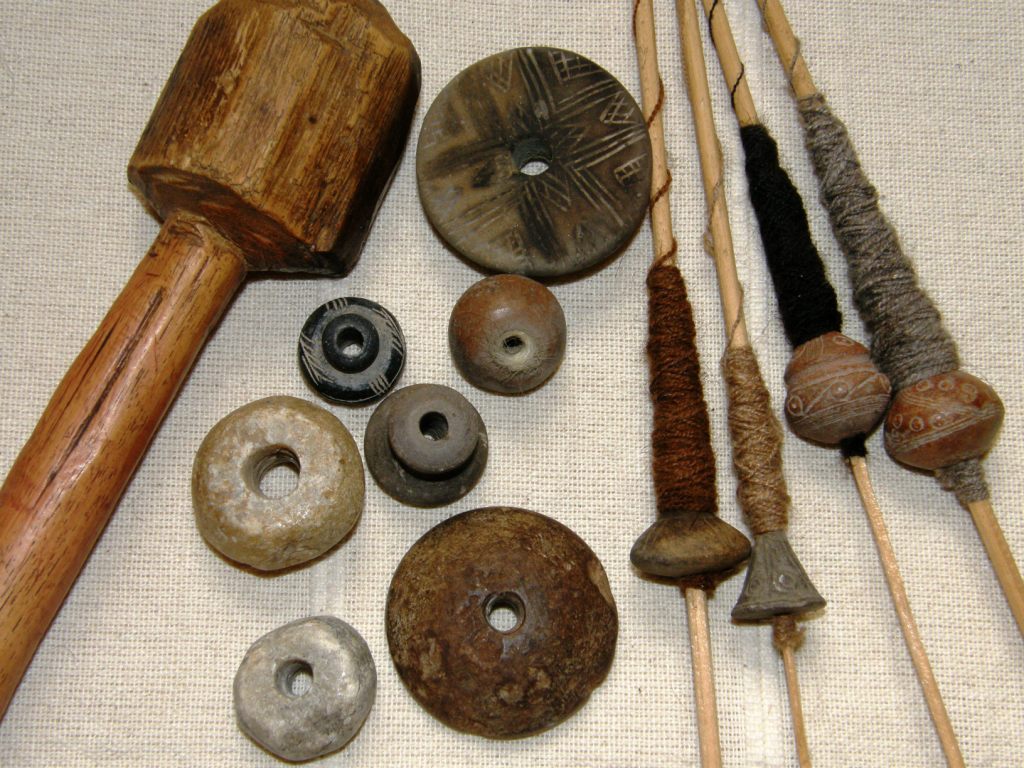
These are various whorls that I have bought in markets, from my weaving teachers or been given.

To end… I posted a tutorial last week on plain weave tubular bands like the one being woven by this little girl at the Tinkuy de Tejedores last November.

Some of you may not have seen it as there was a glitch with the video shortly after posting and I had to try to re upload that and then I took that opportunity to redo the photos as I hated the colors I had used.

It is up and running now and you can see it here.

The tutorial is on “plain weave” bands and we know that plain weave doesn’t necessarily have to be plain. I want to edge more things with striped and more interesting multi colored plain weave bands to provide more examples but have yet to find anything to edge. Maybe I will come up with something next week.


Backstrap Weaving – Variations on a Theme and a New Tutorial

I have been all over the place this week…sewing, braiding, twining and weaving four different patterning techniques. Keeps me on my toes!

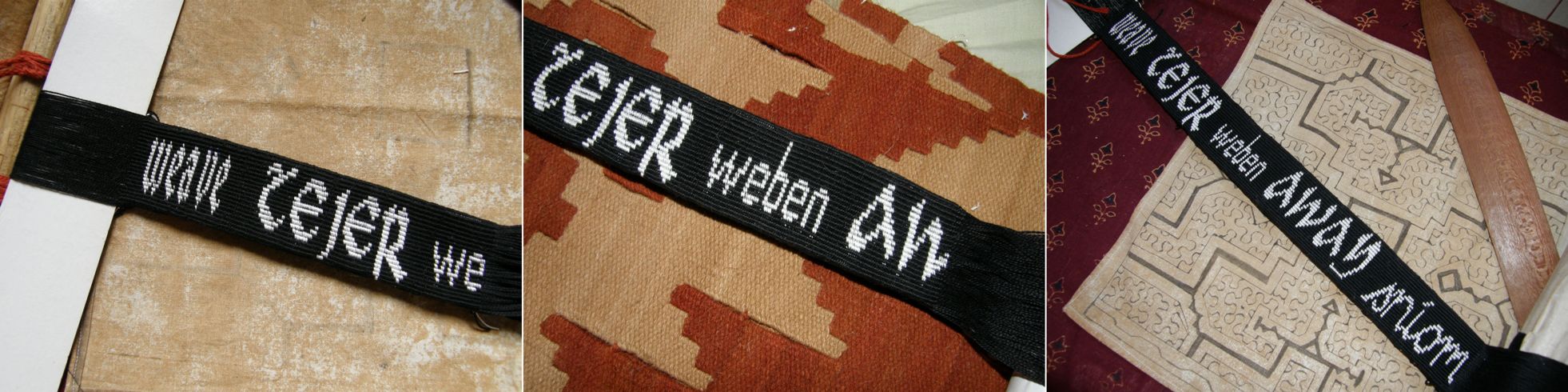
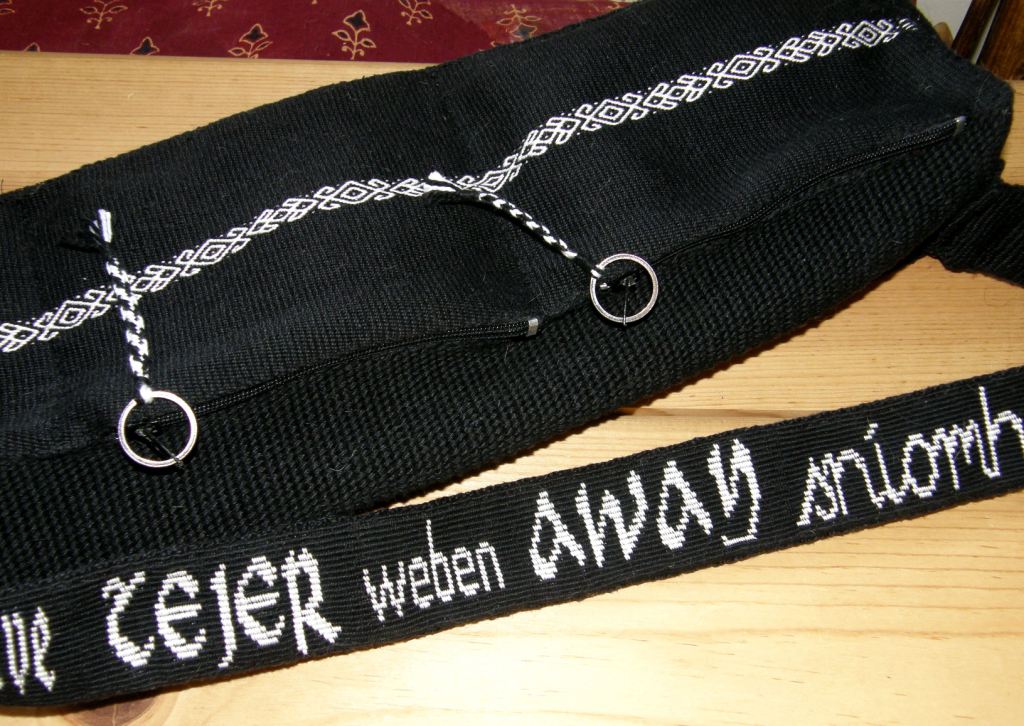
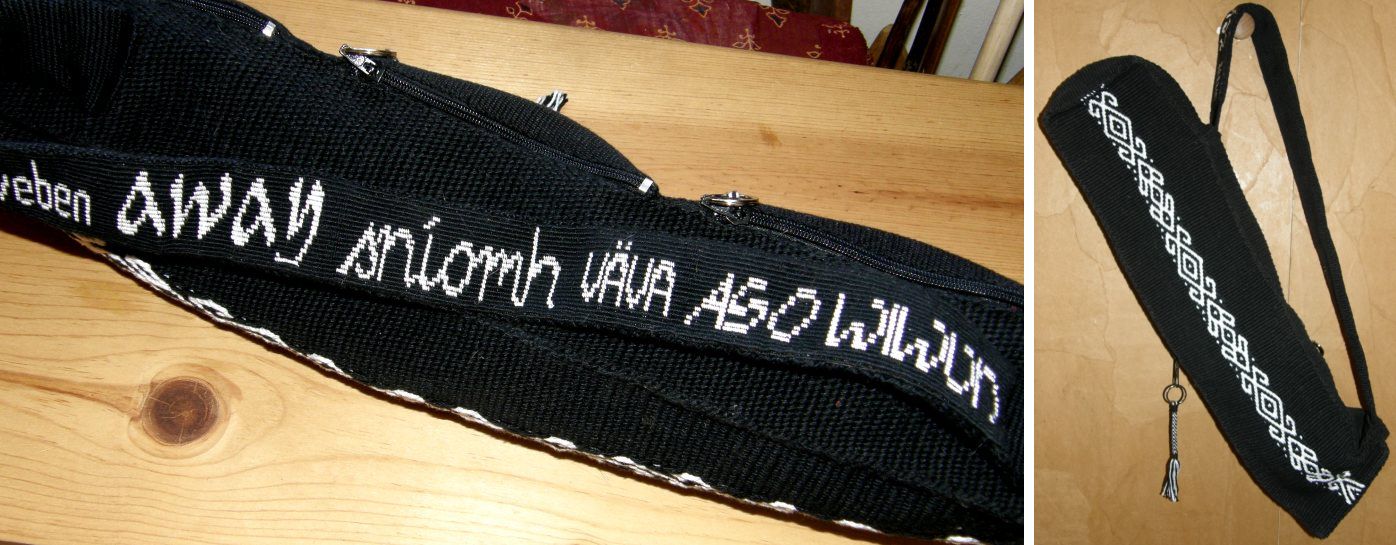
There was a lot of sewing as I finished the loom bag finally! This has been a long project mostly because I chose to twine the strap for the bag and that was slow slow slow. I decided to twine the word “weave” in different languages into the strap and, although I managed to gather a lot of words from different online buddies, I could only use a handful on the strap. I will save the others for another project.

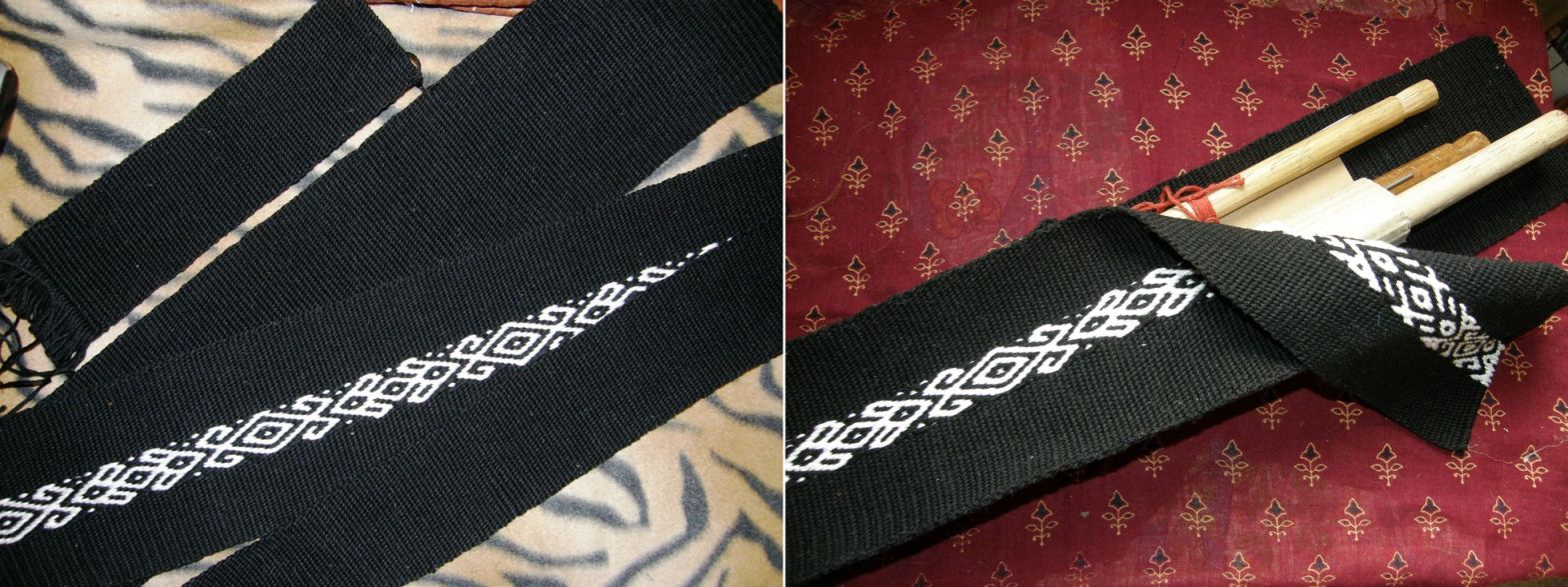
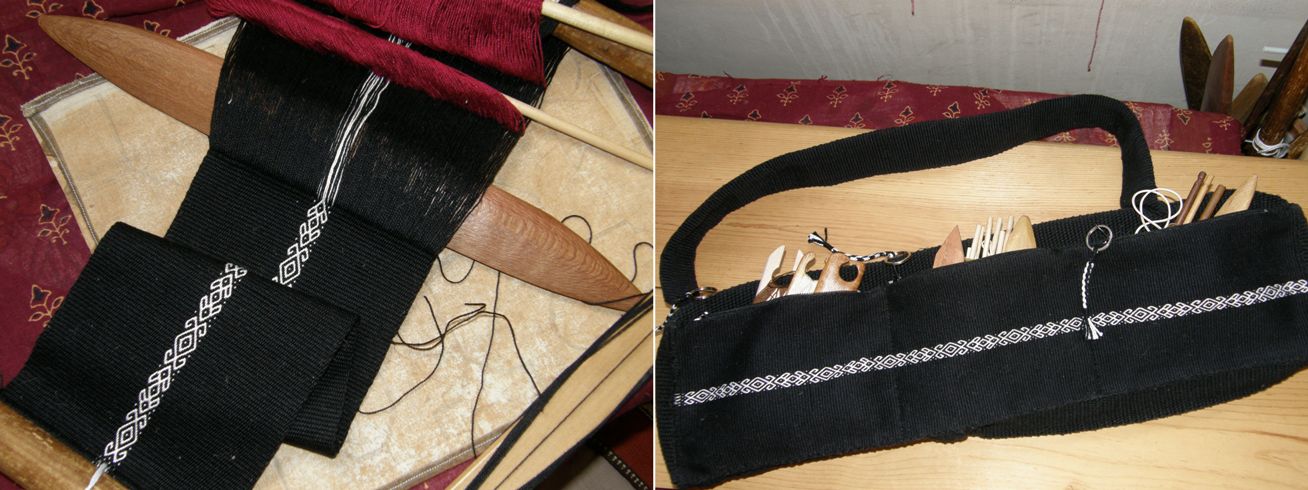
There is some of the twining as it progressed. I used the English, Spanish, German, Quechua, Gaelic, Swedish and Nigerian words. As for putting the bag itself together, I am not much of a seamstress and so just made it up as I went along using a camera tripod bag as the model. First I made the front panel with a pebble weave design.

Then came the sides and the panels between which the zip would sit all woven in plain warp faced weave..

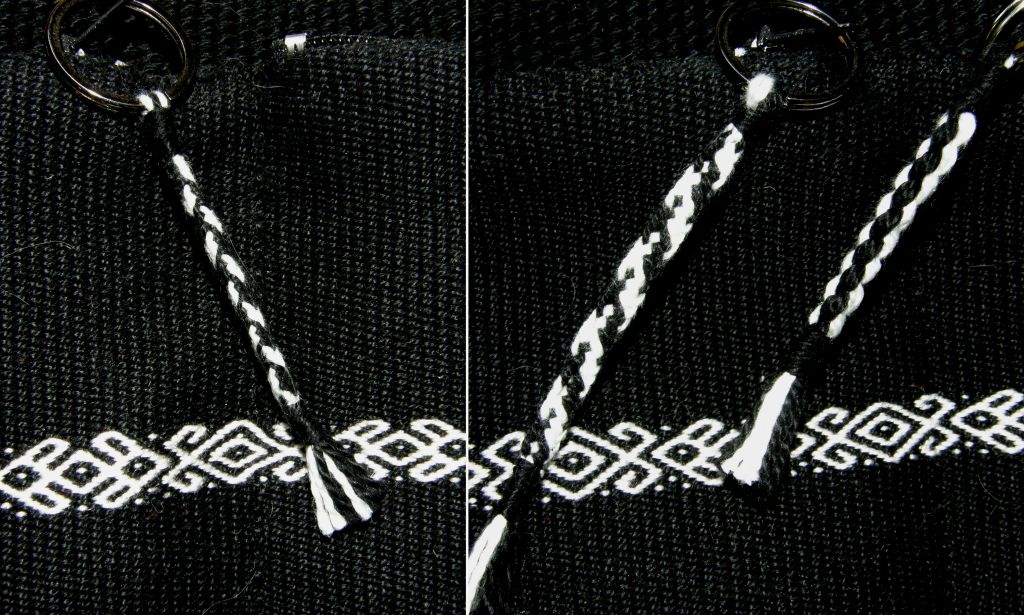
Once the zip was in I added a zip pull made using an Andean sling braiding technique.

Meanwhile I was still slogging away at the twining.

Then I decided it would be more practical to have pockets for all the smaller items like belt shuttles, pick up sticks and small swords and so I wove another thinner panel with the same pebble weave pattern.

The thin panel was sewn to the back of the bag. I have received two donations of large bags of assorted zips from online buddies so it was just a matter of diving into those and finding three small black zips the same size and I was set. I am getting pretty darn good at sewing these in!

Of course I couldn’t resist adding braided zip pulls. I made a square, flat-ish and round-ish braid for the the three pockets. I must do a tutorial here on that flat braid one of these days. I learned it for making straps for chuspas in Potosi.

Last of all was the strap. the last word to be twined was the Nigerian one which had been provided by a Facebook friend.The problem with twining is all the weft ends that are left hanging at the sides. I had to weave yet another plain weave band to sew to the back of the twined strap under which to hide all those ends. Actually it gives the strap quite a cushioned feel – quite appropriate for something that will be hanging off one’s shoulder.

There’s the last Nigerian word below (two words actually)…

DONE!!

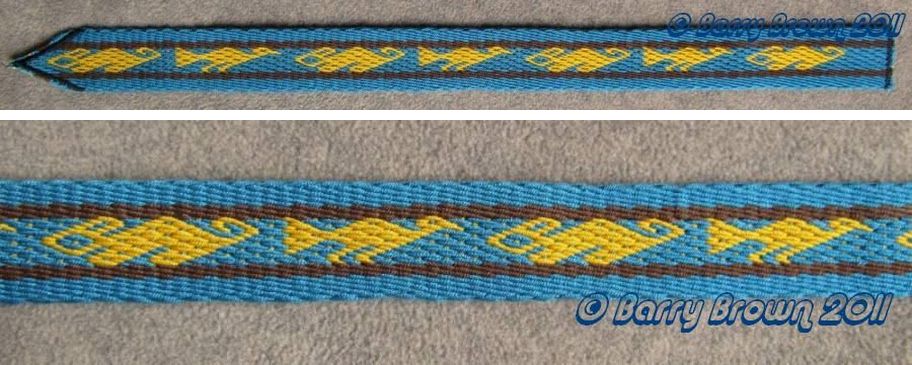
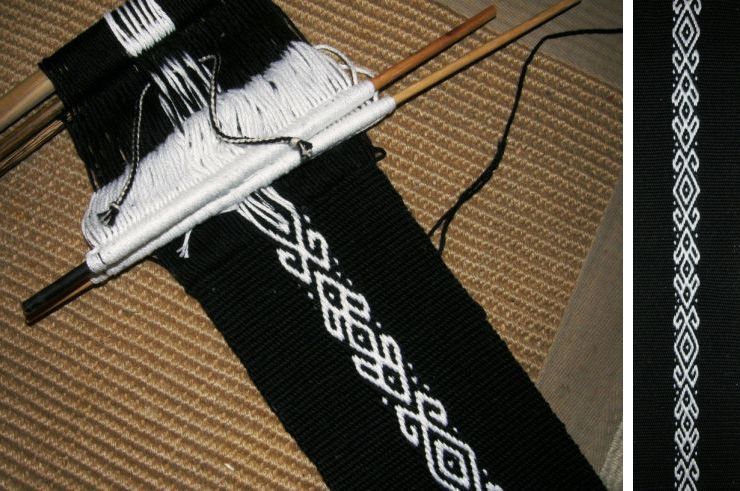
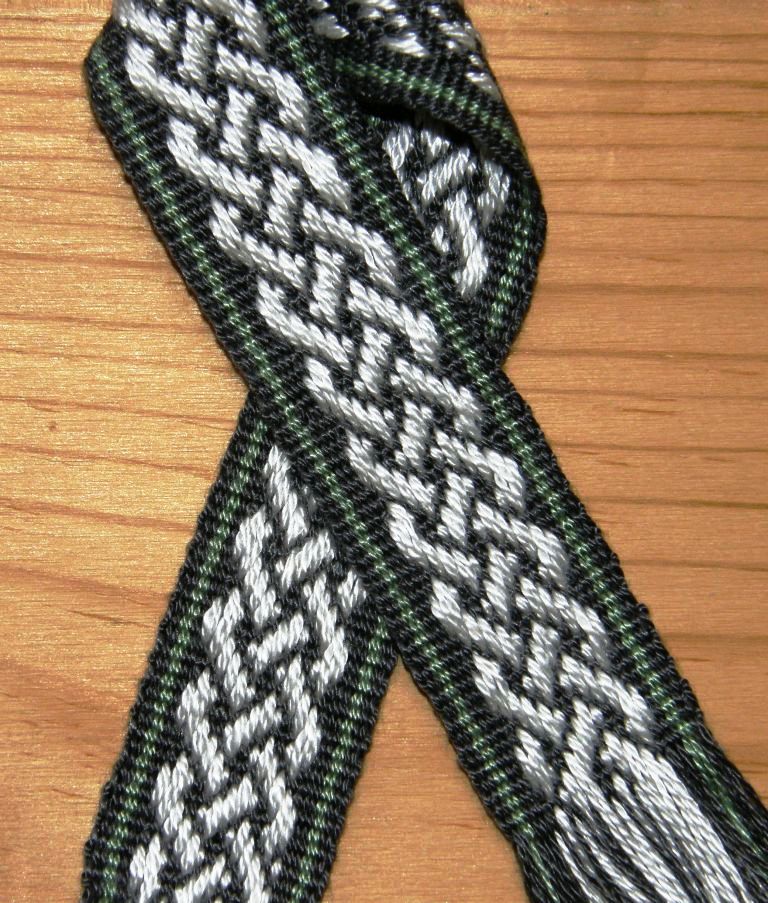
I wove a bit more on the tencel supplementary warp patterned band with its Celtic knot motif…


And I played a bit with a design I got from a Central Asian woven piece.

My friend Lisa photographed this piece at a reenactment event some time ago and sent me the image.

There was not enough detail to see what technique had been employed and I decided that it would look good anyway woven with a supplementary weft. The design is charted here.

Last weekend one of my online buddies sent me this same image saying that she had found it on her desktop and had forgotten from where it had originated and that she thought I might like to weave it in pebble weave. After I reminded her that it was actually from my blog, we both had a laugh and then I thought, “Huh, I wonder how this would look in pebble weave?” And then another “huh”. How would it look in other techniques?

Hence the title of this weeks’s blog post…Variations on a Theme.

Here is how it looked when I originally wove it using a supplementary weft…

I guess I am very lucky to have been able to travel so much here in South America and learn so many different techniques and designs. I have often met weavers here in my travels who are masters at two techniques and have been weaving them all their lives and who are delighted and bubbling with curiosity when I show them motifs woven in the same technique from another region within their own country. Others see a technique in my samples that they don’t know and plead to be taught it. Sometimes I have to push back my desire to learn from them in order to teach them. They are always so happy to have an “edge” over their other weaving companions with this new knowledge.

So, just for the fun of it I celebrated the fact that I have had access to many patterning methods and I adapted the Central Asian motif to three other techniques. There are still several more to try.


From left to right…in the same supplementary weft technique but in finer yarns (35 wpi ground), in double weave, the original supplementary weft (24 wpi ground), pebble weave and supplementary warp. I love them all!

I once taught pebble weave to a weaver in Ecuador. The weavers in his community weave with tapestries and belts patterned with supplementary warps. The pebble weave technique is not known. I left him with drawings of various Bolivian and Peruvian motifs to copy if he wished as I didn’t have woven samples to give him. Eighteen months later I returned to see his band with his attempts to duplicate the drawings but there was also a rooster motif which he had adapted from the typical supplementary warp belts and embroideries of his community.

And Juan definitely wanted to have an edge over the other weavers. He wouldn’t even teach the pebble weave to his brothers!

I shared a room at the tinkuy with a weaver from Cochabamba who was dying to learn the design on one of my pebble weave amulet bags. She already knew pebble weave but not this particular design. As there simply wasn’t time to learn it at the tinkuy I swapped my amulet bag for one of her spindles. I wonder if she has woven it and if her new design is envied by the other weavers in her community.

###############################

The Weave-Along in the backstrap group on Ravelry is coming to its end on March 6th with what we are calling the “big bang”. There seems to be a lot of weaving going on by the handful of weave-alongers and we have even been hearing from a lurker or two. Projects are still being posted…

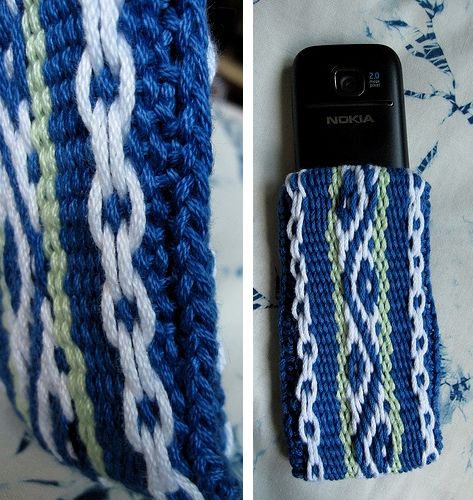
Tracy made one of her pebble weave bands into a cell phone pouch. She edged it with a single row of cross knit looping or Van Dyke stitch as it is in known in embroidery. (See the video in this post for instructions). Check out Tracy’s latest blog post on the textiles she saw in Syria.

Marsha (PandulaArts) wove these pieces on the left patterned with simple warp floats and then dabbled in a little double weave.

Toby, who is not participating in the weave along, but who is a regular contributor to the backstrap weaving group on Weavolution, has been trying warp substitution technique (on the left) using a Bedouin motif and double weave (on the right). The warp substitution technique is a very good introduction to the basic pick up patterning method which is also used to produce patterns in double weave. It is a good idea to start with this technique before advancing to double weave. As you can see, one of the disadvantages of the warp substitution technique is that it produces long floats on the back of the piece. The length of the floats can be reduced by carefully choosing designs and spacing. Toby’s design on the right is his own invention.

Tanyabe has been making her first steps in pebble weave on the left and Tracy is now weaving a Chinchero design in pebble weave. This design is charted in my book.

Jennifer’s Sami bands are gorgeous!! She has been doing these on her rigid heddle and inkle looms and I believe that she has one going in wool on her backstrap loom too. Once again I remind you that you can access instructions and patterns for these bands on the Yahoo Bands and Braids Group or by buying Sue Foulkes’s book here.

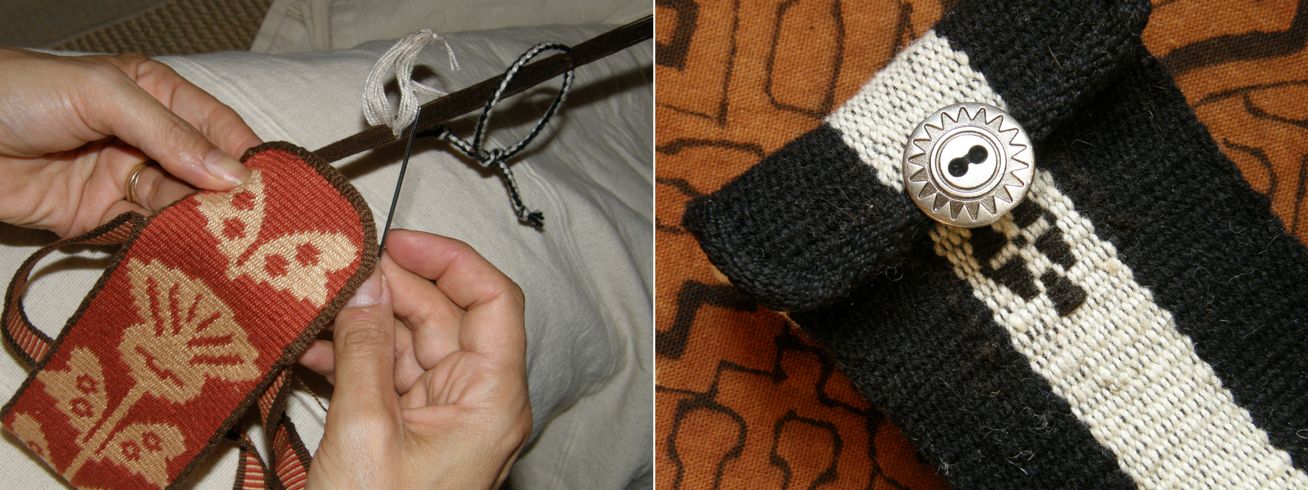
As folks finish off their projects for big bang Sunday, a couple have asked for a tutorial on the tubular bands that are often used here as decorative edgings for finished woven pieces. These are bands that are woven and sewn simultaneously to the edge of a piece of fabric using the weft as the sewing thread. There are several kinds of bands. Some are in plain weave and this is probably the easiest place to start learning about these.

I have put together a tutorial here with photos and a short video. I have also put a video there that I shot at the Tinkuy de Tejedores in Peru of a Bolivian weaver attaching a band to the edge of one of her bags.

These bands can be used to cover the raw edge of a weaving as I did with the edge of the cell phone pouch above. However, I would not attempt to do this until you have practiced the technique many times on the selvedges of your woven fabrics. It is far easier to learn to apply these bands to edges that are not threatening to unravel!

You can see above that a narrow warp is wound and set up with simple string heddles and a shed loop. I use a tapestry needle to carry the weft and sew the band to the fabric.

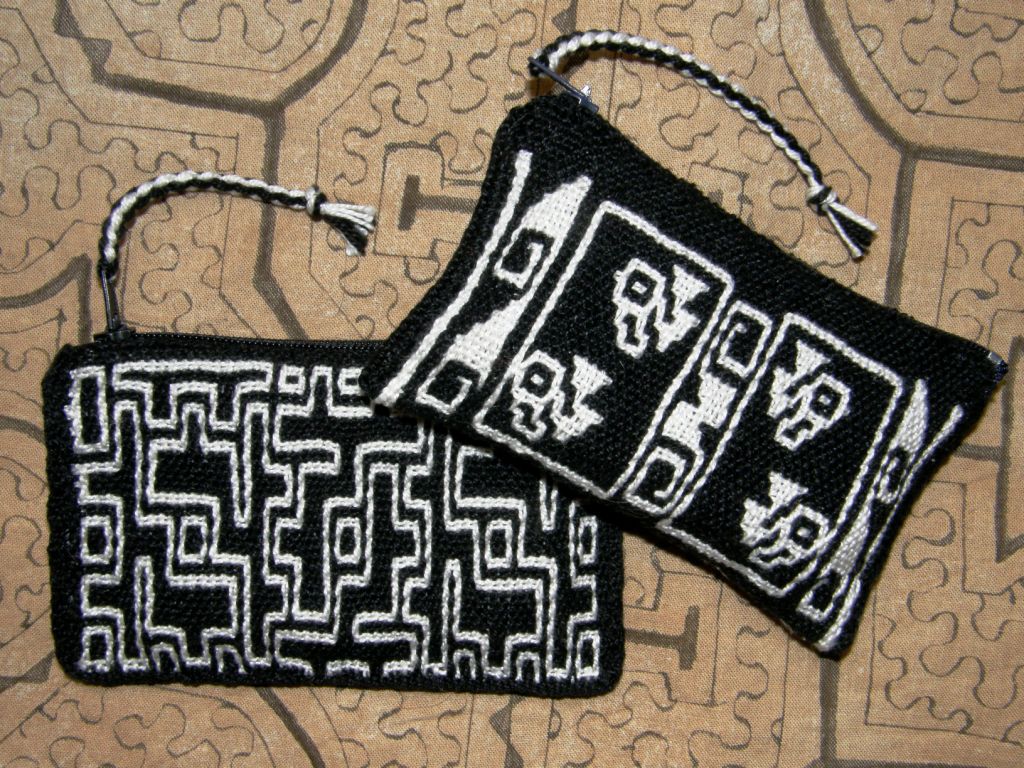
The purse on the left has been edged on three sides with one of these bands. See the full tutorial here.

#######################################

Greetings come from “bicycle Anna” this week who is now down in the Chilean city where I spent my first five years in South America. Punta Arenas is the southern most city on the South American continent. From the city you can see the island of Tierra del Fuego across the Straits of Magellan.

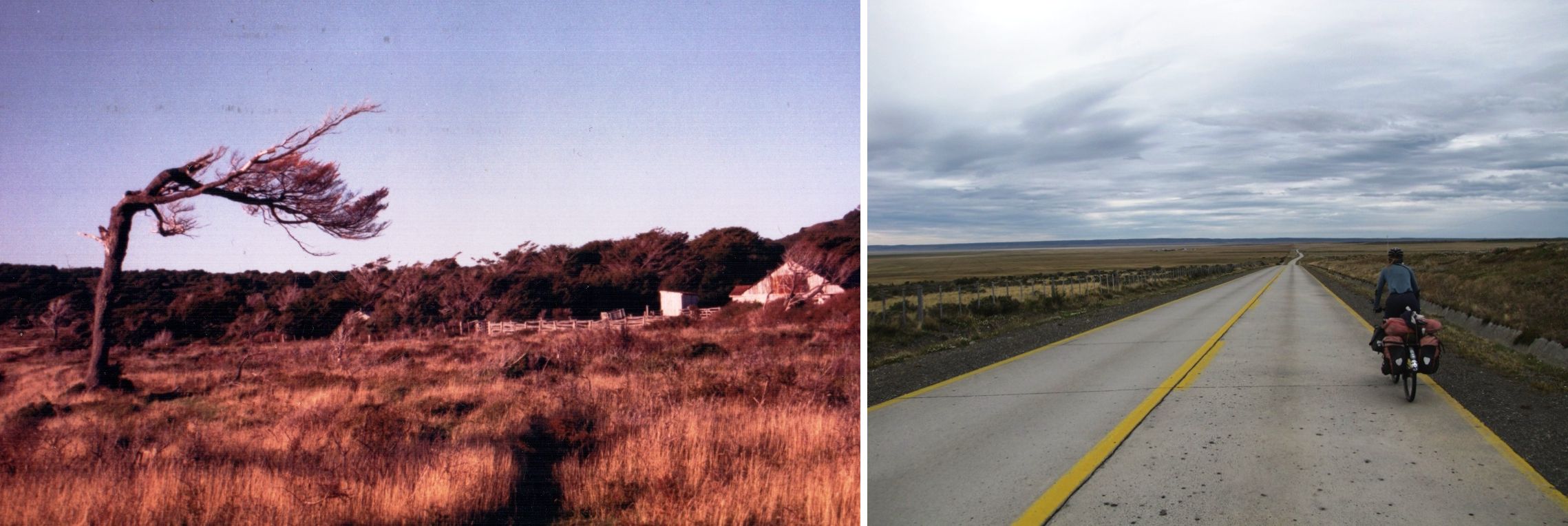
Anna stopped by to see me at home and have some weaving lessons. She is now in the land of sheep…tens of thousands of them and her new drop spindling skills are being honed. She is carrying llama and alpaca fiber that I gave her along with a Bolivian spindle and I am sure that she will be adding Patagonian wool to her fiber stash.

And look how she is getting on with her pebble weave with her loom tied to her bike! It’s summer down there…you wouldn’t think so from the gear she has on. The days are looong and if you get one without wind it can be heavenly.

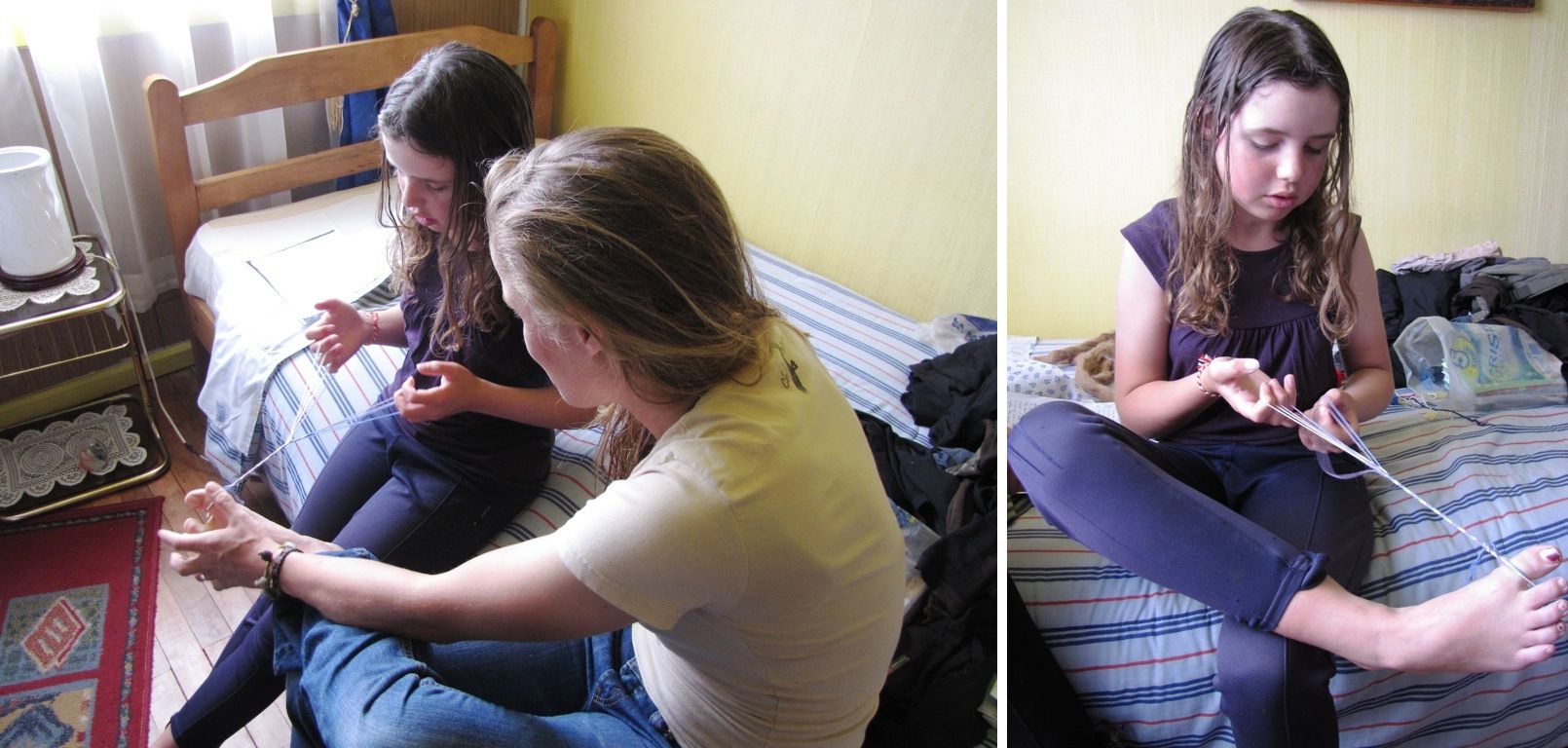
Anna has been spreading the fiber love by teaching young fellow cyclist Kate to make the six-strand finger loop braid that I learned in Potosi (one of the ones on my new loom bag).

I must warn you now that this is pretty much the end for this post of anything related to weaving or fiber as I indulge in a little nostalgia trip to the place I called home for five years…the wild Chilean Patagonia. Some of these pictures are Anna’s.

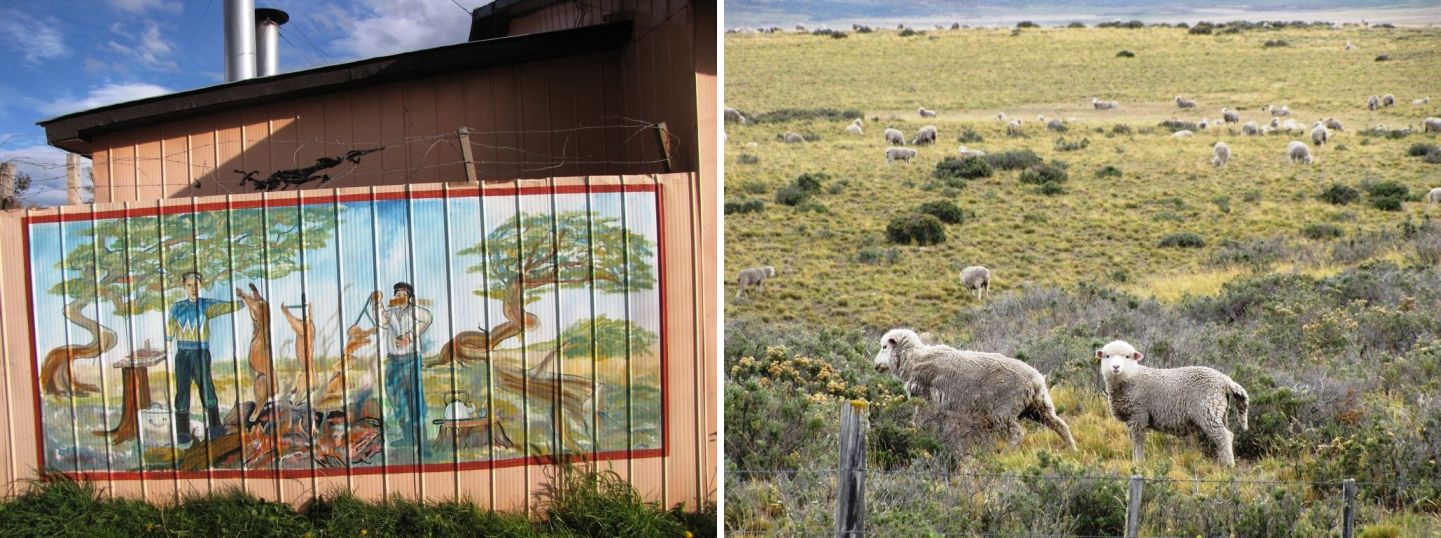
A house at left is painted with a scene depicting the famous southern Chilean lamb barbecue – asado al palo.

The Andes dip down into the sea before reaching this part of the world creating a series of islands, fjords and sounds. The land is scrubby and flat and rather colorless. Trees grow sideways with the constant winds.

Punta Arenas is a city of houses walled with corrugated sheeting. Rather than let it all run to rust residents paint with soft pastel shades, splashes of color in the bleak landscape.

This statue of an Ona indian is in the Plaza de Armas in the city center. The toe shines as visitors rub it to insure their return to Punta Arenas one day. Puerto Natales futher north is located on Ultima Esperanza Sound and is the gateway to the spectacular Torres del Paine National Park.

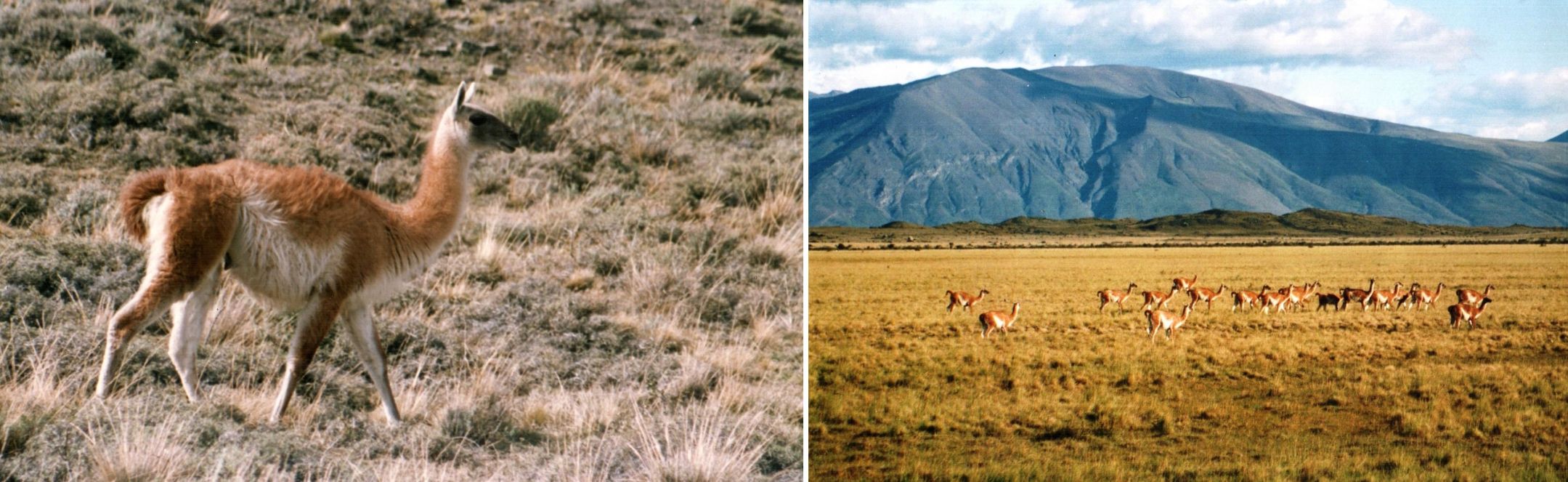
Craggy mountain peaks, fjords and wildlife in and around Torres del Paine…a rhea or ñandu walks with her chicks.

Herds of Guanaco roam  the park.

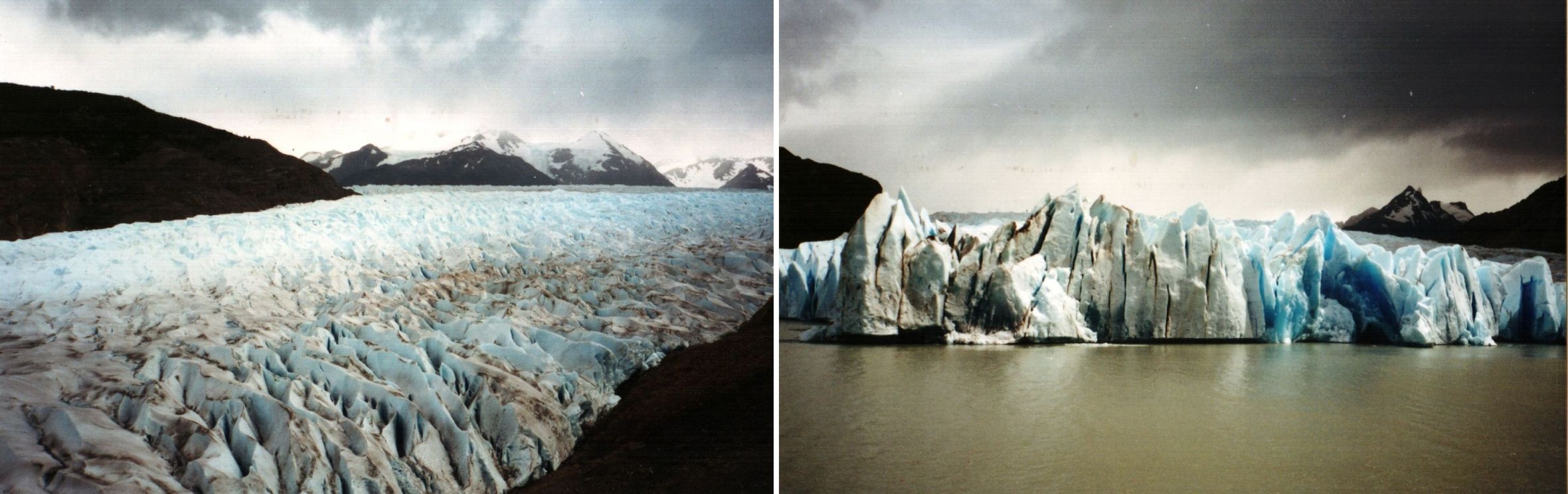
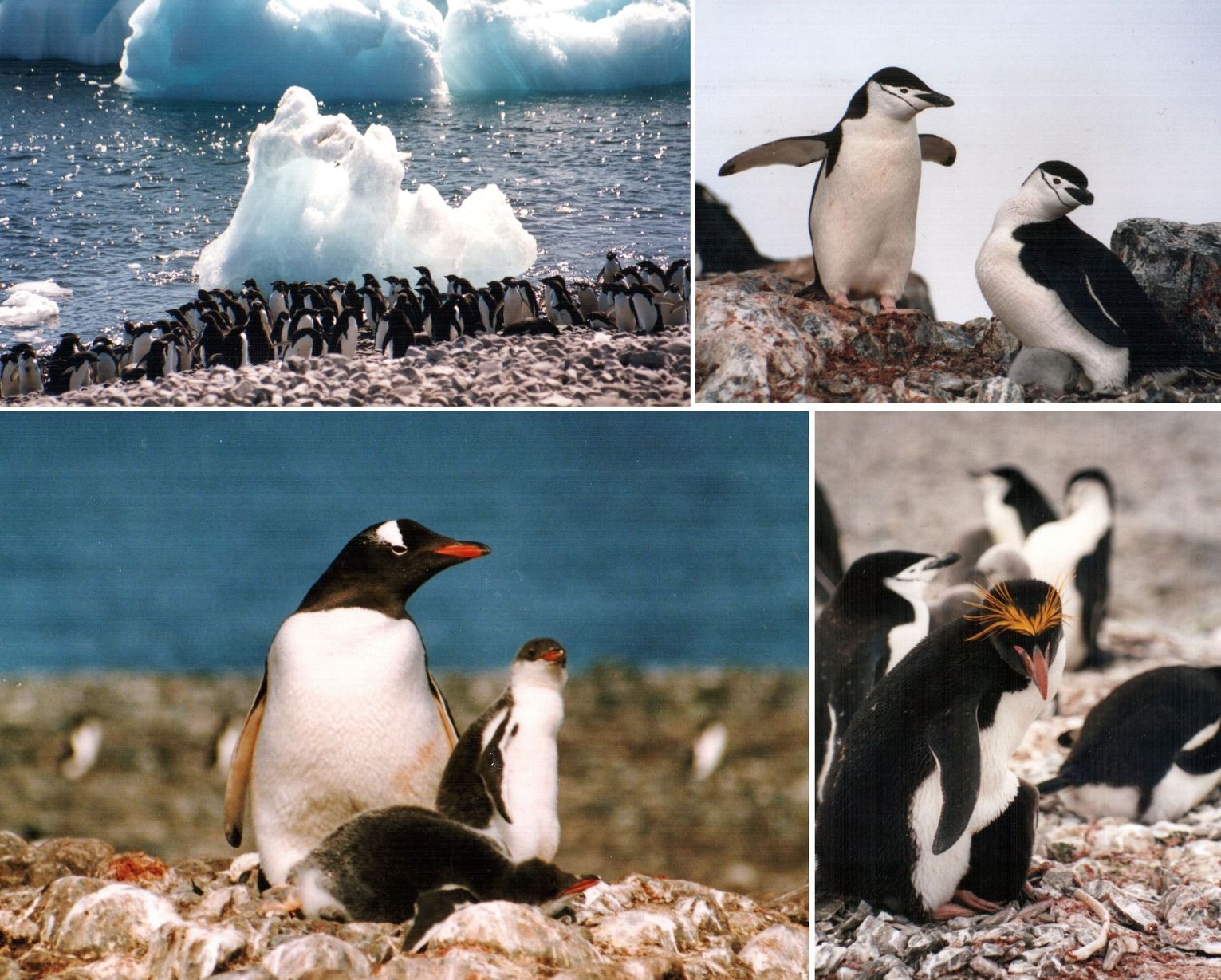
The hiking and scenery are superb but be prepared for a good battering by the wind! I got to go to Antarctica twice when I was there and thus add the seventh continent to my list. After all it is just across the Drake Passage! I will leave you with some shots from there.


Penguins, albatross and seals. This Albatross is in the Falkland Islands. Lots of whales too which I could never quite catch on film. And yes, I was weaving between all this!

They tell you to not to get within ten feet of the wildlife but if you just sit still on the beach long enough, the penguins all come to you!

Ah well, back to jungly steamy Santa Cruz. It’s time for coca tea and a mango!