The bands I ordered from the co-op in Cochabamba arrived. That’s always so exciting. I had been able to take a sneak peek at them when Dorinda sent me a picture of them laid out in her yard but there is nothing like seeing the true richness of the colors, smelling the natural dyestuff in the handspun wool and feeling the firmness of the cloth.
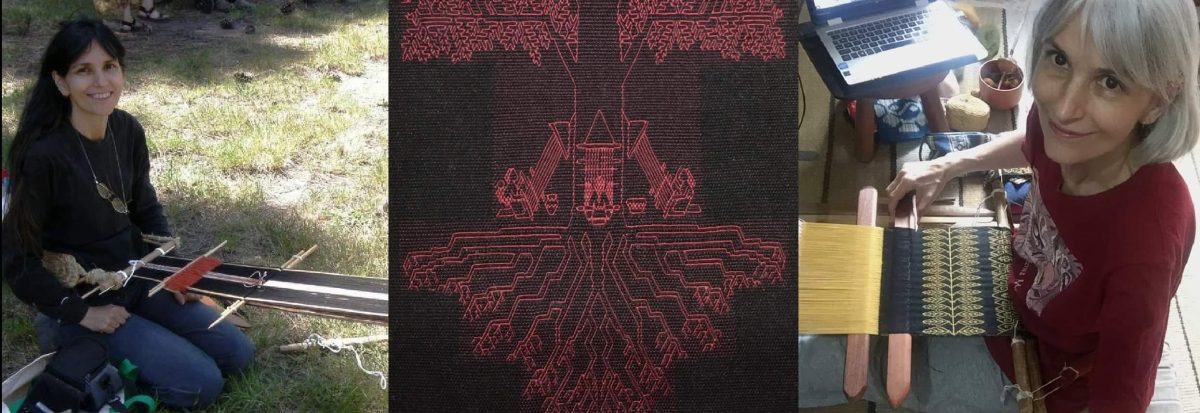
 I love being able to put faces to most of the names on the tags after having met many of the weavers on my visit last year. We spent a day weaving together. The tags on the bands tell of the work of Maxima, my teacher, and her sister Narciza, the go-getter, (pictured below) who chose one of the largest patterns and kept begging me to show her with ”just one more row” so that she could fully grasp it before I left.
 There’s young Eulalia whom I remember as being the quickest to pick up one of my woven samples and start copying the pattern.
 Justina’s name is there. As head of the Huancarani weaving group, she represented her weaving friends and Bolivia when she traveled to the Tinkuy in Peru last November. Antonia contributed a band too. She and her daughter wove with me at Dorinda’s place during my visit.
And then there are Felicidad and Casimira as well as a new name I haven’t seen before – Cerila. Her band has a lighter touch and I wonder if she is one of the much older ladies.
As for my own weaving, I drew and erased and wove and un-wove, drew and erased and wove some more. I like sampling and I almost always make something useful from the samples. That was not so much the case this time as I kind of lost the plot along the way and some of the samples are already in the trash. I told you about that in my last blog post.
Sometimes I would go to bed completely dissatisfied with what I had created only to wake up the next morning to be almost completely happy with it. I decided that I needed some feedback and so I put a picture on Instagram. The response was favorable and very supportive and confirmed that I was headed in the right direction…thank you, guys… and so I felt that I was at the point where I could tackle the ”real” project and put the sampling aside.
 This is warp-faced double weave in 60/2 silk. My paisley-like shapes don’t have the curled tails that you often see in classic Paisley shapes. That is a further challenge that I will leave for another time!
This is the one sample that I will continue to weave and keep so that I can make it into one of my little conference neck pouches. But for now, I am putting it aside while I return to my chart. I need to convert it so that it is suitable for the supplementary-weft technique that I want to use for my silk scarf project. Here is my blank palette awaiting its pattern…
 The parts of the pattern in my sample that have long horizontal stretches of solid white won’t work if they are woven using supplemental weft. They will result in exceedingly long weft-floats. Floats of that length are impractical. They can easily get caught on things and pulled. I needed to break up the long white solid sections into smaller ones. For example, look at the solid white paisley shape that sits within the larger one at the bottom left of the design on my sample. I would need to fill that shape with circles and spots to break up the long horizontal lines of white into shorter floats.
 So, here is the scarf warp underway. The start and end of the scarf will have its busy pattern and I will keep things much simpler along its length. I might double the large design for the center of the scarf or I might even repeat it at every quarter. We’ll see how it goes. I used multiple strands of 120/2 silk in three different colors for the supplementary weft….a deep red and two tones of purple. What’s fun is that the colors of the pattern look quite different depending on how the light hits the cloth.
Now I think I will pick up my drop spindle and finish plying the wool I spun for the Tour de Fleece many years ago. It has just been sitting there and I would like to use it to weave just one more cuff for our Bracelets and Cuff Weave-along on Ravelry. I might be able to squeeze this in before the end of the month. This is yarn I spun from a bag of random fiber that I won in a little Ashford online competition and I think the colors might go well enough together for a cuff project. The blue, red and white are wool. Both the red and blue are variegated but you can hardly tell. The red fiber was a weird red and brown combination that I didn’t like at all. But the spun thread looks quite nice.
 The cuff in the picture is one I wove from my handspun llama fiber a few years ago. It’s one of my favorites. I used spearmint leaves and cochineal (for the beige and red) as dye. I want to weave something similar with this new batch of handspun and add a tubular edging.
 Here’s a nice collage of some of the weave-along bands. I am really happy to see how people are using the patterns and technique from my latest book on complementary-warp pick-up.
Katherine’s latest one looks lovely on her backstrap loom…
 I provide quite a few very narrow patterns in my book and it is great to see them being used as borders alongside larger ones as Katherine has done. I love brown and indigo blue together as well as a buttery yellow and blue combination. She also turned the blue bands I showed in my last blog post into bracelets…
 The bars that she has at the ends of her band are really pretty. Three small metal loops are sewn to the edge of the band. You can see it better in this next shot of her pink band on which she has added a safety chain…
 One thing that KEOG discovered when she added a safety chain to her bracelet is that if the clasp is magnetic it is better to find a chain that won’t be attracted to it. That hadn’t even occurred to me. If you are considering this kind of closure for a bracelet, you should keep that in mind. I have a couple of cheap clasps that came with chains and it just so happens that they are not attracted to magnets.
 Rosemary got four bracelets out of the circular warp she put on her backstrap loom. She was also kind enough to show us several pictures of her set-up. When you use a circular warp, you need to clamp the warp in such a way that it doesn’t just slide around the end beams every time you beat. I was taught to clamp it at the end closest to my body. Then I have to un-clamp and un-roll each time I need to advance the warp. Rosemary has come up with an ingenious way of securing it at the far end which allows her to advance the warp without touching anything…
 In her own words….
…..”when I apply tension and beat with my beater, the band does not move. However, if I release tension, just a bit, and put the beater in the shed, and pull towards myself, then the whole warp shifts forward. In this way, I never have to rearrange anything – I keep the fell about two inches beyond the bar at my belly, and I can weave and weave and weave, without having to stop and rearrange, and this fills me with joy.”
I love it!
Katycat placed her crimps and clasps on her finished band to create her bracelet…

 This is Julie B’s work using a complementary-warp pattern from my second book, the one I like to call the Rolling River. I love seeing how people use various kinds of looms to enjoy these techniques and patterns.
 I will finish this post here with a celebration of Taproot Video’s one-year anniversary. I am one of the founding-year members of the cooperative and we celebrated the anniversary via email recently. I won’t be seeing the other members until April when we’ll be able to clink mugs and celebrate again.
 What is even more meaningful to me personally, is that Taproot’s launch also marked the release of my first ever instructional video. It was a scary trip at first, but it has been fun and heart-warming seeing my dvd make its way to countries all over the world and receiving such favorable feedback.
 The video can be purchased as a dvd or you can buy lifetime streaming.
People very often ask me if it is hard to learn backstrap weaving on one’s own. Most often this question is more about the weaving techniques rather than about the loom itself. The kind of weaving I do on my backstrap loom can be done on many other kinds of looms and I have written tutorials and books about these techniques and plan to keep adding to those with more books, photo tutorials and dvds. My new pattern book is coming along nicely.
What about learning to use the loom? That is a little trickier because the weaver’s body movements are so much a part of the smooth operation of the loom and that can sometimes be hard to understand on your own. It is a lot about ”feel” and that is something that I wanted to be be able to convey via my video class. Many people have told me that they feel that I am in the room with them as they watch the video class. That is exactly what I was hoping to achieve! Even those who were already up and running and using a backstrap loom speak of having had several ”aha” moments while watching.
It has been a great first year with Taproot and I would like to thank everyone who has bought the video so far. There will be more video classes coming.
See you next time with, hopefully, a whole lot more to tell about the paisley progress.


