Backstrap Weaving – ”Unnatural” Beauty

columnweftthreadsI always try to read my latest blog post the morning after having posted it. More often that not there is a typo or two that needs fixing and I seem to catch those more easily when fresh in the morning rather than at 10pm when I generally hit the ”publish” button.

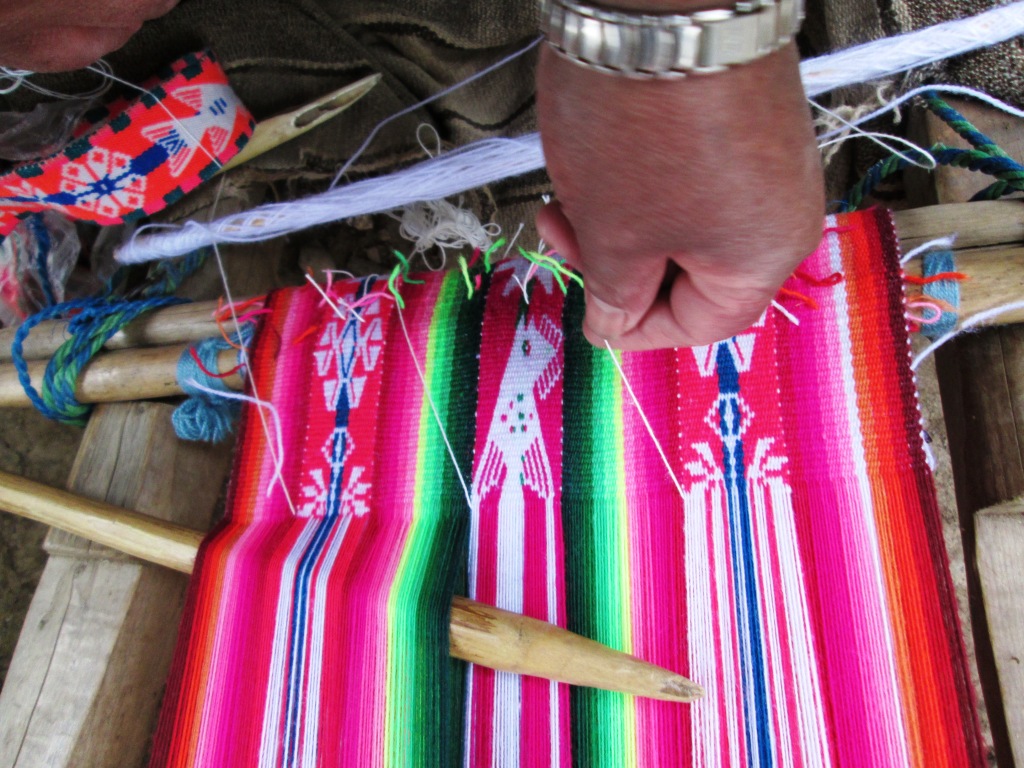
What I noticed more than anything else when I did the morning-after review of last week’s post, was the way that the picture of Maxima’s ch’uspa gleefully jumped off the page. Those festive reds, oranges and pinks and joyful greens rang out as I scrolled down the page. It is not hard to understand why Maxima should want to use the synthetic thread in these bright colors for her husband’s outfit as Mayor of Huancarani as her aim is to create something festive. In the same way, she and other weavers in her co-operative have started working on their llicllas for Carnival next year and are using acrylic yarn in bright colors bought in the market. There is still work involved before the pieces can be warped as the bought yarn needs to have more twist added so that it will stand up to the abrasion of warp-faced weaving.

natural dye colors independencia Bolivia
While the weavers are able to obtain beautiful deep shades of red using natural substances like cochineal, most colors they get from natural sources tend to be much more muted. Natural whites are not as brilliantly white as the synthetic whites either and these weavers are not using indigo to obtain blues. The hairiness of the handspun wool creates slightly more ”subdued” motifs next to the sharp, crisp ones woven with synthetic yarn. However, we, in the western world, love those natural dye colors and the way they so perfectly blend and work together and we tend to choose handspun wool textiles from indigenous weavers over synthetics.

reversingfor2ndhalfIn the above picture, Maxima has just repositioned her ch’uspa piece on the loom so that she can start weaving from the other end. This will enable her to create a piece with four selvedges. (Picture courtesy of PAZA Bolivia.)

It is even easier to understand the weavers’ leanings towards these bright colors when you see the rather bleak and colorless landscapes at some of the higher altitudes of Bolivia.

When I studied with weavers in Potosi, Bolivia, I shopped with one of my teachers for the yarn that we would use. I had her make the color choices as I wanted something that represented her taste. Her sister, however, turned up her nose when we had finished warping! She might have liked the colors but she definitely didn’t like the way in which we had arranged them. You can see how the woven piece is a spot of cheery brightness against the hard baked dry earth and stone walls of the patio. Of course, there is lots of pink.

learning double weave potosiI remember the first time I visited Taquile Island on Lake Titicaca in Peru in 1996. I wanted to buy a textile from the market in the plaza and kept turning down pieces that were synthetic. Yet, these were the pieces that had the most beautiful work of all. The synthetic thread was extremely fine and allowed the weavers to create double weave motifs with an incredible amount of detail. The motifs in brilliant white stood out boldly and crisply against backgrounds of ruby red and green.

I absolutely love this Bolivian poncho made with exceptionally fine synthetic thread that a friend of mine bought in a textile store in California. The amount of design detail that has been packed into the narrow bands of color is extraordinary. The weaver has used some of the typical strong pinks and yellows alongside much softer tones in the columns of double weave.Bolivian poncho synthetic thread double weave

Sometimes, synthetic colors are used alongside undyed handspun wool such as in this piece from Peru….

tantaSynthetic dyes are sold in the highland street markets. It is lovely to see the mounds of colored powders in rows on the tables next to old weighing scales and sheets of paper for wrapping the purchases. Handspun wool can then be easily dyed for colorful woven bankets and carrying cloths….

synthetic dyes peruBolivian hatbands, decorated with colorful acrylic supplementary weft threads, are woven with warp thread that is finer than sewing thread. This fineness allows the weavers a lot of flexibility in their motifs with weft floats that can span up to 20 warp threads without being too long and cumbersome. I doubt that anyone is taking the trouble to spin yarn that fine anymore. The bright colors, tassels and pom poms give these bands a very festive look.

hatbands-aPebble Weave hatbands in Oruro and belts in Ayacucho are bright and eye catching…

oruro hatband

ayacucho beltWhen I show people examples of Peruvian and Bolivian weaving, I place this next piece of cloth alongside samples of handpsun wool, wool weavings and my own work. Many people are immediately attracted to this piece. It is, in fact, a machine-made acrylic version of traditional weaving patterns of Chinchero, Peru. The weavers of Chinchero, of course, weave with their handspun and naturally dyed wool yarn. I don’t know where this piece was made, having bought it in Santa Cruz airport.Craylic knock off chinchero patternYou all must know by now that I adore the use of red, black and white in textiles. For me it has a sort of ”tribal” flavor.  The inclusion of bright acrylic supplemental weft in this red, black and white saddle bag from northern Peru gives it a completely different flavor, I think.

As for me, I remain conservative in my color choices. I took a slight detour this week by using orange. I found a nice burnt orange wool on my last trip away and I wanted to try out this new wool yarn to see how it performed in the grip of string heddles and  warp-faced weaving. I used it, along with the other colors, straight off the skein.

It is wool. Therefore, it was hairy and gnarly in the heddles and sticky. That’s its nature. There are ways to deal with that. Each type of yarn calls on a different strategy for opening clean sheds and avoiding excess abrasion and breakages. I had to be careful to advance the warp often so that the heddles were not sitting too long on one spot and causing a lot of friction on that one part of the warp. No threads broke and the resulting cloth is gorgeously soft!

backstrap weaving woolI am currently planning and sampling a tubular band pattern that will suit the motif. The purpose of this weaving was to test the wool. It was a success and so, I shall make something with the cloth and, at the same time, try out my own tubular band pattern. Ths is the first time I have used the motif you see above besides the tiny sample I wove for my second book.

wool backstrap weaving tinkipaya motifWhen I look at all the colorful weavings in this post, I am reminded of the machine-knitting business I used to have in my skiing days. In Australia, for every colorful patterned wool ear-warmer band that I sold, I would sell ten plain navy blue ones! It was a totally different when I spent the other half of the year in Europe. The Swedes in particular would wear wildly colorful hats with pom-poms that erupted from the top and cascaded down the sides like fireworks! The more colorful, the better and they were a blast of color in the snow. It’s interesting to note the different attitudes to color. And my ski suit? Well, there were a few but my favorite was, of course, black (with some neon pink bands). This was back in the 1980s.

See you next week. I will leave you here with one more piece of bright jolliness….belts from Ayacucho…

ayacucho-belt-with-pom-poms


Backstrap Weaving – Travelers

TRAVELERS…..Postcards from the road….a few thoughts, discoveries, news items, and observations as I weave my way here and there across the USA…

A DISCOVERY:

Before I could even leave Bolivia. my eye was caught by a splash of color as I hurried through the Duty Free Shopping Zone in Santa Cruz airport. There I spotted a pile of colorful fabric wedged between the perfume and cosmetics with a very familiar pattern…

???????????????????????????????It’s an acrylic piece of cloth in lively colors with stripes and bands of two classic weaving patterns of the community of Chinchero in Peru. Anyone who has had anything to do with the Center for Traditional Textiles of Cusco (CTTC) will immediately recognize these patterns as they appear on hundreds of articles such as purses, bags, and table runners that are offered for sale there. The CTTC textiles have been woven with handspun naturally dyed wool and alpaca yarn. I have no idea where this small acrylic piece was made. There is nothing to say that it originated in Chinchero, let alone Peru. It is edged and backed with synthetic material and has been designed to be used as a book cover. It has been very nicely put together. A friend of mine commented that, for all we know, it could have been made in China!

This image of the loraypo motif painted on a wall in Chcero is from the webpage malloryinperu.blogspot.com.
This image of the loraypo motif painted on a wall in Chinchero is from the webpage malloryinperu.blogspot.com.

???????????????????????????????The most surprising thing about it for me is the small “Bolivia” label in the colors of the national flag that has been sewn diagonally across one corner. I suppose these pieces will show up in all the souvenir and duty free stores in airports across the region…Argentina, Chile, Peru, Bolivia and Ecuador… with a label representing the flag and name of each country. It is an example of patterns that have become “travelers”, having left their home in the high Peruvian Andes and wandered, as in this case, to appear with a different identity in such places as a Duty Free store in tropical lowland Bolivia.

From these eastern lowland extremes, to the highlands of Ecuador in the west, the loraypo and jikaku sisan motifs (the spelling of these Quechua words seems to vary) appear in the work of other indigenous weavers.

On my very first visit to Otavalo region in Ecuador, I saw the jikaku sisan pattern in pieces that had been woven in Ecuador by Miguel Andrango, fell in love with it, but had no idea about Peruvian origin of the pattern at that time.

Migue Andrango's garnddaughter sits alongside one of the pieces in progress in his workshop in Peguche, Ecuador.
Miguel Andrango’s granddaughter sits alongside one of the pieces in progress in his workshop in Peguche, Ecuador.

Lynn A Meisch writes in her book Andean Entrepreneurs: Otavalo Merchants and Musicians in the Global Arena (excerpts may be read online)….

A band woven by Ecudorian weaver Jose Cotocachi from the webpage kristincrane.blogspot.com.
A band woven with the loraypo pattern by Ecudorian weaver Jose Cotocachi from the webpage kristincrane.blogspot.com.

When Peace Corps volunteer Dennis Penley took his weaving teacher Miguel Andrango of Agato to Peru in 1973, they were harrassed by Ecuadorian and Peruvian police and border guards, who were outraged that a gringo and an “indio” were traveling together. Dennis and Miguel were hauled off buses for passport checks and questioning and subjected to considerable verbal abuse. The Peru trip was still positive for Miguel. Indigenas in Chinchero, Peru, taught him their weaving techiques, which Miguel taught to other weavers in Agato and incorporated into his textiles.

In the following picture of Miguel Andrango at work, from the web page of Isabella Whitworth (isabellawhitworth.co.uk), it seems that Mr Andrango uses a different technique for picking up the patterns to that used by Chinchero weavers I have seen at work. It looks like he first opens the shed of light warps and selects warps for forming the pattern. He saves them on a stick while he then opens the  shed with the dark threads and does the same.

andrango2

While on the theme of “travelers”… motifs which have left their place of origin…, I will tell you about one of my Bolivian weaving teachers, Maxima, who has been to both the Tinkuy events organized by Chinchero weaver Nilda Callañaupa and the CTTC in Peru. At the first one in 2010, which I also attended, she took the natural dyes workshop.

At the second one last year, she learned to weave four Chinchero motifs in one of the workshops and was able to add these to her own repertoire of patterns. Maxima also demonstrated weaving at the Tinkuy on the leaning looms that are typical of her home of Independencia, Bolivia.

maxtinkuyWhile some of the motifs woven in Chinchero are also used in Bolivian textiles (the mayo kenko pattern, for example, is used by Maxima in her home in central Bolivia where she knows it by the name linquito), many are unique to Chinchero.

It will be interesting to see how Maxima chooses to use the new patterns and how they will spread within her community. Cooperatives are being formed and they are competitive. Weavers are always looking for new designs and techniques so that they can have the edge over their competitors by offering something new.

Speaking of Maxima and the weavers and spinners of Independencia, here’s a piece of news:

A group of twenty-five spinners comprising Maxima and her peers with the team name of Warmis Phuskadoras will be entering the 2014 Spinzilla event in October. I don’t know a whole lot about Spinzilla and what it entails but it has been running very successfully for a few years now and this is the first year in which international entrants have been permitted. Thanks to sponsorship from Thrums and Clothroads, the ladies were able to pay the entry fee and register their team to join 1400 other entrants. Read Dorinda Dutcher’s blog post on her PAZA webpage about preparations and post-contest excitement in the mountains of central Bolivia.

Warmis Phuskadoras planning meeting. Dorinda reads in Spanish while Maxima translates to Quechua.

Another news item of a more personal nature involves my nephew, Ryan, and his bid for gold representing Australia in the World ITU Long Distance Triathlon Championships in Weihai, China. Some weeks ago I asked for your support by “liking” Ryan’s Facebook page. We were both quite overwhelmed by the response. It was wonderful!!

The race was run last Sunday and Ryan fulfilled his dream by winning not only his age group, but the entire amateur category outright and becoming the World Amateur Champion. Here he is bringing the Australian flag to the finish line on the final stretch…

10710872_734796429926140_4057429826783732329_nAnd here on the podium…gold medal winner! I love that hat. He bought it when he was only 15 on a trip he and I took together to Ayers Rock. Who knew back then that it would travel to China with him and appear on the podium?!

10698425_734796546592795_8995245831394791285_nRyan wrote a blog post about the race which really captured all the agony and excitement. In it he took a moment to thank all of you for your support…

Finally I’d like to thank everyone who has supported me, my sponsors, family, friends as well as the weaving community who are associated with my aunt and really supported both her and myself by taking an interest in something and someone so foreign.

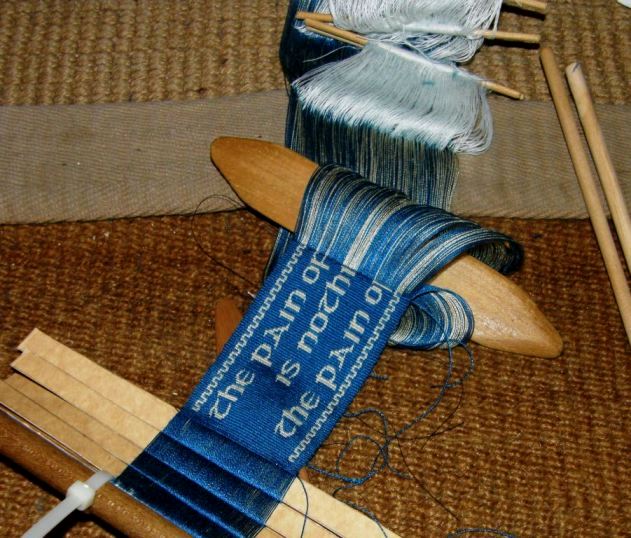
He can always do with more support in the form of page “likes” to attract sponsors so, if you haven’t already done so, please “like” his page. Now, I really must get my act together and make the silk bookmark I promised him. The prototype is below…”The pain of discipline is nothing like the pain of failure”… one of Ryan’s favorite inspirational quotes.

silk bookmark backstrap weavingWhile I don’t get to do much weaving of my own while on the road, the backstrap sticks have been clacking away in the homes of my online weaving friends. Lausanne wove a band in wool using one of the knotwork patterns that I have charted in my second book for the Andean Pebble Weave structure. Lausanne plays the fiddle and is using this band a a sheath for her bow…

10646717_10203926105224941_7621398630356267098_nOlive and Oaks finished her backstrap and her project reminds me how extremely satisfying producing good plain weave can be…

OliveandOaksAnother plain-weave piece by Gwen is underway and will be made into a bag for her loom. The second panel will match this one and will also have supplementary-weft patterns in yellow…

gwen bagJulia has been pushing her skills with the classic Andean hook even further with her latest piece..

julia

Alittle piece of Tibet in western Massachusetts. Liz's landlaord Sonam is a master stone mason.
A little piece of Tibet in western Massachusetts. Liz’s landlord Sonam is a master stone mason.

Since I last wrote a blog post, I have traveled from the tropics of lowland Bolivia to Massachusetts where the first nip of cooler fall weather was in the air. Hints of red were already showing against the greenery and I spent the fall equinox weaving with a group at Liz’s place.

Over my four days there I made new weaver friends and also connected with several ladies who had woven with me before. We created Andean hooks and tubular bands.

Liz has moved into a new space  since my last visit and has an even  larger and more inviting space now.

While we wove, the sister of her Tibetan landlord, dressed in traditional clothing, would be walking about outside. She doesn’t speak English and I was so hoping that somehow she would catch a glimpse of what we were doing and come and sit with us. Apparently, she walked in on one of Liz’s spinning groups one day and sat down happily to spin.

And now I have traveled over to Arizona and I can’t imagine a more different environment! I am looking forward to a visit to the Heard Museum in Phoenix tomorrow to see their famous collection of Native American textiles.

globe aAnd so, I will leave you with something in keeping with this week’s “travelers” theme. This is an image I made via a fun website which allows you to paste your pictures on a globe.

Backstrap Weaving -The Bag of Tricks

I had to dig deep into the bag of tricks this week to come up with a new idea for finshing off my latest three-panel wall hanging. Two days of experimenting with the structure that I had hoped to use for the two outer red panels finally led me to the conclusion that it just was not going to be as I had envisioned. It was time to plan again and take a look at all that I have at my disposal in my “bag of tricks”.  And there is a lot of stuff in that bag of tricks after having spent almost 18 years now studying weaving techniques and simple looms used in South America.

main panel of Shipibo inspired wall hanging backstrap loomThe main panel for the wall hanging is now finished. I can’t cut it off the loom yet to better show you the stepped effect of the woven fringe as I will need to place the two red panels, when I am done weaving them,  on this same loom and then twine across the top of all three to join them together.

It is always fun turning a finished piece over to look at the other side. I have been looking at white squiggles on black for so long now as I inched my way through this weaving. Yes, literally inched. I took note of my progress on the woven fringe part and it was pretty much an inch a day.

light sde of shipibo inspired hanging off loomThis side actually looks more like the painted Shipibo cloth that inspired this project. It is much more common to see light cloth with dark lines. But I don’t have to make any decisions here about which side to show. It needs to be the dark side in order to match the other pieces in this wall hanging series.

I want this second wall hanging to represent the weavers of the tropical lowland regions of Peru. For that reason I had chosen to use the structure that is used by people of the upper Amazon Basin to make wristlets.

shipibo-wristletsI have never been to that part of Peru and so was relying on a sample that I had been given from the work of Nora Rogers and Ann Blinks as well as notes by Cheryl Samuel in order to reproduce the structure. I bought red hemp twine for this project while in the USA. The weave is based on having twined warp threads lying next to what Samuel calls a “half basket weave”.

wristletI did succeed in reproducing the structure but the hemp twine did not give the design the relief that I had been hoping for. It was just a flat red mass at which I had to peer in just the right light in order to make out the pattern.I tried all kinds of weft and beat but I simply could not get the desired effect.  Nevertheless, I found myself sitting alone stupidly squealing with happiness as the piece started to take shape. It was a joy just to able to reproduce it but a disppointment  not to be able to use it in my hanging.

Back to the drawing board. I wanted something that would be all red but with texture and, of course, something that would represent textile techniques of the lowlands.

But, of course….simple warp floats!

shipibo pattern in simple warp floatsSome time ago I had woven the placemat, above, using a two-color simple warp float technique. I copied the pattern from a cotton bag from tropical lowland Peru that Teyacapan shows on her Flickr page. The design is one that I have also seen painted and even embroidered on Shipibo cloth.

The set of placemats I wove became a study of the use of this structure in several regions across the globe…

backstrap weaving placemats simple warp floatsAt the Encuentro de Tejedores that I attended in Cusco in 2012, I was able to observe Matsigenka backstrap weavers from Bajo Urubamba creating striking black and white pieces with their handspun cotton. The pieces were decorated with patterns that were created from simple warp floats.

??????????????????????

Photo by Jennifer Moore

The picture above was taken at Tinkuy 2013 in Cusco and shows a weaver from Pacaya, in tropical lowland Peru, weaving a warp float pattern with handspun cotton on a backstrap loom.

It isn’t necessary to have two colors to create patterns in this structure. If I used an all-red warp, I could create patterns of raised red-on-red….textured patterns rather than colored ones.  I also had a Mexican sash that my friend Annie MacHale had given me way back in 2010. I then remembered that weaving a single- colored piece with warp float patterns had been on my to-do list for some time. It was all coming together nicely!

???????????????????????????????The weaver of this Mexican sash has alternated a heavy warp thread (doubled threads) with fine to create a high-relief pattern in white on white.

???????????????????????????????Above, you can see my red experiments…the hemp twine wristlet structure and the red-on-red simple warp floats.

red-on-red simplewarp floatsI experimented with floating pairs and floating single threads and decided that single was the way to go. I wanted the pattern to be fairly delicate and subtle so as not to interfere with all that is going on in the main black-and-white panel. I decided to weave the solid lines of the main panel with the arrow motif in the center.

I set up both panels on the one loom in the same way that I had done for the first wall hanging. This would ensure that both came out the same way.

???????????????????????????????

red on red panels on backstrap loom

arrow motif red on red panelsYou’ll have to trust me when I tell you that these panels are deep red and not the weird pinkish-red that you see here.

Now it is time to start sketching ideas for the weft-twined pattern that will go across the top of the finished three panels. I remember I had a heck of a time with the twining on the first wall hanging trying to group the warps correctly so that the twined width matched the woven width. Hopefully it won’t take as many attempts this time to get it right!

And in my spare moments I doodle and think about wall hanging number three…the ikat one. Luckily I have a giant cone of thread and a a huge roll of ikat tape (thank you Betty!). I expect there to be a few do-overs for that one! I am also hoping to use supplementary-weft to create patterns on that piece. These ideas are just sloshing around in my mind for now but I hope to base the overall design on hook motifs in positive and negative space like the ones I played with recently in silk supplementary weft on cotton…hook motif mirrored and flippedThen there will be the third series of wall hangings in which I hope to put what I learned with my ticlla (discontinuous warp) experiments to use….using wool and the red-black-and-white combo, of course!

dovetail join ticlla waddington

ticlla with supplementary weft inlayI have spent a lot of time putting that big bag of tricks together. It is nice to be able to use these experiments to create bigger things. I look way, way ahead and I get excited about all these projects as I inch my way along!

See you next week.


Backstrap Weaving – Poncho Envy

I am posting a bit early this week as I will be on the road for the next couple of days making my way to the cold north-east of the US and hoping that the latest dump of snow that DC just had will be the last. It seems like the kind of weather where a poncho would be of good use. What wonderful things are ponchos. I could use one as a blanket, roll it up to make a nice pillow, lay it out and sit on it or just wear it as it was meant to be.

I don’t have any desire to own one here in steamy Santa Cruz but, if my dreams come true and I can one day live in the Blue Mountains just outside Sydney, I think that I could make good use of one there. It even snows there sometimes. The question is, should I weave my own or buy one here in South America?

ponchis1-214x275I am excited about a new book that has recently been published on ponchos of Bolivia. One day before I am due to leave I find out about this treasure. I will have to wait until my return to hunt it down.

This article tells how Oscar Barriga spent 40 years collecting and studying over 250 ponchos in Bolivia.

He sold his collection to a museum in La Paz and has written a book which includes information he has gathered on their symbols, messages and their religious, civil and military roles. Barriga says that the poncho does not have any one country of origin.

I have certainly seen varieties of this item of clothing in the highland, lowland and low valley areas in the South American countries in which I have traveled. My friend Kathie, who works with weavers in the tropical lowland coastal areas of Ecuador, took the most wonderful picture of one of the gentleman there on horseback wearing a handwoven cotton poncho.

ponchos 1I was lucky to have been able to attend a talk on ponchos and rebozos given by Anne Rowe at the Textile Museum in DC some years ago. I am looking at my scribbled notes from the lecture in which I have written that poncho-type clothing  existed in the pre-hispanic times but the poncho, as we know it, was popularized by the Mapuche of central Chile and Argentina. The earliest known image of one dates back to 1648. The Mapuche people wove ponchos for themselves but also to sell. During the Conquest they adopted Spanish customs including riding horses. Ponchos proved to be very useful for this activity.

An image from the 1730s that we were shown during the lecture shows a Spaniard wearing a poncho while watercolors from Peru in the 1780s depict both Spanish and indigenous horsemen and musicians wearing them. During the War of Independence in the early 1800s ponchos were worn by Generals to indicate that they were South American and not Spanish. Some of the designs were Spanish-like while others were more Mapuche-like.

mapuche-ikat-2The black and white ikat ponchos woven by the Mapuche people are worn by those who hold positions of great power and prestige. I imagine that they are quite a weight to carry around as I was able to feel the rather thick and coarsely spun wool in the example in progress above.

It was wonderful to see and touch the incredibly fine vicuña ponchos that were brought from Belen, Catamarca in Argentina to the Encuentro de Tejedores in Cusco in 2012.

poncho-of-catamarca-argentinaThe handspun vicuña fiber has to be carefully selected to find tones of equal value for each piece. The ponchos are woven on floor looms and the fabric measures 2 meters by 1.30 meters and weighs only 320gms.Two people swing the beater and they need to make sure that they beat with exactly the same amount of pressure on this fine, light fabric.

An image on Facebook from this page shows a stunning poncho being made in Londres, Catamarca on a floor loom. This Facebook page shows other beautiful examples of Graciela Salvatierra’s work.

1463897_479549392162132_910966833_nThe Salasaca family with whom I stayed in Ecuador had their son dress up in the typical poncho that he would use for special occasions for a photo. I like this simple black wool poncho. Juan would otherwise be dressed in jeans and tshirt. The Salasaca ladies, on the other hand, wear their traditional outfits every day although they have other “everyday” hats that they use rather than the rock hard ones that you see in the picture.

salasacan-ponchoI managed to sneak a snap of a Cañari gentleman in Ecuador out in his Sunday best ikat-patterned poncho in the town plaza.

canar-poncho-and-beltsMantas and chamantos are made by weavers in the town of Doñihue, Chile and worn by the Chilean horsemen known as huasos. They are silky smooth and tightly woven. It is easy to believe that they could be virtually water proof.

mantaI imagine that the striped mantas provide an more economical alternative to the pick-up patterned chamantos, like the one below, which I am told sell for up to $3000 each.

chamanto

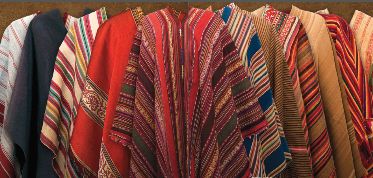
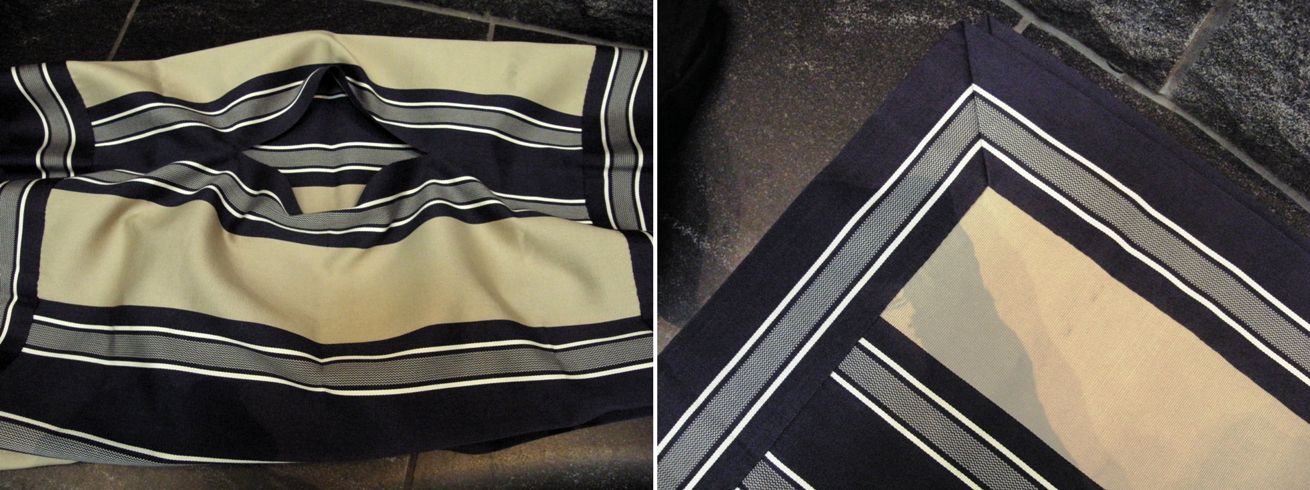
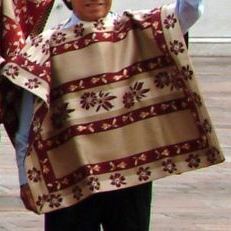
I love simple striped ponchos….so elegant. You will see that many of the examples in the picture from Barriga’s book above are patterned with stripes in  wonderful arrangements of widths and colors. The weavers of Tarabuco in Bolivia create cloth covered with tiny intricate figures which the women use for overskirts and bags in which to carry their coca leaves. However, the cloth that they weave for the men’s ponchos is beautifully simple…(you can see the pick-up patterned cloth in the background.)

Trabuco ponchoAnd of course, there is nothing wrong with a poncho that has been covered with pick-up patterning. Men in the Peruvian community of Chahuaytire in the Cusco region of Peru weave their own cloth for ponchos decorating them with motifs using supplementary warps.

chahuaytire ponchisThe more I read about Oscar Barriga’s book the more I want it but at the same time, the more I am convinced that its price tag will be very high. In fact, it is not clear to me whether the book will even be made available to the public. A more affordable option, if you would like to know more about ponchos in South America, is this book which was published in Argentina  and is available in English…..

??????????????????????In the meantime, I will think about my poncho and how I would lke to weave it. Yes, while writing this post I have decided that I should weave my own…one of these days. I have many hours of airport waits and bus rides coming up in the next few months in which I can sketch some ideas. 


Backstrap Weaving – Vermont!!

Dare I say that Vermont is now my favorite of the US states that I have visted so far? No, it would be impossible to choose a favorite. I was so in love with Utah and its canyons in my hiking days in the 1990s. It isn’t fair to compare the two….so different and so incredibly beautiful in their own way.

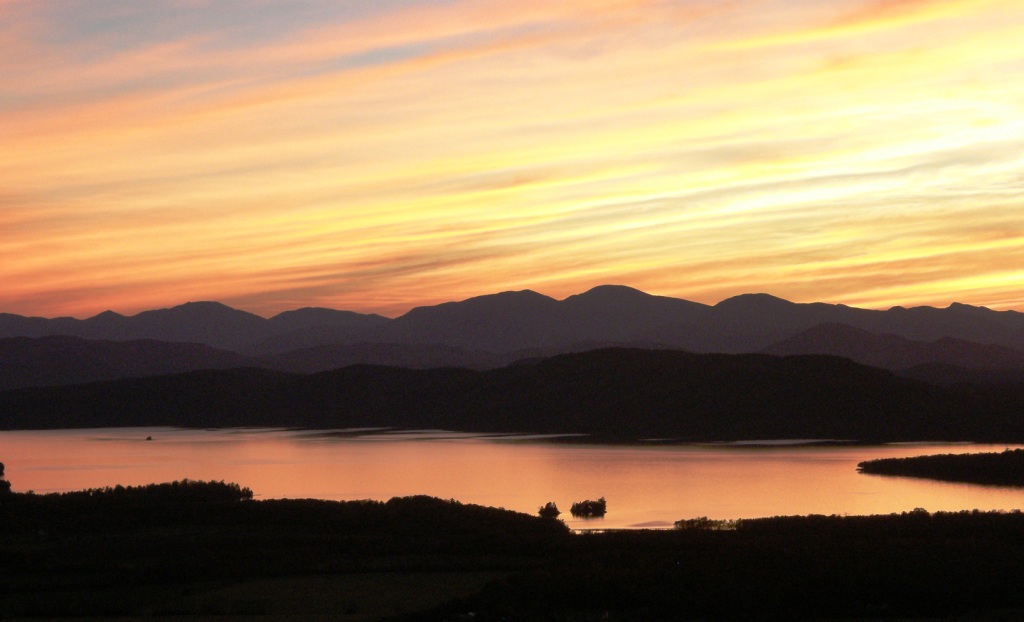
sunset from Mt Philo VTThis is just one of the lovely sunsets we had last week from Mt Philo overlooking Lake Champlain. Lausanne took me up there 15 minutes before the park closed. We were told it would take 7 minues to get to the top….I figured 7 minutes up, 5 down and 3 left over to enjoy the view. About thirty minutes later we still couldn’t peel ourselves away from the spectacle and the park guard finally had to come and coax us to leave so he could end his day.

Vermont foliage over lakeI don’t know if the fall foliage colors have yet to reach their peak and that there are even better things to come. It is hard to imagine it getting better than this!

Photo by Lausanne Allen

Walking in the woods with the dogs on a bed of fallen leaves of all colors…..

And this has been my home for the last ten days or so…
???????????????????????????????

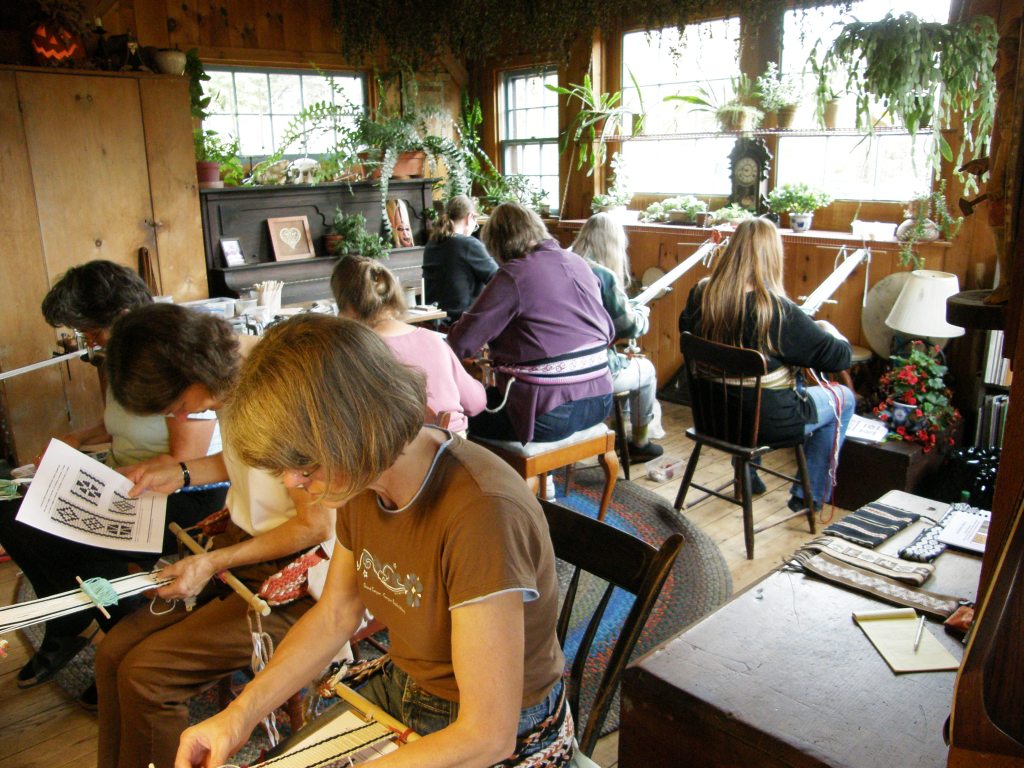
???????????????????????????????Here, in the home of Lausanne and Brian, I wove with two groups of backstrap weavers…friends and neighbors of Lausanne’s as well as a lady I know from one of the Ravelry groups.

Apart from one crazily wild rain storm which knocked out the power one evening, we had day after day of warmth and sunshine in which to explore the area. And who can begrudge a power outage when you get to enjoy Brian and Lausanne’s home in the glow of the wood stove and candlelight….

Candlelight in the wooden cottageThe sun filled Lausanne’s living room with light and warmth as we settled down to play with backstrap looms. The wood stove provided a little early morning warmth while the afternoons had us opening windows and doors to enjoy the freshness of the beautiful day.

tie up spo for backstrap loomsThis plant rack by the window turned out  to be a handy place for anchoring some of the backstrap looms. A sturdy table was the anchor for others.

???????????????????????????????And the back of the sofa provided one more ideal spot for weavers to attach their warps.

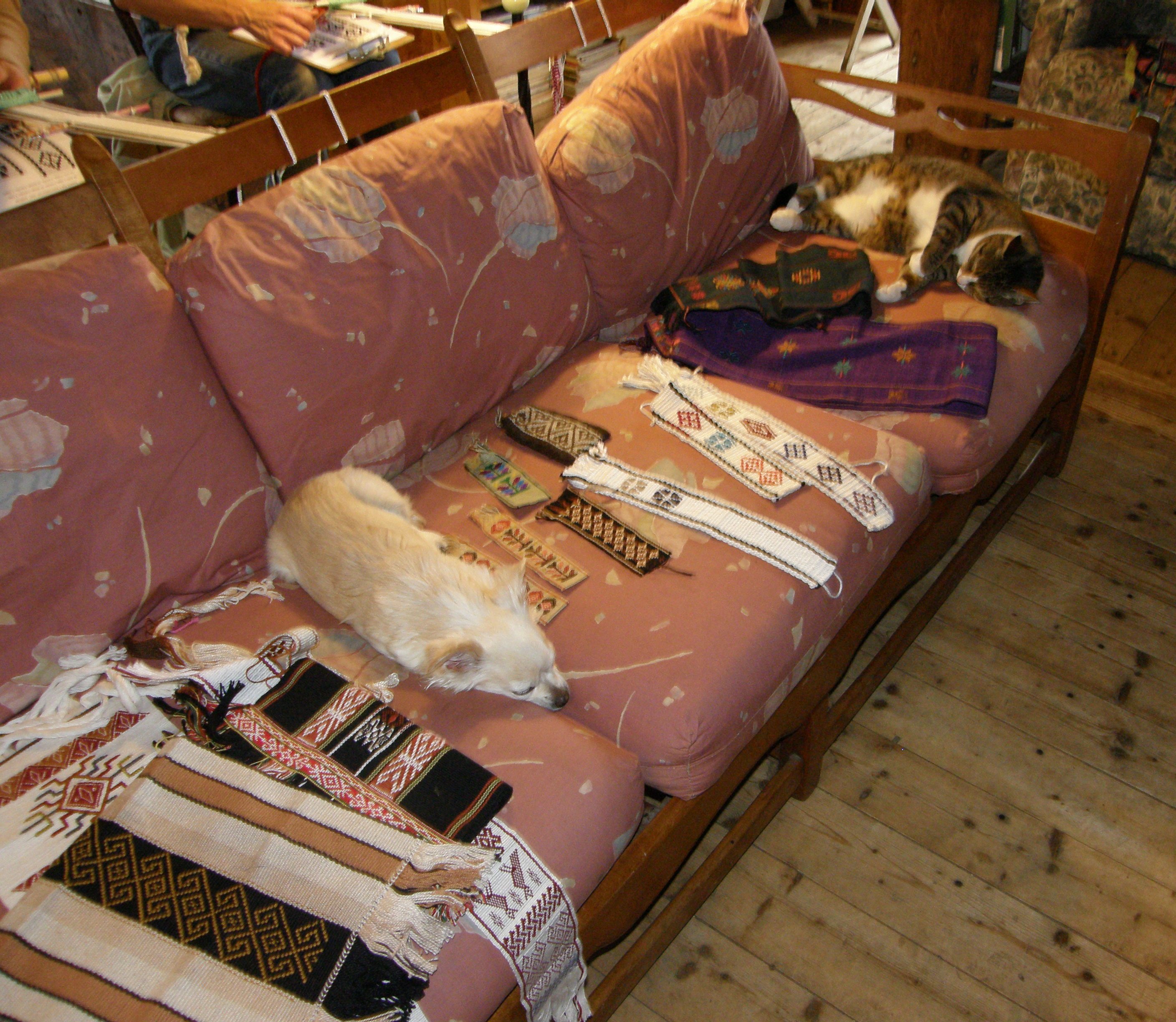
anchoring backstrap looms to the back of the sofaThe pets helped in their own way, adding their weight to the sofa snoozing among my weaving samples so that the sofa woudn’t be dragged away with the weavers’ vigorous beating or over-zealous tensioning of the warps.

???????????????????????????????

Candace and Kathy backstrap weavingCandace and Nancy pause for a smile while taking their first steps in backstrap weaving. Candace is flanked by Lisa and Julia.

Annie learning to open the heddlesAnnie starts to get the hang of coordinating the moves which allow her to open the heddle shed smoothly.

The cats stretched out between us on Lausanne’s many very large, and richly colored homemade braided rugs that adorn the wooden floors.

??????????????????????

???????????????????????????????The bench of the grand old barn loom in the corner served as one of our warping stations.

Lunch breaks provided strolling and recharging time through this kind of thing!….

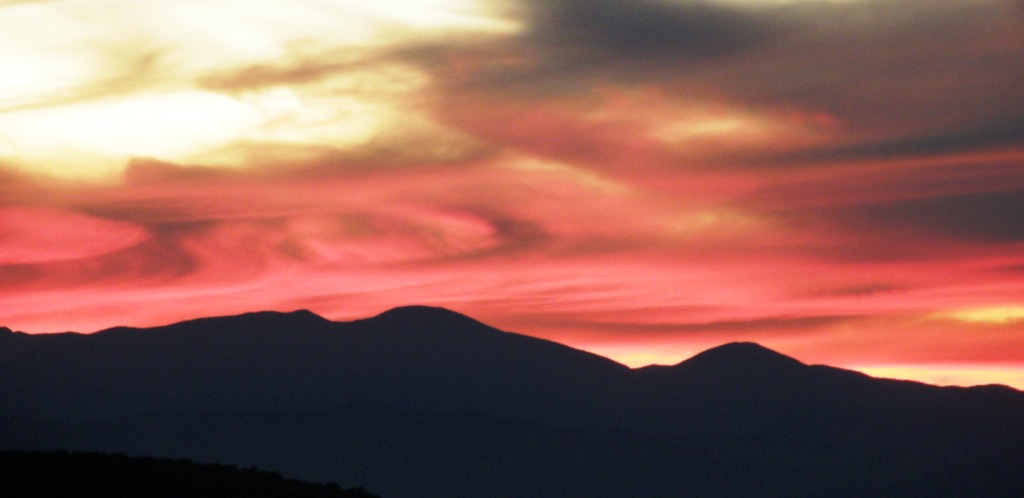
???????????????????????????????And, climbing up the ladder to Lausanne’s cupula in the evening gave views to distant hills and eerie red sky sunsets.

??????????????????????

And then, in amongst  all this natural Vermont beauty, came this…

peruvian ceremonial chuspa

and this….

finger wovwn sash L'AssomptionThe chuspa, (coca leaf bag) from the Cusco area of Peru, came to me as a gift from the collection of Libby van Buskirk. I had met Libby on Facebook via an introduction from Lausanne and Lausanne took me to visit her and her husband, Dave, in her Vermont home one evening. There was so much to see and talk about in so little time! I was shocked when she offered me the gorgeous chuspa. As much as I like the fine, high quality weavings made with naturally dyed handspun yarn that the Cusco Center for Traditional Textiles has been ecouraging weavers in the Cusco communitues to produce, nothing can beat these slightly older and more rustic pieces, in my eye.

??????????????????????I love the twin pockets for the lejia (catalyst in powder or solid form) that you can see in the first picture. Those little pockets are woven along with the main bag. Narrow extensions are created for the pockets as the pieces are being warped. This construction is something I studied with my teachers in Potosi, Bolivia and you can see our warp for a single pocket chuspa underway below, the narrow extension being what will form the pocket.

warping-for-chuspaWhat I really enjoyed seeing was the tubular band that edged the bag and the two pockets…

???????????????????????????????It looks to be the same kind as that is used by weavers in Chahuaytire to edge their woven pieces (Libby does not recall the community in which the chuspa originated).It has quite a different appearance when woven with the heavier more rustic wool and acrylic. Look at band that lines the recently woven alpaca piece from Chahuaytire below.

chahuaytire-tubular-band-on-chahuaytire-fabric1

Libby van Buskirk lausanne and LaverneAbove you see the three “L”s….Libby, Lausanne and Laverne looking over some of the Peruvian bands in the van Buskirk collection. I have my chuspa happily clapsed in my lap. It was exciting to listen to Libby talk about her book which Thrums, llc is publishing and which will come out in December…..US$19.95

1175168_436391443140740_426276318_nThe book includes three folk tales as well as six of Libby’s own original stories of Inca life. Lausanne and I got a preview and the book is simply gorgeous, designed by Ann Douden, and beautifully illustrated with paintings by Angel Callañaupa (you will recognize that last name I am sure). Those of you who have Nilda’s first book will know Angel Callañaupa’s work. That first book includes his painting of a young girl dreamng  her weaving memories.

Here are some paintings by Angel that Libby has been sharing along with her descriptions on her Facebook page. She has kindly allowed me to post them here…

787_398287400284478_1997943343_nThe flying vicuña, fox and frog all seeking the moon.

946419_404916749621543_107816142_nInca children working together to wind a warp to make a narrow loom.

528260_319725568140662_1708481245_nThis one is from Libby’s personal collection.

Libby talked of her connection over many many years with Nilda Callañaupa, founder of the Center of Traditonal Textiles in Cusco, Peru.. She is godmother to one of Nilda’s children and she and Dave helped found the Club de Jakimas where young girls are encouraged to learn to weave and continue the weaving traditions of their communities in the Cusco region.

Laverne and France finger weavingThe other textile that I showed above is an exquisitely fine old finger woven sash from the L’Assomption tradition.

Lausanne, Brian and I took a road trip up to Quebec to the town of L’Assomption and met with two ladies who are carrying on the tradition of creating finger woven sashes. What a treat!

It was exciting being in a place where French was spoken after many many years of not experiencing that (and realizing that all the French that I had strived to learn in the 1980s was well and truly gone!). Meeting with France and Jocelyne was wonderful.

Between the two ladies who welcomed us into their homes, we learned about the history of the sashes, saw their work and pieces from exhibits, watched a demonstration the weaving, listened to explanations of the natural dyeing process and saw the substances and learned about the yarn preparation process they use, It was a lot of information in one afternoon!

naturally dyed yarn for finger weavingA suitcase of respun naturally dyed yarn ready for finger weaving by Jocelyne.

Lausanneand Jocelyne with examples of Jocelyne's work
Lausanne and Jocelyne with examples of Jocelyne’s work.

I took along examples of my backstrap weaving and Jocelyne in particular was very keen to learn. Who knows…one day….

Both ladies were so generous with their time and information. I think back to the early 90s when I first arrived in Chile. I had that small manual on finger weaving/ Indian braiding by Alta R Turner and had a lot of fun working my way through the book. Then came Navajo weaving, a bit of card weaving and then backstrap and all that got left behind.

France demonstarted finger weaving with LausanneFrance demonstrates finger weaving as Lausanne looks on.

France finger weaving

Two of Jocelyne's pieces in progress.
Two of Jocelyne’s pieces in progress.

France exchanged threads below with those above as she worked her way across the warp saying “below,, above, below, above” etc as she went, in French of course, which is ‘”au-dessous, au-dessus, au-dessous, au-dessus”. I think I might go crazy trying to follow those directions as, to my non-French ear, those two words sound so much alike!

I imagine myself as her student constantly reaching for the thread below when she was telling me to take the one above and vice versa.

I guess it’s like the difference in pronunciation in the English words “ship” and “sheep” which Spanish speakers find very hard to hear.

I have a very funny story about the embarrassing result of one of my Bolivian male teaching colleagues confusing the words “kiss” and “keys” because he had difficulty hearing the difference in pronunciation.

The beaded sashes were particularly striking. This one was made by a gentleman in the study group that was formed in L’Assomption in the 1980s and to ensure the continuation of the art.

???????????????????????????????Then it was back to the USA and back to Vermont and some Andean pebble weave. Most of the folks from the first group came for this second gathering.

Lausanne tried her hand at the ñawi awapa band, we roamed about seeing local towns, lakes and vistas of fall foliage and I even got to go to one of the dances at which she called. And, with all that activity, time has simply flown by!

My bedroom during my stay has been Lausanne’s sweet and cosy weaving studio which is in a separate cottage. The studio lies above her husband’s black smith workshop…such a talented pair these two! Lausanne is currently a musician, teacher and dance-caller (and has an abundance of other skills) and Brian creates practical and decorative pieces at his forge and in his workshop and has a  list of commissioned pieces on which he is working.

Below you can see just one of what is surely hundreds of pieces created by Brian Anderson which adorn the cottage in the woods. This is the handle of the door which opens to the stairway up to “my” room. The designs are those of the indigenous peoples of the pacific northwest.  And when Lausanne needed a hook from which to suspend her backstrap warp, Brian created one for her….and not just any old hook…a work of art in itself.

???????????????????????????????

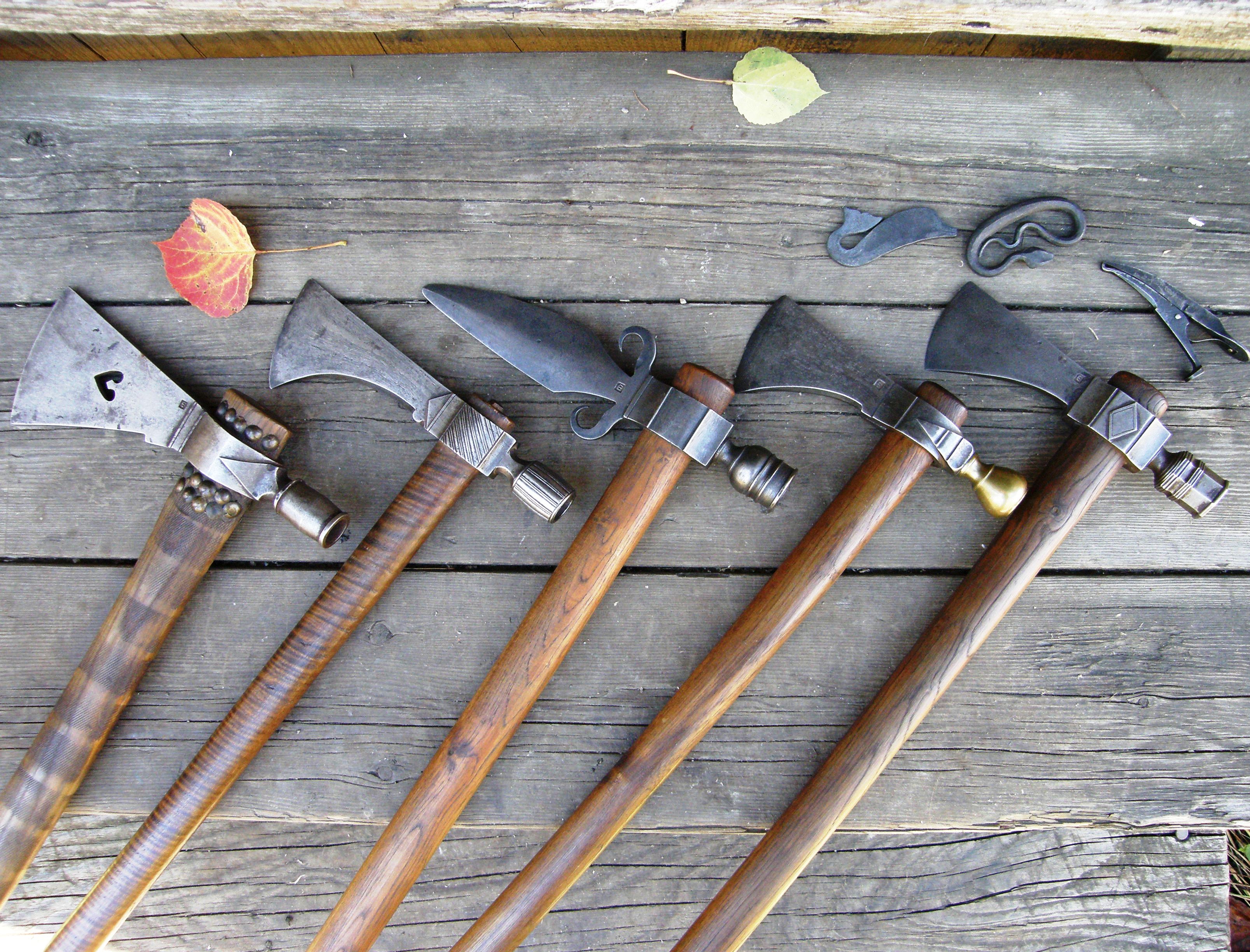
???????????????????????????????Here is a set of of some of the tomahawks that Brian has made.  The four on the right are replicas of mid 18th century pieces and double, as they did back then, as smoking pipes. The one on the left is a replica of a 19th century piece. I loved the small piece up in the upper right corner…the “smokers’s companion”…pincers with which to hold a coal for lighting the pipe and other parts for tamping down the tobacco and cleaning the pipe. The other small figures are for striking against flint.

brian anderson at workThere are so many little treasures around and about in Lausanne and Brian’s home. i could spend days and days examining them all and each piece has a story. When I brought in my little spindle whorls from Ecuador to show, Brian brought out this beauty that he got from Mexico many years ago….

spindle whorl from mexicoI have loved my stay here. I hope that I can come back to Vermont again. Lausanne is organizing a study group and I hope the weavers that I met these two weekends will get together to weave and support each other. I am looking forward to seeing what they create.

Nancy, who wasn’t able to weave with us the second time, went out and got some Plymouth yarn in a closing down sale and had a backstrap woven within days.nancyMeanwhile, on the other side of the US, Janet has been weaving with her handspun and teaching various people who stop by at her farm and mill.

Here’s one of her most recent students, Eric, about to start weaving on a fresh warp…

Erik backstrap weaving at Janet'sJanet promised a picture showing both sides of her guitar strap she wove in the intermesh structure (I teach it in my second book!). The guitar strap is SO amazing!….woven with Janet’s handspun naturally dyed wool.

intermesh guitar strap by janet finchAmd here’s what is on her loom right now…a pebble weave piece…

janets latest pebble weave pieceI love how she uses her tiny woven bands in her loom…. there’s a tanka choro saver cord and she is using a pebble weave band and a ñawi awapa as ties. What a gorgeous combination of colors.

The ever-creative Julia has used her pebble weave band that I showed on the blog recently on a pair of slippers that she made herself…

julias slippersShe used Plymouth Yarn Fantasy Naturale for the band. It is a heavy-weight mercerized cotton which is great for making backstraps and which was the perfect weight for this project too. What a cool project. If only I lived some place where I could wear slippers.

Larisa, who corresponds with me via my Andean Pebble Weave Facebook page, sent me pictures of her own creation in warp-faced double weave. She followed this tutorial on my blog to learn the technique. She calls this design “Tribal Mask”.

tribal mask by larisaSo…..I am heading south to Connecticut and then up to Massachusetts to weave and weave. I think that I will get even more doses of lovely fall colors as I head south. Today in Vermont it is wet and a little dreary (a good day to stay in and write my blog post) and we are noticing that trees that had their colors when I arrived are now bare.


violets 4 mum