Backstrap Weaving – A New Year and a New E-Book!

Happy New Year to all of you! I usually let December 31st slip on by but this time it was a little different because it marked the finish of my latest e-book on the eye-pattern tubular band and other decorative finishing techniques. It really did feel like a big finish and, as the fireworks boomed outside (we tend to only have the noisy ones here and not so many of the pretties), I almost felt as if they were cheering for me. I guess the end-of-year means something different for each and every one of us. This is what it meant to me at that very moment, and on and off until 2am! There are no official public displays of fireworks. People buy them in the market and let them off in their back yards. It can go on all night!

So….about the e-book. You may know this pretty eye-pattern tubular band by its Quechua name, ñawi awapa. I have seen it woven in various places across the highlands of Peru and Bolivia. Because I know of at least one other local name that is used for it, I decided to simply call it the eye-pattern band in my book.

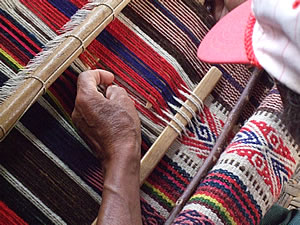
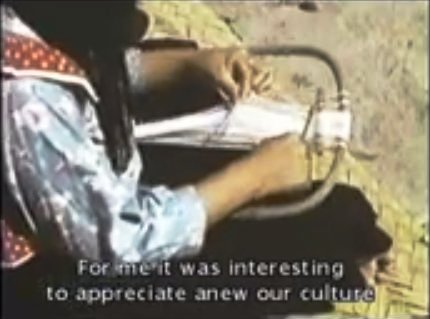
Weaving the eye-pattern tubular band in the central Bolivian highlands.

I have been happily applying it to my small woven pieces ever since I learned it. The novelty of seeing those little eyes appearing along the band never wears off! Used as an edging, it is the perfect finish to my woven pieces. In the highlands it is used for both decorative and practical reasons as it protects the edges of the fabric which are often the first parts to wear out.

Here’s my latest finished project using a simple two-color eye-pattern band as the edging on my Andean Pebble Weave wrist-cuff .

The tubular  band is woven and sewn simultaneously to the perimeter of the cuff using the weft as the sewing thread.

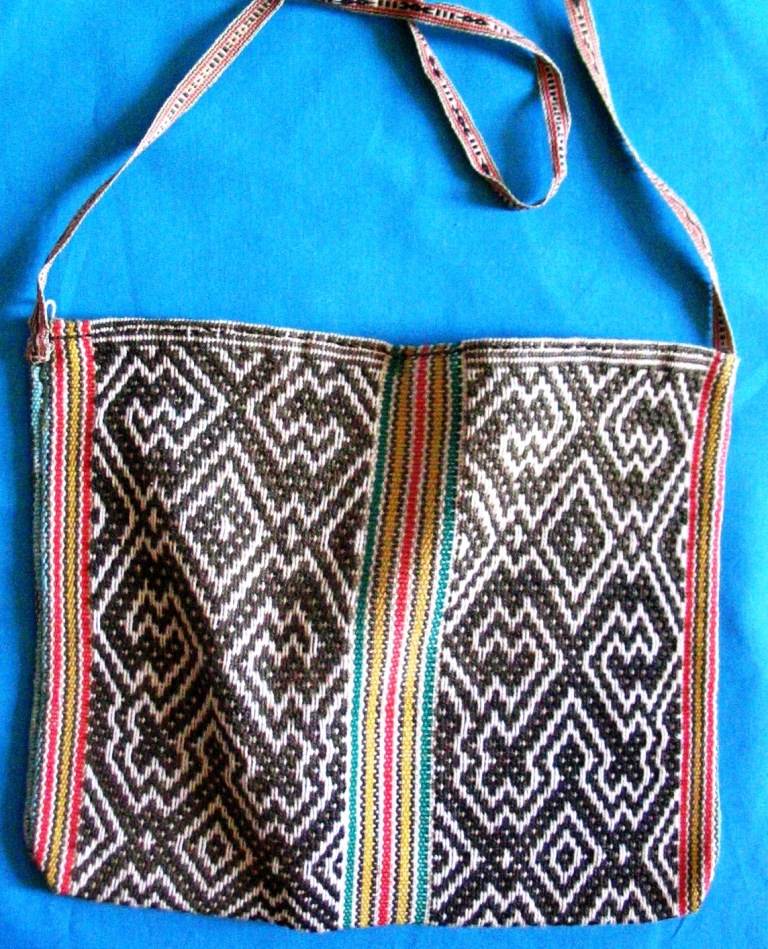
When I was learning to weave a coca-leaf bag with my teachers in Bolivia in 1997, I realized that removing the cloth from the loom did not mean the end of the project. It actually signaled the beginning of a whole new process that involved embellishing the piece with various decorative finishes. I saw that the eye pattern has different levels of complexity in different regions and that the methods used to create it can also vary. These kinds of similarities and differences have always fascinated me.

And, I have since learned that the eye-pattern tubular band is fun to weave on its own rather than purely as an edging. It makes lovely necklaces on which to hang pendants, sweet bracelets and bangles, and can be used in a variety of ways in accessories….fobs for keys and tools, lanyards, eye-glass holders, shoe laces, straps and drawstrings…. From my own experiments, I show you how to create straight, curved and spiraled versions of the tubular bands. They all have their particular charm!

One of the many fun things about this pattern is that you can make it as subdued or as lively as you like. I am generally limited to using only two colors at once in a pattern when I do most of my basic pick-up weaving techniques. The eye-pattern band allows you to use up to five or even more colors in the pattern. My favorite combination is usually with only three but you can make them as colorful as you like!


The traditional way to weave these tubular bands is by having the narrow warp attached to the weaver’s waist or belt with a piece of string. String heddles are not used at all and so the weaver’s body is simply suspending the warp. The weaver is not required to move the body back and forth to add or relax tension on the warp to help operate the heddles.

You should at least be familiar with weaving terminology…warp, weft, beat, shed etc…before you approach this.

Because heddles are not used at all to create the sheds, the warp can be easily set up and woven using an inkle loom or any other loom or frame that allows you to adjust tension for take-up. Full instructions on how to set up and weave the independent band on an inkle loom are included in both versions of the e-book.

Here I am weaving one on my tiny Ashford Inklette.

My e-book is available in two versions. One contains the instructions for weaving the eye-pattern band as an independent tube and then goes on to show how to weave and sew it simultaneously as an edging along the two sides of a project, or around corners, covering all edges.

I used a two-color eye-pattern tubular band to dress up a simple pouch that I made with commercial cotton fabric. The cross-knit-loop stitch decorates the mouth of the pouch.

Other decorative sewn finishing techniques such as the coil stitch, pictured below, are included with dozens of step-by-step photos as well as drawings.

The other version of the e-book is for those who only want to weave the band as an independent tube, perhaps for using it in jewelry and accessories, and aren’t interested in the sewing techniques. Both books provide ideas, instructions and suggestions for finishing the bands and for using them in such projects.

There are links to both versions in each one’s product description on the Taproot Video page.

And, let me tell you about something new for my e-books……

Both e-books include access to supplemental video clips. These are not stand-alone tutorials. They were designed to allow you to see “in action’’ some of the processes. The techniques are thoroughly explained in the books using over 140 photos, drawings and diagrams and so the videos really are optional supplemental material. With these additional materials I hope to be able to cater to a greater variety of learning styles. I had a lot of fun making those video clips and I am thrilled with them! Links to the videos are provided in the ebooks where they can be viewed and/or downloaded, if you like. They are better viewed after you have read each tutorial. Little video camera symbols in the book will let you know when there is a related video clip to be viewed.

For my left-handed weaving friends, I have included instructions in the Appendix on how to adapt the weaving technique to suit. You will notice that I said for my left-handed weaving friends. I am sorry, but for the sewing techniques in the book, I have left it up to you to adapt.  My left-handed students have always been so awesomely good at doing that in my classes!

I will leave you with this picture of me with one of my teachers, Maxima, spending a tranquil afternoon together. I weave as Maxima sews a decorative edging to a small pouch. The pouch on which she taught me to weave and sew a tubular band, lies on the ground between us. This was on my birthday back in 2011….a lovely way to spend it.

So, I hope that you will enjoy the e-book and I look forward to seeing what you create using it!

I wish you all the best for 2019!

(Hair update, for those who are interested…. I now have a blunt-edged chin-length hair cut with a good five months of grey growth!).


Backstrap Weaving – Travelers

TRAVELERS…..Postcards from the road….a few thoughts, discoveries, news items, and observations as I weave my way here and there across the USA…

A DISCOVERY:

Before I could even leave Bolivia. my eye was caught by a splash of color as I hurried through the Duty Free Shopping Zone in Santa Cruz airport. There I spotted a pile of colorful fabric wedged between the perfume and cosmetics with a very familiar pattern…

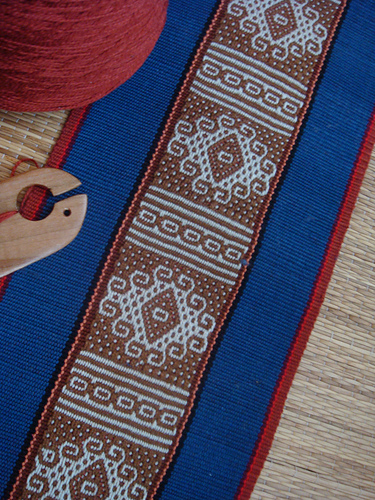
???????????????????????????????It’s an acrylic piece of cloth in lively colors with stripes and bands of two classic weaving patterns of the community of Chinchero in Peru. Anyone who has had anything to do with the Center for Traditional Textiles of Cusco (CTTC) will immediately recognize these patterns as they appear on hundreds of articles such as purses, bags, and table runners that are offered for sale there. The CTTC textiles have been woven with handspun naturally dyed wool and alpaca yarn. I have no idea where this small acrylic piece was made. There is nothing to say that it originated in Chinchero, let alone Peru. It is edged and backed with synthetic material and has been designed to be used as a book cover. It has been very nicely put together. A friend of mine commented that, for all we know, it could have been made in China!

This image of the loraypo motif painted on a wall in Chcero is from the webpage malloryinperu.blogspot.com.
This image of the loraypo motif painted on a wall in Chinchero is from the webpage malloryinperu.blogspot.com.

???????????????????????????????The most surprising thing about it for me is the small “Bolivia” label in the colors of the national flag that has been sewn diagonally across one corner. I suppose these pieces will show up in all the souvenir and duty free stores in airports across the region…Argentina, Chile, Peru, Bolivia and Ecuador… with a label representing the flag and name of each country. It is an example of patterns that have become “travelers”, having left their home in the high Peruvian Andes and wandered, as in this case, to appear with a different identity in such places as a Duty Free store in tropical lowland Bolivia.

From these eastern lowland extremes, to the highlands of Ecuador in the west, the loraypo and jikaku sisan motifs (the spelling of these Quechua words seems to vary) appear in the work of other indigenous weavers.

On my very first visit to Otavalo region in Ecuador, I saw the jikaku sisan pattern in pieces that had been woven in Ecuador by Miguel Andrango, fell in love with it, but had no idea about Peruvian origin of the pattern at that time.

Migue Andrango's garnddaughter sits alongside one of the pieces in progress in his workshop in Peguche, Ecuador.
Miguel Andrango’s granddaughter sits alongside one of the pieces in progress in his workshop in Peguche, Ecuador.

Lynn A Meisch writes in her book Andean Entrepreneurs: Otavalo Merchants and Musicians in the Global Arena (excerpts may be read online)….

A band woven by Ecudorian weaver Jose Cotocachi from the webpage kristincrane.blogspot.com.
A band woven with the loraypo pattern by Ecudorian weaver Jose Cotocachi from the webpage kristincrane.blogspot.com.

When Peace Corps volunteer Dennis Penley took his weaving teacher Miguel Andrango of Agato to Peru in 1973, they were harrassed by Ecuadorian and Peruvian police and border guards, who were outraged that a gringo and an “indio” were traveling together. Dennis and Miguel were hauled off buses for passport checks and questioning and subjected to considerable verbal abuse. The Peru trip was still positive for Miguel. Indigenas in Chinchero, Peru, taught him their weaving techiques, which Miguel taught to other weavers in Agato and incorporated into his textiles.

In the following picture of Miguel Andrango at work, from the web page of Isabella Whitworth (isabellawhitworth.co.uk), it seems that Mr Andrango uses a different technique for picking up the patterns to that used by Chinchero weavers I have seen at work. It looks like he first opens the shed of light warps and selects warps for forming the pattern. He saves them on a stick while he then opens the  shed with the dark threads and does the same.

andrango2

While on the theme of “travelers”… motifs which have left their place of origin…, I will tell you about one of my Bolivian weaving teachers, Maxima, who has been to both the Tinkuy events organized by Chinchero weaver Nilda Callañaupa and the CTTC in Peru. At the first one in 2010, which I also attended, she took the natural dyes workshop.

At the second one last year, she learned to weave four Chinchero motifs in one of the workshops and was able to add these to her own repertoire of patterns. Maxima also demonstrated weaving at the Tinkuy on the leaning looms that are typical of her home of Independencia, Bolivia.

maxtinkuyWhile some of the motifs woven in Chinchero are also used in Bolivian textiles (the mayo kenko pattern, for example, is used by Maxima in her home in central Bolivia where she knows it by the name linquito), many are unique to Chinchero.

It will be interesting to see how Maxima chooses to use the new patterns and how they will spread within her community. Cooperatives are being formed and they are competitive. Weavers are always looking for new designs and techniques so that they can have the edge over their competitors by offering something new.

Speaking of Maxima and the weavers and spinners of Independencia, here’s a piece of news:

A group of twenty-five spinners comprising Maxima and her peers with the team name of Warmis Phuskadoras will be entering the 2014 Spinzilla event in October. I don’t know a whole lot about Spinzilla and what it entails but it has been running very successfully for a few years now and this is the first year in which international entrants have been permitted. Thanks to sponsorship from Thrums and Clothroads, the ladies were able to pay the entry fee and register their team to join 1400 other entrants. Read Dorinda Dutcher’s blog post on her PAZA webpage about preparations and post-contest excitement in the mountains of central Bolivia.

Warmis Phuskadoras planning meeting. Dorinda reads in Spanish while Maxima translates to Quechua.

Another news item of a more personal nature involves my nephew, Ryan, and his bid for gold representing Australia in the World ITU Long Distance Triathlon Championships in Weihai, China. Some weeks ago I asked for your support by “liking” Ryan’s Facebook page. We were both quite overwhelmed by the response. It was wonderful!!

The race was run last Sunday and Ryan fulfilled his dream by winning not only his age group, but the entire amateur category outright and becoming the World Amateur Champion. Here he is bringing the Australian flag to the finish line on the final stretch…

10710872_734796429926140_4057429826783732329_nAnd here on the podium…gold medal winner! I love that hat. He bought it when he was only 15 on a trip he and I took together to Ayers Rock. Who knew back then that it would travel to China with him and appear on the podium?!

10698425_734796546592795_8995245831394791285_nRyan wrote a blog post about the race which really captured all the agony and excitement. In it he took a moment to thank all of you for your support…

Finally I’d like to thank everyone who has supported me, my sponsors, family, friends as well as the weaving community who are associated with my aunt and really supported both her and myself by taking an interest in something and someone so foreign.

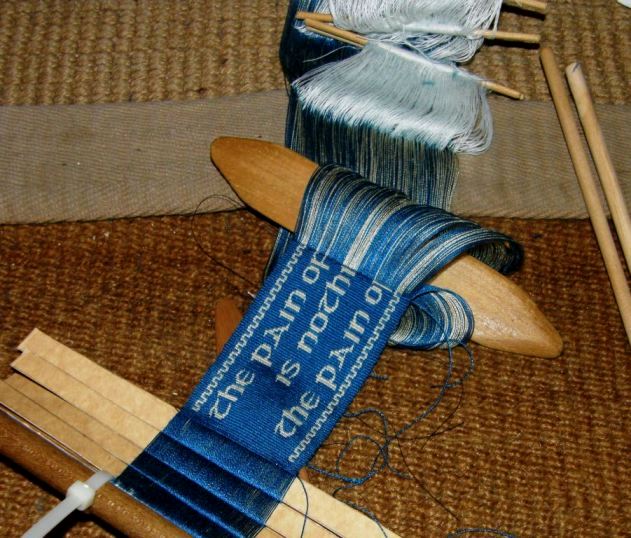
He can always do with more support in the form of page “likes” to attract sponsors so, if you haven’t already done so, please “like” his page. Now, I really must get my act together and make the silk bookmark I promised him. The prototype is below…”The pain of discipline is nothing like the pain of failure”… one of Ryan’s favorite inspirational quotes.

silk bookmark backstrap weavingWhile I don’t get to do much weaving of my own while on the road, the backstrap sticks have been clacking away in the homes of my online weaving friends. Lausanne wove a band in wool using one of the knotwork patterns that I have charted in my second book for the Andean Pebble Weave structure. Lausanne plays the fiddle and is using this band a a sheath for her bow…

10646717_10203926105224941_7621398630356267098_nOlive and Oaks finished her backstrap and her project reminds me how extremely satisfying producing good plain weave can be…

OliveandOaksAnother plain-weave piece by Gwen is underway and will be made into a bag for her loom. The second panel will match this one and will also have supplementary-weft patterns in yellow…

gwen bagJulia has been pushing her skills with the classic Andean hook even further with her latest piece..

julia

Alittle piece of Tibet in western Massachusetts. Liz's landlaord Sonam is a master stone mason.
A little piece of Tibet in western Massachusetts. Liz’s landlord Sonam is a master stone mason.

Since I last wrote a blog post, I have traveled from the tropics of lowland Bolivia to Massachusetts where the first nip of cooler fall weather was in the air. Hints of red were already showing against the greenery and I spent the fall equinox weaving with a group at Liz’s place.

Over my four days there I made new weaver friends and also connected with several ladies who had woven with me before. We created Andean hooks and tubular bands.

Liz has moved into a new space  since my last visit and has an even  larger and more inviting space now.

While we wove, the sister of her Tibetan landlord, dressed in traditional clothing, would be walking about outside. She doesn’t speak English and I was so hoping that somehow she would catch a glimpse of what we were doing and come and sit with us. Apparently, she walked in on one of Liz’s spinning groups one day and sat down happily to spin.

And now I have traveled over to Arizona and I can’t imagine a more different environment! I am looking forward to a visit to the Heard Museum in Phoenix tomorrow to see their famous collection of Native American textiles.

globe aAnd so, I will leave you with something in keeping with this week’s “travelers” theme. This is an image I made via a fun website which allows you to paste your pictures on a globe.

Backstrap Weaving -The Bag of Tricks

I had to dig deep into the bag of tricks this week to come up with a new idea for finshing off my latest three-panel wall hanging. Two days of experimenting with the structure that I had hoped to use for the two outer red panels finally led me to the conclusion that it just was not going to be as I had envisioned. It was time to plan again and take a look at all that I have at my disposal in my “bag of tricks”.  And there is a lot of stuff in that bag of tricks after having spent almost 18 years now studying weaving techniques and simple looms used in South America.

main panel of Shipibo inspired wall hanging backstrap loomThe main panel for the wall hanging is now finished. I can’t cut it off the loom yet to better show you the stepped effect of the woven fringe as I will need to place the two red panels, when I am done weaving them,  on this same loom and then twine across the top of all three to join them together.

It is always fun turning a finished piece over to look at the other side. I have been looking at white squiggles on black for so long now as I inched my way through this weaving. Yes, literally inched. I took note of my progress on the woven fringe part and it was pretty much an inch a day.

light sde of shipibo inspired hanging off loomThis side actually looks more like the painted Shipibo cloth that inspired this project. It is much more common to see light cloth with dark lines. But I don’t have to make any decisions here about which side to show. It needs to be the dark side in order to match the other pieces in this wall hanging series.

I want this second wall hanging to represent the weavers of the tropical lowland regions of Peru. For that reason I had chosen to use the structure that is used by people of the upper Amazon Basin to make wristlets.

shipibo-wristletsI have never been to that part of Peru and so was relying on a sample that I had been given from the work of Nora Rogers and Ann Blinks as well as notes by Cheryl Samuel in order to reproduce the structure. I bought red hemp twine for this project while in the USA. The weave is based on having twined warp threads lying next to what Samuel calls a “half basket weave”.

wristletI did succeed in reproducing the structure but the hemp twine did not give the design the relief that I had been hoping for. It was just a flat red mass at which I had to peer in just the right light in order to make out the pattern.I tried all kinds of weft and beat but I simply could not get the desired effect.  Nevertheless, I found myself sitting alone stupidly squealing with happiness as the piece started to take shape. It was a joy just to able to reproduce it but a disppointment  not to be able to use it in my hanging.

Back to the drawing board. I wanted something that would be all red but with texture and, of course, something that would represent textile techniques of the lowlands.

But, of course….simple warp floats!

shipibo pattern in simple warp floatsSome time ago I had woven the placemat, above, using a two-color simple warp float technique. I copied the pattern from a cotton bag from tropical lowland Peru that Teyacapan shows on her Flickr page. The design is one that I have also seen painted and even embroidered on Shipibo cloth.

The set of placemats I wove became a study of the use of this structure in several regions across the globe…

backstrap weaving placemats simple warp floatsAt the Encuentro de Tejedores that I attended in Cusco in 2012, I was able to observe Matsigenka backstrap weavers from Bajo Urubamba creating striking black and white pieces with their handspun cotton. The pieces were decorated with patterns that were created from simple warp floats.

??????????????????????

Photo by Jennifer Moore

The picture above was taken at Tinkuy 2013 in Cusco and shows a weaver from Pacaya, in tropical lowland Peru, weaving a warp float pattern with handspun cotton on a backstrap loom.

It isn’t necessary to have two colors to create patterns in this structure. If I used an all-red warp, I could create patterns of raised red-on-red….textured patterns rather than colored ones.  I also had a Mexican sash that my friend Annie MacHale had given me way back in 2010. I then remembered that weaving a single- colored piece with warp float patterns had been on my to-do list for some time. It was all coming together nicely!

???????????????????????????????The weaver of this Mexican sash has alternated a heavy warp thread (doubled threads) with fine to create a high-relief pattern in white on white.

???????????????????????????????Above, you can see my red experiments…the hemp twine wristlet structure and the red-on-red simple warp floats.

red-on-red simplewarp floatsI experimented with floating pairs and floating single threads and decided that single was the way to go. I wanted the pattern to be fairly delicate and subtle so as not to interfere with all that is going on in the main black-and-white panel. I decided to weave the solid lines of the main panel with the arrow motif in the center.

I set up both panels on the one loom in the same way that I had done for the first wall hanging. This would ensure that both came out the same way.

???????????????????????????????

red on red panels on backstrap loom

arrow motif red on red panelsYou’ll have to trust me when I tell you that these panels are deep red and not the weird pinkish-red that you see here.

Now it is time to start sketching ideas for the weft-twined pattern that will go across the top of the finished three panels. I remember I had a heck of a time with the twining on the first wall hanging trying to group the warps correctly so that the twined width matched the woven width. Hopefully it won’t take as many attempts this time to get it right!

And in my spare moments I doodle and think about wall hanging number three…the ikat one. Luckily I have a giant cone of thread and a a huge roll of ikat tape (thank you Betty!). I expect there to be a few do-overs for that one! I am also hoping to use supplementary-weft to create patterns on that piece. These ideas are just sloshing around in my mind for now but I hope to base the overall design on hook motifs in positive and negative space like the ones I played with recently in silk supplementary weft on cotton…hook motif mirrored and flippedThen there will be the third series of wall hangings in which I hope to put what I learned with my ticlla (discontinuous warp) experiments to use….using wool and the red-black-and-white combo, of course!

dovetail join ticlla waddington

ticlla with supplementary weft inlayI have spent a lot of time putting that big bag of tricks together. It is nice to be able to use these experiments to create bigger things. I look way, way ahead and I get excited about all these projects as I inch my way along!

See you next week.


Backstrap Weaving – Songs from the Lowlands

While scrambling to prepare for my up and coming travels, I have a little time to show you the latest progress on my Shipibo-inspired piece. I have spent some time looking about online for more information about the Shipibo designs and my head is reeling with the variety of information that is out there on the meaning of the patterns.

I have heard several version from my weaving teachers about the name and meaning of this Bolivian motif. explaations of the
I have heard several versions from my weaving teachers about the meaning of this Bolivian motif.

It doesn’t surprise me. I have written here before that I can ask five weavers here in Bolivia the meaning of a certain motif and receive three different answers. I have heard different stories about designs from people even within the one small community. The real question is, do the weavers even want to share this special information with me?

My warping activity is fairly mindless. I wind warps, make heddles, and sometimes weave a few rows to get the piece started. I don’t need to concentrate except to count revolutions on my warping board and so, it is an activity that allows me to put on some music and sing. And, after having read one of the web pages that has information about Shipibo patterns, it is fun to imagine the woven designs in the cloth in my latest piece singing back at me. I will explain that a bit later…

Unfortunately, I can’t sing while I weave this piece. It involves a lot of concentration… jumping back and forth from chaotic curvy lines to orderly straight ones. One miscount, that may seem insignificant at first, can add up to a big blooper further down the track. I’ve learned that the hard way!

shipibo inspired wall hangingNow…about the songs and the singing. The Center for Shamanic Education is one of the sites from which I learned a little about the Shipibo patterns and their relationship to music. According to this site, the Shipibo people, who live in the Amazon Basin region of Peru, believe that everything is a song and that everything can be sung.

Image from the web site thestorybehindthefaces.com

“In the Beginning a giant anaconda swam through the darkness. She sang the patterns on her back and the patterns fell from her mouth in her song. The patterns took form and created the universe and the people – The Shipibo.”

The patterns are called Icaro (another site calls them Kene) and they are woven into or embroidered on cloth and painted on ceramics, houses and skin.

At the Encuentro de Tejedores that I attended in Cusco in 2012 anthropologist Dr Luisa Elvira Belaúnde, who also called the designs Kene, talked about the patterns that are tatooed on the skin saying that the Shipibo-Konibo people believe that patterns already exist within the person and are simply made to emerge on the skin. A woman’s body is wrapped in design either in the form of tatoos or by wearing patterned cloth.

The Center for Shamanic Education also writes that the Icaro carry healing energy and are a form of musical notation.It says that the Shipibo do not differentiate between seeing and hearing which means that the Icaro patterns in the cloth are constantly singing. What a lovely concept! In rituals, Shamans can hear and sing the tunes of songs from the labyrinth of lines in the patterns.

The labyrinth of lines…what I have been calling a “curvy chaos” in my own piece…is musical notation to the Shipibo people.

One Youtube video which shows a number of pieces of patterned cloth created by the Shipibo people is accompanied by song and the wonderful sounds of the forest.

I have a couple of very small pieces of Shipibo cloth that I bought in a store in Ecuador. I have never been to the Amazon Basin region of Peru.

???????????????????????????????My friend, Yonat, has a gorgeous piece of Shipibo embroidery in her textile collection…

shipibo-embroidery 1

shipibo-embroidery 2The painting and embroidery are now done on  industrially-produced fabric. I wondered if there was anyone still weaving among the Shipibo people. Teyacapan posted a picture of a woven bag from the Peruvian Amazon Basin on her Filckr page. As I had done with my pieces of painted cloth, she had bought the bag in a gallery in Quito, Ecuador. The designs on this bag appear on some of the painted cloth pieces that I have seen.

Z (11)I am guessing that this is the single-faced warp-float technique only because all the lowland weavers that I have encountered so far in Peru and Ecuador who use this structure  weave the single rather than double-faced version.

I used this design on a placemat that I wove along time ago….

???????????????????????????????I wasn’t able to find other images of Shipbo woven pieces or weavers until I came across a video, made in 2011, which is the trailer for  a documentary on footage that was shot by anthropologist Harry Tschopilc Jr in 1953. The footage has been uncovered in the archives of the Field Museum of Chicago and the documentary covers a project which involved taking the footage and showing it to the Shipibo people. The documentary captures the reaction of the Shipibo people, both young and old, to seeing aspects of their culture and lifestyle that have been lost in the last 60 years. The 60-year old footage shows a Shipibo woman weaving using a backstrap loom as well as one weaving on a small frame that could have been made from a bent tree branch. There is also recent footage of a woman using a backstrap loom to weave a very long and colorful narrow band.

Here are a couple of screen shots from the old film…

video trailer 1

video trailer 2And here is the complete trailer…

I try to imagine the sounds of the forest that you can hear on the first Youtube video in this post as I sit at my loom. The weavers most likely have the songs of the Icaro in their heads as they work. Right now, I hear planes droning overhead, the sounds of car alarms and the rumble of the big plastic trash bins as they are wheeled out to the street…life in the city!

There are two quite long Youtube videos, parts 1 and 2, that show the process of creating the painted patterns on the cloth here and here. Again, there is song and forest sound in the background…lovely.

So, I will continue with my wall hanging panel. It will be flanked by panels of deep red and I will join the three panels at the top with weft twining. I hope to twine a pattern that has been inspired by the work of the Shipibo people.

Maybe now you can understand better what I was doing when I was on the floor a few weeks ago drawing squiggles. I had seen wavy lines amongst the hairy wool warp threads on which I had been working a few months ago and  from that was born the idea for this Shipibo-inspired work.

???????????????????????????????See you next week! 

Backstrap Weaving – One Warp, Many Lessons

Guatemalan pick up sticksI have been playing with my black scarf warp for a week now and feel that, at last, I am slowly getting to know the “beast”. There have been some adventures along the way.

I am not so nervous now about the fineness of the threads. While broken warp threads are a major nuisance, they really aren’t that hard to fix once you have a system. Having said that, I haven’t broken many. As it turns out this Guatemalan cotton is surprisingly resilient. I like it.

I have learned to slowly and softly strum the warps with the blunt end of my pretty Guatemalan pick-up sticks (pictured at left) as I open the sheds. I insert the sword and shuttle carefully. Hitting a thread  along the way will either loosen or break it. I think that loose threads are possibly even more annoying and more difficult to remedy than broken ones.

In the meantime I enjoy sitting back now and then to look at the smooth silky curtain of unwoven thread in front of me. It is impossible to see each individual thread. They all merge into a black glossy sheet of loveliness which I have tried without success to capture in a photograph. Is this warp a black beast or a black beauty?

sample for Guatemalan cottonYou may be surprised to find that I have not really advanced at all since I showed you the piece last week. While I haven’t advanced in terms of inches happily woven, I have advanced in lessons learned. There were, in fact, many inches woven….and then sadly un-woven, woven and un-woven yet again….before I could feel happy with what I was producing. And that showed me more than anything how much abuse this cotton thread could stand.

Firstly I had to give in to the fact that it was useless trying to weave a 7-inch piece of fabric on a warp that clearly wanted to be wider.

Lesson 1: Sometimes a “wee” sample just isn’t going to do the trick! The teeny tiny band that I hastily wove to test this new-to-me yarn simply did not have enough ends to give me a true reading of the width I could expect. So, after un-weaving and starting to weave the black beast once again, I let it settle into the width it was yearning to be.

Lesson 2: Don’t get so caught up in happily playing with the supplementary-weft patterns, that you neglect to keep a close eye on what is happening to the ground weave. Yes, I was having a lovely time playing with the soumak technique and didn’t notice how much the ground weave, or the “canvas” on which I was placing the patterns, was becoming distorted. This was a sign that I was stuffing too much supplementary-weft into the sheds. The material that I was using for the supplementary weft, 8/2 tencel, was not appropriate.

Lesson 3: Several strands of fine yarn work better as a supplementary weft than just two strands of a thicker yarn. I already knew this!! but, I was in really new territory with this fine yarn and again, my sample had “lied” to me!  So, it was out with the 8/2 tencel and, yippee, I got to use my new 60/2 silk.

60/2 silk

So, instead of two 8/2 tencel sausage-like strands, I used six to eight strands of the 60/2 silk which emerged from the ground weave to lie side by side like a glossy satin sheet on the surface of the fabric.

Lesson 4: Not everything that is labeled as 60/2 silk in the bargain basket at the yarn store is, in fact, 60/2. Imagine the frustration…. I kept doing my sampling with six strands the off-white silk pictured above as I have more of that than the colors. Then I would weave the “real thing” with the colors. But things just weren’t working out. Why? The off-white 60/2 is at least twice as thick as the colored 60/2’s!…go figure.

Lesson 5: Slow down! A little extra planning goes a long way. It was beautiful to see a video of  Bhutanese weaver Leki Wangmo at work on an incredibly richly patterned piece of fabric. It was as if she had cast her arm across the warp and scattered seeds.  Then we got to watch as the the seeds sprouted and flourished into patterns. It all seemed so random but, without a doubt, it was all carefully thought through and planned from the moment the first warp thread wound its way about the warping stakes. The strategic placement of the stripes and the placement of the particular patterns within them was all part of the overall plan.

backstrap loom Bhutan

It was hard for me, having so many photos and books with images of designs to use on my scarf, to carefully select and plan the layout of my piece. I wanted to weave and try everything at once! Result…mess! Un-weave and start again!

Scarf project with supplementary weft patterns backstrap loom

So, here it is. It may look much the same to you as what I showed you last week but it is, in fact, a little wider, the colors are slightly different and I am using silk weft instead of tencel. Funny how some of the small skeins of white thread dyed in the one black dye bath came out more intensely black than others…another “go figure”. I need to even up the length of the exit points of the supplementary wefts so they look neater and more consistent.

Now I am taking it all more slowly…enjoying rather than fearing the fineness of the cotton warp threads, appreciating the smoothness of the silk weft. I no longer think “Aargh!…sticky warp”. I gently strum and the sheds open cleanly. Now to sit down and map out a design.

While I sit and feel pleased with my seven-and-a-bit-inch piece of cloth as it takes shape on the loom, I remember the backstrap weavers from Tacabamba, Peru that I met in Cusco with their equally fine cotton ikat-patterned shawls measuring up to a meter in width  Humbling!! Oh so very humbling!!

The simple backstrap loom of Tacabamba, Peru on which the indigo ikat-patterned "panones" are woven. They are up to one-meter wide, covered with tiny motifs and have patterns knotted into their fringes.
The simple backstrap loom of Tacabamba, Peru on which the indigo ikat-patterned “panones” are woven. They are up to one-meter wide, covered with tiny motifs and have patterns knotted into their fringes.
Of course, the warp lying idle on the ground attracted many admirers all anxious to see it spring to life.
Of course, the warp lying idle on the ground attracted many admirers, all anxious to see it spring to life.
Nila sits while she prepares the loom for weaving. Weaving is done standing up.
Nila sits while she prepares the loom for weaving. The weaving itself is done standing up.
A few final adjustments are made before weaving can begin. Then Nila asked the crowd to give her more room and we all understood why when she raised the very long sword and shuttle to be placed within the sheds.
A few final adjustments were made before weaving could begin. Then Nila asked the crowd to stand back and give her more room and we all understood why when she raised the very long sword and shuttle to be placed within the sheds.

Now you can watch Nila at work!…The video starts with laughter as Nila nearly clobbers an onlooker, who got too close, with her sword! I love the way she gently pats the warp to separate the threads. That is her way of dealing with any stickiness. I love her balance…one arm outstretched to help her stay centered while the other reaches to pass the shuttle. It’s like a dance.

wearing the Tacabamba shawl

Here’s Tacabamba weaver Laura wearing one of the shawls…something to aspire to??? So, I head back to my wee 7-inch piece hoping that I will end up with something that has at least some of the lovely drape that those warp-faced shawls have!