Backstrap Weaving – Travelers

TRAVELERS…..Postcards from the road….a few thoughts, discoveries, news items, and observations as I weave my way here and there across the USA…

A DISCOVERY:

Before I could even leave Bolivia. my eye was caught by a splash of color as I hurried through the Duty Free Shopping Zone in Santa Cruz airport. There I spotted a pile of colorful fabric wedged between the perfume and cosmetics with a very familiar pattern…

???????????????????????????????It’s an acrylic piece of cloth in lively colors with stripes and bands of two classic weaving patterns of the community of Chinchero in Peru. Anyone who has had anything to do with the Center for Traditional Textiles of Cusco (CTTC) will immediately recognize these patterns as they appear on hundreds of articles such as purses, bags, and table runners that are offered for sale there. The CTTC textiles have been woven with handspun naturally dyed wool and alpaca yarn. I have no idea where this small acrylic piece was made. There is nothing to say that it originated in Chinchero, let alone Peru. It is edged and backed with synthetic material and has been designed to be used as a book cover. It has been very nicely put together. A friend of mine commented that, for all we know, it could have been made in China!

This image of the loraypo motif painted on a wall in Chcero is from the webpage malloryinperu.blogspot.com.
This image of the loraypo motif painted on a wall in Chinchero is from the webpage malloryinperu.blogspot.com.

???????????????????????????????The most surprising thing about it for me is the small “Bolivia” label in the colors of the national flag that has been sewn diagonally across one corner. I suppose these pieces will show up in all the souvenir and duty free stores in airports across the region…Argentina, Chile, Peru, Bolivia and Ecuador… with a label representing the flag and name of each country. It is an example of patterns that have become “travelers”, having left their home in the high Peruvian Andes and wandered, as in this case, to appear with a different identity in such places as a Duty Free store in tropical lowland Bolivia.

From these eastern lowland extremes, to the highlands of Ecuador in the west, the loraypo and jikaku sisan motifs (the spelling of these Quechua words seems to vary) appear in the work of other indigenous weavers.

On my very first visit to Otavalo region in Ecuador, I saw the jikaku sisan pattern in pieces that had been woven in Ecuador by Miguel Andrango, fell in love with it, but had no idea about Peruvian origin of the pattern at that time.

Migue Andrango's garnddaughter sits alongside one of the pieces in progress in his workshop in Peguche, Ecuador.
Miguel Andrango’s granddaughter sits alongside one of the pieces in progress in his workshop in Peguche, Ecuador.

Lynn A Meisch writes in her book Andean Entrepreneurs: Otavalo Merchants and Musicians in the Global Arena (excerpts may be read online)….

A band woven by Ecudorian weaver Jose Cotocachi from the webpage kristincrane.blogspot.com.
A band woven with the loraypo pattern by Ecudorian weaver Jose Cotocachi from the webpage kristincrane.blogspot.com.

When Peace Corps volunteer Dennis Penley took his weaving teacher Miguel Andrango of Agato to Peru in 1973, they were harrassed by Ecuadorian and Peruvian police and border guards, who were outraged that a gringo and an “indio” were traveling together. Dennis and Miguel were hauled off buses for passport checks and questioning and subjected to considerable verbal abuse. The Peru trip was still positive for Miguel. Indigenas in Chinchero, Peru, taught him their weaving techiques, which Miguel taught to other weavers in Agato and incorporated into his textiles.

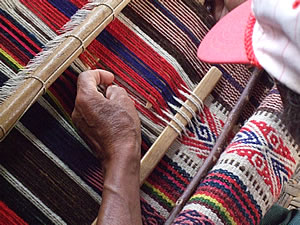
In the following picture of Miguel Andrango at work, from the web page of Isabella Whitworth (isabellawhitworth.co.uk), it seems that Mr Andrango uses a different technique for picking up the patterns to that used by Chinchero weavers I have seen at work. It looks like he first opens the shed of light warps and selects warps for forming the pattern. He saves them on a stick while he then opens the  shed with the dark threads and does the same.
andrango2

While on the theme of “travelers”… motifs which have left their place of origin…, I will tell you about one of my Bolivian weaving teachers, Maxima, who has been to both the Tinkuy events organized by Chinchero weaver Nilda Callañaupa and the CTTC in Peru. At the first one in 2010, which I also attended, she took the natural dyes workshop.

At the second one last year, she learned to weave four Chinchero motifs in one of the workshops and was able to add these to her own repertoire of patterns. Maxima also demonstrated weaving at the Tinkuy on the leaning looms that are typical of her home of Independencia, Bolivia.

maxtinkuyWhile some of the motifs woven in Chinchero are also used in Bolivian textiles (the mayo kenko pattern, for example, is used by Maxima in her home in central Bolivia where she knows it by the name linquito), many are unique to Chinchero.

It will be interesting to see how Maxima chooses to use the new patterns and how they will spread within her community. Cooperatives are being formed and they are competitive. Weavers are always looking for new designs and techniques so that they can have the edge over their competitors by offering something new.

Speaking of Maxima and the weavers and spinners of Independencia, here’s a piece of news:

A group of twenty-five spinners comprising Maxima and her peers with the team name of Warmis Phuskadoras will be entering the 2014 Spinzilla event in October. I don’t know a whole lot about Spinzilla and what it entails but it has been running very successfully for a few years now and this is the first year in which international entrants have been permitted. Thanks to sponsorship from Thrums and Clothroads, the ladies were able to pay the entry fee and register their team to join 1400 other entrants. Read Dorinda Dutcher’s blog post on her PAZA webpage about preparations and post-contest excitement in the mountains of central Bolivia.

Warmis Phuskadoras planning meeting. Dorinda reads in Spanish while Maxima translates to Quechua.

Another news item of a more personal nature involves my nephew, Ryan, and his bid for gold representing Australia in the World ITU Long Distance Triathlon Championships in Weihai, China. Some weeks ago I asked for your support by “liking” Ryan’s Facebook page. We were both quite overwhelmed by the response. It was wonderful!!

The race was run last Sunday and Ryan fulfilled his dream by winning not only his age group, but the entire amateur category outright and becoming the World Amateur Champion. Here he is bringing the Australian flag to the finish line on the final stretch…

10710872_734796429926140_4057429826783732329_nAnd here on the podium…gold medal winner! I love that hat. He bought it when he was only 15 on a trip he and I took together to Ayers Rock. Who knew back then that it would travel to China with him and appear on the podium?!

10698425_734796546592795_8995245831394791285_nRyan wrote a blog post about the race which really captured all the agony and excitement. In it he took a moment to thank all of you for your support…

Finally I’d like to thank everyone who has supported me, my sponsors, family, friends as well as the weaving community who are associated with my aunt and really supported both her and myself by taking an interest in something and someone so foreign.

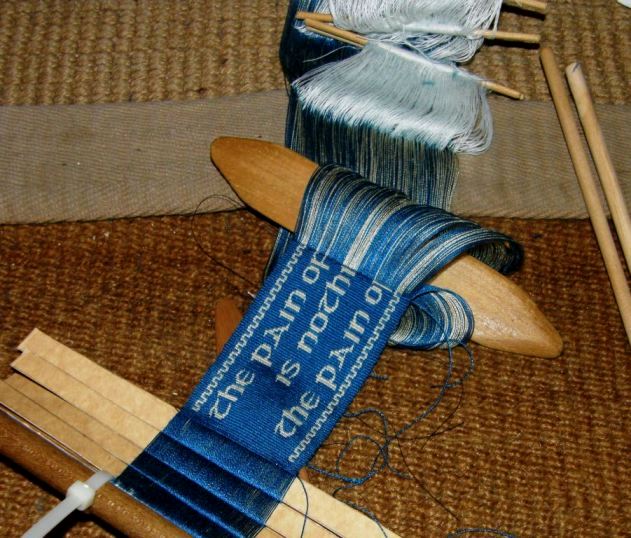
He can always do with more support in the form of page “likes” to attract sponsors so, if you haven’t already done so, please “like” his page. Now, I really must get my act together and make the silk bookmark I promised him. The prototype is below…”The pain of discipline is nothing like the pain of failure”… one of Ryan’s favorite inspirational quotes.
silk bookmark backstrap weavingWhile I don’t get to do much weaving of my own while on the road, the backstrap sticks have been clacking away in the homes of my online weaving friends. Lausanne wove a band in wool using one of the knotwork patterns that I have charted in my second book for the Andean Pebble Weave structure. Lausanne plays the fiddle and is using this band a a sheath for her bow…

10646717_10203926105224941_7621398630356267098_nOlive and Oaks finished her backstrap and her project reminds me how extremely satisfying producing good plain weave can be…

OliveandOaksAnother plain-weave piece by Gwen is underway and will be made into a bag for her loom. The second panel will match this one and will also have supplementary-weft patterns in yellow…

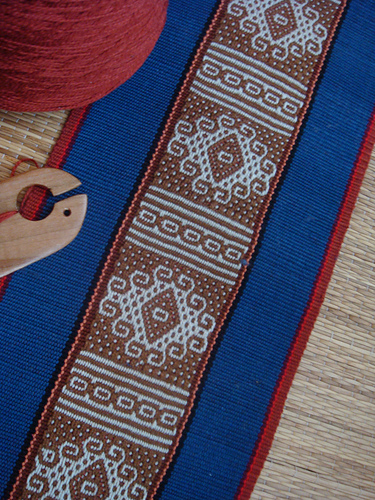
gwen bagJulia has been pushing her skills with the classic Andean hook even further with her latest piece..
julia

Alittle piece of Tibet in western Massachusetts. Liz's landlaord Sonam is a master stone mason.
A little piece of Tibet in western Massachusetts. Liz’s landlord Sonam is a master stone mason.

Since I last wrote a blog post, I have traveled from the tropics of lowland Bolivia to Massachusetts where the first nip of cooler fall weather was in the air. Hints of red were already showing against the greenery and I spent the fall equinox weaving with a group at Liz’s place.

Over my four days there I made new weaver friends and also connected with several ladies who had woven with me before. We created Andean hooks and tubular bands.

Liz has moved into a new space  since my last visit and has an even  larger and more inviting space now.

While we wove, the sister of her Tibetan landlord, dressed in traditional clothing, would be walking about outside. She doesn’t speak English and I was so hoping that somehow she would catch a glimpse of what we were doing and come and sit with us. Apparently, she walked in on one of Liz’s spinning groups one day and sat down happily to spin.

And now I have traveled over to Arizona and I can’t imagine a more different environment! I am looking forward to a visit to the Heard Museum in Phoenix tomorrow to see their famous collection of Native American textiles.

globe aAnd so, I will leave you with something in keeping with this week’s “travelers” theme. This is an image I made via a fun website which allows you to paste your pictures on a globe.

Backstrap Weaving – The Curious Coil Rod

Are you ready for this week’s dose of red, black and white?

3 red black and white backstrap weaving hangingsI have quite a good selection of colors with which to work here in Santa Cruz. None of the colors go by fancy names. They are pretty much the basic tones. Therefore, when someone asked me to pass them the “chartreuse” yarn for their weft in one of my workshops, I had  no idea what they were talking about. Here, we get dark green and light green. But, I have to say that there are enough colors here to keep me happy.

Why then do I keep being drawn to black? I guess there is just something so clean and sharp about black and white.

Even the local Guaraní weavers can’t resist going back to this combination from time to time despite the fact that many of them use the same brand of colored cotton that I do…

guarani black and white weavingsThe third piece in my wall hanging series with the Wayuu-inspired design is an inch or so away from being finished. Naturally, as I have sat there these last few days picking up threads and heaving open the sheds, my thoughts have been turning to my next project. It will probably be a purple scarf decorated with supplementary wefts using cotton yarn from Guatemala and mostly silk supplementary wefts.

colors for next backstrap woven scarf
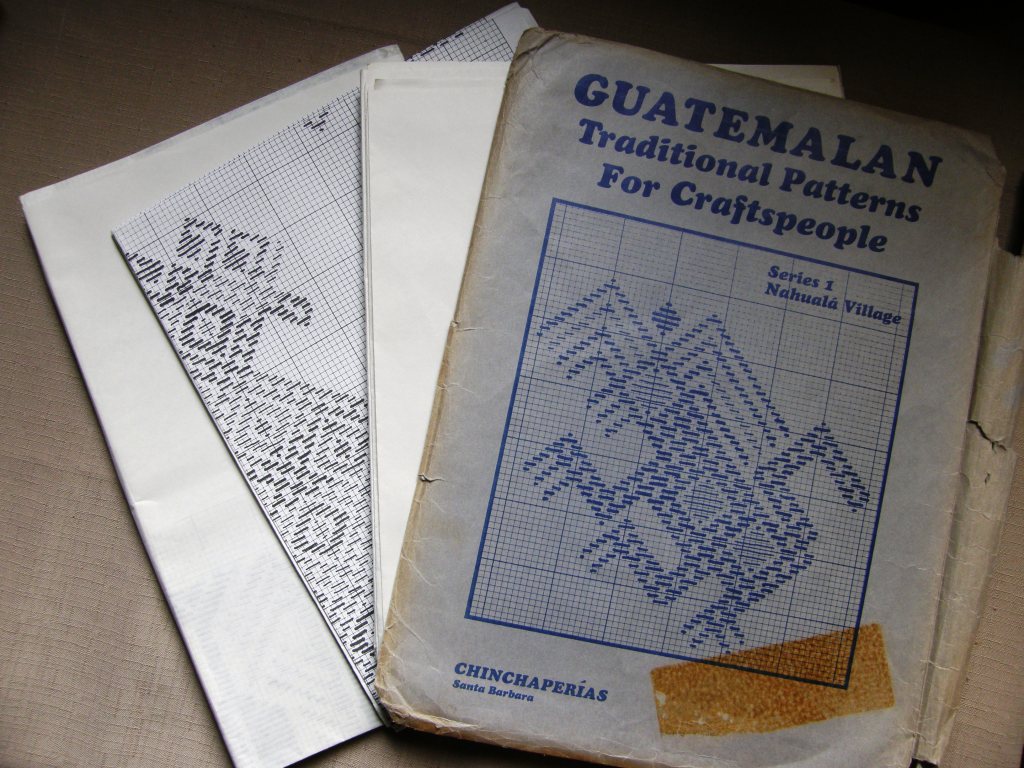
Guatemalan pattern chartsI am still planning the motifs and, while digging around at the book shelf, I unearthed a packet of patterns that was given to me by Sharon, a Weavolution weaving buddy, a year ago.

The packet contains three enormous sheets of detailed Guatemalan motifs. The front of the envelope states that this is Series 1 from Nahualá Village. Nothing on the packet or within indicates when these patterns were charted, by whom or how many packets comprise the entire set. Imagine if this person or people graphed patterns from dozens of villages!

Happily I tracked down another packet, series 3, on Ebay and it seems that there is a weaving guild that may have some others in their library.

However, I probably won’t use any of these motifs for my scarf. I have something quite specific in mind that I learned when I was studying in Guatemala but which also has a slight Bhutanese influence.

I told you about circular and dovetail warps last week and I have decided that I will make a circular one for my scarf. That will keep me in good foot-bracing distance from my bed. Winding a circular warp is straightforward enough. I was easily able to make some changes to my standard warping board to make this work well.

warping set up for circular warpThe two off-set stakes to hold the cross were all I needed. However, that picture is cropped and the following shows the complete set up…

circular warp set up with coil rod stakeThe extra unnecessary stake was incorporated so that I can try to learn more about the mysterious coil rod. So far, I have not seen a coil rod being used in Bolivia and Peru. The first place that I came across one being used was Ecuador. It was in the ikat- weaving town of Bulcay and I had no idea at the time what this piece of equipment was.

ikat weaving loom Bulcay Ecuador

There is a black arrow pointing to the coil rod in the above picture…the thin stick just below the upper beam.

ikat weaver Bulcay Ecuador

When I visited with this weaver, I was concentrating more on seeing how she prevented having the warps move out of alignment and excessively blur the ikat pattern. I suspected that the coil rod was her”secret weapon” but when I asked, she told me that it had nothing to do with it. Actually, I have to say that she was not very keen on answering my questions. Let’s face it…not everyone is fond of having strangers hang about pestering them with questions while they are trying to weave! She was nice enough to let me sit by and watch and take pictures.

coil rodDennis Penley, author of Paños de Gualaceo, writes that the coil rod, (he calls it a “rolling stick”) in Gualaceo, one of Bulcay’s neighboring communities, is added once the warp has been placed on the loom. He says that the warp threads are wound around the stick in bunches of ten. The stick serves to stop the warp threads from slipping.

You can see how the warps have been grouped in the above photo and the way they are coiled about the stick at left.

Of course, as time went by, I discovered that coil rods are used by many backstrap weavers who work with circular warps and I have since seen many examples of weavers in Asia using them.

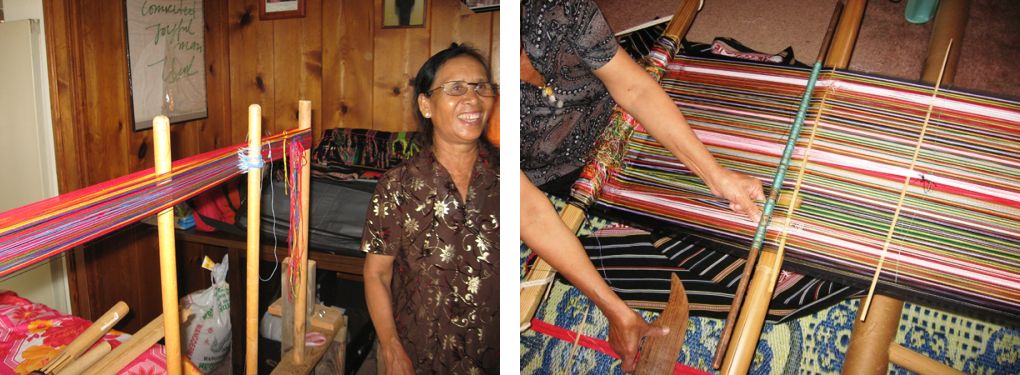
When I met and got to spend a little time with Burmese weaver Dar Ku in Massachusetts, I noticed the coil rod in her loom.

O

It is the rod furthest from the weaver in the picture. I didn’t think at the time to ask her if she added it after or during warping. I was concentrating more on her use of supplementary wefts to make her patterns and the fact that she was weaving her designs while looking at the wrong side of the cloth! Her heddle system was also very interesting. You see, there are just so many wonderful things to see and take in when you watch a backstrap weaver at work!…what is the shape of her sword, how does she open the heddles, how hard does she beat, what does she use to pick up her threads and much much more!

As she wasn’t weaving ikat and her warps could move without causing any harm, I assume that the function of the coil rod in this case is to help maintain width and keep the warps spread and in order in the potentially messy area beyond the heddles and shed rod.

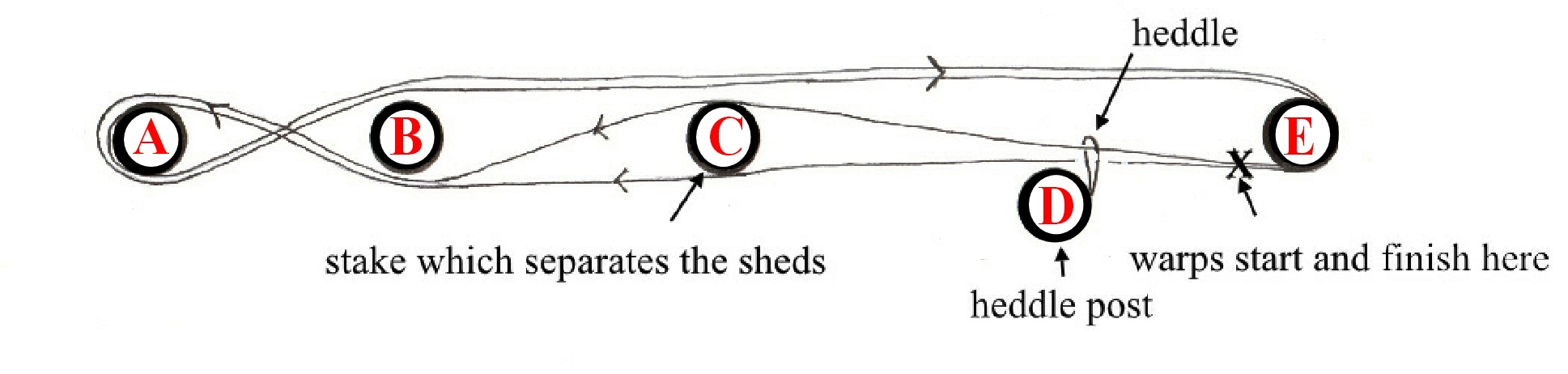
The one time that I have seen a warp being made which incorporated  a coil rod was when I studied with the Montagnard weavers in North Carolina. Again, there was so much to see especially since this was also the first time I had watched a weaver add heddles as she warped. Naturally, much of my attention was focused on that.ju-warpingThis is what Ju Nie’s warping path looked like…

Rhade warping pathIf you flip this upside down, you will see that my new warping set up was designed to resemble this. Stake C on Ju’s set-up separates the threads into two sheds. Stake D  holds the heddles that Ju makes as she winds the warp. Stakes B and E will be replaced with the backstrap loom bars. Stake A will be replaced by the “curious” coil rod.

As I am not going to make heddles as I go, stakes C and D on my set-up will hold the cross.

circular warp set up with coil rod stake

Here is a diagram showing the two-revolution warping path to complete the cross in my set up…

warping path with coil rod cross

From left to right…loom bar 1 will replace the first stake. The next two stakes will be replaced with cross sticks….I used pencils. Loom bar 2 will replace the next stake and the last stake on the right will be replaced with the coil rod. Below you can see how it looks when taken off the warping board. I have just wound a tiny warp and used some random sticks for the sake of this demonstration.

circular warp with coil rod on loom

Below you can see the loom almost ready for use. What remains to be done is make the heddles and select a suitable shed rod.

O

The yellow and green pencils are holding the cross. Heddles will be made to raise the threads that pass over the yellow pencil and a shed rod will replace the green pencil to raise the other half of the threads.

The coil rod has been rolled from its original position, in the picture below left, over the loom bar into its new position as seen below right.

coil rod put in position

This is what it looks like on Ju Nie’s narrow warp.

ju nie's coil rodSo, I know how to wind a circular warp and put the coil rod into position now…yay. The question remains…what exactly is the purpose of this wee stick? I guess I will find out as I weave my purple scarf. I suppose I will have to weave with a coil rod for a while and then without one in order to note the differences.

In Weaving and Dyeing in Highland Ecuador, Anne Rowe notes that the coil rod, as used by the ikat weavers in Azuay Province, helps secure the slippery cotton warp and maintain an even width for the fabric. However, it is not used by cotton ikat shawl weavers in Rumipamba. I imagine that the resulting shawls in both areas are equally well made.

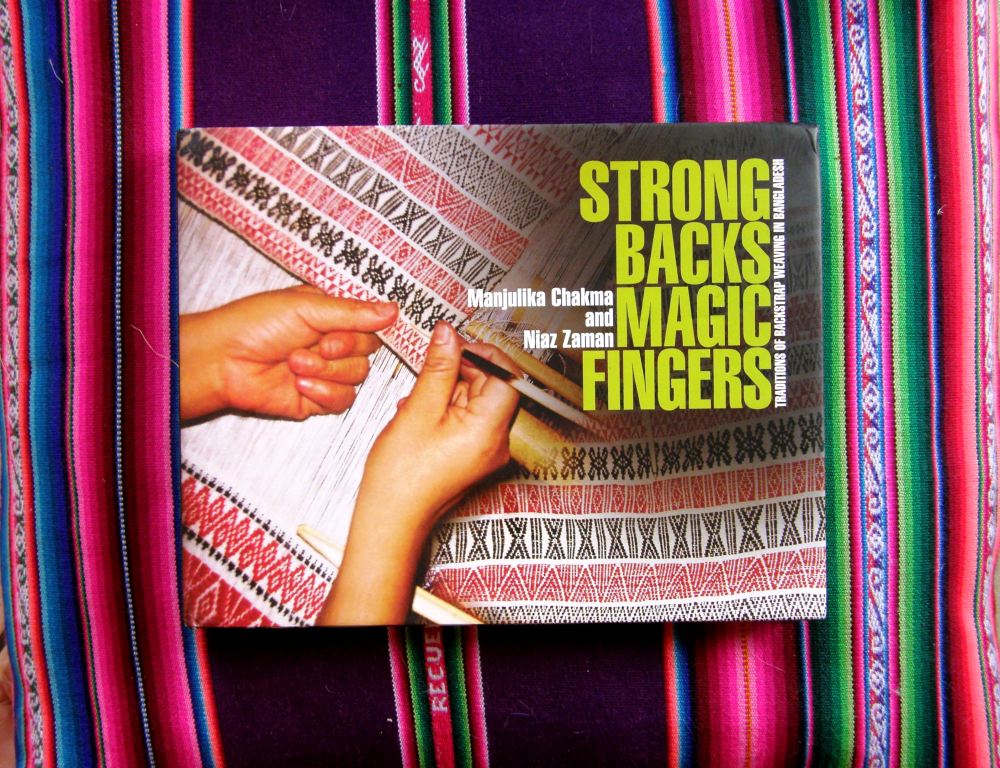
I have a book on backstrap weaving in Bangladesh, Strong Backs Magic Fingers, which describes the looms and textiles woven in twelve areas of that country. While the vast majority of the looms shown have coil rods,  some of them don’t. Certainly those that have the finest and silkiest looking thread always do. Yet, some weavers manage happily without them. It appears to be more of an aid than a necessity. Perhaps it is simply tradition that has some weavers using one.

Strong Backs Magic Fingers

I am kind of excited about having this new piece of equipment to experiment with!… a mere stick.

In Spiritual Fabric, Sadae Torimaru calls the coil rod that is placed in a body-tensioned loom used to weave narrow bands in China a ”temple stick” and says that it is used to keep yarns and width constant.

Some of you may like to read Maria Christou’s thesis An Ethnographic Study of the Loom and Weaving of the Sa’dan Toraja of To’barana’. Her research took place on the island of Sulawesi, Indonesia and on page 26 she ponders the coil rod and quotes the thoughts of other researchers on its purpose and use. It would seem that she found the answers to her questons in the course of her one year of study. I have to confess that I haven’t gotten that far in my reading of her paper to know for sure….printing out to read this weekend!

If you have made it this far in reading this post, thank you for bearing with me in my ramblings about a stick!

And so, let’s enjoy looking at some of the fruits of  these looms we have been talking about.

weavings Bangladesh Montagnard Burma

You can see a length of black skirt fabric with warp-float patterns woven by Ju Nie with a weft-twined edge added by her sister. The back cover of the book on weaving in Bangladesh shows the supplementary-weft patterned work of Chakma weavers and Dar Ku shows the white cotton fabric she wove for a dress as well as a richly patterned traditional blouse.

For those who may be curious about how Ju Nie adds heddles as she winds her warp, here is a video I made explaining it.   Ju Nie works way too fast in the video that I took of her doing it!

Wonderful, isn’t it? Maybe one day I will do this. For now, I find it very relaxing sitting at my loom and making my string heddles. There’s always something new to learn!

I will leave you with a video of Dar Ku weaving. She has such a beautiful peaceful way about her…


Backstrap Weaving – Encuentro de Tejedores de las Americas – Part Three…and more….

Before I get into Part 3 of my report on the Encuentro de Tejedores de las Americas (see Part 1 and Part 2 here and here), let me show you how I have been getting on with my latest experiment with supplementary-weft patterns.

Bhutanese supplementary weft pattern samplerYou may remember from last week’s post that I was inspired by seeing textiles from Bhutan with their  gorgeous motifs created by using supplementary wefts.

I was happy to see that I could decorate my own woven cloth with similar patterns using techniques that I had learned in Guatemala.

At left is the sampler I made to practice the techniques and experiment with the spacing of the pattern warps. I had some fine cotton from Guatemala that my friend Betty had bought about 30 years ago. How nice that this cotton could finally find its purpose.

The black cotton disintegrated as soon as I pulled it out of the closet. I guess that there is something in the black dye that causes the yarn to rot quickly. The other colors…red, green and purple….were just fine and, fortunately, there was plenty of white to dye black. I had my heart set on a black scarf.

There were a lot of ends to wind to make 7 inches…672!!

OThe cotton is kind of sticky and I can see why Guatemalan weavers very often choose to size their yarn with a kind of corn starch wash.

I am using it as is and need to be very gentle. I broke one warp before even getting started and my heart sank but it turns out that it was due to my clumsy handling of the pick-up stick…phew! No more breaks so far but there is still a looooong way to go.

Of course I made a wee sample before diving in to see how many ends I would need to make an inch. I also needed to test the ideal number of strands of tencel to use for the weft patterns.

In the picture you can see my tiny warp with its string heddles and shed loop . The two sticks are the pattern sticks that I talked about in my last post. Of course, the yarn was already showing signs of stickiness even on this tiny project but I decided to go ahead undaunted 🙂

Sample done…width calculations made. Now, how long should a scarf be? Seems like a silly question, but I have never made a scarf before. Fortunately, I do own just ONE. After all those years spent skiing and then living in Patagonia you would think that I would be more scarf-wise.

OThere is the warp and I am ready to make the 336 string heddles. I like making heddles…time to put on a cd and sing! and I didn’t cross or double up any warps…phew!

O

I have lots of pictures that I have taken of Bhutanese textiles in friends’ collections for inspiration and David K Barker’s books are wonderful too. (See my RESOURCES page for information on how to download his books for free.) However, I decided to play it safe to start with and weave one of the patterns that I had already tested on my sampler.

So, I sat down to weave and that is when it hit me…wow, this yarn is really FINE….and….it’s black! All the clues that I usually use to make the pick-up easier for supplementary-weft patterning are dependent on actually being able to see the threads!!

Boy, had I made things hard for myself but, believe it or not, I got used to it and came up with other ways to eyeball the placement of the patterns without having to become a slave to pattern charts and endless counting. It became a very cool learning experience and, as with all things new and experimental, much un-weaving was done and all with my heart in my mouth as I don’t think that this yarn will take much “backing and forthing”!

Bhutan pattern backstrap loom scarf

Here is the first pattern under way. I placed several thin pieces of cardboard in alternate sheds in the warp beyond the cross sticks. This gave me a place to make quick adjustments to loose warps within arm’s reach and with the warp under tension rather than having to get out of my backstrap and crawl up to the end of the loom.

cat on backstrap loom BhutanSometimes you don’t get to choose when to weave. I would come back in from a break to find Her Highness reclining in what was, apparently, the most comfortable spot in the house. Would you dare disturb someone with a look like that on their face? You can see the next set of patterns in progress here.

second Bhutanese design finishedOAnd this is where it stands for now. I am just getting past the first warp break and have my fingers crossed that there won’t be more. I watched a gentleman from Chahuaytire weaving on his backstrap loom when I was in Cusco. A warp broke and I loved the calm and cool way he went about fixing it like he had done it hundreds of times before (well, of course, he probably had). He didn’t need to have anyone tensioning the warp while he leaned forward to fix the break. That is the part I find hardest.

Be prepared to see a lot more of this project in the weeks to come. Unless, of course, those warps start a- snapping, and then you will most likely see it finished really soon as a zippered pouch or journal cover!

#########################################

ENCUENTRO DE TEJEDORES DE LAS AMERICAS  – PART THREE – SPINNERS AND WEAVERS IN ACTION

The Encuentro…it was over two months ago now and I am finding it hard to sum up here but I will try!

It was about yarn being created with the simplest tools…

Handspun cotton by the Matsigenka weavers of the Amazonian region of Bajo Urubamba, Peru
Fine and incredibly even handspun cotton by the Matsigenka weavers of the Amazonian region of Bajo Urubamba, Peru

The "malacate", spindle used in Mexico to spin silk with its horn whorl.
The spindle known as “malacate” used in Oaxaca, Mexico to spin silk. Its whorl is made of horn.

The traditional "sig sig" spindle of Salasaca, Ecuador made from pampas grass.
The traditional “sig sig” spindle of Salasaca, Ecuador made from pampas grass stems. A small piece of thin solid stem is inserted into the soft interior of the large stem section to suspend the wool yarn as it is spun.

OA spinner from Chiclayo, Peru showed me how she spins the natural brown cotton that is cultivated in the region. She told me that a heavy stone is usually placed on top of the cotton as she draws out the fiber to be spun. Not having one handy, she used the bottle of water that you see in the video. The spindle whorl is a piece of avocado seed.

It was about sticks…lots of sticks!

Sticks used by the weavers of Bajo Urubamba to create their warp-float patterns.

Twenty-four heddle sticks are used to weave the traditional pattern on the "faja sara" of San Ignacio de Loyola.
Multiple heddle sticks are used to weave the traditional pattern on the “faja sara” of San Ignacio de Loyola.

It was about threads being strung together in a stunning display of color and texture…

An ikat warp ready to be woven into the traditional shawl of Tacabamba, Peru
An ikat warp ready to be woven into the traditional shawl of Tacabamba, Peru. The ties on the sections of threads were the only means I could see to keep the threads aligned for the ikat patterns.

Threads are stretched on the typical leaning vertical loom of Tarabuco, Bolivia
Threads are stretched on the typical leaning vertical loom of Tarabuco, Bolivia. Multi-colored figures depicting ceremonies and scenes of daily life in the community will sit on a white mesh-like background. The colored threads are generally thicker than the white ones which gives the figures relief.

The backstrap loom with its cotton warp from Chiclayo, Peru.
The backstrap loom with its cotton warp from Chiclayo, Peru. A single-faced cloth decorated with warp-float patterns is created.

Bunches of string heddles control the colored layers of warps on the horizontal loom of Taquile Island, Peru
Small bunches of string heddles control the colored layers of warps on the horizontal loom of Taquile Island, Peru.

A floor loom holds the warp on which a weaver from Ayacucho, Peru will create a beautiful tapestry.
A floor loom holds the warp on which a weaver from Ayacucho, Peru is creating a beautiful tapestry.

And it was about the wonderful hands and spirits of the talented craftspeople and artists who use sticks and fiber to create beautiful cloth….such an amazing variety of people from across the Americas!

Weaver Natividad Machaca Quispe of Taquile Island, Peru creates a sash with bands of warp-faced double weave motifs and complementary-warp patterns.
Weaver, Natividad, of Taquile Island, Peru creates a sash with bands of warp-faced double weave motifs and complementary-warp patterns. This piece had six bands of pick-up patterns.

A weaver of panones of Tacabamba, Peru, puts the finshing touch on hher woven ikat shawl by knotting an intricate pattern into the the fringe.
A weaver of Tacabamba, Peru, puts the finshing touch on her woven ikat shawl by knotting an intricate pattern into the fringe.

knotwork on Tacabamba shawlHere is a short video of  Nila at work knotting the fringe of her woven ikat pañon…

And what about that belt loom with its twenty-four sets of string heddles? Araceli shows us how it is done…

A Matsigenka weaver from tropical lowland Peru creates warp-float patterns in cotton on her backstrap loom.

A woven tubular band in progress...putting the finishing touch on a woven piece from Pitumarca, Peru.
A woven tubular band in progress…putting the finishing touch on a woven piece from Pitumarca, Peru. The tubular band had been set up with three sets of string heddles and a shed loop and, therefore, did not require any pick-up.

And cloth comes off the loom and comes to life when draped around shoulders…

cloth comes to life

wearing the Tacabamba shawl

and wrapped around waists and heads…

taquile island peru and santiago atitlan guatemala

Diana from Guatemala, pictured above, wore this spectacular fine, ikat-patterned corte, or skirt…
O

There was time to watch and chat and share….

watching, chatting, sharing at ETAM 2012

Time to look and learn from Navajo weavers and spinners and an alpaca fiber weaver from Tanta, Peru…

looking and learning ETAM 2012

Time to sit or stand and ponder…

pondering ETAM 2012

Time to listen to weavers talk about their communities and textile traditions and meet new leaders in the field of textile research…

Bolivian Elvira Espejo shows the two most recent books she has written with British/ Bolivian Denise Arnold on weaving in the Andes. Representatives of the textile community on Taquile Island, Peru spoke about weaving and knitting traditions and the 547 families that are part of their textile co-operative which had begun in 1971 with only 7 families. Taquile Island has become an enormously popular tourist spot over the years. One point which created a bit of fun was their comment that "Taquile fashion" was being worn and loved around the world despite the fact that it was not appreciated in their own country of Peru. "Taquile fashion" then became one of the catch phrases of the conference and made us all smile.
Bolivian Elvira Espejo shows the two most recent books she has written with British/ Bolivian Denise Arnold on weaving in the Andes. Representatives of the textile community on Taquile Island, Peru spoke about weaving and knitting traditions and the 547 families that are part of their textile co-operative which had begun in 1971 with only 7 families. Taquile Island has become an enormously popular tourist spot over the years. One point which created a bit of fun was their response to a question about how they felt when a hat that was created to be worn by a high-ranking official was bought and worn by a tourist completely out of context. They said laughingly that they were proud that “Taquile fashion” was being worn and loved around the world despite the fact that it was not appreciated in their own country of Peru. “Taquile fashion” then became one of the catch phrases of the conference and made us all smile.

And time to just stand in complete awe…time and time again!

A weaving of the Jalq'a people of Potolo, Bolivia.
A weaving of the Jalq’a people of Potolo, Bolivia depicting Ukhu Pacha, the underworld, with its khuru figures.

Organizers ETAM 2012

Well, I hope that this gives you just a taste of what the week of ETAM was like. Thank you Maria Elena del Solar, Paula Trevisan and Luis Masa for organizing this event. And thank you Mara Elena for pushing me to go when I was dithering over the cost of getting there. It was the best birthday gift to myself ever!

Thank you Centro de Textiles Tradicionales de Cusco for the fabulous exhibit of textiles from your nine member communities that you organized in the Convention Center to coincide with this event and for providing outstanding teachers for the workshops.

As for Elvira Espejo and Denise Arnold’s books about which I know you will be curious, I have to find out if they are available in English and from where…stay tuned.

OOf course, you do know that the CTTC is having its second Tinkuy this coming year, don’t you?! 🙂 Are you coming?

Backstrap Weaving – Wish List

My new book has both a cover and title now…YES!

Now it really is starting to feel like a book, albeit an e-book, and not just a pile of pattern charts on the floor, half woven bands on sticks everywhere and thoughts, plans, ideas and enthusiasm dancing in my head.

There are more finishing touches to be applied but I can stand back now and look it over and feel very pleased with the whole thing. But, just when I may be getting a little too pleased with the result of all my work, along comes something like this to humble me and put things into perspective…

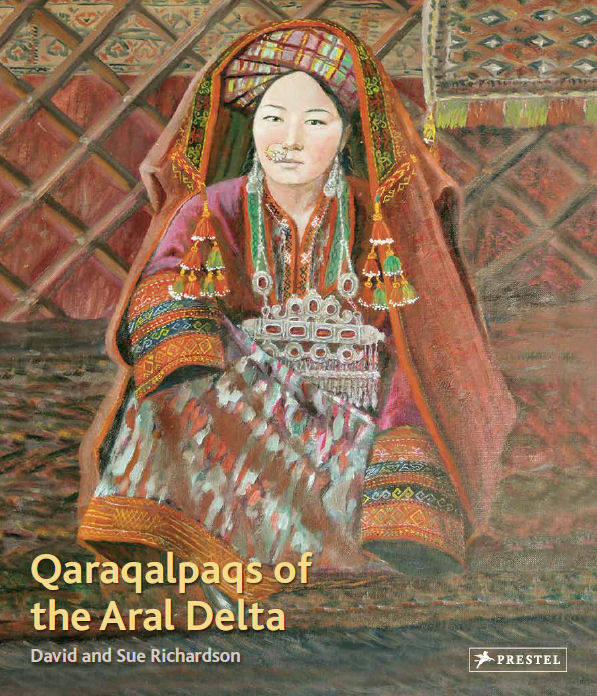
A Facebook friend posted about the publication of this book recently, and oh-my-gosh, this is a definite candidate for the Wish List.

Now, I will be the first to admit that I had never heard of the Qaralqalpaqs and had only a vague idea of the location of the Aral Desert before I checked out this book and the associated website.

This promises to be a book filled with stunningly beautiful drawings and gorgeous pictures of these Turkic minority people and their crafts…lots of textiles and information about the weavers, their looms and the clothing and furnishings for their yurts that they make with their cloth.  This website announces the launch of the book and shows some sample pages. That page is part of an entire site devoted to the Qaraqalpacs. In a way it is fortunate that the book has only become available now as the temptation to adapt some of the Qaraqalpaq textile motifs to complementary-warp weave and include them in my book would have been too great and who knows when my book would be done!

Other Wish List items include weaver, Chinchero native and CTTC director Nilda Callañaupa’s latest book which is bound to be spectacular. How often do we get to hear from the weavers themselves in these indigenous communities?

and I know that all lovers of warp-faced bands are keen to get their hands on Anne Dixon’s new work…

 This book by Ann Pollard Rowe, Lynn A. Meisch, and others is the third which presents the massive amount of research and field studies conducted by the authors on the textiles, costume, identity and history, and weaving and dyeing of highland Ecuador.

I am particularly excited about this third publication as the work that anthropologist Kathleen Klumpp has done documenting the ancient cotton weaving and spinning tradition in Manabí province in coastal Ecuador, to which I contributed, is cited therein. I contributed to the hammock weaving section.

Kathie has just finished putting together a documentary on dvd of the work she has done with the Manabí spinners  and weavers which I am hoping to see on my next US visit.

It is wonderful to see what has resulted from her first encounter with this family of spinners and weavers when she was studying pottery techniques in the area. She happened to spot a farmer on one of the local rural buses carrying a woven saddlebag that was decorated with pick-up patterns and curiosity took her to the home of the weaver who had created it. But, as it happens so often to all of us, life got in the way and it was  thirty years later, in 2006, that Kathie was able to resume contact and strengthen her friendship with this and other families in the area while striving to ensure that the weaving and spinning techniques and traditions are not lost when the elders in these small settlements pass away.

Dare I put the cover of my new book here among all these wonderful publications……? I don’t think so. In any case, light is so sparse in my little home that I need to wait for just one more sunny day for a final photo session and then….

Until next week…happy weaving and happy reading 🙂

Backstrap Weaving – Teachers

I was reading Anita Osterhaug’s post in the weekly Weaving Today letter about teachers and the knowledge they impart. She quoted ” When the student is ready, the teacher will appear“. I had not heard that before. She then added, “Sometimes you carry a teacher in your head until you are ready“.

This was amazing to me as it is the very thing that has been going through mind this week as I work on my new book. Almost sixteen years ago I learned backstrap weaving with my first indigenous teachers in Peru and I find that even after all this time has passed, certain things they taught me which I have been performing mechanically since then, are suddenly taking on a whole new meaning.

I can take certain processes which I now clearly understand and apply to them to other situations and create things I had not been able to previously envision.

It is hard to explain and I know that this all sounds a little vague but I am much more explicit in the book. It is nice to know that I have been carrying those teachers around in my head, as Anita said, all these years and can still benefit from what they showed me. I wonder how many of my other past teachers will make an appearance as the years go by and what seeds of knowledge are sitting in my head waiting for just the right conditions in which to sprout.

So, I thought I would dedicate this blog post to some of my weaving teachers and say just one or two things that I took from my experience with them.

This is Hilda, my teacher in Potosi, Bolivia who taught me “once a weaver, always a weaver”. How must it feel to have been raised a weaver, as Hilda most likely was, having this activity become a part of your very being and identity only to have to abandon it at a relatively young age.

Hilda started out in my lessons by sitting by my side and pointing or calling out the warps that I needed to pick up for my design. Apart from warping with me and setting up the loom, she never once actually sat at the loom and showed me how to weave so there was a lot of “no, not like that” as I was not being given a model to follow. She complained that her eyesight was too poor and her back too weak to weave anymore. Besides, she said that she had forgotten most of the patterns.

However, I started to notice that my piece was growing somehow from the time I left it in the evening to the time I arrived the next morning to pick it up again. Hilda simply couldn’t resist unrolling my work and weaving when I was gone but still felt somewhat shy about weaving in front of me. I am sure that weaving in the low evening light was not helping her. Eventually, she gathered the confidence to start weaving together with me on her own projects in broad daylight leaving me to figure out the pattern for my own work on my own. Happily, I was well on my way by that time.

The other thing I took from Hilda (although it didn’t stick for long) was the idea that cloth should have four selvedges. This is the most natural thing in the world for weavers in Hilda’s world and a weaver finishes her piece without any fuss. Hilda sighed and muttered only because of her poor eyesight.

One doesn’t choose, as I do, whether to have fringes or three selvedges with a fringe at one end. There will be four selvedges and that is that. It gave me the confidence to go straight home and weave a few pieces like that in wool, although, as I said, it didn’t stick, and once I started weaving with cotton, I stopped weaving four-selvedged  fabric.

Felipe in Salasaca, Ecuador has been my only male weaving teacher so far. I was most impressed by the fact that Felipe has taught all four of his sons to weave (one son is absent from the picture) and that they all approach it with such enthusiasm and pride in a world where fewer and fewer youngsters in indigenous communities show any interest in learning to weave. I wondered what Felipe’s secret was.

Although the boys didn’t yet have the skill to warp well, they could certainly tell me exactly what was going on as their father demonstrated it to me. Felipe told me that he was self taught and has created some of his own variations of the traditional Salasaca “frutilla” pattern. His bands are cut into pieces to decorate sandals which are made by a local shoe maker.

He is obviously an innovator with plans for the future and perhaps this optimism is what he has passed to his boys.

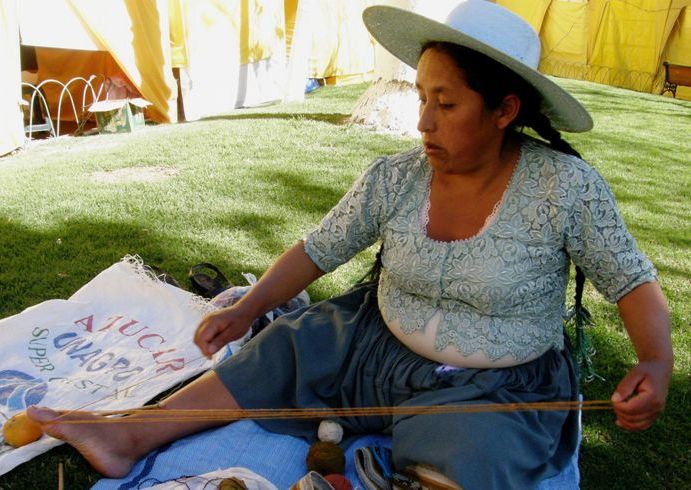
As I prepare to travel and pack my portable warping board, loom bars, dowels, metal rods, beaters and shuttles I remember Maxima in Cochabamba and the ease with which she wound warps on her finger and toe.

All we had a was a pleasant shady spot outdoors, a few balls of yarn and we were able to spend several lovely afternoons producing pebble-patterned and tubular bands.

Yarn was used for cross sticks, fingers formed picking crosses and a hand moved with a slicing action beat the weft into place…the wonderful simplicity of it all. I went home and looked at my buckets of loom bars and beaters for all occasions! Of course they are needed for wide pieces but I tend to depend on them very much even for the narrowest of bands.

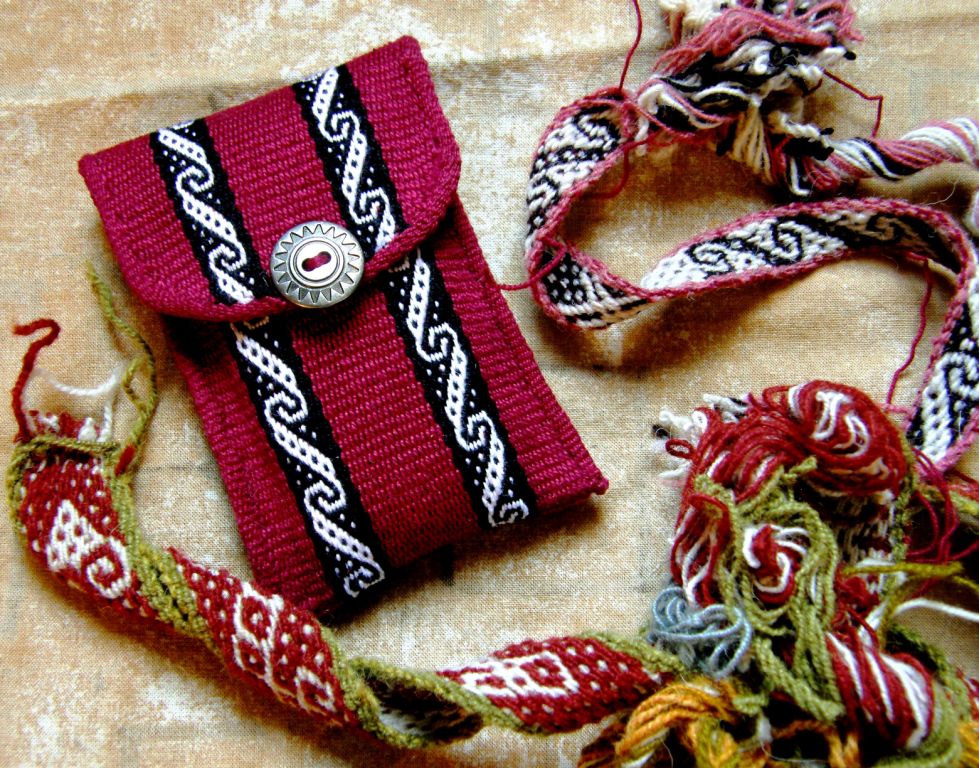
I also took home a new pattern which I used on a cell phone pouch and the knowledge of a new way to do pebble weave.

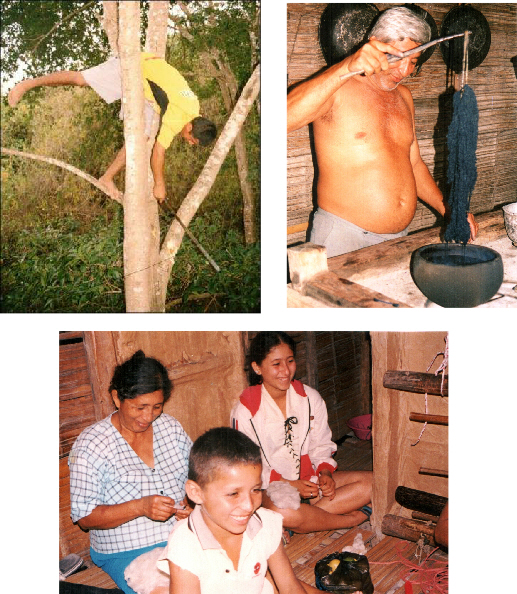
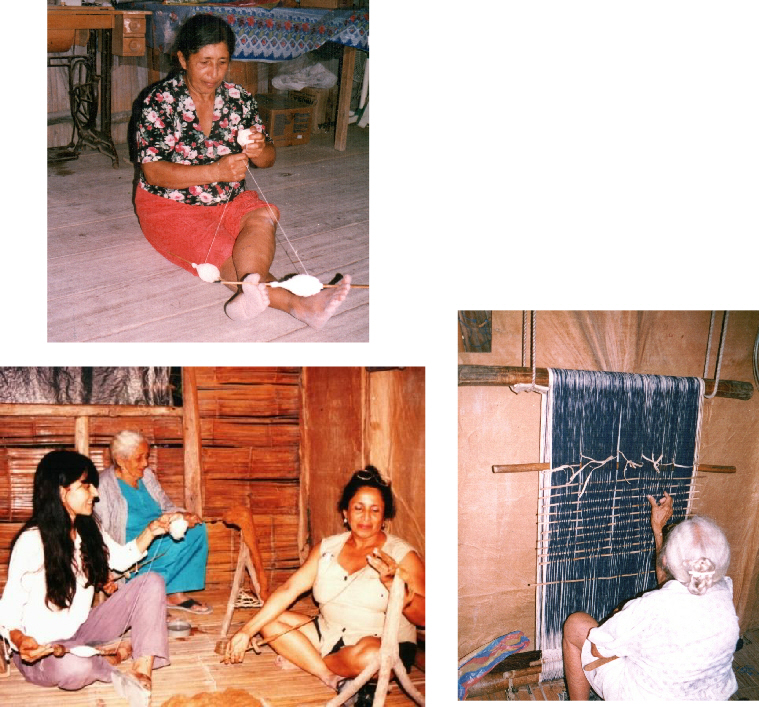
Learning to weave with a family in coastal Ecuador showed me just how much an entire family can become involved in every aspect of the process from cotton boll to finished project….together most of the time sharing the tasks or at least keeping company with the person doing the work with lots of chatter and laughter. I tend to think of weaving as a very solitary process. Don’t speak to me when I am warping for goodness sake! and I can’t even listen to songs let alone chat while I am doing pick-up.

Trini made mistakes while she warped but the discovery of her mistakes only led to teasing and laughter rather than frustration.

Trini is the main weaver but there are plenty of other family members involved in other parts of the process.

A nephew cuts material for dyeing, a brother tends the dye pot and everyone helps to remove seeds from the cotton after the evening meal.

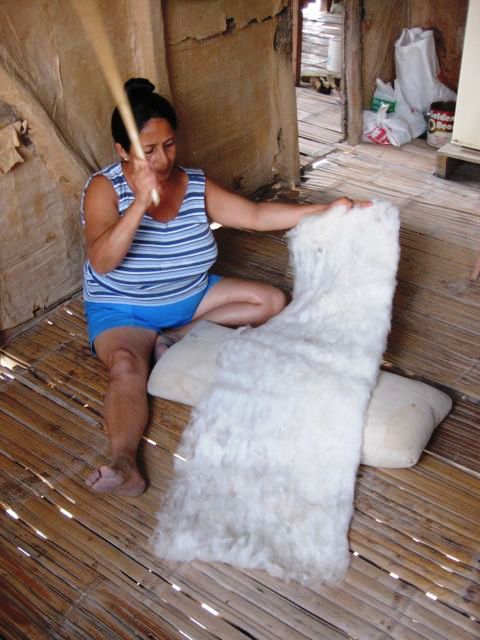
Trini and one of her sister’s share the task of beating the cotton to prepare it for spinning. (photo by K Klumpp)

A sister doubles the handspun cotton singles, all the adult women spin and Mother checks that the pattern-shed warps have been correctly selected.  I am trying out spinning on this occasion. How nice it was to be sitting with this group of ladies and spinning the evening away. You can see that pretty much everything takes place on the floor. Wooden chairs hang from nails on the wall but Trini’s mother is the only person who sits in one. Maybe it was this experience that has me now so comfortable doing everything related to my weaving on a small square of bedroom floor.

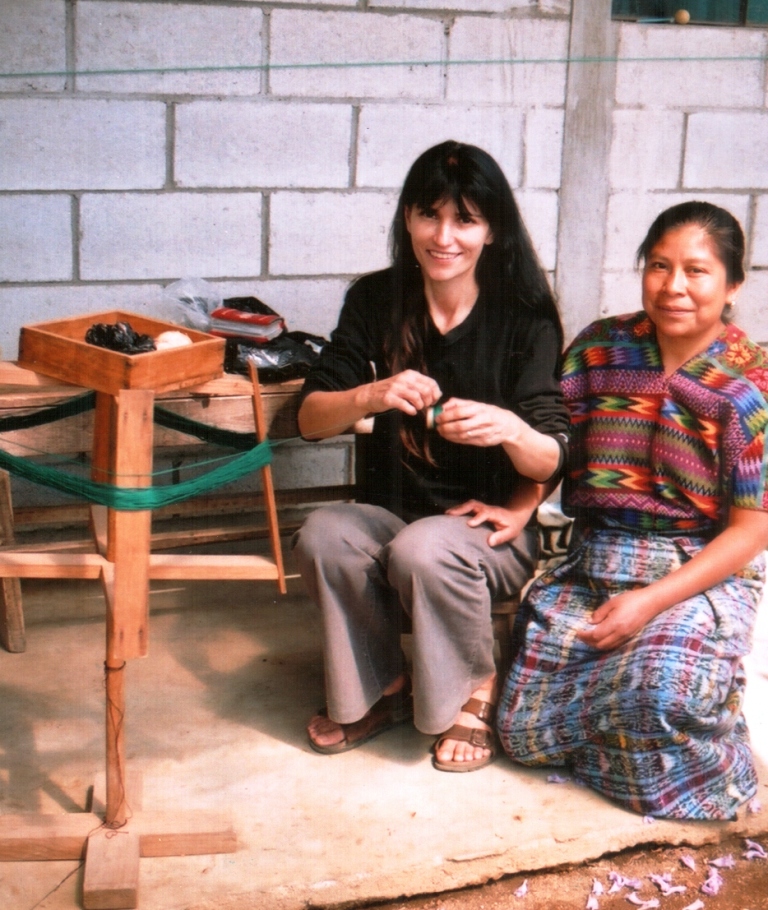
My first Guatemalan weaving teacher, Lidia impressed me with the amount of care and time she took preparing her warp. She is a quiet, calm and graceful person and this all carries over into her weaving. Every single warp thread was patiently and delicately lifted on the tip of a pointed stick and placed in its correct position on the loom bar. She didn’t treat it as the tedious thing that one has to do before the weaving begins. After weaving with Lidia, I started to take everything slowly and really enjoy every part of the process devoting as much time to warp preparation as I am willing to spend selecting the threads to create the patterns.

I loved how Lidia would have me un-weave mistakes. That is just what I like. I have had many weaving teachers who have gotten annoyed at my insistence on fixing errors. In Potosi I would sometimes take my warp home at night to fix an error I had made early in the day that Hilda had not let me un-weave! I have to say that Lidia had a way of spotting a mistake about to happen! She was quite amazing like that and saved me a lot of un-weaving.

I also learned about the efficient use of materials. I have never met a weaver who knows how to measure so precisely the amount of supplementary weft she needs to complete each of the different motifs in a piece.

Angela, my Guaraní weaving teacher, blew me away from day one. She was warping a hammock on a vertical loom and I watched in awe how she passed the warp thread thousands of times up and over the loom, bending down low to pass the thread under the bottom beam and then reaching behind to pass it around the dovetail cord. And then there were the thousands of heddles! Not just one set but three.

Many years later, I got together with Angela again and now she impresses me in other ways with her appetite for learning new techniques and looking for new ways to do things. I could sense that my teacher  Maxima in Cochabamba wanted to learn double weave from me but was shy to come right out and ask. She doesn’t know how to do the “eye” pattern tubular band either but did not seem interested in learning that.

Angela saw my string heddles on a stick on day one and, recognizing that knowing how to make them could be useful, said “Teach me that”. She is willing to learn any new method or skill that comes her way.

And I know that she will teach others in her community to make them too if she thinks that they will help make weaving more efficient. I have come across strong competitiveness in weavers between and sometimes within communities where information like this would not be shared. Don’t get me wrong…I am not condemning that. Everyone likes to have that “edge”, right, especially if weaving is putting food on the table.

I taught a young man in Ecuador to do pebble weave. When I returned eighteen months later to see how he was getting on (very well), I had his brothers begging me for lessons as Juan was refusing to teach them!

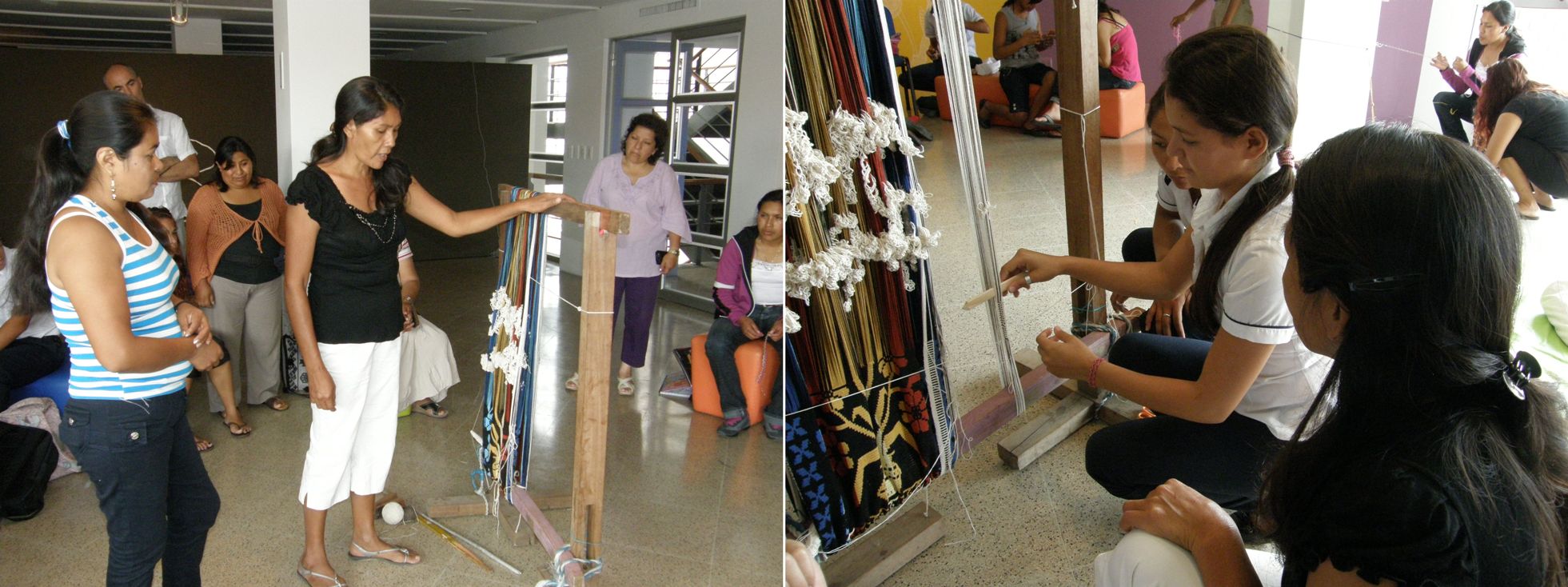
Below you can see Angela talking about Guaraní weaving at a gathering of highland and lowland weavers. School children were able to try weaving on a small warp that she prepared.

Angela is one of a group of people and institutions responsible for the spread of knowledge and the growing appreciation here in Santa Cruz of Guaraní weaving and culture. Even the institute where I used to teach English is now teaching the Guaraní language.

You know I could just go on and on. There are many more teachers to talk about. I carry them all about in my head, as Anita says. I write up all the techniques that I learn in journals when I get home and weave samples and paste in step-by-step pictures. What I don’t write in the journals are the little bits and pieces that I have mentioned here and it is kind of nice to have this blog in which to remember and record such things.

Hopefully I will write a future blog post about some of my other weaving teachers from other parts of Ecuador, Peru, Bolivia, Chile and Guatemala as well as the Asian ladies with whom I have studied more recently in the US. You have already met most of them here.

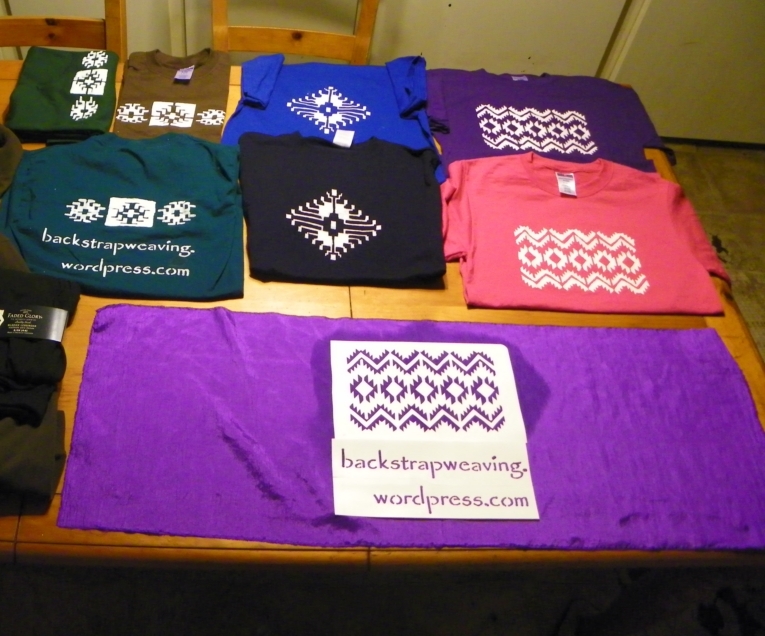
I have one thing to show you before I go. An online weaving friend of mine in Florida made me some t-shirts. She cut the stencils and painted them herself using some motifs from weavings that I have done. One of the designs is the Guaraní snake motif. These are so cool! I look forward to wearing them on my next trip.