Backstrap Weaving – Accidents

There’s been weaving happening at my backstrap loom but this has been a bit different from a standard band-weaving project. A recent incident turned this into an interesting challenge.
This screen shot from security camera footage shows white-headed me walking away in the distance while a happy-go-lucky dog bears down on me. It kept going and ran right into the back of my legs taking me out like bowling ball hitting a pin!
Rocío showing me how she connects two lengths of thread without using a knot.
Showing Rocío some woven rather than stitched garabatá.
The fiber is spun and plied by rolling it along the upper leg. Both hands need to be involved so I’ll just have to be patient.
It was a little discouraging at first because this is the distance I was able to weave after three consecutive days of spending one to two hours at the loom.
One-handed pick-up. I’m just holding the sword here for the photo. I couldn’t rotate my wrist to be able to insert it in the shed.
In progress on the loom and finished. I wish I could complete the gift by attaching it to my friend’s hat but I don’t think either hand is up for that kind of sewing right now.
Eldina working on a warp just wide enough to be able to demonstrate for me the technique the Guaraní weavers call Moisi.
I forgot to bring my swords so we used scissors to separate the threads that needed to be heddled. Three sets of heddles are used for this structure. Eldina’s 5-month-old baby girl is never far away when she’s weaving and teaching.
A cell phone pouch that I wove using the intermesh structure back in the days when phones were small and cute.
Mother and baby busy at the loom!

Backstrap Weaving – Garabatá!

There’s probably a few years of spinning in that bundle….for me, anyway, as a beginner.
The bundles in the top left corner are the indigo-dyed ones.
While it was interesting figuring out how to combine the two patterns, in the end I didn’t think it was the best way to showcase the indigo thread.
The finished pouch is on the right. I used the Dosapey pattern, or part thereof, in all these pieces.
This is one of the products that Carmen sells. It’s made from palm leaves by Guaraní artisans. It’s very firm and holds that lovely egg-like shape. It’s one of those things that just feels so good to cradle in the palm of your hand.
With this I added one more cuff to the collection. These are perfect projects for learning and practicing new patterns. I like the way the indigo is a bigger player in this piece.
I’m still working on the technique that allows the Ayoreo artisans to join two lengths of thread without using a knot. I’m not usually confident about my own attempts and end up adding a tiny drop of glue for extra security. Keep practicing!
This latest bag also got a woven back. This time I used the intermesh structure as I wanted to weave something that resembles the pattern on the front. The intermesh structure as I know it only allows me to use two colors, though.
At the backstrap loom once more. The structure that I’m calling intermesh uses two sets of string heddles alternated with rows of pick-up.
An apple for scale. This will go a long way! I may have to save it to take back to Australia. I love just holding it in my hand and it has the most wonderful smell!
I grabbed this shot from a video I made many years ago with my first Guaraní teacher, Angela. You can see her using the heddles to create a shed.
Piecing together strips of that narrow piece to make another zippered purse. I modeled it on the one above that I wove years ago for a plain-weave weave-along that we ran on Ravelry and have been using ever since.
In the latest class I worked with an even narrower warp, only about 1 cm wide! Sorry, Clara, I still don’t want to weave a placemat.
Hills! Santa Cruz city is soooo flat!
This!

Backstrap Weaving – Dovetailing

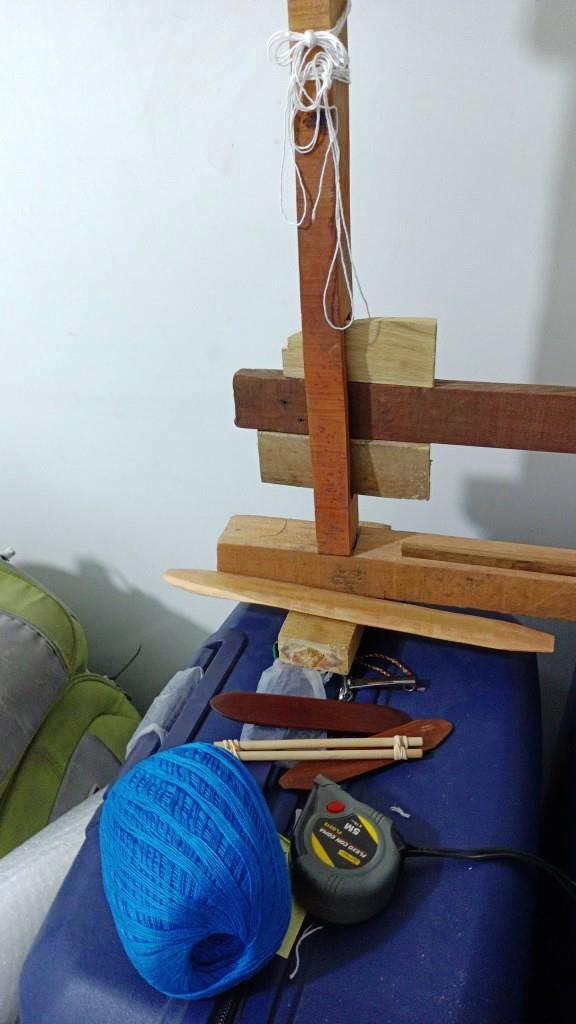
A mini version of a typical Guaraní loom.
Dovetail warping….LEFT: Warping the Guaraní loom. RIGHT: Warping the fixed vertical loom in coastal Ecuador. I was creating a warp for a miniature hammock under my teacher’s watchful eye just so that I could learn the technique. We used her handspun cotton.
My teacher Felipe demonstrating the way he sets up a dovetail warp for his backstrap loom in Salasaca, Ecuador. The post nearest his left thumb is the dovetail post. He uses an additional post for separating colors. He’s just winding a mini warp to teach me and provide me with a sample to take home.
W= Warping stake. C=Cross posts. D=Dovetail stick
Here I am passing the thread around the dovetail string. The two upper strings hold the warp cross.
Winding the two colors together produced the horizontal bars. A weaving class often starts with winding yarn into balls. That’s Clara above. She and her daughter Eldina are the teachers.
The style of string heddles that the Guaraní weavers use is very unique. They are chained together and not held on a stick.
You can get a better view of them here. This is my teacher Angela who used to allow me to visit and watch her at work many years ago.
Several two-color sections in my second warp gave me a lot of practice in sticking to the correct warping path.
This shows the wedges of wood that are the warp-tensioning system. So simple! The lower piece is removed after warping and the upper one, which is shaped, is positioned in order to maintain just the right amount of tension. It gets gradually moved along to its tapered end as weaving progresses and take-up tightens the warp.
The finished cloth….enough for the book cover and a zippered purse. I didn’t need the loops at the ends of the warp around the dovetail string and cut them off.
The cover is on the book and there’s the zippered purse. You can also see the purse I made from the first warp that I’d wound with my teachers.
The two faces of the finished book.
Imagine winding the warp on one of these looms for a hammock! And then making all the heddles. This is the first time I met Angela way back in 2002.
Dyed garabatá thread and an idea for an arrangement of stripes.
I have a handy piece of furniture that allowed me to improvise a warping board for the tubular band warp.
The tubular edging makes the cuff hold its shape very nicely, conceals messy edges and adds a really nice finish. I used a button-and-loop closure.
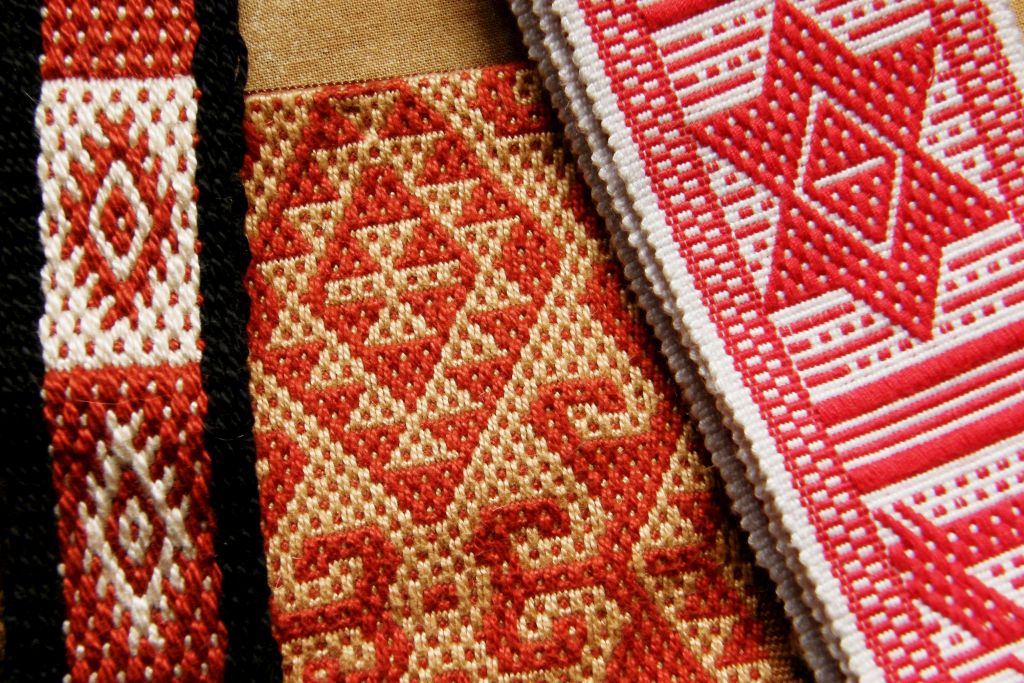
You can see the difference in tightness in the two Ayoreo examples on the left and the Weenhayek on the right.

Backstrap Weaving – Star Gazing

Every night when no one is around I go up onto the terrace of my condo block and walk about star gazing for half an hour or so. It’s a peaceful, quite extensive space that covers the top of eight apartments. I don’t need to wear a mask up there and in spite of the light pollution from the inner city area in which I live, I can enjoy looking at some of the stars and planets while getting in some stretches and exercise. The air is fresh after a steamy summer’s day and I often wish that I could string up a hammock and sleep up there.

I remember one of the few times I was able to enjoy a night sky that was completely devoid of man-made light. It inspired me to weave stars into what I call my ‘Starry Night” wall hanging. I remember stepping outside my little room on Taquile Island on Lake Titicaca in Peru to go to the bathroom on a clear and bitterly cold night and being stunned and almost knocked over by the brilliance and abundance of the stars in the black, black sky over that dark, silent island. Kurt Laitenberger wove this motif with tablets and and I asked his permission to transpose it into the Andean Pebble Weave structure.

It’s interesting that it was this very same motif that caught my teacher Maxima’s eye the last time I was with her up in the highlands. I had taken many woven samples to show the ladies in the weaving cooperative and Maxima had chosen this one. Her first attempt to copy it on her own was not successful. Actually, she had started out very well but suddenly got stumped and stopped. She asked if she could watch me weave it so that she could learn. 

This image has an empty alt attribute; its file name is with-max-at-leaning-loom.jpg

I wove one motif and that was enough. Maxima was then able to continue just by following my woven example.

This image has an empty alt attribute; its file name is maxima-star-band-central-boloivian-highlands.jpg

Up on the terrace In these early months of 2022, it’s been nice greeting Orion on its return to the 8pm night sky on my side of the world and I am currently waiting on the Southern Cross to complete its circle low in the south and once more climb high enough to reveal itself above the light pollution and buildings.

An invitation in one of the online weaving groups to show-and-share star patterns prompted me to write this post. I actually wrote about this same topic about ten years ago but there has been quite a lot to add to it since then. Back then, I was able to share the Andean Pebble Weave strap on which I combined motifs woven by the Guaraní people here in the lowland part of Bolivia in which I live…

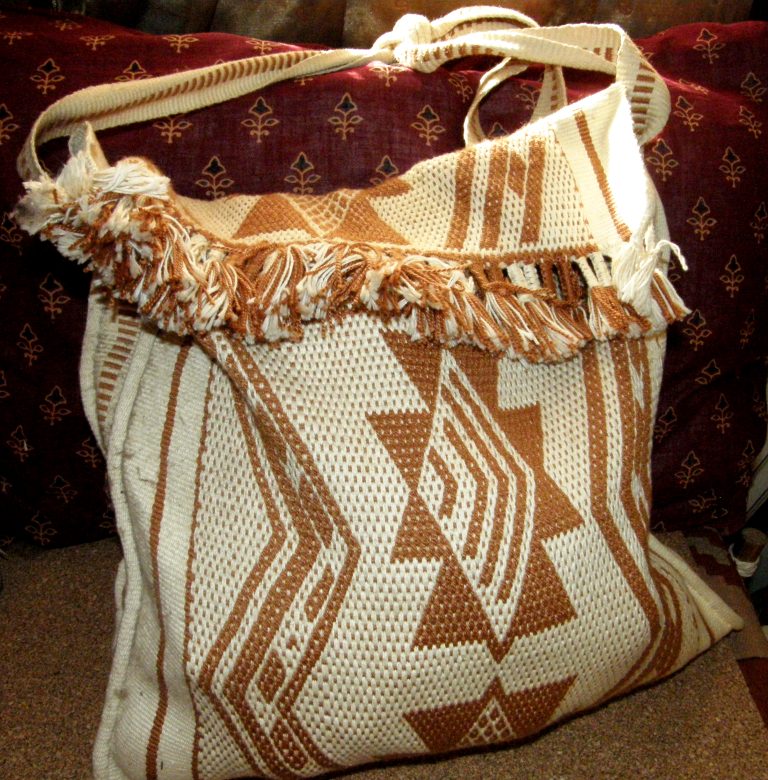
The Guaraní weavers use two types of complementary-warp structures in their cotton cloth. In the structure that they call Moisy, they represent all the natural beauty of their surroundings in large, bold renditions of trees, butterflies, birds, plants and flowers. However, in the pebble structure that I used above, they only ever weave two motifs – a snake and stars –  and there are an endless number of versions of these two items. You can see one such version on the woven bag.

My teacher told me that it was a snake that came to the first weaver in her dreams to teach her the patterns. The Guaraní people who live along the Parapetí River here in Santa Cruz also use the snake motif to represent that life-giving water. The stars are important guides in their agricultural cycle.

I found a story translated from Guaraní to Spanish in a book published by Artecampo, which is a craft cooperative store here in Santa Cruz, about a legend behind the use of the star motifs in Guaraní weaving…..it says that…

One day the children were taken and placed  like stars in the heavens and this is why women cry out about stars in their weaving. The stars not only speak of the sky but also about the richness of nature because one woman, in an attempt to stop her child from being taken, grabbed hold of a finger (or toe, it is not clear in the Spanish translation which). As she pulled on the finger, unfortunately, a piece broke off and this piece was buried. From the burial of this piece a corn plant sprouted. In this way, weaving symbolizes abundance which comes from the piece of the child. And this is why food crops are not only considered elements that feed and sustain men, they are part of Man himself just as the stars are part of Man and Society. Songs name those who are living in the sky and those that sing wear woven cloth to show that they are still with them even though they are distant.

Dionicia added these stars to her pattern repertoire after my visit. She wove them into a bench cover that she sells locally. Being able to include a “novel” pattern gives her a little advantage over other weavers who might also be selling their woven bench covers. 

This image has an empty alt attribute; its file name is dioniciac-1.jpg

The star patterns above are charted in my book More Andean Pebble Weave Patterns. And, speaking of the ladies up in the highlands, Dorinda has just written a new blog post on her most recent visit now that she is back home in the States. Dorinda had been away in the USA for going on two years and I can only imagine the happy reunion when she visited in November. 

In the Bolivian highlands, stars are woven into cloth by the weavers of the community of Tinkipaya. According to Veronica Cereceda in her book which catalogs the designs on these textiles, these ch’askas, stars, are a representation of the world above known as janaq pacha.

The small band in cotton that I wove to test the pattern is pictured above with a couple of wooden tools I got in a market in Potosi, the province in which Tinkipaya is located. I was told that the tool on the left is used to push down the warps behind the heddle rod when the weaver is opening the heddle shed. I have never seen a weaver actually use one of these and I have never seen another one like it. The one I have has a red stain on it and I like to think that it might be cochineal from one day when its owner was preparing to dye. The other tool, of which you can only see the tip, is used for beating and strumming and I have seen tools like this in use in several places in Bolivia and Peru although they are more typically made from a llama leg bone.

The structure used in this piece is yet another style of complementary-warp. The warp floats that surround and fill the star motif are aligned and arranged in a certain way that distinguishes this style from others. Below you can see the same star motifs woven with my hand spun llama fiber into a band that I wear as a wrist cuff. 

This image has an empty alt attribute; its file name is wrist-cuff-in-handspun-llama.jpg

And here it appears yet again in wool on a little bag I made when one of the online groups held an “orange challenge” several years ago.

This image has an empty alt attribute; its file name is 194951393_6181681991845586_2057187051893150363_n_medium.jpg

I published the chart for this pattern in my More Adventures with Warped Faced Pick-up Patterns book and Susan Torntore, one of my new Zoom weaving friends who refreshed her Andean Pebble Weave skills via a Zoom class with me, transposed it into the Andean Pebble Weave structure and then went on to create something like fifteen beautiful variations. Here are a couple of them. She plans to use this band as a bell pull.

This image has an empty alt attribute; its file name is susan-torntore-stars-crop.jpg

The Andean Pebble Weave structure has the advantage of having two regularly repeating rows which can be produced automatically by enclosing those arrangements of threads in heddles. Some weavers choose to do that because motifs can be woven much faster this way. Others prefer not to fuss with heddles and weave the patterns using pick-up for every row. In the structure used for the traditional Tinkipaya pattern, there’s no choice. Each “row” is unique and the threads for each must be picked up manually.

Wikipedia tells me that the stars on the flag of the United States represent the fifty States in the Union. Well, I knew that. I was hoping to find out why exactly stars had been chosen as opposed to some other figure but I guess there doesn’t have to be a reason. I am sure that we could all come up with some kind of symbolic meaning for a star. I swear that some of the indigenous weavers with whom I have studied have made up things about the motifs they are using just to please or else have a bit of fun with me…I have seen the twinkle in their eyes and the way they look sideways at each other!

Gail wove this very patriotic collar for her dog on her inkle loom many years ago and I have seen this pattern and variations of it show up in the various online Inkle Loom groups many times over the years around the fourth of July. Gail was forever coming up with clever collar designs for what must have been the best-dressed dog in New York.

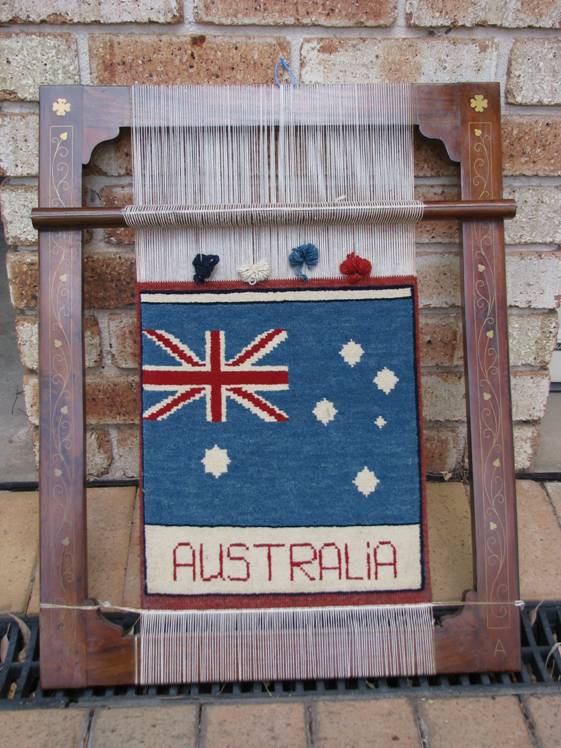
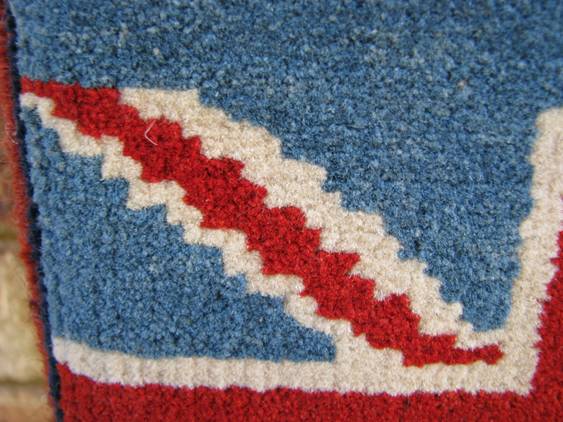
Speaking of flags and patriotic weaving, I assume that the next starry piece was made by someone who is proud to be Australian. I have this very cool cut-pile weaving of a representation of the design on the Australian flag…

The group of stars is the Southern Cross constellation which really is a sight to behold there in the southern sky. I am so happy to be able to see it low on the Bolivian horizon and it makes me feel somehow connected to Australia and  the people I know and love so far away. It is little wonder we so love stars and choose to use them in our cloth.

The large single star, which should only have seven points, represents the Nation’s seven states and territories. This cut pile piece on its beautiful frame is gorgeously dense and I would love to meet its creator.

It was given to my brother as compensation from the Indian owner of a furniture store who went out of business before he could supply all the chairs for my brother’s dining room setting. My brother then gave it to me. One day I will track down this furniture maker and see if I can talk to him about this weaving technique.

I don’t know if the weaver intended to continue with the design. There is so little space at this point and the tension on the warp is so high I can hardly imagine being able to do so.

There are a lot of representations of stars in Andean weaving. I took one small motif  and combined it with others to make the guitar strap below in colors reminiscent of the desert and canyons of the US southwest… a winding river, moon and stars. It took me back to clear, warm nights camping in the depths of Utah canyons with nothing between me and the stars. Moonlight bounced of red canyon walls and dozens of frogs singing away at the water’s edge. These were other precious occasions on which I could star gaze without man-made light pollution.

Combining several small motifs in this way is a nice stepping stone toward designing your own unique patterns. I teach the Andean Pebble Weave technique for those who use a standard inkle loom in my book Andean Pebble Weave on Inkle Looms which you can buy as a PDF or as a spiral-bound book from Taproot Video.

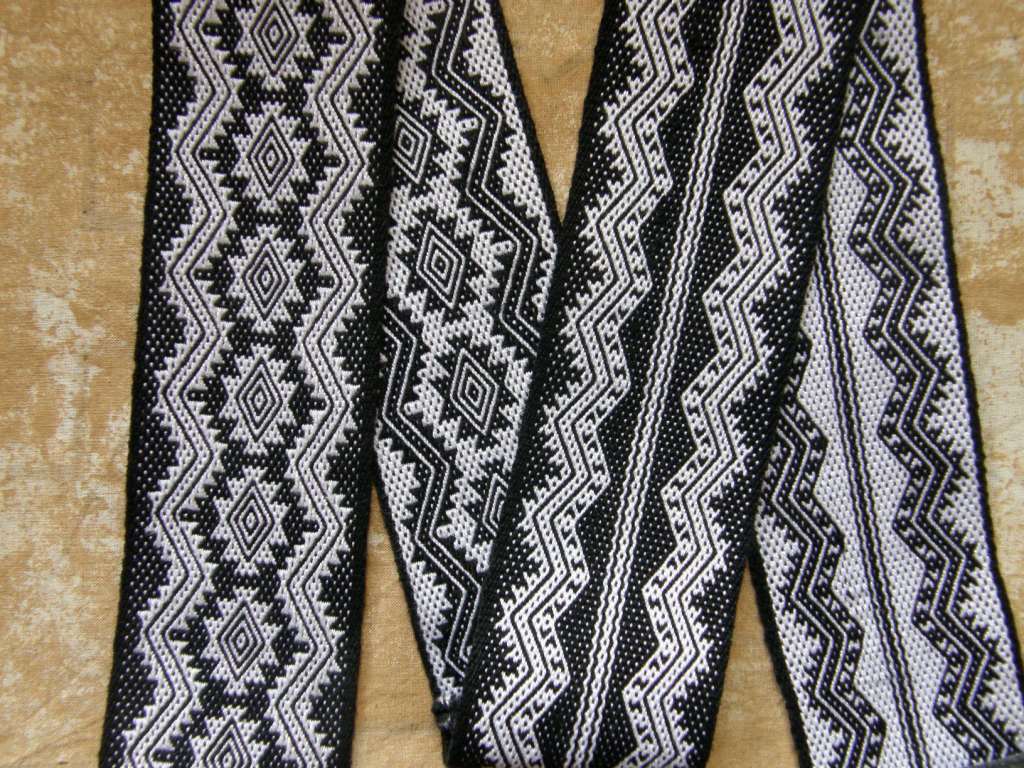
And then there are many motifs that look like stars to our eyes but which and perhaps represent something else all together. Maybe one day I will find out what exactly they mean to the weaver. There’s what I believe to be an Andean ch’aska  in Andean Pebble Weave on the left. In the center are the star-like motifs that I replicated from Central Asian yurt bands. A motif on a belt from Ecuador is on the right. Its star-like motif is woven using supplementary warp threads.

I chose a star motif for my first ever attempt at using 60/2 silk as warp on my backstrap loom. The motif did not have any symbolic significance to me. I simply needed to use something that was smooth-sided and symmetric. This was because I wanted to use a supplementary-weft technique in which the additional weft is not carried from selvedge to selvedge. I didn’t want the supplemental weft to thicken the cloth and so I used a technique in which the weft just travels back and forth from edge to edge of the motif itself. This only looks nice, in my opinion, when regular rather than irregular shapes are used. So, who knows why certain motifs ae chosen by weavers? It could be for what they symbolize or the choice could also just as easily be for purely practical reasons, as was the case in my silk piece.

There aren’t any stars on my current three-color Andean Pebble Weave piece. It’s all about flowers and hummingbirds. If you have been following me on Instagram (I go by my name: lavernewaddington there) you will have seen some of my progress. At some point I unconsciously stopped being concerned about my hand-spun wool being up to the challenge and have been simply enjoying how lovely it feels instead. But for now, I will stick with the Starry topic and wait to show you more of my three-color pebble in my next post here on this blog.

Let me finish by showing you some beautiful creations that were shared with me by another new Zoom weaving friend, Laurice Johnson. She has converted her pretty inkle-loom-woven bands into these gorgeous star ornaments by following online tutorials. There are several tutorials on Youtube for fabric stars that can be used for inkle bands. They are really stunning. My friend Jennifer Williams also has a tutorial on her blog for a different kind of star made from narrow bands.

I’ll be heading upstairs soon for another night of star gazing. See you next time.

Backstrap Weaving – Different Paths

Facebook is fond of showing me memories from past years and the latest one to show up is from November 2017 when I was at my brother’s home in Australia working on weaving the samples for my Complementary-warp Pattern Book. Sometimes, the will is there to start a new book but for some reason it is just so very hard to get the project off the ground. At times, I have started by laying out the table of contents in a Word doc and that has been enough to kick me into further action. In the case of Complementary-warp Pattern Book it was the act of sitting down with this lovely blank Andean Pebble Weave warp stretched out before me that started the ball rolling.

There would soon be four horses galloping along the length of that warp…four horses called “Eldy’s Mustangs” by their creator, my weaving friend, Deanna Johnson. I love the simplicity of this set-up. Another warp that I set up for this book would have angels dancing among snowflakes, candy canes and Christmas trees. I think that just the colors  that I had chosen would have provided a hint of what was to come.

And this next one was set up to display different kinds of maze-like and geometric patterns.

Watch and learn….Of course, I was focused on the way my teachers’ fingers were moving among the threads while picking colors to form the patterns. The body movements when using such narrow warps are very subtle.

All three warps are set up for the two-heddle pebble weave method that I favor when I weave this structure on my backstrap loom. The pencils that you see in the warp are holding what I call the “permanent picking cross”. In the twenty-four years that I have been traveling here and there to study these structures with my indigenous teachers, one of the most important things that I have brought home with me time and time again is the fact that there is no one correct way to do things. There are many different paths that can be taken in order to arrive at the same place. I am so glad that I have been exposed to four very different methods that can be used to weave the Andean Pebble Weave structure.

The set-up that you see in these photos was the one that was taught to me by my very first teachers back in 1996. The mother and daughter who sat with me day after day as I wrestled around with those two sets of heddles came from Ayacucho in Peru. They happened to be living in Huancayo at the time.

I would like to say that they sat by patiently as I made a mess of their carefully prepared warp but it isn’t so. They were perplexed and annoyed by the fact that I was pulling away so violently at the heddles. My warp threads were breaking with all the friction and abrasion. I was not aware at that time of the role my body needed to play in the operation of the loom. The body needs to move and make subtle changes to the tension on the warp which makes the smooth operation of the heddles possible. Several movements need to be coordinated and when you finally find yourself picking up and slipping into the rhythm, it’s almost like a dance. Until then, you are brutish and clumsy and the result is heddles clogged with fluff, broken warp threads and annoyed teachers!

I didn’t understand that there was much to be learned about basic backstrap loom operation before I could hope to learn about the patterning technique. Fortunately it all started to come together eventually.

You can see my teacher picking out her pattern while working close to the cross sticks. This is the method used by weavers in Ayacucho. The two sets of heddles hold the regularly repeating pebble sheds….those that create the little spots, or pebbles, in the fabric.

(If you also find yourself seated at a nicely prepared warp but are unable to progress because of heddles clogged with fluff, you might consider taking a look at the video class that I prepared back in 2016…Operating a Backstrap Loom. It’s available as a dvd or as streamed content from Taproot Video.)

My weaving teacher here in lowland Bolivia uses this pebble weave structure on the large vertical frame loom that is used by the Guaraní people to weave hammocks. Angela uses three sets of heddles…one set holds the threads from one of the two pebble sheds. A second holds all the dark threads and the third all the light threads. The threads for the second pebble shed lie on a shed rod or in one large loop depending on the width of the piece being woven. The Guaraní weavers have a very interesting way of making their string heddles. You can see how they are sort of chained together.

Angela was only working on very narrow commissioned pieces when I studied with her and so I have included here a picture (courtesy of Aude Rossignol) of another Guaraní weaver who is using the full width of her loom for a hammock in pebble weave. You can see the advantage of those loose chained heddles on such a wide piece. If the heddles were suspended on a rod, it would not be possible to just pull on the rod and achieve a good shed clear across that wide warp. This is a fixed tension loom and so using the body to make tension adjustments as one does with a backstrap loom is not an option. Instead, the weavers pull on groups of chained heddles working their slowly way from one side of the loom (in this case from right to left) to the other and inserting the sword as they go.

Picture courtesy of Aude Rossignol.

My weaving teachers in the central Bolivian highlands use yet another method when they weave narrow bands to create the same Andean Pebble Weave structure…

The only name that I can think of for this kind of loom is “body-tensioned”. Maxima’s index finger is one “beam” and her big toe is the other. Her left index finger is permanently in this position to maintain and adjust tension on the warp. All loom operation and pick-up is done with the other hand. There’s no backstrap. The warp is set up with one pebble shed in heddles and the other pebble shed in one large loop. Max makes a picking cross with these two sheds and from there picks the colors to form her pebble weave patterns. And, you should see the speed with which she does so!

The last time I visited Max and the other ladies in the co-op, I demonstrated a new pattern for them using a warp that was tied to my waist in the manner to which I am accustomed. I could see Max studying me and I could almost see from the expression on her face that she approved of this set-up which gave me two free hands with which to operate the loom…a definite advantage when working with the rather sticky handspun wool thread. All the ladies kicked off a sandal and started winding warps using their fingers and toes as warping stakes. Max took a length of yarn and tied hers to her waist. She had decided to try out this “new” method that I was using which involved tying the warp to her body rather than just suspending it on one finger. To my surprise she was immediately mocked by all the other ladies for wanting to do things the “gringa” way!

Max, Antonia and some of the other ladies learned to read my pattern charts. You can see a picture of Antonia showing off the band she wove using patterns from the book I had left behind. Don’t we all love to learn new patterns?

The fourth way is the way that is used by some of the backstrap weavers that I have observed in the Cusco area of Peru in my travels. We were also privileged to have two ladies from Chinchero come to Santa Cruz Bolivia, where I live, to attend a small conference that was held here back in 2011. Only a handful of people from the general public applied to attend and it was wonderful to be able to spend so much quality time with these weavers over the three days that we had together. My Guaraní teacher, Angela, was also invited to demonstrate.

The warp being used by the Chinchero weaver in this picture is set up with all the threads of color A in heddles and all the threads in color B held on a shed rod. She uses two swords to hold what I call a “temporary picking cross” in which all the threads from both layers of warp are raised at the same time and held on swords. She can weave a variety of complementary-warp structures using this method. Some of the patterns that Chinchero weavers use are a complex combination of more than one structure which means that there is no real advantage to storing the pebble sheds in heddles. Some parts of a large motif can be woven using the two-two-two pebble arrangement of warp floats while other parts of the very same motif can be based on a two-one-two-one arrangement.

This two-sword method is he one that I teach in my Complementary-warp Pick-up Book. In my Andean Pebble Weave on Inkle Looms book I teach both this and a modified version of the two-heddle method. In fact, I teach three methods in that book.

You might have guessed that my favorite method for the backstrap loom is the first one that I showed with its two sets of heddles. For me, it has many advantages. I won’t go into them but, if you have ever taken one of my Andean Pebble Weave classes on a backstrap loom, you may recall my talking very enthusiastically about a thing called the “saver cord”. On the inkle loom, I guess I prefer the two-sword method of the three different methods I teach on that kind of loom.

Mary Spanos has woven with me on several occasions when I have been visiting the USA. She loves the backstrap loom and recently showed me her latest project….

This is a Japanese sashiko pattern that is charted in my Complementary-warp Pattern Book. Julia Weldon translated the traditional stitched pattern to the Andean Pebble Weave structure and kindly contributed it to the collection. Mary is weaving it beautifully into this band. I particularly like the way that she has chosen to use a lavender and white strip of plain Andean Pebble Weave as a border stripe instead of a solid color.

And, here’s another band by Mary using a series of fish patterns from the same book alongside some of her own creation…

Carlos is also using a backstrap loom and the two-heddle method to weave a wide piece of fabric to be made into a shoulder bag. The same book mentioned above has charts for three bee motifs. The center bee on this piece is included and is Carlos’ own creation.

Lausanne also learned the two-heddle method using a backstrap loom with me on one of my visits and you can see her here weaving a hatband for her husband with, yet again, a pattern that is charted in the Complementary-warp Pattern Book (from a pre-columbian textile fragment). This is one of my favorites…one of some cheeky viscachas rocking to and fro…

Here it is on the hat….

Annette Giles is using the two-sword/temporary picking cross method to weave the Andean Pebble Weave hummingbirds. Yes, they’re from that book again.

And, here are some initial results from Carol Berry from one of the very first Zoom classes I gave on Andean Pebble Weave on Inkle Looms…

So…… enough pebble weave! How about some double weave?

Nancy Ayton is using her inkle loom to weave warp-faced double weave bands and is creating her own fabulous patterns. Don’t you love the elf?! That’s just one of Nancy’s original designs on this band.  The band includes some motifs from my book Warp-faced Double Weave on Inkle Looms.

I think I will weave the elf on a set of Christmas tree hanging ornaments like the ones I made last year.

On Maureen Farndell’s warp-faced double weave band you can see the motif that I adapted from Bedouin textiles and charted in the book. It’s lovely the way she has connected the motifs and turned them into one continuous pattern along the length of the band.

As for me, I am plodding along with another silk ikat sample. This one is a study of take-up  and the number of warp-ends and picks I need to create a square. Hopefully the information on take-up will help if I later decide to try and tie some curved shapes into a warp. I do hope so because the study sample pattern I have chosen is just plain boring to weave! It’s rare for me to sit at my loom and think “Urgh, I just couldn’t be bothered”! But sometimes you just have to slog through this sampling process. Hopefully, when it comes time to write my next post, it will be off the loom and I will be on to something else with all the valuable information I have gathered from this sample.

Until then….stay safe and well.