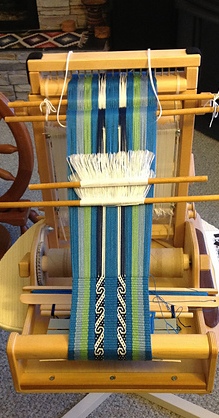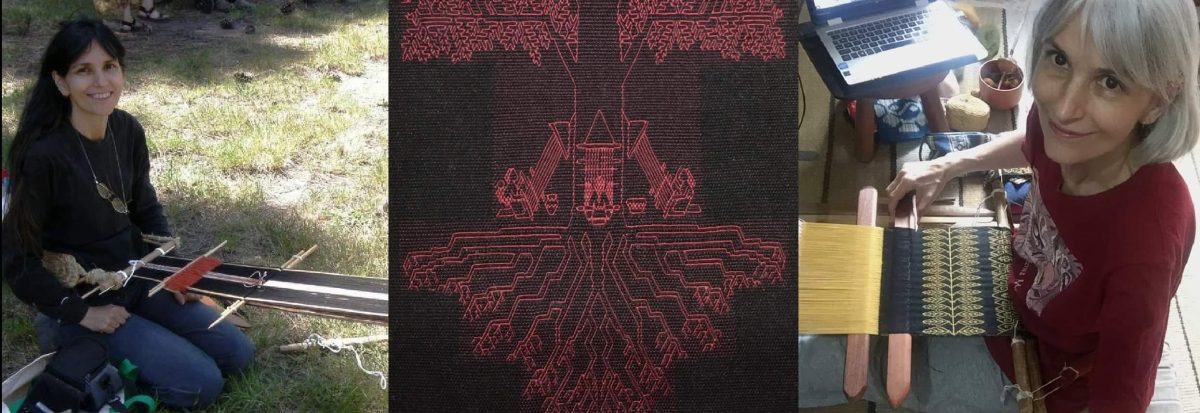
 Seeing double….it was interesting weaving these two panels for my wall hanging at the same time on my backstrap loom. I am sure that doing so helped me achieve the identical spacing and dimensions of the supplementary-weft motifs that I was aiming for. I had those specific reasons for doing it that way. Did it save time? I am not really sure. I guess there was some efficiency in warping both panels in one session.
This is not the first time I have done this. A long time ago when I made a carry bag for my backstrap weaving stuff I needed two separate narrow bands for side panels. I wanted the neatness of the third selvedge on both and so wanted to weave them as two separate bands rather than weave one long band which would then be cut in half. Somehow I thought that it would be more efficient to weave them side by side like this. It was an interesting exercise but I couldn’t find anything about the process that was more efficient.
Well, okay, maybe it saved just a little time…the time that I would have spent dilly-dallying and messing around after finishing the first band and then finally heading to the warping board to set up the second one.
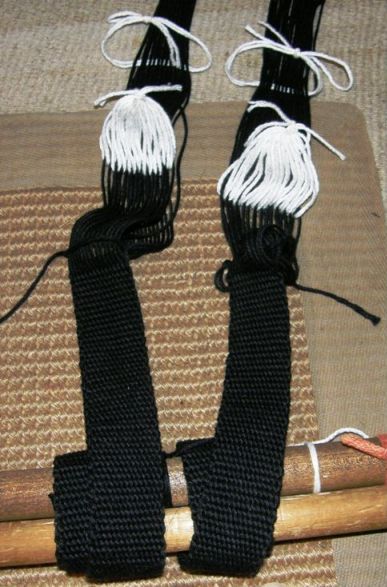 I know why the Montagnard weavers weave two bands together on their backstrap looms. It is simply a question of balance and a more comfortable way to weave. The Montagnard looms are designed for very wide pieces…wide panels that will be joined to make blankets and skirts. Placing a single narrow band in the center of the loom bar that wide is awkward.
 The bands shown in progress above will be bag straps for what the weavers have nicknamed their “Bible bags”.
 In the next picture you can get a better idea of just how large those loom pieces are. Take a look at that mighty sword!
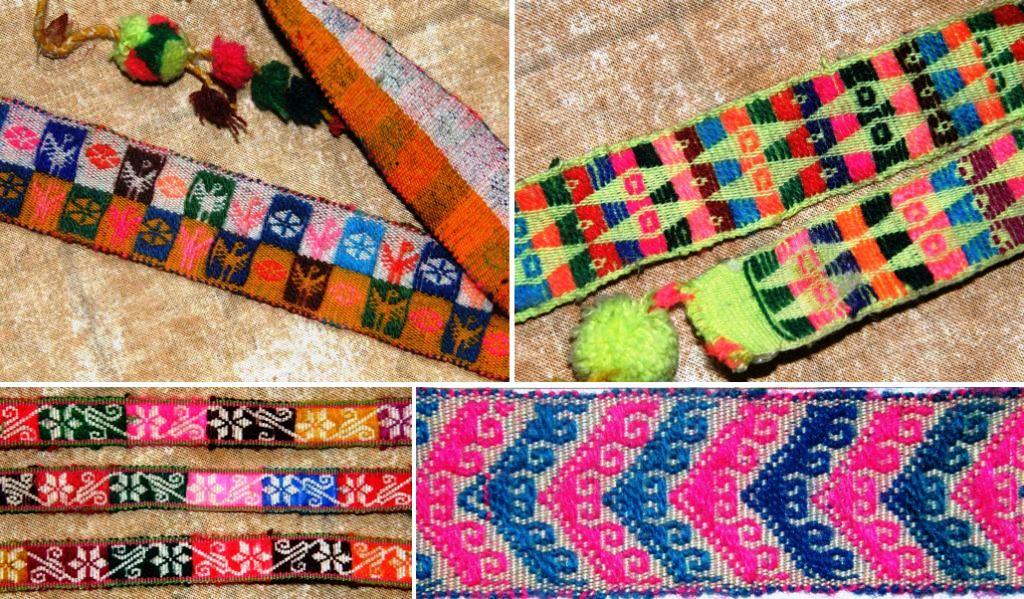
 Now I can sit and wonder about the following piece that I saw recently on Teyacapan’s fabulous Flickr page of Mexican crafts and textiles…
 The motifs are identical on both pieces but it is hard imagine that they are destined to be part of the same project because of the difference in border colors and, indeed, Karen says that they are fajas (belts). The loom bar is not extraordinarily wide so I don’t think that balance had anything to do with it. It is fun to see the different ways that weavers choose to set up their projects.
So, having finished the two red panels I am now working on the central black one…

I am using a coil rod on this warp, as I did on the two red panels, to help lock the warp threads in place and stop them from slipping around the far loom bar. It is the movement of the threads around the far bar as the sheds are opened that I believe is responsible for the corrugated look that warp- faced cotton pieces often develop. I am being a little unconventional by using one on what is not a circular warp. I have written a series of posts about the coil rod starting with this one.
I was apparently very distracted as I placed the coil rod in this warp. I placed it upside down and only noticed, even though it was very obvious, after I was three-quarters of the way through. Thankfully, the fact that the rod sits on the underside of the warp rather than on its upper face does not have any affect on its performance.
While looking through the pictures I took when I studied with the Montagnard weavers I found this shot of Ju Nie’s coil rod sitting nicely in position on her circular warp.
 As I have said before, I want to play with creating the motifs by using the supplementary weft to form the motif itself as well as outline the motif in the black ground weave. You can see below, the first a row of ground weave motifs followed by the supplementary-weft ones and then a repeat of the ground-weave style.
 Then I wove my adaptation of the Calcha hatband motif that I so love which inludes the flower head motif woven at the beginning of the black piece.
So far, I think that it is all working pretty well together.
 And now I have decided that I need to challenge (or torture?) myself by weaving both styles side by side. That is causing me to see double all over again!
You can see what I mean by “both styles side by side” in the patterns on the Bolivian hatband in the center below
 The band has two ground-weave colors with one half of the band being white and the other yellow. The bird motif is formed in the supplementary weft on the white half of the band. On the yellow half the bird shape shows in the yellow ground weave and is outlined by the supplementary weft. The turns of the supplementary wefts are along the edges of the band which means that each shed holds the ground weft and two supplementary wefts. I have tried that myself but the result of stuffing all that weft into each shed with the weight of yarn that I use is too bulky for my liking.
For the moment, a whole two rows into the next set of motifs, I am bending my brain trying to see the motif in positive form and then negative and back to positive again as I work my way picking and dropping threads across the warp. As with anything, I am sure that I will just get used to it.
I finished the three-color pebble weave band…one background color and two motif colors…another form of seeing double, I suppose, having had to think about two colors simultaneously forming patterns instead of one.
 Only now that the band is finished, I fully appreciate the feel and sheen of the tencel which simply weren’t apparent when the piece was at full stretch on the loom.
I found that there are lots of great sites online with free bag sewing patterns…no need to link to any particular one…there are LOADS of them. There is one for a cute backpack that I just might have to try. I will sew this band onto it. Now, should I weave the fabric for the backpack with a tiny bit of three-color pebble accent or should I go out and buy fabric? Seeing as I know nothing about fabric, that alone will be a challenge. Actually, I wouldn’t mind weaving a very wide piece of plain-ish fabric on my backstrap loom.
Now to get that four-color band finished…something to relax with when all that positive and negative stuff on the black panel starts to flip me out! The other thing that is relaxing is thinking about and planning the weft-twined pattern that I hope to use to join the three panels along the top….down on the floor with charting paper and pencil and eraser…love that!
And again, while looking through my pictures of my Montagnard weaving teachers I found this one of a beautiful skirt woven by Ju Nie with its kteh work, the weft twined finish. Ju Nie often sends her skirt pieces back to Vietnam for her sister, who is more expert in kteh than she is, to add the twined and beaded finish.
 To finish I would like to show you one of the most beautiful pictures of a collection of bands I have ever seen…
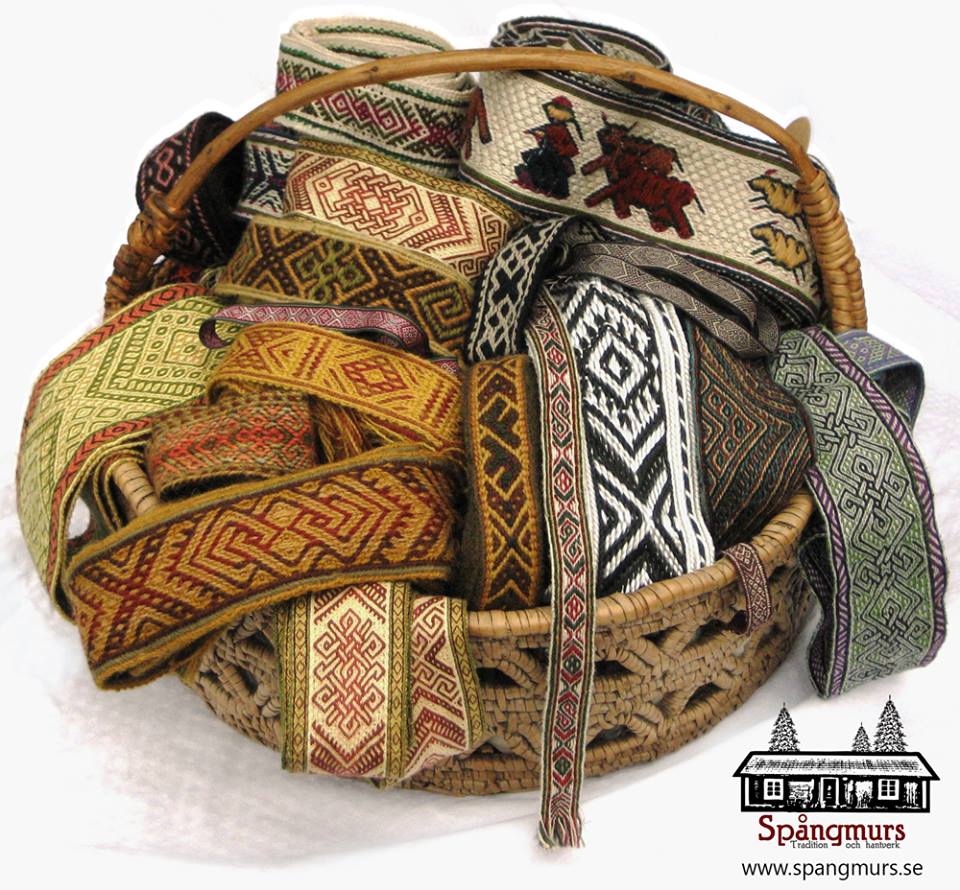 These are some of the tablet-woven bands by Louise Ström in Sweden. Those of you who have my second book may recall Louise’s contribution of some of her tablet-weaving motifs. I show how these can be adapted to Andean Pebble Weave. In fact, I recognize one of the bands that she allowed me to use for patterns is in the basket above. Louise recently completed a booklet in English on tablet weaving entitled Krusband – Tablet Woven Poetry. A booklet about tablet weaving without using a chart. The appendix, which can be bought separately, has over 100 original patterns.
Back to my loom now. Let’s see if now, with a clear head, row three on the black panel is any less confusing!