Backstrap Weaving -The Bag of Tricks

I had to dig deep into the bag of tricks this week to come up with a new idea for finshing off my latest three-panel wall hanging. Two days of experimenting with the structure that I had hoped to use for the two outer red panels finally led me to the conclusion that it just was not going to be as I had envisioned. It was time to plan again and take a look at all that I have at my disposal in my “bag of tricks”.  And there is a lot of stuff in that bag of tricks after having spent almost 18 years now studying weaving techniques and simple looms used in South America.

main panel of Shipibo inspired wall hanging backstrap loomThe main panel for the wall hanging is now finished. I can’t cut it off the loom yet to better show you the stepped effect of the woven fringe as I will need to place the two red panels, when I am done weaving them,  on this same loom and then twine across the top of all three to join them together.

It is always fun turning a finished piece over to look at the other side. I have been looking at white squiggles on black for so long now as I inched my way through this weaving. Yes, literally inched. I took note of my progress on the woven fringe part and it was pretty much an inch a day.

light sde of shipibo inspired hanging off loomThis side actually looks more like the painted Shipibo cloth that inspired this project. It is much more common to see light cloth with dark lines. But I don’t have to make any decisions here about which side to show. It needs to be the dark side in order to match the other pieces in this wall hanging series.

I want this second wall hanging to represent the weavers of the tropical lowland regions of Peru. For that reason I had chosen to use the structure that is used by people of the upper Amazon Basin to make wristlets.

shipibo-wristletsI have never been to that part of Peru and so was relying on a sample that I had been given from the work of Nora Rogers and Ann Blinks as well as notes by Cheryl Samuel in order to reproduce the structure. I bought red hemp twine for this project while in the USA. The weave is based on having twined warp threads lying next to what Samuel calls a “half basket weave”.

wristletI did succeed in reproducing the structure but the hemp twine did not give the design the relief that I had been hoping for. It was just a flat red mass at which I had to peer in just the right light in order to make out the pattern.I tried all kinds of weft and beat but I simply could not get the desired effect.  Nevertheless, I found myself sitting alone stupidly squealing with happiness as the piece started to take shape. It was a joy just to able to reproduce it but a disppointment  not to be able to use it in my hanging.

Back to the drawing board. I wanted something that would be all red but with texture and, of course, something that would represent textile techniques of the lowlands.

But, of course….simple warp floats!

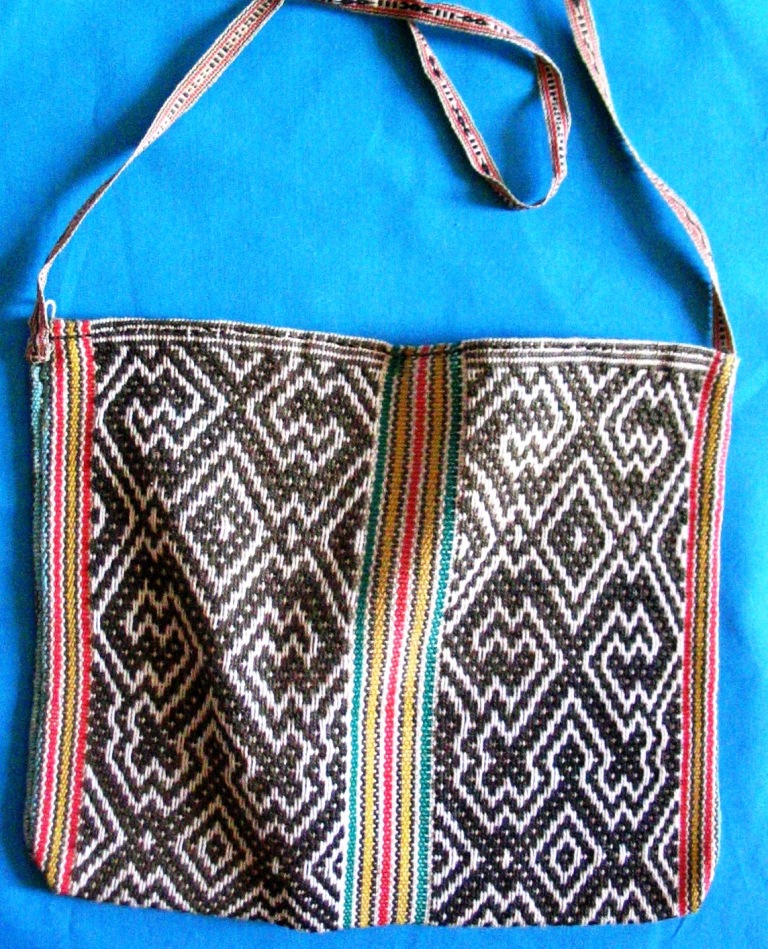
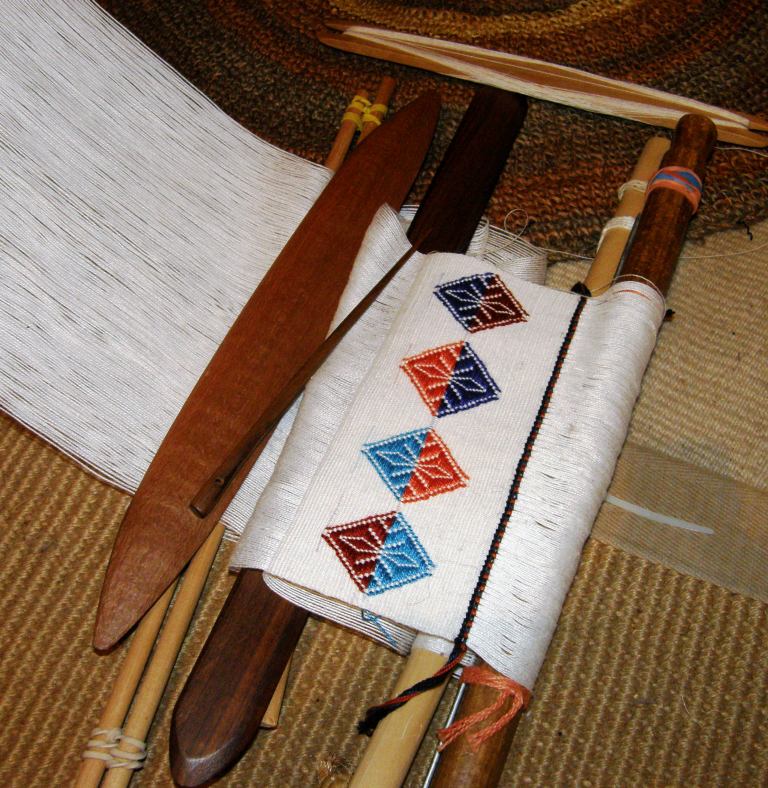
shipibo pattern in simple warp floatsSome time ago I had woven the placemat, above, using a two-color simple warp float technique. I copied the pattern from a cotton bag from tropical lowland Peru that Teyacapan shows on her Flickr page. The design is one that I have also seen painted and even embroidered on Shipibo cloth.

The set of placemats I wove became a study of the use of this structure in several regions across the globe…

backstrap weaving placemats simple warp floatsAt the Encuentro de Tejedores that I attended in Cusco in 2012, I was able to observe Matsigenka backstrap weavers from Bajo Urubamba creating striking black and white pieces with their handspun cotton. The pieces were decorated with patterns that were created from simple warp floats.

??????????????????????

Photo by Jennifer Moore

The picture above was taken at Tinkuy 2013 in Cusco and shows a weaver from Pacaya, in tropical lowland Peru, weaving a warp float pattern with handspun cotton on a backstrap loom.

It isn’t necessary to have two colors to create patterns in this structure. If I used an all-red warp, I could create patterns of raised red-on-red….textured patterns rather than colored ones.  I also had a Mexican sash that my friend Annie MacHale had given me way back in 2010. I then remembered that weaving a single- colored piece with warp float patterns had been on my to-do list for some time. It was all coming together nicely!

???????????????????????????????The weaver of this Mexican sash has alternated a heavy warp thread (doubled threads) with fine to create a high-relief pattern in white on white.

???????????????????????????????Above, you can see my red experiments…the hemp twine wristlet structure and the red-on-red simple warp floats.

red-on-red simplewarp floatsI experimented with floating pairs and floating single threads and decided that single was the way to go. I wanted the pattern to be fairly delicate and subtle so as not to interfere with all that is going on in the main black-and-white panel. I decided to weave the solid lines of the main panel with the arrow motif in the center.

I set up both panels on the one loom in the same way that I had done for the first wall hanging. This would ensure that both came out the same way.

???????????????????????????????

red on red panels on backstrap loom

arrow motif red on red panelsYou’ll have to trust me when I tell you that these panels are deep red and not the weird pinkish-red that you see here.

Now it is time to start sketching ideas for the weft-twined pattern that will go across the top of the finished three panels. I remember I had a heck of a time with the twining on the first wall hanging trying to group the warps correctly so that the twined width matched the woven width. Hopefully it won’t take as many attempts this time to get it right!

And in my spare moments I doodle and think about wall hanging number three…the ikat one. Luckily I have a giant cone of thread and a a huge roll of ikat tape (thank you Betty!). I expect there to be a few do-overs for that one! I am also hoping to use supplementary-weft to create patterns on that piece. These ideas are just sloshing around in my mind for now but I hope to base the overall design on hook motifs in positive and negative space like the ones I played with recently in silk supplementary weft on cotton…hook motif mirrored and flippedThen there will be the third series of wall hangings in which I hope to put what I learned with my ticlla (discontinuous warp) experiments to use….using wool and the red-black-and-white combo, of course!

dovetail join ticlla waddington

ticlla with supplementary weft inlayI have spent a lot of time putting that big bag of tricks together. It is nice to be able to use these experiments to create bigger things. I look way, way ahead and I get excited about all these projects as I inch my way along!

See you next week.


Backstrap Weaving – Songs from the Lowlands

While scrambling to prepare for my up and coming travels, I have a little time to show you the latest progress on my Shipibo-inspired piece. I have spent some time looking about online for more information about the Shipibo designs and my head is reeling with the variety of information that is out there on the meaning of the patterns.

I have heard several version from my weaving teachers about the name and meaning of this Bolivian motif. explaations of the
I have heard several versions from my weaving teachers about the meaning of this Bolivian motif.

It doesn’t surprise me. I have written here before that I can ask five weavers here in Bolivia the meaning of a certain motif and receive three different answers. I have heard different stories about designs from people even within the one small community. The real question is, do the weavers even want to share this special information with me?

My warping activity is fairly mindless. I wind warps, make heddles, and sometimes weave a few rows to get the piece started. I don’t need to concentrate except to count revolutions on my warping board and so, it is an activity that allows me to put on some music and sing. And, after having read one of the web pages that has information about Shipibo patterns, it is fun to imagine the woven designs in the cloth in my latest piece singing back at me. I will explain that a bit later…

Unfortunately, I can’t sing while I weave this piece. It involves a lot of concentration… jumping back and forth from chaotic curvy lines to orderly straight ones. One miscount, that may seem insignificant at first, can add up to a big blooper further down the track. I’ve learned that the hard way!

shipibo inspired wall hangingNow…about the songs and the singing. The Center for Shamanic Education is one of the sites from which I learned a little about the Shipibo patterns and their relationship to music. According to this site, the Shipibo people, who live in the Amazon Basin region of Peru, believe that everything is a song and that everything can be sung.

Image from the web site thestorybehindthefaces.com

“In the Beginning a giant anaconda swam through the darkness. She sang the patterns on her back and the patterns fell from her mouth in her song. The patterns took form and created the universe and the people – The Shipibo.”

The patterns are called Icaro (another site calls them Kene) and they are woven into or embroidered on cloth and painted on ceramics, houses and skin.

At the Encuentro de Tejedores that I attended in Cusco in 2012 anthropologist Dr Luisa Elvira Belaúnde, who also called the designs Kene, talked about the patterns that are tatooed on the skin saying that the Shipibo-Konibo people believe that patterns already exist within the person and are simply made to emerge on the skin. A woman’s body is wrapped in design either in the form of tatoos or by wearing patterned cloth.

The Center for Shamanic Education also writes that the Icaro carry healing energy and are a form of musical notation.It says that the Shipibo do not differentiate between seeing and hearing which means that the Icaro patterns in the cloth are constantly singing. What a lovely concept! In rituals, Shamans can hear and sing the tunes of songs from the labyrinth of lines in the patterns.

The labyrinth of lines…what I have been calling a “curvy chaos” in my own piece…is musical notation to the Shipibo people.

One Youtube video which shows a number of pieces of patterned cloth created by the Shipibo people is accompanied by song and the wonderful sounds of the forest.

I have a couple of very small pieces of Shipibo cloth that I bought in a store in Ecuador. I have never been to the Amazon Basin region of Peru.

???????????????????????????????My friend, Yonat, has a gorgeous piece of Shipibo embroidery in her textile collection…

shipibo-embroidery 1

shipibo-embroidery 2The painting and embroidery are now done on  industrially-produced fabric. I wondered if there was anyone still weaving among the Shipibo people. Teyacapan posted a picture of a woven bag from the Peruvian Amazon Basin on her Filckr page. As I had done with my pieces of painted cloth, she had bought the bag in a gallery in Quito, Ecuador. The designs on this bag appear on some of the painted cloth pieces that I have seen.

Z (11)I am guessing that this is the single-faced warp-float technique only because all the lowland weavers that I have encountered so far in Peru and Ecuador who use this structure  weave the single rather than double-faced version.

I used this design on a placemat that I wove along time ago….

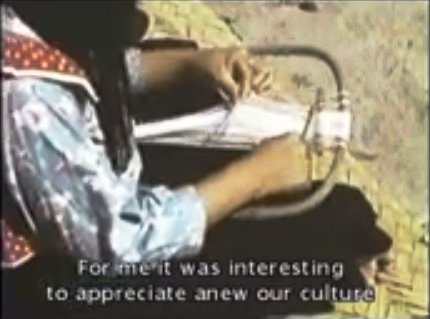
???????????????????????????????I wasn’t able to find other images of Shipbo woven pieces or weavers until I came across a video, made in 2011, which is the trailer for  a documentary on footage that was shot by anthropologist Harry Tschopilc Jr in 1953. The footage has been uncovered in the archives of the Field Museum of Chicago and the documentary covers a project which involved taking the footage and showing it to the Shipibo people. The documentary captures the reaction of the Shipibo people, both young and old, to seeing aspects of their culture and lifestyle that have been lost in the last 60 years. The 60-year old footage shows a Shipibo woman weaving using a backstrap loom as well as one weaving on a small frame that could have been made from a bent tree branch. There is also recent footage of a woman using a backstrap loom to weave a very long and colorful narrow band.

Here are a couple of screen shots from the old film…

video trailer 1

video trailer 2And here is the complete trailer…

I try to imagine the sounds of the forest that you can hear on the first Youtube video in this post as I sit at my loom. The weavers most likely have the songs of the Icaro in their heads as they work. Right now, I hear planes droning overhead, the sounds of car alarms and the rumble of the big plastic trash bins as they are wheeled out to the street…life in the city!

There are two quite long Youtube videos, parts 1 and 2, that show the process of creating the painted patterns on the cloth here and here. Again, there is song and forest sound in the background…lovely.

So, I will continue with my wall hanging panel. It will be flanked by panels of deep red and I will join the three panels at the top with weft twining. I hope to twine a pattern that has been inspired by the work of the Shipibo people.

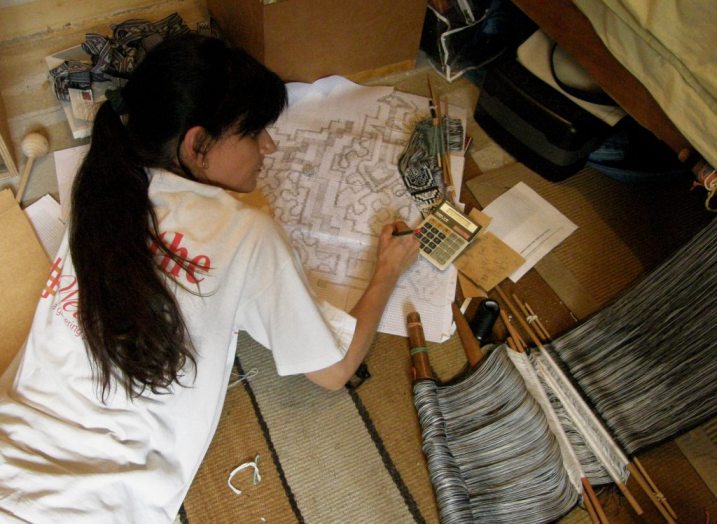
Maybe now you can understand better what I was doing when I was on the floor a few weeks ago drawing squiggles. I had seen wavy lines amongst the hairy wool warp threads on which I had been working a few months ago and  from that was born the idea for this Shipibo-inspired work.

???????????????????????????????See you next week! 

Backstrap Weaving – Worth the Wait

I had wanted to call this post simply “Waiting” but then had a funny feeling that I had used this title before. It didn’t surprise me. We tend to do a lot of waiting here in Bolivia. It’s a part of life and, after 15 years here (plus 5 more in Chile), I can hardly be annoyed or too put out by it. I Googled to check my use of this title and, yep, there it was in August 2012. I went back to see what all the waiting had been about back then. It was nothing to do with Bolivia at all…I had been waiting for some technical help with my second book and impatiently awaiting some exciting weaving events…all good stuff, as you can see below, and worth waiting for.

Some events from 2012

This week has been about a different kind of waiting. It involved getting up every day at 4am and trekking out to the SEGIP office to stand in line and…..wait. SEGIP issues visas and ID cards for foreigners. My ID card had expired and I have been trying since the end of December to move the paper work along. The office opens at 7am. You have to be there in a queue at 4.30am to get one of the 80 daily appointments. You wait in the street in the pouring rain or sun…we had both… and there’s no shelter.  I only wish I could entertain you with some nice shots of the sunrise or my fellow “waiters”. The sunrise was happening behind buildings and it was too dark most of the time for people shots. Today I succeeded! I was #46. I got to speak to someone.

OLYMPUS DIGITAL CAMERAAfter the Monday morning failure to gain admission, it was kind of fun greeting and seeing my fellow “rejects” the following days.

….the Brazilian medical students…always in large groups, always jolly, fun loving, even in the rain, and very, very loud.

…the Argentinians…recognizable by the thermoses that they carried and the little pots of yerba mate which they passed around and sipped and, of course, their gorgeous accent.

…the Mennonite gentlemen with their denim overalls and baseball caps, the ladies with their head scarves, print aprons and straw hats.

…the Russian Old Believer gentlemen with their long beards, piercing blue eyes and long, loose belted shirts. You have no idea how much I wanted to look more closely at those belts! They leaned on a fence with the Mennonites and talked about the recent rains on their land. There were some Mormon missionaries from the US looking so terribly young to be so far away from home.

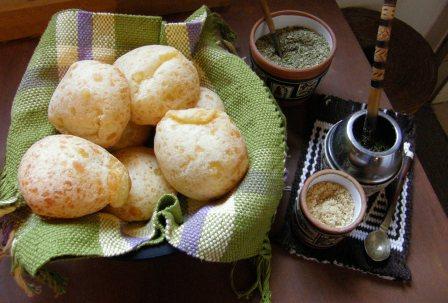
It was strange having so many foreigners gathered in one small place like that. Bolivian life is influenced in many ways by the cultures of its neighboring countries. Above, you can see the baked Brazilian snack called cuñape that is very much enjoyed here, and a pot of Argentinian yerba mate sitting on some of my backstrap woven pieces….a nice piece of Mennonite cheese or a pot of Mennonite honey would make it the perfect tea time picture.

The good thing is that, despite the wait and rejection on three days in a row, I managed to get home every day by 8.30am ready to face and enjoy a whole morning at the loom. That way, the pre-dawn expedition didn’t feel so much like wasted time.

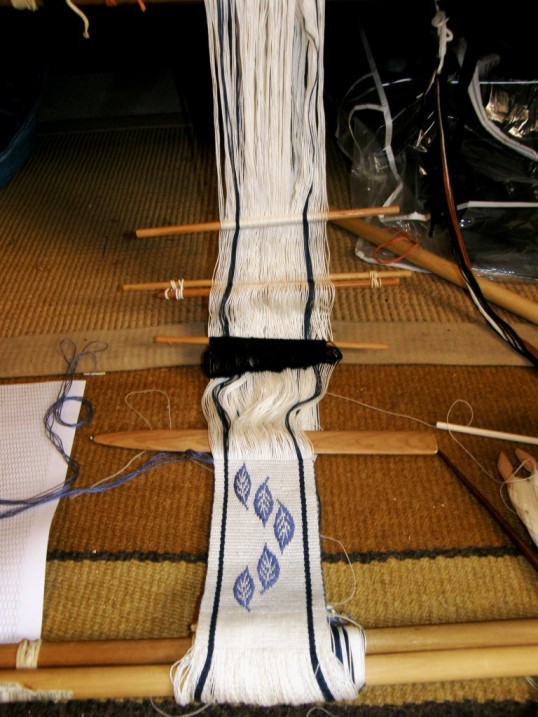
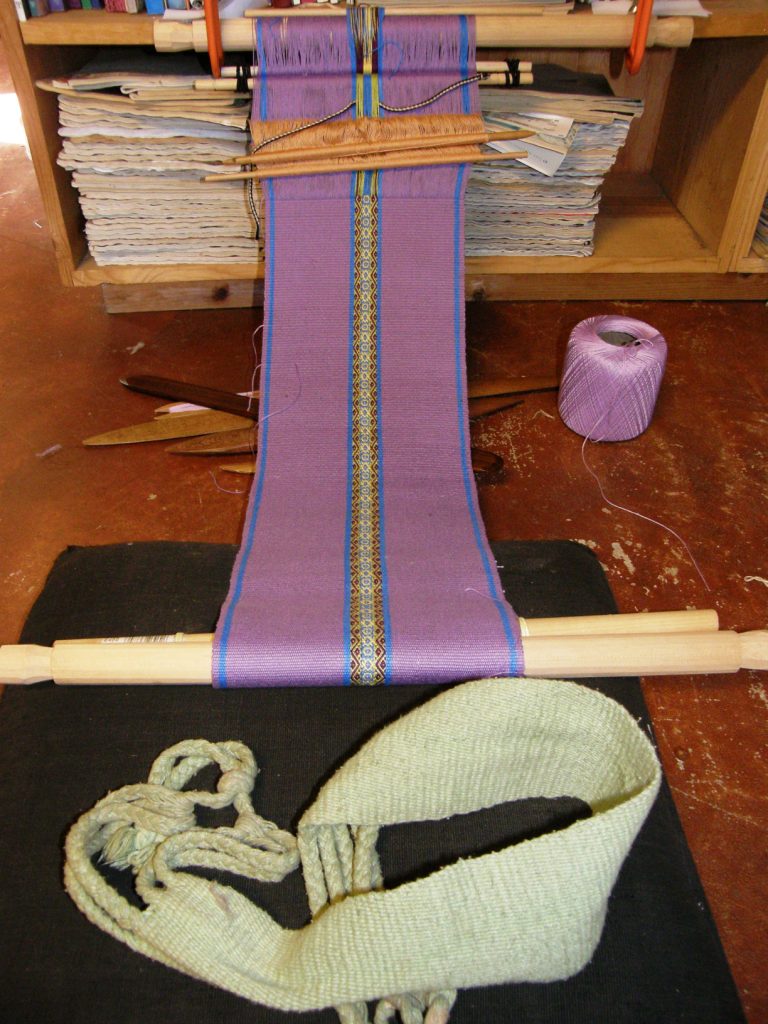
circular warp backstrapThis is one of the things on which I have been working this week. It’s the circular  warp that I took on my last US trip. I use it to show friends the different parts of a backstrap loom including the coil rod.  It’s been sitting here as just a white plain weave piece of cloth. I decided that it needed to have some pattern.

That is one of the things I love about patterning with supplementary weft . You can just add pattern to your plain white “canvas” at any time without a whole lot of planning. This warp had previously held a butterfly motif which I pulled out and replaced with this leafy design.

It’s interesting how different the same motif can look when woven with different materials. I created the leaf motif very recently for my discontinuous-warp experiment in heavy-ish wool. On that piece I had used wool as the supplementary weft.

My circular warp is fine cotton and I used tencel for the patterning weft. I also used a closer sett than I usually do so that the fine white cotton would cover the dark patterning weft well. The leaves that had looked so robust in wool  were thin and sickly looking in tencel on cotton so, I had to make adjustments to the original chart. The good thing about the finer warp thread is that you can use longer floats in the pattern and that allows more flexibility and options in the designing. I could use longer floats than the five-span maximum I used in the wool project. On the other hand, the single-span floats I used on the wool piece would  barely show up in the fine cotton. So, several adjustments had to be made to “fatten” the leaves and make the finer details more visible.

???????????????????????????????I don’t know exactly where this pattern is going from here,  but that is enough weaving for this warp for now. I placed the turns of the supplementary weft on the edge of the cloth rather than trying to conceal or camouflage the turns within the blue stripe as I usually do. I wanted to challenge myself to make consistently neat and attractive turns on the edge that would resemble little beads. I also turned the weft on the edge of the wool cloth. Those rather chunky turns are now hidden within the tubular edging.

circular warp backstrapAbove, you can get more of an idea of the circular nature of this warp and see the coil rod in position. The biggest difference I notice between weaving on a circular warp like this one and one in a single plane, is the ability to apply tension. There is a certain “springiness” to this circular warp which makes me feel like I can’t tension or beat as hard. This has me pushing with my feet (something I rarely do these days) in an attempt to apply more tension. Maybe that is why the majority of indigenous weavers I have seen using circular warps brace their feet against something as they weave. It is interesting to be able to compare the feel of the two kinds of warp set-ups this way.

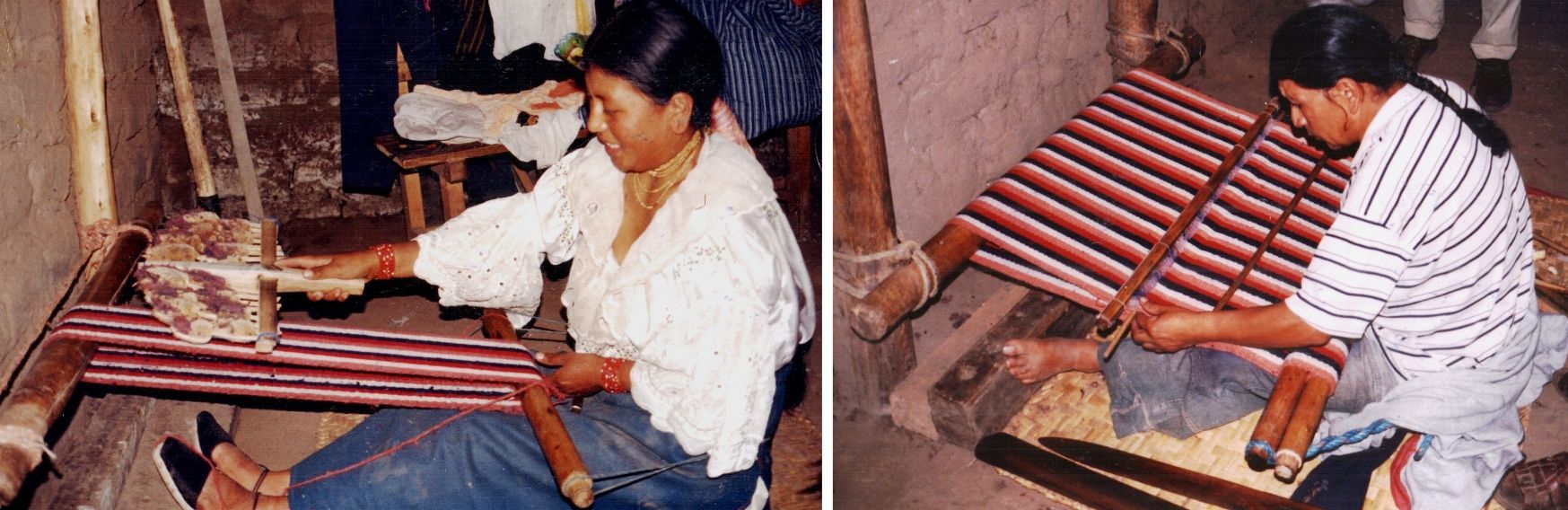
Weavers in Ecuador using circular warps brace their feet against piece of wood to help apply tension to the warp.
Weavers in Ecuador using circular warps brace their feet against blocks of wood to help apply tension to the warp.

At first, I decided that it would be an interesting challenge to just chart and weave one leaf and then see if, by reading from the one motif woven into the cloth, I could flip the design both horizontally and vertically. The challenge wasn’t met as it gave me a big headache! and so I decided to chart the four versions and go from there. I wrote a page some time ago which I added to my list of FAQs on my thoughts about the use or non-use of charts.

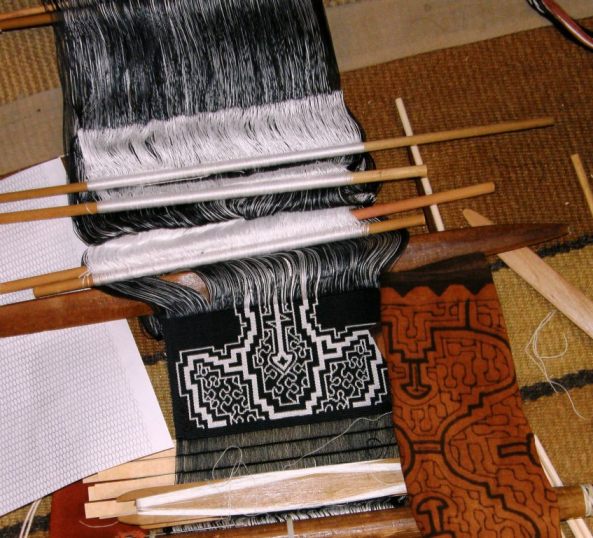
shipibo inspired wall hagnging panelMy latest wall hanging project uses a design I created and charted myself which is, for the most part, not symmetrical. It is a row- by-row slog working with an enormous pattern chart and was inspired by designs painted on cloth  by the Shipibo people of tropical lowland Peru.

Fortunately, for me, warp-faced double weave is one of the easier structures for reading the pattern  on the cloth because there are no warp-float lengths to be considered. Once a base line of pattern has been woven, it is easy and straightforward placing subsequent rows by referring to the preceding one without having to do a great deal of counting.  However, there are no small design elements within the large one that get repeated and which can, therefore, be eventually memorized.

The pattern is not one with which I am all together comfortable yet. What I mean to say, is that I am not sure that I like it yet! My eyes long for symmetry! I keep telling myself that I just need to WAIT (I have had plenty of practice with that this week!), weave a bit more, walk away, stand back, weave some more and allow it to develop. It is a design that has a lot of wiggly chaos within a rigid symmetrical outline. That’s the best I can do to decribe it for now. I just need to put a bit more of that heavy symmetrical outline into place to help me deal with the chaos!

I will wait. I won’t unweave. I feel confident that it will be just what I wanted in the end.

I was Googling some images this past week and came across some of my own things such as this…

Bhutanese motf supplementary weftI thought….wow, I remember that. I wove it at the start of my studies of Bhutanese patterns. Now, what in the world did I do with that? A quick search in the closet turned up nothing. And then I remembered…oh yeah, I unwove it because I didn’t much care for it at the time…too colorful or something like that. Maybe I should have WAITED. At least I took a picture of it before unweaving.

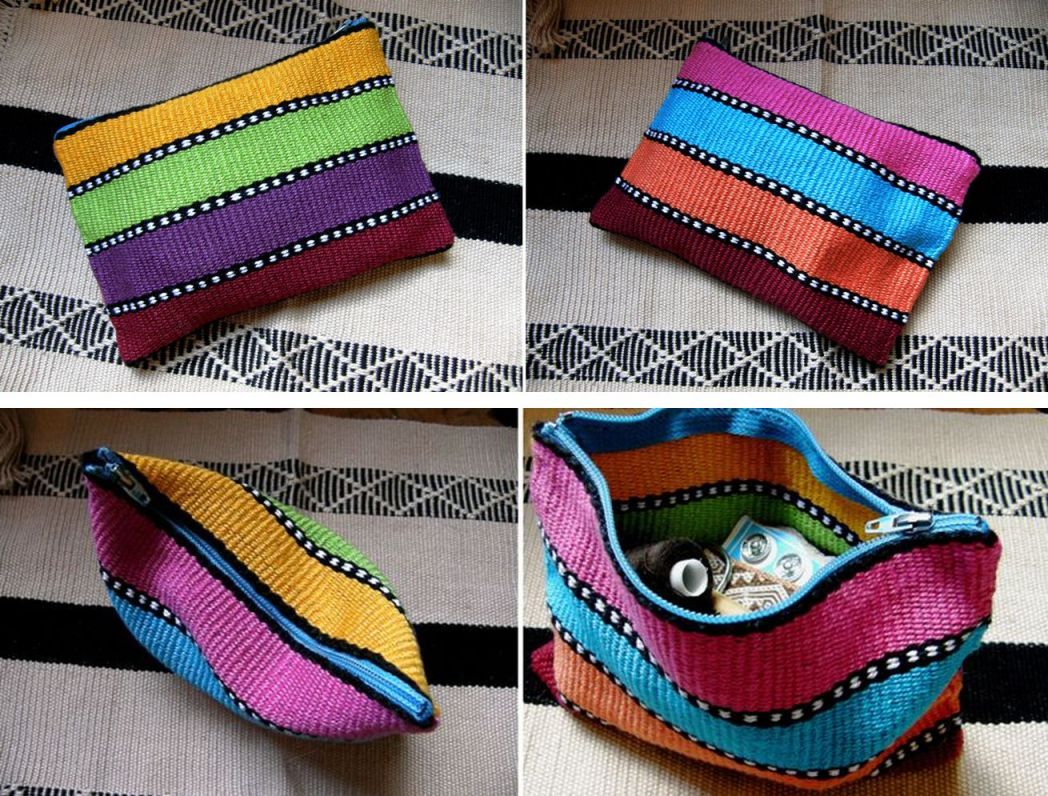
striped-pouch-x-4This had been a very hastily put together demo warp . I disliked the color combination so much that I didn’t even want to put it out to be seen. Nevertheless, I wove it off and sewed it into a pouch. Time has passed and now I just love my happy colorful sewing bag.

I am still waiting for this one to grow on me…

??????????????????????It was another travel warp into which I hadn’t put much thought. I was pleased to at least be able to use the finished fabric from the above warp for a tutorial on edgings.

Let’s see what online weaving friends have been up to…

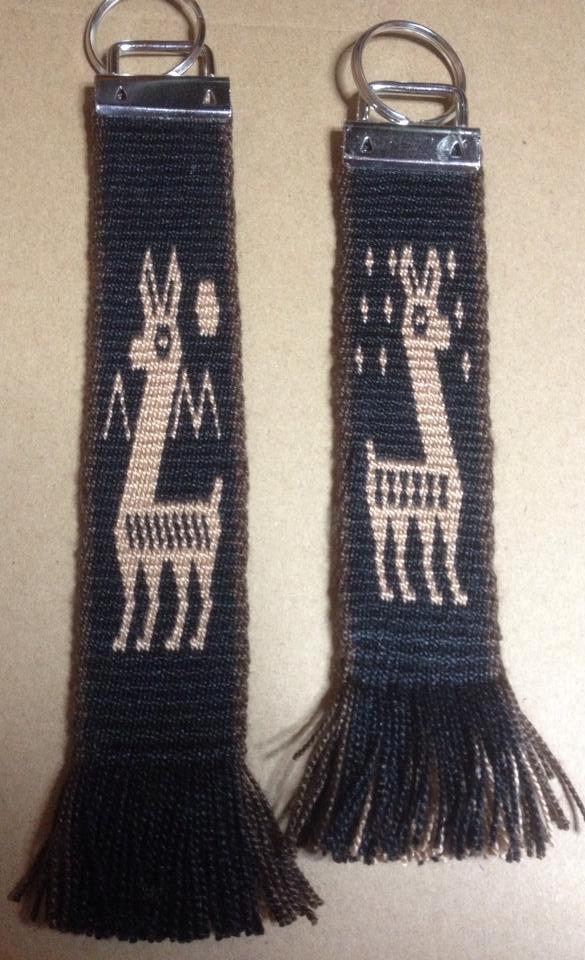
Scott is really getting into double weave and is now charting his own motifs. After working through my tutorial, he used the llama patterns to make keyfobs. I like those grippy keyfob ends…no sewing needed at that end. They are especially suitable for double weave which can be too bulky when folded and passed through a key ring.

scott (1) llamasNext he charted and wove the Norse Valknut motif…love it!

Scott's norse valknut motifI can’t wait to see what he comes up with next.

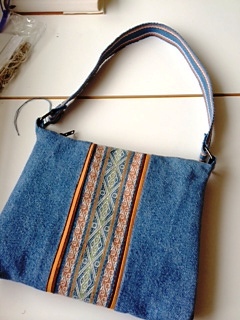
Jennifer finished her bag from our Ravelry Games weave-along…

Jennifer bag with chinchero patternsWhat a superb piece of work. She used denim which so perfectly matched the washed-out blue of her indigo-dyed hemp. Other pieces of colored fabric were used to frame the woven section. She finished it with a zip. 

lausanne pebble weave bandLausanne’s band is a lovely example of how simple 2 and 4-revolution Andean Pebble Weave motifs can be placed together to make new designs…something that I discuss and encourage in my second book. I love the way she has photographed it. It is so nice seeing lots and lots of band length like that.

Teresa in Chile sent me pictures of her first backstrap loom pieces using the tutorials on my blog for creating plain-weave bands with solid colors, comb patterns, and stripes. In this way she wisely develops and practices her skills in managing the backstrap loom with simple, fun, plain-weave projects. Now she is taking her first steps in creating patterns with warp floats.

teresa

I am glad that I didn’t have to keep you waiting for this blog post. Blog day is usually a strictly “at home” day for me consumed with taking photographs, editing and writing. I am just happy that I don’t have to get up at 4am again tomorrow!

See you next week.