Backstrap Weaving – East and West 2…The West Side Story

EAST AND WEST 2 – THE WEST SIDE STORY….

THE HIGHLIGHTS.

This is what happens when you don’t blog for a while! You have to drop the details and limit yourself to the highlights. Since the conclusion of the “West Side Story’ on this trip, I have finished yet another chapter entitled: “Hooray Santa Fe!”. So, as I sit in Miami airport waiting for my flight back to Santa Cruz, Bolivia, I will attempt to capture some of the flavor of just my west coast adventures in this post.

ANWG 2013 logo tapestryThe West Side Story started at the ANWG  Conference in Bellingham, Washington.

It was followed by a stay at my friend Betty’s (author, weaver, traveler, trekking and textiles tour leader, mountain climber, tree farmer, blueberry farmer……!!)  home in Washington state. There I got to meet up with one of Betty’s friends, Judith, whom I had met at the Tinkuy in Peru in 2010, as well as with Bobbie who is in the Ravelry group.

This chapter finished in San Francisco after having spent about ten days at my backstrap weaving friend Janet’s farm in Humboldt County California. Janet arranged two get-togethers with weavers I had met last spring.

This trip has been about many things, one of which was meeting new people and putting faces to online acquaintances…

Here are some of the members of the ANWG Organizing Committee and ANWG instructors at a pre conference get-together. The group includes Marilyn and Linda who took my classes, Sheri, my Bellingham host and my wonderfu roommate, Marie. I am sure that you will recognize some familiar faces amongst the teachers. Here is where I got to meet the ladies with whom I had been corresponding all those months while the conference was being prepared. It was great to meet Holly, Jane, Patrice, Paula ad Marilyn at last.
Here are some of the members of the ANWG Organizing Committee at a pre-conference get-together. The group includes Marilyn and Linda, Sheri, with whom I stayed in Bellingham, and my wonderful roommate, Marie. I am sure that you will recognize some familiar faces amongst the teachers.  It was great to meet Holly, Jane, Patrice, Paula and Marilyn at last.

This was a wonderful conference. Apart from being in one place with over five hundred enthusiastic weavers, I loved the venue, the dorms, the food, our fourth floor weaving room with the view of Bellingham Bay, and all the fun details that the committee had gone to so much trouble to include. I can’t imagine that these events can get any better than this one!

Il oved the handwoven conference logo on the crocheted background which were hung on wondows to mark the rooms which were desgnated classrooms. I kept mine...not sure if I was supposed to...ssshhh! My roommate, Marie was part of teh team responsible for the handwoven pouch and name tag combo. That little piuch was such a cool idea. It held keys and meal card. My backstrap weaving students found it handy for parking their sword/beater. The fabric was so very pretty. Imagine having to make over 500 of these for all the participants!
I loved the handwoven conference logos on the crocheted backgrounds which were hung on windows to mark the rooms which were designated classrooms. My roommate, Marie, was part of the team responsible for the handwoven pouch and name tag combo. That little pouch was such a cool idea. It conveniently held keys and meal card. Backstrap weavers found it handy for parking their sword/beater. The fabric was so very pretty. Imagine having to make over 500 of these for all the participants.

photo (1) mini cropAnd of course, there are one or two special people amongst all those that you get to meet and chat with at such events with whom you have a particularly strong connection.

Marilyn was one of them.

She wove with me on several days, was a committee member, taught four classes and was a whirl of energy. She seems to have an endless collection of beautiful ethnic textiles to wear and I looked forward to seeing what she would be wearing  each day.

At the final banquet, we were asked to wear something handwoven. So, there you see Marilyn in a gorgeous Guatemalan huipil. I simply draped the  Bhutan-inspired scarf that I wove around my shoulders.

(And guess who I bumped into in the plaza in downtown Santa Fe last week as I stopped to buy a fajita?)

The West Side Story is also about meeting some of my online friends from the various backstrap weaving groups as well as reconnecting with weavers from past visits.

Ravelry member Cindy weaving a nawi awapa band in my class.
Ravelry member Cindy weaving a nawi awapa band..

Cindy was also responsible for my spending in the ANWG Vendor Hall. She unearthed some Guatemalan natural dyed cotton at the Mayan Hands booth (on sale) and refrained from buying all of it! She and I bought bags of two colors and swapped. I wonder what she is planning to do with hers.

My backstrap weaving friends from Humboldt County got together in a couple of sessions...Janet, Gina, Autumn, Aceand Linda. We tensioned our warps on poles, floor looms, toes and inkle looms.
My backstrap weaving friends from Humboldt County got together too…Janet, Gina, Autumn, Ace, Pam, Buffy and Linda. We tensioned our warps on poles, the beams of floor looms, toes and inkle looms.

It was about playing with WOOL, something that is not so accessible in my home in the lowlands of Bolivia. And, of course, when I am with Janet and her friends, it is about lots of spinning and plying.
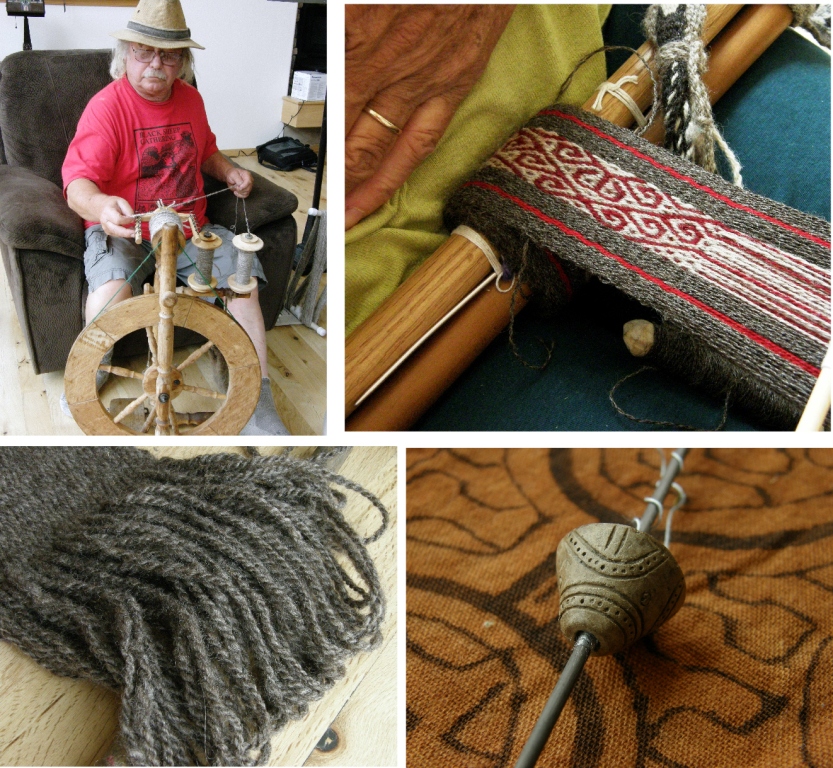
That's Ace at the wheel and below you can see the heavy grey yarn that he spun semi-worsted for his luxury backstrap...a lovely thick, cushy strap. You can see Janet working on a pebble weave band using her own handpsun and a pattern from my second book. And, on the right, there's the wee spindle whorl from coastal Ecuador that I gave Janet last spring. She has mounted it on a knitting needle and has been sponning with it.
That’s Ace at the wheel and below you can see the heavy grey yarn that he spun semi-worsted for his luxury backstrap…it made a lovely thick, cushy strap. You can see Janet working on a pebble weave band using her own handspsun worsted and a pattern from my second book. And, on the right, there’s the wee spindle whorl from coastal Ecuador that I gave Janet last spring. She has mounted it on a knitting needle and has been spinning with it.

Ace is new to backstrap weaving but not to spinning and I gave him a hand with that grey wool project. I have to admit it looked hairy and scary at first! but, it was a breeze to weave with. Who knew that it would weave up so well on a backstrap loom and in a warp-faced fabric? It all comes from the expert hands of the spinner and his/her preparation of the material.

???????????????????????????????I got so carried away with weaving and the enjoyment of working with that lovely thick and even handspun that I wove almost to the end forgetting that Ace would want several inches of unwoven warp ends from which to make braids for his backstrap. Once off the loom he braided the ends and braided a separate cord, from his handspun of course, for the straps.

Aces handspun yarn for backstrap

Some of Janet's beautiful naturally dyed handspun yarn which was destined for warp-faced weaving.
Some of Janet’s beautiful naturally dyed handspun yarn which was destined for warp-faced weaving….no overspin, no kinking!

It was about SUMMER, glorious summer…ripening grapes and berries, fireworks in the night sky, outdoor music, beaches and sunsets.


The view from my bed in Betty's studio looking out on her tree farm and ripening blueberries
The view while lying in bed in Betty’s studio looking out on her tree farm and bushes with ripening blueberries.
Sunset over the mountains in faraway Canada on the final evening of ANWG in Bellingham. The cool and enticing raspberry jungle at Janet's place. My poor, but kind- of -interesting, attempt at photographing the fireworks during my first 4th of July in the US. Beautiful patterns in light and dark sands on the beach at Shelter Cove near Janet's place....Humboldt County...sigh!
Sunset over the mountains in faraway Canada on the final evening of ANWG in Bellingham. The cool and enticing raspberry jungle at Janet’s place. My poor, but kind- of -interesting, attempt at photographing the fireworks during my first 4th of July in the US. Beautiful patterns in light and dark sands on the beach at Shelter Cove near Janet’s place….Humboldt County…sigh!

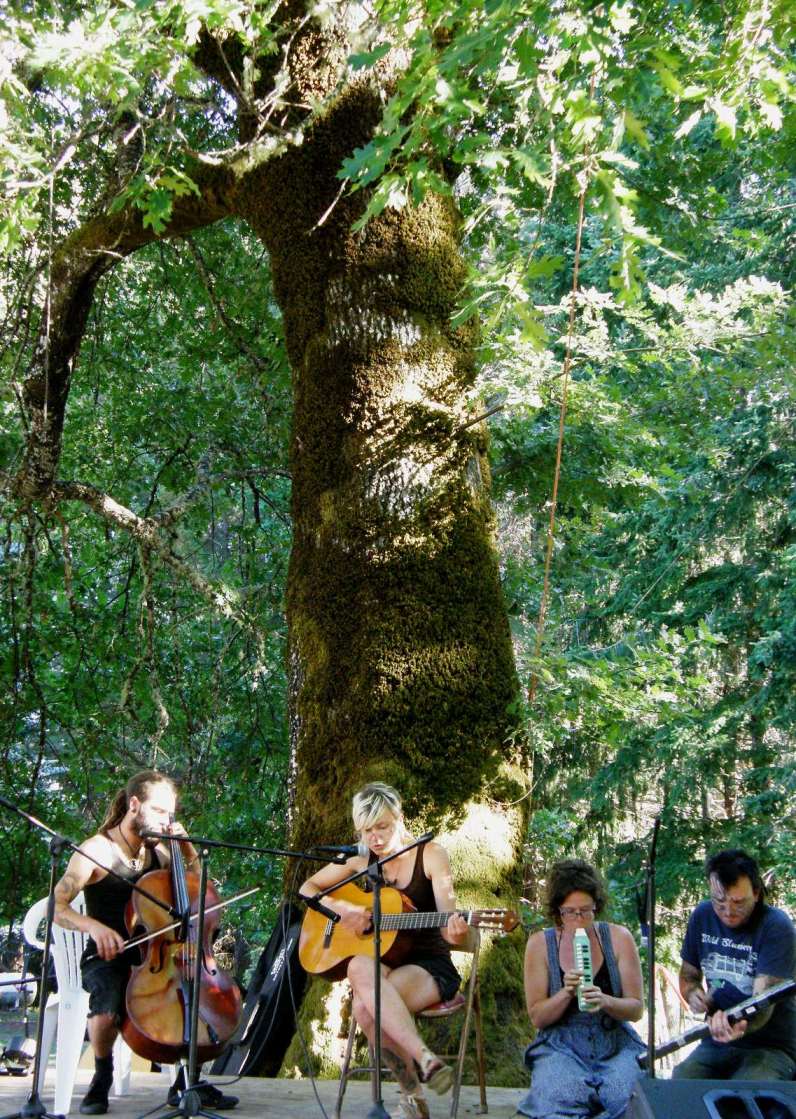
Music under the big ol' white oak...the annual"Strawberry Jam" at Janet's place. I hooked up a warp to my toe, wove and enjoyed the music.

Music under the big ol’ white oak…the annual”Strawberry Jam” at Janet’s place. I hooked up a warp to my toe, wove and enjoyed the music.

And there were textiles!! I was lucky that my visit with Betty coincided with a visit from Betty’s good friend Judith.She had come down from Canada to take a spinning class from Judith MacKenzie McCuin and stopped for a day to visit. She had brought with her the most exquisite textiles from a trip she had taken to Indonesia.

Judith lays out the textiles under the supervision of Trouble the cat.
Woven on a backstrap loom, this piece has both the warp and weft patterned ij the ikat technique. On top of that, the cotton thread was handspun. Judith tels me that this is known as "Magic Cloth" and comes the Tenganan Bali Agai Community in Bali, Indonesia.
Woven on a backstrap loom, this piece has both the warp and weft threads patterned using the ikat technique. The cotton thread is handspun. Judith tells me that this is known as “Magic Cloth” and comes from the Tenganan Bali Aga Community in Bali, Indonesia.

And, speaking of warp and weft ikat, I have to show you the jacket that Linda LaMay enetered in the juried show at ANWG. Linda wove with me over several days. She happened to be in the Gallery on my visit and allowed me to photograph her with her piece that was given the Complex Weavers Award. Her piece also won 1st prize for being the best representation of the conference theme: Crossing Threads, Crossing Borders.

Linda had bought a pre-tied and dyed ikat or, jaspe, warp in Guatemala...one which had been designed for warp faced fabric. Linda, however, wove it as a balanced weave, a twill and, in order to do this, had to dye the weft herself and then carefully place it to match the dyed pattern in the warp....she painstakingly transformed it into warp and weft ikat...amazing.
Linda had bought a pre-tied and dyed ikat or, jaspe, warp in Guatemala…one which had been designed for warp faced fabric. Linda, however, wove it as a twill exposing both warp and weft and, in order to do this, had to dye the weft herself and then carefully place it to match the dyed pattern in the warp….she painstakingly transformed it into warp and weft ikat…amazing.
Another textile in Judith's collection, this one from Sumba, Indonesia...all the stuff I love!...weft twining along the bottom, simple warp floats to create creatures that are mirrored in the central ikat section.
Another textile in Judith’s collection, this one from Sumba, Indonesia…all the elements that I love!…weft twining along the bottom and simple warp floats to create creatures that are mirrored in the central ikat section.

And, speaking of twining, let me show you the ravenstail work that John Beard showed in the Instructors’ Exhibit at ANWG. He kindly gave me permission to show it here….spectacular.
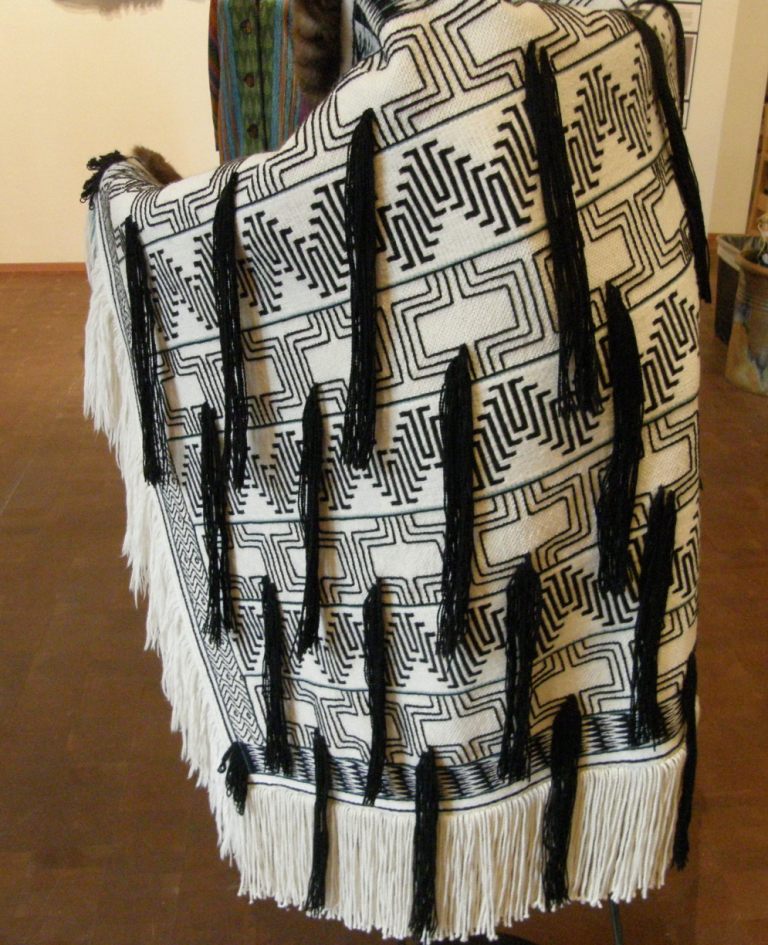
John Beard ravenstail

And, speaking of the warp floats in the Sumba textile, let me show you a textile that ANWG instructor and fellow Australian Kay Faulkner collected in her SE Asian travels. She brought this to ANWG to inform and inspire her students in her workshop entitled “East Meets West”.

We had fun comparing and contrasting spotty pebble-like structures and she came over to my classroom on the last day with Bhakti Ziek so that we could have even more "pebbly" conversation. If you look very carefully at the piece Kay brought you will see that there are weft floats amongst the warp floats.
Both faces of this textile have warp float patterns . Kay and I had fun comparing and contrasting spotty pebble-like structures and she came over on the last day with Bhakti Ziek so that we could have even more “pebbly” conversation.

I just gaze and gaze at this Selendang shoulder scarf of Batuisi, W Sulawesi from Judith’s collection. The colors all come from natural sources. The yarn used was heavier than that used in other Indonesian ikat pieces that I have seen. I really liked the feel of this piece.

selendang shoulder scarf

There are more of Judith’s textiles to show but I think I will save them for another post. Let’s look at the miniature backstrap loom that she got in Indonesia instead. I am always intrigued by new-to-me pieces of equipment that the various backstrap weavers aroud the world use and this loom included such a piece which may hold one of the many secrets of how backstrap weavers go about keeping the ikat-patterned warp threads reasonably aligned.
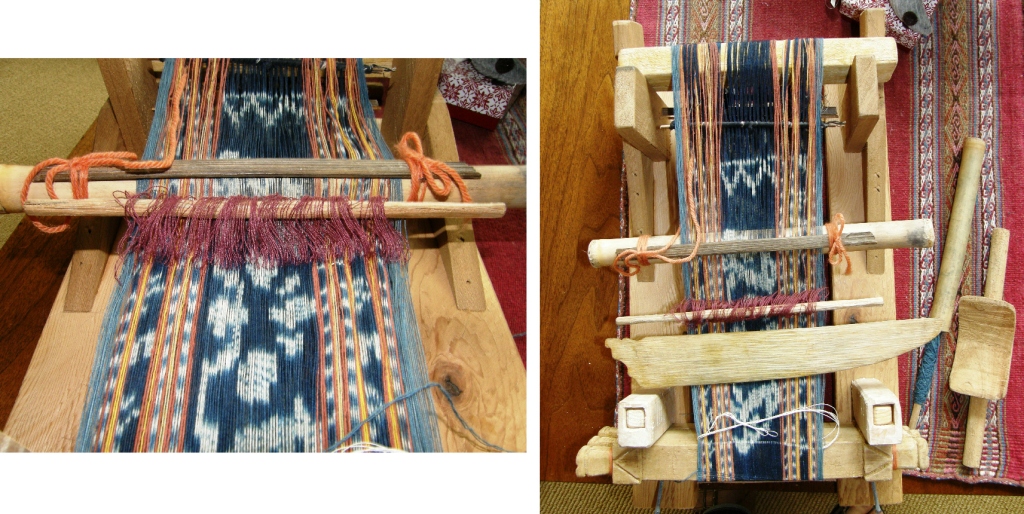
What a sweet little loom with its circular ikat warp in place. It was a great opportunity for me to take a close look at one of the Indonesain backstrap set-ups.
What a sweet little loom with its circular ikat warp in place. It was a great opportunity for me to take a close look at one of the Indonesian backstrap set-ups. The miniature wooden backstrap is so cute!
I love the carved pieces that serve to clamp the circular warp. Beyond the heddles and shed rod, the warps that had been tied and dyed were clamped between two sticks and wrapped. The wrappings seemed to separate the warps nto the sections that had been wrapped. I am wondering if the wraps also serve to squeeze the warp threads into groups and therefore help stop the from moving excessivley.and blurring the design too much.
I love the carved pieces that serve to clamp the circular warp. Beyond the heddles and shed rod, the warps that had been tied and dyed were separated along a stick which was wrapped. The wrappings seemed to separate the warps into the sections that had been tied for dyeing. I am wondering if the wraps also serve to squeeze the warp threads into groups and therefore help stop the from moving excessively and blurring the design too much.

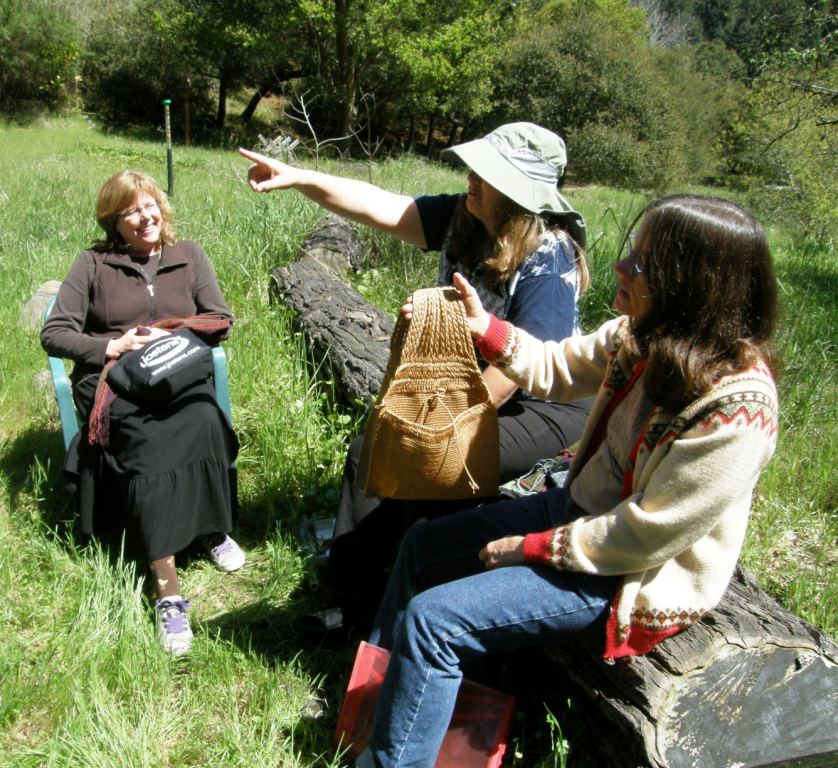
51eM0hePRnL._SX500_And, while on the subject of simple looms from far away places, let me show you a loom that a lady in Arcata, CA  showed us when our weaving get-together group went to the Farmers Market.  A friend had brought it back from Africa for her with accompanying postcards that showed how it was set up. The postcards said Upper Volta and were written in French. This, according to Wiki is today’s Burkina Faso and it seems that the people who use these looms are called the Mossi. The loom pictured at left is from this page.

It has some beautiful parts which include bone foot toggles for operating the shafts and a fine reed framed with what could be wood and horn. The carved wooden pulley system and shuttle were lovely as was the indigo-dyed cloth strips that had been sewn together. I used this as background for one of the pictures. It’s for sale…tempting!
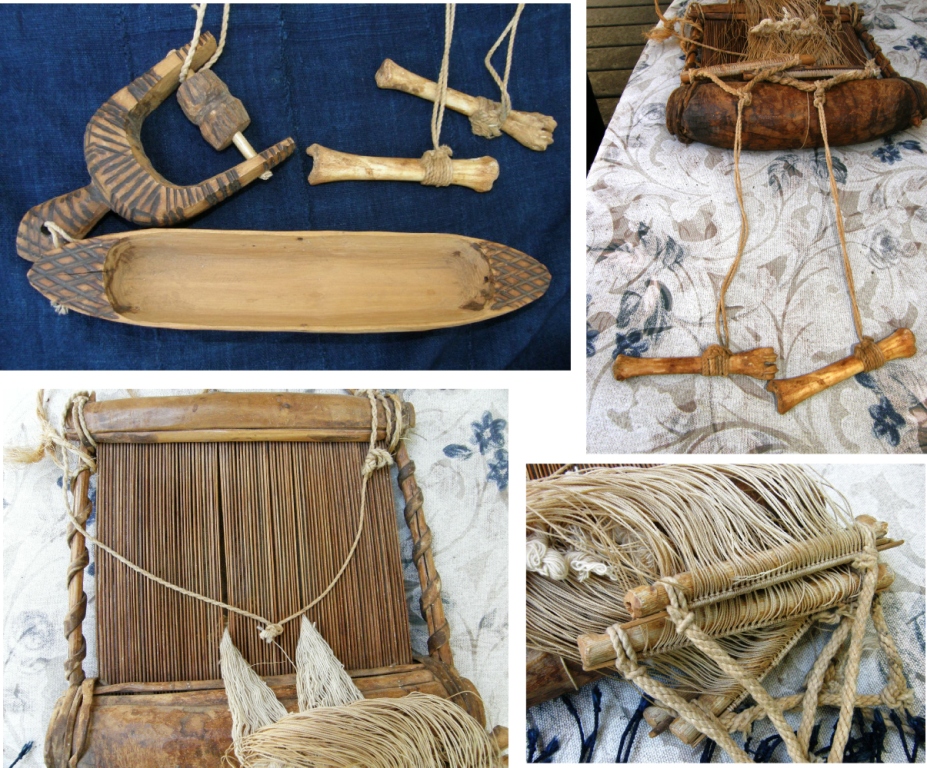
mossi loom

??????????????????????Back at Janet’s I enjoyed a chance to do some weaving of my own.

I got to work on the two warps that I had brought with me.

I have to say  that I was happy to get this one off the loom as I do not care for it at all! I am going to use it to practice and learn some new sewing skills. Maybe I can shape it into some kind of interesting bag.

This is the warp that I wove while visiting at the Mannings’s annual Spinning Seminar last month. The pattern is one that I have woven many a time and observers’ reactions while I was weaving it inspired an addition to my FAQ pagesthis new one being about following and ceasing to follow pattern charts.

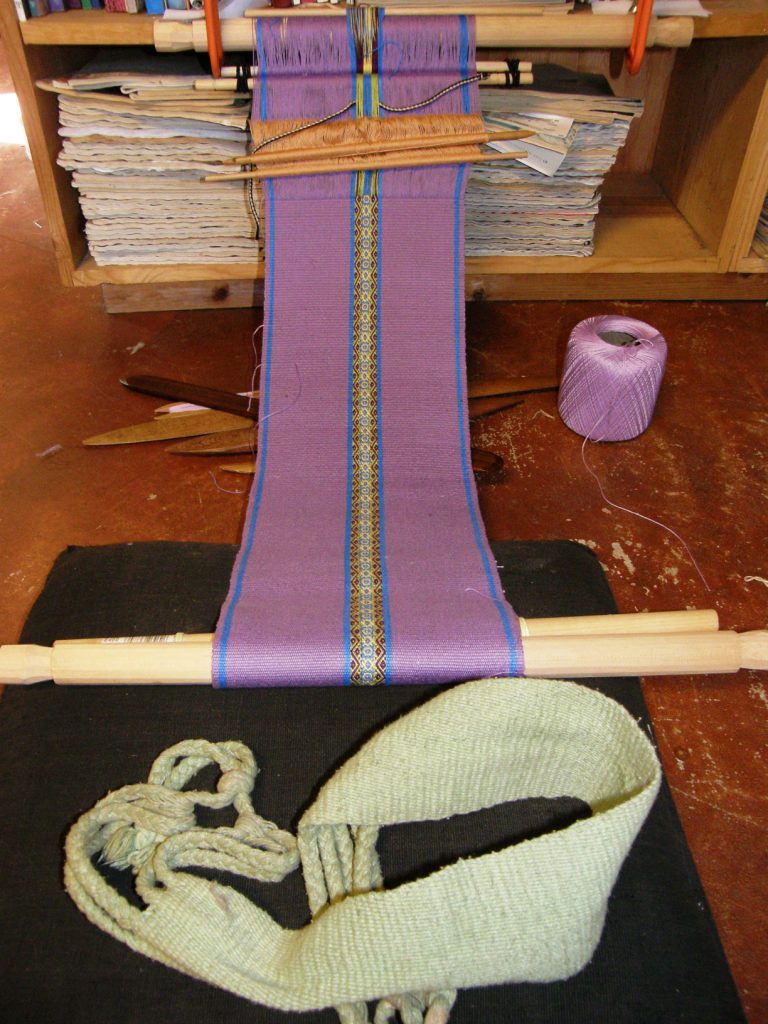
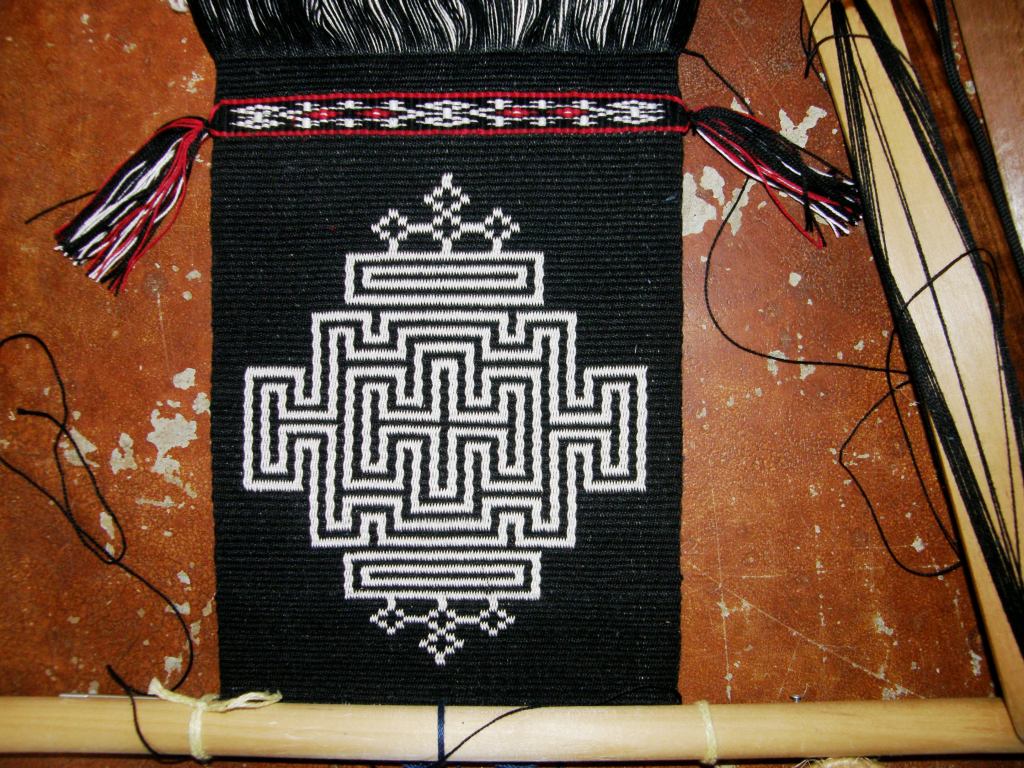
Next up was the piece on which I am weaving a Bhutanese design called “labyrinth”. I am weaving it using the two-heddle intermesh technique that I teach in my second book.
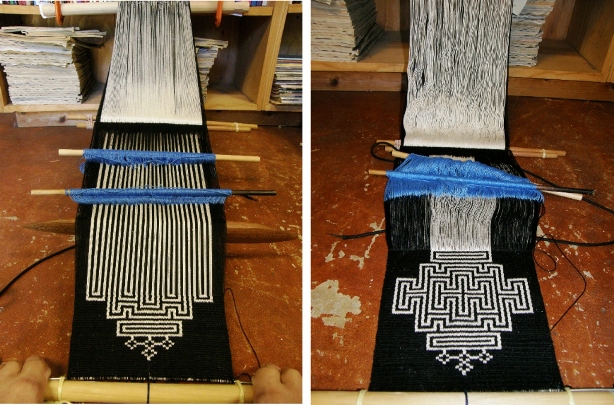
labyrinth design backstrap weavingThe pattern is from David K Barker’s first book of Bhutanese designs. Look at my RESOURCES page to see how you can download this free book. I never plan these ”traveling” warps to actually be anything knowing that my weaving on them is generally so interrupted and disjointed. However, I got to sit and weave on this quite a lot at Janet’s and had it set up in a very similar way to the way I usually like to weave. I lodged the far loom bar behind clamps on a low book shelf and moved the books and magazines around so I could extend my legs within. The angle was just right for me. With a pillow added on the floor, I was right at home.

Once the first large motif was complete and I could see that this could actually become something, I had to decide what would come next. Inspiration came in the form of a double-pocket saddle bag quite likely from Afghanistan. Janet bought it in a local shop of ethnic artefacts and it is gorgeous! It is woven with wool and largely patterned using weft substitution technique which results in floats on the back. However, the kinds of  patterns used in this piece do not create overly long or unruly ones. There are all kinds of soumak and warp-wrapped patterns as well. The fabric is incredibly stiff and tight…made to last a long, long time, no doubt.

inspiration for new backstrap weavingThose reds and blues…love them! The back of the bag, which would be against the animal’s back, was not patterned. Janet and I were both astounded when we realized that the plain cloth was not a separate backing but, rather, a continuation of the weaving in an extremely tight and very well balanced plain weave. I would bet that this bag is waterproof.
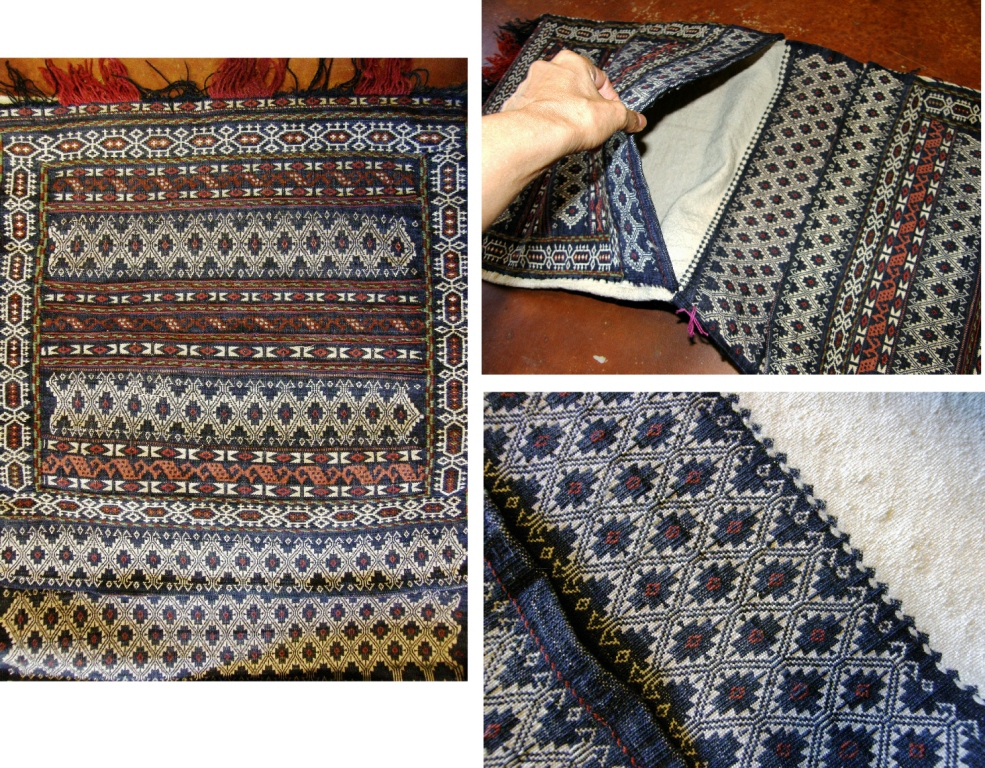
saddle bagSo, this is pretty much where I am at so far with this latest piece of weaving. I just started some vertical warp-wrapping for the back side which I haven’t photographed yet and I have chosen a motif for the center of the back…it’s going to be a bag (of course!)…black, white and red (of course!) and it is going to get seriously dressed up with tassels and trims. This will be something nice to dive right into when I get back home (that will be soon, I hope. I am writing this in Miami airport).
??????????????????????

Next up on my blog…Santa Fe and the International Folk Art Market…it has been one of my dreams to see this. Visiting Santa Fe also gave me a chance to hang out with several weaving buddies that you will have already met here on my blog. I can’t imagine a better place to have gotten together with them and we are wondering how we can possibly top this!

Of course it inspired all of us but the funny thing is… one of my best ideas came  from something I saw in the American Airlines inflight magazine on the way to Miami…funny how these things work! See you next time.
Backstrap Weaving – The Bizarre and the Beautiful

Wow, I hit California with a splash rather than a bang…flights delayed due to the awful weather and dreary wet highways to travel  but, on the up side, everything is so incredibly green! And now we have been treated to several days in the row of gorgeous, calm, sun-soaked blue skies and leafy greens.

Lazy spring lunchtimes while weaving with friends…a good time to look at some of the woven treasures in  Martha’s collection.

Blue skies and green – colors to inspire a new weaving? No…my mind is reeling with the mixture of bizarre and beautiful cloth I have seen in the last few days and what has jumped out to inspire me is simple black and natural white wool in a new-to-me technique…..weft substitution….more on that later.

Before I left Bolivia, I was hurrying to finish up my two-color ikat experiment and practicing some “damage control” to salvage an ‘oopsy’.

I dyed all three panels of my ikat warp terracotta with the cassette tape ties that you see above.. That all went beautifully.

Then I added more ties to the center section of the two outer panels and dyed just those two panels dark blue…..perfect! The result was a terracotta-centered white diamond on a blue background. I wanted the reverse for the center panel and so needed to dye the center dark blue. And this is where things went wrong.

I prepared a small dye solution dissolving the Dylon cold water dye in hot water, added salt and then applied it to just the center part of the warp, which was suspended over a shallow dish, with a syringe. I then let the warp sit in the shallow solution.

I actually thought that I was cheating by doing this but now that I am at my friend Annie’s home, I have had a chance to read her copy of IKAT by Lydia Van Gelder and find that this is a bona fide technique that even has a name-  ”spot dyeing”. In the book, the author is seen applying dye to a small section of warp with a squirt bottle.

But here was my big ‘oopsy’. I had completely forgotten that the reason I am using Dylon cold water dyes in the first place is that I did not think that the cassette tape would stand up to being submerged in very hot water for the dyeing process and I suppose I should be pleased to find that I was right! The hot water in which I dissolved the dye did not lose its temperature in the shallow dye bath. The cassette tape did not like the heat and so, there were major leaks…ugly blue streaks on the white parts under the tape….much cursing ensued…

So, you can see that the damage control involved evening out the streaky blue so that the entire area would be tinted and that was the best I could do to rescue the mess. Well, that was a good lesson to learn. Other lessons learned…don’t wrap the warp in the evening in semi darkness. That accounts for some of the spottiness in the white areas from less then perfect wrapping. And I know that when I get around to making a ”real ” project in ikat, it will be worth taking extra care to make sure that the wraps are all the same length and made more precisely.

I was very pleased with the weaving part. The threads stayed pretty much in alignment and I love the way the terracotta and dark blue look together.

So, that was another project off the loom. My Wayuu inspired wall hanging was retired to the closet. I have been too busy with other things preparing this trip and decided that it should wait until my return. It is not something that I can just pick up and work on for a few minutes a day. I am more likely to ruin it that way…

So, it is there waiting for me to come back.

And then there was just enough time to go shopping and pick up a few requested woven items to take away with me for people with whom I will be staying on my trip…nice representations of Bolivian lowland fiber cultures…

This is an example of the looped bags that the Ayoreo people make and this is a particularly fine example. A cooperative store in Santa Cruz sells these and you can often see the ladies sitting in the street making them. The quality of the work varies and I was pleased to be able to get this stunningly fine one.

These placemats are woven in cotton by the Guaraní weavers. They, too, most often sell their products through the same cooperative store that is just one block from my home. As usual, the motifs they choose represent the abundance of vegetation and flowers in this jungly lowland area.

First stop is Santa Cruz, California staying with my sash weaver friend, Annie for some pebble weaving.

Loop braider Ingrid Crickmore  was up to midnight putting her newly acquired pebble weave skills into practice. Above you can see one of her bands on the left. We practiced drawing pebble weave designs from fabric directly onto charts and then weaving them and Ingrid took advantage of that skill to weave the two designs you can see above. On the right you can see Annie’s tubular band on which she did a beautiful job. Later we practiced weaving and sewing a tubular band onto the edge of fabric.

What was fun was that many of the guys in this group also braid with Ingrid and are avid loop braiders. They couldn’t resist finishing their bands with fancy looped braids. Below you can see Ingrid braiding away. You might notice that she even has loops on her thumbs!!

Some people like to stand and backstrap weave, like Anne above, while others prefer to be down low on the floor like Sawyer…some do a little of everything.  Some people put down their looms and take a walk and stretch while others simply change position so they can just keep on weaving.

Annie looks completely engaged and comfortable sitting at her loom. Annie wears a different hand woven item everyday, usually a huipil or part of a huipil from Guatemala.

This is a group that has woven with me on three occasions and we know each other better than most groups. Most only see each other when they come to weave with me so, there is a lot of chat and catching up to do! But there’s nothing like pick-up weaving to create pin drop silence while everyone settles in to concentrate.

There’s Yonat above left, who usually has us rolling on the floor laughing, in a rare moment of quiet concentration. She picks up things so quickly! I expect to see her Facebook page covered in tubular bands soon. You can see that even the dog has enough sense to keep quiet while everyone concentrates. On the right Sawyer is sitting up off the floor to get stuck into her first tubular band.

We wove, as we always do, in the Martha’s studio  and, as usual,  she brought out some of the beautiful pieces from her collection to show us while we ate lunch. Yonat also brings us some of her latest acquisitions and those pieces are the ”beautiful” part of this blog post.

But first, let me take a little detour at this point to show you some the “bizarre’ things that I mention in this post’s title….

Annie took me on a trip downtown to a clothing store to show me how “ethnic” and “tribal” seem to be the current themes in fashion. We had a lot of fun digging through the store and pulling out items of clothing and home furnishing trying to identify the weaving culture on which the designs had been based.

Some things were very “been there, done that” for me…the kinds of things that you would find in any South West USA or Guatemalan or Mexican souvenir store perhaps…

But other things were, quite frankly, “bizarre”!….

…like these tiny stretch knit shorts with their designs that imitate ikat. Can you see yourself in a pair of those?

This pillow imitates the patterns that are woven with supplementary wefts in some areas of Guatemala. Certain towns are known for these large multicolored flower motifs on black backgrounds.

On the pillow cover above, it seems that they have taken an image and enlarged it so that it has become pixelated and then printed that. In many areas in Guatemala the backs of these fabrics will have all the ends of the supplementary wefts hanging out in colorful chaos but it is never seen as it is on the inside of the garment.

The creators of this pillow fabric, however, have tried to imitate that by attaching fabrics ends to the back face of the pillow….it is not hidden on the inside of the cushion but rather facing out on the back side! Bizarre! Those loose ends are not part of the textile structure at all but have been added on purpose to mimic the original ethnic fabric.

Admittedly some of the fabrics were not quite so bizarre and were, in fact, very pretty but had obviously been fashioned into garments for people way way younger than myself.  The mini skirt fabric is reminiscent of Central Asian ikat and I just might have worn something like that twenty five years ago!

But this was the one that brought the biggest smile to my face….

Back in my ”ski bum” days I would have been perfectly happy prancing around in these leggings. Lime green and black and neon pinks were the colors we sought in those times, but apart from the colors, one of the printed designs in particular caught my eye. It is a motif with which I have been very familiar after having photographed it on a Huichol belt in the National Museum of the American Indian in DC in 2007.

Those of you who have been following my blog may even remember this motif from several of my posts.

It was very bizarre seeing this motif on these wild leggings. I can imagine the designers going off to the museum and taking pictures or making sketches from all the beautiful pieces there or maybe they only need to do a search on the internet these days.

I tried to reproduce the design when I learned how to do balanced double weave and I also translated elements of the main motif to pebble weave. Now, I can even wear the motif on lime green and black leggings if I am so inclined!

From there, let’s go to the beautiful textiles that I refer to in the title of this post and the new technique that I am itching to try. I have seen and heard about textiles made in the weft substitution technique but have not been tempted to try it because of the long floats that are created on the back of the fabric. Marla Mallett writes about it on her website and in her book Woven Structures.

Of course it is a different story when you are actually touching and holding the fabrics in your hands. The designs that I saw in these structures were ones that did not actually create exceedingly long and cumbersome floats. They were not like the Bedouin motifs in warp substitution which result in what many consider long ugly floats.

Yonat brought a Moroccan rug that she had recently purchased to show us…

I could show you image after image of the rows of the weft substitution patterns on this gorgeous rug. Only a few of them are repeated and this is what has me looking for white and black wool (which pretty much doesn’t exist where I live in Bolivia) so I can go home and play with this technique. The rows of alternating red and mustard between the motifs really set off the patterns.

The back of the rug is covered in tufts of wool which didn’t seem to have anything to do with the woven structure. It seemed that these tufts were added to give the rug a more plush feel on the floor. You can see between the tufts that the floats created by the weft substitution technique are not very long. There was one small row of countered weft twining along the bottom. Weft twining always catches my eye.

And here’s the whole rug….beautiful!

One day, Martha brought out a couple of bags in her collection which also show this weft substitution technique from Baluchistan (I had to run to Wikipedia to find out where that is having never heard of it before). She did not know that we had been admiring the Moroccan rug which had the same patterning technique and it so it was pure luck that I was able to have yet another chance to see fabric decorated with this technique.

Baluchistan includes parts of southeastern Iran, southwestern Afghanistan and western Pakistan and is home to the Balochi people.

There are those fabulous sun bleached reds and blues again that I adore! It was fun to see the upper weft substitution motif, a variation of which I have used in my own weaving in a variety of structures…

Above you can the motif woven with supplementary weft, in double weave, pebble weave and supplementary warp.

Above is the other side of the bag and below are a few details on this and other pieces that Martha brought out for us….

The closure system on this bag was particularly fascinating and I neglected to photograph it! It comprised a series of slits through which goat hair loops were passed. Each loop passed through the previous one to create a chain…a little tedious to close the bag but to open the bag you would only have to pull on one end to have all the loops pop open. Someone said that they have seen similar closure systems on canvas tents so some of you may know what I am trying to describe.

Back at Annie’s house, there is also plenty to inspire….like this Chamayo rug on her wall…

The weft-faced stripe patterns on each end of the rug would look right at home in a warp-faced band. And there are walls of colorful sashes to admire. I am struggling to find the time to take them down to examine and photograph before I leave for Oregon on the train tonight. I also have a pile of books that I borrowed from the guild library to peruse.

As for Oregon, I have told my friends up there to hold the rain, please!

I am excited about the prospect of a mini Ravelry meet up while there in Portland. Two members of the Ravelry Backstrap Weaving Group will be coming to spend a couple of days weaving with me. Jennifer and Bobbie have been very active members of the Ravelry group for a long time and I have shown many of their projects here. I am looking forward to seeing first hand Bobbie’s latest piece where she is using fine naturally dyed Guatemalan cotton. I showed a few pictures of that a few weeks ago so we will be able to get an update.

Pantoffels, also in the Ravelry group, recently adapted the techniques I teach in my Andean Pebble Weave book to her inkle loom. She is planning to sew the pieces of her band side by side into a wide piece. It looks great.

I am always happy to see this on inkle looms as it opens up the technique to those who are just not into being attached to a backstrap loom.

My book is now available as a download in four languages on Patternfish if Pantoffels has inspired you to try pebble weave too.

See you next time in Oregon…..