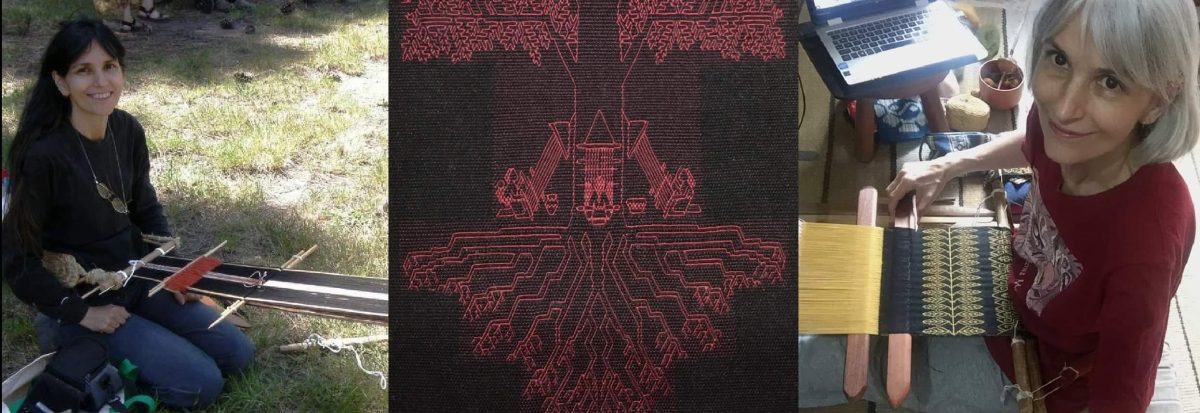

Regular readers of my blog may recall mentions now and then of the fact that I literally fell into weaving after taking a fall while out mountain biking in Colorado. That incident back in 1995, which left me on crutches for six weeks in a Colorado youth hostel, started a chain of events that created the backstrap weaver that I am today. If you’d like to know more, I can tell you that during the pandemic British weaver Stacey Harvey-Brown invited a few dozen weavers to tell the story of how they got into weaving for her Loom Room blog. It’s fascinating reading about the different paths the various invitees have taken to arrive at their looms. Here’s the link to mine.
The reason I’ve taken this little trip back in time to think about an accident thirty years ago that became a life-changing event is because a couple of weeks ago I once again found myself down on the ground thinking “Ouch!”
While in 1995 my first thoughts were about how all my plans to hike and camp in the Utah canyons had been ruined (hiking was my passion at that time), this time my first thoughts were about weaving and all the other fiber-related activities I do that require an intact dominant hand. Darn it, I had broken my right wrist and it required surgery. Was this also going to be a life-changing event?

Anyway, I’m determined not to let this slow me down too much while remaining sensible and giving myself time to heal. First up was a visit with my Ayoreo teacher, Rocío. She’s been teaching me about the traditional process of stitching bags using garabatá thread as well as about the patterns that identify the various Ayoreo clans.

The last time I’d seen Rocío I had still been practicing the basic stitch using crochet cotton. Since then, and without Rocío’s knowledge, I’ve been scavenging bits of garabatá thread from various sources and working entirely with that material.

The most recent piece was this bag that I stitched during the Carnival break…

My indigenous weaving teachers have never been in the habit of expressing much enthusiasm when I show them my creations. Sometimes it’s a little crushing but I know it’s just their way. My current Guaraní teachers are particularly cool! So, of course I was glowing with pride when Rocío reacted so joyfully to the things I showed her. I think she was shocked. She particularly liked the red, black and white bag with the woven backing I used. I showed that in my last blog post.
She immediately called her husband to come and take photos.

The idea of my visit was to have her show me how to spin and ply the garabatá fiber that she had brought me. While I won’t be able to use my hand to do it myself for some time, at least I can turn it over in my mind in the meantime. A friend came with me and took video. The most valuable thing was seeing how Rocío joins lengths of spun and plied thread during the stitching process without having to use a knot. I hadn’t been successful doing it and had been resorting to using a dab of glue as backup. Rocío was not impressed when I confessed that! We really focused on it this time and I’ve learned a thing or two that had previously escaped me because I simply hadn’t been ready for it yet.


As for that hatband project, I decided that it was time to smarten up my left hand. I really needed to at least try.

The gift project had a deadline and I didn’t see myself being able to complete it. But my left hand got smarter and faster and I found that once the cast had been switched to a brace, I could at least insert the pinky of my right hand into the shed to hold it open while I inserted the sword.


And then came a visit with my Guaraní teacher, Eldina.


Eldina had to call her mother to be reminded of how threads are selected to go into each set of heddles. Grandma Clara is the Moisi expert while Eldina tends to focus on Karakarapepo. According to Eldina, pick-up for the Moisi style is much more complicated than it is for Karakarapepo. If you’ve read my posts from long ago when I was studying with my very first Guaraní teacher, Angela, you might remember that I soon realized that the structure that I call Intermesh and which I first learned from an Ayacucho weaver in Peru in 1995, is the same as Moisi. This allowed me to easily replicate some of the lovely patterns that Angela had been weaving to make cell phone pouches. Replication is always one of my first steps in learning.

Hopefully, Eldina will eventually take on all of Clara’s skills and knowledge and maybe pass them on to her baby daughter some day.

Clara has been working on samples of jaguar skin print using the Moisi technique for a project that a wildlife photography guide is planning. While this sample is not exactly what the guide has in mind, I’m so in love with this Moisi piece. I think it’s stunning. Hopefully the guide will be able to communicate more precisely his vision for this project but he is, of course, paying for materials and compensating Clara for the time she has spent so far. Commissioned work is hard!

It’s really interesting for me to discover that the thread arrangement while warping and the thread selection for heddles is really different from the way I was taught in Peru. Once my hand is back in actIon, I’d like to set up a warp for my backstrap loom in the way Eldina and Clara set up on their vertical loom. I’d like to see if there’s perhaps some slight difference in the structure that I’m missing. The woven results certainly appear to be identical.
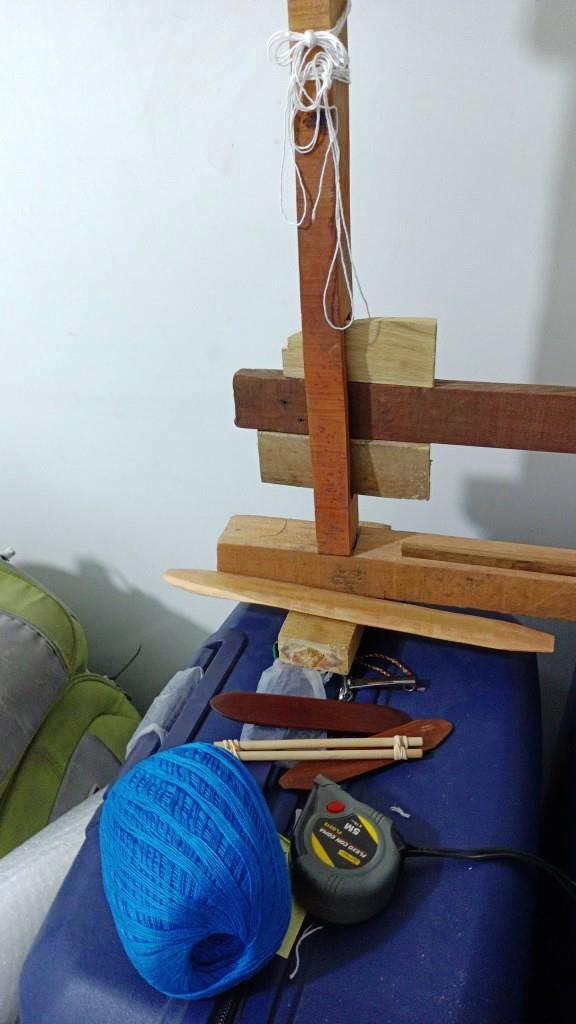
So, my backstrap loom is just a bunch of sticks now. I might give left-handed warping a go eventually to see if I can manage the Guaraní style of set-up for Moisi. But for the next two weeks at least I’ll be giving my wrist a chance to quietly heal. Maybe I’ll dig out the files in which I’ve started writing new books and get my thoughts reorganized on those. I’m in a transition period right now having sold my old apartment and not in a position to set up for photo shoots but at least I could work on the overall plan, chapter headings etc. A good introduction always gets the ball rolling. Let’s see….
And, speaking of my books….the hatband pattern, or at least something very similar, is in my More Andean Pebble Weave Patterns book. There are so many versions of the snake pattern which is basically an embellished zig-zag and I’m often adapting them to suit the number of threads with which I’m working.

If you’re a regular visitor to my blog and have at some point thought about perhaps buying one of my books, maybe you’d like to take the step to buying one now at taprootvideo.com. The accident and resulting surgery have been a significant financial blow and every little bit helps! I’d really appreciate it!