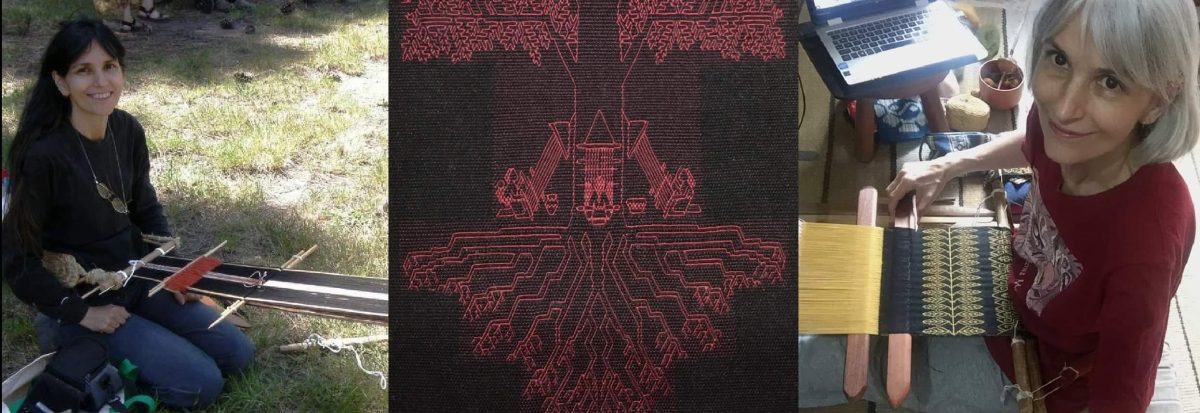
Backstrap Weaving – Round and Round it Goes

‘Round and ’round it goes…..I seem to work in these sort of cycles. For example, every four years or so there’s an ikat phase. And now the Finnweave phase has come around again. I won’t be waiting four more years to get back to my ikat, though. I am just having a short Finnweave interlude while I analyze my stash. The dwindling stash situation is obliging me to think very carefully about the next Finnweave project as I only have enough of the black 20/2 thread for one more. I have tons of the gold!

So, I am thinking of having a brief three-color-reversible-Andean Pebble Weave interlude while I ponder and draw charts for my next Finnweave and ikat projects. Andean Pebble Weave is more commonly found in two colors. Having three colors appear at the same time on both faces of the cloth is a bit more challenging. This is another technique that seems to come upon me in cycles. Some years ago I wove a few trial pieces in this reversible three-color structure in 8/2 tencel. Here’s a very subtle one with yellow and light-blue figures on a blueberry background. The back has blueberry and light-blue figures on a yellow background.

And then I went to finer thread and used it in 60/2 silk in my Big Silk Wrap project combining red, brown and gold in a Celtic-knot pattern.

I even used it in an ikat project. I created these bird shapes, that I had seen in a pre-columbian textile, in ikat and then filled them in with the three-color pebble weave structure. This is 8/2 cotton.

Now I would like to weave something using my hand spun wool. I finally finished spinning the yarn that was supposed to be my Tour de Fleece challenge and I would like to use that in a three-color pebble weave project having never used my own hand spun for that structure before. It will be just something small. I am thinking about another pouch for my IPod…one I can use when the one I have now is being washed. That pouch gets SO much use!

Don’t ask me what kind of wool it is! I got some variety packs that had been put together for felters when I was visiting the guild in Melbourne. The large balls are the result of spinning the fiber from three of those packs. I guess there’s enough there for a few small projects.

But first, I will weave the structure using some commercial wool or maybe tencel so that I can get my head and hands back into this technique.

It was the same story with the Finnweave. After not having woven it for so long, it was like starting from scratch. I was just going along mechanically following the instructions I had carefully written down until a friend asked me to explain it to him. I am so glad he did because now I am able to make sense of it and understand many of the whys and wherefores. I am sure that having this will help me retain it better so that next time I won’t I have to fish out and study the written instructions to get started again.

In my last post I told you about the double filet crochet patterns that I was using for ideas in this sampler. I was disappointed that I hadn’t been able to get the lovely round shapes that the designer of those patterns was able to achieve in her work in double filet crochet.

Well, I finally managed to get that sorted out. That involved doing some serious sampling rather than just fooling around with trial and error. I was running out of warp! So I wove a pattern that would give me the opportunity to test some square shapes which then enabled me to adjust the proportions of the squares on my pattern chart. In doing so, I came up with what, to me at least, is an easier way to record and read the patterns on paper…..and….I got to weave the circle at last. I just managed to squeeze it in at the end.

What this also confirmed (and I knew this from previous pieces I had woven) is that it is not a good idea to weave large areas of solid color as the layers do not connect in those parts. It makes the finished fabric feel unstable and, as I was not using a reed to maintain sett, I found that I lost a little control of the sett in the vast area of solid black. Some warp threads started to wander out of position and way too close to their neighbors. It all seems to hold together very well as long as I am weaving pick-up patterns. 

So, it is off the loom and wet-finished now. I just did some weft-twining at the ends because it is after all just a sampler and I’ll leave the fringe in its wild state. I call it a successful experiment!

Just before the circle motif you can see the pattern I wove as a study of squares and thick and thin vertical lines. I found this pattern as I was looking around online. First it showed up as a filet crochet pattern and then I found it as a cross stitch pattern. The addresses of the websites are on the photos…..

‘Round and ’round it goes….this pattern gets to live a new life as a Finnweave pattern! I made some small changes to it for the purpose of my study.

While on the topic of circles….this time along the lines of the “circle of life”, I have some news to share via my friend Dorinda on little Zuni and young Veronica up in the highlands of Cochabamba. Back in 2011 when I visited and wove with Maxima, her little granddaughter Zuni kept us company. Her voice is a part of almost all the videos I shot on that visit!

In this photo from that 2011 visit, I am watching Maxima weave a on a warp she has suspended on her toe while, Zuni plays at spinning, imitating the motions that she has seen played out around her during her entire young life.

Dorinda tells me that Zuni is now learning to weave…

As for Veronica…. you may remember her from my last visit when she completed her second band on the finger-and-toe warp…

She is now learning to weave on the leaning frame loom on which the weavers in this area of Bolivia weave their wide pieces. Maybe she will be able to join the co-op producing yoga-mat straps and earn a little money along the way.

Both Dorinda and I wonder when we will be able to safely travel to visit these ladies again. Apart from the obvious problem with Covid, we have national elections here next month. You may remember that the attempt to hold them in October 2019 was a disaster which resulted in Evo Morales fleeing into exile. With the pandemic happening in the middle of all that political turmoil, the new election date has been postponed twice. Another postponement won’t be tolerated and so we will see how it goes in a country where voting is mandatory and there is no such thing as a mail-in ballot.

And here’s a reminder to take a look at the blog that Dorinda writes on all that is happening in weaving, spinning and dyeing in the lives of these ladies up the Cochabamba highlands. The first week of October is Spinning Week and Dorinda has written about their preparations.

I’d like to show you some projects from my inbox to finish this post…
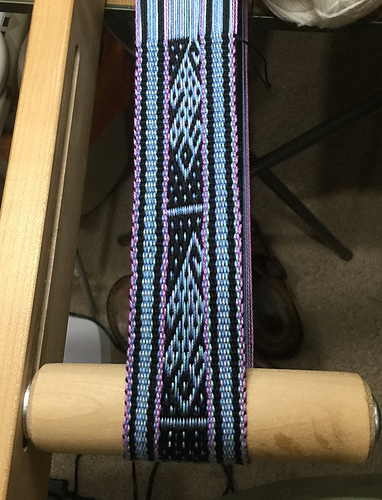
KathyO is weaving the viscacha pattern  that is in my Andean Pebble Weave on Inkle Looms book. This book teaches the technique via step-by-step pictures, detailed explanations and video clips and includes a collection of pattern charts. The viscacha is a chinchilla-like animal that is found in the Andes and it shows up in various forms on the textiles that are woven here. I just found an image of a pre-columbian textile that has a viscacha figure in the Finnweave structure that I am currently studying.

One of the things I emphasize in my Warp-faced Double Weave on Inkle Looms book is how easy it is to design your own patterns in this structure. Terry Martin’s 9-year old granddaughter sat by her side as she wove and created these butterfly patterns. Then she sat by and called out the pick-up numbers as Terry wove!

Nancy Ayton has also been designing and has moved on to wider warps to weave her original pattern of diamonds in warp-faced double weave. This is another book that comes accompanied by instructional video clips.

Here’s another Andean Pebble Weave band by KathyO using 12-thread patterns from the Inkle Loom book as well as a few from some of my other pattern books. I like her use of black weft which places decorative black dots along the red edges of her band.

Lori Gayle is weaving from the double weave book and is making a nice sampler of the 12-thread patterns.

As for backstrap-loom weavers, Kristen showed us the kaku obi that she wove using her own handspun linen and hemp. Too beautiful for words! She is wearing it around a vintage kimono.

I’ll leave you with a close-up of this beautiful cloth and the feeling of space and calm that it brings. Please stay safe and well.


Backstrap Weaving – The Seed of an Idea

I would say that many of my ideas for my weaving projects are born from having found something of interest in woven cloth that I have seen in books or online or in-person in my travels. It may be a particular pattern, a certain color combination or a technique. An example would be my wanting to experiment with the ikat technique again after having seen how it is used in many of the beautiful textiles of Indonesia.

Other times the idea for a project might be based on wanting to use a structure that I have learned with my indigenous weaving teachers to produce motifs and patterns that are not at all like the ones that my teachers use.

Or, they could be about practicing a method of construction, like cloth that has four selvedges or cloth that has a built-in pocket. (at left)

Some projects are just about challenging myself to weave on my backstrap loom using the finest threads that are available to me and/or to weave something wider or longer than I have managed before.

I rarely weave anything simply because I have a real need for the finished product. I have something on the loom now that I am enjoying weaving but I have no idea what it will be when it is finished.

There have been times when ideas have come out of the blue from the strangest of places. One such time was when I was traveling on an American Airlines flight and spotted this in the in-flight magazine…

This gave me the idea of creating shapes on a warp using the ikat technique and then filling in the shapes with pick-up patterns. I started with a small circle to test the idea….

…but didn’t have the confidence at that point to go from there directly to large curved shapes. What if successfully creating this first circle was just a fluke? I played it safe and continued with something very angular….

The horizontal lines are outlined with  cross-knit loop stitch.

And then came the bigger circles….

An attempt to create a circle in ikat and fill it with a pick-up pattern. Due to take-up, my circle got flattened as I wove it.

It’s funny that these projects grew from that chance encounter with an ad as I flicked through the in-flight magazine. I still have that ripped-out page pinned to my notice board in the kitchen. It reminds me that one day I will return to this particular challenge.

Another unusual thing that pushed me towards returning to ikat on a different occasion was the appearance of these ikat-like patterns in the way the layers of dark and light threads were interacting in a fresh warp on my loom…

And I remember another time when light was having an effect on the shapes that appeared on my fresh warp. That time I was seeing fine swirling lines that reminded me of the lines on Shipibo textiles and pottery. I didn’t manage to photograph that.

That led to this big double-weave project in which I enclosed fine curve-like lines within heavier angular shapes….

I haven’t had any visions on my fresh warp threads lately! And so, I draw inspiration from more conventional sources. My latest project involves using a balanced double-weave pick-up structure.

I have chosen to use the Finnweave structure because this particular balanced double-weave pick-up structure was used in fabric in old Peru. I was fortunate to find a couple of fragments of pre-columbian cloth that were woven using this structure. They were stitched to dolls that are sometimes sold in the various tourist markets in Bolivia, Peru and Ecuador. These dolls are modeled on cloth figures that were buried with members of the Chancay culture in the arid coastal regions of Peru about six hundred years ago. Some of them have even made their way all the way over to Santa Cruz Bolivia where I live. I found these in one of the typical kitschy souvenir stores in the center of the city.

The large doll in the center has a fragment of this balanced double-weave cloth. The easiest way for me to distinguish finnweave from other kinds of balanced double-weave pick-up structures is by looking at the back of the fabric. Finnweave does not produce two identical faces. Some shapes on the back resemble the corresponding shape on the front more closely than others. The back always looks a little strange.

I tried to chart a replica of the pattern of the cloth that was sewn to the largest doll. I think I got a lot of it right. Some bits need adjustment. Then I was able to weave it and compare the back of the two pieces of fabric. I made it a bit confusing for myself by arranging the dark and light colors in my piece opposite to the way they are arranged on the fragment.

Now, I would like to leave replicas aside and just play with the structure. The motifs that can be created with it are based on vertical and horizontal lines and so it is quite different to some of the other patterning structures that I use, like Andean Pebble Weave, in which pattern shapes are very much based on diagonals. Finnweave allows me to create true vertical lines of any length, rather than the slightly wavy ones that other structures I use produce.

So, I showed you in my last blog post the sampler that I have been weaving. My piece is not truly balanced. It is definitely warp dominant and I don’t like the fact that I am not getting some of the square shapes that I have created on my pattern charts. My charted square shapes come out as oblongs on the cloth. I will figure out how to use one of my bamboo reeds for the next attempt and hopefully get everything squared off. I had managed quite well without a reed when my projects had been in 8/2 cotton (the replica piece above is in 8/2 cotton). The 20/2 cotton that I am now using is proving to be more challenging in that regard.

I think I mentioned in my last post that thoughts of the wrought-iron work that I saw on Victorian-era terraced houses in the inner city suburbs of Melbourne keep coming to mind as I weave this piece. The problem is that those patterns are for the most part curved! Why would I be thinking of those when I am limited to verticals and horizontals when using this structure?

And then came some inspiration in the form of ….crochet! I honestly can’t remember when I first saw the work of crochet and knit designer and artist Svetlana Rogatykh on Instagram. I don’t even know why I would have been looking at pages associated with these two crafts.  Is it just a coincidence that she is using black and gold in some of her work and that I am too, or did I see her work a long time ago and have it somehow sew the seed of an idea without my even realizing? The only colors I have in this 20/2 cotton are black, gold and bleached white so it’s not like I have much choice.

Here is one of Svetlana’s pieces….

When I first saw this image on the tiny screen of my iPod, I thought…oh, cool…finnweave! I was struck by the way she had used vertical and horizontal lines to create the impression of curves in one of these motifs. The accompanying description was in Russian and it was only when I started looking at Svetlana’s other photos and video clips that I realized that this was in fact crochet. Maybe this technique is well known in the crochet world but I had never seen it before. Apparently, it goes by several names, a couple of which are Interlocking Crochet and Double Filet Crochet. From what I can tell, it is two independent layers of filet crochet, one in black and one in gold, that connect when there is an exchange of colors between the two layers…just like the double weave I am doing.

Here’s another image of Svetlana’s project. Look at those circles!

I think that Svetlana’s designs are amazing. These patterns can be translated directly to the finnweave charting paper that I am using. However, on my cloth they would come out very elongated because my work is warp-dominant. You will be able to see my attempt at Svetlana’s round motif in the photo I posted earlier. I had to alter it to make it shorter but even so, I ended up with an oval shape. This is very good incentive for me to get out my reeds and aim for a better balance in my epi and ppi. I think that I might still have to adapt just a little depending on how my cloth changes after wet-finishing.

You can find Svetlana on Ravelry as SvetaRo and see more of her work in crochet and machine-knitting. As mentioned, she is also on Instagram as svetalna_svero. Many thanks to Kate Dudman who introduced us on Ravelry.

So, maybe I can apply some of Svetlana’s tricks for creating an illusion of curves to the wrought-iron patterns I hope to represent. If not, oh well…there are always lots of leaf patterns  to design!

I have only woven one more motif on the finnweave piece in the two weeks since I last posted. Where did the time go? Well, I was working for the most part on my Zoom presentations and workshops as well as combing through years of old photos to choose the best ones to accompany an article that I was asked to write. That sort of thing always tends to lead one down memory lane. Just like I got lost in my tool drawers recently, I got lost in pictures on discs and thumb drives.

And then I went back further in time to my pre-digital days when my weaving pictures would get printed and then pasted into my hand-made books. I originally pulled out the books because I had wanted to photograph some of  my bone and wooden weaving tools and I thought that covers of the books would make a good backdrop. But then I went and opened one of the books and that was the end of that…the rest of the day was devoted to reading and remembering!

I would make a book every time I learned something new with my indigenous teachers here in South America and Guatemala and would wait excitedly for the rolls of film to be processed so that I could document everything I had learned. These books are full of my little woven samples, drawings, diagrams, photos and yarn and fiber samples….lots of textures…dating back to the mid 1990’s.

Getting a digital camera that allowed me to record video kind of put an end to all that. I did weave what was to be the cover of the book (see below) on the techniques I had learned with my teachers from the Vietnamese hill tribes in 2010  but that was as far as I got with that. By that time I was already writing about my travels on this blog and putting together instructions in pdfs to teach others.

I still have some Zoom presentation work to do but I hope to spend more time at the loom in these next weeks. I am keeping busy and staying home despite the fact that restrictions here are gradually being eased.

Take care and stay safe, please.