
Back home in Bolivia!
 September is the first month of spring. Big rains extinguished all the fires that normally choke the skies with smoke at this time of the year, the green and white flag flies proudly and Santa Cruz celebrates its beginnings.
September 24 is the big day of celebrations and above you can see one of my English teaching colleagues, Lalenya, wearing the tipoy, the typical dress of Santa Cruz (only worn on such fiesta days) with some students from the instutute wearing the light white cotton outfits and sombrero de sao which complete the typical man’s costume for these days of celebration.
Lalenya’s tipoy is patterned with images of the patuju flower which is one of two Bolivian national flowers. One flower represents the lowlands where we live and another the highlands.
Next week the US will be celebrating Spinning and Weaving week (is this an international celebration?) and I will be spending the week in Cusco, Peru at a weavers’ gathering…yay!
I got to enjoy some wonderful late summer/early fall days in Europe. After what I am told was a wet and horrid summer, I was treated to day after day of sun and perfect temperatures in both Holland and the UK.

Here is part of the group that came to meet and weave with me in the Netherlands. Artist, author and tablet-weaver Marijke van Epen, is just behind me. In the chaos that typically accompanies packing up at the end of a weaving day, two people left before I remembered to get a posed group shot but here they all are weaving…
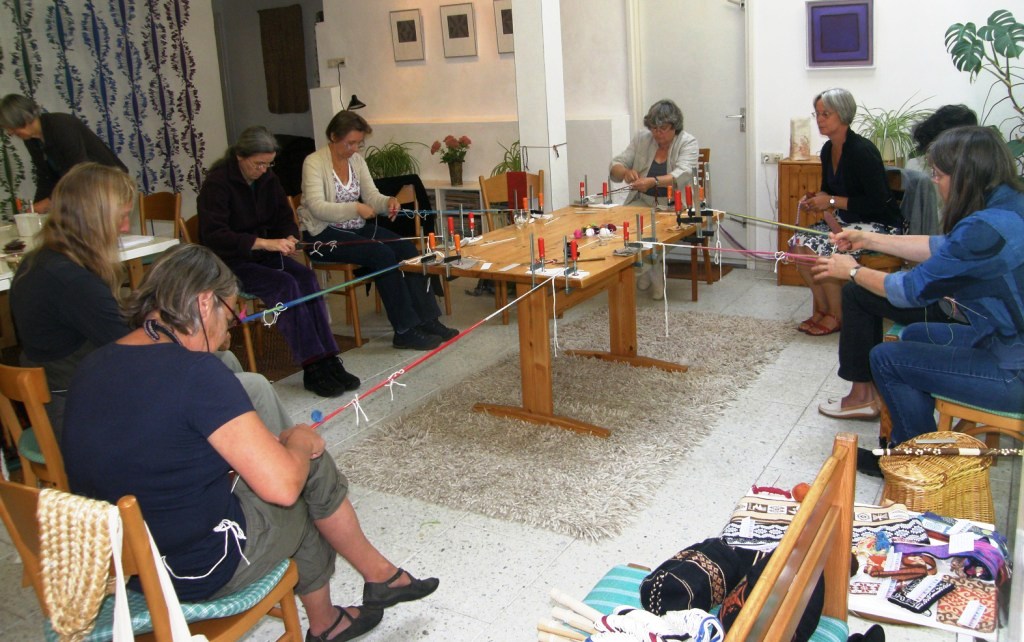
We wove in the workshop and exhibit area in Marijke’s lovely home, a beautiful light and airy space with walls covered in Marijke’s stunning tablet-woven art.

This rainbow piece covers an entire wall and comprises tablet-woven linen spiral bands with twisted paper weft. The slightest movement nearby will set the pieces in motion, gracefully turning. Standing by the green bands as they gently twirled reminded me of being in a forest with dappled light. I can imagine this hanging in a bedroom accompanied by the sound of a gurgling stream and breeze…how relaxing that would be!

Other walls were adorned with smaller tablet-woven pieces. Being behind glass, it wasn’t possible to photograph all of these well.

Yes, these have been woven with tablets!

One of my favorite pieces is Marijke’s reproduction of a tablet-woven band which belonged to Bathilde, Queen of the Franks (7th Century) which was found among other textile fragments in Chelles Abbey. Look at the little “pebbly” figures that run along the bottom edge of the band. They could be woven using the Andean Pebble Weave structure.
And then, upstairs in the loom room where I slept, I had these to keep me company…
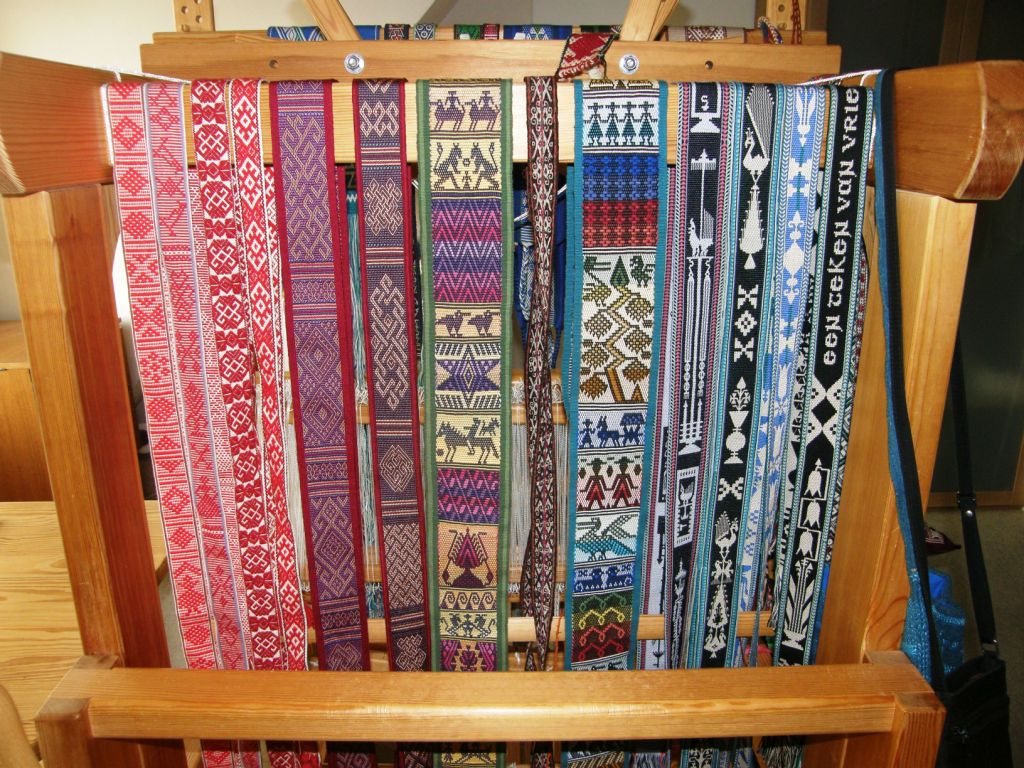
This is just a handful of the bands that reflect Marijke’s love of ethnic textiles and motifs. She has dedicated a lot of time to figuring out how to reproduce the structure of pieces, which have been created with pick-up techniques on backstrap looms, using tablets instead. In this way she has been able to create multi-colored pebble weave bands instead of just limiting herself to two and three-colored bands as are most often seen in the Andes these days. At times she found that she couldn’t find an efficient way to reproduce a certain structure with tablets and so she would weave the piece doing pick-up with a backstrap loom. She is just as skilled at doing pick-up with her backstrap loom as she is with using tablets.

And, as you can see, she also loves to cover her woven pieces with finishes and embellishments…braids, pom poms, tassels, straps, edging bands. All her pieces are impeccably finished down to the very last detail. That is an inspiration for me as I sometimes don’t take as much care with finishing the inside of my pieces as I do with the outside. Above you can see Marijke practicing her ñawi awapa tubular band. She had learned how to make this beautiful band from the writings of Adele Cahlander and I was able to show her how I was taught to make it in Peru.
 It was a lovely week in the small village of Gelselaar, village of geese, in eastern Holland. Much time was spent indoors with Marijke as we poured over weaving books, discovered the many similarities in our interests, peered at photos and tried to figure out structures. We wove the special rolled tubular edging used by the Wayuu weavers on their si’ira belts described by weaver and author Mirja Wark. Together we also figured out how to weave a new tubular band from Chahuaytire…what fun! And then there were evening strolls around the village…breakfasts of typical Dutch treats, Hagelslag – chocolate sprinkles which you have on toast rounds – and morning coffee break with stroopwafel, my favorite!
Two of Marijke’s friends offered to drive us north to spend the day with Mirja Wark. It was a lovely drive with lots of horizon to be seen! Mirja has her home in a remote area on a large piece of property on which she has her weaving school and studio. How tranquil and inviting is that? Students are invited to pitch their tents, if they like, in the orchard that lies on this side of the pool.
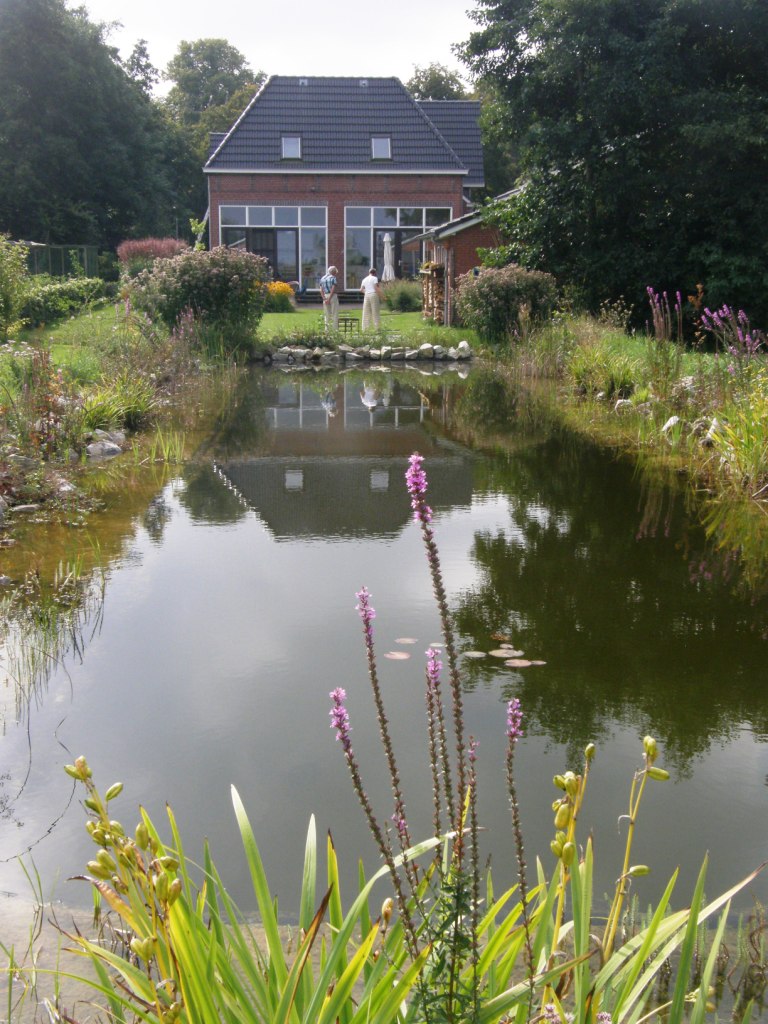
It was another glorious early fall day. We sat outside while Mirja brought us the si’ira belts which she collected and catalogued while living in Venezuela. We also saw three reproductions that she herself has made.

There is a whole lot involved with the creation of one of these belts. Firstly, there is all that pick-up to make the pattern (I know! I am in the midst of weaving a wall hanging using an adaptation of these designs), there is the special rolled hollow edging which you might be able to make out in the picture, there is a weft twined finish at both ends, loop braids and tassels….all of which are beautifully explained in Mirja’s book.

Mirja showed us how the belt is worn by men to secure their loin cloths. The pom poms sit right on the hips and jiggle about as the wearer walks. Below is one of the belts made by a Wayuu weaver. No one is weaving these any more and most of the belts that Mirja collected are quite old with many signs of wear, deterioration and multiple repairs.

Then we saw the typical embroidered cotton dress used by Wayuu women.

A belt concealed inside the dress allows the wearer to pull the dress in and around the front of her waist to give it some form. The back of the dress, however, hangs and flows freely. Mirja says that it is a lovely sight on the notoriously windy Guajira Peninsula to see the women with their dresses billowing behind as they walk.

Mirja was able to collect this young girl’s blouse and a chief’s ceremonial headdress. The patterned woven band of the headdress is almost completely obscured by the pink tassels.
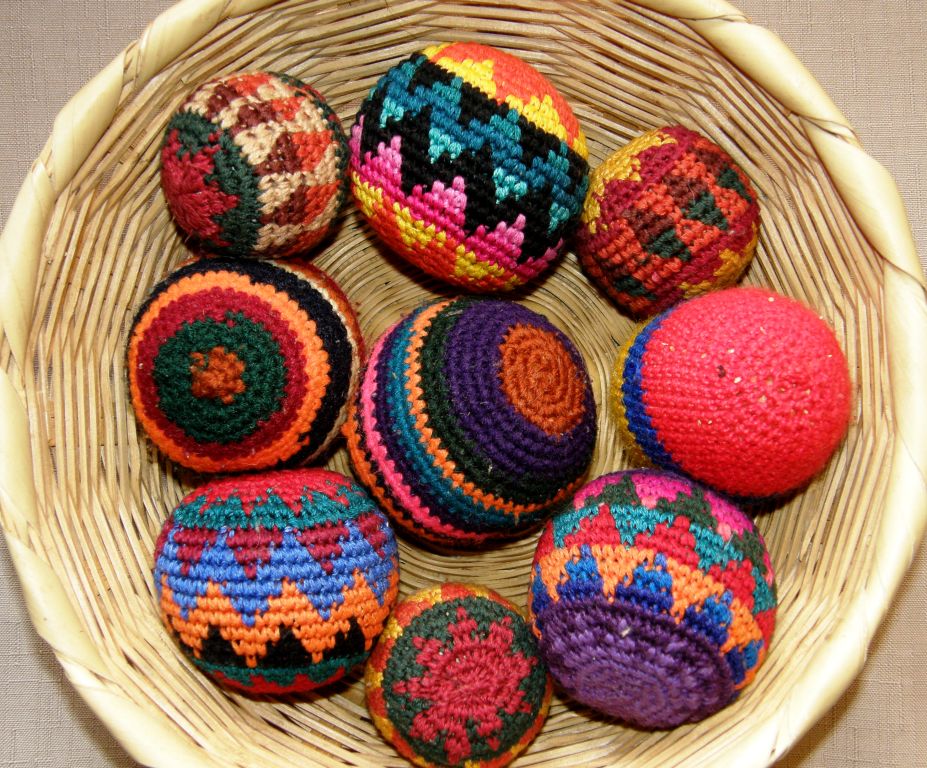
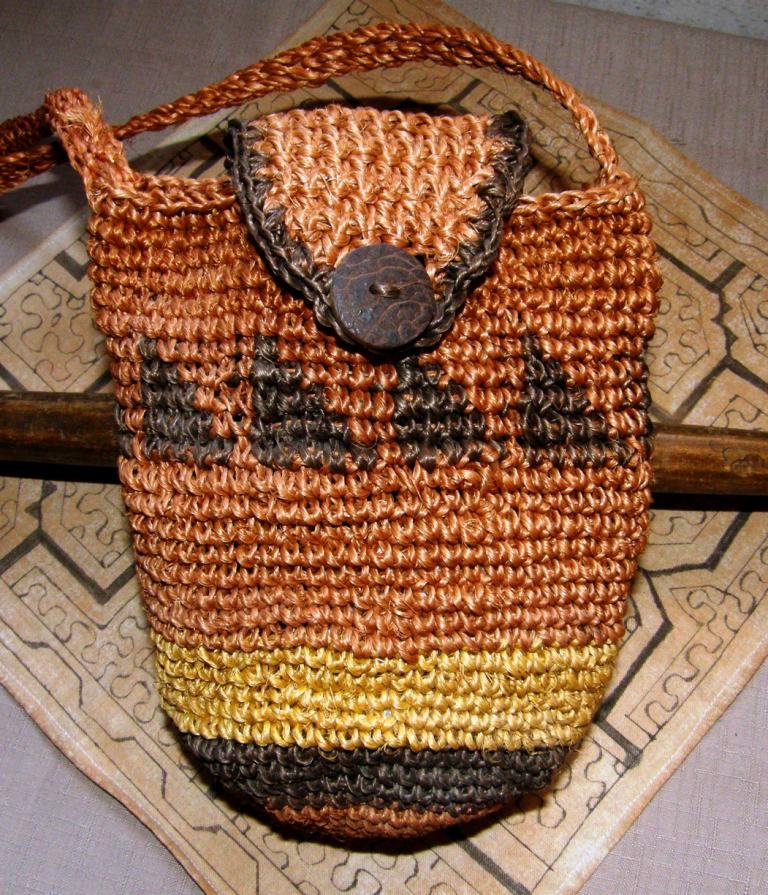
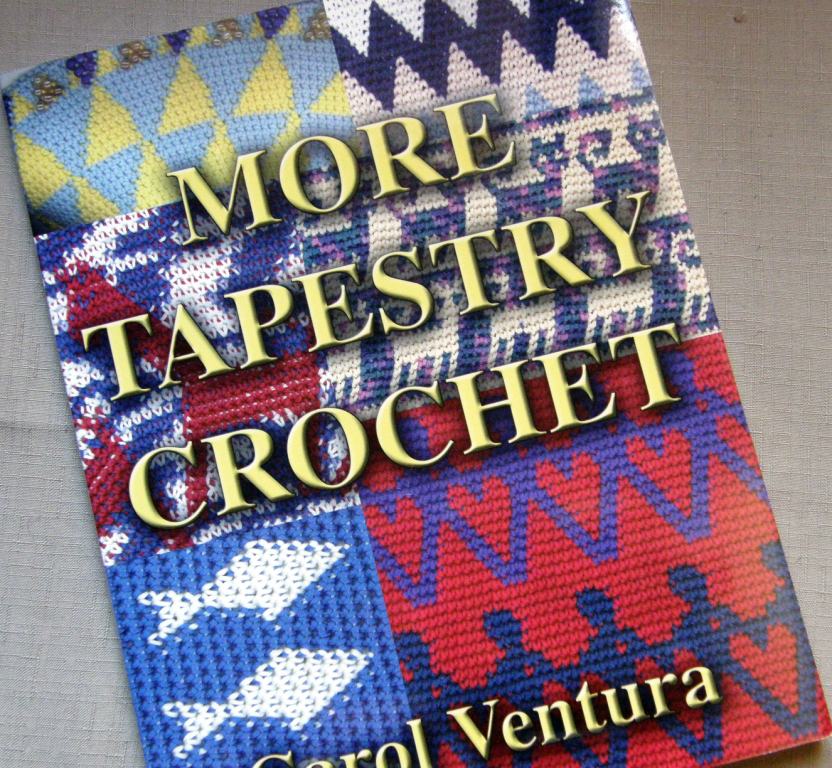
And then there were the susu, or mochilas, the crocheted bags which come in many sizes. Large ones are carried by the Wayuu women while small ones, which are used for coins, hang from the mens’ waists. A crocheter I am not. Well, I do know a few stitches (are they even called “stitches”?) and this in spite of owning Carol Ventura’s wonderful books on tapestry crochet. So, for all the crocheters out there, I have taken a close up shot of the structure so you can see what’s going on.

Mirja has one of the very tiny crochet hooks that the women use to make these bags but in all the excitement of the showing and examining and photographing I didn’t get to see it. However, I found this very short segment on Youtube of a Wayuu woman making a mochila.
Now let’s look at more of these gorgeous bags that Mirja has in her studio…
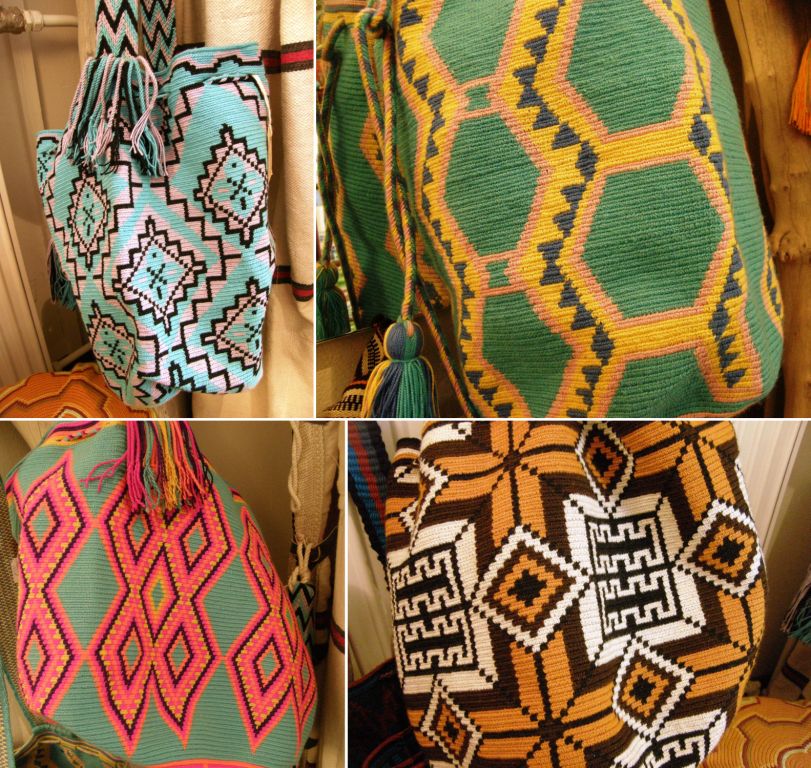
And for the ply-splitters out there, some of the straps of the bags are made in this technique.


The bottoms of the bags, which probably are not seen very often when the bags are being carried, are also beautifully patterned (I have read online that this is one of the features that distinguish a real Wayuu bag from inferior imitations).

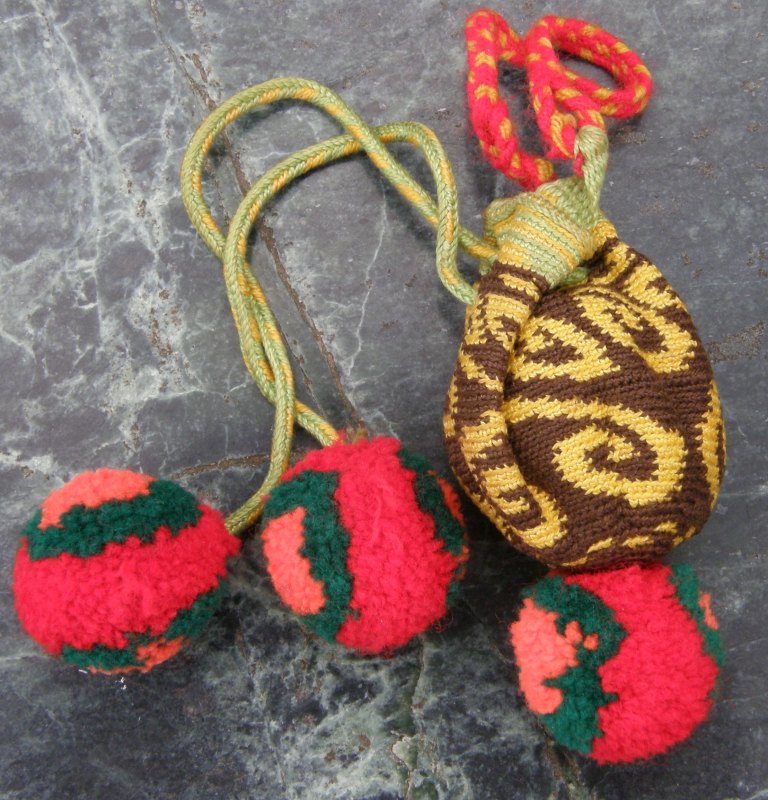
Here is something for the loop-braiders…one of the tiny coin susu that men dangle at the hip….
There was so much to see! Mirja has also lived in the Middle East and there were many textiles that she has collected, studied and reproduced throughout her studio. I will refrain from posting everything as I need to get some of the details sorted…so much information. However, I will show you this woman’s camel bag (the woman’s version apparently has only one pocket) from Oman as we have seen these kinds of Bedouin textiles here on my blog before.
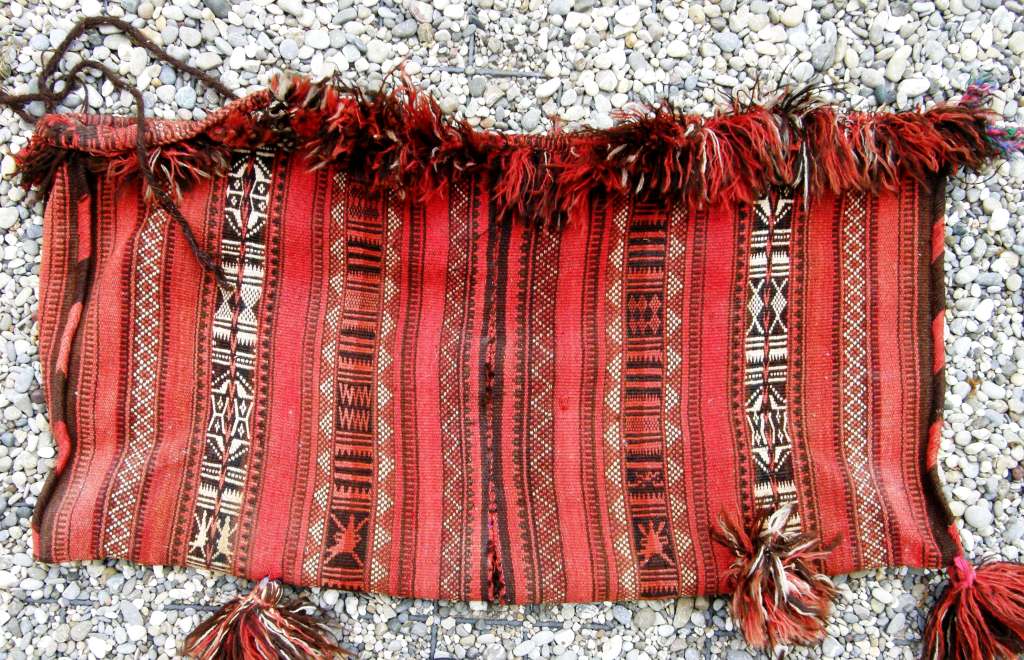 Recognize this style of weaving?…the warp-substitution shajarah and the checkerboard al’ouerjan patterns (both these techniques produce long warp floats on the back). I love the red on black patterns! There is plenty to look at on this piece…all those marvelous finishes and embellishments. What a treat to be able to handle a textile like this!
This next piece that Mirja bought on an island off the east coast of Oman is interesting in that the weavers have tied down the warp floats on the back of the piece.

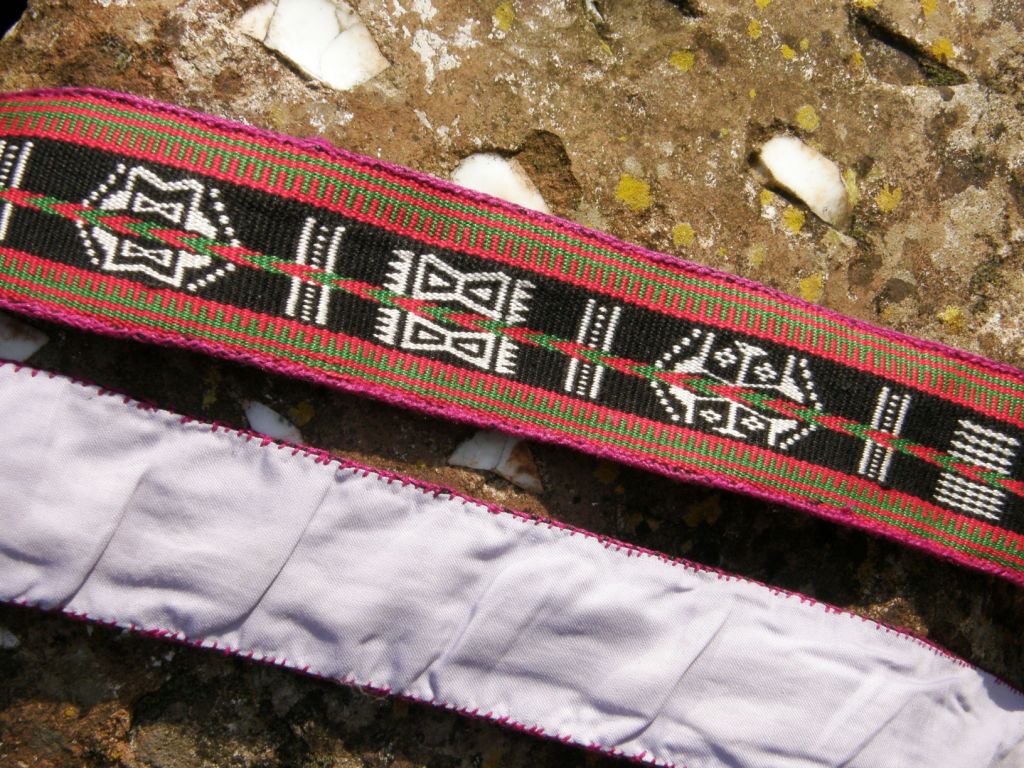
In a previous discussion about this in the Ravelry group we had assumed that this was done simply to make a textile more attractive for tourists and was not a traditional practice. However, Mirja assured me that this piece was not intended for tourists. The island was the only place that she saw traditional textiles woven this way. In other places the long warp floats are often hidden under fabric, as shown below, or left exposed.
So, that was the Netherlands…and two fabulously talented and generous weavers, writers and teachers.
Back in the UK I had one more day with Sue on the farm…ah, the peace, the sunsets, the walks with the dogs, the gorgeous garden… and then I headed down with Sue to Weybridge where I stayed with a Braid Society friend, Norma.
On the way we stopped at the Handweavers Studio and Gallery. Owner Wendy Morris was away at Complex Weavers in the US so I didn’t get to meet her. I went a bit mad and bought a bunch of 60/2 silk with no project in mind. A little voice keeps telling me to “make do with what you can get in Bolivia!” and not to have longings for these other kinds of thread but I have an urge to weave some very fine things with something other than the cotton sewing thread that I get in Santa Cruz.
Sue bought some beautiful handspun and naturally dyed singles yarn form Ayacucho, Peru.
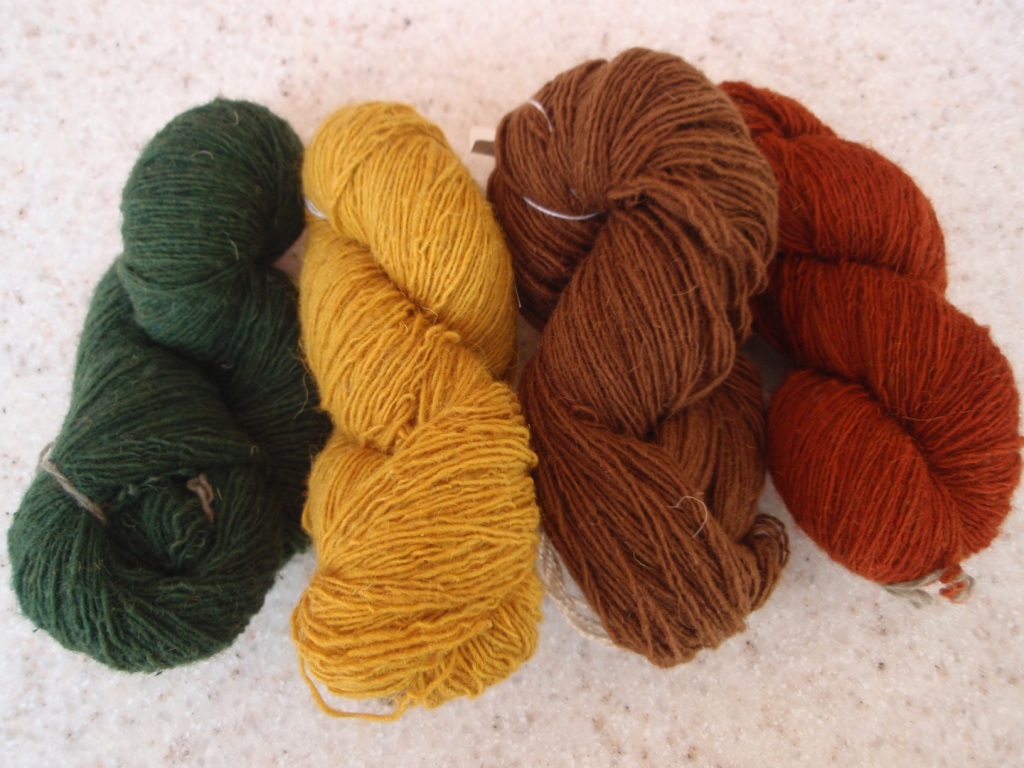
A flyer in the store told the story behind this yarn and it was funny recognizing archaeologist Barbara Wolff’s, name there. I met her at Maryland Sheep and Wool this year where she was promoting and selling weaving of Ayacucho – tapestries and pebble weave pieces. She has been organizing the spinners in the area to produce this yarn and Handweavers Studio is now one of the stores that carries it. Barbara tells me that they are in the process of preparing another shipment so I guess that it is all going very well.
Sue bought four colors with which to make ñawi awapa tubular bands. According to the swing tags and information in-store, the terracotta color comes from masacopa root, the yellow from the chilca bush, brown from nogal (walnut) and the green from tara pod.
 Being a Braid Society member Norma is of course passionate about all kinds of narrow band weaving, ply splitting, tablet weaving, loop braiding, kumihimo etc…and I gave her some lessons in Andean pebble weave and tubular bands while I stayed with her in Weybridge. She showed me her collection of textiles including the gorgeous ply split camel girth above.
Norma’s family is from India as am I, and so, I had a week of authentic home-cooked delicious Indian meals…south Indian curries and sweets! We went to Southhall to an enormous Indian supermarket where Norma and her family helped me choose a few bits and pieces to take back to Bolivia. I am afraid that I cheat and use the prepared curry powders.

The following day Norma and I went to nearby Hampton Court Palace, residence of Henry VIII. My gosh, I have loads of pictures to show you from there…the Tudor and Baroque architecture, the interiors, the gardens, courtyards, squares, paintings, tapestries, furniture, chapel and kitchens. However, in an attempt to keep this post mostly textile-focused I will just show you one tapestry…two small segments of one of my favorites…
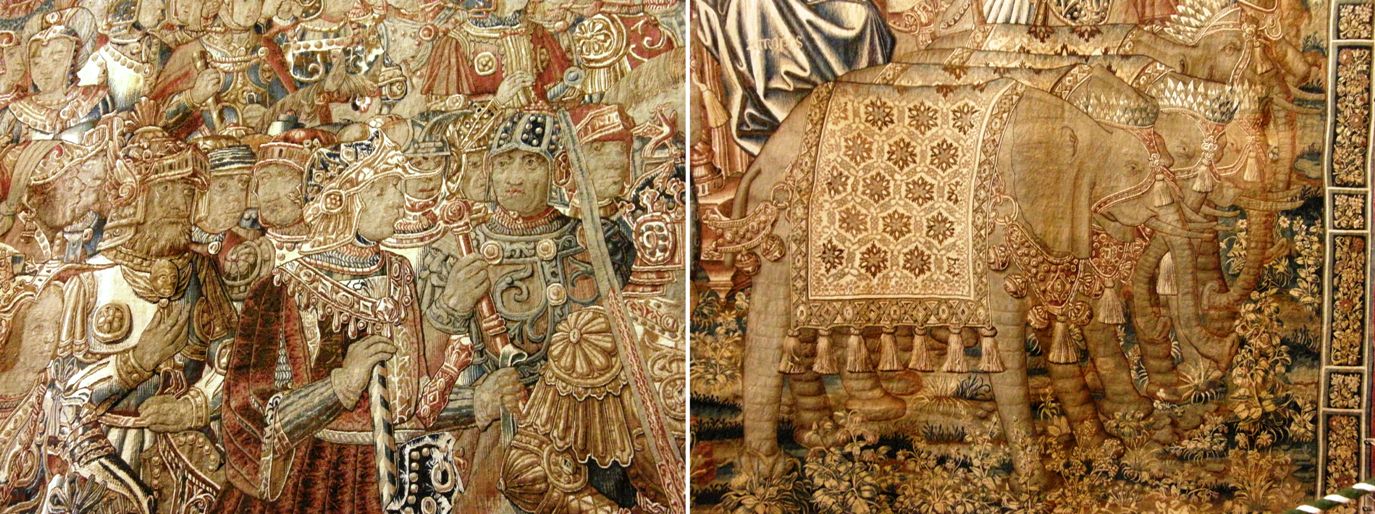 Such detail in this! It is entitled The Triumph of Fame over Death and hangs in the Great Watching Chamber.
Well, okay, just one more picture from the palace…I can’t resist. This is from the Apartments of William III….
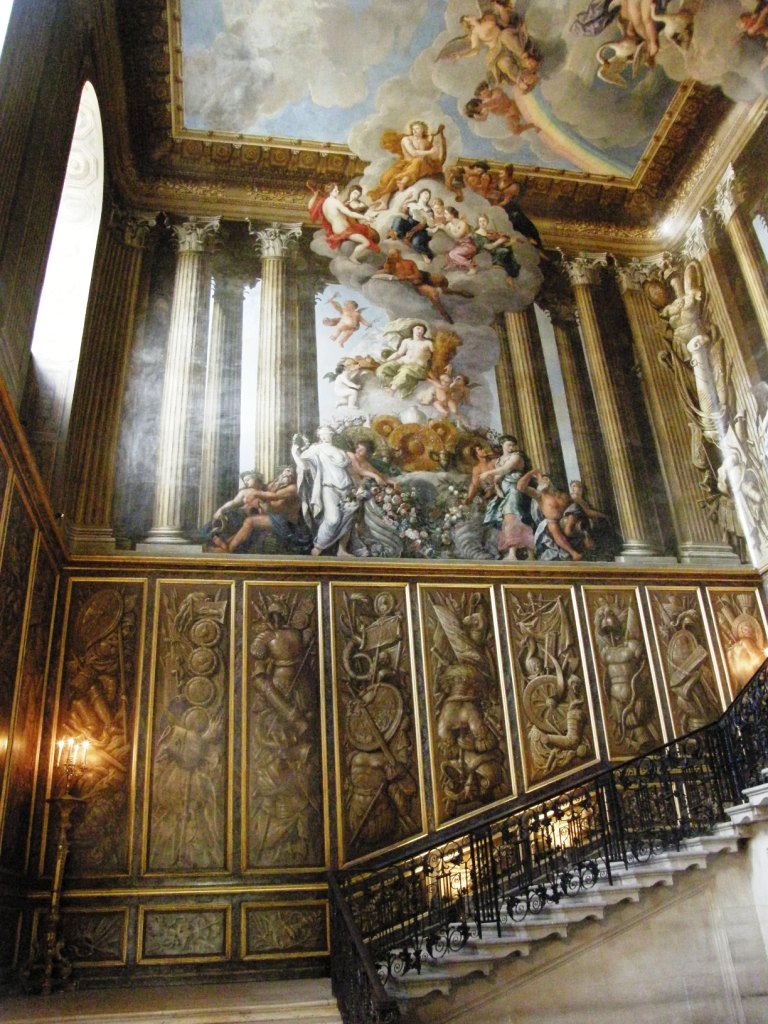
Every inch of ceiling, wall and all that lies between is decorated.
My last day was spent very nicely with Norma on a visit to Rodrick Owen in his home in Oxford where we were able to sit and chat at ease after all the rushing about at the Braids conference. We saw some of his large works…interlaced wall hangings and even clothing!… and had the chance to examine some pieces in his South American study collection.
On the way back to the strain station, Rodrick led us on a short walking tour of Oxford. It was another gorgeous late afternoon with the rowers training on the Thames among the ducks and swans, youngsters playing rugby against a backdrop of the magnificent Oxford colleges with the sun casting a lovely golden glow over everything. It was a beautiful last day.
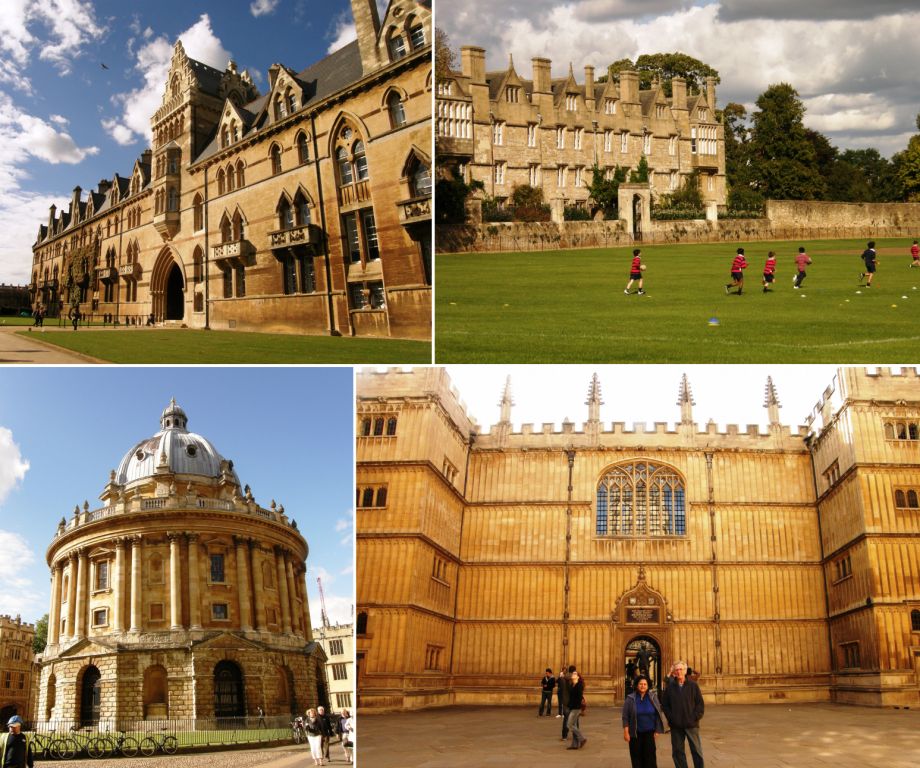
It was just cool enough to have us wearing light sweaters…fall is on its way over there while over here in Bolivia spring has taken its hold. However, I have to say that we don’t really have a spring….just two seasons really…hot-and-humid and warm-and-humid and “hot ” is definitely starting to push “warm” out of the way. Ah well, I will be heading to the highlands this Saturday and an overnight bus trip from La Paz to Cusco will certainly cool things down.
A couple of things to show before I go…
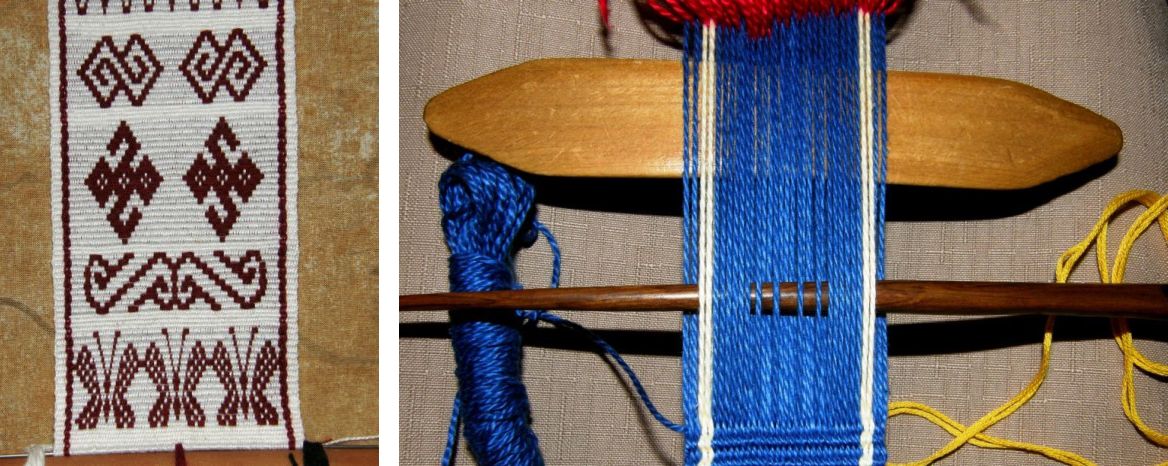
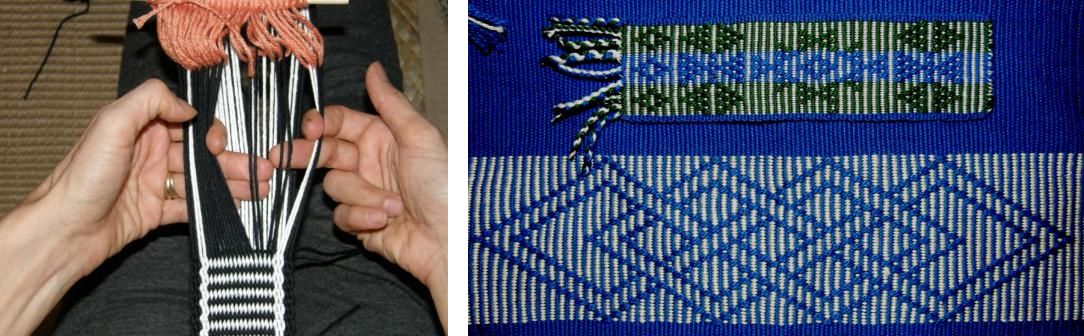
I am happy to have received the first woven feedback from my new book!
Bobbie in the US is weaving the first panel for a bag project using the knot work patterns that are charted on pages 43 and 44.
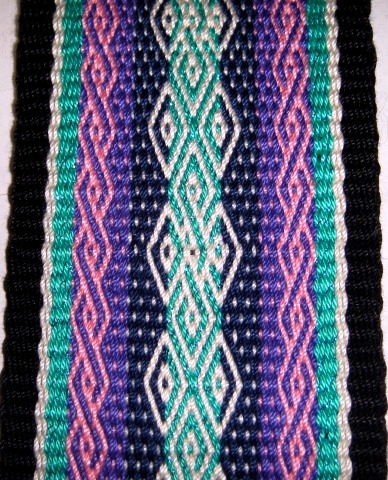
Camilla in Sweden is doing one of the things that I hope many people will do with my book, that is, she is using the designs charted in my book as inspiration for her own unique patterns. Camilla has allowed the hook design that is woven in various parts of the Andes to inspire her work arranging and placing them on both pebbled and twill backgrounds.
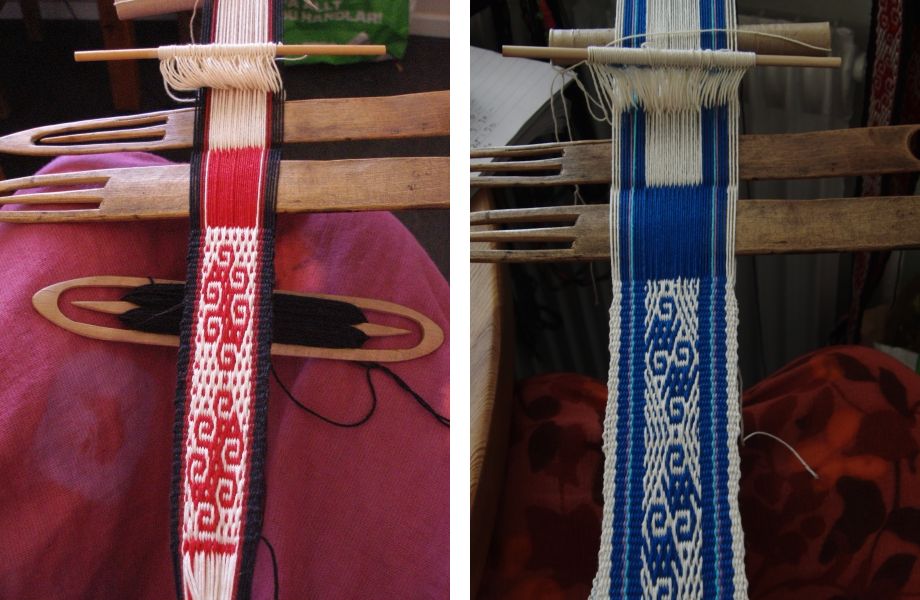
I am looking forward to seeing more projects from people who are using the book.
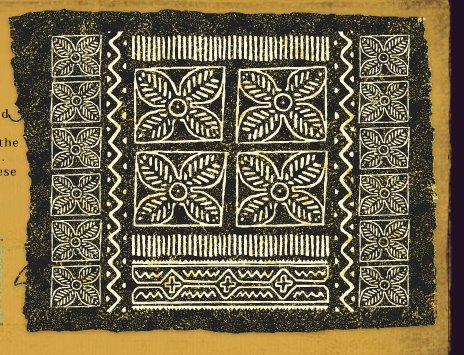
Finally, CraftDesignOnline has put up what they are calling an Interactive Grid Designer on their website. They say that this is the first of a new range of design tools they are planning. It allows you to create patterns by filling in and coloring squares which can then be printed. This style of grid is perfect for warp-faced pick-up pattern structures that incorporate warp floats like Simple Warp-floats, Pebble Weave and other complementary-warp structures. Note that Double Weave, Warp Substitution or Supplementary-weft patterns are best done on charts in which the cells are staggered rather than stacked one above the other.
In my next post I will tell you about the Cusco event, hopefully while still in Cusco. Fingers crossed that my cheapo hostel has wifi service.