While doing some house keeping in my album of weavings on Facebook, I came across a picture I took of the first red, black and white wall hanging I made entitled “Starry Night”. My caption read that I was weaving this in order to push myself beyond my current width comfort zone. That was a nice reminder as I am now on the third piece of similar width in this series and I have to say that I feel very comfortable with this width now! Seems that I need to go wider.
The first two pieces in the wall hanging series.
Here is where I stand with piece number three. That snake continues to slither its way up the cloth.
The pick-up is a piece of cake now…really! There’s nothing like repetition to firmly embed a design in your head and fingers. It began with lots of tedious chart reading which was made a lot easier with the use of removable highlighter tape. Then I played a favorite game…read the cloth and guess what comes next. Then, before passing the weft, sneak a peek at the chart to see if you are correct. Next comes reading the cloth, deciding what comes next and going for it. Beat, pass the weft and then look at the cloth, not at the chart, to see if you were correct. Eventually you reach that chart-free happy place.
But then….you finish the weaving, you start something entirely new with a totally different structure and the fun begins again!
As for going wider….there are still quite a few more pieces I want to make in this current series, but when I do get to the point when I am ready to break out of the old comfort zone, I will need some new equipment…longer loom bars for a start. I already have some pretty long swords. I would also love to have the kind of backstrap that some of the weavers in Peru use.
With its two sets of straps, it was designed to accommodate different widths of weaving.
And, I would like to weave longer pieces. The scarf that I recently made had me extended to the limits of my weaving space. I rolled up part of the warp at the far loom bar but I really prefer to have the warp unrolled at full stretch.
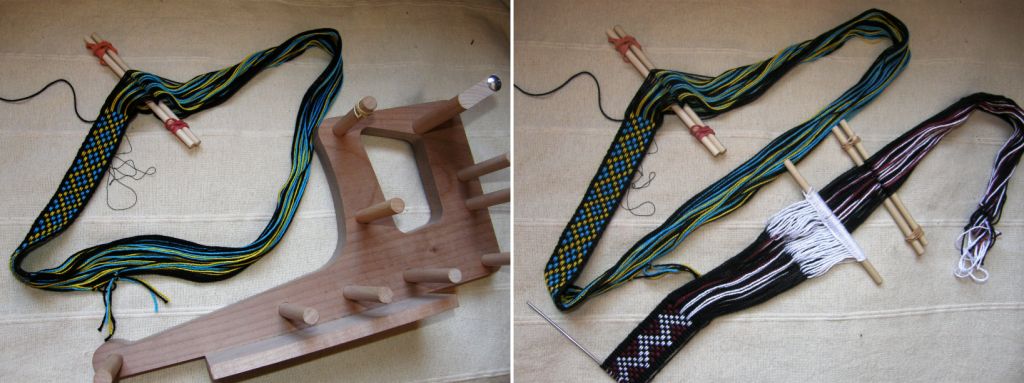
There was just enough space to put my cushion and sit with my back against the closet door. So, if I am to go longer, it is a simple matter of using a circular warp. I have woven on these kinds of warps on a few occasions. Anyone who does inkle weaving certainly knows about circular warps.
The pictures above show a band on which I was working on my inkle loom. The warp is a complete circle. The black band next to it has been warped in a single plane in the same way as the long black scarf warp. Once weaving is finished, the circular warp is cut apart and the band can be extended to its full length.
The Montagnard weavers with whom I studied use circular warps for their long blanket and skirt panels.
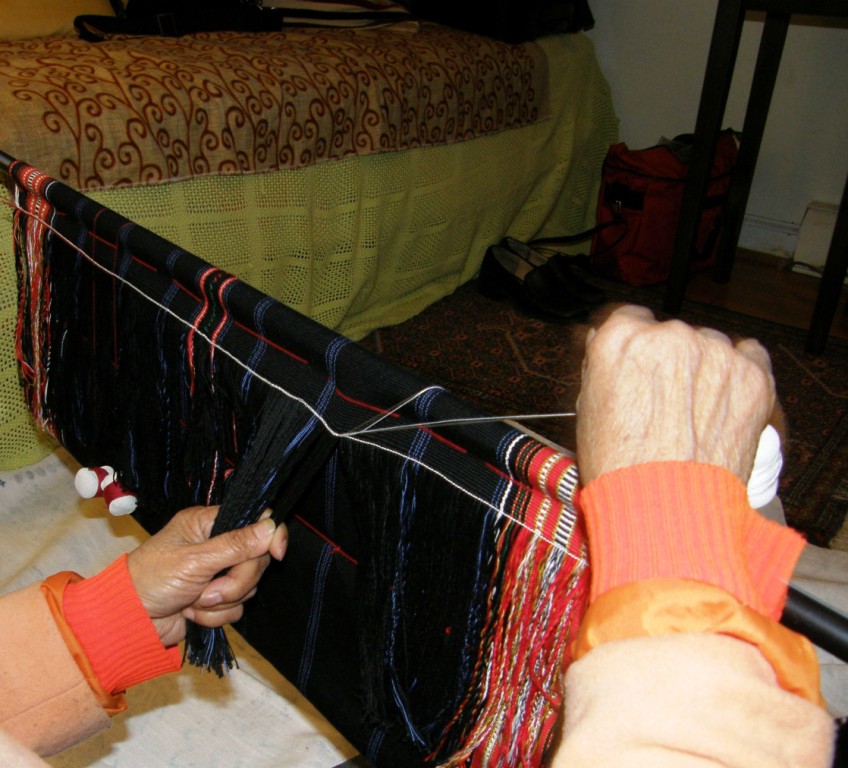
You can see Ju Nie above weaving the top part of her circular warp.
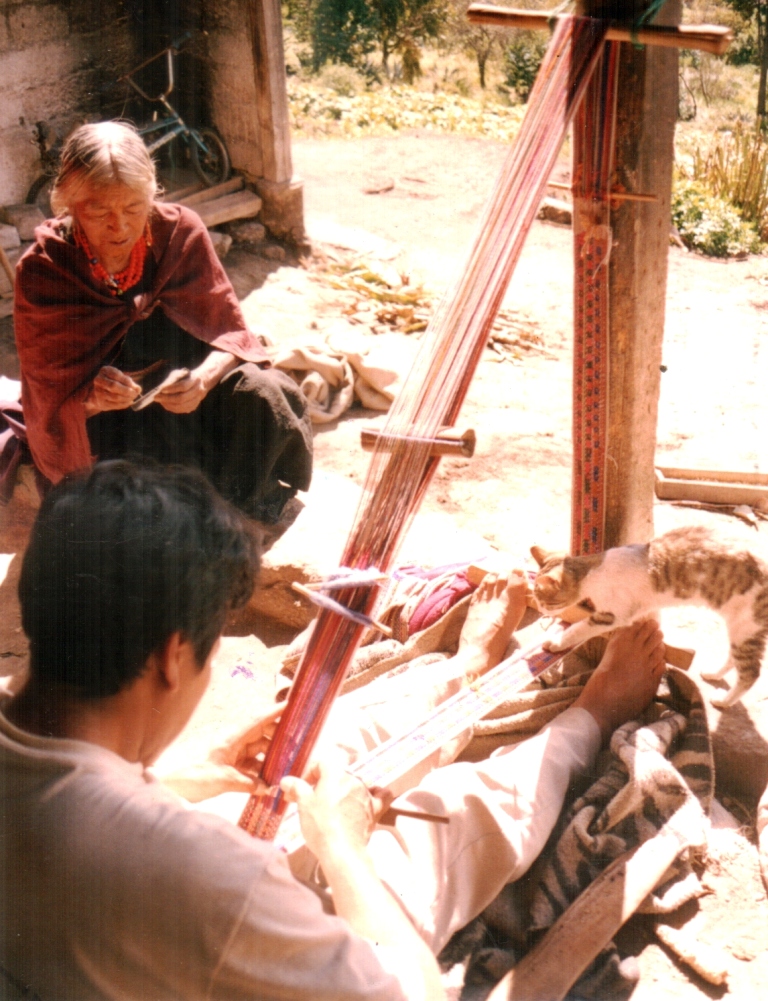
Probably the most time I spent weaving on a circular warp was when I learned to weave the typical belt of Salasaca, Ecuador. My teacher, Felipe, wove on his narrow front porch and his way of setting up a circular warp allowed him to sit and weave the very long belt even in that small space.
Felipe’s belt will not have to be cut once the weaving is finished. He has warped in what is known as “dovetail” fashion.
The following diagram will show you how he is using five of the six sticks you can see in the above picture to wind the warp for the white ground weave. The stick marked with the red arrow is the one around which the warps “dovetail”. When weaving is finished, the stick will be removed and the belt can be opened out. You can see the dovetail stick in the photo of Felipe weaving. It is in the section of band that lies along the porch post.
And, if you are wondering about the sixth stick…that stick is used to hold the colored supplementary warps. Salasacan belts are woven in a supplementary-warp technique.
The diagram above shows the path of the white warps in the ground weave. The following diagram shows the path of the colored supplementary warps. In Salasaca, the supplementary warps all go together in a heddle of their own rather than being split between the two ground weave sheds.
You can see that when the dovetail stick or cord is removed, the end loops of the warp will stay intact. The loops can be very useful for finishing the woven item.
Guaraní hammock weavers here in Santa Cruz use the dovetail warping method and use the intact end loops for attaching the cords from which the hammock will be suspended.
So, longer warps are on the drawing board for me which will mean building a new warping board or modifying my existing ones.
I would really like to have a set-up like Felipe’s. Too bad I don’t have a porch on which to sit (and, yes, the view was lovely from there). I have seen pictures and videos of many Asian weavers with similar “triangular” set-ups. I will have to see into which wall I can drill holes in a place where I can still get good light! The idea of raising my bed way up high to give myself more space is gaining more and more merit.
The third challenge is to use finer yarn and I am already in training for that with my scarf projects made from Guatemalan cotton. I have a ball of fabulous indigo-dyed silk that an English teaching colleague brought back for me from Japan years ago. It is heavier than the 60/2 silk that I have been using as supplementary weft and I think that it is a good weight for a first large silk weaving experiment.
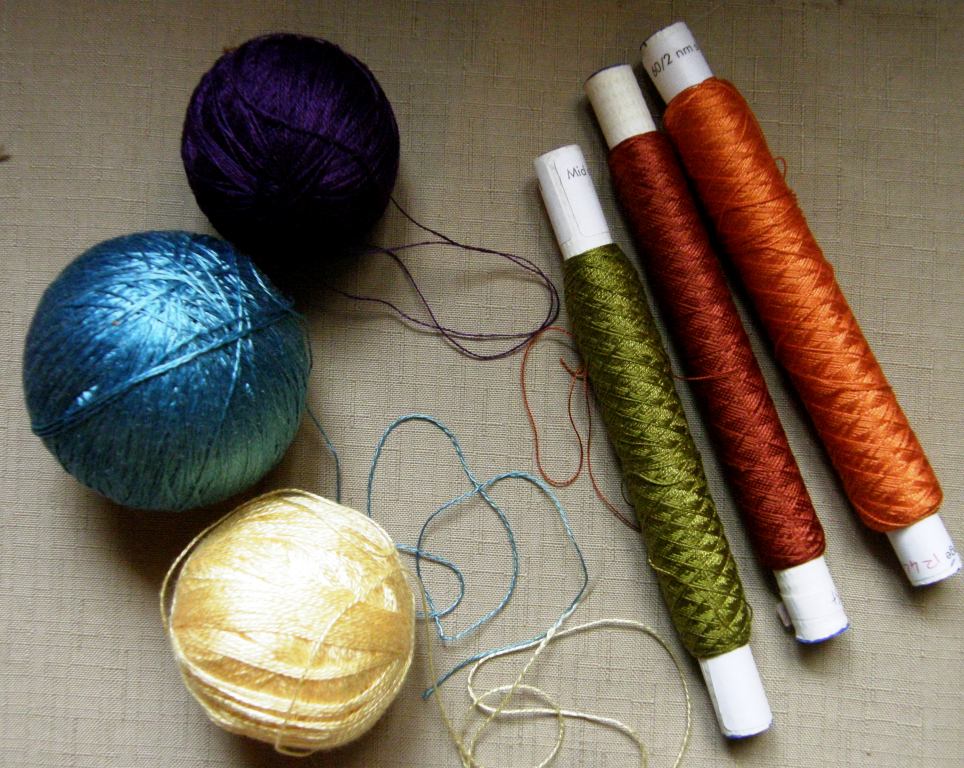
Light blue Japanese silk, spools of 60/2 silk, yellow 8/2 tencel and purple Guatemalan cotton.
However, this doesn’t mean an end to band weaving! I love weaving bands just for the pure fun of it and don’t care if I don’t have a particular use for them.
Narrow bands are a good way to test new yarn or check the proportions of a newly charted motif.
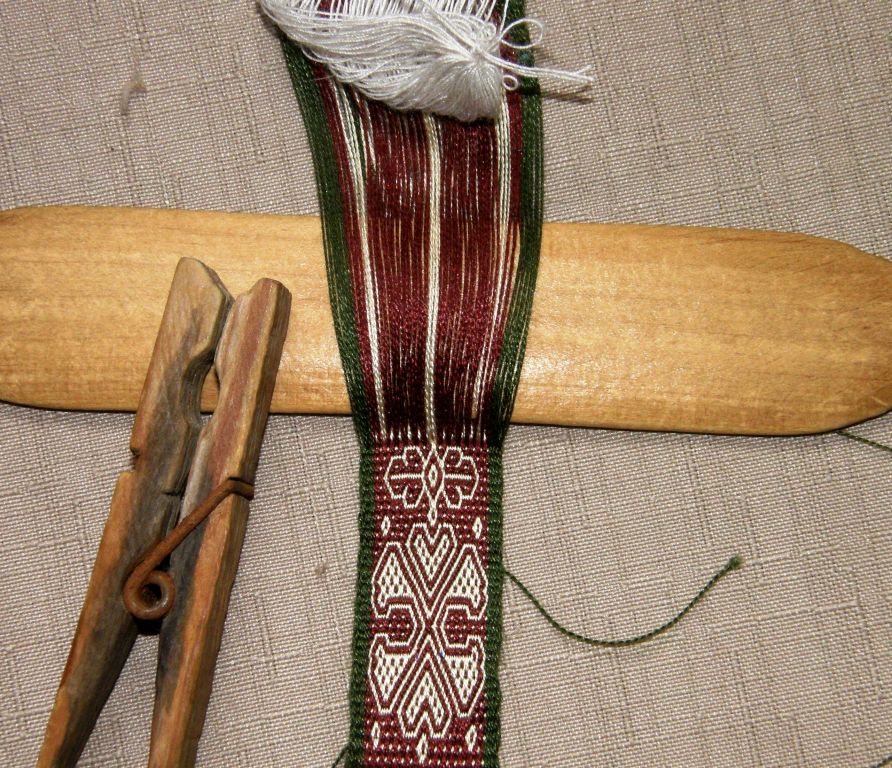
I love weaving miniatures too and have already used the 60/2 silk in a small pebble weave band (at left) to test the yarn, check how difficult it might be to see for doing pick-up as well as to try out a new pebble weave motif.
Band weaving for me is also a nice way to take a break from large pieces on which I might be working…only 16 threads to pick up rather than the 286 in my current project and I can attach to a toe and weave on the sofa.
Much of last year was spent finishing my second book which involved a lot of weaving of samples… mostly bands and a few larger pieces. I have buckets of bands here! They won’t be made into anything. Some of them are very useful in that they travel to my workshops and make good teaching tools.
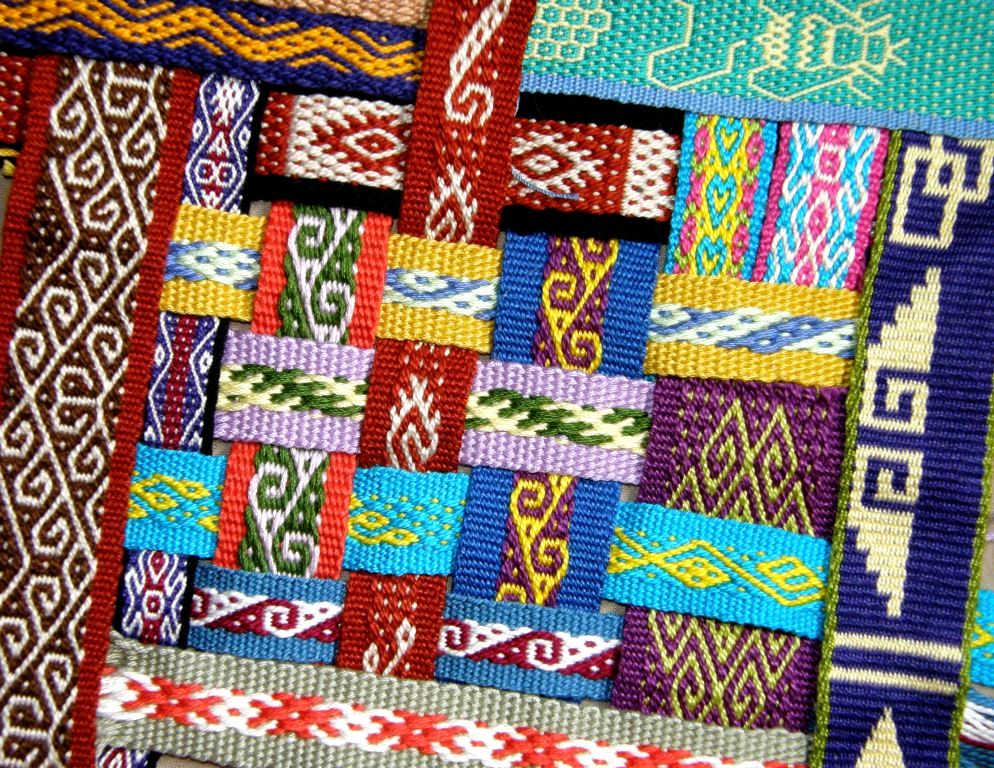
I took this next idea from my friend Yonat who put together a display of her inkle bands to photograph. I put together a few of the bands that went into my book last year. They are of different widths and lengths…some barely two inches long… and so, my display is not as pretty and uniform and Yonat’s.
The resulting book with yet more bands on the cover…
The North West Weavers Conference, which will be held in Bellingham, Washington this June, recently opened its registration. I am going and hope to see you there!
To finish, here are some great projects from members of the Ravelry group…
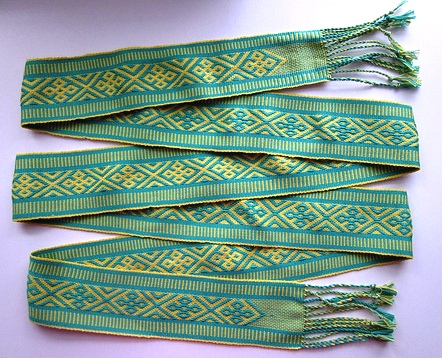
Carrie wove this warp-faced band using the frame of her rigid heddle loom on which to extend her warp. She used string heddles and a shed rod rather than the rigid heddle. The patterns were created with supplementary warps. Gorgeous! We all love the soft colors she chose.
Amanda kindly shared part of her band with her first attempt at creating patterns with supplementary wefts. She shows the difference that applying less tension to her warp made to the amount of coverage she achieved with the supplementary weft. She is using #10 crochet cotton for warp and embroidery floss as her supplementary weft.
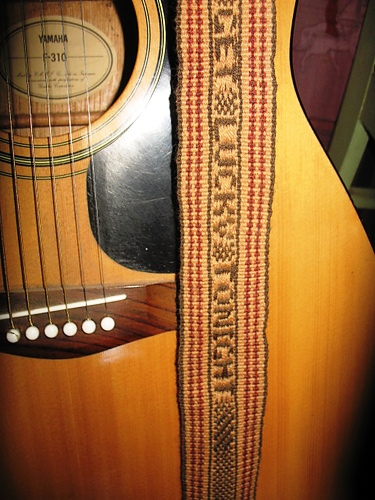
Janet wove this guitar strap for her husband with her own hand-spun and dyed wool. She used instructions for the pick-up patterns from Anne Dixon’s inkle weaving book. She included words from a song which her husband wrote in the design and used guitar strap hardware made by our friend Annie MacHale to put it all together.
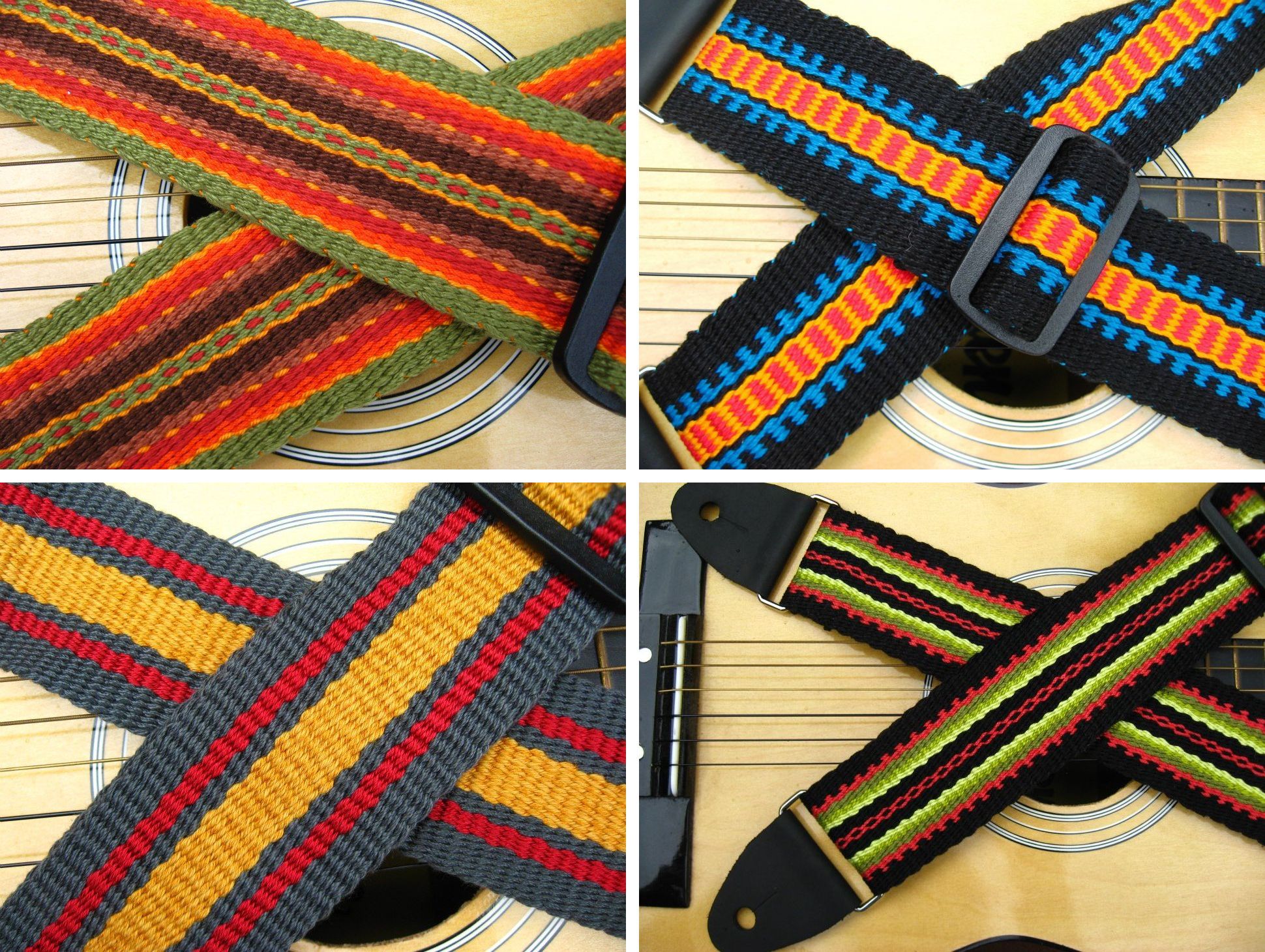
Speaking of Annie, she has been dazzling us on Facebook with the gorgeous straps she has been making on her inkle loom to sell at a big guitar show this weekend in California. Annie is all about color…I will leave you with just four examples of the more than forty guitar straps she will have for sale!
So, my challenges are longer, wide, finer. What are yours?
But first a look at gorgeous rural Maryland where I am currently staying with friends on the first day when it has felt really cold out. There has been talk of snow on Friday…I hope so as we are putting up the Christmas decorations here that day! while Santa Cruz Bolivia in the meantime experiences a “cool” change with temperatures dipping below 30C (86F). Most of the leaves have fallen here and it’s interesting to see the turkey vultures perched in the gaunt leafless tree across the street every morning.
Last week I was down in North Carolina where the weather was mild and the neighborhoods were still awash with red, gold, yellow and brown.
I was down there revisiting the Montagnard (Vietnamese hill tribe) weavers whom I had met on a visit last August about which I wrote in this previous post. I had discovered Betsy Renfrew’s videos and photos on her blog about the group of Montagnard people in her community and her project to help them integrate and find sources of income by teaching them English and making it possible for them to gather the materials and resources necessary to build looms, buy thread and practice their traditional weaving skills. Betsy was more than willing to extend an invitation to visit. She has also allowed me to use some of her photos in this blog post.
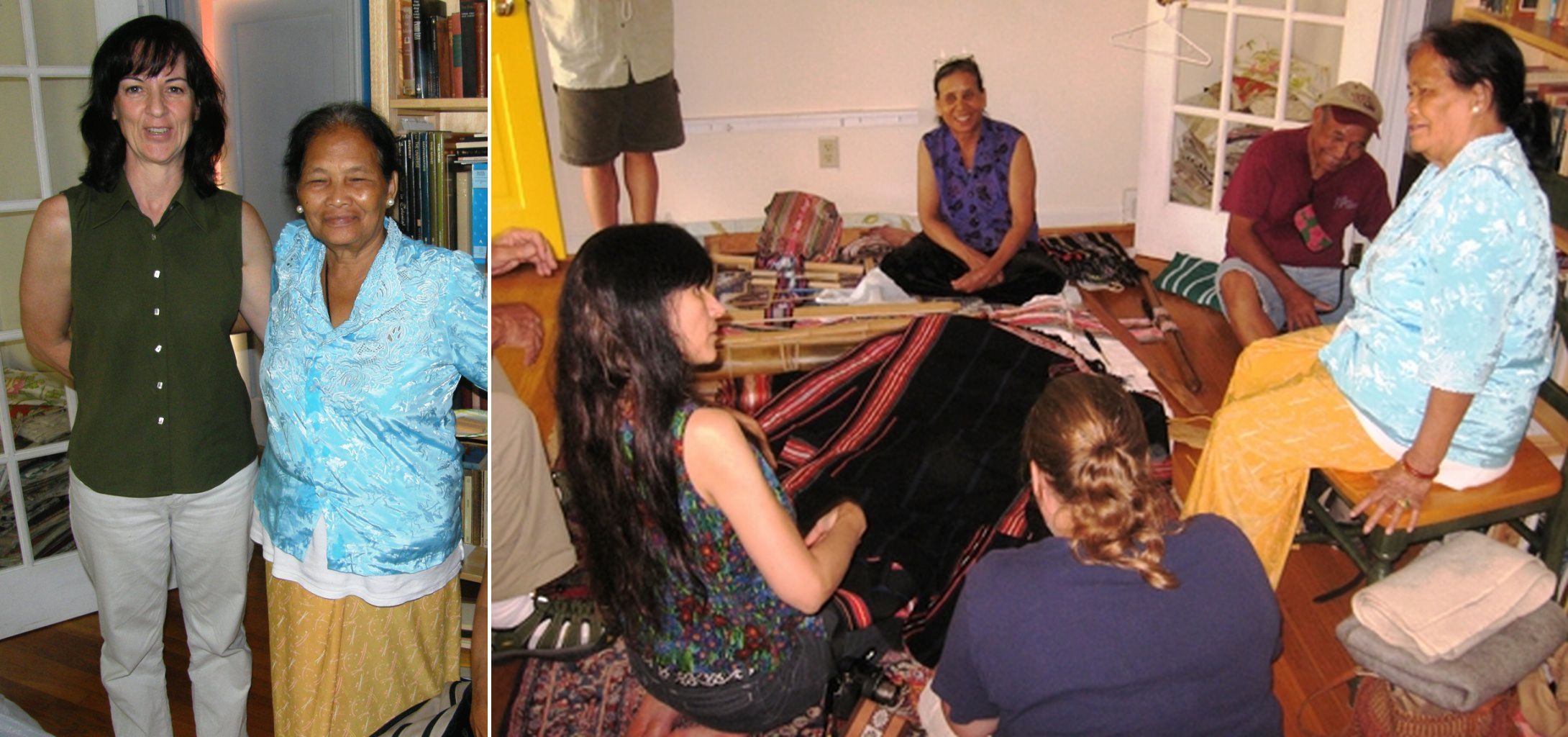
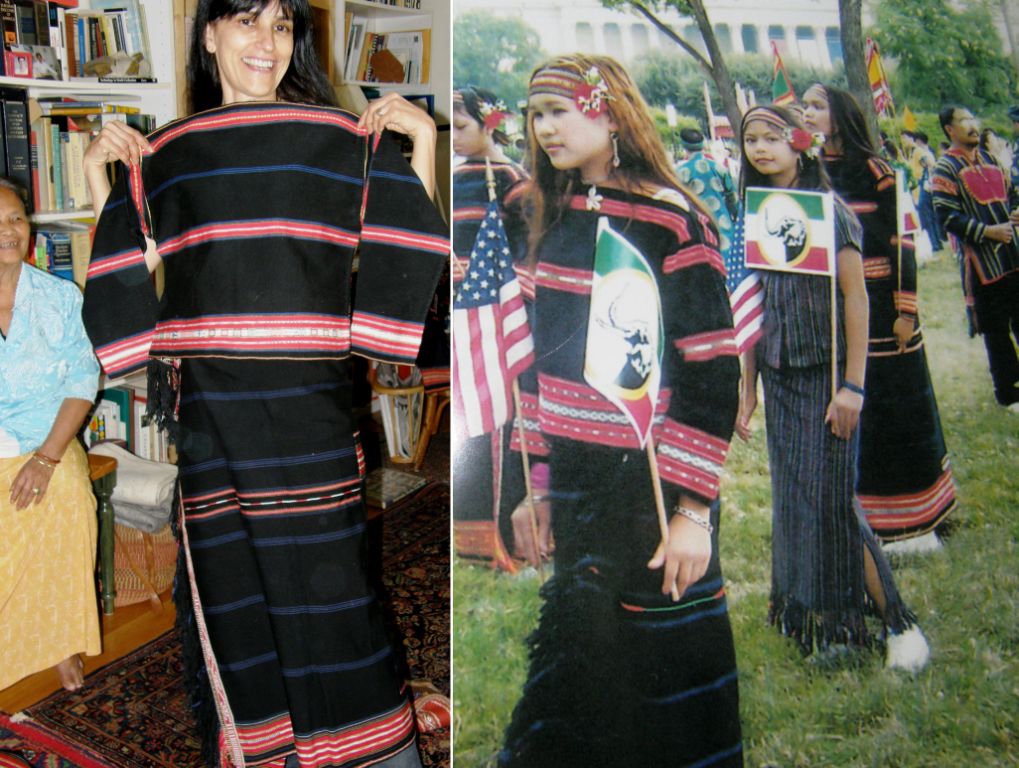
Betsy and weaver Ngach together on the left during my first visit. On the right a scene from my first visit with Lisa and Maurice in Betsy’s home with weavers Ngach, Ju Nie and her husband Thomas. It was a chaotic afternoon with lots of chatter, sharing and interaction which cleared away all language barriers. Backstrap looms and textiles covered the floor of Betsy’s front room and, as this was my very first encounter with these kinds of textiles, it was impossible to wade through and take it all in during our short visit and I left with many unanswered questions knowing that I would simply have to return one day.We got to see Ju warping and setting up her loom and Lisa and I both got to try out her warping technique where she adds string heddles as she winds the warp as well as weave on her backstrap loom. I tried to photograph as many woven pieces as I could – skirts, blankets, baby carriers bags and belts so that I could figure out the woven structures when I got home. Ngach put on skirts for us and Ju modeled the baby carriers. Many of the structures I immediately recognized and it was fun to show Ju and Ngach pieces woven with the same techniques in South America. In fact that was the most fun part of the visit…comparing and sharing our different experiences with the textiles, patterns, tools and looms and seeing for what purpose the textiles were intended. I was able to study and figure out some of the other less recognizable techniques when I got home.
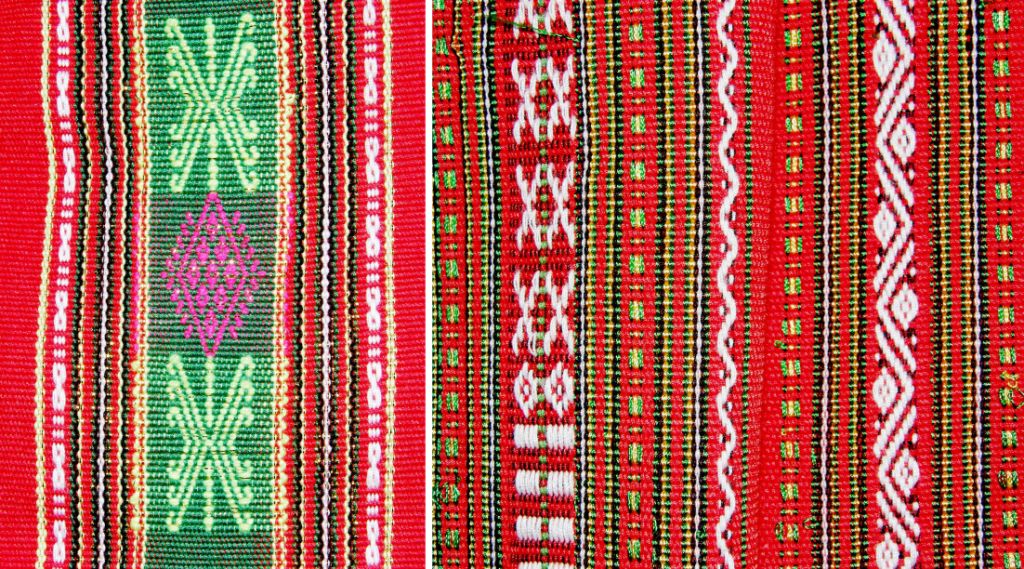
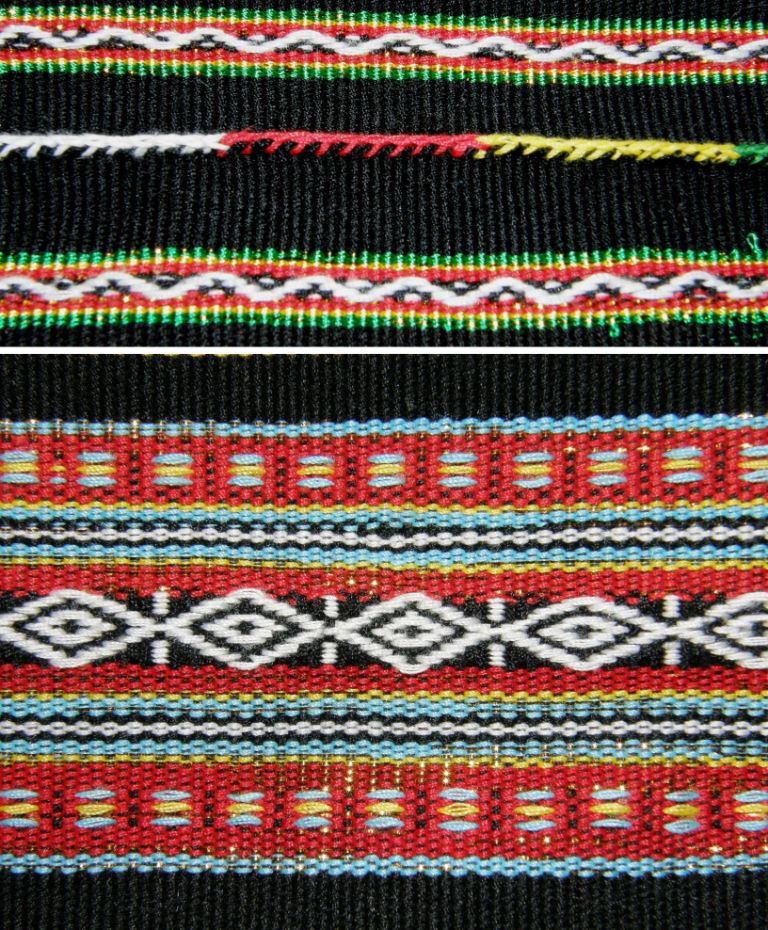
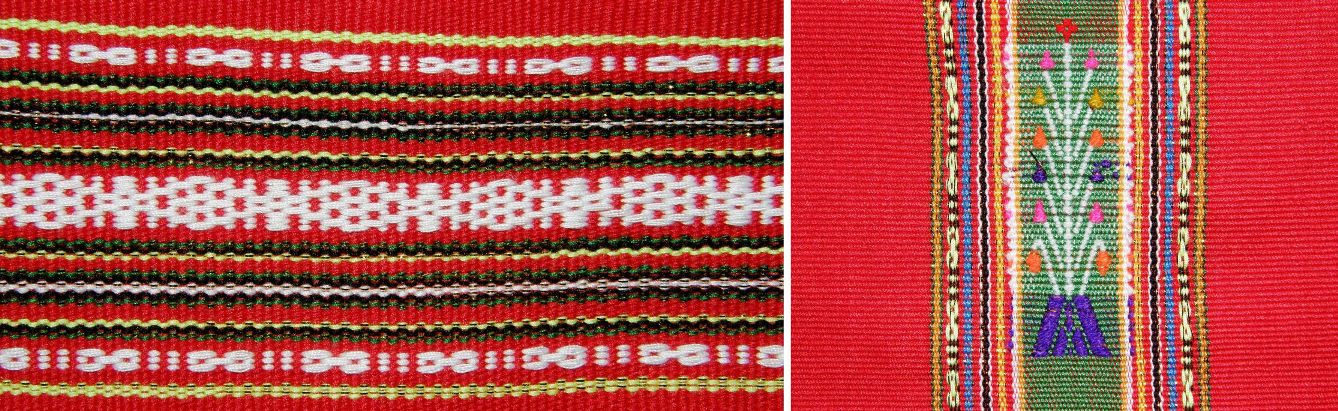
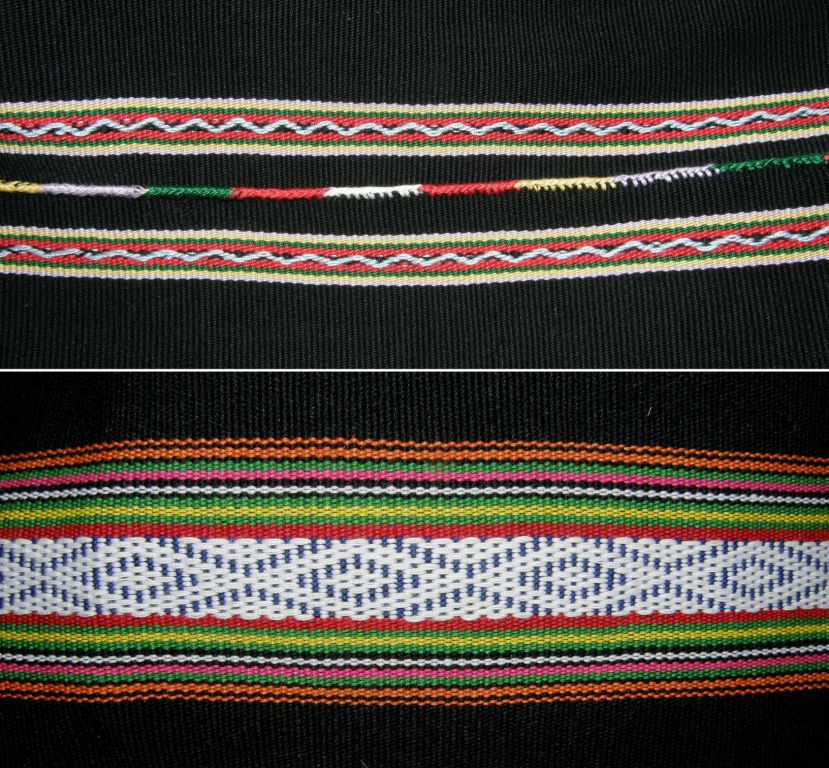
Some of the different patterning techniques which include simple warp floats, cross knit looping, supplementary warp and weft can be seen below…
I like the supplementary weft patterned piece on the right as it reminds me very much of some flower motifs that I recently wove using Guatemalan supplementary weft and warp wrapping techniques. The similarities in the designs across cultures are astounding.
If you have been following my blog, you will know that the technique which really grabbed my attention was the following one which both Ju and Ngach, who are from different tribes, call kteh.
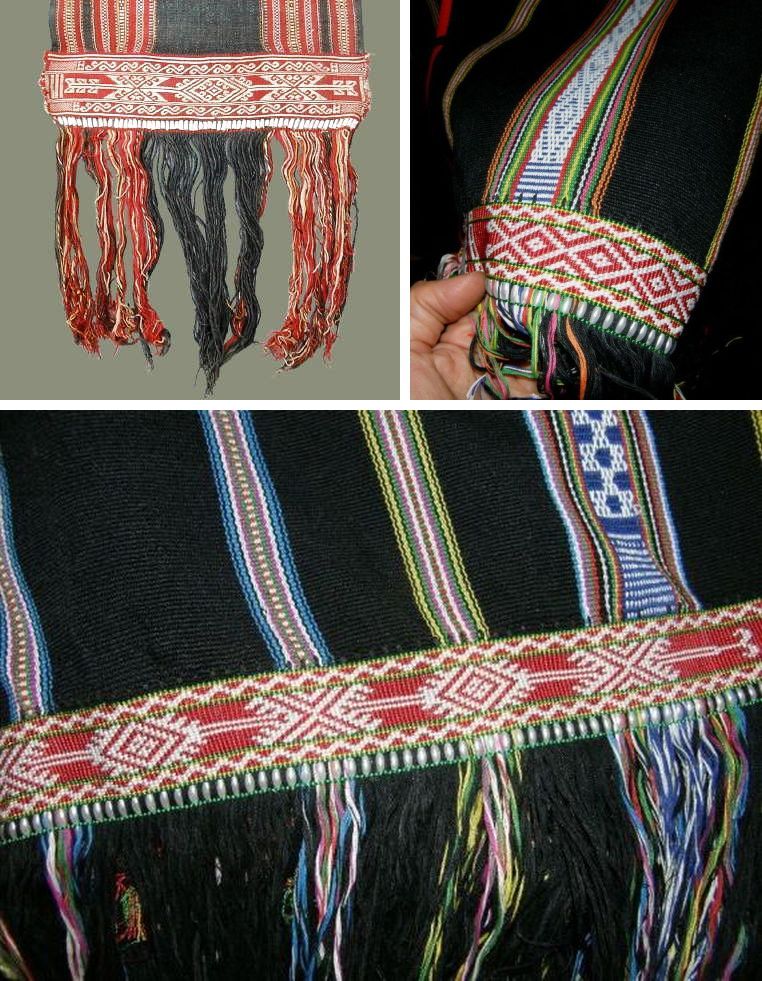
Above you can see two pieces with the kteh weft twining technique that Ngach has worked around the warps on the edge of her woven blankets. The upper left picture is a loin cloth which Susan Stem showed me when I made inquiries about this technique on the Tribal Textiles forum. I think that Ngach’s pieces are every bit as fine as the example photographed by Susan.
So this was the technique that I really wanted to learn more about and I got to see even more amazing examples on this most recent visit.
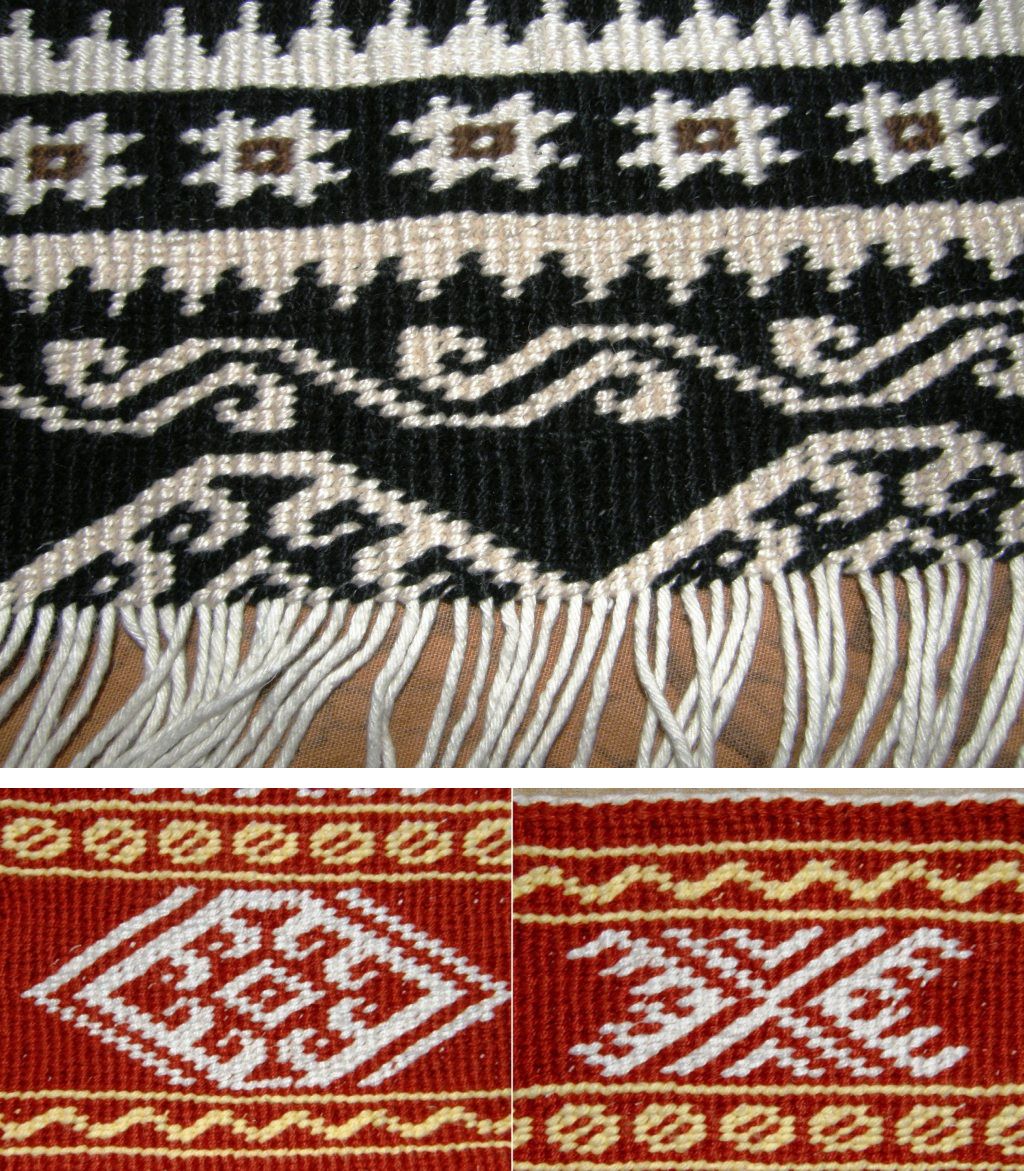
When I got home I was keen to try weft twining and made examples in different colors using Montagnard designs that I had photographed and seen online. (at left)
I learned a twining technique from books on Maori Taaniko..You can read more about this here and here.
I was surprised on my visit last week to see the use of yellow in the main design in one of the pieces as, by coincidence, I had chosen it to use in my own experiments at home.
All the pieces I had seen on the previous visit as well as in books and online had been patterned in only red and white with only the stripes done in green and yellow.
In weft twining, strands of “weft” are twisted around warps. When weft strands of two colors are used, patterns can be formed by controling which of the two colors appears on the upper surface of the piece after each twist.
Here are some more examples of Ngach and Ju’s work in kteh technique.
The above piece of kteh adorns the edge of an extremely fine skirt which Ju wove and which H Ni Buonya modeled for me.
Instead of being wrapped and tucked as traditional skirts are, this skirt had hooks sewn into its waist band which held the folds in place.
The twining was flawless and the selvedges impeccable. I think this was the finest of all the pieces I saw.
Eventhough I was able to reproduce the designs in my bulky cotton thread, I couldn’t feel convinced that I was on the right track until I could compare the reverse of the kteh pieces to my own twined work.
Besty sent me a picture of the back of a piece and I was finally able to see for myself on my visit.
What I really wanted to do was learn how to do the twining alongside Ju and Ngach and Betsy was able to organize classes for me with both ladies. Ju and Ngach, as I said before, are from two different tribes, the Rhade and the Jarai and both Betsy and I thought that it would be interesting to see differences in the way the two ladies did their twining.
LEFT: Twining class with Nagch at Betsy’s house. At right, Ju shows me how she gathers the warps in groups and sizes them before twining.
I first met up with Ju at Betsy’s house where a collector was coming to see and possibly purchase one of Ju’s woven pieces. Ju, who I gather never likes to have idle hands, had brought along a finished piece of weaving that was to be sewn into a bag. She was busy twisting the fringe dragging the warps through a wad of sticky cooked rice that she carried in tissue and then rolling them on her leg to set the twist. She would select four warp ends, divide them into two pairs and then, with one quick movement, roll the two pairs away from her on her leg and then swiftly roll the two twisted strands back toward her to unite them.
She used this same kind of sizing to twist and group the warps ends together for twining which, as a beginner, I found very helpful . Ngach on the other hand does not size the warp ends.
The first class was with Ngach. After having seen pictures of Ngach warping outdoors onBetsy’s blog it was nice to see the enormous tree where she does it in her front yard right on the edge of a very busy street.
Here you can see the different set ups that both ladies use. Both fold and tack the woven cloth so that it can be suspended on a rod or bar with the weft ends, or fringe hanging down. Ju, at left, has a lovely stand built by her husband especially for twining. Ngach suspends her work on a metal rod which she has supported on two chairs. Ngach is twining the end of a child’s skirt while Ju is twining the ends of two small bags, something which she is only doing in order to be able to teach me on a small piece.
Here are pictures of Ngach twining on warmer and brighter days courtesy of Betsy. The pictures we took this time around tended to be somewhat darker unfortunately.
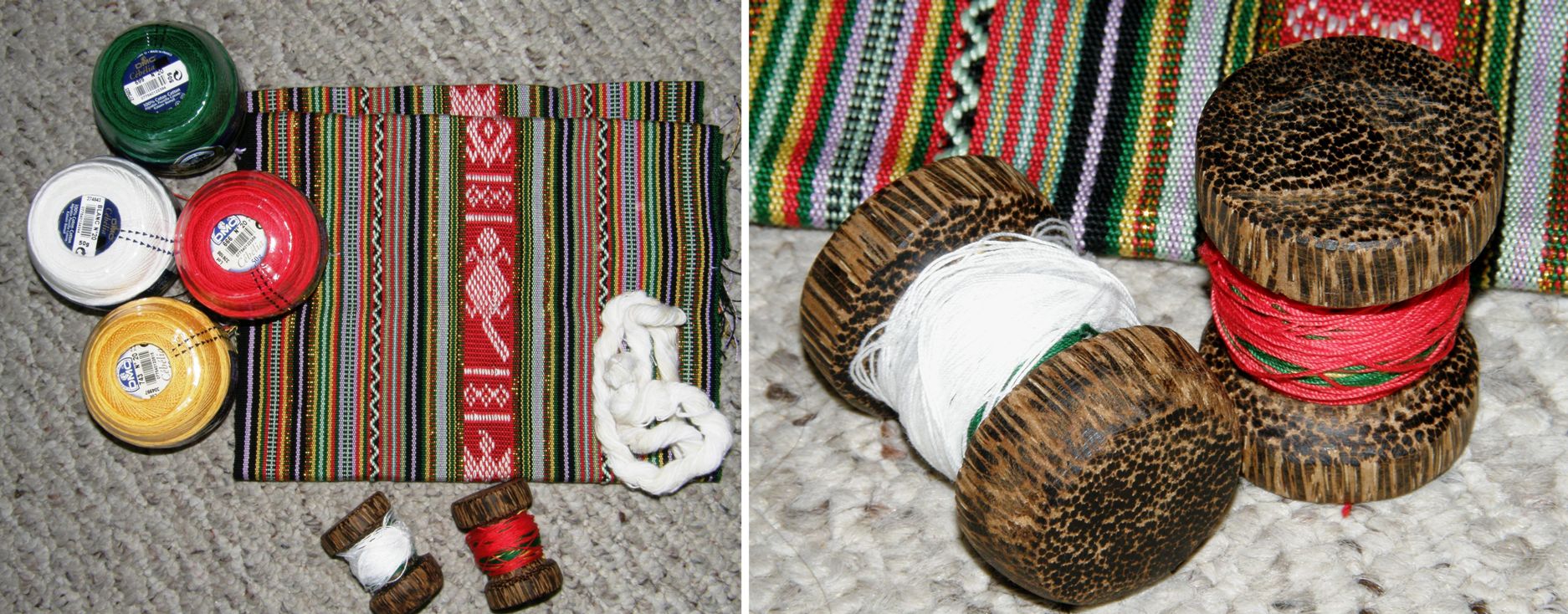
The wefts are stored and carried on bobbins. Ngach says that they are made of clay in Vietnam while Ju used to use wooden ones. Both ladies have had to improvise their bobbins in their new homes.
Ngach has lovely bobbins fashioned from cement.
Ju’s were heavier and made from wood. Her husband bought a pestle from a Laos store from which he carved them. I bought a pair from her. Both use Cebelia size 20 thread.
Below you can see Ngach at work holding the warps under tension with her left hand while she twists the wefts on their bobbins with her right…one twist to change color in the pattern and two twists to continue with the same color.
Her movements are so fluid, graceful and rhythmical and she uses her one long thumb nail to separate each group of warps around which to twist the wefts. This was the part that really slowed me down…separating the warps into correct groups of three. What was nice was that Ngach and I could sit side by side and work together. I would struggle along trying to match her rhythm. We could both work simultaneously on different rows of pattern.
Here is a rather dark piece of video which will at least give you an idea of the movements. Ngach is making a pattern in red and white. Her movements are very graceful and I love the soft “clack clack” of the bobbins as she works. You will see her doing double twists when she wants to continue with the same color and a single when she wants to change colors. I have brighter but longer videos which need to be edited when I get home so I can upload in another post.
Above, Ju is twisting warps on a piece so that I can take it home and practice. I really think both my teachers enjoyed showing me this. Ju, even with her very limited English, was very talkative and eager to show me the entire process while Ngach was very keen to make sure that I learned it just right, constantly correcting and adjusting the way I was holding the warps and not letting me get away with anything. At one point when I had made a mistake and untwined to fix it, I asked her if she always undid her errors. She looked at me over the top of her glasses and said “no mistakes!”. I am not sure if that means that she doesn’t tolerate them or that she doesn’t make them but there was definitely a twinkle in her eye. I liked Ngach!
Results:
We finished a tiny design on Ju’s small piece but didn’t get as far on Ngach’s larger one. However, I enjoyed working more on Ngach’s piece for some reason. I think sitting and working alongside Ngach made all difference as I was able to watch closely and try to follow her movements and rhythm.
Each twined row always starts on the left and moves to the right. When the right edge is reached, the weft ends are knotted and cut leaving a small “fringe”. This was something I had been very curious about as the instructions in my Taaniko book indicated that one needed to ambidextrous and twine in both directions back and forth across the piece.
Ju’s enthusiasm for showing me all about the weaving arts from her home in the hills of Vietnam didn’t stop at twining. After I had become tired from twining and the concentration it required, she brought out a wonderful spinning wheel that she had had sent over from Vietnam.
What a sweet little spinning wheel this is. It is made from simple bamboo wood and wicker and all held together with hand carved wooden pins.
Ju set to spinning cotton, which had also been sent over from Vietnam, with her foot thrown over the beam of the spinning wheel to anchor it down. She really seemed to be enjoying showing this to us.
Once she had finished with her small quantity of prepared cotton, she brought out a funny little tool that looked much like an archer’s bow to prepare more. Below you can see this tool and Ju skeining on a niddy noddy.
The following video will show you how it works. I would love to show this to the cotton spinners that I stayed with in coastal Ecuador.
On another day, I got to see a bit more of Betsy’s work with the Montagnard ladies. A few weavers gathered with their looms in a local church. Its congregation has kindly allowed its space to be used for possible weaving demonstrations. The idea was to see what would be required to enable the weavers to set up their looms in those facilities . Not only would they need a strong and stable place to tie up their looms but also a way to set up the foot braces against which the weavers push to tension their warps as they weave.
Ju and H Ni attended and finally managed to get their looms set up and foot braces in place. While I find a foot brace nice to work with, I am glad that I am not dependent on one and, therefore, have more freedom to set up my loom easily in different places.
H Ni is weaving two bands at once on her loom which will be straps for shoulder bags. Weaving two straps at once helps balances out the very wide loom.
H Ni’s set up was a bit awkward. We had to improvise adding books and bits to her bamboo poles in order to have her foot brace within reach.
I am thinking that one of those wonderful ergonomic benches designed by Synergo Arts with its built in foot rest/brace would be a solution to this problem. I wonder if they break down in pieces for transport.
A close up of H Ni’s two straps.
Ju was weaving a narrow pick up patterned piece which will be a scarf – not one of her typical woven pieces but it has occured to her that scarves may be popular small items that visitors to her demonstrations may like to buy as opposed to skirts and blankets.
Ju and H Ni enjoyed seeing pictures of the designs from various Montagnard tribes in books that Betsy brought to the meeting.
The other purpose of the meeting was to give the weavers booklets which Betsy had put together with pictures and weaving vocabulary in English.
Khin attended the meeting to act as translator and it turns out that she too is a weaver. The problem is that many of the ladies in the community who have these weaving skills simply do not have the means to have looms made and buy thread to get started.
Betsy also made tapes for each weaver to go along with the booklets with the pronunciation of the English words for them to listen to and practice at home.
The idea is to have the weavers eventually feeling confident enough to be able to give presentations and demonstrations of their weaving to small groups in the future. I would love to return for the day when that happens and see these ladies enjoying sharing their skills with even more people with same good humor, generosity and enthusiasm that they showed me.
###########################################
Back to what I like to call the World Wide Cyber Weaving Guild….
It seems that the cold weather has brought on a flurry of weaving activity and so I am able to show you some finished projects from online friends who have visited my blog.
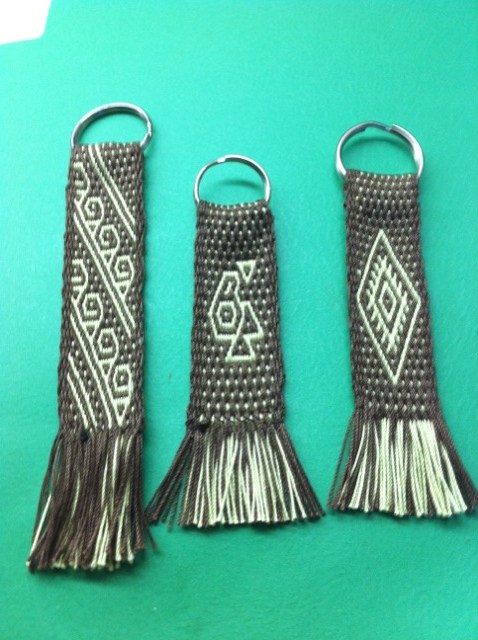
Anna (who is cycling from Alaska to Ushuaia and who is currently in Santiago Chile) sent me this picture of her latest pebble weave bands and Kim, whom I met at Convergence wove the pebble weave keyfob on the right. Both used the instructions from my Andean Pebble Weave book.
These are more of Kim’s bands on the left, again in pebble weave with one in simple warp floats in the middle, and Lavitaaj made this amazing supplementary weft sampler on the right using the pattern charts from my blog. There is also a section with a yurt band design in simple warp floats.
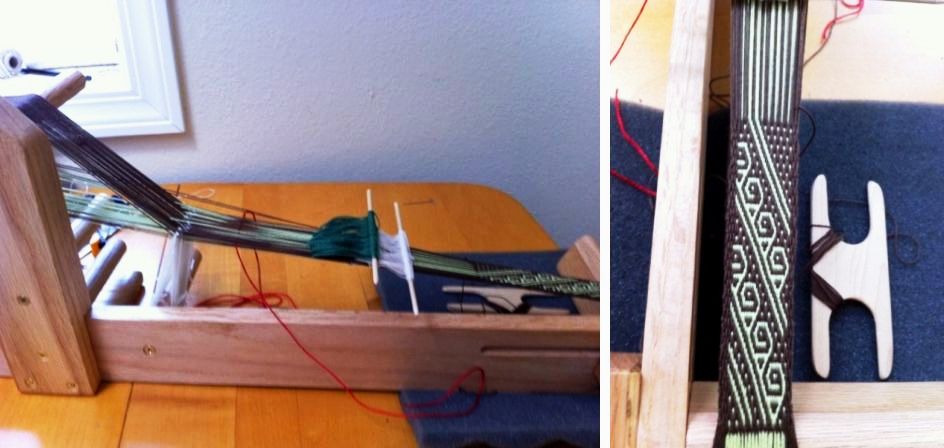
And finally, here is Marsha Knox’s band made with simple warp floats using two color combinations in the same piece while Helena in Brazil has taken the Bedouin patterningone step further with a large strip of diamond pattern bordered by the classic triangle motif. I will definitely add a tutorial on this technique to the blog soon.
UPDATE: Marsha uploaded a picture of her finished band. She reversed the scrolls and did them in brown. It looks super!
Last Sunday I got to quickly pass through the Central Asian ikat exhibit, which was stunning, at the Textile Museum in DC before attending Ann Rowe’s talk on ikat rebozos and ponchos in Latin America.
I hope to return next Saturday to take the guided tour of the exhibit, use the library where I want to look at David Fraser’s book on weft twining, and maybe pick up a few more Textile Museum journals in the gift shop.
There is hardly a journal there that doesn’t have something of interest to me. I think that eventually I will own them all.
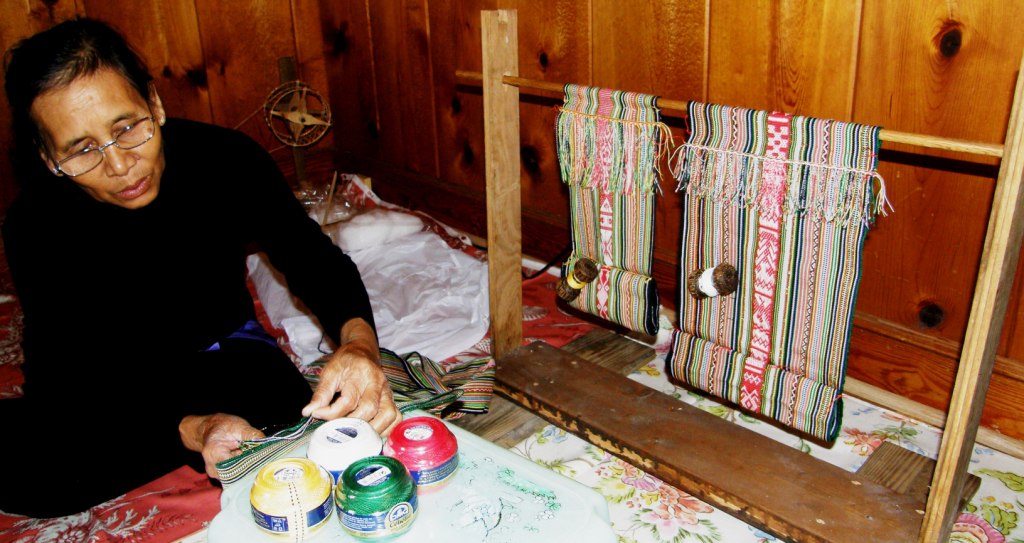
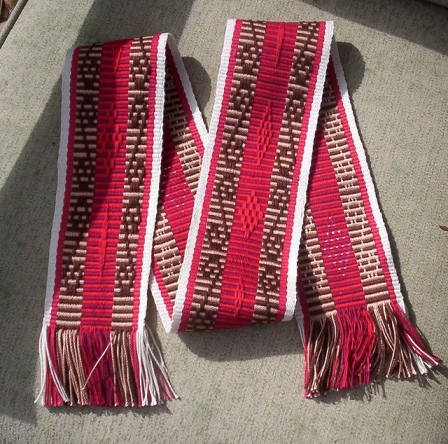
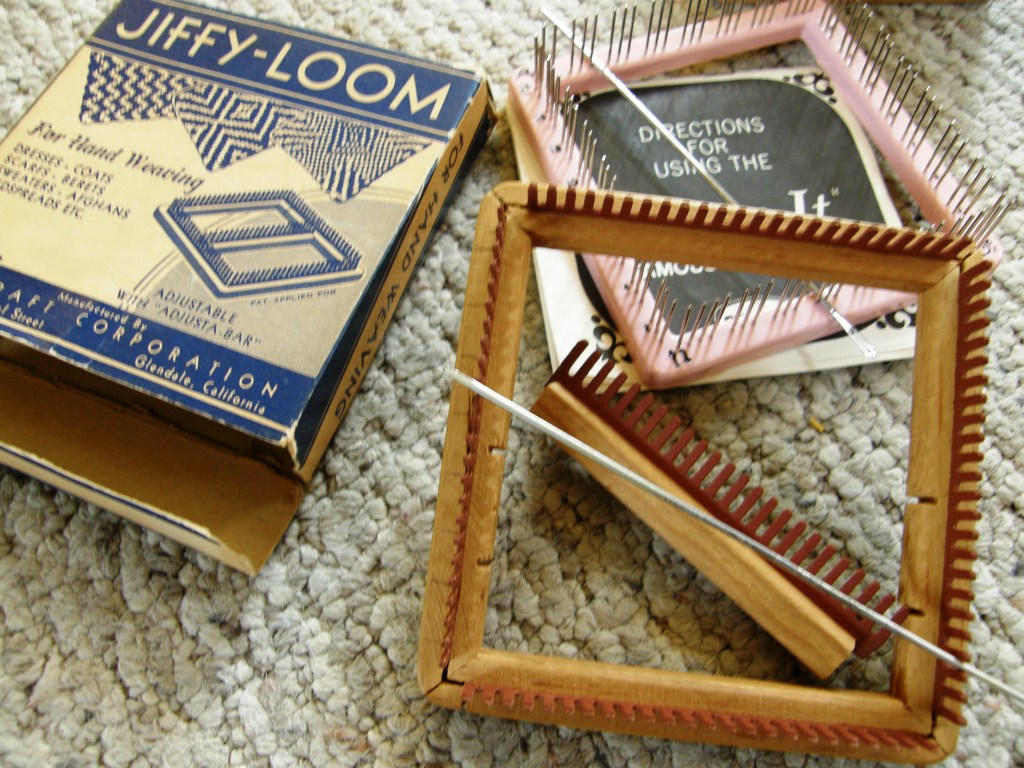
This week Claudia and I had skills exchange. I taught her to make the tubular woven bands that I learned at the tinkuyand she introduced me to the wonderful Weavette. Yep, this was the first time I had ever seen one of these little marvels and Claudia even has an old Jiffy Loom in its original box and a plastic Weave-It. My eye was immediately caught by the cool long weaving needles that come in the kit. Aha…just the thing for weaving in the wefts for my four-selvedge warp faced pieces and so I ordered some online.
These would be just the thing for making little amulet bags…love them!
And speaking of learning new skills, here is DY, still in Peru, picking up some new techniques – drop spindling and backstrap weaving. I think she has been taking Spanish classes too.
Finally, a very happy Thanksgiving to all. I spent it Claudia and family and friends…only the third Thanksgiving I have ever had. We watched the Macy’s parade this morning and I declare the sweet potato casserole with butter, brown sugar and pecan topping my favorite dish of the day.
The colors and motifs of the Jarai and Rhade tribes of Vietnam have found their way into my work this week thanks to an amazing visit with two of these Montagnard weavers in North Carolina during the end of my US visit. Montagnard is the name that the French gave to the various hilltribes of Vietnam.
I have had to resist writing about all my fun fiber adventures with my good weaving buddies Lisa and Maurice during my stay in North Carolina and limit this post as much as I can to the two wonderful afternoons we spent with master weavers Ju Nie and Nach Rahlan.
Unfortunately on this trip I didn’t really have time to dawdle in North Carolina but we did manage to pack a whole lot of activity into my short time there.
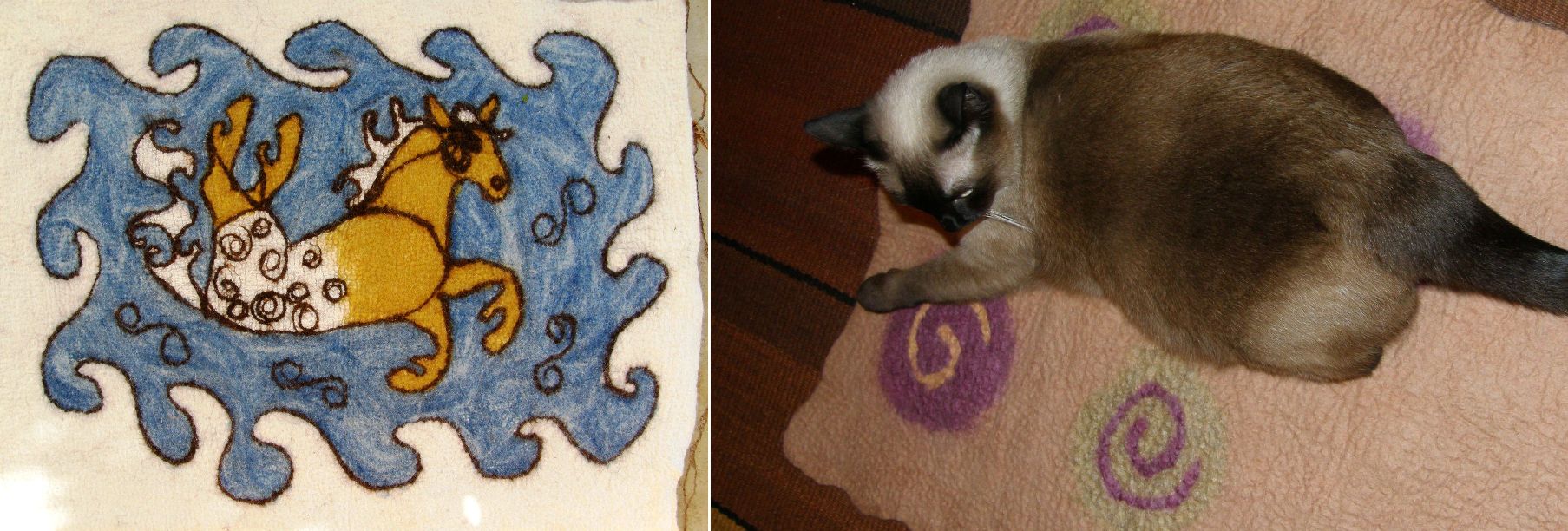
When not warping four-shaft looms, backstrap weaving, spinning and wrestling with sheets of felt, we went blueberry picking, hung out with the family, made s’mores (first time for me, okay they weren’t made over a campfire but they were still gooood!) and spent time with Maurice who made this warping board and beaters for us to play with.Lisa makes beautiful felt pieces like the one here on the left. She took me through the steps to making my own simple piece on the right. Mine has an animal on it too but not a felted one! I had made felt before when I lived in Chile. Now I realize, thanks to Lisa, that I hadn’t felted it enough and that explains why I have to give it a haircut every now and then. Photos of the fun and physically demanding process will be in next week’s blog post!!We gathered a group of friends for a day of backstrap weaving. Renate here is showing off her warp while Lisa works on a yurt band design in two-color simple warp floats.
We warped up Lisa’s four-shaft loom to weave a guitar strap patterned with designs in Andean pebble weave. I will have more pictures of this next week too.
And as if that wasn’t enough….
The highlight of this visit was the trip we made to spend time with the Montagnard weavers. I was lucky to have been able to make contact with Betsy Renfrew, at left with weaver Nach Rahlan, some weeks before leaving Bolivia for this US trip. She invited me to her home where she and her husband Andrew arranged for us to meet two of the Montagnard weavers with whom she has been working. Read about Betsy and Andrew and their goals for working with the weavers here.
The first day was a “show and tell”. Maurice, Lisa and I took examples of our own fiber projects to share with weavers Ju Nie of the Rhade tribe and and Nach Rahlan of the Jarai tribe. Ju Nie’s husband Thomas Tlur Eban acted as Ju Nie’s translator at the times when she struggled to express herself in English while Nach’s English was a lot more fluent. I have to say that I was quite nervous on the drive there. Betsy had told me about Ju Nie’s lack of English fluency and had also mentioned that Ju and Nach were from two tribes that did not particularly get on. I envisioned a very awkward gathering with difficult communication and perhaps a cold stoniness between the two weavers. This couldn’t have been further from the truth!
The room virtually exploded from the very start with lots of excited chatter and movement. We were a group of weavers sharing our mutual passion!
I showed my backstrap loom, woven pieces and tools to a fascinated Ju. Lisa took her spindles and soon had both Nach and Thomas trying them out. Maurice showed several of his own floor loom pieces and explained shibori weaving.
And then it was our turn to be shown. The room that was already packed with eight people, filled to overflowing as enormous looms, blankets, skirts, carrying cloths, bags and straps were brought in to cover the floor and every available space. It was overwhelming and it was hard to concentrate on any one piece and hold back the urge to touch and examine everything at once.
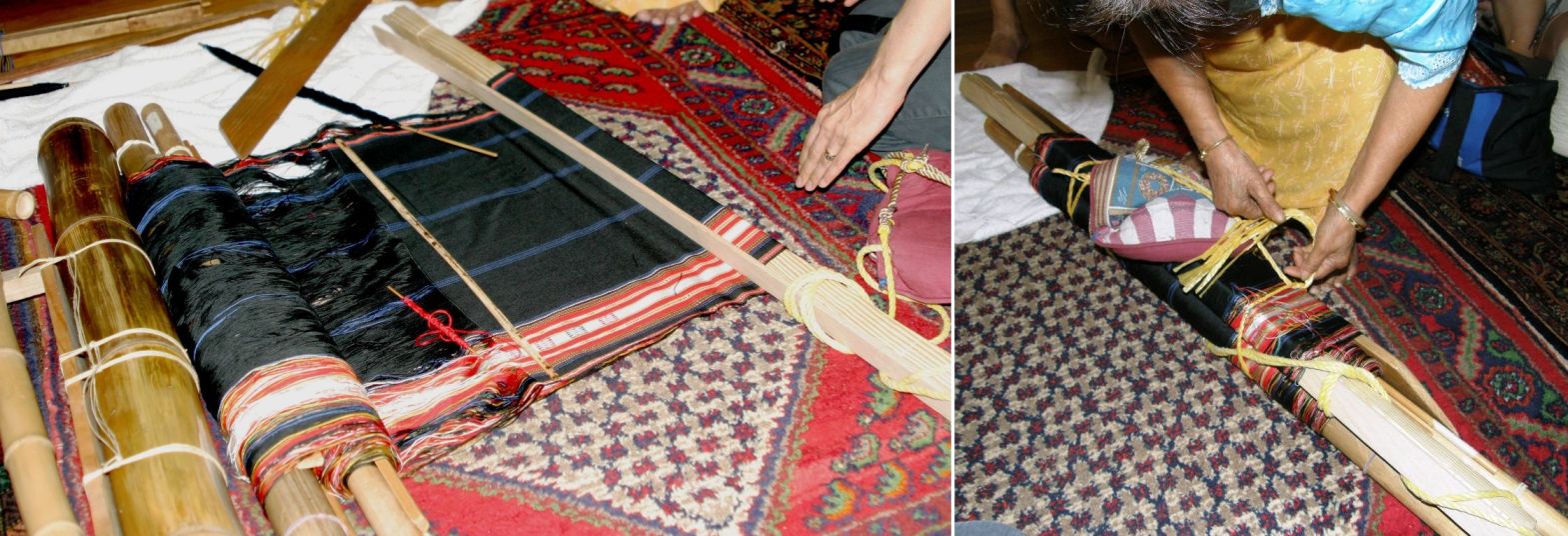
Nach brought in her large loom and unravelled it to reveal one of the panels for a traditional skirt that she is weaving. The design panels on this piece are decorated with motifs woven with supplementary wefts.
The supplementary weft patterning technique used is the same as that described here. It is a single faced technique and both Ju and Nach were delighted to see Bolivian examples of this. Above you can see how panels of blankets and skirts are often joined using single columns of cross knit looping which I am used to seeing here in Bolivia in double and triple columns to edge coca leaf bags and other items. The lower picture shows simple warp float patterning where single warps are floated over a background of horizontal bars to create this striking pattern.
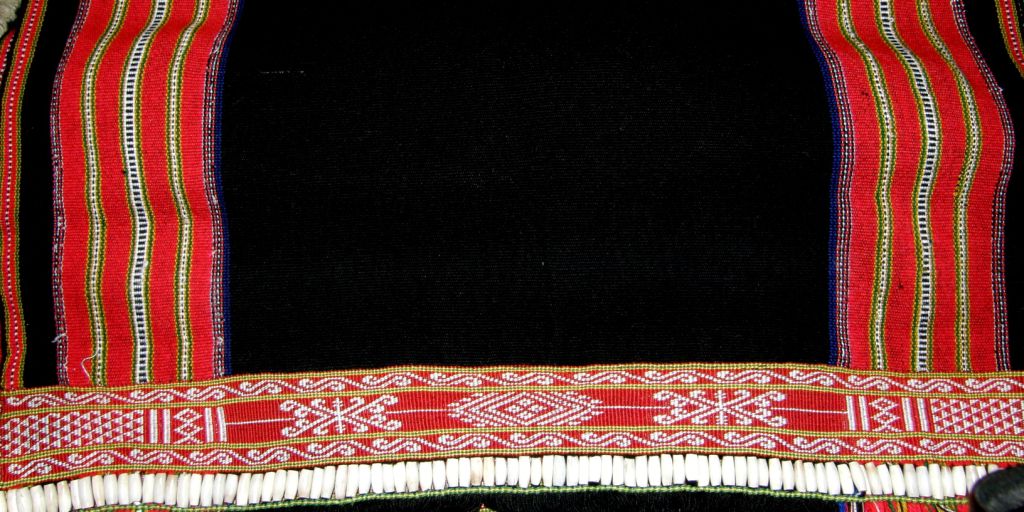
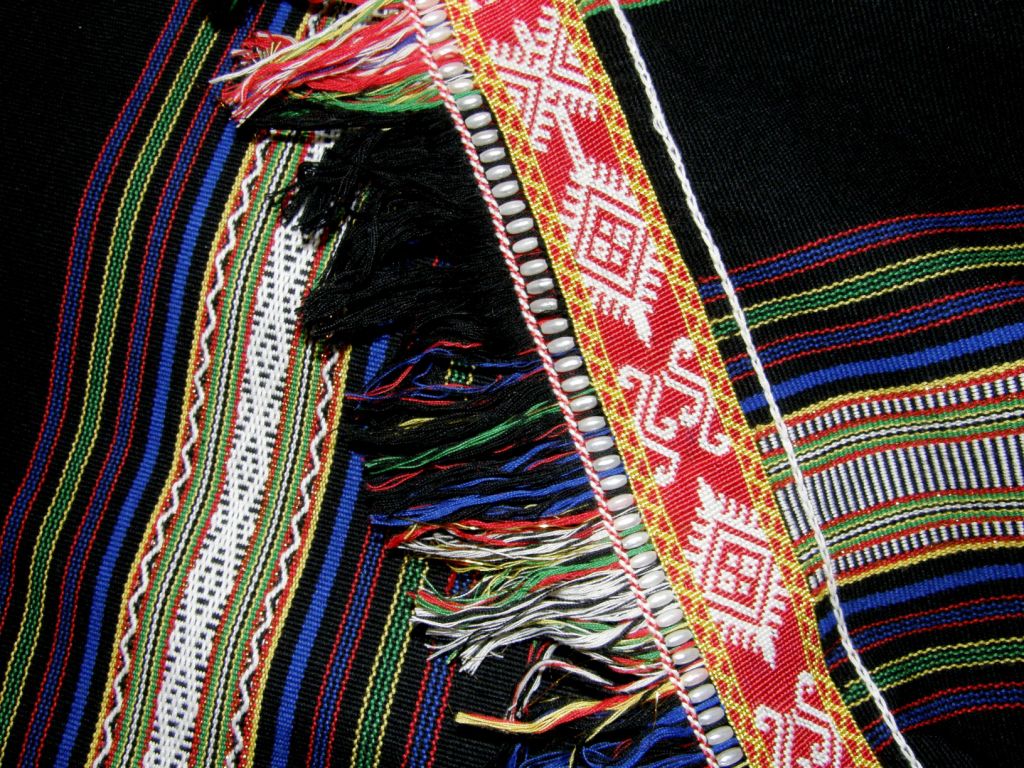
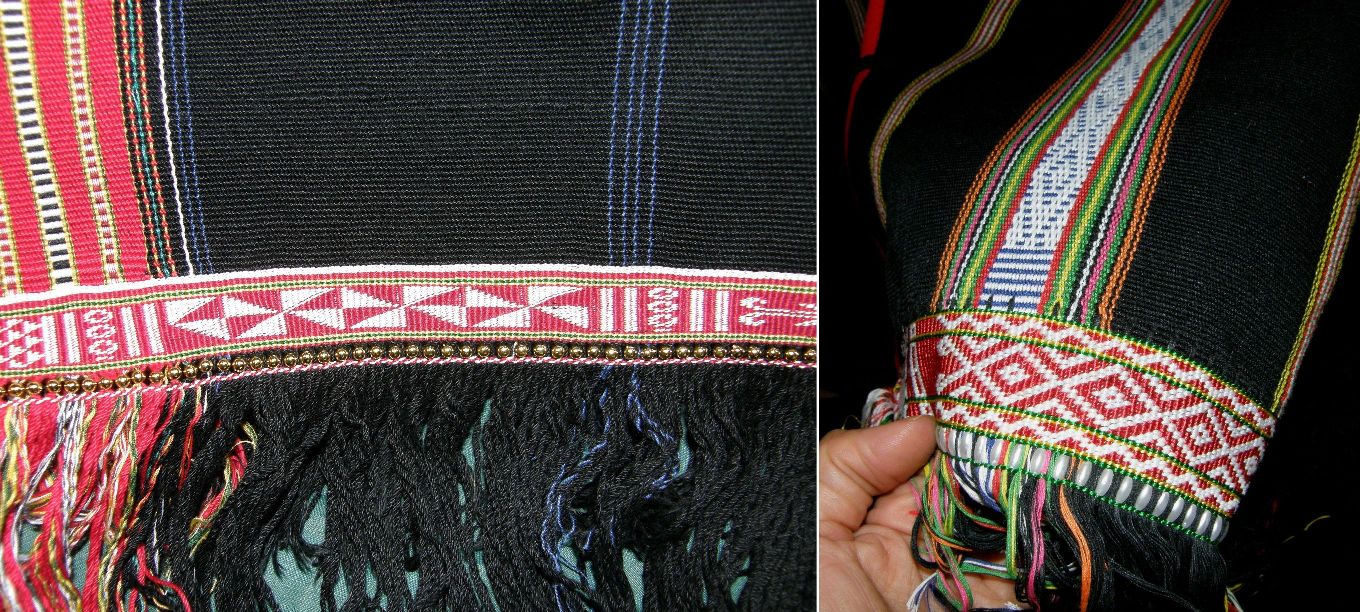
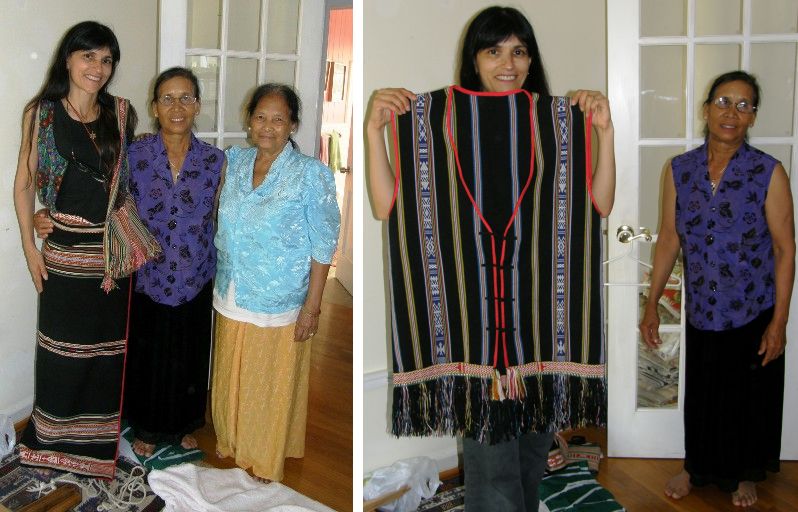
The most astonishing pieces for me were the ones decorated with a twining technique called kteh. Seen in the example on the right, red and white threads are twined around the fringes at the end of large woven pieces to form intricate patterns and then adorned with beads.On the left you can see gun and airplane motifs which often appear among geometric, human and animal figures.More fabulous examples of the kteh work.The weavers have lately been making shoulder bags to sell and experimenting with traditional and non traditional color combinations. They weave straps for the bags placing two warps on the loom at a time (picture at left) as they are not used to weaving such narrow pieces on their enormous looms. Having two bands on the loom at once helps balance things out. At left you can see the tiny temple fashioned from a piece of bamboo much the same as that used by the weavers in coastal Ecuador with whom I studied.Words and phrases are also woven into the bag straps. Some of these appear to be lines from scripture and a google translation turned up such words as “peace” and “wisdom”Ju here is showing us how to wrap the baby carrying cloth. This piece was more warp dominant than truly warp faced and profusely patterned with suplementary wefts.I was coaxed into donning the traditional skirt and blouse. At right is a photo in Ju’s home of young girls in similar costume wearing woven headbands.Ju, Nach and myself wearing one of the skirts. It felt beautiful on but it beats me how they manage to keep them up as they don’t wear a belt. It is simply gathered and tucked. And just in case you are wondering, I am not tall! At right another gorgeously patterned garment with warp float patterns and kteh edging.
So, that was day one! I have no idea how much time we spent there but the time just flew by and I arrived home thinking, why didn’t I take a closer photo of that and how did I forget to ask about this? I am very grateful to Maurice and Lisa who took photos when I was not able and allowed me to use some of theirs.
Are you ready for day two?
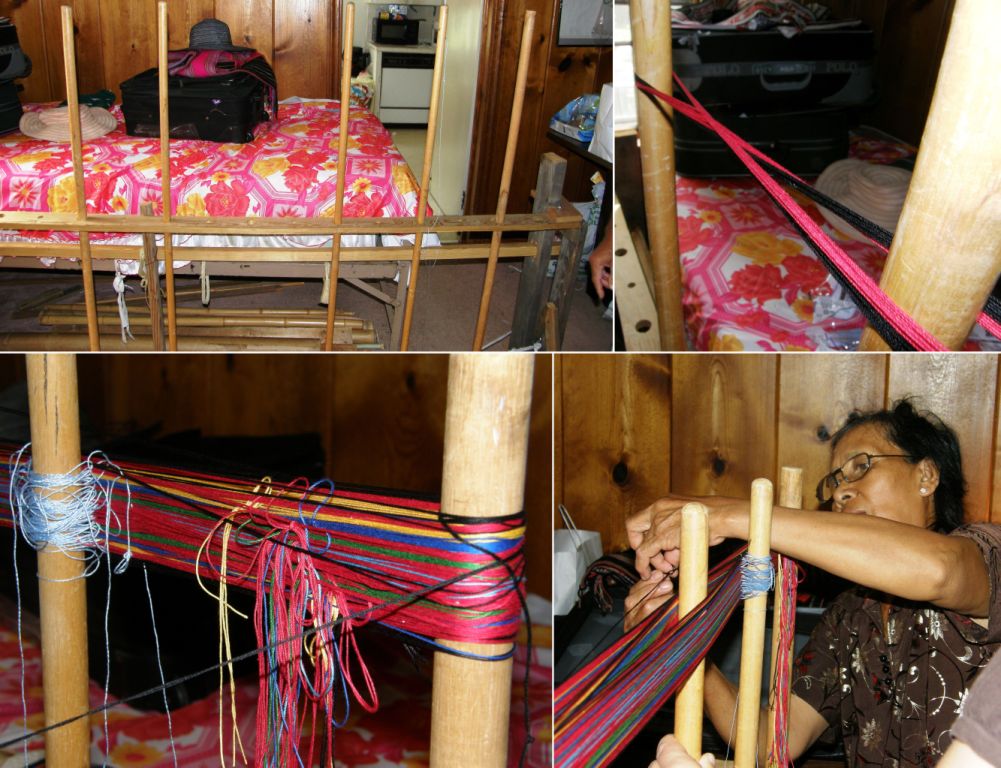
Day two found us at Ju Nie’s home where she was set up and ready to warp. Ju’s husband builds all her tools and he has made her a very nice warping arrangement which fits conveniently in the house beside the bed to which she attaches her backstrap loom. It reminds me of my situation here at home where I weave attached to my bed and warp on the floor nearby.
The warping set up. Five posts are used. One post, the second from the right, acts only as a measure around which the heddle strings are wound. Ju encloses the warps in continuous string heddles as she winds the warp. I was tickled to see that she uses Aunt Lydia’s number 10 mercerized crochet cotton as I have done and uses this same yarn for her string heddles.
In the blink of an eye Ju was off and warping and it was very hard to keep up. Not wanting to interrupt her, as I know how important it is to concentrate when warping, I struggled to follow her quick movements which at first weren’t making sense to me. I had mistakenly thought that the cross was that shown in the upper right hand photo but later realized that it wasn’t. My sketch of the process had to be frequently modified until I finally caught up with her.
Ju makes a circular warp and uses two strands of yarn at once much the same as I do in my four stake warping, separating out the doubled threads only around the cross post and at the place where she pulled the string heddles through. The cross shown above is made of doubled threads and serves as the place where she later inserts her “rolling stick” or “coil rod” as it is sometimes known.
Her movement with the string heddles was so quick that only after having studied the video I had made multiple times am I able to follow it and reproduce it on my warping board here at home. All the warp ends where color changes occur are tied in slip knots which are untied and retensioned once on the loom. This results in an intimidating mess of yarn ends and even the heddles looked loose, uneven and scary! Of course eveything was under control!
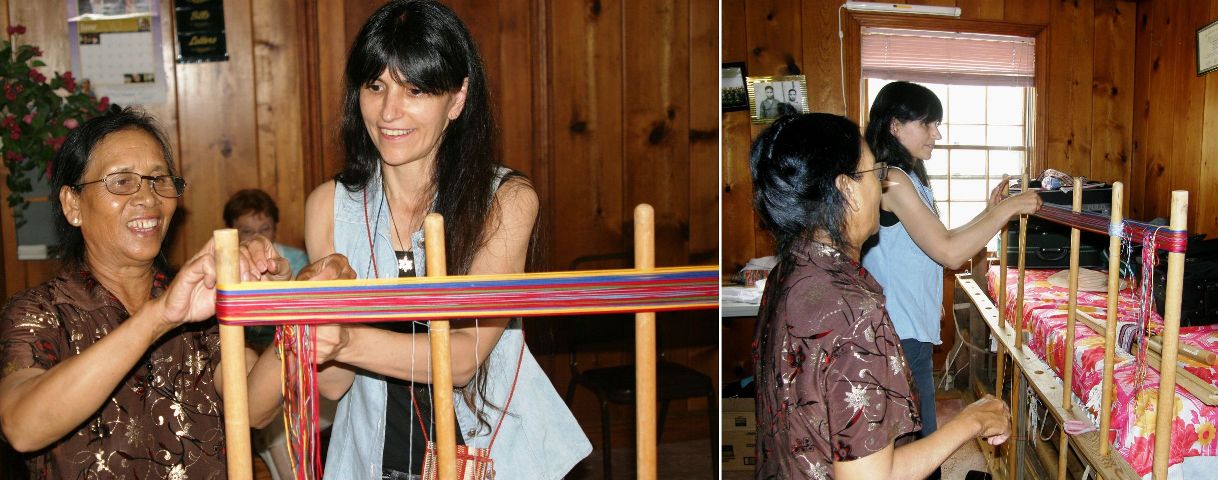
Ju was kind enough to let me try warping. I would never let anyone touch my warp!! She, however, took control of the heddle string at each pass but I was slowly coming to understand what was going on.Warping finished, safety ties were added to the warp and it was slipped off the warping stakes and the rolling stick was put in place. Ju closed the end “cross” around the rolling stick and then put the main loom bar in place which was attached to her bed, just like mine!
Ikat weavers that I have seen in Ecuador told me that the rolling stick helps stop their warps from slipping and blurring their design. I have seen other weavers use it to help space the warps. I imagine it also stops the warp threads from slipping in together as they often do on the far loom bar and keeps them in order.
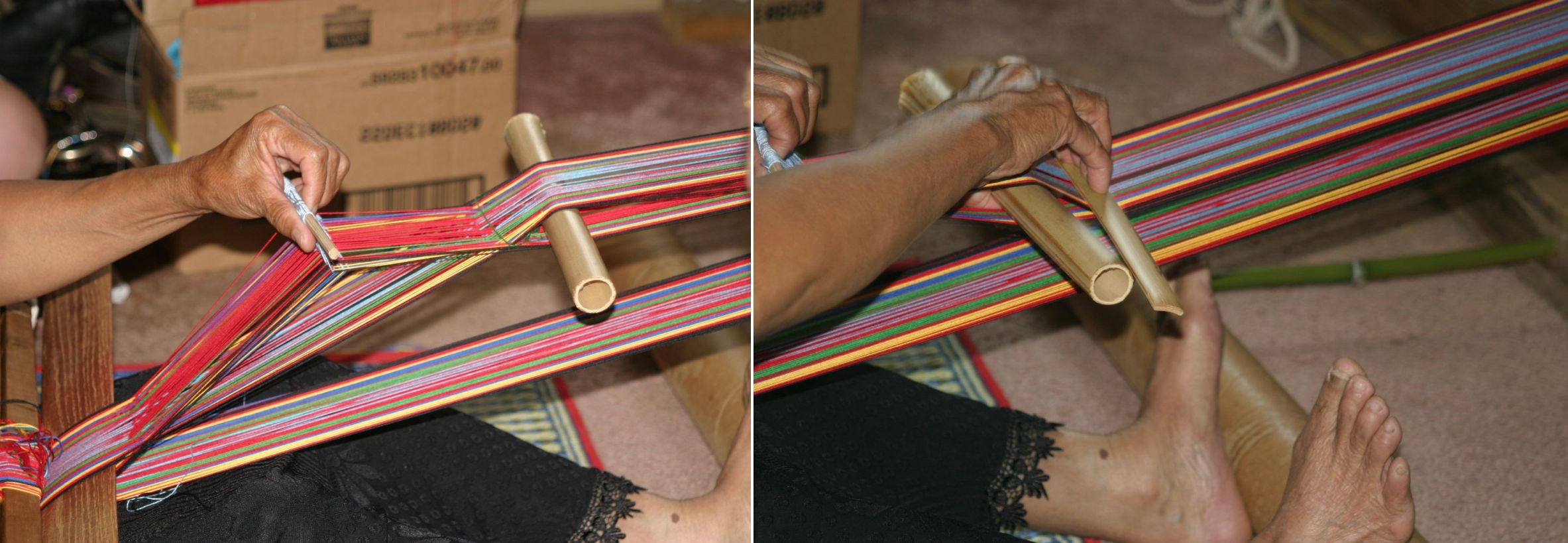
The weaver’s loom bar seen at left has prongs around which the backstrap cords pass. The sword has a hooked end which is used for picking up threads for patterning. All these pieces have been fashioned by Ju’s husband Thomas. Ju had warped a sample band for us to witness the process. Her loom is normally used for much wider pieces which explains how oversized and unwieldly everything looks.The thick roll against which Ju braces her feet then had to be placed at just the right distance. Having something against which to brace one’s feet is a big help. I have sheets of wood under my bed which serve this purpose and this helps spread the load of tensioning the warp between one’s back and legs. Once Ju had untied the knots in the warps ends and retensioned the warps, she sent Thomas out into the yard to cut some thin bamboo sticks which she inserted in the sheds to get the weaving underway. She then carefully moved each and every warp into place with the point of a stick before passing the first weft.Ju opens the heddles by grabbing hold of the shed roll and a bamboo slat which she places on top of the warp. She then rolls both away from her while pulling up on the heddles.When I use a second cross in my warp, I use this method by rolling the shed rod and the second cross stick together. I enjoyed showing Ju another way that I use to open my heddles by rolling them over my hand. At first she was anxious to show me that I was doing something wrong but then saw that it worked and laughed, pointing and saying “new way”. Her shuttle is a simple stick around which the weft yarn is wrapped. These photos were taken by Maurice Blackburn.
I was dying to get into the loom and finally asked Ju’s permission to do so.
What a wonderful birthday gift! A day spent with a master backstrap weaver! There I am happy as a baby. The picture at right shows my view up the warp!
We went home with images spinning in our brains! It wasn’t until I got back to Bolivia that I sat down and went through my notes and sketches, watched the videos and managed to sort it all out. I bought a 12 ft long band from Ju that she had intended using as straps for many bags but was happy to part with. I liked this piece as it gave me many examples of the motifs that they weave with warp floats. I was able to examine it to figure out the technique. This is a new one for me! And so, to work. I wanted to reproduce the structure and make something useful.
First to sample. I could see that Ju’s white and red warps had a 3:2 weight ratio but I wanted to see if I could get away weaving it 1:1.
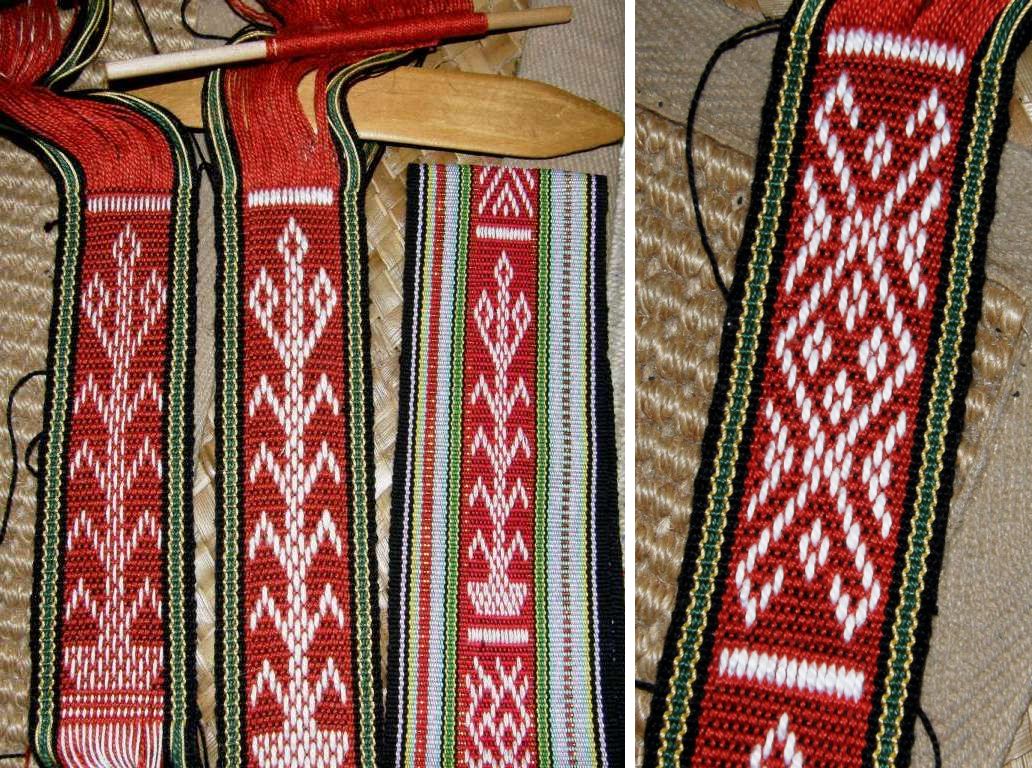
In the photo on the left, Ju’s band is the one on the right. My first 1:1 sample is on the left and my second sample, in the middle, where I also used a 3:2 weight ratio looked far better than my first attempt.
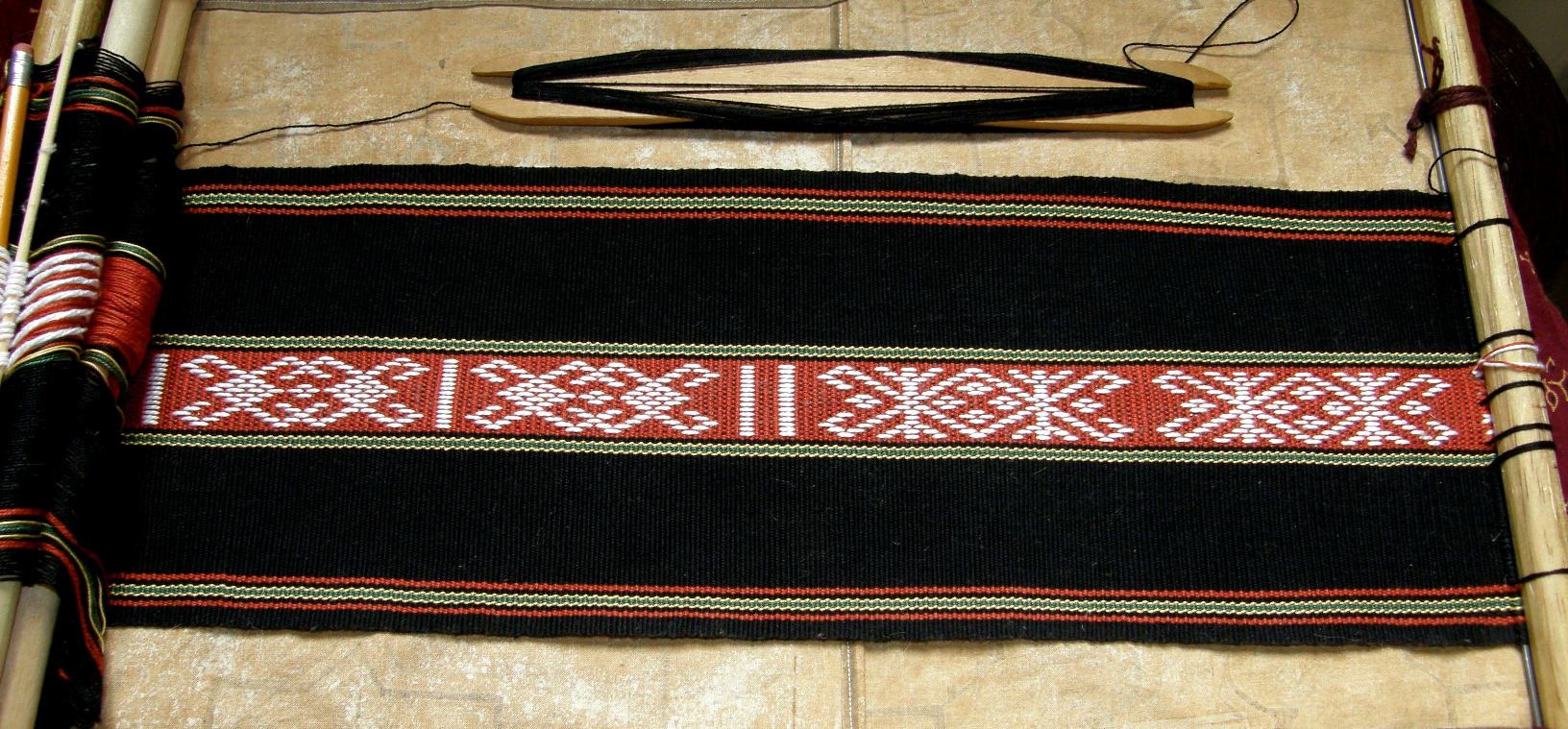
So I went ahead and wove more motifs on this sample band until I was convinced that I had the technique down. I decided to weave a wider piece so I could make a couple of zippered pouches and tried to copy the traditional colors used by my new weaver friends as much as possible. Here is the piece I made on the loom. By cutting between the two white horizontal bands in the center I woud have two pieces which I could fold and sew into bags.
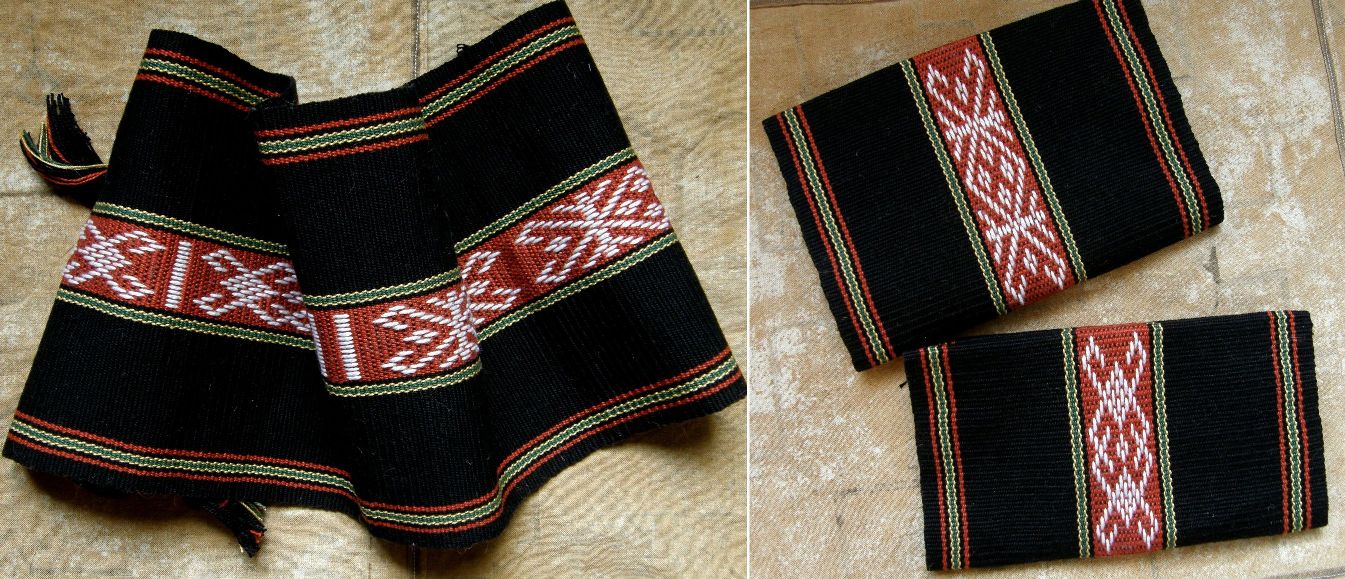
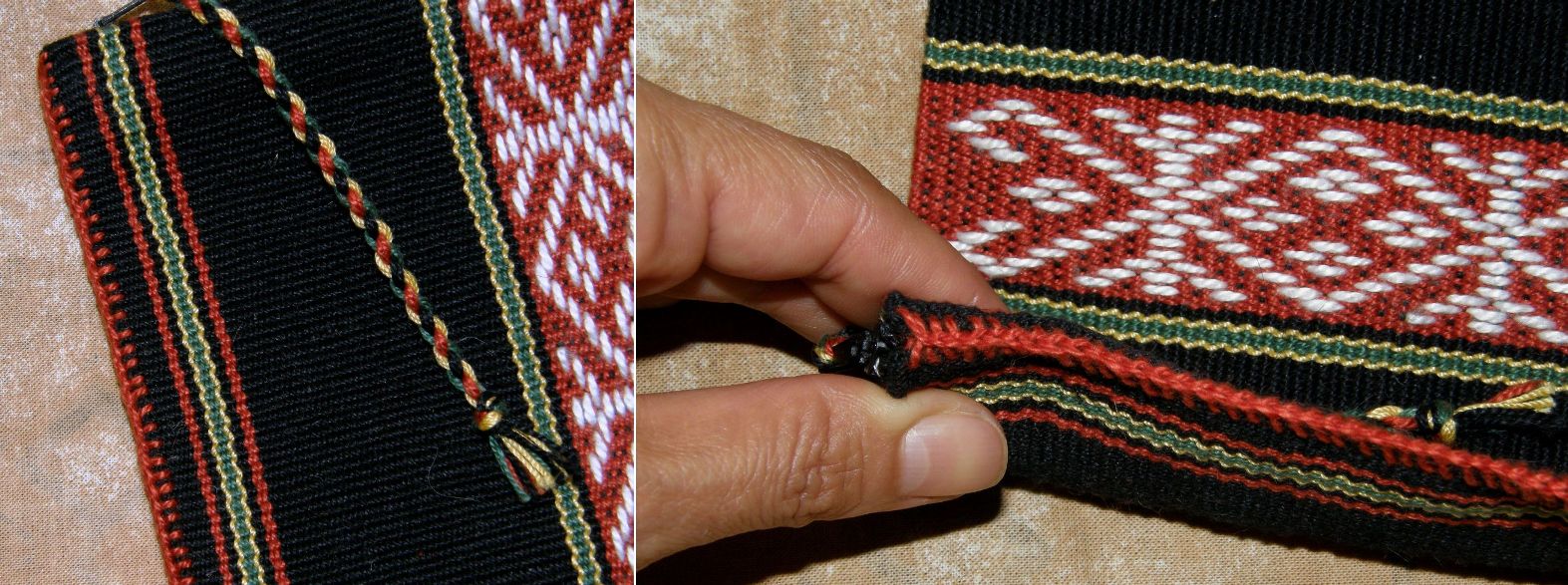
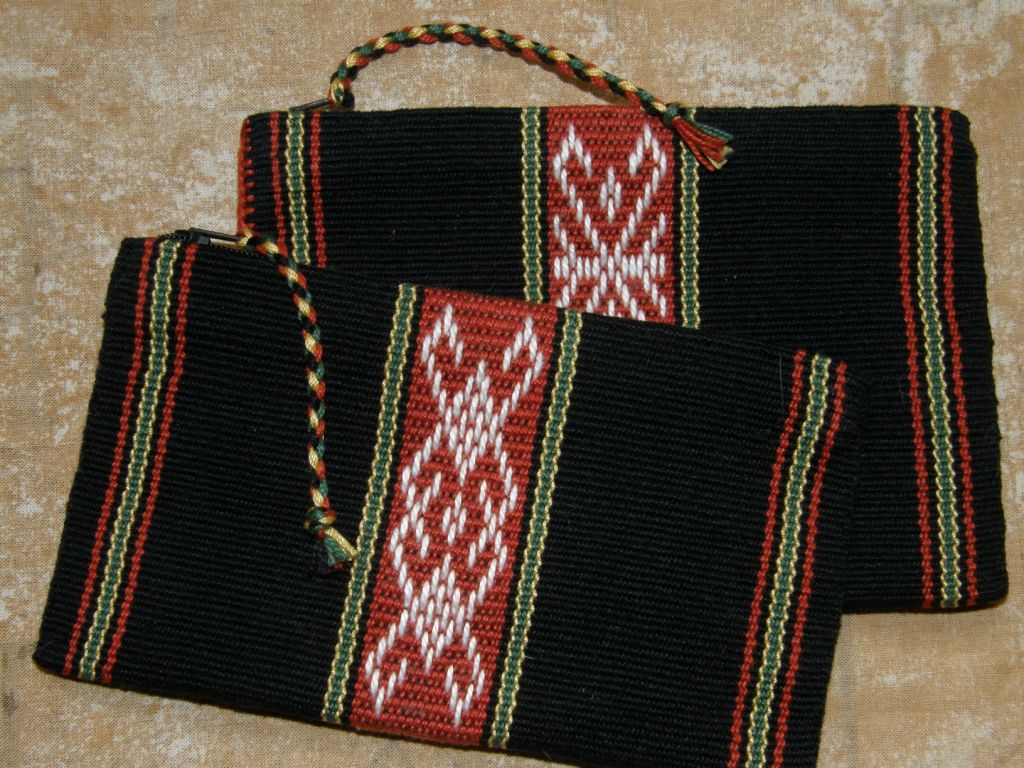
Here is the piece off the loom, then cut and folded. I sewed two lines of stitches in the center of the piece and cut between the two.I sewed a single column of cross knit looping along the edges of the larger of the two bags as Ju and Nach also use this for decorative finishes.Here are the two bags with zips in place and braided zip pulls. I had yet to sew the other edge of cross knit looping when I took this picture as I wasn’t convinced about using it at all.
Once the bags were made (I kept the cross knit looping in the end and really like it), I decided that I would try to make something using the blue and black color combination that Ju and Nach also use in a lot of their pieces. I warped up for a band in these colors wide enough to make a cellphone case and chose some motifs from my photos.
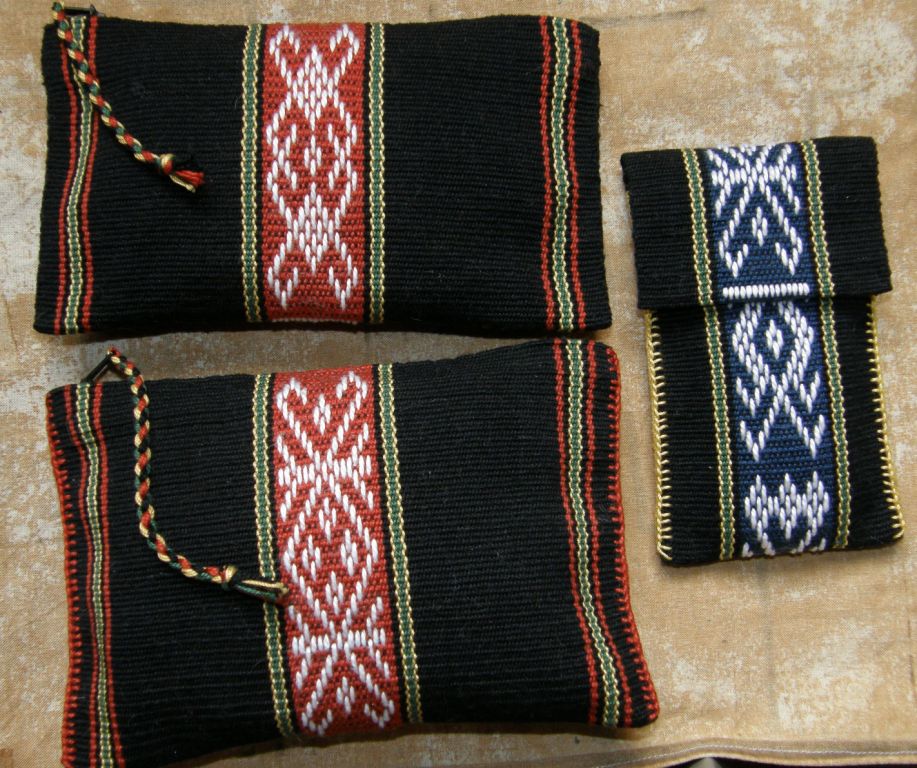
I had trouble settling on the colors for this band and had to pull out warps and replace them once it was on the loom. I decided to keep it very plain and dress it up later with cross knit looping.Here it is finished. I am not sure about working the cross knit looping on the flap as well.And here is the set almost finished. I would like to put a cord on the cell phone pouch but would like to ask Betsy if she knows if Ju and Nach use any particular kinds of braids in their work so I can use the same.
I can’t thank Betsy and Andrew enough for making this visit possible. The work they have done teaching English to the members of this community and documenting these traditional techniques and processes is wonderful. Together they are building a blog which will document this journey.
I hope that I will be able to contribute something to this project by perhaps helping with the documentation work or maybe helping to develop small woven products that the weavers can sell. This was part of my reason for experimenting with these bags. The other part of the reason was my insatiable curiosity and love of the backstrap loom and traditional techniques! Betsy hopes to inspire younger people in the community to want to learn the traditional weaving techniques.
This article gives further insight into Betsy’s work with Ju Nie and you can view a stunning photo essay on Jue Nie at her loom here.
And once again, the “worldwide weaving guild” that is the internet has led me to a new weaving acquaintance, Susan Stem, who lives in northern Thailand and who has generously allowed me to use this image of a Rhade loin cloth which has the twined kteh technique.
She has a really nice inkle loom which has plenty of space in front to have the two string heddles controlling the pebble sheds, allows her to use the saver cord and she uses the loom’s heddles to form her picking cross.
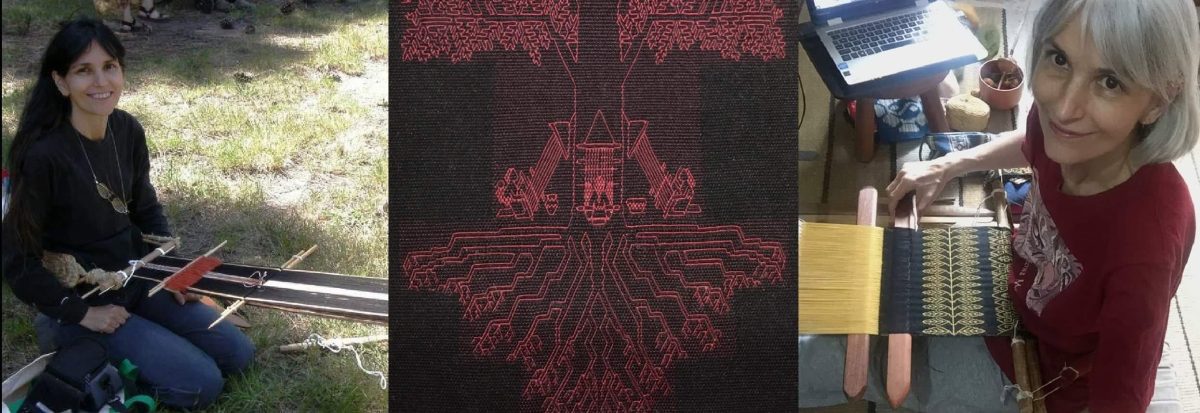


 You can see Ju Nie above weaving the top part of her circular warp.




 You can see that when the dovetail stick or cord is removed, the end loops of the warp will stay intact. The loops can be very useful for finishing the woven item.
 However, this doesn’t mean an end to band weaving! I love weaving bands just for the pure fun of it and don’t care if I don’t have a particular use for them.

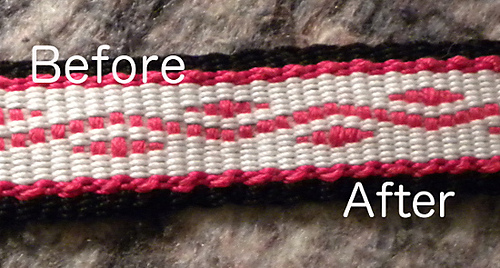 Amanda kindly shared part of her band with her first attempt at creating patterns with supplementary wefts. She shows the difference that applying less tension to her warp made to the amount of coverage she achieved with the supplementary weft. She is using #10 crochet cotton for warp and embroidery floss as her supplementary weft.