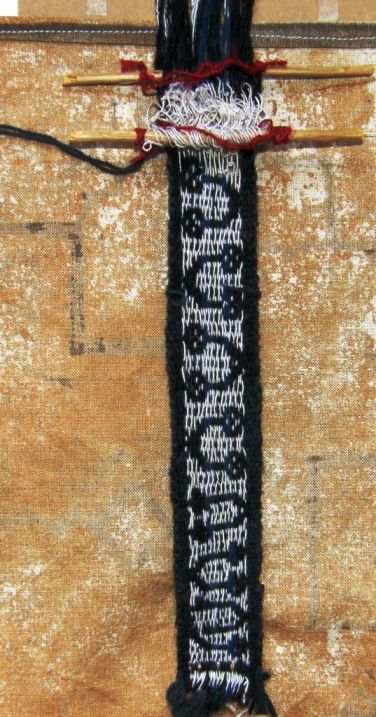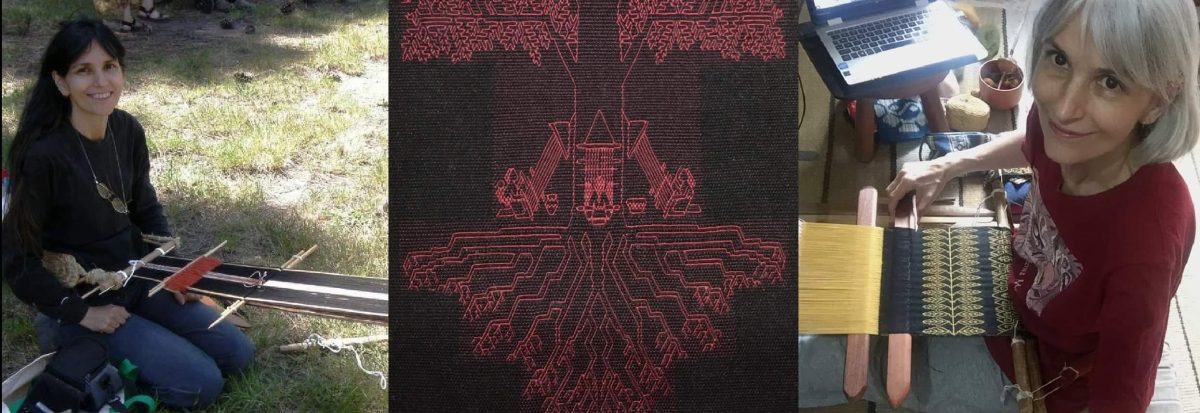
Backstrap Weaving- Color and Weave Along with a new tutorial

COLOR!!

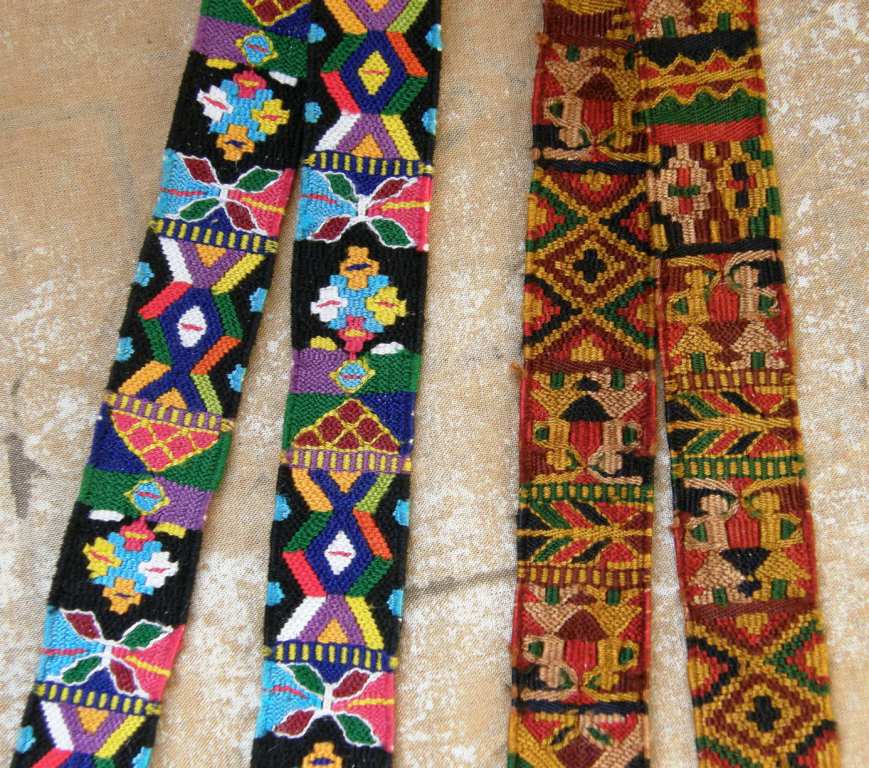
This showed up in my Inbox the other day – something Rodrick Owen says he stumbled upon in his home and was kind enough to photograph and send to me. I can never see enough of these double-woven belts from Potosi and this one has some new designs to add to my collection – some horse motifs which I have not seen before and I can’t wait to chart that particular version of the floral design which appears on a lot of these belts. The floral design rolls along and then suddenly a dog appears. This weaver had a sense of humor!

Its arrival is very timely as I decided this week to put the complete tutorial for one-weft double weave here on a new tutorial page on my blog. You can see it here and I hope you enjoy it.

Here is a reminder of some past projects I have shown here using this technique…

Another reason why I consider the appearance of the colorful Potosi belt well-timed, is that I have been thinking lately about being a bit more bold in my use of color in my weavings.

At left you can see a four-color pebble weave sash that I made way back in 1997. It didn’t seem any problem for me back then to dive into the yarn bag, pull out some colors and whack them all together.

Since then, there has been a drift toward the safe earthy colors –  a splash of red here and there – but nothing too daring.

So I have been trying to look at all my balls of yarn with new eyes, imagining new color combinations and going through the pictures in my ‘ideas” folder. While sorting through my stuff and trying to make room for the new things I had bought in the US, I found a tightly sealed and stuffed black plastic bag at the bottom of the closet. Yet another bag of dusty unspun llama fiber, I thought. However, a small cut in the bag had these contents springing forth…

Firstly I should point out that these yarns, which I bought in Guatemala in 2008, are all acrylic. It is hard not to get color crazy when you are in Guatemala. At first it is all a bit jarring but you get quickly used to it until you are completely addicted by the time you leave. You also quickly overcome any prejudices you may have had against acrylic.

These yarns are used as supplementary wefts for decorating cotton ground weaves.

Simple cotton for the ground weave warp and weft is sold at most markets in Guatemala. The most popular brand seems to be Mish, a local product. I love this ad for Mish painted on the crumbling shop wall.

I wove some pieces when I got back from Guatemala with some of these yarns to consolidate the techniques I had learned there. Then the bag of yarn was put away and forgotten. Now I am going to respin and ply these acrylics – they are very fine – so that I can use them as warp and weave something bright and cheery.

Some of the things that I have been looking at to inspire me in my new “color craze phase” have been these bags from Chincheros, Peru…

What I love is that they are made of natural fibers that have most likely been colored with natural dyes. Well, I have access to all the cochineal I could ever want here. Now I must get that instant indigo I was gifted and put it to work.

At far left you can see my handspun llama fiber colored with cochineal with different mordants and coca leaves – quite dull next to the naturally dyed piece from Calcha on the right.

A Weavolution companion has invited me to her home on my next visit to the US for a dyeing session in her studio. What an opportunity! I can’t wait to get my hands on some logwood.

So, until I can learn how to turn out richer colors in my dyepot and respin all that acrylic, I will play with color using the cottons that I have available here in Santa Cruz. My first project is a zippered pouch for my belt shuttles.

I have been a bit more adventurous here without getting too crazy. Ninety-nine percent of the time I weave a white or off-white motif on a base color. There is not one strand of white in this piece! This is the first part folded in half to show the size of the pouch and I probably have enough warp left to make another. I plan to make a tubular woven band to edge it as I was taught in Potosi. The tubular band I learned with my teacher Hilda is not as complex as the one shown on the blue Chincheros bag above.

I first wove a sample band using three small motifs in Andean pebble weave and decided I liked the green motif on the red background  and the orange one on blue. So I put that all together for my shuttle pouch.

The samples got made into keyfobs.

I was able to make three keyfobs from my sample band.

Other hand woven fabrics that I have at home which I am now seeing with new eyes are…

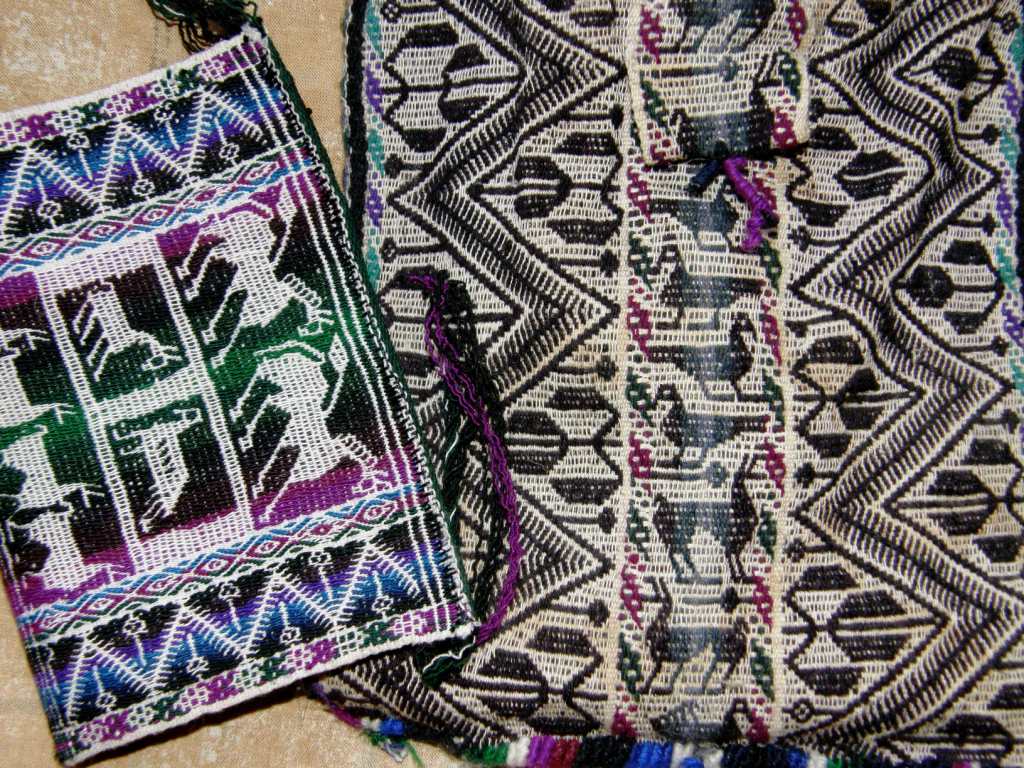
The piece on the left, from Chichicastenango market in Guatemala, is made from richly colored cottons. The piece on the right is the one that I worked on in Santa Catarina Palopo and has acrylic supplementary wefts on a cotton ground weave. My teacher would quite literally put her hand into the yarn basket without looking and pick up just any ball of yarn to form the little motifs. After a while I would do the same, handing the balls to her to measure and cut according to the motif.
Carolyn aka Seaphish sent me this photo of her curled up warp of respun yarn when she took it off the loom and then at right you can see it "tamed' and on the loom with a nice Andean pebble weave band in progress. I am grateful to her for taking the picture as, when this has happened to me before, I have been far too perplexed to stop and take a photo!

I will respin and ply all those acrylics on my drop spindle otherwise they will never stand up to being used as warp on my backstrap loom.

I aways tell people in the online groups to be careful when using respun yarn when they are removing their warp from the warping stakes. The warp will spring to life and curl up on itself due to the overspin and, if you are not prepared with safety strings in place, you might end up with a disaster!

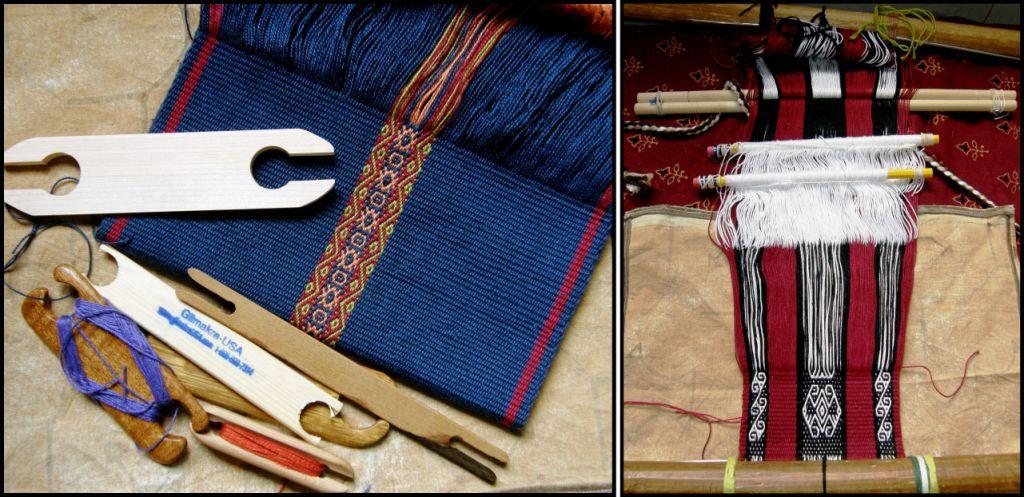
One of the other things I have been working on is a test piece for the Coats Aunt Lydia’s number 10 mercerized crochet cotton. It seemed obvious to me right from the start that this was going to be a great yarn to work with. I had two balls, one of red and the other of white, and so I combined those colors with some of my black 8/2 mercerized cotton and am weaving a piece in Andean pebble weave technique on my backstrap loom. This is a longish warp and could be a tool bag for my longer cross sticks or a series of zippered coin purses for gifts.

There you have all the information - down to the store name and price! Too fine a yarn for first-ever projects but something to build up to as you gain more experience.

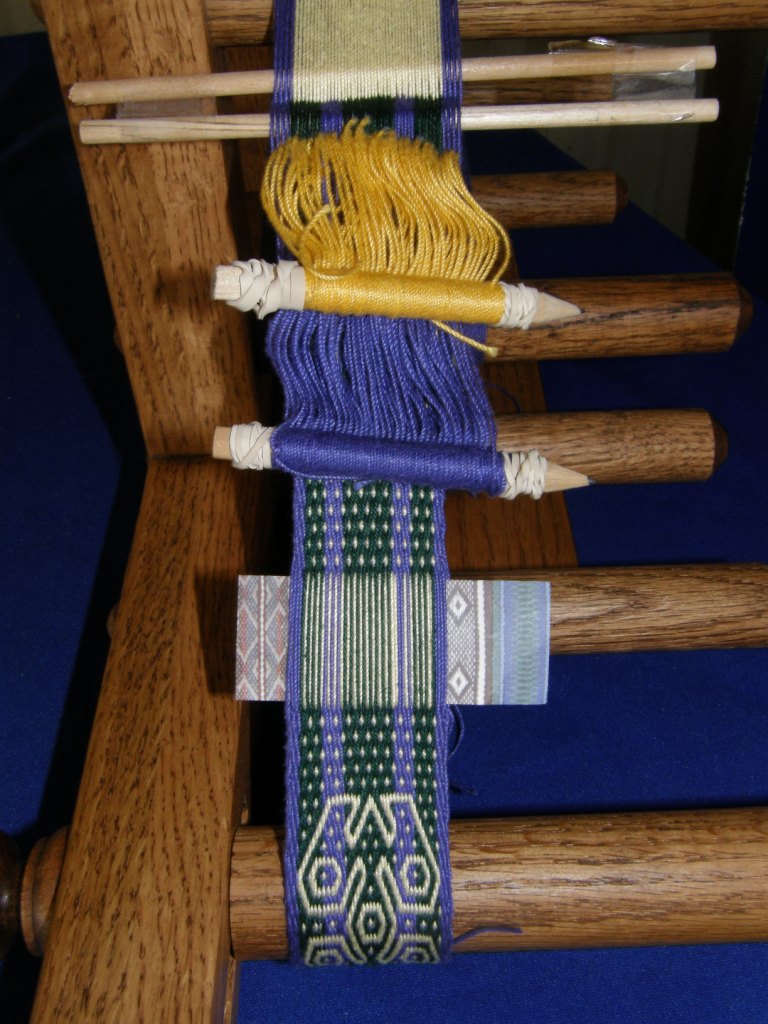
The inklette has been christened! I am still pondering ways to perhaps use the inkle loom’s shedding sytem for Andean pebble weave but I have not found an efficient way yet to do this for any but the very narrowest of bands. For me, the best way is to simply use the loom as a frame on which to place your warp and set it up as shown in my e-monograph. I am inclined to think that nylon heddles may be better when using the inkle loom in this manner.
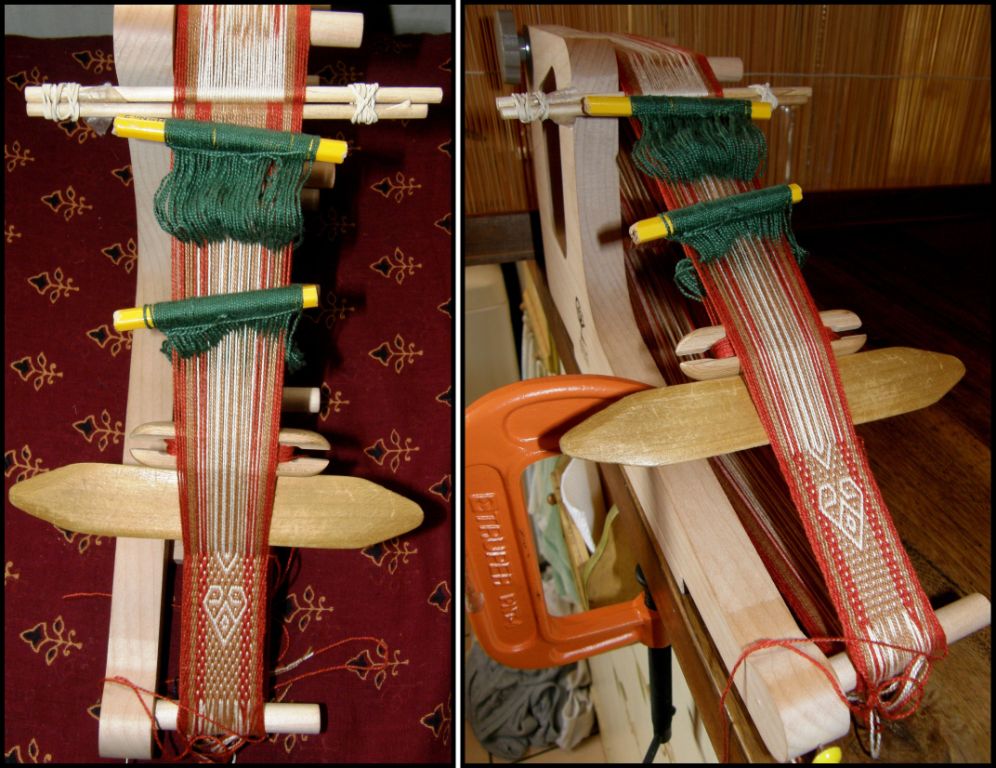
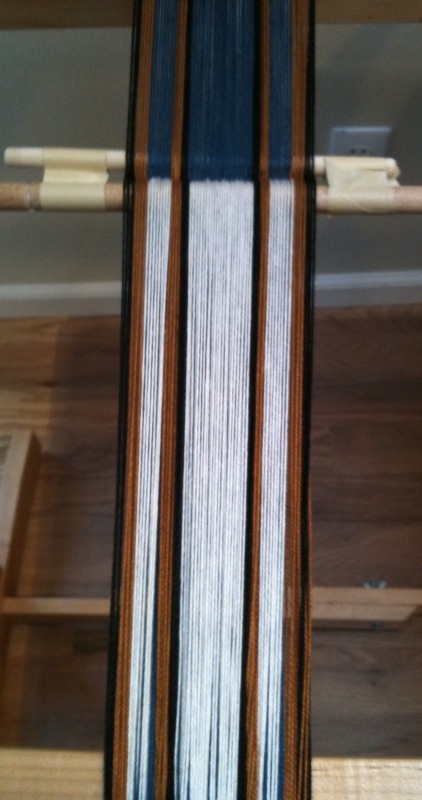
I found myself last night sitting on the foor with one foot anchoring the tiny inklette as I pulled up on the pebble sheds. Not a problem as I spend a great deal of time on the floor. However, I decided today to try it out in a slightly more civilized fashion by clamping it to the breakfast counter. Look at my tiny shuttle - how cute is that! I have gone back to muted tones on this band I am afraid. According to the leaflet I have a 72" warp on this so I think I'll be getting a new belt with enough leftover for something else. I am using a fairly relaxed tension on this which makes opening the sheds easier and stops the motifs from appearing stretched out.

So, we have been weaving along with pebble weave at Weavolution using my e-monograph. Different people are at different stages…some are warping, some are making their string heddles while others have started weaving.

I think that some are still in the process of choosing their designs and planning their piece.

At left you can see Jennifer’s choice of warp colors. I showed you one of Jennifer’s bands last week. Now she is venturing on to a wider piece. She wasn’t sure if the colors were suited to a pre-Columbian bird motif.

I think it will look great.

A lot of pre-Columbian cotton pieces were woven in either natural brown and white or white and indigo.

Her warp looks beautifully made…nice and even. Wind a good warp and everything else, such as making string heddles and opening your sheds, will be that much easier.
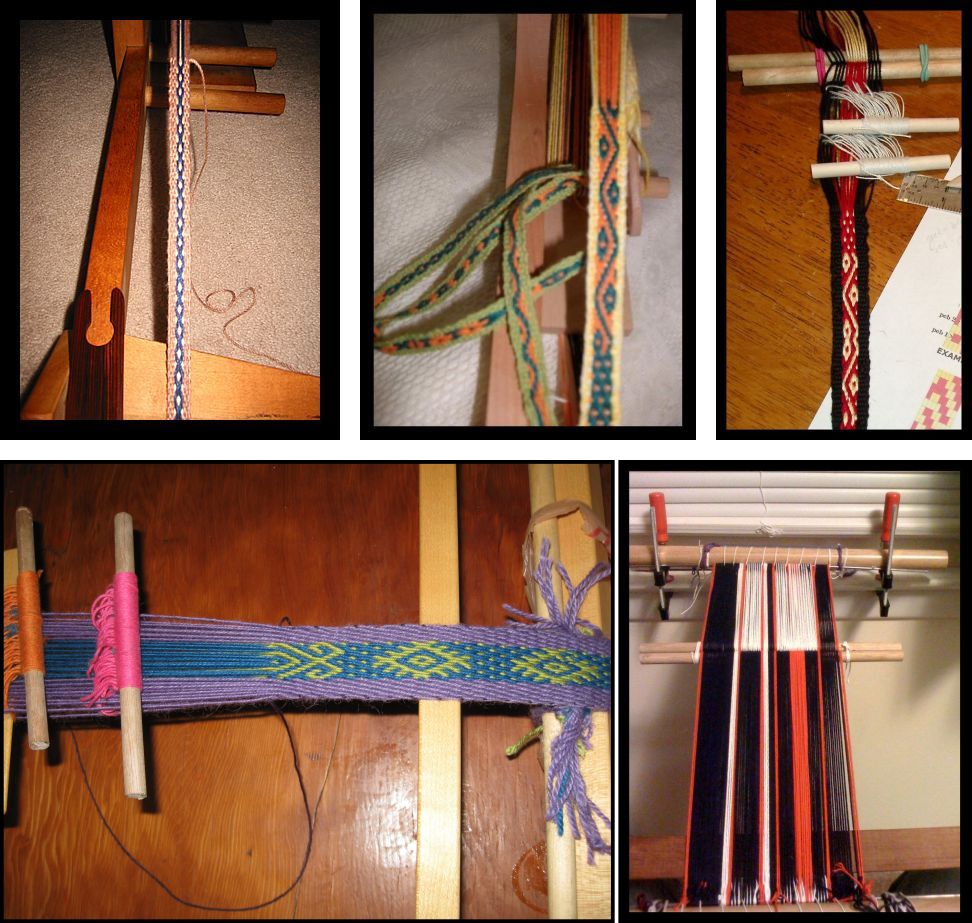

From left to right...Tony's and Caroline's first bands on inkle looms, Jeanne's backstrap piece, Carolyn's band on the frame of her rigid heddle loom and Virag's warp set up for backstrap weaving.

It is all about baby steps. We weave narrow bands first to get the hang of the technique and, in some cases, the loom. Then some more samples will help us to know what to expect from certain yarns. After that we can launch into some more challenging projects. Here are some project ideas…
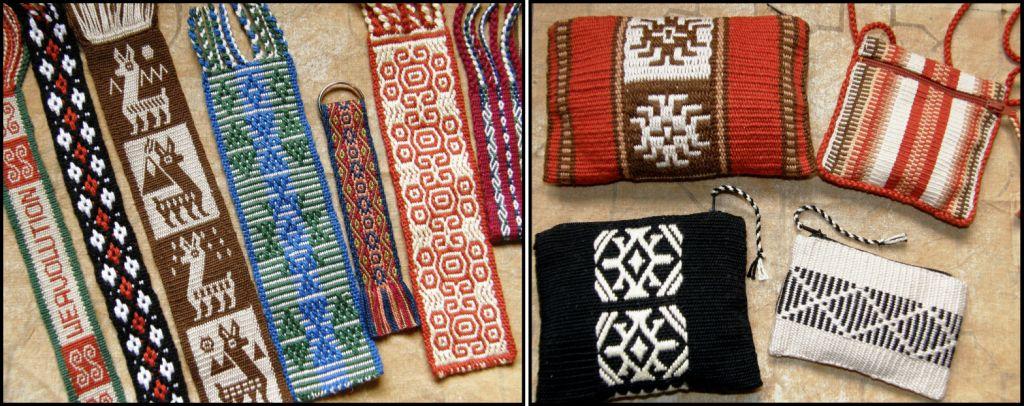
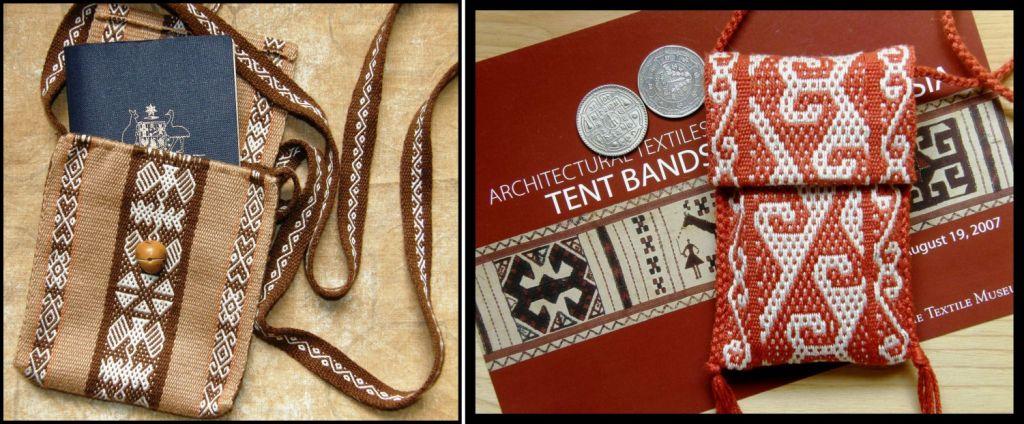
Keyfobs and hatbands look good even in heavy yarns. Bookmarks are better suited to fine ones. Wider warps with or without pick-up designs can be made into small zip purses for business cards, credit cards, coins and cosmetics.
Going wider, you can make small bags for a passport, iphone or other gadget.
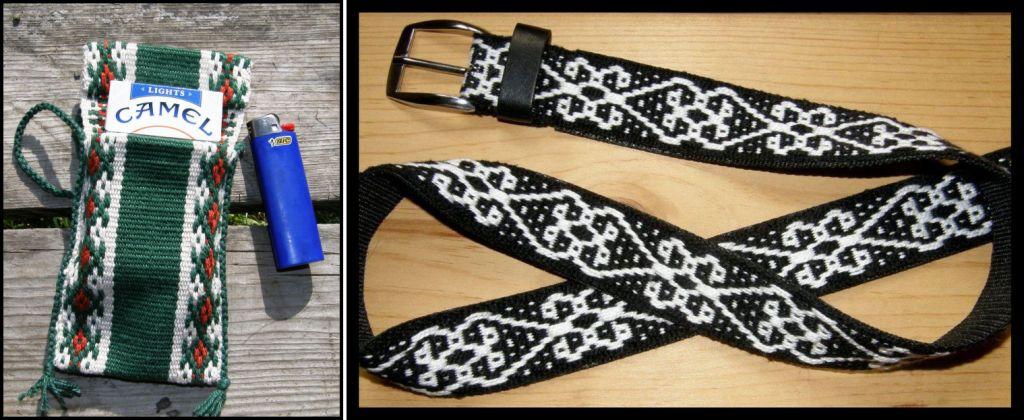
What was originally intended as a cellphone pouch was turned into a cigarette pack holder. Long but narrow warps make nice belts.
Finally, here are my two current small projects. Going wide does not necessarily mean more pick-up. A narrow strip of pick-up can be placed on solid color. The piece at left is weaving up really fast.

######################################

I am putting together some video pieces for next week’s post to show you all how to open the sheds on your backstrap looms smoothly and efficiently. This is one problem I noticed when I visited and wove with some people on my recent trip to the US. Opening the sheds becomes a real struggle when you have a lot of pilling on the heddles. Sometimes it is a matter of a less-than- ideal yarn choice but usually the problem is caused by sliding the heddles around too much when attempting to open them. So, I will have those videos for you next week and NOT just on the dream warp with the perfect yarn! I will show you how to deal with some of those sticky warps as well as wide ones with fine yarns. Included will be tips for working with two heddles for Andean pebble weave.

################################################

I put some photos together to answer a question on the Yahoo group, about using stretchers or tenter sticks on wide warps to help maintain an even width and I thought that I would share them here as well. I don’t use them as I have not woven anything wider than a table runner but I have used them with my teachers in Guatemala and coastal Ecuador.

You can see the upper surface of this Guatemalan weaving at left. The stretcher bar is a hollow piece of bamboo which sits under the weaving just below the weaving line. All those threads hanging out are the ends of the supplementary wefts which may be snipped off when the piece is finished. The stretcher bar is moved up every few inches.
A small nail pierces the upper surface of the weaving just below the weaving line and three or four warps in from both edges. The nails are then turned and inserted in the ends of the bamboo.
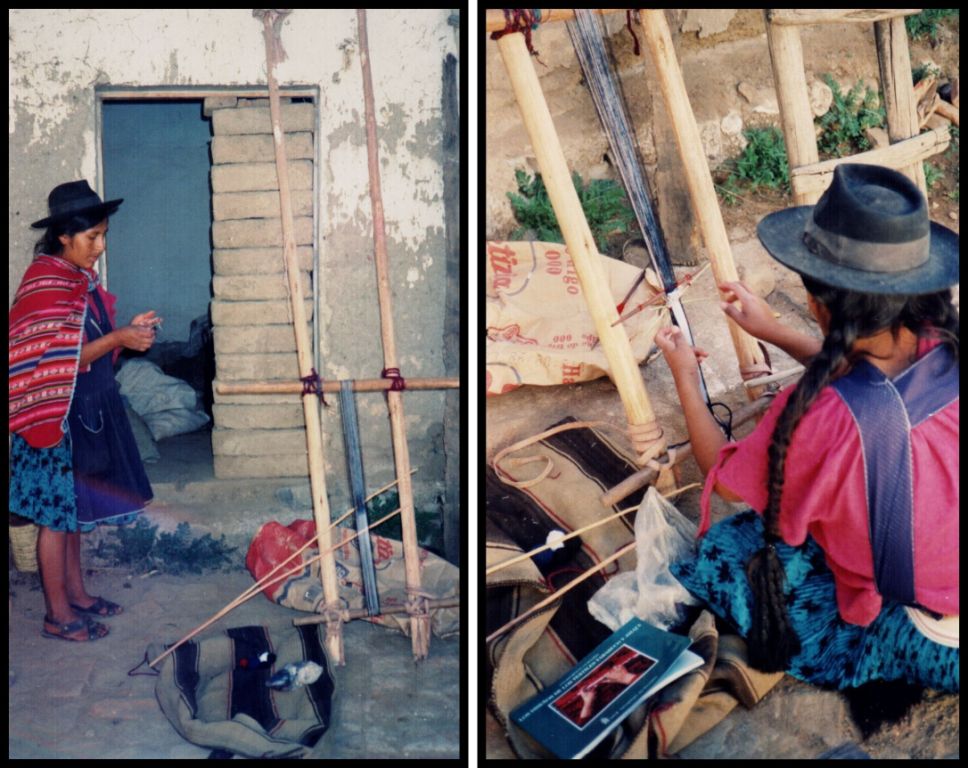
This weaver in coastal Ecuador uses a bamboo slat to help maintain an even width for her weaving. It sits on the front side of the textile. Her tenter stick is a bamboo slat made by breaking open a tube of giant bamboo. Weavers will have a collection of these sticks for the various widths that they usually weave. The ends are whittled down to points which pierce the edges of the weaving. I wove on this piece and it was a real struggle removing, moving and replacing the tenter stick, which is held very tightly in its position, as the weaving progressed. The stick doubles as a spacer when the weavers are making their string heddles. These are the cotton saddle bag weavers I spent time with on a research trip with anthropologist Kathleen Klumpp in 2007.

Come and join the Weave Along at Weavolution , or enjoy the tutorial on one-weft double weave here. Don’t forget to send me pictures of your projects!

Cookie has allowed me to show you a photo of her first ever backstrap weaving project – here is her woven cotton backstrap.

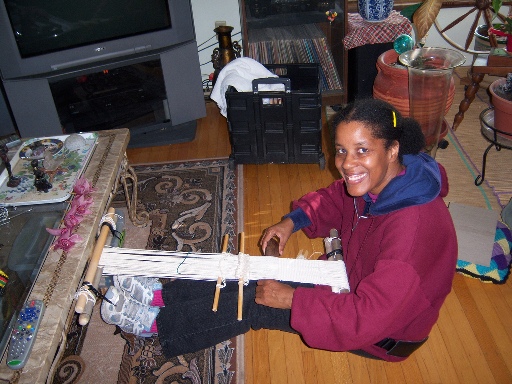
And here is my favorite – possibly the coolest backstrap photo I have ever been sent as so few people have photos taken of themselves at the loom. I love how she has the remote control in the photo as that is one of my essential weaving “tools” too! This is an excellent set up. Her far loom bar is completely stable tied like that and, as she progresses, her legs will just slide under the table. I envy her being able to sit on the wooden floor like that! Thanks for the pictures, Cookie!
Backstrap Weaving- Back in Beautiful Bolivia

Back in beautiful Bolivia and already thinking about the next trip to the US for Convergence in mid July! But, first things first. In keeping with my policy of “new things in, old things out”, I have spent a few days tossing things to make room for the books and bits and pieces I brought back from the US. I do believe I have tossed out more things than I brought back – ah, more space…that is a nice feeling.

The other policy is to finish all the projects that I started on the road and I am pleased to report that I am ninety-nine percent on the way to completing them.

Project number one…the larger backstrap piece I was using for my demonstrations.

Demonstrating, finishing the pebble piece at home and the new tool bag, front and back.
Needed - one more tool bag for my new collection of shuttles. Two months ago, I didn't have a single small shuttle. Always happy for an excuse to weave something!

I had warped this up with nothing in particular in mind. I just needed something to demo with at the Maryland Sheep and Wool Festival. This poor band had a bit of a hard life having been set up at different angles, worked under different tensions and constantly picked up, woven, and put down. My weavings always turn out better if I weave on them for a couple of hours at a time and having them tied up and worked on in the same spot helps a lot too.  In any case, I got this off the loom and decided I needed another tool bag. Anyone who saw me rummaging around in my tool bags for that “special stick” or beater will agree. This new

I wove an inkle band with designs in Andean pebble weave on a couple of road trips and at the beach.

bag should help to sort out the confusion a bit. I wove a narrow blue band which served as the sides of the tool bag. All that is left to do is make a braid and sew on a button for a closure.

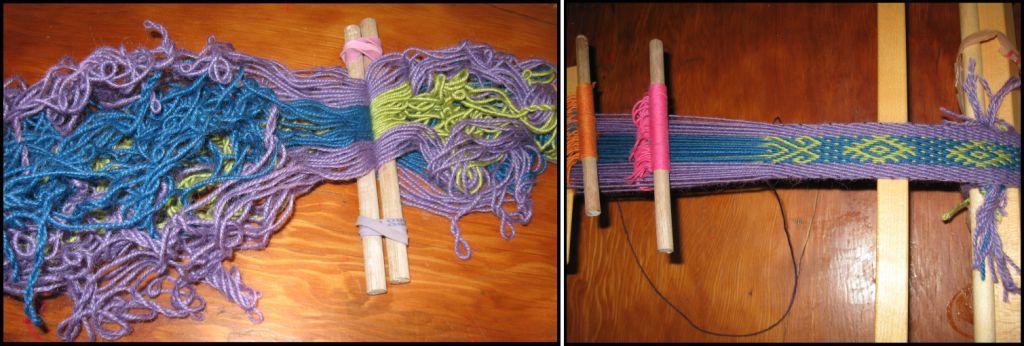
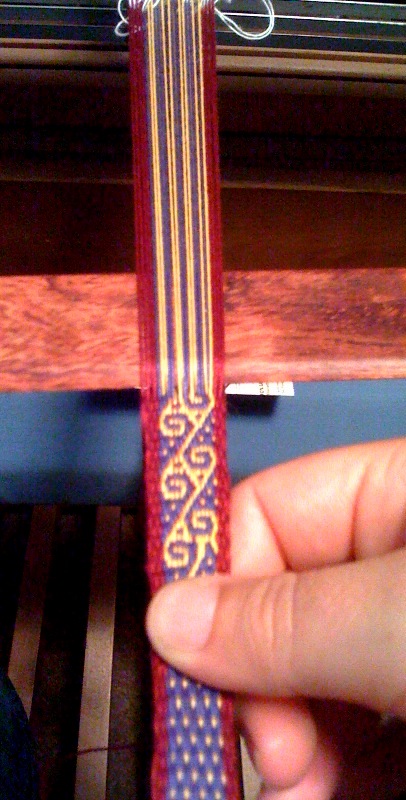
Project number two…the inkle band that I wove on road trips and at the beach. I completed this with twelve spaced motifs so that I could cut the band and sew it into key fobs. It was woven in Andean pebble weave with pre-Columbian and contemporary motifs.

This was a bit fiddly as I hadn’t woven quite enough plain pebble weave at the start of some of the pieces for threading through the metal ring, turning over and sewing so I had to cheat and glue some of the ends down.

So now I have twelve purple and green fobs. To be honest, I think I prefer making two at a time on my backstrap loom as I can change color and offer people more choices but…there are those times when there isn’t anywhere to tie up a backstrap loom and I can weave on my new inklette instead.

The twelve finished key fobs.

Hmmm, seems that I was in a very purple-ish mood when I was traveling as, the third project which I was weaving to show Andean pebble weave at its simplest on a very narrow band, is in an eggplanty purple shade with apple green designs. I had no idea what to do with this band when I got home  – more key fobs? No…And then I remembered a wee twill-weave sample I had made ages ago. It is nothing special at all but it was the very first balanced weave I had ever attempted on my backstrap loom and I had gotten quite a kick out of it. It was also the first time I had ever wet finished something. I had not been in the habit of wet finishing warp faced wall hangings and shoulder bags so it was all new territory.

UPPER LEFT: The thin band. UPPER RIGHT: The twill piece on the loom. I wrapped black yarn between the warps on the loom bar in order to space them for the twill. LOWER LEFT: This little bag will hold my business cards. Many people were amused to see me carrying my cards around in an Altoids tin while I was traveling. I shall probably replace this pouch at some stage with another in pebble weave with two pockets so that I can also carry my e-monograph cards.
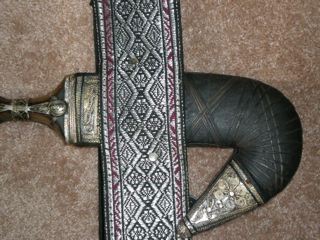
Yemeni knife belt

The band served as sides for the pouch as well as to decorate the center. The picture at bottom right shows two other looms with projects that I took to show in the US. You may remember having seen these in other posts and I shall be getting down to finishing these in the next few weeks. The one on the left is the supplementary weft reproduction of a pre-Columbian fragment and the other is a warp float reproduction of a yurt band. I was lugging around quite a lot of sticks and string!

So those will keep me busy for some time and I have already decided on what will probably come after that. I would love to try and reproduce the Yemeni knife belt pictured above. It has been woven with a supplementary weft with a silvery sheen and is spectacular.

Now what about those yarn experiments? I have even had time to weave a few things in Andean pebble weave with two of the yarns I purchased in the US.

I got this Patons Grace yarn at Michael's-yikes! purple again! What can I say?-there wasn't a good color choice. On their site, Paton's decribes this yarn as super soft or ultra soft and I would not have bought it based on that description as soft yarn and warp faced weaving don't usually get on. I wove two key fobs with it and it is lovely. Zero pilling on the heddles and, being mercerized, it has a lovely sheen. It is a number 3 crochet yarn. These photos show how I make my keyfobs two to a warp so that both fobs have a clean edge. I weave one, then turn the loom around and rearrange the shed stick. I retie the knots at the other end so that they are right at the start of the weaving. When finished, the knots are untied and those ends get passed through the end loops once the metal needle is removed.
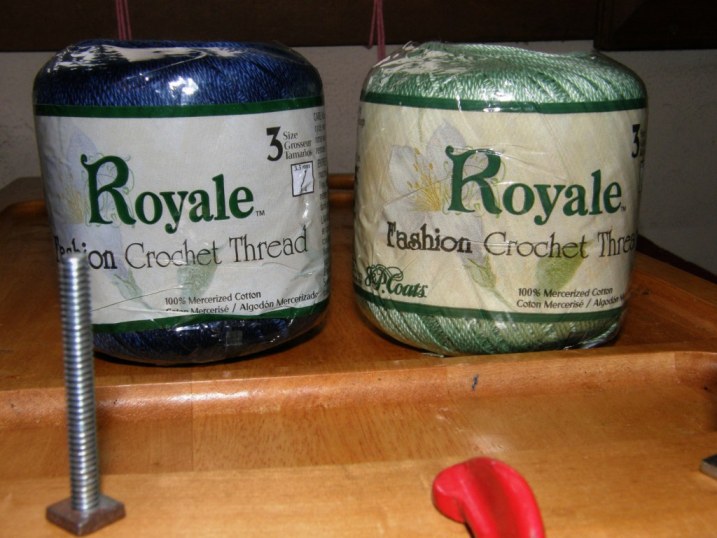
A few more pictures showing the weaving process and the two fobs on the loom. The finished fobs are at bottom right along with two others I made using Coats Royale number 3 mercerized crochet cotton also from Michael's - not many colors to choose from for this brand either. I would buy it from the website. Thumbs up for this yarn too.

I have a finer number 10  merc cotton, also by Coats, to try out for next week and not in purple as well as some wool. People often ask me about respinning commercial wool for backstrap weaving so we can take a look at that too.

Other tempting project ideas that have been appearing in my inbox are pictures of belts and bags woven by the Huichol of Mexico as well as drawings of motifs woven by the Cayapa of Ecuador.

Teyacapan, too, continues to inspire me with her gorgeous photos of Mexican crafts and textiles.

#########################################

Now it has occurred to me that this blog has been filled with images of the US the last few weeks and that it was about time I showed you all a little of Bolivia. I recently contributed some photos and information to Handwoven for a piece they wrote on Sucre, the constitutional capital of Bolivia, and its attractions for tourism related to weaving. How frustrating it was having to narrow down the images to just three or four pictures! In May last year,  I went to Sucre for what was probably my fourth visit but, this time, I went with my brand new and first ever digital camera.

So here is a little whirlwind photo tour of Sucre…

Sucre, the "White City of the Americas"

Sucre sits in a valley at around 3500 meters and it is obvious how it earned its nickname. From the hill tops to down at street level, both inside and out, Sucre is white – almost blindingly so in the mid morning sun! Wooden enclosed balconies adorn most of the downtown buildings as well as black wrought iron window coverings and flower filled window boxes. It has quite rightly been declared a UNESCO cultural heritage site.

The most well known weavings of the area are made by the Jalq'a people of Potolo, upper left, whose textiles depict wild mythical creatures which completely cover the woven surface. Those made by the people of Tarabuco, on the other hand, have designs that are placed in well organized columns and depict common every day objects and events. These textiles are woven by the women on oblique looms while the men weave the brightly colored tapestries, lower right, on floor looms.

More examples….

Weavers from Tarabuco and Potolo demonstrate weaving at the ASUR museum in the heart of the city and it is also possible to travel to the town of Tarabuco or, further, to the villages of Candelaria and Potolo to see weavers at work and purchase their textiles.
Shopping! Traditional weavings and knits from floor to ceiling as well as items produced with traditional based designs for tourists.


More shopping...the Sunday market in Tarabuco, a couple of hours away, is a textile lover's heaven. Again, you can find traditional pieces as well as weavings made specifically for tourists. At bottom right you can see one of the market stalls in the Sucre campesino market where you can buy llama fiber, spindles, cochineal and bone weaving tools called "wichunas".
People in and around Sucre...weavers from Tarabuco and Potolo, a woman spinning in Tarabuco on her way home from the market with her granddaughter wrapped in her carrying cloth, an elderly Tarabuqueno wearing the leather hat or "montero" which is said to be based on old European style helmets, men performing ritual offerings to "pachamama" on Sunday morning in a plaza in downtown Sucre.
A visit with Felicia and her mother in the village of Candelaria. Felicia's cousin, also called Felicia, taught me to weave the pick up technique of Tarabuco way back in 1998. She and her family have long since left Candelaria and I was lucky to run into her cousin who welcomed me into her home to sit and watch her weaving. I took weavings and photos to show and her mother, who is not a weaver, was delighted looking at my things.

I have spent many years traveling around and spending time with weavers here in South America. It is not so easy finding a weaving teacher especially in the cities and not all my attempts to learn to weave have been entirely successful. One thing is finding the weaver, another is finding one who has the time to teach you and, lastly, finding one who is also a good teacher is something else all together.  I have almost always found a good weaver and teacher with some time to spare within a few days of my arrival in a place.

Typical textiles of the Tarabuco area.

On my second trip to Sucre in 1998, I found that I had enough time to look for a weaving teacher. The museum in Sucre had given me the name of a weaver in Candelaria but I bumped into  Felicia while I was waiting for transport from Tarabuco to Candelaria ,we struck up a conversation and she persuaded me to come and weave with her instead. I doubt that Felicia herself knew what she was letting herself in for when she took on the task of teaching me to weave. Youngsters generally learn by observation rather than through explanation and Felicia seemed to have long forgotten which designs she had learned first, how difficult it was to learn from scratch, and I doubt that she had contemplated how time consuming and possibly boring it would be sitting for hours with me and having to help me along with every little thing!

The first classes...Felicia would sit at her loom picking up her pattern warps on a metal needle. All I could see was the long end of the needle flicking to and fro as it emerged from her fist. I couldn't for the life of me figure out how she was forming and reading the patterns. Finally I was able to persuade her to set up a miniature warp for me on another loom and picked out the simplest design I could find from a book I had bought at the museum. I was being a stubborn gringa and I wanted her to teach me MY way.
Here are the loom and mini warp that Felicia set up for me in the yard . But things still did not go well...Felicia still flicked her needle around, sighed with impatience when I didn't get it and rolled her eyes at my questions! Finally I figured that I could slip the warp off the loom bars at night when everyone was asleep. I tied the warp to my bed rail, set myself up with my backstrap and unwove. In a couple of nights, I got it figured out and once I had made a chart of the motif, I was on my way. I decide after that, that I would leave the weaving classes and just enjoy my stay in the village. There was no transport out anyway until the market day the following Sunday.
So I joined in with Felicia's chores instead and learned a few things. I am sure she was relieved that I had suddenly stopped asking for lessons and no questions were asked! We made bread. I am eternally grateful that she didn't have me get my hands into the dough which was made with globs of pig fat from a sack in the corner-that apparently was grandma's job. She showed me how to peel wafer thin slivers of skin off their tiny potatoes with a knife and get the kitchen fire going. Can you tell I am a city girl? I also learned how to use the stone to grind the chili peppers to make 'llajua"-a spicy sauce which she served with the bolied potatoes. Then there were the neighborhood kids to mind. I would go out for walks with a long train of them behind me.

Somehow we ended up hitting it off and I finally showed her the motifs I had been secretly weaving at night. She was pretty happy about that but did not praise me by calling me “machita” as my other weaving teachers had. Probably not surprising as you can see at left all that I managed to weave in a week!

The white yarn used in the background area  is a highly overspun cotton. You can see how the heddle strings, which are made from the same yarn, are curling up on themselves with the overtwist. The pattern warp is overspun acrylic-about three times thicker than the ground weave and not as tightly spun.

We just used twigs from the yard for the shed rod and heddle stick.

I was very surprised to receive a phone call from Felicia’s husband when I returned to Santa Cruz telling me that he had sent me a package by bus. Inside was a chuspa (coca leaf bag) and a wichuna which belonged to Felicia’s mother. Wow! I wonder if Felicia took on any other gringa students after I left!

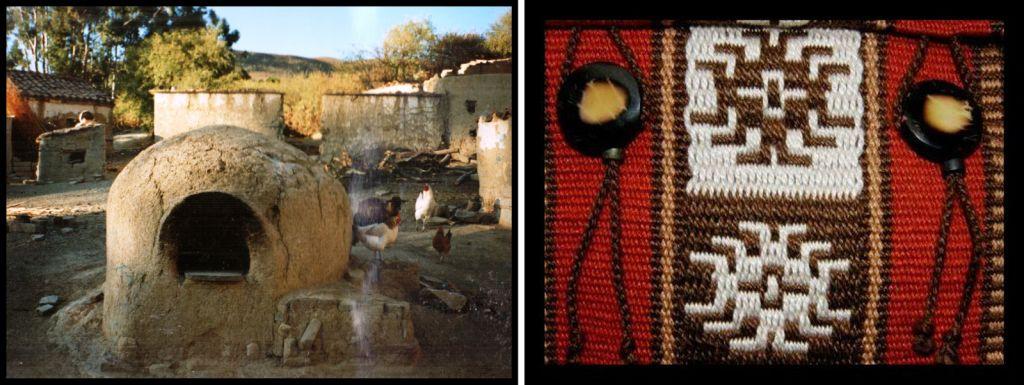
The bread oven in Felicia's yard. A piece I wove using the technique I learned during my stay in Candelaria. I used the same weight yarn for both the pattern and background colors which gives it a very different look.

###########################################

Two hair sashes that I had bought in the market at Chichicastenango. I particularly liked the one on the right in its soft autumn colors. I later discovered that it was originally woven in bright primary colors and then overdyed to suit the taste of foreigners. I have been told that sometimes textiles are simply soaked in tea to tone down the colors. Now I would like to wash this band and recover the orignal hues.

One of the things I enjoyed a lot on this trip to the US, was the chance to play on other looms. I had a great time on what I had been calling my “first encounter” with a four-shaft loom but I had completely forgotten the quirky little four- shaft/backstrap loom that I had woven on in Zunil, Guatemala.

While staying in Guatemala’s second largest city of Quetzltenango, I heard about the hair sash weavers of Zunil and the strange four shaft loom that the weavers used.

The warp is attached to and tensioned by the weaver’s body.

I was intrigued by the loom but also keen on learning how to make the lovely sashes.

Zunil is a twenty-minute bus ride from Quetzltenango and I arrived to market day madness. You can see some of the women there using their hair sashes. A short walk uphill brought me to the relatively peaceful town square and church where I found the weaving cooperative. There I was politely told that classes would not be possible as women were not permitted to weave during Semana Santa (Holy Week). Disappointed, I left, only to be chased down the street by a woman who told me she would take me to a teacher. And so I was led up the hill to Clara’s house which had a gorgeous view over the town and surrounding valley. We negotiated the price and when I questioned the Semana Santa thing I was simply told that “some people get jealous”.

So here is the rickety and very squeaky loom. The warp stretches from the weaver's waist through the reed and shafts around a hook in the door frame, back to the weaver's waist via another hook in the side of the loom. The warp is cotton which is sized with something that smells truly awful - corn starch and other ingredients - and the weft is acrylic. The reed is made from bicycle spokes.

Amazing to think that a weaver using such a loom can produce these beautiful even sashes.

The band on the left is what I wove in my classes. An experienced weaver using exactly the same warp and weft would produce those fine, narrow bands on the right. The sashes are finished with large heavy tassels.
So that was my first four-shaft loom experience. Here are the loom parts that I bought in the hope of making my own one day. Clara was an excellent weaver and teacher.

#######################################

In the coming week on Weavolution I will be running a Weave Along. This will be for those of you who have been working their way through my e-monograph on Andean Pebble Weave and are wanting to extend their skills and  weave a wider piece. It is also for those who have purchased the monograph but have been feeling a bit hesitant about getting started. Join in and weave with the group!


Backstrap Weaving- Have sticks, will travel here, there and everywhere!
HAVE STICKS…WILL TRAVEL HERE, THERE AND EVERYWHERE!
Oh you can’t get to heaven in a little red canoe,

‘Cos God’s favorite color is Carolina blue.

My friend Lisa told me this today as we gazed up at the perfect blue sky in the yard of her North Carolina home. Forgive me if I am getting repetitive when I go on about the wonderful colors of spring and how beautiful everything is here. I realize how much I miss seasons in my jungly home in Bolivia where we experience warm-and-humid or hot-and-humid weather with a smattering of cool days in between.

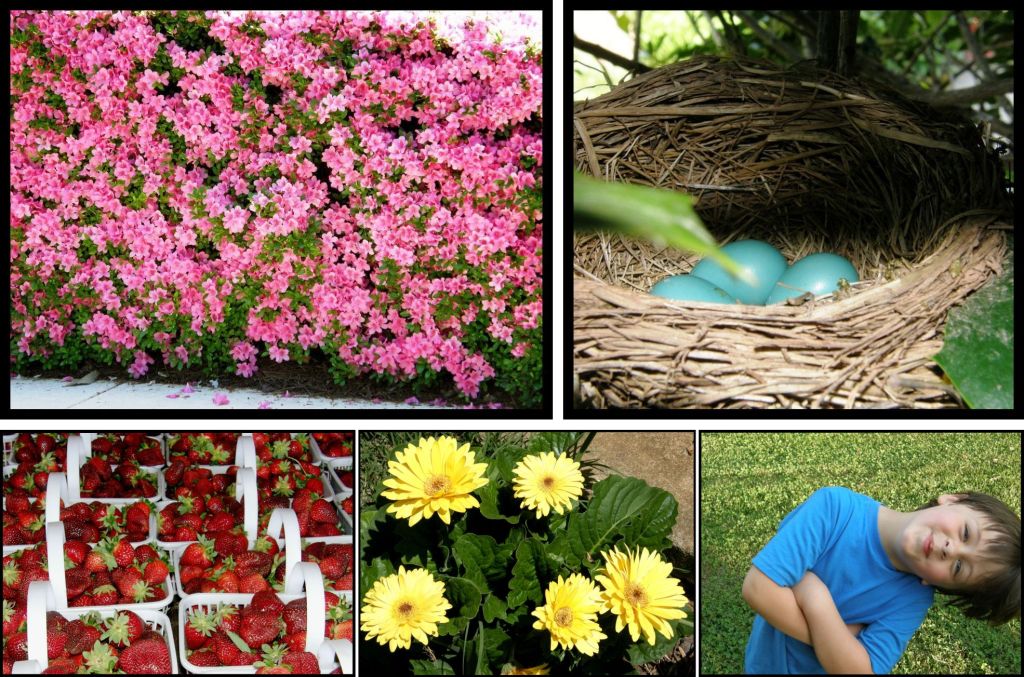
The colors of spring… pink azaleas, the blue eggs of what we believe to be a northern mockingbird spotted in Maryland, luscious ripe strawberries on the roadside,yellow flowers – we don’t know what these are called –  and a blue-eyed happy chappy enjoying his yard on a warm spring day.

After the Maryland Sheep and Wool Festival, I spent a few days in the home of Claudia, one of Weavolution’s founders and her friends in Maryland. We had gorgeous drives through rural Maryland on the way to and from the festival –  green rolling  fields dotted with deep red barns and silos. 


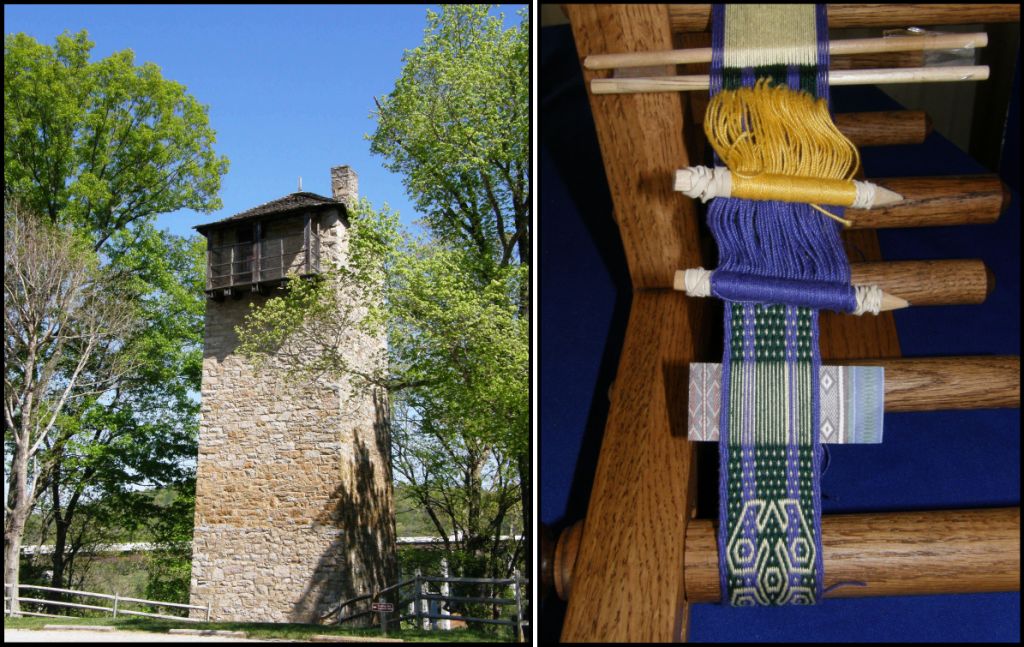
I had ridden up to Maryland from North Carolina with my friends Lisa and Ryan stopping by the Shot Tower Historical State Park to stroll and break the journey. I was making a band in Andean pebble weave in the back of the car while Lisa worked with her Turkish spindle in the front. The inkle loom I borrowed was a perfect lap size but the work space between the top and front peg was a little small for the cross sticks and two sets of string heddles.
The finished band has twelve  spaced motifs for twelve key fobs with motifs from pre-Columbian Peru as well as contemporary Bolivian and Peruvian ones. I have given away a lot of my key fobs on this trip and need to replenish my stock!
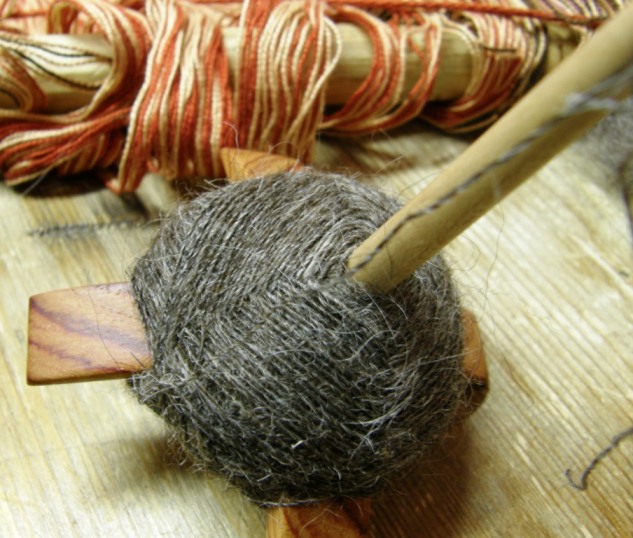
A beautiful ball of worsted spun by Lisa on her Spanish Peacock Turkish spindle

You can see that I didn’t use the inkle loom as it was intended, with its shed making system, but, rather, used it simply as a frame and set up two sets of continuous string heddles as required by Andean pebble weave. The  sheds are a lot easier to open on my backstrap loom and I had to take extra care on the inkle loom to make sure they were well cleared before passing the weft. The resulting band isn’t quite as stiff as the ones that I normally produce on my backstrap loom but I would never have been able to backstrap weave in the car!

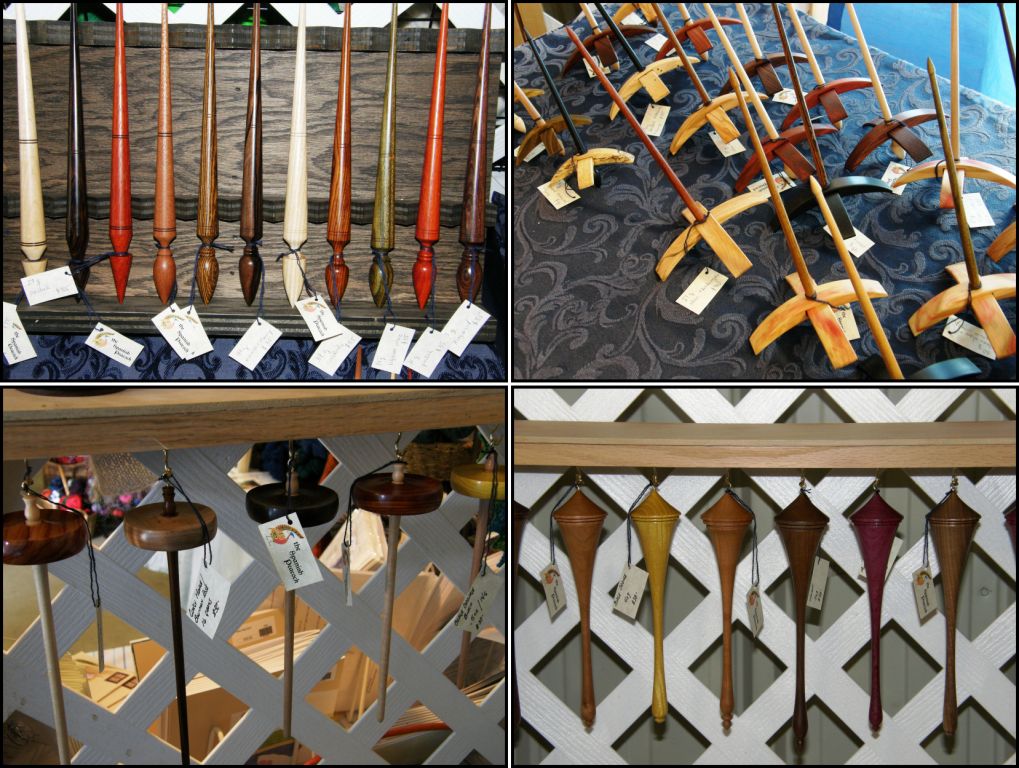
We stayed the first night with Mike King of  The Spanish Peacock and his wife TJ. Mike makes superbly hand crafted precision spindles, lucets and weaving tools in a variety of gorgeous woods – beautiful to look at, touch and use. He was interested to see the humble little Bolivian drop spindle that I had brought along with me, which wobbles comically to and fro as it spins, as well as the wooden backstrap weaving tools, shiny and smooth with age and use that I have collected in South America.
Over his left shoulder in the above picture you can see  mini inkle looms that he makes and calls “tinkles”.
His stand at MSWF was spindlers’ heaven and moments after the gates opened it was full of eager shoppers lining up to make  purchases. Even before the show could open he had to turn down other vendors who were keen to get their hands on his beautiful work.
We spent Friday night with Mike and TJ as they gathered their energies to face the onslaught the following day. TJ showed us the beautiful machine embroidered outfits she makes for their SCA events.
And then suddenly it was upon us – day one of Maryland Sheep and Wool Festival – described by Wikipedia as “the largest and longest-running showcase of domestic sheep and wool in the United States.  …the heat, the crowds and the craziness. I couldn’t get anywhere near Mike and TJ for the rest of the day! I hear that last year canoes were required to navigate the rain-soaked grounds so I really can’t complain about the weather.
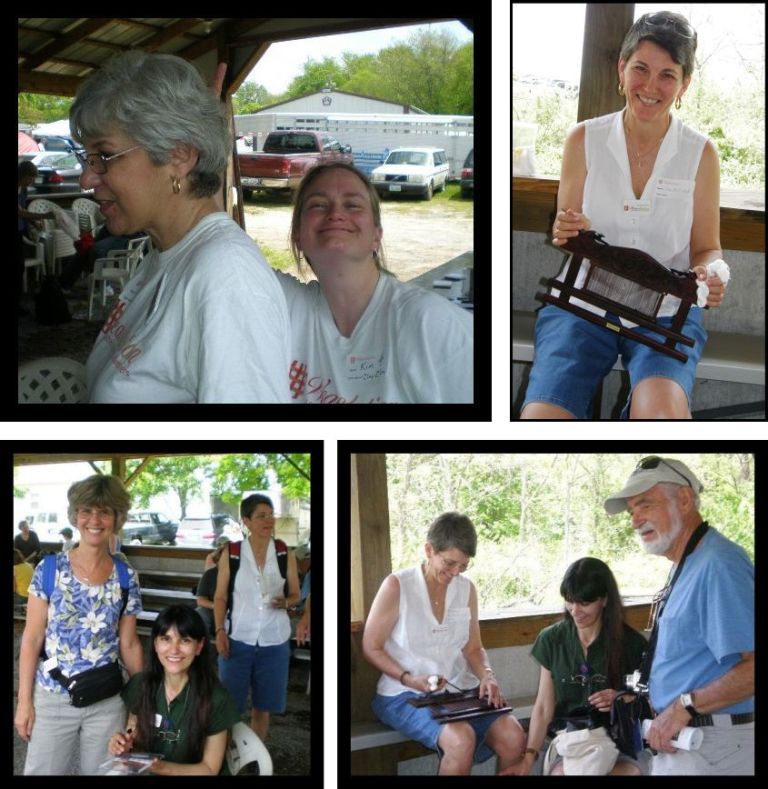
Once I was able to get into shorts, I felt that I might just survive the day. I demonstrated backtrap weaving at the Weavolution meetup at noon. It was fun to see some of those avatars come to life and meet members of some of the local guilds as well as some weavers-to-be.
Some of the Weavolution gang- founder Claudia Segal, Kim Pierce, Deb McClintock, Sharon Carey and Maurice Blackburn.
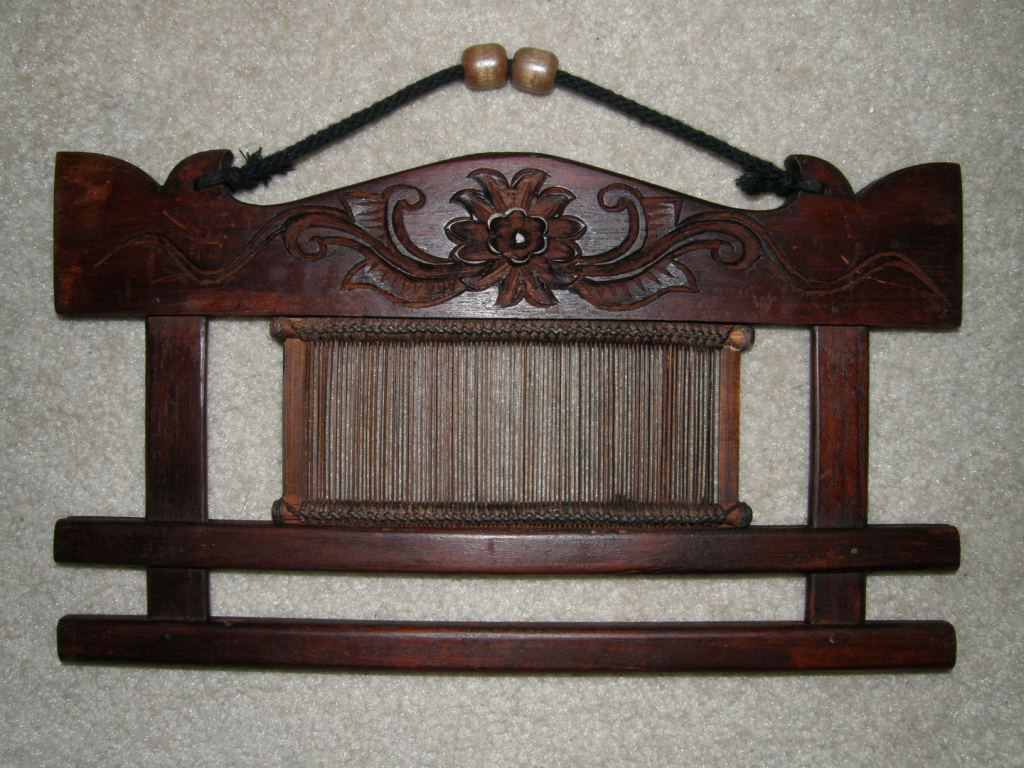
Deb McClintock, who was visiting from Texas, knowing about my desire to get hold of a real reed to use on my backstrap loom, brought this beautiful Thai reed for me as a gift. This piece has been designed to be used as a wall hanger on which to drape a weaving but she gave it to me so that I could perhaps have someone in Bolivia copy it and make a full sized reed. Isn’t it gorgeous?
There were just too many sights, sounds and smells on the first day. The afternoon saw people snoozing sprawled out on the grass in the shade , in their cars or any place out of the sun. Few things really held my attention for long on day one – it was all a little overwhelming.
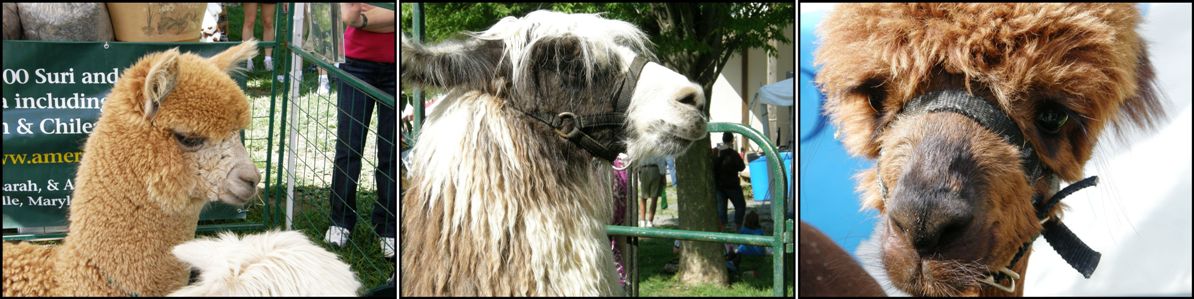
I did enjoy seeing the animals in the relatively uncrowded outdoor areas. The vendor halls on the other hand were packed and too hard to negotiate with inkle loom slung over my shoulder and three backstrap looms in tow.
And then I found my little oasis – the glorious yurt!
It was cool and fresh inside and well insulated from the heat with plush skins on which to sit.
The trellised walls provided the perfect place for tying my backstrap loom.
And there I sat out the afternoon with many visitors who were also quite happy to come in and enjoy the relative cool. Most assumed that I was “keeper of the yurt” and plied me with questions.
Next year I will definitely make that my place to be.
I think I will bring a bunch of backstrap weavings to decorate the walls and we can have our meet up in there!
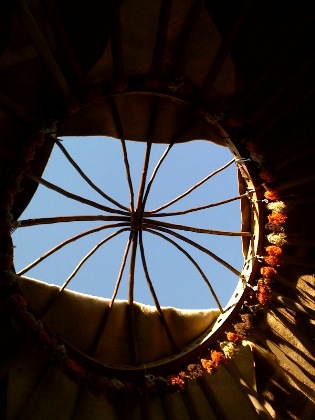
Lisa took the photo at left of the opening in the top of the yurt surrounded by decorative tassels.
The opening provided good lighting  and air circulation and made the yurt a very exotic and comfortable spot in which to weave.
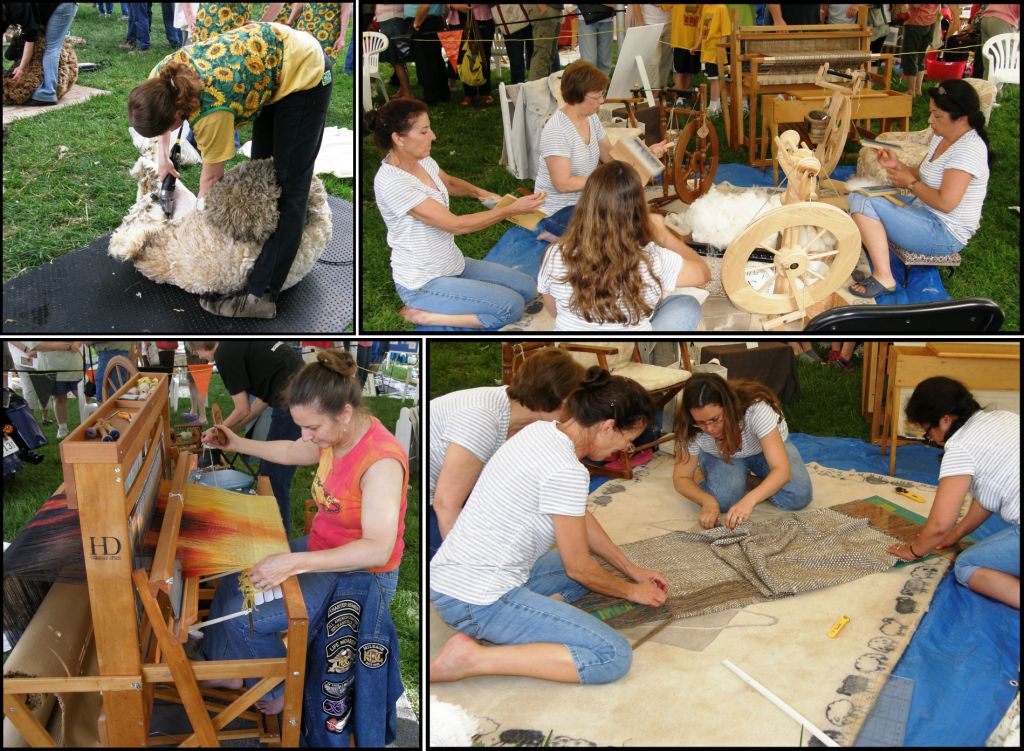
I stayed that night at Claudia’s place where we rehydrated and planned day two – up and out early to catch the start of Sheep to Shawl. I had never attended one of these before and it was very entertaining. Apparently the first Sheep to Shawl was held in England as far back as 1811.
Probably one of the more unusual groups was the Harley Davidson team dressed in denim with motorcycle and spinning wheel revved and ready to go. Their warp was patterned in orange flame colors and they spun and wove to “Born to be Wild”.
If “Born to be Wild” wasn’t to your taste you could listen to some good old Australian bush and shearing ditties. I enjoyed hearing some of those old tunes and they attracted other Aussies to the stage.You can see the winning Bronson lace shawl at right woven by a group wearing colonial-style costume.
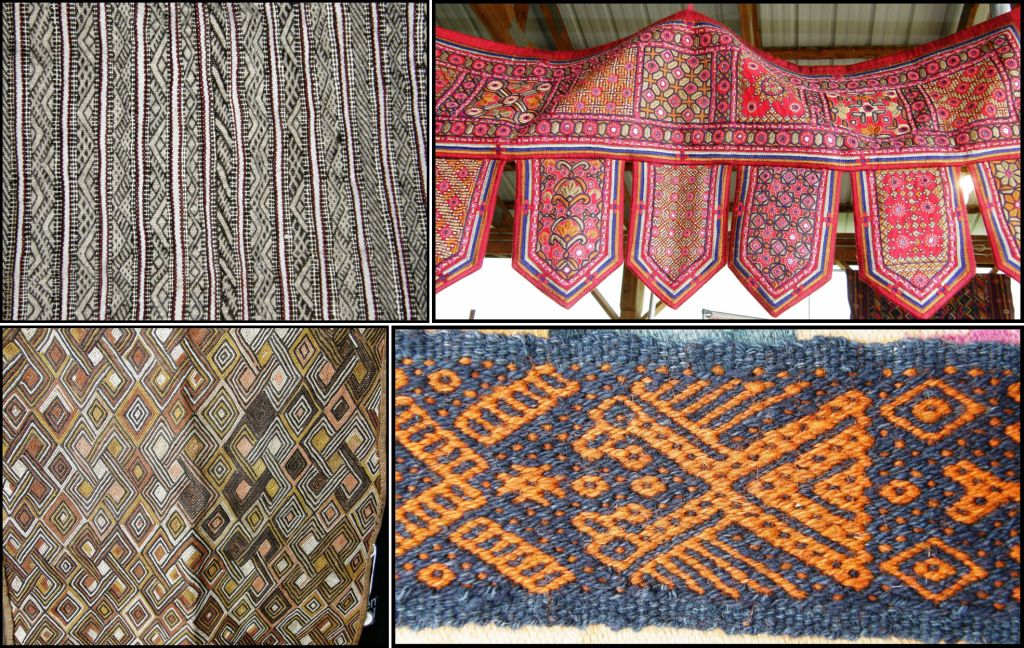
From Sheep to Shawl I headed to the vendors’ halls where I was captivated by a stand of ethnic textiles from around the world. I particularly like the black and white Moroccan textile upper left which is several bands sewn together. I would like to try to reproduce some of those designs. The band lower right is Peruvian from another stand and is woven in Andean pebble weave – some nice motifs to add to my collection. I think I revisited the ethnic textile stand four more times – definitely my favorite.
Then it was time to prepare for the Weavolution meet up and backstrap demonstration.
Although attendance in general seemed to be less on day two of the show, I had a bigger audience at the backstrap demo the second day and the slightly cooler temperature made it a whole lot more fun.
I told you in my last post about the charming English gent I met at Sheep to Shawl and who later came to my demo. I am sure that you have all worked out by now that that was Rodrick Owen.
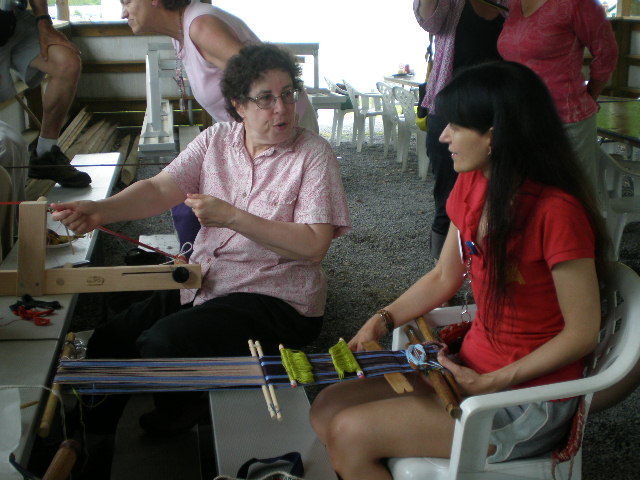
Having seen my band on the inkle loom on the previous day, Carla Gladstone brought her own inkle loom along at my invitation for a pebble weave class.
Mary Pflueger of the Weavers Guild of Greater Baltimore also brought along a warp and set up to backstrap weave and learn pebble weave.
We had a pleasant afternoon weaving. I had seen pretty much everything I wanted by that time and so was quite content to hang out at the meet up point and chat to these two ladies. I was happy to see Rodrick Owen and his friend Terry Flynn return after lunch to chat with me about Andean sling braiding and one of my favorite weaving authors, Adele Cahlander. I got to show him one of the braids that I learned from a sling maker in Peru. We also chatted about mutual acquaintances in the Santa Cruz Guild in California. Ingrid, your name was mentioned more than once!
A visit from Roderick Owen, master braider, pictured below with Mary on the left and Terry.
And all good things must come to an end. At left you can see a rather empty stand at The Spanish Peacock. I left a somewhat shell-shocked Mike out of the picture! Only these kids still had enough energy to leap and dance at the end of the day as musicians and stomping puppets entertained them.
I lingered in Maryland a few more days after the show staying at Claudia’s home. Claudia had some friends over for a day of backstrap weaving. One lady brought an inkle loom on which to learn Andean pebble weave.
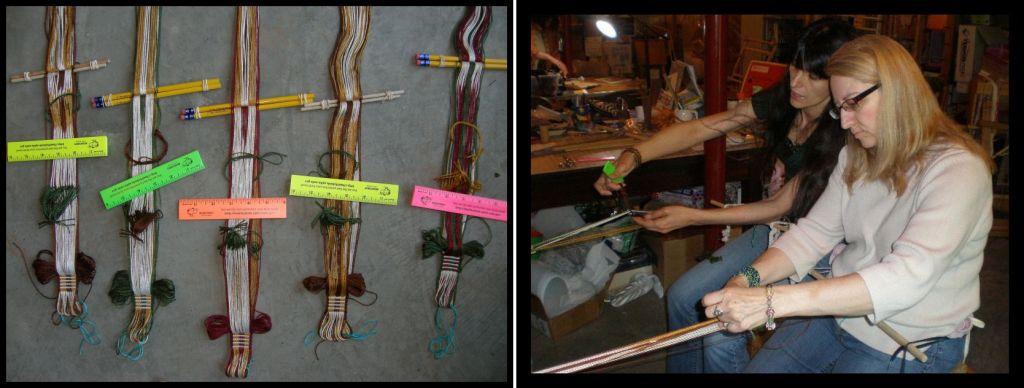
Some brightly colored freebie rulers that I picked up at the Maryland Show made excellent improvised beaters. Claudia has an enormous basement studio with plenty of places to tie up looms. We wove simple warp float patterns. Above, I am showing Carol (aka Retrothreads on Weavolution) good heddle opening technique to avoid abrading her warps and having them pill.
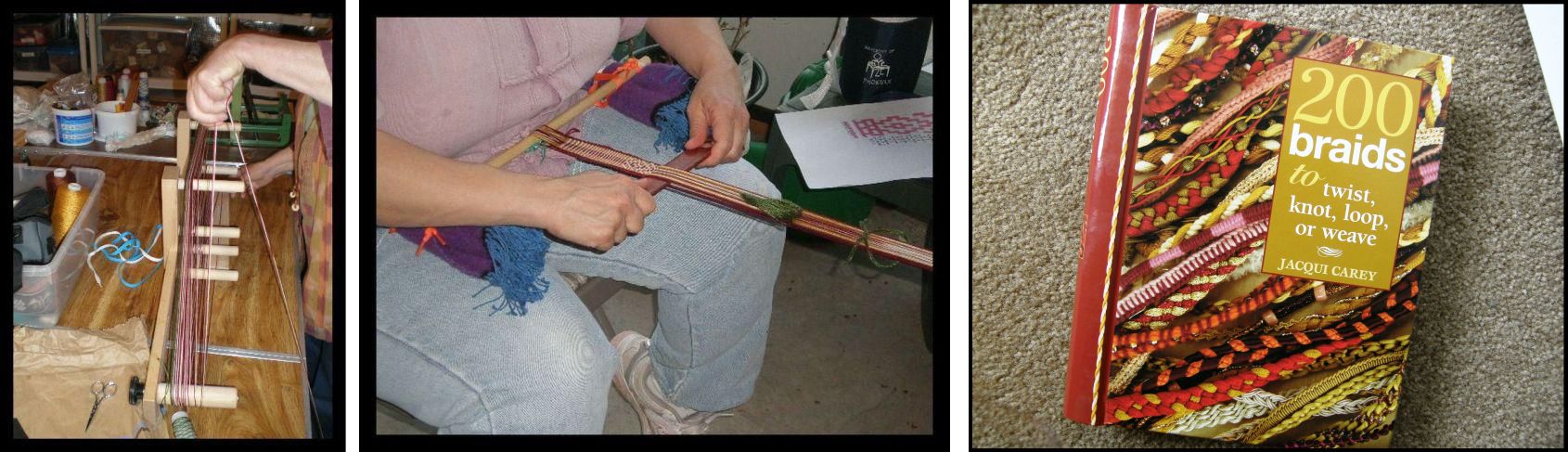
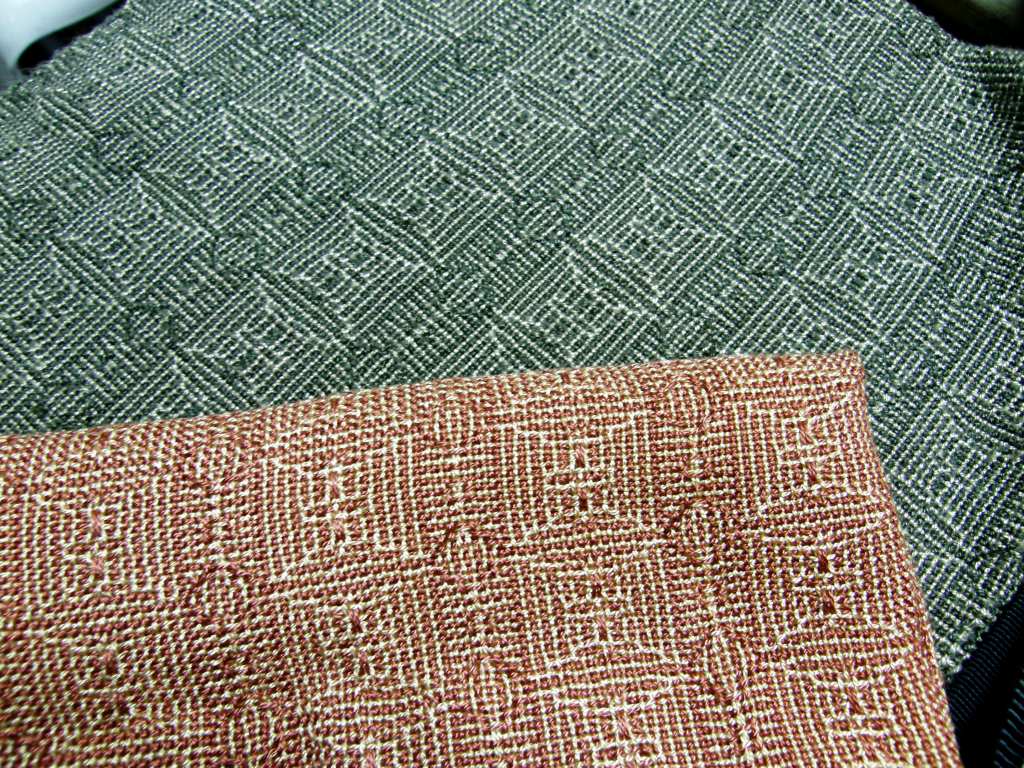
Kim aka Clay2Yarn on Weavolution came along bringing her energy and good humor too and wove simple warp floats. She brought me a gift of the Jacqui Carey braiding book!
Mary with her first ever pebble weave band woven on a backstrap loom
Claudia, Janet and I went to a meeting of the Weavers Guild of Greater Baltimore where Claudia gave a presentation on Weavolution.
Mary Pflueger, who had woven with me on Sunday at Sheep and Wool, attended and  brought along her completed pebble weave band to show me.
I gave a backstrap weaving demo and got to show off Mary’s band too. I just love knowing that my e-monograph is being put to use and that people are enjoying the technique and producing things.
The guild members were fun and very welcoming folks and we had a great evening. I had already met some of them at MSWF and it was nice catching up again.
This was the first weaving guild meeting I had ever attended…sigh! Wish we had these back in Bolivia – so many talented people all in one space!
Rush, rush, rush…the next day I took the train back down to North Carolina to my friend Lisa. We had a trip to the family beach house on Oak Island planned for the weekend.
Quite a change of scene! But…have sticks, will travel…while the guys played in the surf I continued my pebble weave project on the inkle loom and Lisa sat spinning. I don’t know how she managed as there was quite a stiff breeze blowing which is what kept us out of the water. Elderly folks were jogging, cycling and walking their dogs while we two crazy gals sat with our fibery projects. I even got a bit of a tan.
Here, there and everywhere….backstrap weaving on the porch of the beach house. Lisa started a jajim-a Central Asian textile- last year in the summer but had to put it away as she has nowhere to weave indoors. Now it is back out again as the weather warms up and she can once again weave outside.
Now we are back in Lincolnton and time is running out. One more backstrap weaving demo at Lisa’s local weaving guild gave me an opportunity to see Betsy’s gorgeous tencel shadow weave pieces.
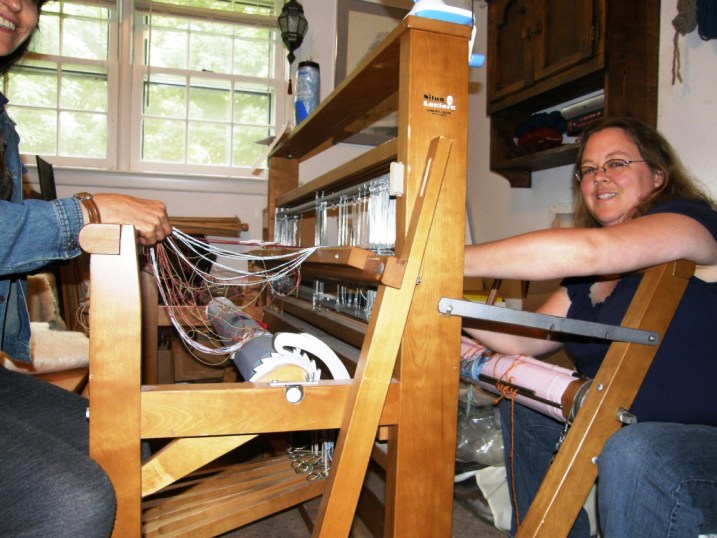
Just when I had convinced myself that shadow weave needs four colors to work well, I see Betsy’s two stunning pieces in two colors. To me they have a certain oriental look about them. I find shadow weave fascinating!
I have now been away from home for over a month and am starting to feel a bit weary and a tad homesick too. As I have decided to come back for Convergence, my new catch phrase is…”I’ll do that when I come back in July”. So the felting, cut pile weaving and other projects have been added to a long list of things to get into on my next visit. However, one project demanded immediate attention…

ANDEAN PEBBLE WEAVE ON A FOUR-SHAFT LOOM
Lisa and I are warping buddies here as I pass the warps to her to be threaded through the heddles.
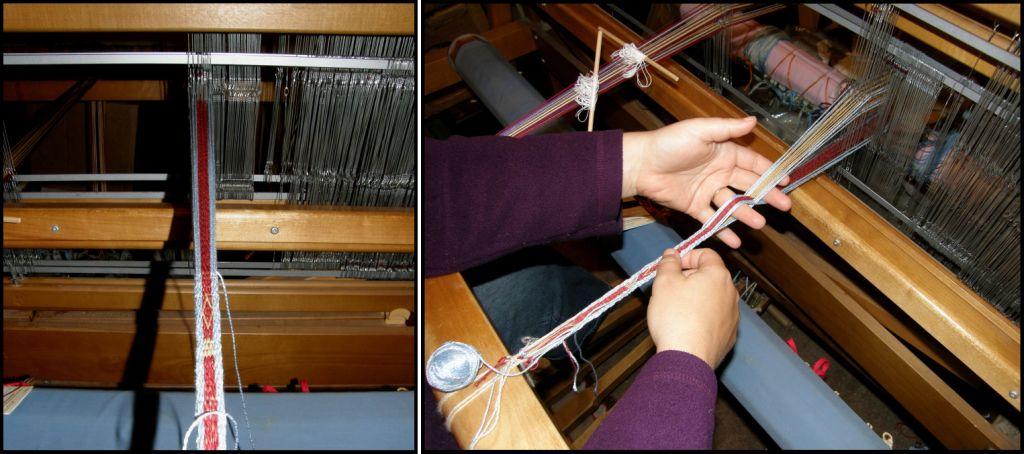
I have this all figured out now and Lisa and I re-warped her four-shaft six-treadle loom with a tiny sample band, this time using all four shafts with no string heddles and, once again, with the reed removed.
I can weave plain pebble weave on this loom using the shafts. Of course, when one wants to form patterns, the warps must be manipulated by hand for every other weft pass. As I mentioned in my last post, the thing I love most about this loom is the beautiful wide clean sheds it creates with a twiddle of the toes!
Maurice Blackburn came over and put my rough draft into his computer program and showed me how to do the notation for the tie ups. I have had little experience reading the classic weaving drafts and needed some guidance. Maurice kindly came to my rescue.
I intend to add this as an appendix to my e-monograph Andean Pebble Weave and am extremely excited about it!
LEFT: The tiny sample band underway with some simple motifs. RIGHT: Preparing to pick up warps by hand to form motifs
Jennifer Jordan was one of the first people to contact me and tell me about the bands she has been weaving in Andean pebble weave following the instructions in my e-monograph. This is a photo of her second project band and she certainly seems to have gotten the hang of it. Thanks to Jennifer and all the other weavers who have contacted me so far.
The other project that simply couldn’t be put off until July was pinning down the kinds of yarn that are suitable for warp faced weaving on a backstrap loom and readily available in US stores, like Michael’s and Joanne’s.
I have bought examples of four different brands – all crochet cotton –  and will be providing photos and more information soon.
I am leaving this until I get home so I can weave bands with them and see how they perform.
 

With lingering thoughts of the sea, I am heading home to landlocked Bolivia.


Tomorrow, (Wednesday) I will be attempting to fly back to Bolivia. I say “attempting” as I am traveling on a standby ticket and it seems that I may get stuck in La Paz along the way.
Well I can think of a lot worse places for a forced stopover. I haven’t been to La Paz for quite some time now and it is a textile lover’s paradise!!

So…have sticks, will travel. The next place my backstrap loom gets tied up may be at 4000 meters somewhere in La Paz. I would really like to get this demo piece finished, off the loom and made into something useful.
And I would really love to get back home and settled and put some more tutorials together for this blog. My head is full of plans.
A big, warm thank you to all my new friends in the US who made this trip so memorable and amazing. I hope we continue to meet and interact online. 🙂 My next visit will be in July in New Mexico for Convergence!
STOP PRESS………….
Wednesday evening…here I sit in Miami airport at the gate waiting for my flight to Bolivia.
I am not very optimistic about my chance of getting on this flight and I have blanket and pillow on hand and  my eye on a good piece of floor on which to pass the night. More importantly I have a good supply of chocolate!
Now what do you think has just appeared in my inbox?…Lisa has leaped back onto the four-shaft loom since my departure this morning and, after a wee false start, is weaving this lovely Chincheros motif from  my Andean Pebble Weave monograph.
She is still working on the original warp that we set up on the four-shaft loom with string heddles as she doesn’t want to waste it.
Woo hoo! I am so pleased!!


Backstrap Weaving- Madness at Maryland Sheep and Wool Festival

MARYLAND SHEEP AND WOOL FESTIVAL – MAY 1 AND 2


Backstrap weaving at the Weavolution meetup on Sunday. I got to meet a lot of the people behind those avatars and user names. It turned out that the rabbit building where we all met up was one of the coolest places in the whole festival.

You may remember a few weeks back when I was still in Bolivia and packing all my “on the road” crafting bits and pieces for this trip, I said that if I didn’t get my Friday blog post out, that meant that I was having too good a time. Well it finally got to me. Waaaay too much fun and craziness at the Maryland Festival combined with a stay with my friends Claudia, Janet and David from Weavolution in Montgomery County, a ten-hour train trip back down to North Carolina and now packing for a weekend at the beach means that I can only give you a mini post this week and a hint of the good things to come.

I had fun backstrap weaving on both days and my wallet came out quite unscathed – I only bought a dvd. But I had plenty of time to watch the Sheep to Shawl, wander the vendors halls , pet the animals,  take photos and meet and talk to loads of interesting people.


Meeting Sharon aka Thelmaweaves at Weavolution with Deb McClintock in the background.
I wove some pebble weave at the show on my backstrap loom and also took a sample on an inkle loom that I had woven in the car on the way up to Maryland from North Carolina. I don’t know who took this shot – a lot of people have sent me pictures and I thank you all.
The rabbit building was cool but this was THE COOLEST PLACE at the festival. I tied up my loom and spent the afternoon weaving in a yurt. The felt was great insulation, I had beautiful skins on which to sit and some cool grass for my toes and the opening in the roof aided good air circulation. Here I am shiny faced and slightly bedraggled after a day in the heat but having a ball!

Now I must leave you or this mini post will turn into a small novel. I am about to go out and plant a herb garden with Lisa. Before I do, I would like to leave you with a little story and a teaser until I can write my complete post next week.

While watching the Sheep to Shawl – my first one ever on day two of the show, I climbed up onto the stage to get a better view of the shawl judging. Along came a charming English gent who said that he envied my lofty position from which to take photos. Well, I just told him to come on up where he spotted the inkle loom I had slung over my shoulder with my pebble weave band and we got to chatting. I invited him to come and watch my backstrap demo at noon, he assured me he would and we parted.

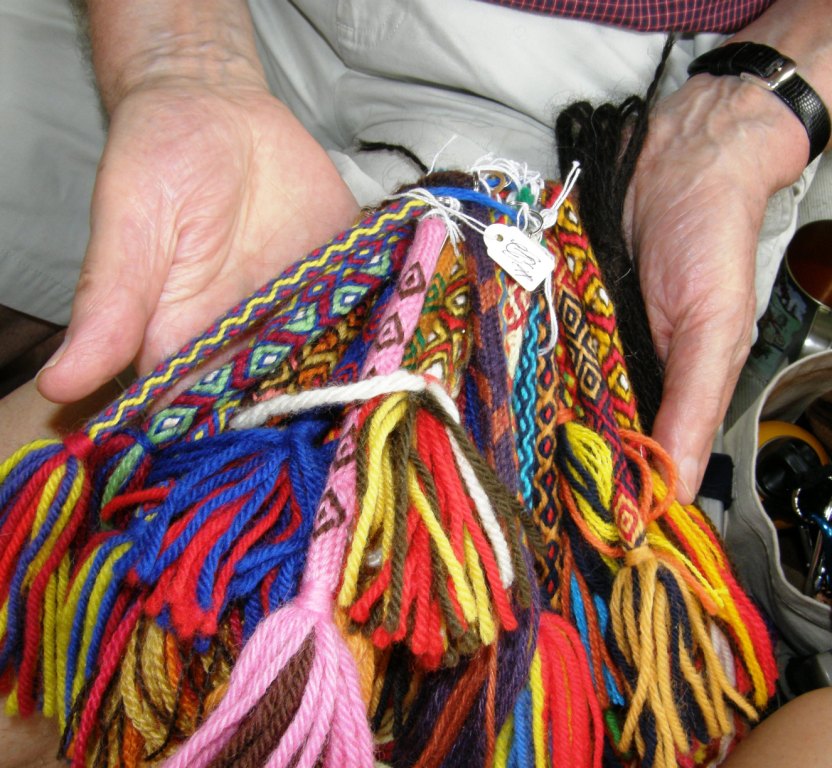
I was in full swing at the demo setting up my loom and getting ready to weave when my new British friend sat by my side and then presented me with a beautiful braid that he made from fiber he had picked up at the show…and then he showed me these…

So, have you guessed his identity? I’ll give you another clue…he was recently the subject of one of Syne Mitchell’s Weavecasts….

Speaking of Syne Mitchell and WeaveZine, my e-monograph has been selling well and I have already met a bunch of people here who have bought it and are using it. I will be writing with some yarn recommendations for backstrap weaving in my next post following very useful feedback I have had from some folks..

More about my encounter with my new braiding buddy and a bunch of other MSWF antics as well as some pre-and-post-festival fiber fun soon!

We are off to Oak Island this weekend. I am looking forward to dipping my toes in the Atlantic, eating shrimp, inkling in the car and backstrap weaving on the porch of the beach house. Next week we are going to try out my theory for getting Andean pebble weave onto the four-shaft loom – I have got it down on paper and am dying to try it.

See you then! 🙂