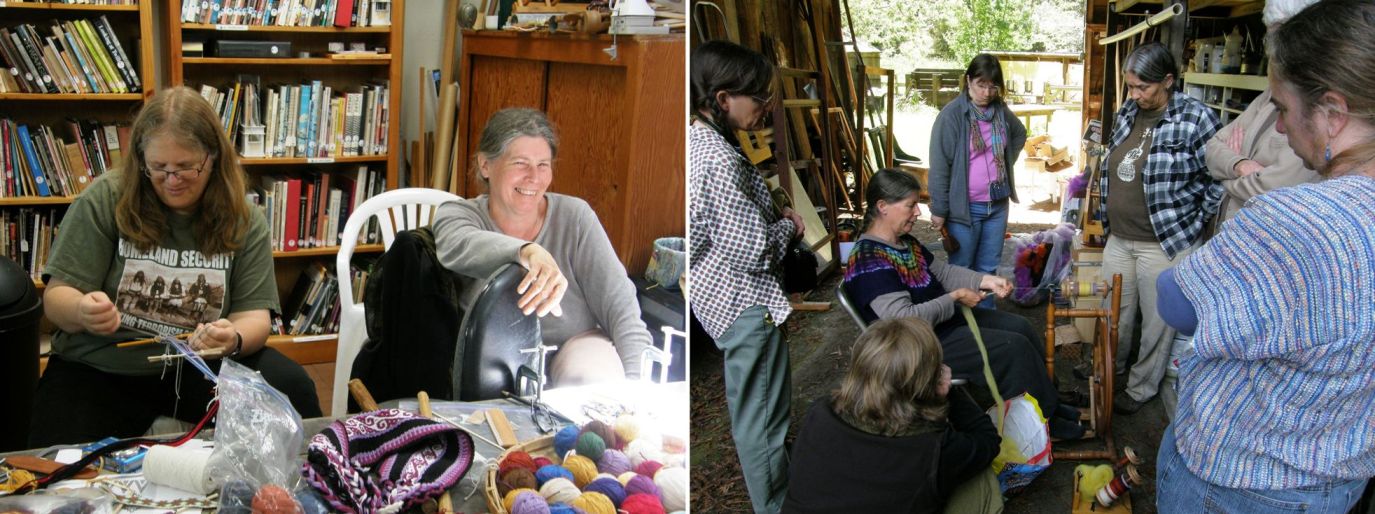
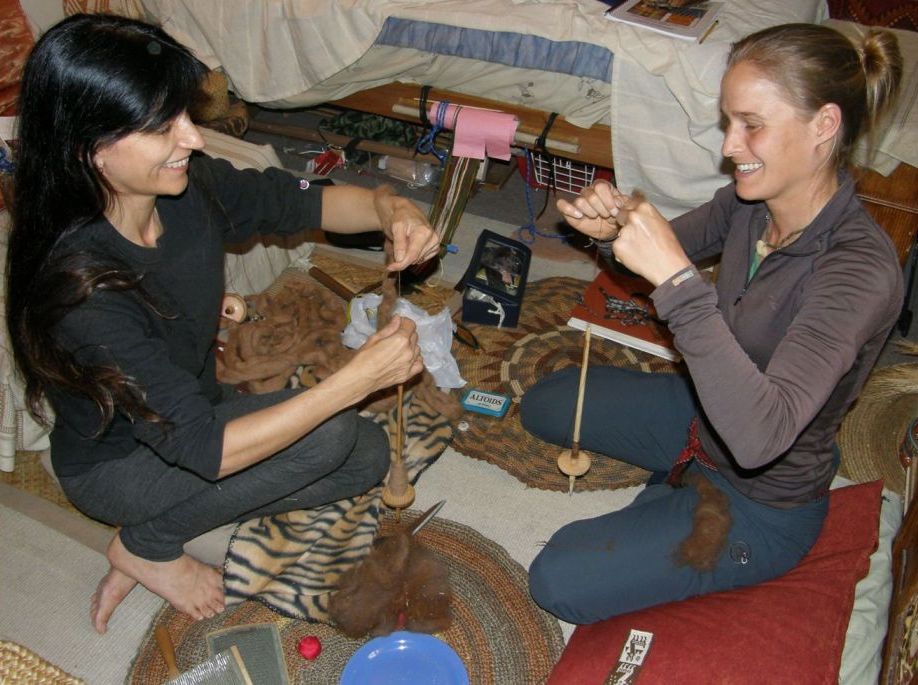
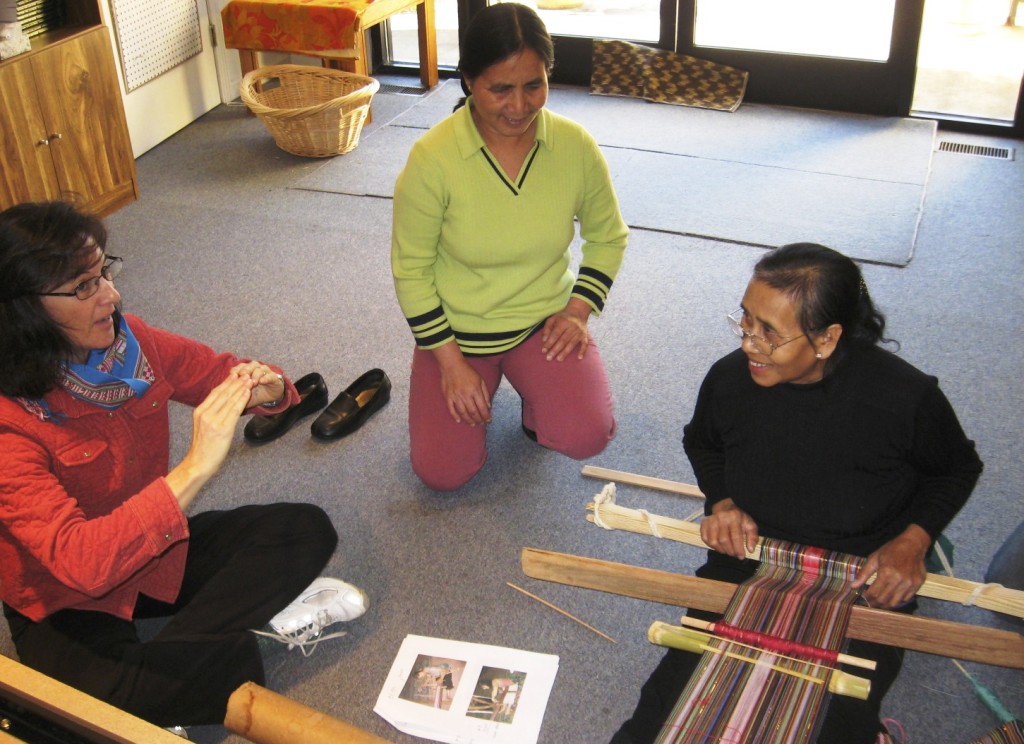
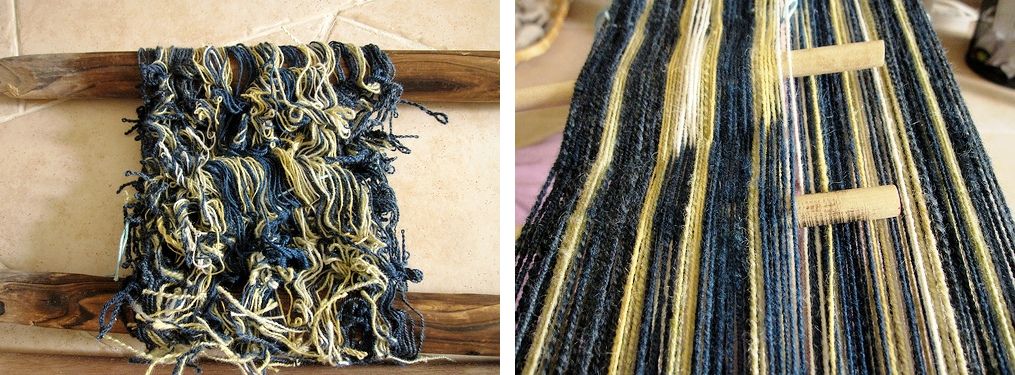
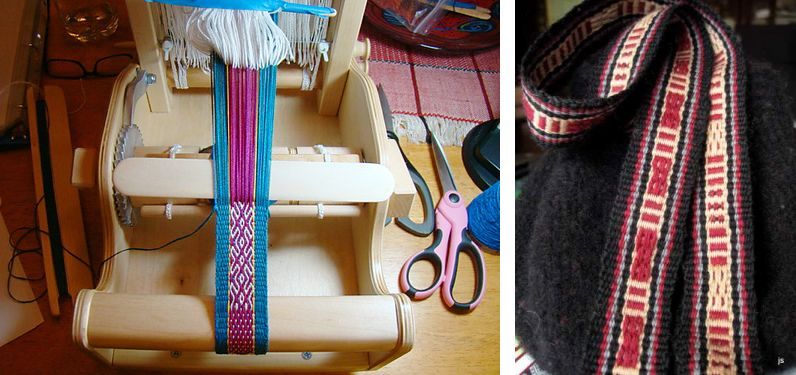
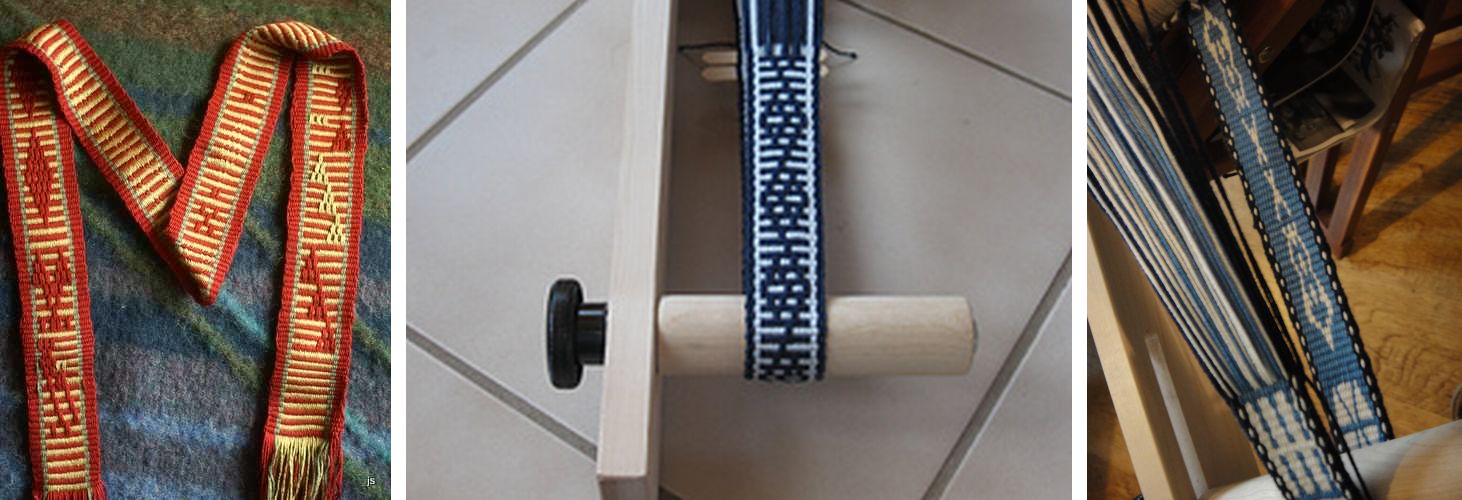
I am up in Humboldt County still on my friend Janet’s beautiful farm. Online friend Cookie has just arrived for the backstrap weaving gathering we are having in Janet’s mill tomorrow.
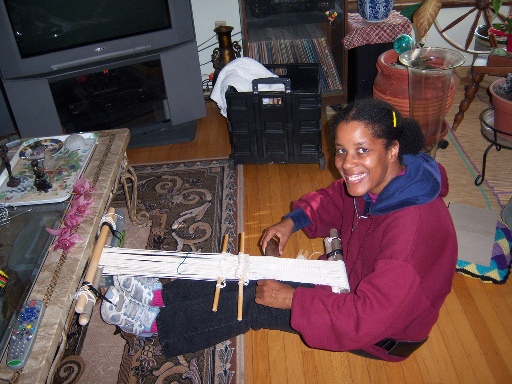
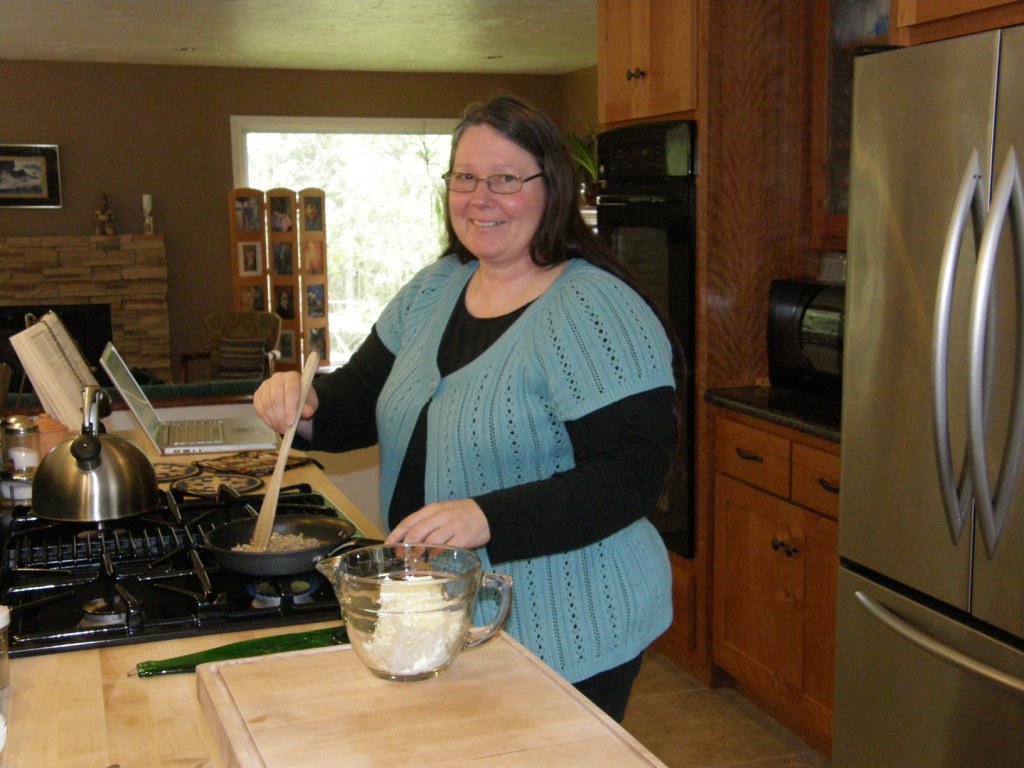
I first met Cookie in the Backstrap Weaving group on Weavolution and lately she has been active in the group on Ravelry. She posted a great picture some time ago of herself at her backstrap loom which she allowed me to post on this blog and it is great to meet her in person.
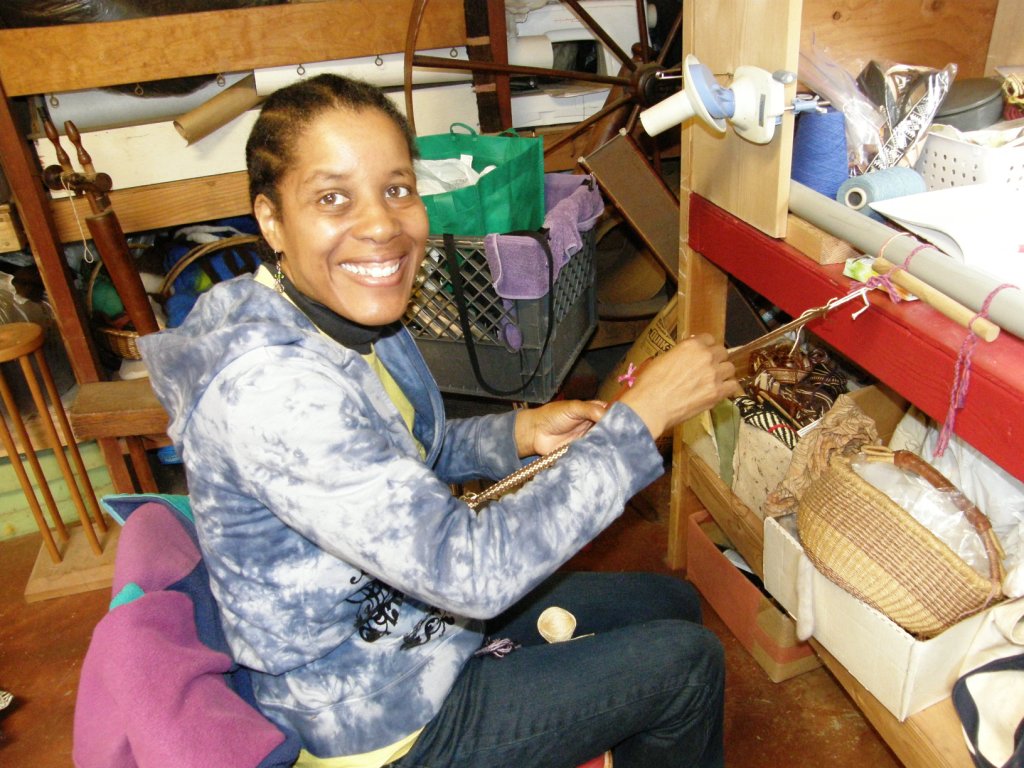
There she is making her backstrap which she has brought along to weave with tomorrow. As I type, Cookie, Janet and I are watching Abby Franquemont’s Respect the Spindle video which can be downloaded from Interweave until Monday for only 10 cents! Cookie had a long drive up from the Bay Area and is feeling tired and cold up here so we will save the rest of the video for tomorrow.
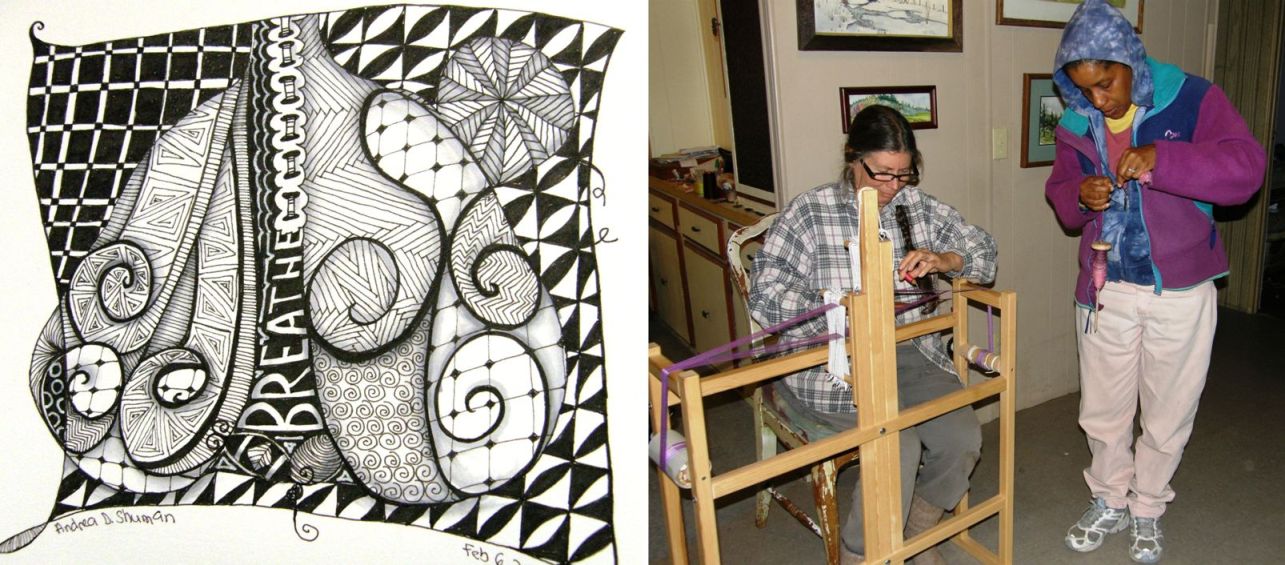
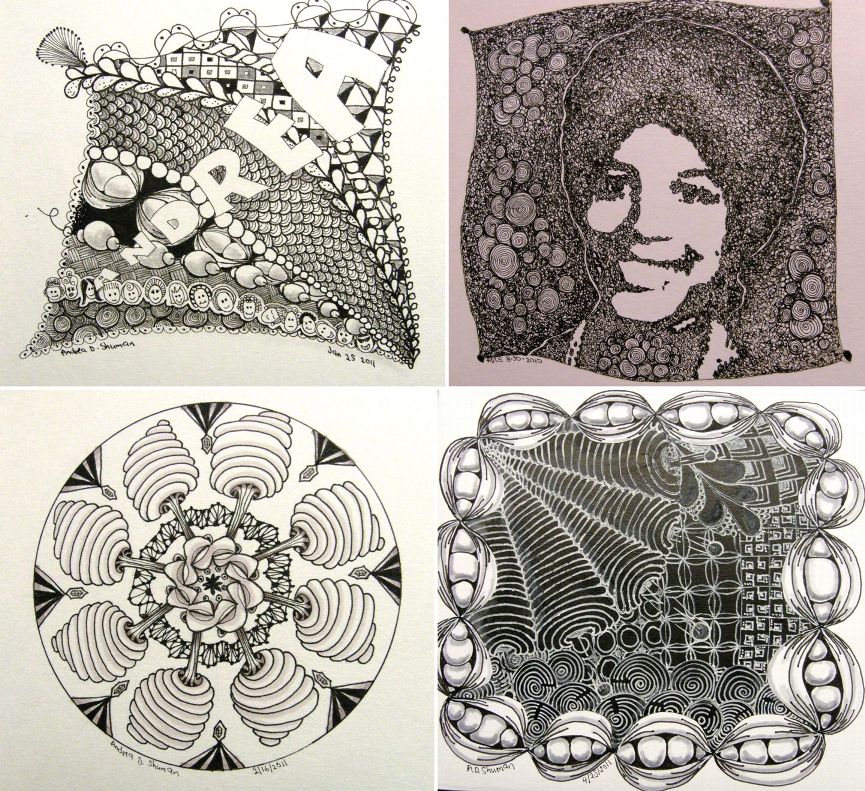
Janet spent the evening weaving a fine silk piece on her Glimakra band loom, Cookie spun silk (looking cold!) and I edited photos for this blog post. Cookie shared her most current passion, a style of drawing called Zentangles. I had never heard of it before and she has a whole book which she bound herself full of these fine black and white ink drawings that she has done….very cool. One is a self-portrait.
So, tomorrow Janet’s neighbors and friends will be over to weave and a decision had to be made…
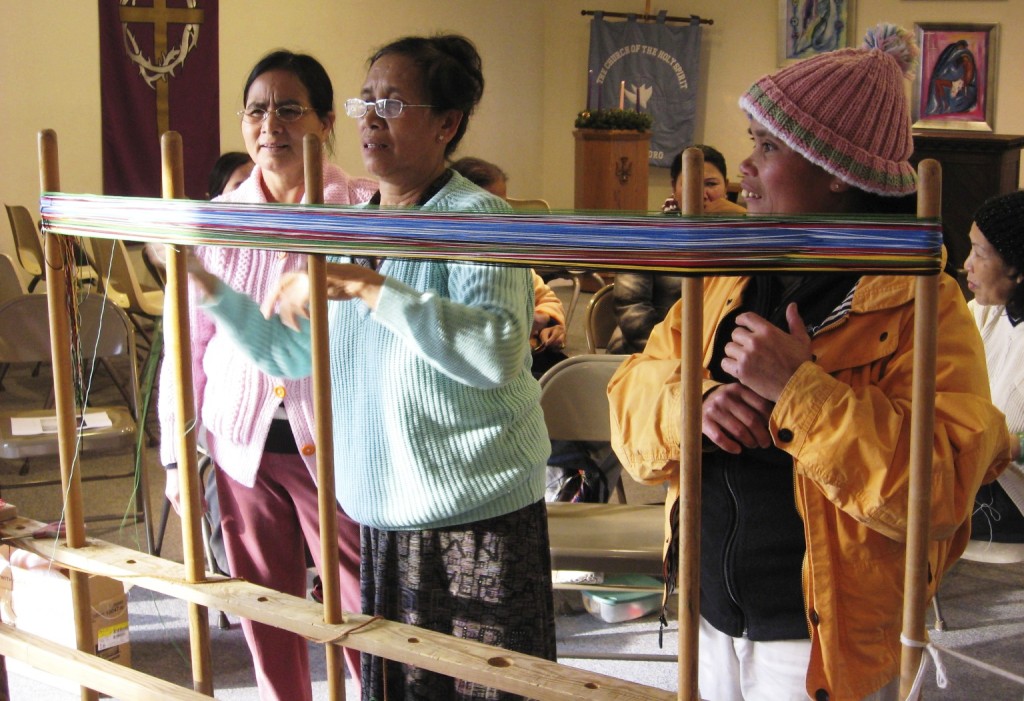
…where to weave? Last week a short wave of warm weather had me out on the porch tied to one of those posts enjoying the view but the temperature is going to drop to 30 degrees Farenheit tonight so I guess we will be indoors where Janet has just as comfy a set-up in her warm mill among all the lovely woolly smells. A long piece of pvc pipe wedged behind uprights on her shelves will be our hitching post. And then there is always this monster…
Last weekend we had eight weavers comfortably hitched to a big floor loom like the one above. We will be warm and toasty in there with the heated floors surrounded by bags and bags of the luscious roving that Janet’s mill produces.
So we pottered about in the mill today setting up for the group finding little hidden treasures to play with here and there…
Janet showed me her charka made by Alden Amos. What a piece of handmade work that is. Apparently he even bends the wood himself to make the wheels. And there is a spool of Janet’s amazingly fine handspun cotton perched on top.
#############################
Flashback to last week….friends gathered at Becky’s for some backstrap weaving.
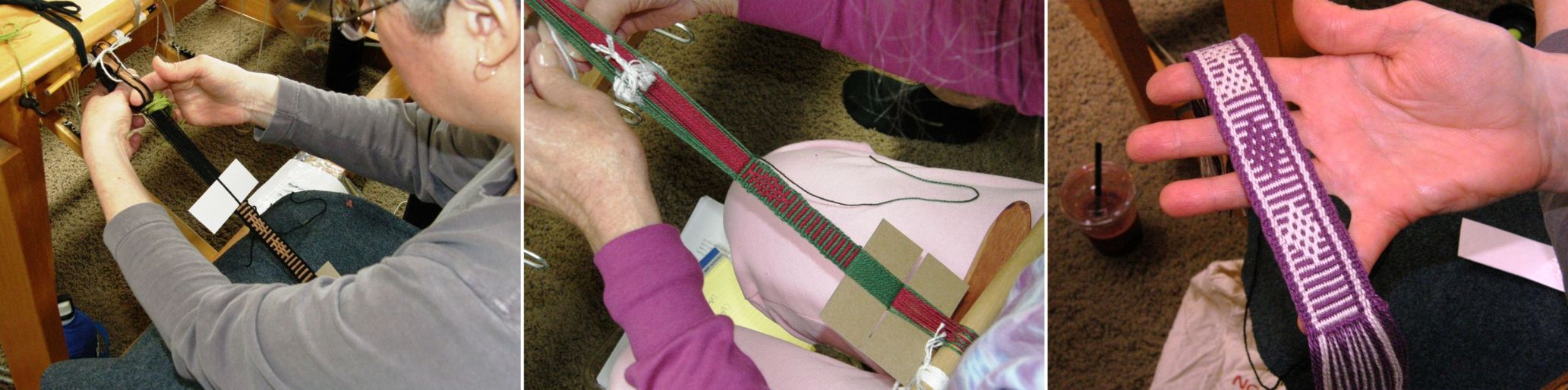
Eight weavers having fun tied to Becky’s floor loom.
Silent concentration .
Getting the hang of it, some people can look up and smile, although Kirby doesn’t look too sure yet, before returning to silent concentration. No room for me to tie and weave.
Smiles at ”hey I can do this!” Now we can weave and smile and chat and relax. Olympia found the floor her ideal spot. Teresa had a cushioned seat while Laurynda felt more comfortable standing.
We warped out on the deck. It wasn’t really t-shirt weather although Kirby seemed to think so.
Becky baked muffins each day, prepared lunch, kept us supplied with snacks and drinks and just took great care of all of us. She didn’t weave with us.
Over dinner on the first night I asked her about her own weaving and she pointed to a shadow weave blanket that was draped over the sofa just visible from the dining table. I told her how much I wanted to weave shadow weave and how I had fallen in love with a particular piece that had been posted on Weavolution some time ago the draft for which I had been trying to obtain. I had stalked the maker to her blog so I could tell her how much I loved her work and had manged to get the book reference for the piece.
Can you guess the end of this story? It turns out that the maker was Becky and the piece on the sofa was the very one I had been admiring online. What are the chances?! Now I will show it to you and you will see why I love it so much….
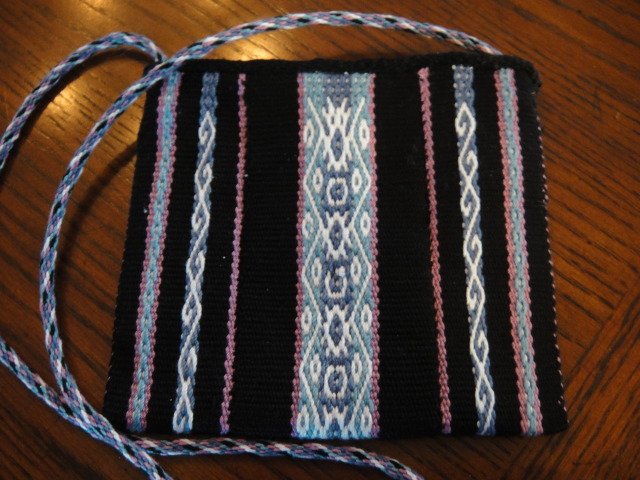
This little scrap at left is my one and only attempt at shadow weave so far…a four-shaft sample which I wove on my backstrap loom with string heddles and which I made into a sewing kit purse.
One of these days I just might attempt Becky’s eight-shaft piece if I ever get my head around the draft. The book she showed me uses a notation with which I am not familiar at all.
But, back to the warp faced weaves we were doing in our group…
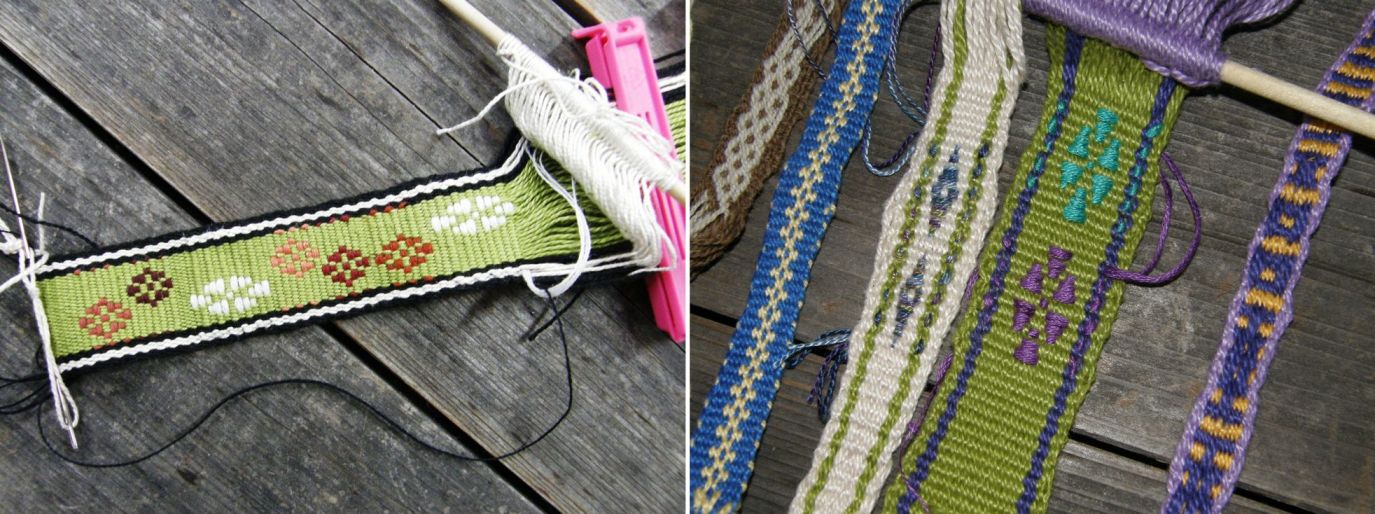
We played with simple warp floats. Pictured above are some of my samples. Thanks to Annie for allowing me to use this picture that she took.
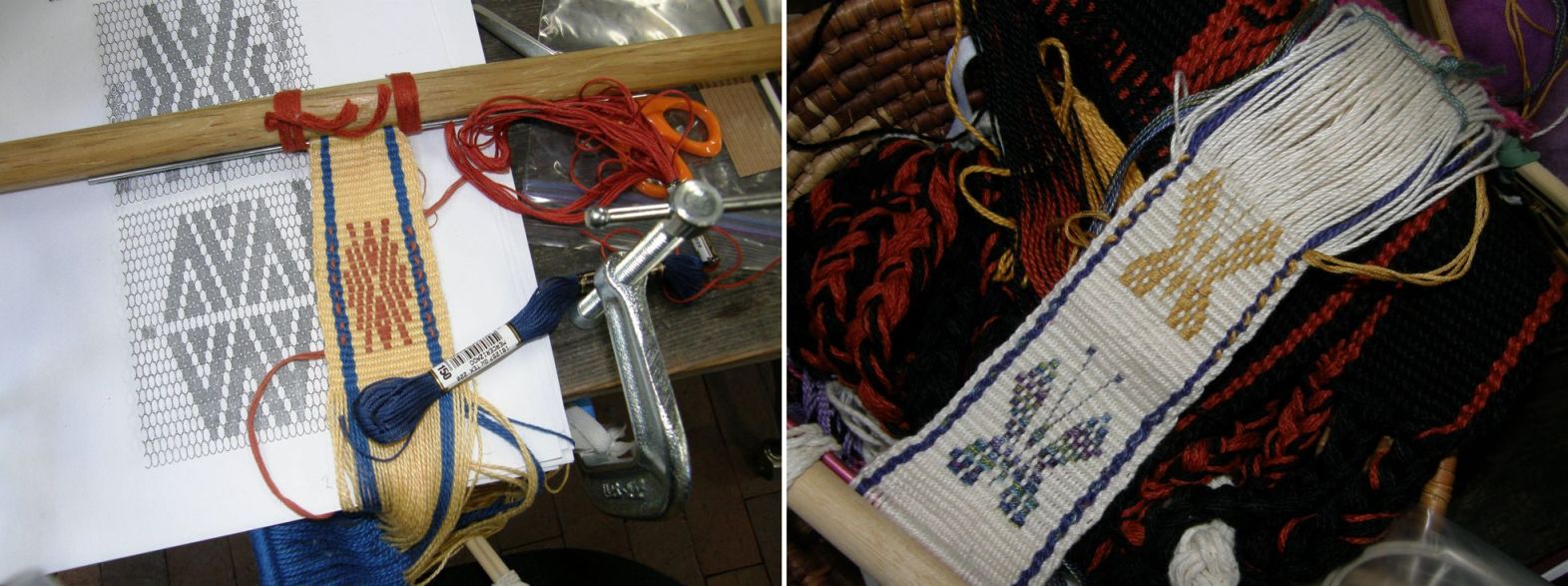
We also dabbled in some supplementary weft patterning which you can see below…
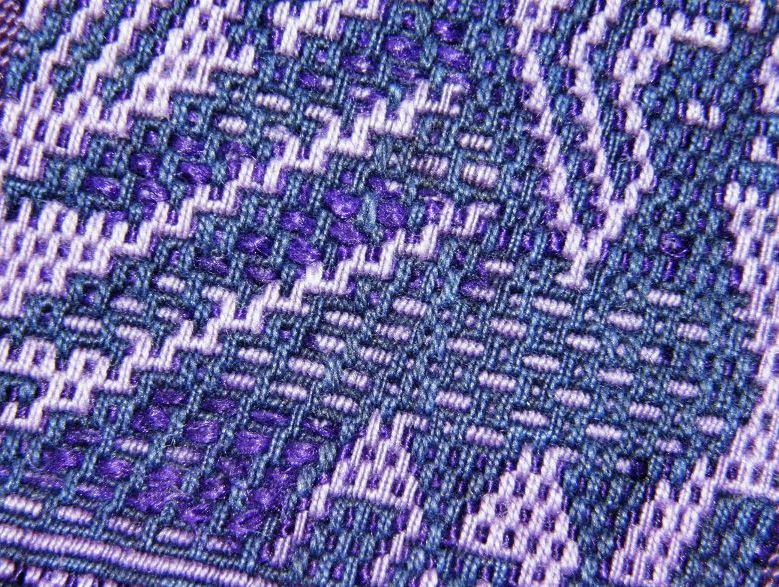
And a real treat for me was seeing a belt that Susan brought that I am guessing is from Mexico.
This is something I have never seen before and I am pretty excited about it. The belt is pretty old and worn and is patterned with two-color simple warp floats in much the same way that the Central Asian yurt bands that I studied and reproduced are. This alone was exciting to me as I love to get new designs to use in that technique.
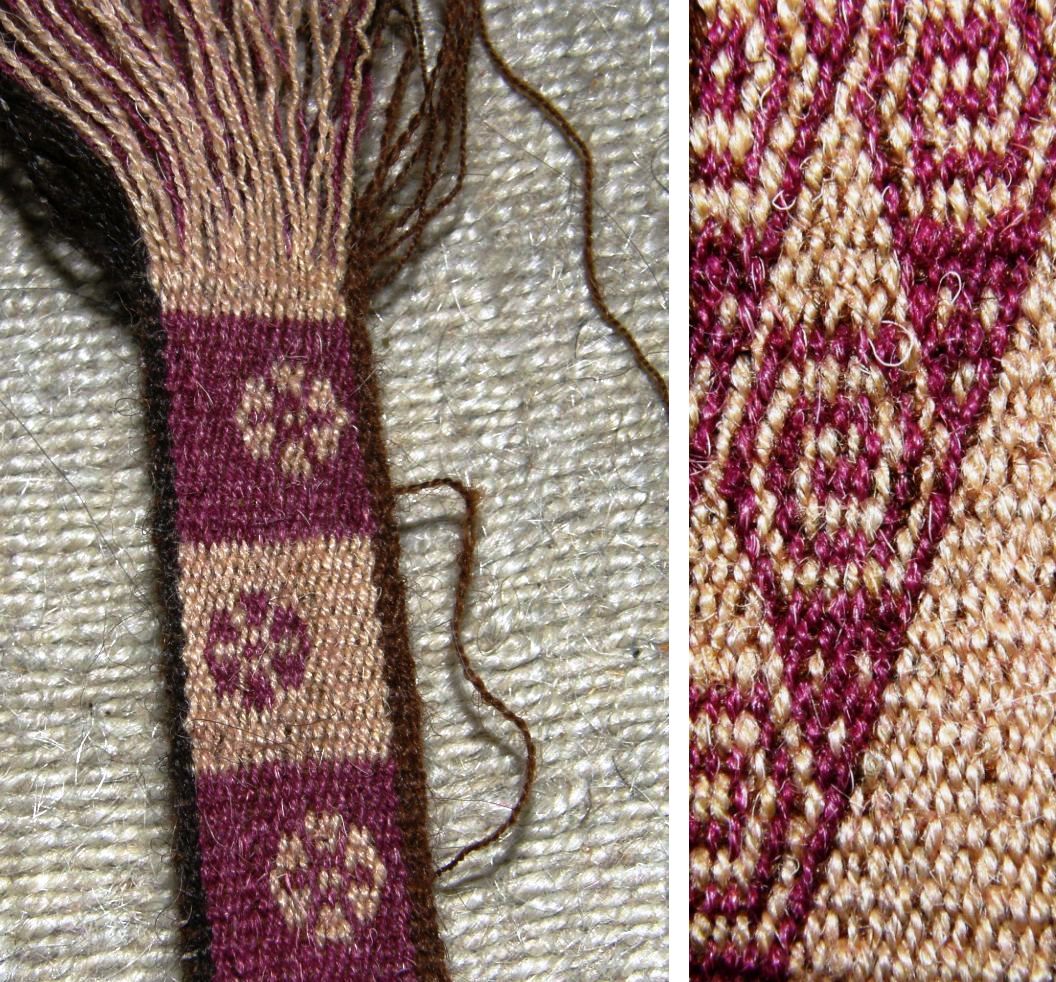
But what was far more interesting was that we could just make out the remnants of what had once been supplementary wefts under the warp floats. The supplementary wefts must have been made of a material that had deteriorated far faster than the rest of the material in the belt.
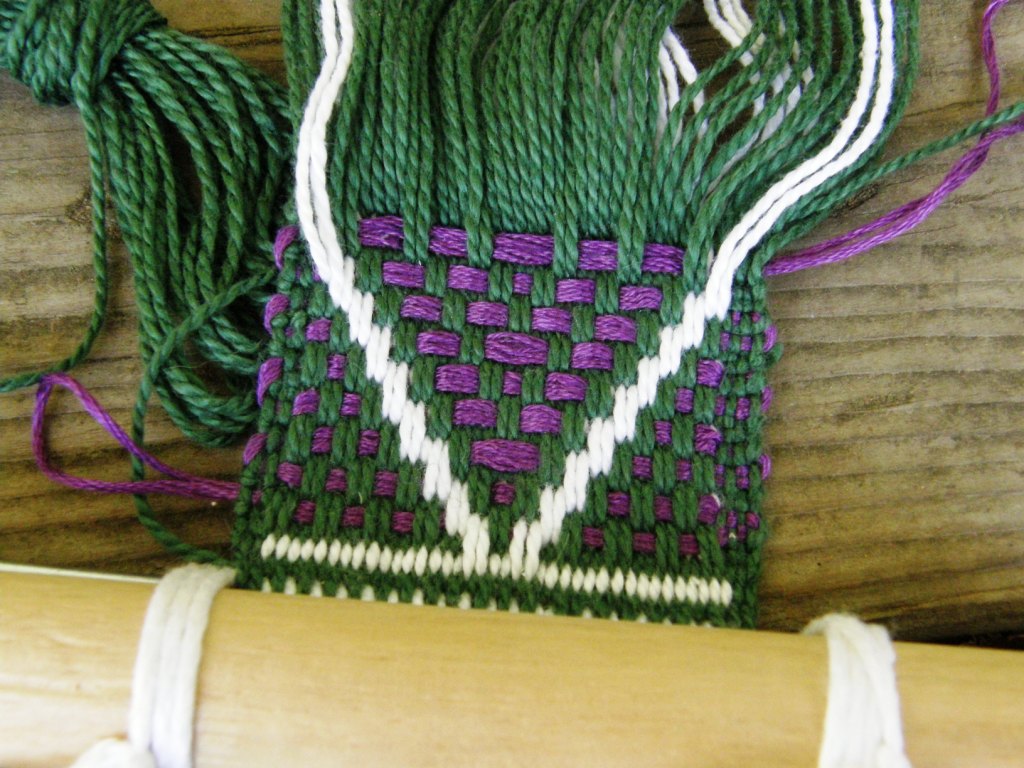
In the picture above you can see the warp floats in green and white with purple supplementary weft which it seems was intended to cover over the white horizontal bars many of which are now exposed due to the deterioration of the weft.
What a neat idea and what fun that we just so happened to be weaving both techniques in our group.
Above left you can see one motif on the belt. Almost all the supplementary weft has disappeared from the central diamond. Actually I really like the way it looks with the two-color floats on the sides and the exposed horizontal bars in the middle and I would like to weave something just like this. However, it seems that the original intention was to cover up those bars with the purple supplementary weft.
You can see remnants of the purple weft in the larger picture on the right. It is still intact under the green floats…you can just see it peeking through.
You can see my attempt above to weave something similar to that central diamond outlined in white today. I am not sure if I have gotten it right and it needs some work and adjustment but I am looking forward to playing with this more when I get back to Bolivia.
If anyone out there has a belt like this, I would love to see it.
Other cool things that were brought to the gathering…
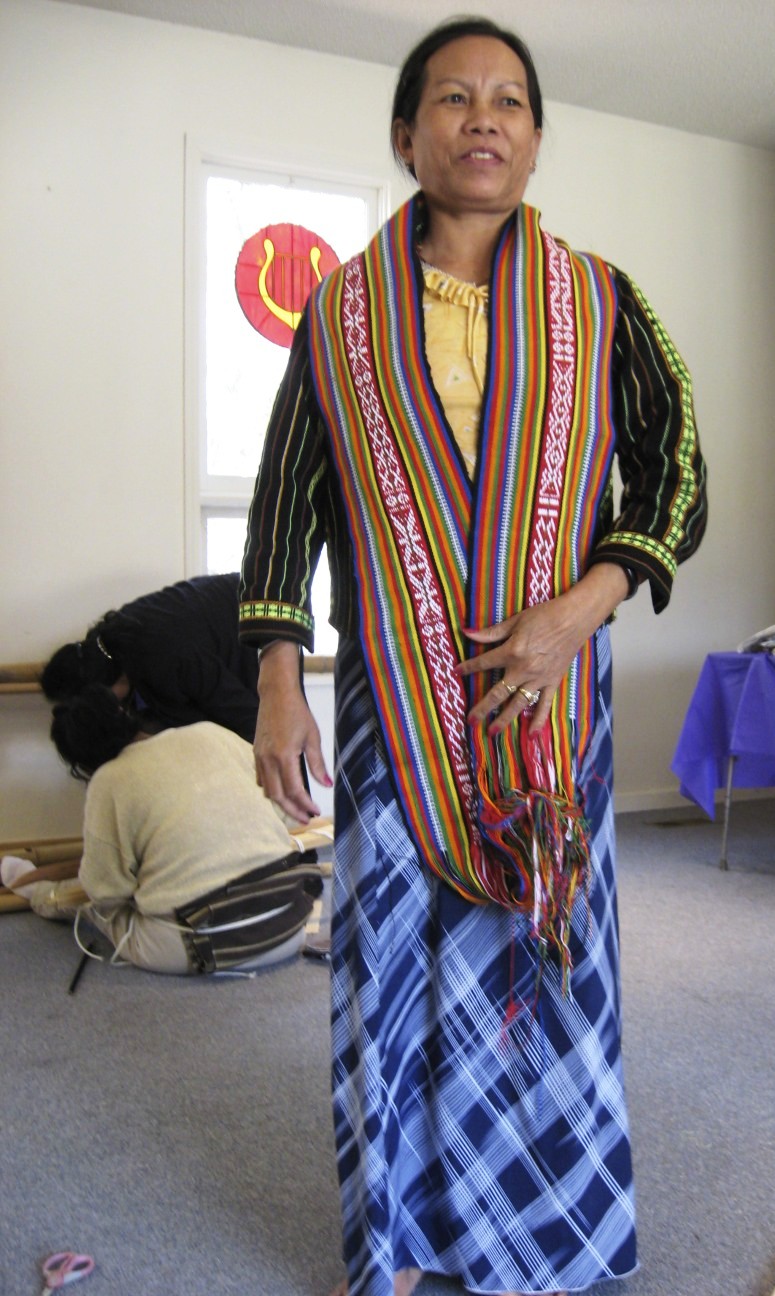
This beautiful skirt was brought by Teresa. Her son had purchased it in Vietnam and I was happily able to identify it as Bunong after having seen something very similar when I was visiting with Betsy Renfrew and the Montagnard weavers in North Carolina.
Linda Hartshorn brought this gorgeous piece from Chinchero, Peru still on the loom which she had purchased on a visit there. She also bought the ruki, the llama bone tool used for beating and a backstrap made from a woven band with tubular bands used for ties.
We also got to see this piece on its beautifully simple loom with just a shed rod and string heddles. Janet says that the main fabric material is linen. It is a balanced weave with supplementary weft patterning but no one knew of its origin. It certainly appeared to be quite old. Can anyone out there help identify this?
We played a bit with pebble weave using Janet’s handspun and everyone enjoyed her spinning demonstration.
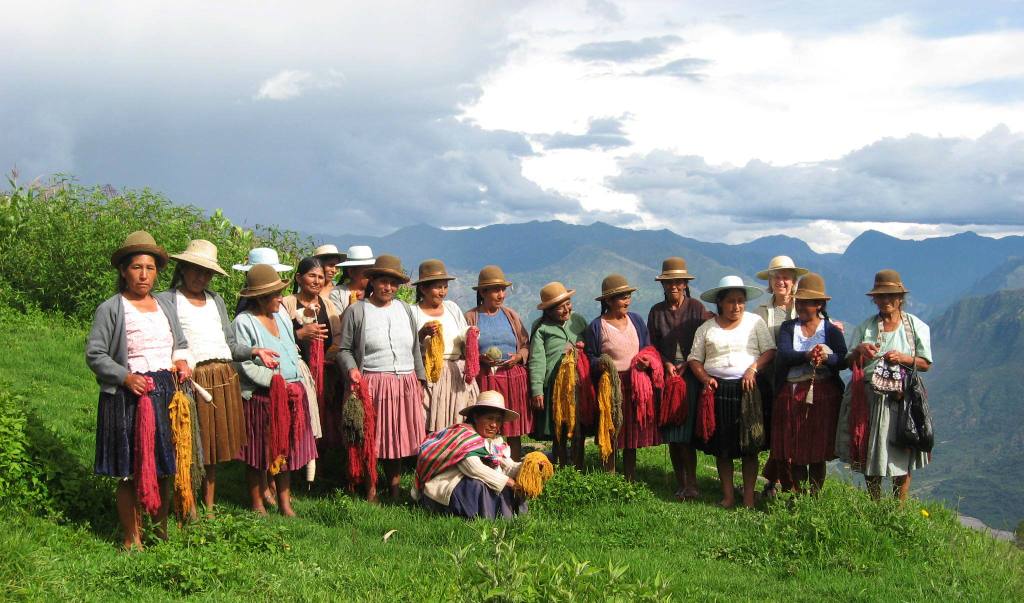
Group photo time just when it was warm enough to go out on the deck again…
########################################
It is already Thursday night and we just had a day weaving in the mill. Here is Cookie happy as can be weaving a backstrap piece.
Cookie and I wove on in the mill long after everyone had left while Janet spun more wool for me to use for backstrap weaving and rescued the warp of friend Carol’s inkle loom which was suffering from a kitten attack. Carol had a really pretty simple warp float pattern on there.
I learned a couple of cool things today from other weavers. Yani, who is not one for details, looked at me as if I were mad when I suggested she do a series of four-strand braids to finish her keyfob.
She then proceeded to teach me a five-strand braid which is lovely and did just one chunky one at the end of her fob. I love this braid and will probably teach it to you all here on the blog soon. It is a nice FAST way to finish off a piece.
That’s Yani’s green piece in the center and then I just had to practice it on the end of my red one.
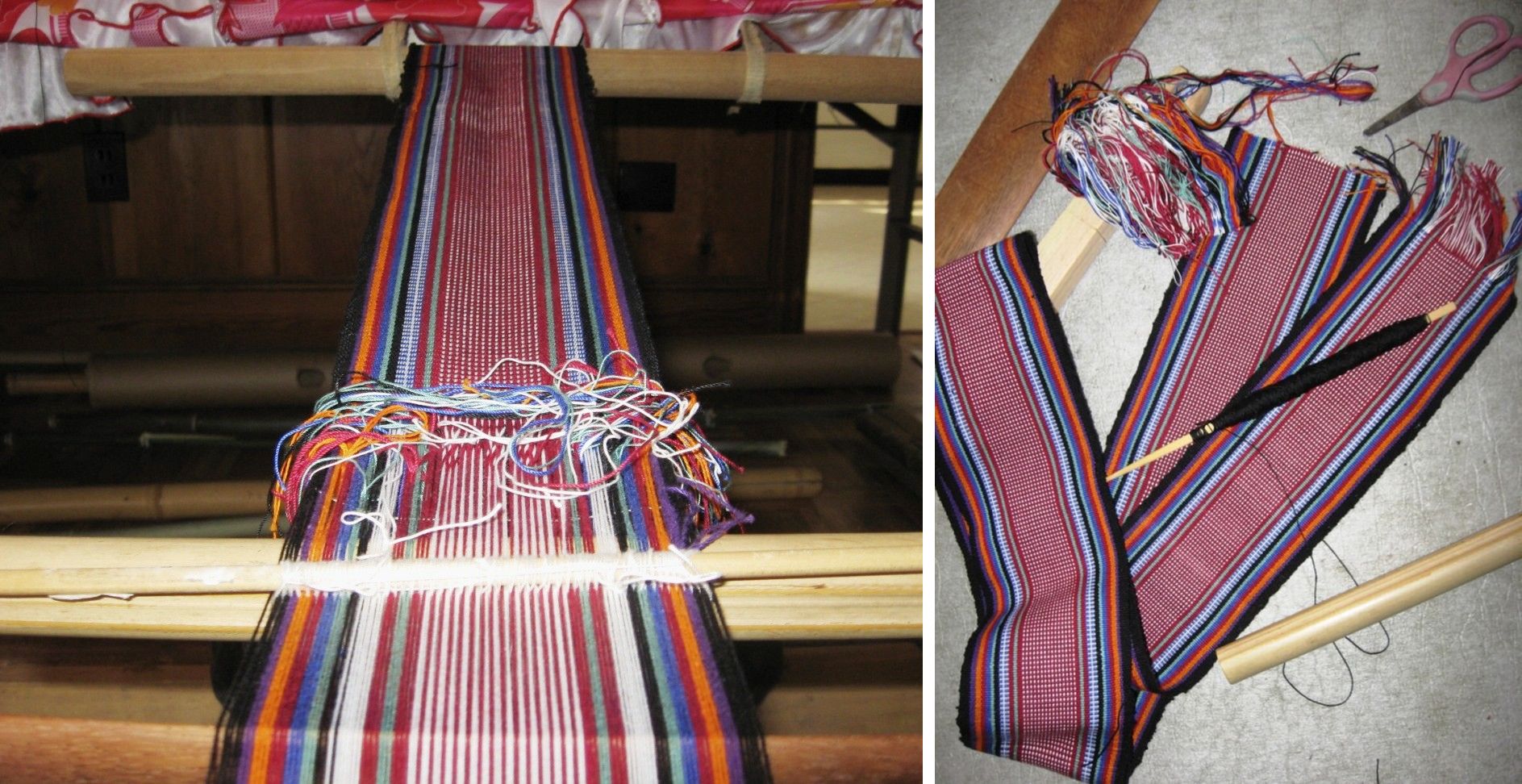
We wove supplementary weft patterns today and one of the decisions to be made is where exactly to have the supplementary weft turn as it weaves back and forth across the cloth. Some weavers turn it at the edge but I don’t like the lumpy edge that that creates. Other weavers turn before reaching the edge and may try to camouflage the turns or use them as decoration. You can read more about the ins and outs of this technique here.
Buffy didn’t care for the look of the supplementary weft turns on the surface of the weaving at all. I showed her ways of trying to camouflage them by hiding them in a stripe down the side of the weaving or turn them into a decorative feature but what she really wanted was for them to go away. So I wove a sample where I turned the supplementary weft on the back side of the band. Such a simple solution but in the end I think I have come to love those visible weft turns on the face of my bands.
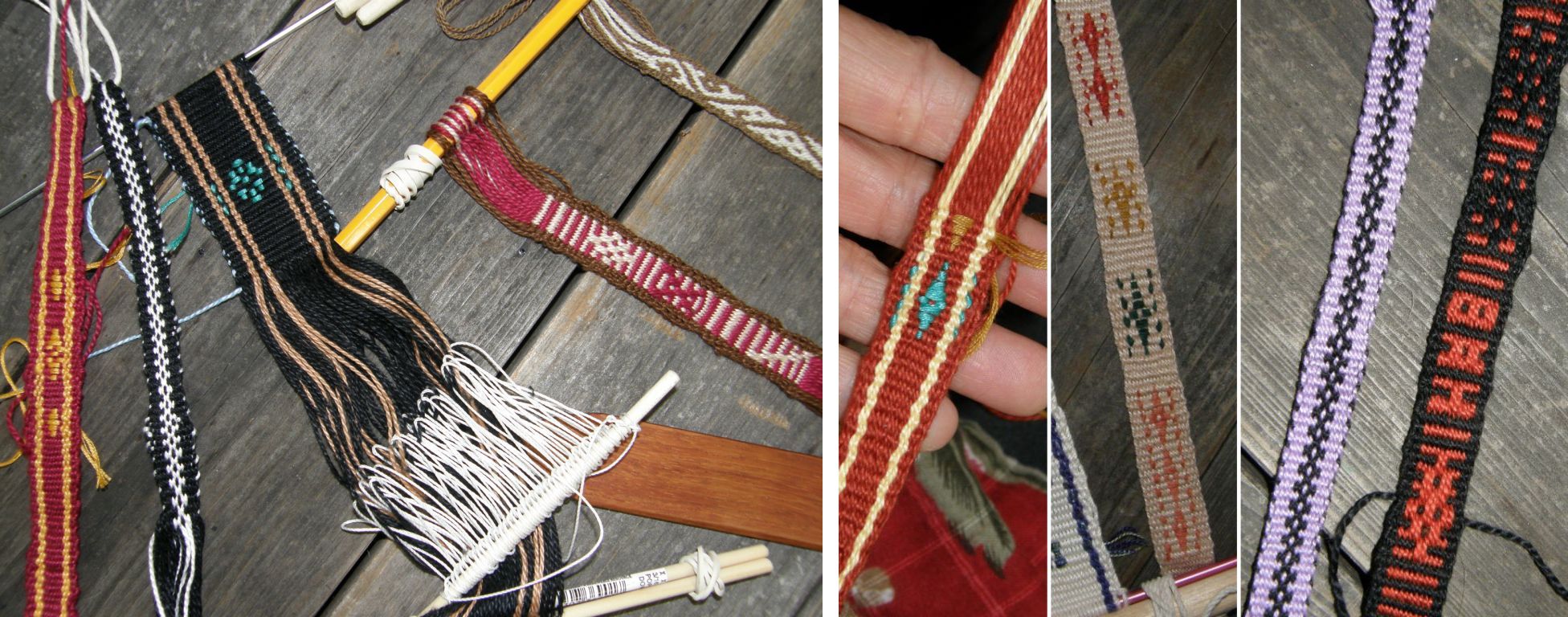
So, here are three versions….on the left – no visible weft turns as they are hidden on the back side of the band. In the center – the weft turns are a decorative feature sitting as little beads of color along the stripes on each edge of the band. On the right – the turns are camouflaged in a stripe which is the same color as the supplementary weft. Which one do you prefer?
We will be banding together tomorrow again…another big day ahead so I shall leave you all here and try to get an early night. Until next week…
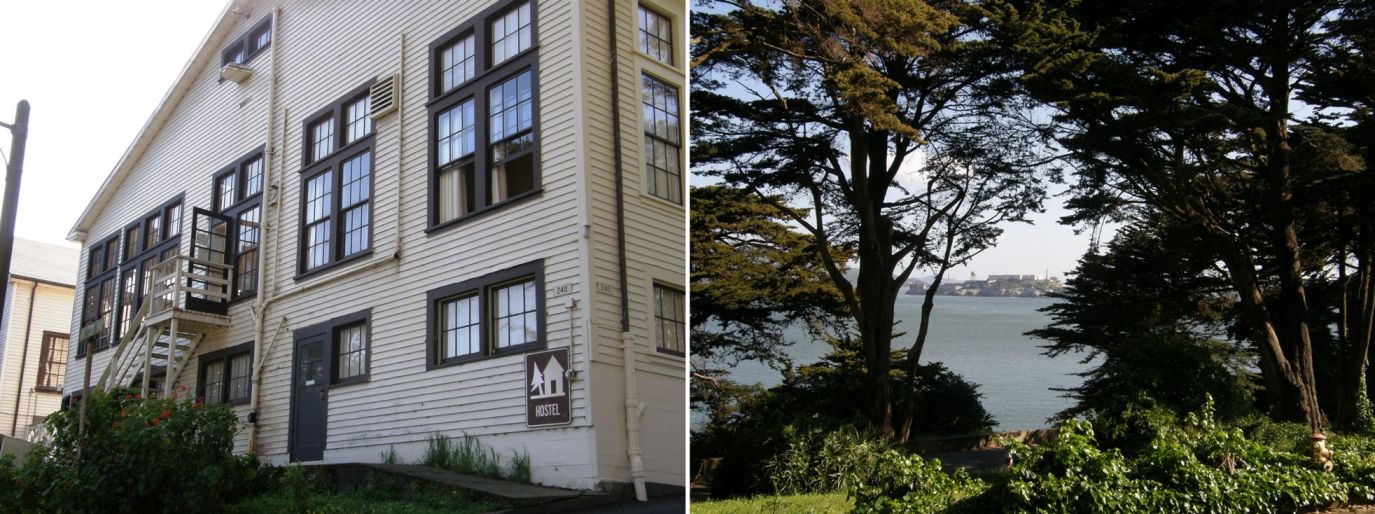
I seem to be really lucky when I go to San Francisco and get mist-free morning views of the bridge.
I spent a night here at the Fort Mason Youth Hostel…what a great place, quite a change from the downtown hostel where I have stayed before. Actually, I stayed at this same hostel way back in 1992 on the first day of a 7-month backpacking and hiking tour of the US. Phew! That takes me back!
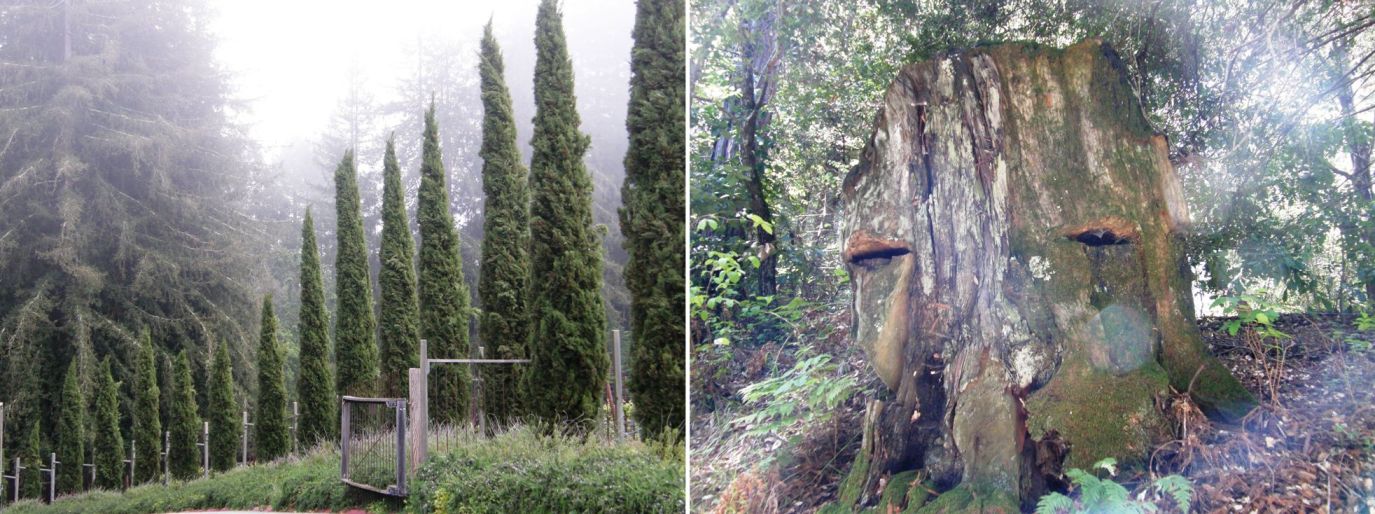
My friend Janet picked me up and we headed down south to Santa Cruz (yep, from Santa Cruz Bolivia to Santa Cruz CA) to stay with Janet’s cousin on the winery that she and her husband own. Lucky us, except that neither Janet nor I are wine drinkers! But we got to enjoy the beautiful landscape.The winery is perched on a hill surrounded by Redwood forest and has sweeping views down to the ocean and across the bay to Monterey which are especially nice when viewed from the hot tub 🙂
Eerie morning mists with weird faces emerging from the Redwoods.
The mists would rise to reveal Suzie’s pretty flower-laden patio which had a lovely Mediterranean feel. (or at least what I would imagine it to be. It is one of my dreams to be on the Mediterranean, perhaps Malta or some place like that).
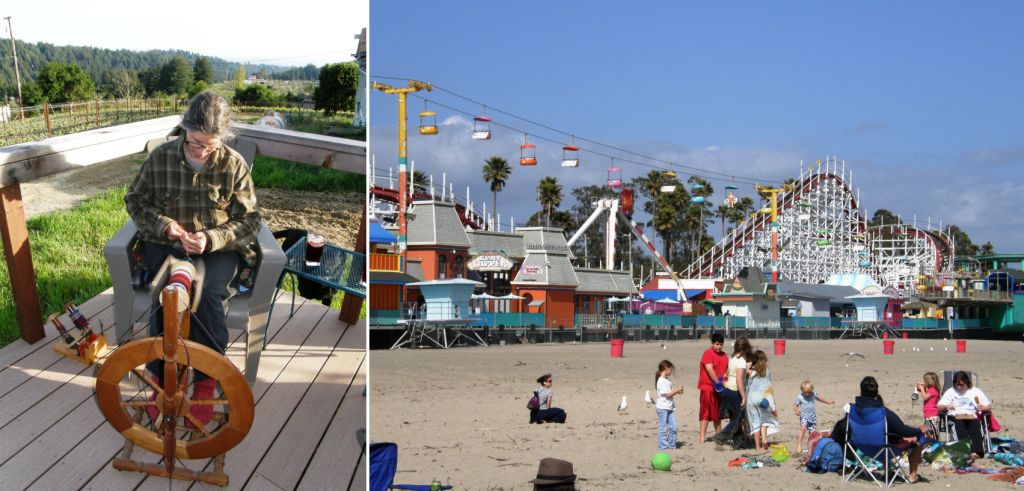
Sunny afternoons were spent spinning and lazing on the porch or hanging out at the beach and Santa Cruz Boardwalk. The Boardwalk has a fantastic old carousel.
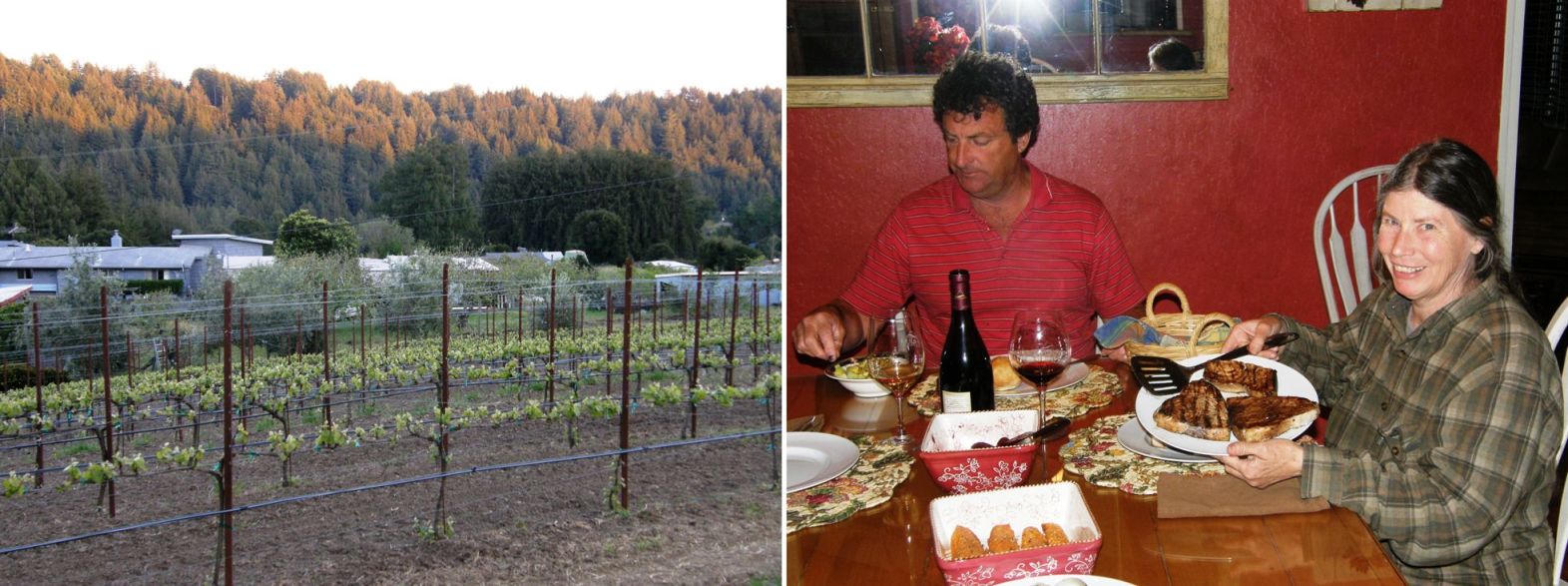
The sunsets brought a gentle glow and we sure enjoyed the swordfish steaks.
Forgive me but I just had to include this next picture. I am a cat person and usually don’t care at all for the small yappy dogs but these two guys were just adorable!
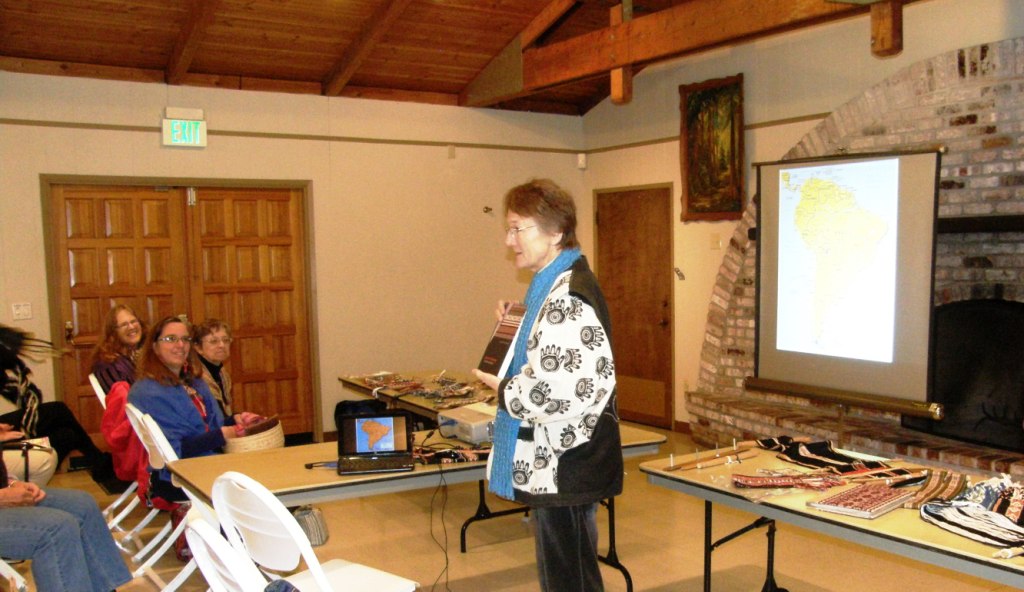
Then it was on to a visit with the Santa Cruz Handweavers Guild for a show-and-tell by members and a slide show by me.
Here, guild president Gudrun is showing her husband’s newly published book called “Quantum Computing” for which he chose to use images of her beautiful card-woven bands on the cover.
My slide presentation took people on a wee tour of the Bolivian high and lowlands, around the continent and then deep into the textiles, and my experiences learning to weave them. At the same time I got the chance to get reacquainted with some people I had met at CNCH last year as well as meet a lot of new folks.
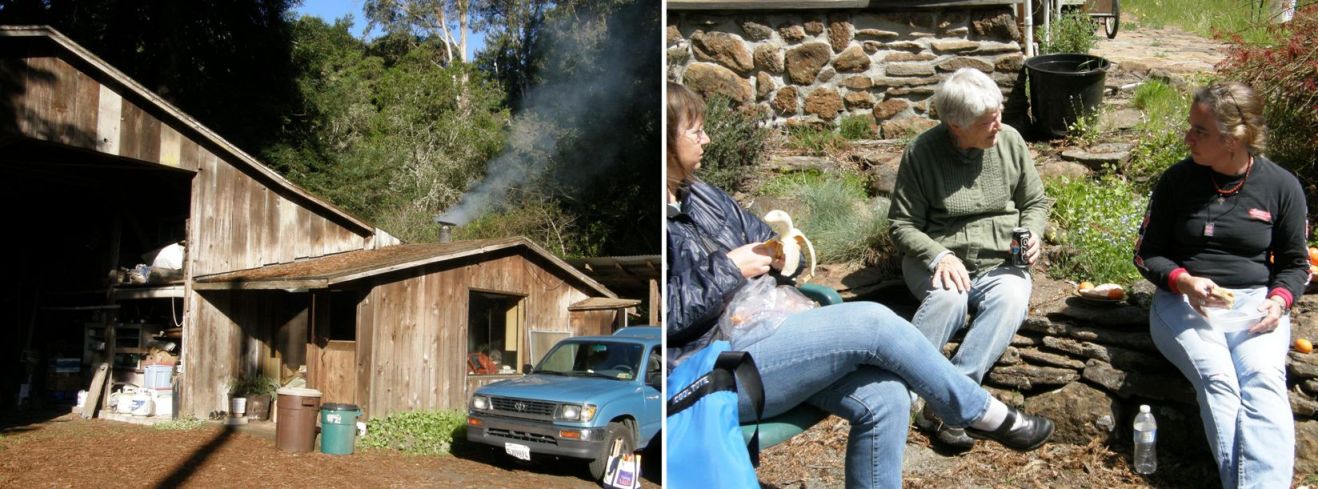
The following three days were spent weaving at Martha’s beautiful cabin in the woods. That little cabin with the smoke curling out of the chimney warmly greeted us each morning. Martha would join us and entertain us with her tales in her sunny garden for our lunch breaks.
And here’s the gang of backstrap weavers and then with Martha popping in to make a matching bookend with me.
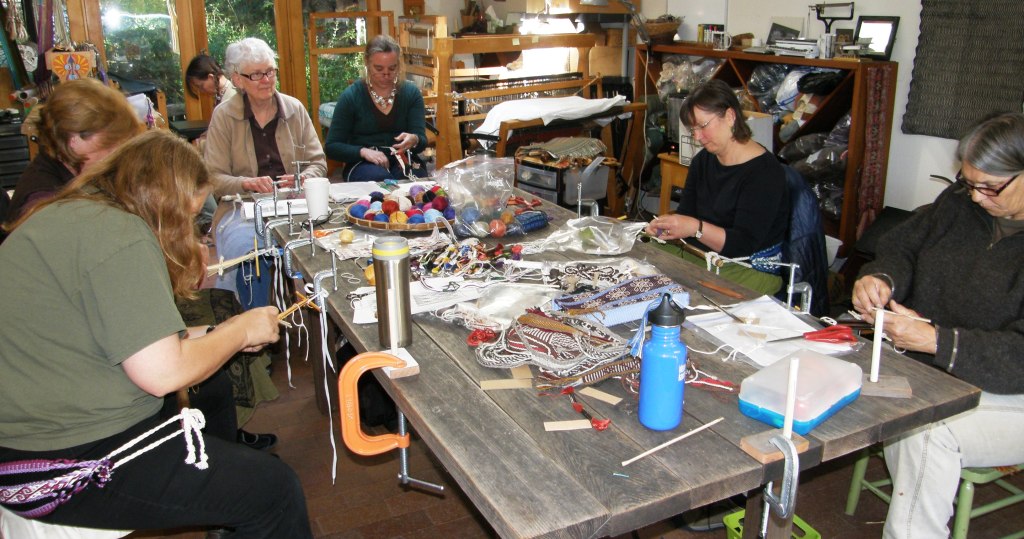
And yes, we did some weaving too. There is everyone “banding together”.
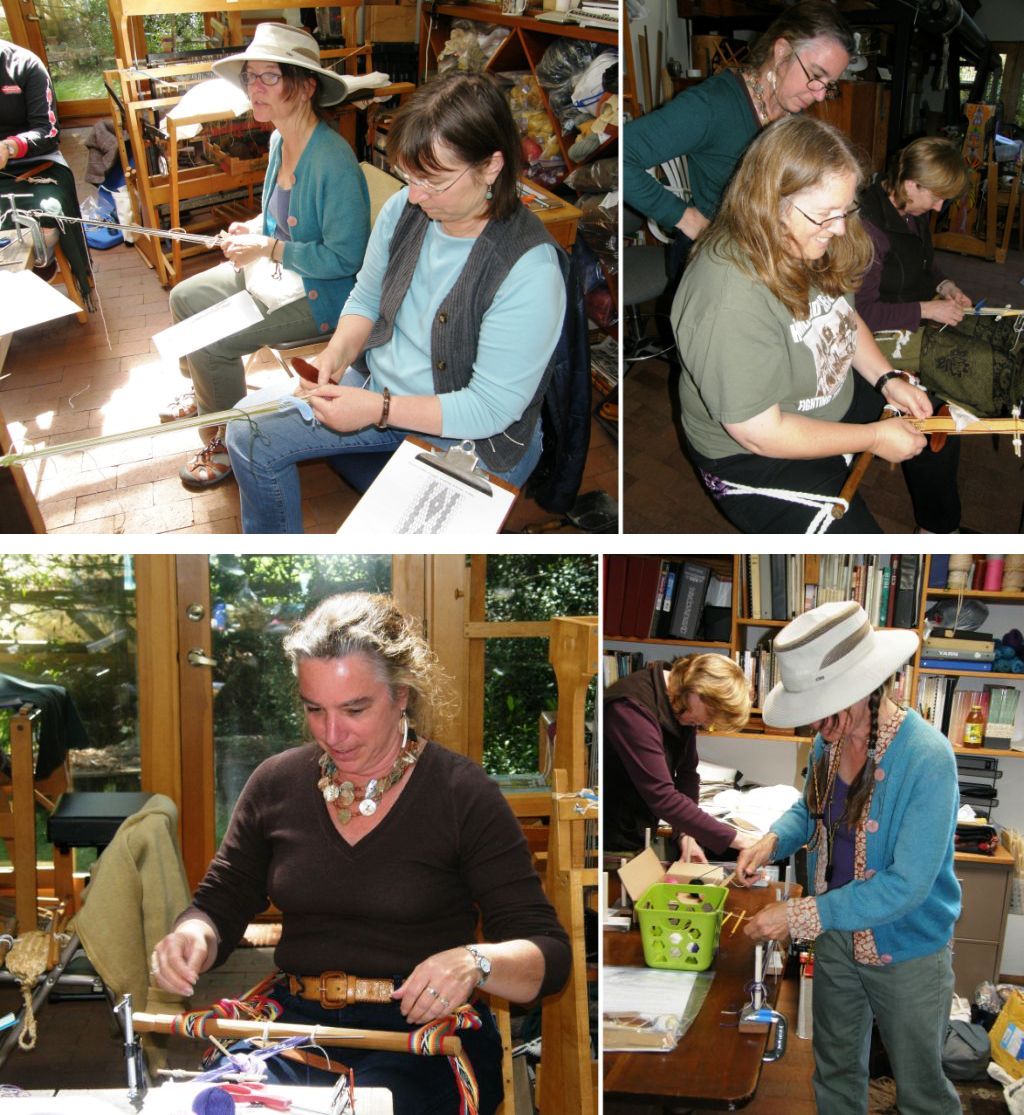
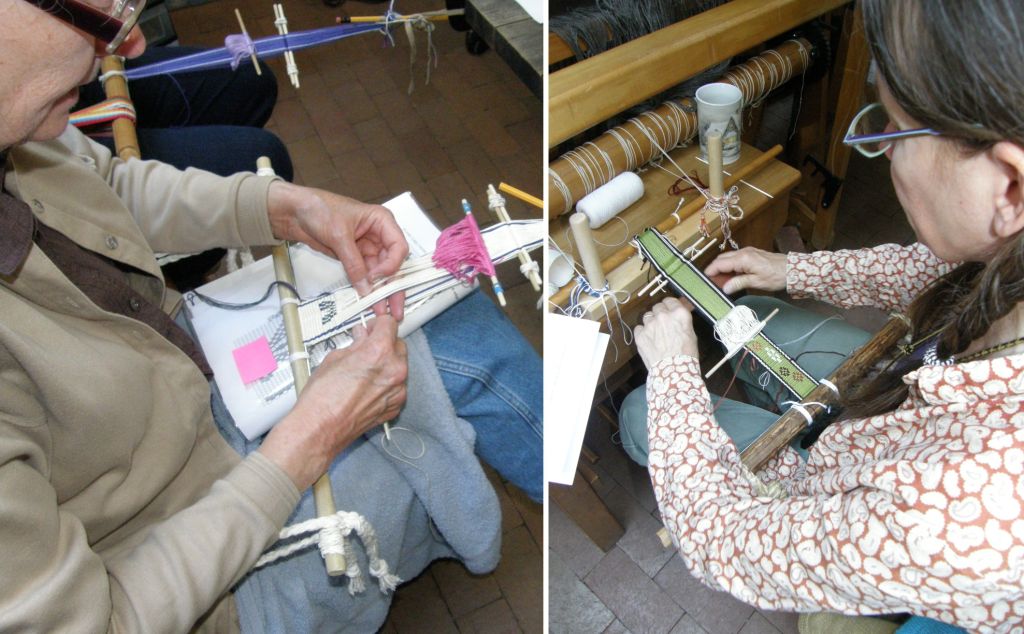
We wove “barefoot“-style and later with loom bars. Annie was happy to get to use a loom that she had bought in Guatemala as well as one of her own woven sashes as a backstrap. Yonat, above right, dove straight in and warped up for the widest motif. Ingrid, with hat, is practicing four-stake warping. That’s Ingrid Crickmore whom I met at CNCH last year. Ingrid is into all things braided and was using her pieces as loom ties during the workshop. The best news is that she has a blog with tutorials on loop braiding and will soon be adding video.
There’s Yonat on the left and Janet. We got to work with Janet’s handspun on day three when she also gave a combing and spinning demo with special tips for spinning for backstrap weaving and everyone loved her yarn.
Smiles from Dorothy and Annie, some “aha”s and a brow furrowed with concentration.
What was interesting and educational for me was the way people chose their colors and placed their designs…no two were alike. I get to learn too in these situations and I have some new color combinations circling in my mind. A friend had asked me to make him a guitar strap with southwest colors and, thanks to Janet, I now have the perfect combo.
Plain weave bands patterned with warp stripes and supplementary wefts, simple warp floats in cotton and pebble weave in handspun wool.
Barbara and Ingrid are at work above showing one of the many cool things about backstrap weaving…you can make short warps quickly and easily for the tiniest projects like a one-of-a-kind key fob or book mark.
During lunch break there was much to see as Martha would bring out textiles from her South American collection. Here is THE textile which I blogged about last week…
But, what I didn’t know was that she was saving the best for the last day….
This is another one of those spectacular discontinuous warp pieces from Pitumarca, Peru. From what I have seen, Pitumarca specializes in supplementary warp patterning on these discontinuous warp, or scaffolded, pieces but this one has been done with three colors in the pattern and it is doubled faced. Wow.
There are four panels, red, blue, green and yellow, each with its triple color supplementary warp pattern.
I should have just saved this for a blog post of its own entitled “Even more Speechless”. It’s hard to take your eyes off it, right?
I told you last week that Martha gave me two tubs full of textiles to take back to the winery and peruse. I will show you bits from those tubs in future blog posts but here is just a taste…
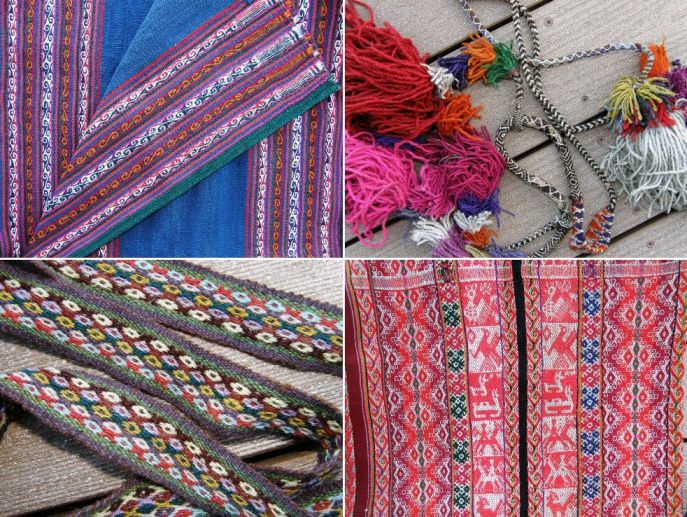
I really like the bag strap with the multiple tanka choros and those braids….!!
But best of all we got to see what Martha herself has been working on…
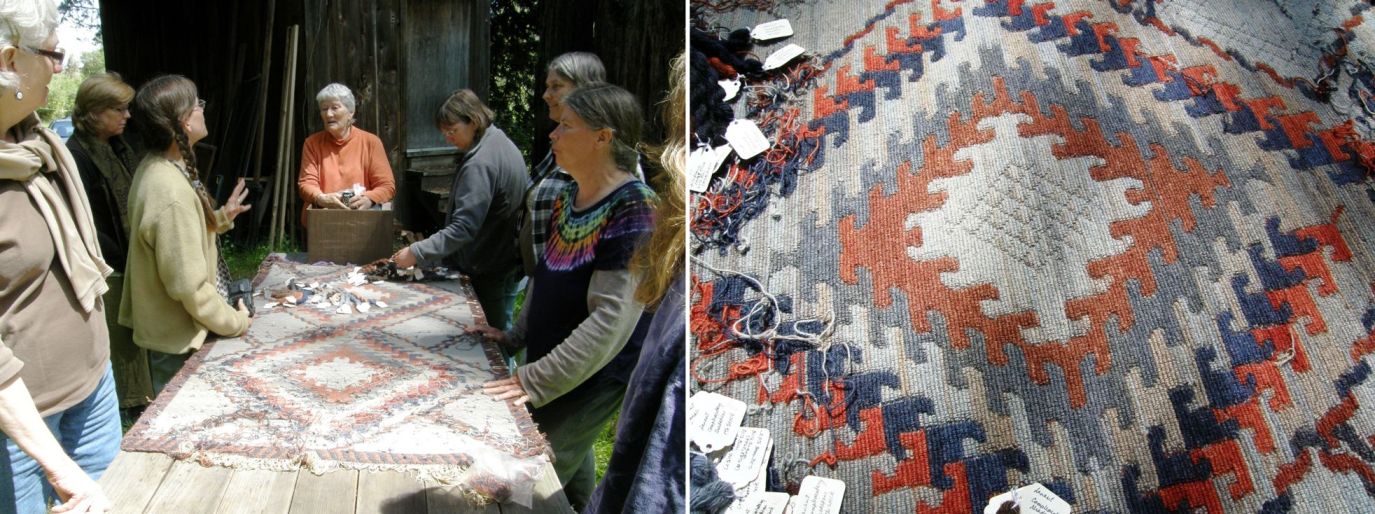
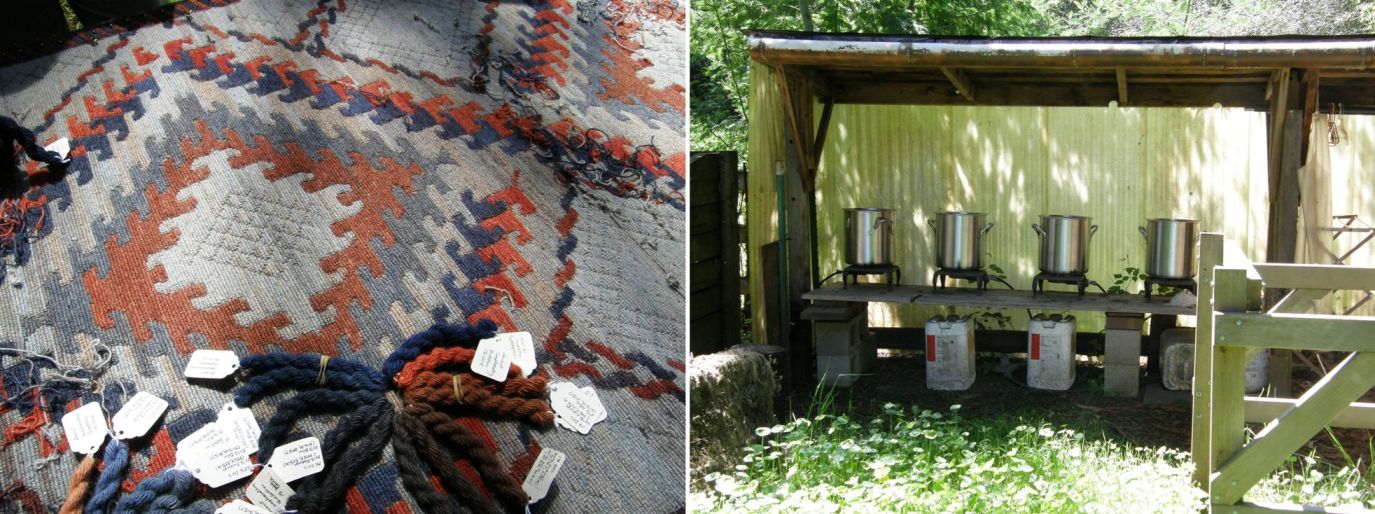
Firstly, the colors! I have been admiring the yurt bands of Central Asia and wishing that I could somehow use those dusty sun-bleached tones of red and blue that evolve after years of having been stretched around the yurt and exposed to the elements. Well, Martha has just gone ahead and dyed her own. The colors are just gorgeous!
With a lot of patience, dedication and know-how she has come up with just the right hues. I was SO envious! The rug above is her latest work. It is a combination of weft twining and wrapping. One of the twined strands wraps around the other to give a raised surface on a flat ground of twining. I think I understood how it works. That’s on the list to play with when I get home.
As for the colors…I’ll keep dreaming. Maybe I will get into that kind of precision dyeing one day.
One of the highlights of this trip was spending more time with Annie MacHale. You may know her as ASpinnerweaverand she is on my blogroll but I think of her as the Queen of Sashes. She is one creative lady with an irresistible bubbly laugh.
Janet and I got to see her sash collection and hear the stories that go with them, rummage through her yarn stash and go from one inkle loom to the next in her living room/studio checking out her works-in-progress…and the books!!
One thing I have been wanting to promote while on this US tour is the lesser known weavings of the lowland areas of South America. We have all become so familiar with the textiles of one particular region of highland Peru through the hard work of Nilda Callañaupa and the CTTC. I have had the fortune to study with weavers in lowland areas too most notably in Santa Cruz where I live and in coastal Ecuador. The weaving may not be as technically sophisticated as the work being done in the Cusco area but is every bit as note worthy and often sadly neglected.
It seems that the work of the Shipibo people is calling to me from various sources. Just before I left home I found an image of a textile which the photographer had bought in Ecuador but which she believes was made by the Shipibo people of the lowland jungle areas of Peru and this is something I would like to investigate. It is woven with a technique that I have only seen used in South American textiles in images in books of textiles of northern Argentina that are no longer produced.
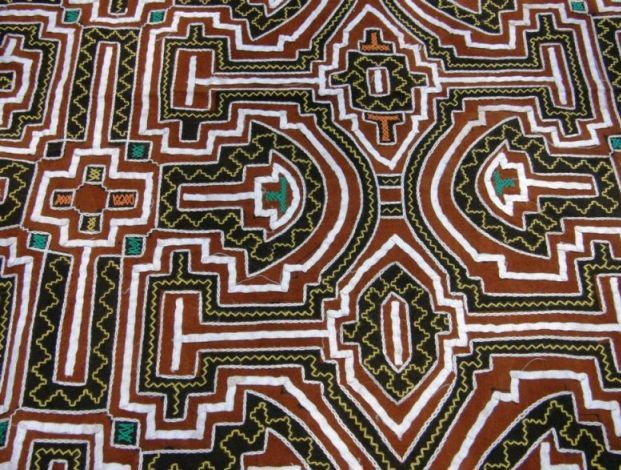
At the weaving get-together Yonat brought, amongst other things, Shipibo textiles to show that she has in her own personal collection…beautiful embroidered and appliqued pieces (above) with very distinctive designs. I only have some small painted pieces of Shipibo cloth at home. This is what Yonat brought…
And then Martha showed me this…
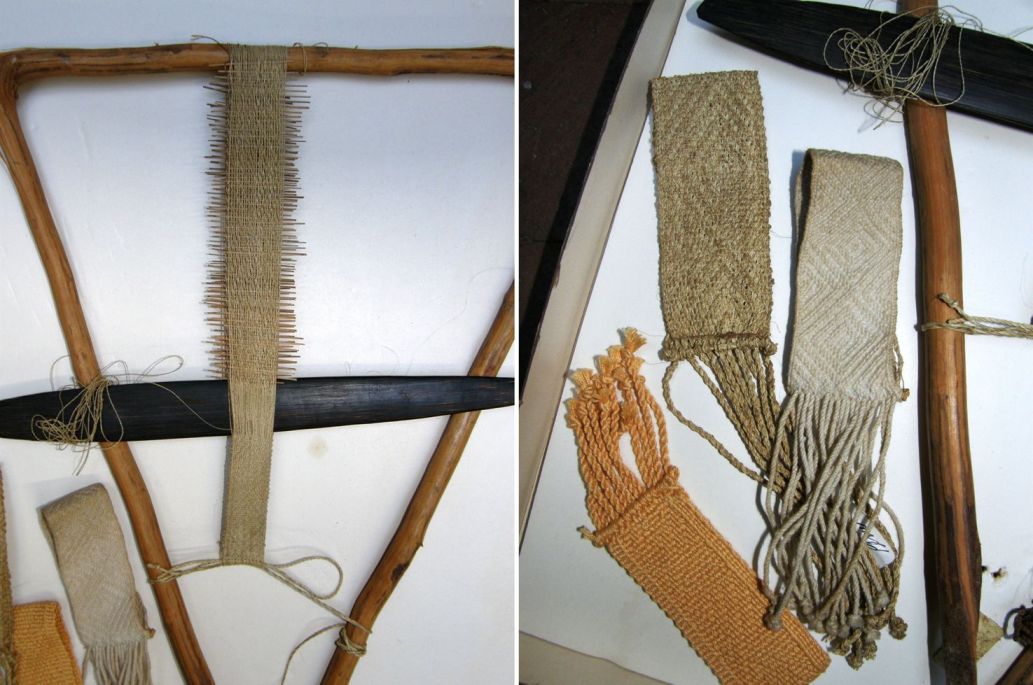
This too is a Shipibo piece and part of the late Anne Blinks’s collection and something which she had studied. The wonderfully simple branch loom holds a piece of fabric which was probably destined to be a wristlet. The completed woven pieces around it are wristlets, some of which are Anne Blinks’s reproductions. You can see the enormous quantity of fine patterning sticks that have been inserted in the warp to program the design. This was amazing! I love the fact that it is just one color and that the pattern shows as a fine texture. I love the sword/beater too.
See all the fun stuff I got into!
A million thanks to everyone who brought textiles and so willingly shared them with me and the group. There was always a frantic effort on my part to take photos of everything. Peggy also brought some interesting bands that she had bought in Oaxaca.
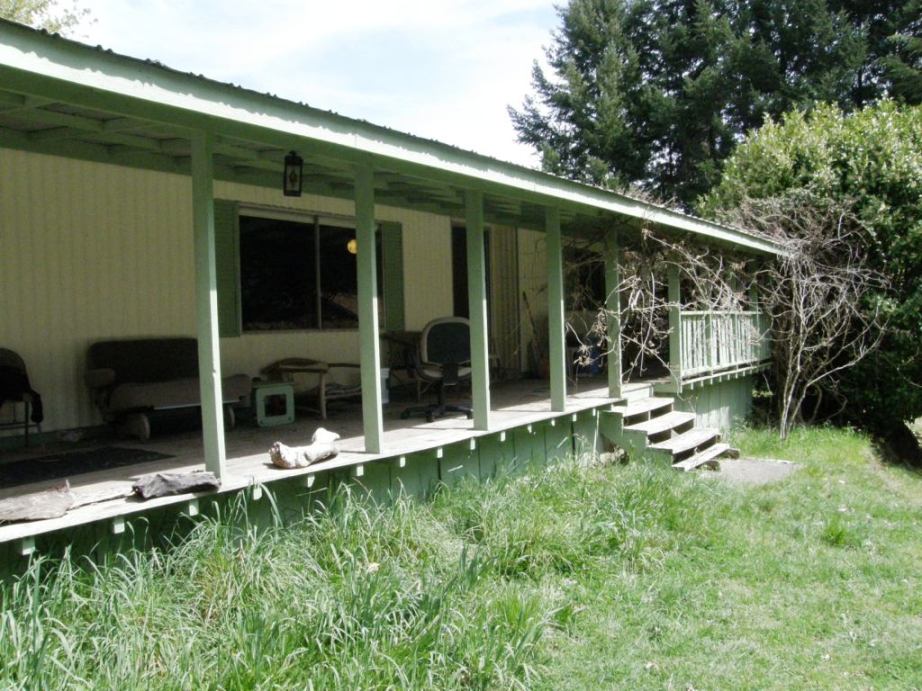
Now I am up on Janet’s farm in Humboldt County and we are planning a weavers’ gathering here. Take a look at that porch…isn’t that the most perfect backstrap weaving site? I put a cushion on the floor and tied up to one of those posts, nicely shaded while I got to wiggle my toes in the sun. For warping I clamped pegs to the edge of the porch and stood down in the garden. Perfect!
Janet’s husband has a family heirloom coverlet. This was especially thrilling to me as I had seen these in the Folk Art Museum in Williamsburg last year behind glass. I read how they were made with both cotton and wool, the white being cotton and the blue wool and could make out the balanced double weave. Now I have had the chance to touch one and drape it across my lap…a whole different experience.
So that is where I am at so far. We are off to Eureka tomorrow to meet some other weavers and do some backstrap weaving and so I have been able to squeeze in this blog post. Before I go I wanted to show you some things that have been going on in the Ravelry Backstrap Weaving Group…
The Spin Along is still going and Jennifer respun some commercial wool and showed us its ‘kinkiness” before it could be stretched out on her backstrap loom and woven into this lovely piece.
Marsha and Carinefile are both doing Double weave. Marsha’s piece on the left is a guitar strap with the musician’s name woven in and Carinefile has made the sampler that goes with the tutorial here.
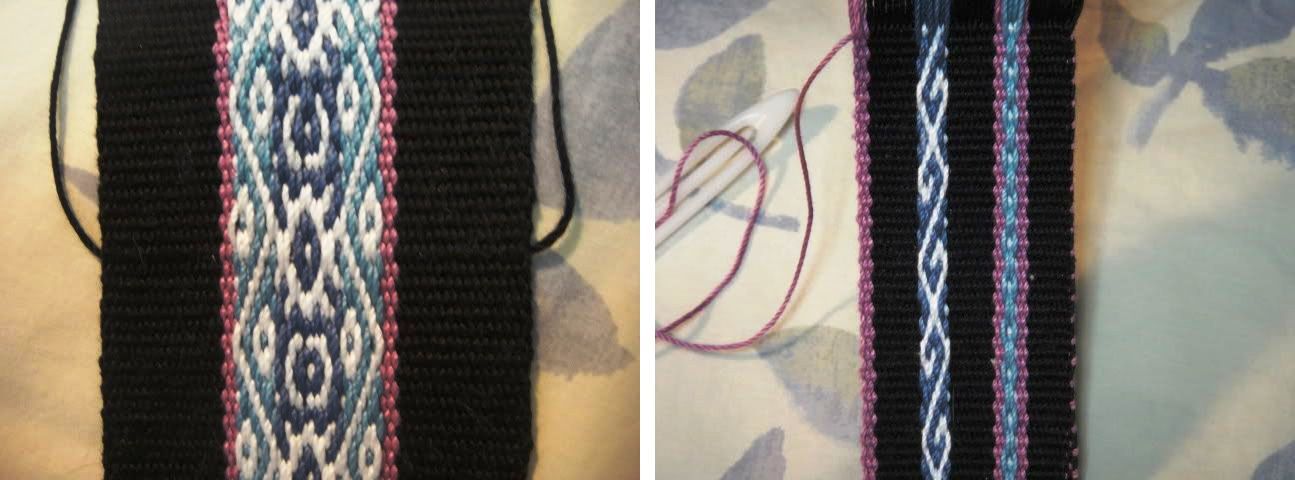
Jentide and Melisende made Sami bands. These are traditionally woven on backstrap looms using a small rigid heddle but, as you can see, they can be perfectly adapted to inkle looms.
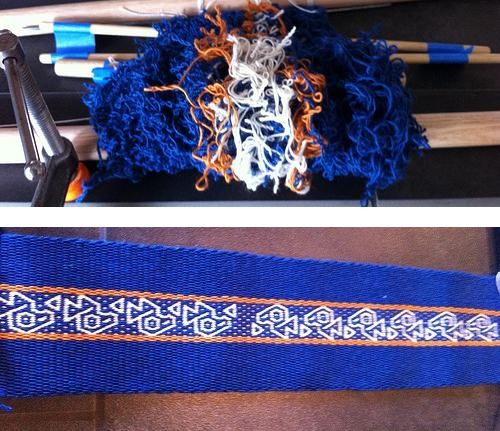
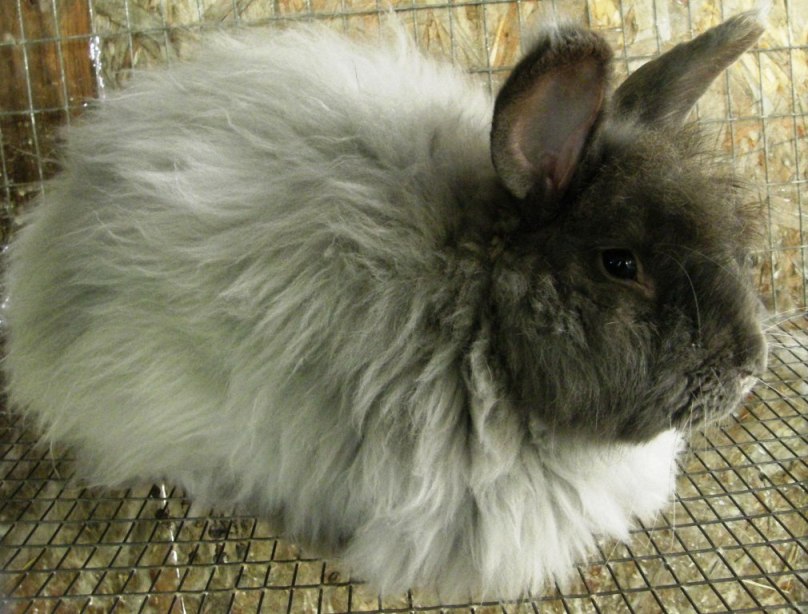
And if you are in an “Eastery” mood from looking at one of Janet’s bunnies, I wrote a post for Easter last year about a colorful Semana Santa, or Holy Week, that I spent in Guatemala in ’08 in three different areas, full of color and beautiful people and textiles.
Well, you all know that I am on the road and haven’t had time to put a proper post together but I couldn’t resist posting a bunch of pictures here so that you can ooh and ahh over something that I got see up close and personal today. I even got to take it back to my digs for the night to enjoy and photograph.
My digs is a wee cabin on my friend Janet’s cousin’s winery in Santa Cruz, California…yes, one of the other Santa Cruces…..fields of grape vines flowing downhill and out of sight amongst a background of cypreses and redwoods with a view of the gorgeous Pacific Ocean with Monterey across the bay. There’s a whole lot more to that story, of course, which will have to wait but I thought I would post these pictures which really do have me speechless.
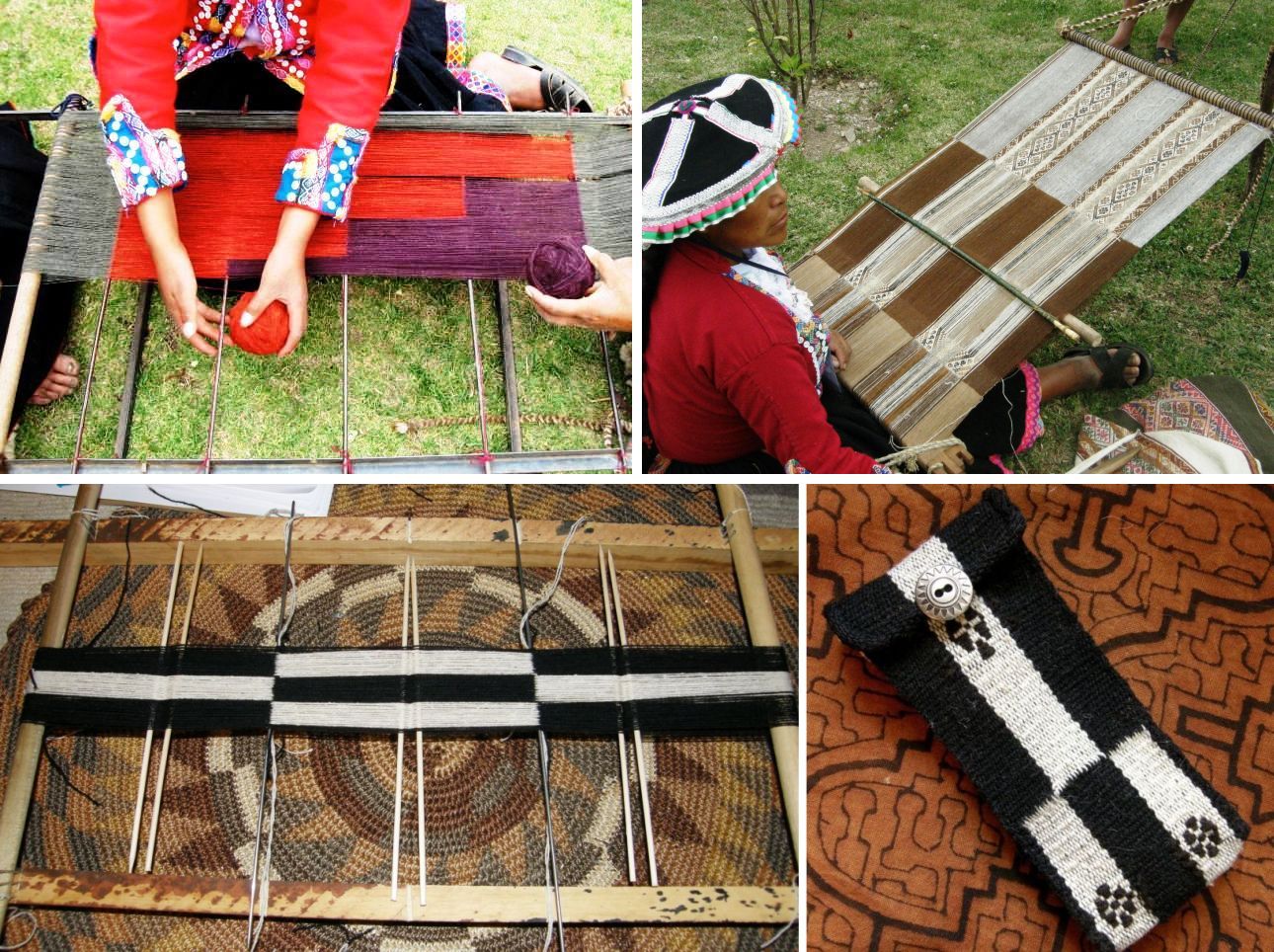
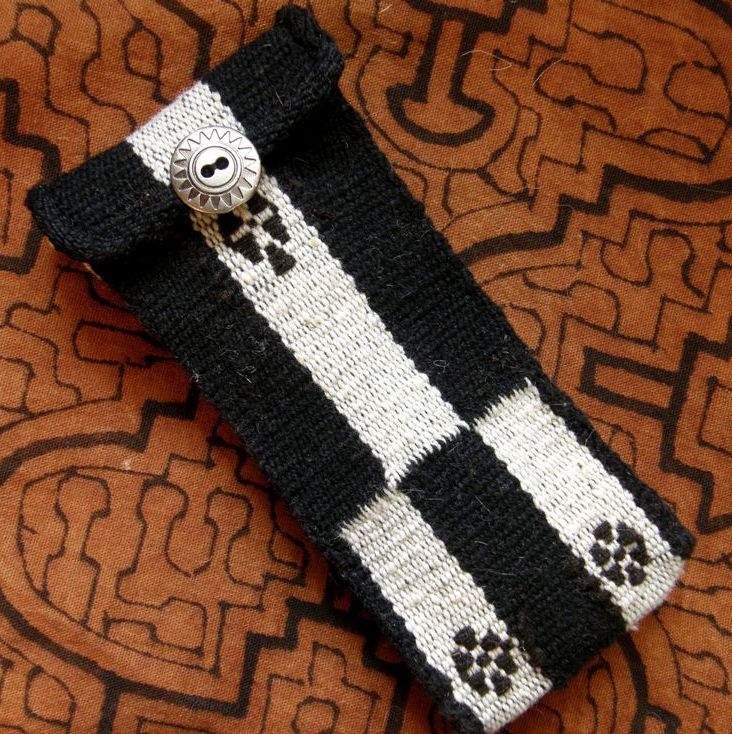
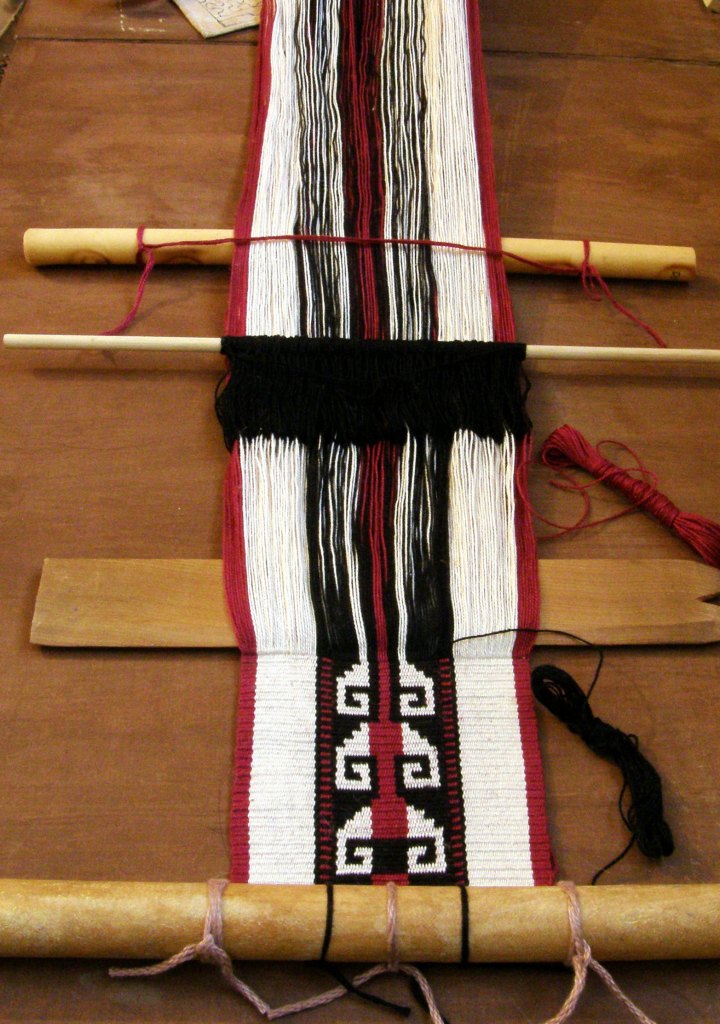
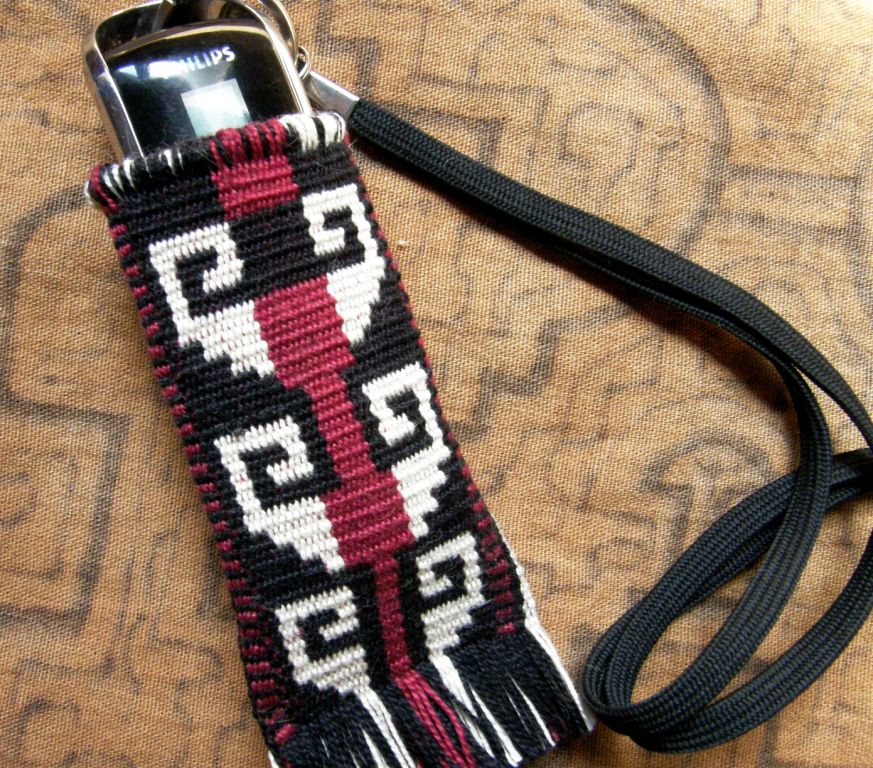
These pictures you have seen before if you follow my blog and you will, no doubt, remember that I became fascinated with the discontinuous warp technique when I met Pitumarca weaver Antonia at Convergence last year. There I got to see a piece being woven even though I didn’t fully understand at that stage what it was all about. At the Tinkuy de Tejedores in November in Peru I got to see more and even got to try out a plain weave piece of my own which I turned into the black and white eyeglass case above.
Well, now, I have gotten to see, touch and fully enjoy and appreciate, after having woven my own very ridiculously basic version, a finished piece…and what a piece! It was lent to me by Martha Stanley to take home overnight and really study. What a treat!
Okay, so I said I was speechless so, this is the point where I should really stop waffling on and just show you the piece!
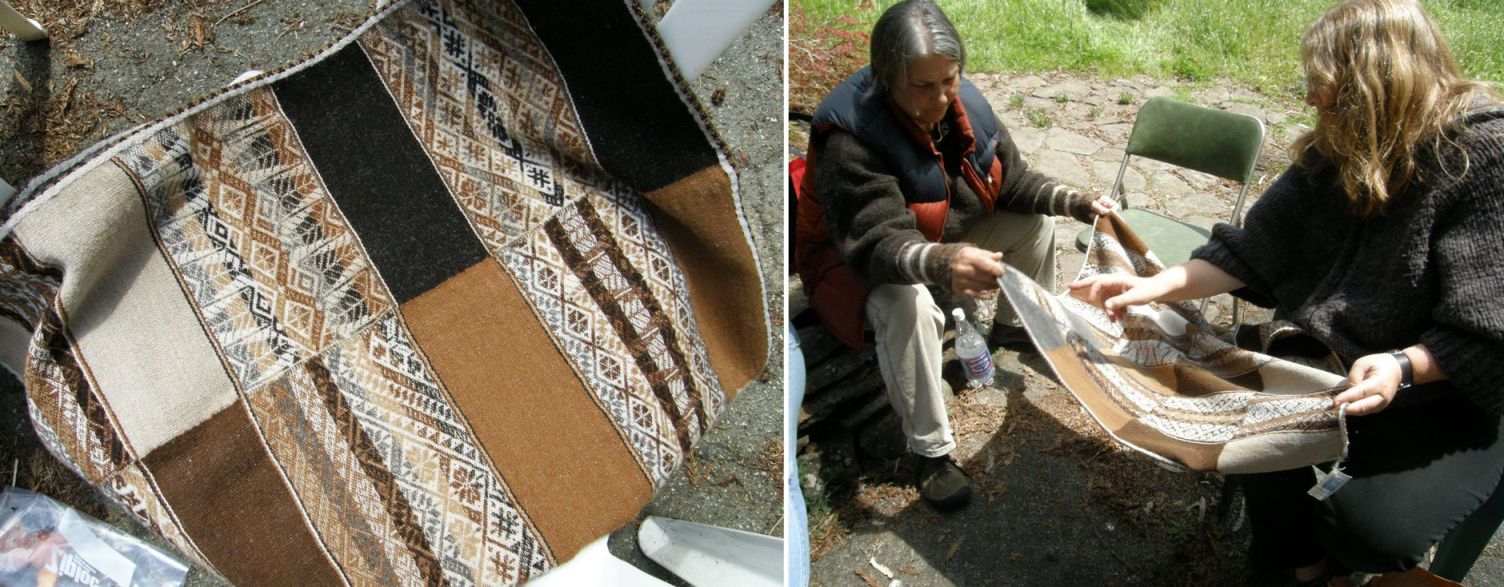
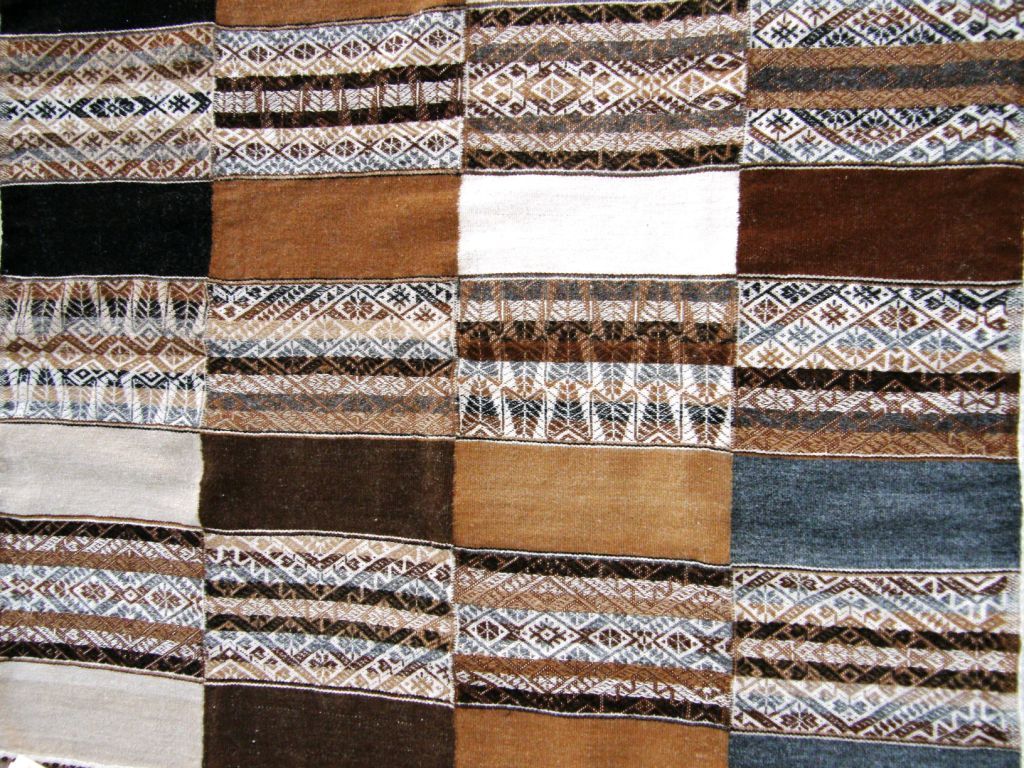
It has been woven in all natural alpaca with twelve panels of supplementary warp pick-up patterning, each one being a four-selvedged piece…incredible! There is the tiniest terminal area in the top and bottom panels, which you can see below, where the weaver simply could not weave any more pick-up due to lack of space to manipulate the warps.
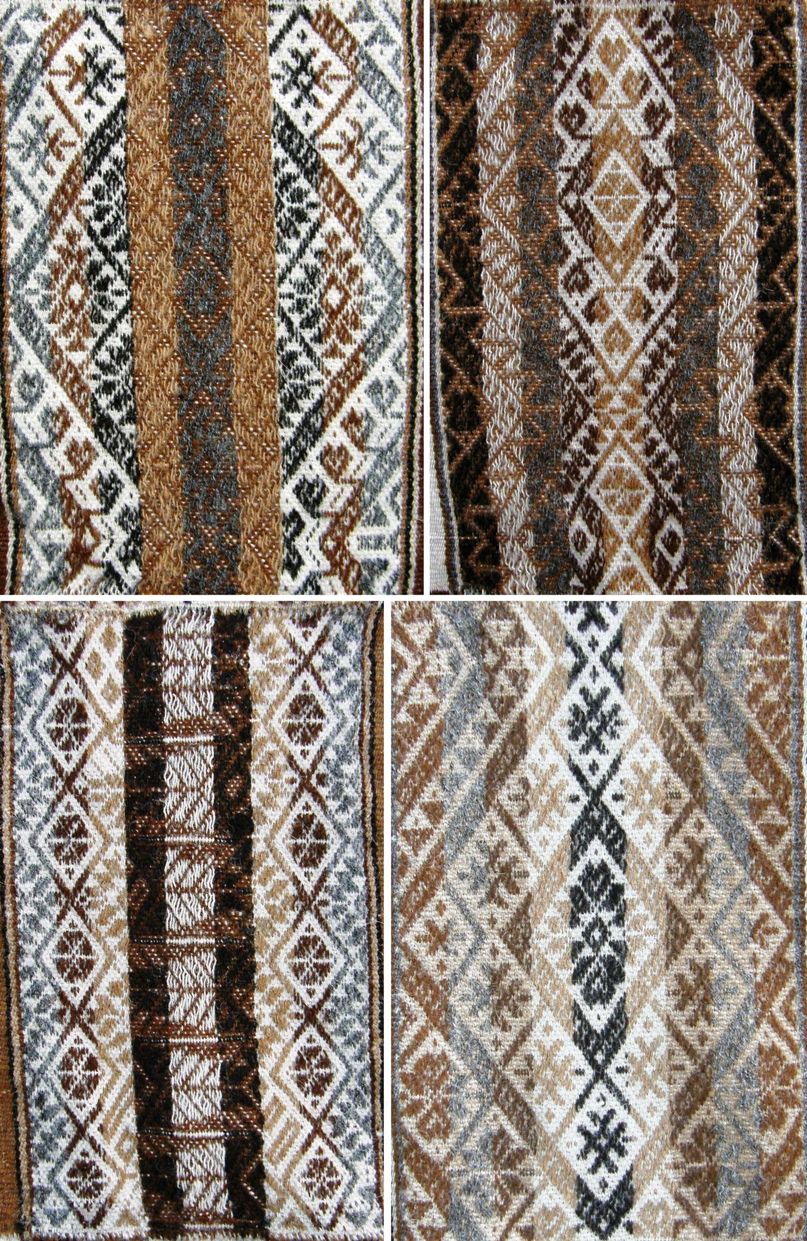
Each panel has a different traditional design of Pitumarca flanked by fields of either black, brown, grey or tan plain weave.
And, of course, it was woven as one entire piece on a backstrap loom.
There you have eight of the twelve panels of pick up patterning. Here are the last four…
This is how a four-panel piece would look once warped…
And here you can see how the warps from each color panel dovetail around a metal rod during warping which is what enables the weaver to have all these warp color changes within the one piece. Yarn is lying parallel to the rod which will stay in place to hold the dovetailing once the rod is removed.
So, this is one of many cool things I have to show. I was given a entire bin of textiles to take back to winery and pour over…but that is all for this week!
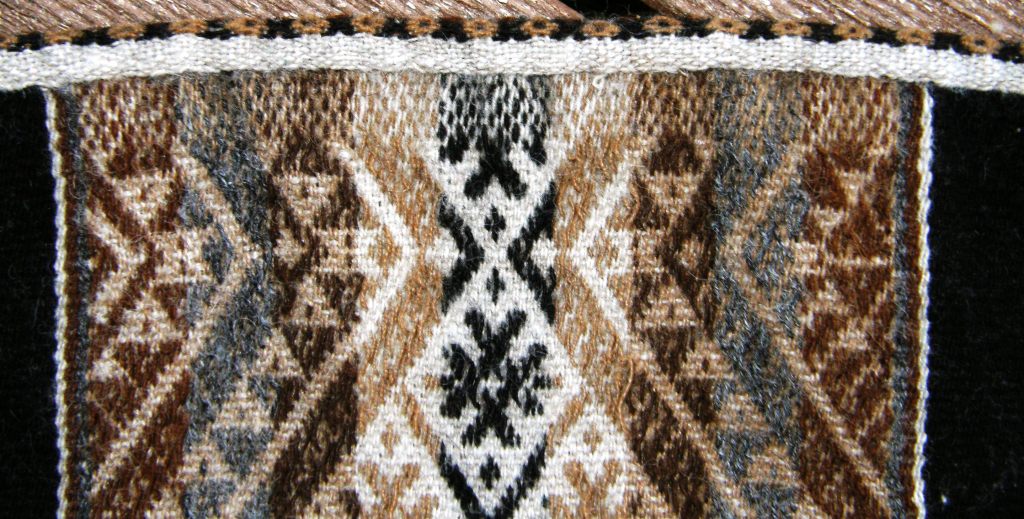
Oh wait, I have to show you one more picture of the woven edging on the piece….
The pre-trip panic is setting in! Actually, I find myself remarkably well-organized for this departure a whole two days before I leave but, even after all these years of traveling about, I still can’t escape that wee bit of unease every time I am about to step out of the comfort zone and launch myself into the great unknown. So, California and all my west coast online weaving buddies, the new places and the new people…here I come!
Spring seems to be fiber festival time in the US and I am looking forward to finding something to which I can tie up my loom, hanging out and weaving and chatting to people. I wound a couple of warps, one with a narrow tried-and-true pick up design on a field of plain weave. I have found that it is better to keep the pick-up narrow and simple as this gives people who have never seen this before more of a chance of following what I am doing and me more of a chance of chatting to them while I am doing it!
You probably recognize this design from the mass of key fobs that I made in pebble weave last year. Yes, I know it is a bad idea to use colored heddles on a black warp. Yes, I know I will be ages picking bits of red and yellow fluff out of my black cloth but it is prettier this way for showing off to people, isn’t it? So, I have just gotten this weaving underway and now it is rolled up in my backpack. I made one other wide warp with fine thread so I can show people how I open the sheds with warps of this nature.
I really wanted to make a contribution to the Spin-Along in the backstrap group on Ravelry before I left too.
We are spinning yarn for warp-faced weaving as well as respinning commercial yarn so it will be smooth and strong enough to use on the backstrap loom.
I already cheated earlier by posting my discontinuous warp project in respun commercial wool which I had made prior to the Spin-Along (SAL). This was wool that my friend Claudia had given me when I was visiting with her last November and was not spun during the SAL. I did let everyone know that!
And I am afraid I cheated again by starting a band just the other day with some llama fiber that I had spun some years ago for dye experiments. I have small balls of various colors in a bag in the closet and was able to make a tiny warp for a double weave band.
My plan was to weave a design based on a Tarahumara belt pattern that I had reproduced a long time ago in a pebbly float weave (at left).
It was easy to chart for double weave but, once warped up, I thought that the fine lines would probably get lost in the hairiness of the llama fiber and so I chose a simple solid pattern instead.
I guess I didn’t really put much thought into this little project. All I wanted to do was make a contribution before I disappeared on the road.
I have to say though that it was a lot of fun weaving with handspun, especially my very own, after all this time.
Pictures of handspun wool have been appearing in the SAL thread in the backstrap group and it is very exciting. I suspect we shall be seeing these yarns on the loom soon.
Jennifer has been hard at it on both wheel and spindle.
This is what Tracy has prepared….
Popsicletote prepared this nice collage of photos of her finished band entitled “Little Prayer”made with her handspun with pebble weave patterns on her backstrap loom…
And here below is my wee “cheat” contribution…
And you can see that I did try the Tarahumara motif in the end and the lines of single warp are not getting swallowed by the llama fiber. The colors are natural brown and black on the edges and cochineal and spearmint leaves for the pattern. I should be able to get two key fobs with each of the two designs from this warp.
This all reminds me of how easy it was get to get nice wool at the store when I lived in Chile…not to mention all the fleece there was on hand down in Patagonia.
There was a beautiful yarn made by Reginella that was a fine combination of wool and alpaca. I used to ply it with high twist and it came in the most gorgeous range of colors which had a soft natural look. Even the reds and oranges were sort of “dirty” looking, if you know what I mean.
I must get back to Chile one of these days to look for that.
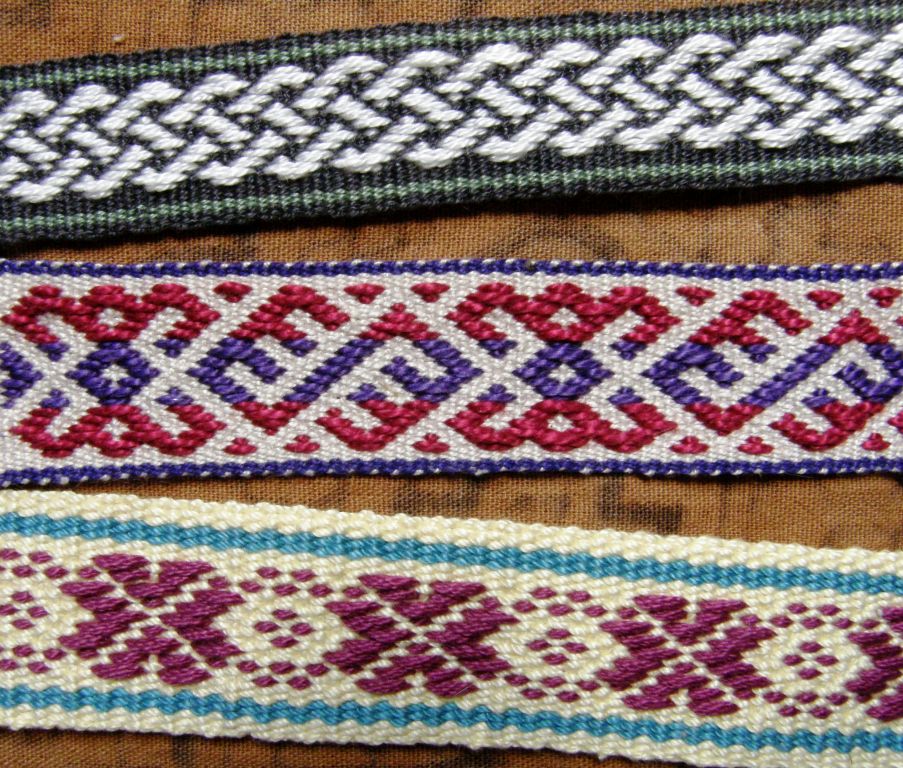
I made the triple color pebble weave band at left with what I had left over of this yarn when I came to live in Bolivia as well as the piece below which was made into a pencil case in my early English teaching days here.
###############################################
You may remember last week I introduced you to Dorinda Dutcher and the work she is doing with weavers through her PAZA organization in Cochabamba. Dorinda works out in the field with a very erratic internet connection but she was in the city recently and responded to my request to provide some photos and information in her own words about what she and the weavers of the township of Independencia have been doing…….
PAZA – “Weaving the Past and Present to Brighten Futures”
PAZA has evolved out of a Peace Corps project begun in 2007 to support the weavers of the community of Huancarani and lead the local movement to rescue, preserve, and market their traditional weavings. PAZA has helped the weavers to revive natural dye techniques and provided technical support to improve the quality of the finished woven items for an external market. The weavers are currently moving forward to become a legal weaving association and have taken the name “Centro de Artesanìa, Huancarani”.
Youth have been involved to address the preservation objective. PAZA began the Club de Chicas in December 2010 during school vacation to help bridge the rupture in the passing of weaving tradition from mother to daughter when families migrate from their farms to town.
Many families migrate to provide education for their children beyond 5th grade. The Club de Chicas activities combine modern and traditional skills. The spinning and weaving classes are taught by Doña Màxima Cortez, the PAZA Coordinator. Dorinda Dutcher, former Peace Corps volunteer, teaches baking, computer, and basic business classes.
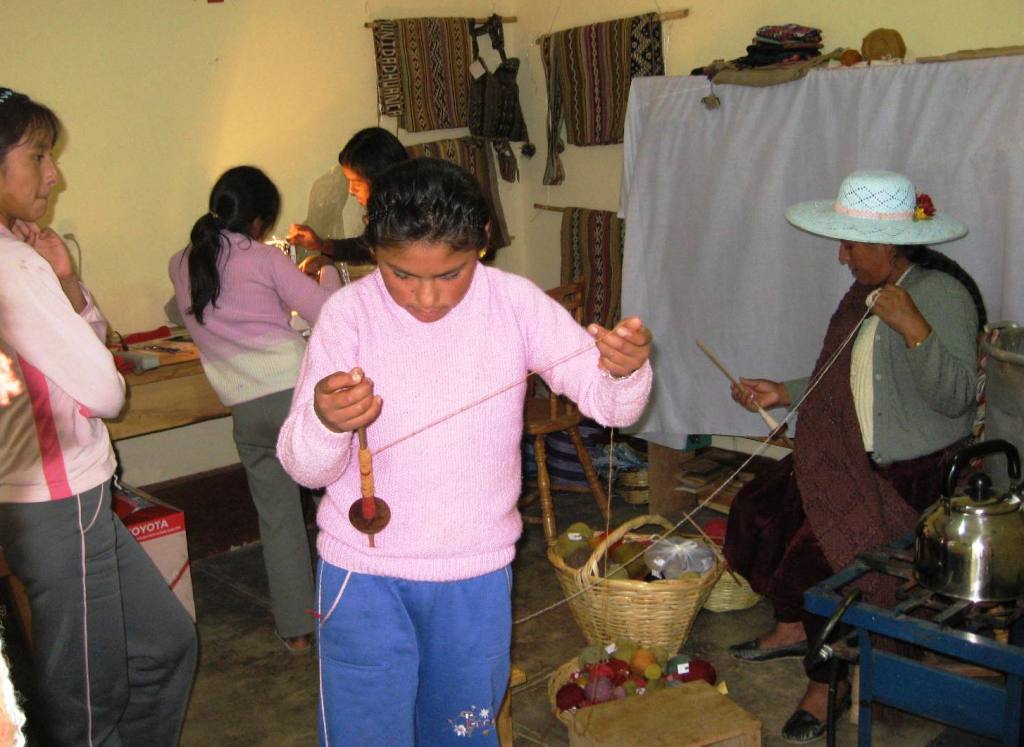
The PAZA volunteer program provides opportunities for fiber artists to enter the Quechua weaving world and take classes from Doña Màxima while offering their expertise in sewing, knitting, crocheting, or any creative activity they wish to teach.
A variety of activities typical of Tuesday and Thursday afternoons in the PAZA store/workshop.
The sales of the weavings are vital to meet the growing costs as the modern world encroaches on the farmer subsistence lifestyle.
Doña Màxima will have to sell 11 ch’uspas at 150 Bolivianos (Bs.) each to pay for the school supplies and uniforms for her 3 sons for this academic year. The 150 Bs. ($22) is not a fair price for the lengthy process from shearing to final product including the weaving by a master weaver, but it is the current ceiling of the national market.
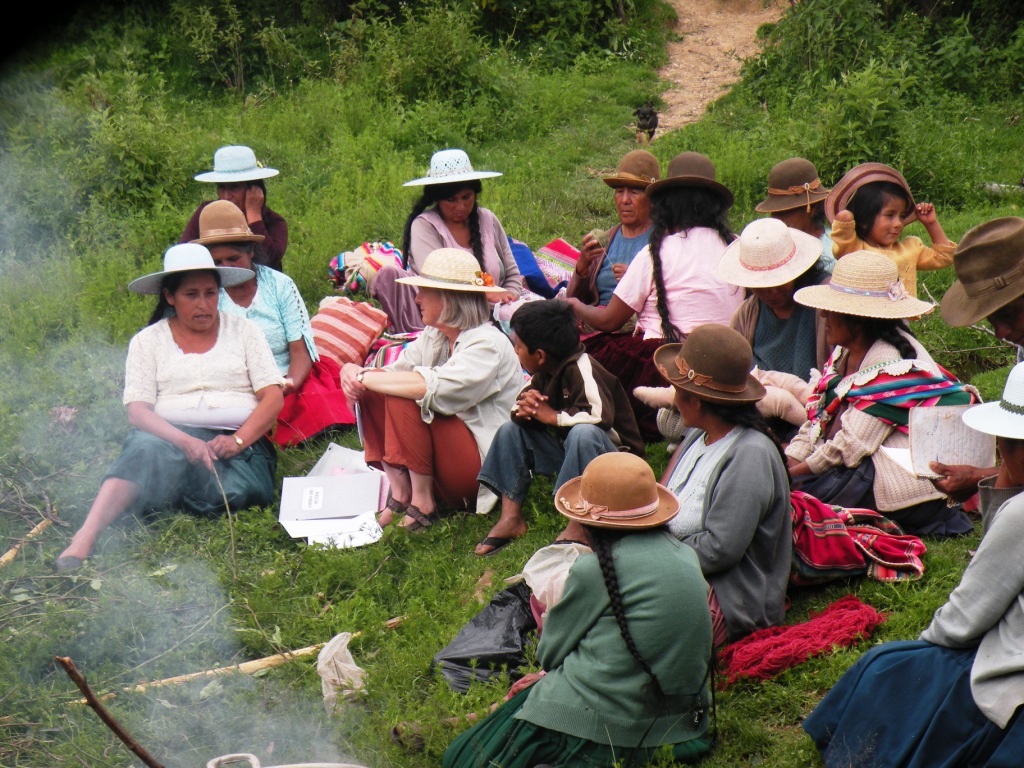
An open-air Association meeting.
For more stories from Dorinda in-the-field please visit the PAZA blog. I am sure that she will appreciate your comments and words of encouragement.
#################################################
Scratching around on Ravelry this week led me to this fun fun discovery.
You know how I love the drawings of Guaman Poma de Ayala. I have posted a few of them here before.
Well, someone on Ravelry in a thread entitled Peruvian Textiles as Cultural Crossroads provided a link to a site which contains Manuscritos de America en las Colecciones Reales which includes the volumes of images by Martinez Compañon which he made from 1782 to 1785 in the area of Trujillo, Peru.
These provide detailed graphic information about various aspects of both Spanish and indigenous life at that time including textile production.
Here is a sampling of some of the pictures…
This is just a taste…go check out the fabulous site linked above. There are wonderful pictures of costumes and more.
You may have read a lot here on my blog about my friend Lisa in North Carolina. Lisa and her family always open their home to me when I am visiting the US. Lisa’s blog is full of her Fiber Addiction Adventures. We met online via a Central Asian yurt band and have spent time together felting, spinning and backstrap weaving and experimenting with pebble weave on her four-shaft loom. As usual, she is currently into something interesting….
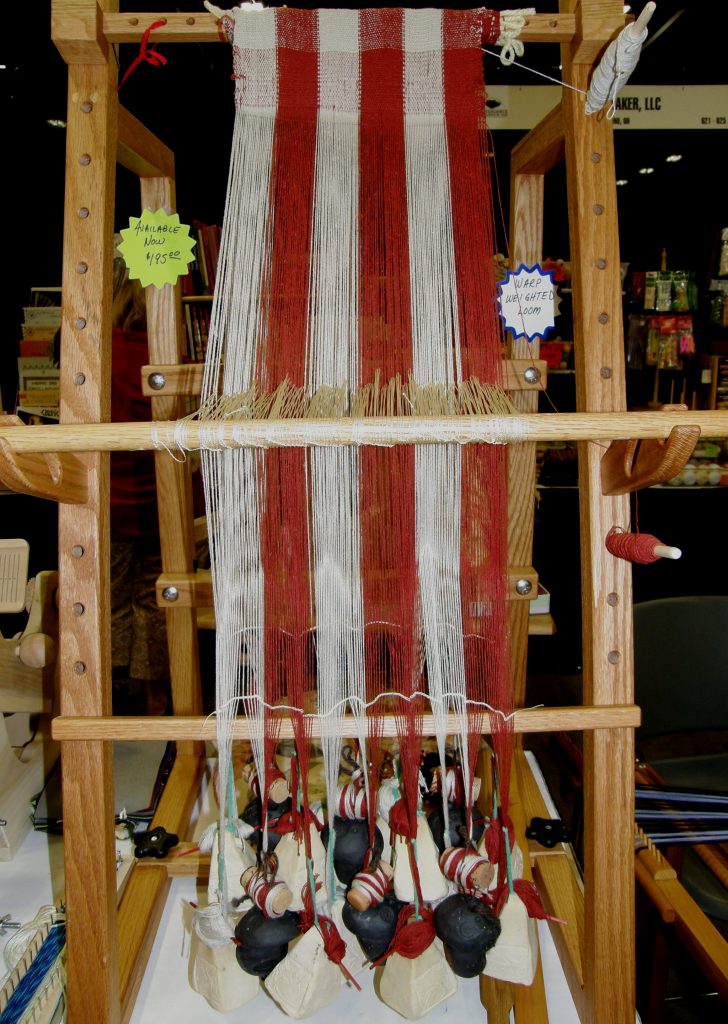
The first time I saw a warp-weighted loom was in the picture above which is the cover of my copy of Elizabeth Wayland Barber’s Women’s Work The First 20,000 Years.
This picture was taken from a Greek vase dating back to about 560 BC.
I then ran across one of these looms (at left), thanks to Deb McClintock, at Convergence last year and even met the owner by chance at the Tinkuy de Tejedores in Urubamba.
I have to say that I am not drawn to building one and weaving on it myself but I certainly find it interesting as Lisa always puts a lot of time and effort into researching her projects and we get to benefit when she shares all the information and activity with us.
So here is a little of what Lisa has to say about her new weaving adventure…
I’m really excited to be learning to use a Warp Weighted Loom. One of my favorite areas of interest is how to make and use low cost fiber tools to get people interested in spining, weaving, and felting by showing them that it can be fun and inexpensive.
My family and I are involved in the Society for Creative Ananchronism with is a historical reenactment group as well as the Piedmont Fiber Guild. This gives me an outlet to find others who are interested in both historical fiber traditions and modern day applications.
Learning to use my Warp Weighted Loom has been one of those wonderful projects that brings in research with actual practice. To prepare I found several wonderful books about Norse and Medieval fabrics as well as some very helpful webpages and groups, then set up the goal to make a low cost loom based off that research. Using just a few tools like a saw, ruler, and drill we were able to construct the loom for between $30 and $35. When added to my backstrap loom and homemade Charhka/Spindle wheel I feel like I am prepared to take on many different types of complex spinning and weaving projects with tools that will serve me just as well at my current skill level as they will as I gain more experience and ability through practice with them.
The Warp Weighted Loom has several interesting differences from other looms I’ve used in the past. Instead of weaving from the bottom to the top you weave from the top down. The loom itself can also be used as a warping board which is very handy.
To begin with I used cardweaving to create a band. My weft in this band then becomes the warp for the loom itself. I found myself really enjoying this novel part of the warping process.
When the band was done I then sewed it onto the upper beam and used weights to tension the warp. I found that the higher the tension the greater tendency to be a weft faced piece but I need to experiment more to find out it that bears out with other yarns.
Right now I am working on a small rug inspired by the Sami tradition of warp weighted loom woven rugs called “Grener”. I’m using Lopi style yarns both from stash and spun at home from local wools. My actual goal for this loom is to weave Viking Era style cloth which I hope will conform with extant finds discussed in “Woven Into the Earth”. I’ve sourced local Romney wool from a sheppardess in the Piedmont Fiber Guild, have scoured it, combed it, and am in the process of spinning high twist worsted singles. When I have enough singles yarn for warp and weft I’ll be ready to start my next project on the loom which I plan to be a simple twill shawl made of my handspun.
#################################################
Here is an update from some of the friends I have introduced to you here on the blog over the last year or so…
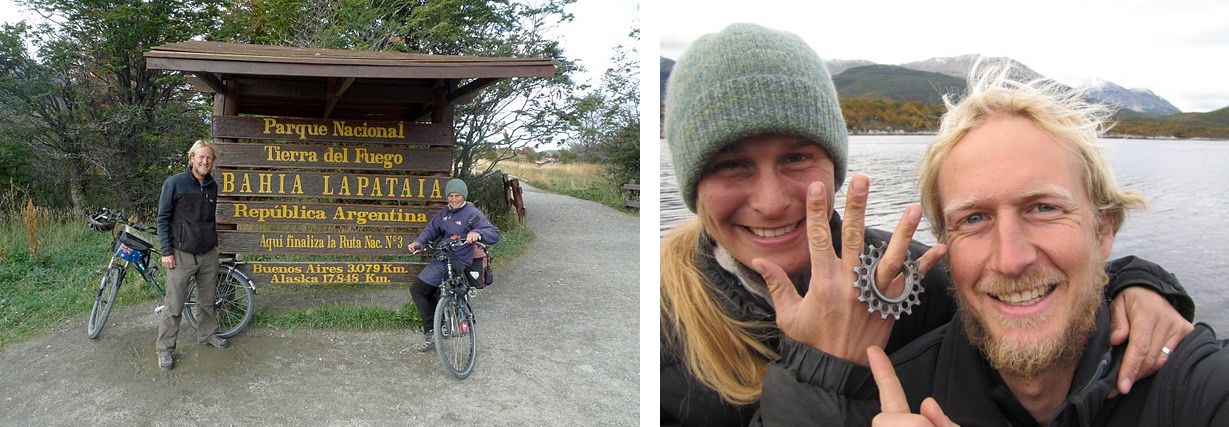
”Bicycle Anna” and boyfriend Alistair are back home after their almost-three-year trip by bicycle from Alaska to Ushuaia. Anna took weaving classes along the way in Guatemala and Peru and then came to Santa Cruz to weave with me. Since then, she has been unstoppable and even told me that she was finding excuses for rest days on the road just so she could weave.
I have shown several pictures of her bicycling and weaving her way down south since she came to visit me last August.
Here is picture of her and Alistair at the end-of-the-road. I am disappointed she didn’t tie her backstrap loom to the sign post! And there is another picture of a surprise happy ending. I leave it up to you to guess what happened!
My friend and anthropologist Kathleen Klumpp, whom I accompanied on a research trip to coastal Ecuador in 2007, sent me this next picture of little Melina, whom we have seen learning to spin in Kathleen’s videos, holding one of the family’s latest weaving products.
As the market for the traditional patterned cotton saddle bags is now virtually dead, they are weaving beautiful satchels with zip pockets using traditional motifs as well as adaptations of other regional designs.
Kathleen is presently in Ecuador and I hope to receive more news of this on-going project and the progress they have been making in the next few weeks.
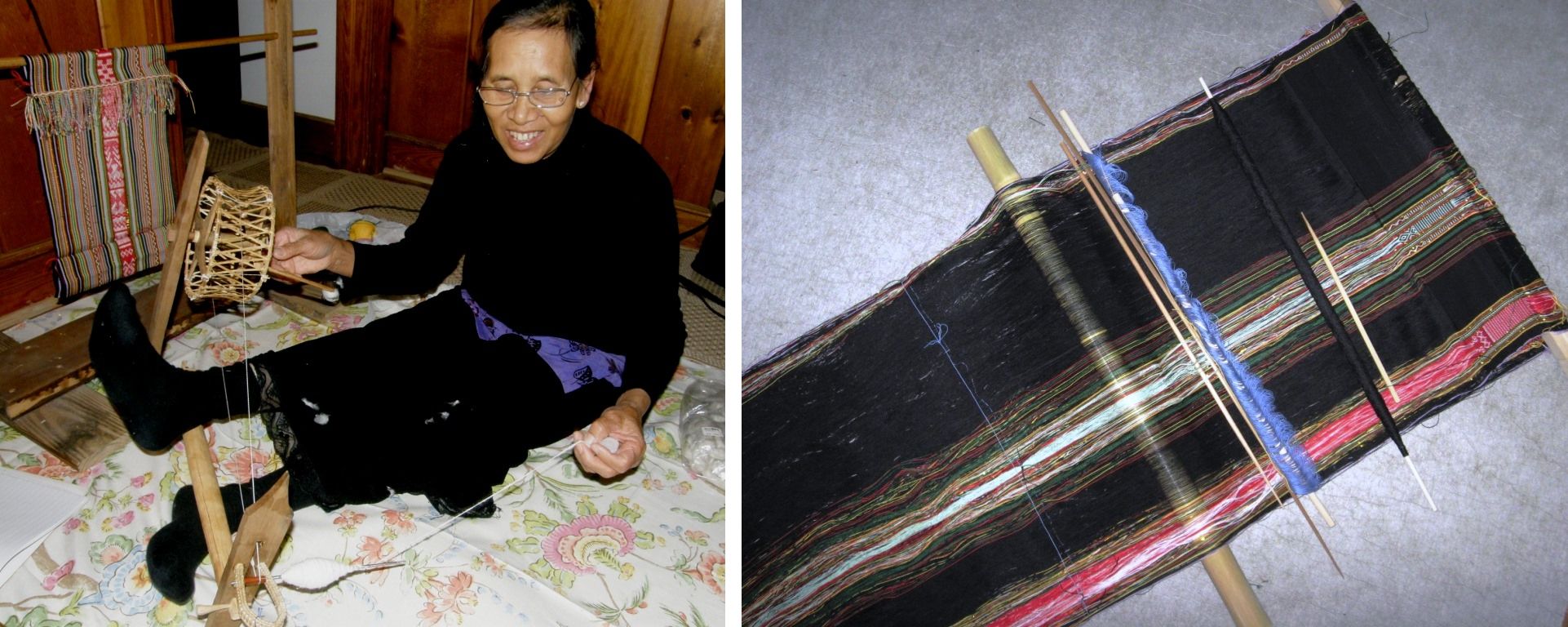
Betsy Renfrew, who is working with the Montagnard weavers in North Carolina sent me a picture of Rhade weaver Ju Nie’s latest project. Ju specializes in weaving the fine cotton panels that go together to make the traditional Rhade skirt. These skirts have strips of pick up patterning in various techniques and are quite often finished with a band of intricate weft twining.
It will be fun to see pictures of this as Ju progresses and get a sense of how long it takes a weaver to complete such a piece. You can read a lot more about Ju and the Montagnard weavers in these other posts here, here and hereand about Betsy’s project on her blog.
Finally, a couple of finished projects from some Backstrap Group weavers…
Look at all the gorgeous warp faced bands that popsicletote has turned out recently. While her handspun wool band earlier in this post was woven on her backstrap loom, I believe all these were done on her inkle loom using one of my tutorials for one and my pebble weave book for a couple of the others.
She enjoys using a variety of yarns and says that it is a shame that the photo doesn’t quite capture the different textures of the hemp, silk, linen, wool and cotton she used. In her words… – each has a different feeling and surface texture and I find I don’t prefer any one over the other. Maybe the wool was a little more fussy to weave but not much.
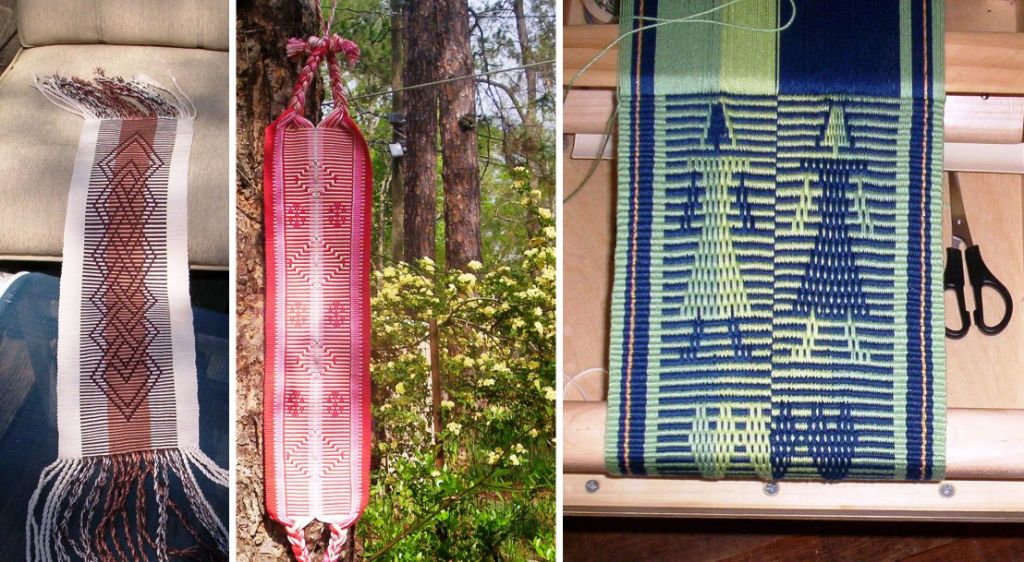
And that’s Marsha’s band on the right. She says that a warping mistake had her reversing the horizontal bar colors halfway through the warping process but she turned the mistake around to make nice stick figures that complement each other in simple warp float technique.
Well, I will be in California next week, all going well. Hopefully my flights will get me all the way through in one go on Saturday. My blog posts may be erratic as a result from now on. I am sure it won’t be from a lack of stories to tell but rather from the want of time in which to tell them. Maybe you feel like some folks I met last year at Convergence who asked me to stop posting for a while so they could catch up! But, there is plenty of stuff back there in the archives worth re-reading. I can barely remember some of it myself!
I want to once again thank Syne Mitchell of WeaveZine, Julia Grunau of Patternfish and all my new customers who have made this transition to the new home so smooth and successful.
I have had a few things going on the loom this week…mostly bits and pieces that I will take along traveling with me…. gifts and such things.
I wanted to free up all my loom bars and have everything in order before the trip and, in doing so, unearthed one more old project that was lurking in the closet.
This was to try out a Mapuche double weave motif that is in the Taranto book. I wove it in two-weft double weave so that only the central section with the design is in double weave.
I really couldn’t see myself finishing it and so off it came. As the beige sides are just regular warp-faced plain weave, they folded very neatly and easily along the edge of the double weave section and I was able to just sew a join. Now the MP3 player has a fancy home.
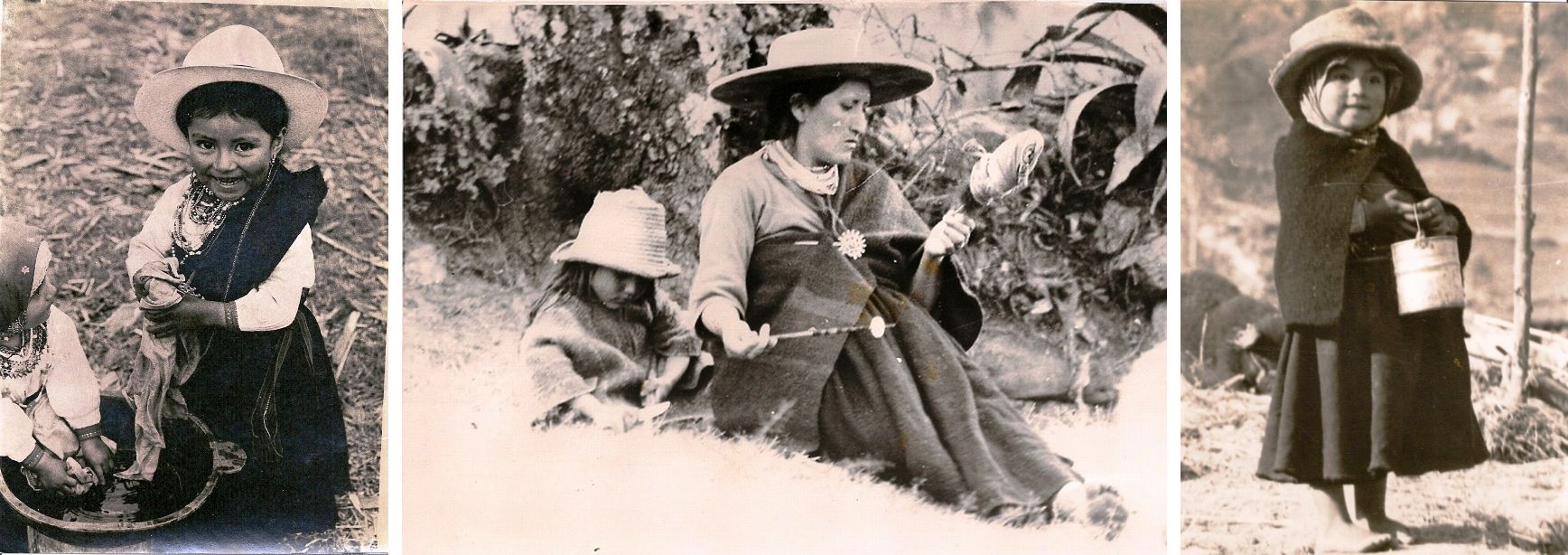
I’ll braid a cord for it. Hmm, might even do one for the player itself. Now I don’t feel so bad about pulling this off the loom.
Then I was prompted to do a little further exploration in supplementary-warp bands, you know that technique that I have never been too excited about. I learned it in two places in Peru and in another in Ecuador but never quite took to it. Well, I have to tell you that I am loving it now!
First I tried a Sami pattern (in non-traditional colors and border in 24 wpi crochet cotton) and then dug out my handout from a Robyn Spady class and used her chart for a Celtic design (in tencel) and now I have reproduced a design from one of the Russian Old Believer belts that I photographed last year. There it is in the center.
This was a width sample with some 3/2 weaving thread that I hadn’t used before. The ground warp and weft is 35 wpi crochet cotton. When I do the “real” band, now that I have established the width, I will warp an edge of off-white so the weft won’t be seen as it is above.
As it so often seems to happen, just as I was thinking about the Russian Old Believer bands, I got a comment on my blog from a visitor. Natasha provided some links to a lovely site with gorgeous Russian bands and a three-holed wooden rigid heddle. I understand the way the two-holed version works and Grace Hatton has done a lovely job of explaining that in her article on WeaveZine, but I am not so sure about this three-holed variety.
Anyway, here is Natasha’s comment…(hopefully she will send pictures of the bands she made herself)
Hi Laverne, The design found on the belts from aRussian online storeis very close to what I see on the old believers’ belts. The weaver’s name is Svetlana. She lives and teaches weaving and other crafts in Moscow. You can see some pictures taken at thecraft exhibition last year. I recently purchased a wooden implement (not sure what the proper name is) from Svetlana that is used for belt weaving and wove my first two belts. It is called“berdo” in Russian. The interest in traditional crafts has grown in Russia too in the last ten years, at least as far as I can tell without being there. If you need anything translated from Russian I can help.
You may remember that I attended a weavers’ conference here in Santa Cruz a couple of weeks ago and dedicated a couple of blog posts to it.
As a participant from the general public, I got to meet and interact with weavers and other fiber artisans from the highlands and lowlands of various South American countries. Through workshops, videos and presentations we not only learned about the fibers and the techniques used to create the woven pieces, but also about the efforts of researchers, artists and academics to document the processes at the source and educate youngsters in the artisan communities themselves and the general public about these cultural treasures many of which are on the verge of disappearing forever.
This made me think of four people I know of who are working or have worked at this very thing and I thought that it would be nice to hear in their own words about their involvement and relationship with the artisans and what they see the future holds.
DORINDA DUTCHER
One such person is Dorinda Dutcher, a North American ex-PeaceCorps worker whom I met online and with whom I shared a room at the Tinkuy de Tejedores last year in Peru.
Dorinda works out in the field and is out of internet contact much of the time and so I was unable to get in touch with her for this blog post. I urge you however, to take a look at her blog and the wonderful programs she has going in the township of Independencia in Cochabamba, Bolivia.
Both Dorinda and Maxima, a local weaver who heads one of the weaving associations, were very much moved and influenced by their experience at the tinkuy. You can read all about it and how Dorinda is educating and involving youth in weaving and helping, very slowly but surely, to improve the lives of women in the community in her own words here.
#############################################
KATHLEEN KLUMPP
I was lucky to come into contact with Kathleen Klumpp through Ann Rowe who I met at the Textile Museum in 2007. Ann knew that Kathleen was planning a research trip to coastal Ecuador and could probably use an assistant. It was one of those “meant-to-be” things. But Kathleen’s involvement with the family of cotton weavers in Manabí Province, Ecuador goes back much much further than this 2007 trip. I will let her tell you in her own words…(photo captions by me, all photos except one by KK)
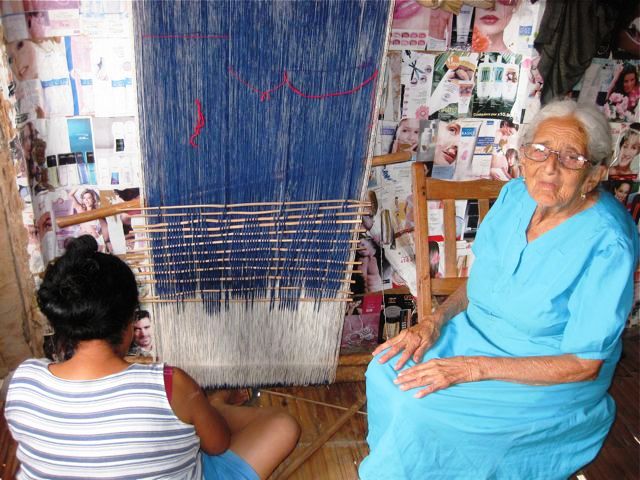
Kathleen with one of Luz’s daughters, Trinidad
My first contact with this family of weavers was in 1976 when I sat next to an elderly campesino man on one of those colorful open-sided country buses who was carrying a patterned saddlebag known as an alforja labrada.
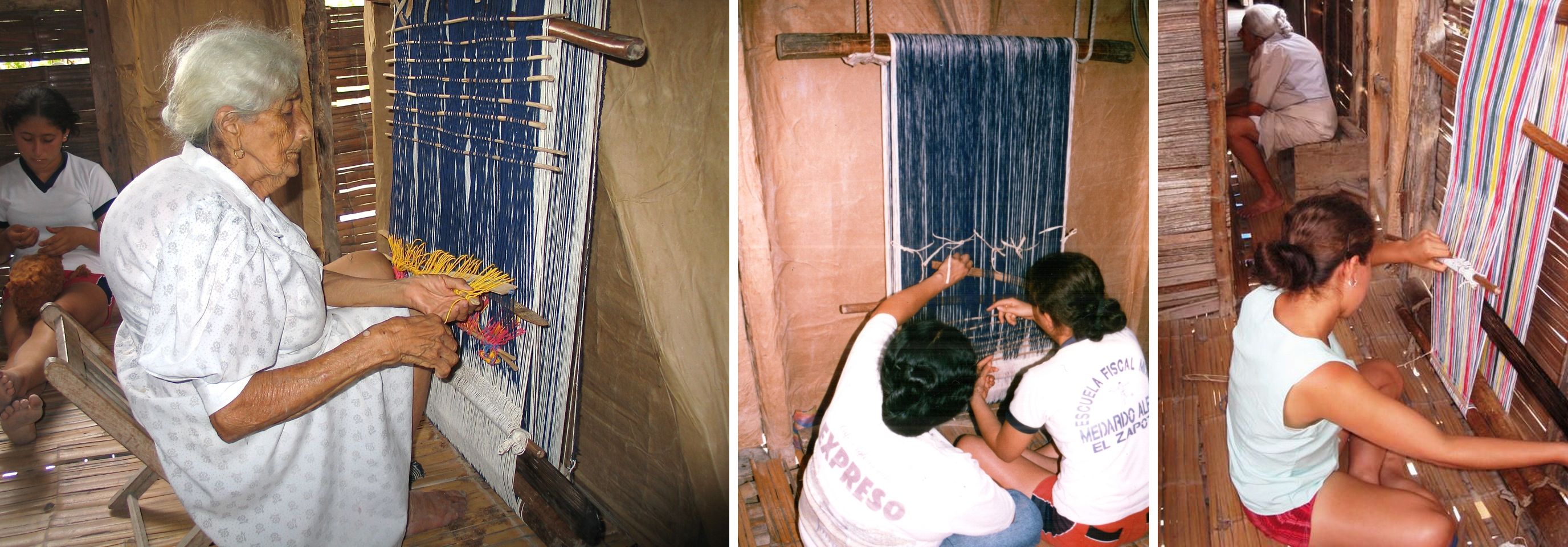
I admired his bag, and I soon found myself up at the home of its weaver, Doña Luz Párraga in the settlement of Zapote documenting their methods in writing and in still photography for preparing cotton, spinning it, and weaving it into alforjas and hammocks.
Spinning cotton and weaving on a native vertical loom is a millenarian coastal Ecuadorian artisan tradition that has been transmitted by peasant women from one generation to the next for at least four thousand years. Throughout much of the twentieth century, this craft flourished in the Rocafuerte valley region of central Manabí. In almost every settlement and small village situated between the city of Portoviejo, the capital of the Province and the city of Rocafuerte rural women spent hours hand-spinning cotton fiber and weaving double-pocket bags or saddlebags (alforjas) and hammocks intended for their own use as well as for that of other peasant families in the area. During much of the 20th century, the spinning and weaving of saddlebags and hammocks were part of a female peasant identity and part of their cultural heritage.
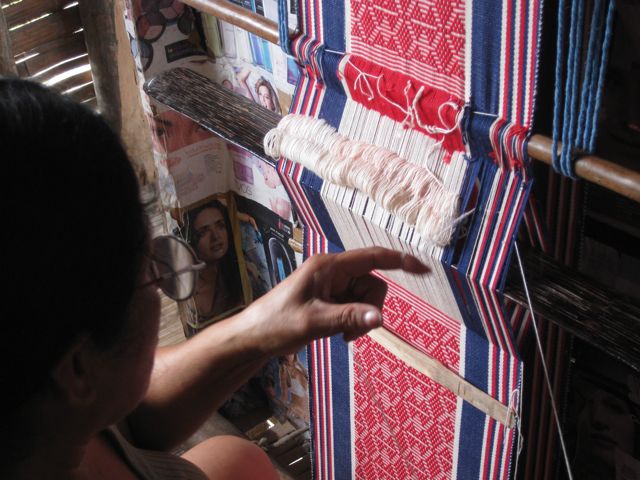
The finished patterned textile ready to be sewn into a saddlebag.Trini beats the cotton as part of its preparation for spinning.
In order to repay Doña Luz and her family for sharing their knowledge and skills with me, I made sure that they had copies of every photograph I took as well as doing some special portrait photography of this family at the request of Doña Luz. Even though the brief article that I wrote about this millenarian fiber art was published in Spanish in an Ecuadorian anthropological journal, nobody, other than non-Ecuadorian textile specialists took an interest as this activity has been invisible to the members of the dominant society for centuries.
I returned to Zapote in 2006, after a hiatus of 30 years only to find that this fiber art was on the verge of disappearing altogether. In fact, Trinidad and her sister Mariana were the last active weavers in the entire Province. But there was a problem: neither of Doña Luz’s daughters had learned how to pattern the fancy saddlebags, since the campesinos had stopped using them in preference for plastic bags.
In the face of an increasing globalization, the economic and social value of transmitting these skills and knowledge to the next generation has collapsed. Today’s cell phone carrying young ladies want nothing do to with this textile fiber art as it is considered “antiquated” and not suited for “modern times”. They would be embarrassed to be seen spinning or weaving—such is the stigma attached to this former female peasant identity—an identity now tenuously held onto only by their “old fashioned” grandmothers. In 2010, one young lady told Trinidad, as she was trying to recruit her as an apprentice, that she “rather starve” than to earn a living from this artisan activity.
My first priority was to insure the transfer of the full inventory of Doña Luz’s knowledge to her daughter, Trinidad, the one most interested in learning.
Now in 2011, I report on some recent encouraging signs that indicate that it is not yet totally moribund. These stirrings of life are, I believe, the end result of the steps that I initiated in 2006 to keep this craft alive and to insure that the necessary infrastructure would be in place for it to continue.
On my (Laverne’s) visit with this family accompanying Kathleen in 2007, Luz’s granddaughter Catalina would help with de-seeding and teasing the cotton (you can see her there in the background of the first picture). Grandmother, mother and aunt Trini would take care of the spinning and weaving process. On that same trip Catalina took only a very short-lived interest in learning to program the pattern warps but you can see her there in 2010 weaving a hammock on her own while 86-year old Luz sits by.
In 2007 when criollo cotton could no longer be purchased anywhere in the region, (cotton used to be a major cash crop of Manabí throughout the major part of the 20th century), I then suggested that they grow their own. Trinidad was able to locate a little old leftover cotton with its seed intact. We both selected the best looking seeds, and she planted them. Since then, she has about 75 viable cotton plants of two varieties of the native South American cotton Gossypium barbadense growing on land that this family owns on the top of the ridge.
We also have secured more macanas (the heavy swords or battens used to beat down each successive row of weft thread) from some old ladies in the village who no longer weave. These heavy swords are hand-hewed out of a dense hardwood with the wood of the chonta palm being the preferred material. We also found some old, abandoned fence posts of chonta wood near the town of Chone where this palm grows, just in case we have to fashion new macanas in the future for additional looms and weavers to use. You can’t weave without a macana—it is the essential piece of equipment!
I also encouraged Doña Luz’s 10 year old granddaughter, Melina, to learn how to spin. (by bribing her with 10 cents for each arm length of spun fiber!)
But, if despite my efforts, the knowledge of spinning dies out ( as today’s generation of young ladies have no incentive to learn it) I have located an excellent source of natural cotton yarn that takes dyes, both natural and aniline.
A new design being woven with suitable industrial spun cotton that Kathleen discovered in the area.
################################################
BETSY RENFREW and ANDREW YOUNG
I met Betsy online when I ran into her blog on the Montagnard weavers who are living in North Carolina. We made contact and I organized to go and meet with her and Andrew and the weavers with whom they have been working. On a second occasion, Betsy welcomed me again and I was able to learn the weft twining process called kteh used to finish the ends of blankets and skirts from weavers Ju Nie and Ngach. On this trip I was also able to take part in some of the weaver gatherings that Betsy organizes.
One of my twining classes with Ngach and examples of the beautiful kteh work.
Here is Betsy writing about her project and its goals…
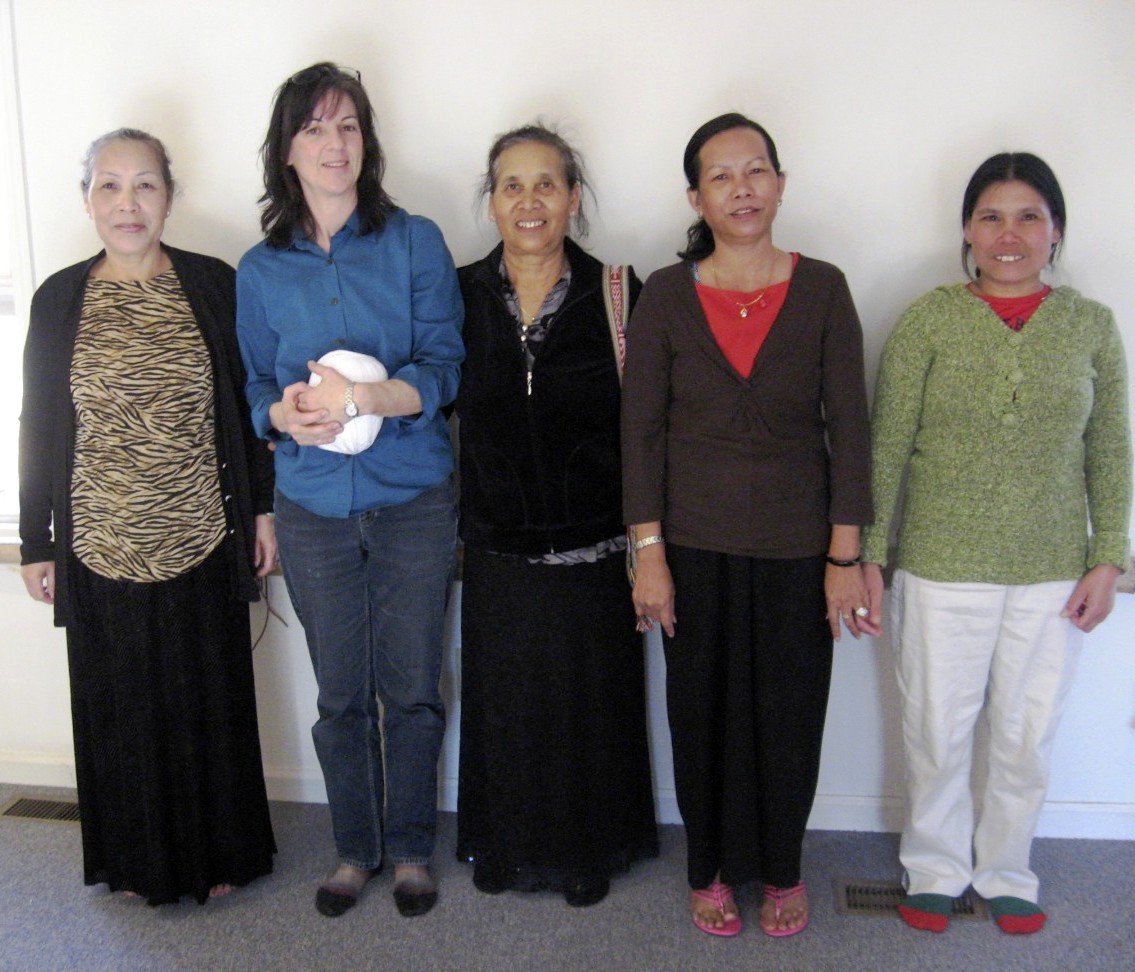
Betsy Renfrew with Montagnard weavers, from left to right H’ Wun Eban and H Ngach Rahlan (Jarai tribe), H-Tep Adrong (Bunong tribe) and Broih Fnu (Banhar tribe)
Since 2008 I have been meeting and interviewing Montagnard weavers in Greensboro, NC, in an effort to document their weaving traditions and understand why so little research had been done on these traditions.
My background is in the Fine Arts and I found this documentation to be an important segue from the world of painting and art history into a more folk/craft oriented project with a digital element. Recently I have received a grant and great encouragement from the Community Folklife Documentation Institute, a program spawned by the North Carolina Arts Council, North Carolina Folklife Institute, and the Center for Documentary Studies at Duke University.
North Carolina is eager to learn more about
A local church has given space where Betsy can gather the ladies to weave, share skills and socialize. Here she also teaches them the English words for their looms and the weaving process.
Montagnard weaving and I am eager to share this knowledge with others. I have also partnered with a local Montagnard organization, the United Montagnard Christian Church, in receiving a grant from the United Arts Council of Greater Greensboro. With this grant I have organized women (now known as the Backstrap Weavers of Greensboro) that weave to help them learn some basic English to demonstrate their skills at local events, teach weaving to new students and learn how to market and sell what they weave.
We have good following of women coming to our meetings to share weaving knowledge. Most of the women are over the age of 50 and don’t speak English at all or have limited English. Most elderly traditional Montagnard women don’t interact with people outside their kinship group or church circle because they don’t drive, can’t read, or do not have a job. I found a certain level of low self esteem at first (because of the language barrier) but now I see these women not only enjoying themselves during our weaving time but interacting with people from different language groups (refugees from the Central Highlands speak five or six different languages) and other ethnicities. They have also come to trust me and to tell me what they love best of their culture.
Ju and Khin, both of the Jarai tribe, meet at the church to make a new warp.
One of my frustrations within the last year or so is a small turnover in attendees. Some of the women can’t come regularly because they care for grand children, have old injuries from working at textile mills, or poor vision. And there is the continual concern for sustainable income or funding for the project. Many of the women do not understand what a grant is or how it works! Despite these frustrations I have built a bond with what seems to be the last few practicing weavers in Greensboro. I teach them English, they cook me hablang, or cassava leaf soup. They teach me the words for their loom parts and I teach them how to teach others to weave. They are weaving with new supplies and beginning to make smaller purse type products to sell.
Betsy helps Ju an other weavers develop a way to teach their backstrap weaving art to others. This is Betsy’s first completed piece from her weekly classes with Ju.
Bunong weaver Tep showing one of her newly woven pieces.
And the future?
More aggressive fundraising tactics and creating an on-line market/gallery on our local arts websites.
I also will be widening my reach to Nepali speaking Bhutanese refugees, who also use backstrap looms.
I never had the pleasure of meeting Dennis Penley.
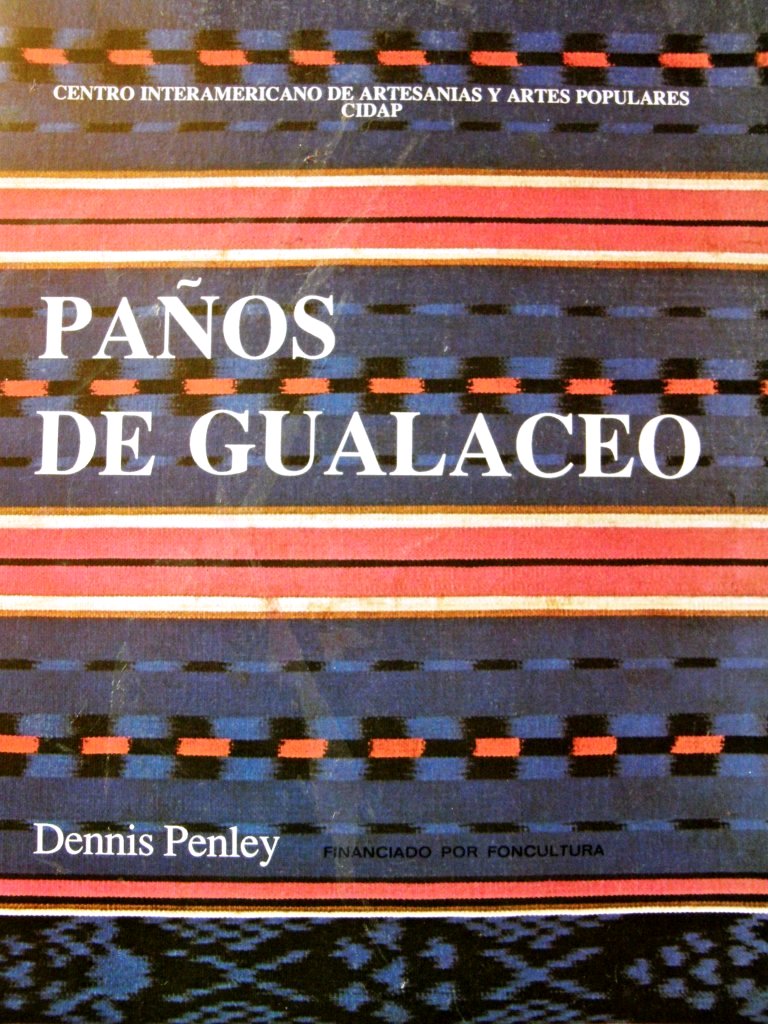
I bought the book he wrote on the ikat shawls or paños of Gualaceo, Ecuador on a visit there in 2005 knowing nothing about its author and the fascinating life he had led.
I have, however, been lucky to have become acquainted with Phil Willett, once again, on line, to whom Dennis Penley was a good friend and weaving mentor.
Mr Penley passed away the year after I bought his book and Phil wrote a short biography to accompany an exhibit of his collected textiles made as a tribute to him.
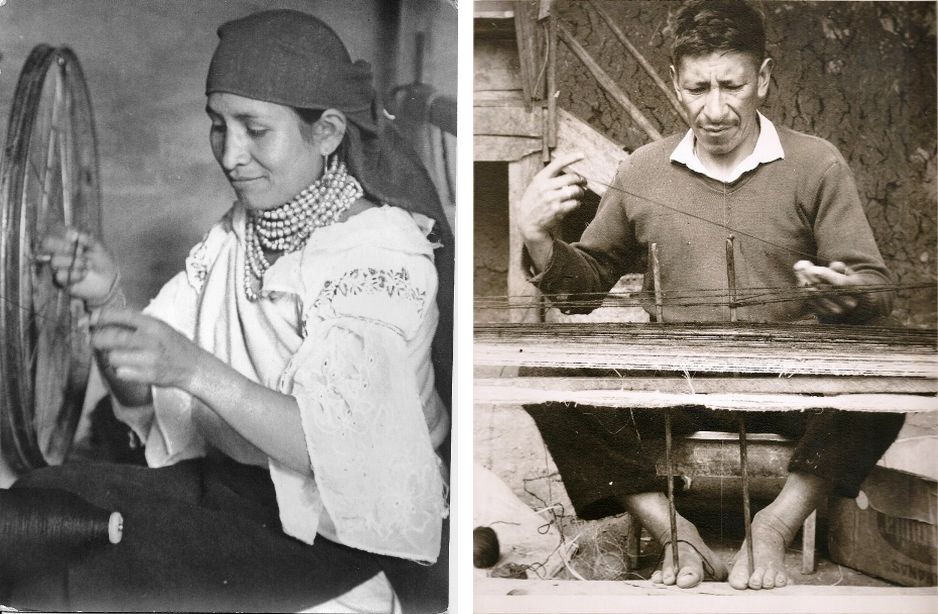
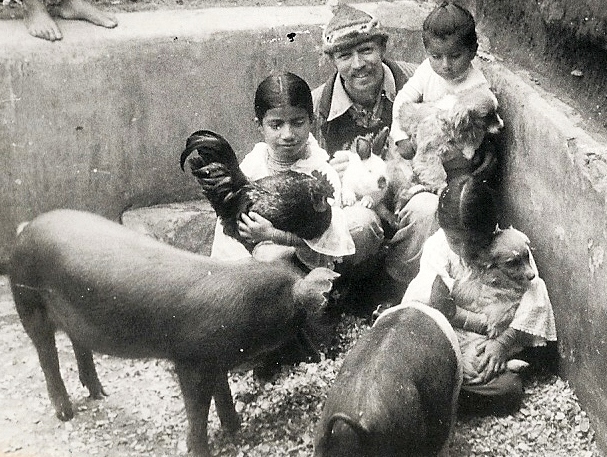
I won’t caption the photos, all of which (except the first in color) I understand were taken in Ecuador.
Here is the biography that Phil put together…
Dennis Penley, a life time of hand weaving enthusiasm.
From his early beginnings creating elaborate costumes for himself and the Arabian horses his family raised and trained, Dennis was a born textile enthusiast. He taught himself to weave as a teenager and utilized that interest to befriend many people through his life.
After high school he joined the Peace Corps and worked within the Ministry of Agriculture of Ecuador. Part of his job was researching the indigenous peoples weaving traditions.
Following his Peace Corps service he stayed in Ecuador to research and write a bilingual book on the shawls of Gualaceo.
He lived and worked among the indigenous mountain weavers, with a horse to travel by and a llama to spin wool from while it also carried extra gear.
When he returned to the USA Dennis received an honorary bachelor’s degree from San Francisco State for his work in Ecuador. Dennis not only photo documented the techniques of the weavers, he learned them by hand using a back-strap loom.
With all this weaving knowledge he had hopes, when young, of a lifetime of hand weaving. Based out of California he produced custom hand-woven yardage for designers, blankets and home accents.
All this was accomplished on a Swedish barn loom. His dream would not prove to be financially viable.
Dennis would, through his working career, excel and profit at many other endeavors. He was a master cabinetmaker and historic architecture restorer. He worked for many years for the city of Lexington, his final position as a code enforcement officer.
Dennis’ studies of non-western cultures, philosophy and textiles would be a passion for his entire life. He first became intrigued with ikat weaving in South America. He would later research its use throughout many cultures. After years of studying the textile traditions of Southeast Asia and Indonesia he traveled twice to the region to see the artisans and collect textiles.
The textiles within this collection are a testament to an inquisitive mind that had a tremendous respect not only for the craft but also the people who created them. They are works of art and expressions of cultural identity and diversity.
My goodness, people have been busy in the backstrap and inkle weaving groups at Ravelry this week. Check this out…
Marsha has been making all kinds of wonderful things with simple warp floats. The knot design on the left is charted here.
Bobbie is making a bag with pebble weave designs. Here we see the wide front and back panel and the side.
And some Spin-Along results are coming in…
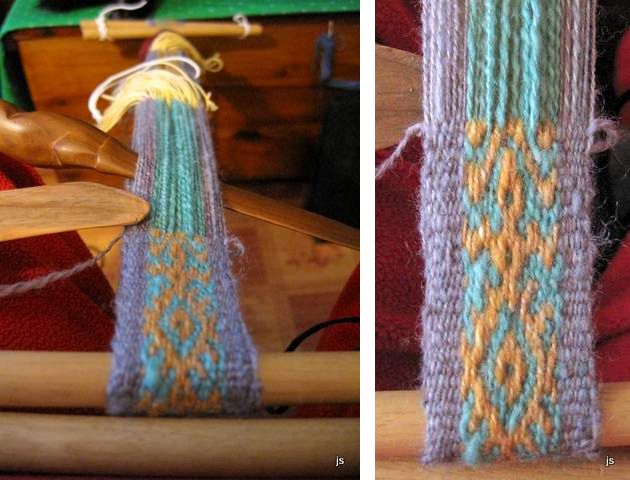
Popsicletote is weaving with her handspun wool/silk blend. The hairiness is making life a little difficult but she is adapting and getting on with it. Her designs are pebble weave.
Tracy has just warped up her own handspun wool. Here you can see it curled up at rest and then tensioned on the loom bars.
Another ‘waver’ has joined in the warp-faced fun (Waver= user of Gilmore Wave loom). That’s Michele’s pebble weave band on the left with one of my designs from my Andean Pebble Weavee-book. Popsicletote tried sock yarn for making a band and it turned out beautifully!
And here are some projects from a little while back from the online groups that I didn’t get a chance to post…
I LOVE all these different wool warps showing up…hand spun, re spun commercial yarn…all working differently and giving a variety of results. How lucky we are to have all these folks experimenting and creating and sharing with us. I am learning so much!
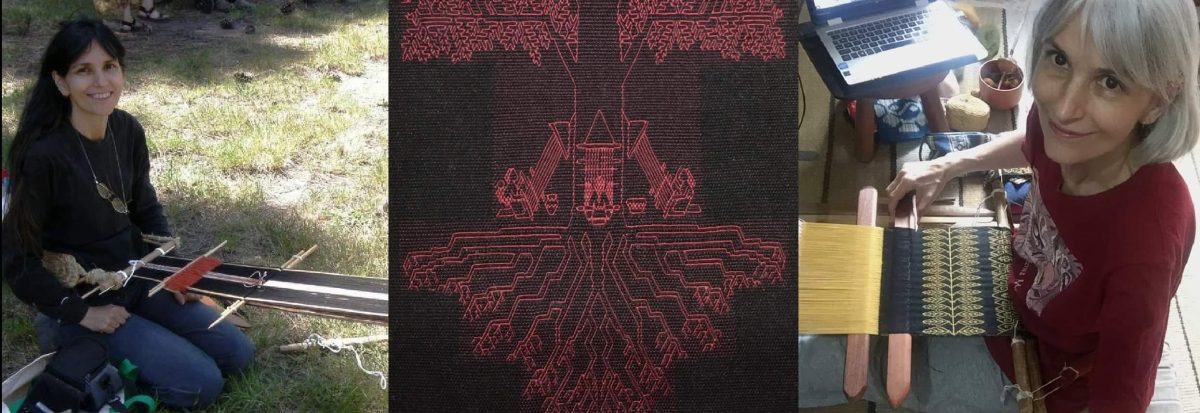
 I am up in Humboldt County still on my friend Janet’s beautiful farm. Online friend Cookie has just arrived for the backstrap weaving gathering we are having in Janet’s mill tomorrow.
 There she is making her backstrap which she has brought along to weave with tomorrow. As I type, Cookie, Janet and I are watching Abby Franquemont’s Respect the Spindle video which can be downloaded from Interweave until Monday for only 10 cents! Cookie had a long drive up from the Bay Area and is feeling tired and cold up here so we will save the rest of the video for tomorrow.
 Janet spent the evening weaving a fine silk piece on her Glimakra band loom, Cookie spun silk (looking cold!) and I edited photos for this blog post. Cookie shared her most current passion, a style of drawing called Zentangles. I had never heard of it before and she has a whole book which she bound herself full of these fine black and white ink drawings that she has done….very cool. One is a self-portrait.
 So, tomorrow Janet’s neighbors and friends will be over to weave and a decision had to be made…
 …where to weave? Last week a short wave of warm weather had me out on the porch tied to one of those posts enjoying the view but the temperature is going to drop to 30 degrees Farenheit tonight so I guess we will be indoors where Janet has just as comfy a set-up in her warm mill among all the lovely woolly smells. A long piece of pvc pipe wedged behind uprights on her shelves will be our hitching post. And then there is always this monster…
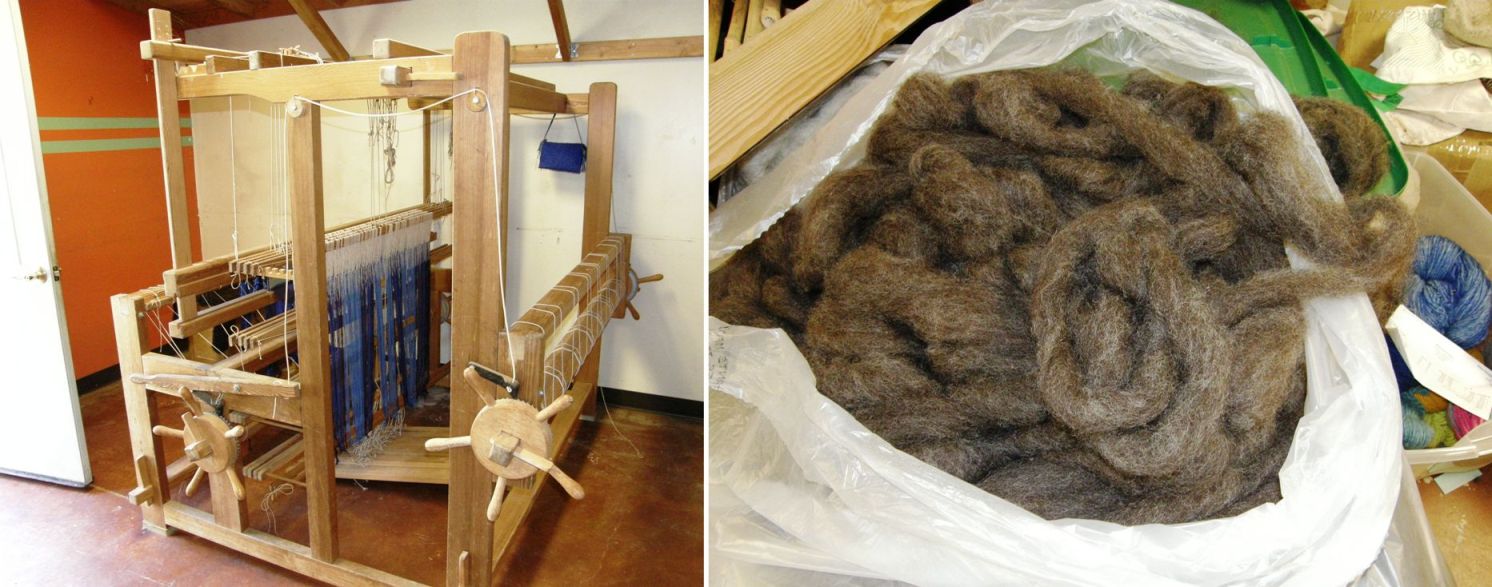 Last weekend we had eight weavers comfortably hitched to a big floor loom like the one above. We will be warm and toasty in there with the heated floors surrounded by bags and bags of the luscious roving that Janet’s mill produces.
 Janet showed me her charka made by Alden Amos. What a piece of handmade work that is. Apparently he even bends the wood himself to make the wheels. And there is a spool of Janet’s amazingly fine handspun cotton perched on top.
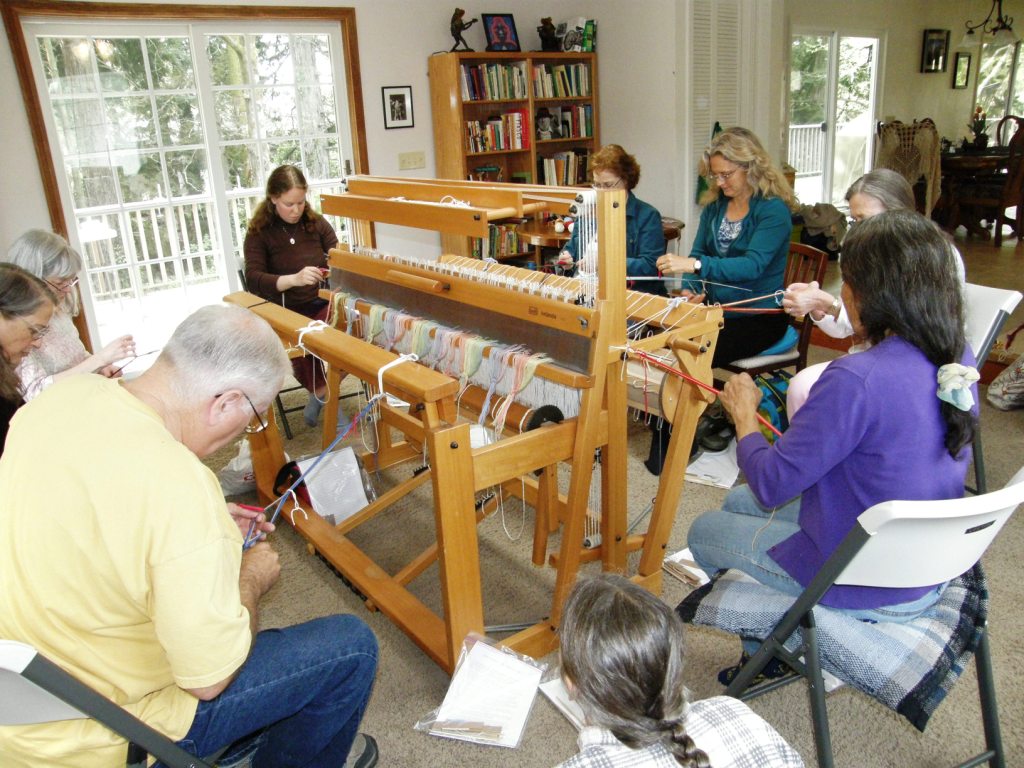 Eight weavers having fun tied to Becky’s floor loom.
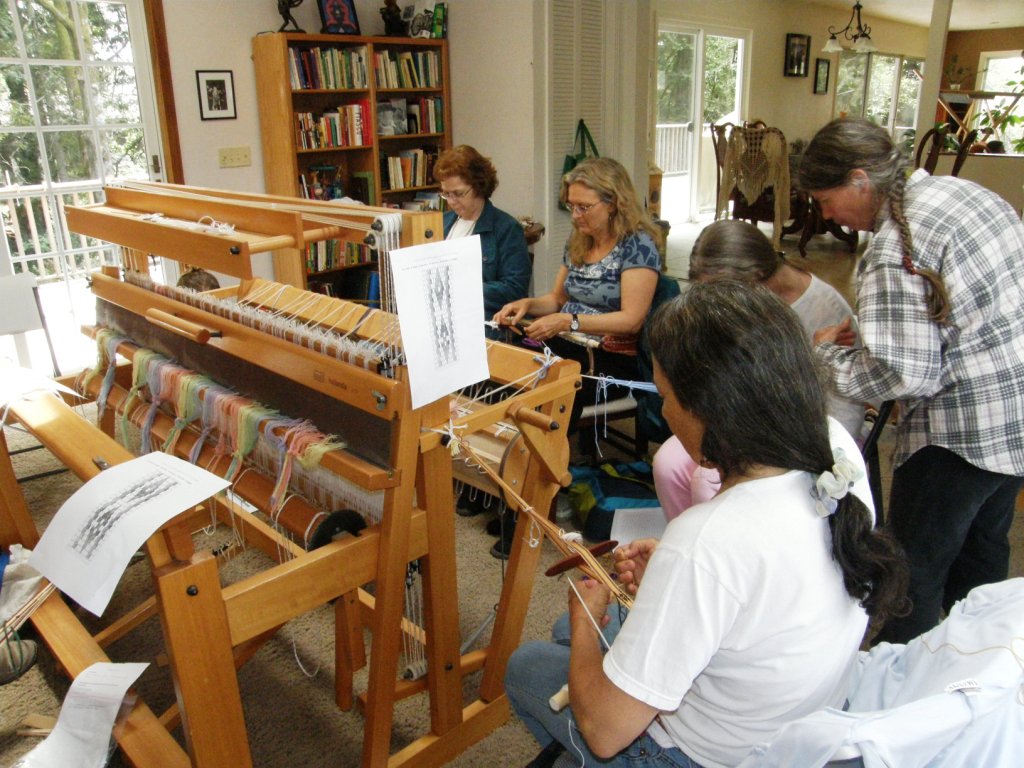 Silent concentration .
 Getting the hang of it, some people can look up and smile, although Kirby doesn’t look too sure yet, before returning to silent concentration. No room for me to tie and weave.
 Smiles at ”hey I can do this!” Now we can weave and smile and chat and relax. Olympia found the floor her ideal spot. Teresa had a cushioned seat while Laurynda felt more comfortable standing.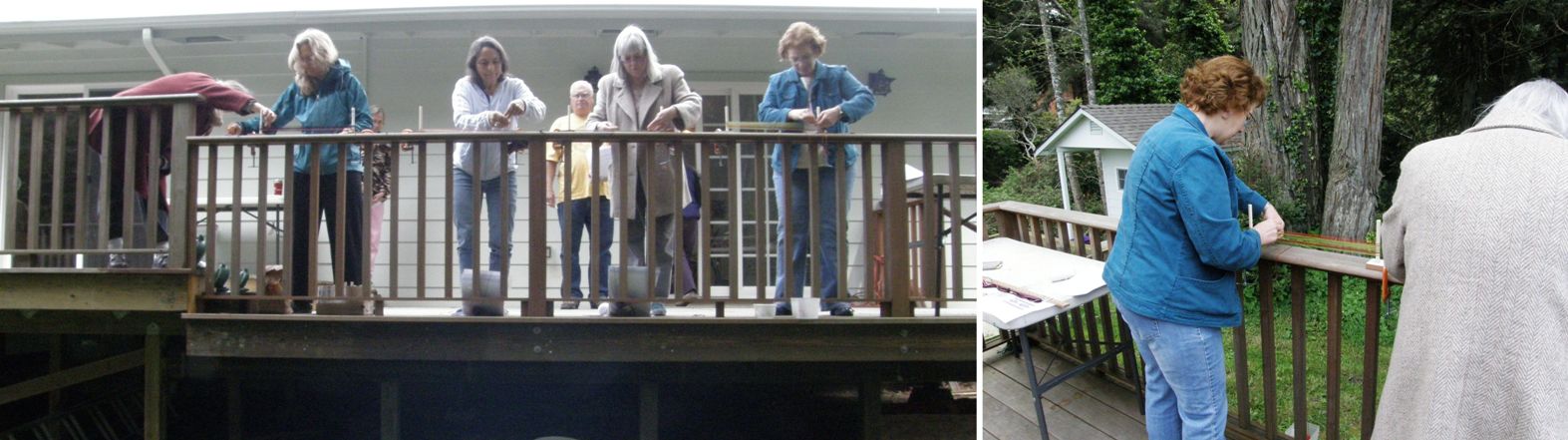
 We warped out on the deck. It wasn’t really t-shirt weather although Kirby seemed to think so.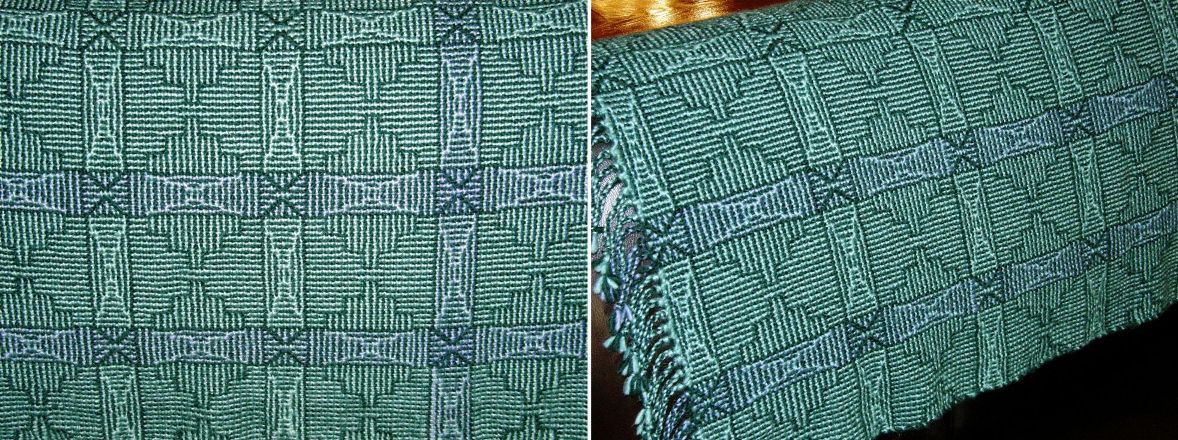
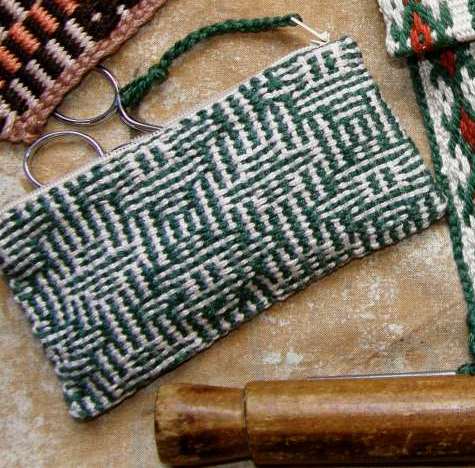 This little scrap at left is my one and only attempt at shadow weave so far…a four-shaft sample which I wove on my backstrap loom with string heddles and which I made into a sewing kit purse.
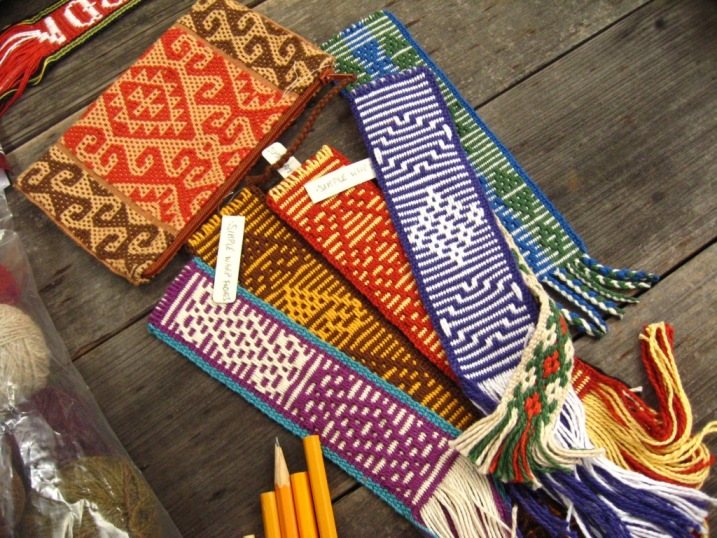 We played with simple warp floats. Pictured above are some of my samples. Thanks to Annie for allowing me to use this picture that she took.
 We also dabbled in some supplementary weft patterning which you can see below…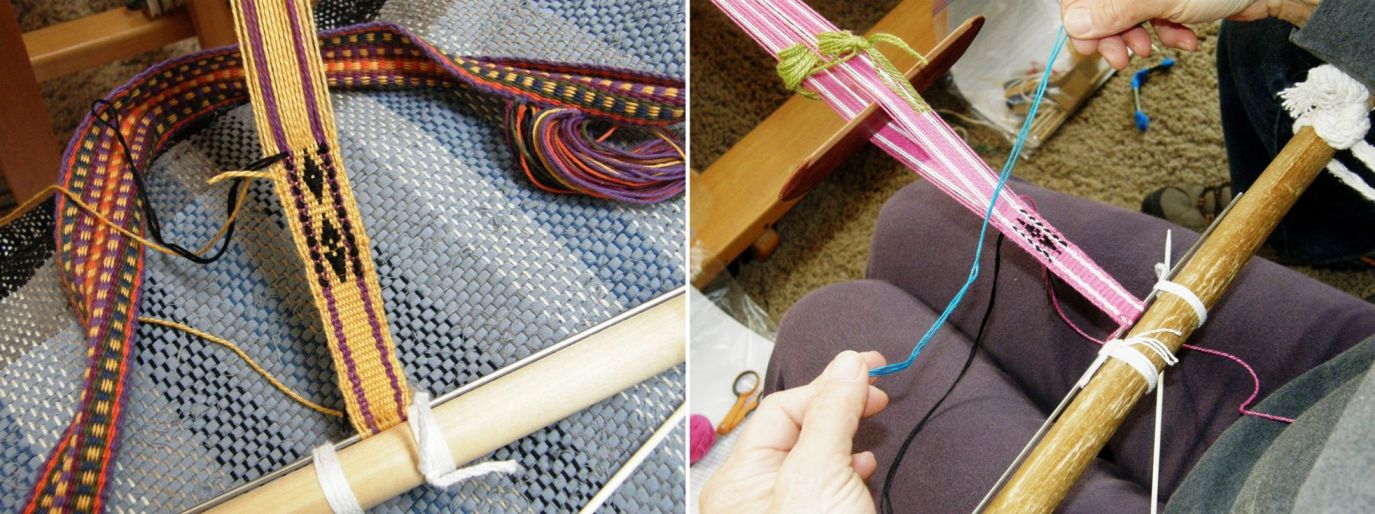
 And a real treat for me was seeing a belt that Susan brought that I am guessing is from Mexico.
 Above left you can see one motif on the belt. Almost all the supplementary weft has disappeared from the central diamond. Actually I really like the way it looks with the two-color floats on the sides and the exposed horizontal bars in the middle and I would like to weave something just like this. However, it seems that the original intention was to cover up those bars with the purple supplementary weft.
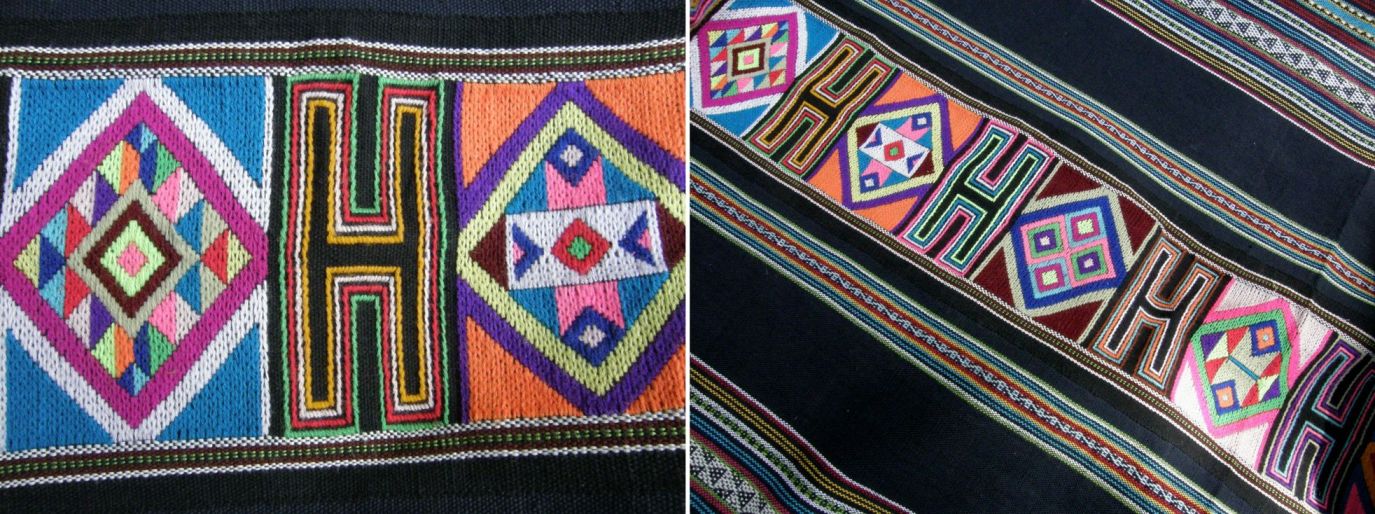 This beautiful skirt was brought by Teresa. Her son had purchased it in Vietnam and I was happily able to identify it as Bunong after having seen something very similar when I was visiting with Betsy Renfrew and the Montagnard weavers in North Carolina.
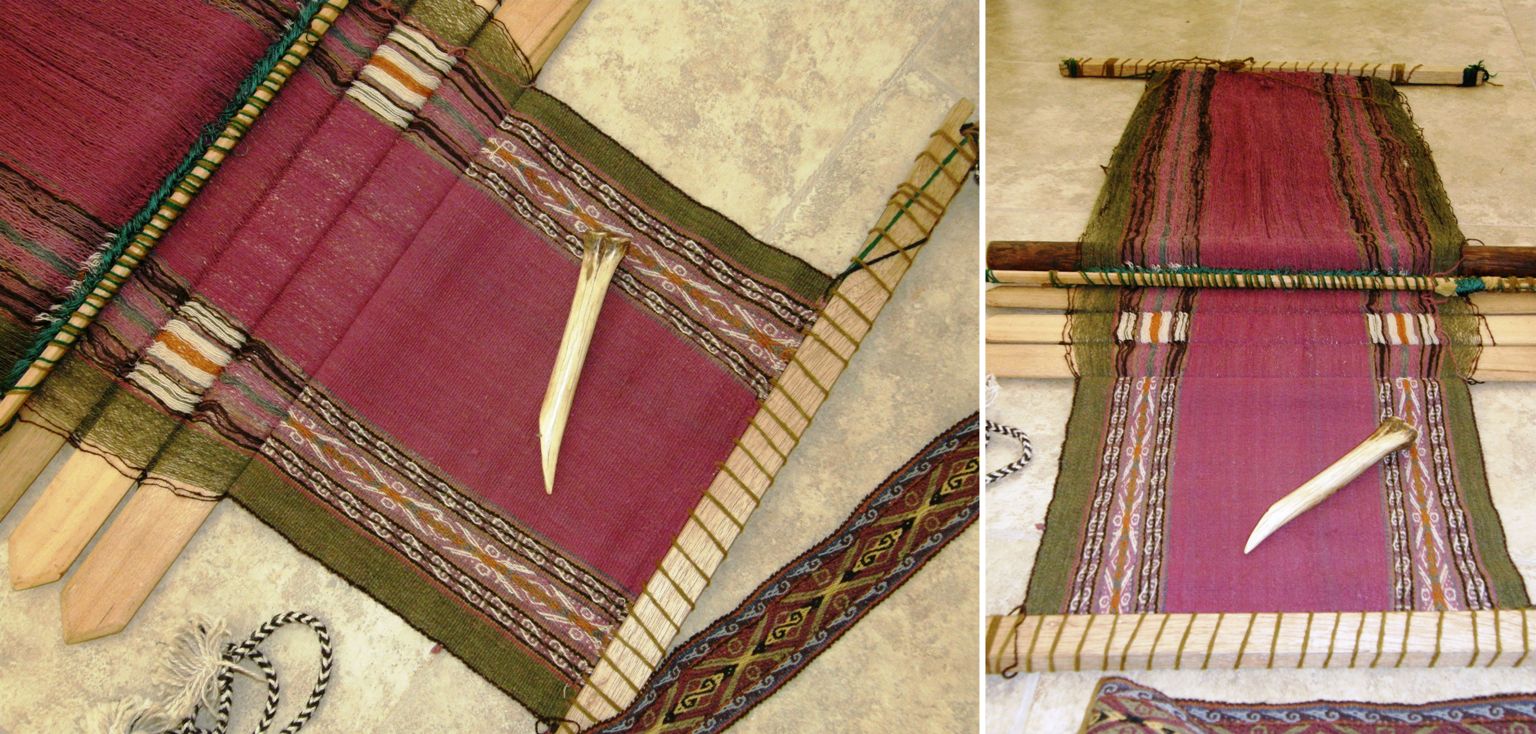 Linda Hartshorn brought this gorgeous piece from Chinchero, Peru still on the loom which she had purchased on a visit there. She also bought the ruki, the llama bone tool used for beating and a backstrap made from a woven band with tubular bands used for ties.
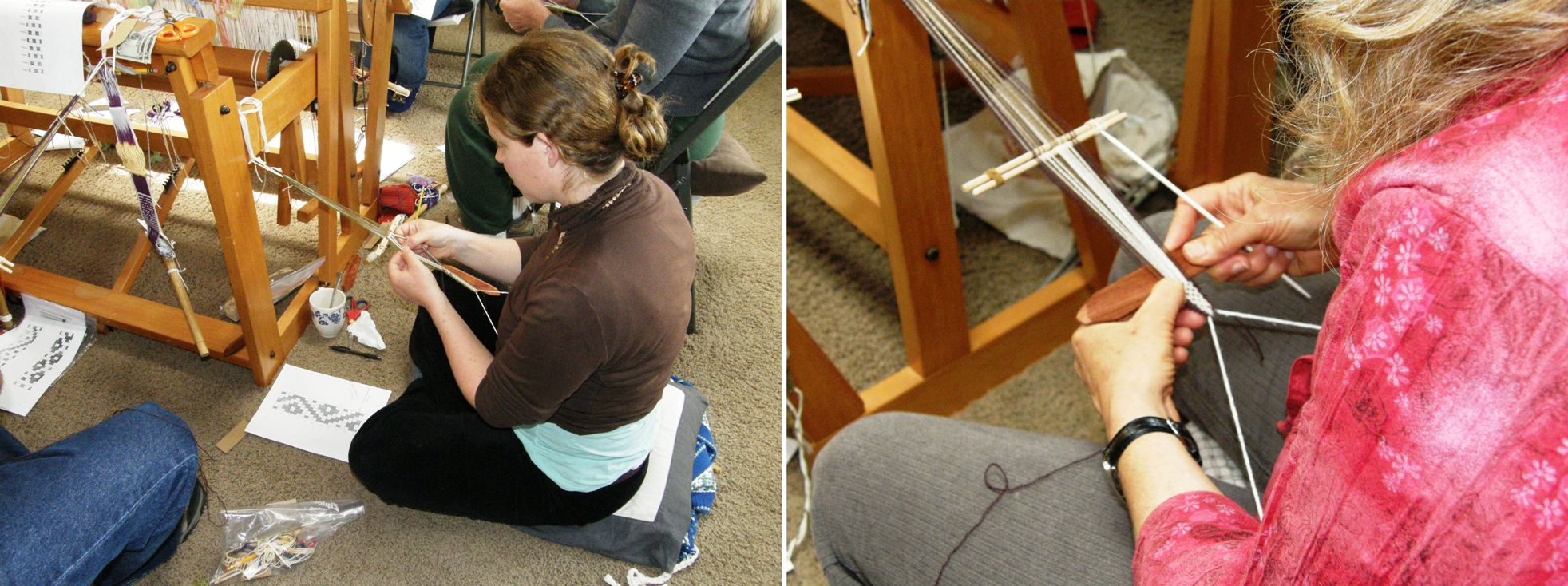 We played a bit with pebble weave using Janet’s handspun and everyone enjoyed her spinning demonstration.
 Group photo time just when it was warm enough to go out on the deck again…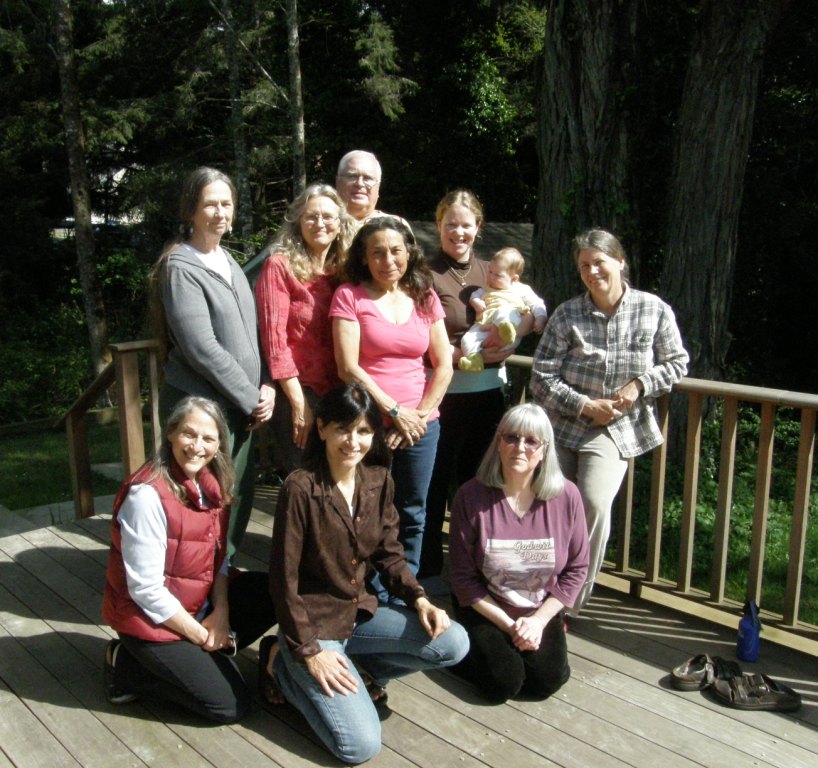
 Cookie and I wove on in the mill long after everyone had left while Janet spun more wool for me to use for backstrap weaving and rescued the warp of friend Carol’s inkle loom which was suffering from a kitten attack. Carol had a really pretty simple warp float pattern on there.
 I learned a couple of cool things today from other weavers. Yani, who is not one for details, looked at me as if I were mad when I suggested she do a series of four-strand braids to finish her keyfob.
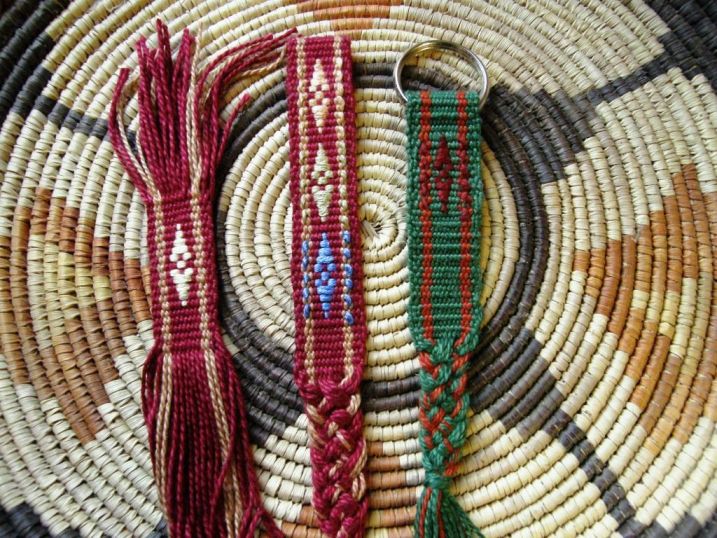 So, here are three versions….on the left – no visible weft turns as they are hidden on the back side of the band. In the center – the weft turns are a decorative feature sitting as little beads of color along the stripes on each edge of the band. On the right – the turns are camouflaged in a stripe which is the same color as the supplementary weft. Which one do you prefer?