Backstrap Weaving – Time for even more Play!

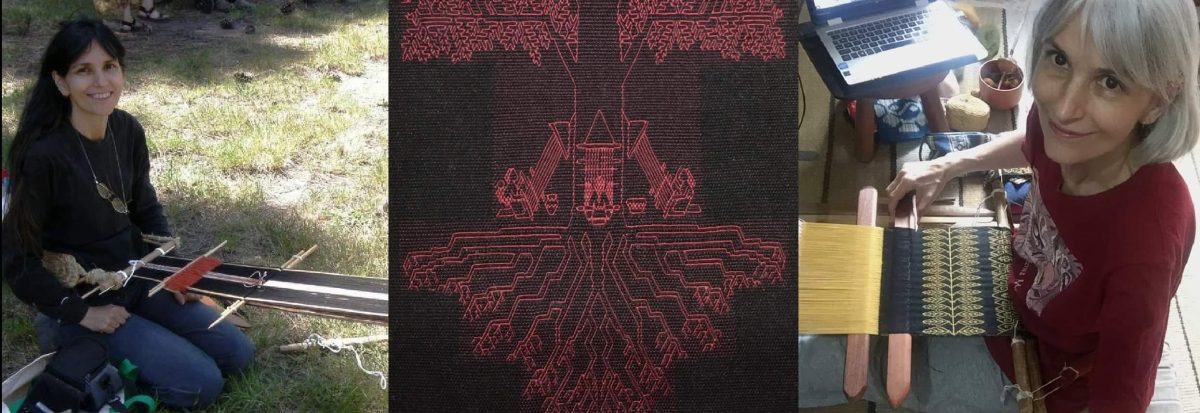
The fall trip is almost over…time to gather and bag my loom bars, fold the backstrap, wind up all the little balls of yarn, stash the beaters and sticks, and stuff them all into the wheely bag ready to fly home….but there is still a little time to play some more!  Now I am home and looking back. I was too busy playing last week to even do a blog post 🙂
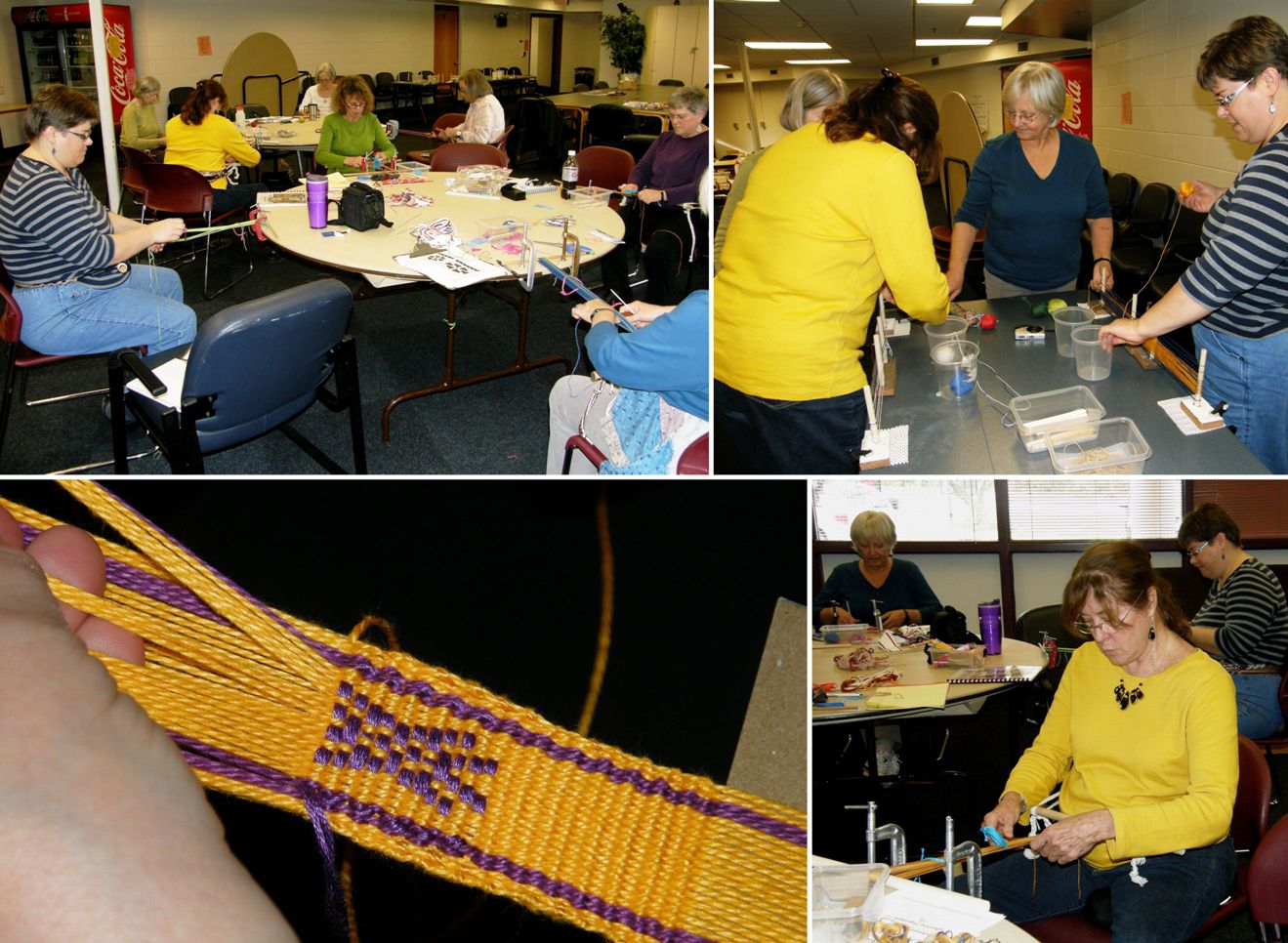
The last days were spent backstrap weaving with friends in Maryland.

It was nice but confusing seeing many familiar faces at the guild meeting. Now…. where did I meet these folks…was it at Sheep and Wool last year where Carla and Mary wove with me in the bunny barn or at the guild meeting I attended?

Weaving in the bunny barn at MD Sheep and Wool last year

There was one very familiar face…oh yes, that was Peggy who wove with me in Pennsylvania last spring. On top of that there were familiar names, if not faces, of people who have commented on my blog or Facebook page.

And then there was Kathie! I spent three weeks with Kathie in coastal Ecuador in 2007 with the family of cotton saddlebag weavers that I have told you about here before. Although we have kept up a regular email correspondence since then, we haven’t been able to get together in person until now. She came along to weave with us.
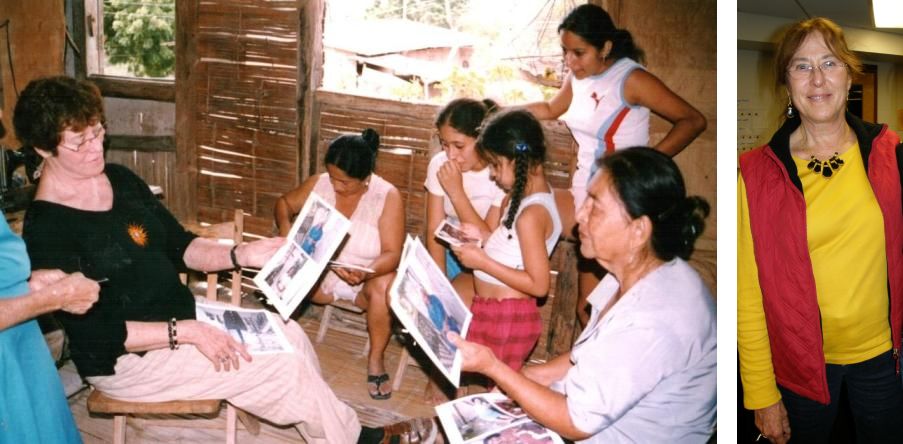
Above left, you can see Kathie on our visit to Ecuador in 2007 showing photos that she had taken when she first met this family back in 1976 and, above right, at our  backstrap weaving get-together.

I unwound with my friends  in their home in Maryland and made plans for my last week in DC. Claudia is a weaver and Janet is a knitter so there were still plenty of fibery things going on around me.

I learned about rag rug weaving from Claudia in her basement studio where she is in the process of making two 9-foot commissioned rugs. I was there to celebrate the finish of the first one. It’s quite a process!…cutting strips, sewing them together end to end, ironing them, winding them onto the long shuttles. I was glad to be able to help at least with the sewing and ironing and the sewing was novel for me…only my second time using a machine.

While the machine is definitely the way to go for sewing those hundreds of strips together, I still prefer hand sewing for my little backstrap woven projects. When I arrived home, I cut the wildly colorful striped demo warp, that I had been carting around the US, off the loom. It had served its purpose, I didn’t really like it and I couldn’t face weaving any more of it. However, it didn’t go to waste as I was able to sew the small piece that I had woven into a new sewing kit pouch.

I folded it in half lengthwise and sewed it together so you only see half the colors at any one time…a little less jarring than the way it looked with all the stripes together on the loom. It is the perfect size for storing tape measure, scissors, needles, buttons and thread. I still have to finish off the sewing on the zip and you can see that the pouch is without the usual baubles and embellishments that I like to add. I think I will leave it this way.
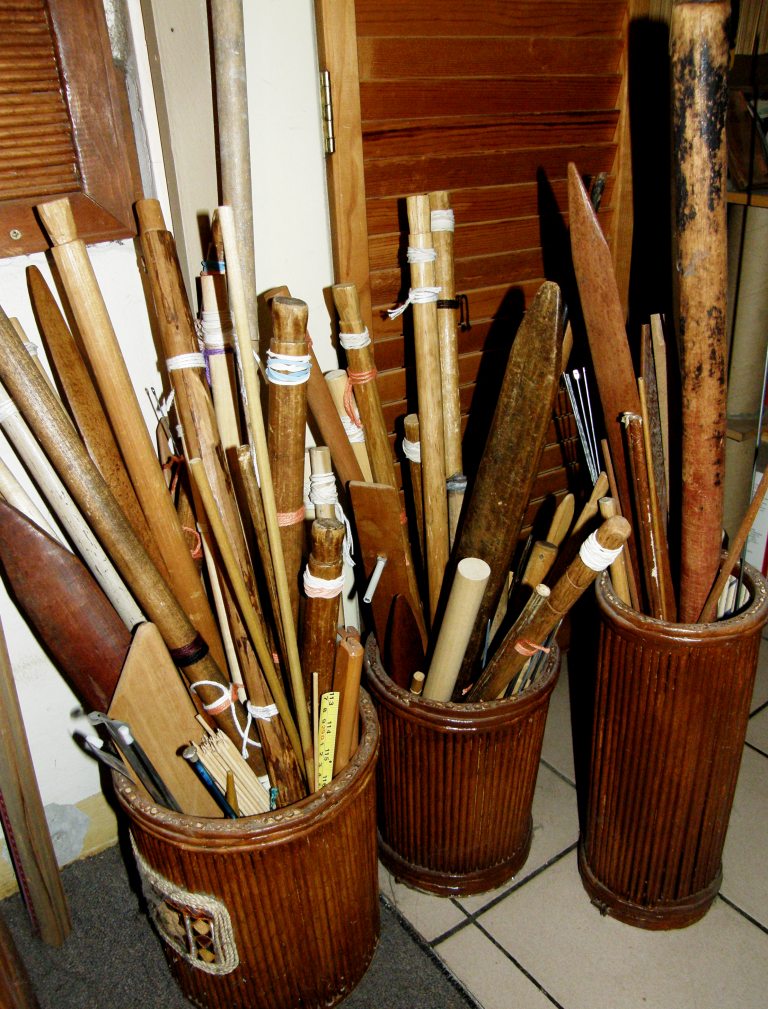
Now I have 26 loom bars standing up in their bins waiting for new warps and I have at least as many ideas floating around in my head for future projects!

But anyway… back to play time in DC.

A couple of emails arrived while I was at Claudia’s place. One from Mary told us about a Chilean handcraft exhibit at the National Museum of the American Indian which would include weaving demonstrations by a Mapuche weaver.

The other was from Peggy who has woven with me a couple of times and who is a docent at the Textile Museum.

She offered to guide me through the current Kuba textiles exhibit on Wednesday which also happens to be the day the museum library is open. I jumped at the opportunity.

Perfect!
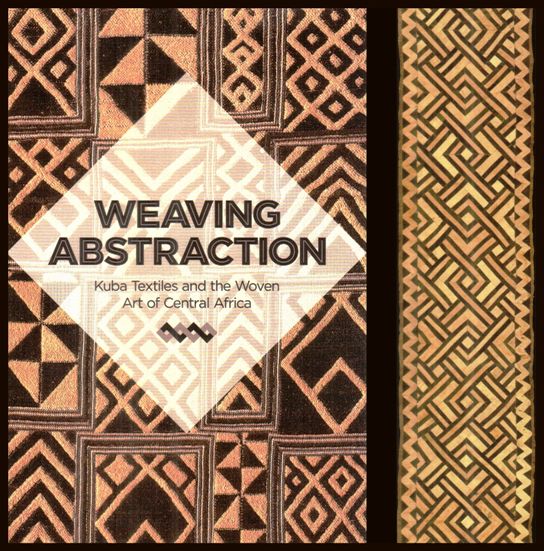
Of course taking photos of pieces in the exhibit is not permitted but you can see above some the publicity material that the museum has put out showing a piece of raffia cloth on the left and bark cloth.

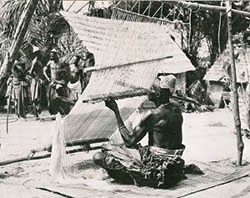
The picture at left of a Kuba raffia cloth weaver in the Congo is on Marla Mallett’s website where you will also be able to see quite a few images of raffia pile and embroidered cloth pieces.

The Kuba Kingdom is a confederation of several groups of people in the area now known as the Democratic Republic of Congo. They were nomadic until the 1600’s and absorbed textile traditions from the Kongo people of the west coast as well as from the Tutsi and Hutu groups in the east.

Men weave the plain-weave panels using fiber from the raffia palm. The cloth is then wet and pounded to make it flexible. The insertion of the colored raffia in a pile technique is the work of the women. The raffia is not knotted. It is simply inserted under warps and/or weft and held in place by the tightness of the weave. The inserted raffia is then brushed with a knife which splits the fibers and creates a fuller more plush texture. I found myself surrounded by bold  labyrinth-like and swirling patterns.

The women also embroider along the edges of the pile sections. I was able to look at the back of the pieces that were on sale in the museum shop. Neither the inserted raffia nor the embroidery shows on the back of the cloth.

One of the uses of the cloth is for ceremonial skirts that comprise many panels sewn together and which are gathered around the body. Smaller panels are used as overskirts by high ranking women while other small pieces are status cloths, amassed as symbols of wealth and nobility.

There was bark cloth from the Bushong people, hats, caps and headdress of titleholders from the Kongo people that I can’t even begin to describe.

I saw a delicate cape thought to be from Angola that looked like it had been made in sprang, tie-dyed cloth using sticks tied to the cloth to create the straight lines in the patterns, patchwork, reverse applique, embroidery and ornate belts decorated with beads and cowrie shells.

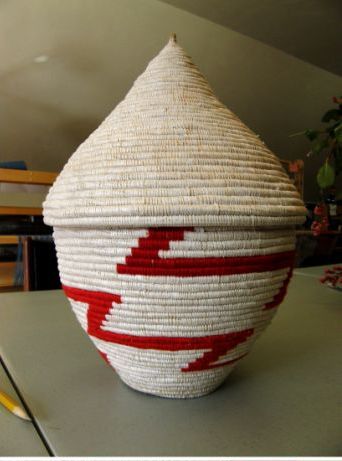
I loved the boxes and baskets with shaped lids which immediately made me think of the basket maker from Burundi with whom my friend Joan is working in Massachusetts. (see her piece pictured at left).

Wouldn’t it be wonderful if she could be taken to such an exhibit?!

I bought the exhibit catalog and would love to use some of the motifs in double weave. That museum shop is a deadly place…I came away with the catalog as well as with Ann Rowe’s latest work on costume in highland Ecuador and a collection of papers on Andean weaving on sale for $5 while all the time wondering how in the world I would manage to squeeze this load into my luggage!

The next day was all about Mapuche weaving at the National Museum of the American Indian at an exhibit called Chilean Rakizuam.

Rakizuam is the Mapuche knowledge of being, whether it pertains to the environment or an understanding of life that has been passed from generation to generation.

It was quite  nostalgic for me listening once again to the very distinctive Chilean accents of the exhibitors and the accompanying folk music.

There was even a gentleman there from Punta Arenas, the country’s southernmost city, where I lived for five years.

He brought baskets made by the descendants of the Yagan people as well as his own jewelry which combines pieces of coiled basketry with silver.

When I lived in Punta Arenas there was one elderly pure Yagan woman still making the baskets who has since died. I still have one of the baskets that I bought back then.
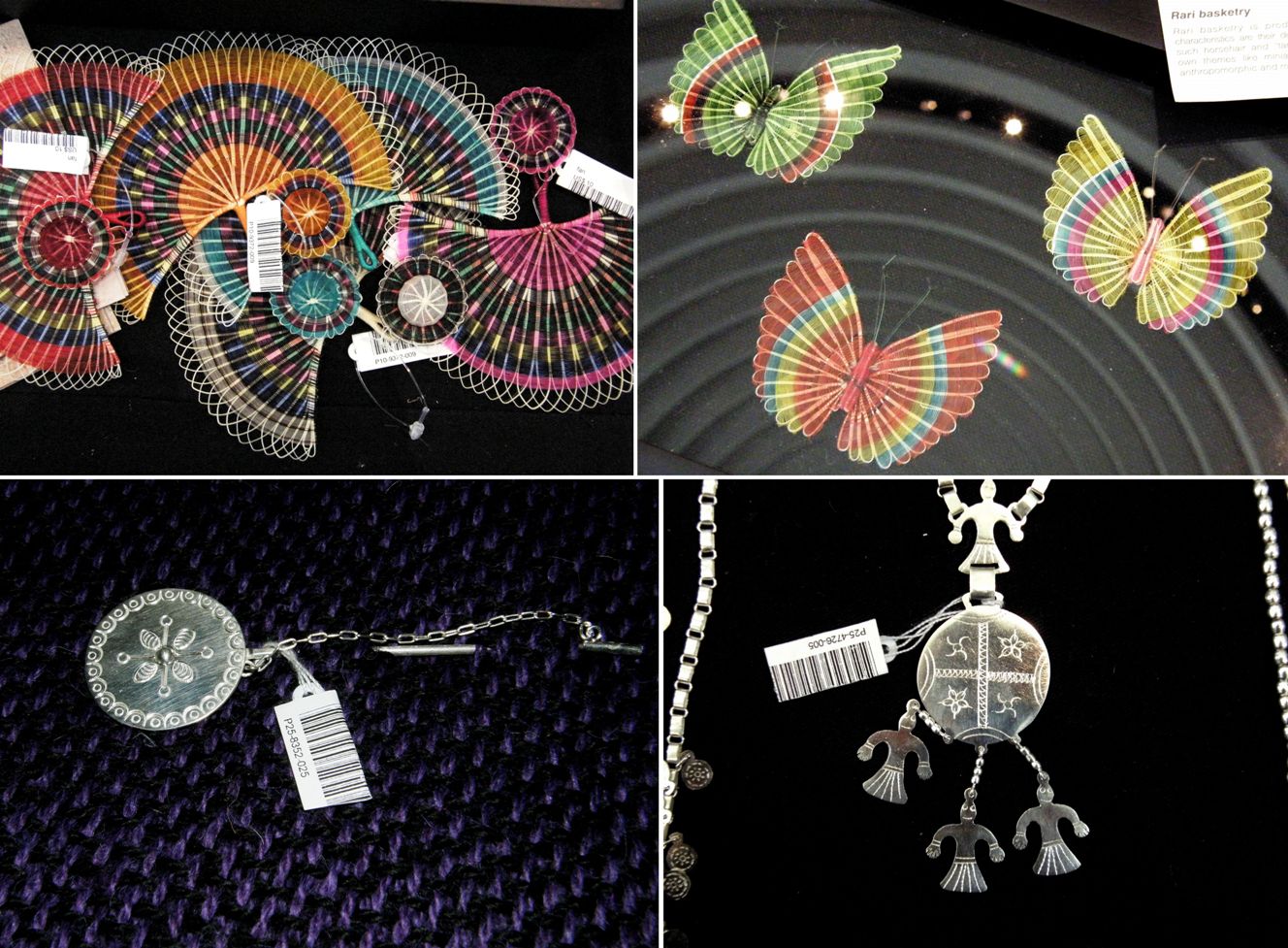
Other displays included pieces from the central zones of Chile south of Santiago…silver work with Mapuche motifs forming pendants and shawl pins as well as almost transparent figures woven from the hair of horses’ tails. The sturdy ribs in the figures are a plant fiber and the finer weft material is the crin, the hair of the horse or ox. And now I know that ”crinoline” according to Wikipedia was originally a stiff fabric with a weft of horse-hair and a warp of cotton or linen thread.
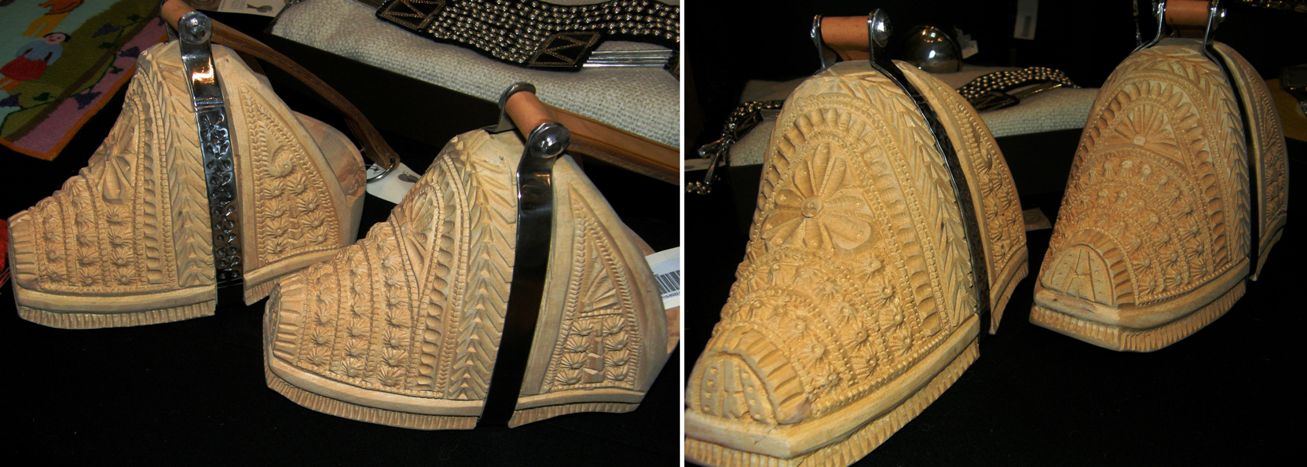
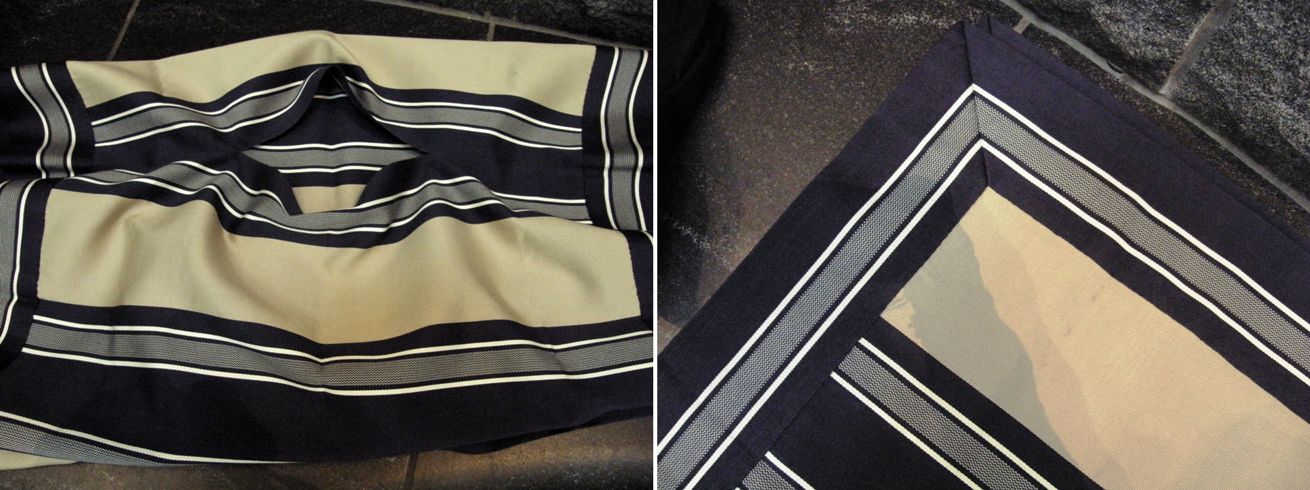
From the central zone of Chile come pieces, such as the carved wooden stirrups above, associated with the huasos, the Chilean horsemen who also use a finely woven silk poncho known as chamanto. The exhibitors brought one of the striped examples which I have been told is called manta with the name chamanto being reserved for the ones that have been decorated with pick-up patterns.
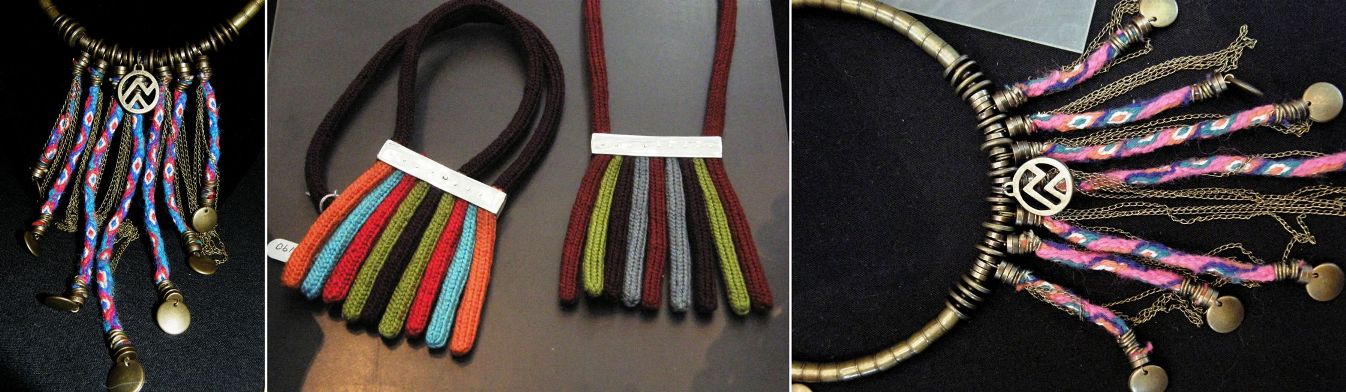
Representatives of the northernmost region of Chile brought jewelry which incorporated traditional weaving and looping techniques. Now there’s another use for the tubular bands!
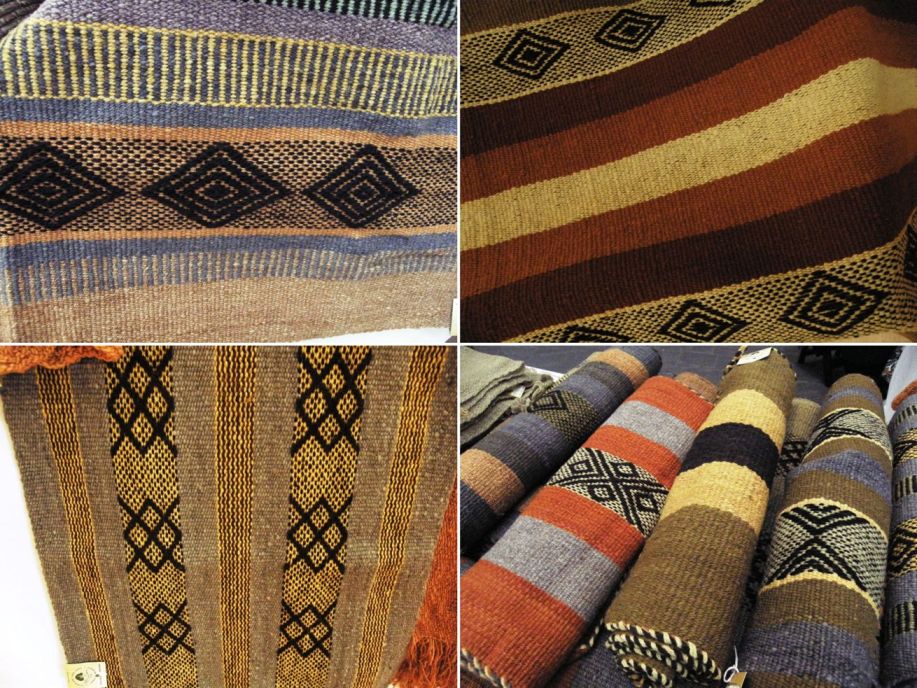
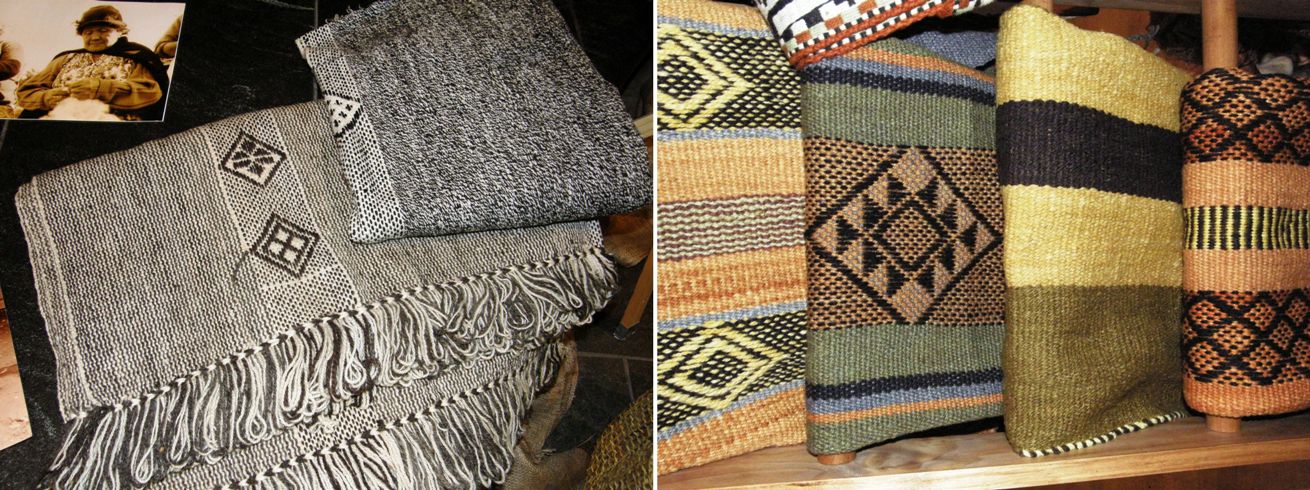
There was a variety of shawls, pillow covers and other woven household items as well as knitted apparel made with handspun and naturally dyed wool by Mapuche artisans.
And the best part…a Mapuche weaver, Marta Isabel Huitraiñan Aillapán from Carahue, had been brought by the Chol Chol Foundation to demonstrate her weaving skills.

While looking at the displays of woven pieces I spotted a spindle in one of the baskets that had been made for Marta by her son. She was quite happy to give me a quick spinning demonstration.
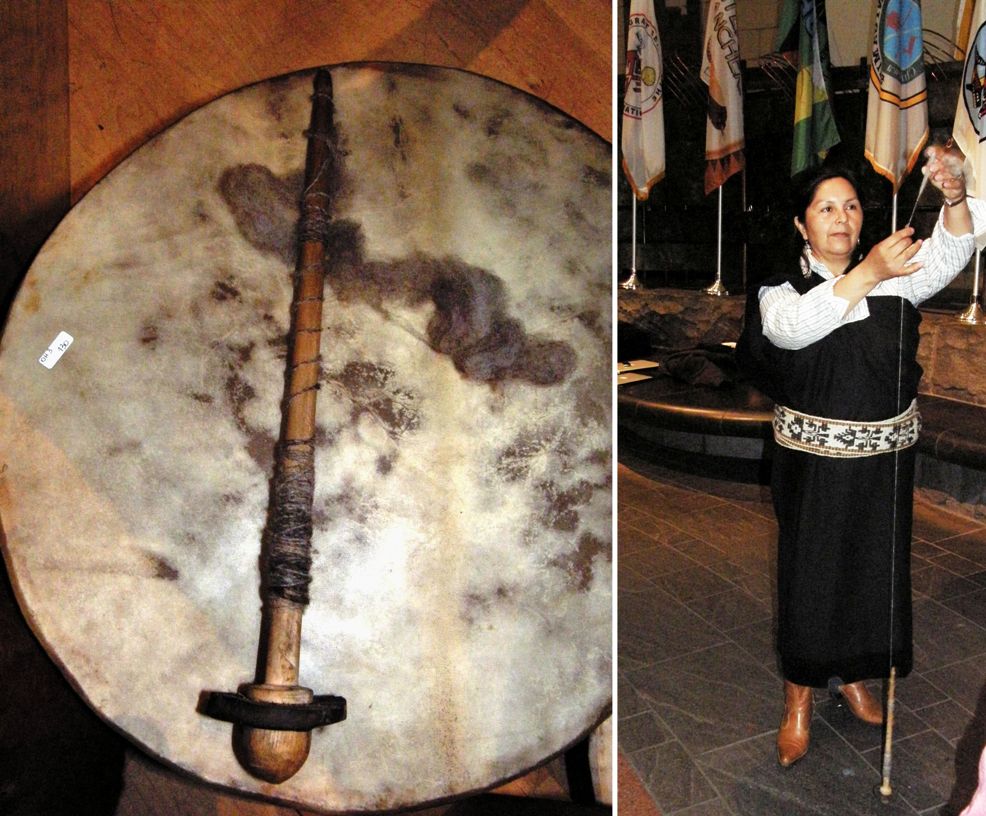
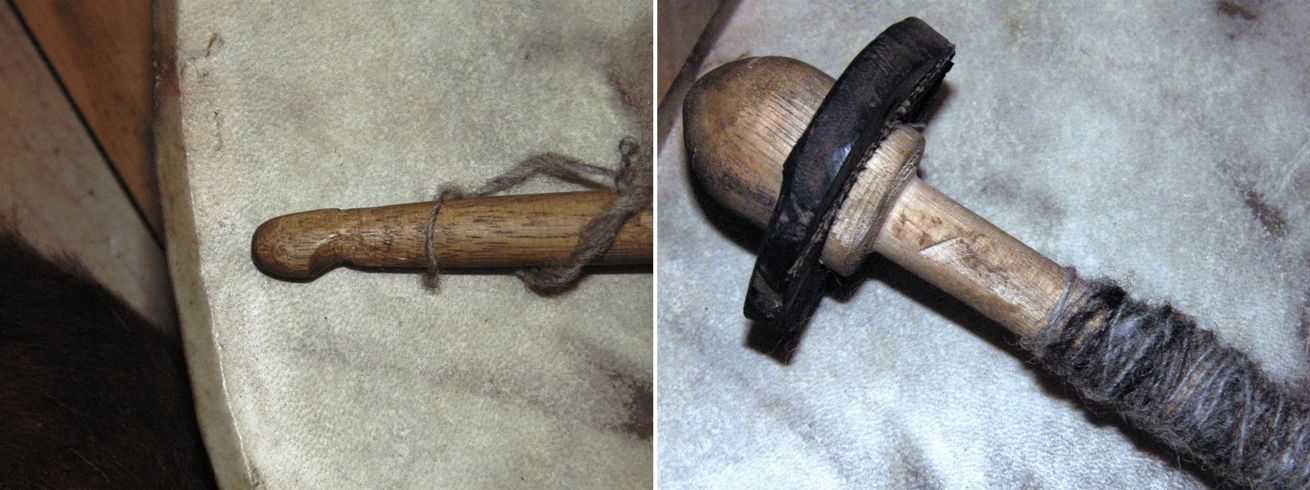
And here is a video…soft lighting in the exhibit area has made the footage a little fuzzy.

And there was the leaning vertical loom almost ready for Marta’s demonstration. You can see that the shed rod is fixed in place lashed to the posts of the vertical frame. The string heddles were made and tied in bunches to transport the piece to the US. They will later be put on a heddle stick.
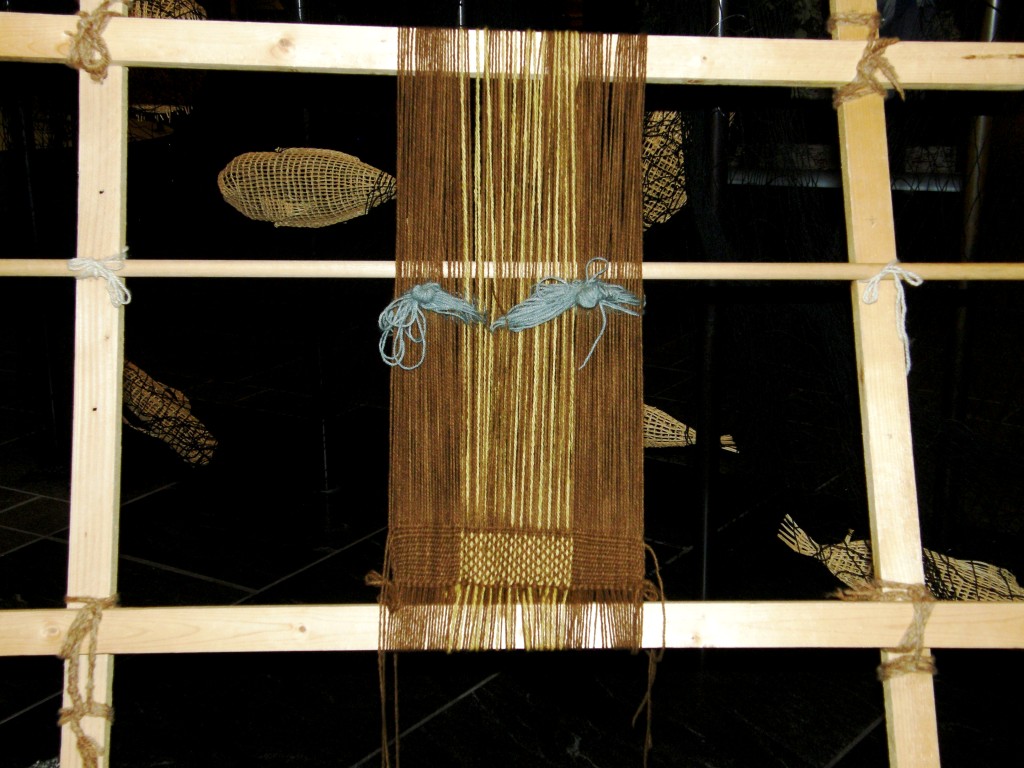
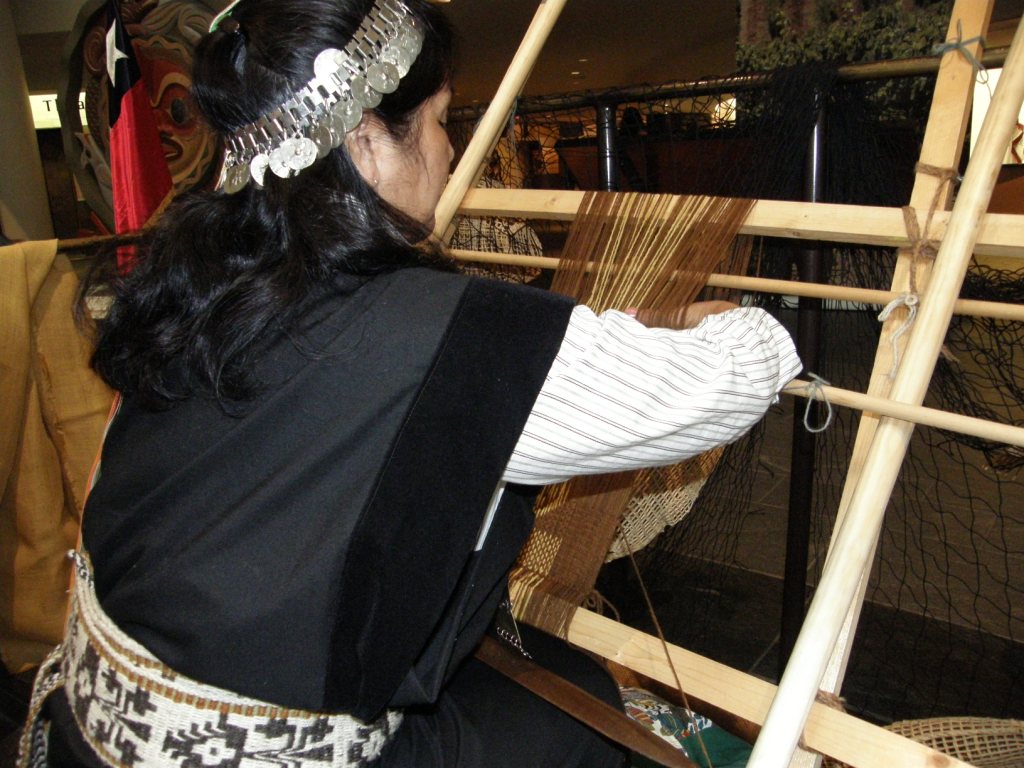
In the picture above, Marta is lifting the warps on the shed rod with her hands and clearing them through the heddles.

You can see that the heddle stick is now in place and is protruding from under her right arm. The heddle stick rests against poles which are placed alongside the vertical posts of the loom frame which means that the warps in the heddles are in a permanently semi-raised position. This means that Marta does not have to pull on the heddle stick in order to raise the warps in the heddle shed. By pushing down on the warps held by the shed rod, just enough space is created to allow her to get her fingers under the warps in the heddles and pull and fully raise them.

You will see the process (executed very quickly!) in the following video:
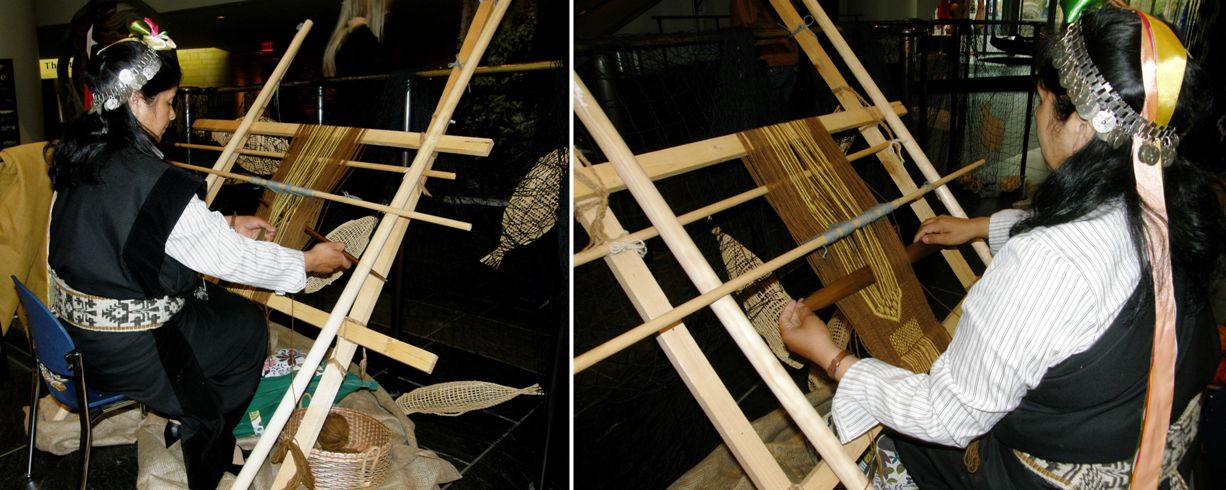
You see that she holds the shed open with the sword in her right hand while picking up and dropping out the supplementary warps with her left. The tension on the warp and her beat are relaxed.

The next day, after warping and weaving the supplementary warp piece above, Marta allowed me to help her warp for the complementary warp technique that is used to weave their belts. With the warp we made, Marta planned to weave a band with lettering (RDO DE CHILE…recuerdo de Chile, souvenir of Chile). I wove the letter “R” with her guidance and then, sadly, it was time to go. And once again twining enters the picture. Marta starts and finishes her woven wall hangings with weft twining before braiding the warp ends or leaving them as fringe.

On this narrow complementary warp piece we did not use a heddle stick but tied the heddles together in bunches instead and pulled on them to raise the warps.
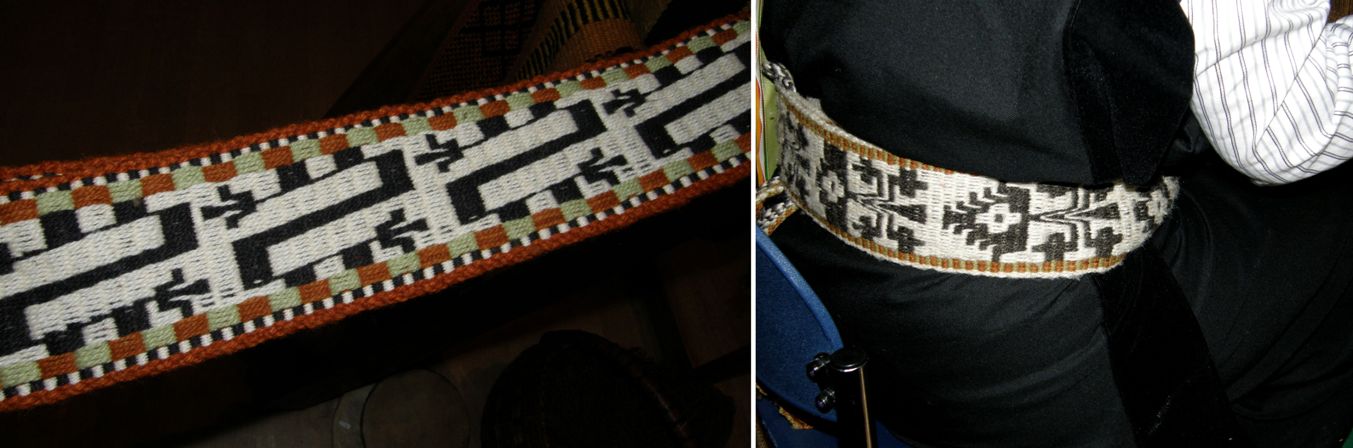
Marta was a great teacher for me – very patient –  and says that she loves to show the process to people who are really interested. I don’t know how many times she answered the question from onlookers “How long does it take you to weave something like that?” I know that question well!!

I was in very good company with Marta on the second day right up there at the loom! On the first day I was very much occupied with taking videos and photos when I suddenly realized that I should probably step back so as not be in the frame of other onlookers’ pictures. It was then that I noticed another particularly interested onlooker with camera in hand… Ann Rowe. So, spending time with Ann made day one even more special.

Another great opportunity at the exhibit was being able to see, for the first time, one of the ikat patterned poncho pieces on the loom.
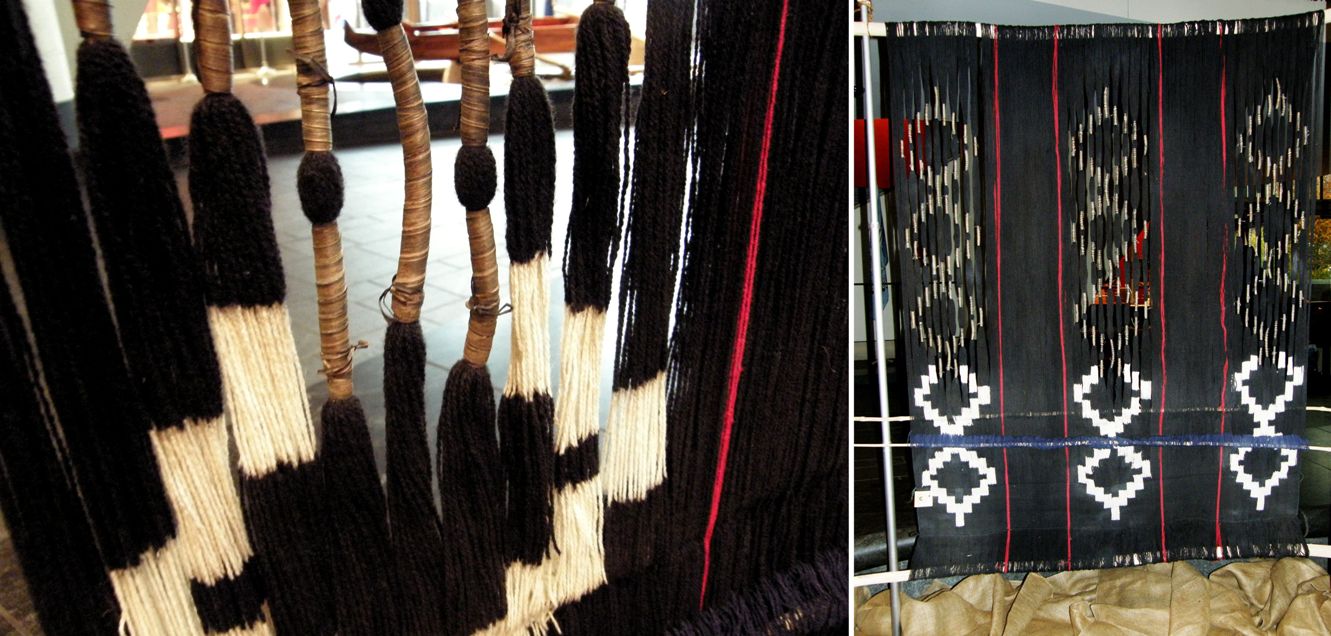
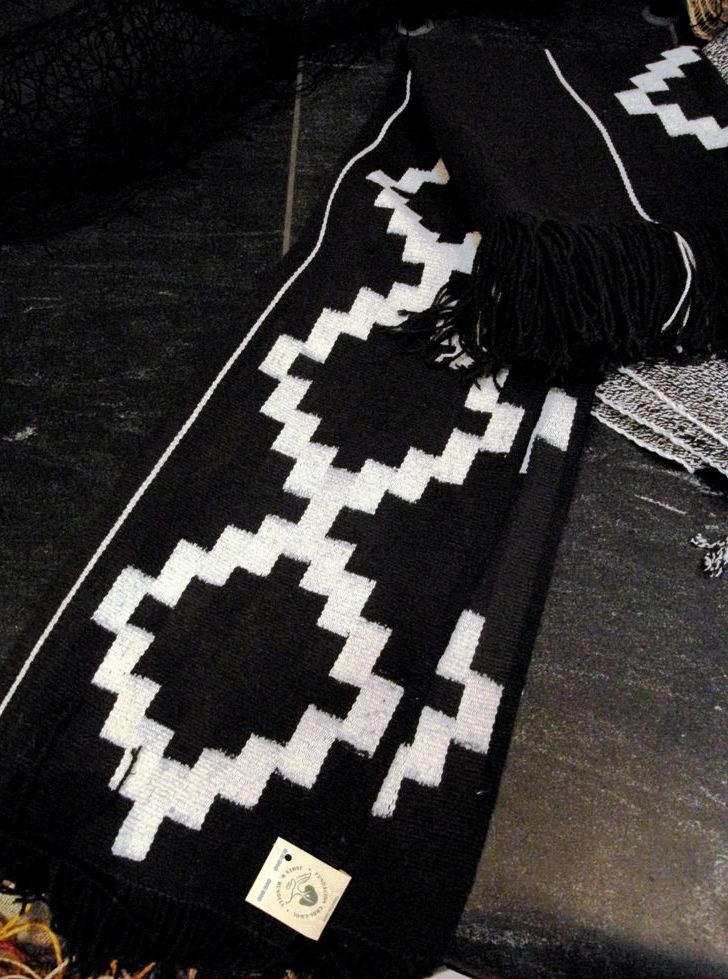
I have always wondered just how the Mapuche weavers stop the warps from moving out of place while they weave ikat patterned pieces.

They manage to reduce the characteristic blurry feathered effect on the edges of the designs  to an absolute minimum. The result is beautifully sharp white figures on the dyed black background.

The set-up on the loom certainly didn’t give away any clues!

I was told that of the one hundred and fifty weavers that belong to the Chol Chol Foundation cooperative only one knows how to make the ikat-patterned ponchos.

One thing  that was missing was the double weave belts. I guess I shall just have to take myself off to Chile to see those. And happily now I have a contact in the Mapuche community. While I have been to Mapuche weaving exhibits before in Santiago, I have never been to one where I have been able to have so much interaction with the weaver.

It would also be nice to visit with Celinda and Isobel, the Aymara weavers, that I met at the weavers’ gathering here in Santa Cruz earlier this year. And, if I need any more reasons to justify the trip, I could also go to Doñihue to learn more about the chamantos.

So, here I am at home in Santa Cruz trying to get back into a routine, blogging one day earlier than usual to make up for the missed post last week. I send a big hello and hugs to all the people with whom I wove on this latest US trip and to all the people who so kindly took me into their homes.

Now to decide what to warp up and put on the first pair of those 26 loom bars!
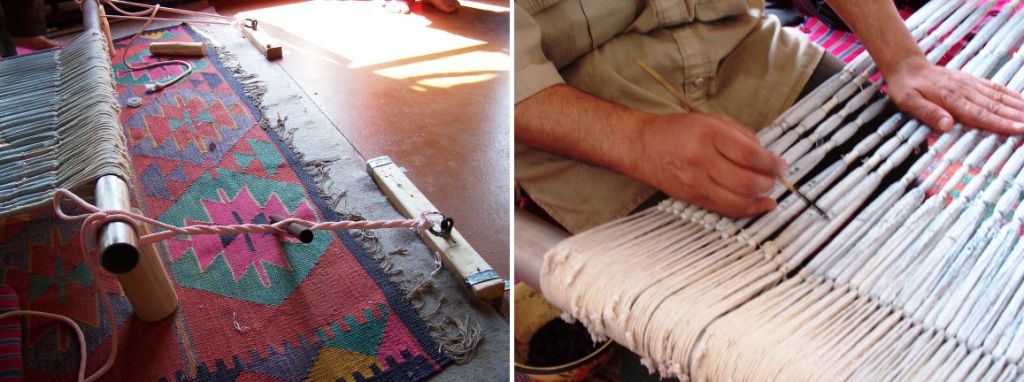
Backstrap Weaving – “You look, you know”

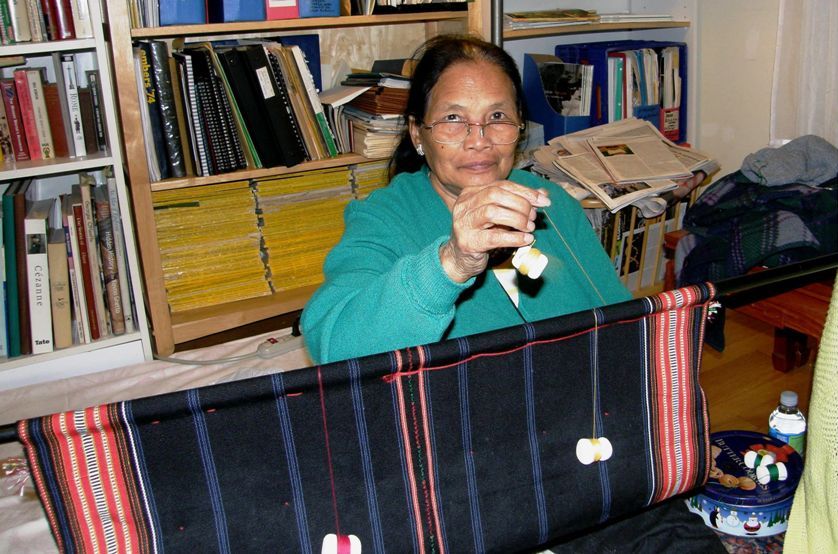
“You look, you know”…..These are the four little words that my teacher Ngach, with her limited English, would say to me over and over as we sat twirling the weft threads on their bobbins and twining the border of her woven blanket panel.

And she was right…there was no need for explanation. Mind you, I had already been making my own experiments in twining based on the Maori method and even charted and twined some Montagnard designs before this class so it wasn’t too hard then to pick up Nagch’s bobbin-twirling method.

And so I looked and listened to the clacking sound of the bobbins smacking together as they carried the wefts, twining their way across the multitude of fine warp ends. Ngach would stop and count the number of warp ends now and then when she lost her place in the pattern and slowly I learned what to do…how to hold the warp ends under the right amount of tension, how to twirl the bobbins well so they didn’t become hopelessly entangled on the back side of the cloth and how to snap the warp ends and nudge the twined wefts up snugly against the cloth.

I am currently on one of my safaris, which involves weaving with lots of my online friends, and it is always interesting to me to experience the different ways that people react to backstrap weaving.

Backstrap weaving with the group in Santa Cruz California.
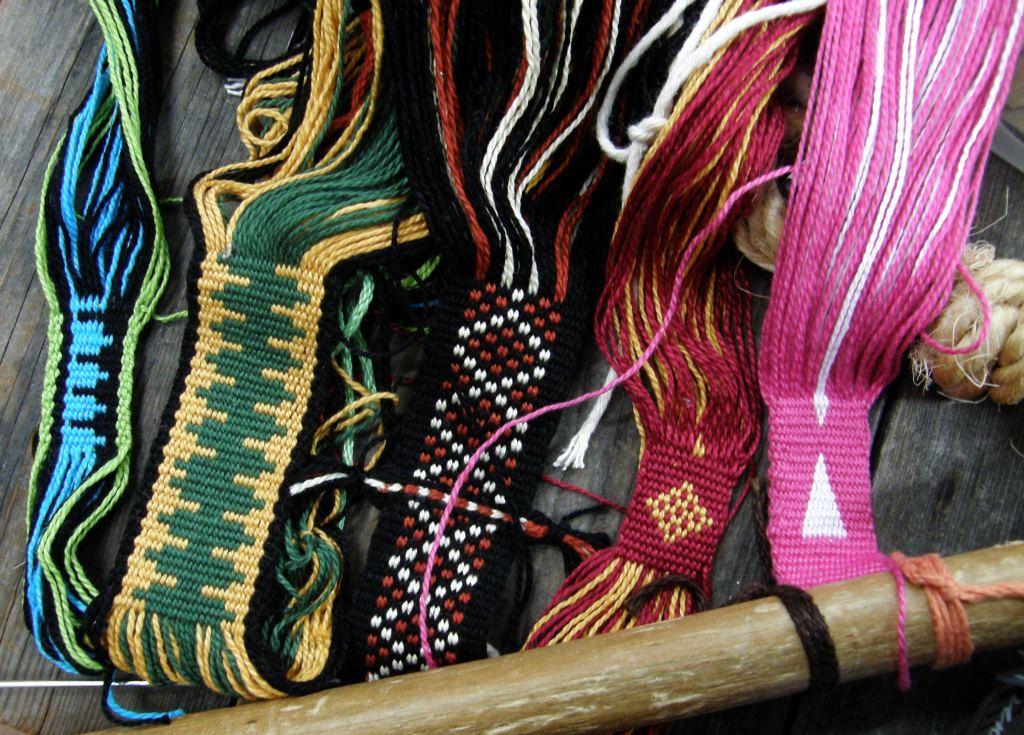
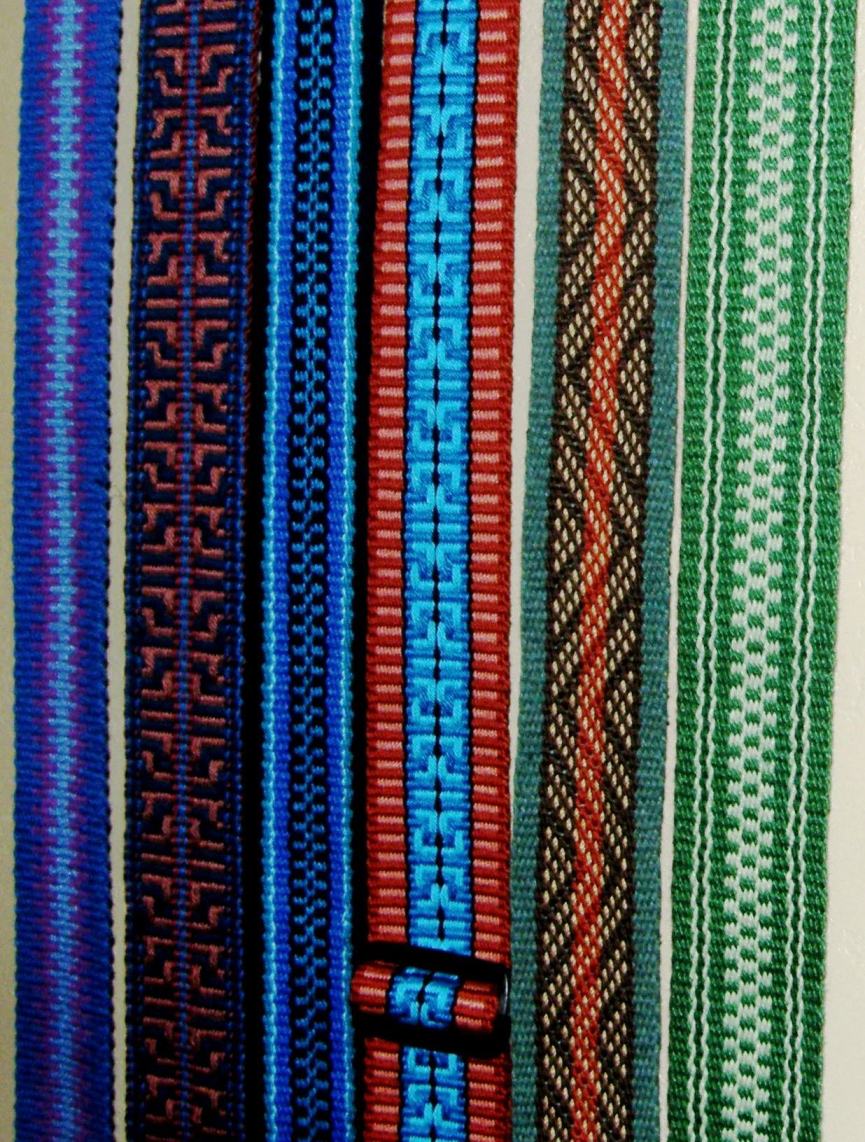
Bands from the Santa Cruz weaving days

As an English teacher I have always been aware of different learning styles but, unfortunately, in the structured environment of the institute in which I taught, I was always racing against the clock trying to cover a seemingly impossible amount of material before the next exam. More often than not I had to limit myself to catering to the learning style shared by the majority.

Joan following a pattern chart.

Now I have more freedom to do my own thing, and develop my  way of showing people about backstrap weaving in a way that hopefully addresses a variety of learning styles.

Some people like to be shown a series of steps uncluttered by explanation and discover the logic in what they are doing for themselves as they weave, others find it impossible to absorb steps without straight away knowing the “why” behind each one.

Some people need to use charts while others find them a hindrance…a confusing mass of squares or ovals that in no way relate to what they see on the cloth and they do very well just “winging it”.

There are those who like their instructions to be backed up in writing while others have more success just listening to them. And there are yet others who like to watch in silence and do it…”you look, you know”.

But, hopefully, the end result is the same…some woven  bands to show at the end of a day but, more importantly, a satisfying experience with new skills learned, mistakes made leading to self-taught lessons, the development of the ability to analyse and trouble-shoot and the creation of the desire to explore further.

Kristi used a pillow case as an improvised backstrap to weave her own backstrap using the warp float technique. Jayne continued with some pebble weave bands after our get together. She wove a series of what we were calling “eyes” on the band on the right and then invented a wove a pair of eyeglasses just for fun.

After weaving with friends in Massachusetts, I headed off to Pennsylvania..my second visit there with Ron and Carol. I was excited as snow had been forecast for Saturday, the first day of my visit. While I am no stranger to snow, I hadn’t really seen lots of the stuff since 1992 and we got enough of it to make me very happy!

I know that for most of you in the north eastern US states this was an ugly, wet, slushy, heavy and unwelcome weather event and I apologize for my enthusiasm here!

I was even still smiling, and so were the other weavers, when the power went off fifteen minutes before the end of our day together. I am a little weird like that…I know that the power cuts were very inconvenient for the hundreds of thousands of people who experienced them but I welcome these little ”adventures” which spice up my travels and it was all good fun to me.

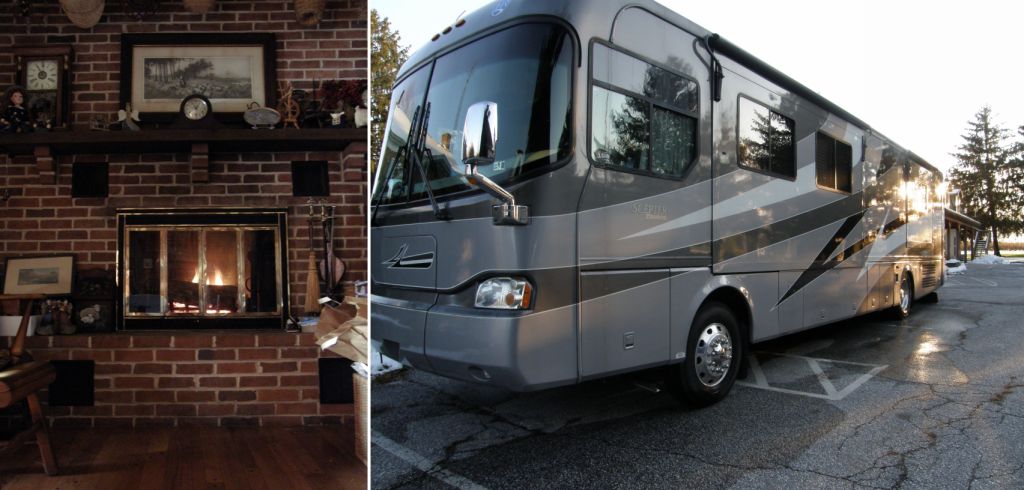
Really we weren’t too badly off with lots of wood to make a fire in Ron and Carol’s living room, kersoene lamps placed about for warm light and dinners cooked in a motorhome with its own generator.

Sunday was gorgeously sunny….still no power but light streamed in through the windows of the room in which we wove. The sun also allowed me to take some pretty pictures in the morning and evening light.

Bundled up but happy (I was wearing five layers!), we were able to weave all day Sunday and yes, Judith was there both days in short sleeves and with bare feet taking my term “barefoot weaving” (which I coined to mean weaving with little or no tools) a little too literally. That’s Elene next to her. Roxanne and Joan came well dressed for the power outage the second day when we wove bands with patterns in simple warp floats.

Weaving, warping, shopping, weaving, browsing.

I spent the evenings ploughing through piles of Handwoven magazines warm and cosy in the motor home. Ron and Carol did their best to make things as comfortable as possible and I was really enjoying the unusual situation. As I said it was all a big adventure for me. That couldn’t believe that I was actually enjoying this!

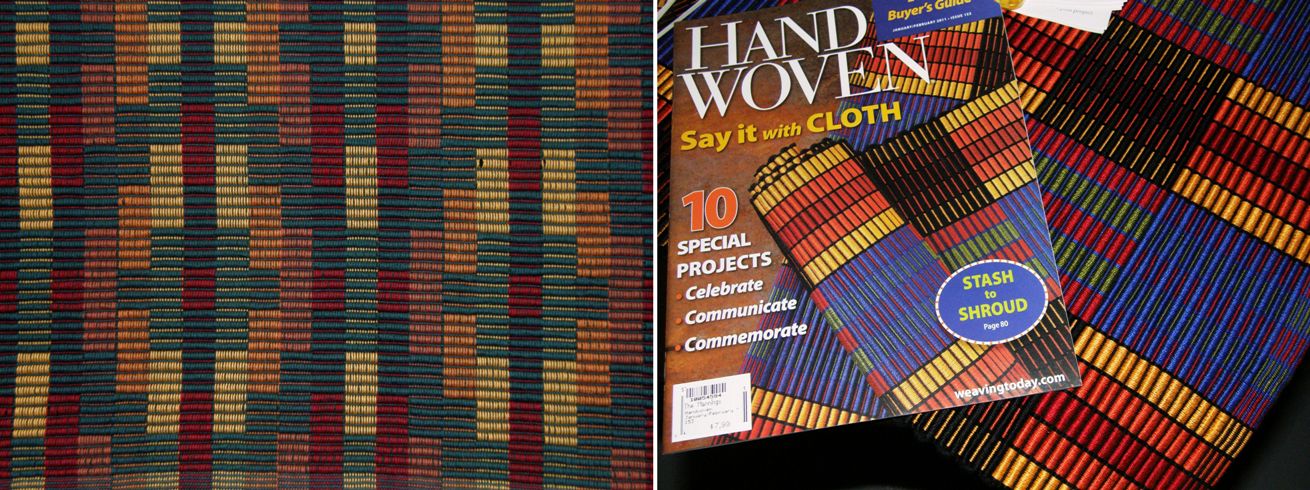
While flicking through the pages of the weaving magazines I realized that there were quite a few years there where it was all about rep rep rep. I have never paid much attention to this structure but there it was again and again in the magazine pages and ideas started to come to mind. There was one rug the colors of which I really liked. It turned out that it had been woven by Tom Knisely and was right there in The Mannings….And how about the piece on the cover of the Jan/Feb 2011 issue…oh yes, that’s Tom’s too.

So, I am adding rep weave to the list of things to tackle when I get home.

The power came back on late on Monday night and I was off headed west the next morning. I was shocked to hear that many places were still without power. Pam in Massachusetts didn’t get hers on until Thursday while many others had to do without for even longer while I settled among the sea and sandscapes with my friend Annie in Santa Cruz California. We visited the frolicking seals at the wharf , hoardes of Monarch butterflies wintering over in groves of eucalyptus trees and humpback whales stopping off in the bay as they migrate along the coast.

 I visited with Annie, the “Queen of Sashes” aka ASpinnerWeaver on my trip to Santa Cruz last spring and she wove with me again. This time I got to stay with her for days…what a treat… tour Santa Cruz and its wild places and wildlife pictured above, chat with a group of local artisans with whom she meets monthly and talk and talk and talk about something that is near to both our hearts…band weaving.

Annie’s living room/studio has at least seven inkle looms parked in it.

She can grab one and sit and weave on it at any moment. Baskets of yarn and woven samples are here and there along with a fabulous collection of books on weaving around the world.

Sashes adorn her walls…her own pieces and those collected from around the world….many Guatemalan hair sashes and belts and she has now added a Bolivian double weave belt from Potosi that I brought to the collection.

Annie decided to wear something handwoven everyday during my visit. Here she is wearing a huipil from Guatemala while weaving her latest guitar strap.

Later that day she packaged up to mail one of the straps that had just sold on her Etsy site. Annie has such a wonderful sense of color and design and it is little wonder that her guitar straps are snapped up not long after they appear on her site. 

We wove for three days in Martha’s studio away in the woods with a lovely fire in the stove and smoke curling from the chimney to greet us each day.


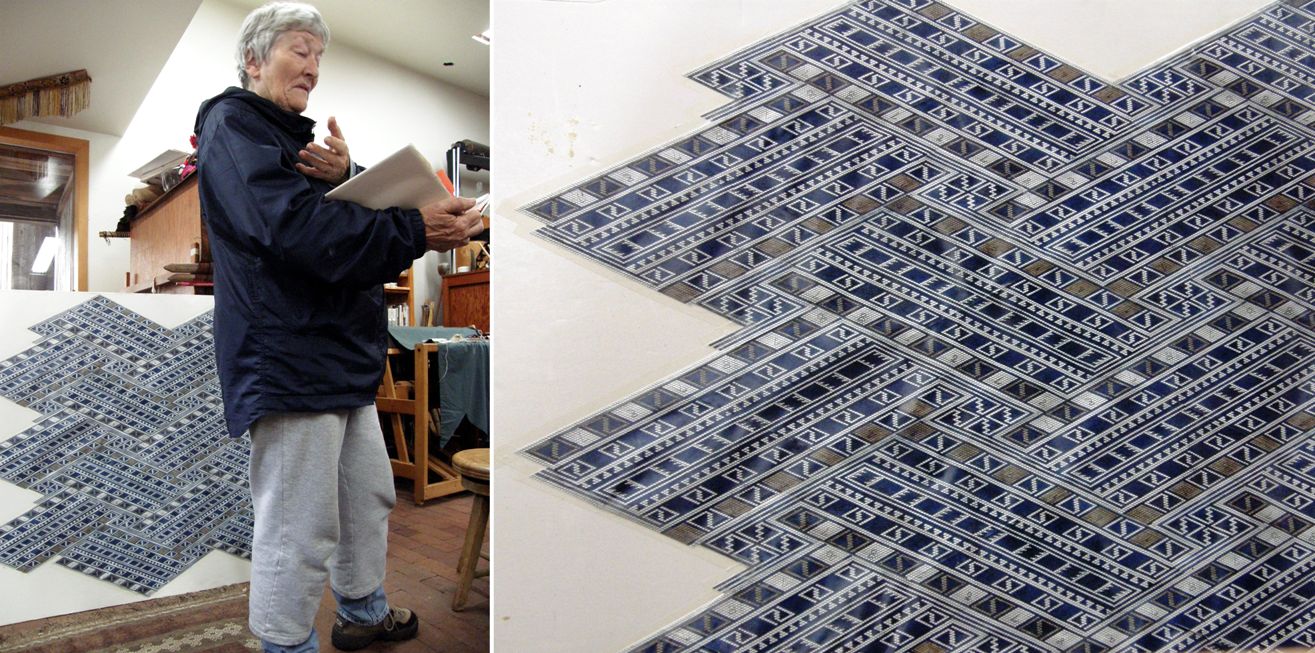
On the third day, at Yonat’s urging, Martha brought out an amazing rug that she had woven which is a reproduction of a piece of fabric that was found wrapped around a mummy from the Anasazi culture dating back to approximately 1134 AD. The rug is woven in a diamond twill and she explained to us her path to successfully recreating the pattern and the method she used to record and chart the design.

Here Martha is standing in front of the design which she plotted on diamond graph paper.

And here is the rug. Yonat and Annie look on as Martha points out some of the details. What I liked was seeing Martha’s progress markers. She sewed a zig zag in red thread along one edge, each “zig” representing a day’s work…most often less than an inch… while white thread would mark the distance she had managed to weave in a week.

And yet again I got to take a look at her reproductions of Anasazi sandals. Thank goodness, as last spring when I had seen these it was all a bit over my head and a case of too-much-information. This time I saw them with new eyes and understood what was going on.

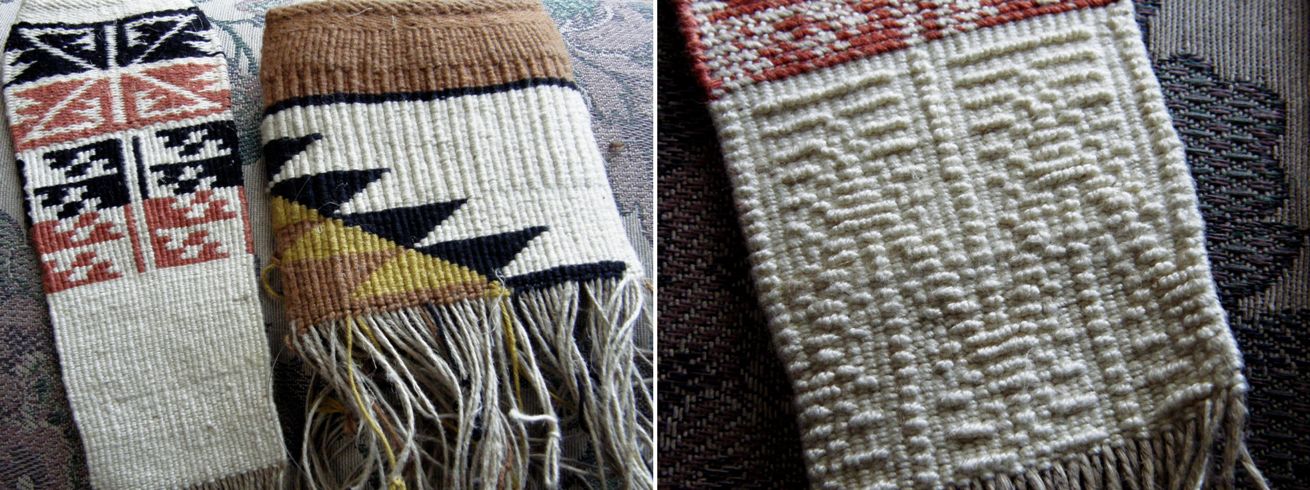
On the left you can see the weft-twined upper part of the sandal sole or the part that would be against the wearer’s foot.  A relief pattern is created on the underside by placing added extra twist to the twined wefts between warps in the positions where the pattern was to appear. This is going on my list of things to try too!
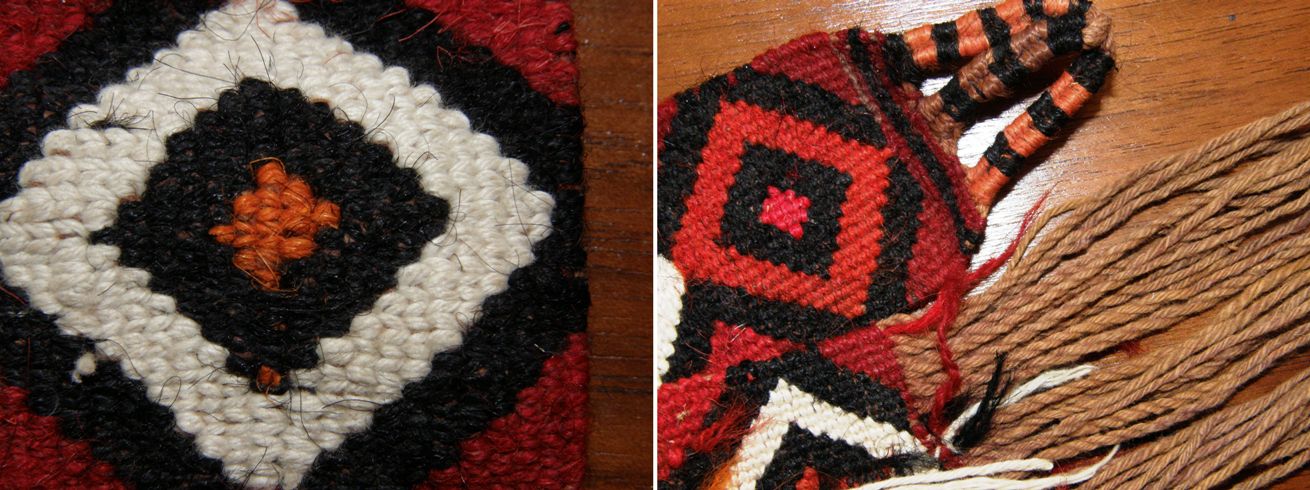
As for all of us, the backstrap weavers, we did our own simple weft twining and created some fun patterns with colors rather than texture. Here are some pictures of the gang including Martha and some of the weft twining, warp substitution and double weave pieces…

Above are Ingrid (Ingrid Crickmore the loop braider), Annie, Sawyer and Dorothy weaving. Below, Yonat chooses colors alongside Annie and Barbara while Anne and Dorothy warp.

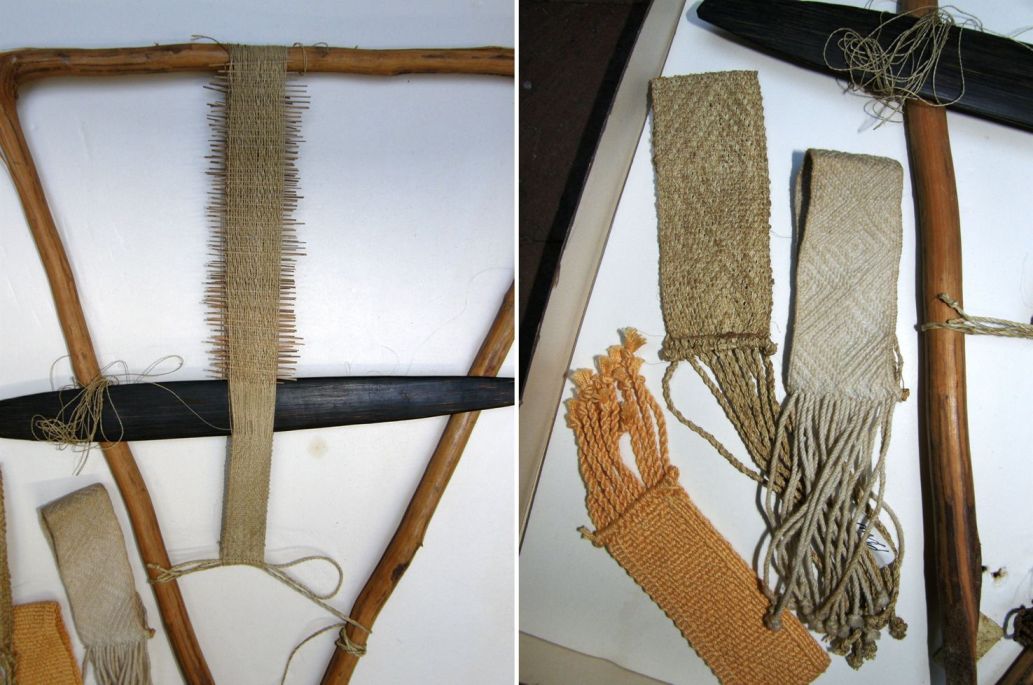
Last spring when I was weaving with this group in Martha’s studio, Martha showed me a collection of woven wristlets and a loom with one in progress which was part of the collection of the late Anne Blinks.

The loom with wristlet in progress is from the Shipibo people of tropical lowland Peru and the completed wristlets are Anne Blinks’s reproductions.

On my visit this fall I found a box in Martha’s studio with my name on it which contained some works-in-progress by the late Nora Rogers, a member of this guild who, among other things, wove with a backstrap loom and studied the structures of these kinds of little-known textiles and attempted to reproduce them.

One was a piece of sprang fabric, still on the loom, where Nora was studying the structure used to create the traditional Hopi wedding sash. Another appears to be Nora’s study of the Shipibo wristlets. I am certainly hoping that that is true. I need to look at these more carefully when I get home.

So, it was a whirlwind visit to the west coast, a chance to catch up with my springtime weaving friends and meet an online friend, Anne Dunham, who joined the group for the first time. We have already set the date for the next visit in spring next year!

Now I find myself back on the east coast in Maryland with friends.

And in the living room in Claudia’s home I see this….everywhere I go there’s twining!

This is the twined edge on a rug that one of Claudia’s sons who is in the Marine Corps had sent back to her from Afghanistan. And take a look at the rest of it…

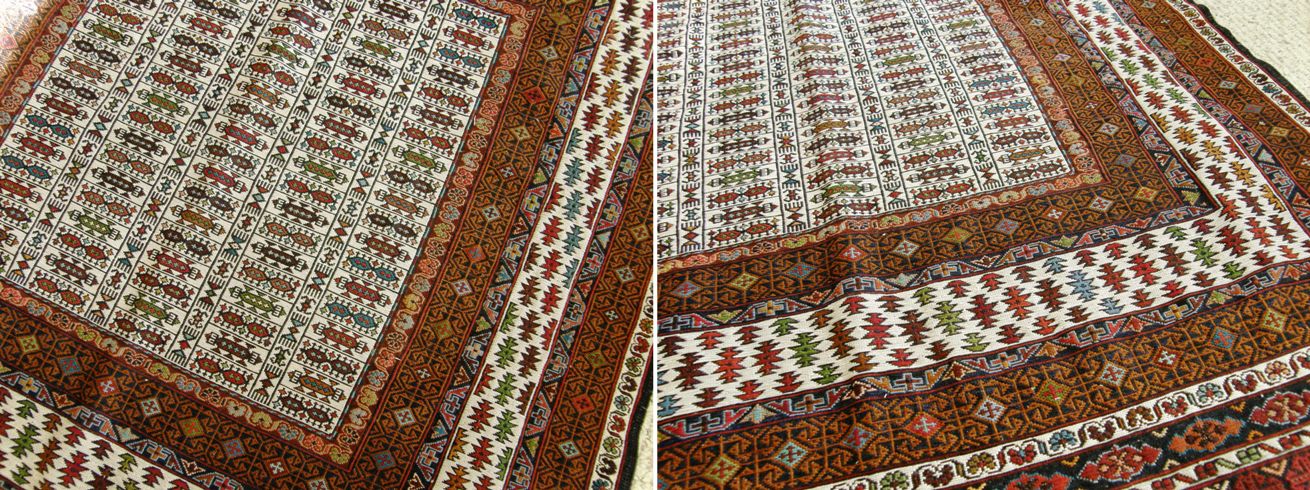
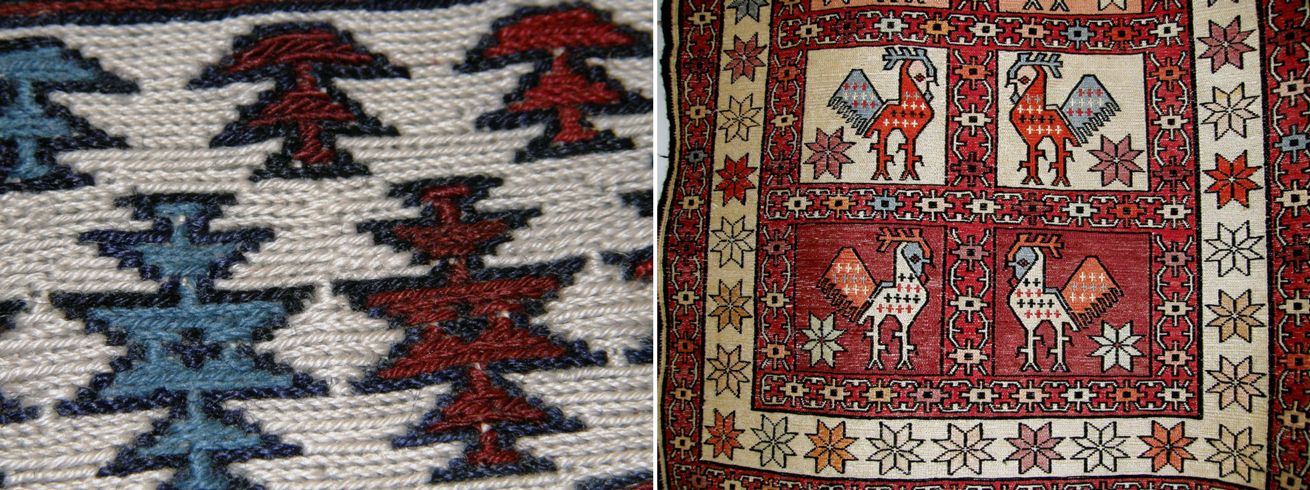
So, I really need to do some soumak myself and see if this is the technique that has been used on this rug. The picture above left shows detail of the Afghan rug and, yes, I have taken pictures of the other side to take home and study.

The rug on the right is a silk one from Uzbekistan in my friend Pam’s collection which she tells me is soumak. The surface of this silk rug looks the same as that of the Afghan one. And I am still wondering about the technique used in the Bunong textiles that I saw when I was with the Montagnard weavers in North Carolina…

One of the Bunong ladies had this textile in her possession but had not woven it and did not know how it had been made. I aim to pin this down!…soumak, warp wrapping, weft twining or a combination of all of them?! Yet another thing to add to the list. 🙂

This is the last stop on my trip and I guess I will be back to steamy mango season in Santa Cruz Bolivia this time next week leaving the US as it moves into winter. But before I leave the DC area I will make a trip to the Textile Museum and see the current exhibit, Weaving Abstraction: Kuba Textiles and the Woven Art of Central Africa. And there is a rumor that Mapuche weavers are exhibiting at the National Museum of the American Indian and who knows what else I will find!

Backstrap Weaving – Blue, white, black and back to blue

When I said I was excited about the prospect of seeing the fall colors in the north east of the US, I was thinking more along the lines of reds, oranges and yellows…turning leaves and pumpkins.

It turns out that the color palette I encountered was somewhat different in an area that seems to have been ravaged by a series of freak weather events this year.

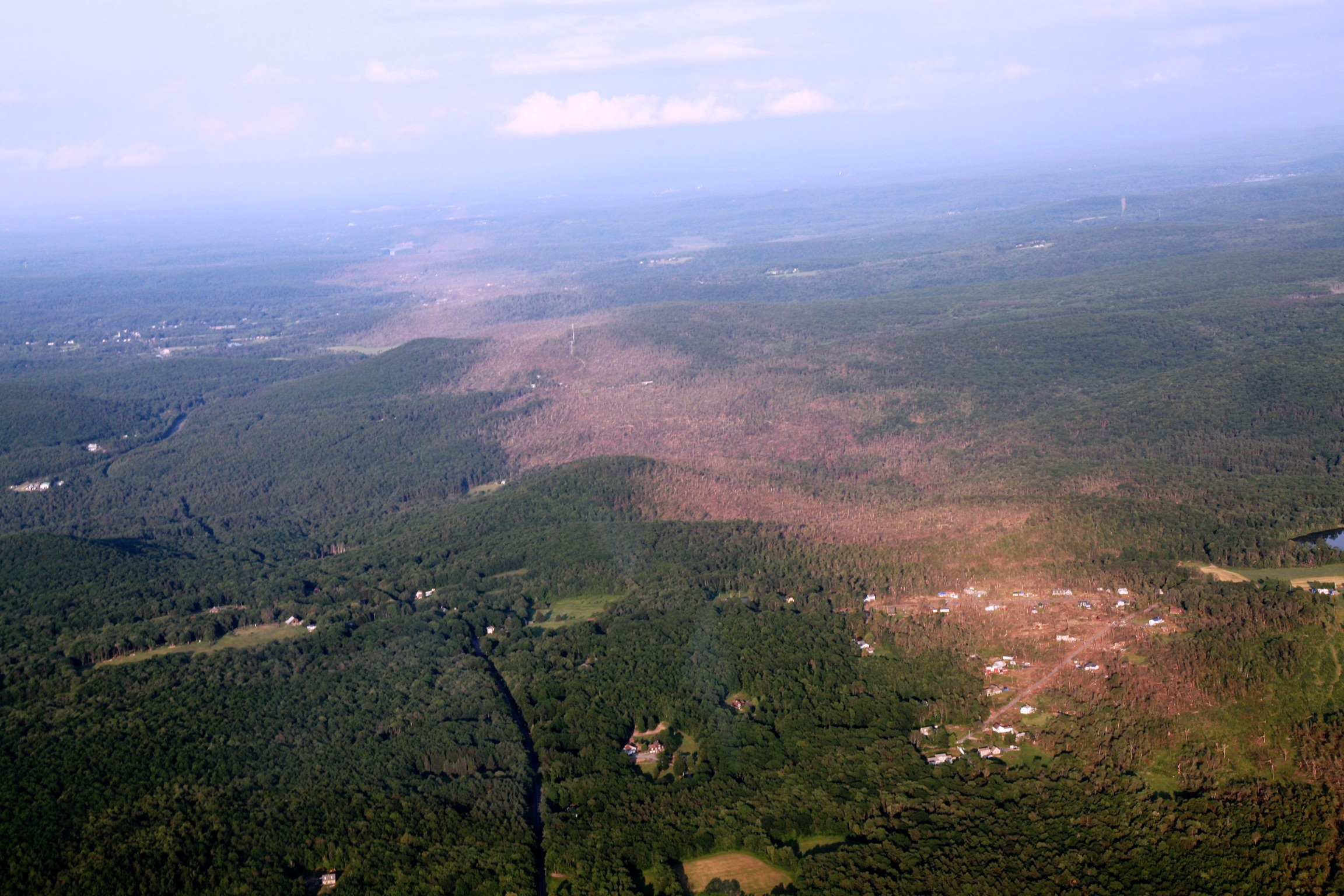
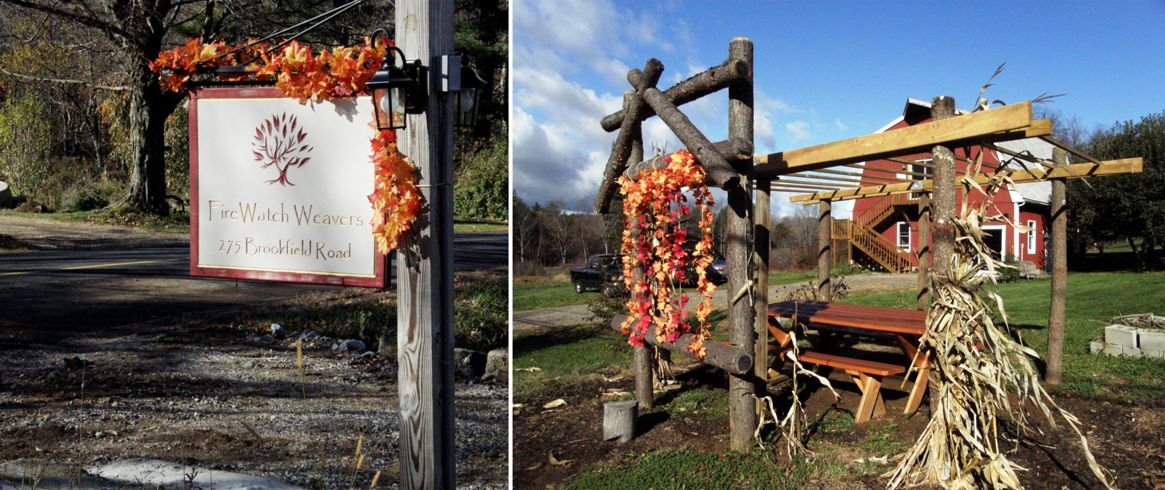
After leaving a cold, drizzly and dreary Massachusetts last May, a tornado swept through the area where my weaving friend Pam has her studio Firewatch Weavers in Brimfield. Pam’s husband Jim Engberg, who pilots his own plane, took this aerial shot of the clear path of destruction. I am happy to say that I missed this by a couple of weeks.

I was a little disappointed to once again arrive in a dreary drizzly Massachusetts in October but the weather was kind and gave a us lovely blue skies and sun the following days. A wind storm had blown most of the pretty fall leaves off the trees so I had to be content with the soft blue of the sky rather than the golden and red leaf colors.

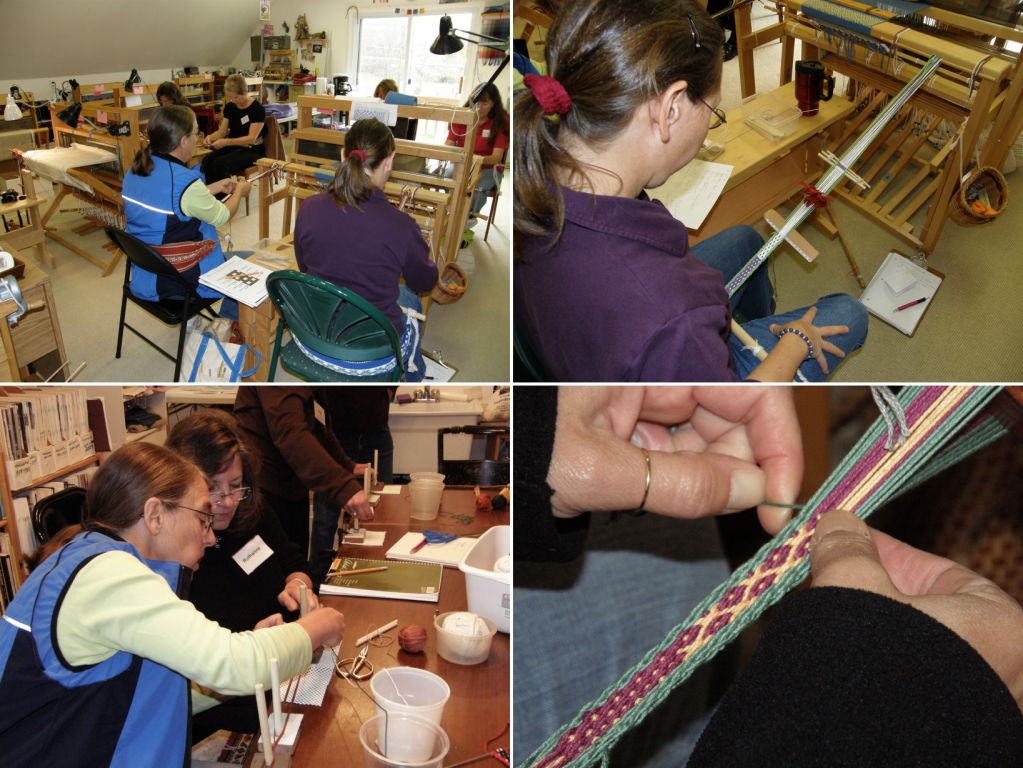
I came to Massachusetts to see my friend Pam and to weave with friends in her studio.

It was a very productive couple of days in Pam’s lovely red barn studio. Since my last visit, Pam has installed an outdoor table and seating and a frame on which shade-giving vines can creep. I can see us all backstrap weaving out there next time!

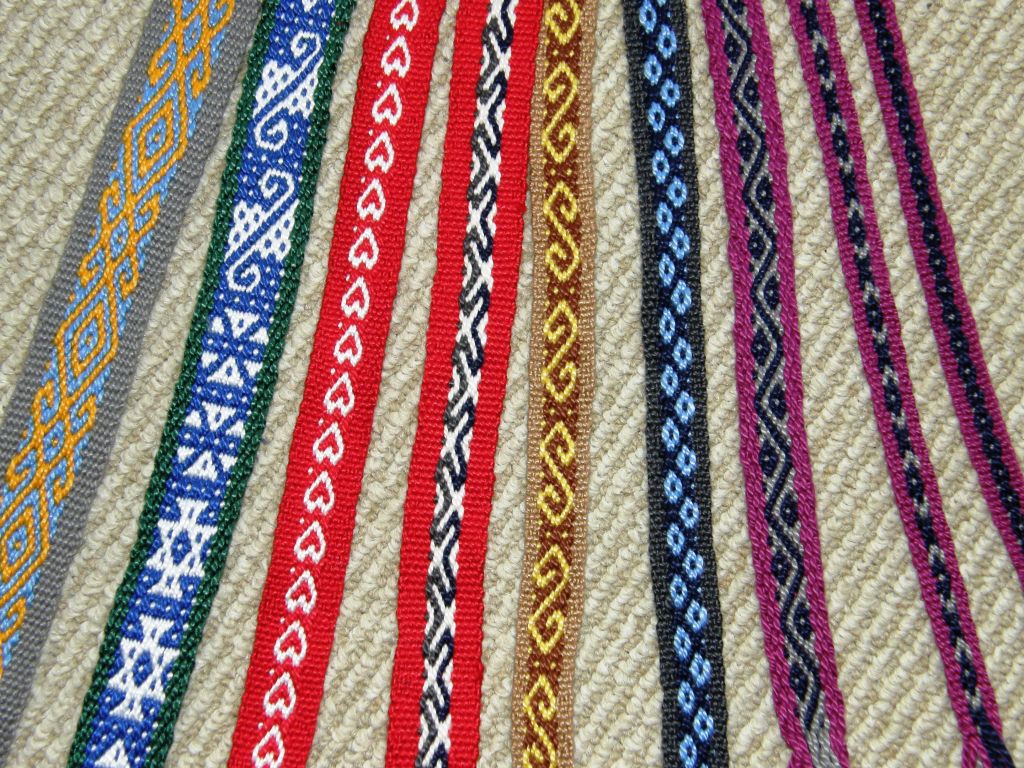
One of the group, Jayne, who has my book Andean Pebble Weavebrought in the colorful collection of bands that she has made while working her way through the lessons. Everyone got a sneak preview of a few of things that will be in my next book.

I got to meet Kateri who has been corresponding with me on Ravelry. It is always wonderful to meet in person one of these online friends. Holly and Cindy returned  after having woven with me last spring and I met Ellen and Ruthanne for the first time.

Kateri had recently been to Mexico and brought a bag made by Huichol weavers to show me. Having just completed my own double weave piece using Huichol and Otomi motifs, I was really interested in seeing Kateri’s bag.

Each time I weave this balanced double weave technique I know exactly what I want to look for the next time I have the opportunity to hold one of the Huichol pieces in my hands and so I carefully examined the motifs on both front and back.

By the way, my bag with the Huichol and Otomi motifs won me the People’s Choice award on Weavolution’s Halloweave event and the prize was $250 worth of cashmere yarn from Colour Mart! I will have to think very very carefully about what kind of piece I will use this precious fiber for. Don’t worry, I promise not to use it for a warp-faced heavily beaten project!

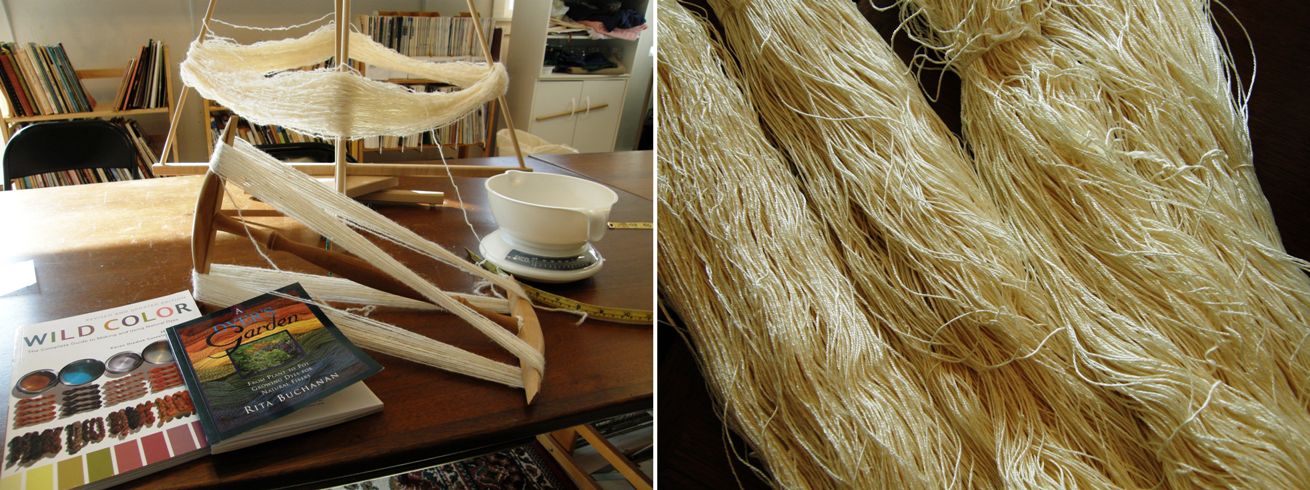
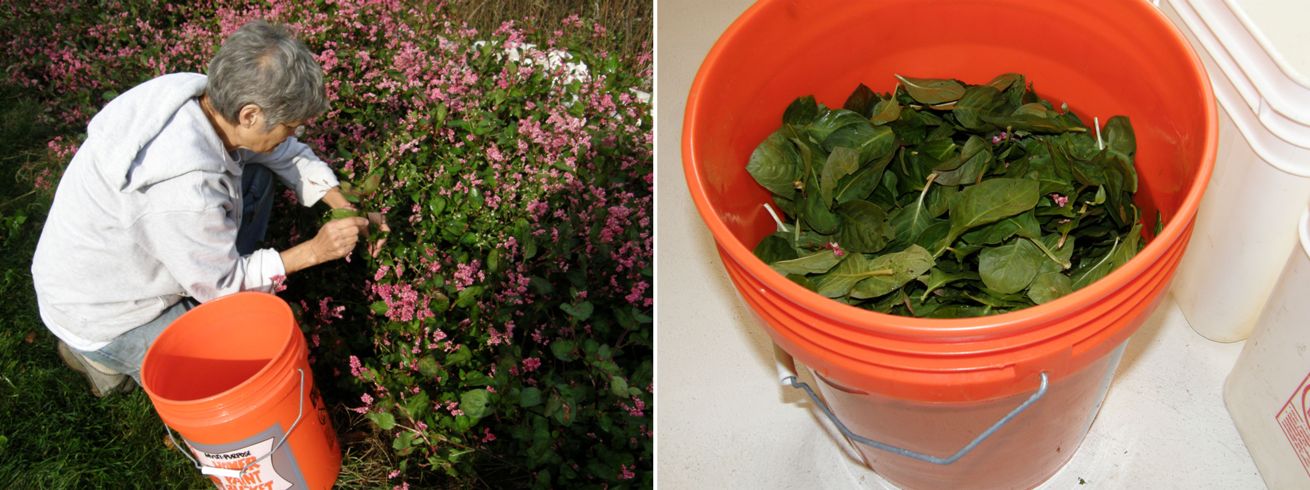
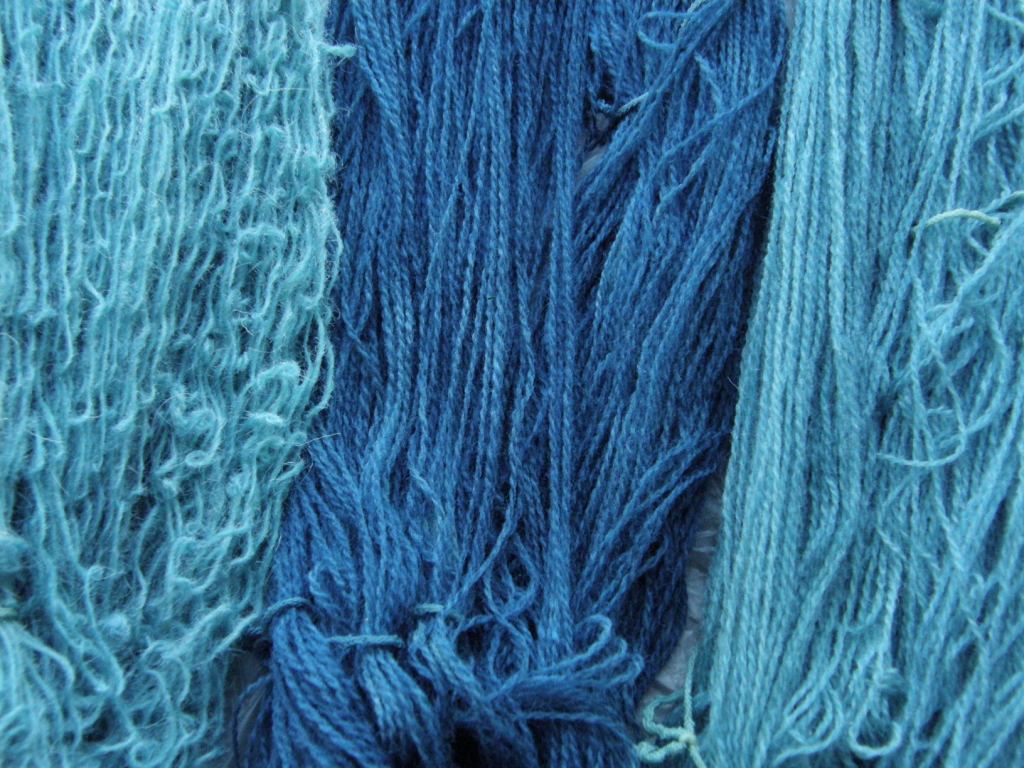
The following two days were spent harvesting Pam’s crop of Japanese indigo to dye silk and wool skeins. This would be my first time dyeing with these plants and I was very happy to have this opportunity to learn about the process. We skeined silk from Uzbekistan and wool in their natural colors and also prepared a skein of yellow wool for the pot.

We went through the whole process on day one and  discovered that there is a reason why the author of one of the books we were following said to add “fresh” spectralite. Pam’s stash of spectralite was obviously beyond its prime and we couldn’t get the oxygen out of the bath. Late into the night we had to admit defeat and stat anew the next day with more leaves and FRESH spectralite.

So, a new batch of leaves went into the pot and into the double boiler to slowly heat over a couple of hours. I was excited to get on with it and see the magical results and it was hard not to just stand there and watch the pot trying to will it into heating more quickly…

Pam passed the time weaving off one of her pebble weave samples on her backstrap loom. Freddy snoozed and I went around taking pictures of all the woven treasures in Pam’s studio to stop myself from poking and prodding the indigo leaves in the pot every few minutes…

Here is a weft-twined band that Pam was given made by the Maori of New Zealand which I supsect is a headband. It was so exciting to see this as reading books on Maori twining is what gave me my first clues about this technique which enabled me to experiment with reproducing the Montagnard twined designs.

This is another of the pieces that Pam bought in Uzbekistan that is originally from Turkmenistan. (I showed some others in my last post.) This one has patterning with supplementary wefts and another  lovely shaped flap, what appears to be a finger woven strap and pretty tassels.

Bunches of tassels hang from a band decorated with a warp float pattern. The soumak rug on the right is made of silk.

Pam’s friend Joan had brought a basket to show which had been made by a newly arrived artisan from Burundi who has come to settle in Massachusetts as part of the refugee program.

Joan found out that she made baskets but had no idea what materials she would need to continue her craft.

Pam donated some reed which the basket maker proceeded to split into finer strips to coil.

She then unwove a plastic rice sack and used the plastic warp and weft material to wrap her split reed coil and produce her magnificent basket.

Red acrylic yarn was used to make the pattern.

Hopefully she will be able to find similar materials to those she used at home in Burundi to produce her baskets but what a fine piece she made with her limited resources!

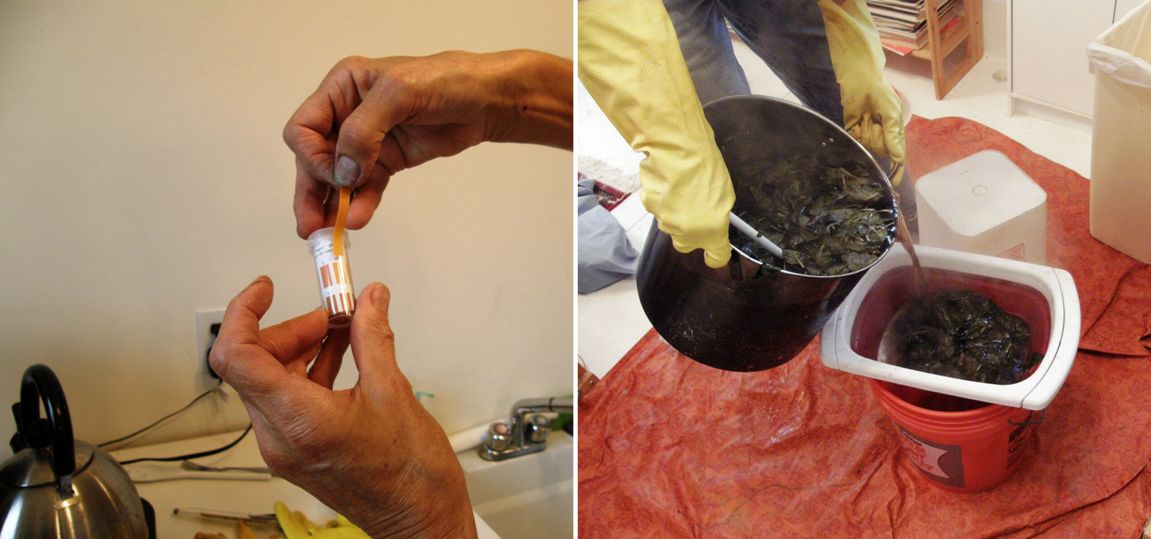
Finally, the water in the indigo leaf pot heated to the desired temperature and it was time to separate the liquid from the leaves and do a ph test.

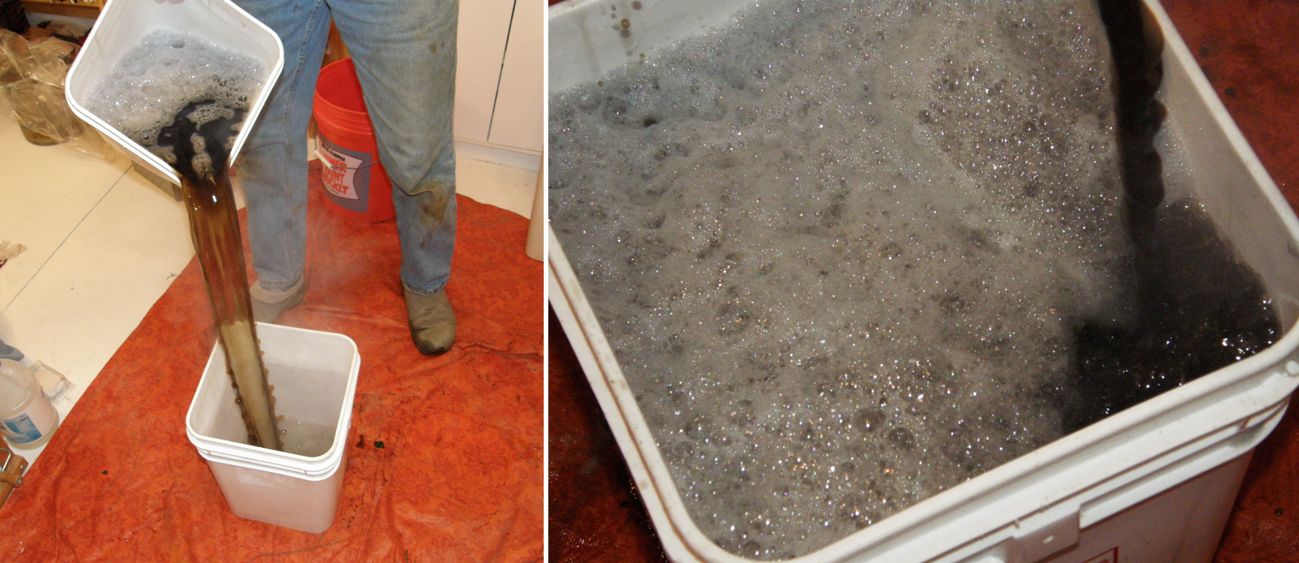
Then Pam poured the liquid from container to container to introduce oxygen. A heavy froth formed and increased in volume with each pouring.

This time we added fresh spectralite and the liquid turned the right greenish-yellow color which indicated that we could now introduce our wet skeins…finally the big moment.

So, I got to see something that I had so often read and heard about…that magical transformation as the skeins emerged from yellow to gradually deepening shades of blue.

If you have never had the fun chance of seeing it for yourself I made a little video of one of the silk skeins coming out of the pot…magic!

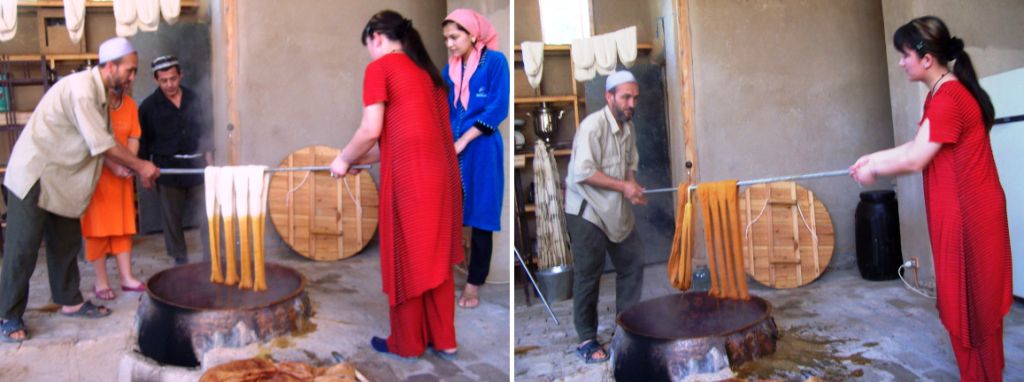
The silk skeins had been bought by Pam on one of her three trips to Uzbekistan the first one of which she made with natural dye master Michele Wipplinger, who is pictured below, with master dyer Madrim Matkarimov in the Silk Carpet Workshop in Khiva, Khorezm Province, Uzbekistan. I was lucky to meet Michele at the Tinkuy de Tejedores in Peru around this time last year (gosh! has it already been a year?!)

Pam told me that Khiva, which is in far western Uzbekistan, was rebuilt by the Soviet Russians using local craftsmen to restore some of the old madrassahs and mosques and the khan’s castle, etc. She said that people do still live inside the wall as well as in the suburbs outside it. All these pictures were taken on Pam’s trips and she has kindly allowed me to show them here.

Above you can see one of the indigo-dyed silk rugs produced by the workshop. On the right, the indigo-dyed silk skeins, as they emerge wet from the vats, are simply thrown against a wall where they stick and can dry. They look like an unhappy tangled mess here which would be a headache to have to unravel but Pam explained that only small lengths of the silk are used for the knotted pile technique in these rugs so there is no need to  unravel the skeins in one continuous thread.

Pam also visited the UNESCO Silk Dyers’ Workshop in Taskent in 2008. In Pam’s own words…this was a project to employ women in the community using traditional arts. Note: Traditionally men are the dyers and weavers of ikat-dyed fabric (women are the cut-pile carpet weavers), but there was a lot of work in new construction in Tashkent that summer so UNESCO couldn’t get men to participate. Therefore they converted it to a project for women.

The dyemaster was named Dalat (pictured below left). The dyepots were huge tanks set into the floor, heated by gas jets. First the skeins of silk were mordanted and wrung out (pictured below left). These were then allowed to “cure” (sit damp overnight) and can be dried and stored.

The mordanted silk is made into  a 100-meter warp on a warping reel and wound on an ikat frame making several layers so that when the apprentices, pictured above right, tie it for dying, they are actually making multiple repeats. The ikat frame is tensioned by securing it to bolts in the floor (below left).

Dalat paints the design onto the warp so that the apprentices know exactly where they need to bind.

The tied warps are then dipped into a vat of onion skins and apple leaves to produce the first of many colors. The bound sections will be unwrapped and other sections tied before dipping the warp in another vat to produce a second color and so on until the multi-colored warp is ready to be woven into fabric like the examples seen below (although these particular examples were not dyed with natural dyes).

The picture above left shows an ikated warp on an 8-shaft counterbalance loom. There is no warp beam – the warp is stretched out across the room and weighted (above right). Each time the warp is advanced it is straightened, smoothed, and sized.  Then they weave it in a warp-faced twill (7/1 – the weft goes under 7 warps and over 1) which looks like satin and shows off the warp colors on the face but is weft-faced on the back.

Quite a process! I at least got the tiniest taste of this ancient practice with our little indigo dyeing experiment and I am so happy that I was able to see the exhibit of the Central Asian ikat robes at the Textile Museum in DC last November. Pam’s pictures and explanations and the stories she told me of her travels in Uzbekistan have added so much to what I saw at the museum last year.

My indigo blue and blue skies which stay with Pam in Massachusetts changed to white, white, white when I got to Pennsylvania.

It snowed!…big fat wet flakes that fell and fell all day Saturday. I was thrilled. I lived in snow for nine months of the year every year for six years back in the eighties and haven’t had a chance to walk about in the lovely white stuff since 1992. I loved it! I especially love that special kind of muffled silence that the snow creates. However, you probably all know of the unhappy results of this early heavy wet snow and we, like hundreds of thousands of others, were a part of the power outages that hit the area. My white wonderland turned to black but we were lucky to have the warm yellow glow of kerosene lamps and crackling logs in the fireplace.

I will write more about the snow adventure in Pennsylvania, my backstrap weaving friends there and my wonderful hosts over those days in the next post. But I will let you know for now that the snow scape has since turned into a sandscape as I have winged my way to the other side of the country. So, the last color for this post is the deep blue of the Pacific Ocean.

I am here for my second time of weaving with friends out at Martha’s  lovely cabin in the woods. As always Martha is a never ending source of fascinating information and stories and her weaving studio is full of interesting experiments, pieces she has collected in her travels and her current works-in-progress. Oooh, I have so many cool things to show you!!

But, that’s enough for this time. I have just managed to catch a break to put this post together before getting ready to hit the road…..back once again east to no snow and full power, I hope!