Backstrap Weaving – Travelers

TRAVELERS…..Postcards from the road….a few thoughts, discoveries, news items, and observations as I weave my way here and there across the USA…

A DISCOVERY:

Before I could even leave Bolivia. my eye was caught by a splash of color as I hurried through the Duty Free Shopping Zone in Santa Cruz airport. There I spotted a pile of colorful fabric wedged between the perfume and cosmetics with a very familiar pattern…

???????????????????????????????It’s an acrylic piece of cloth in lively colors with stripes and bands of two classic weaving patterns of the community of Chinchero in Peru. Anyone who has had anything to do with the Center for Traditional Textiles of Cusco (CTTC) will immediately recognize these patterns as they appear on hundreds of articles such as purses, bags, and table runners that are offered for sale there. The CTTC textiles have been woven with handspun naturally dyed wool and alpaca yarn. I have no idea where this small acrylic piece was made. There is nothing to say that it originated in Chinchero, let alone Peru. It is edged and backed with synthetic material and has been designed to be used as a book cover. It has been very nicely put together. A friend of mine commented that, for all we know, it could have been made in China!

This image of the loraypo motif painted on a wall in Chcero is from the webpage malloryinperu.blogspot.com.
This image of the loraypo motif painted on a wall in Chinchero is from the webpage malloryinperu.blogspot.com.

???????????????????????????????The most surprising thing about it for me is the small “Bolivia” label in the colors of the national flag that has been sewn diagonally across one corner. I suppose these pieces will show up in all the souvenir and duty free stores in airports across the region…Argentina, Chile, Peru, Bolivia and Ecuador… with a label representing the flag and name of each country. It is an example of patterns that have become “travelers”, having left their home in the high Peruvian Andes and wandered, as in this case, to appear with a different identity in such places as a Duty Free store in tropical lowland Bolivia.

From these eastern lowland extremes, to the highlands of Ecuador in the west, the loraypo and jikaku sisan motifs (the spelling of these Quechua words seems to vary) appear in the work of other indigenous weavers.

On my very first visit to Otavalo region in Ecuador, I saw the jikaku sisan pattern in pieces that had been woven in Ecuador by Miguel Andrango, fell in love with it, but had no idea about Peruvian origin of the pattern at that time.

Migue Andrango's garnddaughter sits alongside one of the pieces in progress in his workshop in Peguche, Ecuador.
Miguel Andrango’s granddaughter sits alongside one of the pieces in progress in his workshop in Peguche, Ecuador.

Lynn A Meisch writes in her book Andean Entrepreneurs: Otavalo Merchants and Musicians in the Global Arena (excerpts may be read online)….

A band woven by Ecudorian weaver Jose Cotocachi from the webpage kristincrane.blogspot.com.
A band woven with the loraypo pattern by Ecudorian weaver Jose Cotocachi from the webpage kristincrane.blogspot.com.

When Peace Corps volunteer Dennis Penley took his weaving teacher Miguel Andrango of Agato to Peru in 1973, they were harrassed by Ecuadorian and Peruvian police and border guards, who were outraged that a gringo and an “indio” were traveling together. Dennis and Miguel were hauled off buses for passport checks and questioning and subjected to considerable verbal abuse. The Peru trip was still positive for Miguel. Indigenas in Chinchero, Peru, taught him their weaving techiques, which Miguel taught to other weavers in Agato and incorporated into his textiles.

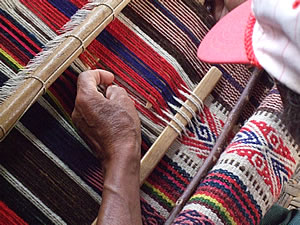
In the following picture of Miguel Andrango at work, from the web page of Isabella Whitworth (isabellawhitworth.co.uk), it seems that Mr Andrango uses a different technique for picking up the patterns to that used by Chinchero weavers I have seen at work. It looks like he first opens the shed of light warps and selects warps for forming the pattern. He saves them on a stick while he then opens the  shed with the dark threads and does the same.
andrango2

While on the theme of “travelers”… motifs which have left their place of origin…, I will tell you about one of my Bolivian weaving teachers, Maxima, who has been to both the Tinkuy events organized by Chinchero weaver Nilda Callañaupa and the CTTC in Peru. At the first one in 2010, which I also attended, she took the natural dyes workshop.

At the second one last year, she learned to weave four Chinchero motifs in one of the workshops and was able to add these to her own repertoire of patterns. Maxima also demonstrated weaving at the Tinkuy on the leaning looms that are typical of her home of Independencia, Bolivia.

maxtinkuyWhile some of the motifs woven in Chinchero are also used in Bolivian textiles (the mayo kenko pattern, for example, is used by Maxima in her home in central Bolivia where she knows it by the name linquito), many are unique to Chinchero.

It will be interesting to see how Maxima chooses to use the new patterns and how they will spread within her community. Cooperatives are being formed and they are competitive. Weavers are always looking for new designs and techniques so that they can have the edge over their competitors by offering something new.

Speaking of Maxima and the weavers and spinners of Independencia, here’s a piece of news:

A group of twenty-five spinners comprising Maxima and her peers with the team name of Warmis Phuskadoras will be entering the 2014 Spinzilla event in October. I don’t know a whole lot about Spinzilla and what it entails but it has been running very successfully for a few years now and this is the first year in which international entrants have been permitted. Thanks to sponsorship from Thrums and Clothroads, the ladies were able to pay the entry fee and register their team to join 1400 other entrants. Read Dorinda Dutcher’s blog post on her PAZA webpage about preparations and post-contest excitement in the mountains of central Bolivia.

Warmis Phuskadoras planning meeting. Dorinda reads in Spanish while Maxima translates to Quechua.

Another news item of a more personal nature involves my nephew, Ryan, and his bid for gold representing Australia in the World ITU Long Distance Triathlon Championships in Weihai, China. Some weeks ago I asked for your support by “liking” Ryan’s Facebook page. We were both quite overwhelmed by the response. It was wonderful!!

The race was run last Sunday and Ryan fulfilled his dream by winning not only his age group, but the entire amateur category outright and becoming the World Amateur Champion. Here he is bringing the Australian flag to the finish line on the final stretch…

10710872_734796429926140_4057429826783732329_nAnd here on the podium…gold medal winner! I love that hat. He bought it when he was only 15 on a trip he and I took together to Ayers Rock. Who knew back then that it would travel to China with him and appear on the podium?!

10698425_734796546592795_8995245831394791285_nRyan wrote a blog post about the race which really captured all the agony and excitement. In it he took a moment to thank all of you for your support…

Finally I’d like to thank everyone who has supported me, my sponsors, family, friends as well as the weaving community who are associated with my aunt and really supported both her and myself by taking an interest in something and someone so foreign.

He can always do with more support in the form of page “likes” to attract sponsors so, if you haven’t already done so, please “like” his page. Now, I really must get my act together and make the silk bookmark I promised him. The prototype is below…”The pain of discipline is nothing like the pain of failure”… one of Ryan’s favorite inspirational quotes.
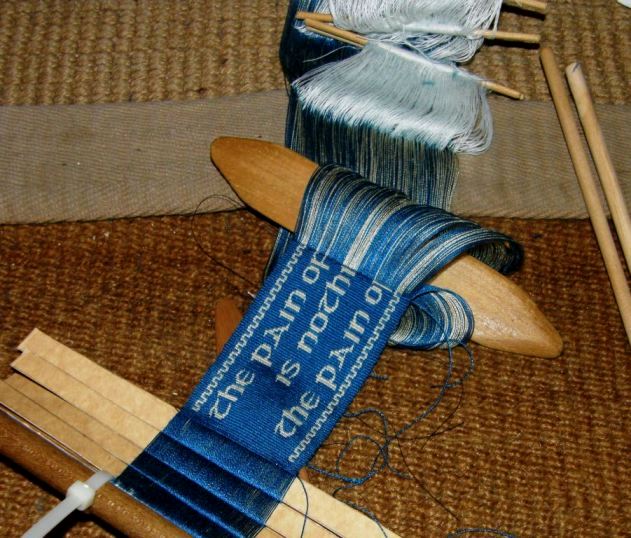
silk bookmark backstrap weavingWhile I don’t get to do much weaving of my own while on the road, the backstrap sticks have been clacking away in the homes of my online weaving friends. Lausanne wove a band in wool using one of the knotwork patterns that I have charted in my second book for the Andean Pebble Weave structure. Lausanne plays the fiddle and is using this band a a sheath for her bow…

10646717_10203926105224941_7621398630356267098_nOlive and Oaks finished her backstrap and her project reminds me how extremely satisfying producing good plain weave can be…

OliveandOaksAnother plain-weave piece by Gwen is underway and will be made into a bag for her loom. The second panel will match this one and will also have supplementary-weft patterns in yellow…

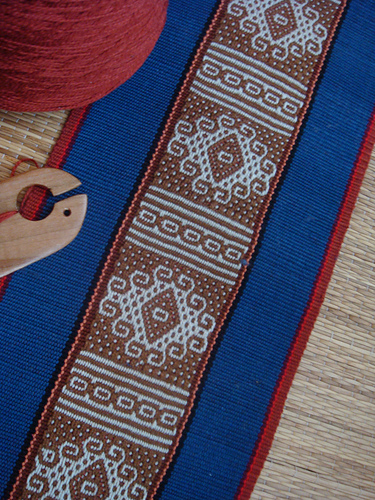
gwen bagJulia has been pushing her skills with the classic Andean hook even further with her latest piece..
julia

Alittle piece of Tibet in western Massachusetts. Liz's landlaord Sonam is a master stone mason.
A little piece of Tibet in western Massachusetts. Liz’s landlord Sonam is a master stone mason.

Since I last wrote a blog post, I have traveled from the tropics of lowland Bolivia to Massachusetts where the first nip of cooler fall weather was in the air. Hints of red were already showing against the greenery and I spent the fall equinox weaving with a group at Liz’s place.

Over my four days there I made new weaver friends and also connected with several ladies who had woven with me before. We created Andean hooks and tubular bands.

Liz has moved into a new space  since my last visit and has an even  larger and more inviting space now.

While we wove, the sister of her Tibetan landlord, dressed in traditional clothing, would be walking about outside. She doesn’t speak English and I was so hoping that somehow she would catch a glimpse of what we were doing and come and sit with us. Apparently, she walked in on one of Liz’s spinning groups one day and sat down happily to spin.

And now I have traveled over to Arizona and I can’t imagine a more different environment! I am looking forward to a visit to the Heard Museum in Phoenix tomorrow to see their famous collection of Native American textiles.

globe aAnd so, I will leave you with something in keeping with this week’s “travelers” theme. This is an image I made via a fun website which allows you to paste your pictures on a globe.

Backstrap Weaving – Bookmarked

I am in that odd sort of limbo time just before I leave on my trip to the US. There’s not enough time to really get my teeth into a new project, yet too much time to sit about idle. I finished the two red panels that will accompany my black and white ikat piece and couldn’t resist mounting all three panels on beams to see how they look together.

???????????????????????????????You should just be able to make out the red-on-red warp floats in the panel on the right. The pattern resembles the stepped pyramids and stepped diamond in the center of the ikat motif.

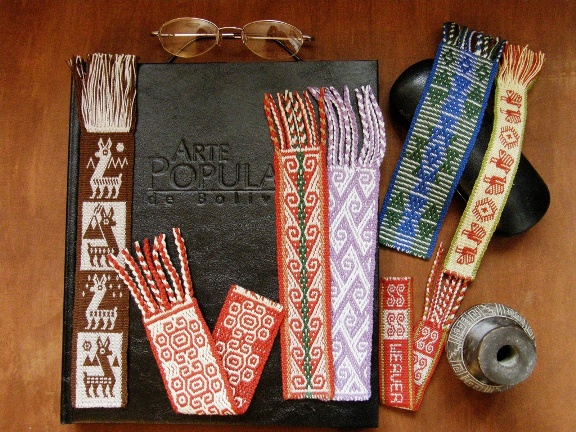
A bevy of backstrapped bookmarks

So, between packing, cleaning and tidying up, I roam the internet taking advantage of the fact that I paid for a whole month of internet and can use my entire monthly allotment of megabytes in half the amount of time that I would normally have. I look at sites and videos and bookmark the pages which give me inspiration and ideas for future projects.

And, because I really cannot stay away from the loom, I have been weaving some small gift projects. You will guess what from the title of this post…bookmarks.

Bookmarks are fun fast projects. If you have a way of creating really short warps, they provide a nice way to use up small odds and ends of yarn. I had some DMC thread left over from my Shipibo-inspired wall hanging and so, I wound a short warp and decorated the bands with silk supplementary weft.


Warping for short bands with a board and nails in Huancayo.
Warping for short bands with a board and nails in Huancayo, Peru.

I had some clear plastic sleeves that had been included in a weaving conference goody bag and slipped my woven bookmarks inside. White bookmarks, afterall, wouldn’t stay clean and white for long and could use some protection…

???????????????????????????????At first I thought that the plastic might look tacky but I am actually quite happy with the finished result. The plastic sleeves have a hole punched in the top through which I could thread a pretty blue braid. Now I want to get more of those sleeves into which I can place the Guatemalan pattern bands that I made ages ago. You can also see in the above picture the silk bookmark in double weave that I made for my nephew. This has become a sample as I want to redo it with the phrase all in one line rather than split into three.

In years past, when I made long trips through Bolivia and Peru, I would take along bookmarks that I had woven to give to fellow travelers and to people who had been kind and helpful. They were a big hit and people wanted them even if they didn’t intend to use them to mark the pages in a book.

yanque ladies with bookmarksThese ladies and the little fellow are members of the family of my sling braiding teacher in Peru. That little guy holding his bookmark must be a young man in his late teens by now I would imagine. I wonder what became of his little woven bookmark.

I would like to get back into the habit of having a collection of bookmarks on hand when I travel to give away. I think I should set myself the goal of weaving two a week . These will make nice on-the-road weaving projects.

I have all kinds of sample bands lying about here at home that would make decent bookmarks…ikat experiements, supplementary-warp bands, double-weave pieces as well as complementary-warp samples made with sewing thread. I still have the good ol’ llama band. That little llama motif appears on some double-weave belts that are sold in the central highlamds here in Bolivia. I adapted and embellished it for my bookmark.

???????????????????????????????Wider experiemental bands or those that are too thick to make practical bookmarks can be folded and made into coin purses…

OLYMPUS DIGITAL CAMERAOne of the many reasons I like using double weave is because it allows me to easily weave letters, words and phrases. One of Weavolution’s founders asked me to weave the following bookmarks as gifts to celebrate the site’s first year online…

??????????????????????Andean Pebble Weave can be cleverly used to create letters as well although not with as much flexibility as double weave. Father Kyriakos just sent me a picture of his latest rendition of what I have named the Kyriakos Kangaroo. He has modified the motif and woven it into a bookmark along with the name of its new owner…Ilya.

kyriakos roo  cropHe’s also using a pebble weave backstrap, the design for which was created by Julia.

Starting with a fringe.

Father Kyriakos has chosen to have fringe at both ends of his bookmark.

My latest bookmarks in their plastic sleeves also had fringed ends but I didn’t like the way the fringes lookedwithin the plastic sleeves.

I cut the fringes right off and painted the edges of the fabric with diluted white glue. I was then able to turn the edges over. The glue-soaked cloth was stiff and it was like folding paper. It gave a nice crisp, neat crease.

Other times, I have chosen to start the bookmark with a selvedge.

I place a fine metal rod…as fine as a “0000” size knitting needle for fine thread…within the warp and lash that to my loom bar. This enables me to start weaving right at the very start of the warp.

Later when I remove the needle, I can fill the gap that it leaves by threading the tail of the first weft shot onto a needle and feeding it into the gap. Weavers in South America, of course, do not use any kind of metal rod…that is just one of my own quirky things.

Using a fine knitting needle at the start of the band and finishing by passing the weft tail on a tapestry needle to fill the gap.

As for finishing the other end of the bands, I usually choose to braid the ends. A four-strand round braid is my favorite. This secures the last weft shot. If I want fringe, I hand sew across the woven end making sure that I catch the last weft. Hand stitches can be pulled and embedded so that they are virtually invisible.

Another way to finish with fringe and secure the woven edge is best shown in pictures…

finishing the band step 1I have just passed the weft for the second last time. It has been passed through the shed from left to right. I have placed a tapestry needle within the shed.

???????????????????????????????I have opened the next shed, beaten, and passed the weft from right to left. This is the final weft shot.

finishing step 3Now I need to secure the weft. I have threaded the needle with the weft and will pull it through the shed. I take it about three-quarters of the way across and then pull it out of the back of the band. The tail can then be cut.

finishing step 4I have beaten well again in the last open shed so that you can’t tell that there are two shots of weft together in the second last shed. You will see the odd weft turn on the left hand side where the weft has traveled “backwards” into the shed on the tapestry needle. If my weft color matched the border, as it normally does, you would not notice this at all. For this demo, I have chosen a contrast color for the weft. To finish, I like to open one more shed and beat just to enclose that final weft shot within its shed.

I’ll copy this little tutorial to a new FAQ page.

So, I have just under a week to weave some more bookmarks. I have lots of fine thread and will weave them with all kinds of structures. Having them in the plastic sleeves will be a nice way to showcase the different structures  I have studied in South America and Guatemala. I am looking forward to trying some of the fine Guatemalan naturally -dyed cotton that I got at ANWG last year.
This will most likely be the last post before I hit the road. I will try to write short postcard-y  posts as I go and not let things accumulate too much.

See you again soon…


Backstrap Weaving – Sheds, Sticks, and Simplicity

SHEDS, STICKS, AND SIMPLICITY.

The simplest form of set-up on a backstrap loom is one that is based on the basic warp cross and which enables the weaver to create two sheds.warping in Salasaca Yarn is wound around stakes in a figure-eight path. Two beams/sticks/ rods are placed within the warp to replace the warping stakes. One beam is attached to a fixed object which could be a tree, a railing, a heavy piece of furntiture or a stake driven into the ground. The other end is attached to the weaver’s body by way of a strap that passes around the weaver’s hips. Heddles are applied to the warp ends on one side of the cross to enable the weaver to lift one half of the warp threads and create a shed. A stick, which I call the shed rod, is placed to allow the weaver access to the other half of the warps.

Simplicity! backstrap loom sheds

The blue object in the above picture represents a sword placed within the shed.  heddle shedAbove, you can see Montagnard weaver, Ju Nie, raising the heddled warps to create one of the two sheds on her simple circular warp. shed rod shedAnd here, you can see her sword placed within the shed created from the threads held on her bamboo shed rod. It’s a beautifully simple set-up for creating warp-faced plain weave. One of my Guatemalan teachers used the terms “crossed” and uncrossed”  to distinguish the two sheds possibly to simplify things even further for gringa teaching! You can clearly see the crossed form of the warp and the uncrossed one in the two pictures above.

Maxima, Cochabamba, Bolivia making heddles.

One of the most interesting things for me is the different ways in which this marvel of simplicity is achieved…

How do weavers place and secure their stakes for warping?

Do they create circular or single-plane warps?

How do they secure the cross?

Do they add heddles while they warp or after?

How do they make the heddles and what material do they use for them?

What do they use to hold the warps in the other shed?

And, how do they operate the sheds?

And this is all before I can even see what kind of cloth they produce with these simple looms.

Yes, it’s simple but that doesn’t mean that the same methods are used everywhere. It can be oh, so very different and there is no single correct way of doing things. My way of doing things is an ever changing mixture of all the wonderful techniques that I have experienced and seen. Right now I am using what I call my “current favorite” way of setting up and operating the loom. This could change at any time when I am shown something new that I want to try.

And that is why I was so excited about the backstrap looms in use in Taiwan by the Atayal people that I showed last week. I haven’t yet been able to find out a great deal about the cloth they produce and am busily collecting information and images.. In the meantime, I can simply enjoy seeing the looms and the weavers at work operating them. a_modern_atayal_woman_weaviI love everything about this Atayal loom (picture by John G Kreifeldt), the way it has been set up and the way it is operated. And, while I am not rushing out to have one of those tipping boxes made for me, I am very much in love with that shed rod.

Shed rods can come in a variety of forms. Some weavers like theirs to be of very large girth. The problem is finding a piece of wood that can be that thick without being very heavy. A common solution these days is to use pvc pipe as it rovides the girth without the weight. Of course, bamboo does the job beautifully. I have some thick rods from Guatemala made from a wood that must be extremely porous. They are surprisingly light for their size. pvc shed rodThe thicker the shed rod, the easier it is to raise those warp threads and have them clear through the heddles to the front of the loom. A lot of weavers will simply draw the shed rod down to the heddles. If the yarn is smooth and friendly, that alone will cause the threads to pass through the heddles. If using sticky yarn, like handspun wool,  the weaver will need to strum the warps to encourage them to separate and clear. Sometimes a lot of strumming is needed. I have watched weavers strum away on wool threads on wide warps for quite some time before the threads will release their hairy grip on each other.

The thicker the shed rod, the more work you have to put into opening the heddle shed. I am not a big fan of  large shed rods. In fact,mine are often quite thin. I prefer to place my sword under the warps and use the size of the sword rather than the size of the shed rod to clear the threads through the heddles. The Atayal shed rod is cool becuase of the extra stick that is slotted into it which sits on top of the warp. Atayal shed rod Here’s another kind in this picture of the various Atayal loom parts taken by John G Kreifeldt. Atayal loom parts John G KreifeldtThe shed rod is the one closest to the box. The stick splits into two. One part would sit within the warp while the other rested on top. The weaver uses these kinds of shed rods to help raise the heddles. The rod is grasped and twisted away while the body moves to relax tension on the warp and the heddle rod is pulled up. If you watched the video I embedded in last week’s post, you would have seen this in action.

I use such a system but I have two separate sticks that are both placed within the warp…one is a shed rod and the other is placed behind it within a second cross. Here is a part of a video I made with a particularly sticky warp showing how this works…

In the following picture of a weaver in Peru, you can see the forked stick that she has in her warp that acts in the same way as the two dowels in mine in the video. See how she twists the forked sticks, leans forward to take tension off the warp (see how slack the threads are behind the forked stick) and pulls up on her heddle rod. forked stickNow, if you can’t be bothered setting up that second cross for placing a second stick, (although, it’s really very easy and I have an FAQ on it here on the blog) you can just attach a second stick to your shed rod and have it sitting on top of the warp just as the Atayal weaver has. I tried it on my current ikat warp and it works every bit as well. It is just a little bit less stable and that is just something that I had to get used to. There are ugly rubber bands and my set-up is nowhere near as pretty as the Atayal one, but, hey, it works. It also means that my shed rod is free to move and I can slide it up and down the warp if I want to better clear the space into which I insert the sword. new sed rod set upSome weavers, rather than having a second stick in or on top of the warp, have a separate stick which they pick up and apply only when they want to open the heddles. Ju Nie, for example,  uses a bamboo slat. She places it on top of the warp and then grasps it and the shed rod in one hand and twists. When not in use, it just sits on the floor her side. montagnard-weaver-opening-heddle-shedOther weavers simply use their sword as their second stick. Ju Nie’s sword is so incredibly large and long that it would be too awkward to use on a narrow warp like this one. The following pictures are shots that I captured from videos that I have taken and are blurry as a result. Pitumarca weaver opening heddle shedThis weaver from Pitumarca, Peru has placed her enormous sword on top of the warp behind the shed rod. She is grasping both and will roll them while she pulls up on the hedde rod. Taking a few steps forward helps her relax tension. She is using a very smooth warp of fine industrially spun cotton. Cusco weaver opening heddle shedThis weaver from the Cusco region is about to do the same. She had to get right up on her knees in order to relax tension while she did this. It is a sticky wool warp. You should have seen the strumming that went on to get the warps to separate in the other shed. Chahuaytire weaver opening heddle shedThis weaver from Chahuaytire in the Cusco region is using a fine aplaca warp. He has moved his sword back beyond the shed rod and is about the grasp the two. With his other hand he will pull up on the heddle rod. He is seated in a chair to weave and stands up to relax tension on the warp.

So, what is the idea behind twisting/rolling these two sticks? What exactly is happening? The following pictures, once again, are shots captured from a demo video I made and are, therefore, quite blurry…I think you can see what’s going on. twisting sticks my demo (2)This warp is way too narrow to be bothering with a shed rod. Normally I would use a simple shed loop on a warp like this but have used sticks just for the sake of the demonstration. In the warp above, the blue threads are controlled by the string heddles and the white ones are held on the shed rod. I have a second stick placed within a second cross and that and the shed rod have been connected with rubber bands. I have grasped both sticks and am rolling them away. You can see that this action tightens the layer of white warps while the blue ones, (the ones I am attempting to raise via the heddles) behind the shed rod have become slack. My legs are straight in this picture as I have not yet moved forward to relax tension on the warp. twisting sticks my demo (1) raising the heddlesNow a knee is bent as I come forward. Look how slack the blue threads are now while the white ones remain taut. This is what will enable me to pull straright up on the heddles and raise the blue threads creating a nice big shed.

As I pointed out before, there are many methods that backstrap weavers use to operate their looms and this is just one of them. It is good to have many techniques up one’s sleeve to use in different situations. Often the stickiness of the warp threads will determine the method I choose to use.

I am grateful for having had the chance to weave with, observe, and learn from backstrap weavers from many regions and countries and try out their various methods.

I get very excited about all these details. I hope I haven’t bored you all with this! I am not sure how many people share my enthusiasm for these kinds of things! Here’s what I have been weaving this week… ???????????????????????????????These are the two red panels that will accompany the black and white ikat and brocade panel I have been working on lately. I have just started a simple warp-float pattern on it and am using two sweet shuttles that Father Kyriakos made and gave me when I was in Australia. Yes, I have gone back to using a shed rod and a second stick in a second cross.

Whether I keep the ikat panel or start over will be decided when I get back from my fall trip with a new supply of black dye. I wove the seven tabs last week and will show you those once all the messy stray weft ends have been put away.

Julia posted a picture of her latest band that has a complementary-warp motif from the Peruvian highlands…part of a series of motifs that I charted in my second book…a complex technique resulting in simple beauty! She has based her color choices on a piece of weaving from the Cusco region. DSC04864_mediumThe summer heat has hit here in a big way and it isn’t even officially spring yet. I am looking forward to some fall coolness in the US. See you next week…