Backstrap Weaving – The Sounds of our Craft

It’s been a while since I last heard the scritchy sound of hairy warp threads releasing their grip on each other as I open sheds on my backstrap loom. I am hearing it now because I have taken on the challenge of weaving with mill-spun wool singles that I bought from a farm while traveling in California. I don’t really know what I had in mind when I bought that yarn. I had just wanted to buy something as a souvenir of that part of my travels from the lovely people who had allowed my friends to gather and weave in their barn.

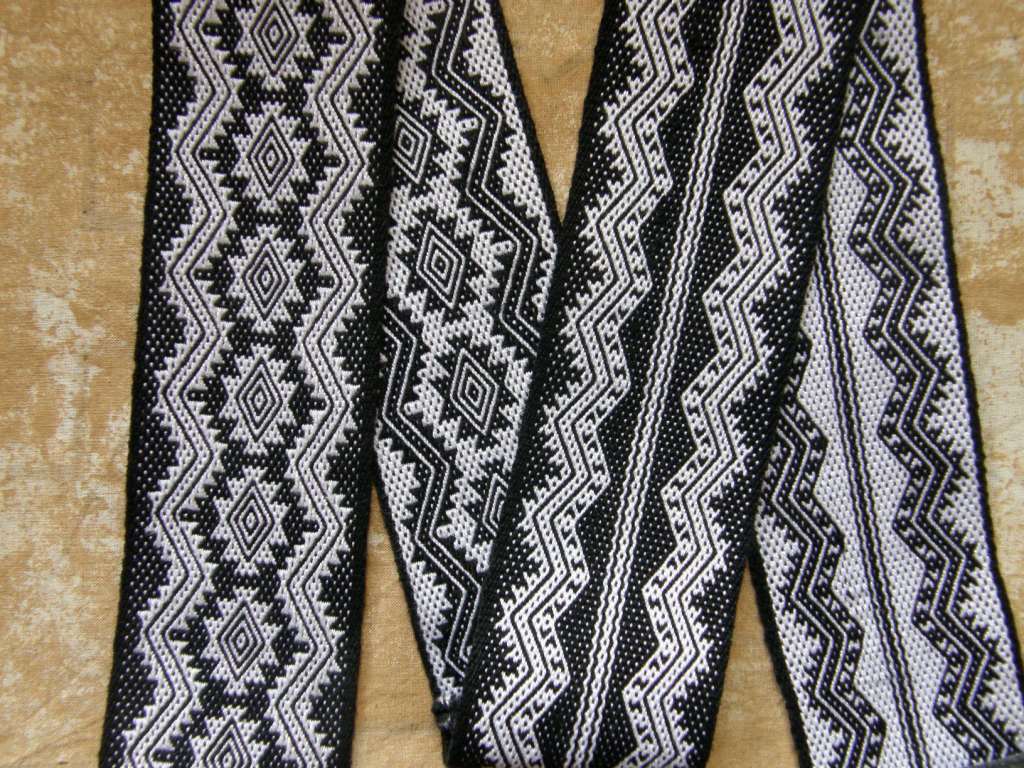
Because traveling to far off places to buy yarn like this is off the table at the moment, this is another case of my exploring my dwindling stash and enjoying the new challenges that this presents. My idea is to use this yarn to weave the body of a bag that will go with the strap I just finished. I used a three-color reversible Andean Pebble Weave structure for this strap and the wool yarn that I had been spinning and plying on a drop spindle during pandemic Zoom gatherings.

Despite the dark colors, I think it’s a happy garden scene of flowers and hummingbirds.

I did start off with the idea of creating an orderly, cohesive pattern layout but the temptation to play with the three colors and pop those hummingbirds wherever I wanted took over and I had a lot of fun doing just that.

One thing that I had wanted to do was use one color for the pebble spot that represents the hummingbird’s eye and another color for all the other pebble spots that sit within the figure’s body…but you know, I forgot to do that every single time! Well, almost every single time. I was determined to remember to do two things before I eventually finished the band…take a picture of myself at the loom working on it and get those colored eye spots in!

I once met a bird photographer that told me that it is really important to capture the little spot of white light in a bird’s eye in order not to have it appear lifeless. I have looked for it in every bird photo I have seen since. In the same way, I think the different colored eye spot on these last two hummers makes an enormous difference.

I didn’t hear any woolly scritchy sounds while working with this hand spun of mine. I had been concerned about how well it would stand up to this rather dense structure but realized after a while that I had completely forgotten all my concerns and was able to enjoy how friendly it was and how lovely it felt.

I remember the first time I wove with my hand spun. It was with some rather nasty dry and dusty llama fiber that I had bought from the animals’ owner up in the highlands. At the time, the scritchy tearing sounds were freaking me out and the yarn I had spun was anything but soft and lovely to handle. I had put a tremendous amount of twist into it so that it would stand up to warp-faced weaving. I don’t do that any more.

And now, there is a new experience…weaving with these mill-spun singles. This is a first for me. Yes, there’s some “scritchiness” but I am actually finding it pleasant…almost like the warp is whispering to me. That llama fiber had seemed to be screaming at me in that first-ever experience. I made adjustments to the way I was spinning it, it became friendlier, and I was able to enjoy weaving with it more. 🙂

This is my sample for the bag fabric that will follow. I wound a warp of 27″ length and 160 ends. The idea was to weave and allow it to settle into a consistent width so that I could then make calculations for the bag fabric. I most typically start off too narrow with new-to-me yarn and have to let the piece gradually widen and settle. Once I am happy with that, I put it aside and work on the real project. This time, however, I was enjoying working with this wool so much, I decided that this piece really needed to be something and I figured that my cell phone, which currently sits in a case, could do with a pouch. So, I unwove a good 3″ of fabric so that I could start over at the correct width. The fact that I was able to unweave the warp-faced cloth woven with wool singles yarn without losing my mind, tells me that this yarn and I are going to have a happy weaving relationship.

And I decided to use some of my plied hand spun as supplementary weft to weave in a pattern. This is some of the thicker “Zoom” hand spun that I first created and used to weave a wrist cuff before deciding to try and go finer. It is making a very nice supplementary weft. I am using the outlining technique of supplementary-weft patterning in which the weft does not travel from selvedge to selvedge. I can make my hand spun yarn go further that way. It is precious to me and I don’t want it to be just hidden away between the layers of warp as it travels to the selvedge. I can’t tell you how much fun I am having with this!

Wrist cuff with the initial run of hand spun.

A couple of observations: There had been a tendency for me to think that the action of the heddles against the wool would be the cause of most of the abrasion and subsequent pilling or shredding. Lately I have found that with good loom-operation technique, this isn’t so. There is actually a point of layer exchange that sits between the heddle and the shed rod where most of the abrasion is occurring for me. This exchange happens when the threads that lie on top of the shed rod are lifted and brought down through the heddles to the weaving line. (I keep my shed rod stationary and don’t slide it forward to the heddles as some backstrap weavers do which explains why the point of layer exchange on my particular warp is in that position.) That abrasion point is the one I need to watch and I notice that a little bit of fluff accumulates there. I am particularly gentle there and tend to spread the threads with my hands and lift them through that point in sections. It is also important to advance the warp as often as possible so that the abrasion point is constantly changing position.

I love the multiple tones in the warp and its rustic look. I had considered a hummingbird pattern but decided that this one better suits these natural earthy colors.

But despite all that gentle handling, the warp does continue to whisper to me in its scritchy voice, possibly just as a reminder not to get cocky and careless when I open the sheds. This talk of sound playing a part in our weaving, reminded me of some thoughts I had posted way back in 2013 that I thought I would revisit and share with you.
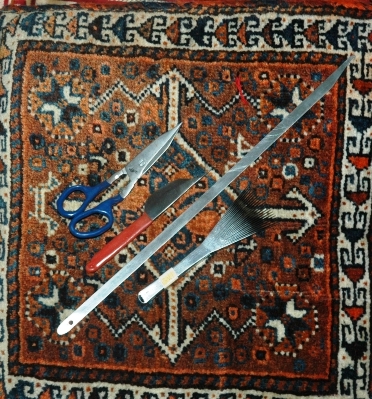
tools01

Back then, something a weaver had posted on the Weavolution website had resonated with me. An Australian gentleman, Hakim, was learning to make cut pile knotted rugs with an Iranian teacher in Australia. He said that when he is at home working on his practice piece, he can tell that the tension of the warp threads is correct if they make the same sound  when he handles them as they do when he is working on his learning piece with his teacher in class.

What a piece of priceless knowledge!

(At left you can see an example of a set of tools that Hakim was able to get for me from his teacher for the day when I try this technique. It’s on that long, long to-do list).

Hakim’s comment made me think about the different sounds that are connected with weaving on simple looms and how much I enjoy them.

I am not one for placing things in my ears and listening to music while busy with something else. I can’t stand that. I like to be in touch with the sounds around me. They form a very important part of my memories of places and experiences.

In my skiing days, I would wonder at people who skied with headphones on. I would never give up the pleasure of hearing the wind and the swish of the skis on the snow, or the sudden change of sound as snow turned to ice giving me time to react and adjust position. Back then, no one wore helmets. I am told that the helmets being worn now don’t affect the skiers ability to enjoy those sounds.

I learned to fly a glider when I was 19. There is nothing like the sound of an engine-less craft rushing through the air. There was so much with which to be occupied while learning (especially for someone like me who was so utterly un-coordinated at the time!) but I could always simply rely on my ears for certain information. For example, if the sound of the rushing air suddenly disappeared it was a sure sign that I had the nose up too high and that told me that I had better do something quickly before the glider stalled!

When we first went into pandemic lockdown here in Bolivia, I remember finding the sudden absence of sound really disturbing and almost frightening. Then I realized that what was missing were familiar sounds of human activity and that they had been replaced by much more pleasant ones…bird song and the sound of leaves being blown across the cobbles…sounds that normally were drowned out by the hum of city living.

As for sounds while weaving, I love using multiple big swords. I so enjoy the musical tok tok sound they make as they knock together in the sheds. And I love the chuckling chatter of all the sticks on the loose as they fall together when I release tension and roll up the warp at the end of the day. Below, you can see the sticks I used in a wall-hanging piece….many different kinds of wood making interesting sounds. It can become quite a collection.

O

Then there’s the plink plink sound as the tip of a delicate Guatemalan pick-up stick slides from one taut warp to the next as the weaver counts out threads for supplementary-weft inlay.
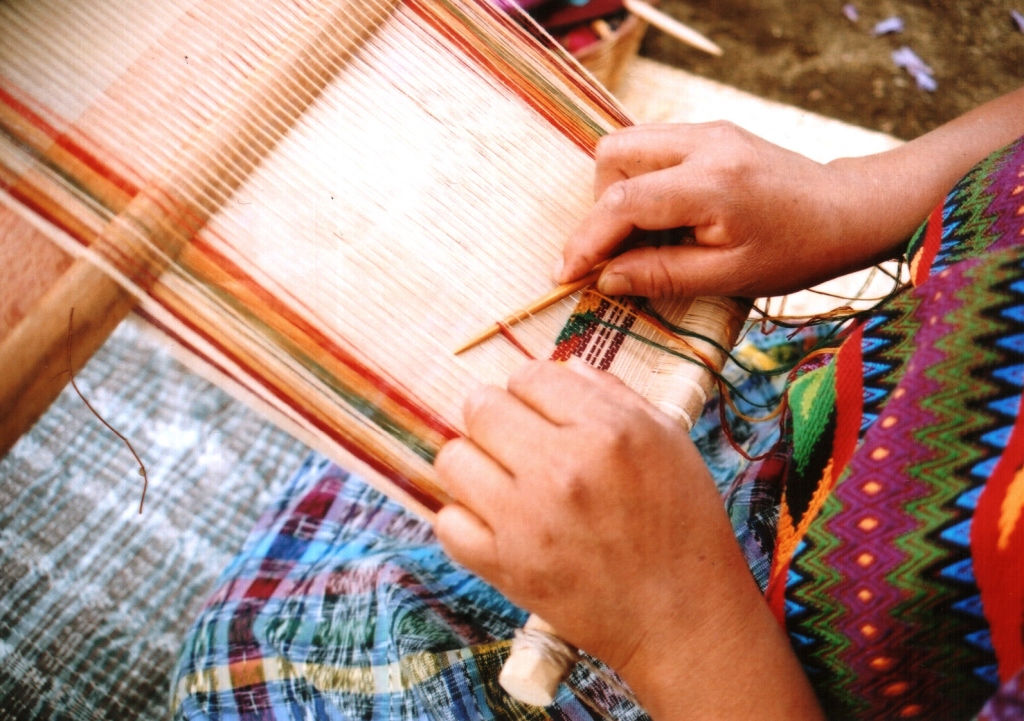
weaving-tijera

The dancing dangling bobbins used in weft twining go clackity clack as they twist and jiggle.
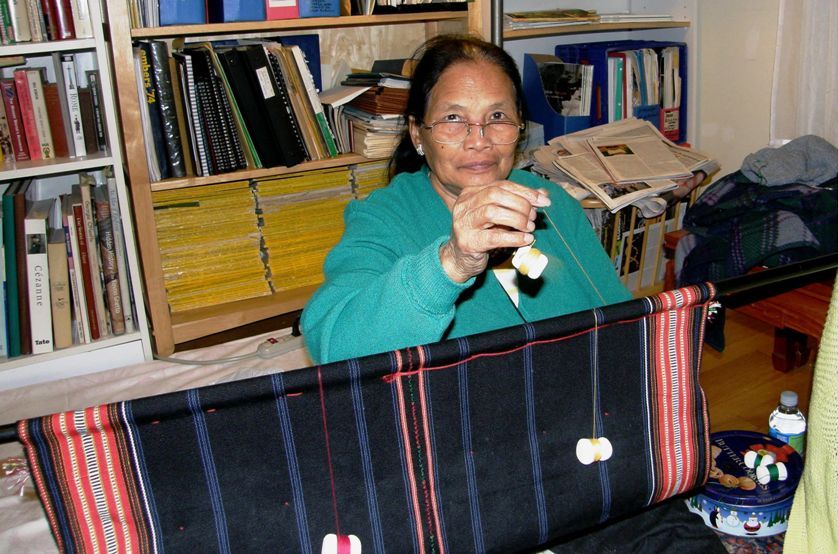
final-twining-session

And they enable my teacher to create such beautiful work as this:

Examples of kteh work by my Montagnard weaving teachers.

I loved the opportunity to drag the llama bone tool across the strong highly-twisted wool threads that my teachers in Peru had prepared below…scritch, scritch, as I strummed to help separate the warps. Only warp threads with certain characteristics will tolerate this.

O

Listen to my teacher doing it…

If you stroll around a  village of weavers in a certain part of the central highlands of Bolivia, you will know in which houses a weaver is at work by the LOUD THWACK!! THWACK!! of the llama bone hitting the sword as the wefts are slammed into place. That sound is one that is not really pleasant, at least not to my ears, when I am seated right next to my teacher. Here is one of my teachers in Candelaria at work at her loom:

When I stayed in the stilt-house home of my weaving teacher in Ecuador, I was often awoken at dawn by the muffled thump, thump and accompanying vibrations as Trini drew down her heavy beater while working at her vertical loom. This was combined with various house shaking and creaking sounds as the loom was connected to floor and ceiling beams…a part of the house itself. You can see that big sword/beater lying across Trini’s leg below and get an idea of the muscle that goes into operating this particular set-up.

trini-opening-shed1

The sound of threads in a warp-faced weaving rubbing past each other as a shed is opened can range from a soothing smooth swish to a seemingly painful tearing protest depending on the yarn being used and how it has been prepared.

When weaving with new backstrap weavers, we even learn to be amused by the constant clatter of swords jumping out of their sheds and hitting the floor. Each sword has its own musical tone…nowhere near as much fun on a rug! A cement floor like the one in this picture greatly enhances the melody.

Joan following a pattern chart at the Mannings.

By the way, I am in charge of picking up the fallen swords….gives me something to do. It is funny that as time goes by we have people weaving in silence. What happened to our musical accompaniment? Well, new weavers, without even realizing it, get a feel for the right amount of tension and the sweet spot in the warp where the sword will sit happily upright and not leap to the floor. Or…they just get rather good at catching the sword on its way down!

Maybe one of the nicest sounds for me is the fwip fwip fwip fwip in rapid succession as I pull my heddle string quickly but carefully (or else it will tangle miserably!) off its heddle stick. This means that the piece is finished.

And with that soft, happy sound in your head, I will leave you.

Until next time.

Backstrap Weaving – Star Gazing

Every night when no one is around I go up onto the terrace of my condo block and walk about star gazing for half an hour or so. It’s a peaceful, quite extensive space that covers the top of eight apartments. I don’t need to wear a mask up there and in spite of the light pollution from the inner city area in which I live, I can enjoy looking at some of the stars and planets while getting in some stretches and exercise. The air is fresh after a steamy summer’s day and I often wish that I could string up a hammock and sleep up there.

I remember one of the few times I was able to enjoy a night sky that was completely devoid of man-made light. It inspired me to weave stars into what I call my ‘Starry Night” wall hanging. I remember stepping outside my little room on Taquile Island on Lake Titicaca in Peru to go to the bathroom on a clear and bitterly cold night and being stunned and almost knocked over by the brilliance and abundance of the stars in the black, black sky over that dark, silent island. Kurt Laitenberger wove this motif with tablets and and I asked his permission to transpose it into the Andean Pebble Weave structure.

It’s interesting that it was this very same motif that caught my teacher Maxima’s eye the last time I was with her up in the highlands. I had taken many woven samples to show the ladies in the weaving cooperative and Maxima had chosen this one. Her first attempt to copy it on her own was not successful. Actually, she had started out very well but suddenly got stumped and stopped. She asked if she could watch me weave it so that she could learn. 

This image has an empty alt attribute; its file name is with-max-at-leaning-loom.jpg

I wove one motif and that was enough. Maxima was then able to continue just by following my woven example.

This image has an empty alt attribute; its file name is maxima-star-band-central-boloivian-highlands.jpg

Up on the terrace In these early months of 2022, it’s been nice greeting Orion on its return to the 8pm night sky on my side of the world and I am currently waiting on the Southern Cross to complete its circle low in the south and once more climb high enough to reveal itself above the light pollution and buildings.

An invitation in one of the online weaving groups to show-and-share star patterns prompted me to write this post. I actually wrote about this same topic about ten years ago but there has been quite a lot to add to it since then. Back then, I was able to share the Andean Pebble Weave strap on which I combined motifs woven by the Guaraní people here in the lowland part of Bolivia in which I live…

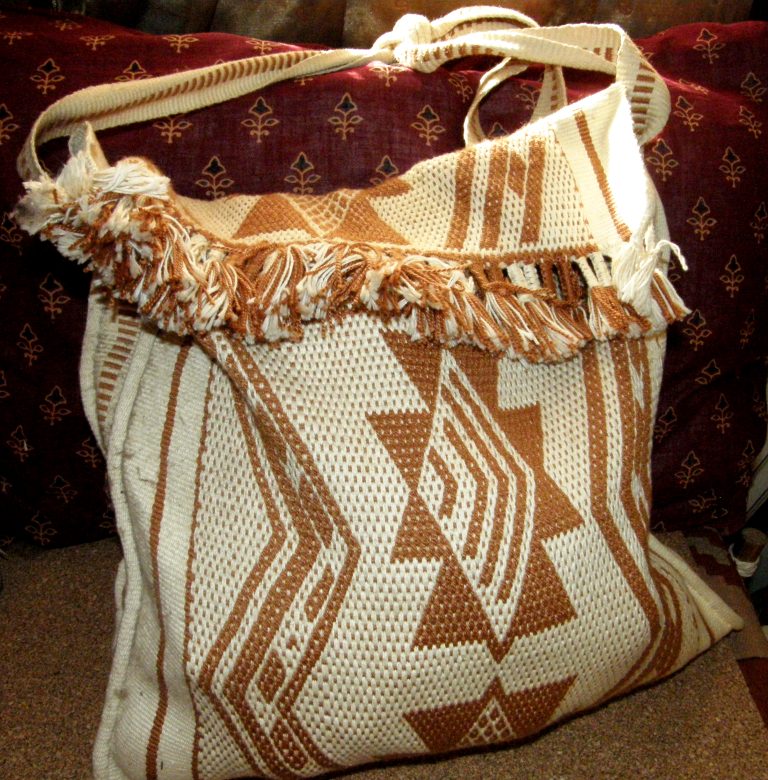
The Guaraní weavers use two types of complementary-warp structures in their cotton cloth. In the structure that they call Moisy, they represent all the natural beauty of their surroundings in large, bold renditions of trees, butterflies, birds, plants and flowers. However, in the pebble structure that I used above, they only ever weave two motifs – a snake and stars –  and there are an endless number of versions of these two items. You can see one such version on the woven bag.

My teacher told me that it was a snake that came to the first weaver in her dreams to teach her the patterns. The Guaraní people who live along the Parapetí River here in Santa Cruz also use the snake motif to represent that life-giving water. The stars are important guides in their agricultural cycle.

I found a story translated from Guaraní to Spanish in a book published by Artecampo, which is a craft cooperative store here in Santa Cruz, about a legend behind the use of the star motifs in Guaraní weaving…..it says that…

One day the children were taken and placed  like stars in the heavens and this is why women cry out about stars in their weaving. The stars not only speak of the sky but also about the richness of nature because one woman, in an attempt to stop her child from being taken, grabbed hold of a finger (or toe, it is not clear in the Spanish translation which). As she pulled on the finger, unfortunately, a piece broke off and this piece was buried. From the burial of this piece a corn plant sprouted. In this way, weaving symbolizes abundance which comes from the piece of the child. And this is why food crops are not only considered elements that feed and sustain men, they are part of Man himself just as the stars are part of Man and Society. Songs name those who are living in the sky and those that sing wear woven cloth to show that they are still with them even though they are distant.

Dionicia added these stars to her pattern repertoire after my visit. She wove them into a bench cover that she sells locally. Being able to include a “novel” pattern gives her a little advantage over other weavers who might also be selling their woven bench covers. 

This image has an empty alt attribute; its file name is dioniciac-1.jpg

The star patterns above are charted in my book More Andean Pebble Weave Patterns. And, speaking of the ladies up in the highlands, Dorinda has just written a new blog post on her most recent visit now that she is back home in the States. Dorinda had been away in the USA for going on two years and I can only imagine the happy reunion when she visited in November. 

In the Bolivian highlands, stars are woven into cloth by the weavers of the community of Tinkipaya. According to Veronica Cereceda in her book which catalogs the designs on these textiles, these ch’askas, stars, are a representation of the world above known as janaq pacha.

The small band in cotton that I wove to test the pattern is pictured above with a couple of wooden tools I got in a market in Potosi, the province in which Tinkipaya is located. I was told that the tool on the left is used to push down the warps behind the heddle rod when the weaver is opening the heddle shed. I have never seen a weaver actually use one of these and I have never seen another one like it. The one I have has a red stain on it and I like to think that it might be cochineal from one day when its owner was preparing to dye. The other tool, of which you can only see the tip, is used for beating and strumming and I have seen tools like this in use in several places in Bolivia and Peru although they are more typically made from a llama leg bone.

The structure used in this piece is yet another style of complementary-warp. The warp floats that surround and fill the star motif are aligned and arranged in a certain way that distinguishes this style from others. Below you can see the same star motifs woven with my hand spun llama fiber into a band that I wear as a wrist cuff. 

This image has an empty alt attribute; its file name is wrist-cuff-in-handspun-llama.jpg

And here it appears yet again in wool on a little bag I made when one of the online groups held an “orange challenge” several years ago.

This image has an empty alt attribute; its file name is 194951393_6181681991845586_2057187051893150363_n_medium.jpg

I published the chart for this pattern in my More Adventures with Warped Faced Pick-up Patterns book and Susan Torntore, one of my new Zoom weaving friends who refreshed her Andean Pebble Weave skills via a Zoom class with me, transposed it into the Andean Pebble Weave structure and then went on to create something like fifteen beautiful variations. Here are a couple of them. She plans to use this band as a bell pull.

This image has an empty alt attribute; its file name is susan-torntore-stars-crop.jpg

The Andean Pebble Weave structure has the advantage of having two regularly repeating rows which can be produced automatically by enclosing those arrangements of threads in heddles. Some weavers choose to do that because motifs can be woven much faster this way. Others prefer not to fuss with heddles and weave the patterns using pick-up for every row. In the structure used for the traditional Tinkipaya pattern, there’s no choice. Each “row” is unique and the threads for each must be picked up manually.

Wikipedia tells me that the stars on the flag of the United States represent the fifty States in the Union. Well, I knew that. I was hoping to find out why exactly stars had been chosen as opposed to some other figure but I guess there doesn’t have to be a reason. I am sure that we could all come up with some kind of symbolic meaning for a star. I swear that some of the indigenous weavers with whom I have studied have made up things about the motifs they are using just to please or else have a bit of fun with me…I have seen the twinkle in their eyes and the way they look sideways at each other!

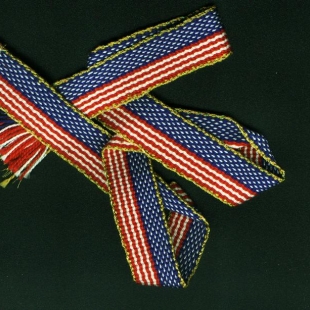
Gail wove this very patriotic collar for her dog on her inkle loom many years ago and I have seen this pattern and variations of it show up in the various online Inkle Loom groups many times over the years around the fourth of July. Gail was forever coming up with clever collar designs for what must have been the best-dressed dog in New York.

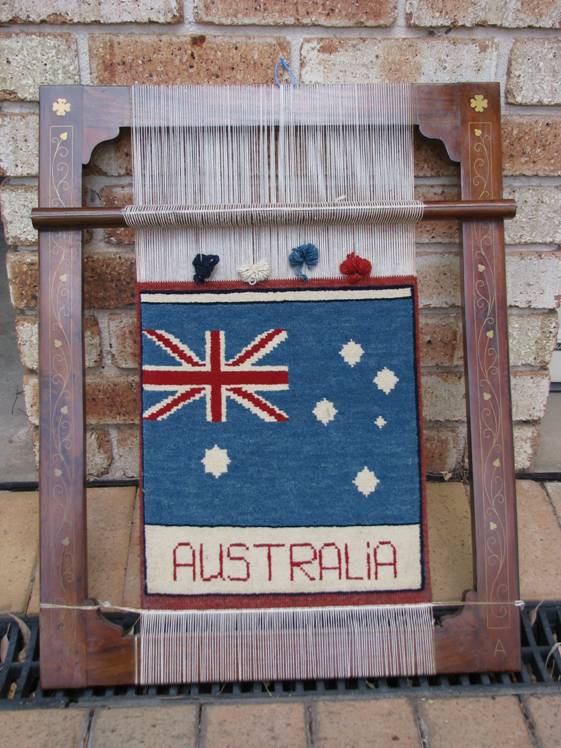
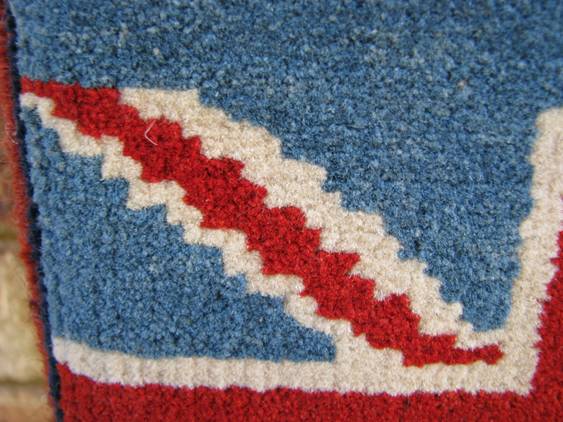
Speaking of flags and patriotic weaving, I assume that the next starry piece was made by someone who is proud to be Australian. I have this very cool cut-pile weaving of a representation of the design on the Australian flag…

The group of stars is the Southern Cross constellation which really is a sight to behold there in the southern sky. I am so happy to be able to see it low on the Bolivian horizon and it makes me feel somehow connected to Australia and  the people I know and love so far away. It is little wonder we so love stars and choose to use them in our cloth.

The large single star, which should only have seven points, represents the Nation’s seven states and territories. This cut pile piece on its beautiful frame is gorgeously dense and I would love to meet its creator.

It was given to my brother as compensation from the Indian owner of a furniture store who went out of business before he could supply all the chairs for my brother’s dining room setting. My brother then gave it to me. One day I will track down this furniture maker and see if I can talk to him about this weaving technique.

I don’t know if the weaver intended to continue with the design. There is so little space at this point and the tension on the warp is so high I can hardly imagine being able to do so.

There are a lot of representations of stars in Andean weaving. I took one small motif  and combined it with others to make the guitar strap below in colors reminiscent of the desert and canyons of the US southwest… a winding river, moon and stars. It took me back to clear, warm nights camping in the depths of Utah canyons with nothing between me and the stars. Moonlight bounced of red canyon walls and dozens of frogs singing away at the water’s edge. These were other precious occasions on which I could star gaze without man-made light pollution.

Combining several small motifs in this way is a nice stepping stone toward designing your own unique patterns. I teach the Andean Pebble Weave technique for those who use a standard inkle loom in my book Andean Pebble Weave on Inkle Looms which you can buy as a PDF or as a spiral-bound book from Taproot Video.

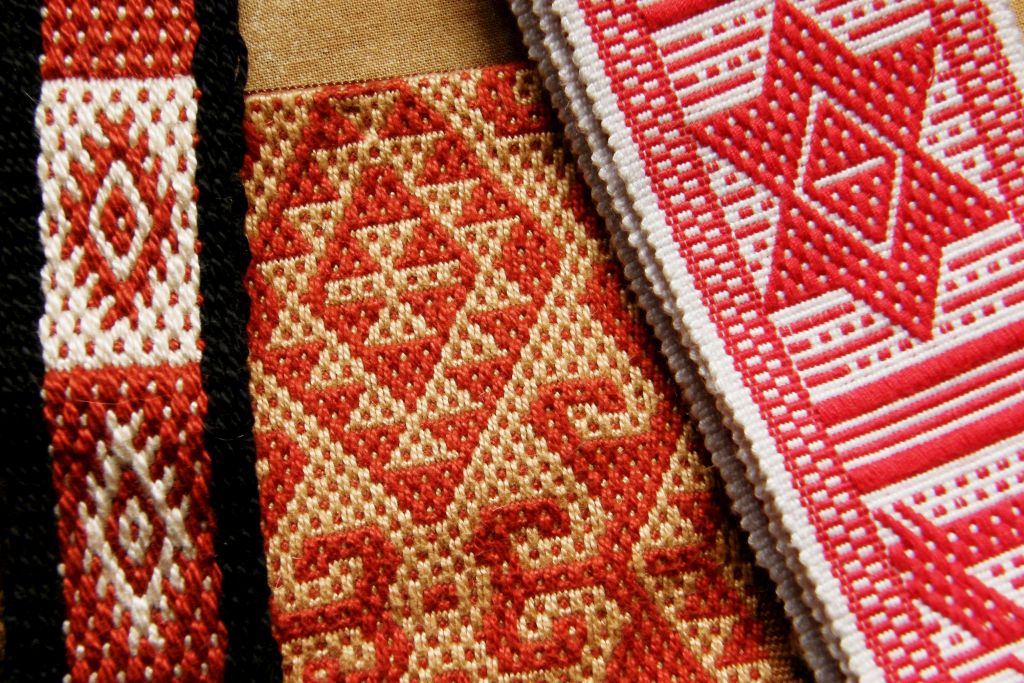
And then there are many motifs that look like stars to our eyes but which and perhaps represent something else all together. Maybe one day I will find out what exactly they mean to the weaver. There’s what I believe to be an Andean ch’aska  in Andean Pebble Weave on the left. In the center are the star-like motifs that I replicated from Central Asian yurt bands. A motif on a belt from Ecuador is on the right. Its star-like motif is woven using supplementary warp threads.

I chose a star motif for my first ever attempt at using 60/2 silk as warp on my backstrap loom. The motif did not have any symbolic significance to me. I simply needed to use something that was smooth-sided and symmetric. This was because I wanted to use a supplementary-weft technique in which the additional weft is not carried from selvedge to selvedge. I didn’t want the supplemental weft to thicken the cloth and so I used a technique in which the weft just travels back and forth from edge to edge of the motif itself. This only looks nice, in my opinion, when regular rather than irregular shapes are used. So, who knows why certain motifs ae chosen by weavers? It could be for what they symbolize or the choice could also just as easily be for purely practical reasons, as was the case in my silk piece.

There aren’t any stars on my current three-color Andean Pebble Weave piece. It’s all about flowers and hummingbirds. If you have been following me on Instagram (I go by my name: lavernewaddington there) you will have seen some of my progress. At some point I unconsciously stopped being concerned about my hand-spun wool being up to the challenge and have been simply enjoying how lovely it feels instead. But for now, I will stick with the Starry topic and wait to show you more of my three-color pebble in my next post here on this blog.

Let me finish by showing you some beautiful creations that were shared with me by another new Zoom weaving friend, Laurice Johnson. She has converted her pretty inkle-loom-woven bands into these gorgeous star ornaments by following online tutorials. There are several tutorials on Youtube for fabric stars that can be used for inkle bands. They are really stunning. My friend Jennifer Williams also has a tutorial on her blog for a different kind of star made from narrow bands.

I’ll be heading upstairs soon for another night of star gazing. See you next time.

Backstrap Weaving – What if?

When I last posted, I had just wound this warp using my “Zoom” hand spun, that is, the wool that I had been spinning and plying on a drop spindle during the various pandemic Zoom sessions that I have been attending. It took a while for some participants to get used to my sitting there with my arm raised as I attempted to get maximum drop distance for my spindle. I was often asked if I was signaling my desire to ask a question. I hope I wasn’t too annoying!

I dyed the blue and tobacco colors so that I could have three colors that would work well together on both faces of this three-color warp. Basically, I wanted to work with a dark, a medium and a light color and the challenge was finding a medium color that contrasts well with both the light and dark.

I am not sure why I always seem to find myself working with wool at some point in the hot, steamy summer months we have here. It kind of made sense when I was traveling a lot as these summer months used to be the longest period of uninterrupted time I would get to spend at home. I would work on as many different projects as possible before having to think about workshop prep, packing and traveling again. But now I have all the time in the world as I play it safe at home and can be more selective about which project I tackle, and when. I suppose stash limitations may have something to do with my choices now.

In my last post I told you that I had bought Joan Ruane’s video class on Spinning Cotton on a Takli from Taproot Video. I am using Joan’s spelling of the word takli. I am only 30 minutes in on her 2-hour 20-minute class and have already learned so much. I get to spend a little time with Joan via Zoom as she is part of the Taproot Video team and I was once her roommate at the Mannings. However, I had never seen her in teaching mode and I can tell you that it is no surprise that she is fabulous.

The blue and brown above are my early attempts with the takli from a few years ago. The white is the remainder of what I bought from a spinner in Guatemala back in 2008. It’s what I used to weave the little sheer-cloth sample that you can see in the photo.

I got some lessons in spinning cotton with Trini and her mother, Luz in coastal Ecuador in 2007.

Now I just need to figure out a way to use the takli comfortably while participating in the Zoom gatherings. I had a few wool plying mishaps when I got too engrossed in what was happening on the Zoom screen. I expect I will be presenting a furrowed brow of concentration to everyone as I try to put what Joan is teaching me into practice. I have a wooden mortar that I could clamp between my knees to use as the platform for the takli. Joan says that using something wooden has the advantage of being virtually noiseless although she does say that it is better if the bowl does not have high sides. I’ll see what I can figure out.

What to do with the cotton? Well, I guess that I would like to use singles in another sheer cloth piece using one of my bamboo reeds. This is what I wove using the hand-spun singles that I brought back from Guatemala. This is part of a scarf that I wove.

But of course I am getting way ahead of myself! I know that I need to put in lots of miles of practice before I can produce something with which I am satisfied.

As for my current hand-spun wool project, I have always said that warp-faced weaving really flatters my hand spun. It’s a very forgiving structure for those thick and thin bits in my yarn. When the threads are all pressed up close together they look wonderfully even. I am pleased to say that my yarn is holding up beautifully. I don’t have to think anymore about the possibility of it being abraded to the point of breaking and am focusing on the colors and patterns instead now.

Which is where the “what-if” comes into it. I have given up any thought of creating an orderly and cohesive design on this strap because I simply can’t resist the urge to explore the what-ifs. What if the hummingbird is outlined in white with a tan filler, for example….what if I reverse that…what if the body and wings are two different colors…what if I change the pebble spot color…how many variations can I create? And so on!

5 hummingbird varieties.

I have a nice assemblage of tools by my side…swords, pick-up sticks and a tool I use to press the weft extra-firmly into place. I have to add my long thumbnails to that group. They really are my favorite tools! I am blessed with having nails that grow as hard as rock. I usually have to cut them back now and then to a socially acceptable length.

You’ll also see some leafy what-ifs here.

This is destined to become a bag strap. I have some lovely wool singles that I bought from a co-op farm while in California. The owners used to allow my group of backstrap weaving friends to gather in their barn. It will be nice to weave something with fiber from their sheep that they had sent out to be spun. I guess I will dye it dark blue and use it for the body of the bag. I am thinking plain dark blue with perhaps a three-color edging to which I will add this fancy strap. And what if I add some lines of color in weft twining to the body of the bag? I love those what-ifs!

Wool singles from the farm.
Fond memories of weaving in the barn.

Maybe I’ll have some of my hand-spun cotton efforts to show next time. And before I forget, you may remember my mentioning, Allen Berry as the maker of beautiful swords for backstrap weavers (allenrberry on Instagram) when my weaving friends gifted me two of his gorgeous pieces a few years ago. Here’s one…

An Allen Berry sword with some of my wrist cuffs.

He doesn’t have a website and so you will need to go to Instagram to see his work. You can contact him via a direct message there. I am not sure if he still making the swords but the reason I am telling you this is because he has added, along with his many other wooden spinning and weaving tools, ADORABLE dishes for supported spindles. Here’s just one example. Go check him out on Instagram (allenrberry).

And while you are there, you might like to follow me. I am on Instagram as lavernewaddington. I post quite a few things there between my blog posts. See you next time.