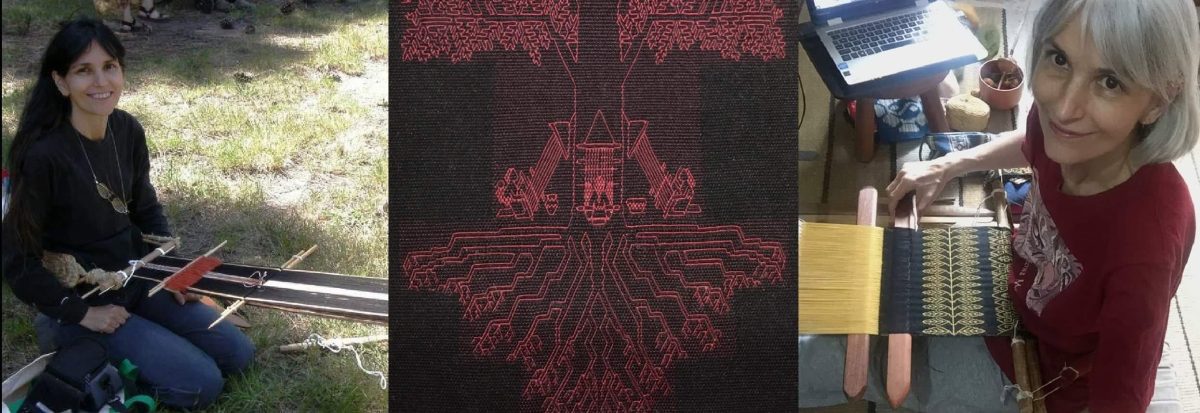
Backstrap Weaving – Seasons

I wove this with handspun cotton singles that I’d bought in Guatemala back in 2008. I used my bamboo reed to achieve the sheer open look and used the same cotton as supplementary weft to weave in patterns. It’s a style that I had been wanting to try ever since I bought a sample from the Coban area of Guatemala.
While I love spinning with a drop spindle, I can’t say the same for plying. I find it downright tedious and I just wanted the task to finish. I’d ply at my craft group gatherings, on the train, at the Arts Society gatherings, at the spinning and weaving group….it just seemed to go on and on.
I managed to squeeze in some time at the loom between hiking trips. It took two attempts to wind a warp to my liking from all those fabulous natural dye colors but I had to face the fact that I just wouldn’t be able to get them all into the one piece.
Four seasons motifs in progress. The heddle arrangement may look awkward but it works well. I had seen weavers in Bolivia use similar arrangements for their double weave pieces.
The figures as well as the colors are meant to represent the four seasons. The yarn I had dyed with cochineal just didn’t belong here. It can wait along with the greens for another project.
I didn’t want to use the handspun wool as weft for either of these pieces and used instead some unidentified soft and very loosely spun ”stuff’ that a friend had given me. It worked well except for the fact that it was somewhat slippery and wanted every now and then to slip out of the shed at the edges rather than lie there snugly. I’d had that very same experience with luscious alpaca yarn that I’d spun once upon a time.
The two faces.
I somehow always find myself on the floor at the planning stage. I didn’t have a choice in Bolivia but I’m in a bigger place now with table space. I still end up on the floor.
I’m in a couple of hiking groups and get to go out at least twice a week.
The “real” project will be much wider than this.
I couldn’t believe that after having admired the Indonesian ikat textiles for so many years, particularly the ones from Sumba, that I should run across these in an op shop?!
This photo was taken after one week. It has developed even further since.

Backstrap Weaving – What if?

When I last posted, I had just wound this warp using my “Zoom” hand spun, that is, the wool that I had been spinning and plying on a drop spindle during the various pandemic Zoom sessions that I have been attending. It took a while for some participants to get used to my sitting there with my arm raised as I attempted to get maximum drop distance for my spindle. I was often asked if I was signaling my desire to ask a question. I hope I wasn’t too annoying!

I dyed the blue and tobacco colors so that I could have three colors that would work well together on both faces of this three-color warp. Basically, I wanted to work with a dark, a medium and a light color and the challenge was finding a medium color that contrasts well with both the light and dark.

I am not sure why I always seem to find myself working with wool at some point in the hot, steamy summer months we have here. It kind of made sense when I was traveling a lot as these summer months used to be the longest period of uninterrupted time I would get to spend at home. I would work on as many different projects as possible before having to think about workshop prep, packing and traveling again. But now I have all the time in the world as I play it safe at home and can be more selective about which project I tackle, and when. I suppose stash limitations may have something to do with my choices now.

In my last post I told you that I had bought Joan Ruane’s video class on Spinning Cotton on a Takli from Taproot Video. I am using Joan’s spelling of the word takli. I am only 30 minutes in on her 2-hour 20-minute class and have already learned so much. I get to spend a little time with Joan via Zoom as she is part of the Taproot Video team and I was once her roommate at the Mannings. However, I had never seen her in teaching mode and I can tell you that it is no surprise that she is fabulous.

The blue and brown above are my early attempts with the takli from a few years ago. The white is the remainder of what I bought from a spinner in Guatemala back in 2008. It’s what I used to weave the little sheer-cloth sample that you can see in the photo.

I got some lessons in spinning cotton with Trini and her mother, Luz in coastal Ecuador in 2007.

Now I just need to figure out a way to use the takli comfortably while participating in the Zoom gatherings. I had a few wool plying mishaps when I got too engrossed in what was happening on the Zoom screen. I expect I will be presenting a furrowed brow of concentration to everyone as I try to put what Joan is teaching me into practice. I have a wooden mortar that I could clamp between my knees to use as the platform for the takli. Joan says that using something wooden has the advantage of being virtually noiseless although she does say that it is better if the bowl does not have high sides. I’ll see what I can figure out.

What to do with the cotton? Well, I guess that I would like to use singles in another sheer cloth piece using one of my bamboo reeds. This is what I wove using the hand-spun singles that I brought back from Guatemala. This is part of a scarf that I wove.

But of course I am getting way ahead of myself! I know that I need to put in lots of miles of practice before I can produce something with which I am satisfied.

As for my current hand-spun wool project, I have always said that warp-faced weaving really flatters my hand spun. It’s a very forgiving structure for those thick and thin bits in my yarn. When the threads are all pressed up close together they look wonderfully even. I am pleased to say that my yarn is holding up beautifully. I don’t have to think anymore about the possibility of it being abraded to the point of breaking and am focusing on the colors and patterns instead now.

Which is where the “what-if” comes into it. I have given up any thought of creating an orderly and cohesive design on this strap because I simply can’t resist the urge to explore the what-ifs. What if the hummingbird is outlined in white with a tan filler, for example….what if I reverse that…what if the body and wings are two different colors…what if I change the pebble spot color…how many variations can I create? And so on!

5 hummingbird varieties.

I have a nice assemblage of tools by my side…swords, pick-up sticks and a tool I use to press the weft extra-firmly into place. I have to add my long thumbnails to that group. They really are my favorite tools! I am blessed with having nails that grow as hard as rock. I usually have to cut them back now and then to a socially acceptable length.

You’ll also see some leafy what-ifs here.

This is destined to become a bag strap. I have some lovely wool singles that I bought from a co-op farm while in California. The owners used to allow my group of backstrap weaving friends to gather in their barn. It will be nice to weave something with fiber from their sheep that they had sent out to be spun. I guess I will dye it dark blue and use it for the body of the bag. I am thinking plain dark blue with perhaps a three-color edging to which I will add this fancy strap. And what if I add some lines of color in weft twining to the body of the bag? I love those what-ifs!

Wool singles from the farm.
Fond memories of weaving in the barn.

Maybe I’ll have some of my hand-spun cotton efforts to show next time. And before I forget, you may remember my mentioning, Allen Berry as the maker of beautiful swords for backstrap weavers (allenrberry on Instagram) when my weaving friends gifted me two of his gorgeous pieces a few years ago. Here’s one…

An Allen Berry sword with some of my wrist cuffs.

He doesn’t have a website and so you will need to go to Instagram to see his work. You can contact him via a direct message there. I am not sure if he still making the swords but the reason I am telling you this is because he has added, along with his many other wooden spinning and weaving tools, ADORABLE dishes for supported spindles. Here’s just one example. Go check him out on Instagram (allenrberry).

And while you are there, you might like to follow me. I am on Instagram as lavernewaddington. I post quite a few things there between my blog posts. See you next time.

Backstrap Weaving – An Interesting Beginning

First of all, I will say that I am not superstitious. I jokingly wrote on this blog some time ago that getting bitten by a dog on a recent outing was a sign that perhaps I was getting too cocky in the range and frequency of my outings. And then I opened my big mouth in a Facebook post on December 29 with this: “I feel less locked-in now and more able to manage this situation we all find ourselves in.”

The universe responded: “Lol, that’s what you think.”

I strolled a block and a half to the bakery on Dec 31 and….bam! Five days later, Covid. Yes, sometimes you just get unlucky. I am well now, feeling back to normal and grateful that I had managed to get an AZ booster before this happened. First task now…find better masks. The chief medical officer in Australia is now coming straight out and saying that in the face of the more contagious Omicron, cloth masks (I am guessing he is talking about those home-made ones that we were all using) should not be used. I had been lining my two-layer cloth job with two disposable masks…still no good.
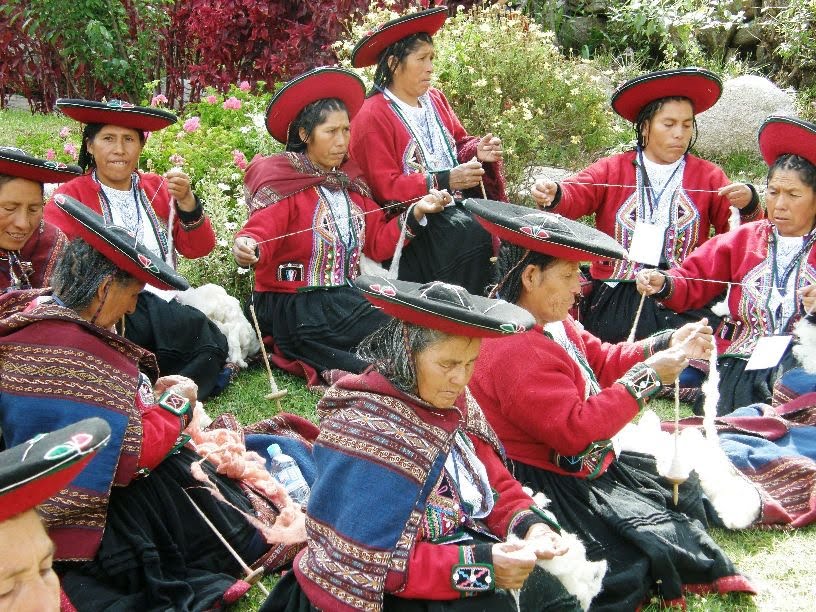
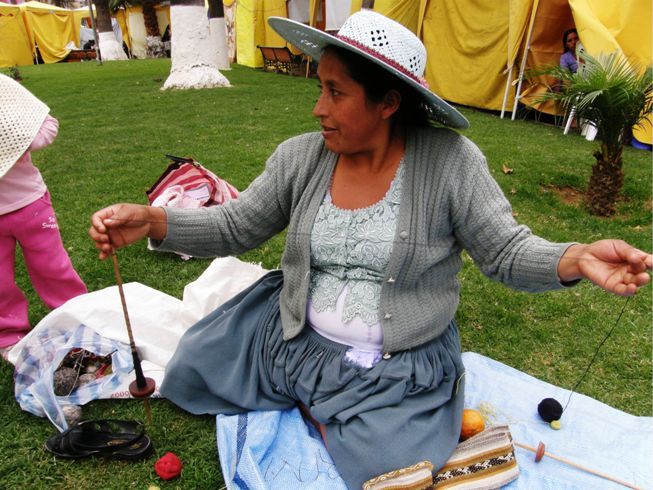
So, yes, the beginning of 2022 was “interesting”.

I had what I am calling Covid-head for a while which I would describe as feeling like particularly bad jet-lag. I dared not touch my weaving after losing the plot and destroying one of my PowerPoint presentations. This is what I had been working on before I got ill….

3-color reversible Andean Pebble Weave

This is 8/2 tencel and my attempt to get once more accustomed to the steps that I use to produce this 3-color reversible structure. My plan was to use the structure with my hand spun and I didn’t want to risk stressing my yarn with a whole lot of fussing about and unweaving while I got back into the swing of this technique. I wouldn’t call the way I do this efficient and I am waiting for that magical “aha” moment to come which will allow me to eliminate a step or two… or three. For now, I just plod along with it because I love the results.

Wrist cuff in 3-color reversible Andean Pebble Weave

During the pandemic I have been pulling out every bit of wool I can find in my closet and spinning it on my drop spindle during the various Zoom gatherings I have been attending. It has been slow going because I have only allowed myself to spin during these few gatherings. Goodness knows what I will do now that I have cleared out my closet and there is no more wool left to spin. Actually, there is a bunch of cotton to spin in there as well as alpaca…..

Part-way through the spinning project, I paused to try some of my yarn in two small wrist-cuff projects. I wanted to see if it would be able to stand up to the extra handling that it would experience in the 3-color method. They were just very short warps but I did feel confident after that test that my yarn would perform well even in much longer warps. I decided then that I would try to spin finer hoping that I could also produce finer yarn that would stand up well. That remains to be seen.

Applying an eye-pattern tubular band to a second 3-color pebble weave cuff in my hand spun.

I’ve been enjoying the tencel project. It’s just a mish-mash of various shapes and color combinations. And, yes, there are hummingbirds.

It has allowed me to play with swapping the outline and background colors and change the pebble spot colors at will. After sampling, I decided that a red outline with a green filler looks good against a yellow background while the same thing does not look good against a green background. The funny thing is that I had to walk away from this every now and then because the colors would suddenly start to get on my nerves! This never happens when I work with only two colors. So, I would go away and do something else and then return, look at the piece, and fall in love with it all over again.

Yesterday I knew for sure that I was fully recovered from Covid because instead of giving in to the post-lunch urge to nap, I was able to easily push it aside and go wind a warp.

These are the four colors I chose from my little stash of hand spun wool. Three will be part of the 3-color pebble and the one in the foreground will be the narrow border. I wanted to come up with a project that would allow both faces of the piece to be seen after going to all the trouble of using this reversible 3-color technique. I decided that a strap for a bag would be perfect….not very wide, but long enough to be able to play with patterns, and both sides would be seen. So, I am working completely backwards by first weaving a strap and then planning a bag to go with it. It’s not like I need a bag…I just like weaving and if I need an excuse and the piece simply MUST be something, then a bag strap it will be.

I know what you are thinking…that’s one ridiculously wide strap…but this will narrow considerably once I start weaving. My hand spun is finer than the 8/2 tencel and this warp has the same number of ends as that tencel sample. One of my concerns is that the blue is a tad thicker and hairier than the other two colors and may swallow them up. There’s only one way to find out, though.

I just really like this shot. It almost looks like ikat. This was right after I had made the heddles. I was testing my heddle-making by clearing the sheds. The three colors played together briefly as I raised one color layer above the others. It made for a pretty picture.

And so, I start 2022 with a weaving project that I find challenging and interesting, a collection of Covid anti-bodies (which of course won’t last forever), and the need to find something else to do during those Zoom gatherings. I find it impossible to just sit there. Maybe I will get back into learning about cotton spinning. I was playing around with cotton spinning a few years ago and even wove with some of the results, which you can see below, when I was studying the sheer cotton cloth with supplementary-weft inlay that is woven in some areas in Guatemala and Mexico. It’s the stuff of a beginner spinner but I was pretty pleased with it at the time

By Rodrick Owen

So, I just bought Joan Ruane’s video class on Cotton Spinning on the Takli from Taproot Video because I really need some guidance.

While on the subject of Taproot Video offerings, I should also let you know that Rodrick Owen’s beautiful book on braids that was published in 1995 and which is now out of print, has just become available for purchase as a PDF.

You can see that I am in some very fine company on the Taproot Video website! I hope that in this new year you might consider buying one of my books at Taproot Video if perhaps you have been thinking about it. We niche-craft authors need all the help we can get. Tell a friend, please! See you next time.

Backstrap Weaving – Forehead Slaps

handspun llama fiberI have a small zip lock bag full of left overs of my handpun llama fiber.

There’s less yarn in those balls than you might think as I remember having wound the thread around clay beads. What to do with them?

For me, combining them all into one project won’t work as I don’t feel I have enough dark colored thread to create a decent amount of contrast. Maybe I could darken some of the colors by over-dyeing with tea, or I could come up with some small projects to weave using just two or three colors.

And then I remembered the beautiful handwoven cuffs I had seen on the Peruvian Connection website…

peruvian connections

Aren’t these gorgeous?! When I first saw these pictures I longed to try making a cuff with my own handpsun and edging it with a tubular band. Then I got distracted and carried away with other projects. I did make cuffs in the end…several of them, in fact…but in silk without tubular edgings.

Now I could finally get around to trying this with my handspun. The reason I was looking for small projects like these is that I really needed frequent breaks from tying plastic strips around warp threads for my latest ikat experiment. I like to be able to weave every day. Even taking a whole day off from warp tying was most welcome…talk about tedious! So, it was very nice to be able to take a break and pick up a small project and weave away.

cuff with handspun yarnHere’s the second cuff I made which is the one with which I am most pleased. I used the Tinkipaya star pattern that I recently used on a wool bag project.

handspun cuffs and wool bagThat’s the first one I made on the right. It’s a little rough and I wish I had put more thought into the layout. The pick-up pattern in the center would have looked better if it hadn’t been bordered by red, I think. I guess I wasn’t very confident about it being a success and was a little careless as a result. Both are edged with tubular bands. The red one has an X and O pattern that I saw being used for a tubular band by a weaver in Pitumarca, Peru. The other has the eye pattern that I learned in Chinchero, Peru.

I didn’t manage to make any sweet yarn buttons like the Peruvian weavers have in their beautiful cuffs. I used buttons made from tagua nut that I had bought in Ecuador many years ago.

tagua nut buttonsOne end of the cuffs that I wove is a selvedge and the other end is raw. I turned the raw edge over, sewed it down and then stiffened it with diluted white glue. This enabled me to then securely apply the tubular edging. I wove and sewed it to the edge at the same time.

The tubular band does a pretty good job of covering that turned edge. As always with these tubular bands, you can start with a selvedge but then have to get creative with the finish where you are left with a bunch of unwoven warp ends to somehow hide away. When edging a bag, this is easy. All sorts of things can be hidden on the inside of a bag. You can see the place where the end of the tubular band meets the beginning in the picture above. Like I said, you just have to get creative. If you can’t see it, that means that I did a pretty good job ;-).

Of course, I had already woven three cuffs before I realized that it would have been wise to position and hide the join in the tubular band under the button! Forehead Slap #1.

tinkipaya design cuffA braid at one end of the cuff loops over the button to secure it around my wrist.

3 cuffs from handspunI made three and each is edged with a different tubular band. The third has the Chauaytire style of tubular edging. The pattern does not show up so well due to the lack of strong contrast in the colors.

The third one has a pattern that I adapted from a belt made by the Tarahumara weavers of Mexico.

3 cuffs with handspun yarnSo, the cuff weaving was a welcome distraction that got me through the tiresome process of applying ikat ties on my larger project. I have seen pictures of young ladies in Uzbekistan seated around a horizontal frame and tying bundles of warp together for ikat. It could be fun as a group activity. It doesn’t really require concentration if the design has been already marked on the warp threads.

ikat circlesI had originally intended having four circles on this warp….two on the front of what will hopefully be a slip cover for my laptop and two on the back. But, after two, I was done! I am still in the experimental stage and I figured I could learn plenty from just two circles…and indeed, I did. I already have new strategies planned for the next attempt.

ikat circle filled with pick-up patternOne of the big lessons…Forehead Slap #2…is that the original tied shape will contract considerably lengthwise if it is being filled with patterning. So, I have a squat circle underway. You can see my original cardboard template on the floor nearby. I hadn’t even noticed this happening when I wove the block-like patterns in my Bird ikat project. However, I don’t mind this squat circle too much.

But, one of the best things I learned this week was the value of having time to let my mind wander freely. This is probably why I seem to solve all my weaving problems when in the shower! When traveling, I have plenty of time to do that…all the airport waiting time and bus trips give me lots of opportunities to let my mind wander and I get my best ideas that way. Once I am home, I spend all my time implementing those ideas, very focused and concentrating on pick-up patterns….a wandering mind leads to mistakes.  All the time I spent standing at the ikat frame and a few hours spent sitting at the doctor’s office this week (where I was surprised to find that I was the only one without an electronic device) have allowed my wandering mind to bring me a whole new set of fresh ideas.

I am going to leave you this week with a couple of videos. The first is a 14-year old Peruvian girl singing Michael Jackson’s The Way You Make Me Feel in Quechua. I love it! This was produced as an effort to promote young people’s pride in their native Quechua language. A word of warning…I have had this song in my head for the last three days.

This second video was produced in Argentina and the song is about Doña Ubenza who, according to this web page, is a shepherdess who spins while she tends her grazing sheep. Inspired by the spinning and sheep, the producer applies the fiber theme to stop motion animation with felt figures to tell the story. It is adorable as is the song itself. Unfortunately, Doña Ubenza is not spinning in the video but you can see here there with her sheep.

ENJOY!


Backstrap Weaving – The Positive and the Negative

I have been working a lot with wool this week as I sew pieces of woven wool bands from Cochabamba into little pouches and dress them up with all kinds of pretty finishing techniques. Some of the finishing stitches are easy but they require precision and doing this work increases my admiration for those who do fine embroidery work. I am using wool for my stitching thread.

Working with wool is wonderful but, above all, working with wool is forgiving! This is one of this fiber’s big positive features for me. It fluffs out happily and fills in tricky spaces. Never mind if you didn’t insert the needle the exact same distance from the edge of the woven piece every single time…wool will forgive this…it has a certain rustic look that forgives even if it doesn’t always hide the imperfections. I love it. I am glad that I have spent years getting my “training” using cotton for these sewing techniques. When you switch to wool, it is all so much easier. My indigenous teachers used acrylic when they taught me these things.

??????????????????????I added multi-color cross knit looping to the top edge of this little pouch and wove a strap. You can just see the grey cross knit looped stitch along the right hand edge.

??????????????????????Here you can see the bottom edges of the two pouches on which I have been working this week. The one on the right has been edged with a tubular band and I added what I am calling a “coil stitch” to the bottom of the other…lots of fun to do albeit rather fiddly. I made a braid with a couple of pom poms for one pouch and added tassels to the other. It was fun weaving the strap. I am using just regular knitting wool for these finishes and am not re-spinning or treating it in any way. It stood up wonderfully well for weaving the straps which were woven on 72-inch circular warps.

Note to the pebble weavers out there: can you see the “blip” in the pattern on the pouch on the right? The weaver used the same pebble shed twice instead of alternating them. You see, even the experts get caught sometimes!

finishing techniques on bolivian pouchesAnd then I played with some decorative joining stitches on some of the left over pieces. That’s where wool really was my friend. It was really hard to count the warps and place the needle accurately on that variegated grey wool. If I had tried this with cotton, it would have looked awful. Wool is Cool! (Too bad that doesn’t really rhyme. But try making it rhyme…it’s kind of funny. Ah, the English language!)

tinkuy 2010Weaving with wool, on the other hand, is a different story. It can be rather unfriendly depending, of course, on your level of expertise in preparing wool for warp-faced weaving.

If not well prepared, each warp will extend its little hairy fingers to grasp its neighbor and protest loudly as you try to open a shed. Worse still, they will start to break. But, you can learn to deal with that stickiness.

Even if you haven’t learned how to prepare the wool to the state of fine, smooth, even, perfection like the spinners in Chinchero do, there  are strategies for dealing with those sticky warps. It can slow things down, and I guess you could call this one of this fiber’s negative aspects. The results, however, are always worth the effort.

Maxima in Cochabamba adds extra twist to her hanspun yarn before winding a warp for a pebble weave band.

Connie's pebble weave1Speaking of beauiful handspun, Janet, Ace, Connie and Gina from the Humboldt backstrap weaving gang got together at Ace’s place in amongst the gorgeous redwoods for a weave-along.

It was a chance to practice among friends and lend a hand to those with a little less experience.

Janet and Connie helped Gina and Ace remember how to make string heddles. Ace is working with his own handspun wool and Gina is using Tahki Cotton Classic to make a backstrap. Janet gave Ace tips on how to handle the wool warp and open the sheds smoothly.

Janet and Connie worked on pebble weave projects. Janet, of course, is using her handspun while Connie used 8/2 tencel to make the lanyard for her name tag for CNCH (pictured at left). I imagine that must feel gorgeously silky in that tencel.

And there they were on Ace’s balcony with their warps attached to the railing calling me to join them from Bolivia via Skype! How cool is that?

Ace and ConnieAbove you can see Ace with his wool warp and freshly installed heddles next to Connie’s latest tencel warp…yummy colors!

Jnet weaving her handspun wool1Janet gets to work on her wool warp while Gina installs heddles on her cotton one. I love that this group is finding time to get together and do this and support each other and I hope that they Skype me every time!

Back at my own loom, I have been sampling supplementary-weft inlay while playing with positive and negative spaces. I showed you in the last blog post how I want to try covering the negative space on a band with supplementary wefts leaving the ground weave exposed to form the motif. So, I have been sampling away and have made some useful discoveries about the changes in weaving width that happen when you do that. This will be something to keep in mind when planning bigger projects later. I have to say that I am loving the way this looks! I am using the 60/2 silk on the Guatemalan cotton warp.

suppleemntary weft in negative spaceI think I will still try to sew this in to something despite the width inconsistencies. I will just keep on sampling and see when I am done what can be made with it. I am keen on dressing it up as I did the wool pouches but I will use cotton instead of wool for that.

positive and negative space inlay in supplementary weft inlay??????????????????????I continued and added a bit of “positive” pattern just to compare.

Now I would like to adapt some Andean warp patterns where both the positive and negative spaces form the same motif and weave those with supplementary wefts.

There are certainly many of those to choose from and I am sure that I can find many on textiles from other cultures too. If you are not sure what I mean, take a look at the motif at left which is from the edge of a belt woven and used by Russian Old Believers.

I will leave you this week with a couple of pebble weave projects.

Larisa has been writing to me via my Andean Pebble Weave Facebook page and sent me pictures of her first pebble weave band using some of the 4 rev patterns from my first book on a wider band. I like the way the hearts look with the border around them. She is going to use this band as the tie for her end loom bar.

larisa pebble weaveAnd Julia continues to adapt traditional Japanese embroidery patterns to pebble weave. She uses the spotted charting system that I show in my second book to sketch the patterns ready to be woven using the pebble weave structure. Inspiring! Background, pattern, positive and negative spaces merge into a spectacular pattern.

julia pebble weave adaptation japanese embroidery

See you next week….