
Daylight Savings is over and we continue what feels like a rapid slide into cooler temperatures here in the Blue Mountains. I welcome snuggling under multiple layers on these cold nights but don’t care much for having to climb out from under them in the morning. We didn’t have Daylight Savings time in Bolivia and I was surprised by how long it took for my stomach to adapt! I kept finding myself restless at 11:30am with my stomach complaining that it hadn’t yet been filled. I still do a large cooked lunch in the way to which I’d become accustomed in South America. And that post-lunch drowsiness is hard to kick too. I can’t blame the tropical heat for it any more.
With the cooling temperatures came the rolling down of shirt sleeves and the layering of coats. I’d have to put away all my wrist cuffs for a while.

In their place out came my woven scarves and neck gaiters that I’ve been accumulating all these years. It was never cold enough in Bolivia to wear them. Sometimes I’d take them traveling to the northern hemisphere spring and fall only to drag them out of a packed bag looking like pieces of crumpled rag and too ugly to wear.
The fall temperatures here have been perfect for wearing things like this light cotton scarf that I wove about eight years ago and never ever got to wear.

I enjoy my woven book cover in naturally dyed silk even more now that I am actually living amongst these colors. I was very spoiled by being able to visit Vermont on the Columbus Day weekend many years ago and experience the fall colors there. It’s nowhere near as stunning here but it feels special because I’m living it rather than just visiting.

This little book along with others that I made is now settled in my new home next to books about textiles from this side of the world, places that perhaps I’ll be able to visit some day.

I finally finished the project in which I used my Bolivian teachers’ handspun wool. That project traveled through an entire year of seasons with me and I named the resulting bag Four Seasons in One Bag. The wool went from the sheep of the central Bolivian highlands, washed in mountain streams, into the hands and spindles of my weaving friends and teachers.
I’m pretty sure that the wool was spun during the October spinning event in 2024 in which my teachers and other ladies in the community compete for prizes to see who can spin the most wool. I bought three balls of the doubled singles and dyed some of it with indigo while I was up in the highlands visiting with Maxima during my last Bolivian summer.
It traveled with me to Australia where I spent some of the winter and spring dyeing it with Australian plant materials. The following summer, I moved here to my new home in the Blue Mountains and started the long task of plying.

When I had just about finished all that plying, an Ashford Wee Peggy spinning wheel together with a bunch of accessories became available on Marketplace at a bargain price and I was able to buy it. There it sits waiting to be spruced up a bit until I next need to ply. Perhaps I’ll use it for spinning too. Who knows. The wheel came with lots of bobbins, a niddy noddy (I’ve never owned one), hand carders (I’d had to leave mine behind in Bolivia), a flicking tool and even an apron. A friend at my spinning group has supplied me with a new spring and hooks to replace rusty ones.


Here’s the finished cloth…

Once I’d decided that this cloth would be a bag, I set about weaving a strap….

Then came the usual dilemma of deciding which face of the fabric I preferred. The bag would be lined and so one of the two faces would never be seen again. I knew which face I had decided would be the “good” one. The problem was that when I asked others for an opinion, they always chose the other! I stuck with my original plan, though.


I rounded off the flap of the bag…always scary cutting into the cloth…and covered and protected the raw edge with coil stitches. The sides then had to be woven, lining attached and everything sewn together…the most challenging part for me.
Here ‘s the completed bag being displayed at the Blackheath Arts Society members’ Easter exhibition. It was so much fun seeing it out there on display!

I managed to also get it in at the last minute, thanks to a kind friend from my spinning group, to the Hawkesbury Show where it won a blue ribbon. I was never able to enter shows like these when I lived in Bolivia and I am very excited about this ribbon!
A buddy from my craft group went to the show and surprised me with this photo while she was there….

So, you will have gathered that my hand and shoulder are now allowing me to be busy at the loom. The one-year anniversary of my accident has passed and things are improving. My wrist at the carpal tunnel level is still clogged and blocked by scar tissue which I don’t believe will ever stretch. My hand is a block of wood first thing in the morning but here I am typing, weaving, spinning cotton and plying. My shoulder is thawing very slowly and my range of reach out to the side to pass shuttle and insert sword is improving.
I am, however, in easy reach of all of this beauty and I just have to ask myself every day what I have done to deserve it!


I wonder if some Blue Mountains scenery and colors will start creeping into my work. I have a long-ish list of things I want to weave, some of which I spent a great deal of time designing last year when I couldn’t weave at all. I remember starting out charting with my left hand and the great deal of concentration that was required to fill within the lines!
I’ve actually started sampling for that large project now that I’ve decided on the thread that I will use. I need to get an ends per inch reading and also make sure that the proportions of the woven figures match those of my charted ones.

I started off the year weaving various narrow items just to make sure that I didn’t overdo things, Last year I had jumped back into weaving too early and messed up my shoulder as a result.
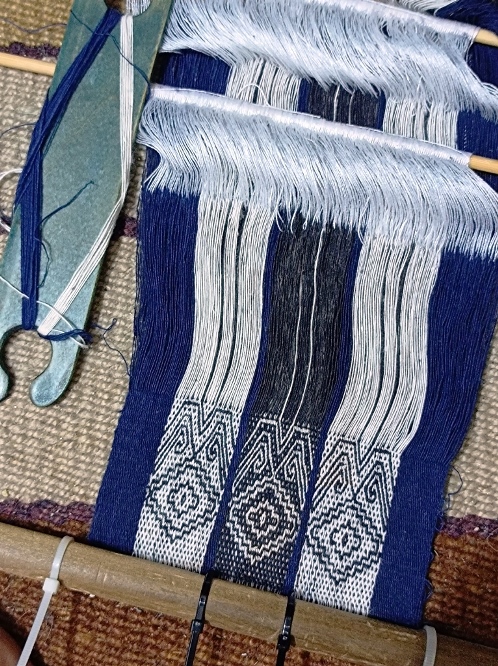
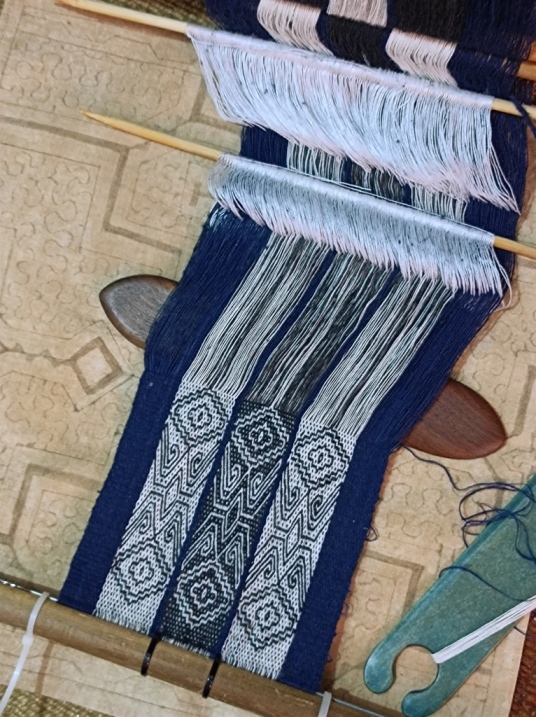
The Canberra Guild of Spinners and Weavers asked me to weave bookmarks/award ribbons for their AGM. This seemed like a great way to start the year even though they weren’t due until March. It’s extremely rare for me to take on commissioned work but the guild folk had made it easier by choosing and providing the yarn and being very specific about the layout. I got to choose the patterns and I had a lot of fun with that. I used the structure that I call Andean Pebble Weave.

I wove a name tag for myself once again in the structure that I call Andean Pebble Weave which produces a quirky style of lettering. The lettering on the award ribbons is less so because the letters are capitals and well spaced. I have joined so many new groups up here that it is a struggle to remember names. At least this tag will help them to identify me and then I can embarrass myself by not being able to identify them in return!

I live above the Aboriginal Health Services office and one day while chatting with the ladies, I admired their lanyards with their indigenous art print. The next thing I knew, one had been popped into my mail box. So, I replied with a woven keyfob. I love these kinds of exchanges.

I had no trouble at all finding a place to set myself up for weaving on my backstrap loom. The previous resident left one of those huge Ikea book cases with 25 cube spaces. I have it filled now with cubes holding pretty much everything I brought over with me from Bolivia. I place C clamps on the edge of the lower shelves and can place my warp beam behind them. It’s a good sturdy anchor point.

Here I sit weaving with some of my late mother’s treasured possessions. She would have had to make the tough decisions about what to take and what to leave behind, just as I had when leaving Bolivia, when she left India in 1962 to come and live in Australia. These things had been in storage waiting for me since my mum died in 2013.There’s a biscuit tin with images of places of interest in Bombay, a pressed tin trinket tray with images of Hindu deities and her sewing basket…all selected by her as being too precious to leave behind. I love that I am able to have them here near me as I weave.
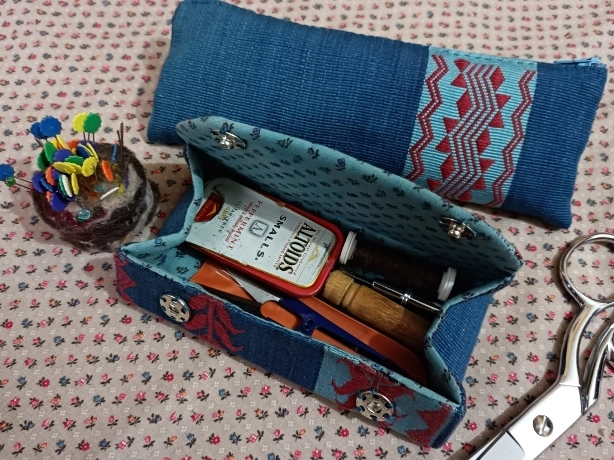
And…one more thing I wove….I converted the pouch I’d made from my handspun llama yarn into a phone carrying pouch for my hikes by weaving and adding a strap…

Between weaving and hiking and other activities, I try to turn this flat, which had been left in a somewhat shabby state, into a cosy home. This town of Katoomba in which I live is Op Shop heaven and I have acquired most of my things there or via Marketplace. Op Shop is the Australian term for a thrift or charity store. There have been a few flat-pack furniture purchases too. Assembling them on my own made me feel like I was playing a game of Twister.
Would you believe I got these Indonesian ikat pieces at a local op shop for the equivalent of US$ 3.50 each?!

Next on the agenda is dyeing with lichen. A friend gave me a jar of lichen that she had collected from fallen branches on the coast. It’s been soaking in a mix of cloudy ammonia and water for almost two weeks now and the color it’s releasing is amazing. I still have some of the Bolivian wool left. I just have to wash it and then give this color a go. I hope to find lichen locally that will perhaps produce other colors although I doubt that anything could be quite as astounding as this.

The sun is streaming in through my sunroom windows and I feel so guilty for being indoors on such an utterly gorgeous day. But at the same time, I have been feeling bad for having neglected my blog for so long.
I want to thank everyone for making purchases before Taproot Video closed at the end of March. I really appreciate your support and hope to have the PDFs back up for sale elsewhere soon. I thought that launching a new publication would be a good way to introduce my new point of sale but I don’t see that happening quite quickly enough. Hopefully it won’t be too much longer before I have my publications available for sale once more. The flurry of purchases at the end of Taproot Video will help keep me afloat until then.
For those who don’t see my blog banner on their particular device, here’s what it says….Stay tuned.