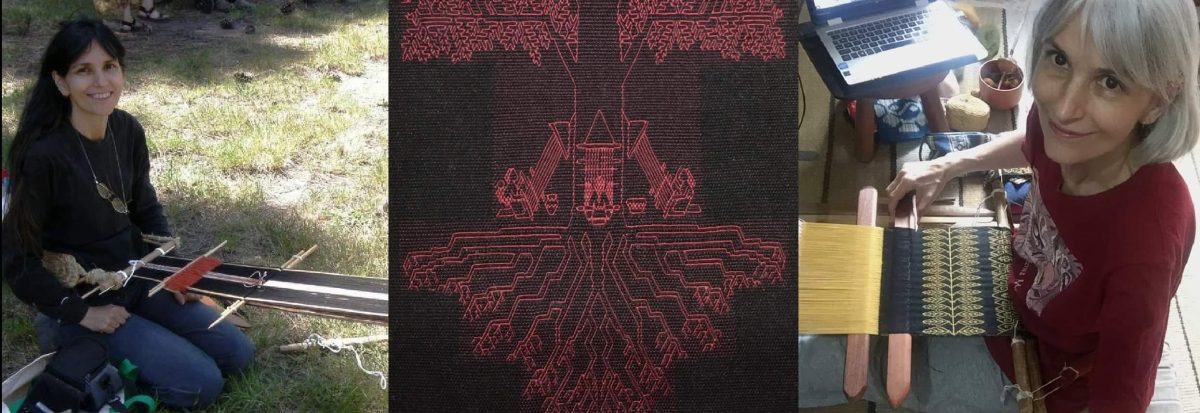
Backstrap Weaving – Finding Joy

Here’s just a quick hello and update (as I’m typing with one finger of my left hand)…

I’m still in transition mode living on the mid-north coast with my brother and sister-in-law (and loving it!) while working on rehabilitating my hand. I did end up having a second surgery because it was all pretty messed up….tendons and a very irritated nerve were encased in scar tissue and stuck together. Another tendon had become adhered to the bone, plus the plate that was too bulky for my small frame was removed. I had been expecting a minor miracle after that but it was, in fact, a move back to square one rehabilitation-wise. Expectations were adjusted and I’m back to work exercising.

In the meantime, there have been several textile-related exhibits to visit at Port Macquarie’s fabulous Glasshouse. I was drawn to this piece by Hannah Garside called Book of Hands because of the hand theme. These well-used and worn gloves “darkened with age and use gently interlace evoking touch, intimacy and the presence of former wearers “

I managed to get one more key fob gift woven before being advised to stop weaving until I’ve recovered wrist rotation. It’s quite limited right now. I was kidding myself thinking I could manage weaving with my injured hand. I was, in fact, compensating with my shoulder and ended up injuring it.

This fob is for my hand therapist, an occupational rather than physio therapist, and has the name of her business. The name will only make sense if you understand that the last two letters are capitals and are pronounced Oh-tee.

So, weaving is on the back-burner once again and I am entertaining myself by designing a hand-themed triptych which will be a story of my Indian roots, my 32 years in South America and the new possibilities that will come to me now that I’m back in Australia.

I’ve joined an organisation here called the Fibre Artisans Network and am excited about being able to exchange ideas and share skills and perhaps exhibit some of my work alongside that of the other members one day. We’ve met up twice already and will do so again tomorrow. The first thing I’d love to learn more about is dyeing with eucalypts.

I’m going to leave you with something I’ve posted before but which brings me joy and makes me want to share it again. I hope the melody isn’t an ear-worm for you. I’ve added some bits since I last showed it to you.

MY FAVORITE THINGS (a few of)

Intricate patterns on bamboo and gourd,
A beater, a shuttle, a small weaving sword,
Plant fibers twisted and woven like string,
These are a few of my favorite things.
Bone tools and wooden ones shaped just for picking,
Others to strum across threads that are sticking,
Laid out before me the pleasure they bring,
These are a few of my favorite things.

Books that tell stories of teachers I’ve known,
Covered with fabric and carefully sewn,
They hold the memories to which I will cling,
These are a few of my favorite things.
Spindles a-whirring turn fleece into thread,
Dipped in a dye pot of cochineal red,
Patterns of summer, fall, winter and spring
,
These are a few of my favorite things.

When I must wait,
Cannot cre-ate,
And I’m feeling sad.
I simply remember my favorite things
And then I don’t feel
So bad.

Spring has sprung here and it’s glorious! The air is drenched with the aroma of jasmine and the sound of bees. An increasing number of surfers can be spotted bobbing about in the waves and it’s time to make friends with all the magpies I encounter on my walks lest they start swooping me at nesting time.

Until next time when maybe I can reveal some of my hand-themed patterns. I’ve made some good thrift store purchases of cotton (I love how thrift stores here in Australia are called “op shops”) which I’ll dye for this project…..or maybe I’ll use eucalypt-dyed wool. It’s exciting to think about.

Backstrap Weaving – The Simple and the Complex

Every now and then when I am sitting at my loom, I am reminded of the years that I spent teaching English here in Santa Cruz, Bolivia. The institute had received a visit from a teaching consultant from the U.S State Department who introduced us to the concept of what she called “barefoot teaching”. She had developed this after having spoken with many teachers, especially those living in countries of the developing world like Bolivia,  who had convinced themselves that they simply could not teach effectively without flashcards, computers, interactive boards and all other kinds of audio-visual aids. The barefoot teaching idea basically involved setting yourself the challenge of leaving all the tools at home and going into class with nothing more than a lesson plan and a piece of chalk (as well as a lot of enthusiasm and creativity)…in other words “barefoot”.

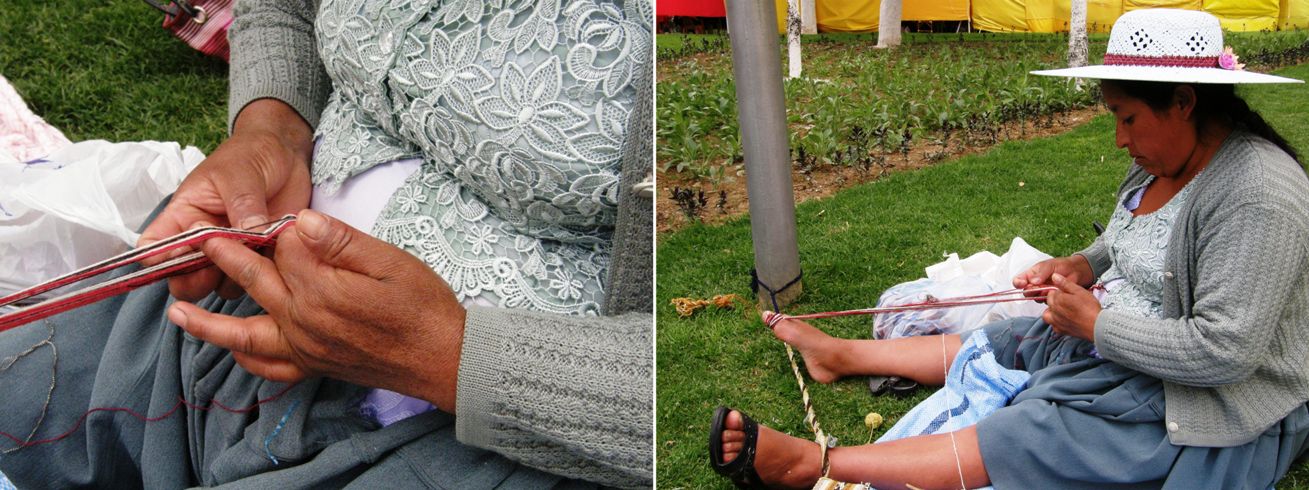
Then I get to thinking about Maxima, my favorite weaving teacher in the Bolivian highlands, and what simple tools one really needs to get started in backstrap weaving…basically your back, some thread/yarn and a toe! (and instruction or guidance, be that in person, or virtually via books, blogs, video or a multitude of other ways to connect online). Real barefoot weaving! Maxima doesn’t even use a backstrap.

Maxima has made a picking cross and is selecting the warps from each side of the cross for her design. Her warp is attached to her toe and for a while so was mine. Then I also attached my warp to her toe when mine had had enough! Finally we moved to the post to tie my warp up and later Maxima did the same.

There’s not a single stick in use.

Ten-year-old Peruvian weaver Juan Miguel, above, has a stake driven into the ground to which his warp is attached – his only real piece of equipment. If it were a shorter warp, he could use his toe. (Maxima deals with longer warps by wrapping the warp once around her toe to securely grip and tension it. A string passed through the end loops of Juan Miguel’s warp goes around his waist and acts as his “loom bar” and “backstrap”. He is using a string loop for one shed and string heddles for the other. He isn’t even using a beater or sword. His hands do the trick. After passing the weft, he opens the other shed and pulls the upper layer of threads up while pulling the other down in order to squeeze the last weft shot into place.

A warp can be wound in a figure-eight around a finger and a toe. The thumb and a finger of the free hand are used to gather up the cross when the warp is complete while the weaver uses the other hand to tuck one end of the warp into the waist-band of her skirt. The other end stays on the big toe. A length of yarn is inserted to hold the cross leaving two hands free to make string heddles.

My weaving friends in the Bolivian highlands were excited about the opportunity to try out cotton that had been donated by Cotton Clouds.

Don’t get me wrong, I won’t be tossing out my loom bars. I like using them even for the tiniest of warps but it is nice to think back to how I got started. We used pencil-width sticks about five inches long for loom bars, slightly longer ones for cross sticks and we had a beater. My teacher tied a cord around my waist and lodged the stick under it. Cord was passed through the other end of the warp which was attached to a bush so we could weave tiny pebble weave bands.

Twenty-six years ago, I sat on that pillow between my mother-and-daughter teachers to take my very first “watch and do as I do” lessons in weaving on a backstrap loom. They were lessons not only about the pebble weave structure, but also about how to use your body to operate the loom. Most importantly of all, they were lessons in how to learn by simply watching.

Last year was the twenty-fifth anniversary of that very first experience and I wove a piece as a representation not only of my vision of a post-pandemic world, but also as a recognition of the twenty-fifth anniversary of the happy scene above. The very first pattern that these ladies showed me was a hummingbird (although it took me several years to recognize it as one!). Hummingbirds, therefore, also became a part of the piece that I wove. In it, we are together again. The bush has grown into a tree with strong and extensive roots and although our warps have widened, the simplicity of the tools remains the same.

Panel 4 from the Within These Walls series.

Even something as simple as long thumb nails can be very useful. I appreciate them most when I am making string heddles. Sometimes I am unaware of the part they play in other stages of the process and only realize when I have had to cut them. Then I really miss them.

I love the simplicity in this picture….one’s entire weaving kit rolled up and neatly stored away.

And I wish that I could be organized enough to create a simple, clear weaving space like this…

My teacher Felicia’s weaving space…sticks, a bone tool, a bit of plastic-wrapped wire, and a sheep skin on which to sit. Simple tools don’t necessarily need to be made from natural materials. Hat and cat are optional. She was weaving for a museum’s gift shop and needed to adhere to precise pre-agreed measurements…hence the measuring tape.

I have an out-of-sight-out-of-mind way of operating and so my weaving space is strewn with things that serve to remind me of ideas for future projects as well as samples and works in progress. Yes, I now have a lovely weaving journal in which to jot down those ideas but it’s not the same as being constantly reminded of them when I have to step over and around them every day..

The thing that really motivated me to write this post was the completion of the simple fabric with which I will, hopefully, construct a bag….a simple blue bag to go with the highly decorated and comparatively complex reversible three-color strap. I even opted out of adding a motif to the cloth here and there using supplementary weft. One of the joys of supplementary weft is that you can treat your base cloth as a blank canvas and just add pattern wherever you please. The cloth can be covered with pattern from edge to edge or just show a few scattered motifs here and there. I used both options in this scarf…

60/2 silk fabric for a scarf on the loom with the simple tools that were used to create it.

One of the other many joys of using supplementary weft is that if you decide that you don’t like the motif you have woven, you can simply cut it out. Your base cloth will remain intact. I started adding a motif to the cloth for my bag, decided it was too much, and removed it. I actually unwove to remove it rather than cut it out.

Having got the urge to decorate the cloth out of my system, I sailed along enjoying the simplicity of the “dance” of just rhythmically operating the two basic sheds on the loom and passing my shuttle. Well, “sailed along” might not quite be the right way to describe it. It was a sticky wool warp and required a slower pace, stopping to advance the warp more frequently and performing strumming and other operations a lot more gently than I normally would….but I so enjoyed weaving it!

A wool warp of 776 ends.

And here’s the contrast between the simple and the complex in the finished cloth and strap….

The cloth is in industrially-spun wool and the strap is in my own spindle-spun wool.

I am showing the string heddles because they are almost perfectly clean despite the stickiness of the wool warp. There is the faintest film of blue fluff on their tips which makes it look like the tips have been dyed.

I will leave you now with this lovely hummingbird piece that showed up in my Facebook feed from the Museo Chileno de Arte Precolombino. I visited that museum many a time when I was living in Chile but haven’t been there since its major renovation some years ago. They were even selling my woven bookmarks in their gift shop at one point…wow, that was so long ago!

Backstrap Weaving – Tropical Themes and Tools

Santa Cruz,  Bolivia has almost all the lovely things that the tropics typically have to offer…swaying palm trees, avenues lined with mango trees dripping with fruit, exotic plant and birdlife and tremendous afternoon downpours of cooling rain (sadly few and far between these days). Too bad there aren’t any beaches in this country to complete the picture of tropical paradise. For those of you in the wintery whiteness of the northern hemisphere, here is a bit of tropical Bolivian color to brighten your day.

tropical color

And, on a similar colorful and cheery note, here is my newest scarf project still on the loom…

supplementary weft patterned scarf backstrap loom

Carmen at her loom

The main inspiration for the patterns has come from a particular Guatemalan plant motif woven using supplementary wefts. Carmen, pictured at left, taught me to weave this in her home of Santa Catarina Palopó on the shores of Lake Atitlan.

The small plant motif uses inlaid supplementary wefts for the leaves and various warp wrapping techniques to create the stem and plant base.

I took the leaf pattern, changed it a little to fit my working space, and used it in the side panels of the scarf. I also expanded it into an imaginary tropical flower. The tiny butterfly motif was adapted from one on a Mexican backstrap-woven textile that I saw online.

I love the way the turquoise and gold supplementary wefts look together in the flowers on this purple background….visions of tropical seas and golden mangoes! I have to admit that I have been dying to combine those two colors somehow ever since I saw the following shawl by Elisabeth Hill on her Flickr page…

Elisabeth Hill shawl

How is that for inspiration?! And I got to meet Lisa and see this piece in person at Maryland Sheep and Wool last year where the shawl took Best of Show. Lisa has done some backstrap weaving  with me so maybe that will somehow influence one of her projects. Take a look at her Flickr page to see more amazing creations in deflected double weave.

yarn from 2012 trips

I like how my purple scarf doesn’t really scream “me” at all…at least I don’t think it does.

I once had someone on Weavolution say that she could immediately spot a project of mine before clicking on the image to see who the weaver was. It’s nice in a way to know that you have developed a sort of weaving “character and style” that can be recognised.On the other hand, it’s nice to branch out and do something completely different and I have realised that, in order for me to do so, it is helpful to have access to yarn that I have never used before. So, I think that along with my “wider, longer, finer” weaving goal for this year, I will add “new fiber”. I intend to quieten the little voice that tells me to “keep it simple and just make do with what you can get locally” and take advantage of my trips to the US to gather up new-to-me fiber and a greater range of colors.

Above you can see alpaca, wool, hemp and bamboo (?…this was a gift and I am not sure what it is) yarn from a recent US trip….much of it gifts from weaver friends.
coil rod and other toolsNow, back to the current project. What about that coil rod…what has it been doing for me? I roll it along the warp as my weaving progresses and the fabric gets rolled around the loom bars. It is definitely a handy width guide. Beyond the coil rod the warp tends to spread and fan out as it stretches away toward the far loom bar.

The rod also ensures that there is always beautifully consistent tension between it and the weaving line. It locks the warps into place and gives me even tension with which to work no matter how many stretched and loosened warps may be gathering beyond it and on the lower layer of warp beyond the far loom bar. In short…I like it! It is a great little tool.

You can see the coil rod in place in the above picture. Other “tools” that I am using on this project are several ties of colored yarn along the shed rod and in the heddles.  Because my patterns are not wide enough to warrant the insertion of pattern sticks to raise the warps under which the supplementary wefts pass, I am using little ties to raise the appropriate warps instead. There are some that go around the warps themselves in the shed-rod shed and others which are tied around certain heddle strings. I simply pull on these to raise the pattern warps in the heddle shed. They save time and prevent eyesight strain!

As far as tools go, sometimes the simplest are the best…

Montagnard backstrap loom with suttes and double band

It always delights me to see that the use of simple sticks to carry the weft is common to many backstrap weavers around the globe….no fancy tool required! You have seen in my pictures that I use a specially shaped shuttle. Three of these were made for me when I lived in Chile and they have a kind of sentimental value. I enjoy using them and they double as beaters and swords sometimes so they are pretty nifty.

The Montagnard backstrap loom above has two bands in progress and you can see the two simple shuttles. The looms are so large that it quite cumbersome to balance them when only weaving one narrow band. They are designed for weaving large panels of cloth which are used for skirts, shirts and blankets.

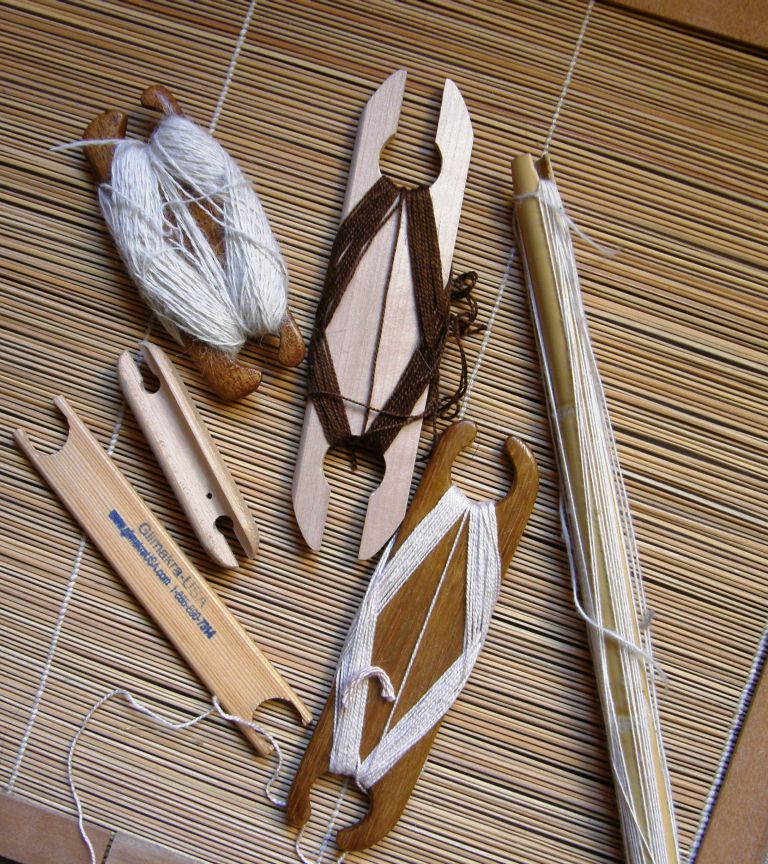
I must admit that I have been often pulled towrad buying teeny tiny shuttles at fiber fairs purely for their cuteness factor. I have on occasion used them but had to turn my closet upside down just now to find them to photograph as they have been idle for a long time…

small band weaving shuttles

The long thin shuttle on the right is one that one of my Guatemalan weaving teachers used. All my other teachers have used simple sticks about which the yarn is wound or, for narrow pieces, simple “mummy”-like butterfly bundles. Below you can see two such weft bundles. The yarn feeds off the outside rather than from the center and a hitch is put in place to stop the bundle from unravelling when it hangs freely. These two examples are of handspun wool and alpaca fiber from the Cusco area.

yarn bitterflies used in backstrap weaving

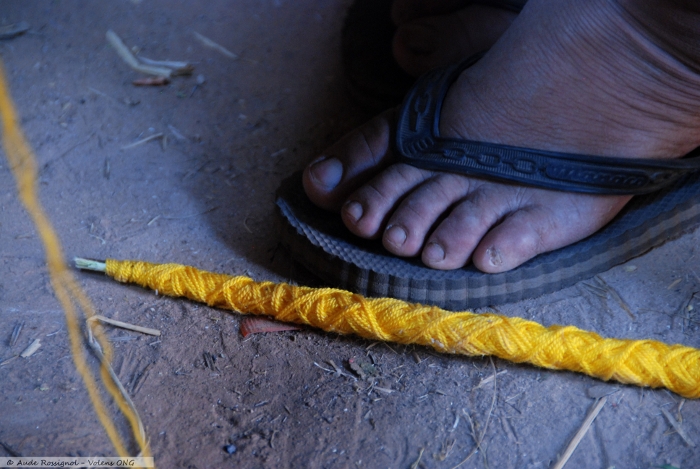
For narrow work my Guaraní teacher uses short lengths of scrap yarn for weft. This way she never wastes a thing! The weft lengths are so short that she does not even need to wind a butterfly. For wide pieces a simple stick shuttle is used as seen below.

Aude Rossignol

Permission to use this image was kindly given by Aude Rossignol.

Here is a video showing my Montagnard weaving teacher, Ju Nie, loading yarn onto her shuttle. You can see that her shin is a very useful piece of equipment as, in a previous post, I showed you how she also uses it to help twist the fringes of her woven projects. The video has two segments with a short pause between. Wait for the second part which shows a weaver from the Cusco area loading her large shuttle.


One of the most charming ways of passing the weft is one in which the weaver has her weft rolled into a ball. She places the ball within the shed and then tilts her body to angle the loom so that the ball rolls through to the other side!

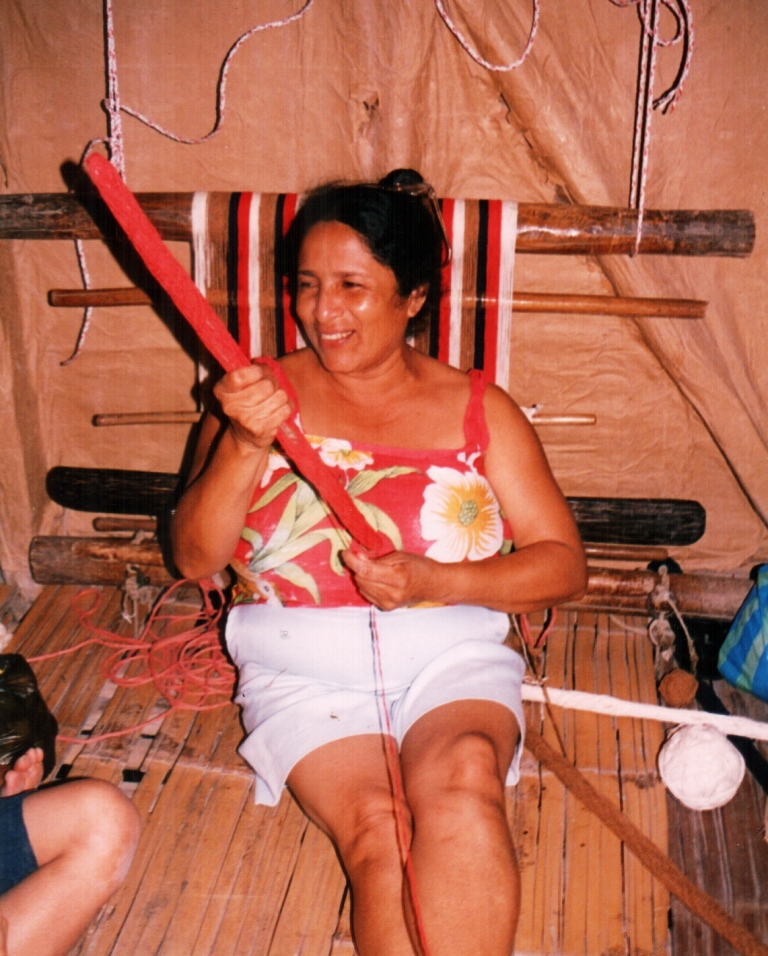
And finally, here is my teacher Trini in coastal Ecuador loading one of the three shuttles for the mini hammock she is preparing to teach me to weave. It was a balanced weave using three weft colors.

Trini with shuttle

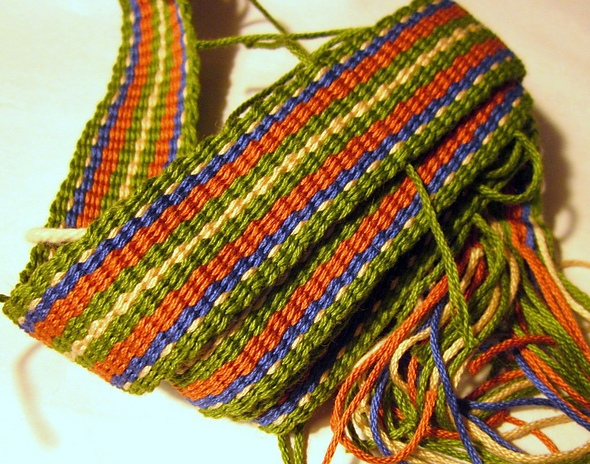
In the Ravelry Backstrap Weaving Group, Marge and Julia showed what they have been working on lately. Marge has been trying out Tahki Cotton Classic Light. I have not tried the Light version but I did see it at WEBS when I visited and the color range is wonderful. Marge used an online inkle pattern generator to help her design the color arrangement. The result is gorgeous!

marge

Julia used two different color ways for the same pebble weave motif (charted in my second book) on two different looms…a four-harness and a Seidel Band Loom.

julia pebble weave on two loomsI will be visiting the Mannings this summer. If you want to come and weave, maybe we can spend a little time outside hitched to some shady trees down by the creek….on the ground or on chairs..that will be up to you.  How cool would that be?!

the-mannings-stream