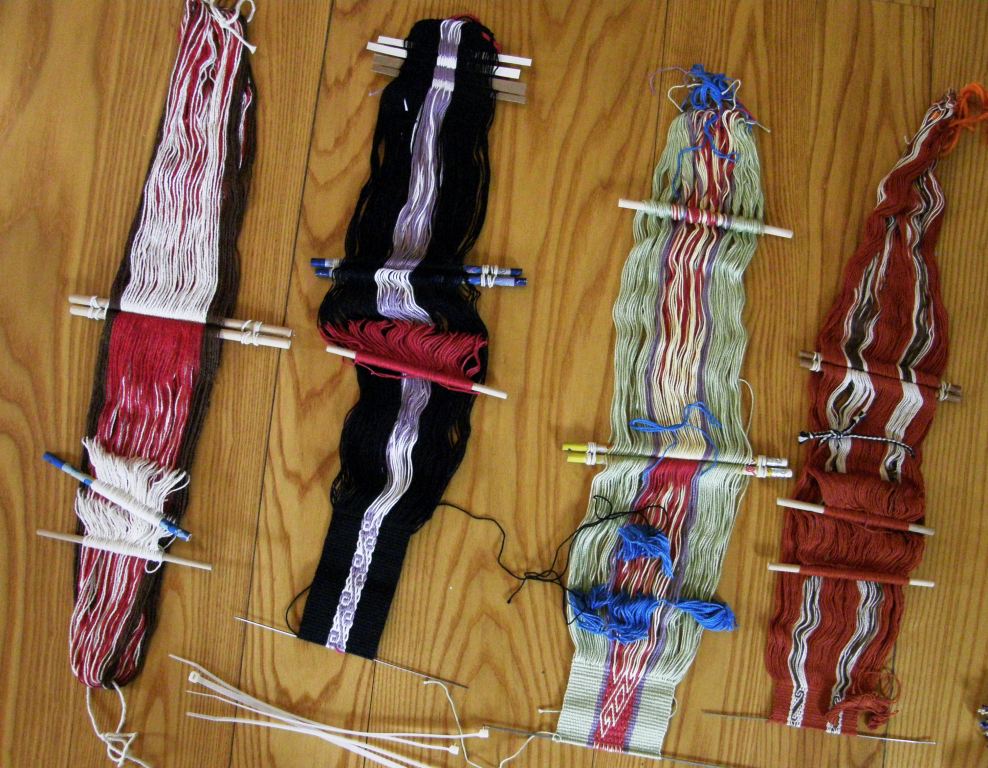
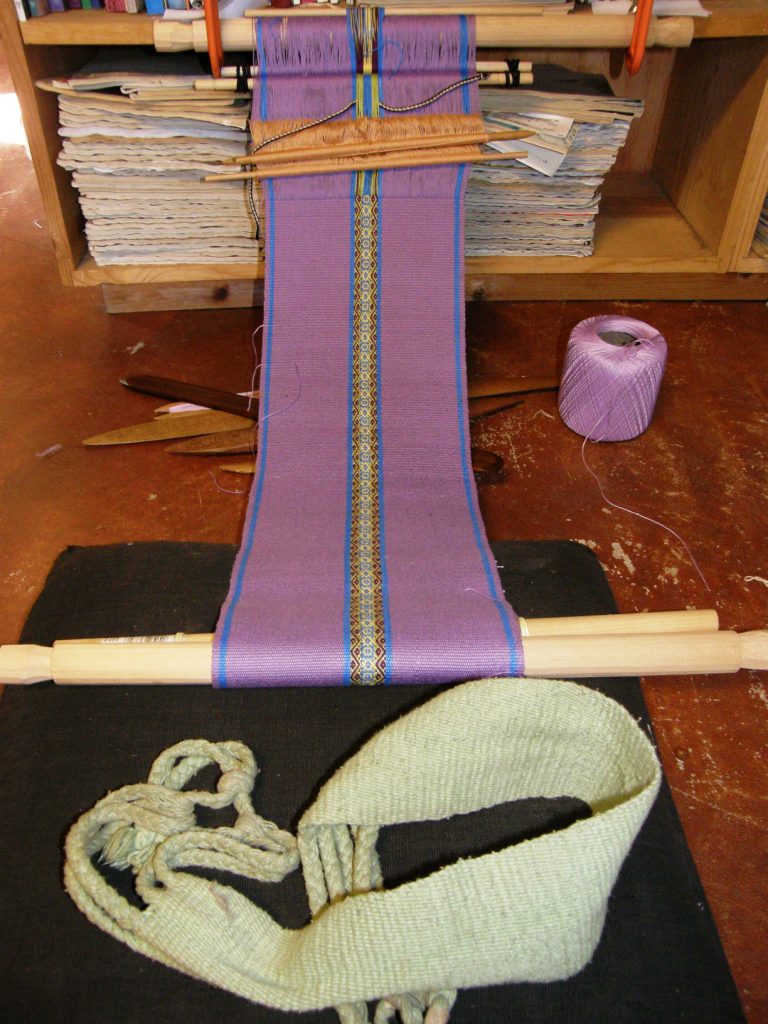
The time to pack up and hit the road is approaching and so I decided to pack away the five months of creative chaos that has accumulated on my bedroom floor…pattern charts, sticks of various sizes and lengths, swords, shuttles, cable ties, metal rods, pick-up tools, heddle string, sewing thread, yarn, cardboard strips, needles, string. Everything went back in its proper place and I could see the rug again and I didn’t need to play hop-scotch on the way from my bed to the door.
But then I decided that there was still time to weave some tiny projects and I started planning a lanyard that a friend has been asking me to weave for her for some time. I also want to weave a strap for a pouch that I have been thinking about for years as well as a bookmark that I promised another friend. And, with just that, wouldn’t you know it, I am back to Square One and can’t see my rug any more! The books, and charts and yarn and worksheets are all over the place along with the shoulder-bag project that I continue to sew.
This is where I was with the bag project when I last posted. The zipper is in place and sides have been installed. On my weekly visit to the supermarket I was happy to find a long table runner that I could use as the lining material. It looked like it was just the right width and I loved the color and subdued pattern. This seemed to be a safe bet for me who knows nothing about fabric and I was happy to pay a bit more than it would have cost me to just buy fabric in the street market. I doubt that I would have found anything that I liked as much in the market stalls.
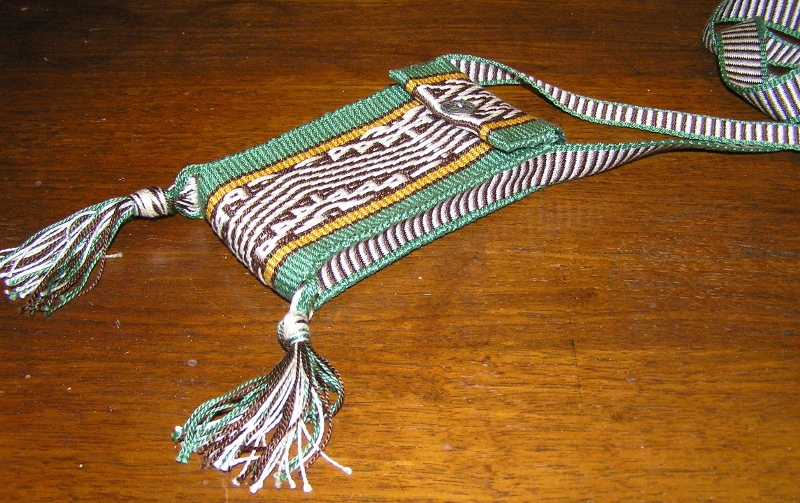
That un-ripping tool got a workout as I sewed and re-positioned over and over. Now it’s done. This is the opening for the quirky pocket…the one that sits on the outside but is accessed from the inside. I got to use a beautiful button that one of my students made by hand as a closure for the pocket. The loop around the button is an eye-pattern tubular band that I wove.
I edged the pocket and the sides with plain-weave tubular bands in blue. Tubular bands are such wonderful finishes. The pocket and sides are so sturdy with those nice firm bands in place. And that is where this project sits until I can get more blue yarn for the straps. I was hoping to use this bag on this trip but that won’t be happening. I’ll come back home with the yarn and weave some nice sturdy straps in the intermesh structure.. The bag is the perfect size for my books!
As for the tiny tape projects, a friend asked me to weave a lanyard for her name tag using the cat motifs that I designed for my book of 100 Patterns.My online weaving friend Andrea had designed cats with intertwined tails which she allowed me to adapt to more closely match my own three cat motifs. All four motifs are charted in the book. The lanyard needs to be 3/4”- 1” wide.
Here’s the first little guy on my width-sample warp which confirmed that I had enough ends to get 3/4”. I am going to continue weaving this sample and make it into a wrist band for myself while I plan the layout of the lanyard. I’ll probably mix the cat motifs with some paw prints, the charts for which are also in the book of 100 patterns.
At the same time, I am getting a start on another band that has been on my mind for several years. I have been collecting the word “weave” in various languages which I would like to weave into a strap for a pouch. Many years ago I wove and constructed a carry bag for my backstrap bits and pieces and I used weft twining to decorate the strap with just a few words in different fonts.
I am using the intermesh structure this time and using just the one font to weave my words.
I have about twenty-four words collected now from online friends ranging from Cherokee to the Yoruba language of Nigeria.
Here are the cats in guitar-strap size woven by Julie Beers for her husband’s guitar…
Kathy King combined patterns from the book of 100 patterns (Complementary-warp Pattern Book) and my very first book, Andean Pebble Weave. She calls her band The Birds and the Bees. I love the blue and brown together.
Margo wove this wrist-cuff combining various patterns that are charted in my books, as well as designing some of her own and giving it all an original twist to create a cycling-inspired theme for a friend. I love this!Colleen Turner added a strap that she wove on an inkle loom to a shoulder-bag. The pattern is charted in the Complementary-warp Pick-up book which also gives step-by-step instructions for those who use any kind of loom to weave warp-faced bands.
Marsha’s band in 20/2 silk is spectacular. The red and blue are her own hand-spun threads. She has combined patterns from two of my books and the result is gorgeous!
And here is Kristin’s latest piece of awesome-ness in her own hand-spun wool. She has named this “Celestial”. The star pattern is one that was created by Kurt Laitenburger for tablet weaving and which he allowed me to adapt to the Andean Pebble Weave structure for my More Adventures book. I like to call the smaller pattern that Kristin used on the sides “Sunrise, Sunset” and this piece makes me think of a sunset with the evening star rising. The red, orange, blue and yellow all come from natural dyes. Kristin is going to sew this into a long zippered bag for for her backstrap loom.
One of my weaving teachers, Maxima, took a liking to this same star pattern when I was up in the highlands. Of all the samples that I took to show her, this was the one that she wanted to learn. We wound a warp and Maxima took over after she watched me weave a few rows. I was able to show Mr Laitenburger how his pattern was being enjoyed on the traditional leaning loom in the central Bolivian highlands. He was very pleased.
Kurt Laitenberger does beautiful work with tablets and I really appreciate his allowing me to adapt some of his patterns to the Andean Pebble Weave structure for my books.
Speaking of tablet weaving, I was looking through some of my old folders on my desktop about which I had almost completely forgotten and I re-discovered some awesome pictures that Taylor had sent me of tablet weavers in Bhutan. Taylor and I had been corresponding by email while she was living in Bhutan and we were able to meet up once in the USA when I was on a visit. She gave me an incredibly fine and stiff tablet-woven band and told me about how some of the tablet weavers use x-ray film to make the tablets for the extremely fine thread that they use. After our get-together, she sent me these photos that she had taken f a family of tablet-weavers.
It’s fascinating to see a classic backstrap loom set-up being used with the tablets. I am guessing that the structure that is used for the bands that are woven using this set-up is one in which the weaver does not have to deal with built-up twist in the warp threads.
Taylor had been working on a project teaching women to construct tote bags from strips of plastic cut from soda bottles. I think that you can just make out the green handle of one of the bags in the foreground of this photo in which the weaver is preparing her warp with the thin film tablets.
I love the rocks and the weights that she is using to hold her stakes in place. I managed to scavenge an old paint can filled with cement that I sometimes need to use when I warp using certain set-ups.
Until next time, let me leave you with this message: A limited number of hard copies of all my books in Englishwill be available while I am traveling. Please leave a comment on this post, if you are interested, and I will get back to you.
It’s always nice in my travels to return to known places. There is something very comforting in the midst of all the “what-ifs” and unknowns of travel to meet once again familiar faces and landscapes.
However, there are always new people and places to add and I have enjoyed visiting new guilds and new US states on this trip. This was my first time visiting New Jersey, for example, and now I am about to venture into Nevada for my first ever visit there. There are new experiences, like trying to navigate the New York Port Authority with loads of luggage for the first time, going flying in a Cessna over Cape Cod on a perfect spring day, and being made very much aware of the rather “shaky” nature of the California coastline! (see picture above).
The mysteries and trepidation of going to new places are always short-lived. The new landscapes are exciting and the new weaving groups without exception are warm and welcoming.
The western part of this trip has take me through a variety of landscapes….from the beaches of lovely Santa Cruz to the big cityscape of Oakland and the forested high passes and lakes of the Sierra Nevada range.
Walking the paths of West Cliff Santa Cruz was a wonderful way to unwind after a day on the move. We watched surfers, pelicans and sea otters at play in the light of the setting sun.This is the view from my 19th floor bedroom at CNCH 2014 last weekend. It was fun sharing with Jennifer Moore whom I had met and spent time with backstrap weaving and at the opera in Santa Fe last year.One of the beautiful peaks of the Sierra Nevada on the way to Truckee California.Yonat weaving among the Redwoods in Santa Cruz.A new place and new faces in Grass Valley California…backstraps in position and ready for action!
I like to call my Santa Cruz group my “firsties and besties”. As it was my fifth time visiting and weaving with them, I decided that it was time to push ourselves outside our comfort zones. The challenge was to take one of the structures that we had woven together on the last four visits and use it in something wide and/or fine. Some group members warped up something much wider than anything they had attempted before while others used much finer thread than they had ever used on a backstrap loom. The results were wonderful!
First we tried different ways to set up warps for wider projects, for example, using multiple swords for creating picking crosses instead of fingers.
Jane uses a multiple sword technique to pick up a pattern for her backstrap project.
Jane is not actually one of the original “firstie-bestie” group but she has put in so much time and effort since her very first time weaving with us, that she was able to fit in perfectly with the skill level of this group. She has woven an impressive array of Andean Pebble Weave bands since we met only six months ago.
Jane makes exquisite baskets and brought along one of her creations filled with her Andean Pebble Weave bands. Ripples the cat had to get in on the act.
Here’s a closer look at the pretty bands and Jane’s basket without the giant cat-head distraction!….
Jane Milner’s basket and pebble weave bands.
Jane has tried patterns from both my first and second books…
Andean Pebble Weave bands woven by Jane using Omega Sinfonia yarn.
The upper band is an adaptation of a pattern that was woven by Louise Ström using tablets. Many tablet weaving motifs can be easily adapted to the Andean Pebble Weave structure and I have charted some of these in my second book.The lower motif is a doodle I made in the second book where I am showing how people can go about creating their own pebble weave patterns. The hook motifs placed in various diagonal arrangements are, of course, classic Andean patterning.
On the first day at Yonat’s place, I found myself just “hanging out” as my weaving friends wove and planned their projects with increasing independence.
In the afternoon, we did a little “round robin” activity on my prepared warps to brush up on structures and techniques that we seen in other gatherings and help in the decision making and planning process for the next days’ projects…
Dorothy’s wide project included three columns of Andean Pebble Weave motifs using Tahki Cotton Classic yarn. As she was only able to weave with us for two days, she had to leave with her heddles installed and just a handful of picks in place. As she is heading to Peru to study with tapestry master Maximo Laura this summer which will lead to a whole new world of weaving, I am hoping that she will find time to sit and finish her project soon.Peggy used Reynold’s Saucy yarn (now discontinued) to create a warp for a backstrap. She liked my “Rolls Royce” backstrap…the thick and cushy one…. and so, chose a pebble weave motif along with the intermesh structure to produce thick fabric. Anne went the other way and used fine thread to make a cell phone pouch. She will use two sets of string heddles to make the process partly loom-controlled and decorate the pouch with an Andean Pebble Weave motif.Here is Yonat’s backstrap warp rolled up at the end of the day with just a couple of inches left to go. Yonat found that weaving outdoors seated on the ground with her warp angled steeply was much more comfortable for her.Barbara’s challenge involved weaving her favorite “viscacha” motif in fine thread (Aunt Lydia’s #10) and swapping the colors for the motif and background while creating beautifully straight edges.
The following day, after having looked at images and watched online videos of the cute Andean viscacha, Barbara brought in a tapestry piece which had been woven on a backstrap loom in Pitumarca, Peru. She had just realized that the critter at the bottom of the piece was the same as the one which she was weaving into her fine backstrap band.
When not weaving, there was also lots of fun to be had. Yonat and I looked at experiments that the late Nora Rogers, former member of the Santa Cruz guild, had been performing on backstrap looms. Here is another kindred spirit and it was amazing and almost eerie to see how closely my backstrap weaving experiments have been following the path of her own carried out years before I came to be involved in this.
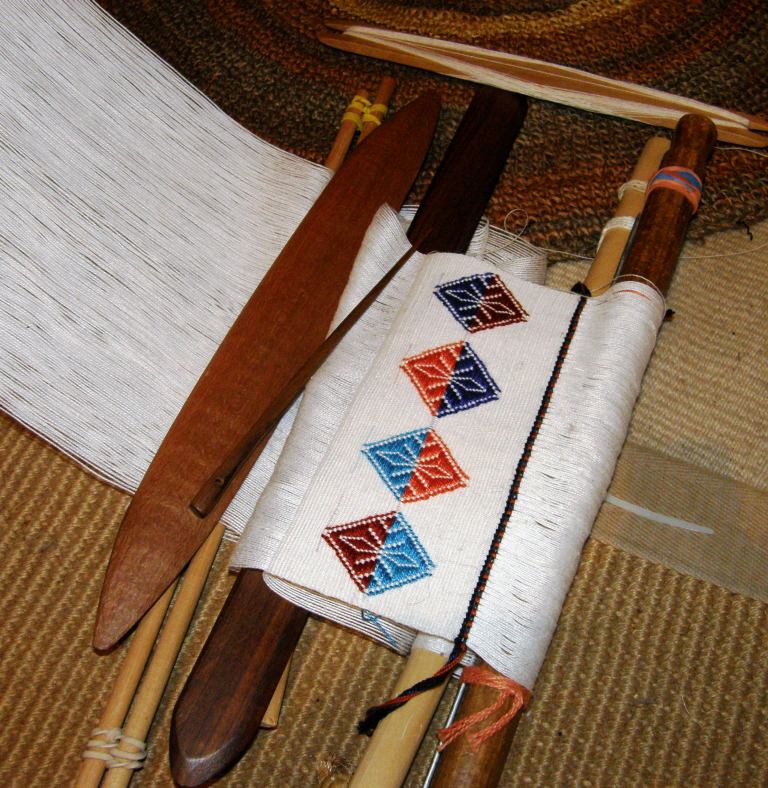
Here is Nora’s experiment in the white-on-white Guatemalan patterning technique using supplementary weft on a light, open cotton ground cloth. I bought a piece like this at the Santa Fe International Folk Art Market last year in the hope of studying and trying to replicate it myself.
And then there were various beauties to be examined created by Yonat’s own hands…from tapestries to handmade beads to Ravenstail twining. I saw one of this set of Ravenstail leggings finished on my last visit. This time I got to see the completed pair….
Yonat and I also went to a local store that buys and sells ethnic textiles from around the world. We had a super time digging through loads of pieces to find some special treasures. Some pieces were long and large and required no digging at all….
It seems so long ago now that my friend Lisa sent me a picture of a yurt band she had bought and I became fascinated with the simple warp-float technique that had been used to create it. Here in the store was a gorgeous example in those lovely sun bleached reds and blues that I adore! This technique produces a pattern of warp-floats on one face and areas of exposed weft on the other.
The warp-substitution technique is another one on which I have spent some time experimenting. We had to resist completely unrolling this band to see how the motifs changed along its enormous length. The designs are crisp on the upper face in warp-faced plain weave. Colors are warped doubled and the weaver simply substitutes one for the other to create the patterns. The unused colored warps float on the reverse side of the textile until they are once again called into use.
Here are three bands from across the globe….from Bhutan patterned with supplementary weft….a three-color double weave belt from Bolivia and a supplemental-warp patterned band from Mexico.
But the jaw-dropper as far as I was concerned was this poncho from Bolivia (see below) patterned with strips of warp-faced double weave. Yonat uncovered this one at the bottom of a pile of mixed textiles on a shelf.
I call this technique “embedded” double weave as the strips of double weave with pick-up patterning are flanked by warp faced plain weave. The yarn is very fine synthetic thread and the weaving was superb! It is a beautifully finished four-selvedged poncho. I know from experience how maddeningly difficult it is to finish a double weave piece with four selvedges and the thread used in this piece does not have the advantage of the springiness of wool which can make the task somewhat less difficult. How I would love to sit by the weaver who created this!!!
The visit to Santa Cruz also included a few get-togethers with my dear friend Annie.
If you are a regular reader of this blog, you will know Annie as creator of guitar straps and custom bands and sashes on inkle looms. She gave me the lovely strap, at left, to use on my camera bag. It is as much fun seeing what wonderful combination of colors she has come up with for her one-of-a-kind pieces as hearing the personal and inspiring stories behind her custom projects.
One of her latest challenges is to create a sash similar to one used by Johnny Depp in the Lone Ranger movie!
I shall leave you here for now. I am in Truckee now and grateful to my friends Suzanne and David for their patience while I bury my head in photo editing and blog writing. I’ll be weaving by the shores of Lake Tahoe in a couple of days and can’t wait to see it!
I shall probably write from Portland, Oregon next with further tales of the Grass Valley group, the CNCH conference in Oakland and weaving at Lake Tahoe. Bye for now!
I had wanted to call this post simply “Waiting” but then had a funny feeling that I had used this title before. It didn’t surprise me. We tend to do a lot of waiting here in Bolivia. It’s a part of life and, after 15 years here (plus 5 more in Chile), I can hardly be annoyed or too put out by it. I Googled to check my use of this title and, yep, there it was in August 2012. I went back to see what all the waiting had been about back then. It was nothing to do with Bolivia at all…I had been waiting for some technical help with my second book and impatiently awaiting some exciting weaving events…all good stuff, as you can see below, and worth waiting for.
This week has been about a different kind of waiting. It involved getting up every day at 4am and trekking out to the SEGIP office to stand in line and…..wait. SEGIP issues visas and ID cards for foreigners. My ID card had expired and I have been trying since the end of December to move the paper work along. The office opens at 7am. You have to be there in a queue at 4.30am to get one of the 80 daily appointments. You wait in the street in the pouring rain or sun…we had both… and there’s no shelter. I only wish I could entertain you with some nice shots of the sunrise or my fellow “waiters”. The sunrise was happening behind buildings and it was too dark most of the time for people shots. Today I succeeded! I was #46. I got to speak to someone.
After the Monday morning failure to gain admission, it was kind of fun greeting and seeing my fellow “rejects” the following days.
….the Brazilian medical students…always in large groups, always jolly, fun loving, even in the rain, and very, very loud.
…the Argentinians…recognizable by the thermoses that they carried and the little pots of yerba mate which they passed around and sipped and, of course, their gorgeous accent.
…the Mennonite gentlemen with their denim overalls and baseball caps, the ladies with their head scarves, print aprons and straw hats.
…the Russian Old Believer gentlemen with their long beards, piercing blue eyes and long, loose belted shirts. You have no idea how much I wanted to look more closely at those belts! They leaned on a fence with the Mennonites and talked about the recent rains on their land. There were some Mormon missionaries from the US looking so terribly young to be so far away from home.
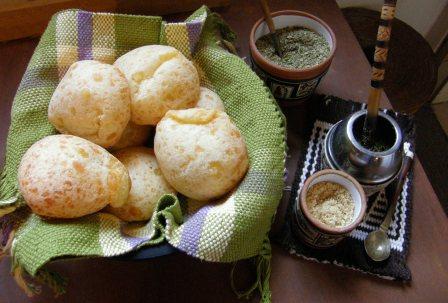
It was strange having so many foreigners gathered in one small place like that. Bolivian life is influenced in many ways by the cultures of its neighboring countries. Above, you can see the baked Brazilian snack called cuñape that is very much enjoyed here, and a pot of Argentinian yerba mate sitting on some of my backstrap woven pieces….a nice piece of Mennonite cheese or a pot of Mennonite honey would make it the perfect tea time picture.
The good thing is that, despite the wait and rejection on three days in a row, I managed to get home every day by 8.30am ready to face and enjoy a whole morning at the loom. That way, the pre-dawn expedition didn’t feel so much like wasted time.
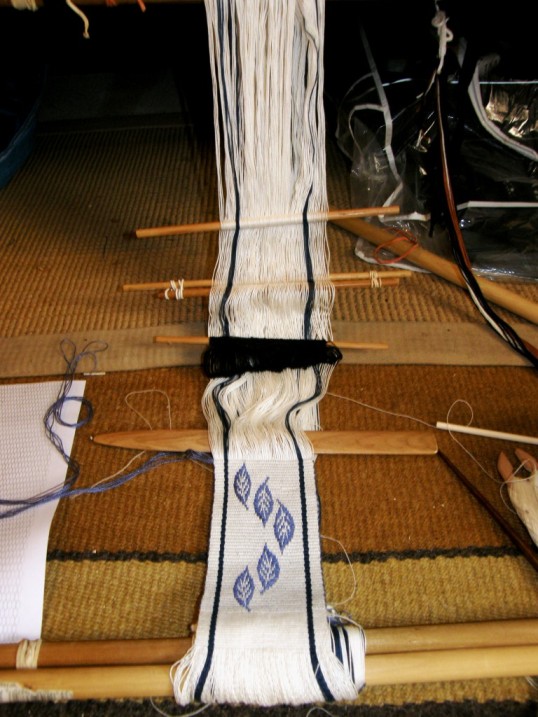
This is one of the things on which I have been working this week. It’s the circular warp that I took on my last US trip. I use it to show friends the different parts of a backstrap loom including the coil rod. It’s been sitting here as just a white plain weave piece of cloth. I decided that it needed to have some pattern.
That is one of the things I love about patterning with supplementary weft . You can just add pattern to your plain white “canvas” at any time without a whole lot of planning. This warp had previously held a butterfly motif which I pulled out and replaced with this leafy design.
It’s interesting how different the same motif can look when woven with different materials. I created the leaf motif very recently for my discontinuous-warp experiment in heavy-ish wool. On that piece I had used wool as the supplementary weft.
My circular warp is fine cotton and I used tencel for the patterning weft. I also used a closer sett than I usually do so that the fine white cotton would cover the dark patterning weft well. The leaves that had looked so robust in wool were thin and sickly looking in tencel on cotton so, I had to make adjustments to the original chart. The good thing about the finer warp thread is that you can use longer floats in the pattern and that allows more flexibility and options in the designing. I could use longer floats than the five-span maximum I used in the wool project. On the other hand, the single-span floats I used on the wool piece would barely show up in the fine cotton. So, several adjustments had to be made to “fatten” the leaves and make the finer details more visible.
I don’t know exactly where this pattern is going from here, but that is enough weaving for this warp for now. I placed the turns of the supplementary weft on the edge of the cloth rather than trying to conceal or camouflage the turns within the blue stripe as I usually do. I wanted to challenge myself to make consistently neat and attractive turns on the edge that would resemble little beads. I also turned the weft on the edge of the wool cloth. Those rather chunky turns are now hidden within the tubular edging.
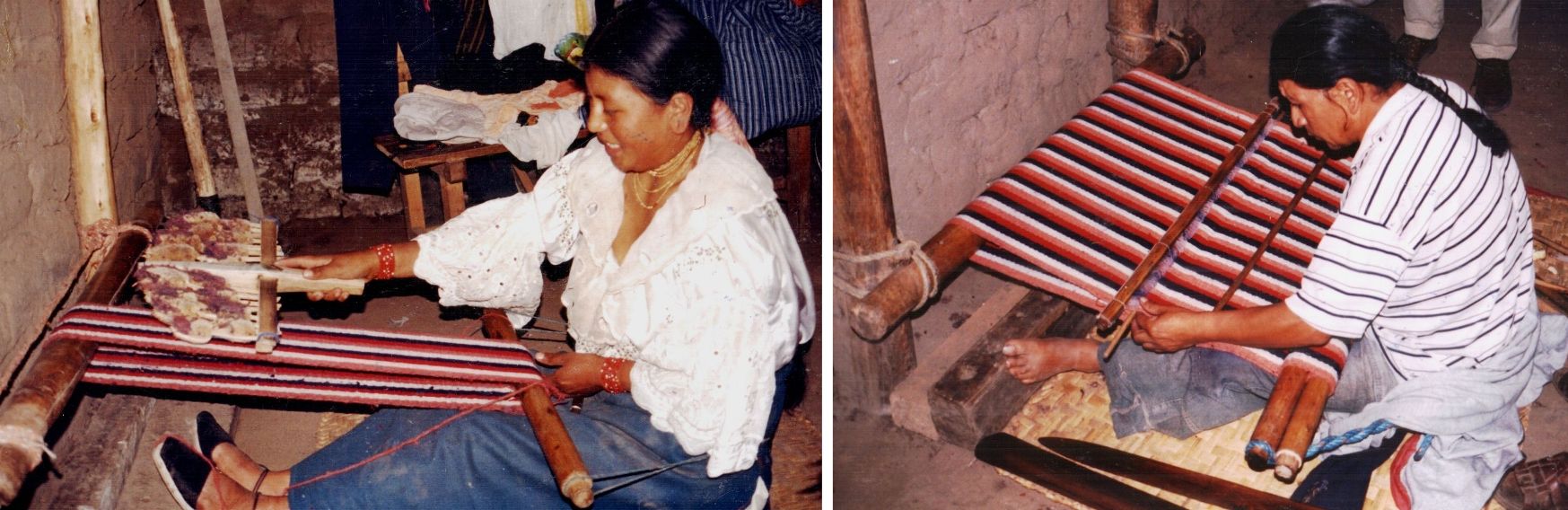
Above, you can get more of an idea of the circular nature of this warp and see the coil rod in position. The biggest difference I notice between weaving on a circular warp like this one and one in a single plane, is the ability to apply tension. There is a certain “springiness” to this circular warp which makes me feel like I can’t tension or beat as hard. This has me pushing with my feet (something I rarely do these days) in an attempt to apply more tension. Maybe that is why the majority of indigenous weavers I have seen using circular warps brace their feet against something as they weave. It is interesting to be able to compare the feel of the two kinds of warp set-ups this way.
Weavers in Ecuador using circular warps brace their feet against blocks of wood to help apply tension to the warp.
At first, I decided that it would be an interesting challenge to just chart and weave one leaf and then see if, by reading from the one motif woven into the cloth, I could flip the design both horizontally and vertically. The challenge wasn’t met as it gave me a big headache! and so I decided to chart the four versions and go from there. I wrote a page some time ago which I added to my list of FAQs on my thoughts about the use or non-use of charts.
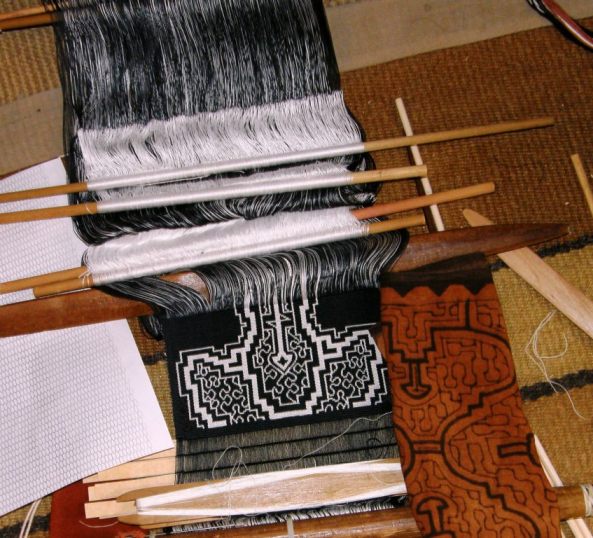
My latest wall hanging project uses a design I created and charted myself which is, for the most part, not symmetrical. It is a row- by-row slog working with an enormous pattern chart and was inspired by designs painted on cloth by the Shipibo people of tropical lowland Peru.
Fortunately, for me, warp-faced double weave is one of the easier structures for reading the pattern on the cloth because there are no warp-float lengths to be considered. Once a base line of pattern has been woven, it is easy and straightforward placing subsequent rows by referring to the preceding one without having to do a great deal of counting. However, there are no small design elements within the large one that get repeated and which can, therefore, be eventually memorized.
The pattern is not one with which I am all together comfortable yet. What I mean to say, is that I am not sure that I like it yet! My eyes long for symmetry! I keep telling myself that I just need to WAIT (I have had plenty of practice with that this week!), weave a bit more, walk away, stand back, weave some more and allow it to develop. It is a design that has a lot of wiggly chaos within a rigid symmetrical outline. That’s the best I can do to decribe it for now. I just need to put a bit more of that heavy symmetrical outline into place to help me deal with the chaos!
I will wait. I won’t unweave. I feel confident that it will be just what I wanted in the end.
I was Googling some images this past week and came across some of my own things such as this…
I thought….wow, I remember that. I wove it at the start of my studies of Bhutanese patterns. Now, what in the world did I do with that? A quick search in the closet turned up nothing. And then I remembered…oh yeah, I unwove it because I didn’t much care for it at the time…too colorful or something like that. Maybe I should have WAITED. At least I took a picture of it before unweaving.
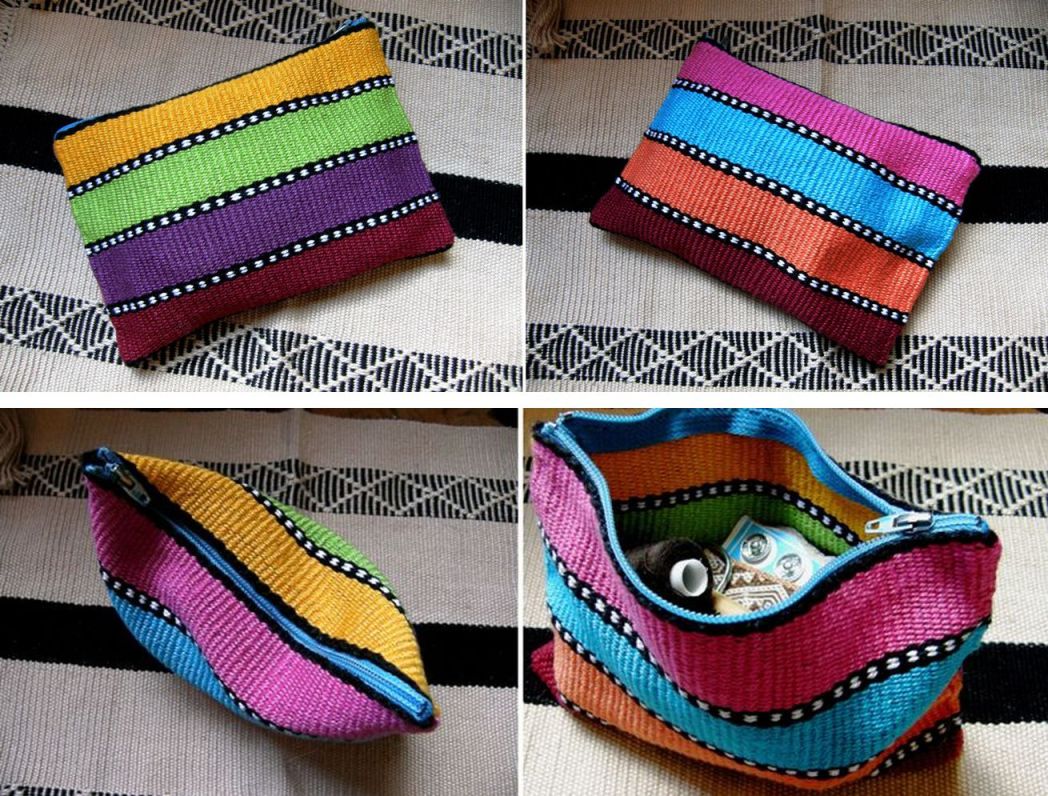
This had been a very hastily put together demo warp . I disliked the color combination so much that I didn’t even want to put it out to be seen. Nevertheless, I wove it off and sewed it into a pouch. Time has passed and now I just love my happy colorful sewing bag.
I am still waiting for this one to grow on me…
It was another travel warp into which I hadn’t put much thought. I was pleased to at least be able to use the finished fabric from the above warp for a tutorial on edgings.
Let’s see what online weaving friends have been up to…
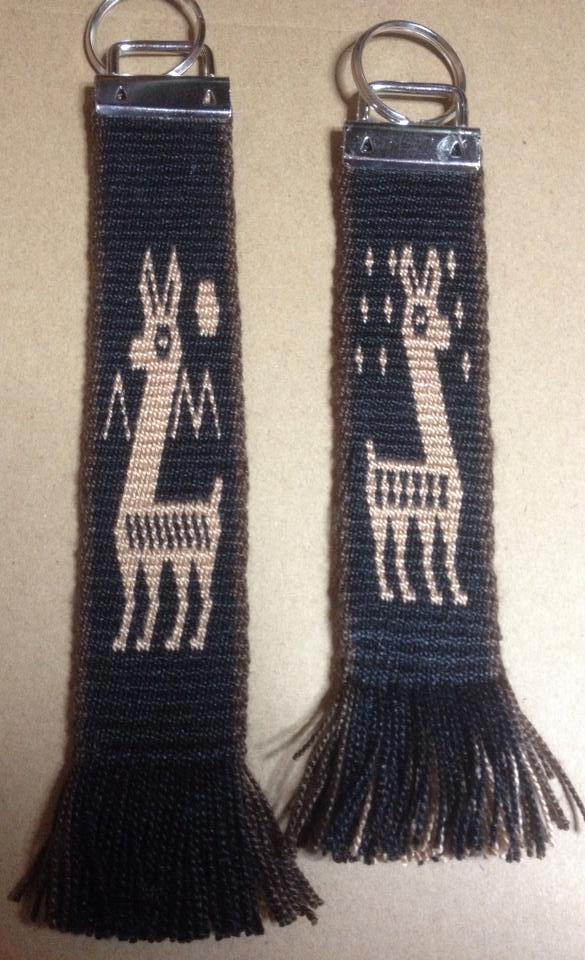
Scott is really getting into double weave and is now charting his own motifs. After working through my tutorial, he used the llama patterns to make keyfobs. I like those grippy keyfob ends…no sewing needed at that end. They are especially suitable for double weave which can be too bulky when folded and passed through a key ring.
Next he charted and wove the Norse Valknut motif…love it!
I can’t wait to see what he comes up with next.
Jennifer finished her bag from our Ravelry Games weave-along…
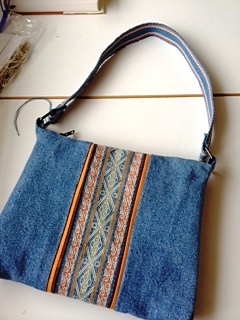
What a superb piece of work. She used denim which so perfectly matched the washed-out blue of her indigo-dyed hemp. Other pieces of colored fabric were used to frame the woven section. She finished it with a zip.
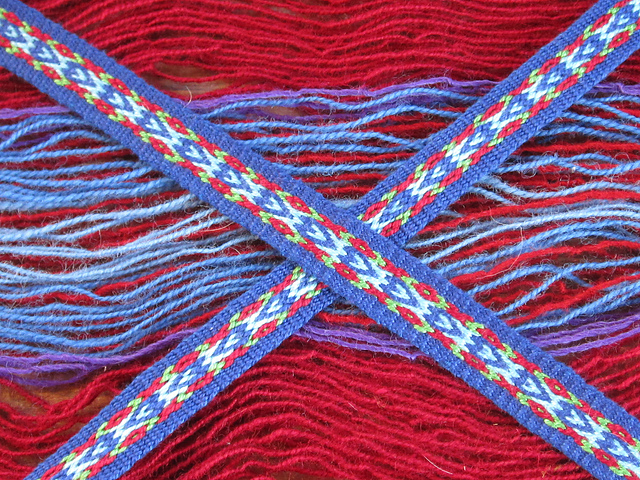
Lausanne’s band is a lovely example of how simple 2 and 4-revolution Andean Pebble Weave motifs can be placed together to make new designs…something that I discuss and encourage in my second book. I love the way she has photographed it. It is so nice seeing lots and lots of band length like that.
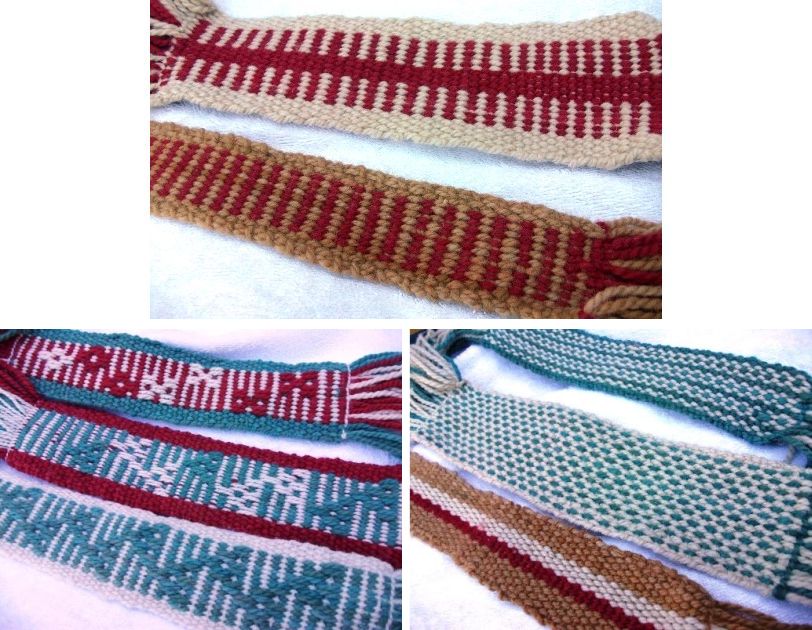
Teresa in Chile sent me pictures of her first backstrap loom pieces using the tutorials on my blog for creating plain-weave bands with solid colors, comb patterns, and stripes. In this way she wisely develops and practices her skills in managing the backstrap loom with simple, fun, plain-weave projects. Now she is taking her first steps in creating patterns with warp floats.
I am glad that I didn’t have to keep you waiting for this blog post. Blog day is usually a strictly “at home” day for me consumed with taking photographs, editing and writing. I am just happy that I don’t have to get up at 4am again tomorrow!
HOME! While I am settling into my visit to my “other home” here in Australia, I would like to share with you three cool websites I found while on my US trip.
1. PROJECT GUTENBERG: Perhaps I am one of only a few people who knew nothing about the Project Gutenberg site and its thousands of free e-books. It seems that everyone I excitedly tell about it discovered it a long time ago. I ran across it while looking for a used copy of Silas Marner to buy. There it was free to enjoy as part of the Gutenberg Project.
As is The Wind in the Willows andthat was meaningful to me because…
On my final night in the US I spent time with a weaver friend who had a copy of The Wind in the Willows from which she has been reading aloud each evening. I was reminded of the part about HOME that had touched me deeply even as an eight-year old child reading the book for the first time. It seemed so appropriate to re-read that part as my US trip ended and my thoughts turned to the home in Australia that I hadn’t seen for four years (a collection of people, memories and experiences rather than a structure) and the one I had left twenty years ago to venture to South America. I faced the trip with very mixed emotions as my mother, my “anchor”, had died in September.
I wanted a copy of the book so I could sit quietly on my own and read the passages about home. And then Ruth wrote to me later to tell me that The Wind in the Willows too could be enjoyed for free via the Gutenberg Project site.
I’ll quote the part about home here. All you travelers out there will surely have felt like this at some point.
From “The Wind in the Willows” by Kenneth Grahame:
Home! That was what they meant, those caressing appeals, those soft touches wafted through the air, those invisible little hands pulling and tugging, all one way! Why, it must be quite close by him at that moment, his old home that he had hurriedly forsaken and never sought again, that day when he first found the river! And now it was sending out its scouts and its messengers to capture him and bring him in. Since his escape on that bright morning he had hardly given it a thought, so absorbed had he been in his new life, in all its pleasures, its surprises, its fresh and captivating experiences. Now, with a rush of old memories, how clearly it stood up before him, in the darkness! Shabby indeed, and small and poorly furnished, and yet his, the home he had made for himself, the home he had been so happy to get back to after his day’s work. And the home had been happy with him, too, evidently, and was missing him, and wanted him back, and was telling him so, through his nose, sorrowfully, reproachfully, but with no bitterness or anger; only with plaintive reminder that it was there, and wanted him.
The call was clear, the summons was plain. He must obey it instantly, and go.
……………………………………………………………………………………………………..
The weary Mole………soon had his head on his pillow, in great joy and contentment. But ere he closed his eyes he let them wander round his old room, mellow in the glow of the firelight that played or rested on familiar and friendly things which had long been unconsciously a part of him, and now smilingly received him back, without rancour…..
…….He saw clearly how plain and simple— how narrow, even— it all was; but clearly, too, how much it all meant to him, and the special value of some such anchorage in one’s existence. He did not at all want to abandon the new life and its splendid spaces, to turn his back on sun and air and all they offered him and creep home and stay there; the upper world was all too strong, it called to him still, even down there, and he knew he must return to the larger stage. But it was good to think he had this to come back to; this place which was all his own, these things which were so glad to see him again and could always be counted upon for the same simple welcome.
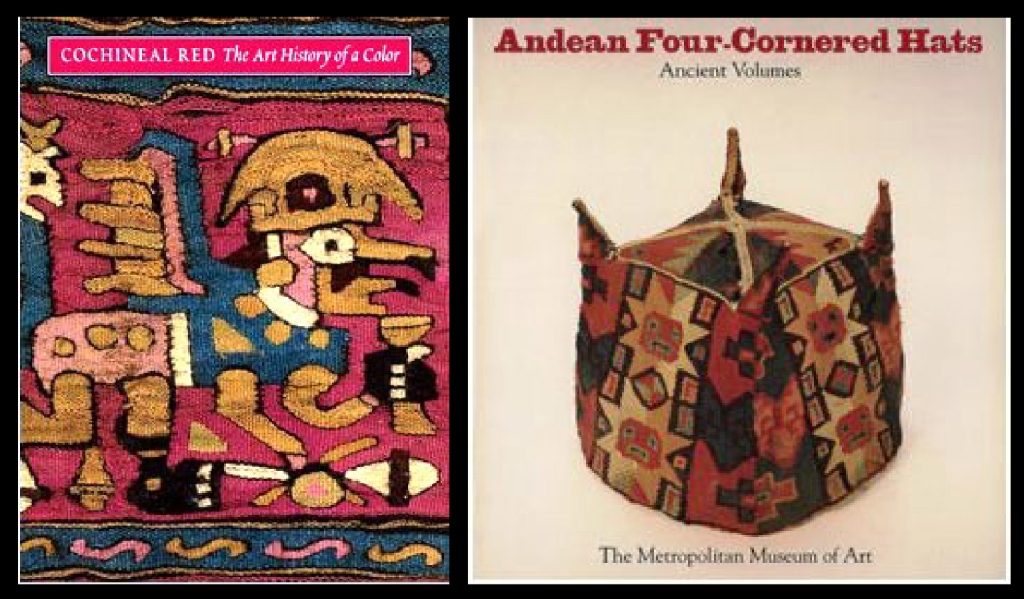
On to the next cool website….2.THE METROPOLITAN MUSEUM of ART’S PUBLICATIONS PAGE…..Many thanks to Kathleen for telling me about this site which has five decades of Met publications on art history, available to read, download, and/or search for free!!! Kathleen had downloaded and was enjoying a book on African textiles. There are hundreds of titles.
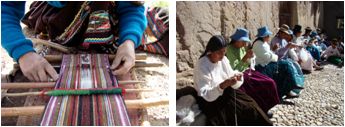
Images byInstituto de Lengua y Cultura Aymara, ILCA, La Paz Bolivia
The Weaving Communities of Practice website is the result of a project funded by the Arts and Humanities Research Council . The project focuses on textiles, culture and identity in the Andes.
I was happy to see that Elvira Espejo, pictured at left, worked on this project as the ILCA’s Textile Expert. I got to meet Elvira at the Encuentro de Tejedores de las Americas in Cusco last year where she was presenting the books she wrote with British anthropologist Denise Arnold: Ciencia de Tejer en los Andes:estructuras y tecnicas de faz de urdimbreand Ciencia de las Mujeres: Experiencias en la cadena textile desde los ayllus de Challapata.
Amongst other things, the site contains video segments of various aspects of backstrap weaving which accompany information about the stages of learning for young weavers-in-training in the Quechua and Aymara cultures. I have only just begun exploring the site and have barely scratched the surface. It is an amazing resource and there we have it at our finger tips,
Image by ILCA La Paz, Bolivia
From the site’s front page…..
The project is based at the Centre for Iberian and Latin American Visual Studies (CILAVS) and the Department of Computer Science and Information Systems at Birkbeck, University of London, with the Instituto de Lengua y Cultura Aymara (ILCA), in La Paz, Bolivia, in partnership with museums in the UK, Bolivia, Peru and Chile.
The principal feature of this website is a database of Andean textiles. There is also a detailed guide to processes of textile manufacture, including images and video clips of techniques, instruments and structures; a glossary of textile-related terms in English, Spanish and Andean languages; an introduction to textile heritage; and bibliography.
And so the sun sank on my final days in Santa Cruz, California. It was time to follow those birds west across the Pacific Ocean to Australia. Time to think back on the six weeks that had passed and “all its pleasures, its surprises, its fresh and captivating experiences” many of which I have already reported here on this blog.
One such captivating experience…Annie and I got to visit with Joy Totah Hilden, author of Bedouin Weaving of Saudi Arabia and its Neighbours, in her home in California.
It was a thrill to be able to meet Joy and sit on the sofa amongst the richly patterned pillows and beneath that enormous woven tent divider listening to her stories.
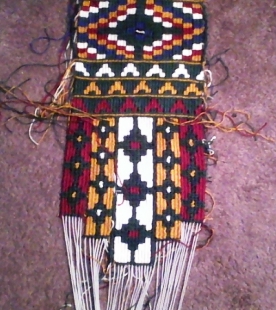
Then we got to touch and examine the textiles that I had been admiring online on her website and in her book…textiles that had inspired me on several occasions to weave pieces of my own (at left) using the traditional Bedouin colors and patterning techniques.
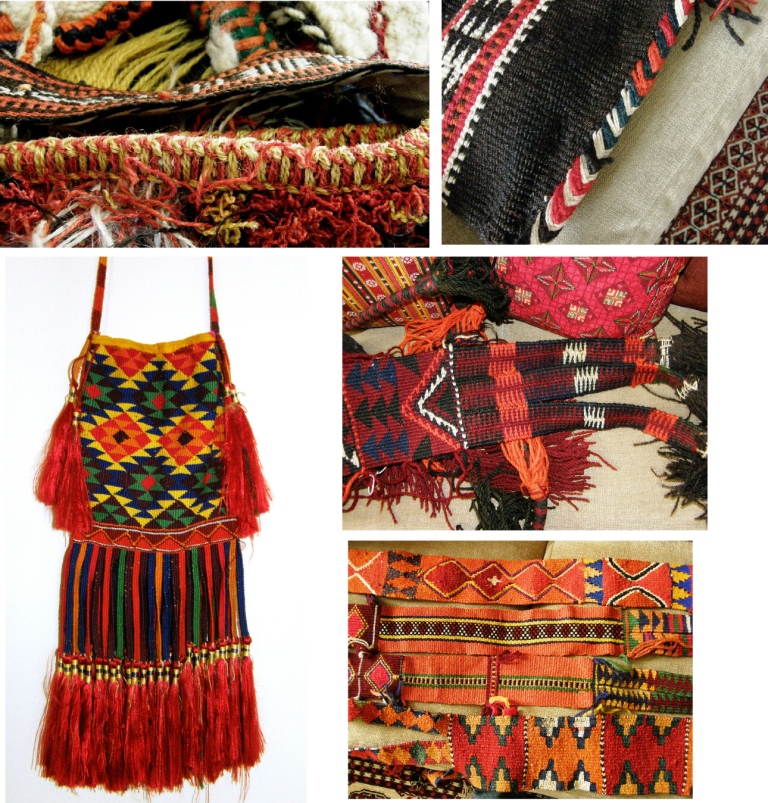
Camel adornments and all kinds of bags decorated the walls of her home. Many more treasures were carefully stored away and Joy was happy to unpack and bring many of them out one by one to show us.
Twining, weaving, braiding, wrapping, stitching…all sorts of bands and tassels and ineresting edgings….colors!!!….heaven! It was particularly interesting for me to be able to examine the pieces from Oman where the weavers cleverly use a second weft to tie down the long floats that are typically created by the warp substitution technique on the back side of the fabric. Having experimented with this with the guidance of images of Omani textiles that Tracy Hudson had provided, it was a wonderful opportunity to at last be able to examine the textiles themselves.
Happy with Annie MacHale and Joy Hilden surrounded by gorgeous textiles.
Moving on….Here are some of the books and publications that I picked up on this trip…
I had my issues of the Complex Weavers Journal all delivered at once so that I could take them back to Bolivia with me.
Bue Eye/Prayer Flags by Miryam-Chavah
After searching online many times over the last years for a reasonably-priced copy of the out-of-print Soumak Workbook, I finally found one and snapped it up. I have been admiring the creations of Julia Miryam-Chavah online, many of which have been done using the soumak technique. She has often named the Soumak Workbook as a resource and so, I am excited to have been able to get a copy.
I got the One Needle, One Thread book from Pam Nadjowski at Textile Treasures in Santa Fe NM when I was there in July but left it behind at my friend DY’s house by mistake. Now that I finally have it in my hands, I will be able to read about some of the wealth of braiding and embroidery techniques used in Chinese textiles that this book covers and maybe incorporate some in my work.
And, finally and surprisingly , I managed to get a copy of Faces of Tradition: Weaving Elders of the Andes by Nilda Callañaupa and Christine Franquemont. The book details interviews conducted with elders from various communities in the Cusco region of Peru. The importance and urgency of this project is underlined by the fact that some of the elders that were interviewed died before the book could be published. And before I could even open the book’s cover I was shocked and saddened to learn of the very recent death of Christine Franquemont in Cusco.
My last days in the US were spent in Santa Cruz, California with some weaving friends. Here are some of the ladies working on decorating their plain-weave bands with supplementary wefts….
This is my fifth visit to Martha’s studio and, as usual, we were dazzled by the interesting pieces in Martha’s collection that she would bring out to share with us….
This double-pocket saddle bag, made from what I am guessing is agave fiber, was collected somewhere in Latin America and given to Martha many years ago. It has an interesting combination of weaving, braiding and sprang work. The sprang and braid work has created a springy, stretchy and open area that would lie over the back of the pack animal. It contrasts with the stiff and rigid nature of the woven pockets. I have not seen anything like this in my travels in South America and I would love to know its place of origin.
I loved the simplicity of the discontinuous-warp piece that Janette brought to show with its combination of natural and dyed colors. The join where the two colors dovetail, seen on the right, was so incredibly smooth.
My final night in the US had me dozing in San Francisco airport beneath stunning woven tapestries which were designed by local artist Mark Adams. These had apparently been stored away for a couple of decades shortly after their creation in the early 80’s and are now on display behind glass. It was a peaceful place to spend the night before my early morning flight to Los Angeles and so unlike many other airports where I have spent the night slumped outside Dunkin’ Donuts!.
Meanwhile, news of backstrap woven projects arrived in my inbox…
Fr Kyriakos and Lausanne sent me pictures of their backstrap weaving pursuits. Fr Kyriakos has a pebble weave pattern in progress and he started his band with a nice bit of weft twining. Lausanne shows how she has set up a comfortable way to weave in her home while still giving attention to her furry companion.
Here is a silk ribbon with pebble weave patterns that Lausanne made for her husband.
Noreen Horak sent me a picture of bands she wove on her inkle loom using a variety of patterning techniques. The darkest one is a sampler of pebble weave patterns that are charted in my first book.
Rosemary Thomas shows that backstrap weaving isn’t only about warp-faced structures.
Joanne’s band is also a nice sampler of the various 4-rev designs that are charted in the Andean Pebble Weave book and shows her experiments with using two and three colors in her designs.
And to finish, I would like to tell you about my friend Wendy Garrity, a fellow Australian weaver. Here I am in Australia and so is she, but it isn’t really a chance to meet up as she is oh, so far far away over on the other side of the country, in Perth!
Wendy has put together a wonderful blog in which she writes about textiles she has encountered on her travels through Asia and particularly about her experience learning to weave in Bhutan.
That is how I found her. I was trying to reproduce Bhutanese patterns based on textiles that I had had the opportunity to examen. Wendy’s site provided some vital information that was missing and preventing me from getting started. Once I had found Wendy’s site, I just had to write and thank her and, with that, we started corresponding across the miles. She was in Bhutan and, later India and I was in Bolivia.
We got to meet in person at last when she came to South America and I taught her some Andean pick-up techniques in my home.
It was during that visit that we discovered that we both had plans to go to the International Folk Art Market in Santa Fe NM….another chance for a fun meet-up and, even better, my friend Annie was there too.
From there, Wendy headed home to Perth. I wonder if she had those same feelings I experienced when she returned home after several years away.
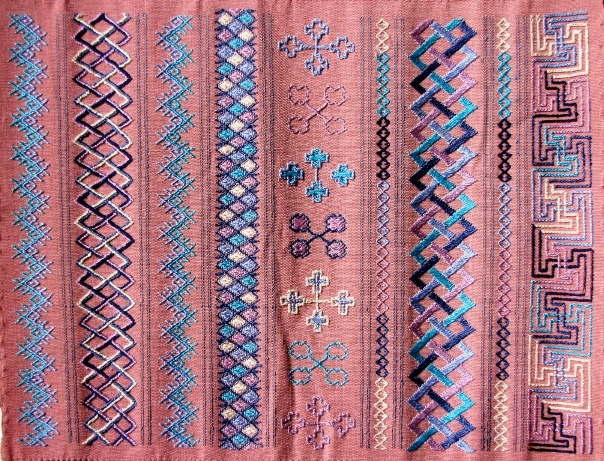
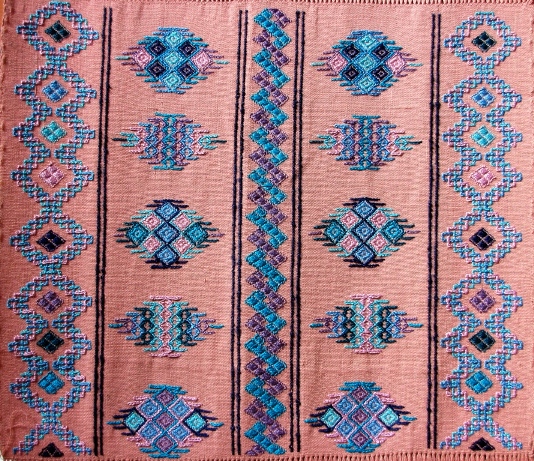
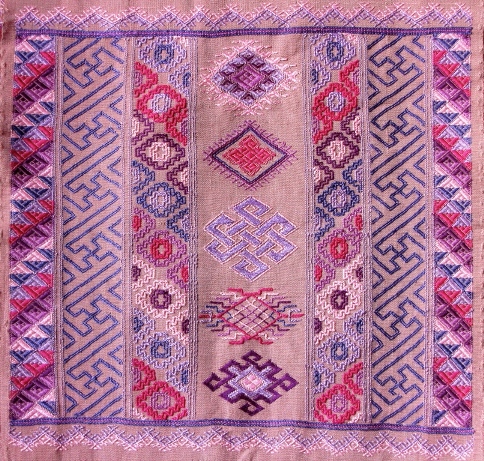
Wendy is planning a trip to the US in the fall of 2015 and would like to share what she learned during her stay in Bhutan. She will be available for workshops and presentations at guilds and I asked her to write a little about what she has to offer for inclusion in this post. All the pictures that accompany the text are Wendy’s own work. These are the samplers that she wove with her weaving teachers in Bhutan.
Hi everyone, I am planning to visit north America in the fall of 2015, and would like to hear from guilds or groups interested in hosting a workshop in Bhutanese kushutara techniques, used to weave gorgeous brocaded festival dresses.
Kushutara means brocaded dress, and refers to cloth decorated with the intricate kushu techniques, involving discontinuous supplementary wefts.
Bhutanese refer to two types of kushu techniques: Thrima and Sapma. Both are woven by lifting selected threads with a pickup stick before inserting the supplementary weft threads in such a way that the stitches only show on the front of the fabric.
Thrima means “to coil” and involves twining the pattern threads around the warp threads. This produces a beautiful textured effect, with the pattern threads creating a raised surface. In fact, when the first Bhutanese textiles were examined by experts in the west, there was much debate over whether their designs had been produced by embroidery or were woven into the fabric!
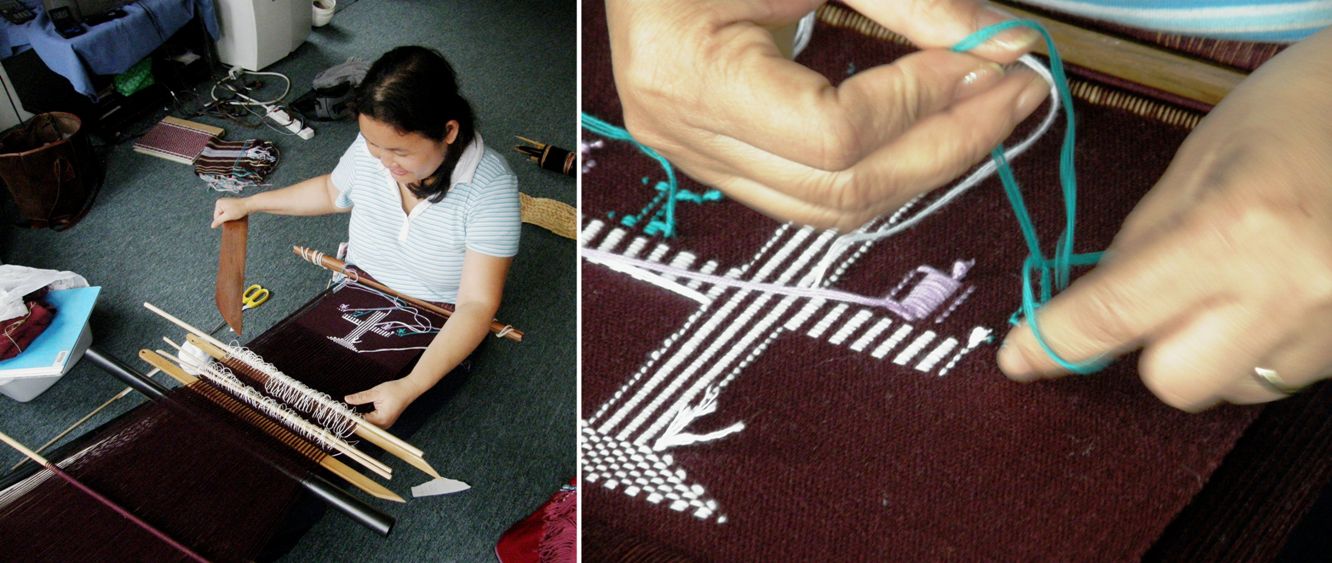
I learnt to weave kushutara when I was living in Thimphu, Bhutan for a year teaching music. I was given a loom next to a master weaver in the local weaving centre, and for 8 months I went before and after school and on weekends to weave. Word spread, as it does in Bhutan, and I often used to find I had local weavers stopping in to see for themselves the spectacle of the foreigner who had learned to weave as well (if not as fast) as the Bhutanese.
In addition to weaving on a Bhutanese backstrap loom, I have adapted these techniques to western looms, so classes can include weavers more comfortable on rigid heddle or shaft looms. Participants would need to be familiar with their looms and comfortable with plainweave, but the work would also extend experienced weavers who may have experience with weft twining from other cultures such as Guatemala (Bhutanese twining is a related structure, but the techniques of execution differ).
Wendy can be contacted through her blog or through me on this blog. Who knows? I just might get myself over to Perth on this trip to see her.
I don’t have any Aussie pictures to post yet! Imagine…after weeks and weeks of fabulous weather in the US, the weather has not been kind so far here in Sydney. I will hopefully have plenty to show in the next post. See you soon.
A Few Unconventional Moves…..If I am to talk about some unconventional things that I did at my backstrap loom this week, I think that I would have to first define what is meant by “conventional” in the world of backstrap weaving….an impossible task!
What is normal, or traditional, or conventional in one backstrap weaving community may not be so on the other side of the world or even within the same region or country.
Adding string heddles as one winds the warp, as Montagnard weaver Ju Nie does, would certainly be looked upon with wonder as something strange and unusual by backstrap weavers here in Bolivia.
The way that many backstrap weavers in Ecuador spread the threads in the shed rod shed over two shed rods is something that I have not seen outside of Ecuador. This makes opening the shed rod shed, with its heavy load of wool warps, easier. You can see the two shed rods in Miguel Andrango’s warp above. Unconventional, you might say, but to weavers like Miguel Andrango, this is perfectly normal. And Mr Andrango is up for a bit “unconventionality” in his weaving too by using motifs that are not traditional in Otavalan weaving.
The use of a tiny sweet wooden temple on even the narrowest of warps by the Montagnard backstrap weavers is something else that would seem less than normal to many backstrap weavers on this side of the world.
I have yet to see a circular warp being used by backstrap weavers in Bolivia but it is commonplace in Ecuador as is the use of a foot brace.
Burmese weaver Dar Ku weaves her patterns with supplementary weft while facing the wrong side of the cloth. She kept smiling and telling me how easy it is. I wonder what the Guatemalan weavers with whom I have worked, who also work with supplementary wefts, would think of that!
In Ecuador I never saw women weaving wide heavy wool pieces on backstrap looms. This was a task for men. The work is considered too heavy for women, I was told.
In Peru, men do weave at backstrap looms and there are communities where most of the backstrap weaving is in their hands. However, this is the exception rather than the rule.
I wonder what the male Ecuadorian weavers would think coming to Peru and seeing the wide and heavy warps being managed by the female weavers.
I wonder what the belt weavers in Salasaca, who use an enormous meat cleaver type of wooden implement to beat weft into place on their narrow belts with a couple of quick, heavy and powerful slams, would think seeing the way a Bolivian weaver pushes weft firmly into place bit by bit across the wdith of the warp with the tip of a llama bone tool.
All the implements were strange and unusual in my hands the first time. I can’t tell you how many times I forgot to let go of the weft before slamming that meat cleaver tool down….ouch. The llama bone was a bit more subtle but I still ended up with blisters from tightly clenching it and pushing that weft into place with all my strength. My weaving teachers considered tightness of weave to be a very important feature of well made cloth and I was determined to achieve their approval.
On the other hand, it was interesting to watch the gentle tappy-tapping of the beater in Dar Ku’s hands in contrast to the yell of “wham-wham” as Ju Nie showed us how firmly weft should be beaten! Clearly there is no general rule about how firm warp-faced cloth woven on a backstrap loom should feel.
I would love to see my teacher Maxima’s reaction to the set-up and way that weavers in coastal Ecuador add bands to the edges of their fabrics with their wooden rigid heddle that slides from side to sde along the floor to change sheds.
So…conventional? What is conventional in the world of backstrap weaving?
As for my aforementioned “unconventional” moves…let’s just say that I did some things that I haven’t seen backstrap weavers do. Of course, the day will probably come when I see this done somewhere. I have, after all, just scratched the surface of the backstrap weaving world here in Latin America and have had but the slightest glimpse into Montagnard, Burmese and Bhutanese weaving.
I have been finishing off the little supplementary-weft sampler that I have been working on these last couple of weeks. I wanted to get a piece off the loom and make it into a bag to take along on my next trip. I had experimented with positive and negative space. However, there was still a fair amount of warp left and the Guatemalan cotton is precious to me as I am not sure when or if I will be able to get more. I really didn’t want to waste any of it.
So here is what I did…I wove a dowel into the warp so that I could cut off my little bag piece and continue weaving the left over warp.
I will probably fold that little flap of cloth over the dowel and tack it down and then lash the dowel to a bigger one. I think that should be sturdy enough to allow me to keep weaving. I have to admit that this wasn’t my idea. There was a discussion in one of the online groups where a floor loom weaver wanted to cut off her first towel on a long warp and then continue weaving. Someone said “weave in a dowel”. I am not sure if what I did is in fact what she meant when she said that but it was enough to have me wanting to try to “weave in a dowel”. I think it will work!
I still have this Bedouin patterned embedded double weave piece that I cut and then clamped so that I could continue working on it. It is still there….I feel that that the woven-in dowel is a more secure system. We will see. Now I can compare!
Here is the wee pouch that I made with the first part of that warp.
So, the piece of supplementary-weft patterned fabric was cut off the loom. Now to see how best to fold it.
There are the back and front views. I decided to leave the flap on the front unpatterned as I wanted to edge the whole thing with a tubular band and I thought that things might look a bit too busy with pattern on the flap as well.
However, I thought that it would be cute to have a design on the inside when the flap is open.
And that is another place where I got kind of unconventional.
The design on the inside of the flap had to be on the “wrong” face of the fabric to be in the right position once everything was folded. So, I turned the warp over and wove on the other side leaving the heddles on the back side of the fabric.
I wove the flower head pattern that I had been creating in the negative space at the beginning of the piece. I think it gives a nice touch to this little pouch…a nice little surprise when you open it up.
Folding and then sewing done…it was time to start embellishing.
This is all I have done so far… a ñawi awapa tubular band around the outside. The eyes of the tubular band are red on the back side which matches the predominantly red patterning on that side. I will decide what to do with the tassels at the bottom and whether I should add some kind of finish to the bottom edge. Then there is a strap to be made and a button to be found for the front for some sort of closure.
So, after that experience with flipping the warp upside down and weaving on the other side so easily, I have a clear idea about what to do with the rest of the warp. I am excited to get started on that. I would like to continue with the supplementary-weft patterning but use both sides of the cloth, flipping back and forth, so that the finished piece has completely different patterns on both faces…or perhaps the same motifs but in completely different color schemes. It would need to become a finished product that would allow both faces to be visible. This, of course, will be the sampler for a “real” project later.
In between sewing and embellishing, I got something else started on a loom. I am preparing some warps so I can weave at the Spin-In Day at the Mannings in June. Are you coming? I will be weaving away with my warp tied up to a tree. Come and say hello!
Here is one of the warps I have prepared so far. This one is two-heddle intermesh which will have a large Bhutanese labyrinth design taken from David Barker’s first book (see the RESOURCES page for information on this free download).
And if you are tired of seeing red and black today, here is a bit of relief.
I have been recycling some of the many sample warps that I use which end up being a chaotic mix of odds and ends of sample motifs.
I unwove some of them and have several more to go. I am re-weaving them using the same Andean pebble weave motifs along the length of each.
I can also finish this week’s post with some nice pieces in other color combinations too that were sent to me from online friends.
Larisa patterned her piece that is destined to become her backstrap with pebble weave patterns from my first book.
Gmpicket also sent me a picture of a great pouch that she made using a design influenced by a belt of the Tarahumara people of Mexico that she saw on my blog. I have two Tarahumara patterns charted in my second book but this is not one of them. I love that brown, yellow and green combination.
So, I will be on the road again as from Wednesday next week. .hoping for nice weather and lots of people to chat to about backstrap weaving. If you have backstrap weavings to show me, please bring them along! I probably won’t blog next Thursday but will as soon as I can. I hope to meet lots of online friends at ANWG too and reunite with backstrap weaving friends in Humboldt County California. And then there’s a New Mexico adventure in mind… See you soon!
 This is where I was with the bag project when I last posted. The zipper is in place and sides have been installed. On my weekly visit to the supermarket I was happy to find a long table runner that I could use as the lining material. It looked like it was just the right width and I loved the color and subdued pattern. This seemed to be a safe bet for me who knows nothing about fabric and I was happy to pay a bit more than it would have cost me to just buy fabric in the street market. I doubt that I would have found anything that I liked as much in the market stalls.
 That un-ripping tool got a workout as I sewed and re-positioned over and over. Now it’s done. This is the opening for the quirky pocket…the one that sits on the outside but is accessed from the inside. I got to use a beautiful button that one of my students made by hand as a closure for the pocket. The loop around the button is an eye-pattern tubular band that I wove.
 I edged the pocket and the sides with plain-weave tubular bands in blue. Tubular bands are such wonderful finishes. The pocket and sides are so sturdy with those nice firm bands in place. And that is where this project sits until I can get more blue yarn for the straps. I was hoping to use this bag on this trip but that won’t be happening. I’ll come back home with the yarn and weave some nice sturdy straps in the intermesh structure.. The bag is the perfect size for my books!
 Here’s the first little guy on my width-sample warp which confirmed that I had enough ends to get 3/4”. I am going to continue weaving this sample and make it into a wrist band for myself while I plan the layout of the lanyard. I’ll probably mix the cat motifs with some paw prints, the charts for which are also in the book of 100 patterns.
 At the same time, I am getting a start on another band that has been on my mind for several years. I have been collecting the word “weave” in various languages which I would like to weave into a strap for a pouch. Many years ago I wove and constructed a carry bag for my backstrap bits and pieces and I used weft twining to decorate the strap with just a few words in different fonts.
 I am using the intermesh structure this time and using just the one font to weave my words.
 I have about twenty-four words collected now from online friends ranging from Cherokee to the Yoruba language of Nigeria.
 Kathy King combined patterns from the book of 100 patterns (Complementary-warp Pattern Book) and my very first book, Andean Pebble Weave. She calls her band The Birds and the Bees. I love the blue and brown together.
 Colleen Turner added a strap that she wove on an inkle loom to a shoulder-bag. The pattern is charted in the Complementary-warp Pick-up book which also gives step-by-step instructions for those who use any kind of loom to weave warp-faced bands.
 Marsha’s band in 20/2 silk is spectacular. The red and blue are her own hand-spun threads. She has combined patterns from two of my books and the result is gorgeous!
 One of my weaving teachers, Maxima, took a liking to this same star pattern when I was up in the highlands. Of all the samples that I took to show her, this was the one that she wanted to learn. We wound a warp and Maxima took over after she watched me weave a few rows. I was able to show Mr Laitenburger how his pattern was being enjoyed on the traditional leaning loom in the central Bolivian highlands. He was very pleased.
 Kurt Laitenberger does beautiful work with tablets and I really appreciate his allowing me to adapt some of his patterns to the Andean Pebble Weave structure for my books.
 It’s fascinating to see a classic backstrap loom set-up being used with the tablets. I am guessing that the structure that is used for the bands that are woven using this set-up is one in which the weaver does not have to deal with built-up twist in the warp threads.
 I love the rocks and the weights that she is using to hold her stakes in place. I managed to scavenge an old paint can filled with cement that I sometimes need to use when I warp using certain set-ups.