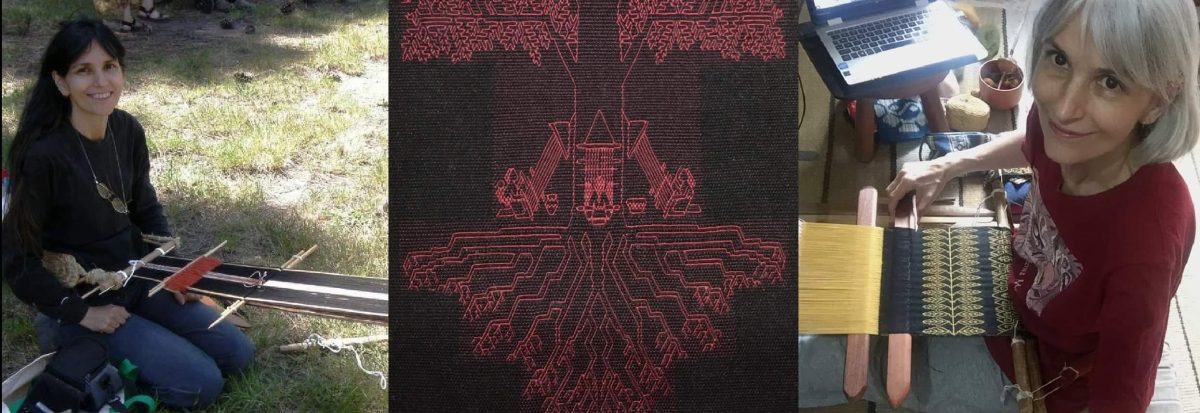
Backstrap Weaving – The View from the Driver’s Seat

Twice during my recent trip away I got to sit in the ”driver’s seat” to experience what a weaver from another culture sees as they sit at their backstrap loom gazing down the length of their warp.

First, I got to spend the day with Yan Zhang, a woman from mainland China who went to study with backstrap weavers of the Li minority group who live on Hainan Island, China. She kindly brought her loom and warping frame and we, along with my good friend Deanna, talked about all things backstrappy for a good part of the day. You may remember Yan from a previous post of mine in which I embedded a beautiful video that she made of herself warping and  weaving with her teacher on Hainan Island. I had also written about a loom and patterning process from Hainan Island when I crossed paths with Megan in this post. some time ago.

Unrolling the warp and feeling excited as the beautiful cloth and tools are revealed.
Soaking up everything Yan has to tell me about the process…and hoping that I might have a chance to try!

Here’s my view as I sit at Yan’s foot-tensioned loom with its circular warp. While I have woven many a time using my big toe to tension my warp, this was the first time I had had the opportunity to sit at one of these awesome foot-tensioned backstrap looms. Yan’s legs are shorter than mine which meant that we needed to unroll the woven cloth from the beam and adjust length. We didn’t take the time to get it quite right and, as a result, I didn’t have the full range of movement in my feet that was necessary to be able to operate the loom comfortably. Nevertheless I got to use the loom and throw some shots of weft and it was thrilling!

The pattern structure is what I call ”simple warp-floats”. Floats form the patterns on one face of the cloth but not on the other. The loom was set up to create all the pattern sheds with heddle rods and other sticks in place and so no pick-up was required. I loved having my feet be part of the loom. I loved the feeling of curling my toes around the beams. Of course it requires lots of practice to make just the right amount of tension adjustments with movements of the feet. Quite often, I moved my feet too much and had the far beam slide down off the balls of my feet.

Look at Yan’s feet flexed toward her so that she can relax tension enough on the warp to enable her to raise a heddled shed.  She is adding the threads that are held on her pattern stick to the main heddled shed.

The tools that Yan used were all beautiful in their simplicity. She told us that some weavers on Hainan Island have introduced materials such as pvc pipe and I often see these also being used in the highlands here in Bolivia and Peru. Yan’s tools are all natural traditional materials.

Like backstrap weavers in many regions around the world, the shuttle is a simple stick. I  love the shape the yarn takes as it is wound onto the shuttle and Yan showed us how the Li weavers create that. Look at that gorgeous sword on the floor! The heddle rods are doubled pieces of bamboo and weavers look long and hard to find bamboo that grows in such a way. Once found, these pieces very much cherished. They are formed when a thin off-shoot of bamboo grows parallel to a piece of larger girth. The larger piece holds the heddles  while the thinner piece closes around them and secures them. Yan does not use a temple. When I asked her about that, she indicated that the coil rod is what is used to help maintain consistent width.

When we asked Yan about the thread she was using we all had a chuckle when she said it came from the craft chain store Joann! My Vietnamese weaving friends in the USA were never quite comfortable with the thread that they bought locally. Whenever a family member traveled back to Vietnam they were asked to bring back thread.

Yan showed us her handwoven skirt fabric and the way it is wrapped and pleated to fit the user.

Yan also learned how to spin cotton with her Li teachers and showed us a beautiful piece that she has woven using her own hand spun cotton. Here it is removed from the loom still in its uncut circle…

One of the other many fascinating things for me was the frame that Li weavers use to measure their warps. The loom can be set up anywhere and held between the body and the feet. In the same way, the warp can be measured anywhere on a simple hand-held device!

The particular warping path shown in my photo is what Yan calls ”four point” and creates the shortest possible warp. She showed me how to wind this shortest warp for what she says might be used to make a scarf. We separated the colors at the cross sticks in much the same way I was taught to do using my four warping stakes. The heddles are only made once the warp is off the frame and on the beams. However, the threads are turned in such a way as the warp is wound on the frame to allow the immediate insertion of the coil rod when the warp is removed. You can see the way the warp threads wrap around the upper right corner of the frame.

I shared some of my weaving with Yan and we compared warp-float techniques as well as the techniques used to create patterns using supplementary weft. She liked my wrist band with my leaf pattern in supplementary weft and I was happy that she accepted it as a gift. Here she is wearing it while warping.

She showed us some fabric that was woven by her teacher which is considered particularly precious because it is embedded with slivers of mica. You can see one sliver glinting in the light in the next picture. Follow that column down and you will clearly see the pieces of mica sitting under the red warp threads.

It was an absolute delight meeting and weaving with Yan. It was just a few months ago that I first saw her beautiful video on Youtube. I am grateful to my friend Deanna for opening up her home for this visit. Deanna is my backstrap weaving buddy and she of course was just as interested to meet Yan and spend the day with her.

A week or so later, I got to sit in the driver’s seat at another backstrap loom, this time from Guatemala. Susan had been to Guatemala and bought a loom with a couple of yards of cotton cloth already woven and wound onto its beam. She asked me to give her some tips on how to operate the loom so that she could finish off the weaving.

Single-layer warps are used in Guatemala rather than the circular ones that the Li weavers use. This one is made up of lively cotton stripes. Two colors have been used to create horizontal bars on one half of the warp. There is even some variegated thread in use on one edge.  Variegated thread was also used to make the colorful heddles. Susan did not know for what this piece of cloth was intended but I think the sturdy cotton fabric could be made into tote bags.

Unlike the Li weavers, Guatemalan weavers use a simple temple which is made up of a length of bamboo with open ends that spans the width of the cloth and two small nails. The piece of bamboo sits below the fabric. The nails are pushed through the edges of the fabric from top to bottom and then turned into the open ends of the bamboo.

The loom came with a good ol’ hefty sword…not as smooth and polished with use as the sword Yan was using but it certainly does its job in propping open the sheds and beating the weft firmly into place. I used the two cross sticks that are typical in Guatemalan backstrap looms as ”twisty sticks” to help raise the heddle shed.

One thing I found particularly interesting was the way the weaver had settled the far end of her warp. This is the second time I have seen this. My Guatemalan teachers taught me to start out by weaving an inch or so at the far end of the loom before turning it around and starting from the other end. The inch of weaving at the far end locks the two layers of threads together around the far beam and also sets the width at the far end of the loom. I noticed that the weaver who was using the loom that Susan bought had simply placed a metal rod in the second cross, lodged it up against the far beam and firmly lashed it into place. This is a quicker and far less fiddly way of achieving the same result, although perhaps not quite as pretty!

Yes, I had a very nice time sitting in the driver’s seat of these two looms and am so grateful for these opportunities. I think both Yan and I show it in our faces…the joy of weaving on a backstrap loom! The wonder of “being the loom”!

Right now, I am happily weaving on a 180-inch-long narrow warp, creating the straps for my blue pocket bag. I bought the wool yarn I needed to finish the project while I was away. It’s just a plain blue strap in the sturdy intermesh structure and it is a nice way to get back into the loom with an easy task which gives me head space to plan out my next project while I weave. I will get to use my shoulder bag with its quirky pocket on my next trip away in late July.

Oh, and if you happen to subscribe to Spin Off magazine, the summer issue has an article by Devin Helman to which I was excited to be invited to contribute.

You will also see Sara Lamb’s contribution to Devin’s article, Honest Cloth, as well as words of spinning wisdom from Kristin Merritt whose work I often show here on my blog.

And…here’s the ten-month grey hair update.

DON’T FORGET: While Patternfish sales will cease on May 31st, you still have until June 30 to download and save your purchases to a safe place. I’ll be announcing the new home for my ebooks in my next post.


Backstrap Weaving – Patternfish is closing…multi-language announcement

################################################################

Patternfish .com, the home to the seven e-books plus five foreign language versions that I have published over the years, is closing for sales on MAY 31ST, 2019.

Purchased files will continue to be available for download until JUNE 30, 2019.

################################################################

I have bought only a handful of e-products myself over the years and I downloaded them right away. However, I know that many people have not done this and have been using the convenient Patternfish ‘Pattern Stash’ feature to store their purchases. If you are one of these people, you need to download your stash and store it somewhere safe now. I have been told that using your computer hard drive as the only storage place is not advisable and that you should consider places like Dropbox and other cloud-type services as back-up.

Please pass the word on to anyone you know in your fiber guilds and/ or in your social media circles so that everyone has a chance to save the knitting patterns they have bought as well as my e-books by JUNE 30, 2019.

Don’t forget that the last three books I published:

The Eye-pattern Tubular Band and other Decorative Finishing Techniques,

The Eye-pattern Tubular Band of the Peruvian and Bolivian Highlands, and

Andean Pebble Weave on Inkle Looms

also have video files. Make sure you download those too.

################################################################

I will be re-housing my e-books on another site for new purchases after the May 31st close of business of Patternfish and making what I expect will be a very smooth transition. I will also be attempting to update all the links I have posted to them in this blog over the last 9 years! Phew! Expect an announcement with details soon!

################################################################

Announcements about the Patternfish closure in the various languages in which I have published follow. I so appreciate that my weaving friends Caroline, Lidia and Michèle who also act as my translators are always more than willing to help out. 

Thank you for all your support during the Patternfish years! And I would like to add a special thanks to Syne Mitchell who published my very first book on WeaveZine and who was responsible for getting me set up on Patternfish in the first place. It has been an awesome site!

A blast from the past….my very first WeaveZine edition of Andean Pebble Weave back in 2010 at Convergence Albuquerque NM.

################################################################

IMPORTANT ANNOUNCEMENT: Some of you may have heard about the fact that Patternfish.com that hosts my ebooks is planning on closing at the end of May. Patterns, e-books etc that you have bought along with any accompanying videos will be available for downloading and saving until the end of June and I urge you to do so. I will be making a separate blog post about this in the near future once I have investigated my options. In the meantime, if you have concerns about your ability to save your purchases, please contact me via a comment on this blog post or via private message on Facebook or Ravelry. I have an awesome team of customers who have been willing to provide technical help to those who may be having trouble downloading or finding places to store their purchases. Let’s work through this together. We have two months to get your purchases safely tucked away. It’s sad news. Patternfish has been a wonderful home for my ebooks but it’s time to move on and new things are coming!

################################################################

Certains d’entre vous sont peut-être déjà au courant que la fermeture de Patternfish.com, le site qui héberge mes livres électroniques, a été planifiée pour la fin du mois de mai. Les patrons et livres électroniques que vous avez achetés ainsi que les vidéos d’accompagnements sont disponibles pour télécharger et sauvegarder jusqu’à la fin de juin, et je vous encourage à le faire le plus tôt possible. Je vais écrire un article à ce sujet sur mon blogue bientôt, quand j’aurai fini d’explorer mes options. Entretemps, si vous avez des doutes quand à votre habilité à sauvegarder vos achats, S.V.P. contactez-moi en laissant un commentaire sur l’article dans mon blogue ou en m’envoyant un message privé sur Facebook ou Ravelry. J’ai une équipe formidable de clients qui sont prêts à fournir de l’aide technique à ceux qui pensent avoir de la difficulté à télécharger ou à trouver un endroit sécure pour sauvegarder leurs achats. Travaillons donc ensemble pour passer à travers ! Nous avons deux mois pour sauvegarder de manière sécure vos achats. C’est une triste nouvelle. Patternfish a été un site formidable pour mes livres électroniques, mais il est maintenant temps pour un changement, d’autres choses s’en viennent !

################################################################

WICHTIGE ANKÜNDIGUNG: Einige von Euch haben vielleicht schon gehört, dass Patternfish.com, die Webseite, die meine E-Books im Internet vertreibt, Ende Mai schließen wird. Muster, E-Books usw., die Ihr, evtl. zusammen mit den dazugehörigen Videos, gekauft habt, werden nur noch bis Ende Juni zum Herunterladen und Speichern zur Verfügung stehen und ich möchte sichergehen, dass Ihr diese rechtzeitig speichert. Ich werde in Kürze einen gesonderten Blog-Post schreiben, sobald ich Genaueres weiß. Falls Ihr Probleme mit dem Speichern Eurer Waren habt, sagt mir Bescheid in einer Antwort auf dieses Posting oder kontaktiert mich bitte mit einer privaten Nachricht auf Facebook oder Ravelry. Ich habe ein fantastisches Team von Kunden, die gerne technische Hilfe leisten, wenn jemand Probleme beim Herunterladen oder beim Finden von Speicherplätzen hat, um bereits gekauften Waren zu sichern. Wir können diese Probleme gemeinsam lösen! Wir haben zwei Monate Zeit, um Eure E-Books zu speichern. Ich bedaure, daß Patternfish schließt. Es war ein wunderbares Zuhause für meine E-Books, aber das Leben geht weiter und es gibt bald Neues zu berichten!

################################################################

Annuncio importante: Avrete forse sentito che Patternfish.com, il sito che ospita i miei libri, ha deciso di chiudere a fine maggio. I libri, gli schemi e relativi video che avete acquistato potranno essere scaricati entro fine giugno e vi invito a farlo.Vi aggiornerò con un post apposito non appena avrò capito quali sono le mie opzioni.  Nel frattempo se avete dei dubbi per il salvataggio dei vostri acquisti non esitate a contattarmi tramite un commento su questo blog o con un messaggio privato su Facebook o Ravelry. Ho una formidabile squadra di clienti che volentieri offrono aiuto tecnico a chi possa avere problemi nello scaricare o nell’archiviare i propri acquisti.  Lavoriamo insieme per superare questo momento. Abbiamo due mesi di tempo per archiviare i vostri acquisti in modo sicuro.  E’ una triste notizia,  Patternfish é stato un magnifico ospite per i miei libri, ma ora é tempo di andare oltre, nuove mete     all’orizzonte!

################################################################

ANUNCIO IMPORTANTE: Algunos de ustedes deben haber recibido las noticias de que Patternfish.com que hospeda mis libros electrónicos, está planeando cerrar a fines de mayo. Los patrones, libros electrónicos, etc., que usted haya comprado junto con los videos que los acompañan, estarán disponibles para descargarlos y guardarlos hasta fines de junio y les recomiendo que lo hagan. Yo haré una publicación separada al respecto en mi blog más adelante una vez que haya investigado mis opciones. Mientras tanto, si usted tiene alguna inquietud acerca de cómo guardar sus compras, por favor, contácteme por comentario en esta publicación de blog, o por mensaje privado en Facebook o Ravelry. Tengo un equipo fabuloso de clientes que están dispuestos a proveer ayuda técnica a los que puedan tener problemas al bajar o encontrar lugar donde almacenar sus compras. Trabajemos juntos en esto. Tenemos dos meses para guardar sus compras en un lugar seguro. Son noticias tristes. Patternfish ha sido un maravilloso hogar para mis libros electrónicos pero es hora de continuar y ¡nuevas cosas vendrán!

################################################################

Backstrap Weaving – Woo hoo! Going Wide!

Some people have noticed the lack of recent blog posts and commented with concern. Others know to expect a period of silence once I mention that I am about to travel. Some may even be relieved to perhaps have a chance to catch up on some older posts.

I took my new weird two-tone hair look out of the hat and boldly faced the public! I’ve had some twenty-something-year-olds tell me that it is a cool look. I would actually like to keep the two-tone look. It has taken nine months to get to this point and I quite like it! I have also had some weaving friends tell me that they have decided to join me in this cold turkey trip from dyed hair to natural grey.

There’s plenty to tell but I will limit this post to sharing with you what some of my particularly hard-core backstrapper friends did when we spent a weekend together.

We decided to try going wide together.

Everyone wove samples in preparation. Realistic expectations also needed to be set. This weekend was not going to be about weaving the super-wide project of our dreams. It would be about  warping, setting up and beginning a project that was significantly wider than the bands that we had previously been weaving together, yet not so wide as to take all weekend just to set up! The new skills could later be transferred to even wider pieces.

Some of the samples that were created before the gathering.

The samples were essential. From those we would take measurements and make calculations for the ”real” project. We had samples in the pick-up structure that we wanted to weave. All except Tracy went with complementary-warp pick-up. Tracy chose a structure that creates warp floats on only one face of the band so that she could replicate some beautiful patterns that are woven into yurt bands in Central Asia. Aunt Lydia’s size 10 and size 3 crochet cotton were the yarns of choice with a beautiful range of colors (there are a lot more colors in size 10 than in the thicker size 3). Tracy again was the exception in that she chose to weave with her hand spun wool. The other required sample was a piece in plain weave.

Tracy’s hand spun wool alongside one of Allen Berry’s gorgeous swords.
Nancy’s ”samples” were awesome in their own right! and enabled us to calculate the number of ends she would need for her project and plan layout.

Nancy was planning a woven cover for her daughter’s journal and it needed to be a precise width. We took measurements from her pebble weave and plain weave samples to calculate the number of ends she needed as well as the layout of the pick-up patterns and areas of plain weave.

Number-crunching with Tara for her wide project calculating warp requirements based on her samples. She planned a length of patterned fabric that could be folded into a box shape.

The wide warps were wound in sections as they were too wide for our warping stakes. I often choose to wind in sections as I don’t like having my warps climb too far up my warping stakes. I have found that even the sturdiest of stakes can lean when they are holding many bouts of yarn. Good, even tension on the warping stakes is critical. These warps will not be cut and threaded through heddles and then re-tensioned as they would be for floor and other kinds of looms. We are basically dressing the loom as we warp and the tension we create while doing so is what we must live with for the life of the project.

Ann removes one of sections from the stakes . She placed each section on loom beams and cross sticks that waited on the floor in another room…out of the way of feet and curious kitties!
Off comes one of Tracy’s sections. Each person decided how large they would make their sections depending on how far they trusted the sturdiness of the warping pegs under their particular warp tension. Some people wind tight warps, others not so much.
Nancy stops to check her count. Her notebook lies nearby with warping plan. There was much chatter and laughter which made me nervous. No one can come anywhere near me when I am warping and I need silence!
I stopped now and then to amuse myself with the cats and take pictures of the projects that the ladies had brought to share.

Above you can see the spindle bag that Tracy made using some of the beautiful pieces of fabric from the Bolivian co-op that we all support. Tracy covered the seams with cross-knit looping stitches and added a round base. On the table you can see a collection of spindles also made by the talented wood-working friend Allen Berry.

This is the band that Ann had been weaving the last time I saw her. She used my favorite leaf motif in spring-to-fall colors.

And here are some lanyards for name tags woven by Tara and Nancy. They combined patterns that had been woven into Bolivian bands that they own.

Lanyards in cotton and tencel made by Nancy and Tara.

Here are more amazing swords by Allen Berry. The ladies knew that they would need longer swords for their wide projects and Allen Berry created these. Each has its own unique pattern.  You can  view his products via his allenrberry Instagram account and make direct contact with him there.

Tracy was using this shoulder bag. I had last seen this as fabric on the loom made from Tracy’s own handspun wool a year ago. It was great to see the finished product with its eye-pattern tubular edging and strap. It feels gorgeous!

And, as I photographed all these beautiful projects and played with the cats, completed warps started appearing!

Phew! The warps are on the looms and they look great! Now to make heddles.

Tracy’s hand spun wool is even more stunning all stretched out like this!

Aunt Lydia’s size 10 crochet cotton has some bold and beautiful colors and Ann has combined them so nicely.

Stacy starts her heddles on a beautiful red, black and white piece for which she planned a knot-work pattern in pebble weave….

Some moments of hush while heddles are made. It’s funny because that is the part of the process when I can actually talk to people. These ladies, on the other hand, got very quiet during this part.
Tara’s warp with heddles in place. She included some sparkles in the warp which unfortunately don’t show up in the picture. This piece will be for her daughter. It is beautifully tensioned…so exciting to see a fresh warp on the loom!
Are we done yet? Getting there slowly with the heddles!
Woo hoo…time to start weaving!

Stuff happens when big projects like these are warped and set up. I won’t say that every warp came off the stakes ready to roll. Some threads had to be removed when the count was wrong. Some threads needed a little adjustment for uneven tension. That’s all to be expected. I remember sitting with my teacher in Ecuador and learning how to wind a dove-tailed warp for a hammock while her family watched. She made three errors in the warping and how she laughed and laughed when she discovered them. Everyone joined in! Maybe it’s not so funny when you are on your own but we were all there to help each other. With my Bolivian teacher we chatted as we rolled the balls of yarn back and forth to each other as we warped. Only when we finished we discovered that the stripes we had warped were totally asymmetric. Hilda laughed it off but I was determined to fix it!

Consulting with Nancy above as she throws her first passes of weft.

Tracy is counting out her first row of pick-up. The first row is critical as all other rows will be picked relative to that foundation. It’s always a relief to get that first row and in and confirm with subsequent rows that all is well.

Getting each and every warp end settled in its place at the very base of the warp is something I like to do.  Tara shares my feelings about this and is using a pointed stick to separate the ends and create as neat a start as possible. In some projects this selvedge will end up hidden in a seam and this much attention to neatness may not be necessary.
Tracy’s yurt band pattern takes shape.

Classic Andean hooks start to appear in Ann’s turquoise beauty … with another Allen Berry sword.

Nancy’s journal cover will include bee and hive motifs among others. She wove in her daughter’s initials in supplementary weft using lettering of her own design while I was there. You can just make out part of the lettering in progress below her right hand.

Margarite was not part of this group of friends but she did show me this weaving when I visited with her. She had started it back in the 1970’s when she was learning Guatemalan-style patterning. It had the two patterning sticks in place that I know well and we were able to set it up to finish off the motif she had started working on all those years ago. I was able to show her how to continue and put the pattern sticks to good use for creating other motifs. This is one of my favorite things to do…reviving a long forgotten warp that has been languishing in some dark corner unfinished. This one is between forty and fifty years old!

Let me leave you with an important announcement about Patternfish, home of my e-books….

IMPORTANT ANNOUNCEMENT: Some of you may have heard about the fact that Patternfish.com that hosts my ebooks is planning on closing at the end of May. Patterns, e-books etc that you have bought along with any accompanying videos will be available for downloading and saving until the END OF JUNE and I urge you to do so. I will be making a separate blog post about this in the near future once I have investigated my options. In the meantime, if you have concerns about your ability to save your purchases, please contact me via a comment on this blog post or via private message on Facebook or Ravelry. I have an awesome team of customers who have been willing to provide technical help to those who may be having trouble downloading or finding places to store their purchases. Let’s work through this together. We have two months to get your purchases safely tucked away. It’s sad news. Patternfish has been a wonderful home for my ebooks but it’s time to move on and new things are coming!