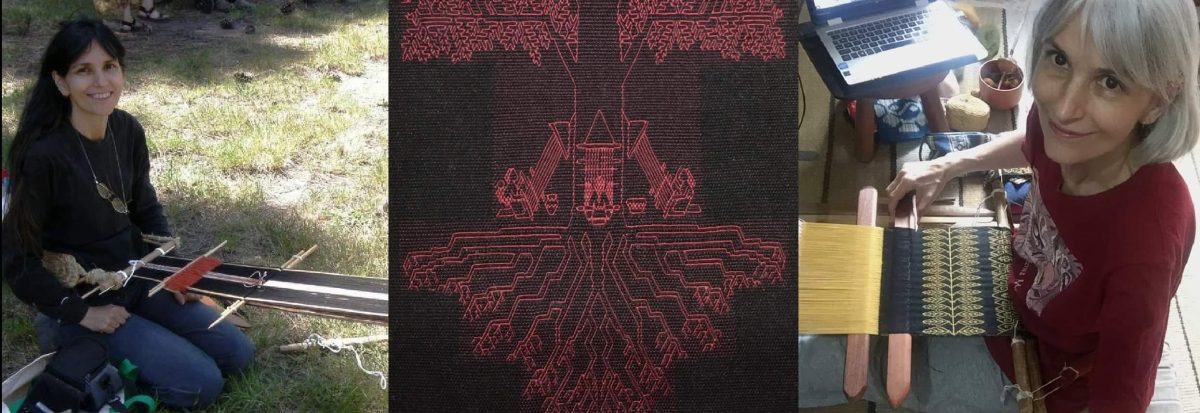
I’ve been up to the highlands and am now back again in the hot tropical lowlands. Yes, I’m still in Bolivia. Australia is there waiting for me and I’ll get there event-u-a-lly…..
I meant to write a blog post yesterday but once I got into sorting and editing the photos, I found myself completely overwhelmed. Lest that happens again today, I’ve decided to make this just an overview. Anything that doesn’t make it into this post will probably show up now and then in future ones as well as in my Facebook and Instagram accounts.
So, on this ten-day visit to Independencia , Cochabamba where my weaving teachers live and where Dorinda was also vacationing, here’s a run down of some of the things I did…..
I took the five-hour minivan route to Independencia from Cochabamba instead of the eight-hour one by coach. I’m guessing that the minivan is capable of traveling on roads that are perhaps unsuitable for the larger bus and that the bus remains in service because it’s required to service many tiny communities that are scattered along its longer path. The minivan route is no less scenic than the one I traveled last time by bus. In fact it may be even more so.

From there it’s a journey along slopes of deep narrow valleys high above lively rivers (it’s wet season). Water cascades down the slopes above, crosses the dirt road ahead of us and continues tumbling its way down to the green valley floor. Then we go up over passes to continue along the next valley, up again and so on. I was sitting in the second last row and it was like riding a bucking bronco back there with every descent from the passes. I gave up trying to take photos and instead just tried to imprint the scene on my brain.
And then we stopped so that the driver could negotiate the carrying of some freight for a couple who had flagged us down and it was one of those perfect moments for getting a nice shot. We happened to be on a relatively flat and open area with the setting sun casting a golden glow on the hillsides and I was able to hold my phone steady for a change and get a photo of the peaceful scene. I thought that if I just get one nice photo from the five-hour trip, I’ll be happy.

So much for this just being an “overview”. I’ve already spent too much time just on the van trip! Back into overview mode….
On the surface, the town didn’t seem to have changed much since my last visit….


However, some things had changed….Maxima was now living in a house of her own with a lovely view and even had wifi.

With Dorinda, my teacher Maxima, (long time followers of my blog will know them), her daughter, Vilma and the grandbabes, we dyed a bunch of skeins of handspun yarn with indigo in a banana-based vat.

I think this was only the third time that Maxima was attempting to dye with indigo. The second time had apparently failed and so I spent a lot of time wondering…are we doing this right? Will it work this time? Well, it did and I got to keep one of the skeins. I can’t wait to use it in a project on my backstrap loom. The skeins are made up of the ladies’ doubled handspun wool singles. Once dyed, the doubled threads are then tightly plied. I’ll get to ply my own skein which pleases me because I’m not fond of weaving with the high amount of twist that these weavers typically put into their yarn.


So, I came home with this (below). The mug is for scale more than anything else because those balls of yarn I bought are huge! I bought those two balls from one of the weavers from the outlying community of Huancarani that I visited on my last trip up here. The ladies from Huancarani come into town on the weekend to sell their produce in the market. We attempted a trip to Huancarani on the preceding Thursday for a weaving get together much as I had done on my last visit but it had rained heavily all through the night and a landslide had shut the road.

Here’s a flashback to that Huancarani trip and the fun day we’d had all weaving together…

When not dyeing, I would visit with Max and weave with her as she had asked me to teach her some new patterns in the structure that I call Andean Pebble Weave.
When I was walking in the market street on the Saturday, I was stopped by one of the Huancarani ladies who asked “Where’s Berna?” That’s the name they know me by. No one calls me Laverne in Bolivia. Bs and Vs are pronounced virtually the same and they don’t recognise that the La is part of my name as La is often placed before any woman’s name when referring to her as a third person. So, here in the lowlands I’m Verny and up there I’ll always be Berna/Verna. The Huancarani ladies had been expecting my visit on the Thursday and so now that they were in town, they were looking for me. Of course they didn’t recognise me as the lady with long dark hair that had been to their community to teach patterns seven years ago!


You can see the unique way weavers in these communities in this part of Bolivia manage their warps. They don’t attach them to their bodies with a string or backstrap. Instead, they have the warp suspended between an index finger and a toe. Together with the middle finger they form a picking cross of the two “pebble” sheds and then do all the pick-up and loom operation with just the one free hand. It’s amazing to see! I did this with Maxima back in 2011 when I visited her in Cochabamba. Even though the structure is the same as the one with which I am thoroughly familiar, this method of weaving it was completely foreign to me and it took me some time to get used to it.

So….back to the lady in the street market who stopped me. Once I told her that this white-haired person was indeed Berna, she pulled out a couple of bands to show me, one of which is pictured at left. Sadly, Narciza hadn’t been able to come to town that weekend as she has a herd to attend to but it seems that Narciza spread knowledge of the new pattern to other ladies in the community. How happy that made me!
And Maxima had taken advantage of the copy of my book that I’d left behind with her on my last visit.

Maxima showed me what she had woven from the book….


On our first morning weaving together, Maxima chose to use some of the crochet cotton that I’d brought. I think her unfamiliarity with the material left her a little frustrated. These weavers create a very tight weave, squeezing the weft into place with a tremendous amount of pressure. The cotton thread just wasn’t behaving the way her handspun wool or re-spun acrylic thread would. Those materials have a certain amount of stretch which the cotton simply doesn’t. While she was able to weave the little motif she had chosen correctly, it just didn’t look right with that tight, tight beat.


My second session with Maxima was completely different. She used her re-spun acrylic thread this time and the results were completely different. She confidently chose larger and more complicated patterns from my Complementary-warp Pattern Book (all the patterns therein are in the structure that I call Andean Pebble Weave) and her joy at watching the figures appear and then reaching the stage where she could predict what was to come next, was apparent.


Here’s a video clip of Maxima doing the last row of pick-up for the horse pattern….

The cat figure,also from pre-columbian textiles, that Maxima chose was not completely successful but I know it will be in her next attempt now that she has understood how to weave the eyes of the viscachas.

I also wove a bunch of patterns to leave behind for Maxima to study and attempt in her own time after I left. When I showed Maxima the hotel key fob, she loved it and so I offered to make one with her name as well as for her daughter. Her husband then laughingly asked why I wasn’t offering to make one for him. I was happy to oblige. Dorinda took this photo of Maxima after I left as I wove the fob on the last night and wasn’t able to deliver it in person.

And then it was my turn to learn some new weaving thing. I noticed that the large aguayo that Maxima had woven was edged with a patterned tubular band that is known in some parts as nawi awapa. The weavers here call it chichilla or simply nawi (nawi meaning eye). Maxima handed that task off to another weaver as she has forgotten how to weave these patterned tubular bands. She generally edges her carrying cloths with crochet. The customer in the U.S however, wanted the more traditional patterned tube. What I noticed in this particular tube was that the color arrangement would flip back and forth along its length. The zig-zag would change colors every now and then as would the inner eye color and I was mad keen to meet a weaver who would show me how ro do it. Maxima’s sister Narciza knows how to do it but she hadn’t come into town.
So, on Saturday market day I visited with the Huancarani ladies in the street and asked if any one of them knew how to do it and if they would be willing to teach me. Of course no one just happened to be carrying colored yarn and besides, all except Justina said that they didn’t know how it was done. I invited them to come up to the hotel so that I could show them a nawi awapa band that I had started and also show them some other bits and pieces that I thought they might find interesting.


Justina examined my ñawi awapa warp which was set up in the way I had been shown in Chinchero, Peru. It turns out that while the results are exactly the same, the weavers in this part of Bolivia set up their warp for the ñawi awapa in a slightly different way. It’s slightly different but different enough to be confusing to Justina who said that she wouldn’t be able to teach me using this warp. I was a disappointed but interested to know exactly what the difference was. Time didn’t allow further exploration but Justina returned the next day and agreed to teach me if we created a new warp from scratch. I was thrilled!


Justina told me that they call the forked stick illawa, which is the same word used for string heddles. Perhaps these weavers use the word for any device that enables them to create sheds. I do love the name for the other stick….el muchacho, which strangely is in Spanish rather than in Quechua.

I can’t tell you how much I enjoyed this visit. On certain afternoons Dorinda and I would walk up and up and up above the town to get some exercise. I was suddenly very much aware of my calves. I was really pleased with the way I was dealing with the altitude.
One afternoon, Sandra, the hotel manager, took me down to her orchard. So that was a down, down, down walk with the harder part coming at the end of the day. I was happy to see custard apples growing for the first time and to be able to pick quinces which Dorinda later made into jam. We took back apples and Dorinda made a pie. How spoiled was I? The biggest thrill was seeing a hummingbird nest with two eggs in the orchard. The photo needs something for scale. The nest and eggs are tiny!

There was time first thing in the morning to hang out on the balcony with hotel cat, Garfield, and watch some young girls herding their flock of sheep onto the football field. Stray dogs would arrive to romp and freak out the sheep who would bolt out the gate and into town with the little girls running screaming behind them! It would happen pretty much every other day.


We got stuck in the mud on the way back to Cochabamba. The mud sucked the soles right off my sandals and I never saw them again. Then we got caught up in protest roadblocks as we neared Cochabamba and it was quite a saga getting from there to the airport. It involved walking with soleless sandals through shin deep water and taking the train that was packed to the gills. It was so difficult getting on and even more so getting off! If my flight had not been delayed, I might have just missed it. To be honest, if the road had been closed due to the landslides and I had been stuck in Independencia, I might have chosen to just stay on until Dorinda’s visit ends on the 10th. It was a glorious visit and I really had no need to leave when I did.

And the scenery on the way back….could it get any better? Yes, it could. It was and had been raining a lot and in the red rock sections the waterfalls that had sprung up and started to flow down the other side of one of the valleys, were running bright pink! Mud and rain-streaked windows made decent photography impossible but I burned those images into my brain!
Back in Santa Cruz and once I’d woven and documented the color-changing nawi awapa, I turned to other projects. I’d taken some garabatá fiber to Independencia to toss into the indigo dyepot.


And now I’m working on something a little unusual. An expat gentleman who runs wildlife tours here with a particular focus on the endangered jaguar asked me if it would be possible to weave a jaguar skin pattern. He would like to commission Guaraní weavers to produce small bags with the print to offer to his clients. He is and always has been keen on promoting the handwork of the artisans that live in this lowland part of Bolivia. He showed me a tapestry pattern that he’d found online and I took it as a challenge to try to reproduce it in one of the warp-faced structures that the Guaraní weavers use. With this I can show him how much pattern can fit into the dimensions he has in mind. He can sketch out his ideal pattern and then approach the weavers with a proposal. This way they won’t have to waste time and yarn sampling and experimenting. Besides, you know me….always looking for an excuse to weave.

So, the overview grew somewhat as I settled into writing and felt less overwhelmed! I hope you’ve enjoyed these tales from the Highland Holiday.
Until next time…..