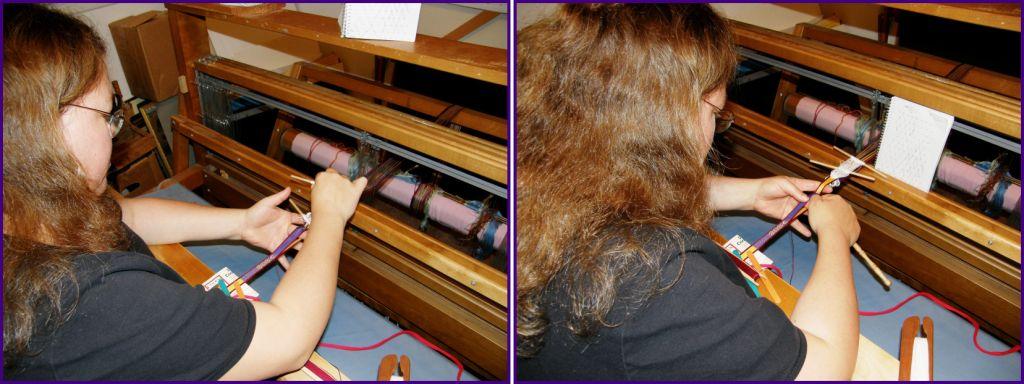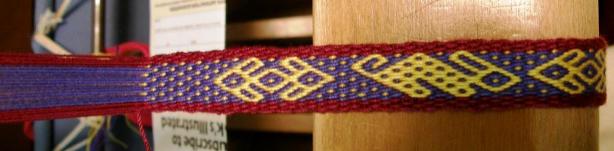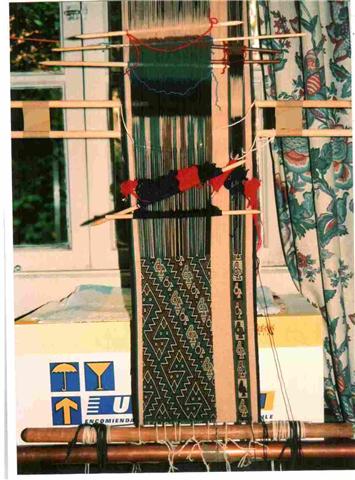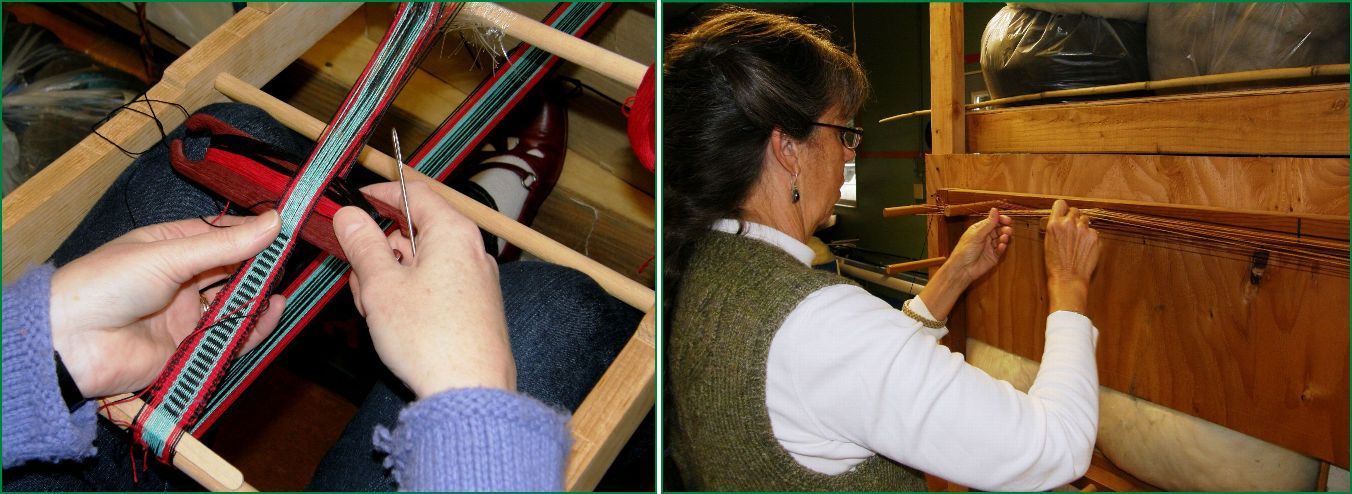
Backstrap Weaving: Looms, MORE looms and southern hospitality.

Spring has sprung in North Carolina! I am spending some time here in Lincoln County with my online buddy Lisa and her family. Lisa’s father owns and runs the local newspaper and is a wealth of information on local history and its colorful characters and has kept me highly entertained with stories throughout my stay over breakfasts and dinners of typical southern treats. He tells me that North Carolina, while being one of the ten most populous states in the US, is also one of the most forested. This town looks like a gorgeous well manicured and landscaped park in which people have been graciously allowed to place their homes – luscious, expansive  green front lawns, azaleas in full bloom, majestic oaks, show-case flower beds and vegetable and herb gardens abound. You can barely see the houses amongst the trees and shrubs – so gorgeous!..so spacious! Oh, and I heard a mocking bird yesterday! – To Kill A Mockingbird is my favorite book.

And I have been treated to helping upon helping of southern hospitality. I am so tickled everytime someone calls me ma’am!  I was eager to try some typical southern food – all those names that we hear in movies and TV shows and have no clue about –  so Lisa’s husband made me a batch of “biscuits” which we enjoyed with Lisa’s homemade berry jams. We have biscuits in Australia but our biscuits are what people in North America call cookies.

LEFT: Homemade buttermilk biscuits…RIGHT: A good southern breakfast.

We went out for a good southern breakfast. The largest plate in the above picture is mine! – biscuits with gravy, corn grits and country ham. I still can’t believe I ate all that! I asked about chitlins as I have always wondered about those but the general reaction at the table made me think that I would be better off not trying them!

For something different, Lisa and Ryan took me to their favorite Thai restaurant as I had mentioned that south-east Asian food is something that I miss in Bolivia.

On entering the restaurant, Lisa and I were drawn immediately to the textiles that decorated the walls and tables. The owner was so pleased by our interest in Thai weaving that he gave us each a woven bag from Thailand!

So, what has been planned for my visit apart from eating? – lots  and lots of fibery fun! Lisa and I met online through a discussion on her fabulous yurt band which you may remember from a previous post. Finally my little yurt band border bands get to meet their inspiration. You can see them there at right next to the huge forty-eight foot yurt band. There is nothing like seeing something like this “for real” after having admired it for so long online. The colors are so much richer and I am suprised at how loose and flexible the weave is compared to South American bands which are beaten hard into a stiff firm fabric.

So Lisa and I met on Ravelry where she was trying to figure out the structure of the yurt band weave to see if she could reproduce it. Photos were flying back and forth in cyber space and it was only after seeing the back side of the textile that I finally recognized it as simple warp floats. We then set about weaving a tiny reproduction – the “s” motif  on which I made a tutorial here. We laugh about the fact that a chica in South America helped a gal in North America figure out a weave from Central Asia – and all online! And thus  a friendship was formed.

By the way, my friend Caroline in Australia has been doing her own investigation into other kinds of yurt band construction which you can read about here. She wove a three-color reproduction band recently.

Inkle, cardboard, tapestry, card, backstrap, frame and rigid heddle looms!

Lisa is a felter, spinner, knitter, painter, braider, weaver and loom gatherer. In an attempt to clear some space so we could use her four-shaft floor loom, we pulled no less than fourteen looms out of her studio!  Now what am I , the backstrap weaver doing on a four-shaft loom? I will tell you more about that little adventure later on.

In the meantime, check out Lisa’s fabulous felt work above. Lisa is in the local fiber guild and SCA group and so her projects tend to involve historical reproductions with her SCA companions as well as work with the fiber guild which gives her an outlet for more contemporary pieces.

Lisa’s felted pouch and inkle loom woven strap. I can’t wait to make one and decorate it with a backstrap woven band. The yurt design cell phone pouch I wove for Lisa is next to it with her iphone inside – a perfect fit.

The piece above on the left has a Scythian design. The Scythian people existed on the Central Asian steppe around 500 BC and a feature of their animal motifs is the twisted hindquarters.

The piece above on the right is a Viking design.

There are a lot of felted pieces in Lisa’s home. I am seated on a felt cushion with my feet on a felted rug and, hopefully, if time permits, Lisa will teach me to make a felted pouch like the one at left. I will do a South American motif – shock! – and weave a strap on my backstrap loom.

I have my fingers crossed for a cut pile lesson or two while here too! Lisa has one started on her Mirrix loom which you can see on the left. The felt rug in the center is one she bought and is from Kazakhstan and I think it is splendid. At right, check out her grin as she peruses her newly arrived catalog from the “Secrets of the Silk Road” exhibition currently at the Bower Museum in Santa Ana.

Did I mention that she is also a terrific spinner? Here are a few of her most treasured spindles –  Turkish and Tibetan styles, phangs from Ladakh, a Kundert, which is her workhorse spindle, and sentimentally valuable ones gifted by her husband as well as a bead whorl crafted by 5 1/2 year-old Joshua.

Lisa loves to teach and share and I got to see her in her element at an Earth Day Festival last weekend, where she showed and taught her crafts.

Lisa has taught me that finger loop braiding need not be limited to short braids as I had thought. She has a nifty way of hooking the end around her toe and an even niftier way of tamping down the braid which I will show you in a video. Here, she is teaching a five-strand braid to girl scouts, Carolie and Julia who had a ball with it.

When my weaving tecaher in Potosi  taught me a six-strand finger loop flat braid, I would make the braid while she would tamp it down using the side of her hand with a slicing action. So it seemed that two people were required to work together to make the braid nicely. Not so… check out Lisa’s cool foot action in this video!

I got to demonstrate backstrap weaving and that was a lot of fun. There was a convenient pole in our area to which I could tie up.
There was music and the weaver eye, forever on the lookout, spotted the ikat guitar strap

I wove pebble weave to promote my new e-monograph and it was quite a different experience to weaving at CNCH where my audience was largely weavers.

At this Earth Day event a lot of the people had never seen weaving demonstrated in any form and we attracted quite a lot of onlookers.

Lisa was spinning and explaining the felting process while I knelt on the floor and wove.

Caught up in the excitement of it all, I completely forgot that that kneeling position is not something I can maintain for longer that five minutes at home! I sat there happily for a couple of hours!

Kids were kept busy painting Earth Day flags. I was quite taken with a lady who was selling cards on recycled paper with photographs of her cats-eye-glasses-1960’s youth and with a wicked sense of humor. She gave a pair of cats-eye sunglasses to her vistors and that led to this photo op with me there in the center. Becca, from Shiele Museum, who was making paper flowers with kids, kind of caught the whole sunny spirit of the day with her colorful clothes and radiant smile.

The next day I was invited to visit with British couple Maurice and Ursula. Those of you who are on Weavetech may know Maurice and the superbly crafted looms he made for himself. Maurice, on hearing that there was another “British Subject” in town, promptly invited me to tea and then lunch and a visit with his four and eight-shaft floor looms and weaving studio. Ursula’s passion is quilting.

Maurice in his studio. He also built the spinning wheel in the center. Ursula posed with her quilt which she has finished piecing together but has yet to quilt. She is still experimenting with designs on her recently purchased quilting machine. Maurice and Ursula can work side by side on their fiber pursuits in the studio. The photo does not show the true colors unfortunately. The main colors are deep purple and apple green and they are stunning together.

Since putting out my e-monograph on Andean Pebble Weave, I have had a couple of enquiries about whether the technique can be worked on a four-shaft loom. Sadly, I didn’t feel qualified to answer those questions well and so I was determined to get educated about that on this part of my trip and Maurice was extremely helpful. I had never seen a four-shaft loom “in person” and I don’t think that Maurice was all that familiar with a backstrap loom. So together we muddled through and came up with a possible way to get the pebble weave going on this kind of loom if you simply didn’t have any other kind of loom to work with.

Here Lisa and I are ready to attack this project. I got a lesson in warping one of these looms with this tiny narrow warp. We warped front to back with Lisa sitting on a stool behind the harnesses while I fed the yarns to her. We only used two harnesses and set up the pebble sheds in those.
All set up and on our way. We used a pair of string heddles in front to form the picking cross and removed the reed and away we went. All went very smoothly starting off with plain pebble weave. We are using an eight-revolution warp which gives us sixteen warps from which to pick patterns. This wee band looks quite funny on this large loom.
The first motif is started and Lisa’s smile says it all.
More motifs start to take shape and all is working well, The tension is just right as the motifs are not elongated and there is enough room to get hands and sticks in to do the pick up.
Opening the heddle sheds to form a picking cross and then using a stick to pick up the pattern warps.
More motifs. This center one is a “viscacha”, a rabbit-like creature with a long tail found at high Andean altitudes . The pattern charts for these are in my e-monograph.

So, we had fun with this. Lisa learned to make patterned bands (she had graciously tested my instructions for plain pebble weave before I published my e-monograph) and I learned a little about the workings of a four-shaft floor loom. What a lovely wide shed those harnesses create with the minimum of effort.

EDIT…..As I get more familiar with this loom and its workings, I have had the famous aha! moment and figured a way to do away with the string heddles and get everything into the four shafts. However it won’t make the actual weaving any faster. It is still, after all, a pick up weave and individual warp threads need to be handled. When I get back here from MSWF and a short stay in DC, I shall get another band on this loom.

Lisa is not the only weaver in this household. Above you can see five-year old Joshua making a scarf on an Easy Weaver rigid heddle loom. The scarf has been finished and hopefully he will find it so I can show it to you here before I publish this post.

I had another encounter with this Easy Weaver loom this week as Brian Jones in England sent me a picture of an Andean pebble weave band he has been weaving following my e-monograph. I can’t tell you all how ecstatic I am about seeing the monograph being put to use!! 🙂

LEFT: Brian’s warp set up on his Easy Weaver loom. He is weaving a band from lesson 2. RIGHT:Jennifer Jordan made a key fob with the plain pebble weave band in lesson 1.

I told you before that Lisa pulled out her collection of looms so that we could get at the four-shaft one and this gave me a chance to play with and think about looms, other than backstrap ones, on which pick up bands can be woven.

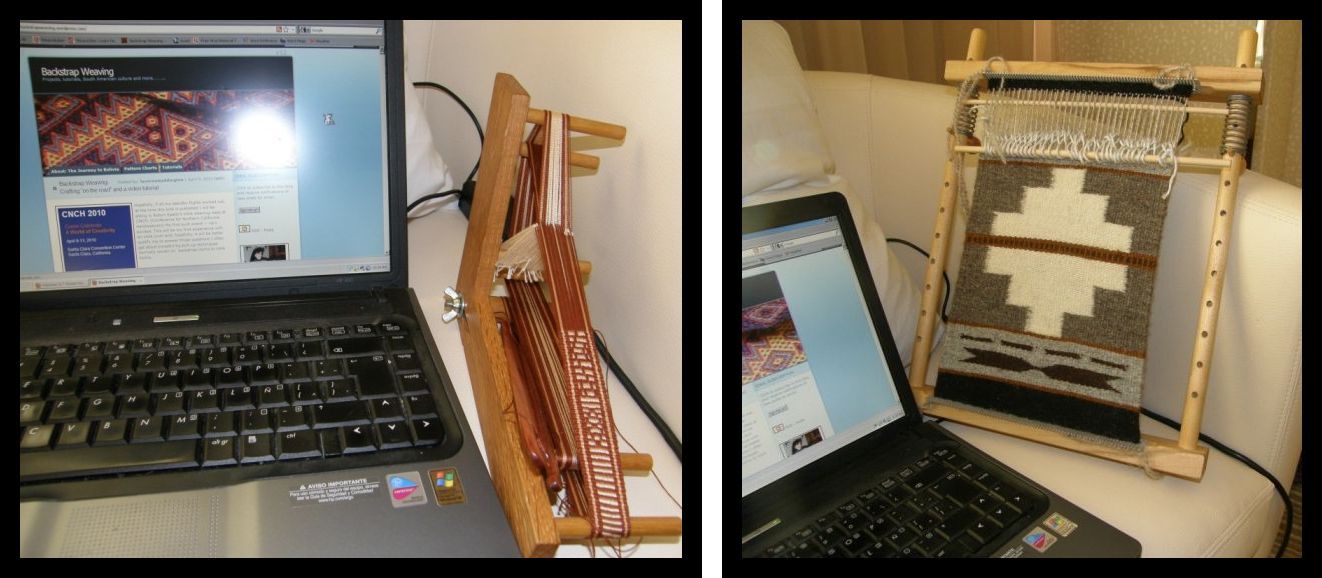
You may know Franco’s clipboard loom at left. Lisa also has a somewhat sturdier frame loom on which she has been weaving a band with simple warp floats.

If some kind of tensioning system could be rigged on these so that tension could be eased off as weaving progressed, they would be wonderful. As is, the amount of take up in the warp makes it increasingly difficult to open the shed and pick the warps as weaving progresses.

I set up a warp for Andean Pebble Weave on Lisa’s frame loom to see what it would feel like and wove some pre-Columbian birds. The pattern charts for these are in my e-monograph.

As I warped up quite firmly, I think I will only be able to weave half this warp before everything gets too tight. I think it is a nice loom for sampling and short bands.


Here are some pick up bands on inkle looms. The one on the left above was made by Karren from the Weavolution Backstrap Weaving Group some time ago. She made this into a cell phone pouch. This motif is charted in my e-monograph.
On the right is Lisa’s “s” yurt band design on her inkle loom. I warped up a narrow pebble weave band on an inkle loom when I was in California and enjoyed doing all manual pick up. I have just started winding a warp for a wider one on one of Lisa’s looms and will use additional string heddles this time. I’ll keep you updated on that.
Above, you can see a picture that Ellen sent me from Denmark where she is weaving one-weft double weave on her inkle loom following my tutorial on Weavolution.

Carolyn sent me these pictures of her first Andean pebble weave band, following lesson one in my e-monograph, which she lashed to her rigid heddle loom.

Then there are tapestry looms, or this Navajo loom onto which I lashed a four-color pebble weave warp. My Navajo loom has a tensioning device so I could ease off on the tension as I progressed and, therefore, compensate for the take up.

Lisa’s Mirrix loom on which she has her cut pile weaving would work well for this.

So, all the beautiful pick up weaves that I show on my blog and for which I have provided tutorials, can be set up on a variety of looms. They by no means have to be restricted to the backstrap loom.

This has been a wonderful learning experience here! Tomorrow we are going to get into some felting. I would like to learn this and make something for myself but probably won’t get to continue with it back in Bolivia as I can’t get sheep wool where I live in Santa Cruz. And then there is the cut pile weaving. I got Noreen Roberts’s wonderful book on the subject but there is nothing like having someone show you in person. Lisa is still in the experimental stage with this but I am sure that she will be able to give me some good tips.

And look above at what she gave me! – a charka from India. I am thrilled to bits to have something like this from my place of birth. Lisa’s fiber guild friend Katherine came over today and showed me how to use it.
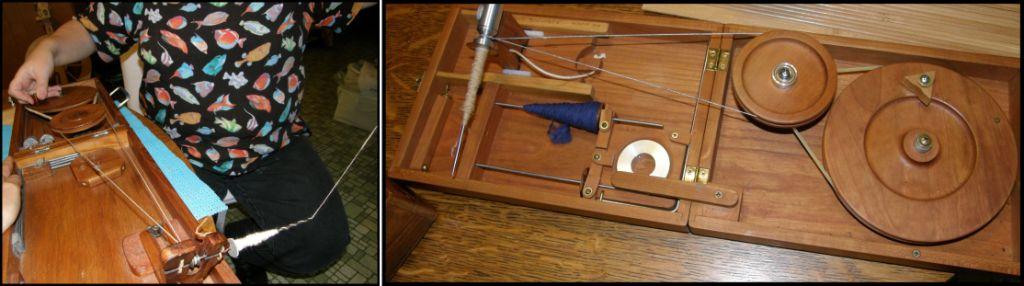
Katherine spinning cotton on my new Indian charka – the parts need a good oiling! At right is Katherine’s own charka made by Bosworth – what a piece of work! Of course she makes it all look terribly easy. Lisa sat quietly by spinning up cotton of sewing thread weight on a takhli supported spindle. So we had a very spindly day and shall be getting back into our pebble weave projects later-Lisa on the 4-shaft loom and me on the inkle.

Katherine sews and also makes card woven bands. She made the pin cushions from felt and then embroidered them and the band, I think, is intended for her husband’s guitar.

I would so love to be in a fiber guild and surrounded by all these talented people. Well, I shall do my best to soak up everything I can from Lisa during my stay here although I have to admit that being in Weavolution gives me access to weavers from all over the world – so I can’t complain – and I only need to go up into the Bolivian highlands to be with wonderfully talented backstrap weavers.

###############################################

I have a band to show you from Ann Littlewood, woven from her own design in supplementary weft technique (see my tutorial here). She is going to use this as a bookmark.

And I also had a fun message over at Weavolution from Marta Madeja in Spain who tells me that she is hiking in the Alpujarras south of Granada and picked up some sticks along the way to make a backstrap loom. She has never tried backstrap weaving before and decided to dive head first into pebble weave and bought my e-monograph. The only “yarn” she had about was embroidery thread and she managed to make a tiny pebble weave band based on lesson 1 in the monograph.

The pin will show you just how tiny this band is. She tells me that she will try lesson 2  with thicker yarn when she gets home. I wonder what she tied up to on the trail. I am waiting to hear more details from her. I think this is really cool!

##########################################

Finishing here with a million thanks to Lisa, Ryan and Jack-in-the Box Joshua, popping into the photo there below, for an amazing time in North Carolina. We are off to Maryland Sheep and Wool Festival this weekend. If you are going, please drop by and say hi. I will be demonstrating backstrap weaving in the rabbit building at the Weavolution meet up point from noon to one pm on both days.

See you there!

Thanks to all who have written to me about the e-monograph. Keep the projects and comments coming. 🙂

Backstrap Weaving- New Friends and Old Believers

Giddy with all the nice comments I have been receiving about my e-monograph on Andean Pebble Weave, here I am back in San Francisco. Ridiculous as this sounds, I have to tell you that my mental image of California has always been freeways and car yards. Don’t ask me why – I guess I have been watching the wrong kinds of movies and TV shows. I have spent the last week since the weaving conference up in beautiful Humboldt County in Northern California with my Weavolution friend Janet Finch.  Janet lives and works with her husband Larry on a berry farm up there and I doubt that you could find anything further removed from that ugly freeway image. What a paradise! Now I think my new Californian mental image will be something like what you see at left.

Aunt Janet’s Fiber Mill

Some of you might know Janet as “Aunt Janet” from the spinning lists and know about the spinning mill that she runs – a wonderful playground for the fiber fanatic – full of warm fibery smells, processing equipment, looms, spinning wheels, yarn and fleece at all processing stages…bags and bags of the stuff and lately it has become the hangout for a bunch of neighborhood backstrap weaving folk. Janet has rigged up hitching posts so that probably up to a dozen backstrappers could be happily weaving away in there at any one time.

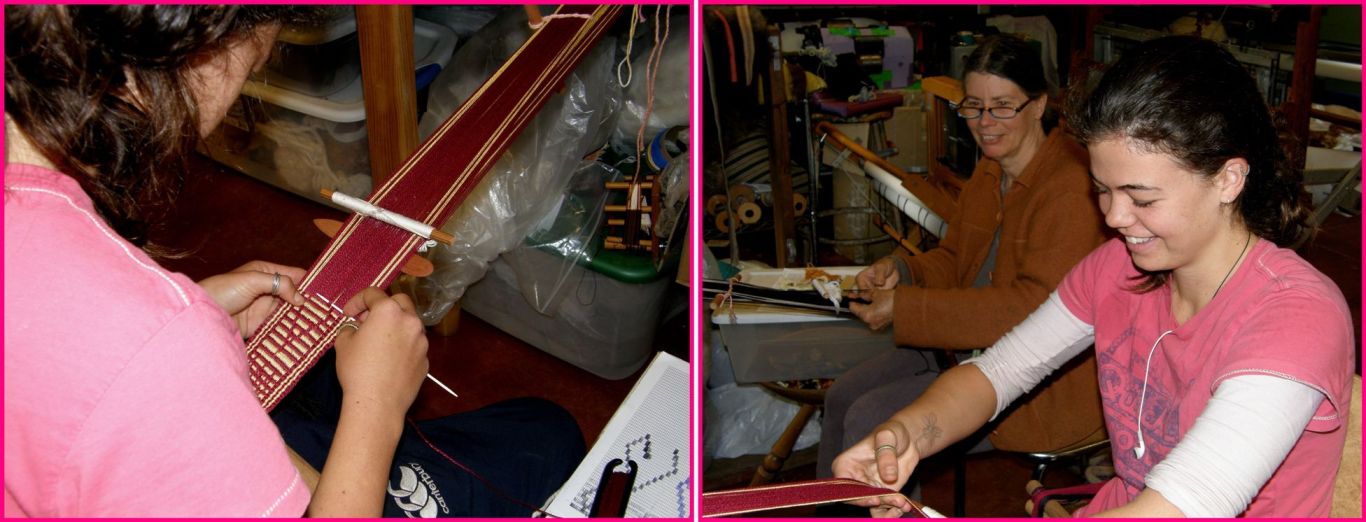
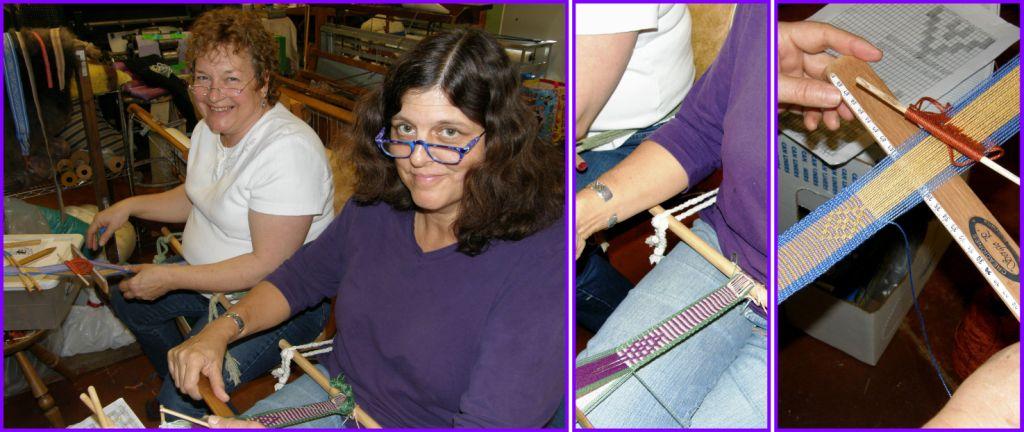
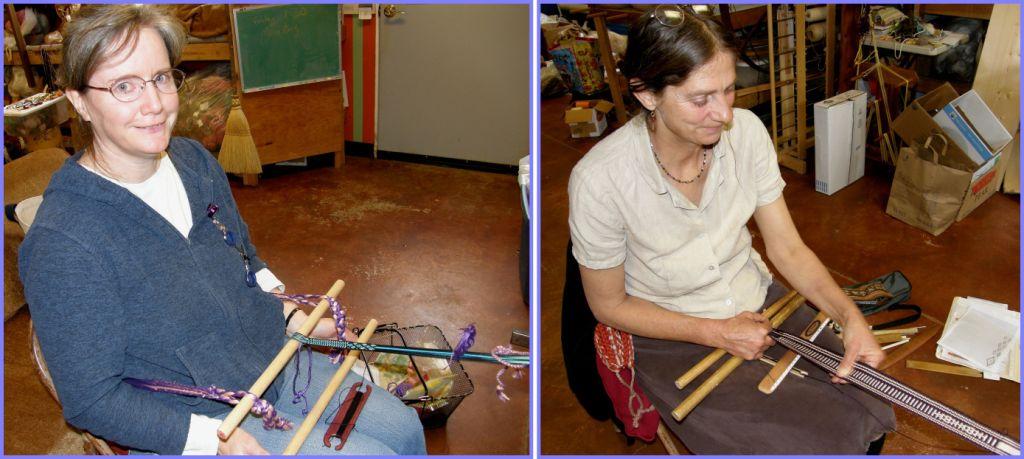
So we took advantage of that, spread the word and set up some backstrap weaving for the week that I spent there and it was a lot of fun. It was all very casual – people came whichever day they wanted, stayed however long they liked and wove whatever technique they chose. It kept me on the ball as quite often I was helping people with three or four different techniques all at once!

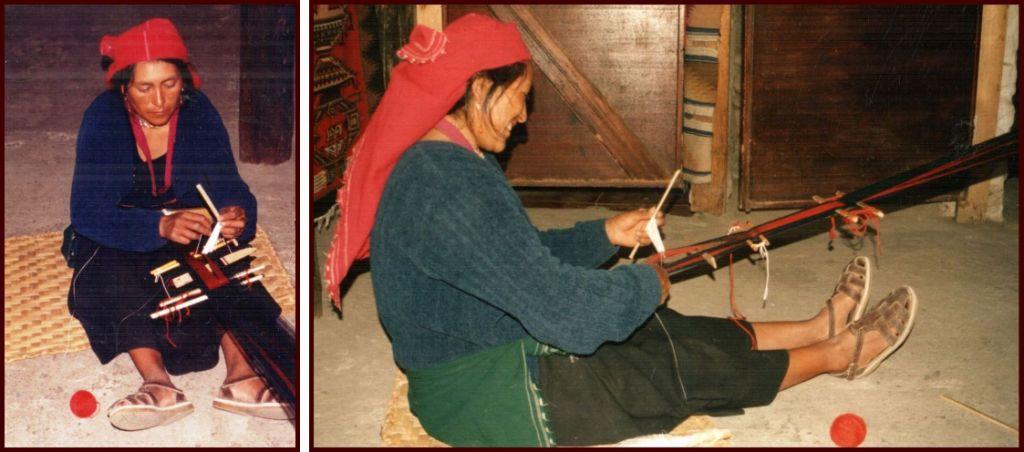
LEFT: Georgie brought her homemade inke loom on the first day as she had already warped up on that. It was a nice loom with two sides, one of which was removable. First we worked on her selvedges which you can see improved very quickly. RIGHT: Connie learned to warp on four stakes for pebble weave as I was taught in Peru.
LEFT: Nineteen year-old Mikeila was visiting from Kenya to learn about organic farming. She joined in and really took to it  weaving simple warp floats and charting her own designs. RIGHT: Janet was trying out supplementray weft and had a gorgeous range of embroidery floss colors to work with.
Janet’s supplementary weft band.
Karen, a nun from the Redwood Monastery came along on two days. She is from La Paz, Bolivia and was happy to speak Spanish with me about her home. She arrived in the US when she was 17 and is so pleased to be able do a traditional craft from her homeland. She brought linen thread which was at the monastery and chose to learn double weave starting out with the simplest of motifs and a fine job she did. I love her tapestry crocheted hat from La Paz..
Linda and Jane were both doing simple warp floats. It was Jane’s first time working with a backstrap loom. They both wove the same motif but see what a difference different tension and beat can make to the design. Remember you can click on these photos to see larger images. Linda gave me some freeze dried indigo to take home and try – excellent! I can’t wait to go home and weave something dyed with indigo next to cochineal. Linda gifted indigo to the weavers in Chincheros, Peru and she could very well be responsible for the gorgeous blue and red textiles that they are now creating.

Linda has a lovely weaving website, by the way, and has a particular interest in natural dyes. She showed me one of her ikat pieces – just simple ikat dots in stripes of various colors but her color combinations and arrangements were stunning. It has really inspired me to give ikat another go but to keep the design simple as Linda did and play with color instead. I have found and bought my cold water dyes and so am ready to go!

Georgie came back another day with her backstrap loom and tried the more complex warp floats making the yurt band border design that I taught in a tutorial here on the blog. Jani also came for two sessions with a specific project in mind. She wanted to make a bag strap – the bag will come later. She wove the simple warp floats but decided that she was more into the plain horizontal stripes – not a pick-up kind of gal!

So that was our week of weaving and between all that there was plenty to enjoy on the farm…

I met Janet’s gorgeous angora bunnies whose fur gets plucked and spun into fiber.
LEFT: My second cell phone pouch with the yurt band border found its owner when Mikeila spotted it and promptly put her cigarette package inside – a perfect fit –  so that’s going off to Kenya now! RIGHT: Janet showed me an amazing Peruvian textile fragment that she got in some sort of sample exchange  – it is marked as being from the Chimu culture and is a slit tapestry weaving. The colors are so delicate and pretty.

We were invited by Karen, the nun from Bolivia, to visit the Redwood Monastery and that was a real treat. It is located on a three hundred-acre property where deer, wild turkeys and the occasional mountain lion roam -all very very novel for me and I was quite taken with all the wildlife! The church is decorated in a minimalist style with floor to ceiling windows looking out on the redwoods. Karen showed me the rec room in the weaving house high up on a hill where she ties up her backstrap loom to weave. She ties up to an enormous eight-shaft countermarche loom with a six-foot weaving width and a flying shuttle! Her backstrap sticks cetainly looks very small and humble up against that monster. Talk about from one extreme to the other!

Karen and Janet on the porch of the weaving house overlooking the dorms and redwoods. Karen’s is one of the few groups that has decided against wearing habits.

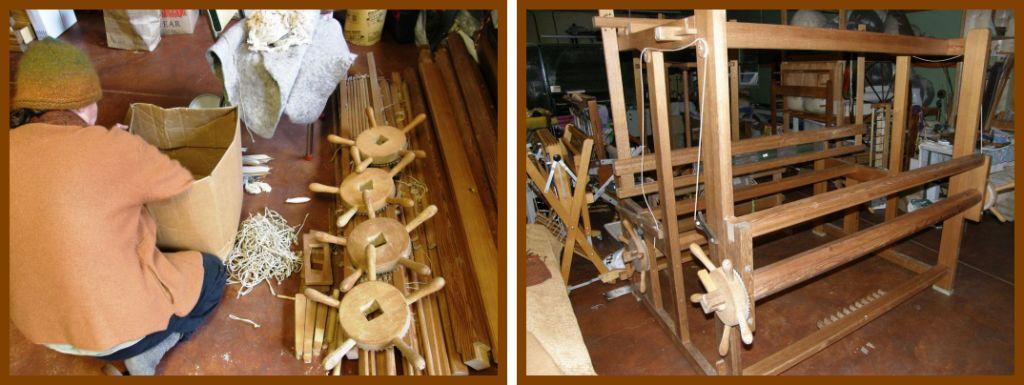
Speaking of enormous looms, Janet’s mill will be needing some re arrangements as she has been recently gifted her own monster loom. Yes – GIFTED!!  Her walking wheel and smaller looms will need to find new homes. I know of one loom that has been particularly unfriendly and won’t be missed – Janet has given it a name that I can’t even mention here!

Janet’s new toy – a Glimakra 8-shaft coutermarche loom. I am hoping that her poor wee backstrap loom won’t be neglected now…Anyway, this loom will provide a multitude of backstrap loom hitching posts! but I am sure that Janet has other things in mind for it…
One of Siv’s tapestries based on a traditional Flemish design.

It took two trips to get the loom from a Swedish woman, Siv Berg, who has had to find the loom a new good home as she had injured her arm in some way and felt she could no longer use it. I went along on the second pick up trip and found Siv to be a delightful and interesting person with enormous energy and a desire to tell us stories and share all her weavings . She is a wonderful tapestry weaver who has created pieces based on traditional Swedish and Flemish designs.

And it turns out that her son Bjorg spent some time in Argentina living and working with the gauchos on the southern sheep estancias and he totally blew me away when he appeared with this….

The traditional belt worn by the gauchos of Argentinas woven in warp faced double weave quite likely by a Mapuche weaver. They are designed to wrap two to three times around the waist. This was thrilling for me as I have only seen these in pictures and have actually always wondered if they were only worn for the tourist photo op. Bjorn was able to put me straight on that.

Siv showed us other textiles that she had around her home including a particularly fine huipil from San Antonio Aguas Calientes, where I learned to weave, in Guatemala. It is almost completely covered in double faced supplementary weft patterning and woven on a backstrap loom. She also showed us the complete traditional Swedish woman’s costume that she handwove and embroidered. I am afraid that the photo of her holding it here does not do it justice.

We could have stayed all day with Siv really – she is a fascinating lady and she must be happy knowing that her loom is going to a good home.

So I left Janet’s and headed on down to San Francisco once more and am having a couple of lazy days to catch up on this blog post and do a little online promotion of my e-tutorial. My backpack is somewhat swollen, not so much with stuff I bought at CNCH, but rather with what you see there at left. Janet gave me a whole lot of beautiful alpaca fleece to take back with me. Now you are probably thinking this is nuts – taking alpaca from the US back to Bolivia. Well would you believe that I have yet to find alpaca fleece in my travels in the highlands and that which is processed by the mills is only available for export. Janet gave me a big variety of colors including some incredibly soft stuff which she says is probably cria. I shall have to choose my weaving project very carefully for this lot.

################################################

BACK TO CNCH (Conference of Northern California Handweavers)

A little step back in time to share a bit about the cool folks I met at CNCH a couple of weeks ago.


Bambi, who made this all possible and who kept us all supplied with cookies and munchies.

The conference had countless highlights for me. Just one of these was the chance I had to meet people from the Santa Cruz Handweavers Guild who were demonstrating various fiber arts at their Education Booth. I was invited to demonstrate by Bambi who was busily spinning.

The problem was HOW to tie up my loom and I was just lucky that Janet had purchased a new set of wool combs that came with clamps so I was able to put the clamps on a table at the booth and lodge my loom bar behind it. Actually I only used one clamp and it worked really well.

Next to me was Annie McHale who was demonstrating inkle weaving. I have crowned Annie the Queen of Sashes and she has a great website showing her work. We had met up the previous day and she returned bringing me a bunch of beautiful bands to see. She makes the coolest guitar straps and was weaving one at the conference with letters writing a line from a Beatle’s song – what a great idea and it turned out so well!


There’s Annie showing her Beatle’s song line – I don’t know this song , but it has a special significance for the person who ordered this band. Next to Annie is Yonat, also from the Santa Cruz Guild, demonstrating inkle weaving and infecting us all with her high energy.

And then there was Ingrid. Now I would have had to have some kind of super high speed camera to catch Ingrid as she never stood still….and I didn’t manage to catch her!

Ingrid was demonstrating finger loop braiding and her lessons were highly popular and she was on the go all day. She tells me that she has seen my braiding tutorials here and that she is going to make some YouTube videos too to teach her braids – excellent!

One of Ingrid’s students at the show was kind enough to let me film her making a five-strand square braid and so I can share that with you all here – I LOVE finger loop braids – I used two strands of each of two colors and  one strand of a third color.

And then there was the shopping. I will just give you a taste of the colors here…

Colorful and highly popular African baskets. Yarn and yarn galore! My purchases…the book on sashes was a gift from Annie!! I bought an Ashford inklette, some beautiful belt shuttles and a 12.5 dpi rigid heddle for my backstrap loom as I still get a kick out of doing balanced weaves now and then.
Syne and Ruth Temple, who I know from Weavolution. Ruth presented Syne with the “Syne Mitchell action figure” complete with tiny rigid heddle and card looms! Now I must make her a teeny backstrap loom…

And some other cool people I met…I met Syne Mitchell online last year when I wrote the Backstrap Basics article for WeaveZine and lately we have been in close touch about the publication of my e-tutorial on Andean Pebble Weave which she is selling on the WeaveZine site.

So finally we got to meet in the flesh. Ruth Temple, who I know from Weavolution, was there too. It was actually from Ruth that I first heard about Weavolution – she wrote a comment on it on Ravelry back in the early days.

Franco Rios, a very active participant in my Weavolution Backstrap Weaving Group and undisputed King of DIY shows off his clipboard loom to Syne.

If you want to see some really nifty homemade looms and learn lots of cool DIY tips, check out Franco’s blog.

Lastly, I will show you a little about the gallery…

Tien Chu, one of Weavolution’s founders, entered her handwoven silk wedding gown and coat in the garment category in the gallery and won Best Of Show. She also won first and second place in the accessories section with other pieces.

I entered a set of three sashes in the wall hanging category and got a blue ribbon 🙂

The three sashes have been woven with three different Andean pick up techniques and represent three different regions of Bolivia. My aim is to extend this into a set of nine sashes covering all the techniques I have learned spanning the South American continent. Even the prize ribbon with the writing was handwoven by Lillian Whipple-you may have read her articles on WeaveZine.
Kathe taught, amongst others, a class on how to make the tassels used on the Old Believer belts.

Finally I would like to introduce you to Kathe Todd-Hooker, tapestry weaver and one of the teachers at CNCH.

I told you all last week about Kathe and Pat Spark’s involvement with the Russian Old Believer communities in Oregon. One of my blog readers was kind enough to embed a video with her comment last week which has a series of black and white photos of various Old Believer communities around the world. I thought it would make a fitting introduction.

The music that accompanies the photos is beautiful and haunting.

Feast your eyes on some of the backstrap woven and braided belts of the Russian Old Believers in Kathe’s collection…

LEFT: Supplementary warp patterned bands at top and bottom with a tapestry woven piece in the middle. The motifs on the supplementary warp patterned ones closely resemble some of those that are in the book on Lithuanian sashes that Annie gave me. RIGHT: These look to me to be Andean pebble weave-they are doubled faced and appear to be patterned with the same warp float structure as Andean pebble weave and they have me baffled! I am quite confident that I could reproduce them exactly.The motifs are not any that I have seen on Andean belts except for the border design on one.They again resemble those that I see in the Lithuanian sash book. If anyone knows anything about a belt weaving tradition in Europe using this structure, I would love to hear from you.
LEFT: Braided belts RIGHT: A single color plain weave belt with simple warp floats. Kathe told me that the belts are generally 60 inches long and three are woven to a warp.
These are the kind of plain belts that the Old Believers are now opting for. 

To be honest I think I have rambled on more than enough in this blog post this week!

I still have a lot to tell you about these belts and mostly about the fact that the skills involved in weaving them, at least in the communities in Oregon, are on the verge of being lost forever. Kathe was privileged to have been accepted as a weaving student by one of the older ladies in the community, then in her eighties, who has since died. I gather that it is by no means easy to be accepted and indeed a rare privilege. She was taught to weave a supplementary warp patterned belt and, once that was done, was simply told not to return. I imagine it was hard going as after a short time they made do without a translator.

Kathe is including information on the backstrap loom these weavers use and their weaving tools as part of a book she has written with Pat Spark called “So Warped, Warping a Loom for Weaving Tapestry”-soon to be released.

You can see at left the belts that are now being used. Woven by indigenous weavers in South America, they are brought to the US by members of the Old Believer communities in Brazil and Bolivia  when they travel to the US in search of wives and sold for a few dollars.

It seems strange to me that their interest in their traditional costume, in what would probably seem to most of us, garishly clashing colors is still strong. Yet ,what Kathe tells me is the most important part of their outfit, the belt, is neglected. The belt represents the arms of their church encircling them and they seem content with these plain quietly colored versions. Perhaps the skills have indeed been completely lost and they would welcome someone to reteach them. I would gladly oblige!

#############################################

And speaking of threatened traditions…you may remember this little poppet from a previous post. She is the granddaughter of Luz, my weaving teacher in coastal Ecuador who taught me to weave simple warp floats and spin cotton. Luz and her family are probably the very last saddlebag weavers in the area who still handspin their cotton. Kathie, the anthropologist whom I accompanied on this trip has just uploaded to YouTube a video of nine year-old Melita learning to spin. Although, she doesn’t quite get it all coordinated, I am sure that it is just a matter of time . She certainly seems to be keen and interested and Kathie has played a very large role in documenting the weaving, dyeing and spinning traditions of the region and ensuring that they are not lost by encouraging the youngsters to take them on.

And just in case you didn’t know…

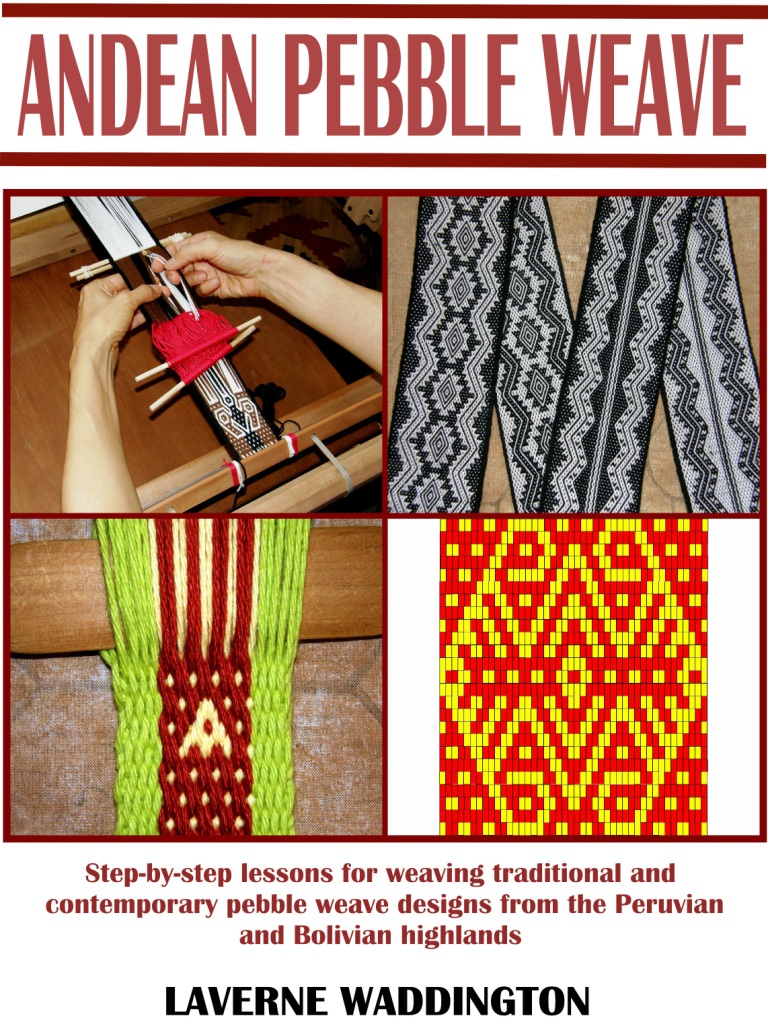
My e-tutorial on Andean Pebble Weave is now available at WeaveZine!

Thank you so much to all who have bought it so far and have mailed me with kind comments 😉

UPDATE………

Thursday night..Dallas airport. Ah, the life of the standby traveler! I finally got on a flight to Dallas from San Francisco but too late to continue on to Charlotte, North Carolina and my friend Lisa. A lovely American Airlines lady gave me a cot, blanket and bottle of water and so here I am set up in one of the lounges cosy as can be, laptop set up and getting ready to pass the night. Hmmm…I wonder if there is a place to set up my backstrap loom here. Now if I could just figure out how to turn off the annoying tv!

Good night! See you all here Friday morning. 🙂

Backstrap Weaving- Andean Pebble Weave-my ebook

Well here’s a surprise midweek post!

Syne Mitchell, editor and publisher of WeaveZine, after working closely with me for quite some time, announced last night that all was in place and ready to go on the WeaveZine site to sell my first ebook tutorial on my number one favorite South American pick up technique…(now available at Taproot Video.)

ANDEAN PEBBLE WEAVE


Today was a travel day for me – I took  the train down from Humboldt County in Northern California with its majestic redwood forests and turbulent rivers through wine country with distant snow capped peaks to bustling San Francisco  so I had to wait all day to be able to tell you all about this.

Andean pebble weave – this was the first pick up technique I learned with my  teacher Margarita in Huancayo, Peru back in 1996 and it really is my favorite for the flexibilty in the designs you can create as well as for the fact that it weaves up a lot faster than the other pick ups that I know.

It is partly loom controlled so only every second row requires a manual manipulation of the warp threads.

You will recognize pebble weave easily by its spotty “pebbled” background on which the indigenous weavers of Peru and Bolivia place a myriad of traditional and contemporary motifs.

It is also double faced so that both sides of the textile show the same motifs with their colors reversed.

You may remember from my blog post last week that this was the technique that I taught to Juan in Salasaca who wanted to learn something about his Bolivian weaving heritage and now I get to teach it to all of you.

The e-tutorial is really crammed with step-by-step photos – once I decided that it would be an ebook, I went to town with the pictures! There are over thirty pattern charts too.You can see that it is too huge to have here on the blog – it just kept growing!!

I have woven it on my backstrap loom, as Margarita taught me, as well on my rigid heddle loom by lashing the warp to the warp sticks. For some time I was lashing the warps to my Navajo loom in Chile as you saw in my last post. More recently I have been playing with it on an inkle loom using my fingers as a picking cross. Once I get home to Bolivia and unpack my inklette and get it set up I will see about installing two sets of string heddles and see how it goes – shall keep you posted on that.

So, it can be woven pretty much on any kind of sturdy frame that allows for tension adjustment and gives you enough working space to get your hands in to pick the pattern warps.

My e-book shows you how to wind the warp and arrange the threads in a cross ready for weaving. It is then up to the reader to decide how they would like to suspend and tension the warp. That could be by attaching one end of the warp to the body and the other to a fixed point (backstrap-style) or by lashing the`warp to the frame of a rigid heddle or other loom.

This is what Andean Pebble Weave looks like with its spotted or “pebbled” background…

Pebble weave Guarani designs from lowland Bolivia that I wove into a guitar strap.
A pebble weave motif from highland Peru woven in my handspun llama fiber. This was made into a shoulder bag.

I have used it on very narrow and wide pieces like guitar straps, belts, bag straps, purses, bookmarks, keyfobs, table runners and wall hangings. The e-tutorial takes you through four lessons from the narrowest plain bands to introductory patterning and then on to wider pieces with more detailed motifs and leaves you with pages of pattern charts of pre Columbian and contemporary designs.

My friend Janet inside a redwood!

I am still on the road with lots to tell which I am saving for Friday’s post – a new braid tutorial along with some other great videos and photos. I have had all sorts of unexpected weaving encounters up in the redwood forest area of Northern California with my buddy Janet and now find myself with a little quiet time here in the Youth Hostel in San Francisco. Just what I need to get all my pictures together and write my post.

See you all on Friday. I hope you like my e-tutorial and I get to see your own pebble weave projects soon. 🙂

Thank you to all who have downloaded it so far.

Backstrap Weaving- Where it all started

Syne Mitchell, publisher of WeaveZine teaching the “Rigid Heddle- Beyond Basics” class at CNCH this weekend.

WHERE IT ALL STARTED…

I am a teacher of English as a Foreign Language by profession and I love to teach. I knocked around doing a variety of jobs all over the place for a few years -travel agent, ski shop manager, to name a couple- until I was finally drawn to teaching. I also love taking classes, not just for the opportunity to learn something new, but also for the chance to observe another teacher at work. I am especially interested in seeing how weaving teachers manage those one-day workshops, imparting skills and sharing knowledge, while connecting and building a rapport with students over such a short period of time.  Being at CNCH (Conference of Northern California Handweavers) was a golden opportunity to learn from and observe some of the great teachers at work. I was lucky to have been able to take classes with Robyn Spady and Syne Mitchell at the conference last weekend. I finally got to “drive” an inkle loom and have bought an inklette. No thoughts on abandoning my beloved backstrap loom, though!

Robyn Spady teaching passementrie techniques that can be done on plain weave bands made on inkle looms. She has recently put out a book on the topic.
Since the conference I have been experimenting with weaving Andean Pebble Weave on an inkle loom.
I was staying in Grand Junction , Colorado with plans to do three multi-day hikes and climbs in the Utah canyon lands. A mountain bike accident put an end to all that and I ended up trading hiking boots, rope and backpack for shuttles, yarn and loom.

So, here I am in the US. I haven’t done any lengthy travel here since 1995 when I spent some time in Grand Junction, Colorado and I am reminded of  that trip so many years ago when I was fortunate to meet another great teacher – the one who set me on the weaving path along which I travel today.

This was my first real weaving experience and it was with a North American indigenous weave – Navajo style tapestry weaving. I came across Gladys Miller of Grand Junction Colorado quite literally by accident. She welcomed me into her home and taught me Navajo style weaving. Gladys was already well established and respected as a Navajo weaving teacher and had taught on several occasions at the Ghost Ranch educational retreat in Abiquiu.

I still can’t believe my luck in meeting up with her. What had started as a disastrous and disappointing vacation became a major turning point for me.

Under Gladys’s guidance and using Noel Bennett and Tiana Bighorn’s “Working With the Wool” I made these two samplers on one of Gladys’s looms practicing hooked and turned joints, raised outline and other techniques.
A Navajo weaver at the Hubble Trading Post taking her finished rug off the loom.

But  Navajo-style weaving techniques is not all that Gladys shared with me.

She completely immersed me in everything she knew about the Navajo people and their weaving.

Gladys had been taught by a Navajo woman, Mae Jim and has two of her rugs. Since Mae Jim’s death she has kept in close contact with her children. We did an amazing road trip through Navajo country, visiting trading posts and other historic sites as well as Mae Jim’s family on the Navajo reservation. We bought yarn, books and tools and covered so much ground – there was so much to take in – it was overwhelming and inspiring.

When I finally went back to Chile armed with warp and weft yarn, books, swords, battens and forks as well as my new weaving skills, my head was swimming with the designs of the rugs and the colors and shapes of the canyons and deserts. I had a loom made and got to work making larger samplers with finer yarns.

I worked through all my yarn, ordered more and some larger rugs followed in quick succession…

The rugs I made based on Storm Pattern, Two Grey Hills and Wide Ruins styles.

I eventually got to the bottom of my stash and just managed to piece a couple more rugs together from scraps…

A saddle blanket based on a chief blanket design and a Mexican motif made from gathering up scraps and dyeing them all the one color.
Gladys and I traveling through Monument Valley in 1996


A church we visited in Los Ojos

I returned to see Gladys in 1996. Another road trip ensued – this time to New Mexico and to visit the descendants of the original Spanish weavers in the region.

Again, Gladys shared her time, knowledge and friends with me and opened up a new world of Rio Grande weaving traditions. However, by this time I had already made my first trip to Peru and learned backstrap weaving and so South American indigenous weaving was very much on my mind. Nevertheless, I wasn’t ready to abandon my beautiful Navajo loom yet and continued to use it to weave wide pieces which I didn’t feel I could yet manage on my backstrap loom.

Two pieces employing South American pick up techniques lashed to my Navajo loom.
These are two warp-faced South American pick up pieces that I wove on the Navajo loom. Now I am spoiled with my backstrap loom and the way it allows to me increase and relax tension at will and I just don’t feel that comfortable weaving them on other looms. Yet I have to remind myself that I was perfectly happy weaving these pieces on my Navajo loom all those years ago – this will please those of you who would like to give these techniques a try but are hesitating about using a backstrap loom…

So, how did this all come about? Well we were chatting one night in the hotel room at CNCH last weekend about what our “gateway drug” into weaving was, that is, the activity that led us into weaving in the first place – were you first a knitter or a quilter or…?. It turns out that mine was mountain biking! I was in the US to do a series of canyon hikes in Utah, destroyed myself on my first day in a mountain bike accident, managed to hobble my way to a Navajo weaving exhibition while recuperating , met Gladys and there it all began – like I said, quite literally by accident.

One of Mae Jim’s granddaughters getting ready for her puberty ceremony

Well the years went by and I lost touch with Gladys but we were lucky to get back together after Gladys read my article on WeaveZine last year.

I was so excited to hear that she is still teaching, giving talks, getting together with Mae Jim’s family, leading tours and now weaving fabulous miniature rugs.

Who knows how many more people she

Gladys with one of Mae Jim’s daughters and her family

has set on the weaving journey with her energy, enthusiasm and generosity.

In fact, she sent me a photo of one of her miniatures on a C.Cactus Flower loom, a loom I had never heard of before and this now has me thinking about getting one and revisiting Navajo weaving in miniatures. You see, Gladys, you’ve done it again! THANK YOU!!

Three of Gladys’s rugs. The center one is on the C.Cactus Flower Loom – won’t take up too much room in my limited living space. I was lucky to be able to get acquainted with one at  CNCH.

########################################################

A few of the backstrap woven sashes in Kathe’s collection that are used by the Russian “old believers” in the communities in Oregon.

Speaking of the conference again, I have to tell you about two other teachers that I met there. Now this was just one of those freaky meant to bekind of meetings. I wasn’t signed up for their classes but we happened to be seated together at one of the dinners and got to talking.

Kathe Todd-Hooker and Pat Spark, after our initial introductions, suddenly put two and two together and recognized me as that “backstrap blog person”. They had run into my blog while googling backstrap weaving and “Old Believers”.

And that is all that I am going to tell you for this week. Next week’s blog post will be all about what Pat and Kathe shared with me about the Russian “Old Believers”, their community in Oregon  and most of all…their beautiful backstrap woven sashes. They are doing wonderful work documenting it all. The sashes will completely blow you away! Guess what will be my next reproduction project!!

And one of the most interesting and exciting things for me is that I am sure that there is a community of these people in Santa Cruz Bolivia where I live. Once or twice a year I have spotted a few of them in the streets but no one has been able to tell me anything about them. I had to come all the way to California and have this chance meeting to find out! Kathe taught tassel-making in her final class and invited me to see her slide presentation on the ”Old Believers”.

I just can’t believe my luck sometimes! 🙂

And there is a lot of other stuff about cool weavers and spinners I met at the conference which I will share with you next week.

#############################################

I have spied a blog with Becky aka Yodaknits  working on the “S” yurt band border design that I showed you all recently (pictured below). Her blog goes by the name of Knitasha Von Stashenskeins. She took weaving along on her Caribbean cruise on a picture frame loom and has since bought an inkle loom on which she wove the “S”. Check it out!

Janet, my roomie at the conference, has been weaving it on her backstrap loom, pictured at left, with fine perle cotton that looks super with its gorgeous sheen.

Becky’s “S” band woven on an inkle loom.

#############################################

Finally, seeing as I have been telling you about teachers and learning experiences, I thought I would leave you with a story about a fun and unusual teaching experience I had when I went to Salasaca in Ecuador in 2005.

One of the typical supplementary warp backstrap woven belts of Salasaca and my rough charting of some of the motifs.
We gathered to learn in a store rather than at a weaver’s house and so had to improvise a few things. We warped in the yard using metal and wooden stakes and whatever else we could find lying about.

I had gone to Salasaca,  a small town in the  central highlands of Ecuador, to learn how to weave their traditional supplementary warp patterned belts on a backstrap loom. I showed them my weavings as I always do when I approach potential teachers as well as photos of my home and other weavers in Bolivia. They were pleased to have this Bolivian contact as they believe that their ancestors were originally from Bolivia and are people who were forced to come over to settle in Ecuador as part of a Spanish plan to divide and weaken communities.

Juan had never woven before while Natalia had some experience. Here they are trying warping as I had shown them on their own.

They were very interested, therefore, in learning a Bolivian weaving technique – something that their ancestors had very likely known how to do –  and so I was persuaded to teach them rather than have them teach me. They looked through my woven samples and chose pebble weave.

First, a day or so was spent respinning their chosen yarns so they would be firm enough for the backstrap loom. Then we warped up in the yard and looked for a place to tie onto in the shop. My students were 19-year old Juan, Anita’s youngest son, who for some reason had never learned to weave the tapestries on the floor looms as his older brothers had, and Natalia who had learned to weave as a teenager but who had not had much opportunity to put it into practice.

Natalia didn’t need to be taught about heddle making. She got to work making her heddles before I could stop her and tell her that we had to make new crosses on which to make them. So here she is having a good chuckle as she undoes them.

Natalia’s classes were being constantly interrupted as she had a market stall across the street. She seated herself by the  door so she could dump her loom and take off every time she saw a customer approaching. So it was Juan who made the most progress.

Juan was such a great student! I showed him how to weave a triangle, he copied that a few times and, despite my recommendations to advance more slowly, wanted to go straight on to a more diffcult hummingbird motif. Here he is sitting on sacks on the concrete floor and using, at first a piece of cloth,and then some kind of tool belt as his backstrap. There weren’t any beaters or swords about so he used sticks from the yard which he cut and shaped for his heddle sticks and swords.
Juan with his mother Anita and Natalia. You can see the looms we were using on the floor tied to the wooden post.

I told Juan which warps to pick up for his first hummingbird and then away he went! Although it wasn’t perfect, he did an amazing job of copying it. His mother, who is not a weaver, was thrilled.

And then it was time for me to leave. I wanted to leave Juan with more designs that he could continue working on so that he wouldn’t just have the hummingbird to copy. Unfortunately I didn’t have any textiles that I could leave so I bought paper and colored pencils and drew pattern charts and tried to explain how to read them and relate the pictures to what he had just woven.

He was not one bit interested in learning about my crazy charts and,  no matter how much I tried to persuade him, he just wouldn’t have anything to do with them. Well, I left them there anyway as I had a feeling that when I wasn’t around, he might just pick them up and have a look.

I am happy to say that I was able to return to Salasaca eighteen months later to find that Juan had picked up the pattern charts and woven some of the motifs, invented a few of his own and even adapted a design from one of the traditional Salasaca belts to weave in pebble weave. I was thrilled! I then had his brothers asking me to teach them. Apparently Juan wouldn’t teach them – this was “his” thing and they had their own thing – the tapestry weaving. I didn’t get to catch up with Natalia on this trip as she had taken work in the city. I am amused to think that maybe some time in the future some anthropologist will be scratching his or her head and wondering how pebble weave found its way into Salasacan weaving!

##############################################

One more thing before I leave you all for this week…

Helena from Brazil, who first introduced me to the weavings of the Huni Kuin people of tropical Brazil and Peru, (you may remember that I wove a bag patterned in supplementary weft based on their motifs – at left) has sent me a link to an amazing YouTube video on these people and their weavings and it has English subtitles.

Do check it out – it’s wonderful. Thank you so much Helena for always keeping me in mind 🙂

PS…I have made a new page with links to all the videos on this blog.  A lady I met here in the US said it took her ages to find the one-weft double weave videos so now they are indexed and linked on a new page.


Backstrap Weaving- Crafting “on the road” and a video tutorial

Hopefully, if all my standby flights worked out, at the time this post is published I will be sitting in Robyn Spady’s inkle weaving class at CNCH. (Conference for Northern California Handweavers) My first such event! – very excited. This will be my first experience with an inkle loom and, hopefully, it will be better qualify me to answer those questions I often get about transferring pick-up techniques normally woven on  backstrap looms to inkle looms.

On Saturday, I will be taking Syne Mitchell’s rigid heddle class and the rest of the time I guess I will be looking at all the goodies on display, seeing Weavolution members in the flesh for the first time at the meet-up, perusing the galleries and taking lots of pictures to share with you all here at some stage.

So, as I write this here in Santa Cruz, Bolivia I am thinking it is time for me to get my “on the road” crafting stuff together.

I always take my backstrap gear along with me and, when there really isn’t anywhere I can hitch my loom, I braid or spin.

First the backstrap gear…

Backstrap weaving stuff to take traveling.
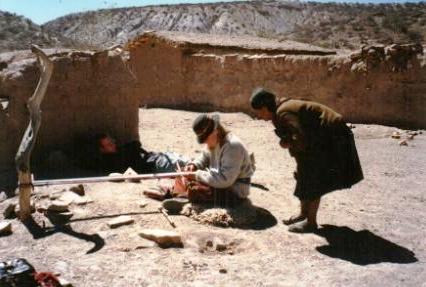
Weaving literally on the road near Potosi, Bolivia. I went with friends to the village of Calcha near Potosi to meet with weavers. On the way back we had to sit for hours on the side of the road waiting for a ride and finally got to travel back to Potosi in the back of a truck. We passed the time by hitching to a convenient dead tree and weaving. We had bought a sheep skin in the market in Calcha so we could pass the night sleeping on the floor in the hospital! This made a nice comfy seat for weaving. One lady who lived right near the main road where we were waiting came along to see and was enchanted!

I see that there is something I forgot to include in the photo – several flat non-stretchy shoelaces to tie the loom bars to a fixed object. I usually take a project already warped up and then my mini warping board goes along for when I get through that and want to start another.

The mini warping board with its removable screw “stakes”  is on the left.  Moving from there to the right, I have several thin dowels for cross sticks and heddle rods, my new shadow weave sewing kit purse, three beaters, a large curved needle, my new belt shuttle (thanks Lydia!), two loom bars and a roll up rod,  metal rods for three-selvedge pieces and my backstrap. I also take a small bottle of white glue so I can finish the braids on keyfobs and bookmarks. I usually pick up yarn on the trip so I can try out new stuff.

As for the braiding…

I was recently sent this image of a Tibetan nomad sling. I am no braiding expert but superficially, at least, the braid on the left looks exactly like the Margarita braid that I learned in Peru.

No, I am not going to pop a marudai, the piece of equipment on the left, into my backpack. Thanks to my teacher, Zacarias in Peru, I can make the nice Palma and Margarita braids used to make slings in Peru (which I first showed you in this post) with those two pieces of equipment on the right.

Of course there are other ways to braid the 24-strand braids without the use of cumbersome equipment. Rodrick Owen shows you in his Braids 250 Patterns from Japan, Peru and Beyond how to make them using notched cardboard squares and circles to keep the strands nicely in order. Perhaps you listened to the recent WeaveZine weavecast with Roderick Owen.

I am going to show you by video today how to work the 24-strand Palma braid as I was taught in Peru by a sling braider. The fiber used in the sling braids is generally llama and the strands are fairly thick and, therefore, easy to manage in the hands. I don’t imagine it would be quite so easy with fine yarns.

The video has been split into two segments. The technique has four parts so you will see parts one and two on the first video and the other two parts on the second one.

The idea of the videos is to show you the movements of the strands. I am not showing you there exactly how my teacher held his hand as he braided as the crossings were not so clear on the video that way so I will show you that in a still shot later.


Two Palma braids made with 12wpi cotton. I am going to use the one on the right as a strap for the bag which you can just see at right.

Getting started on the Palma braid:

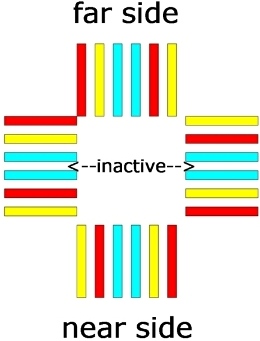
You need eight strands of each of three colors, that is, twenty-four in total. Keep the strands short for your first practice braids – I suggest no longer than 18″. Tie all the ends together in a knot . Hold the knot in your fist having all the strands emerging from the top of your hand and then separate them into four groups. Try to align the strands as closely as possible in the order shown in the following diagram. Organized in this way, you will have red and yellow “Vs” in your braid separated by columns of light blue. It will be impossible to get the strands to stay exactly in this order at first, but don’t worry about that. This is just to get them more or less in place so you can start.


You can also see the strand order in the photo below left. Once you are braiding, only two sets of strands are worked together at any one time. You work with the near and far side sets while the other two sets are hidden in your fist, clasped against the braid itself as you can see in the photo below at right.

LEFT: The four groups of strands. RIGHT: Grasping the strands in the fist.

And now for the videos…They are a bit on the dark side-still haven’t found the perfect spot for movie making…


Well, I hope these video instructions were clear for you. Remember that yellows always pair with reds and vice versa and that you are always working from left to right across the strands. In your very first two moves, you won’t need to think about “uppers” and “lowers” when you work with the blues – just grab any blue and cross it over. Uppers and lowers will become apparent after that. Tug lightly on each strand before you cross it.

Starting is the hardest part as the strands will be loose and wandering about. After the first sequence, however, they will begin to sit naturally in their correct positions.

The picture at left shows how my teacher held the strands while braiding.  All the ends were wound into butterflies and his hand was tilted so the strands all hung down. It looks like a mess and the strands occasionally wrap around each other, but it works! Strands are going this way and that and then you open your fingers to reveal this gorgeous braid. This is the first time I will be using a braid for a bag strap – let’s see how it goes.

I will be braiding on my flight to San Francisco as I am putting some woven pieces in the gallery at the conference and hope to use the braids to hang them. This is one of those things I just didn’t get around to doing so I guess I should stick to four-strand braids for this so I can get them done quickly.

And finally the spinning…

I always take a spindle and a bit of llama fiber along but usually only to show people a

Trini in Ecuador having a go on my drop spindle.

typical Bolivian spindle. The weavers in Guatemala knew nothing about llamas or llama fiber so it was fun to show them pictures of llamas and samples of the fiber as well as some things I had woven with it. Those in coastal Ecuador had never seen drop spinning so it was nice to be able to teach them a little. Spinning, unlike pick-up weaving and braiding, is something I can manage while chatting with people. I do like hunting for typical spindles and unusual whorls on my trips and this usually leads me off the beaten track. Having a spindle on me is always a good ice breaker. Not everyone can weave but in the villages of Bolivia it seems almost everyone can spin a bit or at least use a spindle to respin or ply yarn. They actually think I am a little mad when I say I want to learn – “What is there to learn? Even my four-year old son can do it!” – they tell me.

LEFT: Typical drop spindles sold in the Bolivian markets. RIGHT: A few of the spindles that I have collected in my travels.
LEFT: Spinning in Yanque, Peru RIGHT: Salasaca, Ecuador where the spindle called ‘sigsig’ is made from pampas grass stems. The wool is spun to be woven on floor looms into the cloth from which skirts and shawls are made.
LEFT: Spinning in Otavalo, Ecuador RIGHT: Spinning on the way home from the market, Tarabuco, Bolivia.

And last of all I take my small photo albums with pictures of weavers, looms and textiles from around South America to show weavers and travelers. I also have another album with small samples of various motifs I like to weave. In Salasaca they treated this like some kind of shopping catalog and started  making orders selecting motifs for belts and purses!

Now is there any room left in the backpack for clothes and stuff?

I am going to try my best to continue with my Friday blog posts while on the road. If I don’t don’t get a post out, it will mean I am having too much fun! 🙂

Late addition to this post…here is Stitchwort’s “S” design band from last week’s tutorial on her inkle loom made with her own handspun yarn. So if you have been wanting to try these techniques but have been a bit dubious about getting strapped into a backstrap loom, take a look at the lovely band that she has turned out. By the way, I am in love with her little shuttle and she made that herself – check it out on her blog.

The only drawback with the inkle loom that I can see is width limitations but for a band like this there is no problem. One Weavolution member did mention that these types of weaves put a lot of strain on the inkle loom so that is something to bear in mind – just in case! I am hoping to come back from CNCH a lot wiser about inkle looms!

##################################################

TRAVEL UPDATE…WEDNESDAY: Yay I made it. Both my luggage and I got to San Francisco. I have one day to recover from the trip before the conference. Gorgeous day here today – I even got sunburned.

A little time for some sightseeing…

This is one of the places I wanted to see but, wouldn’t you know it?-it was closed just today to prepare for an exhibition. So I had to satisfy myself with pressing my nose against the window and looking at all the lovely things.
THURSDAY: Dim sum breakfast in lively Chinatown, San Francisco before heading down the coast to Santa Clara. The ocean!-something I miss in Bolivia.
At the Convention Center- meeting other weavers and a lesson on spinning angora rabbit fiber from Janet, a Weavolution friend, using spindles with bead whorls.
A couple more “on the road” weaving tools belonging to my roomies here at the conference. LEFT: Janet’s mini inkle loom which she let me play on last night. RIGHT: Connie’s cool C Cactus Flower Navajo loom with her cute miniature rug.

It is funny that I have run into this Cactus Flower loom here because I saw one for the very first time last weekend when I was emailing my first weaving teacher – a lady here in the US who taught me Navajo style weaving. This is where I first got my start in weaving back in 1995 and, seeing as I am here once again in the US where it all started, I hope to blog a bit about my first weaving teacher and my adventures in Navajo style weaving next week. I have always lamented having to leave my huge Navajo loom behind in Chile when I moved to Bolivia in 1998. Now you can just pop a Cactus Flower loom in your bag and hit the road!

A buzz of excitement in the air…classes start tomorrow. 🙂