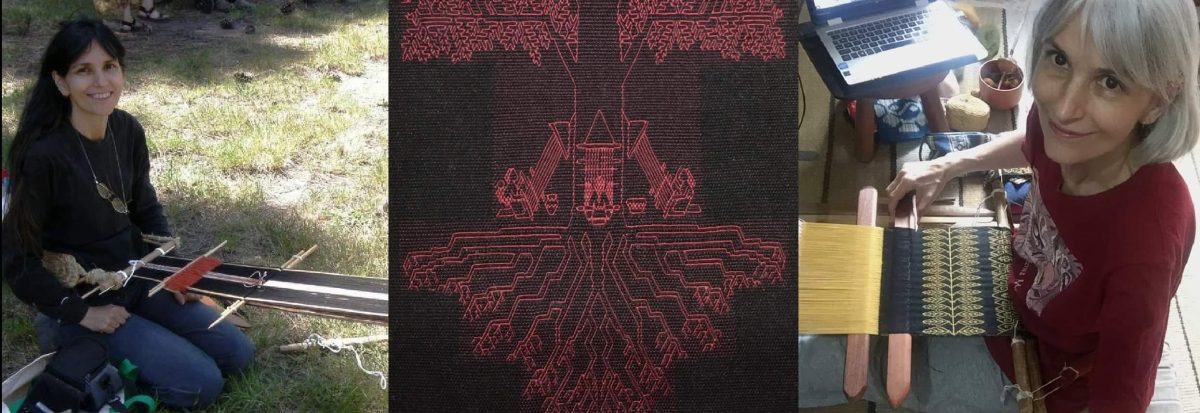
Backstrap Weaving – A Little Online Globetrotting

I’ve been playing with lanyards this week. These are nice tiny projects which have kept me entertained at the loom during breaks from other things not related to weaving that I have had my head in this week. I have been adding more and more string heddles to my bands to make them more and more loom-controlled and it has been a fun exercise.

Here are the first three finished bands which I will send away, as promised, for lanyards…

three lanyards backstrap weavingThe one on the left has the heaviest yarn, the center one I will call ’medium and the one on the right has the finest –  the 60/2 silk. I set up the center black and white band with 11 sets of string heddles. I could have made the eleventh heddle a simple loop but I got carried away with the fun of making heddles…

11 heddles on band backstrap weavingUsing a system of colors certainly helped. Every second heddle is white. I knew that when my weft was on the left, I needed to use a white heddle. Then it was just a matter of remembering the color of last heddle I had used when the weft was on the right to know which heddle was next in the sequence. I worked my way up through the heddles and then back down again. The thread I used has a lot of twist and is super smooth. That helps a lot when using multiple heddles.

I had to advance the warp as often as possible so that I didn’t have to lean far forward to reach the last heddles. This black and white band is the one with the most heddles and the one I enjoyed weaving the most….so far.

bands for lanyardsNow I have four made. The last blue and white one is in the 60/2 silk using the intermesh structure that I teach in my second book. However, I am going to re-do that one. I didn’t start it at its ideal width and the width changed a bit before settling. Now that I have a sample from which to work, I can make a better one. I am finding the the silk is the hardest to work with when using multiple heddles as it has more of a tendency to fluff with the extra abrasion.

Before getting into the second version of the intermesh lanyard, I warped another band in a different weight of mercerized cotton…

lanyards with multiple string heddlesAgain, the colored heddles help a lot with keeping track of the pattern. I am using the Andean Pebble Weave structure for this one with its two Pebble Sheds. I know that after every black heddle I need to use Pebble Shed 1, and then, Pebble Shed 2 after every orange one. These little tricks help keep the process fun rather than frustrating.

Last week, I posted a video that was shared with me by Adem in Turkey. It showed backstrap weaver Kay Seng demonstrating the use of multiple pattern sticks rather than multiple heddles on a piece that she was patterning with simple warp floats. The floats were formed from threads that were in one of the two sheds.

12895472_10154144034673629_611384756_nAdem has been weaving a band using this technique. He found a picture of a band online with this sweet butterfly pattern and tells me that it is from a book published in Japan. The image at left is the best I can do to show you the name of the book. Here is Adem’s band….


adem pattern sticksYou can see that he has half of the pattern stored on his pattern sticks beyond the shed rod. Many thanks to Adem for sharing a video he made of himself weaving the pattern and showing how to operate the loom with those sticks.

And now for some more globetrotting…from Turkey and Japan, let’s now travel to Nigeria where I have a new online weaving friend, Roli.

Roli and I had similar experiences when we were first introduced to the wonderful String Heddle. The Question of the Week in one of the online weaving groups was about an epiphany that we had experienced in the course of our learning to weave. I don’t know if mine was exactly an epiphany, but it certainly felt like the light shone down and the choir sang, the moment I was shown these things called String Heddles. I was with the teacher who taught me Navajo-style weaving. How I love them!

Until that moment, I had been using a plastic ruler to go over and under warp ends to create sheds on a very crude wooden frame I had knocked together. The cardboard rigid heddle I later constructed kept breaking and I was becoming frustrated with the whole business of trying to create fabric. This was back in 1994 and 1995.

Roli told me of a similar experience. In 2006, she was trying to revive the traditional ancient costume of the particular group of people to which her husband belongs in the Niger Delta. She tells me that the royal cast who were priests and kings wore the cloaks you see below and still do. She wanted to construct caps and bags and cloaks using strips of cloth that she had woven on a frame loom she designed and made from pieces of the raffia palm tree. It is a very lightweight material.

niger deltaShe, too, was using a stick to pick up every other shed and found it so tedious she almost lost interest. Then, one day, she came across my blog where she learned to make string heddles and she tells me that she has now resumed in earnest.

Not only does she use the raffia palm tree to provide pieces for her loom and tools, she also uses the fiber from the leaves as warp and weft. Often she combines it with colored acrylic yarn.

loom and tools

raffia

textile and hatShe produces fabric decorated with pick-up patterns. Bands are sewn into caps and several bands can be sewn together to make the cloaks and bags you see below.

cloaks hats and bagsI had never seen a raffia palm tree before. Here is a picture of one from the Wikipedia page. Hopefully, I am showing the same species that Roli knows in Nigeria.

Raphia_australisUsing wood from the raffia palm, she has created four looms of different sizes to accommodate the different widths of cloth that she needs for her projects. Right now she is working on a custom order for a white cloak and has used a lettering and patterning technique from this tutorial on my blog to create a band for the center of the cloak. She will weave six white panels of 6” each for the cloak and then make a matching bag and cap. Beautiful work!

Roli at her loom

pieces for cloakRoli’s loom is of her own design. She sits it with one end in her lap with the other end on the back of a chair. It can be adjusted to compensate for take-up (unlike the frame loom I built for myself all those years ago. I had no idea about such things as take-up!) She tells me that the traditional loom for these garments is a vertical frame. However, the clothing, the weaving and the stripping of raffia leaves for fiber are all shunned practices now as they are considered ‘’fetish’’. She explained ‘’fetish’’ as meaning that these items of clothing were associated with traditional worshipers.

I hope to see more from Roli. I would love to know more about how she strips the raffia leaves and processes the fiber and I can’t wait to see the finished white cloak. I am hoping its new owner will allow himself to be photographed with it. Many thanks to Roli for sharing this with us.

From Africa let’s move over to North America…..Amanda showed us the backstrap she wove for herself using Plymouth Yarn Fantasy Naturale yarn. That’s my favorite yarn for backstraps. She chose of the variegated options and did a beautiful job.
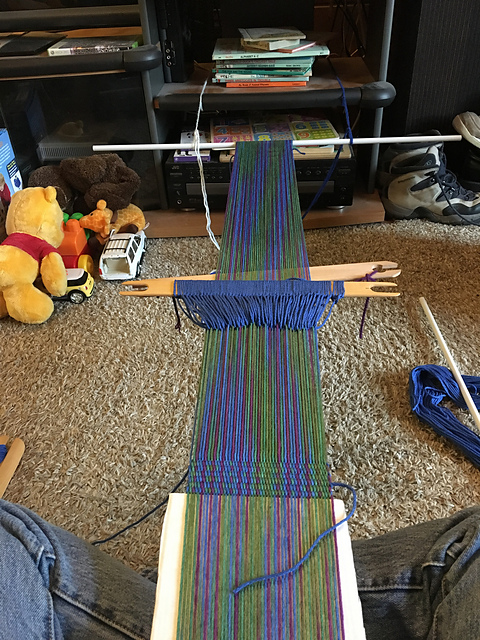
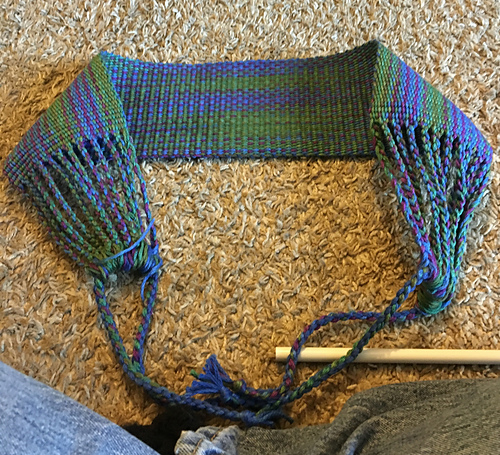
amanda set up

amandaAnd, Janet has been using her gorgeous handspun once again to weave beautiful things using the Andean Pebble Weave structure. The pattern is her own design and she says she might use this as a guitar strap.

janet handspunIt’s nice seeing these large projects as I head back to my tiny lanyards. I am having fun. I have always loved things in miniature.

My purple panel sits by waiting for me to produce its twin. I have decided to call it the ‘’lady bug’’ project after seeing the colors in this beautiful picture online

finished purple panel on loom


Backstrap Weaving – All Warps Great and Small

A couple of months ago, I created a project that had outgrown my regular loom bars and I had to buy brooms and cut them down for my beams. That project was a plain-weave piece of 2000 ends of 60/2 silk and supplemental weft for patterning. This week I find myself weaving with the same silk and my regular loom bars but, this time, my project is a mere half-inch wide.

silk on silk supplementary weft motifsIt may seem like overkill using those big sticks for such a tiny project. Many a time I have abandoned the sticks to pass cord through the end loops of the warp and tie that to my waist with the other end of the warp hooked to my big toe. No backstrap, no sticks…just fingers, a toe and string.

However, I do prefer the stability of the sticks and I feel perfectly balanced and at home with what may look to others as a very cumbersome, clumsy and perhaps unnecessarily complex set-up. I think this backstrap weaver in Mexico feels the same way I do.

picture by Karen Elwell
Picture by Karen Elwell

I think her band may be even narrower than mine. The narrow band project is happening because I promised some lanyards for name tags for a friend. They need to be roughly 1/2 ” wide and 34” long. I have to admit that it is a nice change and break to be weaving these after having had so many large projects on my loom lately.

I wanted to fit a lot of pattern into that mere half-inch space and so I used 60/2 silk. I wove an Andean Pebble Weave pattern. Because it is a complementary-warp structure with warp-floats on both faces, the band is dense enough to make a good lanyard. I chose a pattern that I have woven so so many times before, I can just about do it with my eyes shut. I was a bit put off by the impending boredom…34″ of a pattern that I already know so well and have woven in many color combinations. I wouldn’t experience the delight of seeing new shapes and forms appear or new color combinations. It was just going to be very, very slow going with the fine silk.

So, I decided to set it up for loom-controlled patterning so I wouldn’t have to have my fingers in among the size 60/2 threads. Having it set up with a series of heddles to control all the pattern sheds would make this novel and interesting, not to mention fast!

pebble weave guitar strapA few years ago, I wove this guitar strap for a friend. She was giving it as a birthday present and it had to mailed to the USA from Bolivia. I was on a deadline and had to move fast. I set up only two  heddles in addition to the two pebble heddles to speed things up a bit. Part of the process was still weaver-controlled in that I was picking up some of the sheds by hand.

For the new silk lanyard project I went with almost 100% loom control…

silk lanyard with multiple heddlesI have five sets of heddles and a shed loop. This particular pattern has a couple of horizontal bars. I picked up the first horizontal bar by hand, stored it on a saver cord and used that cord to weave the second horizontal bar. Then I had to remove the cord. That is the only time I picked up by hand. I could have installed another set of heddles for that pick but didn’t want to clutter things up too much. This silk does tend to fluff and there is a lot of extra abrasion with sheds being cleared through all those heddles.  The weaving went really fast and what I thought might be tedious was, in fact, a lot of fun.

silk lanyardBand weavers in Peru sometimes use multiple string heddles on their simple body-tensioned warps to quickly weave small repeating patterns…

Picture by Virginia Glenn

Now I am weaving a second lanyard with #10 crochet cotton. As the thread is heavier, there is less detail in the pattern…only 16 ends of pattern threads this time compared to 64 in the silk lanyard. I have installed more heddles for this one as this mercerized thread can take the abrasion better than the silk.

second lanyard with 7 heddles and a loopThis project has 7 sets of heddles with one pattern shed held in a loop. The colors of the heddles help me find my way in the sequence. It’s another pattern that I have woven many times and that I did not wish to pick up for 34”. I used it quite recently on my silk yurt-shaped pouch and accessories.

yurt pouch with cuff and necklaceIt has gotten to the stage where I am not interested in weaving something unless there is some major learning to be had. This project will show me how well I can manage 7 sets of heddles and if the work of clearing sheds through multiple heddles makes this method worthwhile. It is not something that I am planning on adopting for my own weavings. I really do prefer getting my hands in there and doing the pick-up!

weaver san ignacio de loyolaI doubt you will be seeing me doing this any time soon! I will weave a couple more lanyards and see just how many sets of heddles I am willing to manage for other patterns.

I have seen other pattern shed storage systems used by backstrap weaver in various places…sheds stored in multiple heddles and on sticks. Deb McClintock showed me how Laos weavers use a vertical shed storage system on their floor looms. She adapted the system to one of her own floor looms.

deb-mcclintock-adapted-pattern-storage-systemInspired by that, I have sometimes placed colored strings on my string heddles to help me lift threads for small repeating supplementary-weft patterns. The colored guide threads help me locate the spot where the pattern needs to be placed and gives me the first pick rather than having to count lots of fine warp ends.

pattern warp storage systemHere is a video that I took of Deb McClintock  demonstrating the Laos pattern storage system.

I have not had the chance to see how other backstrap weavers in Asia set up pattern storage systems. I have seen lots of sticks piled up on backstrap warps but have never seen them in use. An online weaving friend in Turkey, Adem, sent me a link to a very interesting video showing how a backstrap weaver uses those sticks. The video does not give information about the weaver but I believe, from having looked around online, that she may be a Karen weaver of Thailand or Myanmar. She mentions having brought thread with her from Thailand. There seem to be a few groups of Burmese weavers being formed in the USA where the ladies can come together, teach and support each other, practice their art and eventually sell their cloth.

These are a couple of shots from a video made about a group of such weavers in Vermont at the Vermont Folklife Center. They show the pattern sticks in the warp between the shed rod and coil rod.

pattern sticks backstrap warp Burma

pattern sticks Here is the video that Adem sent me. The weaver is using a simple warp-float technique with floats formed from the threads in one of the two basic sheds on only one face of the fabric. It is a very cool set-up!

And so, I will be be playing with multiple heddles on my teeny tiny warps for a few days. If it is fun, I will make even more lanyards than I originally promised.

two wool panels with aligned motifsIn the meantime, the brown wool on which I had been waiting arrived and now I can plan and weave the edging for the brown wool panels that I recently finished.

I finished the purple wool panel and have put that aside. It was tougher weaving the pattern on the purple piece than the ones I chose for the brown panel.

A few factors made weaving the brown panel more enjoyable. Firstly, I used the Andean Pebble Weave structure on the brown panels which means that every second weft shot was through a loom-controlled shed. That speeds things up. Plus, I just love working those two sets of heddles. The fact that there are six different motifs made it a lot more interesting too. I was also weaving the narrow continuous pattern alongside the larger motifs for the first time. It was my own design which added extra interest.

I used a supplementary-warp structure for the purple panel. I have never been a huge fan of this structure and, unfortunately, weaving this piece did not change the way I feel about it. I am not sure what it is…I just don’t like the way it feels.

The motif was continuous and rather confusing with those hooks going this way and that but I like those kinds of pick-up challenges! I really want to wash this piece and see how things come together after the wet finishing. However, I dare not do that until I have the second matching panel completed. In any case, I am really pleased with the way it came out. It will be nice to have these two large wool pieces showing two different structures. I will weave more in this wool set representing other structures.

finished purple panel on loom I have quite a few lovely things to show from my online weaving friends but will leave them for next week.

Instead, let me leave you with this gorgeous video of a song by Mapuche singer Anahi Mariluan sung in a mix of Spanish and the language of her people of southern Chile and Argentina. I am very grateful to my many Chilean and Argentinean online weaving friends who send me links to these beautiful things. The scenery of the south in this video is stunning and the song is so peaceful and delicate yet powerful. On the Youtube page for this video you can see the lyrics…. ” No Estamos Solas” –  ”We are not Alone”. You can listen to more here.

Backstrap Weaving – Colors

band from PAZA BoliviaGorgeous colors! Just what I need to lighten a dreary drizzly day in the tropics….warm colors of the highland countryside. This is one of the bands that I received recently from PAZA Bolivia. My weaving teacher, Maxima, heads the cooperative that weaves these bands on the traditional leaning vertical loom in Cochabamba, Bolivia. The weavers use their own handspun wool which has been colored with natural dyes.

If you are a regular reader of my blog, you will be used to seeing this annual event – the arrival of the Cochabamba fajas. You will have heard many times about my excitement at opening the box with its outpouring of colors and aromas of the Bolivian countryside.

PAZA BoliviaI mentioned to my friend Dorinda, who works with the weavers and helps to manage their sales, that this latest batch of bands was lacking the rich chocolate browns of previous collections I had received. I was surprised when she told me that those darker colors were obtained from khesi misa, or soot. 

What I wasn’t surprised to hear was that the ladies do not enjoy scraping off the build-up of soot on their kitchen walls to use in the dye pot. As you can imagine, it is mixed with grease from the hundreds of cooked meals and must be truly awful to work with. I don’t know what the cooking spaces look like in the communities where these weavers live but I can show you the kitchen of one of my teachers in another part of Bolivia to give you an idea. This is an old print from 1998.

kitchen candelariaOf course, it is so much nicer to be dyeing with leaves and flowers and cochineal bugs. Natural black can always provide the dark contrast and some of the greens that are obtained are quite dark too.

I have showed you pictures of Independencia and Huancarani where Maxima lives in other blog posts. At around 2600 meters above sea level (approx 8600 ft), it is very green and hilly. Pictures that Dorinda sends me or posts show the ladies working in pretty gardens amongst an abundance of plants and flowers.

grphuancarani

1 (1)The city of El Alto in La Paz, on the other hand, sits above 4000 meters (approx 13000 ft). It’s a different story up there on the Bolivian high plains – dry, flat and largely colorless. That’s why a recently finished project of several high apartment blocks in El Alto has attracted widespread attention. Bolivian artist Mamani Mamani, known for his use of color, (see an example of his work at left)was commissioned to design enormous  murals for the walls of the buildings.  I am hoping that the next time I fly to El Alto airport in La Paz, I will see these colorful images standing out against the dry and dusty plains. The following pictures of the project are from the webpage of Mistura Urbana

mamani-mamani-el-alto-la-paz-whipala-bolivia99

mamani-mamani-el-alto-la-paz-whipala-bolivia-1

More of Mamani Mamani’s work can be seen here.

In this next picture, you can really appreciate the bleak surroundings…

mamani-mamani-el-alto-la-paz-whipala-bolivia-9

mamani-mamani-el-alto-la-paz-whipala-bolivia6I became a little obsessed with the red, purple and gold that you can see in this last picture. Actually, the red-purple-gold ”thing” really started when I watched the movie The Grand Budapest Hotel for the second time last week. As it was a second viewing, my mind was freer to wander and take in more of the scenery and sets and the purple, red and gold kept calling to me…

This image released by Fox Searchlight shows Tom Wilkinson, Tony Revolori, center, and Owen Wilson, right, in "The Grand Budapest Hotel ." (AP Photo/Fox Searchlight)
This image released by Fox Searchlight shows Tom Wilkinson, Tony Revolori, center, and Owen Wilson, right, in “The Grand Budapest Hotel .” (AP Photo/Fox Searchlight)

It’s not like I haven’t used this combination before…

amulet bag backstrap weavingWhat looks rather blue in this picture is actually a dark purple. This is an amulet bag that I made many years ago when I was first practicing sewing and weaving tubular edgings. It was a cute little pouch with its cross-warp strap and pom poms. My friend DY has it hanging from the rear view mirror in her car.

Last week, I was about to start my next wool project and I had purple, gold and red wool…perfect. Well, not so much. The purple wasn’t deep enough, the gold was greenish and the red just wasn’t lipstick-y enough. I spent several days winding warp with these colors, adding and subtracting ends, re arranging ends, pulling things out and starting again before I gave up on trying to make the particular tones of red, purple and gold work. It was so hard for me to wipe that color combination from my mind and start anew.

So, this is what I have come up with. You can see that I really wanted to use the purple! It is one of two panels that will be connected with decorative stitching. I am creating the patterns with supplemental warp threads. There was one more thing that I wanted to change but I got to the point where I realized that this could go on forever! and so I just decided to get on with it and weave. The center stitching, which will run along the right hand edge, will be in the greenish gold and the edging around the two joined panels will be in purple. I hope that will balance it all out. And, I am very pleased that I remembered, despite all the warping chaos, to add a stripe at the inner edge to make placing the stitches easier.

wool panel with supplementary warp patterns backstrap weavingIn the meantime, my brown wool is on its way in the post so that I can create the outer edging for my first wool panel piece…

decortaive joining stitch on wool panels Something is going on with me and I am noticing color more. I am currently watching the series Parenthood for the first time on dvd. I see scenes with characters dressed in black seated on a butter-yellow couch in front of a dark green wall and all I can think of are the colors. Will we ever see a red-white-black piece from me again? Undoubtedly! I still have more hangings in that series that I want to create.

Now, it’s back to the loom for me and I will leave you with some final splashes of color…

cochabamba bands