

Backstrap Weaving- Weavers in New Mexico and a new Mexican weaving

Convergence is now long over and I can’t believe I have left it so long to write up this blog post. You have no idea how hard it was to skip that first post having gotten into the habit of regular Friday posts. Then the next Friday slipped by….The danger with waiting too long to write is that you risk losing that special feeling that you had associated with the event and even forget some of the important details. So here I will try to recreate some of that and I do hope that I don’t leave anything out. I was surprised to have some people at Convergence ask me to please stop posting for a while so that they could have the chance to catch up! I have been relieved to see that readership has only slightly dropped off during these two weeks of madness. So I hope you have, in fact, had time to catch up on things and perhaps revisit some pages because…. here we go with a bunch of new stuff…
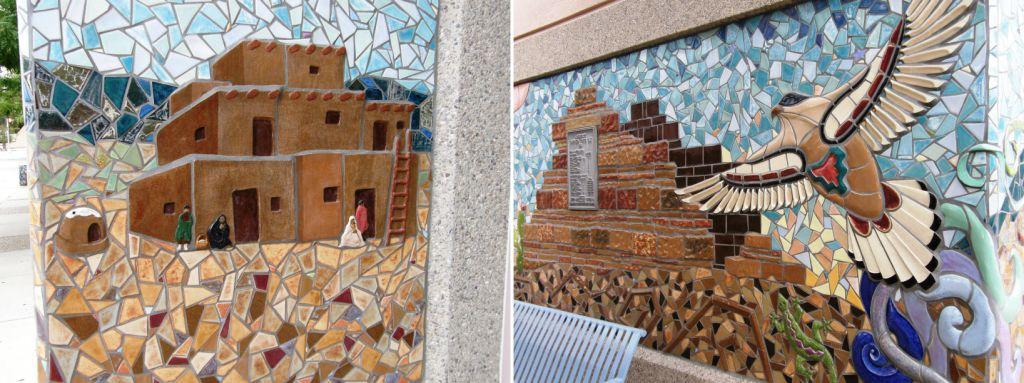
 

These are some of the colorful murals that decorate the outside walls of the Albuquerque Convention Center. These are probably all the “classic” New Mexico scenes you will see on this blog. Thankfully, this was my fourth visit to this beautiful state and so I was not overly concerned about not being able to get out and about. I glimpsed some hills on my shuttle ride in from the airport and then, as I was staying downtown 8 blocks from the Center, my only view on my walks to and fro were downtown buildings..


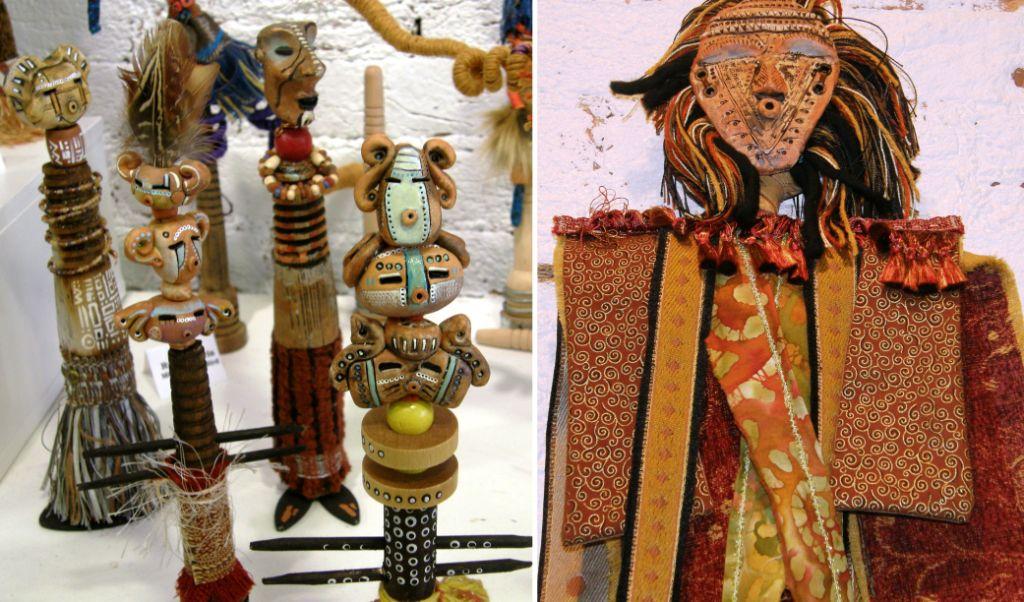
On my first day in town I did manage to get out to see a gallery of Joanne Moore’s double weave pieces downtown and I was fascinated by these wire dolls made by Ruth Morris.


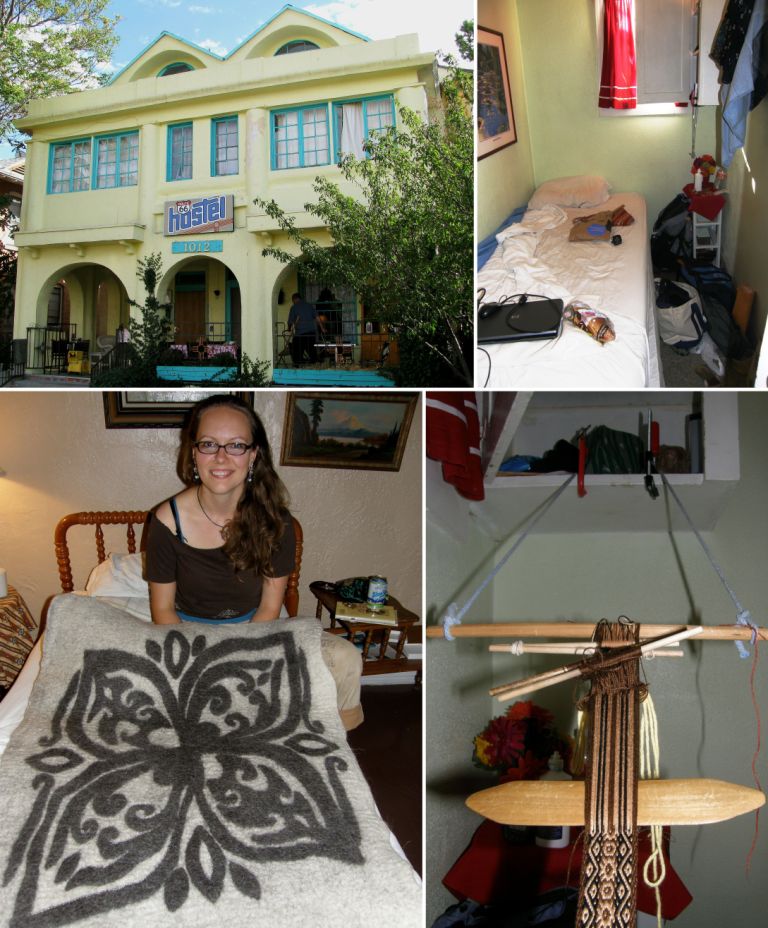
This was my home sweet home for the duration of my stay…Route 66 Hostel…a backpacker style place where I had a wee closet-like room with free wifi and breakfast and a very laid back family atmosphere. The only other Convergence participant there was Jasmine Johnson-Kennedy who had come all the way from Fairbanks Alaska – possible as far north as Bolivia is south! Jasmine took the felting class and produced this gorgeous piece. It was fun meeting up with her at night and seeing her work grow. She had just started outlining her design in stitching to give it a raised three dimensional effect on her last day of classes. Of course I had to find a place to tie up my backstrap loom in my wee abode and, as I had wisely brought clamps, I was able to do so on a little shelf unit on the wall.


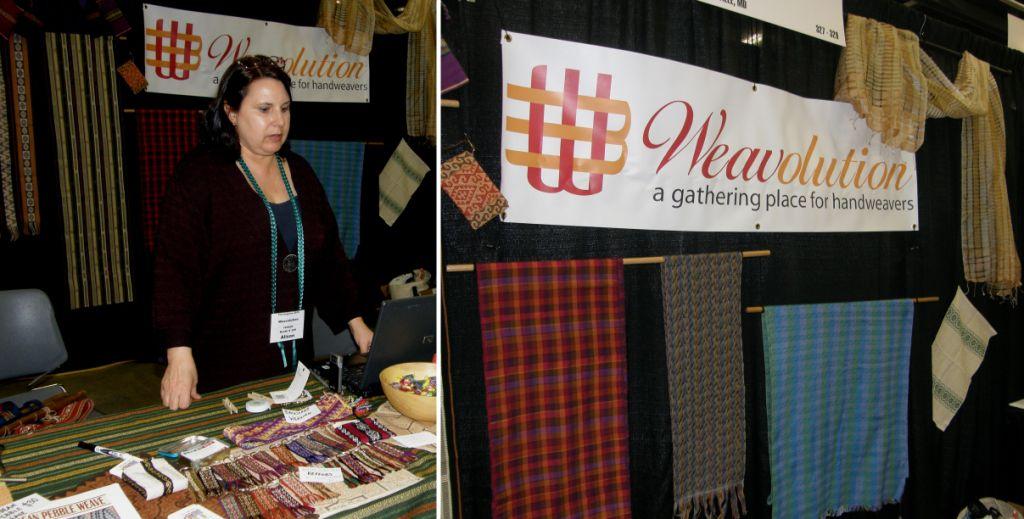
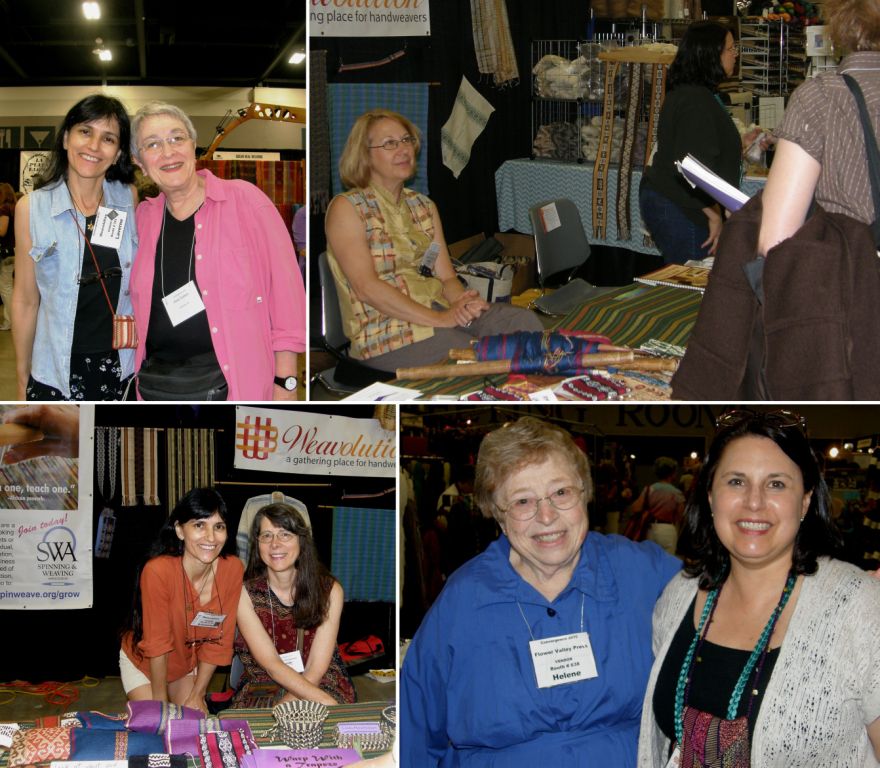
My goals for Convergence were to meet my online weaving friends and hang out and backstrap weave. I was sitting at the Weavolution booth between my wanderings just so that I could give Weavolution co-founder Alison Giachetti a break now and then. The booth was shared with SWA (Spinning and Weaving Association).


Here’s Madelyn van der Hoogt of Handwoven magazine visiting the Weavolution booth. You can see Madelyn above trying out a handwoven jacket she had seen on one of the stands. Tien Chu, one of Weavolution’s founders came by to show her latest project – a beautiful double weave shawl. Patty Graver of Interweave flew by to say hi and I was very happy to have a visit from John Mullarky of TWIST as we had met online at Weavolution while admiring each others’ bands on the Project Pages there.


Day One was short as the vendor hall was only open from midday to five pm but it was a nice introduction to the routine we would be following for the next few days. Sally Ogren kindly allowed us to use some of her pieces to decorate the Weavolution stand and I hung a few of mine. Here you can see Alison with a display of my keyfobs and Weavolution goodies.


Day Two started for me with a wonderful surprise visit from my very first dear weaving teacher, Gladys Miller. Gladys taught me Navajo style weaving back in 1995 and had also taken me on two wonderful roadtrips through the Four Corners area in 1995 and 1996. I blogged about this here. Over the years we had lost touch until Gladys saw my name on the Backstrap Basics article in WeaveZine and emailed me. She had not told me that she was planning to come to Convergence and so it was a complete surprise. She stayed a day and we caught up and then she headed to Santa Fe to see the Spanish market with her granddaughter.
I was free to weave, visit some booths and be a bit more helpful on the Weavolution stand. It was a hard decision where to go and be sometimes. All I had to do if I wanted to meet all the wonderful weavers in attendance was stay put at the Weavolution booth. They all came by to say hi. It seemed that every time I stepped away to see something I would miss someone.
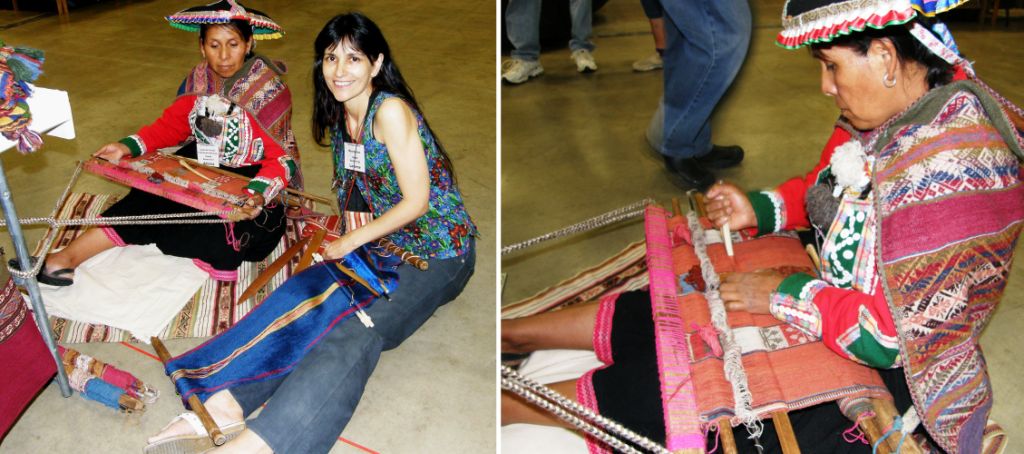


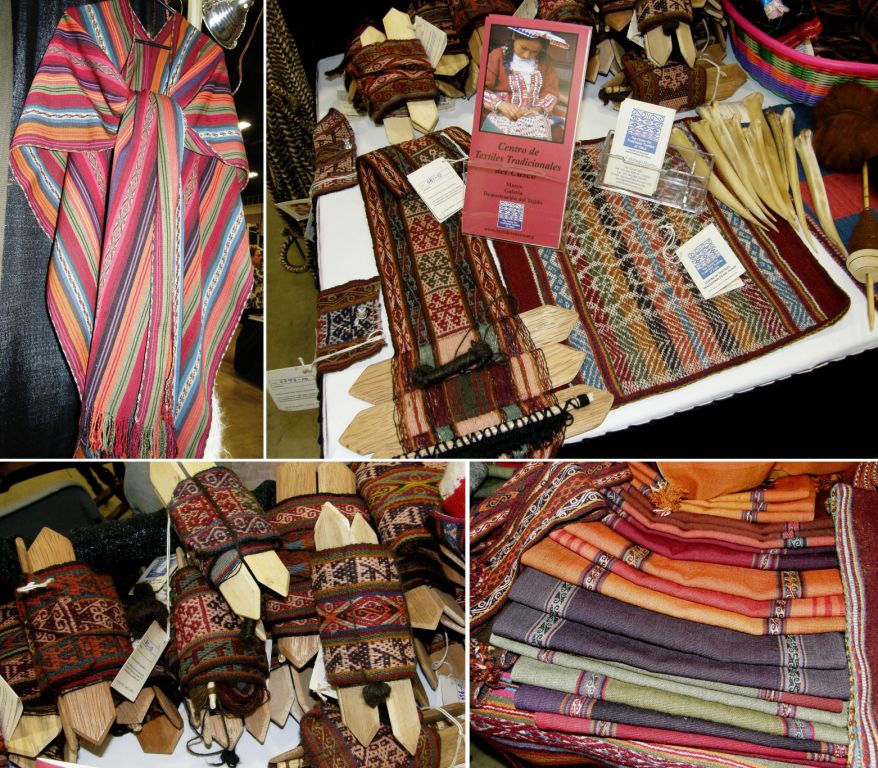
Later Antonia was working on a discontinuous warp piece, something I had never seen before, and a technique she says the weavers of Pitumarca are now trying to revive. Jenny and Antonia had brought several bone beating and pick up tools, called wichunas or ruki, which sold out in a couple of days.


The CTTC (Centro de Textiles Tradicionales de Cusco) stand was a feast of colorful textiles….ponchos, cloths, bags, purses and woven belts still on their looms.


Meanwhile back at the Weavolution booth, we were being visited by Alice Schlein whom I had kind of met in “blog link land”, Daryl Lancaster who came to hang out and chat as well as to do a book signing, Linda Hendrickson, who thankfuly came back to visit several times ( I had gotten totally goofy on her first visit!) and dear Helene Bress.


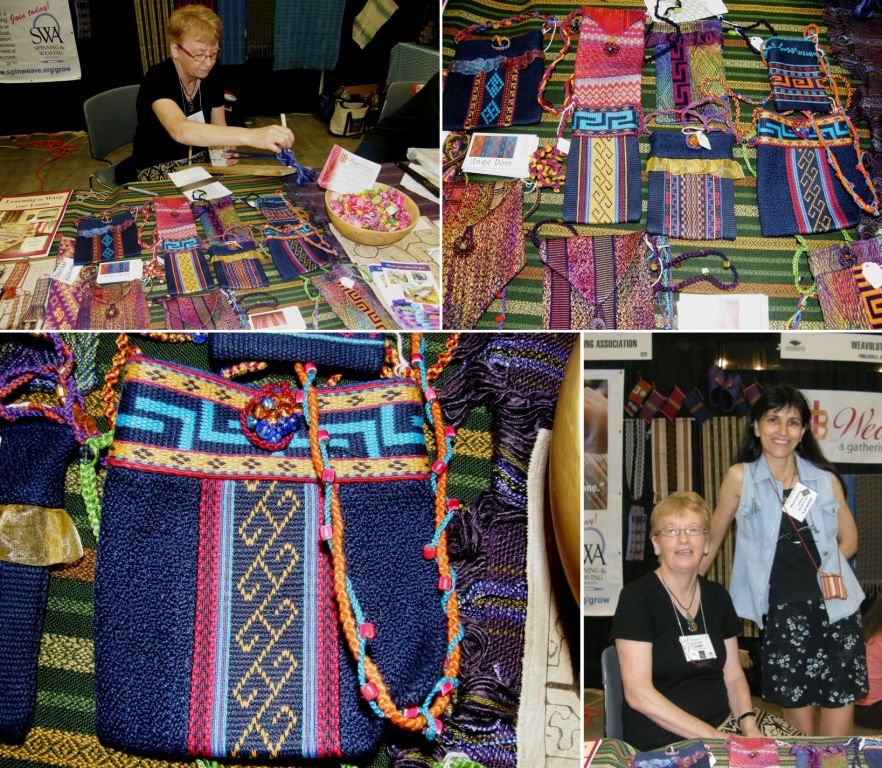
We were privileged to have Inge Dam with us demonstrating her card weaving and selling some of her beautiful pieces.


Betty Davenport and I had connected online through my blog as Betty used to lead weaving trips to Bolivia in the 80s and 90s and enjoyed reading my tales about the places that she had visited and enjoyed. She has always been extremely supportive and especially helpful when I was first planning to write a book.  She brought the new reprint of her Textures and Patterns book.  It was wonderful to meet her in person. I got some impromptu ply split braiding tips from Betty’s roomie, Linda Hendrickson, and got to see some of the pieces she writes about in her up and coming book on the subject. She has certainly changed my mind about three dimensional pieces in this technique which had not previously attracted me although I must admit that the camel girths I have seen in ply split braiding are my favorite examples.


With Linda, I went along to the TWIST (tablet weavers) meeting as I recently joined this group. The TWIST newsletter was where I first read about the Hochdorf technique of tablet weaving which led me to weave Celtic knotwork in Andean pebble weave. I met Shirley Berlin of the Braid Society, another group of which, thanks to Rodrick Owen, I am now a member.
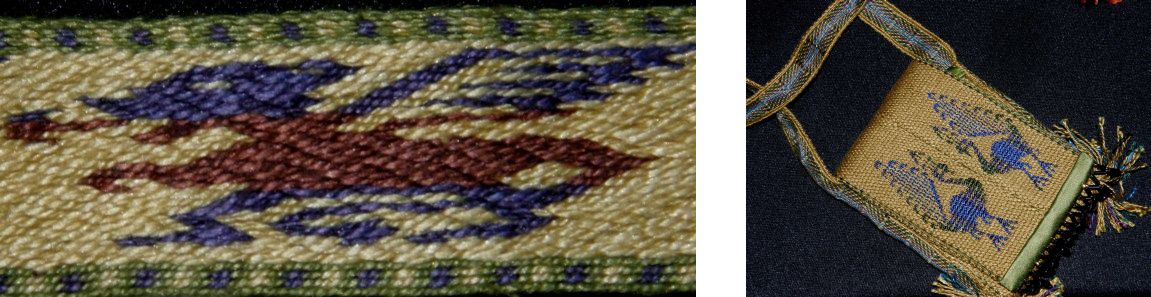
 

The TWIST meeting ended with a “show and tell”. John Mullarky showed some of his fine silk pieces and the piece above left and I loved the little purse made by Nancy Alegria using a design from one of Linda Hendrickson’s books.


And what about all those Weavolution folks?


Here are some of our members! Annie MacHale (aspinnerweaver) at her inkle loom meets Helene Bress soon to be followed by an encounter with Richard Ashford who had spotted Annie’s inklette. Annie and I had met at CNCH and wove side by side at the Education Booth there. It was wonderful to meet Kathe Todd-Hooker again after our first meeting at CNCH where we had spent a lovely evening looking at her collection of Old Believer sashes. Kathe’s new book, So Warped. Warping a Loom for Tapestry which she wrote with Pat Sparks is now out and she joined us for a signing. It was wonderful to see Kathe’s tapestry take first place in the Small Expressions juried exhibit.
Tapestry weaver Tommye Scanlin, who also had a piece in the galleries, visited on more than one occasion and that’s John Mullarky, wearing his own hand woven jacket, who started the tablet weaver’s group at Weavolution.
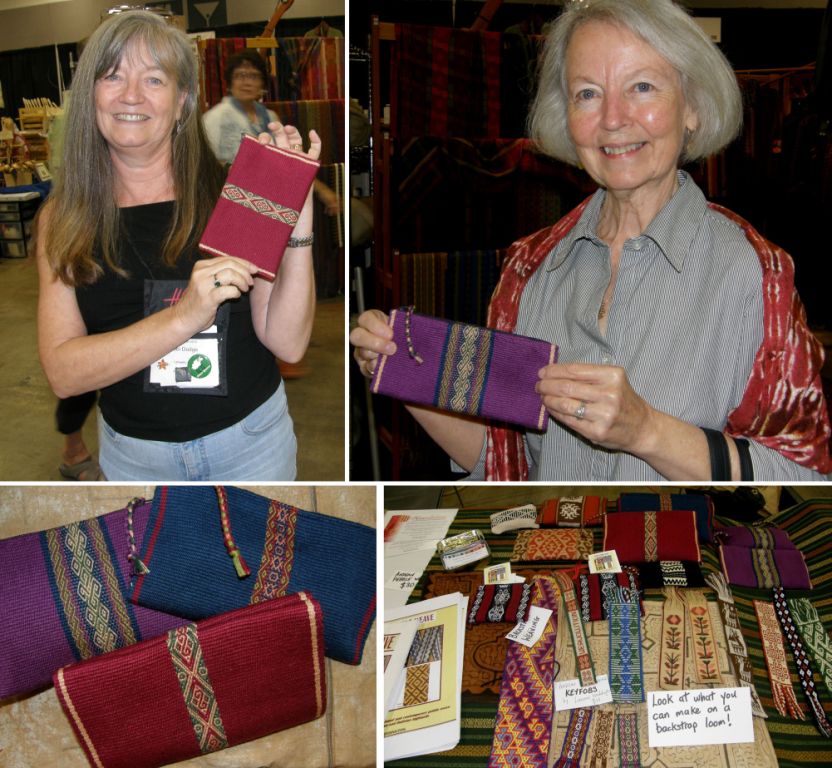
 

One of our many SWA companions was John Colony of Harrisville Designs. I couldn’t have  asked for a better booth mate as John is responsible for the Harrisville backstrap kit which I got to see for the first time. Not only that, he had also met and had classes from Ed Franquemont. Convergence offered what were called ArtSparks classes, one-hour introductory fiber classes, and John taught backstrap weaving to a group. The idea was to show adults how to to teach weaving on a  simple loom to kids. The kit comes with a small rigid heddle segment and is quick to warp and get going. John allowed me to visit his group and take pictures and a couple of the students soon found their way over to the Weavolution booth to watch my demo.

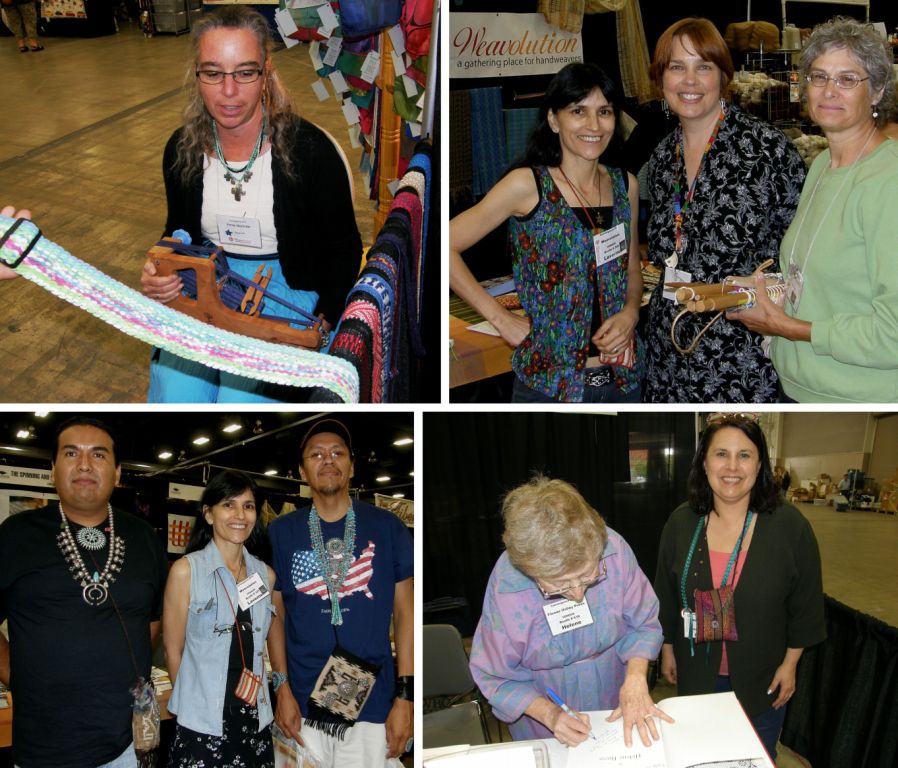
 

More cool people passing by and stopping for a chat… Annie attracted weavers with her inkle woven guitar straps. Anita Osterhaug from Handwoven magazine dropped by and Pam Engberg. a Weavolution Backstrap Group member brought a warped up loom along to get some tips from me. I had Navajo, Pueblo and Hopi weavers stop to look at my loom and work. These two Navajo guys are weavers and wove the bags they are carrying. They shopped for churro fleece to spin. Helene Bress signed a copy of her coverlet double book set for Alison.


The stand with antique Indonesian textiles, Dancing Threads, was a great favorite of mine…

The stand with weavings and silver ornaments crafted by Chinese minorities and run by Pam Najdowski was a treasure trove and is where I did my spending. Pam was such an interesting person and gave a slide show on the main stage on her many trips to China.


I have been looking for bamboo reeds in a good size for my backstrap loom and thinking about having them specially made in Bolivia. Now I have these two beauties bought from Pam’s Textile Treasures booth. I also got the pair of string heddles which I may use on my loom but which will most likely go on the wall. I just love them!


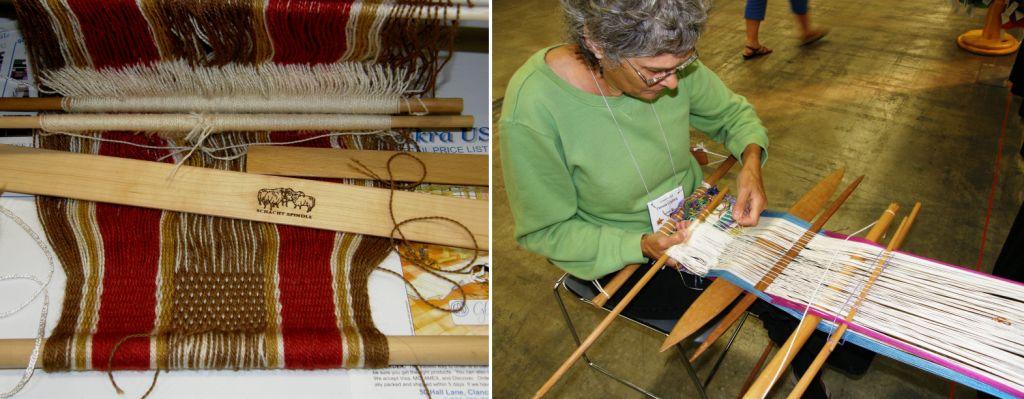
This backstrap loom, which the weaver tensions with her feet, blew me away. I had to go back and back again to see it. Below you can see the paddle-like pieces against which the weaver braces her feet. I would like to try this. Only once I tried tensioning the loom bar behind my toes but it wasn’t a position I could maintain for any length of time. The patterning on the woven piece was really quite simple and controlled by the several patterning sticks you can see there in the loom.
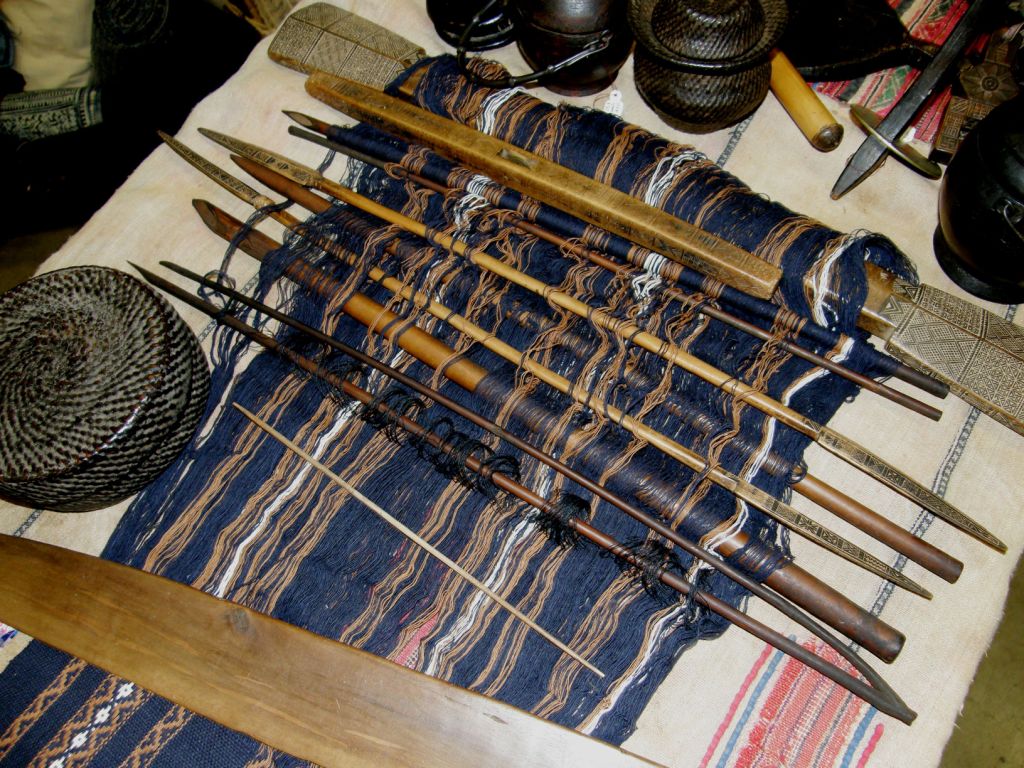
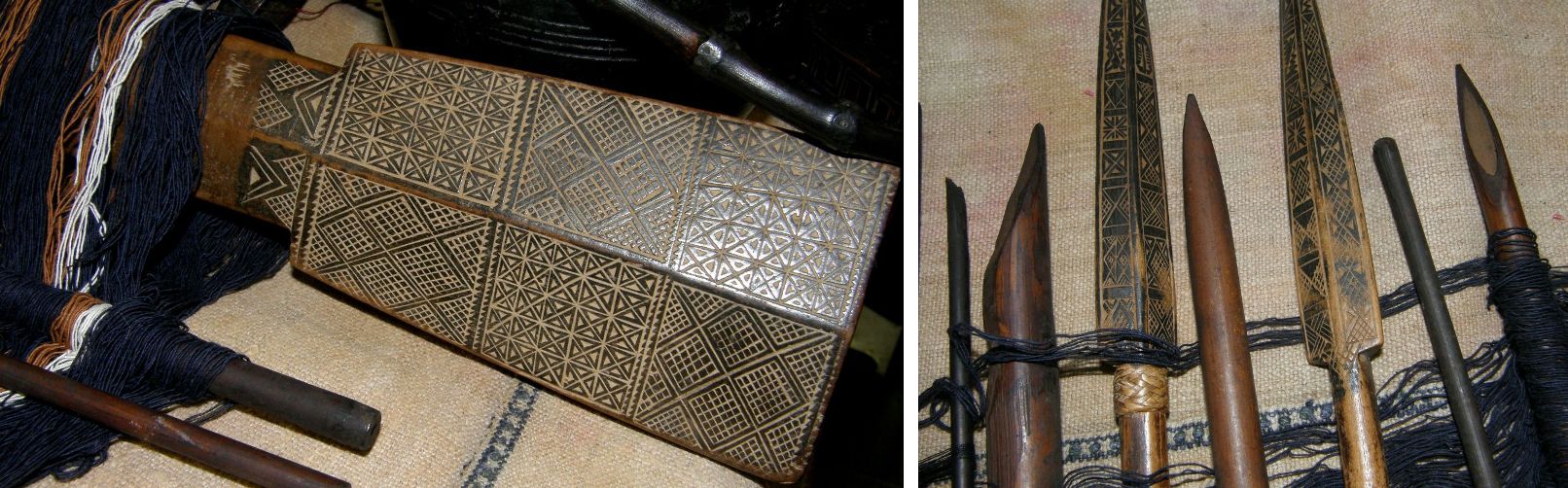
Another loom which Deb McClintock took me to see…
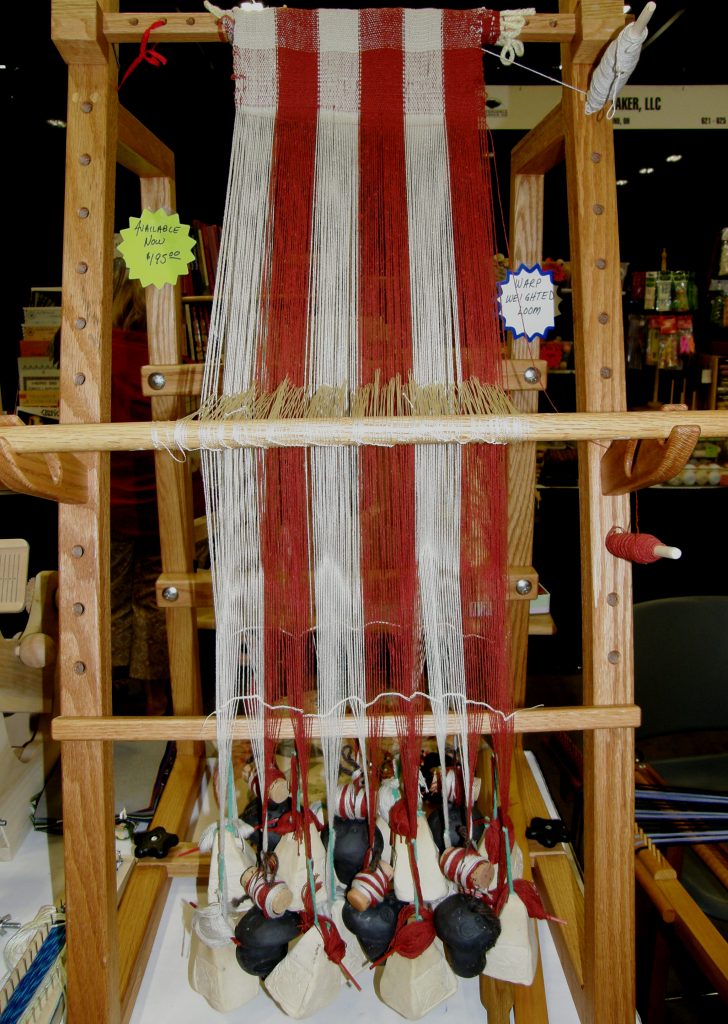
A warp weighted loom above…heard about them, read about them but had never seen one up close.

And one more curiosity at the Textile Treasure stand. I would love to have been able to see this one stretched out. Look at that beautiful reed!
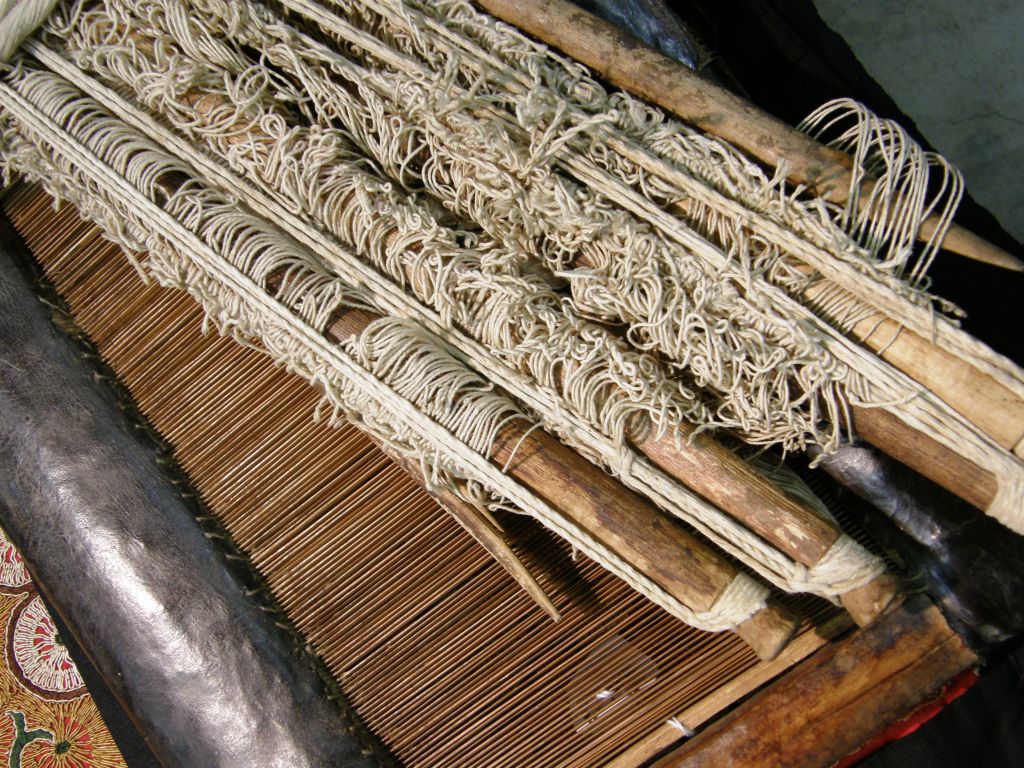
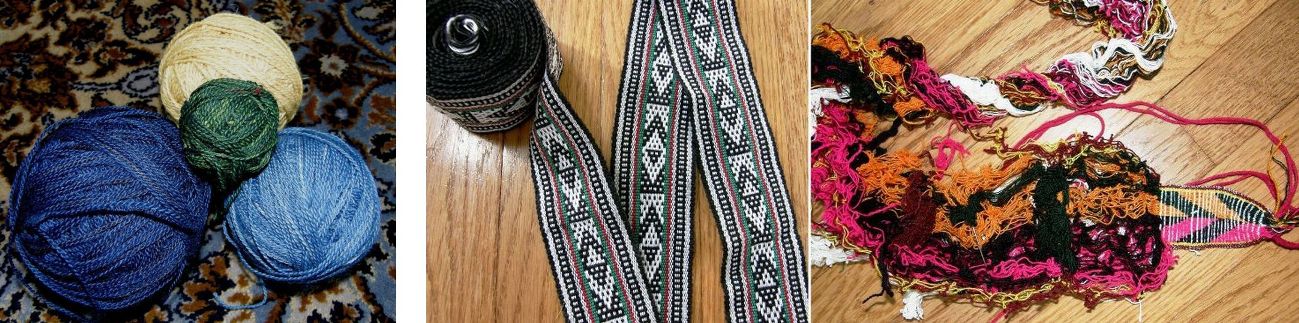
I got some gifts! Kim Hamill of Weaving Southwest, who is also a backstrap weaver and teacher, gave me some yarn that she likes to use and which she dyed herself. Pam from the Textile Treasures stand, knowing my love of all things pebbly, gave me this belt which I am sure to have fun examining and reproducing when I get home. Betty Davenport gave me a crinkle weave warp that she got in Bolivia which I can finish weaving. I have never seen one of these before except in pictures. Above you can see how overspun the commercial yarns need to be before they can be used on a backstrap loom.

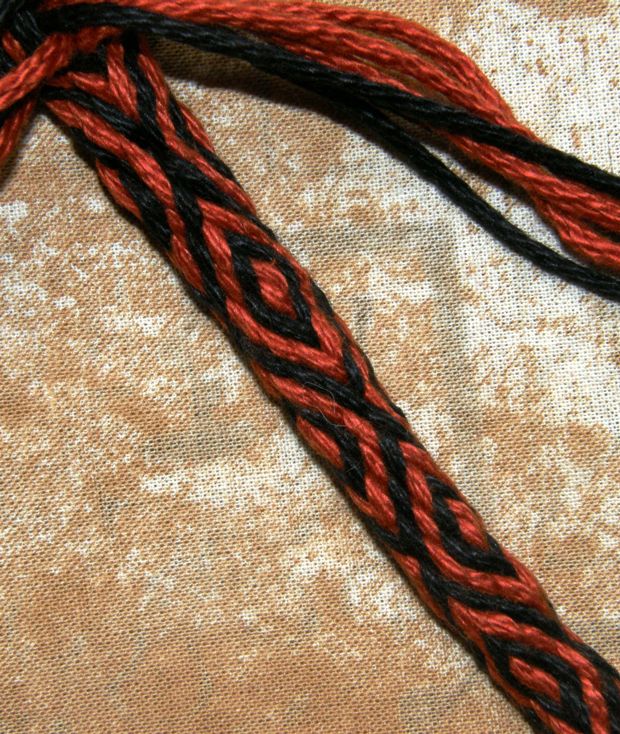
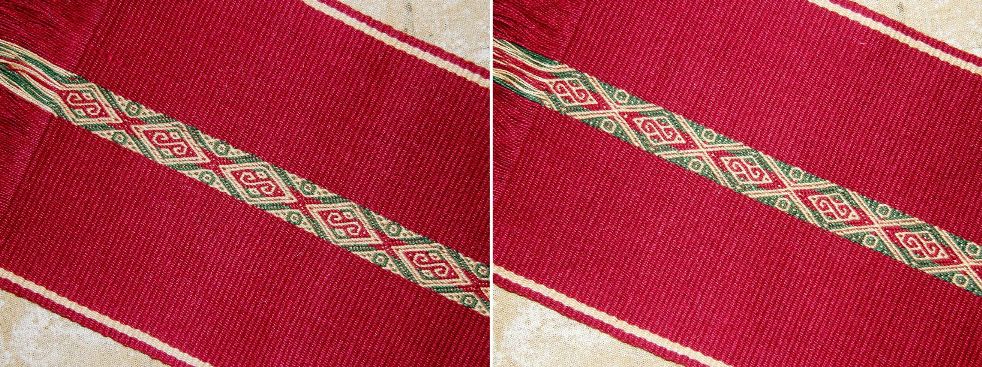
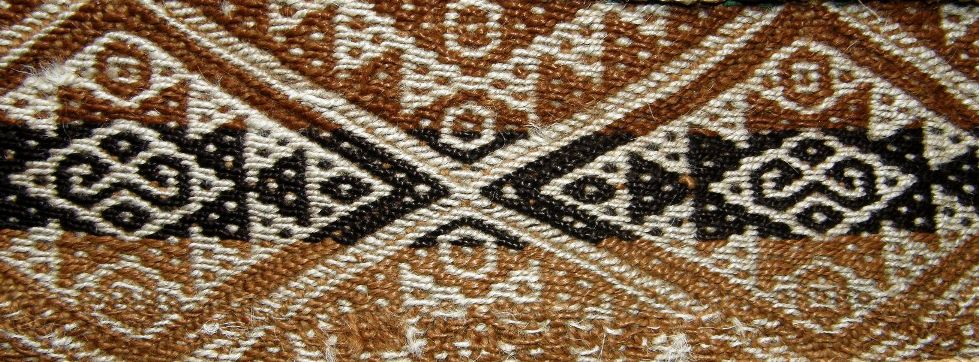
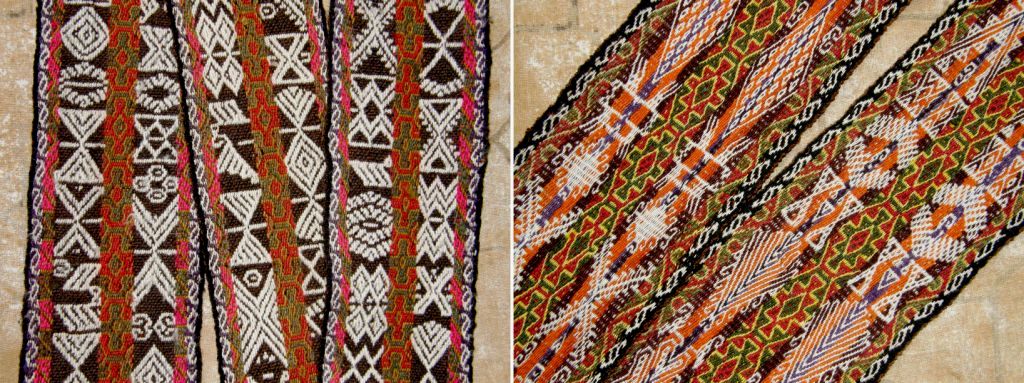
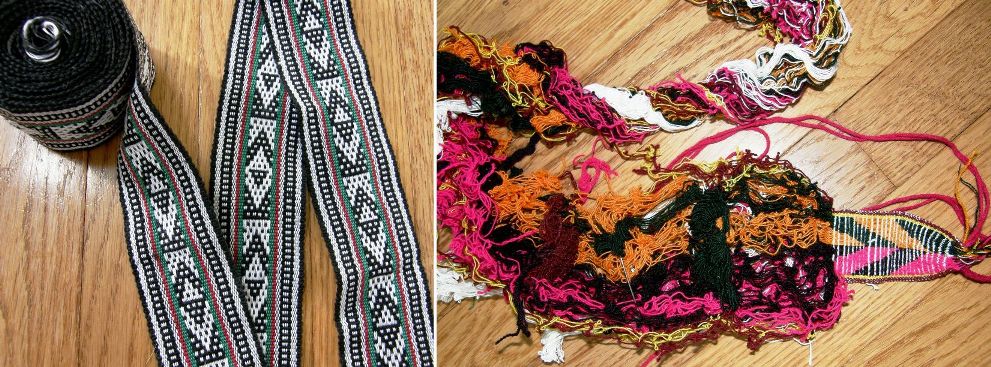
Then along came Martha Graham, an anthropologist who has been studying the belt weaves of the Tarahumara (Raramuri) weavers of Mexico. She spotted my display of my largely pebbled weavings and brought along, the next day, some Tarahumara belts that she just happened to have in her car! I got to photograph them and you can probably guess what is on the “to do” list for when I get home…reproductions and a comparison to Andean pebble weave. So this is the “new Mexican weave” that I refer to in the title to this blog post. I had never seen these belts before nor heard of the Tarahumara people and their weavings. Then lo and behold along came Annie MacHale the following day wearing one!! Hers is the one with the colored border above.

More Weavolutionaries!
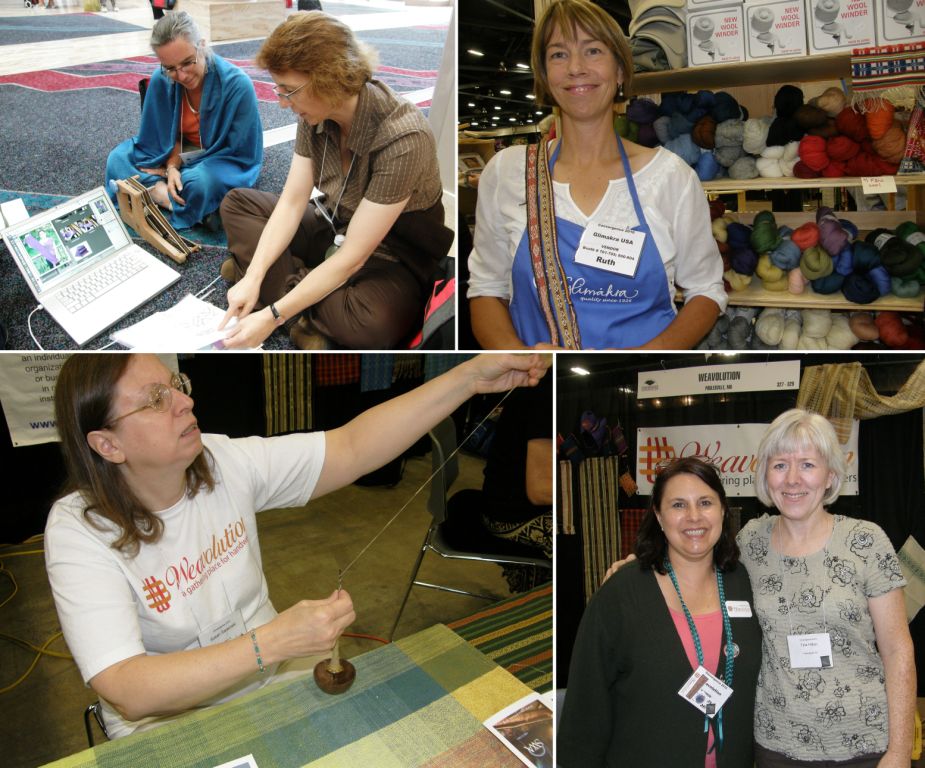
 

Annie and Sally Ogren at the meet-up deep in discussion about charting software and inkle bands. Ruth (Ruthie99) from the Glimakra stand has bravely branched out into weaving with wool on her backstrap loom and brought it along for me to tame! She is displaying here on her shoulder some of the pebble weave bands she made following the intructions in my monograph. Craftin’ Susan (Susan Sarwinski) spun silk while helping out at the Weavolution booth and Tina Hilton stopped by for a chat.


At left, Ruth’s wool warp which she dyed with all natural substances, now under control and ready for pebble weave patterning. Look at the fabulous red she gets from cochineal. She shared her dyeing secrets with me. It is lovely wool that she didn’t respin and it behaves very nicely – Henry’s Attic Crown Colony 2 ply. She uses a Schacht sword, pictured there with the warp, which works beautifully (I took this warp back to my hostel and worked on it) and I think it is a great tool for backstrap weaving if you are looking for a sword. Pam Engberg also brought a warp that needed some attention. She is trying out Guatemalan brocading for the first time and so I helped her improve her heddles and insert a second patterning stick to vary her designs.


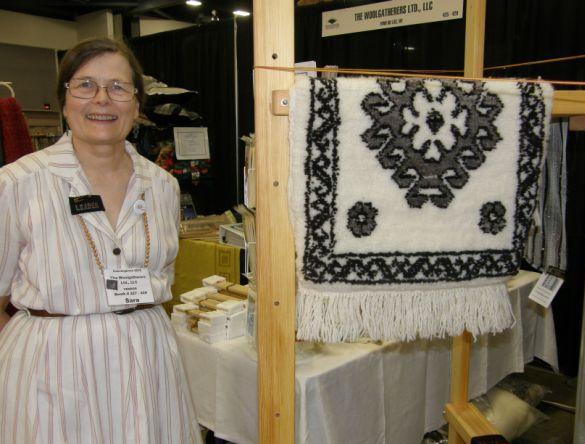
It really was a delight to meet our booth neighbors Hans and Sara Von Tresckow of  The Woolgatherers. I have “known” Sara for some time as a fellow member of Weavolution and she has shown two of her knotted pile projects on the site. It was amazing to be able to see one of them up close. I got to drive one of her big looms – first time ever for me! Quite a treat!
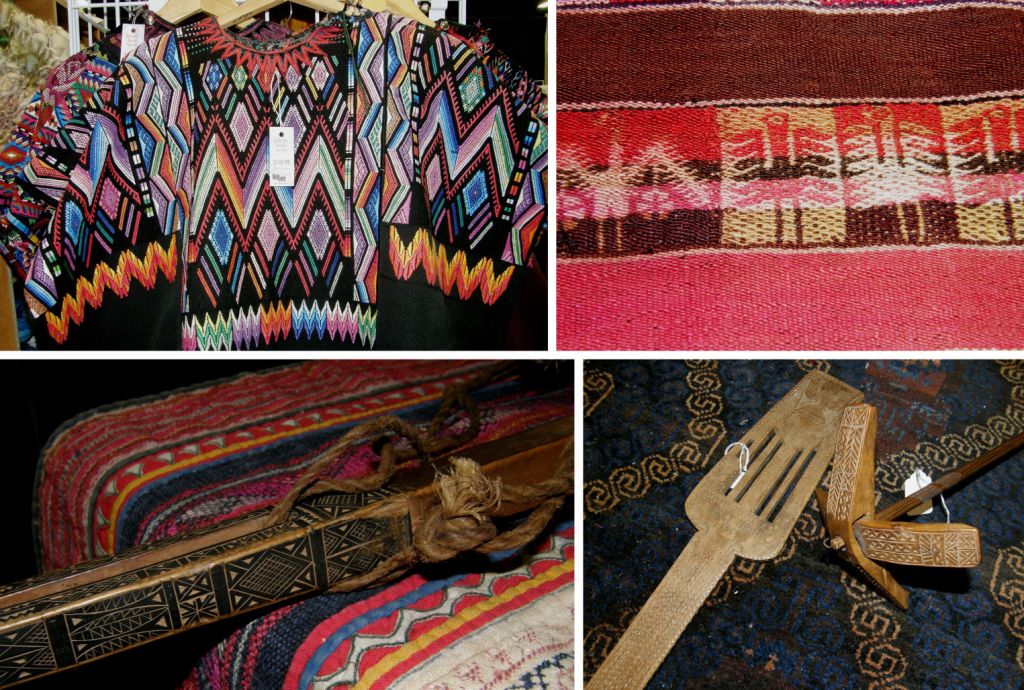
 

Other cool stuff….marvelous huipiles at the Red Corn stand. Annie’s friend Joanne showed me a carrying cloth in her collection and I was surprised to see a double weave band on it which suddenly changed to pebble weave. I have never seen these two weaves combined like that before. The weaving tools at the Chinese minorities booth had me constantly sneaking back for more. Jeffrey Appleby’s stand had an intriguing array of textiles, books and artifacts including this Turkish spindle and distaff. I bought his book “Traditional Textiles of the Andes” which he signed for me and which contains his personal collection.


I didn’t register for Convergence nor take any workshops but I learned so much! The experience of being in the Vendor Hall and meeting all these wonderful people exceeded my expectations. In a way I was sorry for the people who only had a brief lunch break in which to come into the hall and mingle. As it was, there never seemed to be enough hours in a day for me to weave, look at booths and chat. I only saw a third of the Vendor Hall after 5 days!

It was such a sharing experience.  Betty Davenport wove and gave  me a pebbe weave piece and I was delighted that she accepted my Mapuche purse in return.

Cally Booker, a fellow member of the Online Guild of  Weavers, Spinners and Dyers dropped by. It was great to meet Cally. And then there were the Ravelry folk…CoAlpine, Restless Knitter and Sherie all came to visit.

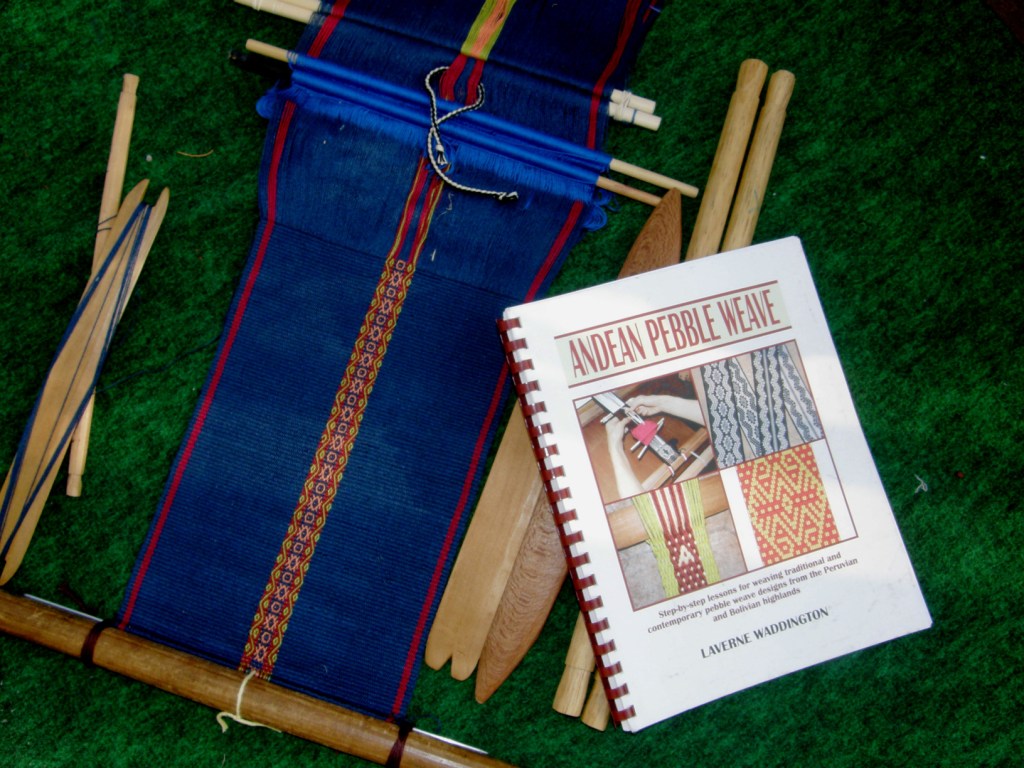
Meanwhile weavers have been warping up their four-shaft looms to try out Andean pebble weave using the instructions in my book...
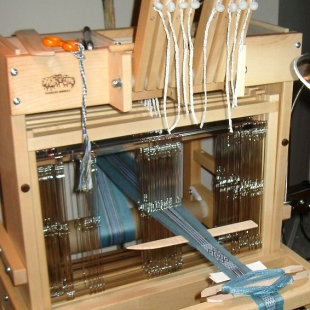
Jeanne from Weavolution is on her way and hopefully we will see this completed band soon and then a wider project. You can buy both the download version or the hard copy of my book Andean Pebble Weave which include the draft and instructions for pebble weave on a four-shaft loom here.
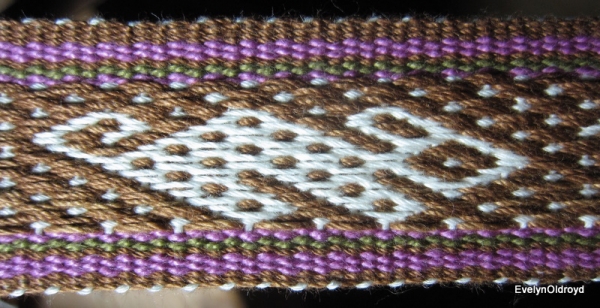
 

Evelyn wove this little guy using one of the pattern charts in the book. This is a “viscacha”, a small Andean animal with a long tail that resembles a rabbit.


Would you believe I have four tiny video segments of Antonia weaving to post here? I think I will leave those for another time! I am in Maryland now with my friend Claudia where I am being treated like royalty! But sadly it is time to move on and tomorrow I take the train to my friend Lisa’s place in North Carolina. More about the Maryland weaving adventures next week! 🙂
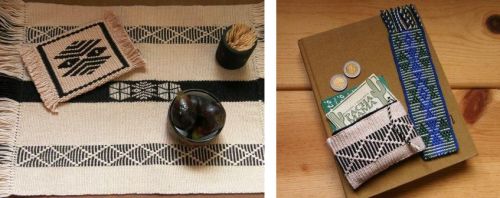
Backstrap Weaving- Convergence, Cusco, Comparisons and Contrasts

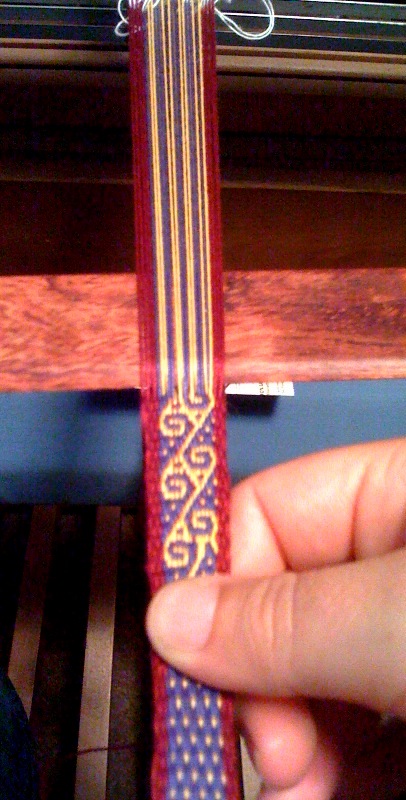
I have put the full tutorial for the simple warp float technique shown above on a new tutorial page along with two videos I made that show the process.  In this technique, warps of one color form a design which sits on a background of horizontal stripes. By working slowly through the steps and the two follow up tutorials on warp floats, you will build up the skills necessary to weave the kinds of pieces where floats of two colors are used to completely cover the surface of the weaving. This is the technique used in the yurt band piece below.

My yurt band reproduction moved along this week and, after having done a couple of repeats of the design, I decided that I had had enough practice on this piece and that I would make a new warp adding some plain weave and weave it again to make something useful. So it has finished up like most of my samples with a zip and will be used to store stuff or gifted. Actually, I wouldn’t mind weaving it this size again but on a much longer warp and sewing it onto brown suede for a laptop bag.

Now to chart the designs on these other yurt band pieces. I know I have shown these here before but they are well worth another look…so gorgeous! The designs are very similar and, after having charted the one above, I am sure that it won’t be too hard to do these.

Chris Buckley in Beijing was kind enough to allow me to use these images of yurt bands in his collection. The band immediately above left belongs to Lisa and Ryan Matthews. Remember that there are tutorials on my blog for weaving the red and white border design as well as the yellow and brown one.

I got a little braiding time in this week too but couldn’t find the Margarita braid that I had started for the tutorial I posted here. I suspect my cat made off with it during the night so I made another.

Braiding is fun but I have never really used the braids for anything. One is being used to hang one of my weavings on the wall.

This braid I am working on now in the 12wpi cotton is so thick and sturdy I am sure it will make a brilliant bag handle. So I will make the braid and then think about a bag to match – kind of putting the cart before the horse.

I had started a Palma braid some time ago to use as a handle for an existing bag but the colors were not a good match and that idea was abandoned.

These are the two main braiding styles I learned with a sling braider in Peru many years ago.

Here is a summary of the steps to this braid following on from the original tutorial here:

Part 1,2,3,4,1,2,4,3,2,1,4,3,2,1,3,4,1,2,3,4,1,2,4,3,2,1,4,3,2,1,3,4,1,2, etc……..

This is turning out to be a very red dominated page especially with this, my latest project…

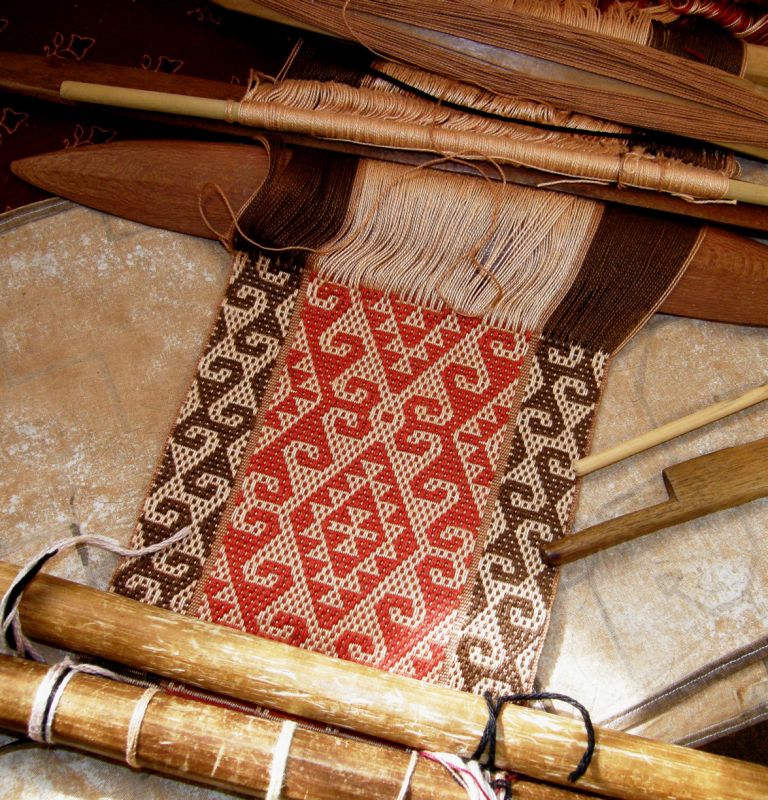
This is both faces of a piece that is destined to be part of the colorful tool bag collection I am making. The design is a classic one from Chinchero, Peru which turns up on so many of the beautiful textiles from there.

Although I have been to Chinchero and bought weavings I only really noticed this particular design for the first time when I was in Sydney of all places at the Saturday Paddington market. An American chap was promoting and selling the knits and weavings of the Cusco and Ausungate areas and amongst his goodies were some beautiful bags with this motif which he allowed me to photograph. I tried to persuade him to sell me a ball or two of the handspun yarn he had there in the basket without success. Since then, I have seen this motif over and over again in various gorgeous pieces of Chinchero and have been waiting for the opportunity to get down and chart and weave it.

It was only when someone participating in the Andean pebble weave weave-along, that I ran recently at Weavolution, asked if this motif could be charted for the pebble weave that I described in my e-monograph, that I took a good hard look at the structure. (This is one of the many things I love about the weave-alongs I run…I get to learn stuff too!)

Certain small elements of the Chinchero motif alone could be woven as a partly loom-controlled piece like the pebble weave I learned in Huancayo. The central “s” and diamond motifs as well as the “eyes” would be easy to chart and weave using pick-up and two sets of string heddles. However, the structure of the other parts of the design make this impossible if one wants to exactly reproduce it. It has to be totally weaver-controlled which means pick-up for every single weft pass.

From what I have seen, the Chinchero weavers use four colors in their design, two for the central motif and another two for the outer ones. I only used three. I confess that I started with four and my color choices were so ugly that I had to unweave a good five inches and take out those warps and replace them!  That’s the price you pay for not doing a sample!

I also noticed that they usually divide the design in three sections of ten warp pairs. I divided mine as nine, twelve, nine so that the diamonds would be split down the center.

In the close-up above you can see the little pebble spots in certain areas which is what had me hoping that this could be woven using the Huancayo technique.

I love looking at these different structures and comparing and contrasting.

Recently on Weavolution a link was posted to a guild gallery of Peruvian weavings purchased in the 1990s that one of the members had brought in and there was a beautiful Chinchero design band in black and white still on the loom. I love this picture as it also shows the overtwist in the handspun wool.

So now I have taken a closer look at the very first weaving I ever bought in Peru (actually the first in South America) on my trip there in 1996. I was in Cusco before I made my way to Huancayo and learned pebble weave and this used belt in one of the market stalls caught my eye.

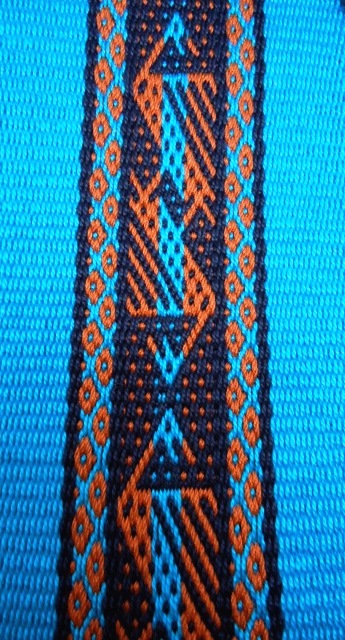
I sewed this belt onto a cushion in my living room and it has been there so long that I just don’t notice it any more. At first glance you see it covered with pebble spots and it looks like the partly loom-controlled pebble weave that I learned in Huancayo. However, those two sets of long diagonals that enclose the main motif do not follow the pebble weave warp float arrangement. I wove a shoulder bag in my handspun llama fiber many years ago with a motif in the Andean pebble weave I learned in Huancayo using a design based on this belt.

You can see that the central motif is the same except that I chose to weave an “S” in the very center but I was not able to exactly duplicate those diagonals as I did in my latest project, the red piece above. Believe me, the Andean pebble weave that I learned in Huancayo is a lot faster for me with the two sets of string heddles. However, I know that the Chinchero weavers are very fast at pick-up and, whatsmore, have this motif well memorized. I haven’t woven this motif enough yet to be able to let go of the pattern chart I made and that slows me down.

Here are a couple of other pieces I bought on this first trip to Cusco…

Although I have been a few times to Peru, I have only been once to Cusco  and am looking forward to seeing it again this November during the tinkuy de tejedores a gathering of weavers in Urubamba, near Cusco over four days. I finally registered and am so looking forward to going and know quite a few people from the US and a few from Europe from my various online groups who will be there.  I will have the opportunity to meet some of the people that I didn’t manage to see on my US visit in Cusco instead! The tinkuy promises to be a wonderful event with weavers from South America and beyond meeting to share techniques. Experts in the field, including Ann Rowe and Mary Frame will give lectures and presentations on various aspects of indigenous weaving. Workshops are also being offered on Andean knitting, dyeing and weaving techniques. It is not too late to sign up!

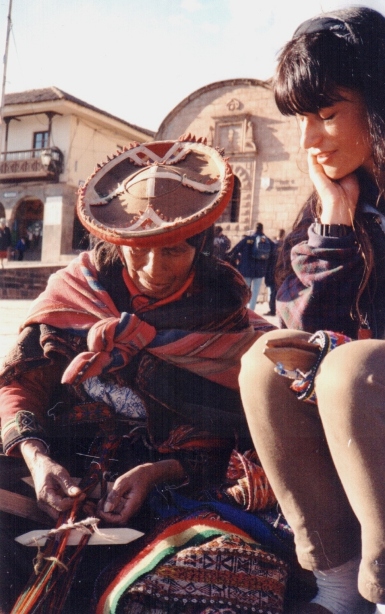
Watching a weaver at work in the main square of Cusco

I thought I would show you a few shots of my visit to Cusco and the Scared Valley in 1996.

I am wondering how much Cusco may have changed.

I have to admit that I was slightly disappointed at first as I was expecting to feel some sort of spiritual vibe from the place similar to what I had felt in Kathmandu when I was there in the mid 80s.

It was soon obvious that I wasn’t going to experience this sitting in the main plaza of downtown Cusco and my special place turned out to be Ollantaytambo.

I felt it as soon as I stepped off the bus at sunset.

My bus had broken down and we had gotten in late after having repaired the mechanical problem with banana skins!

The Sunday market at Chinchero. I bought one of the typical hats and caught the woman at right watching me, probably wondering what in the world I was planning to do with it. I smiled and walked up to her and she took off her old hat, put on the new one and handed the old one to me! I was actually very pleased to have the older one which had some character. A man, who I assumed was her son, came along and they had a good laugh about it.
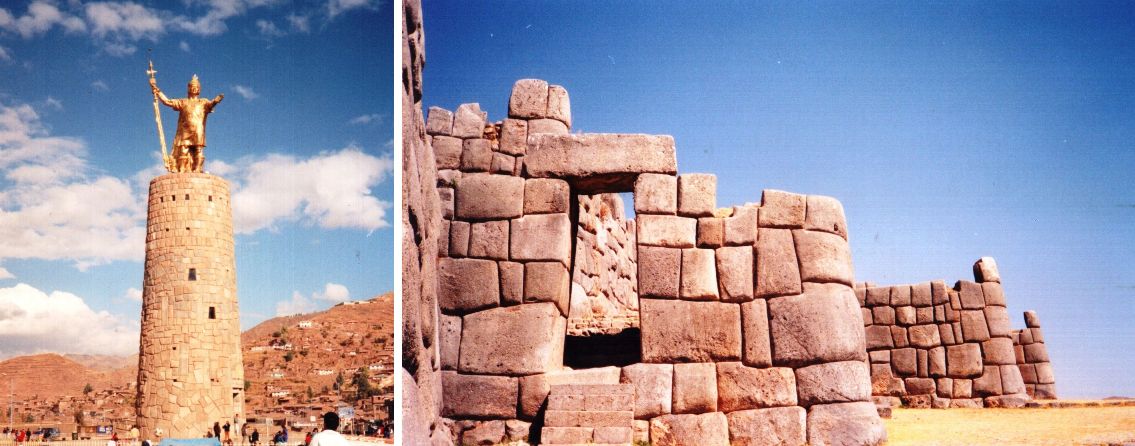
Walking around Cusco itself you can see the statue of the Inca king Pachacutec with whom the history of the Inca empire begins. He is behind one of the great expansions of the empire in the 15th century. The ruins of Sacsayhuaman with its examples of Inca stonework can be reached on foot from the center of Cusco.

A spinner and weavers near Pisac. The weavers are making the band that decorates the edge of their skirts. I have since learned from Nilda Callanaupa’s book that this kind of weaving is called golon. It is a twill tapestry weave.

There are lots of photo ops with the ladies and their lovely llamas. At right is the train station at the bottom of Machhu Pichu. Remember that this is 14 years ago. I had the “Cusco cough” and wasn’t in any shape to hike the Inca Trail and so I did a day trip to Macchu Pichu. Things look completely civilized in this picture but I have to tell you that when the train came in, everything went to hell! People were jumping on and throwing backpacks onto the train before it could even come to a halt. There were no reserved seats and far more passengers than seats and the guys who had spent three days hiking the Inca Trail were determined not to have to stand the 5 hours back to Cusco. I don’t think anyone stood in the end. There were bodies everywhere on the floor on top of backpacks in the aisles, four to a double seat etc….all very cozy, friendly and a wee bit smelly and we had a nice trip back!

Finally, after viewing my pictures from fourteen years ago, let me show you one of Guaman Poma de Ayala’s drawings of Cusco from his chronicle written in the early 17th century:

#############################################################

Finally, a reminder that my e-monograph on Andean Pebble Weave now has an  appendix with instructions for weaving this technique on a four-shaft loom.

I am hoping to warp up for a large pebble weave project on my friend Lisa’s floor loom on my next visit to the US. I leave in a week! Lisa and I wove a narrow band last time I was there.

Here is a new image of the wall hanging that Lydia made on her floor loom using one of the bird motifs that I wove in Huancayo.

Lydia calls this “Fish or Fowl” as she spent some time thinking it was a fish until I told her otherwise! She can see both a fish and a bird. I can’t see the fish at all!

Jennifer’s new backstrap at left and Lisa’s practice band on the right.

The appendix shows how to weave Andean pebble weave motifs using a combination of shafts alternated with pick-up. There are no string heddles involved. Plain pebble weave can be totally loom controlled.

So I am off to the US  next week slowly making my way to Convergence!

I will be hanging out at the Weavolution booth and wandering the vendor hall with my backstrap loom. Please come and visit, bring your loom and weave for a while. I hope to have an Easy Weaver warped up for pebble weave too. Just come along and weave with me!

Backstrap Weaving-A Bolivian winter of flowers and sunshine and a Guatemalan tree (Part 2)

While people in my online weaving groups are posting pictures of lilies, poppies and butterflies in celebration of the northern summer, here in the southern hemisphere winter is in full swing. The Bolivian President Evo Morales suddenly declared June 21st, the winter solstice, Aymara Day and a national holiday.  Bolivia is now known as Estado Plurinacional de Bolivia rather than La Republica in recognition of the various indigenous groups which it comprises and this has me wondering if we will be having Guarani and Quechua Days as national holidays too.


However, it is hard to believe that we are in the middle of winter here in Santa Cruz, Bolivia where I sit at my laptop in tshirt and shorts wondering whether I should turn on the air conditioner as the suns comes around the building and throws golden rays through my bedroom window.
The highlands are experiencing their dry season and it is COLD. I spent most of one July and August up in Potosi at 4000 meters in a shabby room in a backpacker hostel – bare cement floor, pinned down in my bed under kilos of thick hand woven blankets and still cold! I remember trying to squeeze myself into the thinnest possible package in order to fit under the tiny trickle of hot water that came out of the electric shower head. The lowest possible water pressure was the only way to get  hot water. Washing clothes in the cold water brought tears to my eyes!
At left you see dry, dusty and sparsely vegetated Potosi with its landmark mountain Cerro Rico whose silver deposits sustained the Spanish economy for centuries.

LEFT: Miners keep effigies of the devil, whom they call El Tio, in various places within the mines as they believe that he is the owner of the minerals and needs to be appeased with offerings of cigarettes, coca and alcohol. RIGHT: You can beat the winter chills with a soak in the thermal waters of the volcanic crater lake at Tarapaya. I must confess that this photo was taken on a second visit to Potosi in January when it wasn’t so cold. Rumors that there are whirlpools in the center of the lake which suck people in keep most visitors in the cement pools in the valley below. I kept close to the edge of the lake at all times!
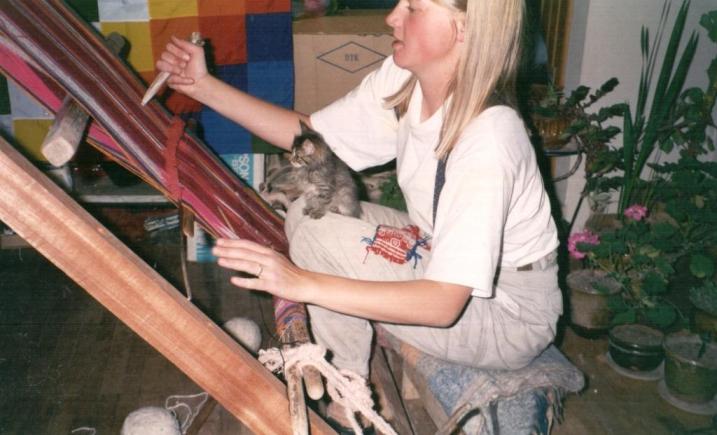
On my first visit to Potosi in 1997, I met Ulla, a Danish girl who was staying on in Potosi after having spent a year there as an exchange student. We learned to weave together with sisters Julia and Hilda. As Ulla didn’t have a patio, she set up an oblique loom in her warm little apartment and was able to weave comfortably there. It certainly beat having to bend over the grond loom. On her lap, apart from the kitten, you can see the “saca” or little woven sample that the weavers use to help them remember how to weave the designs.
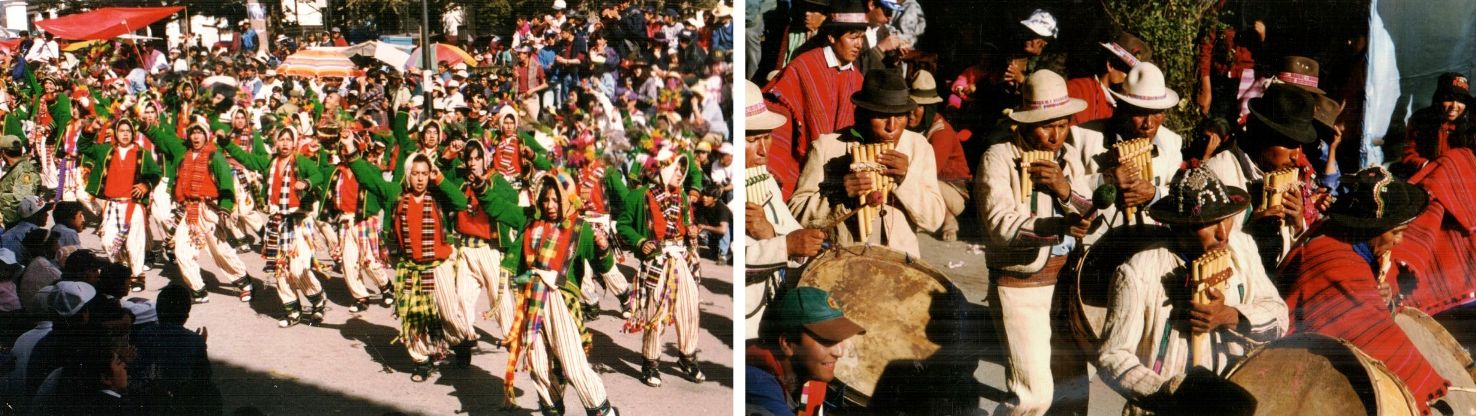
I was fortunate to be in Potosi on August 31st for the Chu’tillos festival which celebrates San Bartolome. Dancers in typical costume from all over the province of Potosi parade in the street on the first day followed by dancers from all over Bolivia on the second. The best part is actually the weeks leading up to the festival as the groups rehearse late at night in the empty streets and laugh and chatter and have a lot of fun while doing so.

Bolivia extends from the dry, dusty highlands to the lush green lowlands known as the “oriente”, where I live. They are like two totally different countries in so many ways. In recognition of that, Bolivia has not one but two national flowers,  the patuju from the oriente (below left) and the kantuta from the highlands (right).

Both contain the colors red, yellow and green, the colors of the Bolivian flag. Santa Cruz abounds in flowers, trees and greenery at all times of year. It just never really feels like winter. Electric cables disappear within mazes of tree branches and it sometimes feels like the city is on the verge of being swallowed by the jungle that lurks on its outskirts.

The “tajibo” and “torobochi” trees that line the streets.
The pattern barely shows on the back of supplementary weft patterned pieces

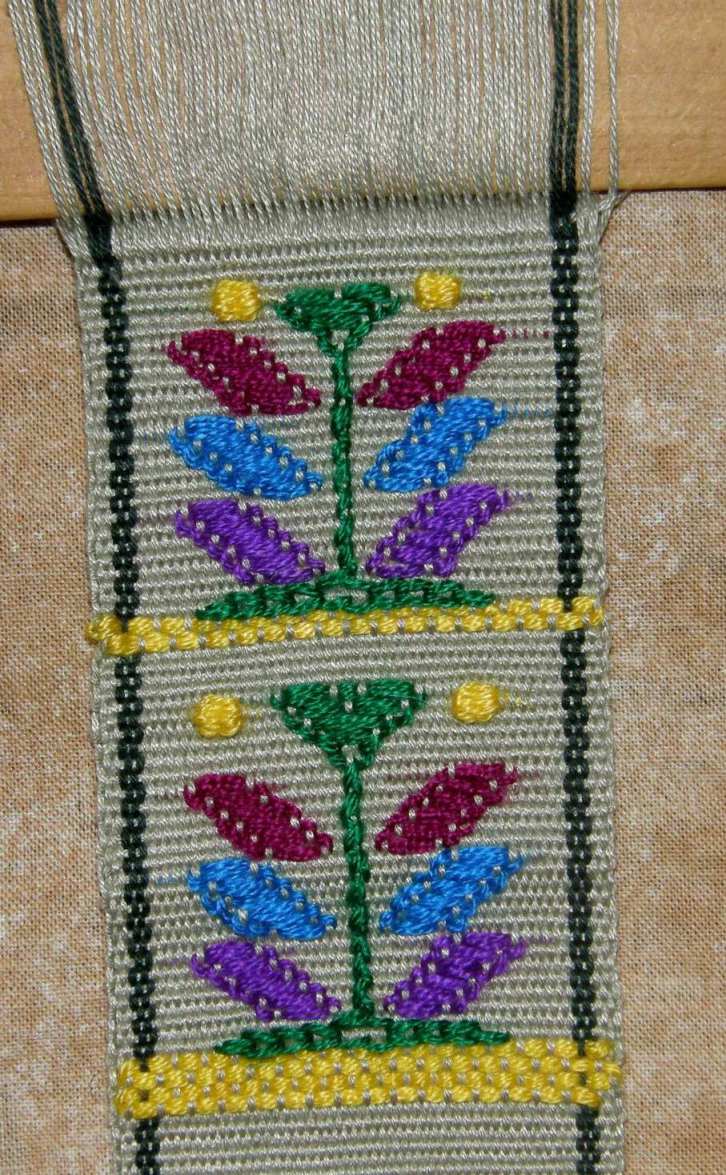
So with all this in mind I have been weaving some sunny tree and flower designs in the single face supplementary weft patterning  technique that I learned in Guatemala in Santa Catarina Palopo.

This is a fun technique with little or no counting involved which allows you to play freely with shapes and colors.

The resulting weaving looks like a piece of embroidered cloth except that the “stitches” only appear on one side of the fabric.

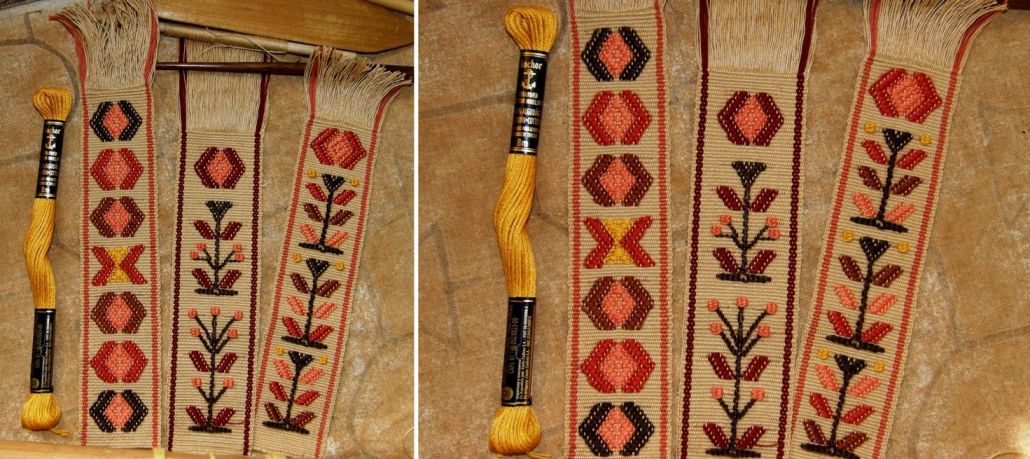
Bookmarks made with Guatemalan tree and sun motifs

Last week when I started the tutorial on this technique, I was using acrylic threads that I had brought back from Guatemala to create bright mutlicolored trees on a green background, pictured at left.

I decided to buy some embroidery floss to work with and it took some time to get just the right thickness to go with my chosen ground weave warp. The ground weave is a 50 wpi cotton and I used 4 strands of embroidery floss to do the patterning.

The 50 wpi warp produces a wonderfully thin cloth just right for bookmarks although the pattern wefts do add some bulk.

So, let’s continue with the tutorial.

I have done a recap of what I showed you in Part 1 of the tutorial last week on a video. I have used  thick cotton and only a few warps to demonstrate the picking of the warps for the two patterning sheds, the placement of the patterning sticks in the loom, the technique for opening the patterning sheds and the weaving sequence. I don’t recommend using such thick yarn for your own supplementary weft project!

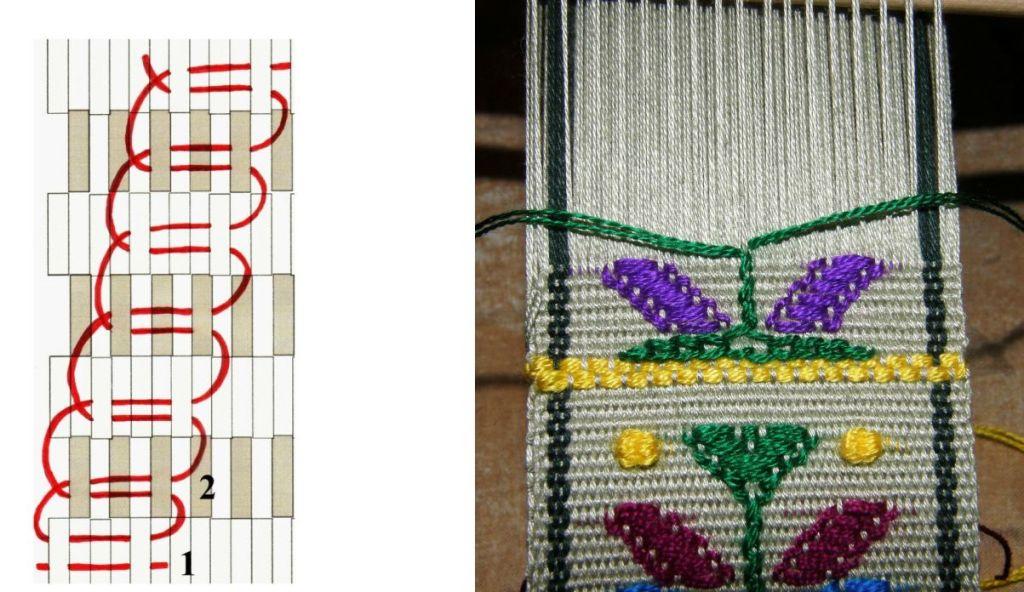
All the colored wefts that form the patterns pass under or wrap around the warps in the two patterning sheds. This green piece has 86 ends between the dark green border stripes.

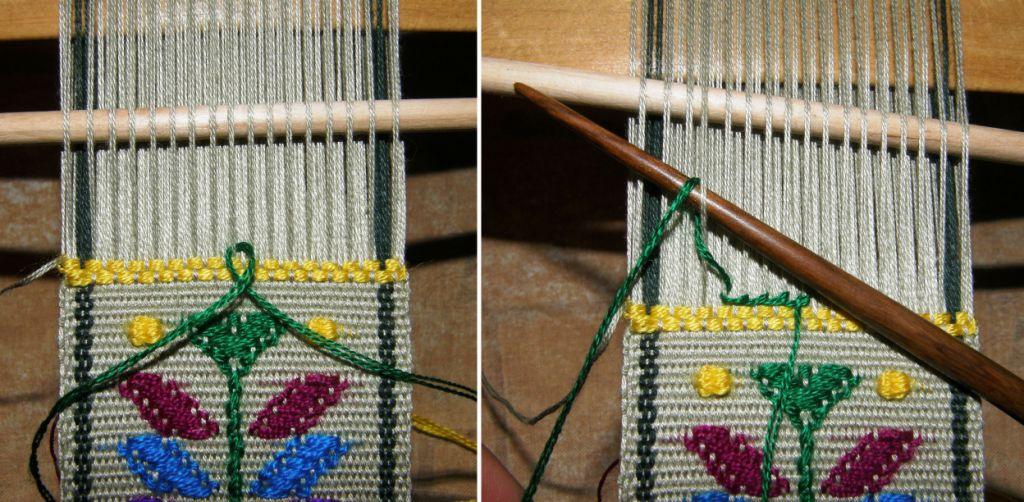
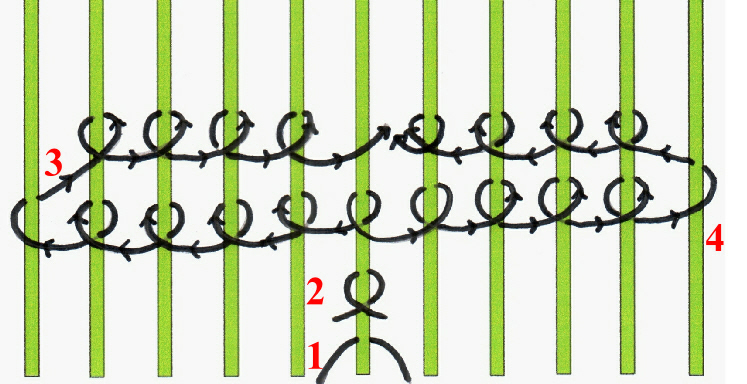
The base of the little Guatemalan tree is a double horizontal line. STEP ONE: To form this, place a strand of around 40cm/16″ of supplementary weft under the central patterning warp. The two ends on either side should be of equal length. The central warp in my set up just happens to be in patterning shed 2 so I have started in the heddle shed.
STEP TWO: Cross the ends of the supplementary weft. STEP THREE: Start wrapping the left hand end around the 5 warps to the left of the central warp and return wrapping around 4 warps. The diagram below shows how this is done.
The steps for horizontal wrapping are shown here. The left end of the weft wraps to the left and returns and the right end wraps to the right and returns. These four steps all take place in the same pattern shed. The wefts wrap around four warps on their return journey to the center. STEP 5: Pass the main weft through the complete shed.

Open the next shed, which is, in my case, the shed rod shed and pass the main weft.

Open the heddle shed and raise the patterning warps in patterning shed 2.

Patterning shed 2 contains my central warp.

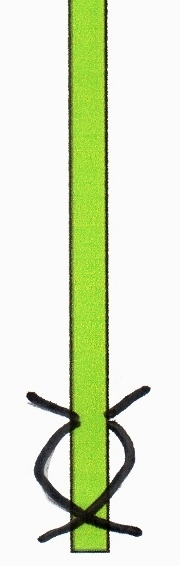
Every time I raise the warps in patterning shed 2, I will wrap my green tree base weft around the central warp to form a stem. The drawing at left shows the very simple vertical wrapping method.

The stem, therefore, is woven only in every second shed.

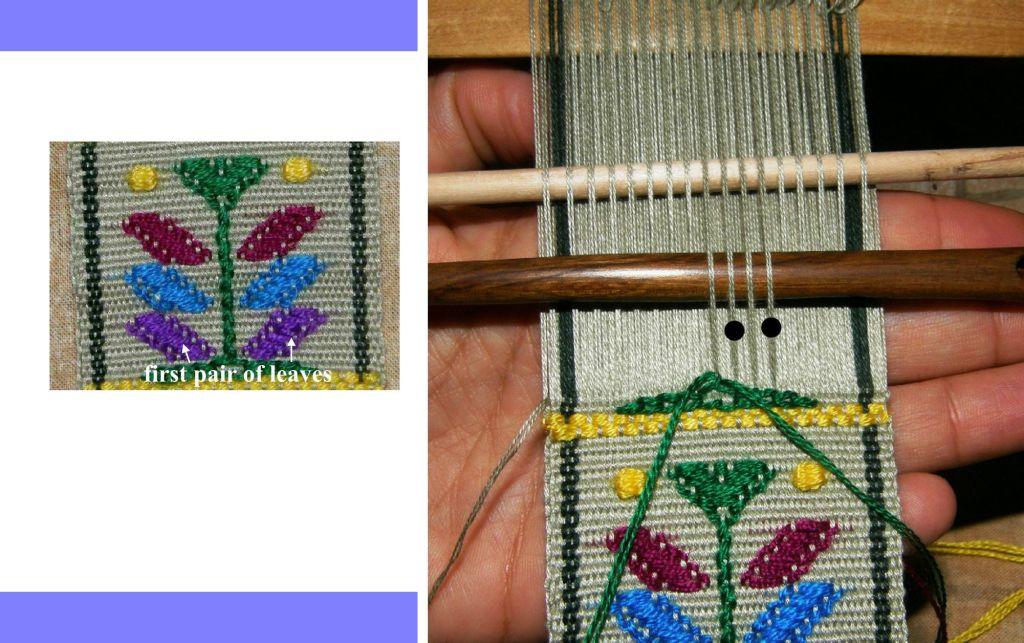
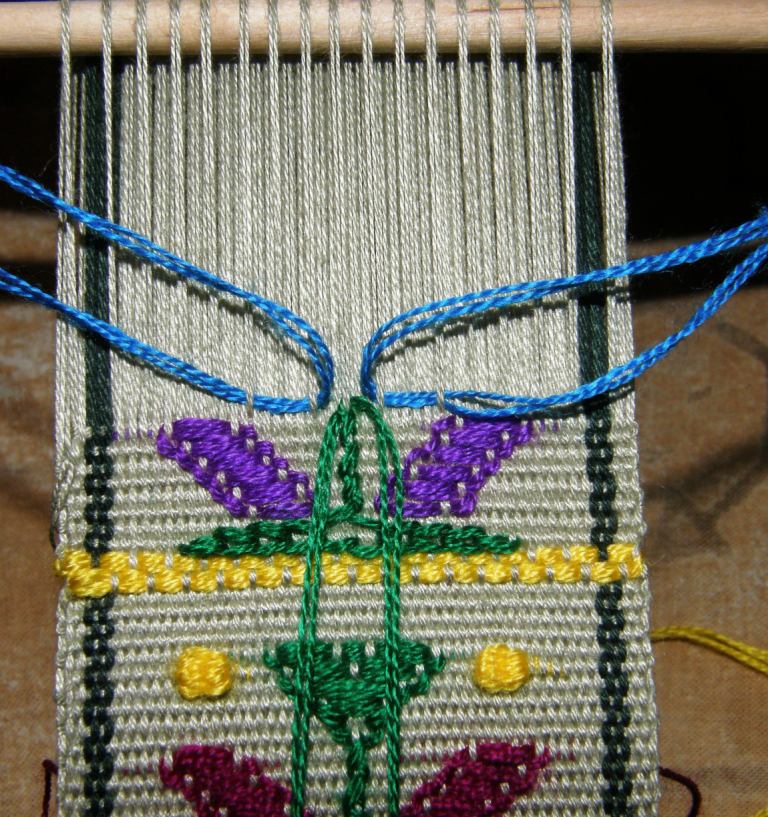
In this shed I will lay in the wefts to form the first pair of leaves.

Cut two lengths of weft around 24cm/9 1/2” long for the two leaves.


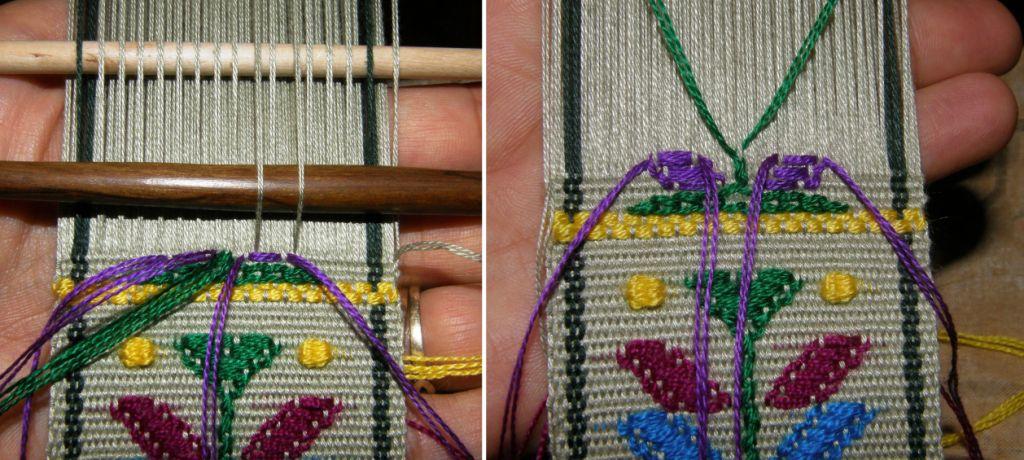
Starting the second leaf.

The little Guatemalan tree has three pairs of leaves and the stem continues growing until it eventually widens out into the tree top.

Once you have woven your six leaves, I am sure that it will be very easy for you to see how the tree top is formed.

You are weaving your stem with two strands of weft – one will start traveling to the right and one to the left while filling in the tree top in the same way that you filled in the leaves.

Finally there are the little spots that the Guatemalan weavers like to use to fill in blank spaces between motifs. I used them in my bookmarks as flower buds. You can see two yellow spots in the photo above.


To make a spot, you use two adjacent patterning warps as shown in the drawing above left. Use a strand of weft half the thickness that you would normally use. Around  12cm/5″ length should be plenty. First pass the weft behind the warp on the right as shown. Then join the two ends together and go wrapping them back and forth in the same shed about six times. Pass the ends through the main shed and out the back of the weaving.

The drawing above right shows how to make a diagonal line for a branch.

It is very easy to improvise with this technique. Have fun with it!

#############################################

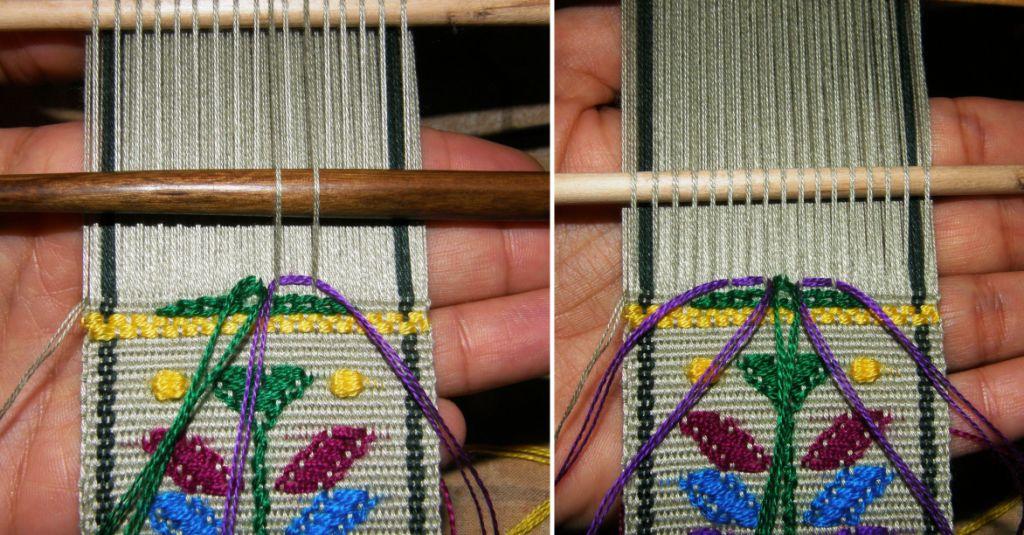
It seems I was in the mood for autumn colors as I got back to work on the yurt band piece that I started a while ago and really had a good time picking that up again. At first I found it very confusing after having spent so much time on Andean pebble weave lately. Usually one is picking up light warps on a dark background or viceversa  but in this technique you pick up lights for one weft pass and then darks for the next. This is a simple warp float technique ( see this tutorial and this one) that can look a lot like Andean pebble weave but is totally different in structure. I copied the design from an image of a Turkoman yurt band that my friend Lisa had showed me on the net,

The original Turkoman band on the left next to my reproduction. I left out the triangles that run down the sides separating the two main pattern areas.

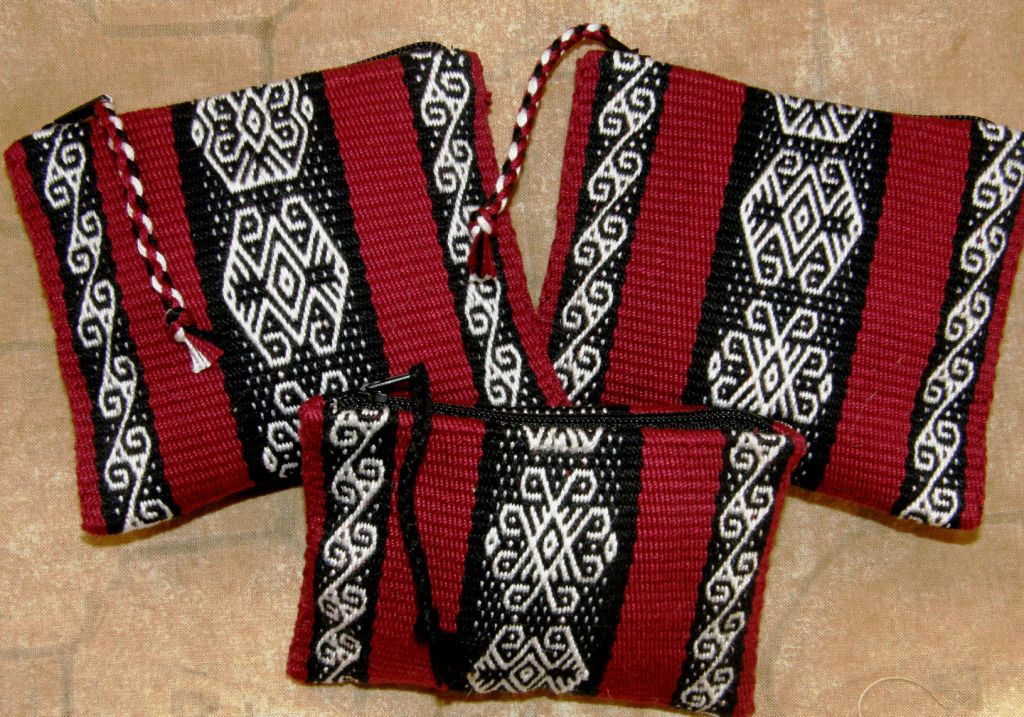
The other project I worked on this week was finishing off the red and black piece, sewing it up into three coin purses and putting in those dastardly zips! I believe that I am actually getting the hang of these zips now.

Three coin purses with North and South American motifs in Andean pebble weave.

#####################################################

AND THE BIG NEWS IS…

Today, (July 1st), the appendix to my e-monograph with instructions for weaving Andean pebble weave on a four-shaft loom went out!

Those who have already purchased my monograph will automatically receive it and it will be included in all future downloads of the monograph from now on at no extra cost.

My testers have made some lovely things on their four-shaft looms which I have been showing here on my blog over the last few weeks.

Lisa wove a band with several small motifs. Lydia made a wall hanging with a bird motif of Huancayo and Jennifer is going to turn her piece with the design from one of the Russian Old Believer belts into a backstrap.


########################################################

Finally I would like to show what Helena, who is in the backstrap weaving group at Weavolution, has made  in supplementary weft patterning using various colors and Mexican designs. Beautiful!


Backstrap Weaving- Have sticks, will travel here, there and everywhere!

HAVE STICKS…WILL TRAVEL HERE, THERE AND EVERYWHERE!

Oh you can’t get to heaven in a little red canoe,

‘Cos God’s favorite color is Carolina blue.

My friend Lisa told me this today as we gazed up at the perfect blue sky in the yard of her North Carolina home. Forgive me if I am getting repetitive when I go on about the wonderful colors of spring and how beautiful everything is here. I realize how much I miss seasons in my jungly home in Bolivia where we experience warm-and-humid or hot-and-humid weather with a smattering of cool days in between.

The colors of spring… pink azaleas, the blue eggs of what we believe to be a northern mockingbird spotted in Maryland, luscious ripe strawberries on the roadside,yellow flowers – we don’t know what these are called –  and a blue-eyed happy chappy enjoying his yard on a warm spring day.

After the Maryland Sheep and Wool Festival, I spent a few days in the home of Claudia, one of Weavolution’s founders and her friends in Maryland. We had gorgeous drives through rural Maryland on the way to and from the festival –  green rolling  fields dotted with deep red barns and silos. 


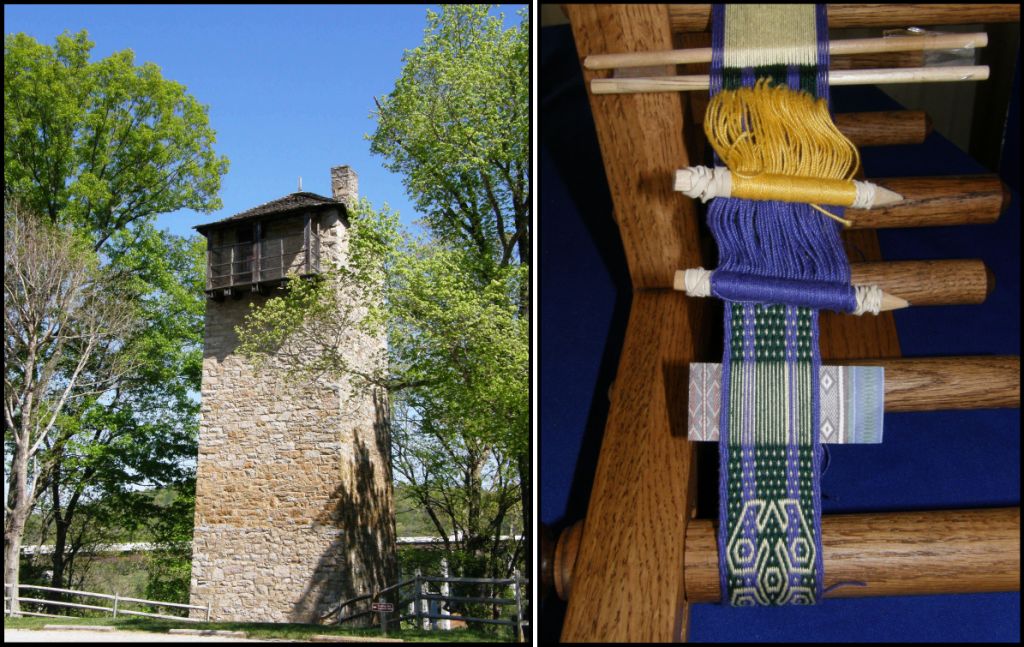
I had ridden up to Maryland from North Carolina with my friends Lisa and Ryan stopping by the Shot Tower Historical State Park to stroll and break the journey. I was making a band in Andean pebble weave in the back of the car while Lisa worked with her Turkish spindle in the front. The inkle loom I borrowed was a perfect lap size but the work space between the top and front peg was a little small for the cross sticks and two sets of string heddles.
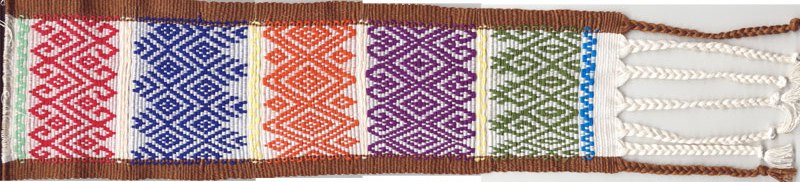
The finished band has twelve  spaced motifs for twelve key fobs with motifs from pre-Columbian Peru as well as contemporary Bolivian and Peruvian ones. I have given away a lot of my key fobs on this trip and need to replenish my stock!
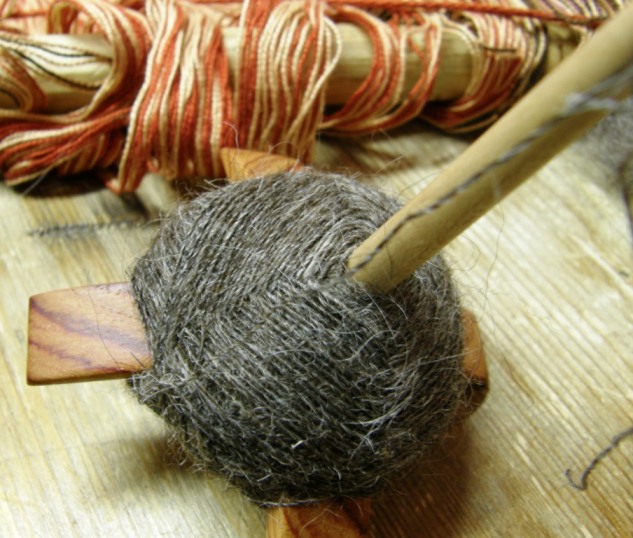
A beautiful ball of worsted spun by Lisa on her Spanish Peacock Turkish spindle

You can see that I didn’t use the inkle loom as it was intended, with its shed making system, but, rather, used it simply as a frame and set up two sets of continuous string heddles as required by Andean pebble weave. The  sheds are a lot easier to open on my backstrap loom and I had to take extra care on the inkle loom to make sure they were well cleared before passing the weft. The resulting band isn’t quite as stiff as the ones that I normally produce on my backstrap loom but I would never have been able to backstrap weave in the car!

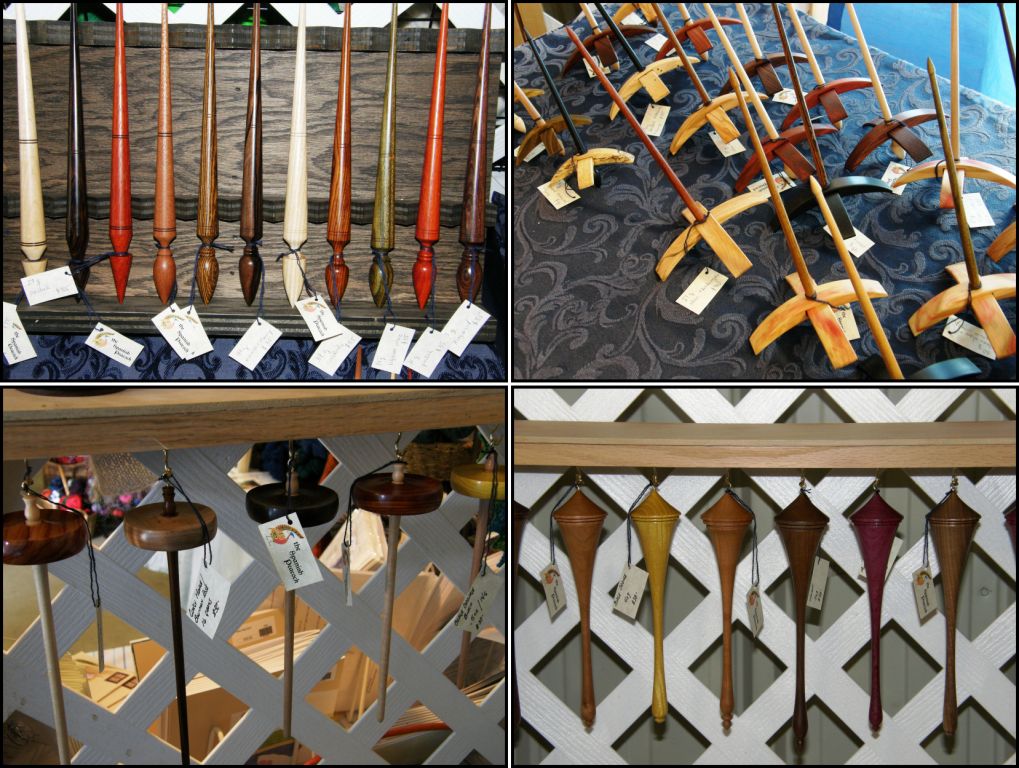
We stayed the first night with Mike King of  The Spanish Peacock and his wife TJ. Mike makes superbly hand crafted precision spindles, lucets and weaving tools in a variety of gorgeous woods – beautiful to look at, touch and use. He was interested to see the humble little Bolivian drop spindle that I had brought along with me, which wobbles comically to and fro as it spins, as well as the wooden backstrap weaving tools, shiny and smooth with age and use that I have collected in South America.
Over his left shoulder in the above picture you can see  mini inkle looms that he makes and calls “tinkles”.
His stand at MSWF was spindlers’ heaven and moments after the gates opened it was full of eager shoppers lining up to make  purchases. Even before the show could open he had to turn down other vendors who were keen to get their hands on his beautiful work.
We spent Friday night with Mike and TJ as they gathered their energies to face the onslaught the following day. TJ showed us the beautiful machine embroidered outfits she makes for their SCA events.
And then suddenly it was upon us – day one of Maryland Sheep and Wool Festival – described by Wikipedia as “the largest and longest-running showcase of domestic sheep and wool in the United States.  …the heat, the crowds and the craziness. I couldn’t get anywhere near Mike and TJ for the rest of the day! I hear that last year canoes were required to navigate the rain-soaked grounds so I really can’t complain about the weather.
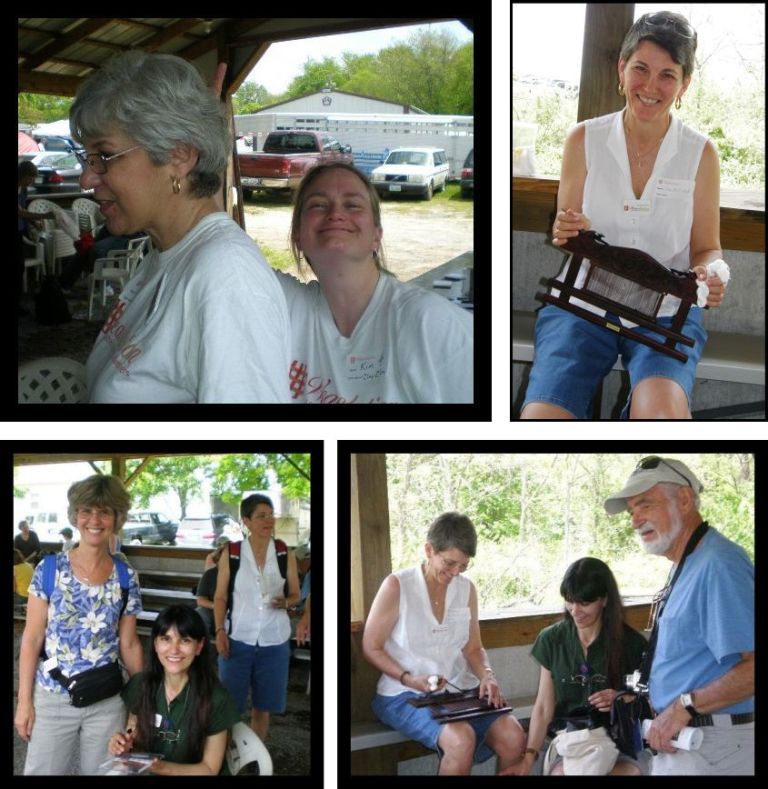
Once I was able to get into shorts, I felt that I might just survive the day. I demonstrated backtrap weaving at the Weavolution meetup at noon. It was fun to see some of those avatars come to life and meet members of some of the local guilds as well as some weavers-to-be.
Some of the Weavolution gang- founder Claudia Segal, Kim Pierce, Deb McClintock, Sharon Carey and Maurice Blackburn.
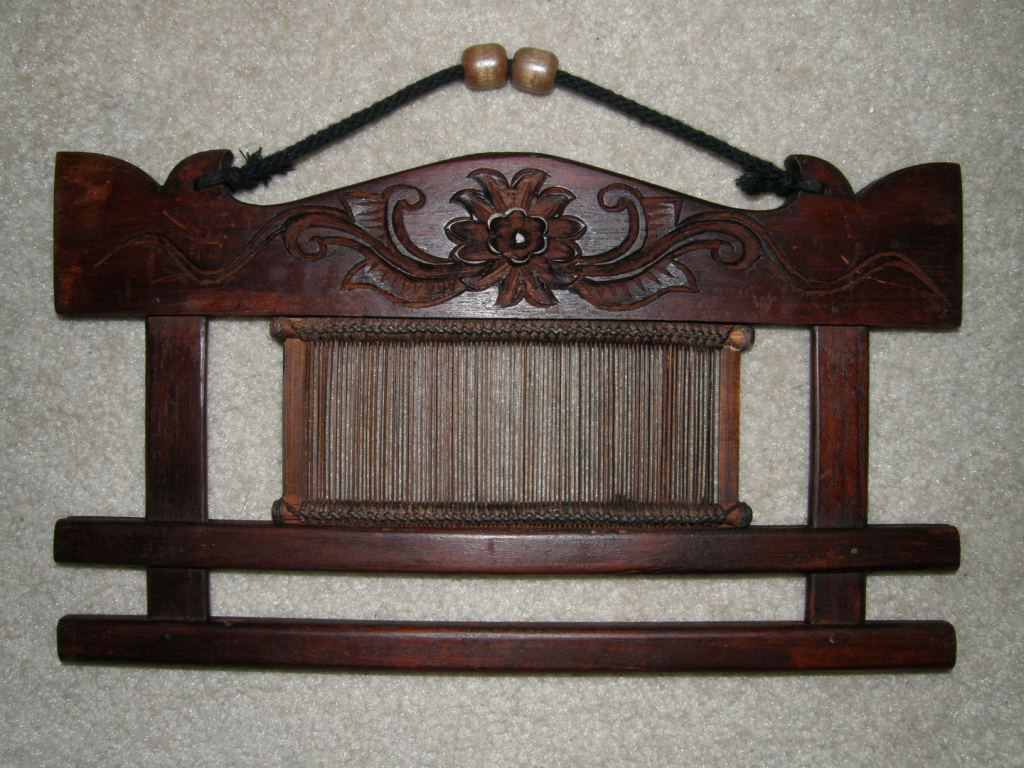
Deb McClintock, who was visiting from Texas, knowing about my desire to get hold of a real reed to use on my backstrap loom, brought this beautiful Thai reed for me as a gift. This piece has been designed to be used as a wall hanger on which to drape a weaving but she gave it to me so that I could perhaps have someone in Bolivia copy it and make a full sized reed. Isn’t it gorgeous?
There were just too many sights, sounds and smells on the first day. The afternoon saw people snoozing sprawled out on the grass in the shade , in their cars or any place out of the sun. Few things really held my attention for long on day one – it was all a little overwhelming.
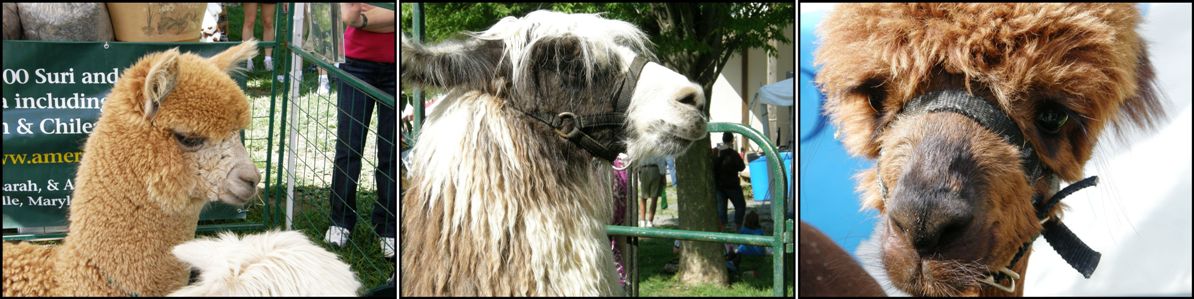
I did enjoy seeing the animals in the relatively uncrowded outdoor areas. The vendor halls on the other hand were packed and too hard to negotiate with inkle loom slung over my shoulder and three backstrap looms in tow.
And then I found my little oasis – the glorious yurt!
It was cool and fresh inside and well insulated from the heat with plush skins on which to sit.
The trellised walls provided the perfect place for tying my backstrap loom.
And there I sat out the afternoon with many visitors who were also quite happy to come in and enjoy the relative cool. Most assumed that I was “keeper of the yurt” and plied me with questions.
Next year I will definitely make that my place to be.
I think I will bring a bunch of backstrap weavings to decorate the walls and we can have our meet up in there!
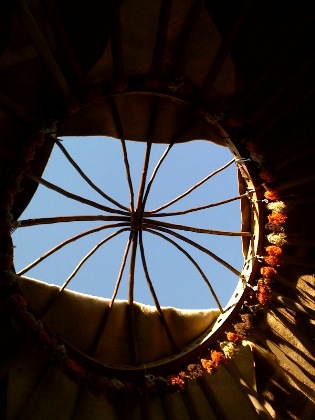
Lisa took the photo at left of the opening in the top of the yurt surrounded by decorative tassels.
The opening provided good lighting  and air circulation and made the yurt a very exotic and comfortable spot in which to weave.
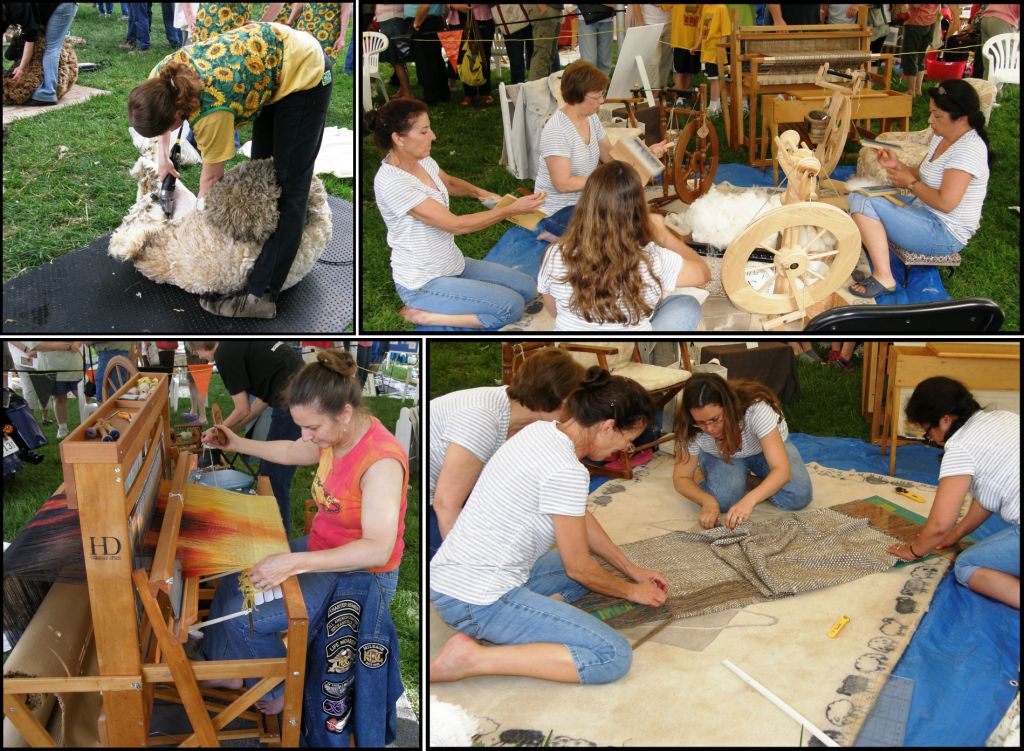
I stayed that night at Claudia’s place where we rehydrated and planned day two – up and out early to catch the start of Sheep to Shawl. I had never attended one of these before and it was very entertaining. Apparently the first Sheep to Shawl was held in England as far back as 1811.
Probably one of the more unusual groups was the Harley Davidson team dressed in denim with motorcycle and spinning wheel revved and ready to go. Their warp was patterned in orange flame colors and they spun and wove to “Born to be Wild”.
If “Born to be Wild” wasn’t to your taste you could listen to some good old Australian bush and shearing ditties. I enjoyed hearing some of those old tunes and they attracted other Aussies to the stage.You can see the winning Bronson lace shawl at right woven by a group wearing colonial-style costume.
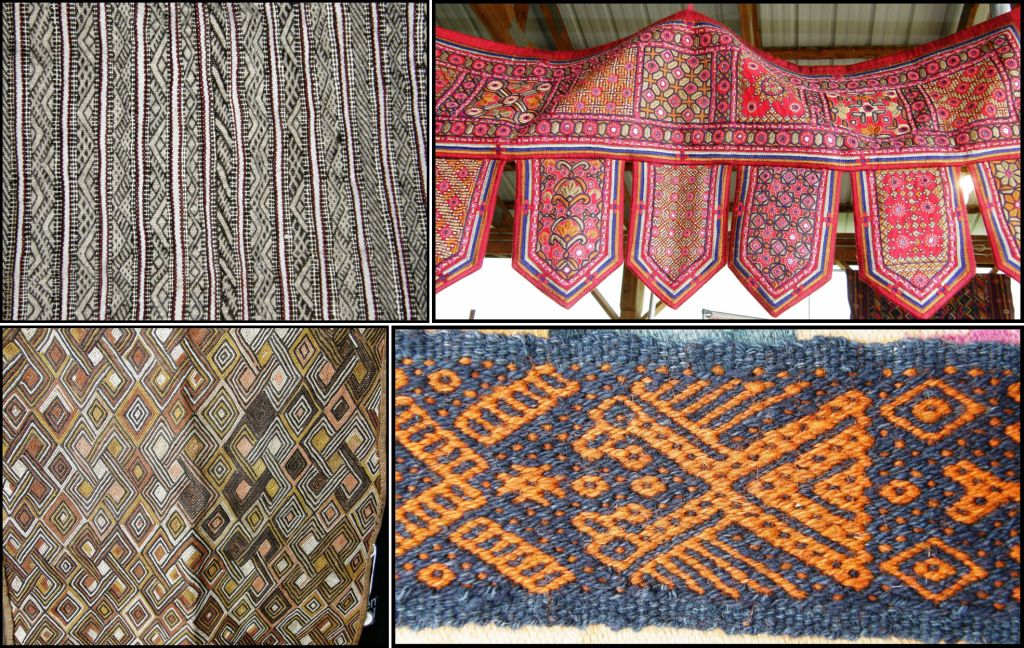
From Sheep to Shawl I headed to the vendors’ halls where I was captivated by a stand of ethnic textiles from around the world. I particularly like the black and white Moroccan textile upper left which is several bands sewn together. I would like to try to reproduce some of those designs. The band lower right is Peruvian from another stand and is woven in Andean pebble weave – some nice motifs to add to my collection. I think I revisited the ethnic textile stand four more times – definitely my favorite.
Then it was time to prepare for the Weavolution meet up and backstrap demonstration.
Although attendance in general seemed to be less on day two of the show, I had a bigger audience at the backstrap demo the second day and the slightly cooler temperature made it a whole lot more fun.
I told you in my last post about the charming English gent I met at Sheep to Shawl and who later came to my demo. I am sure that you have all worked out by now that that was Rodrick Owen.
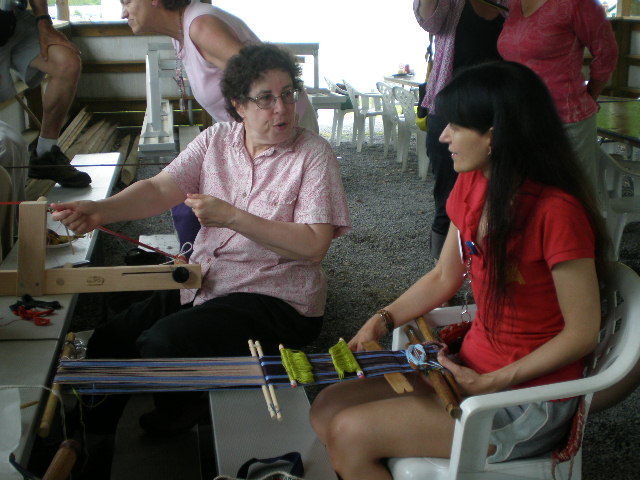
Having seen my band on the inkle loom on the previous day, Carla Gladstone brought her own inkle loom along at my invitation for a pebble weave class.
Mary Pflueger of the Weavers Guild of Greater Baltimore also brought along a warp and set up to backstrap weave and learn pebble weave.
We had a pleasant afternoon weaving. I had seen pretty much everything I wanted by that time and so was quite content to hang out at the meet up point and chat to these two ladies. I was happy to see Rodrick Owen and his friend Terry Flynn return after lunch to chat with me about Andean sling braiding and one of my favorite weaving authors, Adele Cahlander. I got to show him one of the braids that I learned from a sling maker in Peru. We also chatted about mutual acquaintances in the Santa Cruz Guild in California. Ingrid, your name was mentioned more than once!
A visit from Roderick Owen, master braider, pictured below with Mary on the left and Terry.
And all good things must come to an end. At left you can see a rather empty stand at The Spanish Peacock. I left a somewhat shell-shocked Mike out of the picture! Only these kids still had enough energy to leap and dance at the end of the day as musicians and stomping puppets entertained them.
I lingered in Maryland a few more days after the show staying at Claudia’s home. Claudia had some friends over for a day of backstrap weaving. One lady brought an inkle loom on which to learn Andean pebble weave.
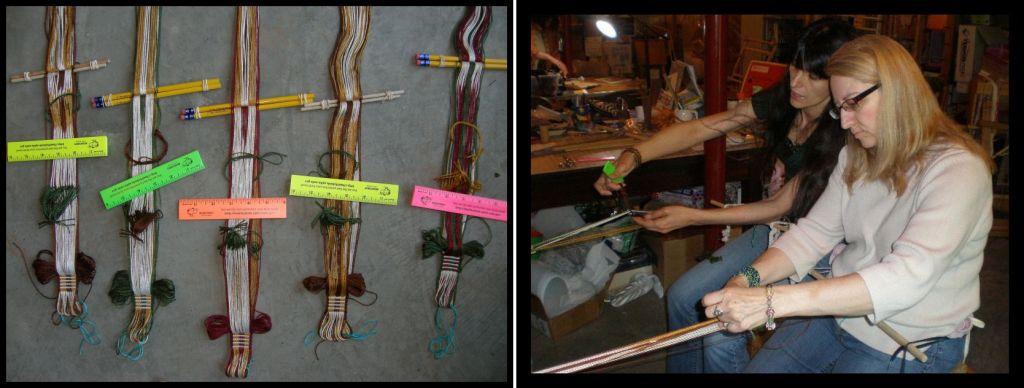
Some brightly colored freebie rulers that I picked up at the Maryland Show made excellent improvised beaters. Claudia has an enormous basement studio with plenty of places to tie up looms. We wove simple warp float patterns. Above, I am showing Carol (aka Retrothreads on Weavolution) good heddle opening technique to avoid abrading her warps and having them pill.
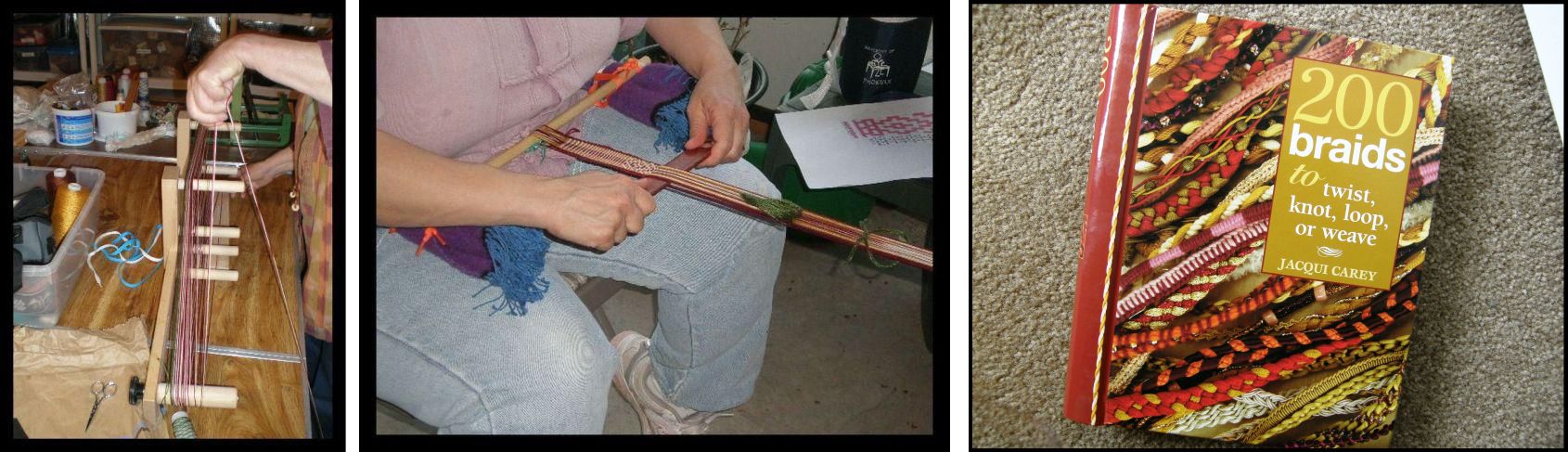
Kim aka Clay2Yarn on Weavolution came along bringing her energy and good humor too and wove simple warp floats. She brought me a gift of the Jacqui Carey braiding book!
Mary with her first ever pebble weave band woven on a backstrap loom
Claudia, Janet and I went to a meeting of the Weavers Guild of Greater Baltimore where Claudia gave a presentation on Weavolution.
Mary Pflueger, who had woven with me on Sunday at Sheep and Wool, attended and  brought along her completed pebble weave band to show me.
I gave a backstrap weaving demo and got to show off Mary’s band too. I just love knowing that my e-monograph is being put to use and that people are enjoying the technique and producing things.
The guild members were fun and very welcoming folks and we had a great evening. I had already met some of them at MSWF and it was nice catching up again.
This was the first weaving guild meeting I had ever attended…sigh! Wish we had these back in Bolivia – so many talented people all in one space!
Rush, rush, rush…the next day I took the train back down to North Carolina to my friend Lisa. We had a trip to the family beach house on Oak Island planned for the weekend.
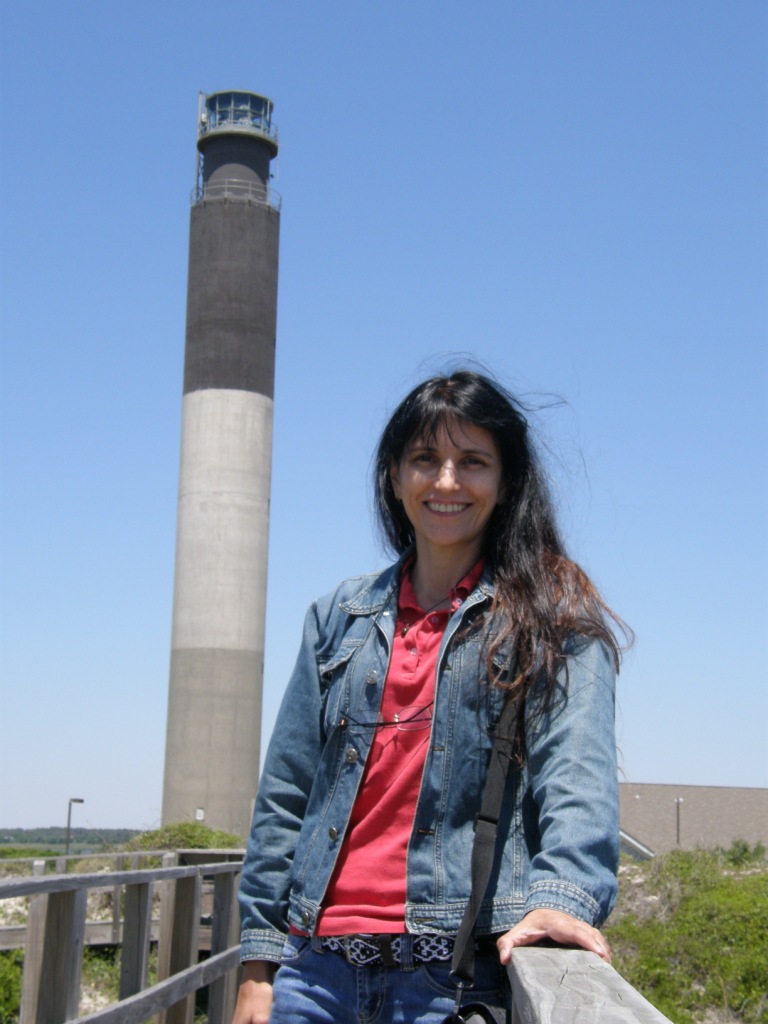
Quite a change of scene! But…have sticks, will travel…while the guys played in the surf I continued my pebble weave project on the inkle loom and Lisa sat spinning. I don’t know how she managed as there was quite a stiff breeze blowing which is what kept us out of the water. Elderly folks were jogging, cycling and walking their dogs while we two crazy gals sat with our fibery projects. I even got a bit of a tan.
Here, there and everywhere….backstrap weaving on the porch of the beach house. Lisa started a jajim-a Central Asian textile- last year in the summer but had to put it away as she has nowhere to weave indoors. Now it is back out again as the weather warms up and she can once again weave outside.
Now we are back in Lincolnton and time is running out. One more backstrap weaving demo at Lisa’s local weaving guild gave me an opportunity to see Betsy’s gorgeous tencel shadow weave pieces.
Just when I had convinced myself that shadow weave needs four colors to work well, I see Betsy’s two stunning pieces in two colors. To me they have a certain oriental look about them. I find shadow weave fascinating!
I have now been away from home for over a month and am starting to feel a bit weary and a tad homesick too. As I have decided to come back for Convergence, my new catch phrase is…”I’ll do that when I come back in July”. So the felting, cut pile weaving and other projects have been added to a long list of things to get into on my next visit. However, one project demanded immediate attention…

ANDEAN PEBBLE WEAVE ON A FOUR-SHAFT LOOM
Lisa and I are warping buddies here as I pass the warps to her to be threaded through the heddles.
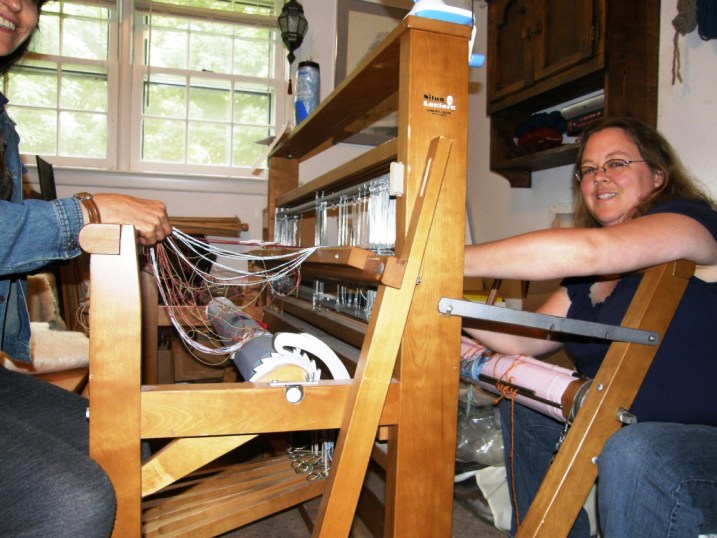
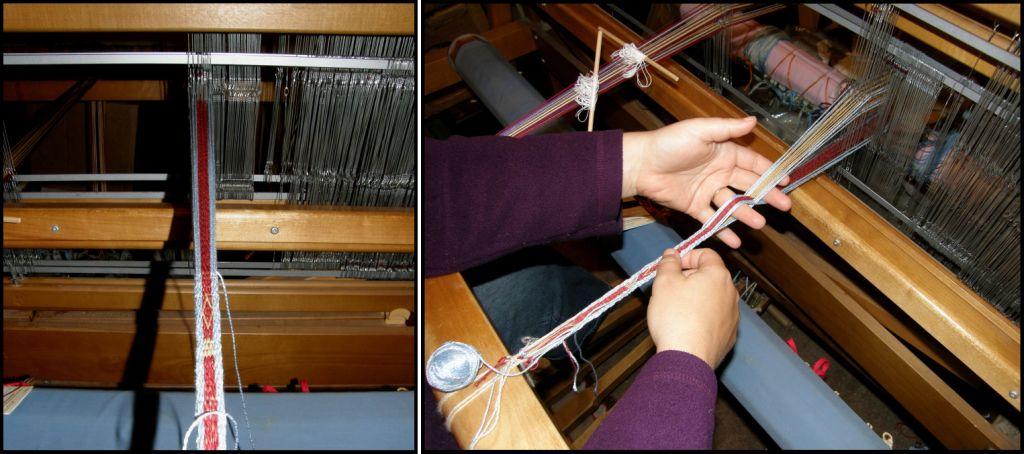
I have this all figured out now and Lisa and I re-warped her four-shaft six-treadle loom with a tiny sample band, this time using all four shafts with no string heddles and, once again, with the reed removed.
I can weave plain pebble weave on this loom using the shafts. Of course, when one wants to form patterns, the warps must be manipulated by hand for every other weft pass. As I mentioned in my last post, the thing I love most about this loom is the beautiful wide clean sheds it creates with a twiddle of the toes!
Maurice Blackburn came over and put my rough draft into his computer program and showed me how to do the notation for the tie ups. I have had little experience reading the classic weaving drafts and needed some guidance. Maurice kindly came to my rescue.
I intend to add this as an appendix to my e-monograph Andean Pebble Weave and am extremely excited about it!
LEFT: The tiny sample band underway with some simple motifs. RIGHT: Preparing to pick up warps by hand to form motifs
Jennifer Jordan was one of the first people to contact me and tell me about the bands she has been weaving in Andean pebble weave following the instructions in my e-monograph. This is a photo of her second project band and she certainly seems to have gotten the hang of it. Thanks to Jennifer and all the other weavers who have contacted me so far.
The other project that simply couldn’t be put off until July was pinning down the kinds of yarn that are suitable for warp faced weaving on a backstrap loom and readily available in US stores, like Michael’s and Joanne’s.
I have bought examples of four different brands – all crochet cotton –  and will be providing photos and more information soon.
I am leaving this until I get home so I can weave bands with them and see how they perform.
 

With lingering thoughts of the sea, I am heading home to landlocked Bolivia.


Tomorrow, (Wednesday) I will be attempting to fly back to Bolivia. I say “attempting” as I am traveling on a standby ticket and it seems that I may get stuck in La Paz along the way.
Well I can think of a lot worse places for a forced stopover. I haven’t been to La Paz for quite some time now and it is a textile lover’s paradise!!

So…have sticks, will travel. The next place my backstrap loom gets tied up may be at 4000 meters somewhere in La Paz. I would really like to get this demo piece finished, off the loom and made into something useful.
And I would really love to get back home and settled and put some more tutorials together for this blog. My head is full of plans.
A big, warm thank you to all my new friends in the US who made this trip so memorable and amazing. I hope we continue to meet and interact online. 🙂 My next visit will be in July in New Mexico for Convergence!
STOP PRESS………….
Wednesday evening…here I sit in Miami airport at the gate waiting for my flight to Bolivia.
I am not very optimistic about my chance of getting on this flight and I have blanket and pillow on hand and  my eye on a good piece of floor on which to pass the night. More importantly I have a good supply of chocolate!
Now what do you think has just appeared in my inbox?…Lisa has leaped back onto the four-shaft loom since my departure this morning and, after a wee false start, is weaving this lovely Chincheros motif from  my Andean Pebble Weave monograph.
She is still working on the original warp that we set up on the four-shaft loom with string heddles as she doesn’t want to waste it.
Woo hoo! I am so pleased!!