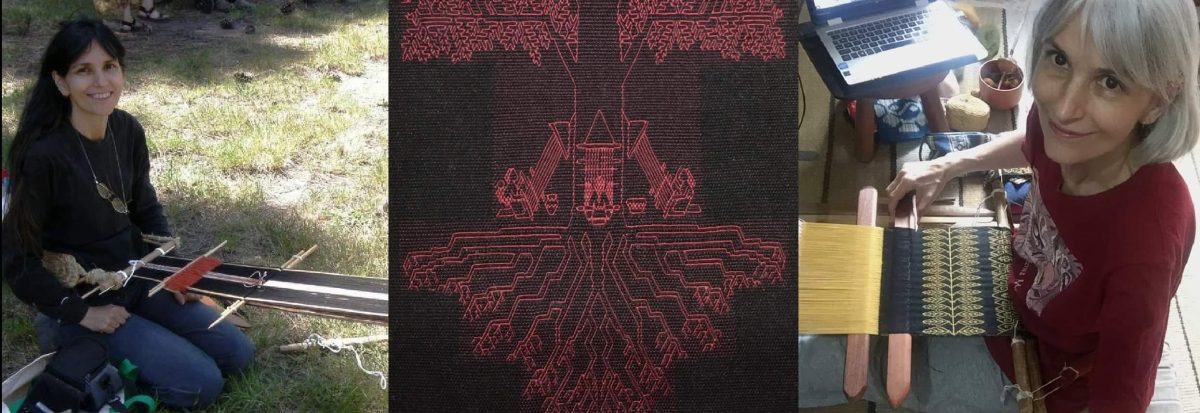
Backstrap Weaving – Come Fly With Me

Let’s do a little armchair traveling.

I have been enjoying talking to my weaving friends in the USA via Zoom and hearing about the little freedoms that they are now experiencing in their small post-vaccination worlds. Bubbles seem to be expanding to allow some people to feel comfortable in gatherings of vaccinated friends. Here in Bolivia as in many countries around the world, some of which are deemed wealthy, poor or somewhere in-between, we are still waiting. Thankfully, the internet allows us to travel to far off places from the safety of our homes.

First stop: the Tibetan Plateau. Daniel Miller allowed me to share this photo that he took of a backstrap weaver who is part of a nomadic group of people that lives on the high Tibetan plateau. The tent has been constructed from panels of woven yak fiber that are woven on a ground loom. The piece that the lady is weaving in this picture is more likely destined to be a saddle bag. She has found the perfect rock against which to brace her feet and make the operation of the loom a little easier on her back. The rock seems to be deeply embedded in the ground. However, I have to wonder if a rock of such perfect shape and size is a favorite that she transports on the back of a yak from from place to place so that she can quickly set up and weave more comfortably. Cheese made from yak and goat milk lies on the surrounding sheets of cloth.

I like to stare at this picture and imagine the sounds that might accompany this weaver…a gust of wind passing across the plain that causes the panels of the tent to billow and flap, the gentle clacking of the sticks as she changes sheds, the rasping sound of the sword against the handspun wool, perhaps the snorting, stamping or sighing of the yaks or a burst of bleating from the goats. I have a recently-formed habit of thinking sounds into pictures.

Tent panels of woven yak yarn. Photo: Daniel Miller

I have been listening to a BBC Radio program called Ramblings in which Clare Balding walks paths in urban and rural Britain while chatting with friends and other personalities. As beautiful as all that countryside must be, there’s something very special about only being able to listen to the sounds of Clare’s ramblings and her descriptions rather than being able to see it all. There’s the squelching sound of her feet on wet turf, the patter of hooves along a bridle path, the gurgling of a stream….

On a recent episode she walked with a sound recordist who introduced me to the words “geophony”, which covers sounds that are made by wind and water, for example; “biophony” which covers the sounds of animal life; and “anthropophony”, the sounds that we humans produce. It made me think of roughly this time last year when we were in our very tight lockdown and the way I had suddenly become aware for the first time of the sounds of our fall season in the form of the rustling leaves traveling over the cobbled yard as well as the birds that sounded like party whistles. It was weird and just a little difficult to adjust to at first.

Enjoying the sounds of lockdown from my third-floor window.

Sadly, one year later, that has all been drowned out now by the typical sounds we humans make as we go about our daily lives. Some are not necessarily unpleasant. Others are disturbing on many levels.

Just this morning I became aware of a new and unusual sound…a strange grinding metallic scraping followed by a heavy thump which was repeated at least twenty times. Leaning out the window, I came to discover that it was the sound of one man struggling to transport a large green oxygen bottle down four flights of stairs and into a truck. Apparently someone in one of the downstairs apartments has been suffering with Covid. The fact that the bottle was being removed and not replaced by another is hopefully a good sign.

But, back to the backstrap weaver seated at her loom far away on the Tibetan plateau. I would like to share a link of more of Daniel Miller’s spectacular photos that accompany an article that he wrote about these nomadic peoples. He has also published several books that are available on Blurb.

From the Himalaya, a video of a backstrap weaver preparing her warp and weaving her cloth has been making the rounds in the various online forums. Here we get to enjoy the sounds and don’t need to imagine them. The clacking of the sticks is my favorite part and makes me smile every time I watch this precious video. I like hearing her whispered mutterings to herself as she works and try to imagine from my own experience with warping what she might be saying. I love listening to her counting her threads while roosters crow and chickens fuss.

How wonderful that she separates the threads into the various sheds that she needs to weave her houndstooth pattern right there on the warping stakes. I marvel at the weaver’s confidence as she removes the warp from the stakes with her shed rods floating in the warp. I would have them all tied off with additional safety strings in place and still feel nervous about losing one!

And now, let’s fly over to the Outer Islands of Micronesia. Unfortunately, this very low-resolution map image is the only one that I could find. I hope that it gives you some idea of the location of Yap which is written in red on the map.

From visityap.com

I met Emily Robison when she came to weave with me on one of my visits to the USA. She told me about her experience learning to weave with backstrap weavers when she was living In Micronesia and allowed me to share some of her pictures in a blog post I published some time ago. This is the loom that Emily built and set up for her own use in the style that she was taught by the weavers of the Outer Islands of Yap state.

This and the following three photos are from the website of weavingconnections.org

An organization called Habele found Emily via my blog post and contacted her for help on one of their projects called “Weaving Connections. Habele describes itself as…

a 501c3 nonprofit promoting educational access and accomplishment among Micronesian communities.

“Weaving Connections” an initiative of Habele established in 2020 to support Remathau women in the mainland United States. “Weaving Connections” helps in sustaining and continuing their distinctive weaving traditions that keep and maintain cultural identities and can provide means for economic support.

On their website you can find detailed instructions with plenty of step-by-step photos on how to build one of the typical looms as well as tutorials on constructing a warping board and making a sword.

An interesting feature of these looms which I find quite unusual is the use of a board as the cloth beam. Instead of a rod, a broad board is used as the near beam and it is to this piece of shaped wood that the backstrap is attached. I can see the advantage of this in that it raises the top layer of the circular warp high above the lower layer. I have often found the closeness of the cloth to the unwoven warp ends in the lower layer of a circular warp to be distracting, particularly when I am using supplementary weft.

You wll find more pictures of this broad beam in use on the loom on the website.

Emily writes:

I’m super excited to share a project I’ve been working on to support the preservation of indigenous Outer Island Yapese backstrap weaving. One of our major goals is to help young Micronesian women living in the US get access to the tools they need to learn their craft while going to school and such, but this website is a great resource for any backstrap weaver interested in Pacific Island technique, including plans for building tools.

Other articles on the website talk about the lavalava which is the typical garment that is made from the cloth woven on the backstrap loom. You can also read about what weaving means to the women who live on these Outer Islands.

When thinking about sounds, I like to add those of the ocean, tropical birdlife and breezes blowing through tropical vegetation as I imagine these women seated at their backstrap looms.

In my next post, I’ll take you to visit the Boruca people of Costa Rica via the pictures that Constance Lee generously shared with me. Constance traveled to Costa Rica from her home in the USA to stay with a family in a Boruca village in the Talamanca Mountains. She was shown the process of preparing, spinning and dyeing cotton with natural plant dyes so that it could be woven into cloth on a backstrap loom. I had no idea that backstrap loom weaving was still practiced in Costa Rica and was so grateful that Constance organized an invitation for me to attend a program that she gave on her experience via Zoom. Here’s a taster…

As for my own backstrap loom, it currently sits as a pile of sticks on my bedroom floor while I plan Panel 4 in the Within These Walls series. Yes, I have decided that a fourth panel is a must and I would like this one to represent what I imagine my post-pandemic world will look like. I am skipping the post-vaccination stage as I have absolutely no idea what that world might look like. Does anyone?

The panel that I just finished is the transition between the chaos of Panel 1 and the relative harmony of my new normal within the walls of Panel 3.

The hummingbirds will unravel the lines of chaos from the first panel and help build a space of safety and harmony.

I won’t explain this in detail. Everyone has had their own pandemic experience and I have actually been enjoying hearing how others are interpreting this series. As I have said before, it is a combination of literal story-telling and symbolism. You can make of it what you will. 🙂 Yes, I am still struggling to get decent photos of it.

So, I see a definite need to weave a fourth panel so that I can end the story on a note of hope as well as create a match for Panel 1 in terms of layout.

I would like to include several weaving figures in the fourth panel and have been working on designing another backstrap weaver in the Andean Pebble Weave structure. This one is viewed from the back rather than in profile. That way I can place several weavers sitting around a tree weaving together.

This is my fourth attempt on this sample band to get this weaver right and I am pretty pleased with. It does include some floats that are longer than ones that I would normally tolerate in this structure but I think that I can get away with them in 60/2 silk. I just need to add a heddle rod and shed rod to the warp. That part is easy. The stick that is currently in the warp is a sword sitting within a shed. The hard part was creating a weaver in the same scale as the other weaver figure that I have been using in the other panels so that they can happily sit side by side.

So, launching into another warp of doubled 140/2 silk that needs to be tied and dyed before I can even begin weaving gives me a lot more time to spin yarn for the projects that will follow this Within These Walls series. There won’t be a fifth panel! I have been devoting all my Zoom time to spinning and that’s coming along nicely.

As I type these final lines, the sounds I hear are those of the birds raucously finishing their day with the setting of the sun. And then one of them gives a signal, or so it seems, and they all stop at once. There’s a moment of hush.

Until next time…..

Backstrap Weaving – Percolating

Ikat! I have been giving myself time to allow the abundance of images and information that I keep finding on ikat to slowly filter so that I can focus on the next project. Without this filtering, there is the tendency to want to try everything in the one project. Another thing that is driving that tendency is the fact that my supply of natural-color 60/2 silk is coming to an end. I had used much more than originally planned in the last ikat project. This project was supposed to be a “sample” which for me is typically pretty small. The project turned into something else all together and will end up hanging on a wall.

Here it is after having been pressed good and hard. That always brings out the sheen of the silk but it has been hard to capture it in a photo.

In a way I am being forced to stop and ponder and allow the ideas to percolate because I was surprised to find that the suppliers of alum that I have always used here in Santa Cruz suddenly don’t carry it any more. I had been planning to dye my next ikat project with cochineal and was depending on being able to find alum. I have yet to find a substitute for alum as the mordant. That brought the plans for the next project to a halt.

Getting cochineal here in the lowlands is usually the tricky bit, not the alum. Cochineal is not used for dyeing here but is sold instead by the ladies in the street markets who carry home remedies. They tell me that it is to be taken as a remedy for susto which I can only understand to mean “fright” or perhaps that could be stretched to mean “anxiety”? Finding cochineal was even trickier this time. The massive street market that lies just two blocks from my home was recently “cleaned up”. All the vendors who normally wander the streets or sit on the sidewalk were ordered to move on. This must have included some of the home remedy vendors.

Asking the wrong vendor brought on a cranky almost offended response. It seems to me that this attitude is somehow part of the Highland-versus-Lowland vibe that is quite strong here in lowland Santa Cruz where certain things associated with the highlands, such as the chewing of coca leaves, are rejected as inferior and “indio”. It appeared that only the vendors from the highlands would have cochineal in their home remedy stalls. In any case, you can see that I was successful in finding someone from whom to buy the little dried beetles.

One down, one to go – alum. I was told that the Mennonites use alum when canning their produce so I will be off to the Mennonite market to see if I can find it there. I have not been to that market before and look forward to it. I am told that it is a market of farming implements and supplies for raising livestock etc.

With those two items in hand, I can start to make some experiments. I wonder what kind of red I will get? I will be happy with pretty much anything except  pink. Here’s the color I got with cochineal on my hand spun llama fiber many years ago using an alum pre-mordant. I used it in small double weave, tubular band and complementary-warp pick-up projects.

My challenges for this next ikat project include using a natural dye and tying a much finer pattern. I was lucky to be shown a detailed image of a small section of an ikat textile from Indonesia in which I could actually count the warp threads. I could see that the weaver had tied around groups of six ends to create such a fine and detailed pattern. I could clearly see the three white  warp threads in the woven cloth against the morinda-dyed background. WOW.

I know that the hand spun cotton that weaver was using is most likely thicker than the 60/2 silk I have been using. That makes it hard to make a comparison. In my last piece I tied around sections of fourteen ends in the pattern area and around twenty eight ends where I had created broad bands of resist. I would love to know generally how fine the hand spun cotton used in the Indonesian ikat pieces is in terms of wpi.

The other challenge is creating a new pattern to use with the finer tying. That hasn’t been easy….I have been looking around a lot for ideas and there’s just way too much input!

I have sketched out something very loosely based on leaves. Leaves have become one of my signature patterns and so I figured it would be appropriate to do something with stylized leaves. What I have drawn has ended up being so stylized that it may not be recognizable as leaves, but that’s okay. Whether I can transfer my sketch to the warp remains to be seen.

So far, I have worked with steps of fixed height and width to form the diagonal lines in the patterns, all carefully plotted and measured out. All the angles have been the same. The pattern I have sketched will involve a lot more free-form tying. Oh my goodness, what have I done?! I can often get very carried away creating these challenges right up until the moment I see the warp stretched out before me. Then some hasty adjustments are made. I remind myself every time I think I have become ridiculously over ambitious with this new pattern I have sketched that I did, after all, manage to tie a a couple of fairly nice circles some years ago. Let’s wait and see what happens.

The other benefit of taking time-out is that I have had much more time to spend on the book. I still can’t quite see the end in sight but I have made really good progress. 

Now, I have something wonderful to show from a weaving friend, Emily Robison. I can’t remember exactly how Emily and I connected but she contacted me online and we were able to meet up on one of my trips away and weave double weave bands together. You can see her already weaving a pattern of her own creation at left.

I asked Emily if she would like to write a couple of paragraphs to share with you about her woven work and her experience learning to weave on a backstrap loom in Micronesia  and I will leave the rest of the story for you in her own words….

To my knowledge, the type of weaving that I do is found only in the outer islands of Yap state, in the Federated States of Micronesia — migratory origins unknown. They are a collection of about 16 tiny inhabited low-lying coral islands (possibly all less than one square mile). The culture practiced in the outer islands is very distinct from the main island of Yap — the two cultures have languages of unrelated origins — but they are very intertwined. The islands practice a caste system, and the main island considers outer island people and culture to be either very low caste or other caste, meaning that a main islander wouldn’t go to the homes or eat the food of an outer islander, and main islanders do not weave lava lava.

Photo supplied by Emily Robison of her own non-traditional use of some of the patterning elements she learned with the weavers of the outer islands.

The backstrap woven fabric called lava lava is used in certain patterns as the only form of outer island female dress — a type of wraparound skirt — and in other patterns it is used as part of the traditional male main island dress. It is also used in main islander funeral ceremonies. Therefore it’s an important trade item from the outer islands to the main islands, but main islanders consider it taboo to participate in any part of the manufacture.

Photo supplied by Emily Robison of her current work which she says is a reproduction of one of her teacher’s pieces except for the supplementary-weft pattern.

Traditionally, lava lavas were woven of banana and hibiscus bark fibers and naturally dyed in reds and blacks (maybe other colors, but I haven’t seen them), but this practice has shifted in favor of commercially available thread from China. This transition is less than 50 years old. The traditional fabrics weren’t warp-faced, I don’t think — at least the few I’ve seen weren’t — but today’s lava lavas are.

Silk is too expensive, wool too hot, and cotton doesn’t hold up to the production, so they exclusively used polyester (but I’ve heard rumors of people incorporating more cotton in the past 10 years). Their patterns are pretty distinct and uniform. People can use many colors (reds are off limits unless used as an accent color or on the edges), but the two types of patterns are the lava lavas with large fields of solid color and accents on the edges and in the middle. These are the ones that have a supplemental weft, and an example is the one that I am currently weaving. (Emily tells me that the supplementary-weft patterning technique shows pattern on both faces of the cloth. Here is a view of the back of the cloth of her current piece showing the black supplementary-weft pattern.)

Another example is the style with 6 or 7 contrasting stripes (I don’t know when one would be chosen over the other — 6 is more common) on a colorful background. The stripes are made of two complementary colors and some patterning. 

The ones for men are just black and white, 6 or 7 striped. 

Image of a Yapese man’s lava lava taken by Laverne from the website of worthpoint.com

Single-thread floats in the green section on the upper face of the cloth.

Much to the chagrin of my Yapese host family, I studied with outer islanders and wove in secret for about 18 months. It was a real taboo thing to do and it didn’t make me any friends… so I don’t know as much as I could have learned if I’d been living with an outer island family.

The patterns are made with two sticks that control the floats — one for the right face, and one for the reverse face. The warp is always continuous, and the tension rod loop, string heddles, and pattern floats are all created in the warping process.

(Note from Laverne: I just love that extra heddle peg sitting there so neatly like that. If you are curious about how heddles are made during the warping process, I can show you how my Montagnard (Vietnames hilltribe) backstrap weaving teachers do it. It’s probably not exactly the same way as the Yapese weavers do it but it will give you an idea for now. There’s a video showing how Ju Nie does it embedded in this blog post  followed by a video I made slowing the process down so that you can more easily see how it works.)

Lava lavas must be long enough to cover a woman from upper hips to knees (it is taboo to show off any thigh). and so they are usually about 26 inches wide and 60 inches long. Once cut, the strings of the fringe are kept long to create a kind of modesty curtain between the legs. They’re worn by wrapping them in half around the body, and then pinching the two sides together at the right hip and folding the fringe inward to sit between the legs. They’re usually tied on with a belt, but some ladies just tuck them in.

Emily wearing a lava lava.

You can follow Emily’s work via her Instagram account: @thewovenworld. She is hoping to create a website soon too.

To finish, I have a few things to show you from my online weaving friends….

Kathleen Frtiz recently received a Guatemalan backstrap loom and has taken off on her backstrap weaving adventure as if she had been born for it. This is only her third piece as far as I can tell. It is woven in fine cotton and she is pleased with how surprisingly pliant it is even before it has been wet finished. She used this piece to experiment with patterning with supplementary weft using the patterning sticks and techniques that I describe in this tutorial.

Nancy Ayton made sweet hanging ornaments from her Andean Pebble Weave bands. The deer head motif is her own creation. I love it when people start designing their own patterns. The owl and bird motif is from my Complementary-warp Pattern Book and the knot-work pattern is from More Andean Pebble Weave Patterns.

Nora Dereli is using her inkle loom to weave one of several knot-work patterns that are charted in More Andean Pebble Weave Patterns. This is a motif that  Louise Ström weaves in one of the structures that are woven using tablets. I translated the motif to the Andean Pebble Weave structure.

Susan Bratt finished weaving a guitar strap on her backstrap loom using the Andean Pebble Weave structure. The pattern is from the Complementary-warp Pattern Book.

Wendy Garrity completed what she tells me is her first silk-on-silk wrist band using the supplementary-weft patterning technique known as sampa in Bhutan. The multi-color spots of color that appear between the floats of supplementary weft are so pretty. Wendy studied weaving on a backstrap loom and various traditional patterning techniques while living and working in Bhutan and leads textile tours there every year. Her website is Textile Trails.

Gregory W and I wove double weave bands together and she came up with this lovely band with her own original design shortly after. Her guild had challenged members to use these colors in a project and this was Gregory’s contribution.


Marilyn Albright and I have never met but I feel that we are bound to one of these days in her movements between Alaska and Mexico. She has been experimenting with Bedouin al’ouerjan patterns using my tutorials here on this blog and adding her own twist to the traditional pattern .

And here’s one more from Priscilla Bradburn who wove this band after learning Andean Pebble Weave from my book Andean Pebble Weave on Inkle Looms. She has taken flat-top S hooks, hearts, diamonds and other basic shapes and combined them in her own unique way to create a new pattern of her own. This and her creative use of color has produced a beautiful band! 

Let’s hope my hunt for alum is successful otherwise it will be back to the synthetic dyes for me. I wonder what other interesting things I will see at the Mennonite farmers’ market.

Until next time…