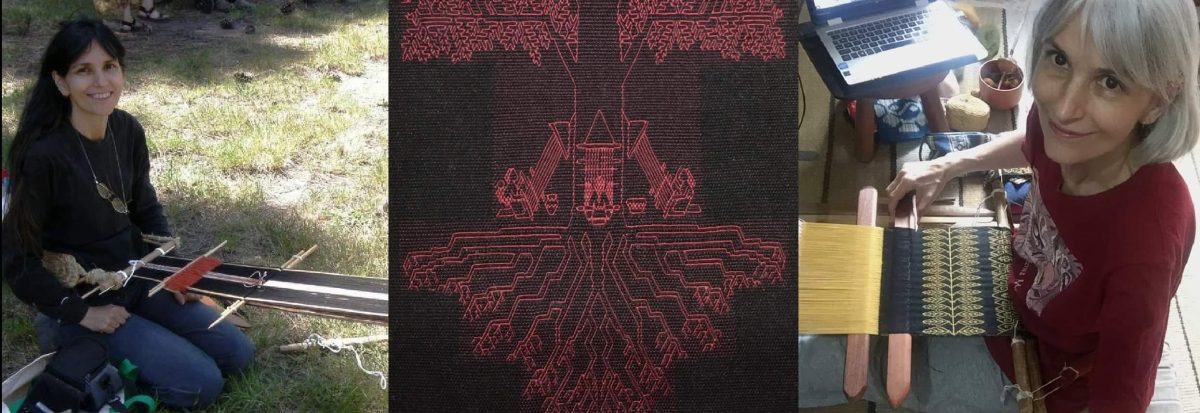

I don’t have the blues. In fact, the opposite is true. I have been getting such a lift from the various Zoom events that I have been attending lately and I try to focus on these rather than on the news.
One such Zoom event that I found very uplifting was the annual conference of WARP (Weave a Real Peace) that took place last weekend. My friend Dorinda had given me a one-year subscription to this organization which allowed me to take part in the Members Only social sessions over the course of the three-day gathering. The rest of the conference was free and open to the general public. The webinar style of the panel discussions did not give us the chance to see who else was attending and so the social sessions were particularly nice in that they enabled me to see and chat with many of my “old” weaving friends, some new friends that I have made during the pandemic and meet new-to-me textile enthusiasts via the break-out rooms.
Zoom and loom…they are both still very much major parts of my life.
During the Sunday morning coffee social, Mari took a screen shot to show what we were all working on while chatting. It seems that I am not the only fiber person who finds it hard to sit still with hands unoccupied. I have been using Zoom time to spin on my drop spindle.


I chose to use the word “blues” in my title for this post because I have finally shifted away from the red and black that I have been using for the last seven months. I started sampling my new hummingbird figures in warp-faced double weave on a sample warp of black and gold 60/2 silk. Yes, black again, but I find that sampling in black is handy because I can adjust the patterns on the cloth with a black charcoal pencil before changing my chart. Most of the charcoal dusts off with some coaxing if I want to revert to the original. Now, a variety of blues are creeping into my work.
There is no lack of images of hummingbirds on the internet to help me chart my patterns. I think it must be quite a feat to be able to capture an image of one in flight with its wings showing sharply. I have read that they flap their wings up to eighty times per second. The giant varieties that are found in South America flap at more like ten to fifteen times per second. But even without internet access there was an image available to me right under my nose….

There it is, the picaflor gigante! This new Ten Boliviano bill has been around for a few years now and I can’t believe that I had never noticed this! I am not sure what made me stop and examine the bill just the other day and discover the hummingbird.

It didn’t take me long to fill my black sample band with figures, many of which were multiple re-workings of the same motif and I was still left dissatisfied. Some looked too chubby, some too pigeon-like. Back to the warping board. I could barely face the black thread again!
In the meantime, I found an article about the Guaraní people’s legend of the hummingbird. One of the regions that the Guaraní people inhabit is the part of Bolivia in which I live. I studied for a while with a Guaraní weaver here and while her textiles in the Moisy structure contain images of birds, they are not recognizable to me as hummingbirds. If I ever find my Guaraní teacher again, I hope to ask her about that.

The legend tells of the forbidden love between Poti, (flower in Guaraní), a princess belonging to one of the tribes, and Guanumby, a member of another rival tribe.
When the affair is discovered, it is forbidden and a marriage is arranged with a member within Poti’s own tribe. In her despair she begs the gods to kill her. Instead, they turn her into a flower. The moon tells Guanumby of this and he extends his arms to beg the heavens to help him find Poti. He is transformed into a hummingbird going from flower to flower trying to recognize the kiss of his beloved Poti.
Before I could make it to the warping board, I suddenly remembered a silk warp that has been lying dormant in one of the drawers for a few years. It was the warp that I used to sample my arrangement of paisley shapes before I moved on to the real project. It was all heddled up and ready to go. Brilliant. As much as I love making string heddles, being spared having to make the seven hundred and twenty that have already been made for this warp made me very happy. I loved being able to revive this warp. The rubber bands had rotted but the sticks had not jumped out of the cross. I don’t know if it was a conscious need to be color coordinated when I chose that pretty blue for the string heddles. That’s a DMC mercerized cotton thread in size 60, from memory.

Because the silk threads are so fine and because there are so many ends, I use four sets of string heddles to help me to do the double weave pick-up. Warp-faced double weave can also be done using just two basic sheds which is what enables us to do it on inkle looms. That is the method I teach in my book Warp-faced Double Weave on inkle Looms. It works beautifully when weaving narrower bands using thread of larger girth.

The pattern appears on both faces of the cloth with colors reversed. I find warp-faced double weave a very nice structure for designing and include a tutorial in my book with suggestions on how to go about it. There are no warp-floats to consider which means that anything that you draw on the chart will be structurally sound.

I used a metal rod in the warp ends which is then lashed to the warp beam. This enables me to create a third selvedge. You can see that in the center picture above. Using a metal rod is not traditional and is just one of my own quirky practices! It works for me and makes it easy to remove a partly-woven project from the beam and store it away. These soft colors are so nice to look at after all those months of black!
And so, I continue sampling my hummingbirds and can test my charts of bits of foliage in the process.
In the real project, whatever that might turn out to be, I won’t be leaving all that open space. That will be mostly filled with foliage. It will be quite a busy scene.
This is one thing about warp-faced double weave that should be kept in mind. In places where there is no pick-up pattern, the two layers of double weave do not connect. The two layers of double weave in this piece are bound at their edges by the green strips of plain weave. Wherever there is pattern, the layers are connected. The fabric can feel unstable or even experience a sort of ballooning effect if there are large plain solid-color areas between the figures.
I think that I am pretty happy with these two figures but there’s still some work to be done on the others. I also want to experiment with weaving the hummingbirds as solid shapes rather than as outlined figures. I think that it is fun seeing the birds emerging from the splash of paisley shapes. I enjoy using my ice cream-stick shuttles which are just the right size for this piece
This will keep me busy for a while and in the meantime, I will think of what exactly I want to weave once I am happy with the designs. If you know me at all, you will know that I am really all about the process. The idea for the product may only come once the fabric is off the loom. I agree that it’s a strange way to operate.
And here’s some more gorgeous blue. Lately, I have been creating to-do piles instead of to-do lists and so my bedroom floor is an obstacle course of little piles of yarn, woven samples and scribbled notes to remind me of my intentions. Among the piles is some beautiful indigo-dyed 30/2 (or perhaps it’s 20/2s?…I don’t remember now) cotton from Guatemala that I bought at an ANWG conference way back in 2013, I think. I don’t think that it is possible to buy more and so I must choose its project very carefully. I used some of it to weave a couple of journal covers as gifts. You can see my friend Claudia’s initials in this piece that I wove some years ago which lay along the spine of the book….

At the moment the thread sits in a pile next to my weaving spot simply because I like looking at it. I haven’t yet come up with the idea of what I would like to do with it. Actually, just pausing to stare at this picture on the screen is starting to give me ideas. Maybe it is in fact 20/2s. Hmmm….I have some white 20/2s but do I have dye for cotton?
But then there are all the other piles to consider. There is certainly no shortage of projects to keep me busy for the rest of the year. I know that I won’t be traveling anywhere this year no matter how optimistic some people seem to be in other parts of the world.
I know that one day my life might be very different and I will be wishing that I had more time to weave and so I plan to make the most of the rest of this enforced time at home. What about you?
Until next time…..


