Backstrap Weaving – Venturing Outside the Comfort Zone

Venturing Outside the Comfort Zone

???????????????????????????????It’s always nice in my travels to return to known places. There is something very comforting in the midst of all the “what-ifs” and unknowns of travel to meet once again familiar faces and landscapes.

However, there are always new people and places to add and I have enjoyed visiting new guilds and new US states on this trip. This was my first time visiting New Jersey, for example, and now I am about to venture into Nevada for my first ever visit there. There are new experiences, like trying to navigate the New York Port Authority with loads of luggage for the first time, going flying in a Cessna over Cape Cod on a perfect spring day, and being made very much aware of the rather “shaky” nature of the California coastline! (see picture above).

The mysteries and trepidation of going to new places are always short-lived. The new landscapes are exciting and the new weaving groups without exception are warm and welcoming.

The western part of this trip has take me through a variety of landscapes….from the beaches of lovely Santa Cruz to the big cityscape of Oakland and the forested high passes and lakes of the Sierra Nevada range.


Walking the paths of West Cliff Santa Cruz was a wonderful way to unwind after a day of teaching. We watched surfers, pelicans and sea otters at play in the light of the setting sun.
Walking the paths of West Cliff Santa Cruz was a wonderful way to unwind after a day on the move. We watched surfers, pelicans and sea otters at play in the light of the setting sun.
The view from the 19th floor room that I shared with Jennifer Moore at CNCH 2014.
This is the view from my 19th floor bedroom at CNCH 2014 last weekend. It was fun sharing with Jennifer Moore whom I had met and spent time with backstrap weaving and at the opera in Santa Fe last year.
One of the beautiful peaks on the way to Truckee California.
One of the beautiful peaks of the Sierra Nevada on the way to Truckee California.
Yonat weaving amongst the Redwoods in my Santa Cruz class.
Yonat weaving among the Redwoods in Santa Cruz.
A new venue and new faces in Grass Valley California...backstraps in position and ready for action!
A new place and new faces in Grass Valley California…backstraps in position and ready for action!

I like to call my Santa Cruz group my “firsties and besties”. As it was my fifth time visiting and weaving with them, I decided that it was time to push ourselves outside our comfort zones. The challenge was to take one of the structures that we had woven together on the last four visits and use it in something wide and/or fine. Some group members warped up something much wider than anything they had attempted before while others used much finer thread than they had ever used on a backstrap loom. The results were wonderful!

First we tried different ways to set up warps for wider projects, for example, using multiple swords for creating picking crosses instead of fingers.

Jane uses a mulitple sword technique to pick up a pattern for her backstrap project.
Jane uses a multiple sword technique to pick up a pattern for her backstrap project.

Jane is not actually one of the original “firstie-bestie” group but she has put in so much time and effort since her very first time weaving with us, that she was able to fit in perfectly with the skill level of this group. She has woven an impressive array of Andean Pebble Weave bands since we met only six months ago.

Jane makes exquisite baskets and brought along one of her creatios filled wih her Andean Pebble Weave bands. Ripples the cat had to get in on the act.
Jane makes exquisite baskets and brought along one of her creations filled with her Andean Pebble Weave bands. Ripples the cat had to get in on the act.

Here’s a closer look at the pretty bands and Jane’s basket without the giant cat-head distraction!….

Jane Milner's basket and pebble weave bands.
Jane Milner’s basket and pebble weave bands.

Jane has tried patterns from both my first and second books…

Andean Pebble Weave bands woven by Jane using Omega Sinfonia yarn.

The upper band is an adaptation of a pattern that was woven by Louise Ström using tablets. Many tablet weaving motifs can be easily adapted to the Andean Pebble Weave structure and I have charted some of these in my second book. The lower motif is a doodle I made in the second book where I am showing how people can go about creating their own pebble weave patterns. The hook motifs placed in various diagonal arrangements are, of course, classic Andean patterning.

On the first day at Yonat’s place, I found myself just “hanging out” as my weaving friends wove and planned their projects with increasing independence.

weaving at yonats place

In the afternoon, we did a little “round robin” activity on my prepared warps to brush up on structures and techniques that we seen in other gatherings and help in the decision making and planning process for the next days’ projects…
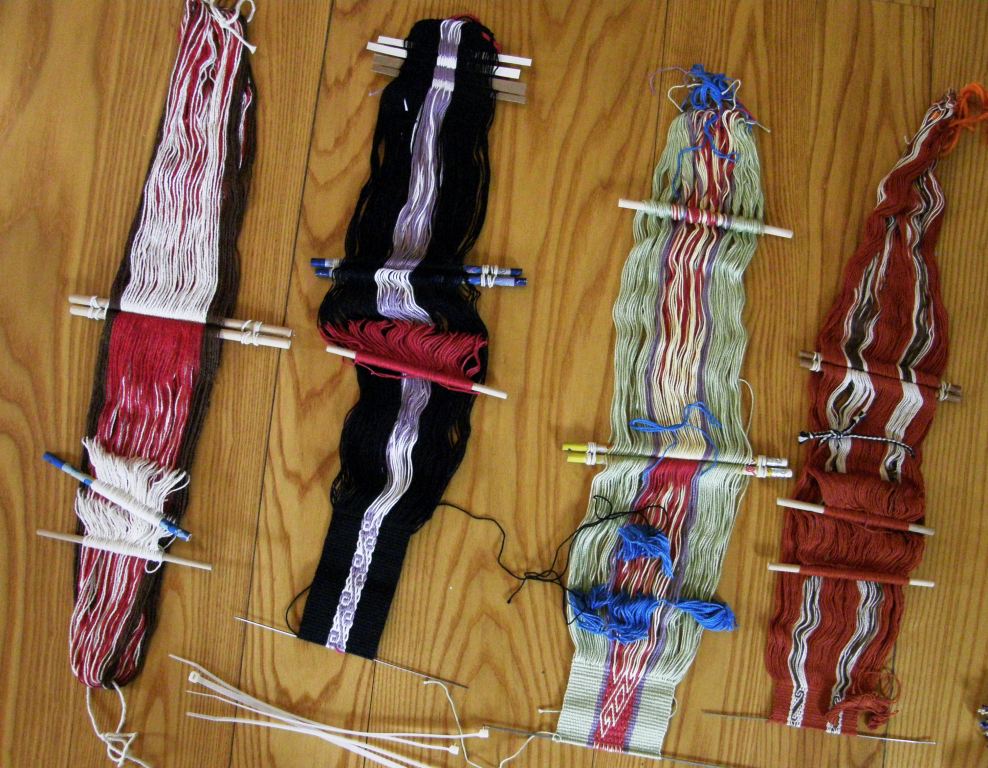
round robin backstrap weaving

Dorothy's wode project included three columns of Anean Pebble Weave motifs. As she was only able to take two of the three-day workshop, she had to leave with her heddles installed and just a handful of picks in place. As she is heading to Peru to study with tapestry master Maximo Laura this summer, I am wondering when she will find time to sit and finish her project.
Dorothy’s wide project included three columns of Andean Pebble Weave motifs using Tahki Cotton Classic yarn. As she was only able to weave with us for two days, she had to leave with her heddles installed and just a handful of picks in place. As she is heading to Peru to study with tapestry master Maximo Laura this summer which will lead to a whole new world of weaving, I am hoping that she will find time to sit and finish her project soon.
Peggy used Reynold's Saucy yarn (now discontinued) to create a warp for a backstrap . She liked my "Rolls Royce" backstrap...the thick and cushy one and so, chpse a pebble weave motif along with the intermesh structure to produce thick fabric.
Peggy used Reynold’s Saucy yarn (now discontinued) to create a warp for a backstrap. She liked my “Rolls Royce” backstrap…the thick and cushy one…. and so, chose a pebble weave motif along with the intermesh structure to produce thick fabric. Anne went the other way and used fine thread to make a cell phone pouch. She will use two sets of string heddles to make the process partly loom-controlled and decorate the pouch with an Andean Pebble Weave motif.
Here is Yonat's backstrap warp rolled up at the end of the day with just a couple of inches left to go. Yonat found taht weaving outdoors seated on the ground with her warp angled steeply was much more comfortable for her.
Here is Yonat’s backstrap warp rolled up at the end of the day with just a couple of inches left to go. Yonat found that weaving outdoors seated on the ground with her warp angled steeply was much more comfortable for her.
Barbara's challenge involved weaving her favorite "viscacha" motif in fine thread (Aunt Lydia's #10) and swapping the colors for the motif and background while creating beautifully straight edges.
Barbara’s challenge involved weaving her favorite “viscacha” motif in fine thread (Aunt Lydia’s #10) and swapping the colors for the motif and background while creating beautifully straight edges.

The following day, after having looked at images and watched online videos of the cute Andean viscacha, Barbara brought in a tapestry piece  which had been woven on a backstrap loom in Pitumarca, Peru. She had just realized that the critter at the bottom of the piece was the same as the one which she was weaving into her fine backstrap band.

??????????????????????

When not weaving, there was also lots of fun to be had. Yonat and I looked at experiments that the late Nora Rogers, former member of the Santa Cruz guild,  had been performing on backstrap looms. Here is another kindred spirit and it was amazing and almost eerie to see how closely my backstrap weaving experiments have been following the path of her own carried out years before I came to be involved in this.

Here is Nora's experiment in the white-on-white patterning technique using supplementary weft on a light, open cotton ground cloth. I bought a piece like this at the Santa Fe International Folk Art Market last year in the hope of studying and trying to replicate it myself.
Here is Nora’s experiment in the white-on-white Guatemalan patterning technique using supplementary weft on a light, open cotton ground cloth. I bought a piece like this at the Santa Fe International Folk Art Market last year in the hope of studying and trying to replicate it myself.

And then there were various beauties to be examined created by Yonat’s own hands…from tapestries to handmade beads to Ravenstail twining. I saw one of this set of Ravenstail leggings finished on my last visit. This time I got to see the completed pair….

???????????????????????????????Yonat and I also went to a local store that buys and sells ethnic textiles from around the world. We had a super time digging through loads of pieces to find some special treasures. Some pieces were long and large and required no digging at all….

It seems so long agao now since my friend Lisa sent me a picture of a yurt band she had bought and I becane fascintaed with the simple warp-float technique thathad been used to create it. Here in the store was a gorgeous example in those lovely sun bleached reds and blues that I adore!
It seems so long ago now that my friend Lisa sent me a picture of a yurt band she had bought and I became fascinated with the simple warp-float technique that had been used to create it. Here in the store was a gorgeous example in those lovely sun bleached reds and blues that I adore! This technique produces a pattern of warp-floats on one face and areas of exposed weft on the other.

The warp-substitution technique is another one on which I have spent some time experimenting. We had to resist completely unrolling this band to see how the motifs changed along its enormous length. The designs are crisp on the upper face in warp-faced plain weave. Colors are warped doubled and the weaver simply substitutes one for the other to create the patterns. The unused colored warps float on the reverse side of the textile until they are once again called into use.

???????????????????????????????

Here are three bands from across the globe….from Bhutan patterned with supplementary weft….a three-color double weave belt from Bolivia and a supplemental-warp patterned band from Mexico.

???????????????????????????????

But the jaw-dropper as far as I was concerned was this poncho from Bolivia (see below) patterned with strips of warp-faced double weave. Yonat uncovered this one at the bottom of a pile of mixed textiles on a shelf.

I call this technique “embedded” double weave as the strips of double weave with pick-up patterning are flanked by warp faced plain weave. The yarn is very fine synthetic thread and the weaving was superb! It is a beautifully finished four-selvedged poncho. I know from experience how maddeningly difficult it is to finish a double weave piece with four selvedges and the thread used in this piece does not have the advantage of the springiness of wool which can make the task somewhat less difficult. How I would love to sit by the weaver who created this!!!

???????????????????????????????


???????????????????????????????The visit to Santa Cruz also included a few get-togethers with my dear friend Annie.

If you are a regular reader of this blog, you will know Annie as creator of guitar straps and custom bands and sashes on inkle looms. She gave me the lovely strap, at left, to use on my camera bag.  It is as much fun seeing what wonderful combination of colors she has come up with for her one-of-a-kind pieces as hearing the personal and inspiring stories behind her custom projects.

One of her latest challenges is to create a sash similar to one used by Johnny Depp in the Lone Ranger movie!

I shall leave you here for now. I am in Truckee now and grateful to my friends Suzanne and David for their patience while I bury my head in photo editing and blog writing. I’ll be weaving by the shores of Lake Tahoe in a couple of days and can’t wait to see it!

I shall probably write from Portland, Oregon next with further tales of  the Grass Valley group, the CNCH conference in Oakland and weaving at Lake Tahoe. Bye for now!


Backstrap Weaving – Scattered Drops in the Ocean

Sometimes I am fooled into thinking that just because I am in several online weaving groups, whose forums I read, contribute to, or simply lurk in on a fairly regular basis, I am seeing a good representation of what is going on in weaving in the USA , Europe and other regions of the developed world. Of course, what I am seeing online are mere drops in the ocean. Consider this blog post a peek at a scattering of drops in the ocean as I try to gather the bits and pieces that have come my way, both online and off, whilst on the road.

Let me first show you some pictures of beautiful textures of ocean currents and sand alongside quilt-like patches of color in the Massachusetts landscape. I went flying with my friend Pam’s husband in his Cessna to Cape Cod, over Nantucket and Martha’s Vineyard on a perfect spring day. We had hoped to do such a flight on my visits in previous years but the weather had always been against us.

massachusetts sea and landDrops in the ocean….a corridor of  islands stretch along a bed of blue and green ocean. Those patches of deep red are the cranberry bogs amongst the various tones of green in forests, lakes and fields.

river and ocean and sandSquiggly lines on the ocean floor and across the land make me think of my “Shipibo songs” woven piece at home on my backstrap loom which is awaiting  my return.

???????????????????????????????I have managed to visit three fiber guilds so far on this trip. Some are devoted to all kinds of fiber arts while others are exclusively about weaving. I see the items in the Show and Tell sessions and am astounded by the variety and beauty of the cloth and the humility of their creators.
Many of the weavers simply do not use the internet as a way to connect with other weavers. Their guilds provide a wealth of kindred spirits with whom they can share their projects, ask questions and supply answers. …more drops in the vast sea of weaving.
I like to hear the personal stories behind the woven items from people who are more at ease with sharing within a small group of people with whom they have become well acquainted over many years rather than posting things online for all the world of friends and complete strangers to see. And, of course, the added bonus at  the guild meetings is that we all get to touch and examine the pieces.
We heard the story of Pam’s wool/silk  tallit, or should I say, tallits. You can see two being passed around in the picture. It was only after having twisted the fringe and completed the piece that she realized, on folding it, that the stripes didn’t match on the two halves. One colored band had been woven slightly differently and had, therefore, thrown all the others off. I can imagine that sinking feeling in her gut as she discovered the error. It was back to the warping board to start all over again. She told us of the kindness of the person for whom she had woven the piece and why it was so important to her to have the piece come out just right. He received it in its handwoven bag in tears and says that it wll now be a family heirloom.
??????????????????????
At the same Show and Tell session I was pleased to see a piece of warp and weft ikat from Thailand that a  member had brought along just after I had mentioned this technique in a blog post.
???????????????????????????????
Again, I wonder how many lifetimes I will need to try out these techniques. I may perhaps try weft ikat one day when I am done with experimenting with the warp version and then, if I have a decade to spare, I might get to try warp and weft ikat!
It was nice to see another kindred spirit of mine, Ute, at the Springfield meeting. Ute is part of a group with whom I have woven in Northampton and her sharing of  her collection of Bhutanese textiles and her encounter with Bhutanese backstrap weaver Leki Wangmo were great sources of inspiration to me.
Meanwhile, back in the internet world, with its blogs and weaving forums, my friends Claudia and Janet  showed off their latest custom designed handwoven baby wrap, the colors of which were based on a photograph of a Hawaiian sunrise supplied by the mom. Unlike most internet encounters with beautiful cloth, I have been able to touch this piece ansd heard the story about its creation from concept to fulfillment when I visited with Claudia a couple of weeks ago. Janet took the picture. I think that yardage is difficult to photograph and Janet has found a very effective way to show off the cloth.
lots aknots
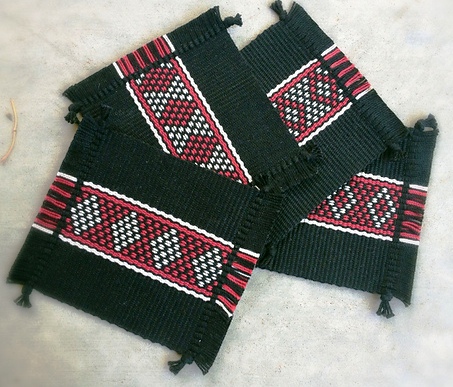
Ravelry friends have been at their backstrap looms. Kim is currrently exploring the world of the Bedouin weavers using their striking red, black and white al’ouerjan patterns for a set of mini rugs. These designs are traditionally woven using a warp-substitution technique which means that the back of the cloth will have very long warp floats. One of our group members, Tracy Hudson, showed us Bedouin examples where the weavers had cleverly used an extra weft to tie down the excessively long floats and create a much neater, more attractive and practical “wrong” side. I have tutorials on the technique and these kinds of patterns here and here on this blog.
kim
And, while on the subject of red black and white, from which I never seem to stray too far, I got to see once again the stunning looped bag made by the Ayoreo people of lowland Bolivia that I had given to Pam some years ago. I often visit the co-operative store which sells the work of the various indigenous artisans in the region of Santa Cruz where I live and I have yet to find another example of the looped bags where the work is quite as fine as this one. Perhaps the best pieces are being taken to the International Folk Art Market in Santa Fe (although, I have to say that I don’t remember seeing pieces this fine there either). I am hoping that the quality of the work is not deteriorating as older more skilled artisans die and younger ones sacrifice a little quality as they strive to produce pieces quickly for international markets.
???????????????????????????????
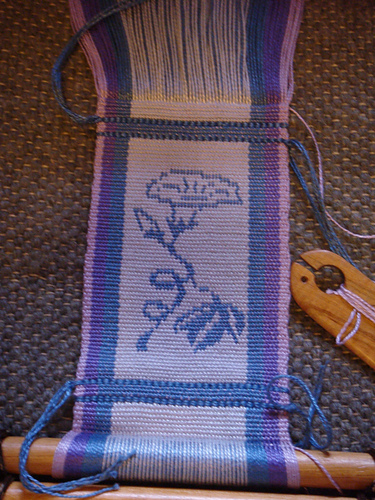
More from the Ravelry group…Julia is celebrating the arrival of spring (although rumor has it that it will snow here tomorrow as I make my way to California) with a double weave piece inspired by her blossoming garden.
DSC04534_medium
She has framed the flower with vertical stripes and weft twining and I can’t wait to see where she goes from here. I am wondering if she will create a series of flowers, each within a little frame.
Here in Pennsylvania, the daffodils are in full bloom. It got warmer and warmer as I traveled from Massachusetts to Pennsylvania, staying with Susan, then Beth along the way and now with Ron and Carol.. It was interesting to attend the guild meeting in Boston….more like a mini conference than a guild meeting with four well attended workshops running side by side in the morning followed by a guest speaker after lunch.
Founded in 1922, it is the oldest guild in the USA and the book that they published to celebrate their 90th anniversary is a treasure. The meeting was the largest I have attended with a surprising amount of familiar faces…online backstrap weavers and people I have met at other guilds. It was nice to see Laurie Autio again and meet Deb Watson.
On the way to the Mannings I spent an evening in Beth’s home accompanied by the work of Jason Collingwood….well, what do you know….red and black! (with some white wall space between to complete the favorite color combo)….
??????????????????????
I had a fun weekend with a group of backstrap weavers…
???????????????????????????????
Laura is a natural and quickly found that “sweet spot” where the sword would sit up nicely in the shed without constantly clattering to the floor. You can see how she is practicing controlling the edge warps to make nice even edges.
Julia was back for a second time. Jeanne, whom I had met at the Spinning Seminar last year, was there too as was Karthika..
Julia has a lovely collection of old Guatemalan textiles that she collected in the 1970s. It was very nice to have these textiles on hand to look at. They show examples of both single and double-faced techniques.
??????????????????????
This panel from a huipil of San Antonio Aguas Calientes is well used and very faded. The bird motifs were executed in the double-faced technique and the colors on the reverse are bold and bright.
??????????????????????
This piece, which is covered in double-faced motifs, would have been a baby’ cap. A string along the top would have been drawn to close the top. What is most likely the baby’s name has been worked in. It is so incredibly fine!
??????????????????????
This hair sash is a lovely example of single-faced techniques. The back of the sash is solid red with a  few very fine stripes. We don’t know the exact origin of this sash.
I had two days to wander the Mannings store, see what’s new and catch up with staff including resident weaving instructors Tom Knisely and Sara Bixler. The ladies from Just Our Yarns came in to give a two-day class on weaving with their fabulous hand painted tencel.
??????????????????????
I have been using one of their handpainted varieties as supplementary weft for years…a little goes a long, long way… and now I have several more of their color combinations to add to my stash. The first was given to me by my friend Lisa before I even knew what tencel was. Using it for weft inlay creates motifs that look as if they were made from mother of pearl.
There was also work to be seen by other past instructors and I discovered that rug hooking is not the same as latch hooking…
??????????????????????
Debra Smith, editor of Rug Hooker’s magazine teaches at the Mannings and has created a small gallery of her work amongst the tools and other supplies for this craft that the Mannings sells.
??????????????????????
This last piece ,with its colored vertical lines on black, reminds me of the reverse applique molas of Panama and Colombia…
??????????????????????
nawi awapa tubular bandsSo, I am off to California tomorrow. It has been a wonderful visit meeting new people and old on this east side of the US. It is always sad to leave the Mannings. This visit was too short.
I got to play around with some of my tubular bands trying to devise ways to finish the ends. I found that I could make a neat blunt finish on the blue band and I could also finish the end with a sizeable knob, as on the gold band,which could be used along with a loop to close the band into a bracelet. I am still working on making that as neat and compact as possible. I need to keep practicing.
I will leave you here with a beautiful video that showed up in my Facebook newsfeed. I mentioned this to Karthika, who was born in India like me, and she knew straight away about the famed Jamdani weaving of Bangladesh. The incredibly fine and almost transparent fabric is woven on traditional looms with two weavers seated side by side. It is decorated with supplementary wefts. Watch as they prepare the yarn, warp, thread the fine yarn through the reed and then watch the speed with which they create string heddles!

See you next time from California.


Backstrap Weaving – Kindred Spirits

I meet and get to weave with all kinds of wonderful people on my trips away. Everyone has a tale to tell about their connection to backstrap weaving. Perhaps they took a trip to Guatemala or South America some years ago or know someone who has been there and who brought back beautiful textiles. Maybe they happened upon and bought a backstrap loom in a thrift store or at a garage sale. Some people owned and used a backstrap loom back in the 1970s. I met a 92-year old woman at one of the guild meetings I just attended who was taught to weave on a backstrap loom by a Japanese woman who had studied in Guatemala. She is still using her loom at the age of 92 and weaves woollen warp-faced fabric for pillow covers.

And every now and then I meet what I like to call a “kindred spirit”…someone who has been swept away with their fascination for ethnic textiles and has taken off to far and exotic places to pursue their interest. Even more exciting for me is knowing about people, especially young ones, like the ladies below, who are about to embark on such adventures for the first time.

Backstrap weaving with students at Yale University.... They have a wonderful weaving room full of floor, table and rigid heddle looms which meant standing room only for this impromptu lesson in basic backstrap loom management which followed my talk.
Backstrap weaving with students at Yale University…. They have a wonderful weaving room full of floor, table and rigid heddle looms which they can use in their free time which meant ‘standing room only’ for trying their hands at basic backstrap loom management.

Last fall, my friend Barbara arranged for me to visit with a group of young ladies at Yale University. Barbara teaches weaving on floor, table and rigid heddle looms to this group as a leisure activity on Sundays and I accompanied her on one of the Sundays to meet her students. They were so enthusiastic when they saw my weaving and loom that I ended up staying longer  with them and giving them a chance to try some backstrap weaving basics.

I am so happy to now hear that one of the ladies who has lately been corresponding with me on Facebook  has submitted a fellowship application to study backstrap weaving this summer in Indonesia. Barbara tells me that another is doing the same and hoping to study in Guatemala!

Sometimes I connect with these kindred spirits online and it is a “meant-to-be” connection which has us then getting together all over the place. Wendy has studied and collected textiles from all over South-east Asia and the Indian subcontinent and we met online when I was looking into Bhutanese weaving techniques. When she came to South America, she visited me in Bolivia. We met up again in Santa Fe New Mexico where we spent time at the International Folk Art Market and I hope to go visit her at home in Perth when I go to Australia in June.

Kindred spirit Wendy follows her textile passion around the world from South-east Asia to South America. Here she is making a stop in Bolivia to hang out with me and talk textiles and travel.
Kindred spirit Wendy Garrity follows her textile passion around the world from South-east Asia, the subcontinent and on to the Americas. Here she is making a stop in Bolivia to hang out with me and talk textiles and travel.

And then there’s Taylor who is over in Bhutan right now. She initially wrote to me very happy about learning to make string heddles from my blog to use in her projects in Bhutan. I gathered that she is working in an area where the weavers use tablets hence the lack of information on string heddles.

In her own words...I work for a local NGO on waste awareness issues, which I primarily do through creative reuse.  I tend to work waste materials into local craft techniques, and have attached  a couple of shots of my first plastic wrapper weaving experiments (plastic wrapper as the weft, and cotton thread as the warp).  Pretty basic stuff.  The local ladies are teaching me some belt and brocade techniques, mostly using tablets right now.  I am excited to make some abstract forms with the brocade technique, will keep you posted!

reused plastic bags for weaving in BhutanYou can see a bit more about the loom set-up that Taylor is using here.

My most recent kindred spirit encounter was in Bucks County where I met Laura at a guild meeting She had just returned from 3 months of weaving study in Thailand. I  got to see Show and Tell by weaving guild members. This was all followed by lunch and then a chance for several of us to weave together.
One guild member had brought in the backstrap loom with popsicle stick rigid heddle that she had constructed for her 4H group. Another brought in all kinds of scarves that she had bought from backstrap weavers in Guatemala. The 92-year old backstrap weaver had brought an interesting double weave blanket from Nepal as well as one of her own backstrap woven pillow covers….weft-faced, black and white and gorgeous!  And Laura showed the amazing piece of weft ikat patterned indigo-dyed cotton yardage that she had woven on a  simple two-shaft loom in Thailand. It was stunning but I didn’t photograph it!

I used small strips of warp ikat in this piece to learn about the technique.

You may know from previous posts that I have dabbled in warp ikat and have found that challenging enough.

Weft ikat boggles the mind. The weft threads are placed on a frame and tied and dyed. Some ties are unwrapped and others added as the yarn is placed into a second dye bath to add a second color to the overall pattern. I have watched in videos as the yarn is then carefully wound onto a shuttle ready for the weaving process. Each and every weft thread has to be carefully placed within the shed so that the pattern is properly aligned.

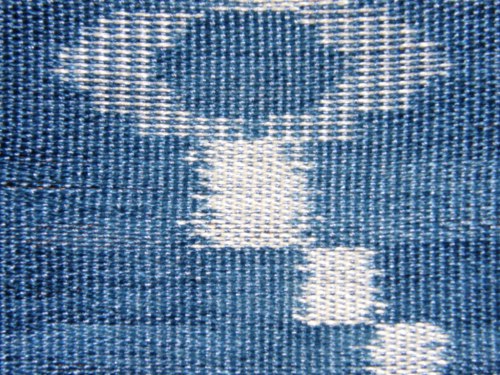
There was a nice display at the Textile Museum in Washington DC that had examples of warp ikat, weft ikat and warp and weft ikat. Below, you can see in the upper oval-shaped motif how the tied and dyed weft threads are exposed in the balanced-weave cloth to create the pattern. The lower square motifs are examples of warp and weft ikat which give the motifs a more solid look.

???????????????????????????????I found this image from Marla Mallett’s website which shows part of the tying process for weft ikat in Thailand…

Thailand-IkatTies-smI have just bought yarn here in the US for my sixth red-black-and-white wall hanging which I hope to weave as a warp ikat piece. Maybe one of these years I will give weft ikat a try.

south jersey group backstrap weaving

I met yet another kindred spirit from years gone by through a folder that Ellen brought on one of the days of backstrap weaving-alongs. That’s the group that you can see above. Trisha and April had come to watch me weaving last summer and suggested I come and weave with them this year.  Camille, who joined in, had already made her loom and backstrap using my Backstrap Basics article. It came out beautifuly in Tahki Cotton Classic. 

Camille_s_1st_Woven_Backstrap_medium2She bought the yarn  at Woolbearers. They carry an extensive range of colors in another favorite backstrap cotton yarn of mine…Cascade Ultra Pima.

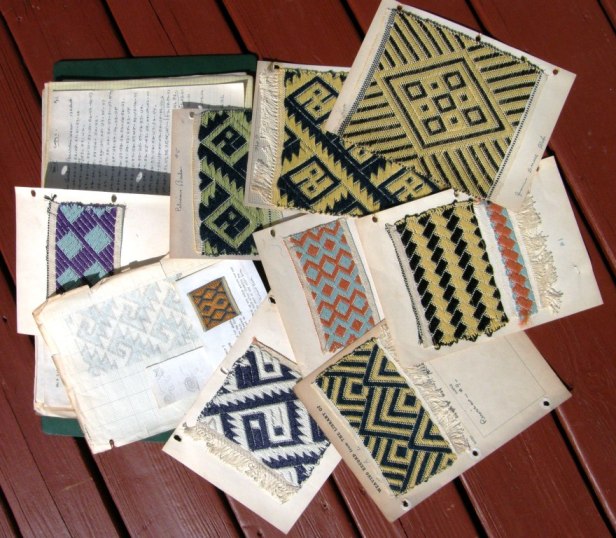
???????????????????????????????Now, back to the folder that Ellen brought for me with its connection to another kindred spirit….. It had belonged to a lady who was living in Florida and contained all her carefully handwritten and typed notes, samples, charts and sketches on her studies of Peruvian brocades. What a treasure. I tried to find dates and found one page marked by hand with “May 64” and other type-written pages dated in the early 70s. I suspect that the folder was donated to a guild on this lady’s passing and it has traveled, being passed from hand to hand, weaver to weaver, until it found me. Well, I can tell you that with me it shall stay and it will be loved.

peruvian brocade study folderHere is the folder with various pages removed so you can see some of the woven samples and sketches. It was nice to meet this kindred spirit from the past. I have to say that I wonder, being childless, what will eventually  happen to this and  my own handwritten journals.

Another little goody that Ellen brought was a ñawi awapa tubular band with its little knob and loop endings. The knob can be pushed through the loop and this makes a neat way to use the woven piece as a necklace or bracelet.I think I can do some experimenting and come up with a way to make a knob like that.

finishes for tubular bands

pam-and-freddy I am going to work on that with my friend Pam with whom I am currently staying.

Pam has invited her weaving friends to come and weave with me several times.  I am enjoying a nice long stretch of days hanging out with her.

Pam is “Number One” kindred spirit on my list! She has been interested in and has studied ethnic weaving techniques for years. She has made several visits to Uzbekistan and has studied other weaving technologies from books, in workshops and online.

On top of that, she is the local loom doctor and teaches floor loom and pretty much any kind of simple loom weaving at her studio.

I see that she is about to set up to experiment with Chilkat twining using Cheryl Samuel’s book for guidance….

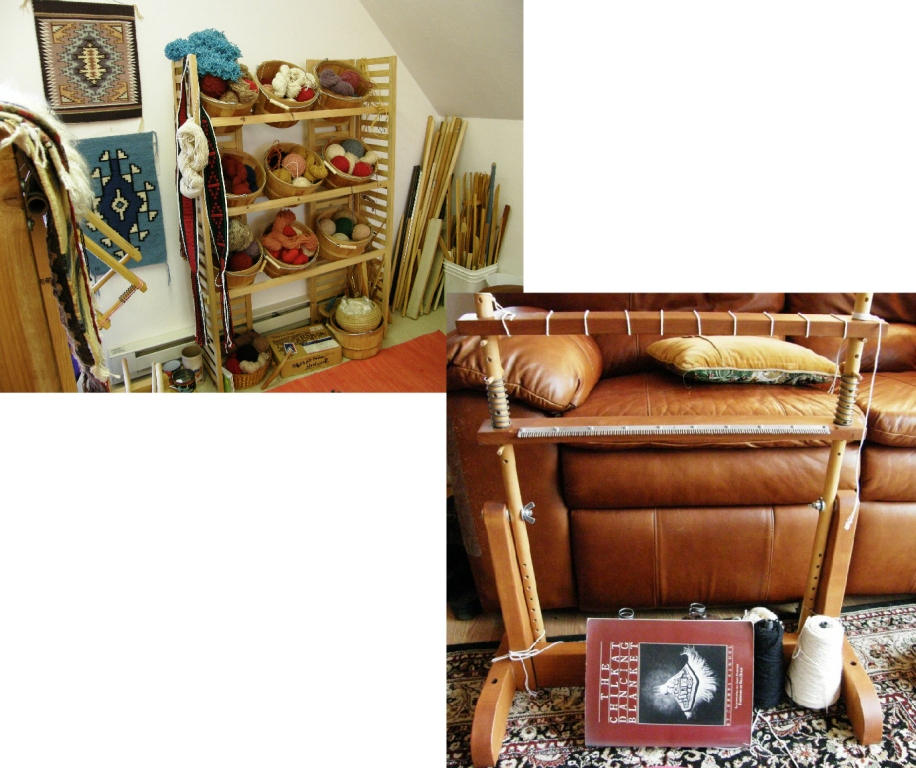
Pams weavingYou can see Pam’s “Navajo corner” in her studio and then her C Cactus Flower Navajo loom which she will use for the Chilkat twining.

Here is her latest finished work…

pams woven wool silk tallit
the Jewish CatalogIt’s a wool/silk tallit, a Jewish prayer shawl. Above, you can see it drying after having been wet finished. Pam is making this as a gift for a friend. 

Yes, we had the most spectacular sunny spring day here yesterday, as you can see.

Amelia, the cat, found the warmth after months of snowy winter a bit too much to handle all at once and enjoyed the piece of shade that the drying tallit cast.

I am a little bit more knowledgeable about this item and its use after Pam read to me from the book at left. Right now, as I write this post, she is tying the special “braid” that adorns the four corners of the piece.  There is something significant about the number of wraps, or coils, and knots that are incorporated in each of “braids” which is all explained in Pam’s book.

The books says that tallits were originally made from linen or wool but that now silk is also acceptable. Pam’s is a wool and silk blend and it feels gorgeous….light as air. She used a summer/winter structure to create the patterning in blue and gold and the wool/silk is Zephyr Yarn by Jaggerspun.  She also wove the atarah, or crown, with its gold thread. This is placed on the edge of one side with “the purpose of providing some spatial orientation for the tallit (or tallit-wearer)”. The woven pouch Pam made in which the tallit is stored is yet to be sewn  together.

I will be meeting more fiber people of Springfield this weekend and then heading onward.

See you soon!