Backstrap Weaving – Three Tips, Twining and a Tutorial


Central Asia, Mexico, Vietnam and the Middle East were new weaving territories for me this year.

I am not one for making New Year resolutions but I got caught up in the moment last year at this time and went public with three weaving resolutions in one of the online weaving groups. I am happy to say that I did not even come close to fulfilling them. I say “happy” because my weaving path for the year took me off on several tangents and led me to interesting and unexpected places.

I am not going to make new resolutions. I do have  two or three things mapped out for the coming year and I will happily allow the gaps in between to be filled with whatever comes my way. I have to say that a lot of those gaps are being filled by you guys, my blog readers, who email me with video links, images and ideas from all corners of the world.

What was on the loom this week?…firstly, I will show you what was on the weaving

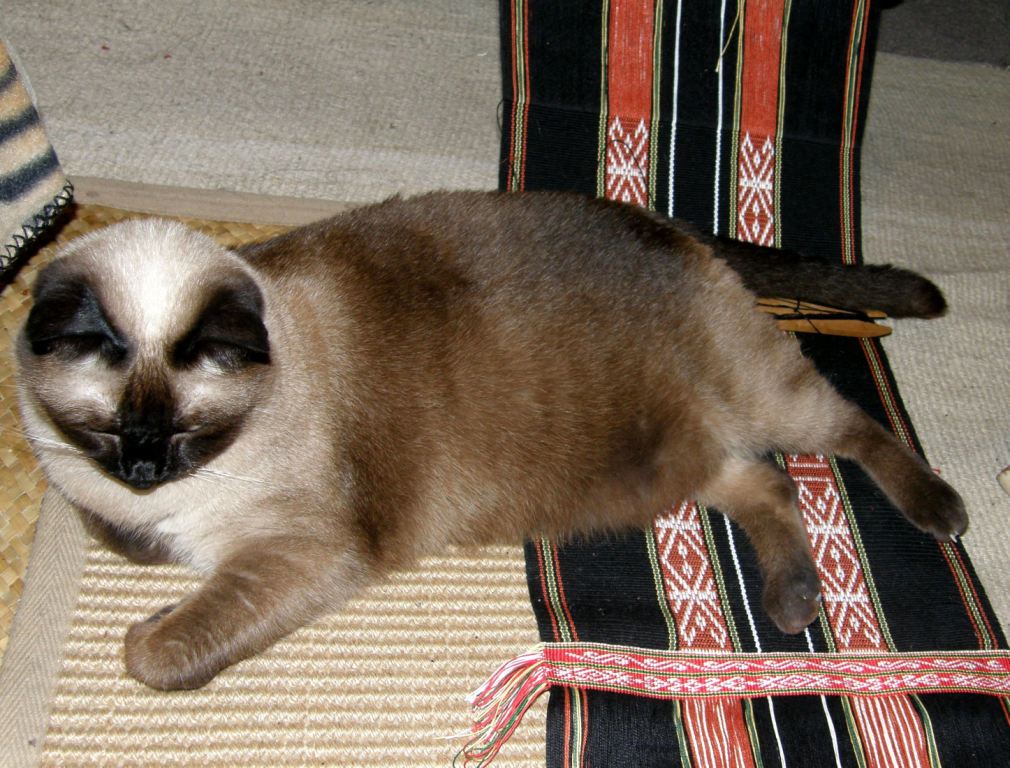
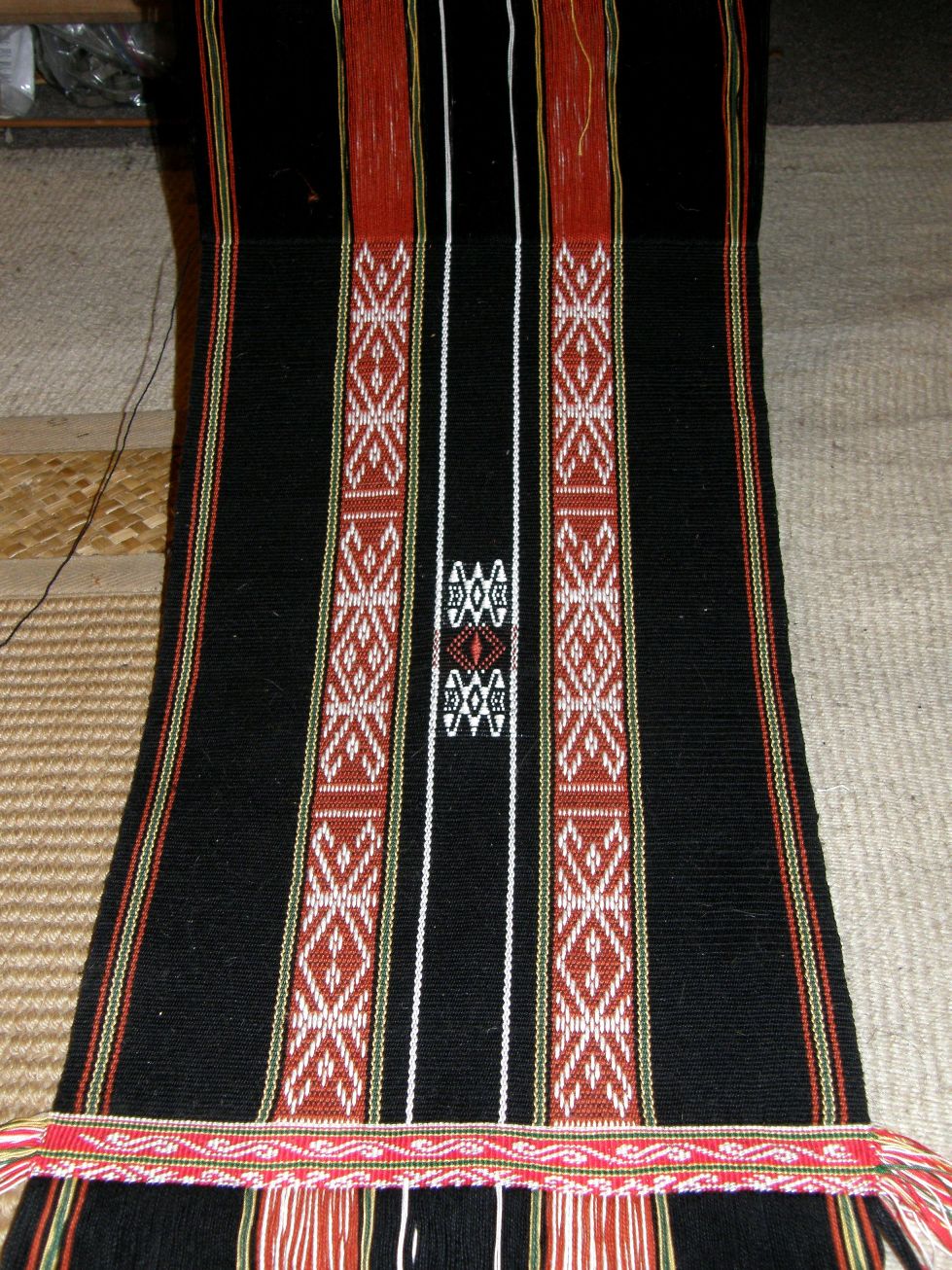
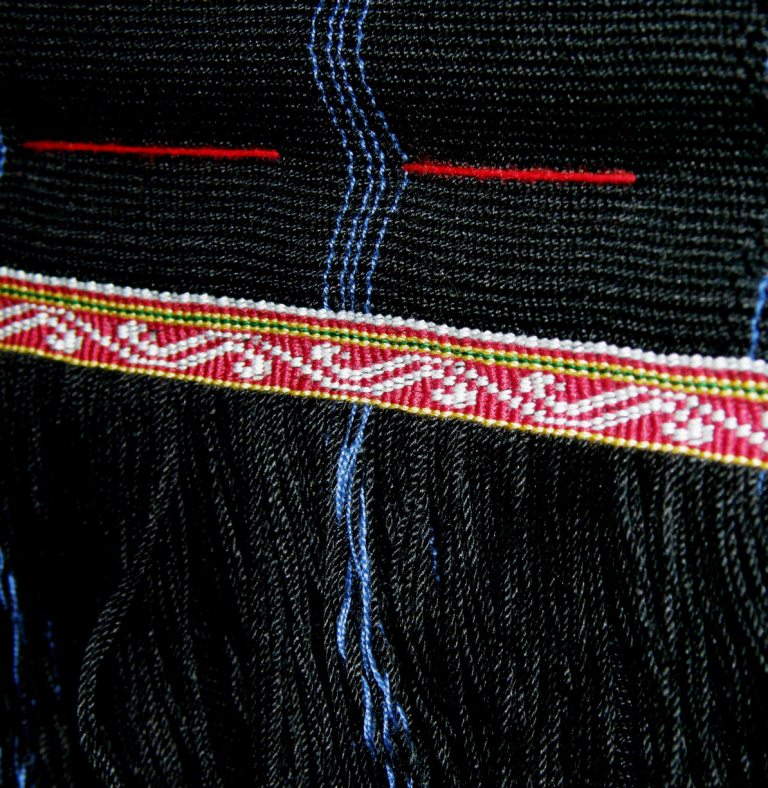
My cat loves to leave all her little beige colored hairs on my black weavings. You can see the twining at the bottom of this piece where I have finished the second part of the design.
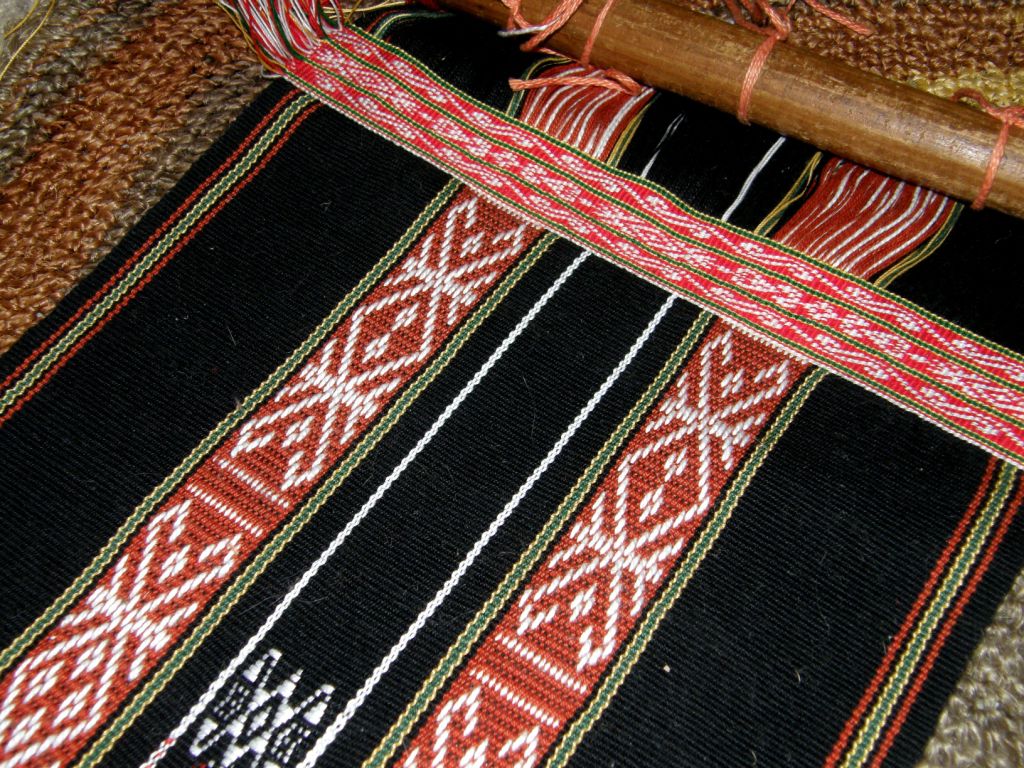
Above you can see the three parts finished. I was still debating at this stage what to do with this piece. You may remember my mentioning table runner and then center piece. Who am I kidding?

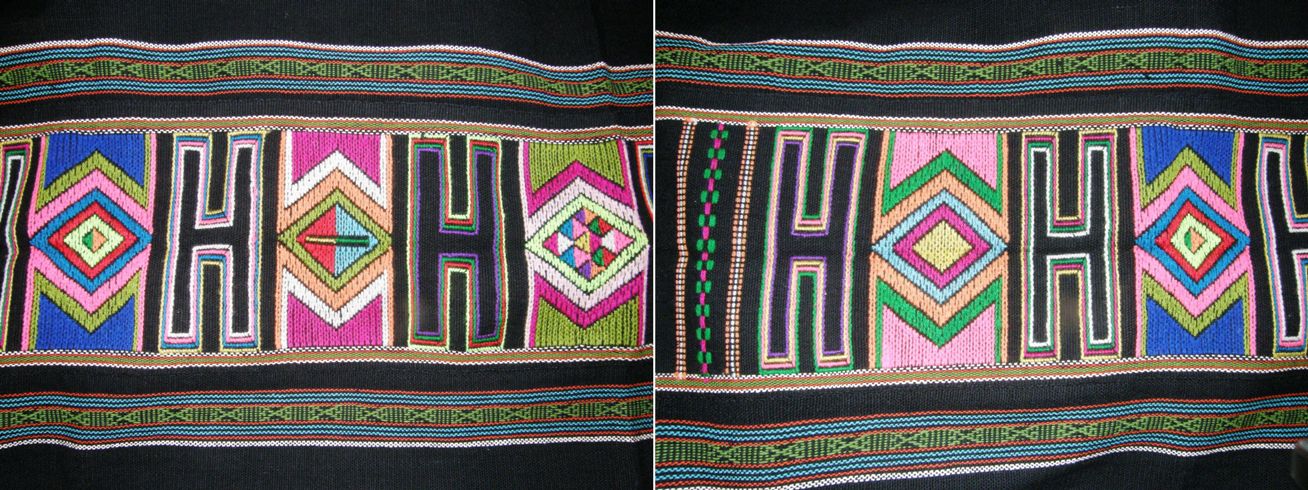
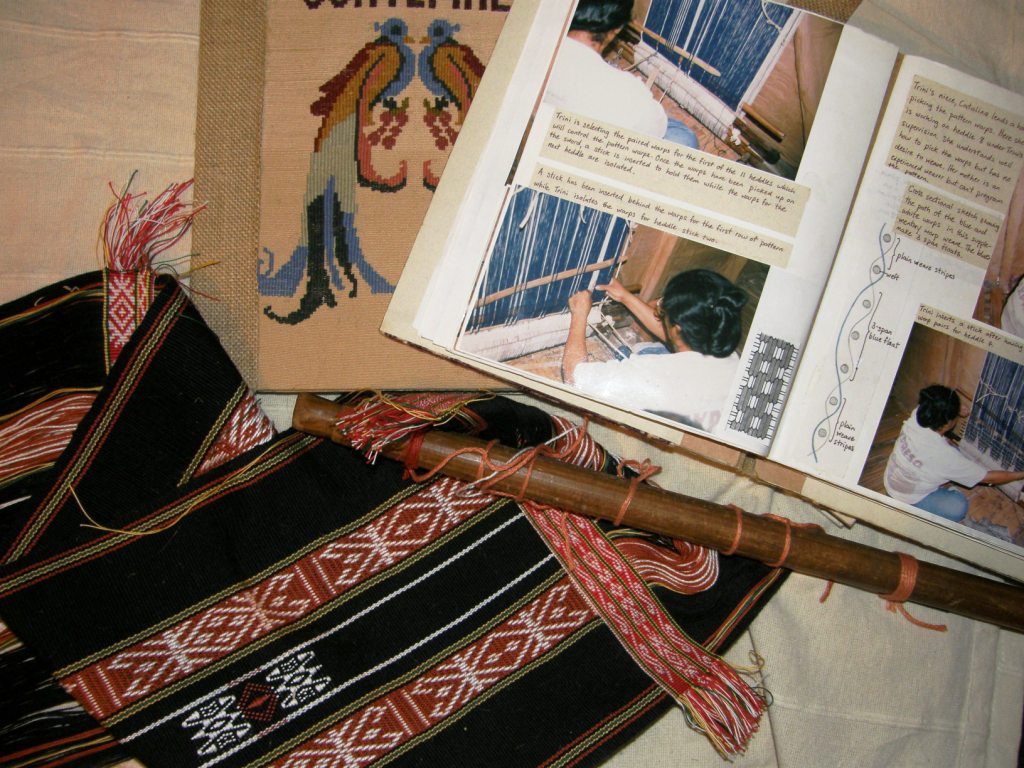
This was never about the product. I just wanted to weave something to put the various Montagnard weaving techniques into practice. So I finally decided that the piece would be cut in two and used as the cover for the journal in which I will document the processes. I have over twenty supplementary weft motifs to chart from photos I took when I visited the Montagnard weavers as well as their warp float designs and twined motifs which I will put in the journal along with step-by-step photos.

Above left are a couple of my finished journals from other weaving trips. One has a woven cover which I made to practice the double faced supplementary weft patterning that I was taught in Guatemala and the one on the right documents all I learned in coastal Ecuador.

But first I had to twine the other end of the piece. I needed to weave some more in order to have enough fabric for the book cover and then I twined the edge using one of the same patterns from the other end but doubling it, that is, I twined two rows for every row of pattern. What a difference that made!
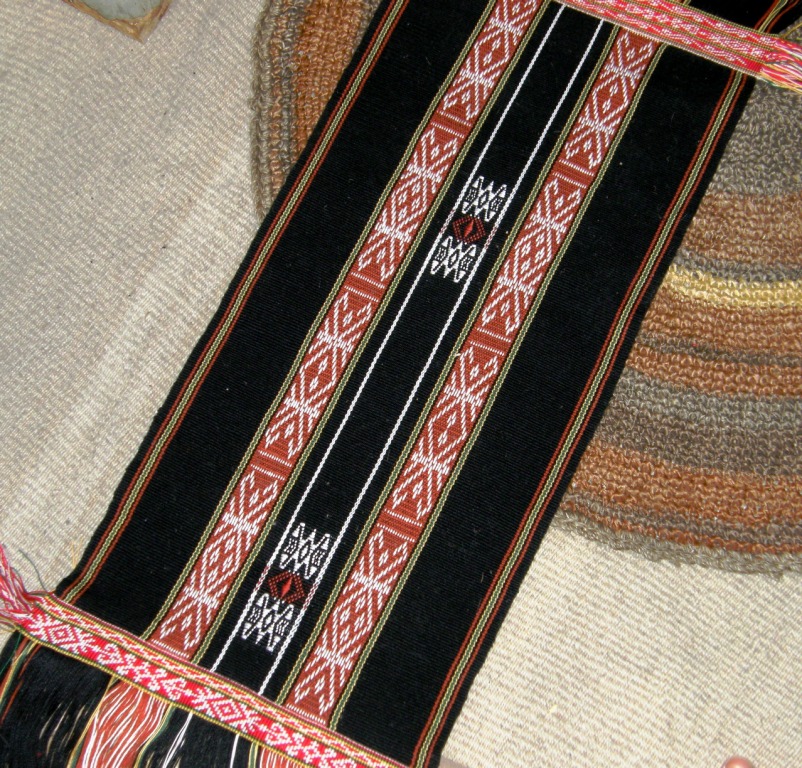
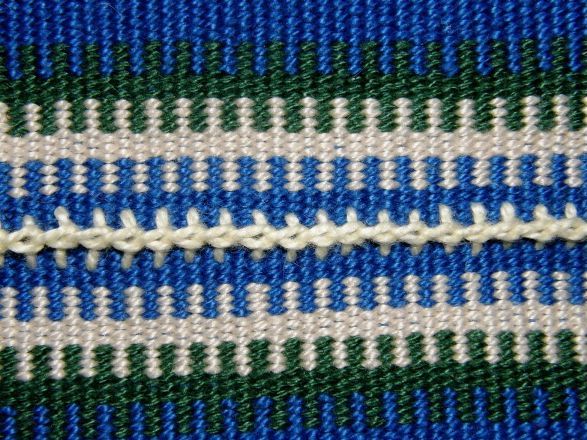
You can see that the design on the center strip of twining on the first end is the same as that on the second end.  A closer look…
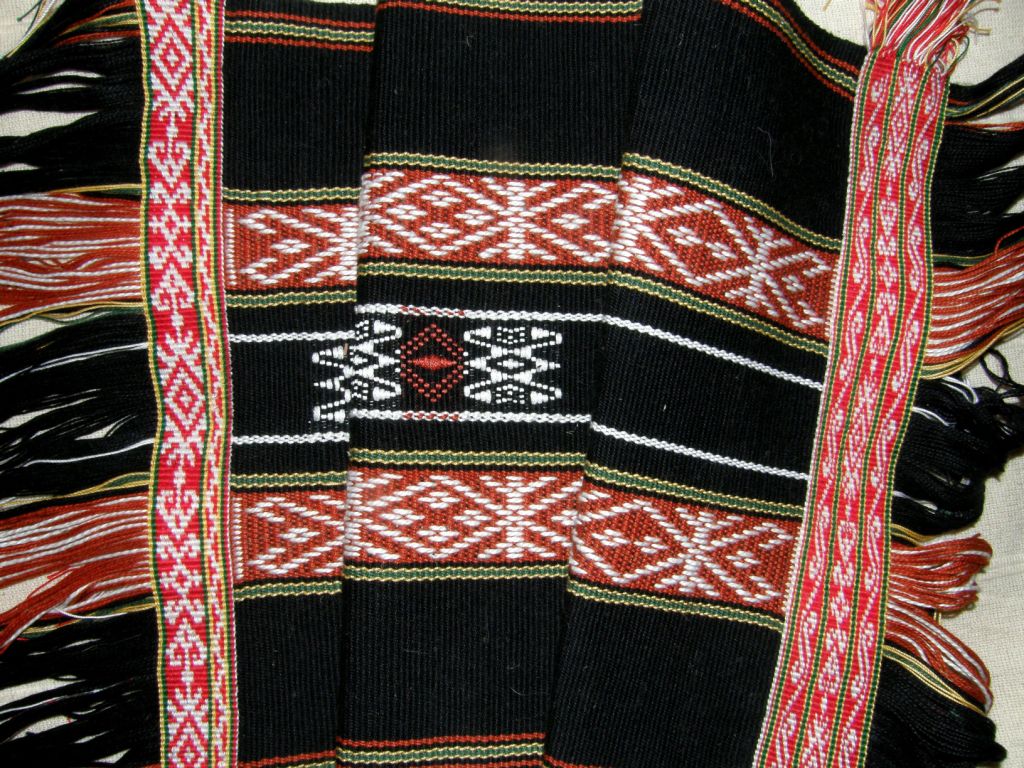
I have the pages, now I just have to get the cardboard for the journal’s cover. I stitch and bind everything together myself. Then I have to get the scissors out, take a deep breath and cut the weaving in half  – yikes.
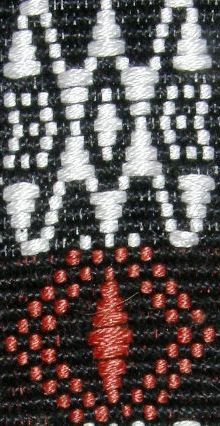

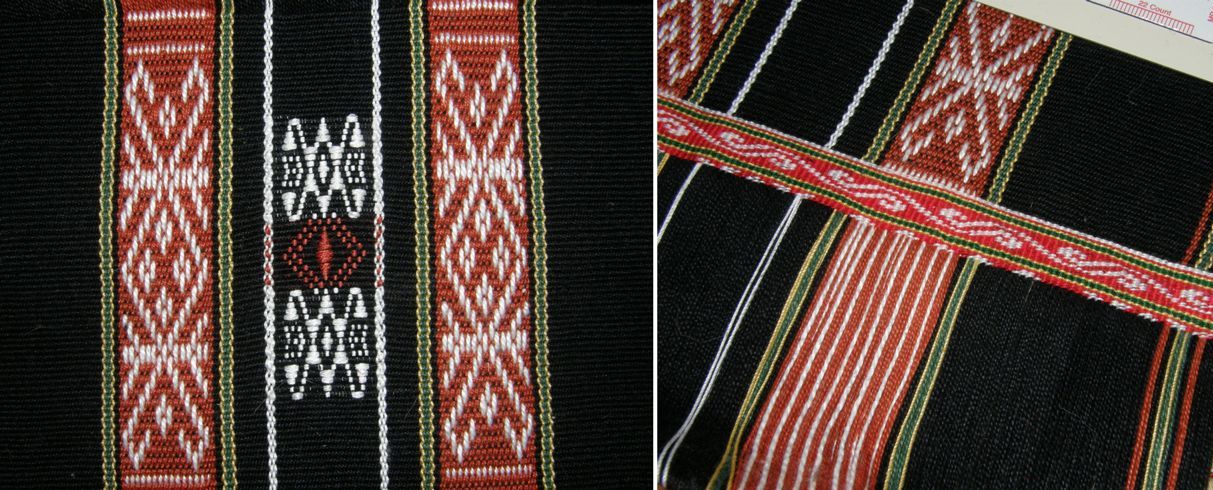
An interesting thing about the supplementary pattern on this piece…usually I don’t recommend having weft floats of less than two warp spans as they barely show up on the fabric but I had to have floats that only spanned one warp on this piece in order to faithfully reproduce the Montagnard motif and, to my surprise, the design shows up very well. My base warp and weft are number 10 crochet cotton and I used one and a half strands of embroidery cotton as the supplementary weft. The white thread for the warp floats is number 3 crochet cotton and the twining was done with number 20.

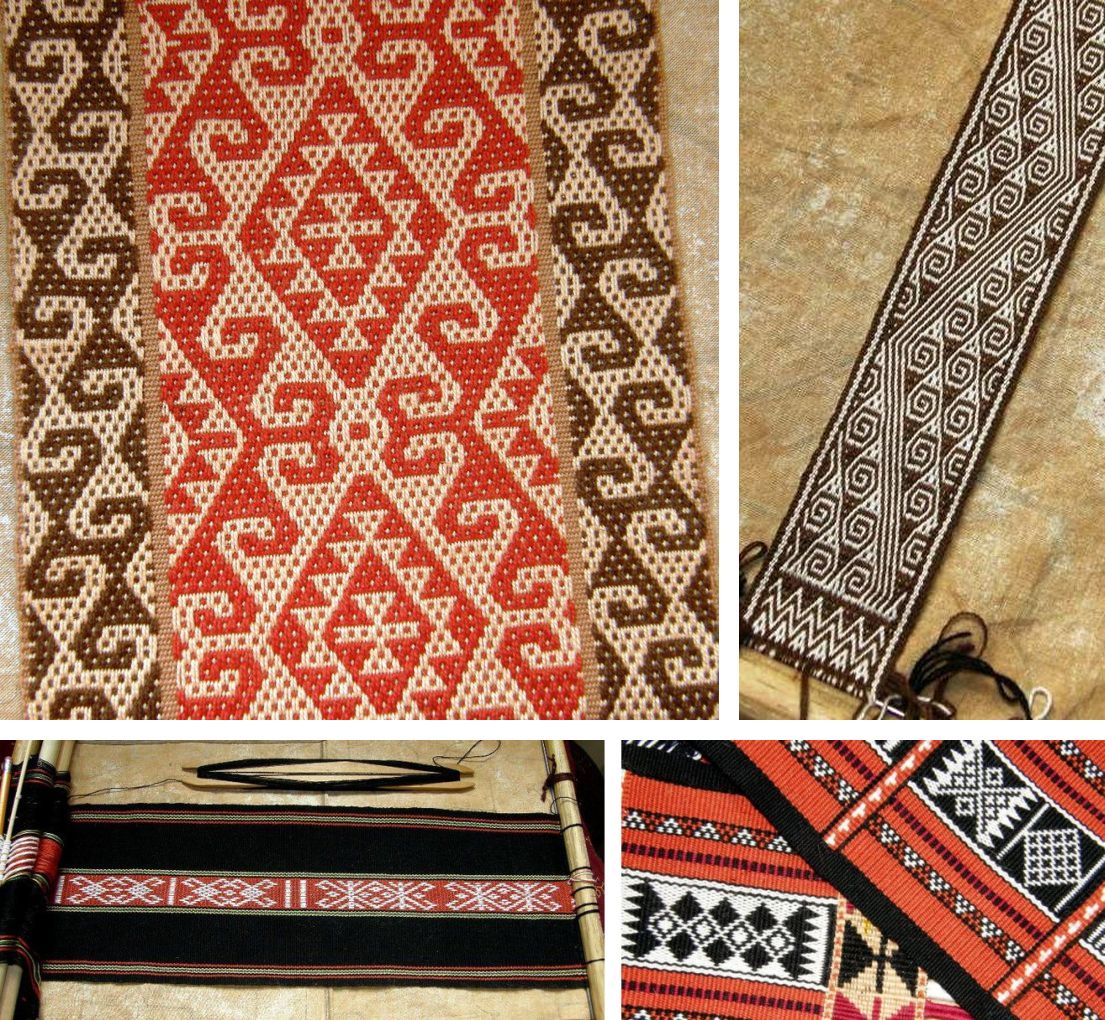
Staying on the topic of Montagnard pick up weaving, I have put together a tutorial on the woven letters that some of the Montagnard weavers are using to weave biblical phrases on their woven bag straps. I really like the shape of these letters and it is quite a simple pick up technique. The drawback is that there are some longish floats on the back of the piece which doesn’t bother me too much as bands with letters are essentially single faced anyway with the letters being reversed  and unreadable on the back. The technique does not produce an entirely warp faced fabric.

You can see the tutorial here.

One weft double weave can also be used to weave letters which don’t have long floats on the back. The one weft double weave tutorial is here and the chart with some basic stick letters is here.

These letters, which were woven by Guarani weaver Angela, are the ones that I really want to learn…

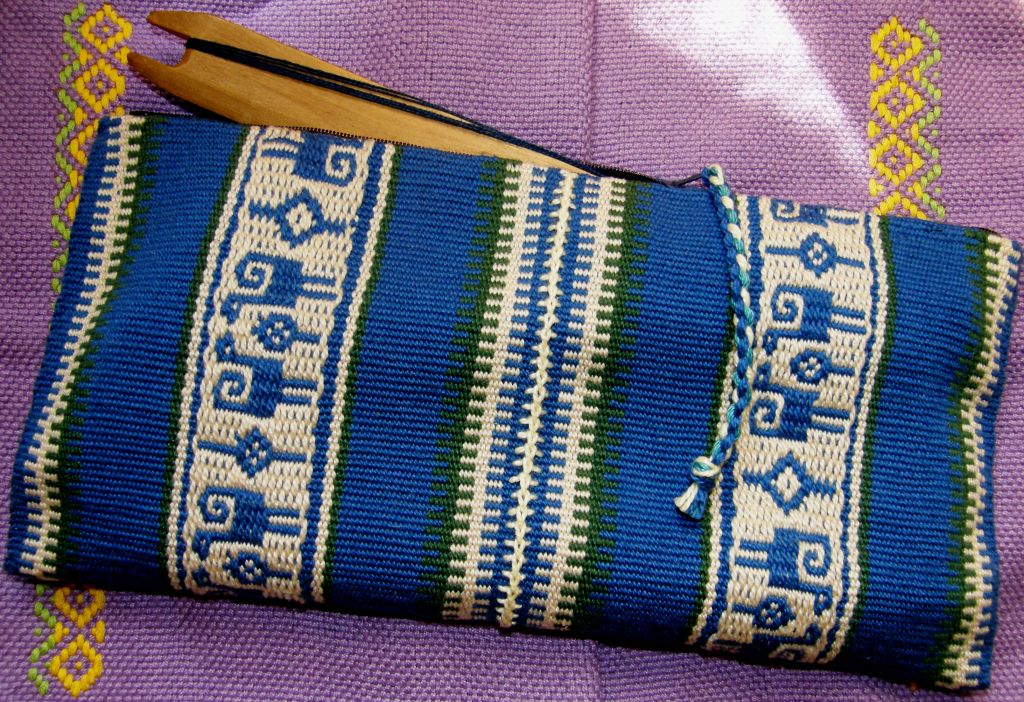
These are woven with the same technique that I used to weave this copy of Angela’s cell phone pouch design…

I would like to have Angela weave a complete alphabet for me to use. I really like the solid “blocky” nature of these letters.

Other beautiful, fluid and non-blocky letters can be found in Linda Hendrickson’s book Please Weave a Message with charts designed by Linda as well as adapted by her from the work of Michael Cook for card weaving. I have just set up warps to make my first attempt at twining Linda’s lettering. Her charts don’t work for the double weave pick up that I like to do on my backstrap loom but should work perfectly for twining. Hopefully next week I will have some progress to show and I will try to make something useful from the sample!

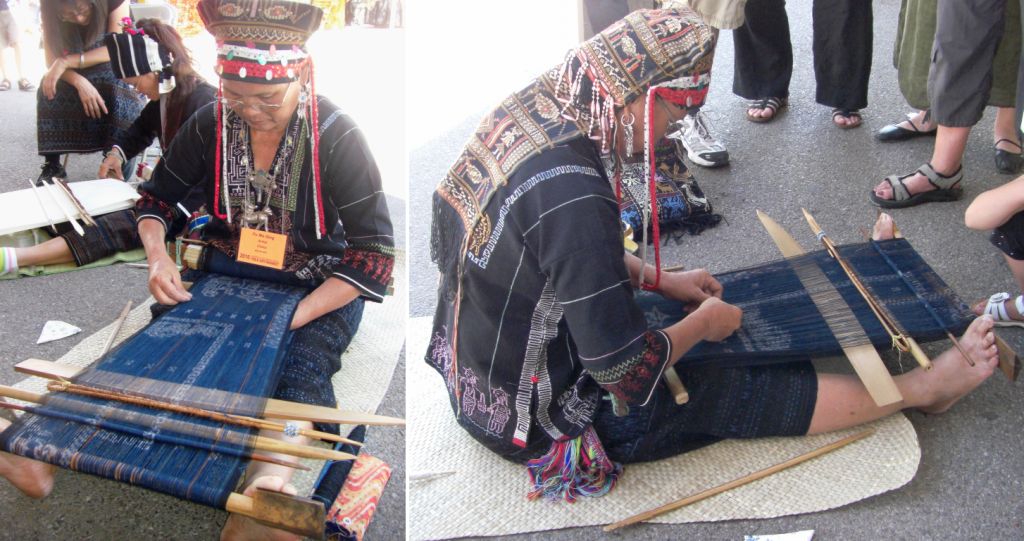
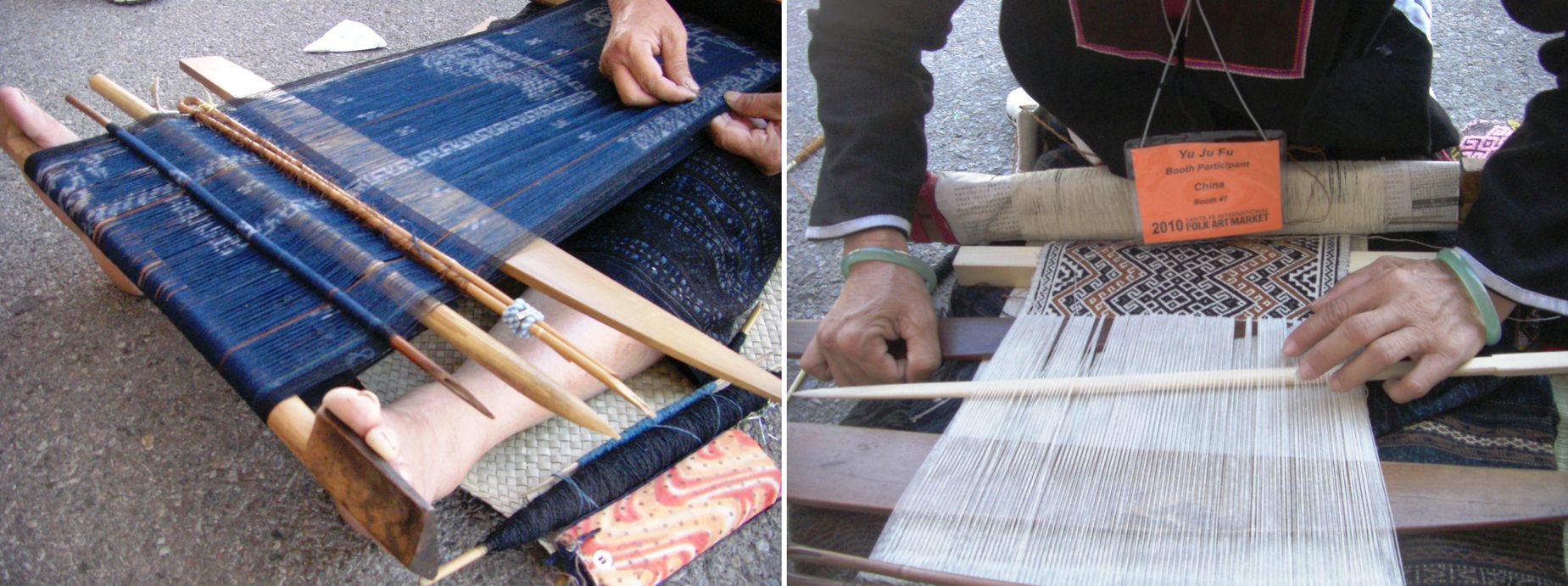
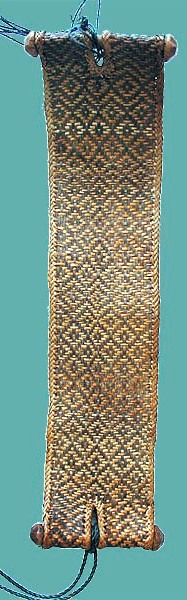
You may remember in last week’s post I showed you pictures of Li weavers from Hainan Island and their looms. I have since found someone else who owns one of these looms who also has the backstrap. I don’t remember seeing one at Pam Najdowski’s stand. Susan Stem of Tribal Trappings has this photo of a Li weaver’s backstrap…
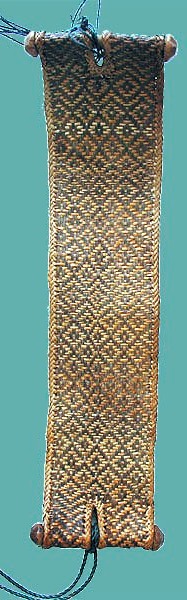
The one on the extreme left is the Li backstrap, made from fiber, which is believed to be from the weavers who speak the Meifu dialect according to collector Pamela Cross. The one on the right is probably from a completely different part of the world. This was gifted to Tracy who lives in Qatar and who unfortunately does not know anything about its origin. I love them both and wish that the weavers here in Bolivia had such interesting ones! Most weavers I have met here have had no interest whatsoever in constructing any kind of special backstrap and have been quite content to use any old piece of sacking that is lying around.

I find backstraps almost as interesting as the textiles that are being made on the looms. I really like the way the two backstraps above have been constructed with the pieces of wood on the sides. So, I dug around and found a weaving that has been sitting neglected at the bottom of the basket. Another one of those things that I wove for my interest in the process rather than for any real interest in the finished product…


It started off as an experiment on my friend Lisa’s four-shaft loom. I wanted to weave a long Andean pebble weave piece after having made only tiny sample bands in order to put the draft together for my Andean Pebble Weave book.  It came home with me to Santa Cruz and went onto my backstrap loom to be finished…

When it was done, it was too wide to be a guitar strap and too long for anything else that I could think of. So, it got shelved to be later made into a loom bag of some sort…again, I was kidding myself.

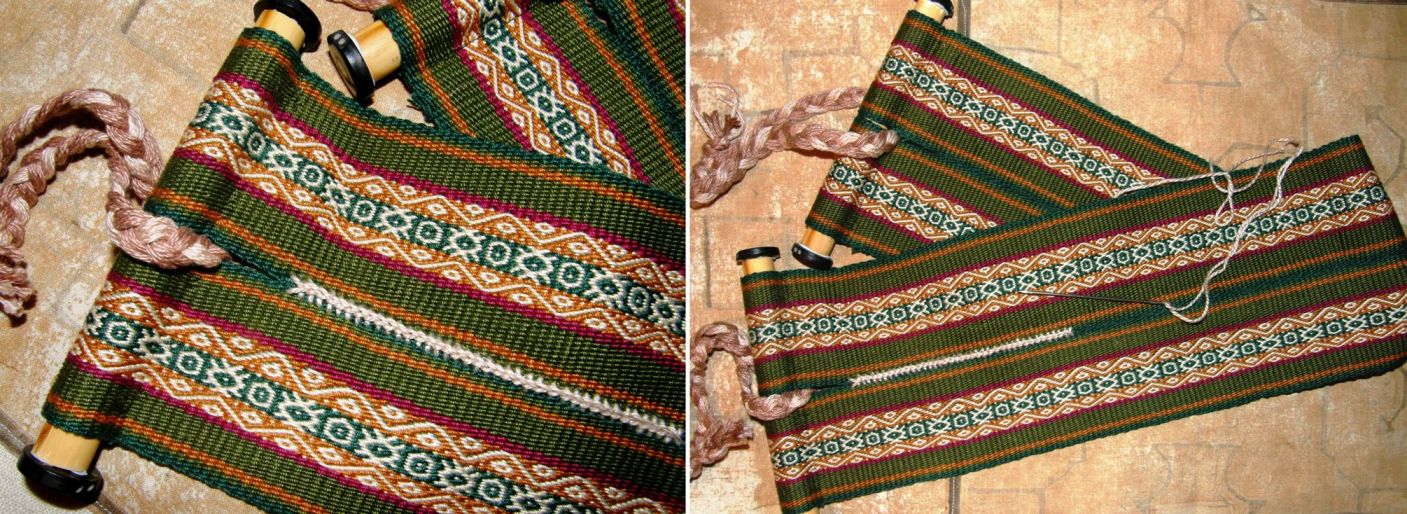
Now here it is resurrected as….my new backstrap…
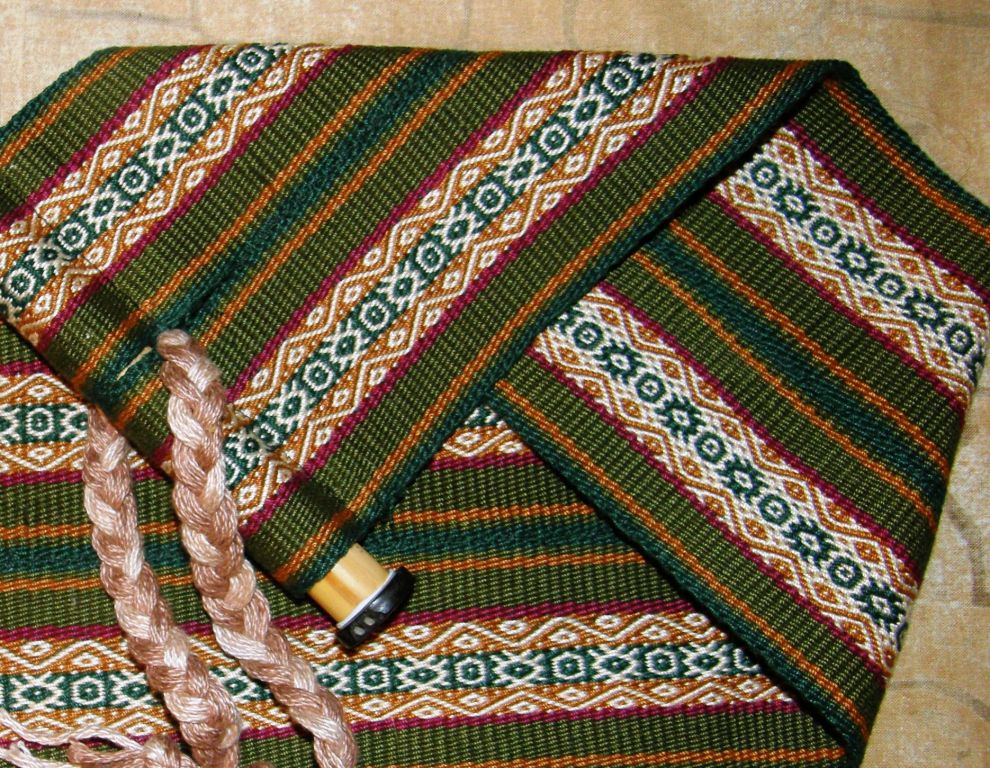
It isn’t quite finished yet. I have just joined the two pieces together with rough tiny stitches and am now using the cross knit looping or Van Dyke stitch to make a stronger and more decorative join. You can see a video on the Van Dyke stitch in this blog post. I used bamboo sections on the ends of the strap stolen from a cheap set of panpipes and the dark ends on the bamboo are pieces of tagua nut that I bought in Ecuador which are only held on with Blutack until I can get some strong glue.

I have collected nice backstraps from a few other countries – a fiber one from Peru, a leather one from Guatemala and a very unusual hide one from Ecuador but nothing interesting from Bolivia.
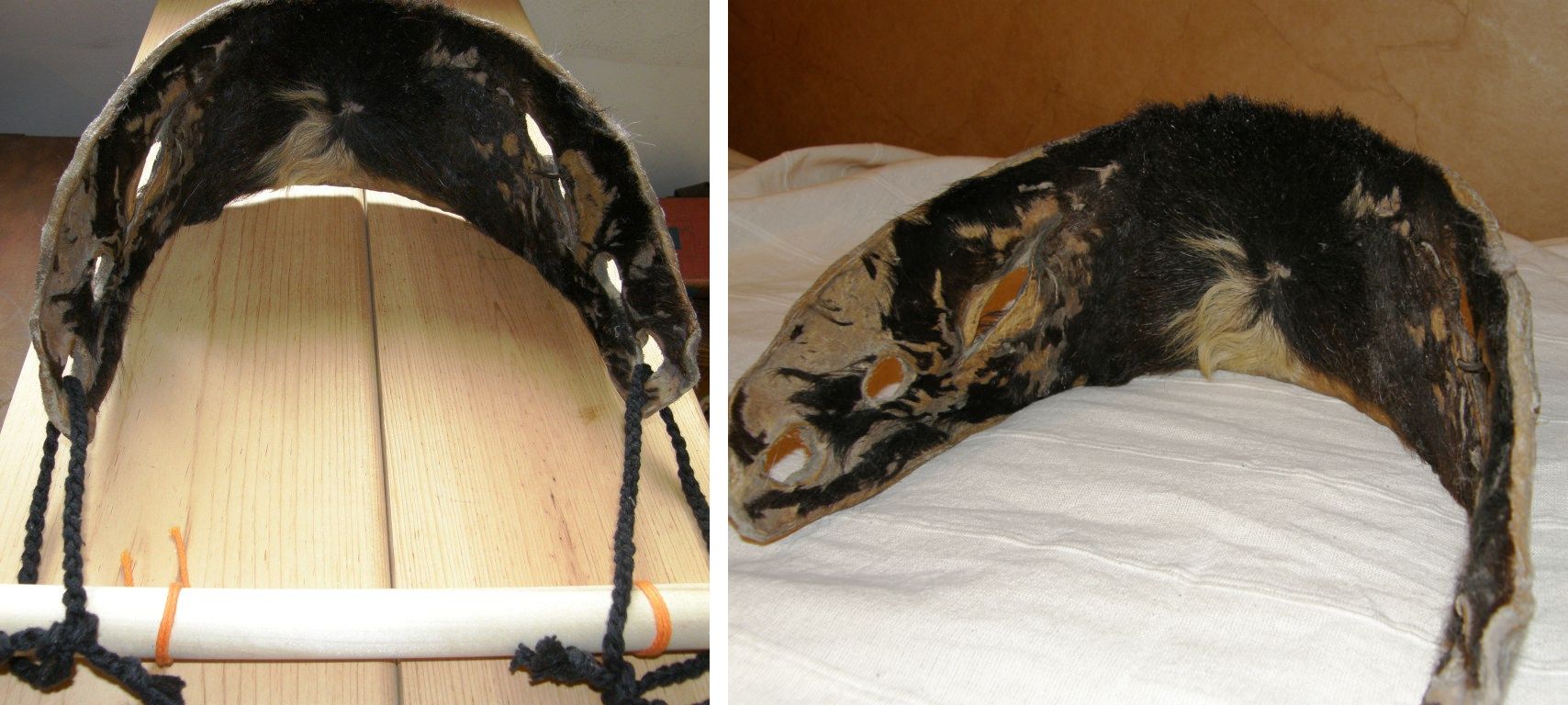
A nice sturdy hide backstrap from Otavalo, Ecuador. The hairs tend to tickle while you are weaving.

I found the image at left on this site about backstrap weaving in Timor.

Timor is so close to my former home in Australia. I am seriously thinking about making a trip there the next time I go back to Sydney.

In the picture it looks like the weaver is making two pieces at once side by side as Montagnard weaver Ju Nie often does.

I love the backstrap. Ju uses a large pad which I think is stuffed with some kind of fiber. She just passes a rope behind it to hold it to her back which she then loops around her loom bars. It is very comfortable. You can just make it out in this picture…

Some blog readers, Weavolution and Ravelry members have made backstraps this last week…

Claudia from Weavolution finished her backstrap (on the left) and found a good place to tie up her loom in the process…to the bottom of the sofa (but with her back to the tv!). Anna who you may remember is cycling down to Tierra del Fuego wove her own backstrap while on the road. She has been weaving pebble weave and double weave until now and told me how lovely it was to cruise along with plain weave for a change. Anna does not, of course, have a regular tie up spot for her loom and I always look forward to seeing where she is weaving. You may remember seeing her warp tied to her bicycle on the Uyuni salt lake in a previous post.

Jennifer has her backstrap on the loom right now and I caught this image of Melisende’s “ceinture” on a French forum called Tricofolk. I didn’t ask her permission to post this here and hope she doesn’t mind!

Bonjour et bienvenue aux tisserands de la France!

I know that at least Jennifer is getting ready for a backstrap Weave Along that was proposed in the Backstrap weaving Group on Ravelry some weeks ago. We all agreed that post holidays would be the best time to start and we should be underway in January. The exact date is yet to be announced.

This will be a chance for beginners to make their own bands and backstraps with lots of support and advice on the forum. Those who have already woven their first pieces on a backstrap loom can try their hand at a project or two. I will be putting several proposals and ideas in the forum based on the tutorials here on this blog. A few weavers have asked about forming a group to work through my Andean Pebble Weave book too. So, all levels are welcome to join in.

As the WAL (weave along) approaches, I have three tips for you as you prepare…

1. Think about how you are going to wind your warp…

An evenly tensioned warp is essential. The warp will not be cut, threaded and retensioned once it comes off the warping stakes so you need to get it as evenly tensioned as possible while you are winding it. Beware of using stakes that are loose and may lean in as you are warping. The photo above right is from Franco’s blog. I am sure that Franco made sure that those stools were heavy enough to not move during the warping process. You can read more about warping and see videos here.

2. Find a strong and secure place to tie up the far end of your loom. It is always better in my humble opinion to lash your entire loom bar to something rather than have it swinging in space. Experiment with the angle of your warp and find what is most comfortable for you.
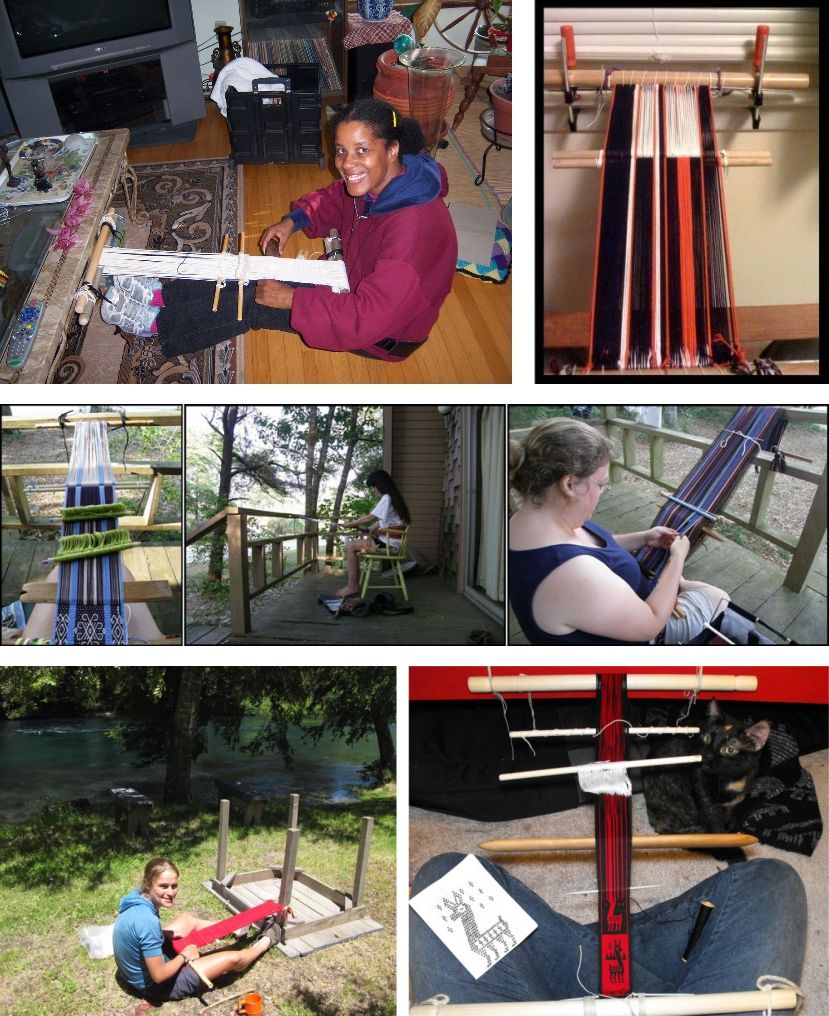
Read more about this here.

3. Choose your yarn carefully. Don’t use wool for a first project. Try to find a mercerized crochet cotton. Size 3 crochet cotton is good for beginner practice bands. Heavier cotton is better if you want to make a backstrap. Don’t use the cottons that are sold for dishcloth projects.
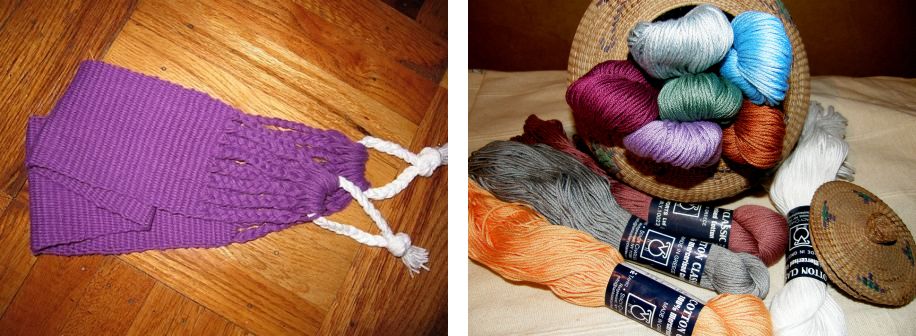
Tahki Cotton Classic is a good choice for making a backstrap. Cathyz made the purple strap above with this thread. WEBS recently had a sale on Tahki Cotton Classic and I got a grab bag of ten skeins.

Other brands that are readily available at Michael’s, Hobby Lobby and such places that I have tried and recommend are pictured below…The Fantasy Natural is a good weight for backstraps. I got that at The Mannings.
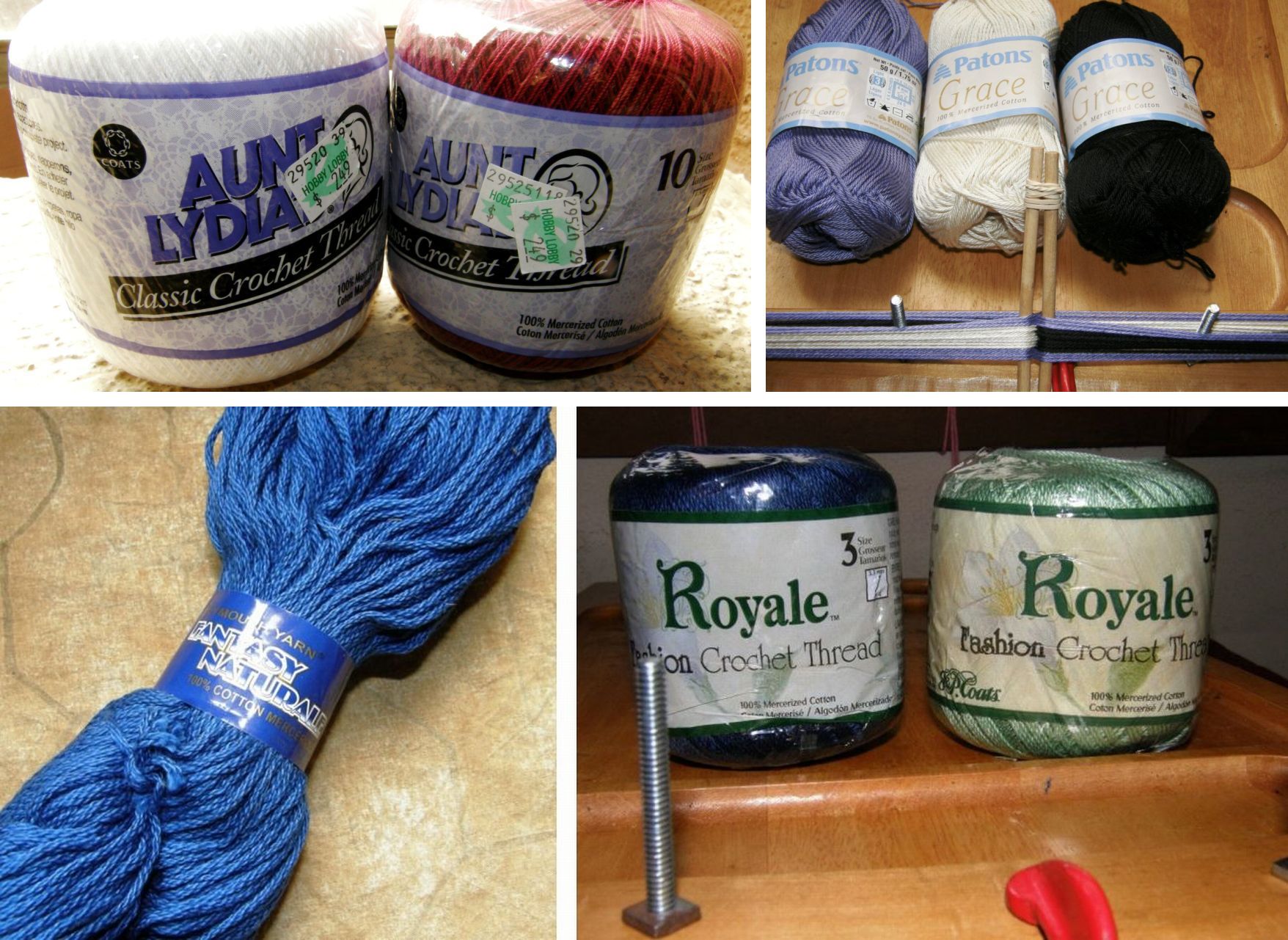
Read more about yarns including some information on using wool here.

My new backstrap was made with this thread pictured below…love this stuff!

Read more about suitable cotton thread and wool here.

Don’t forget the lettering tutorial.

Many thanks to all those who visited and left me Christmas greetings last week.

A very happy new year to everyone!

Backstrap Weaving – A New Anniversary and Past Lives


Never mind that I am back home here in Bolivia with Christmas lights in the palm trees and ninety plus degree heat and that I spent my entire childhood having summery Australian Christmases… I still think of snow and glowing fireplaces at Christmas time, particularly so this year. Perhaps it is because I just came back from the US where I got a good taste of the wintry chill or maybe it is the constant talk on the news of the big white that has hit Europe. My brother was piloting one of the QANTAS flights that was supposed to land in Frankfurt while one of my best friends from high school just flew to New York from Sydney in the hope of meeting and spending Christmas with her daughter who has been studying in London. All of this has kept snow very much in my thoughts.

Believe it or not I spent much of my twenties, one of those “past lives”, here for Christmas…

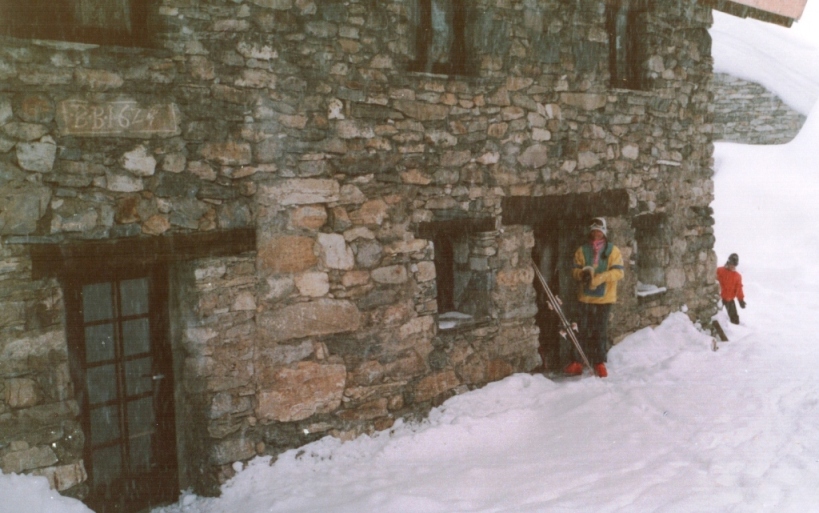
This is part of the old village in the ski resort of Val d’Isère in the French Alps. Nature usually cooperated and gave us a nice cover of snow for Christmas. I spent five months of the year every year for five years here.

We lived in the lower level of this old stone farm house in a village just outside the resort. In the old times the animals would be housed there for the winter and we had the original stone feed troughs in our home which the owners had covered over with wooden slats and converted into sofas/beds. The small building on the left of the farmhouse is the chapel in which a small service was held on the night of December 24th attended only by those in our village. After the service everyone would place large candles in the snow between all the houses. It was magical!!

This is how it would look early in the season. There I am at the front door ready for a day of skiing. And then the BIG SNOW would come!

Here you can just see our door and windows. Fortunately there was another well protected entrance. My friend, who was a heavy smoker, would go out in any weather and conditions to smoke his Davidoff cigars!

And then this would occasionally happen…

We would get cut off from the resort due to avalanche danger. The first time we got stuck for three days with little more than potatoes to eat. We always made sure that we had supplies after that.

Christmas day would be like any other. We were all ski bums there living without our families and so we would just get up and go skiing. I have kind of gotten used to not celebrating Christmas and we let it pass here in Bolivia as if it were any other day.

I got back last week from my US trip buzzing with ideas. There had been plenty of time on trains and in airports to think about what I wanted my next projects to be and so I didn’t waste any time getting warped up and back into my backstrap loom when I got home.

I wanted to put the weft twining I had learned with Montagnard weavers Ju and Ngach into practice and I decided on a table runner using their traditional colors and designs. I want to twine both ends of the piece. The Montagnard weavers usually twine only one end of their skirts and blankets. I warped for two strips of pick up designs and planned a traditional supplementary weft motif for the very center.
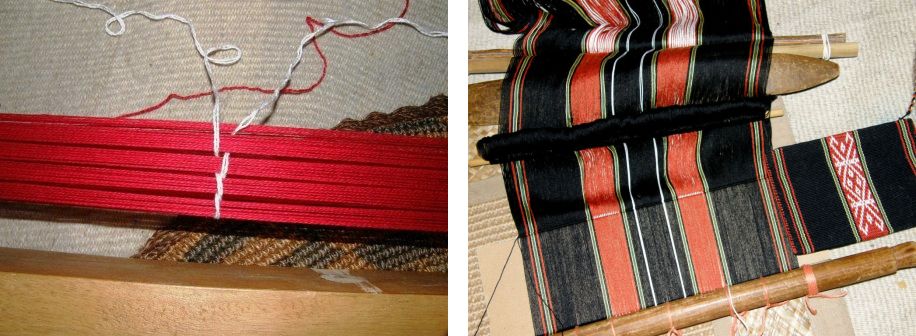
People often ask me how to keep the warps in better order when warping for a wide piece. The picture on the left shows how chaining doubled yarn as you warp can help do this. It also helps you keep place in your count. I didn't, however, chain this Montagnard warp. I find that simply using thick cross sticks and binding them well together helps keep everything in reasonable order when I take the warp off the warping stakes.

I placed a piece of cardboard in the warp to leave enough room for the twining and  got the weaving underway. I then returned to twine a little.

I will do this first twined edge on the loom. I plan to take the weaving off the loom for the final edge and suspend it on a stick as my teacher Ngach does. See previous posts here and here for details. This way I can compare both ways for speed and neatness. On-loom twining appears to come out neater but it is SLOW!

The off-loom twining that I did with Ngach wasn’t as neat with small gaps appearing now and then between the “stitches”. I don’t seem to have developed the knack as yet of preventing these gaps. In any case, I can’t wait to put my new bobbins to use.

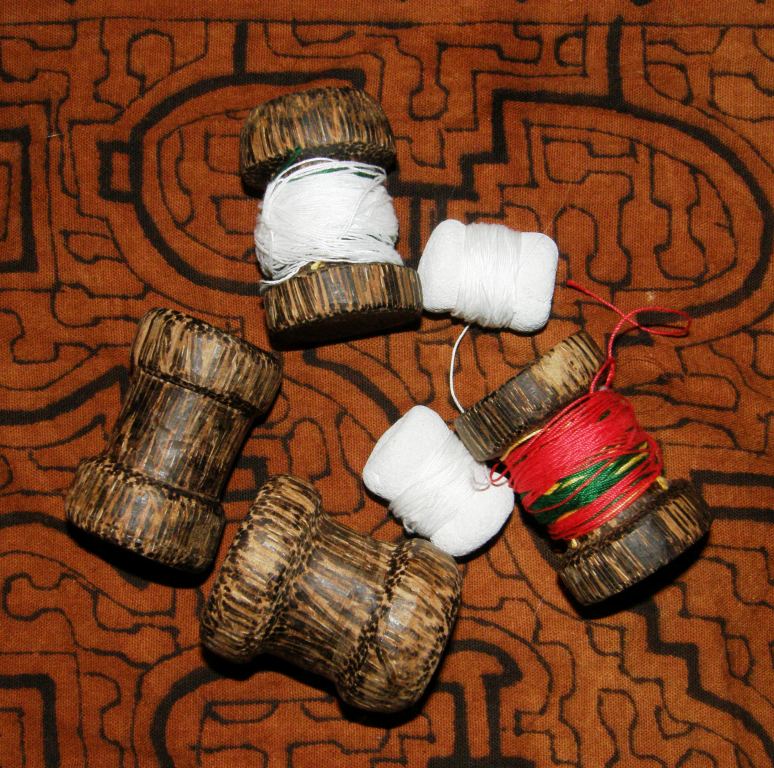
You can see the little cement bobbins that I bought from Ngach alongside the larger and heavier ones made by Ju’s husband. Ngach told me that heavier ones worked better and so I bought another pair from Ju.


At left you can see the warp float design with the supplementary weft motif in the center. At right is the first part of the weft twining. I am using the same Cebelia number 20 thread that my Montagnard teachers use. This first part of the design is the same motif that Ngach and I twined together in our classes. I am going to do another design taken from other Montagnard textiles that I photographed for the next part.

I found I needed a break from the twining…several hours just to do seven rows! and so I went on to finish the woven part of the table runner…more like a table center piece really.

Then I returned to continue the twining and you can see that I am more than  halfway through the main motif. The piece does widen with the twining and I think that twining around larger groups of warps may be the solution to that problem. I did notice this same problem on the skirt that Ju had just gotten back from Vietnam on which her sister had done the twining. There was a slight rippled effect on the skirt edge.

Now all that is left to do is twine away! Once the first row of design has been done, it all becomes quite mindless and I can use the time to plan my next project….There are several projects in my head all fighting to be next. Some were inspired by all I saw and learned at the Tinkuy de Tejedores (which you can read about here and here) in November…tubular bands, discontinuous warps and the tocapu designs on which Mary Frame spoke.

More recently, my friend Lisa sent me a link to this amazing documentary video on the Li weavers of Hainan Island.

(EDIT: I have heard from a blog visitor who can’t view this video. Here is the YouTube link just in case)

I had taken a picture of the loom pictured below at Pam Najdowski’s Textile Treasures stand at Convergence. Pam confirmed that this is indeed a Li loom. She has these looms to sell as well as other implements from Chinese minority groups. Although they are not shown on her website you can contact her here and ask about them. I bought a couple of bamboo reeds from her. Which reminds me…that’s another project on the list.

She was also kind enough to share pictures taken at the Folk Art Market in Santa Fe. That settles it! – I am definitely going to this market next year, not to buy anything…just to marvel!!

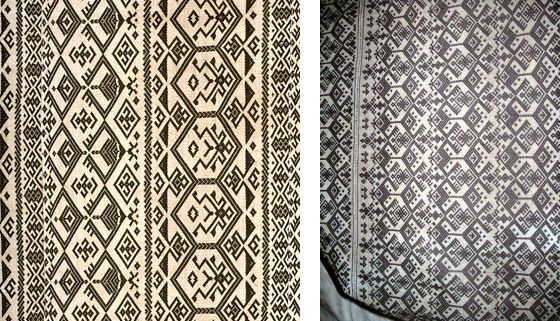
Well this led me on a little hunt online for other Li textiles and Chris Buckley, who is a collector in China, allowed me to use this image of a Li blanket he has which I love and can see myself reproducing, perhaps not in its entirety…it’s so big…but at least a small part of it.

Which brings me back to those “past lives” and a saying my friend David told me…”Youth is wasted on the young”(or something like that).

Would you believe that I spent six weeks in China and made two trekking trips to Nepal in my world wanderings back in my “youth” and didn’t go out of my way to seek any weavers? That was in my life before weaving. I was into running up and down mountains in those days and I did the three-day trek up the stone steps on one of the seven sacred mountains in China staying in monasteries along the way. It was a wonderful trip in itself, but imagine all those wonderful textiles and weavers that I didn’t notice!

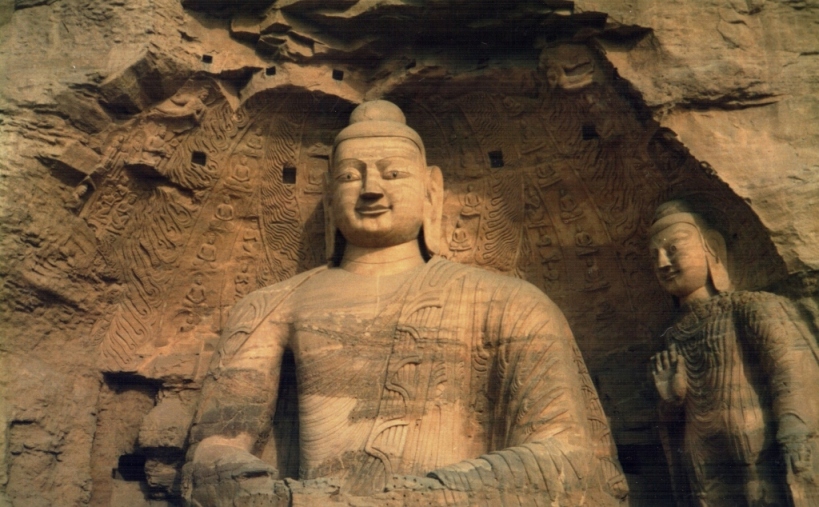
Well, it wasn’t all about mountains in China. We did and saw a lot in those six weeks including these rock-cut Buddhas near Datong at the Yungang Grottoes which were constructed in the 5th and 6th centuries. There are over 51,000 stone Buddhas in this site.

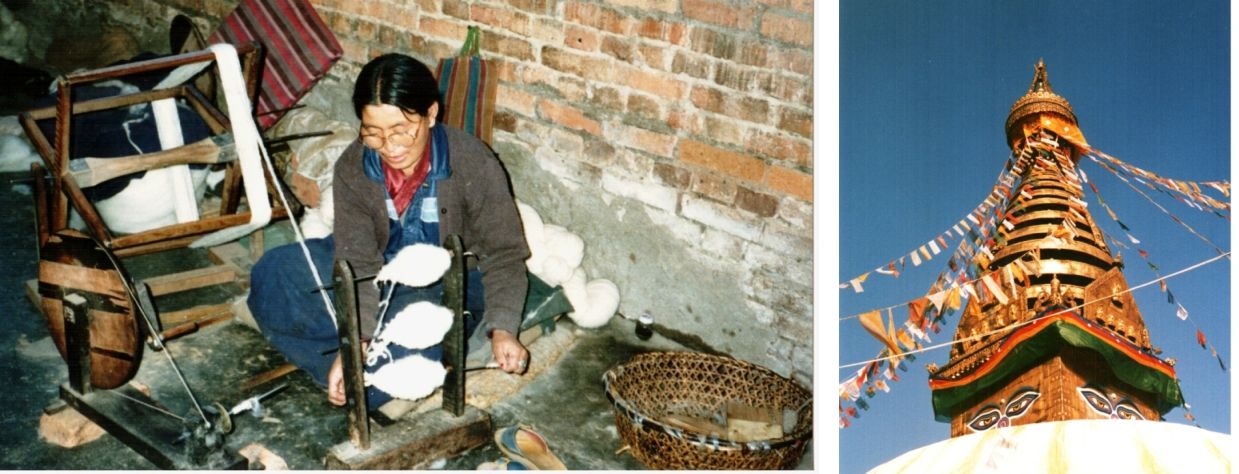
After the mountain adventures in Nepal, I did go to see a workshop where yarn was being prepared for weaving and rug knotting. We even bought a rug, which got stolen, but that’s another story!

So, now I try to make up for the wasted weaving opportunities through the wonders of the internet and books but I have to say that I have no doubts that I will get back to these countries one day (as long as my brother keeps working for QANTAS, that is!)

Here are a couple of books that I bought fairly recently…Spiritual Fabric by Japanese author Sadae Torimaru was recommended to me by a Weavolution buddy and is subtitled  “20 Years of Textile Research among the Miao People of Guizhou, China”. The book covers an enormous range of textile topics and the photos are beautiful. It is not quite a “how-to” but is certainly inspiring and gives a lot of information about the techniques with numerous photos. The author herself states “My only regret at the time of publishing this book is that the scope of my research has become so much broader than I initially expected that it has compromised the depth of my probe”.

The book on Nepalese Textiles is a new acquisition and I haven’t looked at it closely yet. I wish I had had it with me when I met the weavers from Bhutan last month. As we did not share a common language, showing them pictures from the book would have been a nice way to communicate. I am assuming that there is probably some kind of resemblance in techniques and designs between these two neighboring countries.

Swinging back now to this side of the globe and a country in which I have had some weaving adventures…I was recently gifted this….

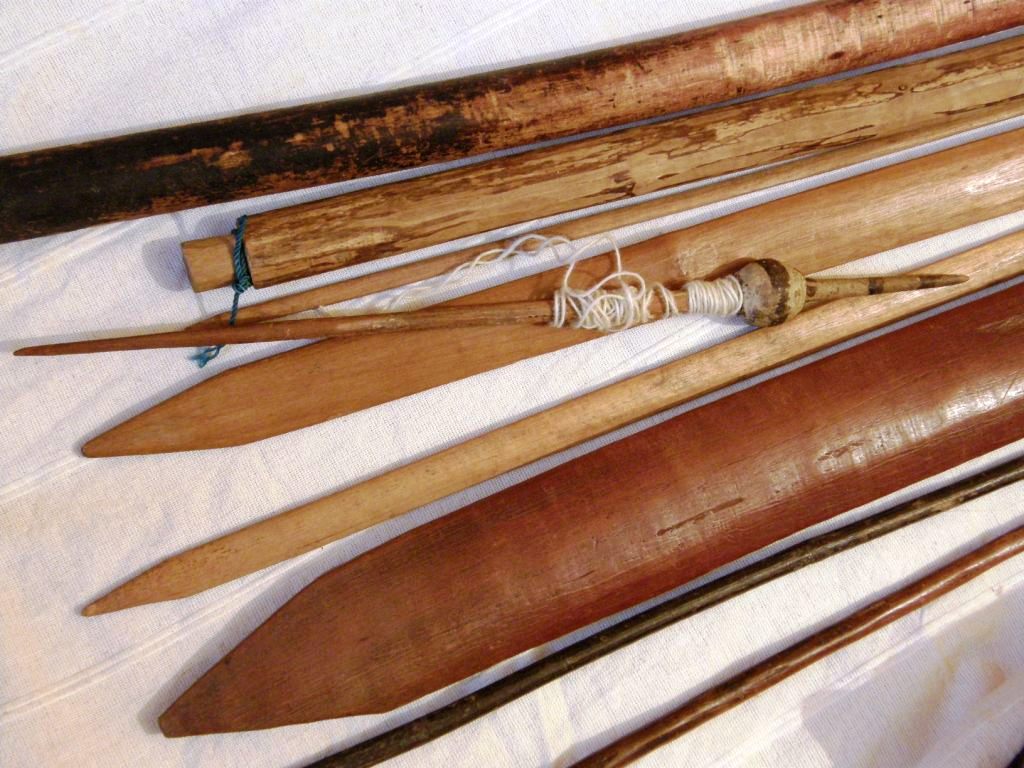
It is a Guatemalan loom and was given to me by Lorraine in California. She contacted me through this blog with her wonderful story of having learned to weave in Guatemala in 1979. This loom was given to her by her teachers and it is a real treasure. There are loom bars (two of which are not in this picture), heddle rods, shed rod and four wonderful wonderful swords of different widths. Included is what I have seen used as a spindle but which Lorraine was taught to use as a shuttle. The shed rod, the thickest piece you see there, is especially beautiful. It is a good size to hold open the warps for that shed without being heavy. I am not sure what kind of wood gives it these handy properties. The very finest sword is also a beauty and will work beautifully when I want to weave four-selvedge pieces.

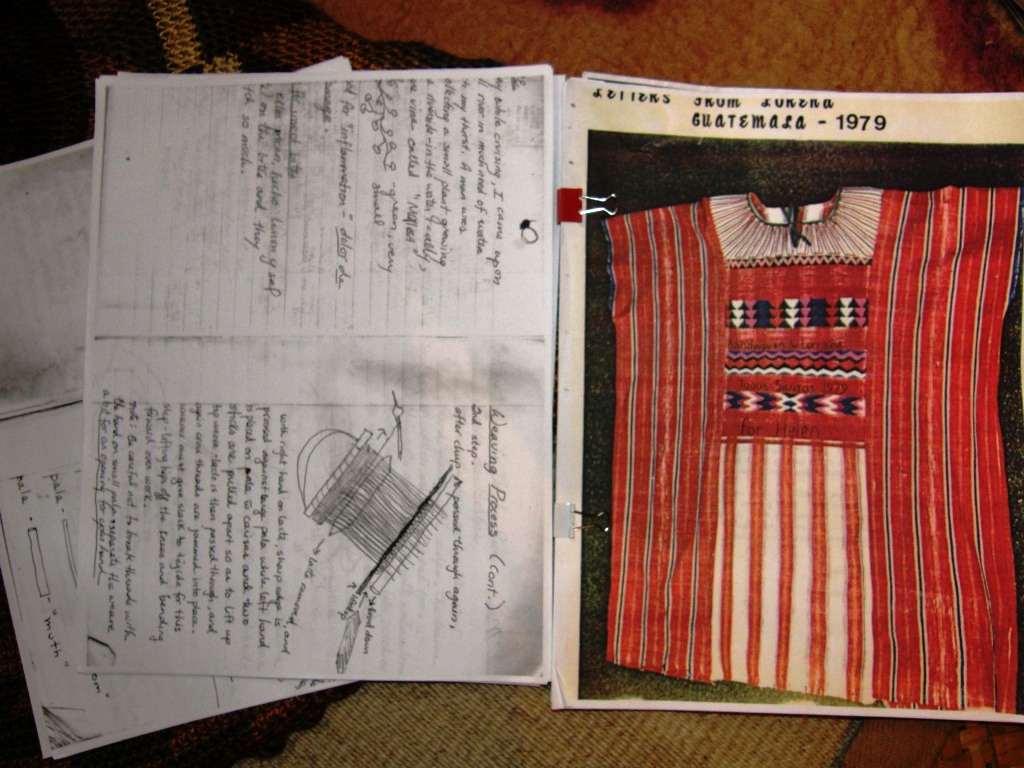
Also included in the large box that arrived for me in Maryland were copies of Lorranie’s notebook with all her instructional notes and sketches as well as all her letters home during her stay which her mother kept and typed up. The cover of the booklet of letters shows the huipil that she wove with her teacher in Todos Santos Cuchumatán and the letters themselves tell the delightful, amusing and often moving story of a twenty-two year old girl and her discovery of a simple life amongst dangerous times in the Guatemala of the late 70s.

I will be warping this loom soon with a special project for Lorraine.

I have been doing some housekeeping behind the scenes on this blog organizing the tutorials. I have extracted the tutorials that had been embedded in posts and put them on separate pages so that they appear in the tutorial list on the side bar. You can still use the TUTORIAL tab at the top of the page to find them all. Another FAQ has also been added.

And for all the Spanish-speaking visitors another tutorial has been translated into Spanish.

Now you can find the instructions for Supplementary Weft Patterning in Spanish. Thank you for your patience.

El tutorial “Diseños con Trama Suplementaria” ahora está disponible en español. Pueden encontrar los enlaces para todos los tutoriales que he traducido a español hasta ahora aqui. Gracias por su paciencia!

And what about the “New Anniversary” I mention in the title of this blog? That is my blog anniversary. I announced this blog to the world on December 13, 2009 after it had sat for a few weeks with a couple of posts and me agonizing over how to get it started with a bang. Finally, I got the thumbs up from my brother who told me to pretty much “just do it” and then I had all my Weavolution buddies come along and give me their fullest support. And from there it went on…Thank you all!

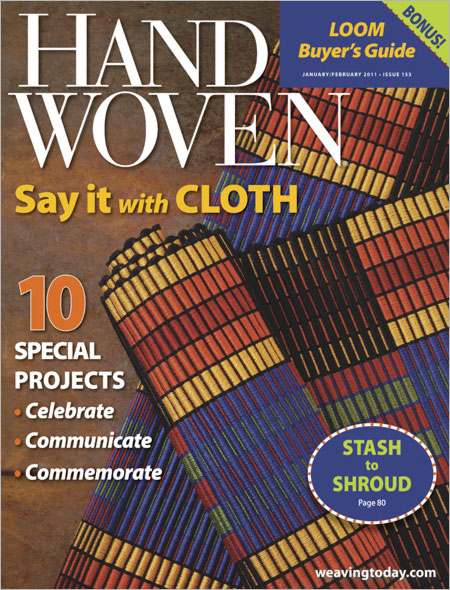
And to end, I am waiting on the arrival of the Jan/Feb 2011 issue of Handwoven where I contributed a tiny piece on the meaning of cloth. I hear that Carol Ventura also contributed and I am looking forward to reading that. Carol is the one who got me into online weaving groups in the first place which pretty much started this whole adventure. It sounds like a great issue with many projects displaying ethnic influences.

I had a fair bit to say on this topic of “Meaning in Cloth”, obviously WAY too much as only a very small portion of my article actually made onto the printed page. The magazine editors have allowed me to place the article in its entirety here on my blog. If you would like to read it, take a look HERE.

A topic opened up in one of the online weaving groups this week – a Christmas gift wish list for weavers. It started off with small and simple gadgets and worked its way up to entire looms. I had a think about this and am pleased to say that I have my sticks, my string, my World Wide Weaving Guild via the internet and, most importantly, TIME and so I simply can’t think of anything weaving-related to put on a wish list. Lucky me 😉

HAPPY HOLIDAYS EVERYONE!

Backstrap Weaving – Back from the 18th Century

I’m back, after having a wonderful week in colonial Williamsburg at the invitation of my friends David (aka Dr D, historian and super guide), Janet and Claudia. There wasn’t a blog post last week…no internet in the 18th century, you see. 😉

Colonial Williamsburg is “the restored 18th-century capital of Britain’s largest, wealthiest and most populous outpost of empire in the New World.

In the 301-acre Historic Area stand hundreds of restored, reconstructed, and historically furnished buildings. Costumed interpreters tell the stories of the men and women of the 18th-century city – black, white and native American, slave, indentured and free – and the challenges they faced.”

The challenge I faced was the COLD! It was not quite what I am used to in hot and steamy Santa Cruz Bolivia. It was interesting to note yesterday that the temperature was the same here as in Bolivia – around 34 degrees – except that the temperature here was in Fahrenheit while it was in Centigrade in Bolivia.

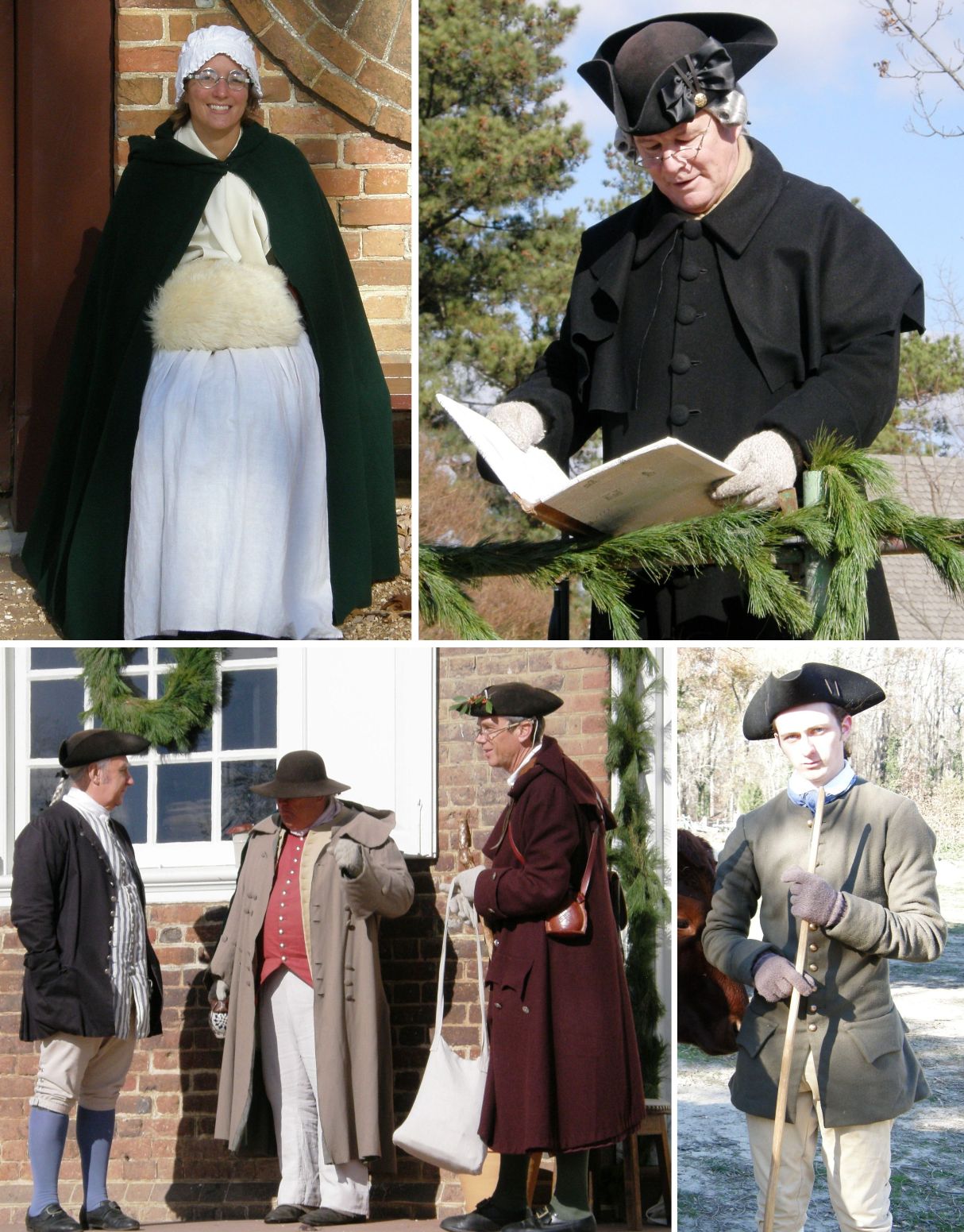
Here is what the colonial Williamsburg folk were wearing outdoors in the cold winters…

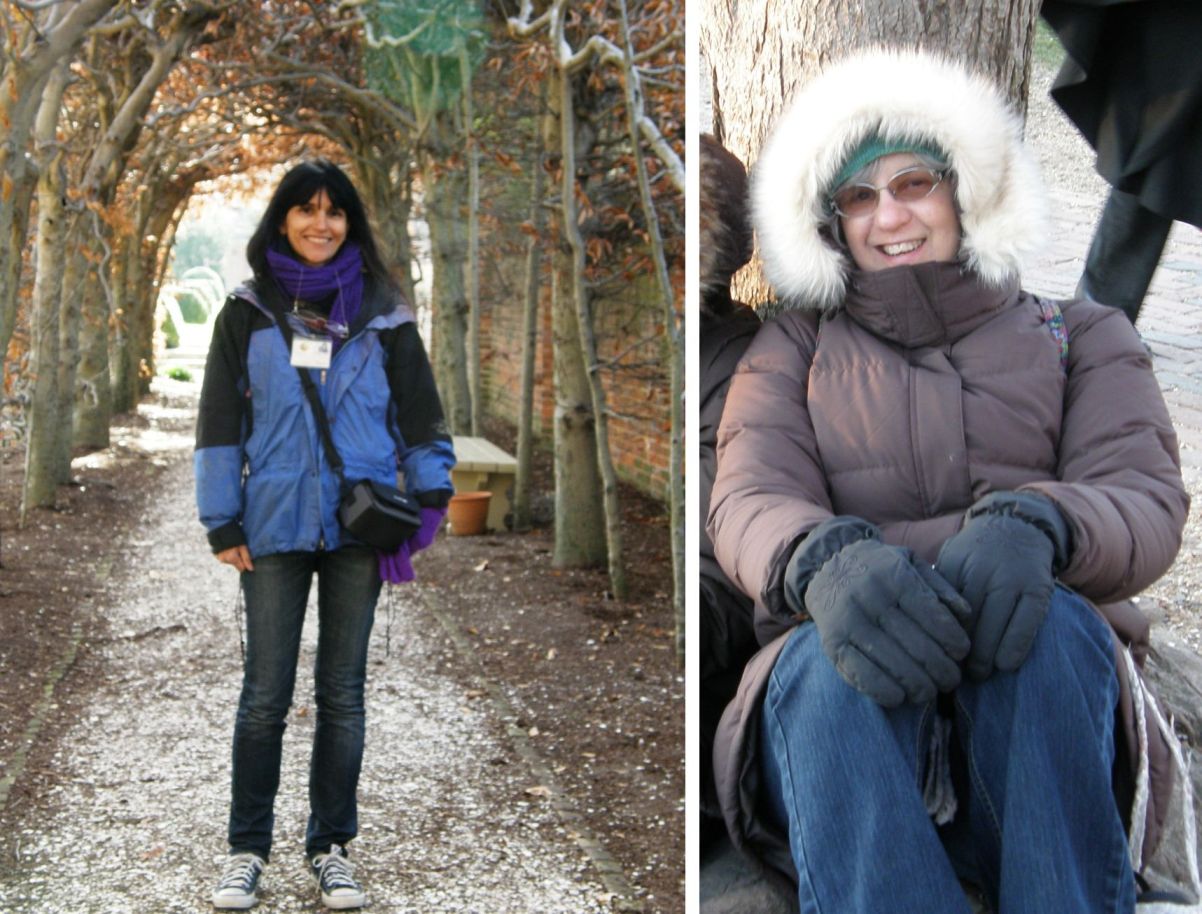
And here we are in our down, goretex and thermals…

It was a week of flames…candles, fireplaces and burning braziers in the streets after dark. It was COLD! and I made friends with every fireplace in every building along the way and became a big fan of hot cider.

We stayed at the historic Powhatan Plantation which is named after Chief Powhatan of the Powhatan tribe and father of Pocahontas.

I had wished for snow and there I got a dusting on the morning of day one. That was enough for me, thank you very much! A week of glorious clear blue skies followed. Above you can see the plantation Manor House and kitchen building which is now an intimate elegant restaurant. I don’t know what kind of awful weather in Canada has the geese flying down here to happily set up camp on the frozen ponds.

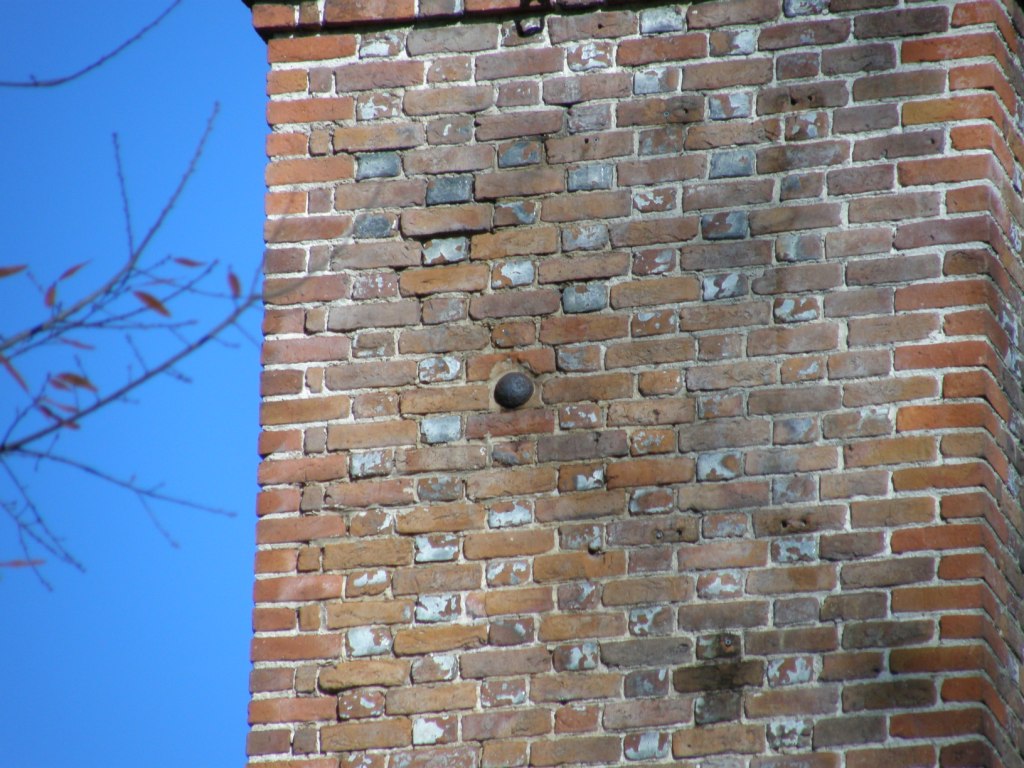
The Manor House came complete with a cannon ball lodged in its chimney and resident ghost Eliza.

Walking from place to place around the historic area and visiting every single place that was open to the public, we managed to keep ourselves warm, quite often forgetting the cold all together – everything was so absorbing and interesting with the constant reminder that we were walking the same floors, visiting the same stores, climbing stairs and grasping the same banister rails as people like George Washington, Thomas Jefferson and Patrick Henry.

Only Sunday evening had us sitting still and huddling  down against the cold as we waited for the “Grand Illumination” – a tremendous fireworks display which marked the start of the holiday season. Large blazing braziers lined the streets and groups gathered around in the darkness for light and warmth.

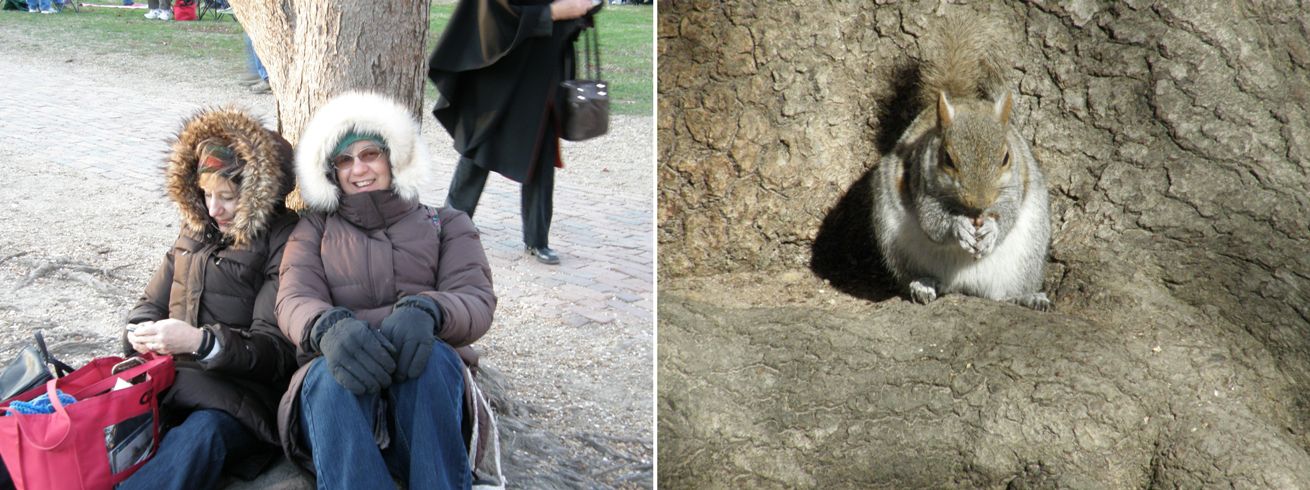
Forgive this photo – we don’t have squirrels in Bolivia.

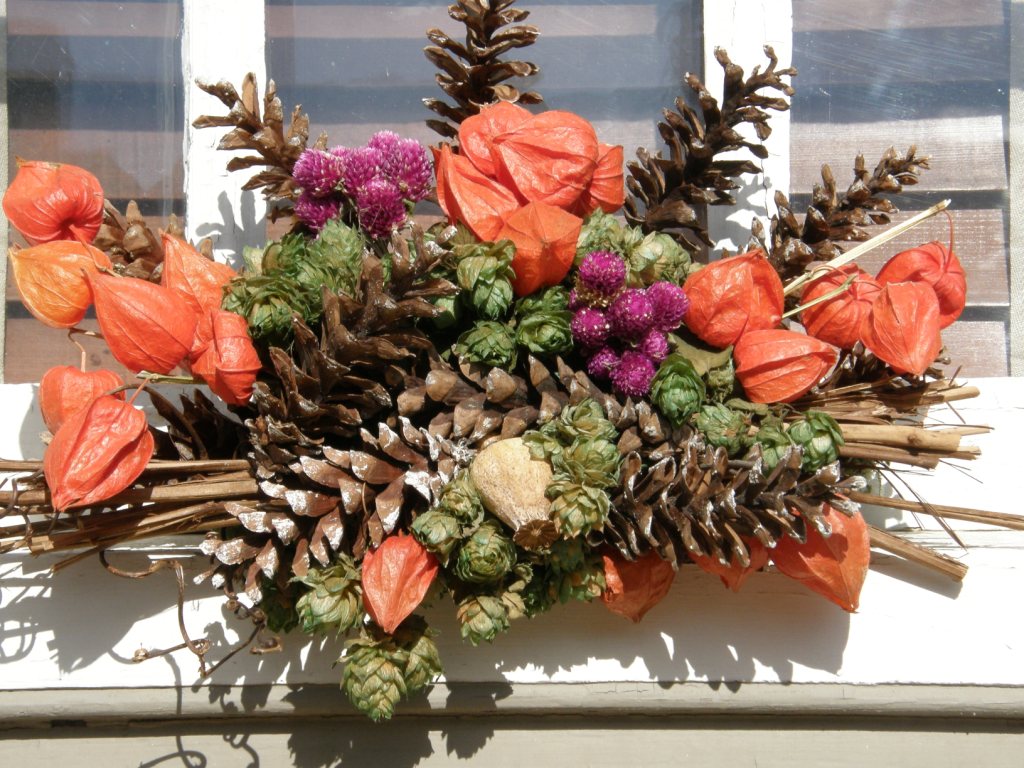
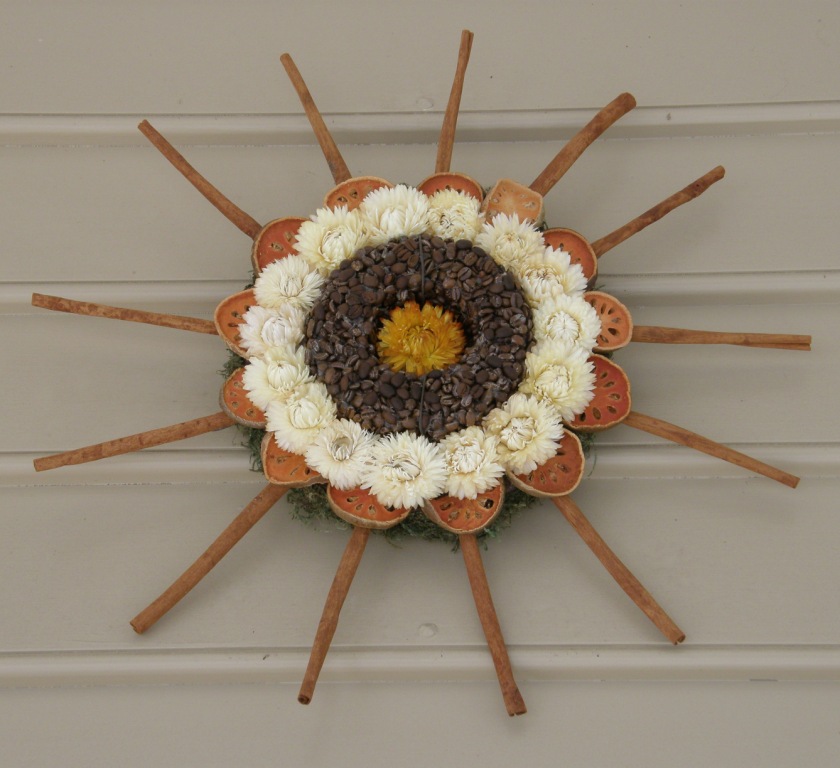
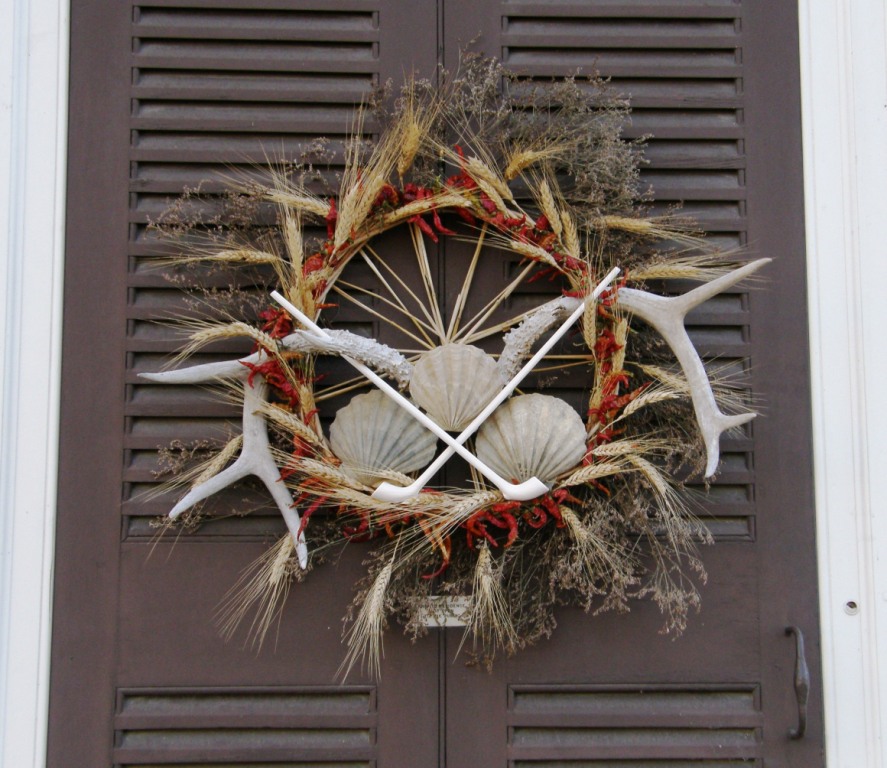
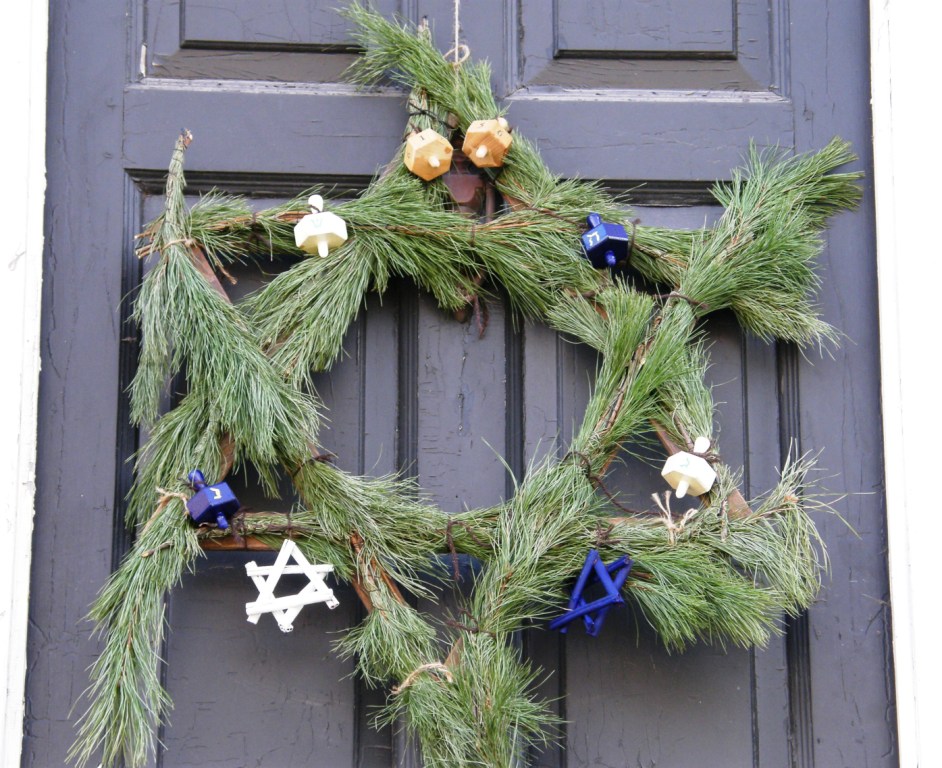
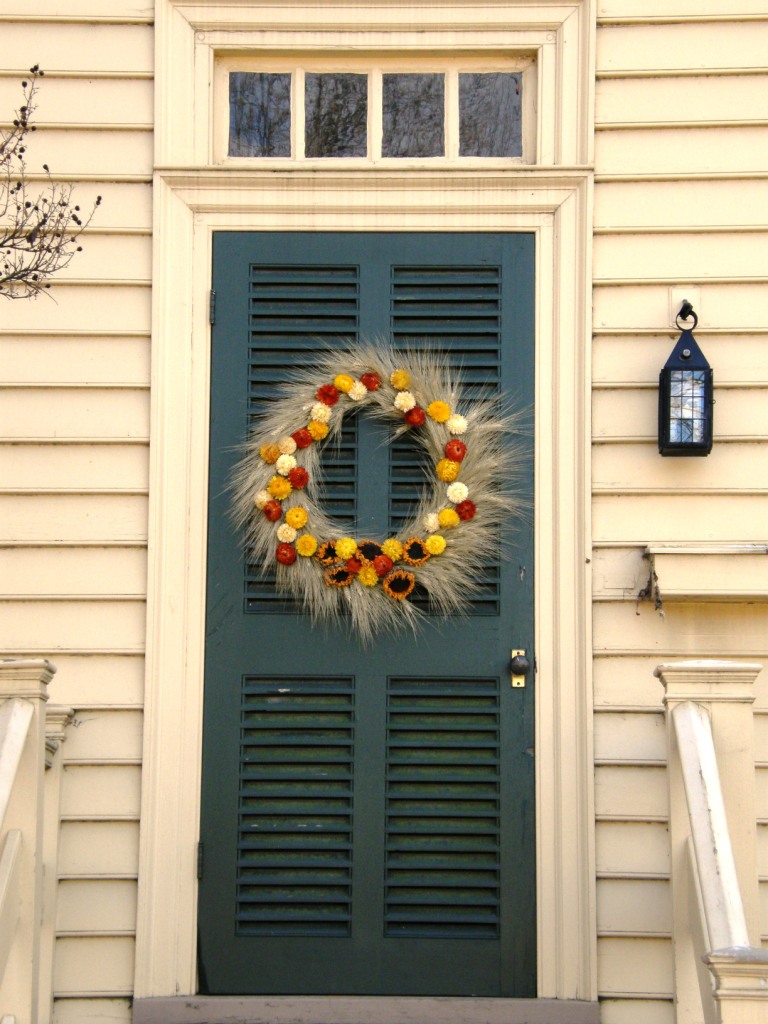
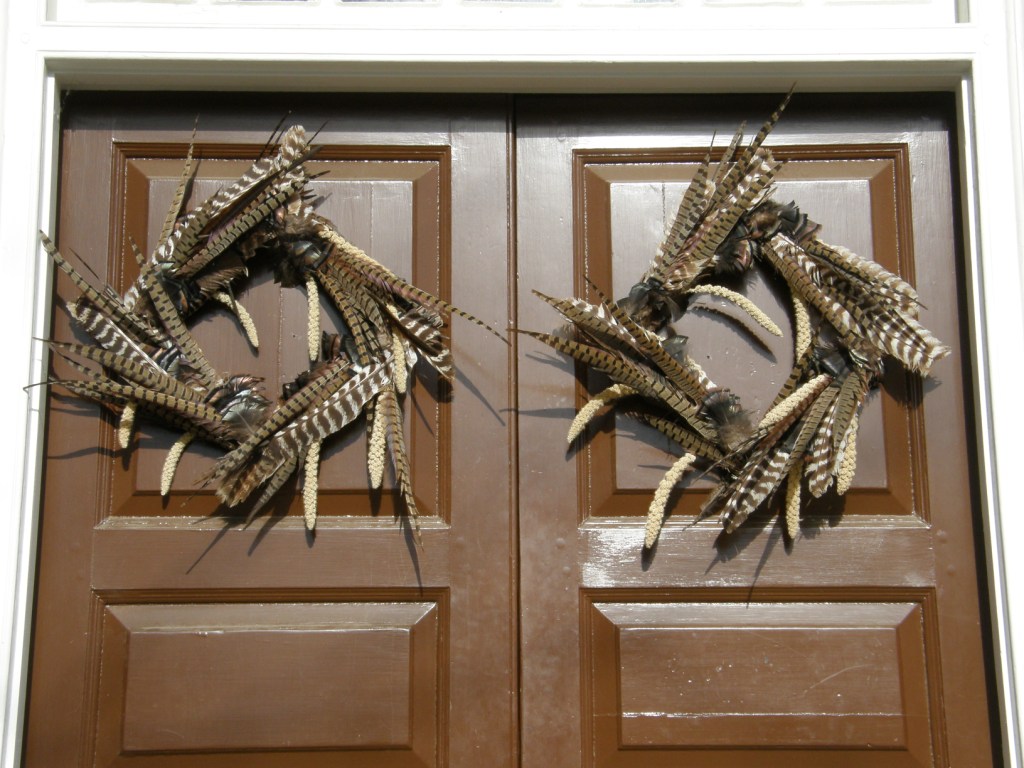
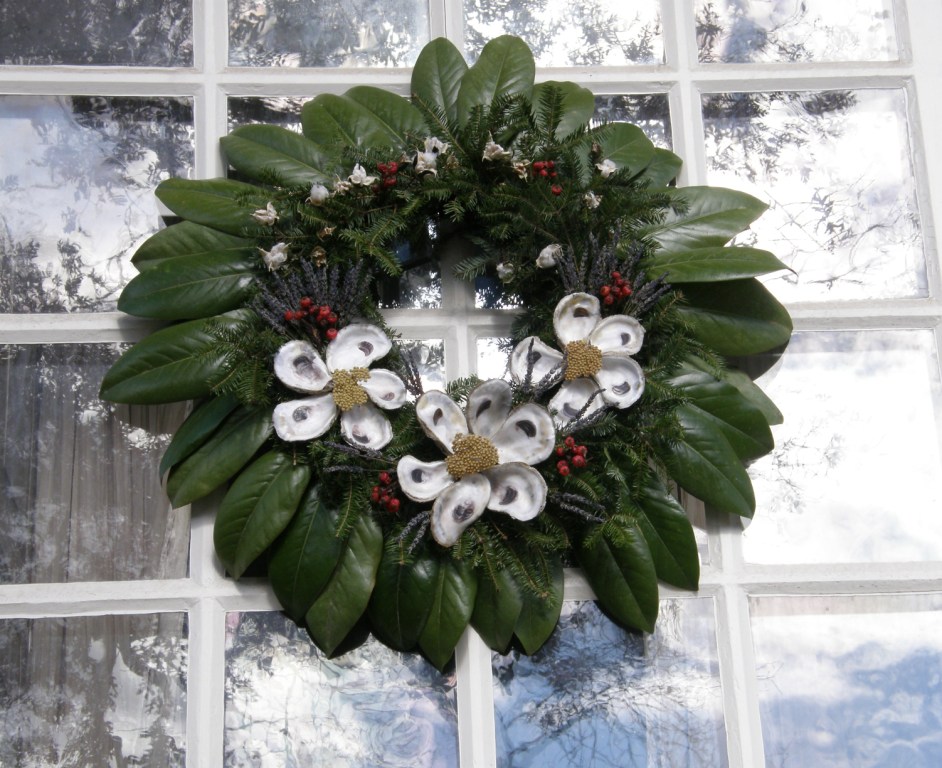
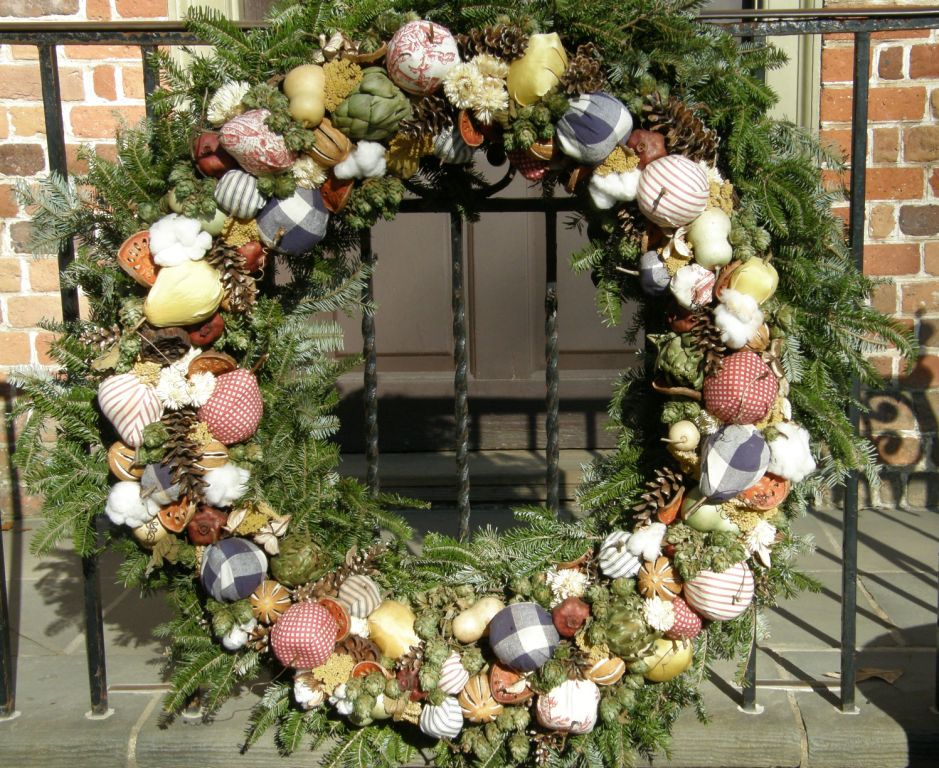
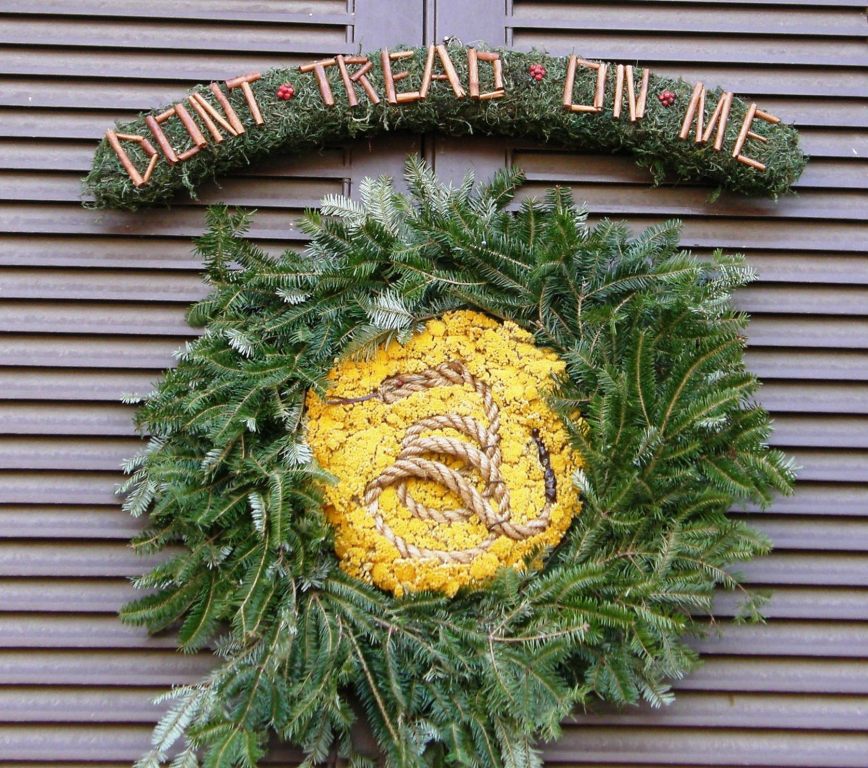
Doors, windows, shutters, fence posts and walls were adorned with wreaths – no two were alike, some pretty, some just plain quirky – candles flickered in windows and carol singers gathered on street corners while horses and carriage clopped by.

I have inserted tiny pictures of just a few of the wreaths throughout this post.

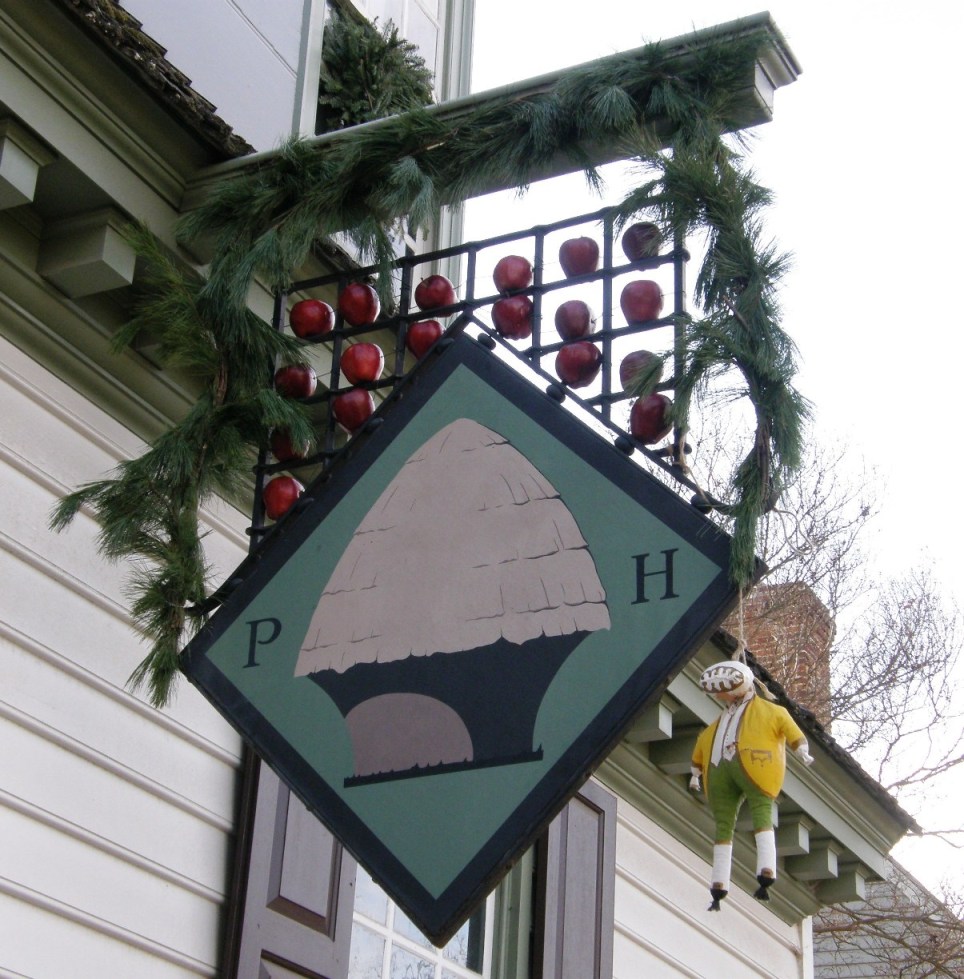
As idyllic as this all sounds, this swinging sign outside a private residence of colonial Williamsburg with its hung effigy of who was, most likely, Governor Dunmore shows that not all was well in the colony around the 1770s.

Indeed, we heard snippets of gossip and rumor from the various store, tavern and coffee house keepers about the general discontent with the British Government and its taxes. There were even whisperings of “independence”.

The vast majority of the interpreters stayed faithfully in character and it was fun interacting with them.

Of course we had to pursue the fiber trail which took us to the workshop of the weaver and spinner and out to the pastures to find the Leicester Long Wool sheep, one of the breeds known to have been raised in these colonial times.

This image from a website called Sheep 101 and the reproduction of a children’s toy in Williamsburg clearly show how this breed of sheep earned its name.

We eventually tracked down a half dozen LLW sheep in one of the pastures and saw some of the handspun wool on sale in one of the stores.

According to various pieces of literature that I picked up here and there in Williamsburg, most colonists bought fabrics imported from England from the local milliner.

However, those who could not afford these or who had very large households produced their own cloth.

On plantations around Williamsburg, the work of  growing, combing and spinning flax into linen yarn for weaving usually fell on slaves or domestic servants.

Domestic fabric production increased with the eventual boycott of all English goods, including textiles. Strategies proposed to deal with this sudden end to the availability of fine English cloth included the following declarations set down in the Continental Association of 1774…

“We will, in our several stations, encourage frugality, economy and industry, and promote agriculture, arts, and the manufactures of this country, especially that of wool”…..and…..”use our utmost endeavors to improve the breed of sheep, and increase their number to the greatest extent.”

The additional labor of raising the sheep and carding the wool and cotton would go to the slaves who were now clothed in “Virginia cloth” instead of imported English fabric. Weaving, spinning and dyeing became  necessities and  patriotic duties.

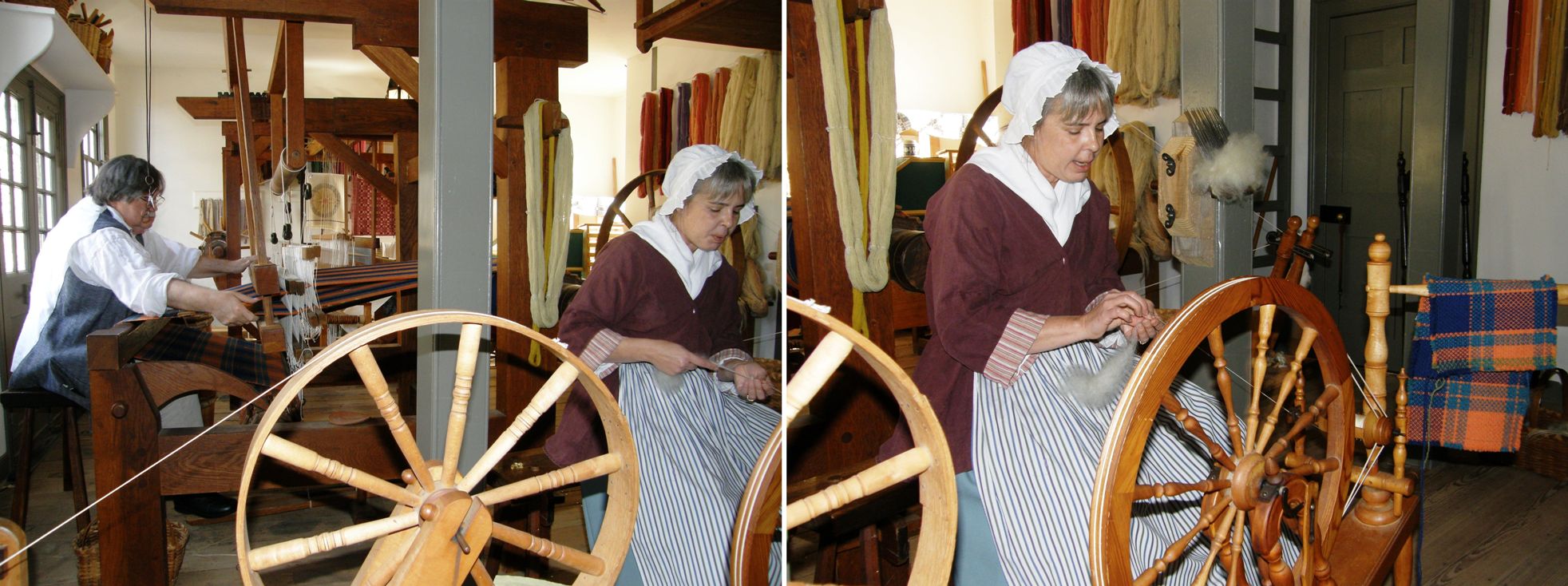
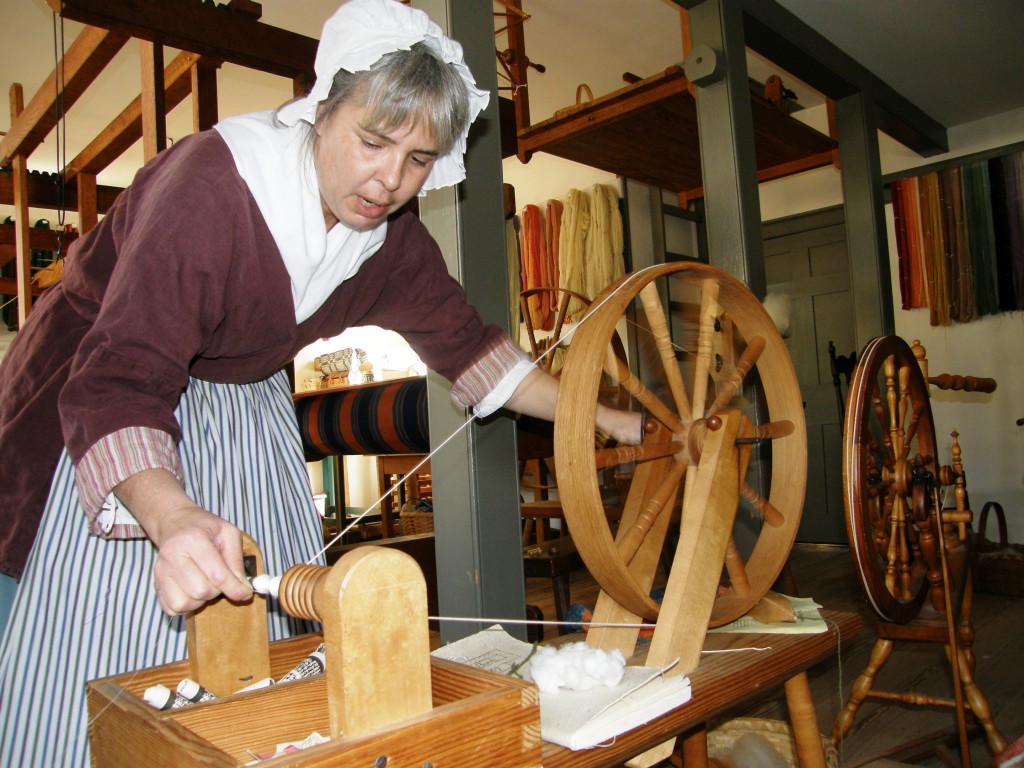
We visited weaver Max and spinner Karen more than once as, on each visit, they had different interesting tidbits of information to share. In fact, you could probably visit all the tradespeople in town several times over and learn something new every time. None seemed to have limited themselves to a set well-rehearsed speech for the visitors and their enthusiasm for their work was evident.

Karen showed us her Saxony and walking wheels while Max was reproducing an antique blanket woven in overshot for a client, a piece of which can be seen draped over Karen’s spinning wheel. While Karen wound quills as you can see above, she told us that children would be tethered to the equipment to perform the tasks of loading shuttles and winding the quills.

Let me take you on a short photo tour of several highlights of colonial Williamsburg…

Above left is Bruton Parish church, completed in 1683, where we attended an evening concert of Christmas songs ranging from pilgrim songs of the 15th century to  jazzed up versions of twentieth century tunes. The Williamsburg Courthouse, on the right, is the only building we didn’t enter but we did try the stocks on for size. You can just make them out on the right.

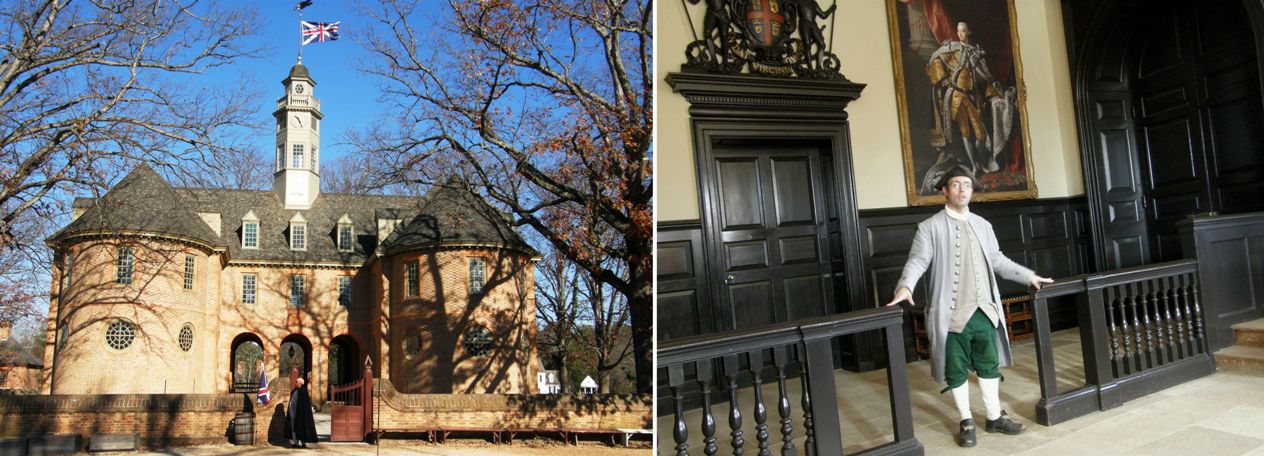
The reconstructed Capitol building. The Capitol building was the center of political life in Virginia for most of the eighteenth century and is where Members of the House of Burgesses met. it was here that Patrick Henry delivered his “Caeser-Brutus” speech against the Stamp Act on May 29, 1765.

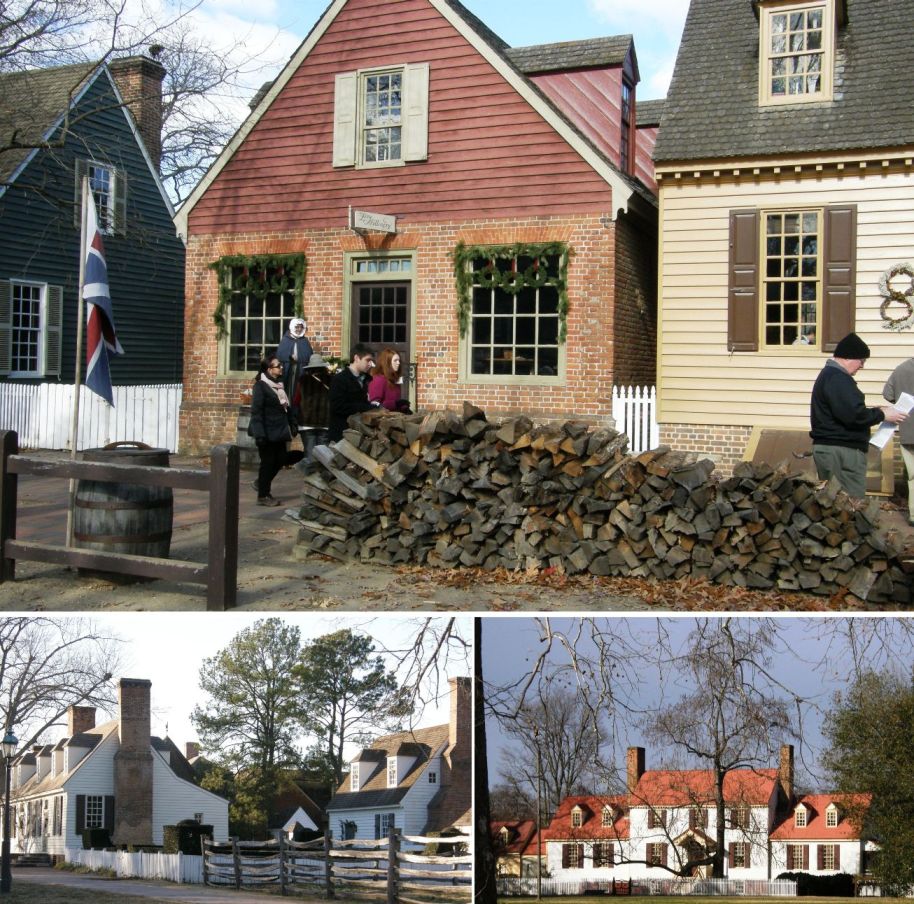
Private homes and stores in the historic area.
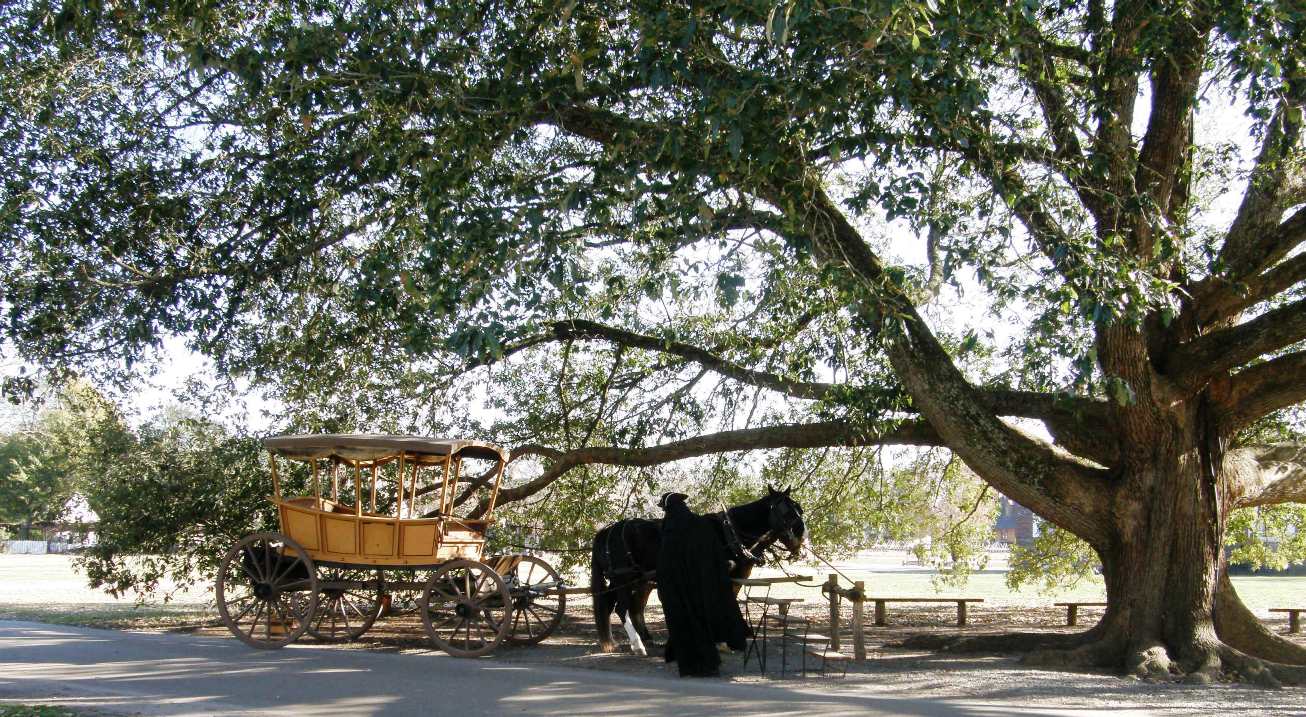
A carriage pulls up under what we were told is a majestic willow oak.
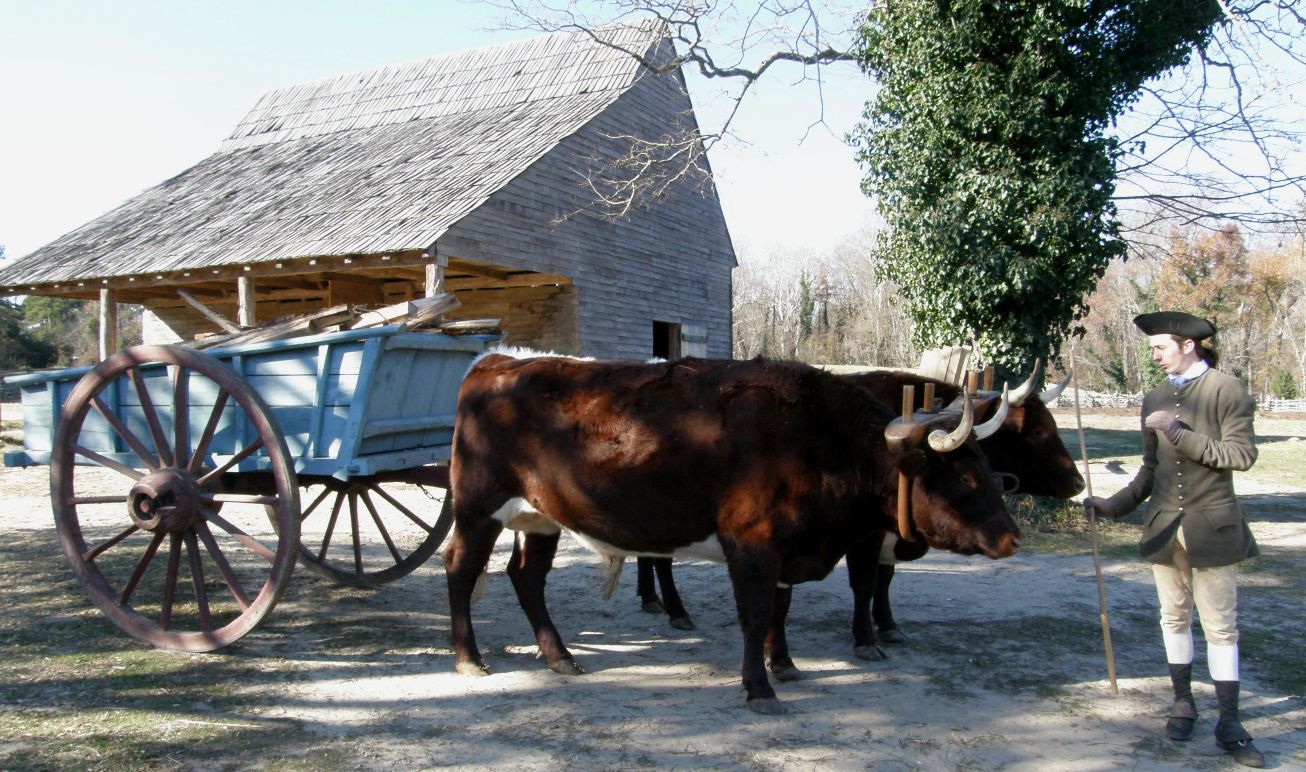
Ox and cart on Hope plantation where tobacco amongst other crops was grown.
We encountered all manner of folk in the street.
An actor plays out a scene from Sheridan’s School for Scandal and a group sings carols for passersby.
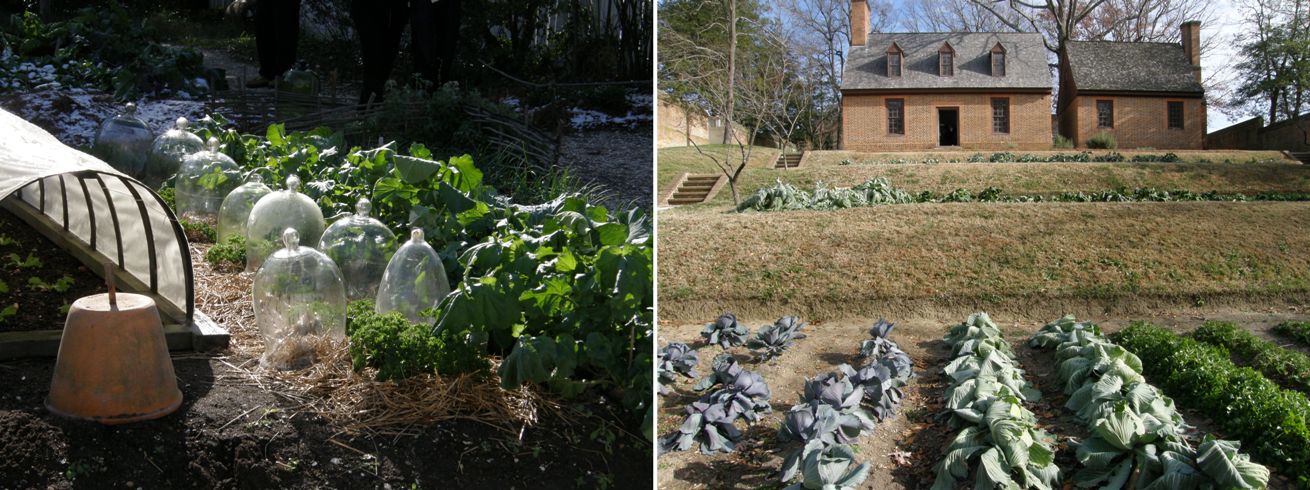
The gardens of the Governor’s Palace were particularly beautiful even in the wintry weather.
The kitchen gardens flourished despite the low temperatures and frosts.

My favorite places were the workshops of the various tradespeople.

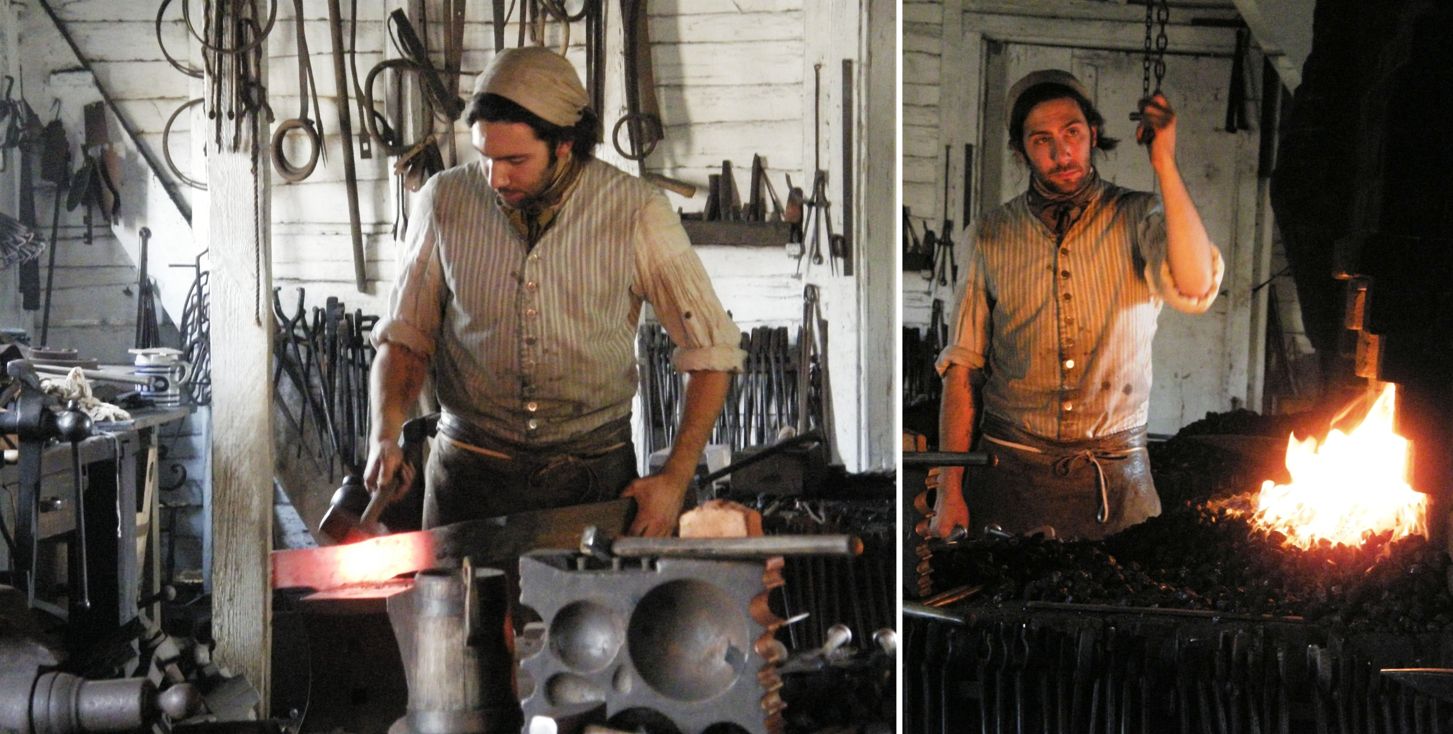
The blacksmith was working the bellows and beating out an ax head.

The visit to the seamstress’s shop gave us a chance to see some of the fabrics that were in fashion in the 18th century as well as some examples of the handstitching. My immediate reaction was to marvel at how someone had managed to work stitches by hand so perfectly that they resembled machine work. I then realized how stupid that was when reminded that machines were built to try to speedily replicate the perfection of hand stitching.

The wig makers at left were a fun couple with a lot of jolly banter between them and a witty comeback to every comment and question from the visitors. The brick kiln was being fired up for a restoration project.  I was wondering how on earth they were going to slide all the bricks within when I realized that the kiln itself was built from the very bricks that were to be fired.

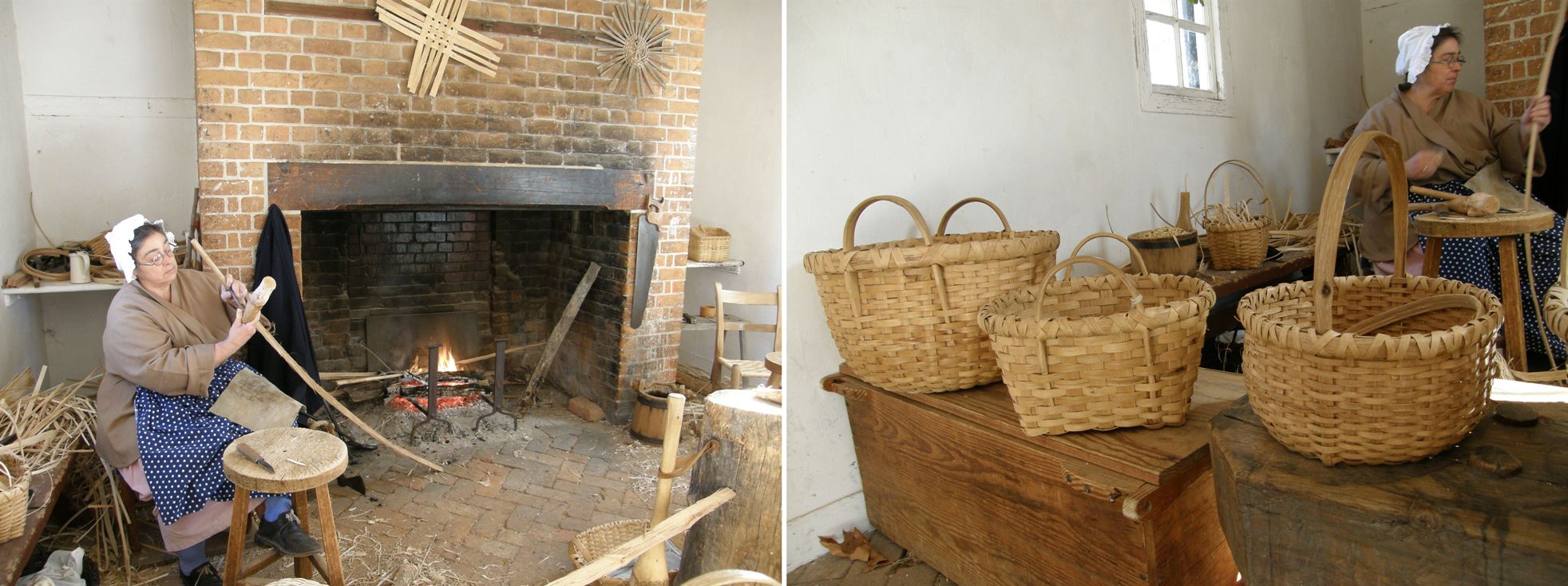
The basket maker was making containers from white oak, a hard task for the hands in those low temperatures.

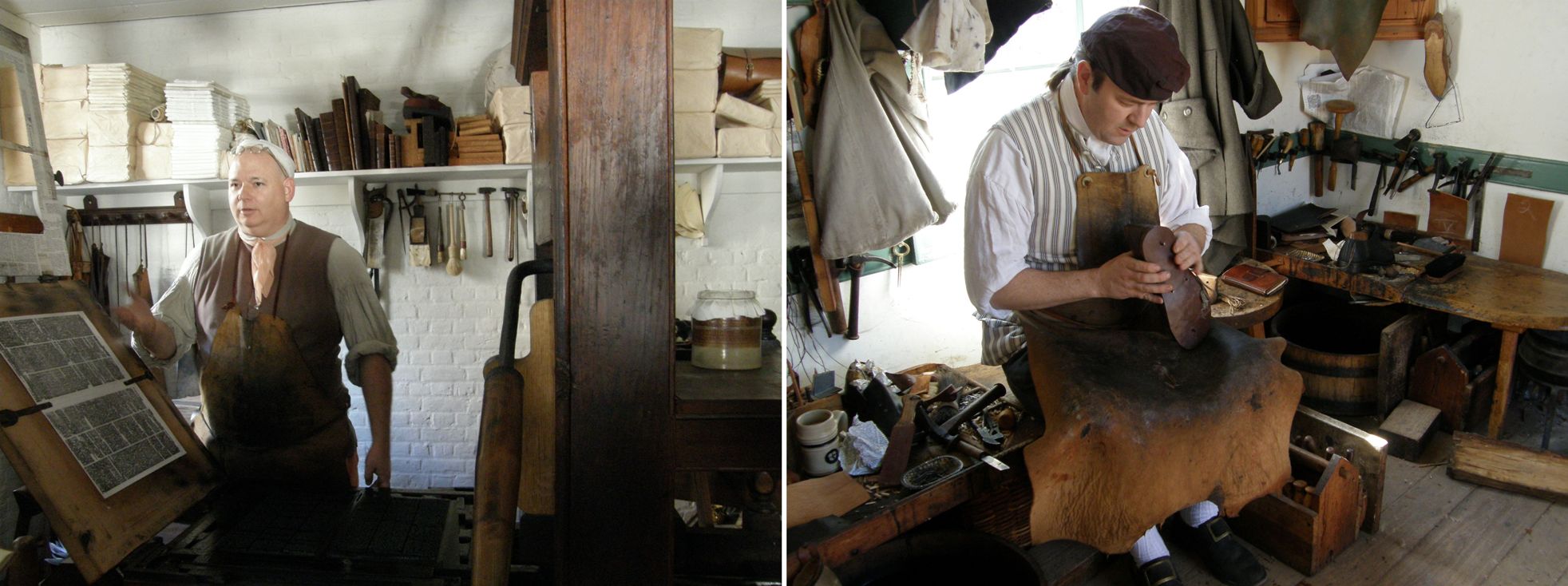
The printer and shoemaker. It was interesting to see the font that the printer was using which included different forms of the letter “s” depending on where it was placed in a word.

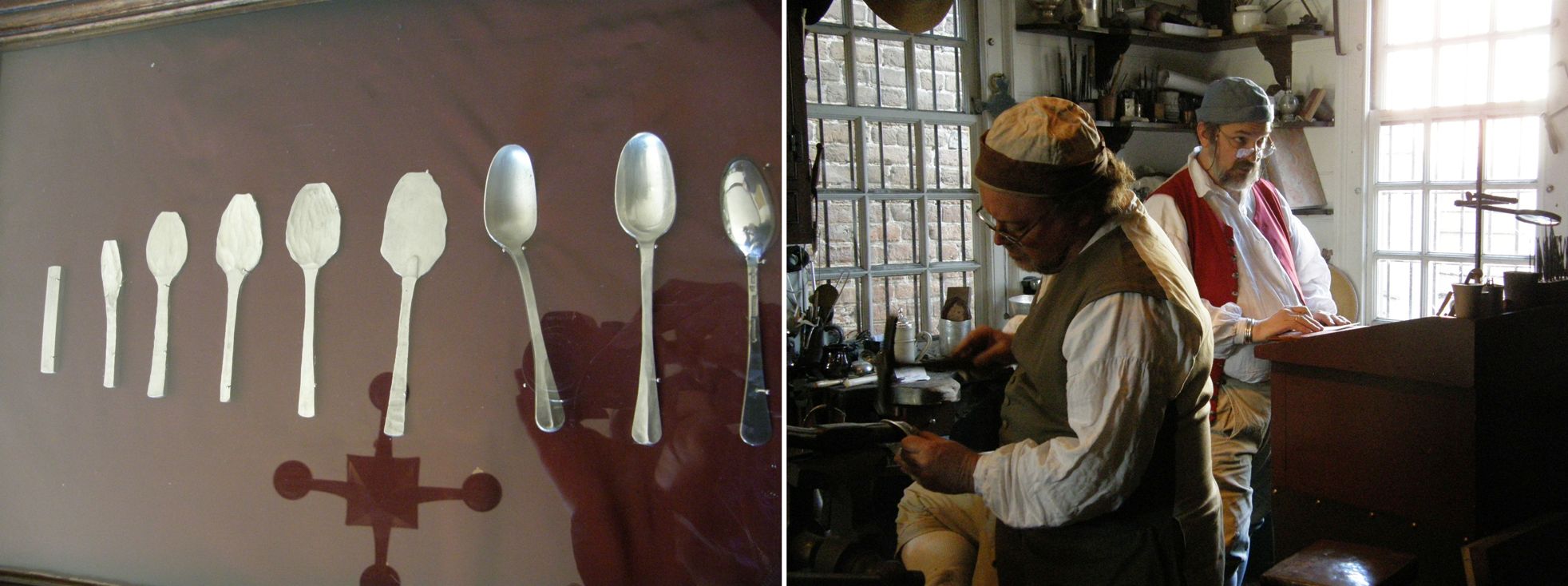
We learned a little about silver smithing and also visited the cooper, wheelwright, joiner, cabinetmaker and gunsmith. At the cooper’s it was interesting to see the amount of work and precision that went into making a simple wooden bucket, cutting pieces that fit together so perfectly in order to make the piece completely watertight.

It was very surprising for me to pick up a musket at the gunsmith’s and find that it weighed as much as 8 pounds.

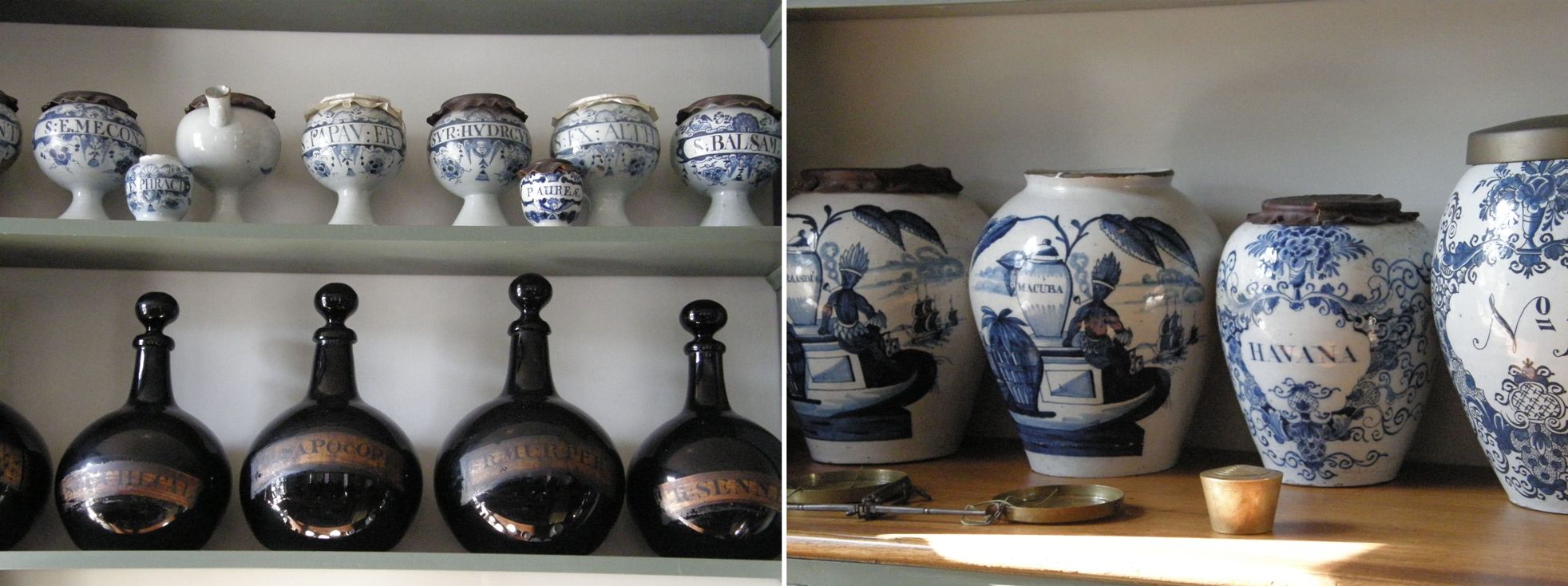
The apothecary was a favorite of mine with its strange mixtures in exotic-looking bottles and jars and herbal remedies for all manner of ailments.

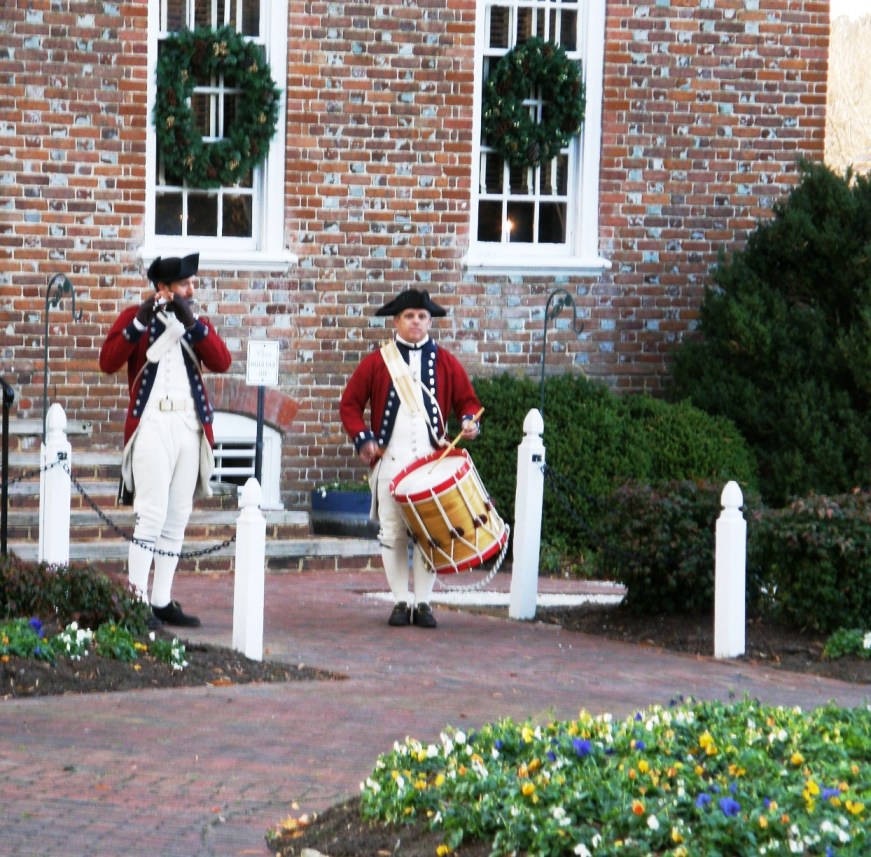
One of the highlights of the week for me was going into the historic area after dark to walk with the entire Fife and Drum Junior Corp as they marched and played along Duke of Gloucester Street accompanied by flaming torch bearers.

It was such a powerful sight in the darkness with the torches casting their orange glow over everyone.

The onlookers were completely hushed in awe.

Two members of the senior corps played at sunset at the manor house on the plantation where we were staying.

We stopped by the Abby Aldrich Rockefeller Folk Art Museum but the exhibit really was too much to try and take in in just one visit. I was a little uncertain about what exactly constitutes folk art and so a quick google search cleared this up. Folk art is defined as being…

that which is produced by an indigenous culture or by peasants or other laboring tradespeople. It is an unsophisticated art which is supposedly rooted in the collective awareness of  simple people and reflects the traditional values of a society.

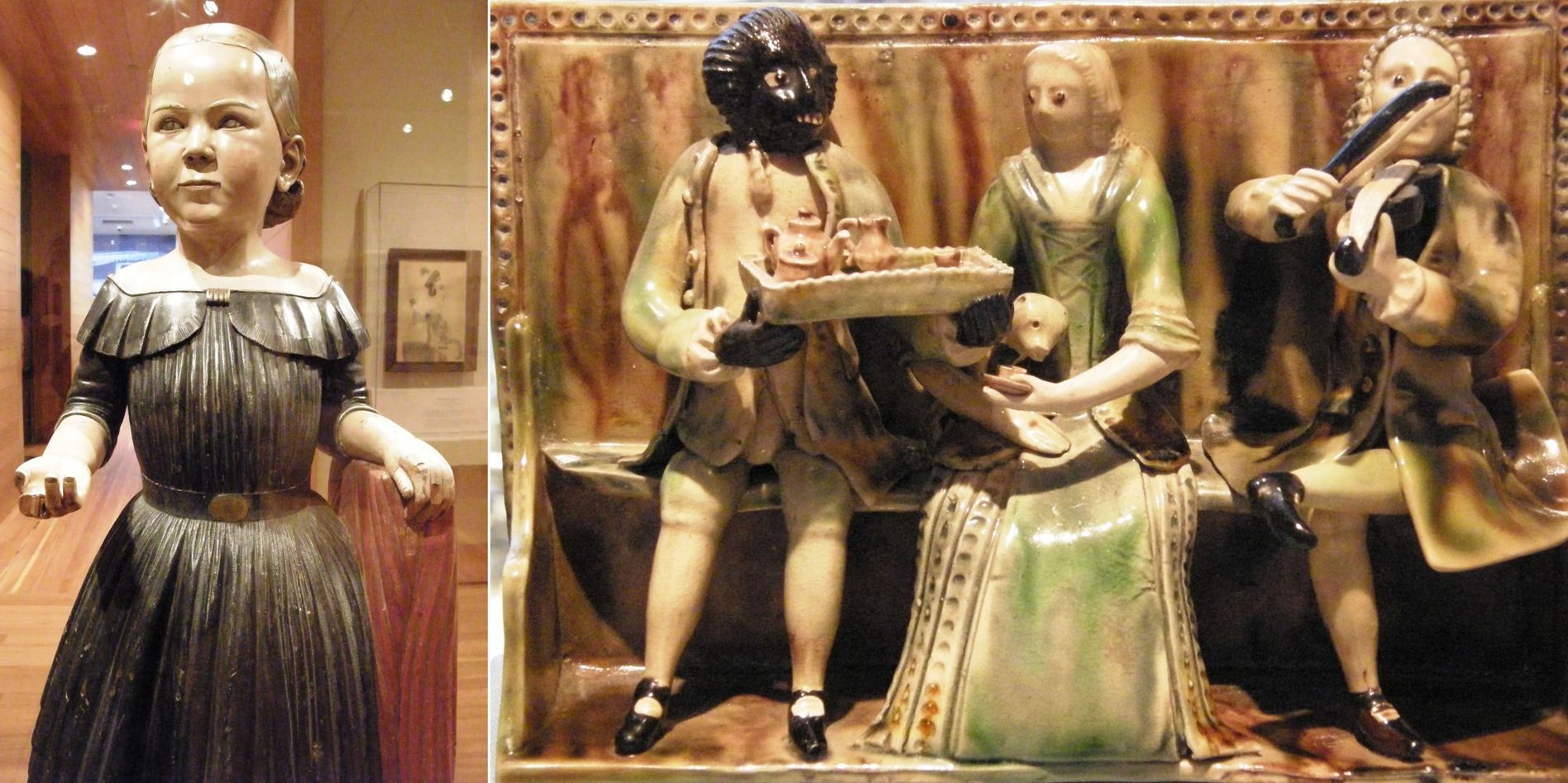
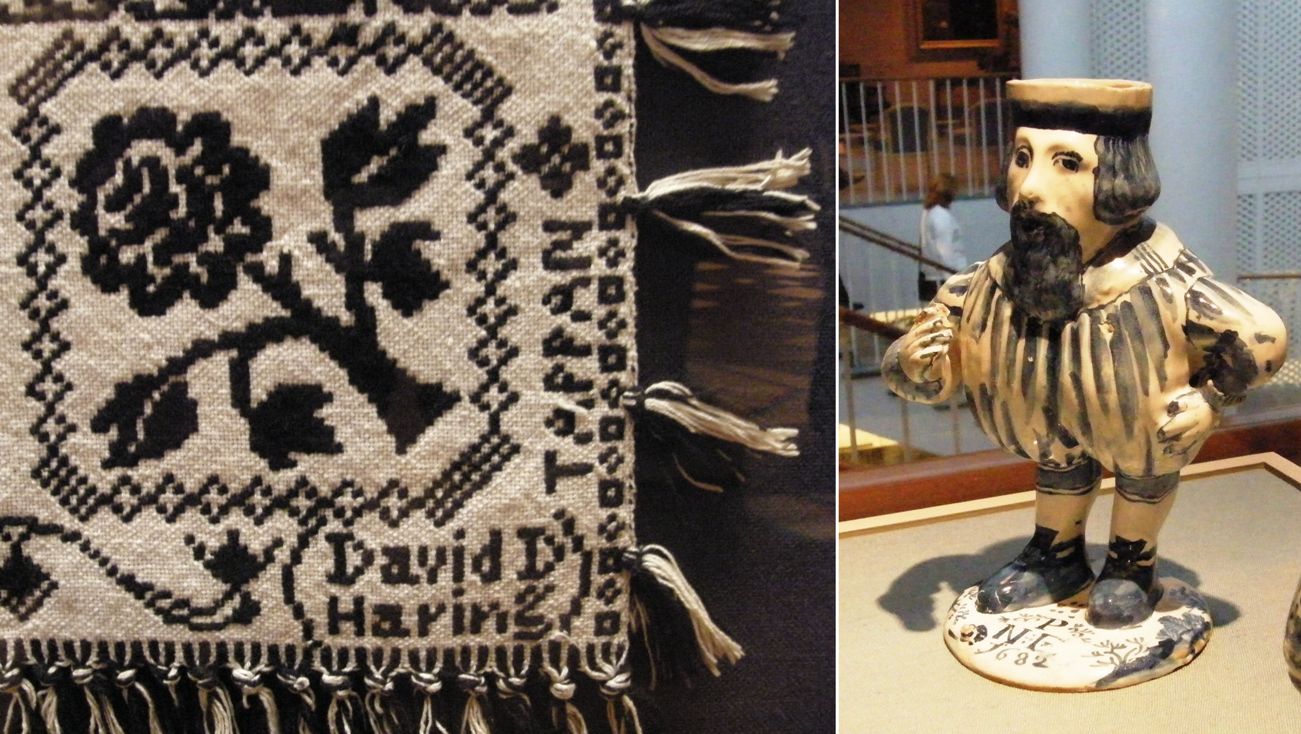
Here are a few pieces that were easier to photograph that caught my eye on my brief visit.

I particularly like things like the piece on the right that capture a slice of life.

On the left you can see the signature of coverlet maker David Haring on his double weave coverlet made with white cotton warp and weft and blue wool warp and weft. The figure on the right is called Mr Nobody and apparently is the fellow in the household who is blamed for all that goes amiss.

Part of the folk art collection had been originally used to decorate Bassett Hall, the twice yearly residence of the Rockefellers in Williamsburg. It was Abby Aldrich Rockefeller’s husband, John D Rockefeller Jr., who we have to thank for financing the return of Williamsburg to its eighteenth century aspect.

And now let’s wander back ON TOPIC…

I have a few more things to show about my visit with the Montagnard (Vietnamese hilltribe) backstrap weavers a few weeks ago which I wrote about here and here.

A local church has kindly allowed Betsy and the weavers to use their space for weaving get-togethers and demonstrations.

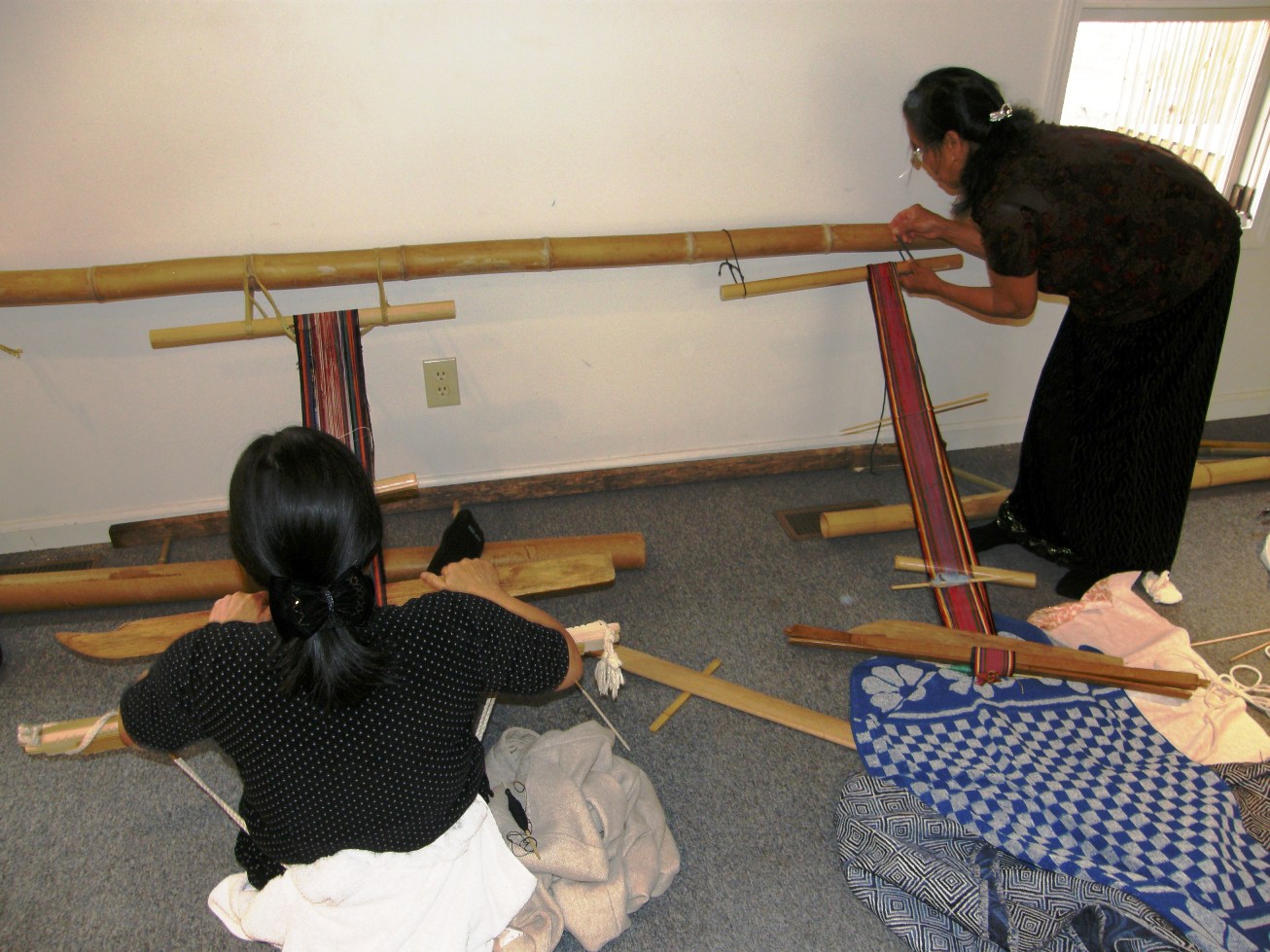
On a second visit there we were able to address the first challenge which was to find a place in the church where several weavers could tie up their backstrap looms at once as well as set up the foot braces against which they like to push to increase tension on the warp. The large piece of bamboo that you can see in the photo with some screws and rope did the trick. Khin joined us on this visit as translator and weaver. She said that she had not woven in at least twenty years and was a bit unsure about picking it up again.

Ju gave her a few pointers and she was on her way looking and feeling completely at home in the loom. Of course now she wants her own loom and is thinking big…she is already planning a skirt as her first project. My twining teacher, Ngach, arrived later and also gave Khin some tips.

A local nun, Sister Gretchen, dropped by and brought a collection of blankets that have been gifted to her by people in the Montagnard community over the last ten years. She is keen to have them identified by tribe and to have them out somewhere on display. There were some pieces there that were quite unlike anything I had seen made by Ju or Ngach. Nagch was very pleased and proud to identify one of her own blankets in the collection.

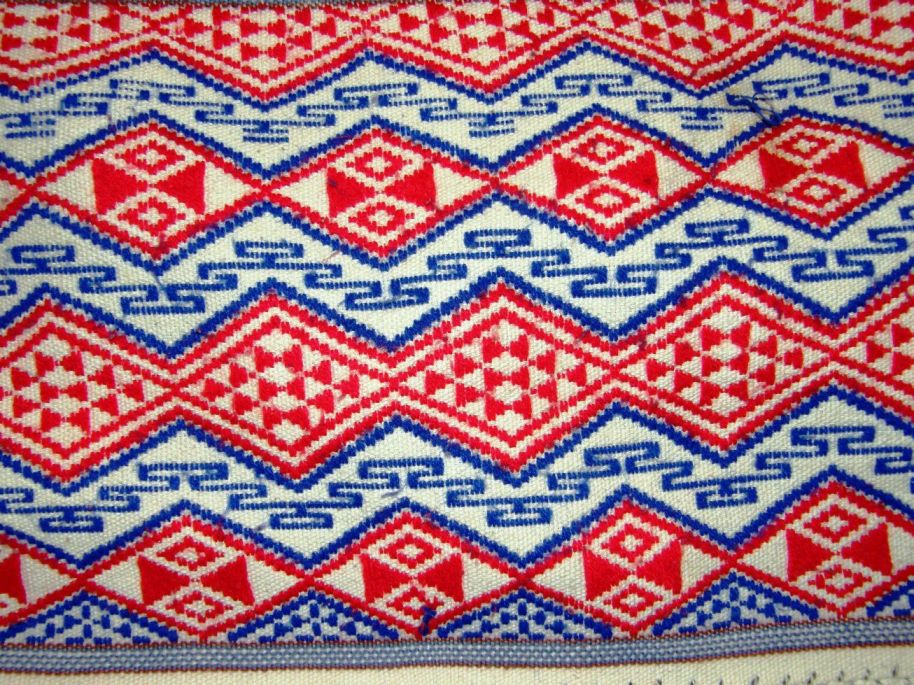
This heavy blanket caught my eye, not only for its lively red and blue pattern and the fact that it is white (you may have noticed that the Montagnard use a lot of black in their work), but for the band along its edge. This is not twining. It seems that the blanket was woven on a backstrap loom and then somehow the warps were used as weft to weave a warp faced band across the bottom of the piece. Three warps are used as a single weft. You can see that there is some puckering in the blanket where some adjustment in the number of warps used for at least some of the weft passes should have been made. I have been trying to imagine how this could have been set up.

I could see myself first weaving a narrow warp faced band passing my weft through a shed and extending it out and around a post some meters away so as to create a warp for the blanket. Once the band was finished I would then turn it around and somehow attach it to a loom bar and weave the blanket.

I guess I could figure out a way to do the blanket first and then the band but it seems that that would be much more awkward. One day I will meet the weaver and find out!

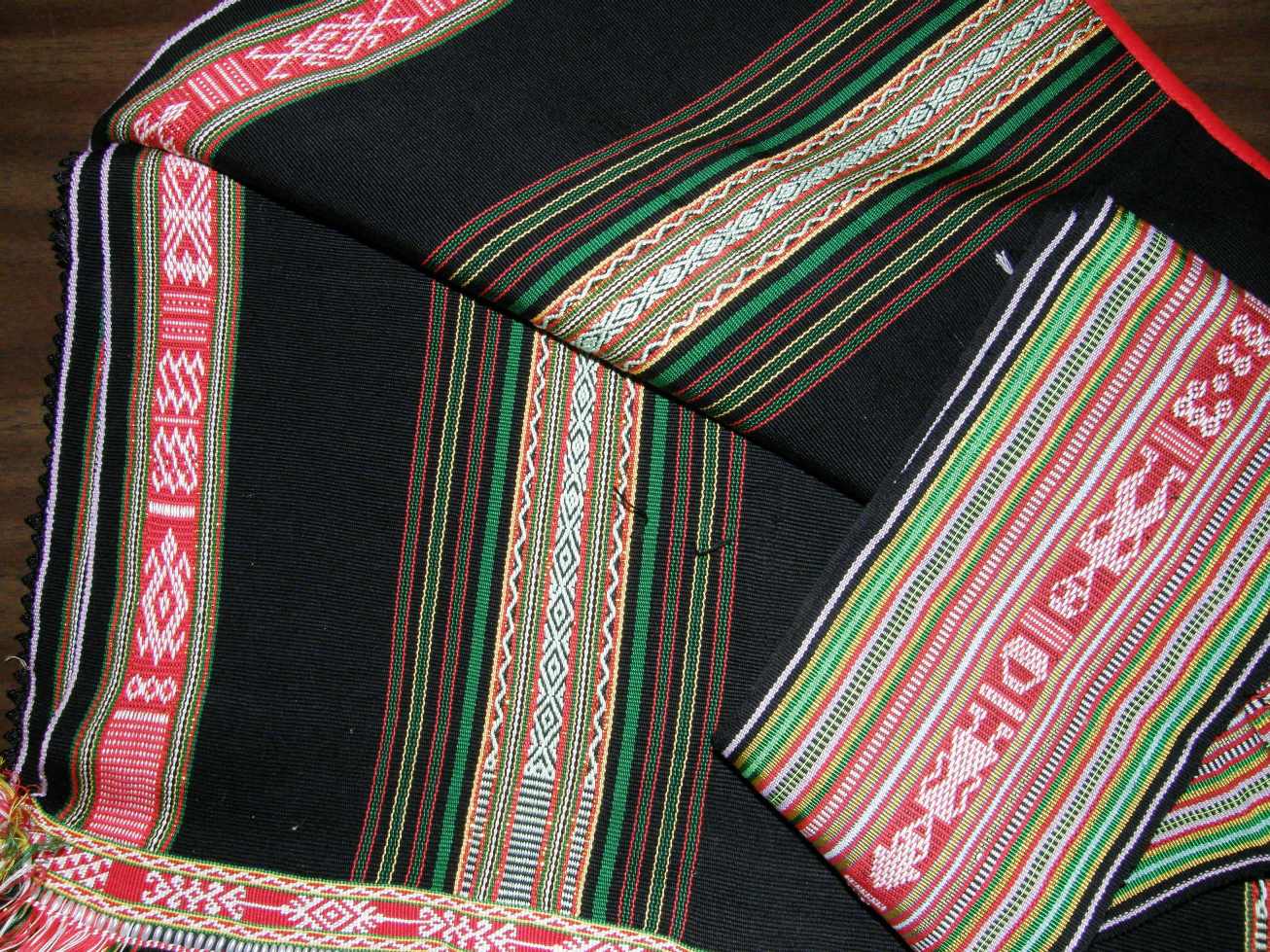
This piece was amazing! I liked it better from a distance as, on close inspection, I saw that the floats were very long on both faces and that it would only really work woven in very fine thread. All the weavers present had thoughts on the tribal and/or regional origin of this piece but nothing has been confirmed as yet.

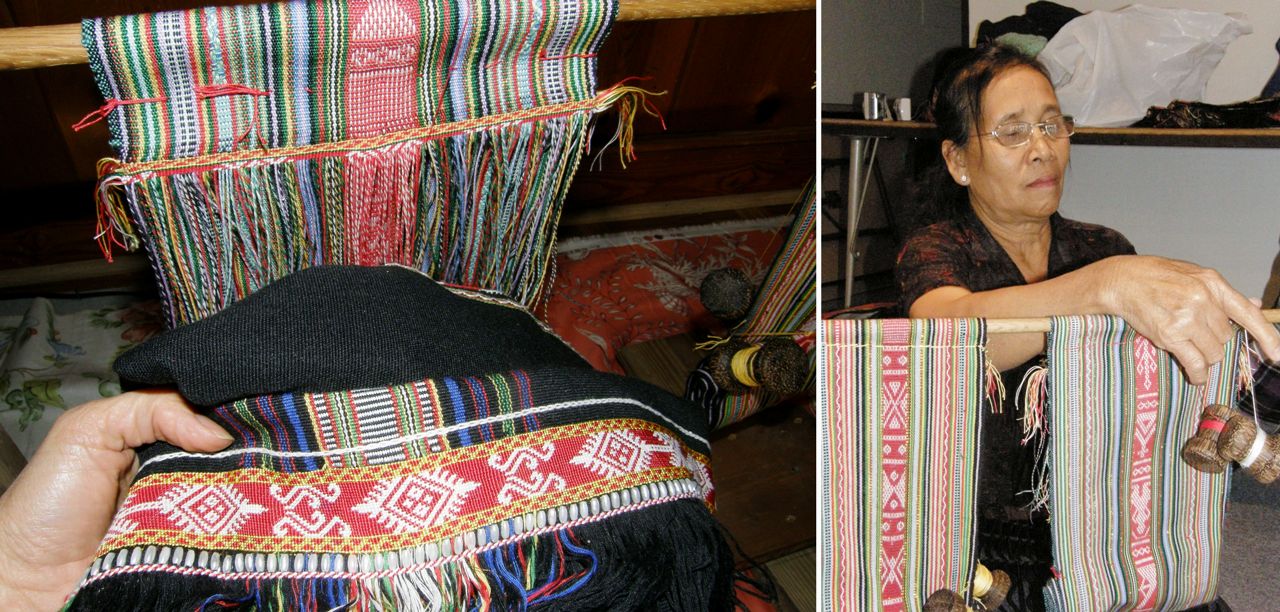
Ju brought along her twining frame and is twining designs on the edge of some bags she is making. On the left you can see the design that she is copying. She seems not to consider twining one of her strengths as she often sends her woven piece back to Vietnam with a traveler where her sister does the twining and then returns it.


The skirt made for Betsy and my scarf.

Pictured above is a skirt which had arrived back from Vietnam the previous day. Ju’s sister did the twining and bead work. This she gifted to Betsy along with a matching blouse. She gave me a beautiful narrow piece to use as a scarf and then had me cut up a similar long narrow piece into thirteen pieces so that she could sew them into glasses cases and pouches. She handed me the piece and a small pair of paper scissors and had me cut it up then and there! I can tell you that I was not really keen on the idea, especially not with a pair of paper scissors, but she trusted me to know the right lengths as I had shown her the small pouches that I had constructed at home.

Winter is a time for weaving for Ju as there is no work to be done in her very extensive vegetable garden. I wouldn’t be at all surprised if she has already finished all thirteen pouches.

################################################

My friend Lisa has started weaving again on her four-shaft floor loom. I thought she was making scarves and then she surprised me with pictures of this lovely fiber tool bag that she made…

She used the cross knit looping/Van Dyke stitch to edge the bag and embroidered a “running dog” design.

There is a video tutorial for the Van Dyke stitch as well as photos of how the Montagnard weavers use it as a joining stitch in this blog post.

She is still contemplating what kind of strap to put on it….perhaps a braid?

I love the colors and the contrasting edging and tassels.

EDIT: I have since heard from Lisa who says that this was never meant to be a tool bag. It turns out that her chosen yarn created the warp-from-hell and that she had had to abandon the original project but found she was able to salvage enough fabric to make something useful. Her less-than-perfect selvedges which resulted from her battle with the warp were nicely concealed within the Van Dyke stitch.

Claudia revived the backstrap project which she had warped up ages ago in a combination of variegated and solid colored yarn. She is using a scarf with cord now as her backstrap until she completes this, her very own woven one. I never think about using these variegated yarns and I should really try them out. I have a variegated roving that Lisa gave me ages ago that I need to spin and try out on my backstrap loom.

I am pretty much done with the cold weather now. It snowed last night and is blustery and windy today…nasty! I am ready to head back to the jungle and will leave tomorrow. It’s the usual story…standby flights which the airline tells me are fully booked. Fingers crossed that I don’t end up sleeping in Miami airport.

Happy Holidays to everyone!


Backstrap Weaving – Different “tribes”, different customs.

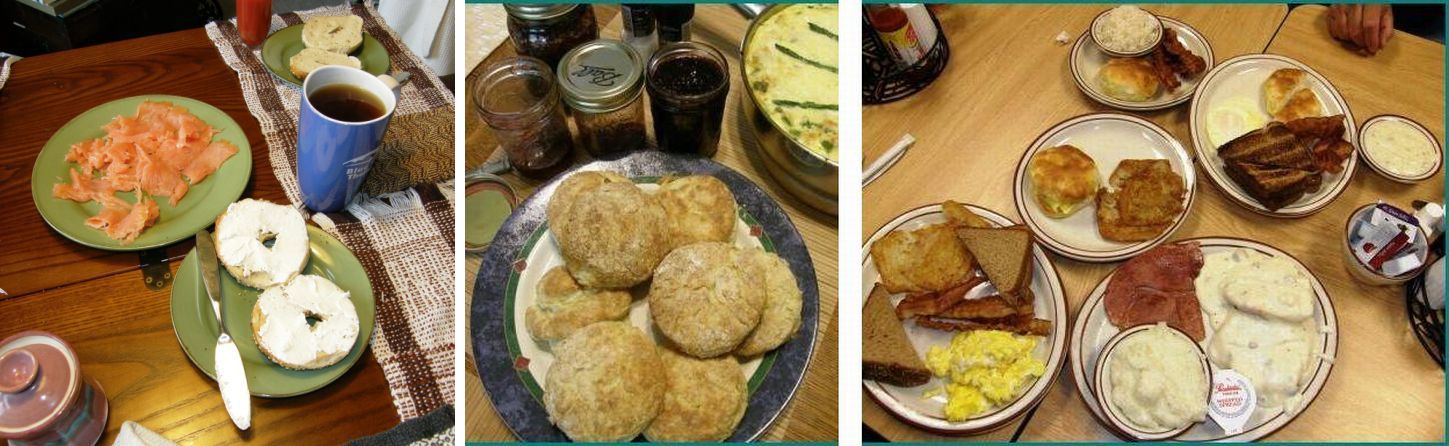
Different places, different customs…are you one for grits, biscuits and sweet tea or bagels, lox and giant mugs of coffee for breakfast? I love seeing all these different things when I am traveling. Different “tribes”, different places, different customs…

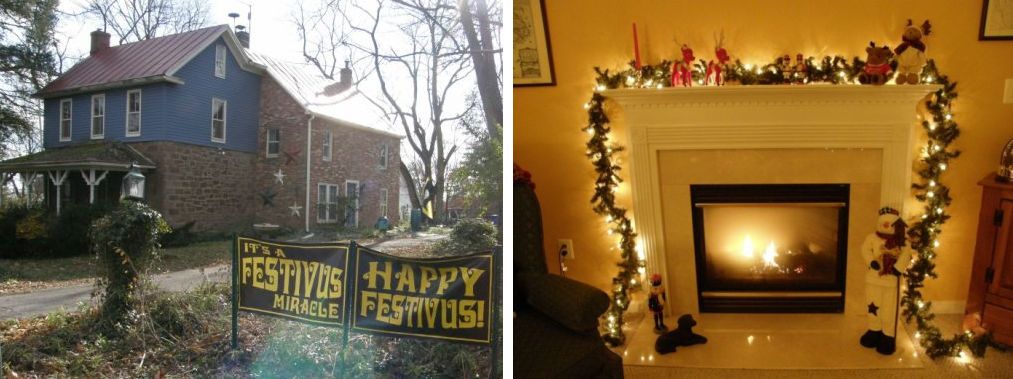
Christmas, Hanukkah or Festivus?

I had fun the weekend after Thanksgiving helping to decorate the tree in Claudia’s home and then we ran into this Festivus sign (for the Seinfeld fans out there) in Poolesville. Maybe the Festivus pole will make its appearance soon.

I am enjoying the cold weather here in the US getting wrapped up in scarves and gloves. It makes me nostalgic for my skiing days. I have been invited to spend a week in colonial Williamsburg with Claudia and friends and I hope it snows.

In the meantime, I have more to show and tell about the time I spent with the Montagnard weavers in North Carolina. They are all grouped under the general French title of “Montagnard” but Ngach, a Jarai women, tells me that the hill area of Vietnam is home to over sixty different tribes with their many similarities and differences in customs, textiles and weaving styles. I was able to meet people from the Jarai, Rhade , Bunong and Koho tribes during  my stay.

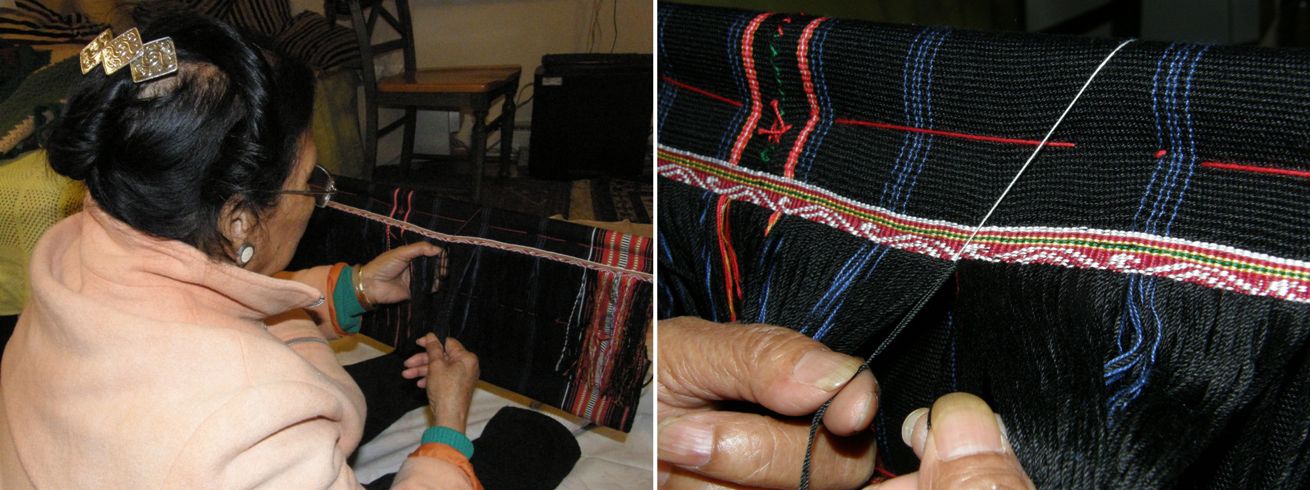
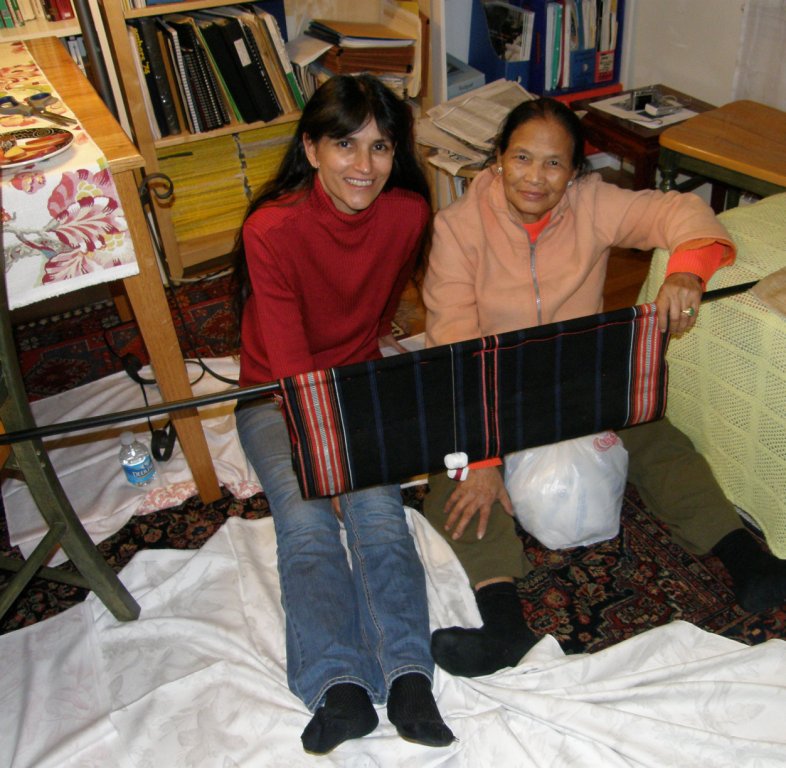
My twining classes were with Ngach from the Jarai tribe and Ju who is Rhade. I ended up spending more time with Ngach who seems to have had more experience with the kteh technique and whose eyesight is better able to deal with the fine threads that are used.

We twined this small border design on a child’s skirt as that is all that time would allow. Normally this would be followed by a large central design three to four times the width of this one and then finished with the same border. Ngach was a wonderful teacher, as I said last week, with a quick eye for catching my mistakes and a lot of attention to detail.

She would start a row and work it to the midway point and then let me take over and finish copying the design while she went back and started the next row. So, pretty much the entire left side of the work is Ngach’s and the right side is mine. You can certainly tell the difference between the two halves.

She asked me  a lot of questions about Bolivia and was pleased and surprised by the similarities in climate, vegetation and food between the hills of Vietnam and lowland Bolivia. I showed her pictures of llamas from the highlands, weavers and weavings of Peru and Bolivia and told her about the custom of chewing coca leaves. She would ask me again and again to repeat the words in English so that she could tell, I imagine, all the stories to her husband when she got home.

She then shared a story with me about how she had learned the kteh technique at the age of ten.

She was visiting her sister-in-law in her village who happened to be doing kteh that day and immediately fell in love with the designs and insisted on being allowed to sit and watch and try it. She stayed all morning instead of going home to prepare the rice for lunch as was her duty.

Eventually, angry messages and threats of slaps, in Ngach’s words, started arriving from her mother who had come home to find that lunch preparations were not underway. Both Ngach and her sister-in-law decided that it would be better for her stay on and pratice the kteh in the hope, I suspect, that her mother’s anger would pass. I don’t know what happened when she got home but Ngach soon became the one to whom other weavers would bring their finished loin cloths and other woven pieces so that she could make the intricate twined patterns. she would be paid with a leg or pork or sometimes cash.

She told me of one time that she stayed awake all night thinking about and planning her design and then got up in the morning to go straight to the store to buy her thread so she could get to work.

I think I really lucked out having Ngach as my teacher!
And she softened and finally agreed to sell me two of her lovely cement bobbins. She also has wooden ones from Vietnam but I have not seen her use those. The cement ones are a little heavier and feel really nice in the hands although they can be a bit rough on the thread.

And here is the design finished with only the border stripes to go…that’s the easy part.

Dear Ngach working at the kteh and then the two of us celebrating the end of the design.

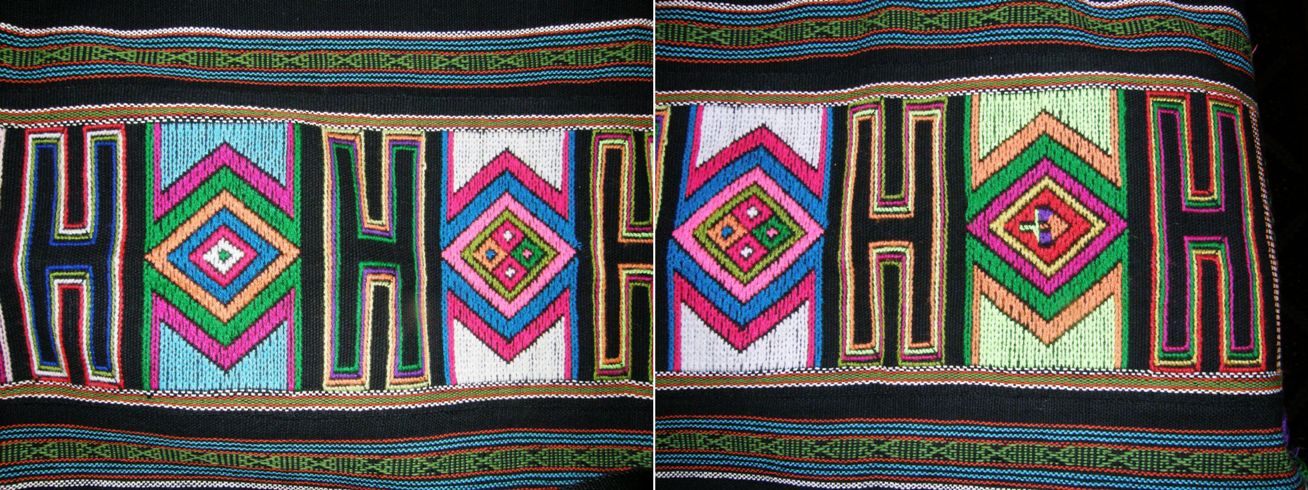
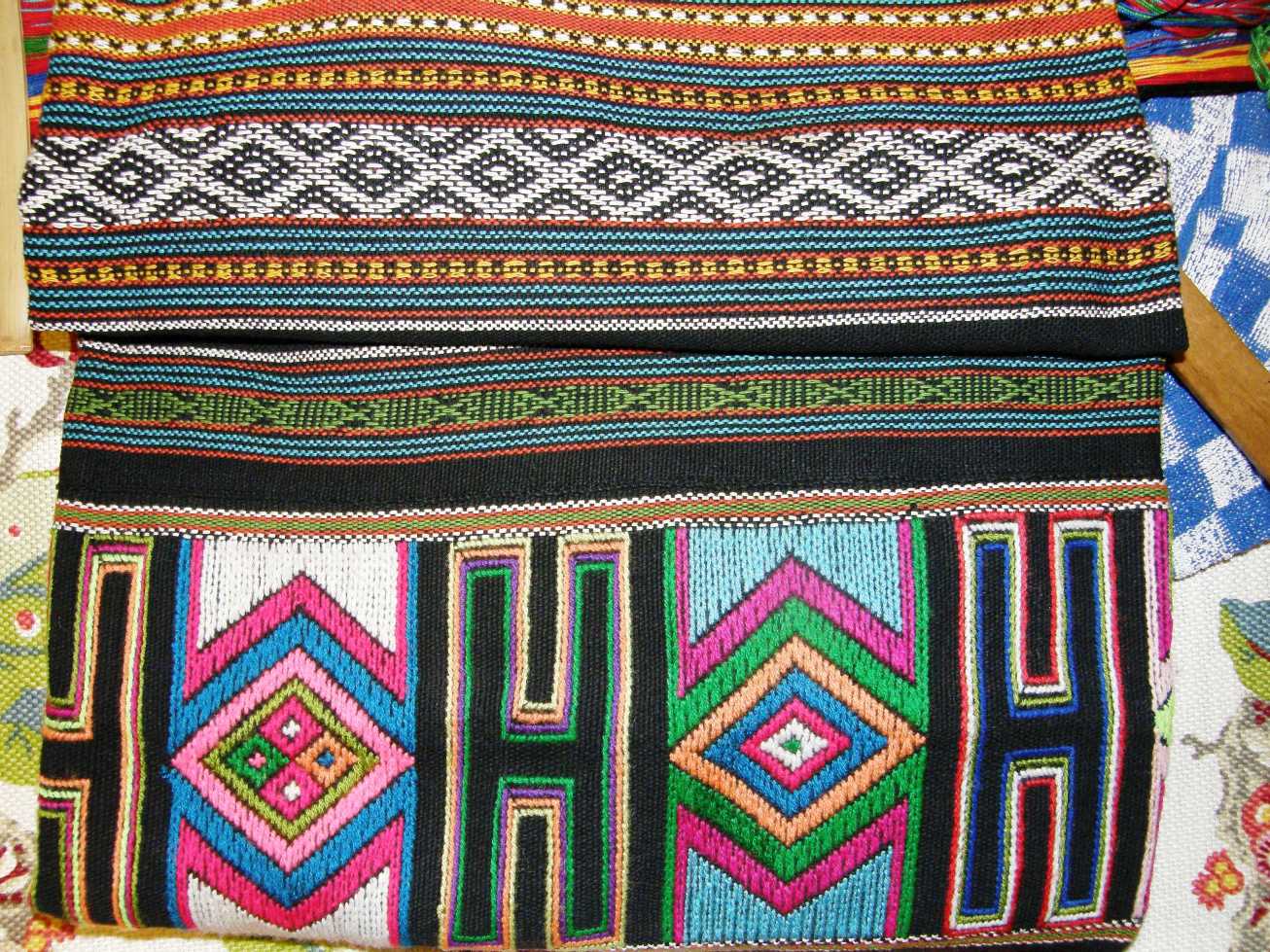
Betsy Renfrew, who is working with the Montagnard weavers and who  made all this possible for me, has several books on the textiles of the hill tribe weavers of Vietnam. I had just been admiring a particularly beautiful piece, which was labeled as Maa in one of the books and which unfortunately was not detailed enough to allow me to see the technique, when in came Rah and her daughter Sel who are of the Bunong tribe (Betsy has found many variations of the spelling of this name), armed with a  woven basket full of Bunong textiles. There was a piece with the very same technique that I had been squinting at in the book.

Above you can see the work on the central panel of Rah’s gorgeous skirt.

Rah understands English quite well but has difficulty expressing herself.

I don’t think she had any problem understanding my excitement over this piece and my desire to learn how to do the patterning technique.

However, her fourteen year old daughter Sel told me that, although her mom would love to teach me, unfortunately she had not  woven this particular piece nor had she ever learned this kind of patterning.

It had been sent over from Vietnam.  Sel was happy to show off the baby carrier that her mother had made for her – a piece for which she has an obvious strong attachment and affection. Her blouse was woven by her mom too.

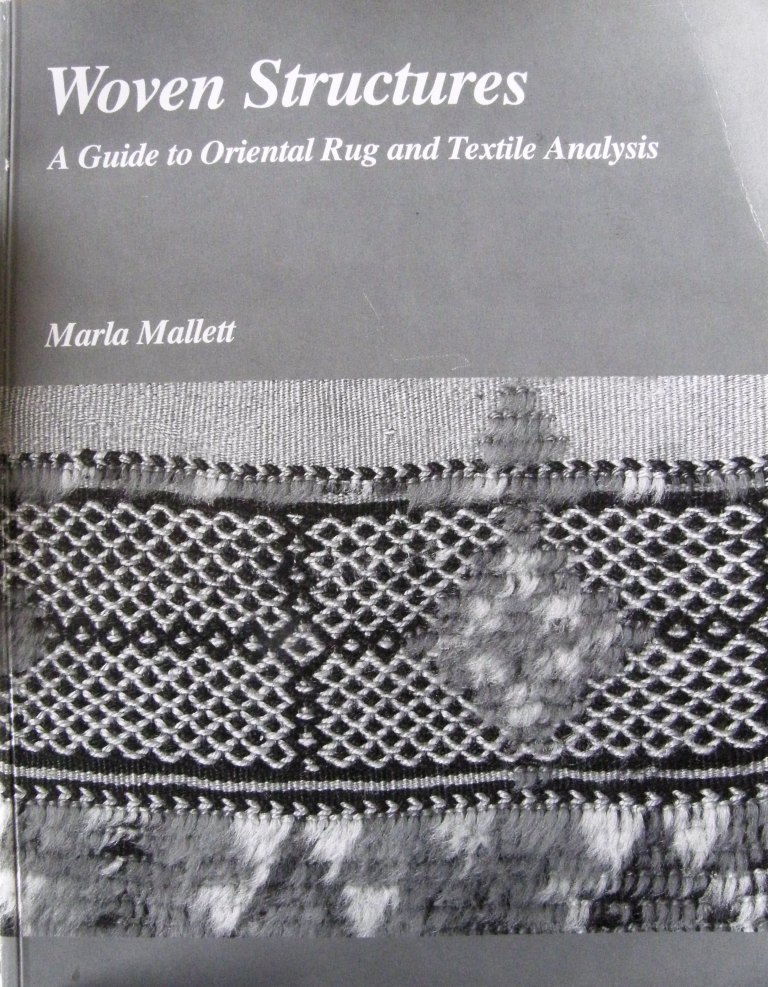
There are  examples of Bunong skirts on the Tribal Trappings website where the structure is described as “a soumak-like technique”.  As I am now the happy owner of Marla Mallett’s wonderful book on woven structures, I am hoping to perhaps be able to pin it down from her pictures and descriptions. It could be countered soumak but I need to look at this more closely. Any thoughts from my readers would be very much welcomed.

In many ways the patterns resemble those that are created using one of the warp wrapping techniques I learned in Guatemala. The main difference is that the Guatemalan style is worked in a shed on a warp faced ground weave and does not show on the back of the piece. The Bunong piece has a balanced ground weave.

Rah wearing her traditional Bunong skirt. Betsy tells me that Bunong textiles generally stand out from those of other tribes for the use of green in the designs.

Here is the beautiful “backpack” ‘basket in which some of the textiles had been brought to Betsy’s home…

Rah enjoyed watching videos that Betsy has made of Montagnard weaver Ju Nie at work at her loom. Sel said that Rah had had a loom at one stage here in North Carolina but also said that some of the loom parts had been confiscated by airline security when they had attempted to bring them over from Vietnam. We are hoping that she may feel inclined to take it up weaving again and that even Sel may decide that she would like to learn.

One more look at that gorgeous skirt piece, this time showing some of the other float patterns…

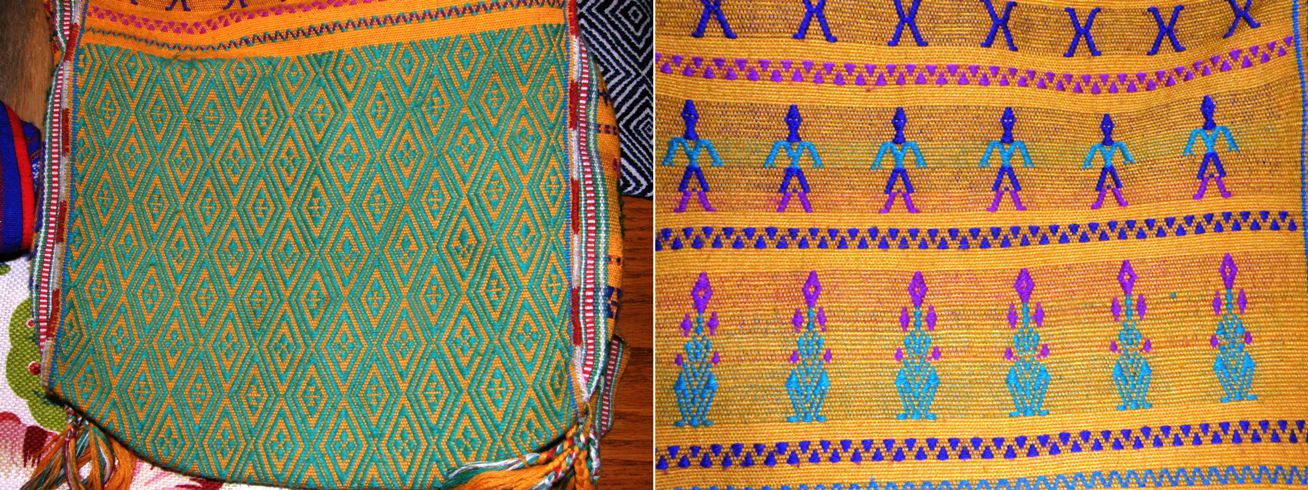
I loved this next piece too – a bag that Rah and Sel brought to show with all-over supplementary weft pattering on the body and supplementary weft patterned figures on the flap…

As I mentioned earlier, I was happy to be able to swap my Andean Pebble Weave book for the first edition of Marla Mallett’s book with someone who had recently purchased the second edition although I must say I am itching to find out what I am missing from the updated version!

I simply haven’t had time to take a close look at it but one thing I did notice is that the cross knit looping ”stitch” which is often used by the Montagnard weavers to join their blanket and skirt panels or edge bags is a well known stitch in the world of embroidery known as the “Van Dyke stitch”. After seeing Ju’s blanket panels so effectively joined with this stitch I used it myself to join two of my woven pieces to make a tool bag.

A closer view…

For those of you who would like to try this on your own work, I found a great video tutorial on Van Dyke stitch and I particularly like the way she starts the stitch which is not at all like the way I was taught by the weavers in Bolivia.

Marla Mallett shows an example of it on a south Persian bag. It’s amazing how these techniques show up across the globe.  The Bunong weavers use it too and Rah’s bags were edged with it.


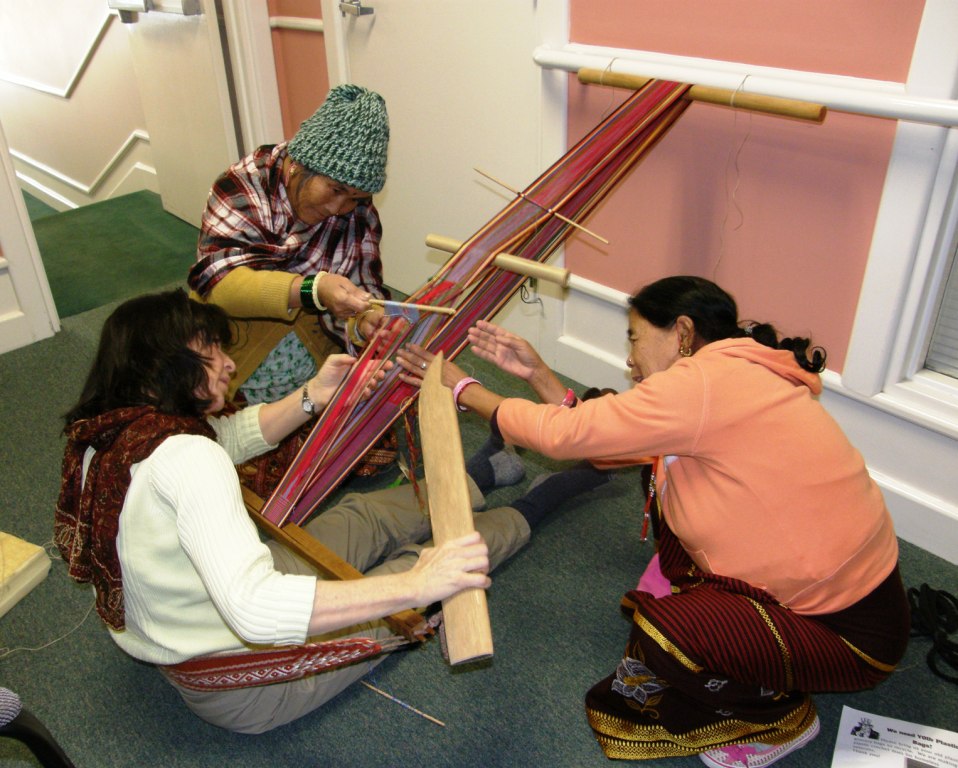
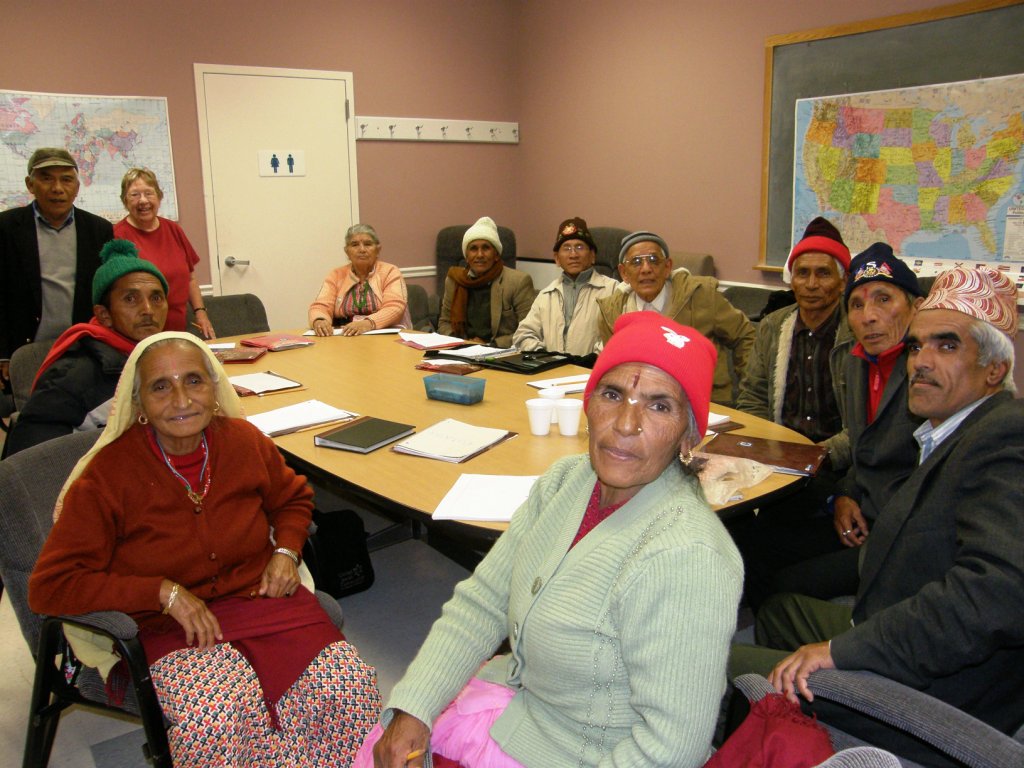
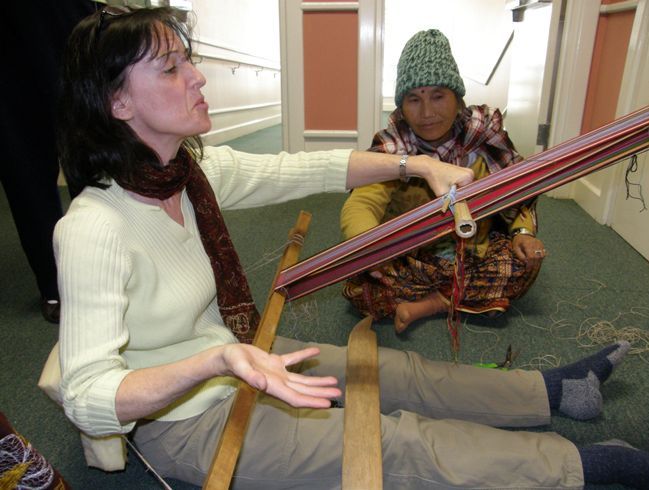
My visit with Betsy also included an afternoon at the Seniors Center where a group of Bhutanese ladies and gents, recently brought here from refugee camps in Nepal, have English classes with teacher Mary Ellen. Betsy had organized to give a weaving demonstration during their class and so we took along the loom on which Betsy has been learning from Ju and a narrow double weave piece still on the loom that I have been working on while on the road. Again, Betsy is hoping to find weavers in this group  who may like to take up weaving in their new home here in the US.

The demonstration certainly aroused a lot of interest and chatter with two ladies in particular very keen to help Betsy manage her loom. Betsy is learning to weave a narrow band on a very large loom which is not at all suited to this size of weaving. The loom, therefore, is very unwieldy. Ju weaves two bands at once side by side on these large looms to help overcome this problem.

One of Betsy’s helpers indicated with gestures that she weaves much wider pieces in Bhutan and showed the way she throws the shuttle across the warp. She patiently sat by while Betsy explained that she was just learning and still having problems opening the sheds until, finally, the urge to lend a hand became too great.

Above Ranmaya and Bhimaya Gurung are helping Betsy to open that nasty heddle shed.

Poshupati (I am guessing the spelling) came along to act as translator.

He told me that he used to be the director of an artisan training center in the refugee camp that taught weaving and leather work amongst other skills.

Once most of the class members had returned to continue their lesson of “family” vocabulary with Mary Ellen, we were left alone with Ranmaya and Bhimaya and our looms and got along just fine without our translator.

I was surprised to find that I could remember a few words of Nepali from my two trips there in the eighties like the words for “finished”, “thank you” and “sister” which seemed to be a word used for any female companion.

One of the big problems with Betsy’s loom was the fact that the heddle stick kept falling out. This was not due to poor heddle making but rather to the fact that the loom  bars are so wide that it is difficult to manipulate the sheds without tipping everything from side to side.

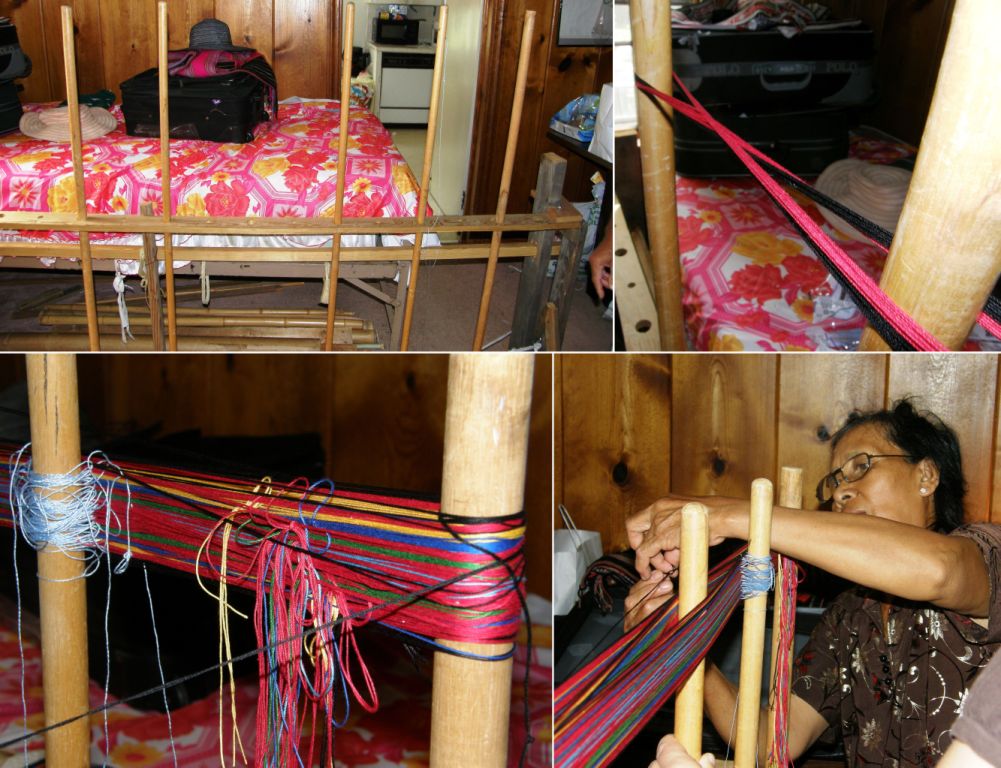
I told you all in a previous post about how Ju and Ngach set up their heddles during the warping process rather than later once the warp is on the loom. It is a tremendous time saver but I am far too fond of my string heddles with their extra hitch to adopt this method. I did, however, try it at home just to see if I understood how it is done.

Here is a short video clip that I made on my last visit with Ju in August in which you can see her winding the warp and making her heddles as she goes. The stick she is using ensures that the heddles are of equal lengths.

BACK IN MARYLAND…….

Claudia has been coming along well with her tubular woven bands to the point where she doesn’t need my help any more. I suspect she will have the directions memorized soon.

I made another trip to the Textile Museum so that I could revisit the Central Asian ikat exhibit with a guide and use the museum’s library. The tour was good, our guide enthusiastic, but I was disappointed not to find any information on what appeared to be warp twined bands on the edges of some of the garments. I seem to be twining mad at the moment.

In the library I got to see David Fraser’s work “A Guide to Weft Twining and Related Structures with Interacting Wefts” which, sadly, can’t be had for under $300 these days but, then again, there it was in the library for me to peruse for free. It was quite a coincidence to find a mail from a Weavolution member a couple of days after with a link to a site which gave a virtual version of the talk which David Fraser had given on the weft twining in what he calls plateau bags at the Textile Museum in August.

There is a great photo here on the same site which I really like of a woman twining a bag in much the same way as I have been doing at home with the piece simply held in her lap…no loom and no tools, except that she twines with the warps extending away from her.

Upstairs in the Education Room at the museum, the only place, the guide told me, where one can take photos, I was able to clear up my confusion about the different kinds of ikats.

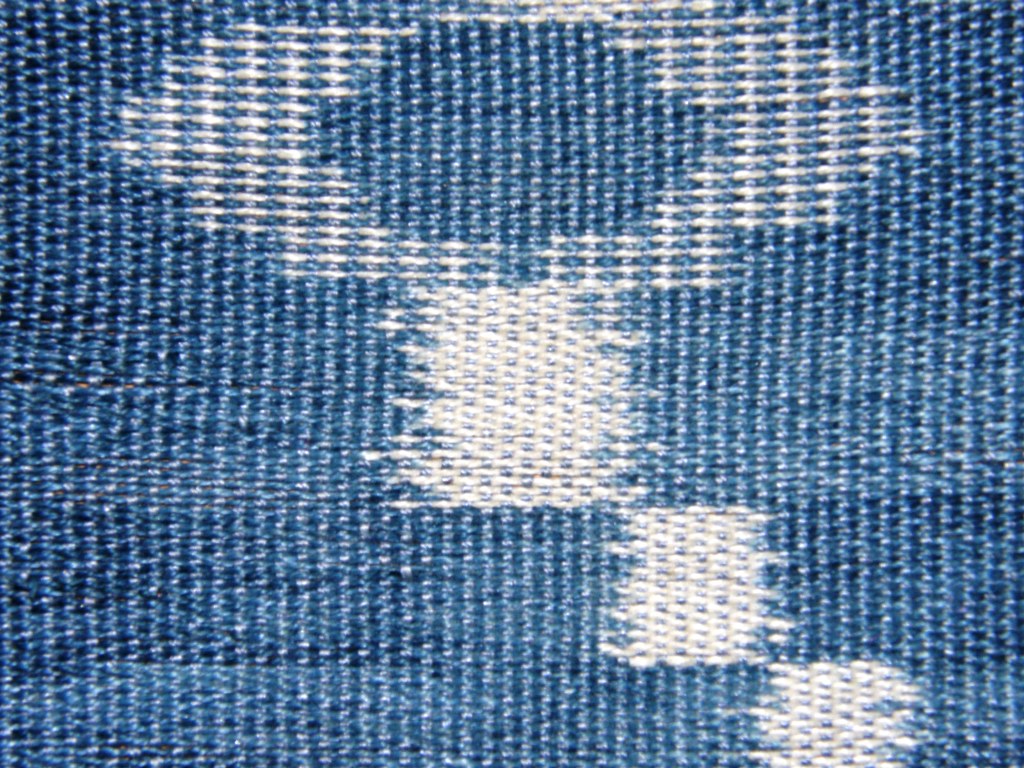
This is weft ikat where horizontal resist dyed yarns are predominant in the fabric.

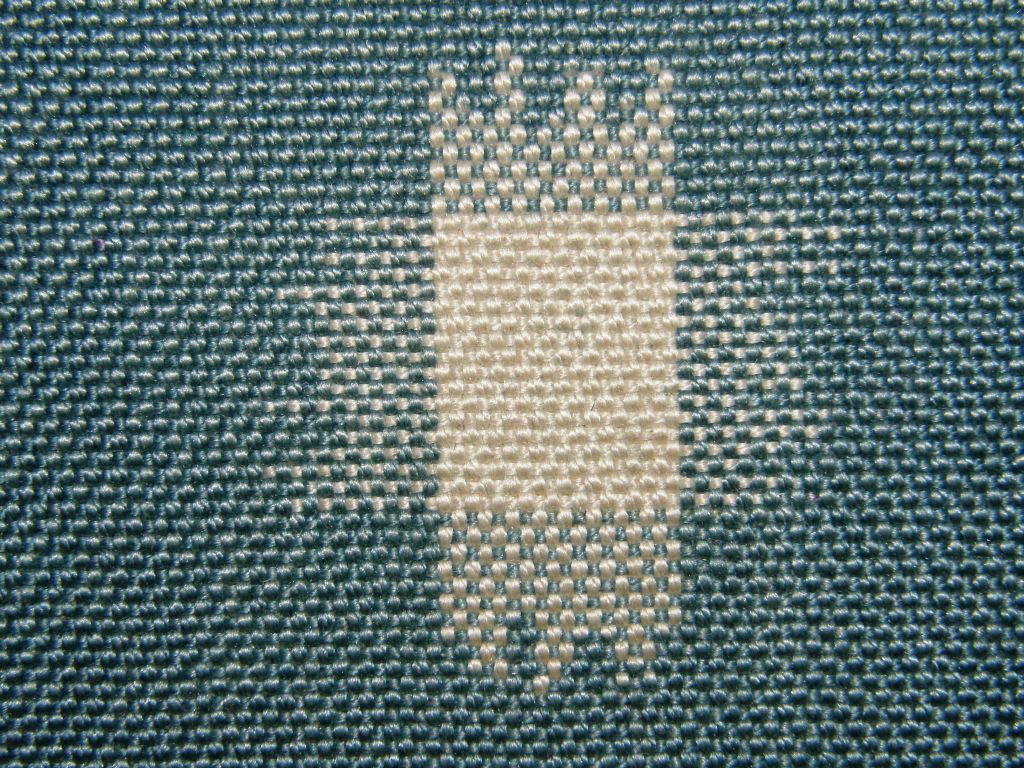
Both warp and weft yarns can be resist dyed separately and then used to create independent designs in a balanced weave fabric. This is called compound ikat.

In double ikat the weave structure is balanced and resist dyed warps and wefts meet to produce a single design.

I don’t think I had ever seen a piece of just weft ikat fabric until once again along came someone at Weavolution with a link to a gem of a video on traditional Laos weaver Bounxou Duoheuang and her inlay work. Wait until you see the piece of weft ikat that she prepares towards the end of the video.

I will finish off here by showing once again the wonders of the online Worldwide Weaving Guild which is, by the way, the way I first found out about Betsy’s work with the Montagnard weavers. This week I would like to show you what Tracy has been up on her backstrap loom in Qatar. Check this out!!

I was going to give you the whole story here but Tracy has covered it on her blog with lots of background and details so you can read about what it took to produce this gorgeous piece.

Above is a sneak peek at the work in progress but you really need to read the story of how this all came to be. Note the plastic tape that she uses for her heddles.

And here is the amazing backstrap that a friend gave her as she took her first steps in backstrap weaving. Does anyone have an idea about its possible place of origin?

Next there’s a balanced weave piece on the loom that I know is already off the loom and done.

I am saving a few more stories from the Montagnard weavers for next week’s writings from colonial Williamsburg. Let it snow, let it snow, let it snow!

I have a million thanks for Betsy Renfrew and Andrew Young who hosted me during my stay in North Carolina and made all these encounters with the Montagnard people possible.