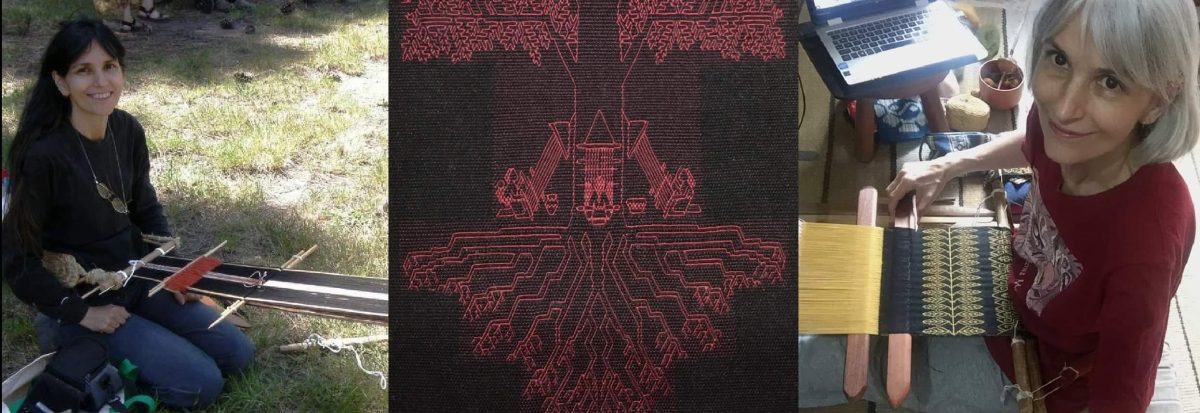
It’s been a while since I’ve had something wide (wide for me, anyway) on my backstrap loom. The last thing was the cotton rep-weave warp from which I made a backstrap/loom carry bag. This one was 15 1/2″ and had 800 ends.


As I said, these kinds of warps are wide for me but not necessarily for backstrap loom weavers in other parts of the world. The widest warp that I’ve seen over here was 39″. It was a light cotton ikat warp that was being woven by a weaver from northern Peru. She stood while weaving in order to manage the width. That makes my 15 1/2″ seem quite ridiculous. Backstrap loom weavers in parts of SE Asia routinely weave what look like even wider pieces while seated at their looms. Maybe when I am eventually living back in Australia, I’ll be able to explore that side of the world and maybe sit beside those weavers to see how they skillfully create their warps and manage those widths.

I like the fact that, as far as the loom is concerned, going wide simply means getting hold of some longer sticks. I have a piece of painted metal curtain rod that I’m using as the cloth beam of my latest project. A dowel rod acts as the warp beam. The weft thread can be wound around a suitably long stick if I don’t have a long enough shuttle.

My current project is 18 1/2”…a very humble width in comparison. However, to me it feels wonderfully wide and I love having my beams loaded up like this.
The other thing to which my “Wonderfully Wide” blog title refers is the fact that I feel that I have a wonderfully wide range of techniques and structures that I can draw on when it comes down to planning a new project. I wandered through several ideas when it came down to figuring out what I would do with the silk thread that I had been given by a couple of fiber friends in Australia.

I thought about doing rep with alternating thick and thin weft and some pick-up. That idea got discarded in favor of ikat…a variegated ikat pattern on a solid-color background. In the end I settled on using supplementary weft to play with positive and negative space.


The warp on which I’m currently working will hopefully be fabric for one face of a pillow/cushion cover. I am using the 10/2 variegated thread alongside doubled 20/2 to give me the width I need. Please bear in mind that I’m not saying that doubled 20/2 equals a single strand of 10/2. I’m just hoping that the two will play well enough together to give me the width that I need.
But first, as always, comes the sampling. The pattern will be foliage and hummingbirds. I wanted to weave the foliage using white supplementary weft (multiple strands of 30/2 silk) to fill the negative spaces. This means that the foliage pattern would be revealed in the underlying variegated ground cloth. Normally it’s the supplementary weft itself that forms the positive part of the pattern.


So, I wound a warp of what I figured would be a suitable width to give me the information I needed for the larger project. With this sample I would find out the number of ends I needed to create X inches of cloth, the number of strands of 30/2 silk that would give good coverage as supplementary weft, the best weight of silk to use as the main weft and the warp span of the longest practical weft float. I took some old foliage patterns that I had created for other projects and altered them to reduce the negative spaces to what I guessed wouldn’t create impractical lengths of floats….the kind that would sag or get hooked on things when the cloth was in use.
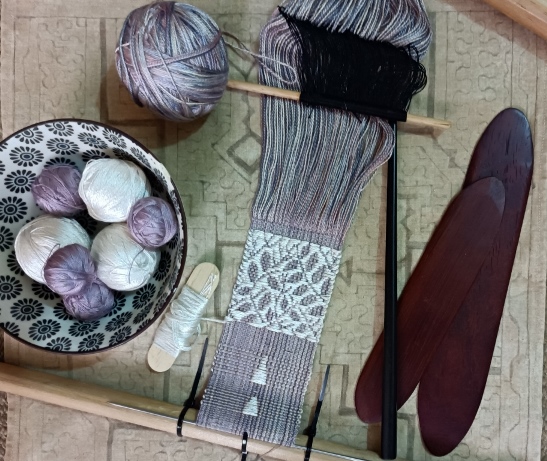
I was very happy with the result and made a note not to have the pattern on the real project extend all the way to the selvedges. The first couple of little triangles you see there are where I was testing the ideal number of strands of 30/2 silk to use for the supplementary weft. The 30/2 silk comes from my weaving friend Deanna. We made a swap….a very large cone of 10/2 cotton (which had also been a gift from my friend, Betty) for a cone of 30/2 silk.
Susan’s gift of 20/2 silk is being used as warp alongside the Will’s variegated 10/2s in the real project. Deanna’s 30/2 silk (which in a roundabout way also comes from Betty) is the supplementary weft. I am weaving the generosity of all these fiber friends into this piece!

The next task was to make 593 heddles.

I placed a couple of cardboard strips in the sheds to help me see if any sections of the warp are set more closely than others…as I’ve said here many times, there are varying degrees of “warp-facedness” which means that some warp threads might be positioned closer together than others. When weaving with supplementary weft I need to weave a little narrower than is my natural tendency so that I make sure that the patterning weft is not exposed at all when it travels between the layers of warp. That can be a bit tricky….fighting against muscle memory.

This is the point where I will start weaving the pattern. And here I’ve stopped for the time being while I figure out my design. My sample was on 142 ends. I need to extend it to 1186 ends! I plan to have a strip of pattern the same length as my sample, once again using the supplementary weft to fill the negative space. Then I plan to weave scattered frolicking hummingbirds in white supplementary weft, this time using the variegated thread as the negative space surrounding the figures. I’ll finish by repeating the first strip of pattern. Well, that’s the plan anyway.

This is what I mean by “wonderfully wide”. Choices, choices, choices. I have another idea, which I won’t go into yet, for including some very quiet pattern in the white sections of warp. I thought of it about two minutes ago! There’s something about writing this blog that helps with the creative process, it seems. The idea is a little mad so I might wait and see how that goes before I reveal it….or not! The madness might be just temporary, lol.
So, thank you so much all my extremely generous fiber friends for these lovely gifts of thread. Here I am weaving in a color palette that is not a common one for me. It does remind me a little, though, of the piece I wove when weaving friend Marilyn let me pick colors from her stash of 10/2 cotton.

Maybe this sunrise I had witnessed with Gwen while in Florida was on my mind at the time……

I’ve spent several evenings now just working on the pattern. Let’s see how much progress I’ve made when next we meet…..