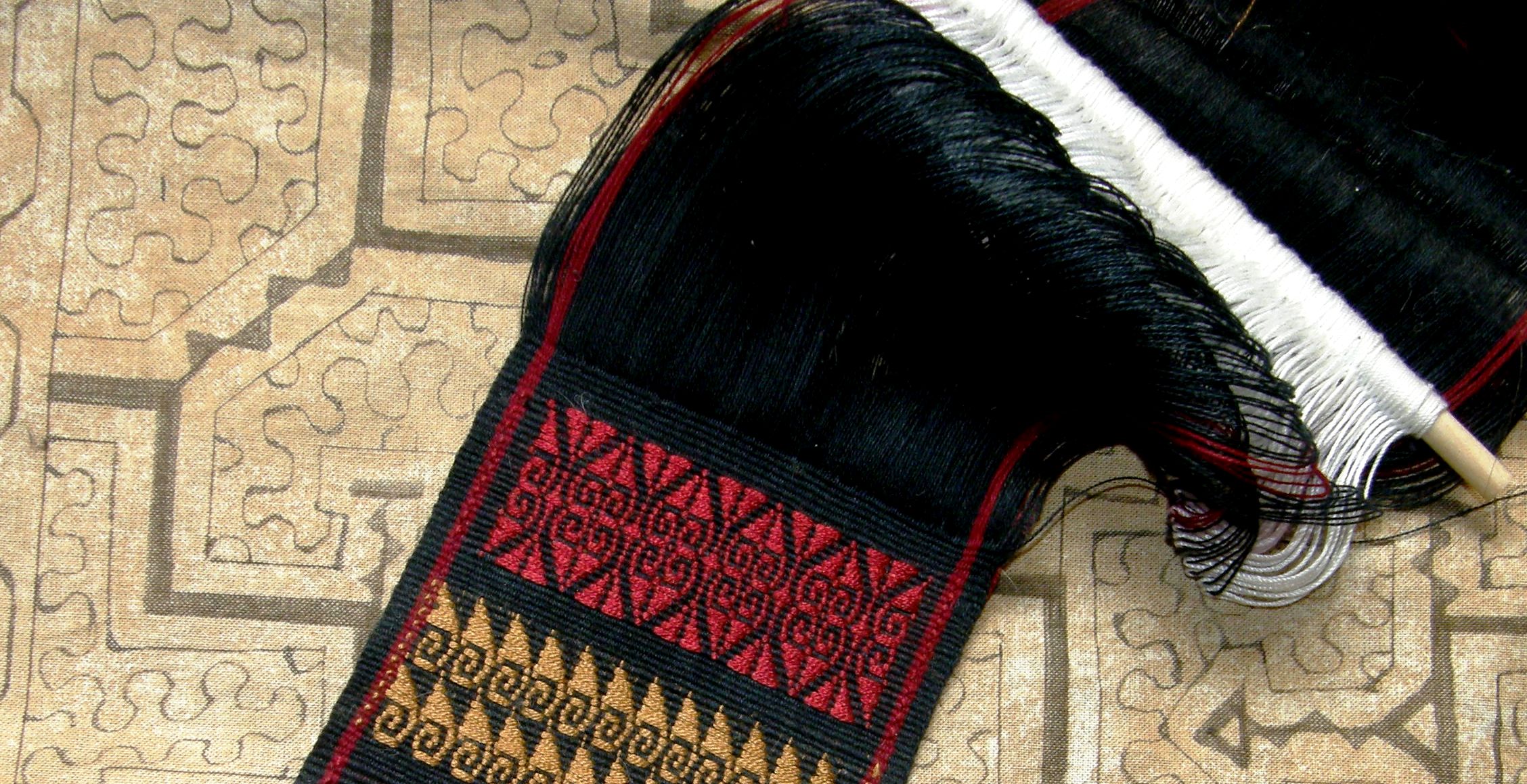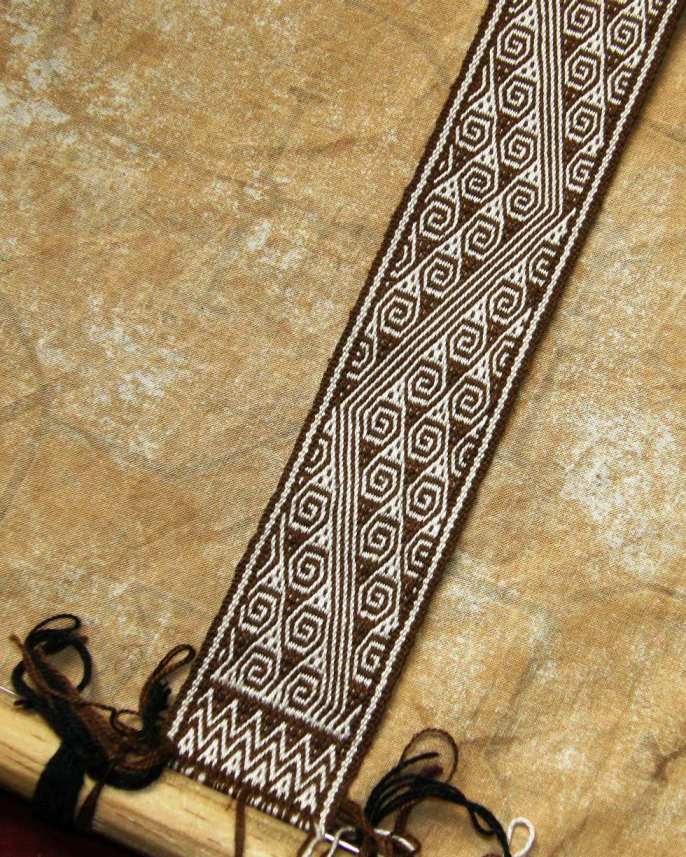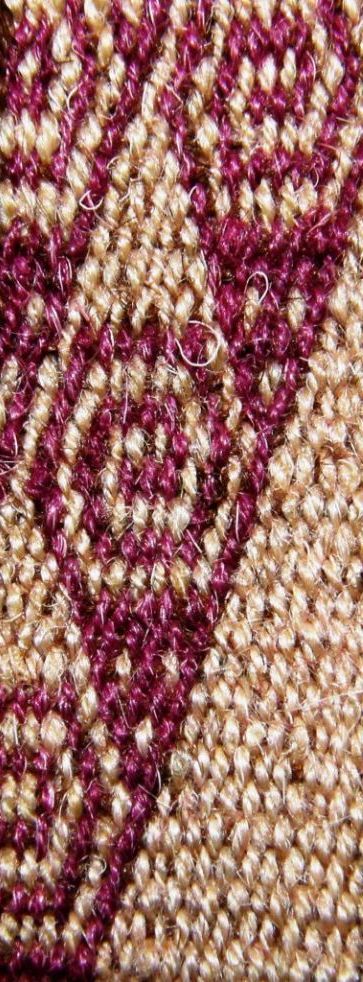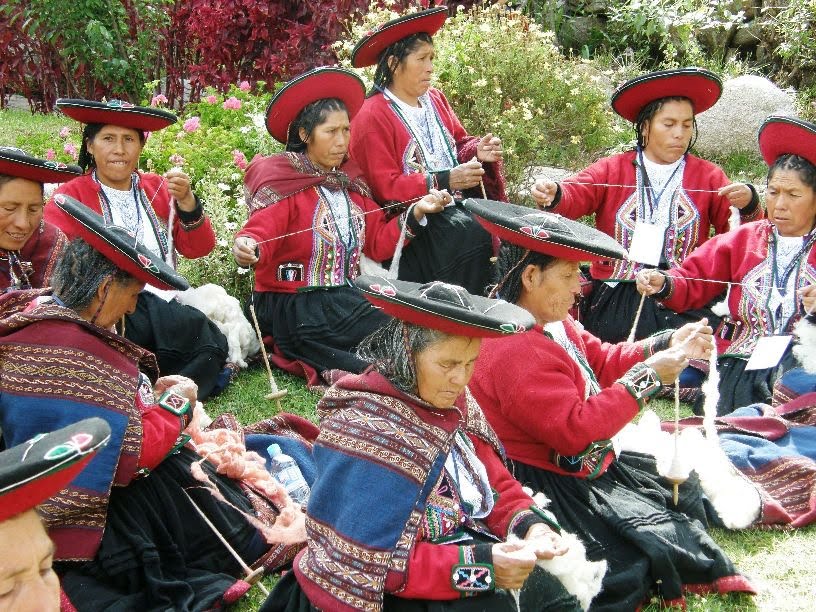
Backstrap Weaving – A Few Unconventional Moves

A Few Unconventional Moves…..If I am to talk about some unconventional things that I did at my backstrap loom this week, I think that I would have to first define what is meant by “conventional” in the world of backstrap weaving….an impossible task!

What is normal, or traditional, or conventional in one backstrap weaving community may not be so on the other side of the world or even within the same region or country.

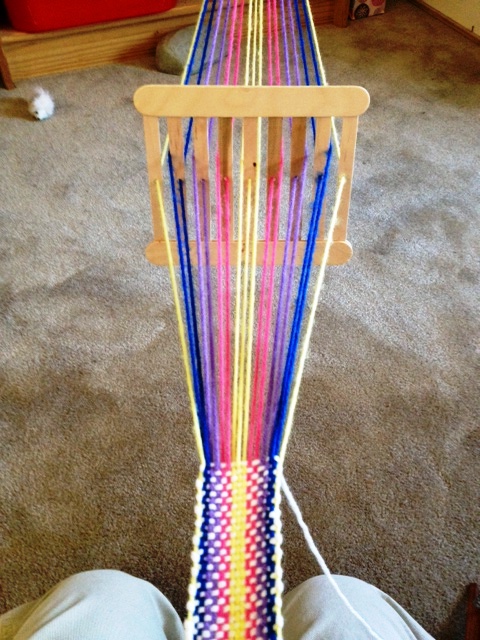
ju-warpingAdding string heddles as one winds the warp, as Montagnard weaver Ju Nie does, would certainly be  looked upon with wonder as something strange and unusual by backstrap weavers here in Bolivia.

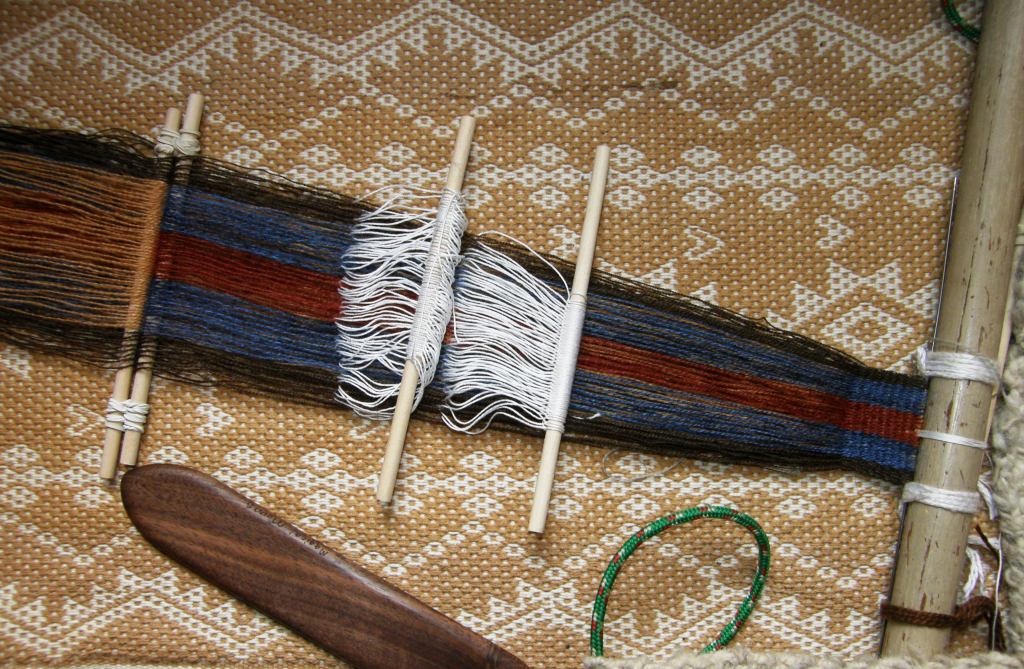
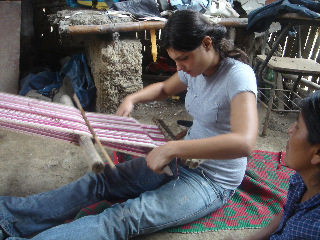
This one of Miguel Andrango's looms pictured here with his granddaughter. You can see the two shed rods above the heddle sticks. The space for the extra shed rod is programmed into the warp by using an extra stake during the warping process.

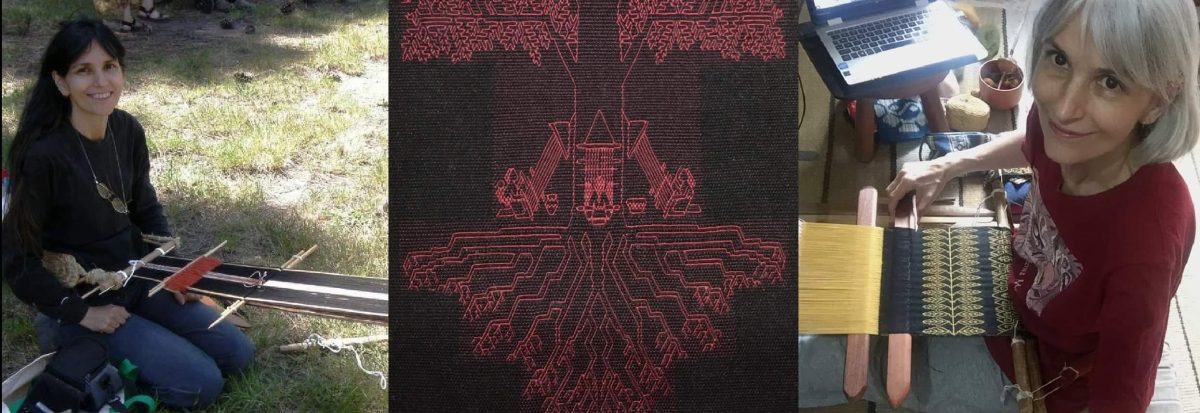
The way that many backstrap weavers in Ecuador spread the threads in the shed rod shed over two shed rods is something that I have not seen outside of Ecuador. This makes opening the shed rod shed, with its heavy load of wool warps, easier. You can see the two shed rods in Miguel Andrango’s warp above. Unconventional, you might say, but to weavers like Miguel Andrango, this is perfectly normal. And Mr Andrango is up for a bit “unconventionality” in his weaving  too by using motifs that are not traditional in Otavalan weaving.

montagnard_weavers-jpeg-scaled-1000The use of a tiny sweet wooden temple on even the narrowest of warps by the Montagnard backstrap weavers is something else that would seem less than normal to many backstrap weavers on this side of the world.

I have yet to see a circular warp being used by backstrap weavers in Bolivia but it is commonplace in Ecuador as is the use of a foot brace.

Burmese weaver Dar Ku weaves her patterns with supplementary weft while facing the wrong side of the cloth. She kept smiling and telling me how easy it is. I wonder what the Guatemalan weavers with whom I have worked, who also work with supplementary wefts, would think of that!
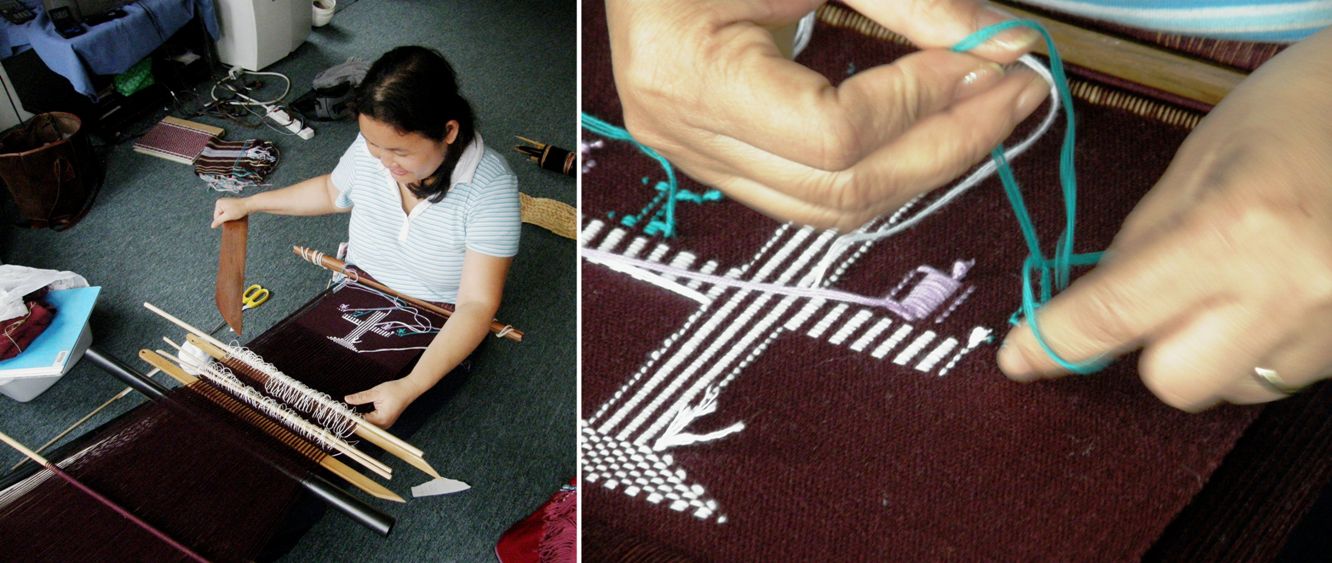
Dar Ku at work??????????????????????In Ecuador I never saw women weaving wide heavy wool pieces on backstrap looms. This was a task for men. The work is considered too heavy for women, I was told.

In Peru, men do weave at backstrap looms and there are communities where most of the backstrap weaving is in their hands. However, this is the exception rather than the rule.

I wonder what the male Ecuadorian weavers would think coming to Peru and seeing the wide and heavy warps being managed by the female weavers.

I wonder what the belt weavers in Salasaca, who use an enormous meat cleaver type of wooden implement to beat weft into place on their narrow belts with a couple of quick, heavy and powerful slams, would think seeing the way a Bolivian weaver pushes weft firmly into place bit by bit across the wdith of the warp with the tip of a llama bone tool.

3868486832_48e6a1c778All the implements were strange and unusual in my hands the first time. I can’t tell you how many times I forgot to let go of the weft before slamming that meat cleaver tool down….ouch. The llama bone was a bit more subtle but I still ended up with blisters from tightly clenching it and pushing that weft into place with all my strength. My weaving teachers considered tightness of weave to be a very important feature of well made cloth and I was determined to achieve their approval.

On the other hand, it was interesting to watch the gentle tappy-tapping of the beater in Dar Ku’s hands in contrast to the yell of “wham-wham” as Ju Nie showed us how firmly weft should be beaten! Clearly there is no general rule about how firm warp-faced cloth woven on a backstrap loom should feel.

I would love to see my teacher Maxima’s reaction to the set-up and way that weavers in coastal Ecuador add bands to the edges of their fabrics with their wooden rigid heddle that slides from side to sde along the floor to change sheds.
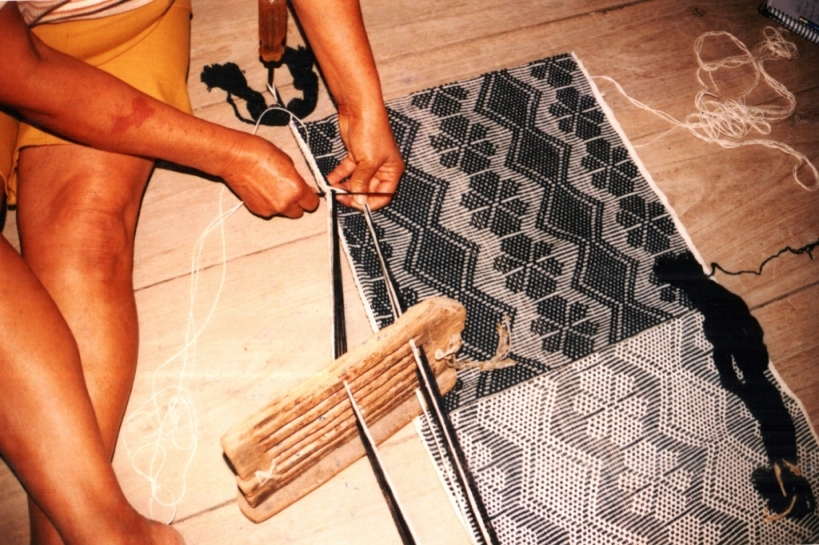
rh edgingSo…conventional? What is conventional in the world of backstrap weaving?

As for my aforementioned “unconventional” moves…let’s just say that I did some things that I haven’t seen backstrap weavers do. Of course, the day will probably come when I see this done somewhere. I have, after all, just scratched the surface of the backstrap weaving world here in Latin America and have had but the slightest glimpse into Montagnard, Burmese and Bhutanese weaving.

I have been finishing off the little supplementary-weft sampler that I have been working on these last couple of weeks. I wanted to get a piece off the loom and make it into a bag to take along on my next trip. I had experimented with positive and negative space. However, there was still a fair amount of warp left and the Guatemalan cotton is precious to me as I am not sure when or if I will be able to get more. I really didn’t want to waste any of it.

So here is what I did…I wove a dowel into the warp so that I could cut off my little bag piece and continue weaving the left over warp.

weaving a dowel into the warpI will probably fold that little flap of cloth over the dowel and tack it down and then lash the dowel to a bigger one. I think that should be sturdy enough to allow me to keep weaving. I have to admit that this wasn’t my idea. There was a discussion in one of the online groups where a floor loom weaver wanted to cut off her first towel on a long warp and then continue weaving. Someone said “weave in a dowel”. I am not sure if what I did is in fact what she meant when she said that but it was enough to have me wanting to try to “weave in a dowel”. I think it will work!
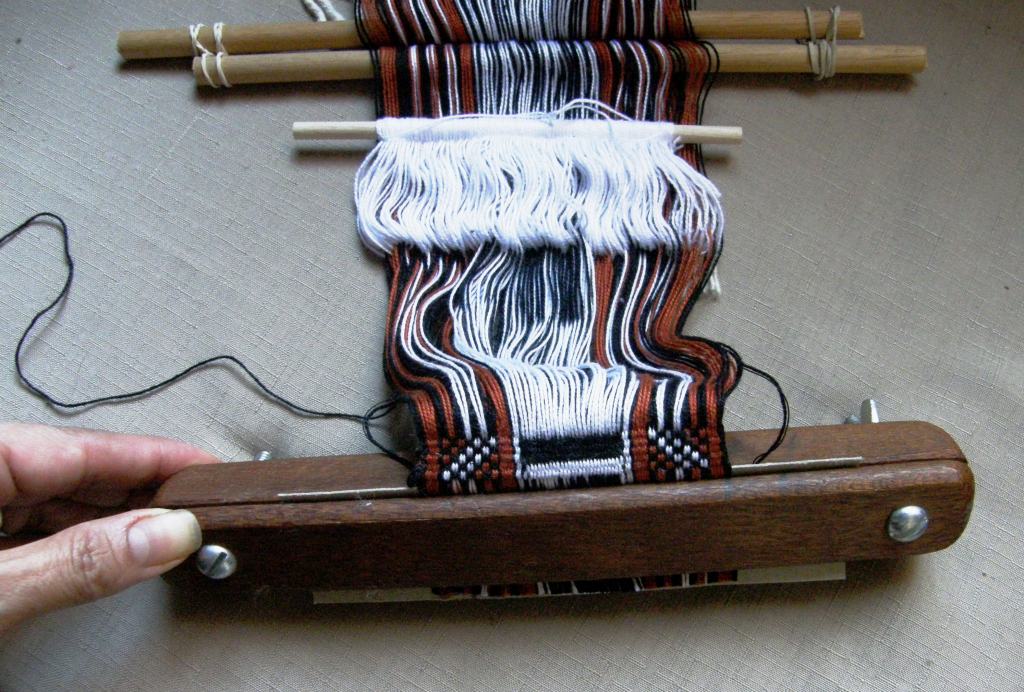
clamp toolI still have this Bedouin patterned embedded double weave piece that I cut and then clamped so that I could continue working on it. It is still there….I feel that that the woven-in dowel is a more secure system. We will see. Now I can compare!

Bedouin design amulet bagHere is the wee pouch that I made with the first part of that warp.

So, the piece of supplementary-weft patterned fabric was cut off the loom. Now to see how best to fold it.

back and front of supp weft pouchThere are the back and front views.  I decided to leave the flap on the front unpatterned as I wanted to edge the whole thing with a tubular band and I thought that things might look a bit too busy with pattern on the flap as well.

design on inside flap backstrap woven pouchHowever, I thought that it would be cute to have a design on the inside when the flap is open.

And that is another place where I got kind of unconventional.

The design on the inside of the flap had to be on the “wrong” face of the fabric to be in the right position once everything was folded. So, I turned the warp over and wove on the other side leaving the heddles on the back side of the fabric.

I wove the flower head pattern that I had been creating in the negative space at the beginning of the piece. I think it gives a nice touch to this little pouch…a nice little surprise when you open it up.

weaving on the back side of the cloth backstrap weavingFolding and then sewing done…it was time to start embellishing.

fron tof pouch with tubular bandThis is all I have done so far… a ñawi awapa tubular band around the outside. The eyes of the tubular band are red on the back side which matches the predominantly red patterning on that side. I will decide what to do with the tassels at the bottom and whether I should add some kind of finish to the bottom edge. Then there is a strap to be made and a button to be found for the front for some sort of closure.

pouch front and back backstrap weavingSo, after that experience with flipping the warp upside down and weaving on the other side so easily, I have a clear idea about what to do with the rest of the warp. I am excited to get started on that. I would like to continue with the supplementary-weft patterning but use both sides of the cloth, flipping back and forth, so that the finished piece has completely different patterns on both faces…or perhaps the same motifs but in completely different color schemes. It would need to become a finished product that would  allow both faces to be visible. This, of course, will be the sampler for a “real” project later.

In between sewing and embellishing, I got something else started on a loom. I am preparing some warps so I can weave at the Spin-In Day at the Mannings in June. Are you coming? I will be weaving away with my warp tied up to a tree. Come and say hello!

two heddle intermesh bhutan designHere is one of the warps I have prepared so far. This one is two-heddle intermesh which will have a large Bhutanese labyrinth design taken from David Barker’s first book (see the RESOURCES page for information on this free download).

pebble weave bandsAnd if you are tired of seeing red and black today, here is a bit of relief.

I have been recycling some of the many sample warps that I use which end up being a chaotic mix of odds and ends of sample motifs.

I unwove some of them and have several more to go. I am  re-weaving them using the same Andean pebble weave motifs along the length of each.

I can also finish this week’s post with some nice pieces in other color combinations too that were sent to me from online friends.

larisa pebble (2)

???????????????????????????????Larisa patterned her piece that is destined to become her backstrap with pebble weave patterns from my first book.

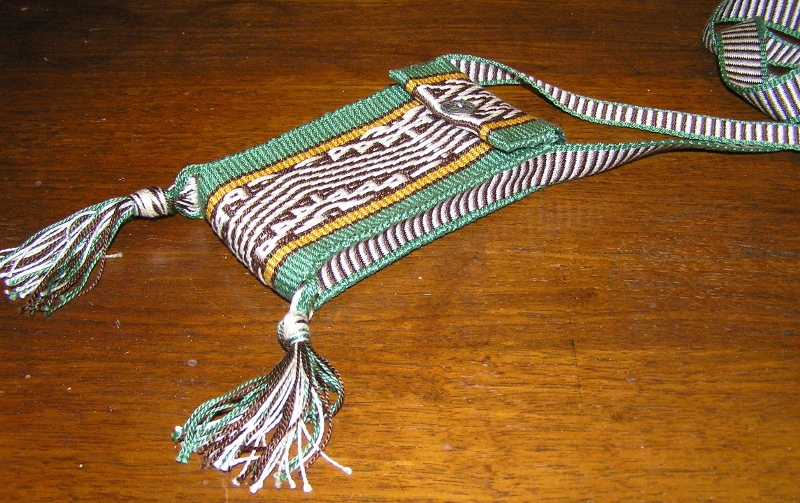
Gmpicket also sent me a picture of a great pouch that she made  using a design influenced by a belt of the Tarahumara people of Mexico that she saw on my blog. I have two Tarahumara patterns charted in my second book but this is not one of them. I love that brown, yellow and green combination.

So, I will be on the road again as from Wednesday next week. .hoping for nice weather and lots of people to chat to about backstrap weaving. If you have backstrap weavings to show me, please bring them along! I probably won’t blog next Thursday but will as soon as I can. I hope to meet lots of online friends at ANWG too and reunite with backstrap weaving friends in Humboldt County California. And then there’s a New Mexico adventure in mind… See you soon!

Backstrap Weaving – Hooked!

I was on the lookout for a simple pattern to continue my sampler of supplementary-weft patterns and the positive/negative space studies that I have been writing about these past two weeks.

After weaving some patterns based on Bolivian hatbands where the weft is used to fill the space surrounding the motif rather than the motif itself, as seen below, I wanted to weave a motif where the same shape appeared as both motif and background

supplementary weft in negative space

hook motif of peru and boliviaSeveral of the classic warp-float designs found in the Peruvian and Bolivian highlands have this very characteristic. In the hook motif pictured at left, it makes no sense to talk about “motif” and “background” as the same hook shape flips and turns and dances along the band changing from red to white and back again. Is it a  series of white hooks on a red background or vice versa or none of the aforementioned?

This was the kind of thing that I wanted to weave with supplementary wefts. So, I set about trying to adapt it to the structure with which I have been working.

As it turns out, it wasn’t that straightforward.

So, I spent a lot of time with paper and pencil and eraser (I still like the old fashioned way). The only way I could get the shapes to interlink well was to make several changes to the basic shape and, even then, the black version of the hook is not exactly the same as the gold one. The gold has an extra warp or two in a couple of places. There was a fair bit of weaving and unweaving involved too. But that’s what “sampling” is all about, right? I had to remind myself about that as I was starting to regret having set myself this challenge as I seemed to be spending more time planning out the design than actually sitting at my loom.

supplementary weft study with hook motifsSo, there it is. Two sets of gold hooks surround and expose black hooks in the ground weave. I am pretty happy with the way it turned out and hope to play a lot more with this hooky shape.

red hooks relected anf flipped in supplementary weft Where to go from there and how to best use all the work I put into figuring out those hooks? Chris Buckley writes about pattern building in traditional textiles in his article on warp-ikat weaving of SE Asia:

A further important feature of ikat, and indeed of most traditional textiles, is that weavers tend to use a narrow repertoire of simple shapes such as dashes, hooks and curls, in a ‘building block’ fashion to create their designs. This approach makes understanding and copying complex designs manageable for the weaver, and aids their transmission from generation to generation. Recognition of this repertoire of basic shapes (which I call primitives) is also of considerable help to the researcher with analyzing and comparing motifs between traditions,…..

So, I took one of my many discarded charts of the hook motif and used it as a “building block” for a new design, joining hooks together, reflecting them and flipping them upside down in the same way that many Andean weavers do with their warp-float motifs. The result is the band of red pattern above the gold in which there are four red hooks with just the hint of a black hook outline around them.

What had brought me, yet again, to Chris Buckley’s interesting article was a romp across the internet in search of hook patterns when my initial attempts at charting something suitable for supplementary-weft patterning were not working out. It is so interesting to see how the hooks show up in all sorts of woven structures and cultures. Of course, certain structures only allow a fairly limited repertoire of shapes to be produced and so, regardless of the culture, it is inevitable that a hook motif will appear if those particular structures are in use. Techniques like ikat,  on the other hand, can be used to produce a limitless variety of shapes and patterns.

hook-motifs-in-southeast-asian-textilesThese pictures by Chris Buckley show hook motifs in various SE Asian warp-ikat textiles.

I have woven the hook motifs used in yurt bands of Central Asia…

??????????????????????I wove the  pieces above and below using the same single-faced warp float structure as the yurt bands. You can see how the basic hook motif can be placed in different ways to create patterns and how dark and light hooks interlink so beautifully…

central asian yurtI have also woven patterns in pebble weave that are loosely based on Central Asian hook motifs…

central-asia-all-stitched-wih-borderas well as in supplementary-weft, double weave and supplementary-warp structures…

central asian motifs in various techniquesI enjoy the challenge of adapting a motif woven in one structure to others.

Chris Buckley writes that Indonesian ikat weavers sometimes copy designs, for example, from imported luxury textiles, particularly those from India…

When copying a design from a foreign source, weavers are likely to re-interpret the copied motif in terms of their own vocabulary of basic shapes rather than produce an exact copy. This is analogous to linguistic borrowing, where the pronunciation of a borrowed word may change from one language to another according to the repertoire of sounds available.

My own particular “weaving vocabulary” comprises the various structures that I am able to produce rather than a group of shapes. I have not dedicated myself completely to a study of the patterns of any one weaving region and so have not developed a vocabulary that is limited to certain shapes.

I love it when I see the Bolivian highland design that I call “rolling river” woven by indigenous weavers in both complementary-warp-float and double weave structures. Perhaps a weaver saw and admired this pattern when she traveled to another region and returned home to interpret it in her own weaving vocabulary which, in this case, happened to be a completely different structure. I can only speculate.

I taught Juan to do pebble weave when I was studying in Salasaca, Ecuador. No one in the area was using this structure. It was part of the deal…I teach pebble weave and they teach me to weave their supplementary-warp patterned traditional belts. Eighteen months later when I returned, Juan showed me his finished pebble weave band. Until then, he had not known how to weave at all. His final motif is a rooster which he took from one of the traditional supplementary-warp belts of Salasaca and interpreted in the only weaving “language” he knew…pebble weave. I thought that was brilliant!

juan pebble weave bandBack to the hooks…I like to think of the following  motifs, that I copied from a belt of the Tarahumara people of Mexico, as a “swirling” hooks…

Tarahumara patternI had not become completely familiar with that swirly hook and made it a part of my vocabulary, as skilled Tarahumara weavers surely would have, before attempting this piece and, as a result, it was very tricky to weave! Just as I got a grip on the swirls going in one direction, they changed to the other direction. It was much easier to weave it using another structure in my weaving vocabulary…double weave…in which it is generally much easier to “read” the cloth. However, I don’t think the pattern is as pretty in double weave….maybe slightly more so in my handspun llama fiber on the right (spearmint leaf and cochineal dye).

5892932496_f074da5701_m

handspun llama cochineal dyed

And so I go playing with structures and shapes. Even as I sit and look at the last red supplementary-weft hook pattern that I wove on my most recent sampler, I see the motif on the very right hand edge and think…hmmm….wouldn’t that look good on a narrow double-weave band?

By the way, many of the patterns I have shown in this post are charted in my second book.

Pebble_Leaves_on_a_Band_medium2Here’s one final bit of lovely hookiness before I go. Julia has been using the tutorials in my second book on creating and charting one’s own or adapted patterns in pebble weave.

Here is one of her bands in which she has adapted a tablet weaving pattern to pebble weave and…yes…there are hooks!

Backstrap Weaving – The Positive and the Negative

I have been working a lot with wool this week as I sew pieces of woven wool bands from Cochabamba into little pouches and dress them up with all kinds of pretty finishing techniques. Some of the finishing stitches are easy but they require precision and doing this work increases my admiration for those who do fine embroidery work. I am using wool for my stitching thread.

Working with wool is wonderful but, above all, working with wool is forgiving! This is one of this fiber’s big positive features for me. It fluffs out happily and fills in tricky spaces. Never mind if you didn’t insert the needle the exact same distance from the edge of the woven piece every single time…wool will forgive this…it has a certain rustic look that forgives even if it doesn’t always hide the imperfections. I love it. I am glad that I have spent years getting my “training” using cotton for these sewing techniques. When you switch to wool, it is all so much easier. My indigenous teachers used acrylic when they taught me these things.

??????????????????????I added multi-color cross knit looping to the top edge of this little pouch and wove a strap. You can just see the grey cross knit looped stitch along the right hand edge.

??????????????????????Here you can see the bottom edges of the two pouches on which I have been working this week. The one on the right has been edged with a tubular band and I added what I am calling a “coil stitch” to the bottom of the other…lots of fun to do albeit rather fiddly. I made a braid with a couple of pom poms for one pouch and added tassels to the other. It was fun weaving the strap. I am using just regular knitting wool for these finishes and am not re-spinning or treating it in any way. It stood up wonderfully well for weaving the straps which were woven on 72-inch circular warps.

Note to the pebble weavers out there: can you see the “blip” in the pattern on the pouch on the right? The weaver used the same pebble shed twice instead of alternating them. You see, even the experts get caught sometimes!

finishing techniques on bolivian pouchesAnd then I played with some decorative joining stitches on some of the left over pieces. That’s where wool really was my friend. It was really hard to count the warps and place the needle accurately on that variegated grey wool. If I had tried this with cotton, it would have looked awful. Wool is Cool! (Too bad that doesn’t really rhyme. But try making it rhyme…it’s kind of funny. Ah, the English language!)

tinkuy 2010Weaving with wool, on the other hand, is a different story. It can be rather unfriendly depending, of course, on your level of expertise in preparing wool for warp-faced weaving.

If not well prepared, each warp will extend its little hairy fingers to grasp its neighbor and protest loudly as you try to open a shed. Worse still, they will start to break. But, you can learn to deal with that stickiness.

Even if you haven’t learned how to prepare the wool to the state of fine, smooth, even, perfection like the spinners in Chinchero do, there  are strategies for dealing with those sticky warps. It can slow things down, and I guess you could call this one of this fiber’s negative aspects. The results, however, are always worth the effort.

Maxima in Cochabamba adds extra twist to her hanspun yarn before winding a warp for a pebble weave band.

Connie's pebble weave1Speaking of beauiful handspun, Janet, Ace, Connie and Gina from the Humboldt backstrap weaving gang got together at Ace’s place in amongst the gorgeous redwoods for a weave-along.

It was a chance to practice among friends and lend a hand to those with a little less experience.

Janet and Connie helped Gina and Ace remember how to make string heddles. Ace is working with his own handspun wool and Gina is using Tahki Cotton Classic to make a backstrap. Janet gave Ace tips on how to handle the wool warp and open the sheds smoothly.

Janet and Connie worked on pebble weave projects. Janet, of course, is using her handspun while Connie used 8/2 tencel to make the lanyard for her name tag for CNCH (pictured at left). I imagine that must feel gorgeously silky in that tencel.

And there they were on Ace’s balcony with their warps attached to the railing calling me to join them from Bolivia via Skype! How cool is that?

Ace and ConnieAbove you can see Ace with his wool warp and freshly installed heddles next to Connie’s latest tencel warp…yummy colors!

Jnet weaving her handspun wool1Janet gets to work on her wool warp while Gina installs heddles on her cotton one. I love that this group is finding time to get together and do this and support each other and I hope that they Skype me every time!

Back at my own loom, I have been sampling supplementary-weft inlay while playing with positive and negative spaces. I showed you in the last blog post how I want to try covering the negative space on a band with supplementary wefts leaving the ground weave exposed to form the motif. So, I have been sampling away and have made some useful discoveries about the changes in weaving width that happen when you do that. This will be something to keep in mind when planning bigger projects later. I have to say that I am loving the way this looks! I am using the 60/2 silk on the Guatemalan cotton warp.

suppleemntary weft in negative spaceI think I will still try to sew this in to something despite the width inconsistencies. I will just keep on sampling and see when I am done what can be made with it. I am keen on dressing it up as I did the wool pouches but I will use cotton instead of wool for that.

positive and negative space inlay in supplementary weft inlay??????????????????????I continued and added a bit of “positive” pattern just to compare.

Now I would like to adapt some Andean warp patterns where both the positive and negative spaces form the same motif and weave those with supplementary wefts.

There are certainly many of those to choose from and I am sure that I can find many on textiles from other cultures too. If you are not sure what I mean, take a look at the motif at left which is from the edge of a belt woven and used by Russian Old Believers.

I will leave you this week with a couple of pebble weave projects.

Larisa has been writing to me via my Andean Pebble Weave Facebook page and sent me pictures of her first pebble weave band using some of the 4 rev patterns from my first book on a wider band. I like the way the hearts look with the border around them. She is going to use this band as the tie for her end loom bar.

larisa pebble weaveAnd Julia continues to adapt traditional Japanese embroidery patterns to pebble weave. She uses the spotted charting system that I show in my second book to sketch the patterns ready to be woven using the pebble weave structure. Inspiring! Background, pattern, positive and negative spaces merge into a spectacular pattern.

julia pebble weave adaptation japanese embroidery

See you next week….

Backstrap Weaving – Re-defining “fine”

Internet fail yesterday kept me from blogging. All kinds of crazy specials and offers by the phone company here have the whole system on the point of complete saturation. Goodness knows how long it will all keep running before everything comes crashing down. Of course, the phone company tells me that everything is just “fine”.  So, I couldn’t write my blog but, never mind, there is always plenty to do.

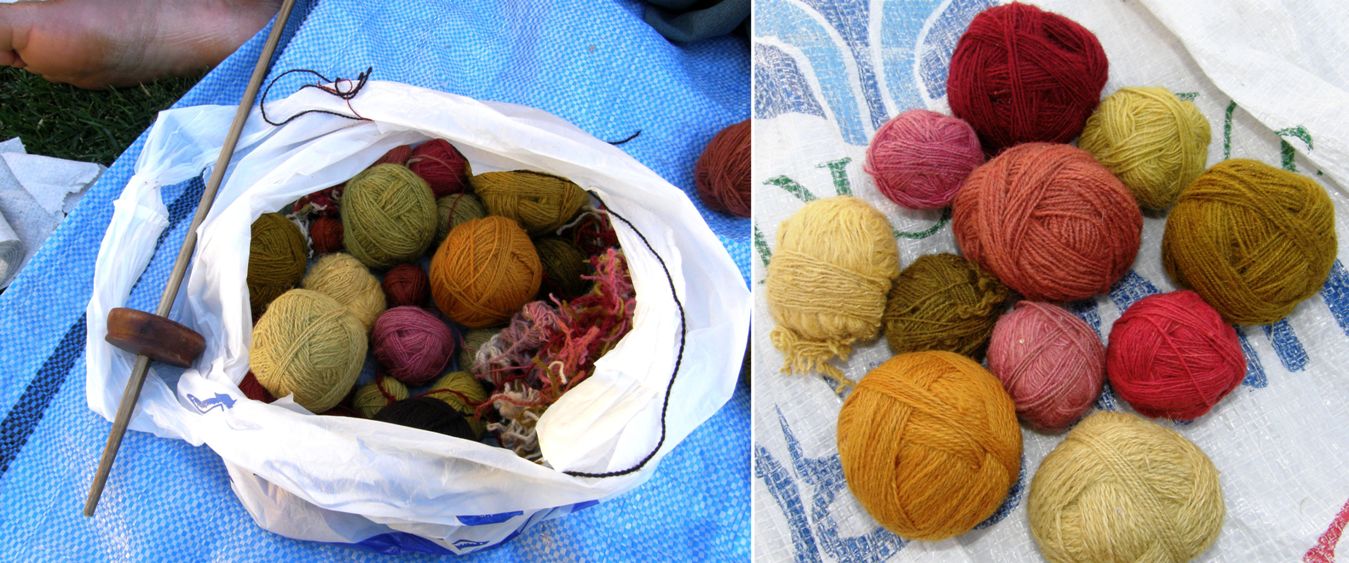
Once again I was immersed in the warm woolly smells and happy colors of the highlands as I took out the beautiful bands made by the weavers in Independencia, Bolivia  from their handspun yarn colored with natural dyes.

yarn

?????????????????????? You know how much I love to dress up little bags and pouches. I am cutting up the bands just as the weavers themselves are doing in Independencia to make cell phone pouches and other such things to sell. So, I have been weaving and sewing tubular bands, braiding and embellishing away and having fun.

embellished wool pouch???????????????????????????????Here is one partly dressed-up pouch with a brown and red tubular band, braids and tassels. These projects give me the perfect opportunity to put into practice the many little finishing techniques that my weaving teachers and sling braiding instructor have shown me over the years.

The two-color edging stitch that my sling teacher in Peru taught me for decorating the cradle section of the sling looks lovely along the edge of fabric. I have used it to edge a table runner.

Now that it is not so hot here, it is really nice to feel the wool in my hands. It is also nice to have something off-loom to play with.

On the loom, I have the black warp that I took on my last spring trip away. I am using the fine Guatemalan cotton which I recently wove into black and purple scarves decorated with supplementary-weft patterns.

As I am still in my supplementary-weft phase, I have been thinking about what to do with this black demo warp. I created it with nothing in particular in mind…just something to show one of the ways in which a warp can be put together for backstrap weaving.

supplementary weft patterned scarf backstrap loom

Now I am thinking that since I used patterns based on Bhutanese motifs on the black scarf and Guatemalan inspired patterns on the purple one, I should base the designs on this new project on supplementary-weft patterns from another weaving culture….either Bolivian hatband motifs or the designs used by the Montagnard weavers with whom I studied in the US.

I have a few hatbands that I have gathered over the years. The problem with studying the motifs on these supplementary-weft patterned bands is that the thread that Bolivian weavers use for these is so incredibly FINE!!

supplementary weft project for on the road

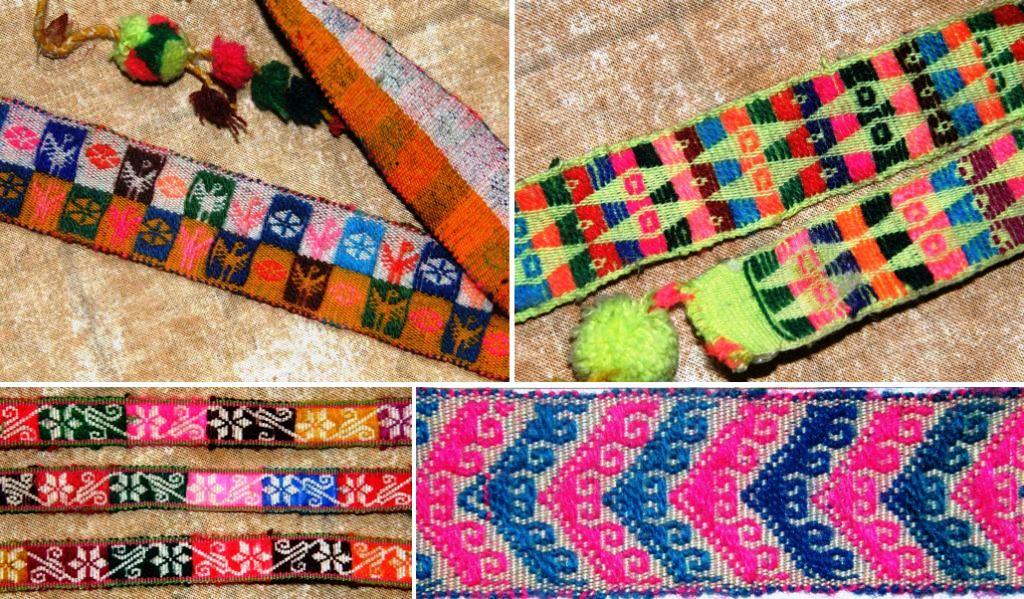
hatbands-aWhat I like about some of the Bolivian hatbands that I have seen is that the supplementary weft is used to fill the negative spaces.

Look at the flower pattern at bottom left on the hatband from Calcha, Bolivia. The ground weave is white and the colored supplementary wefts fill the negative spaces so that the ground weave below is exposed in the shape of a flower. The thread used in that flower band is unbelievably fine….almost like strands of hair! I can’t count the threads and will need to get a magnifying glass to do so. The fineness of the thread means that the weaver has been able to get away with making some very long floats of supplementary weft. As the piece was designed to be worn around a hat, long floats  are not really a problem as it is unlikely that they will catch on things and get pulled.

sample for Bolivian hatband designFor my sample piece I have had to modify the pattern to eliminate some of the long floats as my Guatemalan cotton, as fine as it is, is nowhere near as fine as the Bolivian thread.

You can just see the top half of the flower head in my sample as I weave to check the proportions. Look at the difference in size between my sample with my “fine” cotton and the Bolivian band. I think that I will have to re-define “fine”!

The Bolivian weaver has used a colored stripe to border the pattern so that the colored wefts don’t just end “in space”. Besides looking good, this also saves her the trouble of having to count threads to see where the wefts need to dip back down within the shed. I was trying to just eyeball it when I was doing it and found myself one warp thread off the mark many times. So, to weave this, I really need to make a new warp with stripes included or….maybe I can come up with another plan by doing some more sampling.

Hopefully the  sampling will become something acceptable and I will be able to make this little black piece into a pouch with lots of embellishments.

In the Ravelry group, Cindy has been doing pebble weave on a Gilmore Wave loom making what might become a backstrap. The pattern is one that my teacher Maxima taught me and is charted in my second book.

cindy pebble weaveBetsy is making guitar straps on her backstrap loom with her own handspun. Janet is her spinning teacher and Betsy works hard at her spinning every day, so you can imagine that her handspun is really lovely and works beautifully for backstrap weaving.

betsy guitar strap handspunJennifer demonstrated how using a coil rod eliminated the annoying corrugated look in her cotton warp and gave a new life to this abandoned project. She then used the warp to create a really interesting solid-color warp-float pattern using a pattern stick and heddles to raise the warps for the floats.

jennifer coil rod and warp float patternWell, it’s back to sampling on the cotton warp, embellishing the wool pouches and playing some more on the inklette project for the article. My internet is running again and all is “fine”.

922915_10151577057823866_898758942_nThanks to everyone who wrote with suggestions about the embroidery stitch on the pillow cover from Peru. I think that it would make a nice cover stitch for joins and hope to experiment with it soon.

In the meantime I have also found out that the word used by Spanish speakers for tatting is frivolité….love that word!…and that a few of my online friends do it. I follow the Textile Museum of Oaxaca on Facebook and they are even giving a workshop on it. Let’s see how I can add a bit of frivolité to my weaving!

Backstrap Weaving – A Little Armchair Travel (courtesy of Jose Jaime Araujo)

Reproductions of Wayuu si'ira belts woven by Mirja Wark
Reproductions of Wayuu si’ira belts woven by Mirja Wark

I had my heart in my mouth last Sunday night watching the CNN program “Anthony Bourdain’s Parts Unknown”. He was in Colombia! That’s a place where I would dearly like to go although I have to admit it has gotten such bad press that it scares me somewhat. I was hoping to be told what a safe and wonderful place it is and the host did a good job of projecting that. In fact he said that it was the “most welcoming” of all South American countries he had visited.

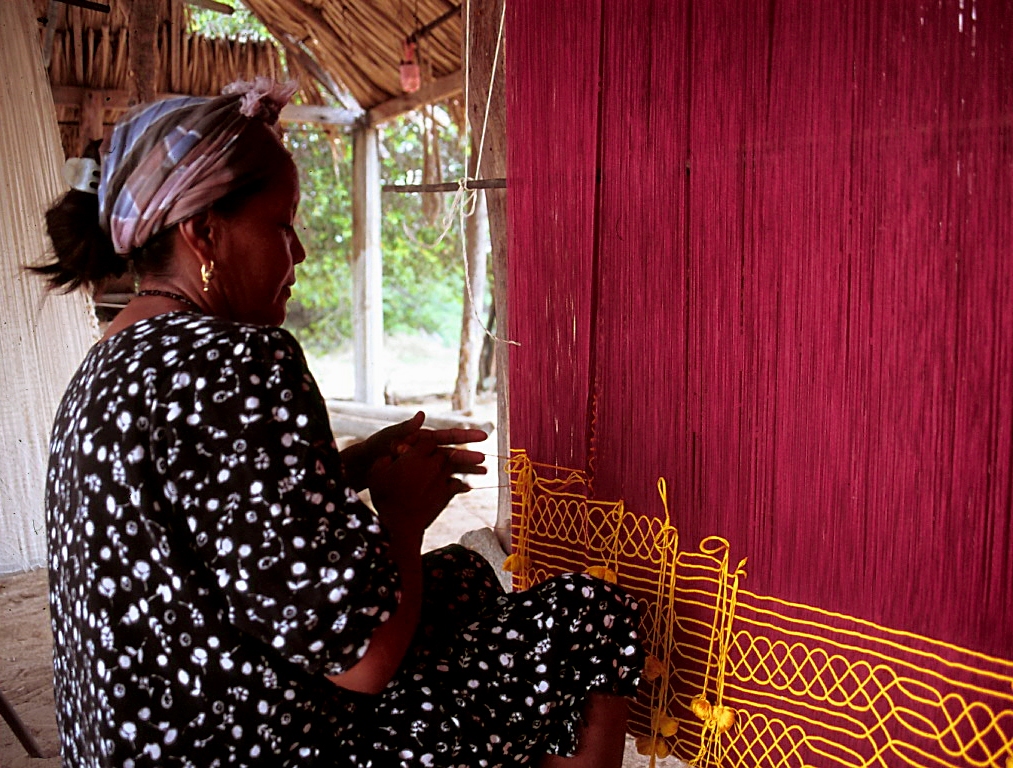
The part that had me on the edge of my seat was when he went to the Guajira Peninsula, home of the Wayuu people. If you follow my blog you will know that through Mirja Wark’s book, I have been using Wayuu si’ira belt patterns to inspire some of my weaving.

Mr Bourdain wandered through the markets  and I recognized versions of the typical embroidered dress that the Wayuu women wear. Mirja had modeled one for me when I visted her in the Netherlands last year. It was nice to be able to catch these glimpses of life in the market and learn a little about local food.

mirja modeling wayuu dressBut, sadly, he didn’t go looking for weavers or for the craftswomen who make the beautiful crocheted susu, or “mochilas”. He and his guide swung in hammocks after a day of ripping along the coastline on noisy four-wheel bikes. Yes, we got to see all that as well as the host falling off his bike on his head but didn’t get to hear anything about the woven hammocks. Too bad.

Fortunately, I found a gentlemen online, Jose Jaime Araujo, who has visited the Venezuelan side of the Guajira Peninsula and who is willing to allow me to share pictures that he took of the textiles and craftspeople there. He visited a market that looked very similar to the one that Mr Bourdain showed on the CNN program. Here you can see Mr Araujo’s guide using one of the susu, the typical crocheted bag, used by both men and women.

Photo by Jose Jaime Araujo

This could easily be a street market in Bolivia except for the beautiful flowing dresses that the women are wearing . I expect the music they are playing (all markets here  in Bolivia jump to the rhythm of various pieces of music clashing merrily together!) is different and you would be hearing the sounds of the Wayuu language. Mr Araujo’s guide acted as his interpreter.

Photo by Jose Jaime Araujo

Imagine….a stick with a hook on the end and talented hands are the only “tools” needed to create such a beautiful piece! I got to see one of these susu, or “mochilas” when I visited Dorothy on my recent US trip. Mirja, in Holland aslo had a fine collection.

??????????????????????I will leave it up to the crochet experts to look at this and understand how it is done!

close up of Dorothy's Wayuu mochilaAnd below is something for the ply-split braiders…

???????????????????????????????Mirja told me that the art of weaving the si’ira belts is on the verge of dying out and that she found it almost impossible to find someone who could show here how to do it. The belts are woven on simple vertical looms. Mr Araujo was lucky to find this elderly lady working on the ends of a belt after it it had come off the loom. This is eighty-five-year old Maria Úrsula Ipuana and Mr Araujo describes her as a living legend. She is one of the best Wayuu artisans that knows all the techniques of weaving. Right now she is passing her knowledge to other young Wayuu women.

Photo by Jose Jaime Araujo

You can just make out the “like the nose of a cow”  pattern at the end of the belt, a version of which I used in my wall hanging.

Wayuu inspired wall hanging progress

In this next picture Maria Úrsula Ipuana is holding two single loops in her hands and is most likely adding some countered twining to unwoven warp ends.

Photo by Jose Jaime Araujo

You know how I love weft twining! You can see the simple twining in blue and green  at the bottom of Mirja’s belts…

braiding and weft twining at bottom of siira beltsI added a very small and simple version of the twining to the bottom of my Wayuu inspired wall hanging…

wayuu inspired coutered weft twining

You can see how the threads in the first row of white twining are diverted to swap places with the threads in the second row of black twining and then vice versa as the twining proceeds across the warp ends.

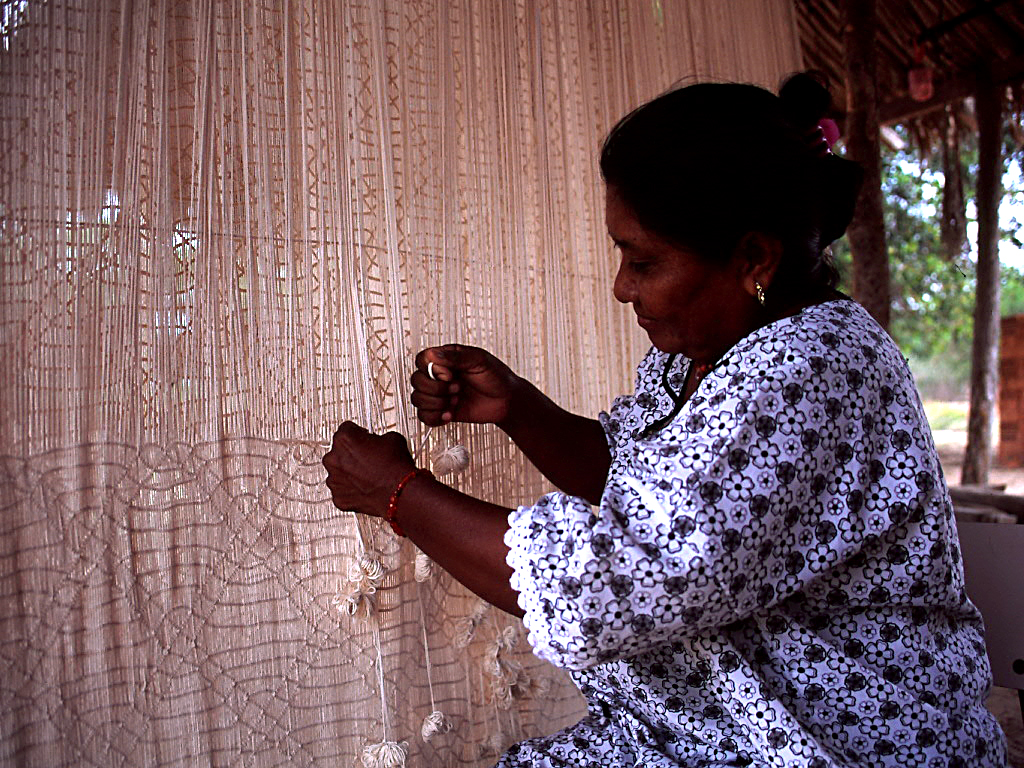
Included in Jose Jaime Araujo’s collection of photos are ones of Wayuu women twining across large groups of warp ends which Mr Araujo says will be a hammock.

Photo by Jose Jaime Araujo

How spectacular is that?! This is something I wouldn’t mind trying. Here is another one with white on white…gasp!

Photo by Jose Jaime Araujo
Picture by Jose Jaime Araujo
Photo by Jose Jaime Araujo
Photo by Jose Jaime Araujo.

Above, Maria Úrsula Ipuana shows a man’s ceremonial belt, a si’ira that she wove. You can see another stunning example at left and get another look at the weft twining at the end of the belt.

Jose Jaime Araujo’s flickr page has more pictures of the Wayuu people, their environment and crafts which include hat-making.

Thanks to Jose Jaime Araujo, we get to see a little of what Mr Bourdain neglected to show us. In the meantime I will look with a little more confidence at Colombia and maybe Venezuela on that long list of places I would like to visit.

Back here in Bolivia, I am still breaking down that seven weeks of accumulated dust and evacuating some unwelcome spiders. Fortunately, I saw this poem on Facebook, by an anonymous poet, only after my work was mostly done. Otherwise, I may never have done anything at all!

dust if you must

bhutan scarf with borderLots of excuses there!

But, I found that dust I must as I had a visitor last weekend from Australia. Wendy Garrity stopped off in Santa Cruz on her way to the highlands. Wendy spent some time in Bhutan teaching music and learned to weave at a weaving center there.

When I was trying to figure out the Bhutanese supplementary-weft chain-stitch technique by studying textiles from Bhutan in friends’ collections and online, I was able to find a piece of missing information about the spacing of the pattern warps from Wendy’s blog. That enabled me to make the scarf, at left, using traditional and adapted Bhutanese patterns

with WendyWhen I found that last piece of crucial information on her blog, I told Wendy that I had wanted to jump through the computer and hug her. That saved me a lot of trial-and-error.

Well, who knew that she would turn up in my home and get that hug for real?!

We spent two days chatting in “Australian”. I always like feeding backpackers who have either been living off cheap greasy cafe and bus terminal food or noodles that they cook up on camping stoves by the side of the road. It makes my simple cooking seem like something wonderful!

We poured over the Bhutanese patterns in David Barker’s books and Wendy told me the names and meanings of many of them. We talked about our travels through Asia…mine having taken place mostly in the mid eighties to early nineties and involved mostly trekking up and down mountains. Wendy’s travels in Asia have been about working and looking at textiles.

We shared what being away from Australia for extended periods of time is like. I have been living outside Australia for 20 years now!

I taught her a simple Andean pattern on a narrow band so that she could take it along with her on her travels. It is a complementary-warp pick-up technique which will give her a little insight into some of the textiles that she will see on her way through  Bolivia and Peru.

Wendy weaving the tanka ch'oro patternWhile Wendy wove her tanka ch’oro pattern, I set up to weave with my friend Janet’s gorgeous handspun wool.

Backstrap weaving with Janet's handspun wool This yarn came from a basketful which Janet invited me to dive into and sample. So, I made up a short warp for the intermesh technique. I weave it as a two-heddle method and teach it in my second book.

???????????????????????????????

I have to tell you that Janet’s yarn is just wonderful to weave with. I have spun llama fiber that I bought here in Bolivia (very dry and coarse stuff it was!) and some beautiful alpaca fiber that Janet gave me. I carded the fiber to prepare it for spinning on my drop spindle. I spun the llama fiber very tightly but tried not to overspin the alpaca. While I was happy with the results, I knew that on a very long warp my handspun would probably start to break quite frequently.

handspun-detailsAbove you can see my handspun llama in pebble weave and double weave projects.

cell_phone_alpaca_warp_on_backstrap_loom

My handspun alpaca lay happily flat when not under tension but this is just a teeny tiny warp…just enough for a cell phone pouch… so, who knows if the yarn would have stood up to a longer project.

Janet combs her wool rather than cards it and the yarn she offered me had been spun on a wheel. I don’t believe that her yarn is anywhere near as prone to breakage as my llama yarn was. Janet’s yarn is wonderfully smooth and resilient without being overtwisted and kinking back on itself. It is perfect for warp-faced weaving and produces fabric that almost lies perfectly flat.

intermesh band with Janet's handspun

It tilts ever so slightly at opposite corners but I have to tell you that sometimes the bands that I weave with Tahki Cotton Classic twist more than this band I made with Janet’s wool! I used a very simple intermesh pattern just to test the wool. The weft is a light gray fine commercial wool. You can see my teacher Maxima’s bands corkscrewing nearby. Those band were woven using Maxima’s handspun as both warp and weft.

You can see a little twist in the unwoven brown warps below but there is certainly none of the furious kinking back that one often sees in yarn spun for warp-faced weaving.

experiment with Janets handspunI love the neat third selvedge that working with wool produces.

And that is all I have done with my backstrap loom since getting home :-(….that darned dusting!)  But, I have been busy with my inkle loom. Why? Because I am writing an article. My wee inklette is one of the dust-covered items that needed taking down from the shelf. Now it is warped up and is being posed all around the place for photographs. I have to admit that sometimes I wish I had a bigger heavier inkle loom. If the article ends up on a printed page, I will tell you all about it!

bobbies ergonomic benchThere was sudden flurry of activity in the Ravelry group right at the end of a pretty quiet month and I have a bunch of things to show but will save most of it for next week.

Let me show just a couple of things for now…

Bobbie posted a tiny image of the ergonomic bench for backstrap weaving that she built following the instructions that Synergoarts has put online. It looks like she has done a perfect job and we hope to see a large picture of her using it soon.

Bethan, in Scotland, sent me a pretty spring picture of the warping board she built following pictures of Guatemalan warping boards that I have posted here. The warping boards that I saw in Guatemala all looked like this in various sizes. To keep the set-up compact for long warps, the warp is extended to one end and then turns a corner and comes back to the starting point.

warping board in dandelionsThere I was thinking that this system is  unique to Guatemalan weavers when I remembered that Sasha, who wove with me in Portland last year, learned to weave with cotton in the Piura region of Peru. She shared pictures with me of the warping set-up her teacher used in her home.

peruweavingI am sure that those stakes are very firmly beaten into the ground so that they won’t lean as warping progresses. They look like they may be permanently positioned there. This weaver  sets up two crosses as she warps as the Guatemalan weavers do.

peruweaving-16

Here is Sasha’s friend settling down to work on her cotton warp. Sasha brought her unfinished weaving to show me and get some tips. She had set it aside and had forgotten how to operate it and her string heddles had gotten really messy.

sasha and the piura warp

Amy sent me a picture of her home-made rigid heddle which she is using to weave a band. She wants to teach her children to weave with this as well as give Guatemalan children, who are residents on the US and who participate in a Latin American Cultural group,  a simple hands-on weaving experience.

amyAnd adventures with the famous coil rod continue in the Raverly group. Julia is using one on her single plane warp and loving it. (I have only seen it used so far on circular warps). I had been waiting to question Wendy about Bhutanese circular warps and how the coil rod is applied. After having watched a video of Leki Wangmo warping and weaving, I had some questions and now have them answered. Yes, the story of the “curious coil rod” continues to unfold! I will tell you more next time.

I am jumping between winding warps, cutting and hand sewing bands, playing with my inkle loom, photographing the inkle loom and drawing charts, writing an article, braiding , braiding and braiding warp ends and backstrap weaving. Oh, and yes, a little bit of dusting and armchair travel.

Let me leave you with Marge’s beautiful belt…woven on an inkle loom ….but it serves as great inspiration for a backstrap project and the buckle she has used solves all those problems of cutting a slit in the the band and making holes that a regular belt buckle requires.

Marge belt