Backstrap Weaving – Staying Balanced

One part of me is crying out for more ikat while another part is telling me to take a break, process what I have learned so far, and then head back in. I am really pleased with my latest ikat piece, mainly because I don’t have to add the familiar footnote: ”The colors didn’t turn out anything like I had expected them to”. This time I mixed my dyes…two kinds of blue with a blue-grey…and got very close to what I had in mind. Can I replicate it? Probably not. I am using such small quantities and don’t have the equipment with which to measure them. All I have is the tiny spoon that comes with the Stevia. 

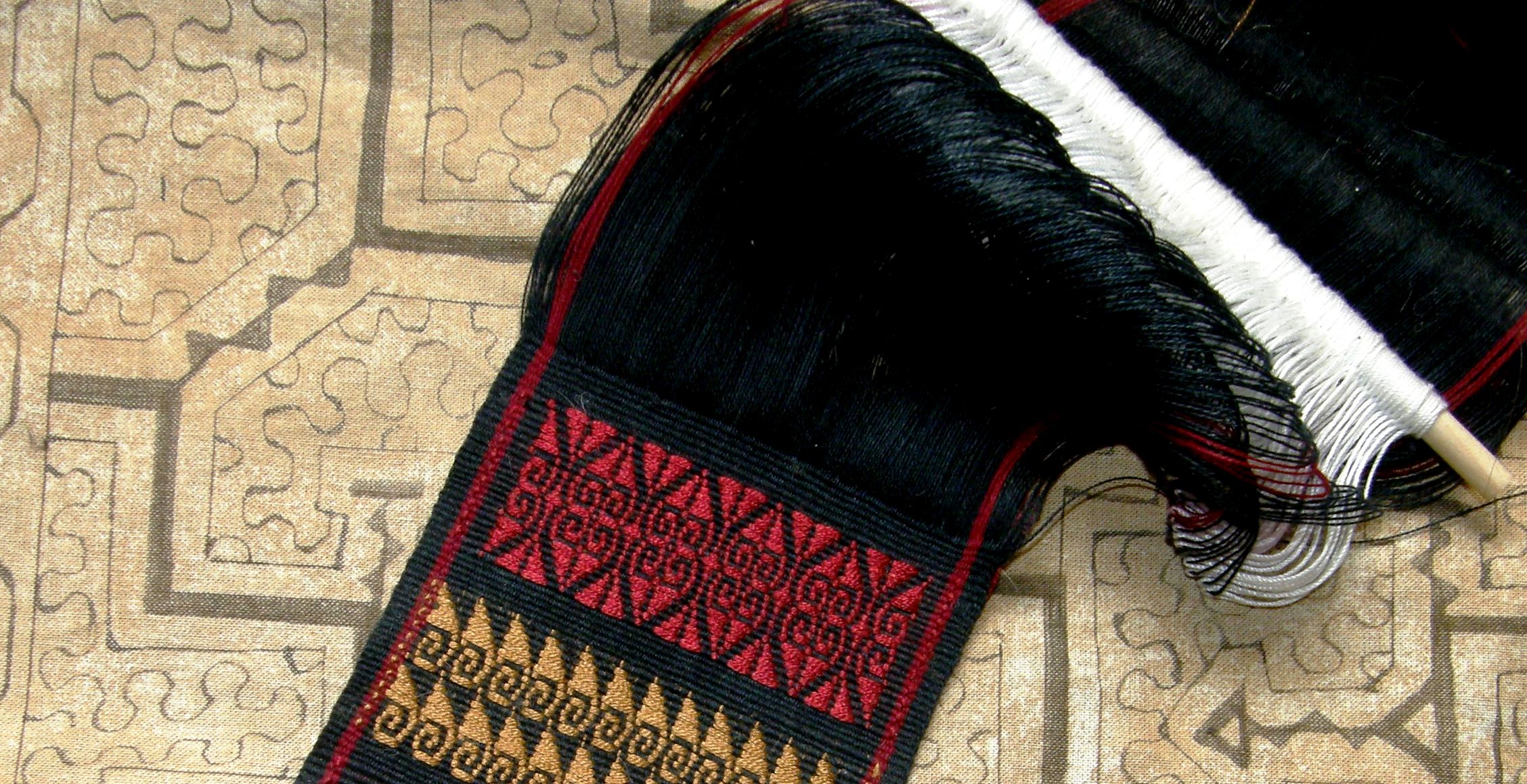
In my last post, I showed you the warp extended on my backstrap loom. I told you how I was getting “railroad tracks” and had unwoven to see if I could do anything about it. No, there wasn’t a fix that I could see so off I went again with the weaving satisfied that I had at least tried.

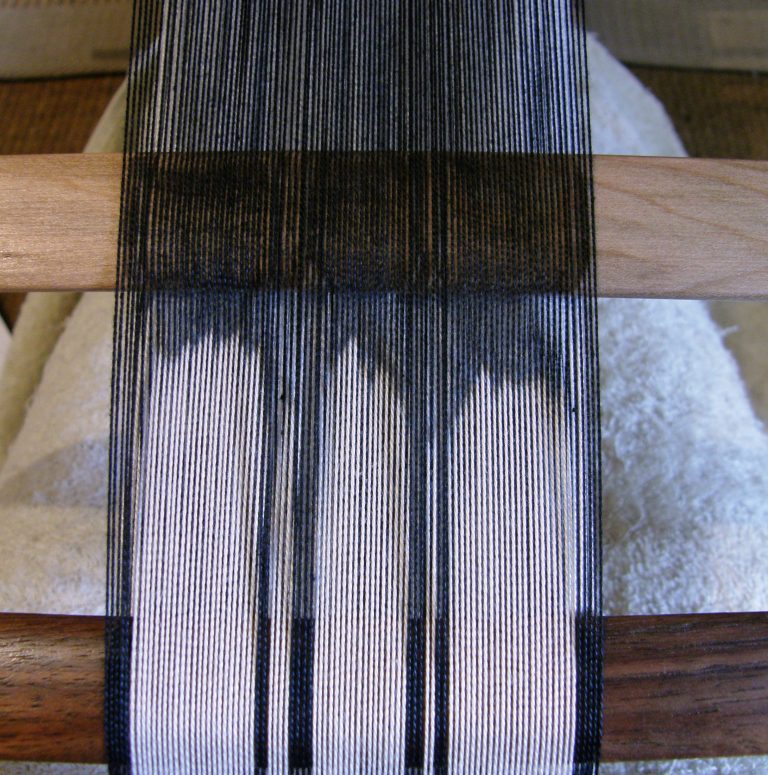
As I mentioned in my last post, I believe the “railroad track” effect is due to the two layers of warp threads being slightly misaligned. I think that they got misaligned when I folded the warp in half to set it up on the frame where I wrap it with plastic. This is only the second time that I have folded the warp to halve its length. Other times I have either folded it in half to halve its width or not folded it at all.

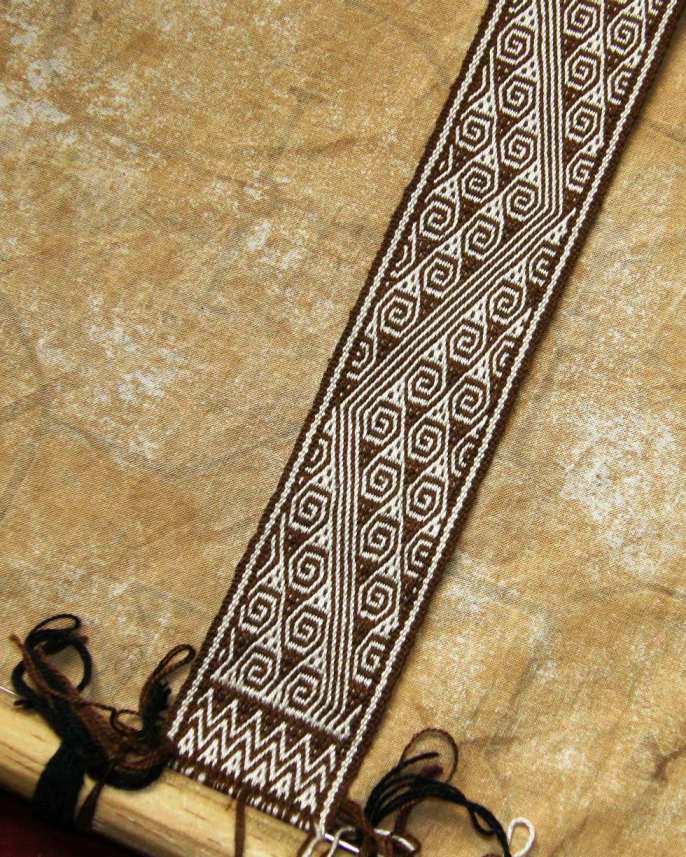
This is the other project where I folded the warp in half. You can just see the two horizontal bars of white on either side of the center. That’s where I tied tape to secure the layers before I folded it. I think that’s the key and not doing that might be where I went wrong in this latest piece. I’ll just have to do another and test this theory! 

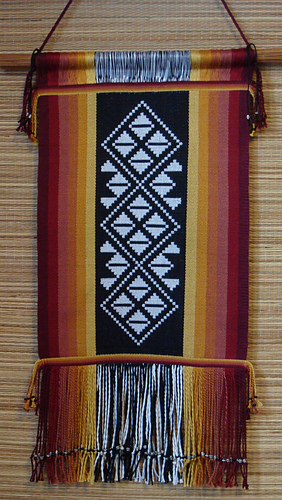
I was pleased that the pattern in my latest piece came out balanced, that is, my warp threads were quite evenly spaced across the width of the piece. Many things about this piece make me very happy! 

I say that the threads were “quite” evenly spaced because there is some tell-tale exposure of the supplementary weft in some parts where I added a motif in the center of the piece. 

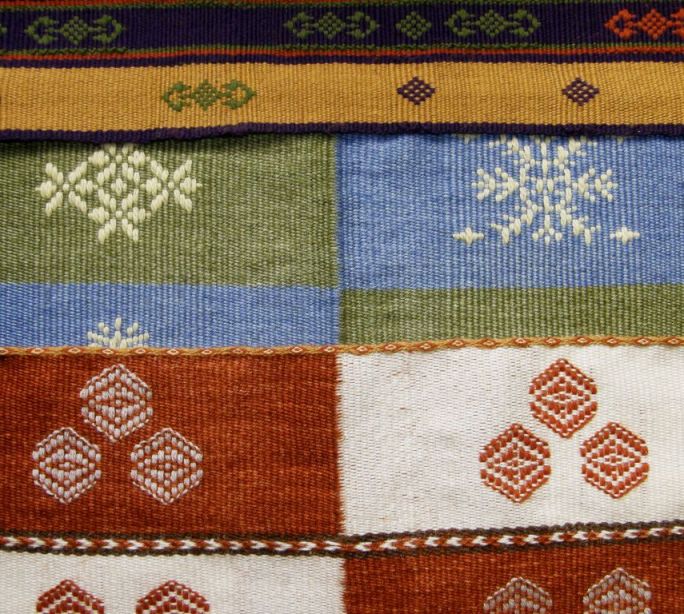
I created a little motif in supplementary weft that would suit the ikat shapes. The hardest part of this was creating and placing a motif that would fit exactly in the available space. So, I had to start weaving the motif at just the right moment, make sure that I got to the center of the motif when I had reached the center of the warp and make sure that I maintained an even beat so that the two halves of the motif were balanced. The horizontal center line is created by wrapping the supplementary weft around equally spaced warp threads….it looks like chain stitch and is a method I learned from my teachers in Guatemala. I couldn’t use the usual inlay technique for an uninterrupted line like that because the resulting float would be way too long.

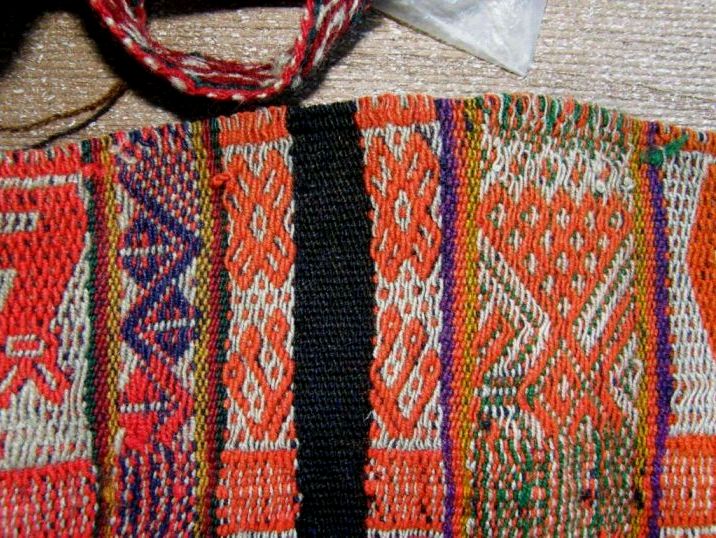
The Guatemalan weavers use this chain-like “stitch” in their figures to form things like the brim of a hat, a bird’s beak, the base of a skirt, a wing, or a plant and feet. You can see some examples below in the piece I wove with my teacher in Guatemala. 

Weavers in Bhutan also use it although they execute it in a slightly different way. My friend Wendy Garrity uses it in her work.

Here I am nearing the end. You can see the railroad tracks. I am thinking that in certain motifs, this effect could actually enhance a pattern but using it in that way would require being in control of when and where it occurs. I can’t see myself being able to do that!

Here it is fresh off the loom before being washed and pressed good and hard. It’s just the right size to hang on the narrow bit of dividing wall between my living/dining room and kitchen. However, I think I’ll be saving all my wall hangings for the time in some distant future when I am able to move back to Australia.

So, that marks the end of the experiments with un-dyed 60/2 silk for the time being. I’ve run out of thread. I’ll be spending some time now looking at my stash of colored 60/2 silk and the remains of my un-dyed 30/2 silk to see what kind of ikat project comes next.

As I said earlier, part of me is saying that I should take a break and do something else. I saw some work in striking black and gold by a Russian artist online that, at first glance, looked like Finnweave. When I read her descriptions, I saw that it was in fact crochet! It seemed to me that the motifs could be quite easily replicated in Finnweave. That is, if I could remember how to do Finnweave! I don’t weave this structure very much and have to go back to my notes each and every time I want to try it. My notes are scribblings of information taken from various sources including the Baizerman and Cahlander book on double weave structures and an article by David Xenakis in an old Prairie Wool Companion. 

This is the last thing I wove in Finnweave….It’s in 8/2 cotton and has motifs that I saw on belts made by Otomi weavers in Mexico.

I set up the warp with multiple heddles. It’s the only one of the balanced structures that I have tried that I am able to successfully weave without using a reed to maintain sett.

It’s a double weave. Two balanced plain-weave layers are being woven…one dark and one light. They are connected when there is an exchange of colors between the two layers, that is, when you create a pick-up pattern. You can see the dark and light layers separated in this picture….

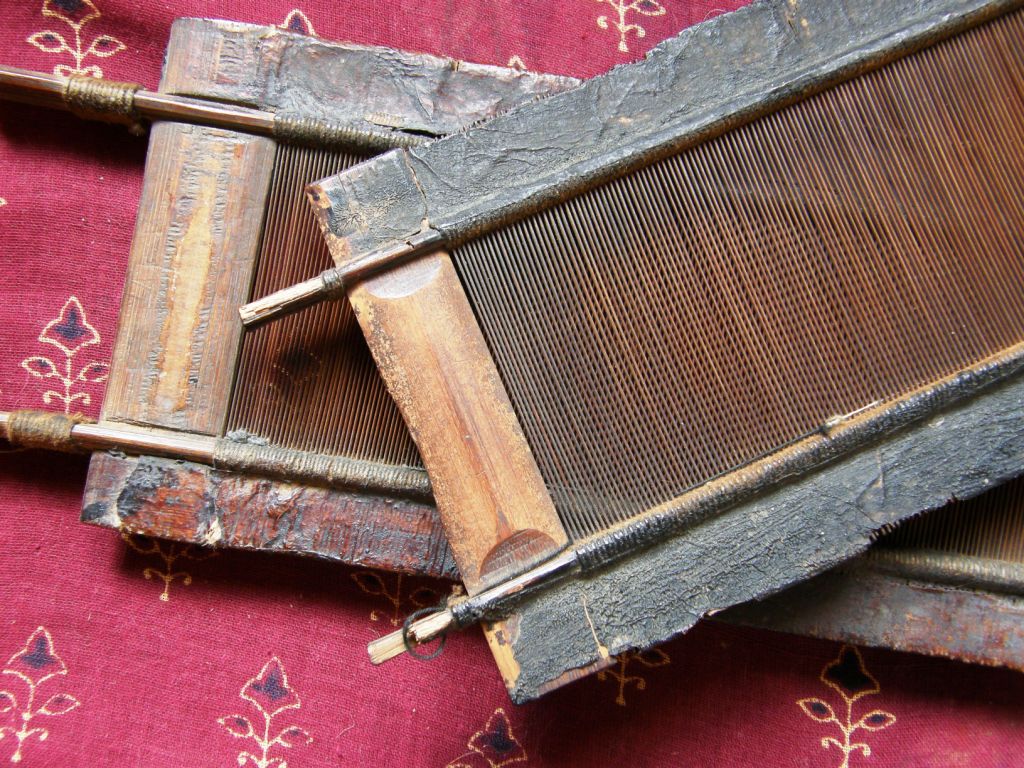
For all other work in balanced structures, I use one of the lovely bamboo reeds that I have. I have two wide ones and one small one. The small one is the finest.

Recently, I used the small one with my 30/2 silk as I test to see if perhaps one day I could dabble in weft ikat.

A couple of years ago I was using the larger reeds for my experiments with cotton sheer cloth and weft inlay…

This is what the cloth looked like after being washed….

I experimented with weaving a small piece without a reed (because the reed was too cumbersome for this width) and using a flea comb to beat!…It was somewhat successful but there’s no need to mess around with this on wider pieces when you have a reed, is there?

I think the first piece I ever wove using one of the bamboo reeds was this shadow weave piece from many years ago…

It’s fiddly reaching and working with multiple heddle rods behind the reed and I am grateful that Finnweave, with its need for multiple heddle rods, works for me without the need for a reed. 

When I saw the black and gold crocheted piece that I mentioned earlier, I was reminded that my friend Betty had given me two cones of 20/2 cotton…one black and one gold. Perfect! So, I set out to weave a width sample.

The finest thread I have used for Finnweave so far has been 8/2. I needed a new sample in 20/2.

My first sample was cute but way too small to really give me a reliable measurement. I will probably return to it some time and weave a wrist cuff so that I have another structure to add to my wrist cuff collection.  I used it to also test the proportions of some shapes I was panning to use in a bigger project.

I then created a wider warp.

There was a bit of a wobbly start as I got back into the rhythm of the moves and working out how best to interlock the weft threads when working with two shuttles. The lower pattern is from bags that are woven by Otomi weavers in Mexico. The pattern that I am starting is part of a motif from a piece I photographed in the National Museum of the American Indian in D.C way back in 2007, also from a textile woven in Mexico. I have doubled it and added a motif in between.

Although I am able to stop the warp threads from drifting together and making the piece warp-faced, you can see that the sett is not equal. The motif on the right is wider than the one on the left….something to work on. The motifs at the weaving line that I am just starting to weave are some basic leaves that I created. Of course, there had to be leaves! I am pleased with the way this is turning out. I am anxious to see how it all comes together after wet-finishing and am hoping that the black is color-fast. I am so used to the what-you-see-is-what-you-get nature of warp-faced weaving, that it is hard to wait until the wet-finish to discover how this will really look and feel. The 20/2 thread is not hard to work with . It is helpful that the threads are paired in Finnweave and so the units that I need to pick up for the pattern are easy to see. 

Doramay Keasby wrote a nice article in Handwoven Jan/Feb 2011 in which she compared five types of double weave pick-up structures. She noted that Finnweave gave the smoothest pattern (that is, no feathering along horizontal or vertical lines. Feathering along horizontal lines look like icicles hanging off the end of a roof and can be a pretty effect) but is not double faced. So, you wouldn’t want to use it for something in which you would like both faces of the cloth to be admired. There is pattern on the reverse but it is rather odd looking.

So, that’s what has kept me busy and sane these last couple of weeks. That, and another Zoom meeting with some weavers along with my attempts to learn some new juggling tricks. I confess that I didn’t get too far with my spinning in the Tour de Fleece. I plied one lot of the green I was spinning and got through the purple. But, I am motivated to do some three-color pebble with this yarn and just need to keep that goal in sight. I am not adding extra twist as some people do for wool that is destined for warp-faced weaving. I just don’t like the way the “tight” thread feels and I would rather just adjust the technique I use to operate the loom to account for a softer yarn.

The messages that I get from online friends are a big help in these unsettled times too! Keep them coming. Please never feel shy about contacting me with questions. I include an email address in all my publications for that very reason. Or, you can write to me via a comment on this blog. The comments go into moderation before they are approved for publication so you can ask me not to publish, if you like. 

Here are some projects from my online weaving friends….

Annette Giles has created a nice set of wrist cuffs using the warp-faced double weave structure that she learned in my book. I see that she added a touch or two of her own to some of the patterns. That’s a good first step toward designing one’s own motifs.

Judy Lepthien has also been using my Warp-faced Double Weave on Inkle Looms book and has already started creating some patterns of her own.

Wendy sent me a picture of the piece that she wove on a backstrap loom and sewed into a pillow. She tells me that she had some trouble handling the wider warp with the multi-sword pick-up technique that I teach in my Complementary-warp Pick-up book and so she went back to a narrower band to practice it some more. Then she was able to better handle this wider piece. The pattern is one used by weavers in the community of Chinchero, Peru.

Josefin Waltin has been using her own hand spun and hand dyed yarn to weave fabric on a backstrap loom. She used this fabric to make a sweet bag….

Carlos Vargas has been working with un-mercerized cotton on his backstrap loom to make some beautiful fabric too.. He said that he worked out a way to operate the loom so that there was not too much abrasion of the un-mercerized cotton. If not handled well, un-mercerized cotton can create a mess of fluff in the heddles and make it impossible to create clear sheds. Backstrap weavers need to have different strategies up their sleeves to allow them to work with a variety of materials. It would be a shame to have to be limited to only the smoothest and friendliest of materials…only mercerized cotton and only very tightly spun wool, for example.

It’s nice to finish this post admiring Josefin and Carlos’ soothing colors.

Take care, please and I’ll see you again soon.

Backstrap Weaving – Lucky Finishes

Sometimes it is just all about luck.

closing gap discontinuous warp four selvedgeYou may remember from last week’s post that I was happy about having been able to weave my pick-up pattern uninterrupted all the way from one selvedge to the other on this discontinuous-warp four-selvedge piece. Whether I would be able to pull it off on the other half of the warp remained to be seen.

I measured and estimated. The were four weft shots in the sequence for this tiny motif and I wanted to see if I would be in just the right shed to be able to close the gap between the two woven ends without interrupting the pattern. My estimates told me that it wasn’t going to work. What to do? Well, just weave on and see what I can come up with at the very end. There was nothing at that point that I could have done about it and I might have been able to find some kind of creative solution.

discontinuous warp finishedAs it turns out, it worked! My estimates had told me that it wouldn’t, which only goes to show you how little control I really had over it and how much depended in the end on pure luck. The terracotta wool is rather streaky. The ties were too tight on the skein when it was dyed. I am okay with the resulting rustic look. It goes with other defects such as the change in tone when I ran out of white weft and had to use terracotta. It has been a fun experiment.

??????????????????????Bolivian and Peruvian weavers, as far as I have seen, never bother to try and match up their patterns in this way on four-selvedge pieces. My tiny motif is nothing compared to the complex patterns that they generally weave into their pieces. A typical finish on a complementary-warp piece looks like this….(this piece is from Calcha, Bolivia)

??????????????????????The weaver  abandons the pick-up pattern and uses the two basic sheds, in this case, one in each color, to close the gap. The last few weft passes create horizontal bars. That small piece of plain weave  comes out wider than the warp-float patterned areas.

Supplementary-warp patterning requires less space in which to maneuver as the weaver does not need to create a picking cross. He or she simply reaches down with fingers or stick to the lower layer of threads and picks up the warps that are needed for the pattern while dropping others from the top layer. As I showed you last week, some weavers who use this structure weave the design uninterrupted right to the very end of the piece and abandon it to the basic sheds only for the last three or four weft passes (the example below is from Pitumarca, Peru).

finishing-backstrap-weavings

terminal-areasThis piece from the Cusco region of Peru has both supplementary and complementary-warp patterns and the weaver has chosen to end all in the same way and place.

Double weave is something else again! My teacher in Potosi showed me when to abandon the pick-up and start using the two basic sheds, each with double the amount of threads for the two layers of cloth now being squeezed into a single layer. The needle-weaving part was horrendous! Here you can see my dear teacher Hilda, poor eyesight and all, showing me the final steps….

hilda finsihing a pieceSo, my terracotta piece was taken off the loom and I was ready to weave and attach the tubular band . I had created a warp for a tubular band for another piece that I had woven a few weeks ago and had decided not to use it. Although I think that a band with a dark brown base would have suited this piece a lot better, I simply didn’t have any suitable dark brown wool. This was the next best thing.

??????????????????????First, a wee sample…I had lots of this warp which had been originally planned for a much larger piece so I was able to weave an independent band and lay it along the edge to see if the colors really did suit. As you know, a tubular band is generally woven and sewn to the cloth at the same time using the weft as the sewing thread. I have a tutorial on that here.

tubular band on ticlla pieceIt’s done, and that heralds the end of the summer wool adventure. I learned a lot and have three study pieces to remind me of that.

woolstudy pieces four selvedge and ticllaNow it is time to get on with other things.

I have ideas swirling in my head about my next piece in the wall hanging series. When I finally have something to show you, you will see that the word “swirl” is very appropriate for describing the design on which I am working.

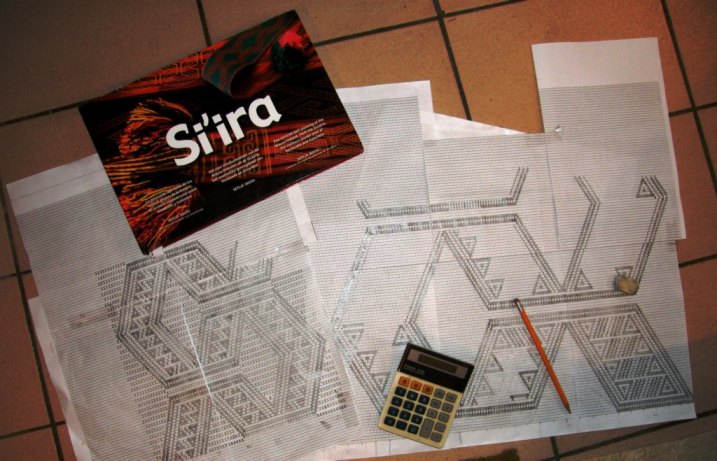
As is my custom, I am belly down on the floor with charting paper and pencil and a small mountain of accumulated eraser dust. They say that the third time is the charm. Not so. I go to bed thinking that I have everything in place but then wake up next day to see that something very obvious needs changing. I am weaving samples as I go which is a good thing as many of the needed changes that were not so obvious on paper scream at me from the woven fabric!

I plan to weave this fifth wall hanging in three panels and join them with weft twining just as I did for hanging number four. With this piece I hope to represent techniques and design influences from  tropical lowland regions of Peru.

Nora Rogers experimentThis study piece of a wristlet woven by the Mayoruna people of Amazonian Peru,  made by the late Nora Rogers, will help me design the red side panels.

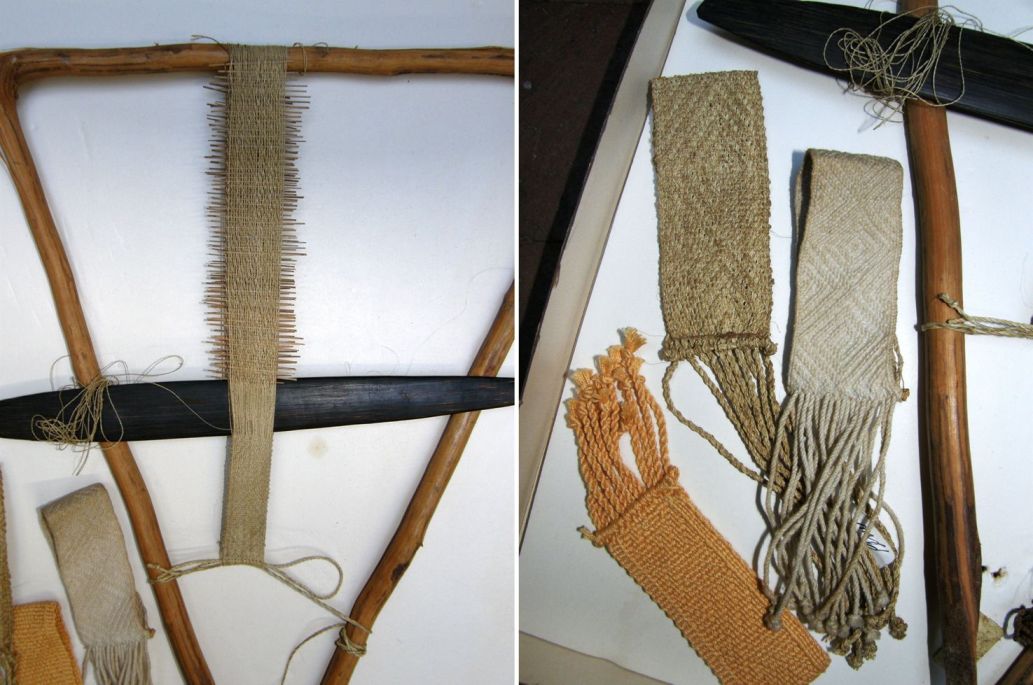
shipibo wristletsI won’t be using the traditional type of loom, though! All those tiny sticks hold the pattern sheds. The weaver picks up the threads for a pattern shed, passes the weft, inserts a stick and stores it at the end of the warp. He/she continues doing this for every shed. I tried to count the sticks on the above piece and got at least sixty. When the weaver reaches the mid-way point of the pattern he/she can then satrt drawing the sticks forward to open the shed, pass the weft and then discard the stick. The next stick in sequence is then drawn forward and so on until all sticks have been removed. Then the process of inserting the sticks starts again. 

I can’t wait to get started but I want to finish charting the pattern for the center black and white panel first.

Here is my sampling warp in black and white….

???????????????????????????????I told you a few weeks ago that I was seeing swirly patterns in my wool warp as I stared down at the lines of warp threads. Those swirly lines are what have led me to this latest project idea and, funnily, also led a friend of mine to write and ask me if I was suffering from some kind of medical condition! Now I stare down at the warp lines in this new sample and, as I open the shed and clear it down to the weaving line, I see ikat-like patterns. I am wondering if this is trying to offer up clues to me as to why warps shift in different ways while weaving (despite your best efforts to stop them!) causing ikat patterns to develop their characteristic feathered effect.  

Team Backstrap is starting its weave-along in the Ravelry Group tomorrow as the Sochi Winter Games commence. I have something in mind to make with a sports theme but we will have to see if I can get out to buy the yarn tomorrow. So far, I know that Jennifer is planning to weave a strap for a bag and Julia has something planned with a colorful Guatemalan theme. She was given some 10/2 thread in many colors which she used in this wall hanging…

julia bhutan intermeshThe motif was inspired by designs from Bhutan which you can find in David K Barker’s free downloadable pattern books. Check my RESOURCES page for the links. I love everything about this….the gradation of colors which border the pattern which she also cleverly used in the weft twining. She used the intermesh structure for both the solid and patterned areas. Those of you who have my Andean Pebble Weave book will know the intermesh structure described there in the section on thick borders. I teach intermesh as a patterning technique in my second book. I like the neat braided ends of Julia’s weft twining. I usually leave mine in a state of wildness.

And to finish, as I have been talking about luck in this post, here are two people who have had extraordinary luck rummaging about at thrift stores and garage sales in California….

1157544_10203147433553344_313383261_nMy friend Yonat posted this to one of the finger-weaving groups on Facebook in order to be able to identify it for the friend who had picked it up at a garage sale in the seventies. It caused high excitment in that group, I can tell you! One of the experts thinks that it was probably made during the period of Standardization from 1830-1850 and, because of the pink thread that has been used, was most likely made in the region of Lanaudière. What a treasure!

I am so thankful to Lausanne and Brian who took me to Quebec last fall to meet two sash weavers in L’Assomption.

And then, a Facebook acquaintance showed me a lucky find in a flea market in Pasadena in 2001….

huichol otomi bandIsn’t that gorgeous?! The Huichol, Cora and Otomi people of Mexico weave these kinds of pieces using a balanced double-weave pick-up structure. From internet sources alone, it is not yet clear to me which motifs in particular belong to which group or if the same motifs are woven by all. After only being able to look at examples online, I would love to touch and handle this belt! I used examples of Huichol and Otomi work that I had found online as well as a surprsingly similar motif from Scandinavia to weave the piece below. It is exciting to be able to see what looks like an old piece in such fine condition. 

huichol otomoi inspired backstrap weavingThat’s all for this week. Here’s wishing you all lashings of good luck in your projects this week! 

Backstrap Weaving – Working the Weft

I keep picking up the white paper bag that is lying on the chair in the bedroom half buried under a pile of tubular bands and warps. I scratch my head and wonder “What on earth is this?” My idea was to stop putting weaving things away in the closet. I fear the old “out of sight, out of mind” thing. So, the bag remains on the chair. I open the bag…oh yes, the contents of the paper bag are too precious to be left just lying about.  However, they are out of sight in the bag and, therefore, I keep forgetting what a  gorgeous delicate object it is that lies within.

Guatemalan supplementary weftIt is the wee Guatemalan backstrap loom that I bought at the Santa Fe International Folk Art Market in July. I gaped at the stunningly beautiful and delicate cotton gauze huipiles on the Guatemalan stand of weaver Amalia Gue with their white-on-white supplementary-weft patterns and was thrilled when I found that I could take home a relatively inexpensive example of these remarkable pieces.

This photo and description of Amalia Gue is from the website of the Santa Fe International Folk Art Market.

Guatemala_AmaliaGue_ArtistPortrait2_smAmalia represents Ixbalamke, a cooperative of women dedicated to the production of traditional textiles and preservation of traditional weaving. They live in the community of Samac de Cobán in Alta Verpaz and are inspired by the landscape and beautiful views of the region. The members of the cooperative maintain the intricate technique of gauze weaving and the use of coyuche, or natural brown cotton – practices that are rapidly disappearing. They also have a project making little looms for younger generations to continue to learn the tradition of weaving.

The cotton warp and weft is very fine and rather soft and a bit fluffy. It had not been sized. A thicker very loosely spun cotton is used for the supplementary weft. I haven’t looked at it closely enough to see if it is one thick strand or several fine strands combined. I am afraid that I will have to pull out one of the motifs in orderto ascertain that.

There are no obvious start and finish weft tails for the figures. The little bird figures just mysteriously start and finish. By picking at the weft I can see that the cotton used to weave the figures is most likely just twisted to undo the spin a little so that it can be torn when the motif is finished rather  than cut to give a blunt end. The torn end then just sits obediently within the shed. I think the fluffiness of the supplementary weft and the thread used for the ground weave causes all the fibers to interact and  somehow mesh and this is what prevents the motifs from unravelling….just my guesses and ramblings.

Guatemakan mini loom with supplementary weft patterningSo insanely delicate. Yet, this is the fabric of huipiles that I assume are frequently washed.

As it turns out, I have three large skeins of natural and bleached white Guatemalan cotton that is the same as the thread used in this piece. It has sat in the closet since 2008. It was an impulse buy and, when I got it home, I figured that it was way too soft for warp-faced backstrap weaving. I decided that one day I would size it and use it for something. For me, the biggest challenge will be achieving that even gauze-y ground weave. How in the world do the weavers manage that?  The good thing is that I have a ton of the thread and can afford to experiment and fail and try again.

I haven’t done supplementary-weft patterning on an open weave like that before. There will be much to learn! He is one of the huipiles for sale on the Gautemalan stand. This one was easier to capture in a photograph than the white-on-white ones.

Guatemalan huipil santa fe folk art market 2013So, while on the subject of the workings of supplementary wefts to create patterns, let me show you a few more things that I saw while in Santa Fe.

This is the work of weavers in the Sna Jolobil cooperative in Chiapas, Mexico headed by Pedro Meza Meza…

???????????????????????????????

And from Myanmar, Chin weaving…..

myanmar supp wef….brought to the Market by Khun Shwe and Pa Mang, experts in the textiles of the 40 subgroups within the Chin culture.

All the textiles I looked at on Khun Shwe’s stand were created with the single-faced weft inlay technique that I describe in my tutorial here. Below, you can see the “clean” back side of one of the pieces. 

single faced supplementary weft patterning myanmar

khun shwe myanmarIf you are in Santa Fe outside of the weekend of the International Folk Art Market there are still plenty of ethnic textiles to be seen at the Travelers’ Market not far from the downtown area. Many thanks to Marilyn who put me onto this place. It kept me happily occupied during one of the days leading up to the Folk Market.

There, I got to catch up with Pam Nadjowski whom I had met at Convergence 2010 in Albuquerque. Pam has a booth in the Travelers’ Market with textiles, jewellry and artefacts from Chinese minority groups that she has collected over the years. It was from Pam, in the booth she had at Convergence, that I bought the beautiful fine bamboo reeds that I use on my backstrap loom when I want to weave balanced cloth. These are treasures to me!

bamboo reedsPam allowed me to examine and photograph the beautiful silk brocade cloths, with pattern appearing on both sides, which come from the Quiandongnan area of China. They are used as baby carrying slings.

Sadae Torimaru in “Spiritual Fabric. 20 Years of Textile Research among the Liao People of Guizhou, China” briefly describes the patterning technique. She shows a weaver working at a floor loom and writes that each row of supplementary weft pattern takes 7-8 minutes to pick. The book includes 3 pages of images of individual symbols that are traditionally woven into the baby carrying slings and information about what they represent….such things as roosters’ feet, grass in paddy fields and a big tiger’s claw. It is interesting to go through the photos I took and identify the symbols in the book.

Here is just one of many pieces that I photographed. What an amazing piece of fabric in which to carry a baby.

???????????????????????????????I’ll show you just one more thing from Nagaland, a state in the far north-easten part of India.  There happened to be an exhibit of Nagaland textiles while I was visiting the Travelers’ Market.  Here is a very striking piece of fabric patterned with supplementary wefts. It is quite a contrast to the delicate Miao brocade. I like the way the supplementary weft extends from the sides of the cloth to form a fringe….an interesting solution to bulky weft turns on the edge of the fabric. I have more interesting pieces to show from Nagaland….another time.

???????????????????????????????As for my own weaving, it is a little “on hold” as I am counting down to my departure.

My living room floor has once again turned into a hop-scotch field of baskets of skeined yarn,  all sizes of balls of yarn arranged in possible color combinations, sticks, elastic bands, tape, warping boards and STUFF. This is where I warp. I love the speed and efficiency that comes from winding many warps this way….choose the colors, wind the warp, put the warp on the sticks, make heddles. For the simplest warps I make the heddles after the warp is wound right there on the warping board….Done!…NEXT!

4 color pebble weaveThe bedroom remains the paradise where I do the actual weaving. It is simply a smaller version of the chaos of the living room but has many more sticks as well as scattered cushions on which to sit and weave.

Now that I don’t have my cat anymore, I don’t need to put everything away from kitty claws at night. This means that things can remain in sight and in mind at all times rather than being put away in the closet to be possibly forgotten. There is quite an array of bits and pieces scattered about to remind me that there is this certain thing that I wanted to investigate further, or that color combo that I wanted to try or that pattern that I wanted to chart. I see them during the day and step on them in the middle of the night if I need to visit the bathroom.

I now have several weaving anchor points in the bedroom so I don’t even need to roll up a project and put it aside when I feel like working on another for a change of pace.

Between spurts of warping which can be rather mind-numbing, I wove one more  pattern on the four-color pebble weave band and rearranged the colors a little for the repeated motif. This is certainly something that can “un-numb” my mind!

And then, when my head is good and clear, I work on my supplementary-weft wall hanging. It’s not a sampler. I don’t want any mistakes in it and so, I leave that project for the times when I feel relaxed and want to reward myself after a good long bout of warping. I will give you a break from seeing that project this week.

Let’s look at what others have been up to….

hummingbird_guitar_strap_002_mediumI taught Janet the two-heddle intermesh technique that I teach in my second book, when I was visiting with her in northern California last spring. She wove this guitar strap using her own handspun wool and…. look at that, first prize at County Fair!  The strap has bird, leaf and hummingbird patterns. I got to see it when I was at her place in July but wasn’t allowed to show it here at that time because of the rules of entry in the Fair. I have been waiting and waiting to show you how fabulous this is.

Photo by Zev Eisenberg

Figmentling, from Ravelry, told me that she learned how to twine from the basic tutorial here on my blog. This is another resource that she consulted as well as this discussion on Weavolution where my friend, Franco Rios, lists many more resources for instructions and information. Then, she took it so so much further and created the bag you see above! It has interesting finishing techniques and a braided strap that she learned to make from Ingrid Crickmore’s loop braiding blog. She drafted her own pattern which she says commemorates the new bak’tun in the Mayan calendar.

DigitalLeaf from Ravelry shared pictures of her backstrap project.

DigitalLeaf backstrapIt looks  wide and very comfortable, has nice edges and is beautifully finished. I hope that she will get a lot of use from it.

And finally, I would like to share a comment I got from a reader this week. As one of my goals in writing my second book was to have people feeling confident and inspired enough to design and weave their own pebble weave patterns, I can’t tell you how happy this comment made me:

Thank goodness! I have finally cracked it. Having worked my way through the first Andean pebble weave book I was looking forward to dipping into the second and then I noticed that you had changed the pattern format. My heart sank and I put that book away for a month. But I looked at it this weekend, tried one of the smaller bands without any notations (thought it best just to throw myself into it) and by the time I was halfway through the first repeat it all made perfect sense and I can now read them perfectly and am presently designing my first band from scratch

Thank you Laverne – you have opened a whole new range of patterns to me.I will post my first effort when it is completed (if it works, that is)!

See you next week!

Backstrap Weaving – Hooked!

I was on the lookout for a simple pattern to continue my sampler of supplementary-weft patterns and the positive/negative space studies that I have been writing about these past two weeks.

After weaving some patterns based on Bolivian hatbands where the weft is used to fill the space surrounding the motif rather than the motif itself, as seen below, I wanted to weave a motif where the same shape appeared as both motif and background

supplementary weft in negative space

hook motif of peru and boliviaSeveral of the classic warp-float designs found in the Peruvian and Bolivian highlands have this very characteristic. In the hook motif pictured at left, it makes no sense to talk about “motif” and “background” as the same hook shape flips and turns and dances along the band changing from red to white and back again. Is it a  series of white hooks on a red background or vice versa or none of the aforementioned?

This was the kind of thing that I wanted to weave with supplementary wefts. So, I set about trying to adapt it to the structure with which I have been working.

As it turns out, it wasn’t that straightforward.

So, I spent a lot of time with paper and pencil and eraser (I still like the old fashioned way). The only way I could get the shapes to interlink well was to make several changes to the basic shape and, even then, the black version of the hook is not exactly the same as the gold one. The gold has an extra warp or two in a couple of places. There was a fair bit of weaving and unweaving involved too. But that’s what “sampling” is all about, right? I had to remind myself about that as I was starting to regret having set myself this challenge as I seemed to be spending more time planning out the design than actually sitting at my loom.

supplementary weft study with hook motifsSo, there it is. Two sets of gold hooks surround and expose black hooks in the ground weave. I am pretty happy with the way it turned out and hope to play a lot more with this hooky shape.

red hooks relected anf flipped in supplementary weft Where to go from there and how to best use all the work I put into figuring out those hooks? Chris Buckley writes about pattern building in traditional textiles in his article on warp-ikat weaving of SE Asia:

A further important feature of ikat, and indeed of most traditional textiles, is that weavers tend to use a narrow repertoire of simple shapes such as dashes, hooks and curls, in a ‘building block’ fashion to create their designs. This approach makes understanding and copying complex designs manageable for the weaver, and aids their transmission from generation to generation. Recognition of this repertoire of basic shapes (which I call primitives) is also of considerable help to the researcher with analyzing and comparing motifs between traditions,…..

So, I took one of my many discarded charts of the hook motif and used it as a “building block” for a new design, joining hooks together, reflecting them and flipping them upside down in the same way that many Andean weavers do with their warp-float motifs. The result is the band of red pattern above the gold in which there are four red hooks with just the hint of a black hook outline around them.

What had brought me, yet again, to Chris Buckley’s interesting article was a romp across the internet in search of hook patterns when my initial attempts at charting something suitable for supplementary-weft patterning were not working out. It is so interesting to see how the hooks show up in all sorts of woven structures and cultures. Of course, certain structures only allow a fairly limited repertoire of shapes to be produced and so, regardless of the culture, it is inevitable that a hook motif will appear if those particular structures are in use. Techniques like ikat,  on the other hand, can be used to produce a limitless variety of shapes and patterns.

hook-motifs-in-southeast-asian-textilesThese pictures by Chris Buckley show hook motifs in various SE Asian warp-ikat textiles.

I have woven the hook motifs used in yurt bands of Central Asia…

??????????????????????I wove the  pieces above and below using the same single-faced warp float structure as the yurt bands. You can see how the basic hook motif can be placed in different ways to create patterns and how dark and light hooks interlink so beautifully…

central asian yurtI have also woven patterns in pebble weave that are loosely based on Central Asian hook motifs…

central-asia-all-stitched-wih-borderas well as in supplementary-weft, double weave and supplementary-warp structures…

central asian motifs in various techniquesI enjoy the challenge of adapting a motif woven in one structure to others.

Chris Buckley writes that Indonesian ikat weavers sometimes copy designs, for example, from imported luxury textiles, particularly those from India…

When copying a design from a foreign source, weavers are likely to re-interpret the copied motif in terms of their own vocabulary of basic shapes rather than produce an exact copy. This is analogous to linguistic borrowing, where the pronunciation of a borrowed word may change from one language to another according to the repertoire of sounds available.

My own particular “weaving vocabulary” comprises the various structures that I am able to produce rather than a group of shapes. I have not dedicated myself completely to a study of the patterns of any one weaving region and so have not developed a vocabulary that is limited to certain shapes.

I love it when I see the Bolivian highland design that I call “rolling river” woven by indigenous weavers in both complementary-warp-float and double weave structures. Perhaps a weaver saw and admired this pattern when she traveled to another region and returned home to interpret it in her own weaving vocabulary which, in this case, happened to be a completely different structure. I can only speculate.

I taught Juan to do pebble weave when I was studying in Salasaca, Ecuador. No one in the area was using this structure. It was part of the deal…I teach pebble weave and they teach me to weave their supplementary-warp patterned traditional belts. Eighteen months later when I returned, Juan showed me his finished pebble weave band. Until then, he had not known how to weave at all. His final motif is a rooster which he took from one of the traditional supplementary-warp belts of Salasaca and interpreted in the only weaving “language” he knew…pebble weave. I thought that was brilliant!

juan pebble weave bandBack to the hooks…I like to think of the following  motifs, that I copied from a belt of the Tarahumara people of Mexico, as a “swirling” hooks…

Tarahumara patternI had not become completely familiar with that swirly hook and made it a part of my vocabulary, as skilled Tarahumara weavers surely would have, before attempting this piece and, as a result, it was very tricky to weave! Just as I got a grip on the swirls going in one direction, they changed to the other direction. It was much easier to weave it using another structure in my weaving vocabulary…double weave…in which it is generally much easier to “read” the cloth. However, I don’t think the pattern is as pretty in double weave….maybe slightly more so in my handspun llama fiber on the right (spearmint leaf and cochineal dye).

5892932496_f074da5701_m

handspun llama cochineal dyed

And so I go playing with structures and shapes. Even as I sit and look at the last red supplementary-weft hook pattern that I wove on my most recent sampler, I see the motif on the very right hand edge and think…hmmm….wouldn’t that look good on a narrow double-weave band?

By the way, many of the patterns I have shown in this post are charted in my second book.

Pebble_Leaves_on_a_Band_medium2Here’s one final bit of lovely hookiness before I go. Julia has been using the tutorials in my second book on creating and charting one’s own or adapted patterns in pebble weave.

Here is one of her bands in which she has adapted a tablet weaving pattern to pebble weave and…yes…there are hooks!

Backstrap Weaving – Books and Blessings

I don’t do Christmas. I don’t have any family here and so it seems kind of pointless but it seems that Christmas does me! And all my Christmases came at once, as they say, this month when four packages were waiting for me at the post office this week on top of a couple that I had received the week before. Two were purchases that I had made some time around Christmas and the rest were gifts.

One was from Argentina, another from Morocco via Australia, one from Bangladesh, one from Sweden, one from the UK, one from India and yet another from Australia. Luckily, I now have space for all this new stuff!

I can’t decide which one produced the biggest smile.

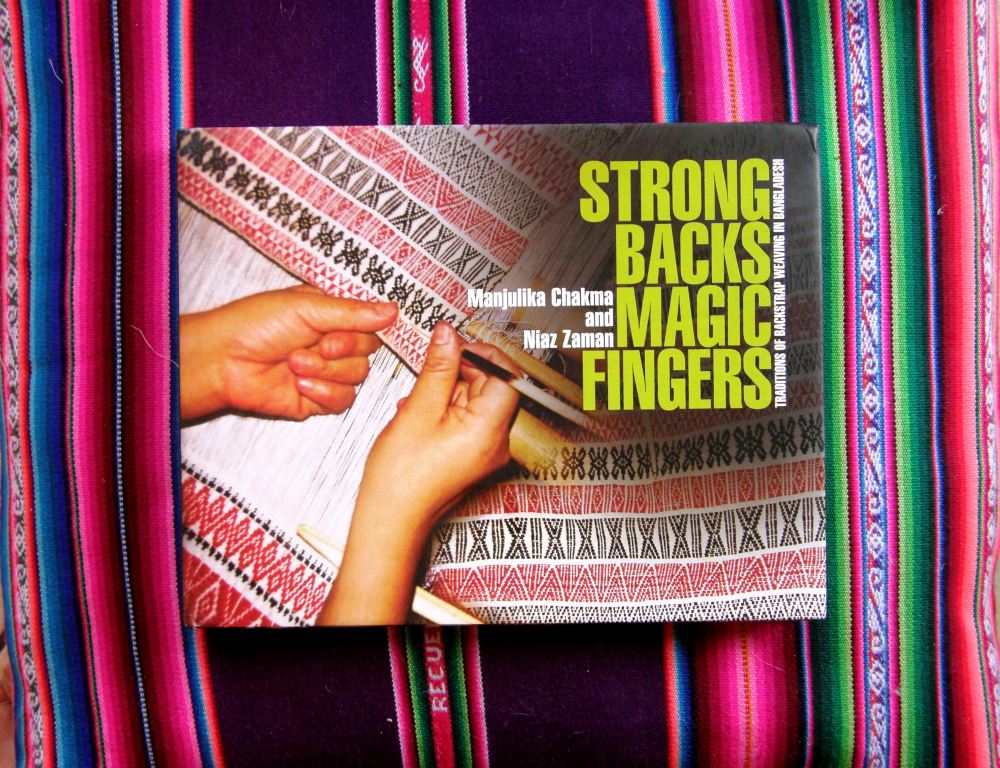
Let’s start with the book from Bangladesh on backstrap weaving. I suppose this is the one about which I feel most triumphant.

I have been trying to get this book since the middle of 2010 when I ran across a newspaper article about it online. Letters to the publisher didn’t produce any response. I tracked down an Australian journalist who had written a review on it but she couldn’t help. I asked my Godmother in India to try through some friends of hers in Bangladesh…no luck there either. I met a teacher from Spain on Ravelry who is working in Bangladesh who offered to try and get it…she couldn’t manage it… and finally, a Facebook acquaintance, Ananda, who works as a fashion designer in Bangladesh, came through.

He had heard of one of the authors, Manjulika Chakma and seen the book at a book fair. He managed to find the author, go to her house, where he said he enjoyed seeing her collection of tribal textiles, buy the book from her, tease me by posting a picture of it on Facebook and then send it to me! We were both very nervous about the mail as we both live in countries in the developing world where things often don’t work quite the way they should.

Well, I have been blessed because here I have it in my hands and it is really lovely.

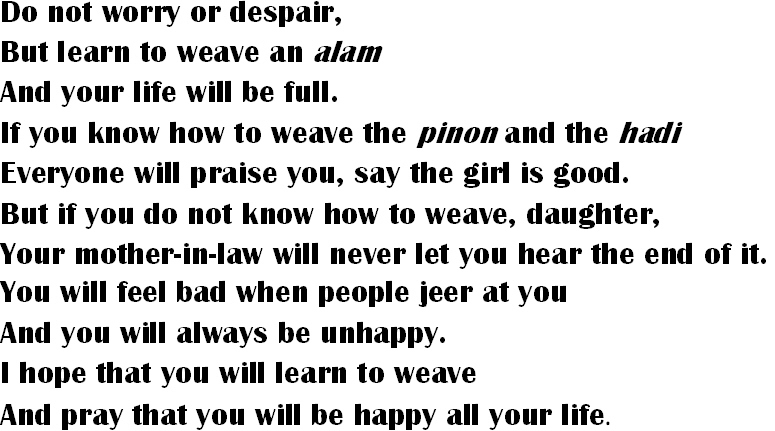
I have only read the first few pages of Chapter Two which is about the Chakma weavers and it starts with a lovely story of how, in order to encourage the tribal backstrap weavers to start weaving again the traditional sampler known as alam as well as to see just how many of the 210 designs could be recovered, a competition was organized among twenty weavers to see who could produce the best example. And the story goes on from there telling about the preparation for the weaving, the loom, the process. I can’t wait to read more.

One thing I would like to share with you are some lines from The Song of the Loom by Chiranjib Chakma translated by Niaz Zaman which appears at the very start of the book. This is just a part of the song:

How I wish I could hear this sung in its original language!

Twelve chapters in the book deal with twelve different tribes and their work. One disappointment is that the index promises a bibliography on page 164 but my book ends at page 160! Too bad…I love bibliographies. 

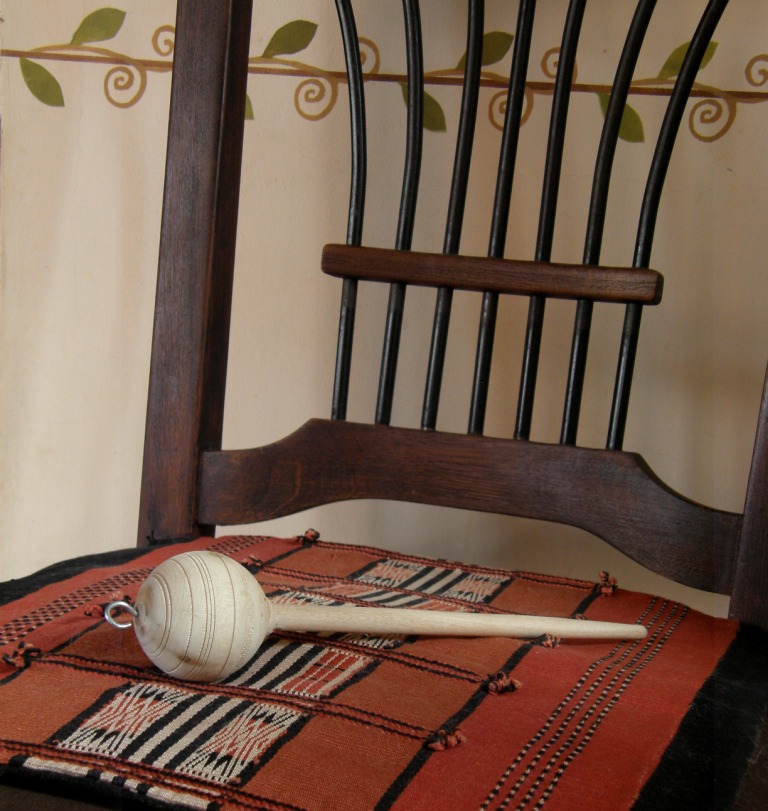
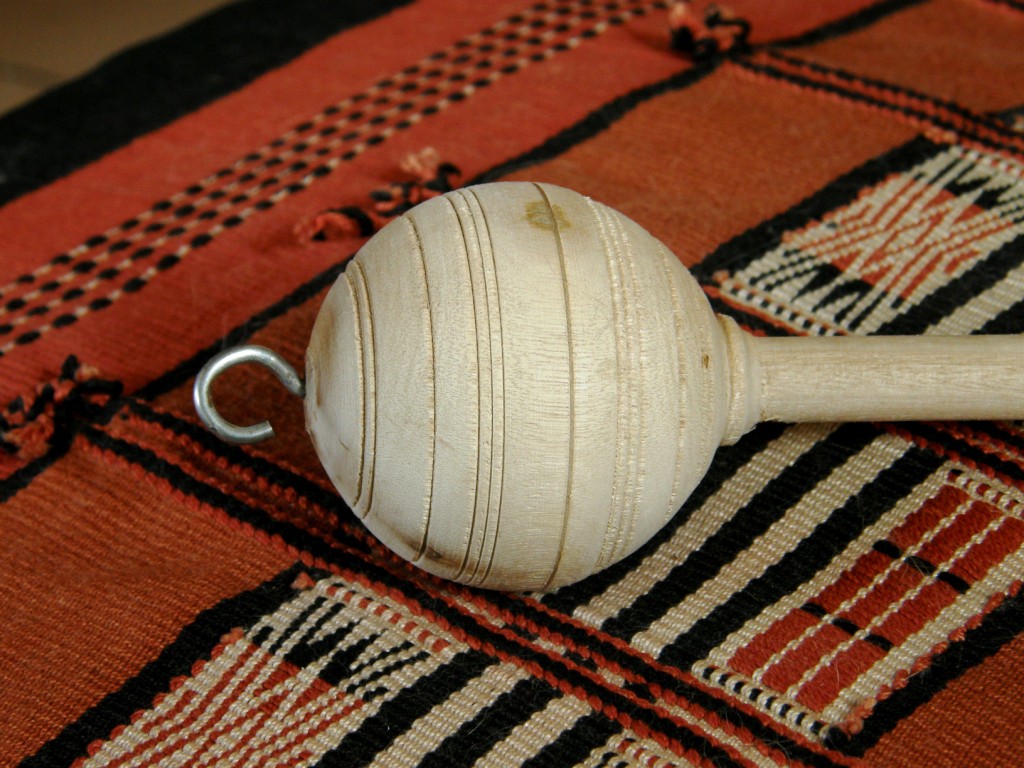
From Morocco via Australia came this spindle…

A friend of mine in Australia, Linda, went to Morocco last December and I asked her to get me a typical spindle. I have since decided to make this a gift for my friend Lisa in North Carolina. It isn’t for me anymore after my recent de-clutter campaign…books will always be welcome but I have enough spindles!

I actually had no idea what a typical Moroccan spindle looked like and Linda is not a spinner and told me that she had quite a difficult time finding one in the markets. Eventually an elderly gentleman told her that, if she came back the next day,  he would have one for her. Linda thinks that he had this specially made for her.

I asked the ladies in the Spindle Lore group about this particular kind of spindle and got many helpful responses.

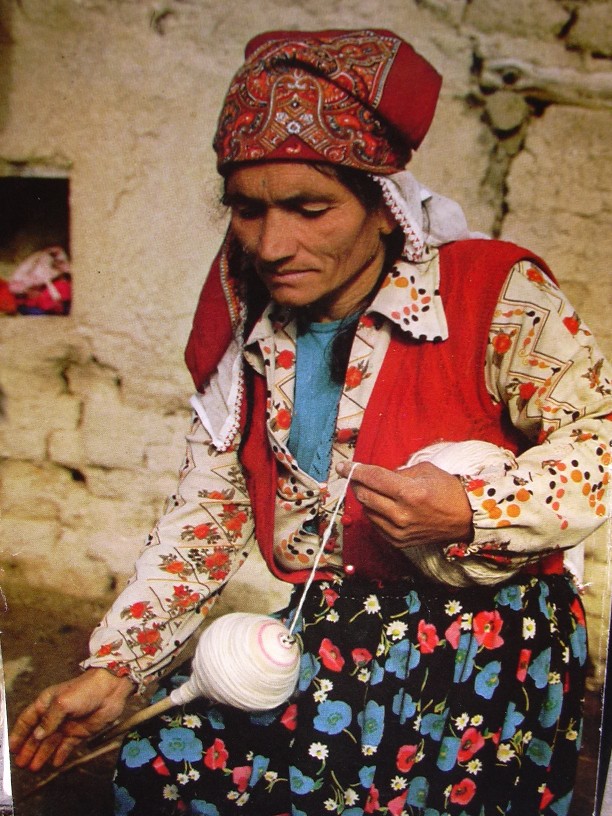
Tracy sent me a link to this site about Turkish tribal textiles which has this image of a woman using a very similar spindle.

I know that Lisa will use and enjoy this spindle. If it stays here with me, it will be left hanging on the wall. I am happy to see it, handle it and take pictures of it and learn a bit about it in the process.

To Think With a Good Heart…Wixárika Women, Weavers and Shamans by Stacy B Schaefer came to me as a used copy from the UK (copies for under $3 are out there!) after having been recommended to me by Hopi weaver Luis Garcia. Luis and I met online through a mutual interest in Huichol, or Wixárika double weaving.  Here is one of Luis’s pieces in progress. He is weaving almost exactly the same motif as I chose for my bag above.

The book is described as being …”a fascinating journey into a realm of ancient beliefs and traditions woven into the story of a way of life constantly threatened by the outside world…..(It) addresses both the technology of weaving as well as the dramas and personalities in a community.”

In the words of Stacy B Schaefer herself…

A woman’s weavings reflect the changes and transformations she undergoes as she follows her life’s path, and her rites of passage from childhood to adolescence and marriage are marked by her abilities as a weaver. As a wife and mother, she is the provider of woven items for her family until she is physically no longer able to weave. But, never idle for long, she takes up spinning to help the younger women in the family carry on the weaving tradition. A woman’s life is so integrally tied to her identity as a weaver that she carries her loom to the grave, where it is buried with her.

In this book, I hope to bring Wixarika women into visibility by focusing on the medium of loom weaving. I present a descriptive ethnography of Wixárika women’s lives in chapters organized in interconnected sections that discuss gender roles, the life cycle, economics, religion and cosmology.

The book is the result of Schaefer’s having apprenticed with master weavers in two Wixárika families but it is not a how-to book.

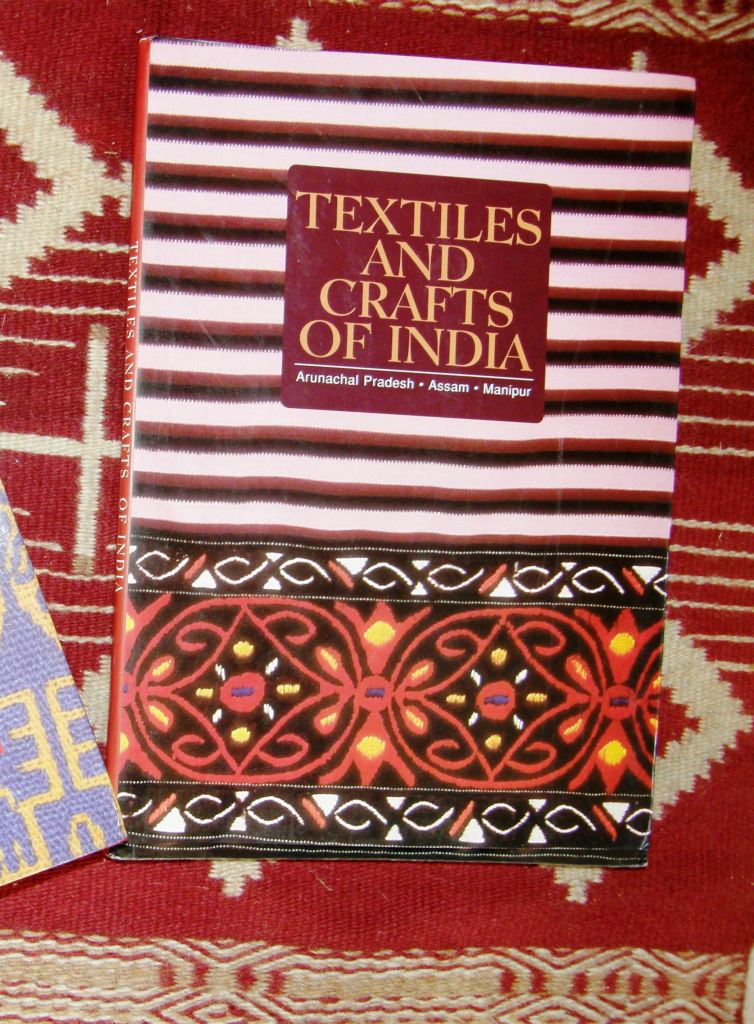
From India I received a book that was recommended by a weaving friend in Canada who just returned from a trip to the northern states of India.

Beautiful pictures and plenty of luscious inspiration! One particular textile jogged my memory from back in 2007 of a bag that one of my Youth Hostel roomies in the Washington DC Youth Hostel had. She said that a friend in Sri Lanka had given it to her.

What a great color scheme! I think I need to try something like this.

From Argentina…

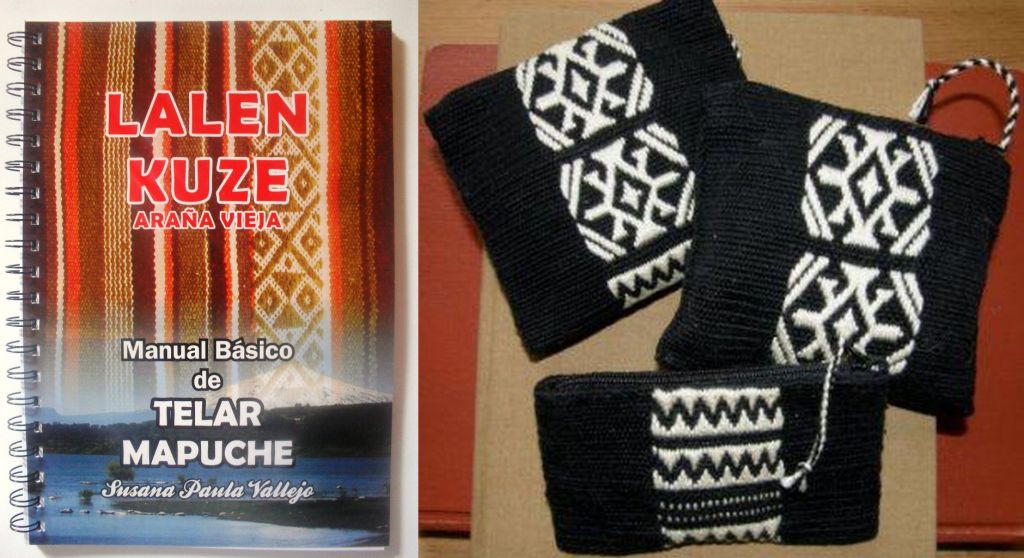
This is Susana Vallejo’s updated edition of her Manual Básico de Telar Mapuche. This revised edition has many more beautifully taken step-by-step photos than the original. Susana and I are online weaving buddies and we swap our books and ideas. I first swapped my Andean Pebble Weave book for a copy of her first edition. I will send her a copy of my next book in exchange for this copy of hers. She lives in Mar del Plata, Argentina where she runs a very active weaving school and I find her always buzzing with energy and so wonderfully charming!

Here is a picture that Susana herself put online to show what her new edition looks like…

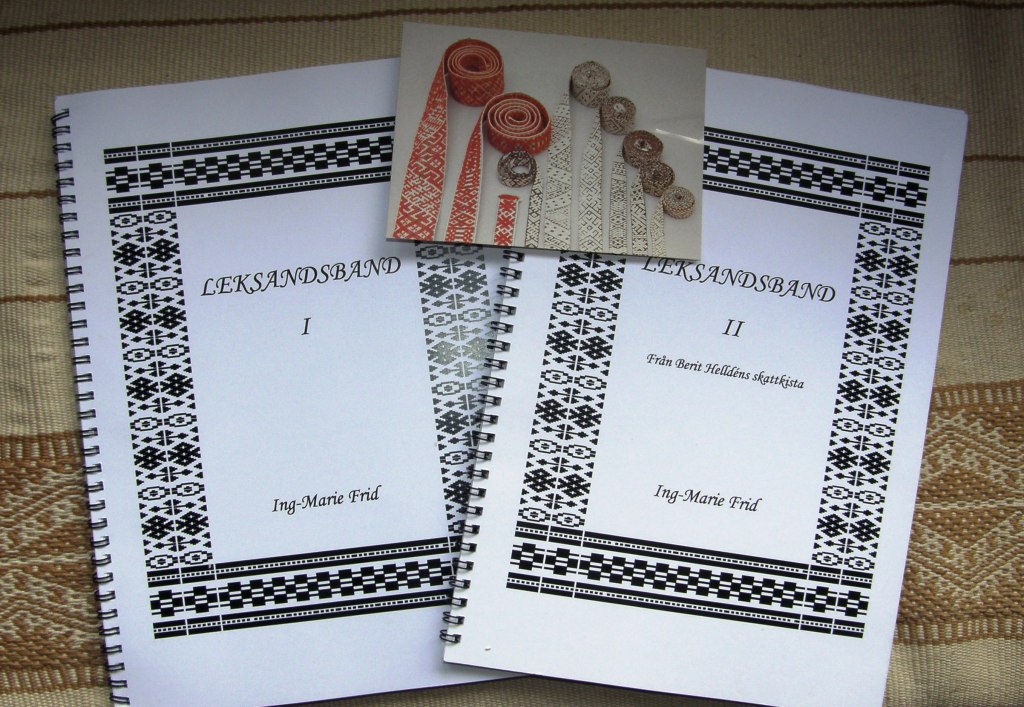
Two gifts from Sweden via my online weaving friend Olle-Petter…

What a beautiful piece of work author Ing-Marie Frid has made with page after page of meticulously charted designs from these wonderful traditional bands. Photos of the original bands accompany every chart and they are simply stunning.

It wasn’t all about opening packages and playing with all my gifts and purchases this week. I did some preparation for future weaving projects too.

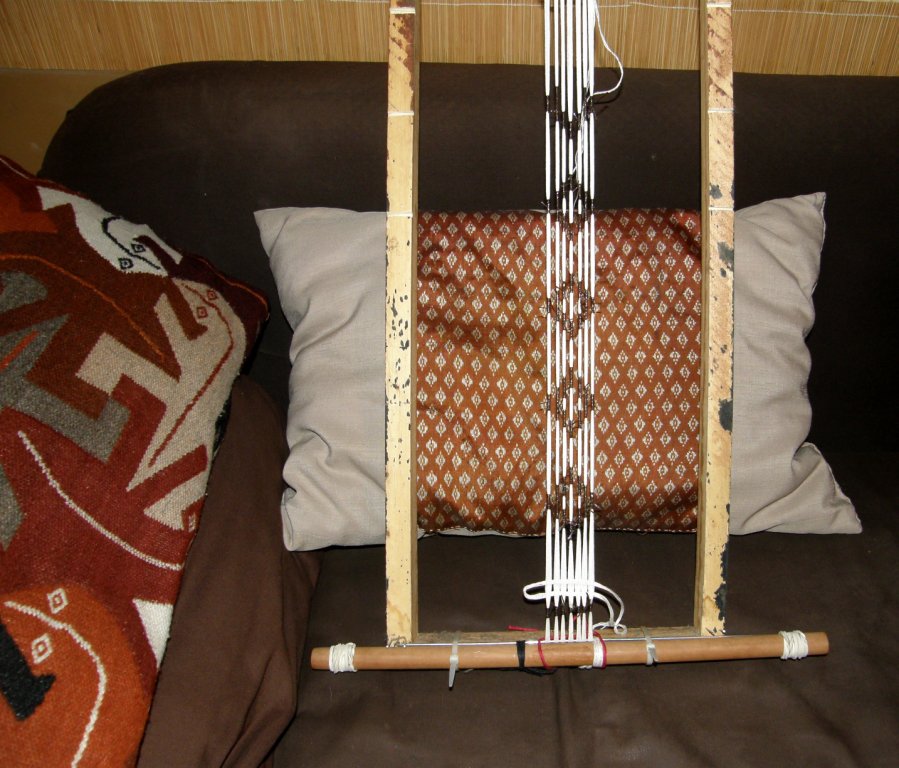
I am preparing a sample ikat warp putting into practice some thoughts and theories that I have on how to keep the threads better aligned. I am still not being terribly brave or adventurous about this and am using a simple diamond motif and keeping things small. I wrap the warps for one diamond a day, slowly and methodically while I think about different strategies for successfully weaving it.

I have the warp set up on a frame for now as I wrap and here it is sitting in front of a silk piece, with a similar simple ikat pattern, from Cambodia. I am using cassette tape to wrap.

I was pretty happy about my last attempt at ikat, which was just narrow strips within a larger textile, but I would  like to make some improvements…

The ikat is part of our new weave-along and we have Janet and Tracy so far wrapping away as well.

The other preparation project which was really taking a long time to get off the ground was the charting for the continuation of my Wayuu inspired wall hanging. Well, dither no more, it is going and appears to be successful! (although the proof will be in the weaving).

Mirja Wark has charted the traditional design in her book but it is not entirely symmetrical as that is the way the Wayuu weavers choose to weave it. I, however, have this need for symmetry and so I adapted and recharted it only to weave it and find it too small and delicate for my wall hanging and the thread I am using. Now I am changing it yet again to be big and bold enough for my piece. I kind of like the fact that I am changing it so much as there are now several  pieces of “me” in the design!

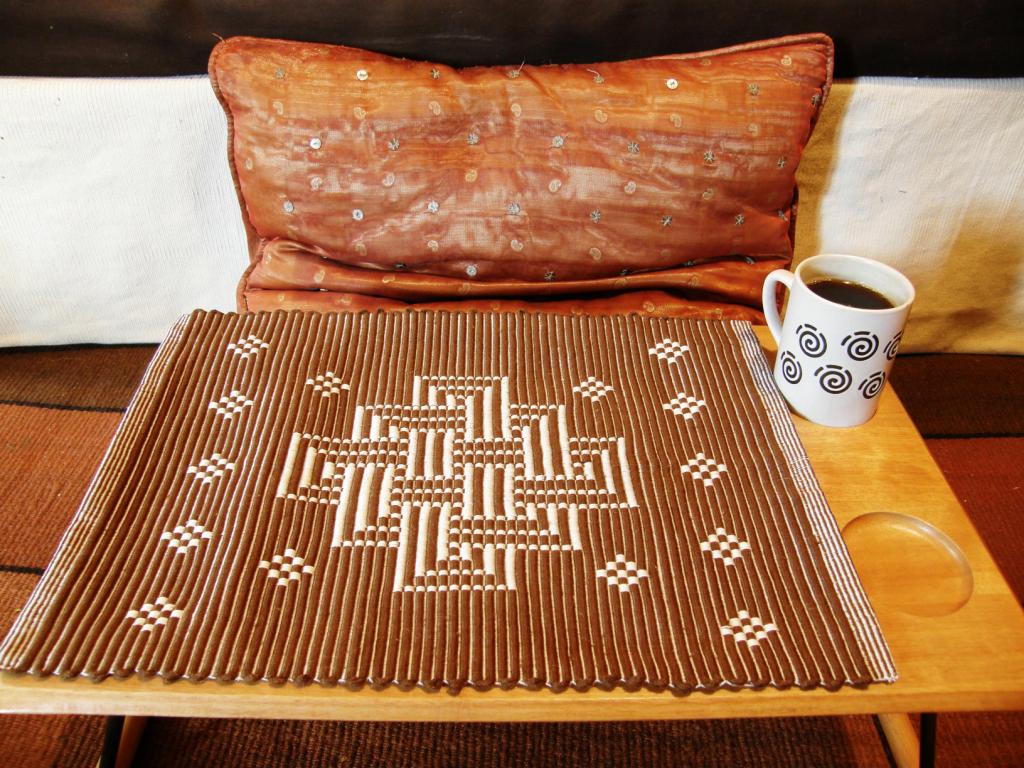
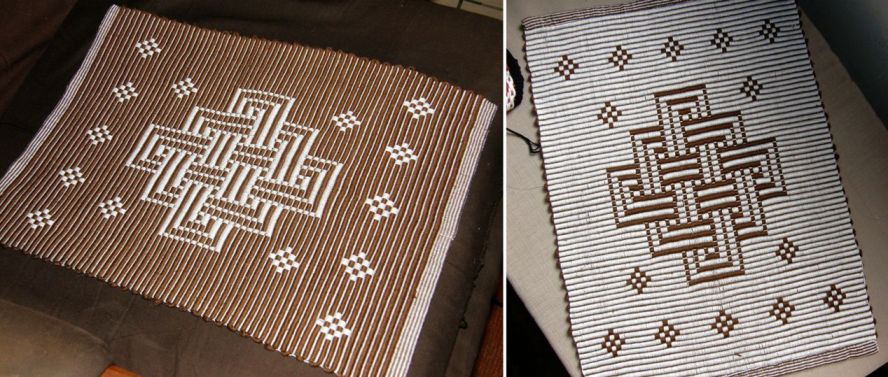
The rep weave sample came off the loom and got hemmed. I had some width issues so this definitely goes in the “sample” category. It fits my tray table perfectly though and will certainly be put to use to stop my bowls from sliding about.

And then Jorge came and said that he preferred the other side…not terribly practical white side up… but now I can’t decide which side I prefer! Thank you Marijke for your card woven  knot pattern!

Some Bedouin activity from online weaving friends…

Bobbie, from the Ravelry group is weaving this lovely piece using that yummy Dylon Cold Water terrcaotta dye on her cotton. She is weaving one of the al’ouerjan variations. Yonat wove Bedouin Warp Substitution  with me last fall and is weaving this band with many variations of the al’ouerjan pattern on her inkle loom. It is a sample band of the different patterns and she is practicing her weft twining along the way. She says that she is not crazy about the colors she chose but I love them!

We have exciting news from Tracy Hudson in the backstrap group who lives in Doha Qatar. She has written an article on Bedouin spinning which will be in the spring issue of Spin Off.

And that brings to me to wrapping this up with the unwrapping of the last “Christmas-comes-late” gift.

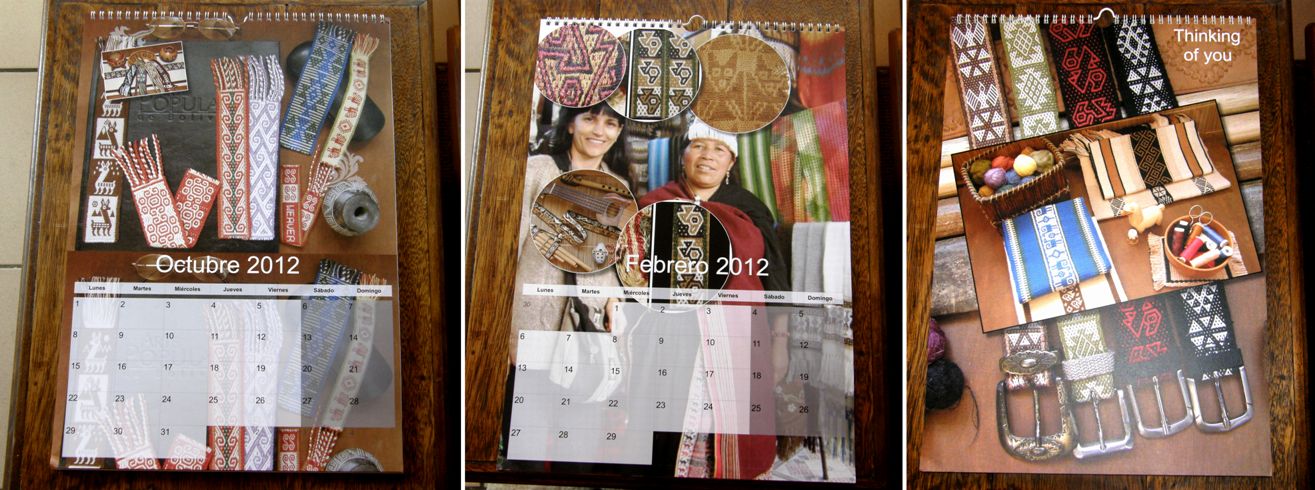
My dear sister-in-law made me an amazing calendar with pictures of some of my weavings mixed in with Navajo and other bits and pieces that she saw on her recent trip to south-west USA.  She didn’t have many pictures of my stuff to work with…just a handful of pictures I had sent to my brother for editing about two years ago but she did a tremendous job putting it all together.

And, wise and clever woman that she is, she left January 2012 off the calendar and replaced it with January 2013 at the end knowing that I probably wouldn’t get this until February. I don’t get to see Deb and the family very often and am way overdue on a visit to Australia. She blew me away with this!

And finally, I have to tell you that my book Andean Pebble Weave will soon be speaking French! I am very close to getting this e-edition up on the Patternfish website. And don’t worry, I didn’t translate it! It has been translated by a weaver in France about whom I shall tell you more once the e-book is ready for sale. Here’s a sneak peek at the cover…