If I needed an excuse to be a little less productive than usual this week, I had one. It was my birthday!
Another was the arrival of another wave of cold weather. It was perfect for lying on the sofa under a blanket with a hot beverage and a pile of textiles books. I was getting and consolidating more ideas for the next series of wall hangings.
The dilemma: My current wall hanging project has been woven in three colors: red, black and white. I have three pieces so far and have just started the fourth…
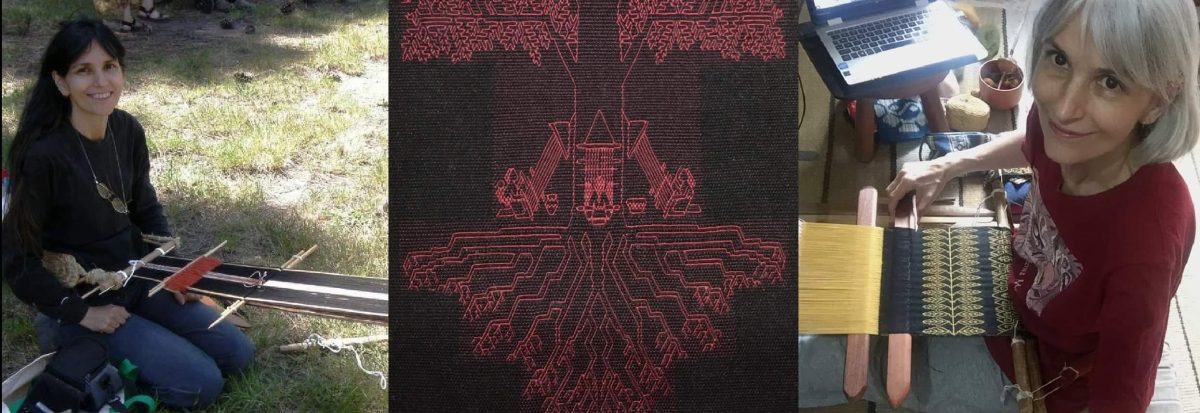
 These are two of three panels that will form the whole piece pictured with the weft inlay sampler I made with this project in mind. I have a plan for a special way of uniting the three panels once they are done. There will be two identical red panels flanking a black. You can see that I have decided to weave both the red panels at once. Why? Because I am simply not confident about being able to weave one red patterned panel alone and then go on to produce a perfect replica.
 And this is the thing about backstrap weaving and the fact that part of the loom itself is ME, a living, breathing thing with changing moods and attitudes which are so easily reflected in the cloth I am producing.
Just the way I am seated in any one weaving session and a change in the amount of tension I am applying can have an effect on the way the motifs look…more rounded, more elongated. Some days I weave in half hour bursts and barely settle into it. On others I can sit for three hours at a time and get into a wonderful flowing rhythm.
This means that if I write down the fomula for my first panel, for example, the number of picks of plain weave I need to do between motifs and follow that to the letter for the second panel, there is no guarantee that panel number 2 will be identical to number 1. However, I am happy to report that this is less and less of a problem for me as years go by and I become increasingly experienced. BUT I am not taking any risks with this wall hanging project and its two red panels!
Solution: weave them both together!
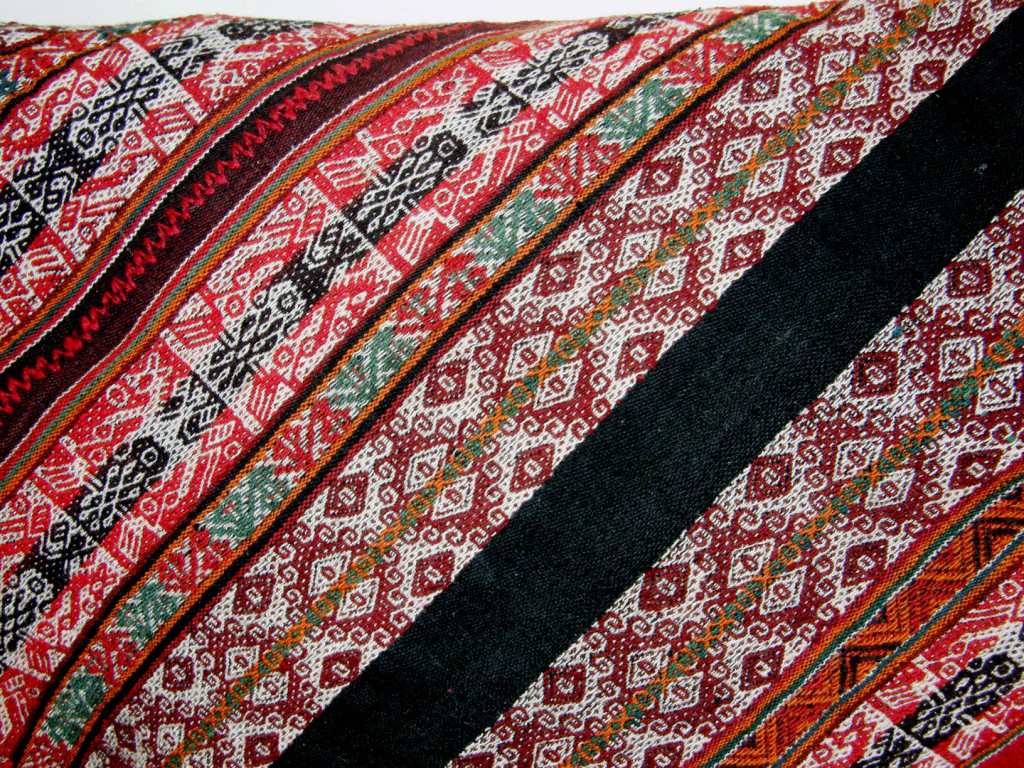
Of course, the weavers here in Bolivia and Peru don’t have that option when weaving the panels for their carrying cloths. Due to the width of the pieces, they can only manage one panel at a time on their backstrap loom. Look at the Peruvian piece above. You can see the zig zag red stitching that joins the two panels. All that patterning you can see on the right is perfectly duplicated on the left. They can weave for months and months with the myraid of interruptions and distractions that running a household entails and still produce two perfectly identical panels.
And then my mind is blown completely when I see the competition pieces that are made for the annual events held by the Center for Traditional Textiles in Cusco (CTTC). The 2010 event required weavers from each community to work as a team to produce pieces comprising many individual panels. Some communities challenged themselves to the max!
 This is one of the winning pieces (I believe that it is from Sallac) from the 2010 competition and is being presented in this picture at the Tinkuy. I don’t know how many weavers were involved with this but I imagine that they must have had to work very closely together to achieve such consistency in those individual squares. Each weaver would have had to include the same amount of pattern with exactly the same dimensions as the others in his/her square. A weaver who applied more tension or who didn’t beat as hard would have created motifs that were slightly more elongated than the others and would have not been able to fit as much pattern into the square. Goodness knows if or how many squares had to be rejected. There were stories of tears, disappointments and frustration when weavers representing the various communities spoke on the podium.
I can see that the top ikat panels on the left and right don’t have the same orientation. I bet there is quite a story behind that!
The community of Pitumarca added yet another dimension by weaving panels of pattern within panels using the discontinuous-warp, or scaffolding, technique for which they are famous…
 The CTTC has been posting pictures of some of the finalists in this year’s competition on their Facebook page (see below). I don’t know what the theme or requirements for this year’s event have been. The winners will be presented at the tinkuy in Cusco in November.
 Some more detailed pictures posted by the CTTC….
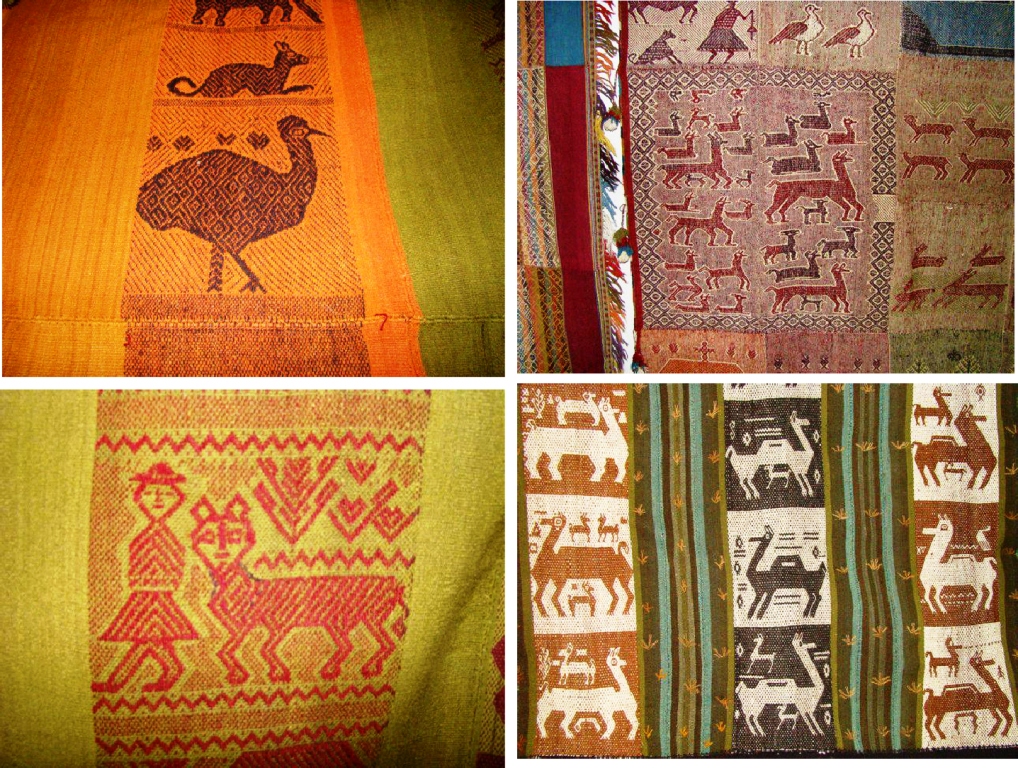 Any guesses for the possible theme?….animals? twill?
And, are you going to the Tinkuy this year? It’s in November. There’s still time to register. Sadly, I am not. It was a tough decision but with my idea of going to Australia and possibly a trip to Mexico some time in the near future, I have to sacrifice some things. Even Australia is a bit iffy at this point.
Two of my backstrap weaving students, Dorothy and Karen will be going and I am already pestering them to send me daily reports. You can read my reports on the 2010 event here and here.

As for the dilemma that I mentioned way back in the beginning….before getting sidetracked by spectacular panels….I have taken up my studies of 3 and 4-color pebble weave again after having put it aside for several years and I now I want to include the 4-color version as part of my wall hanging series.
Four colors in a series of red, black and white….does not compute. So, a whole new series will be born. Those of you who have been following my blog and looking at my weavings for some time may already have a pretty good idea of what colors I will choose. If so, do tell, because I haven’t made that decision yet myself!
The red, black and white series will continue as I still have a bunch of ideas for that. However, while I have the 3 and 4-color pebble weave studies fresh in my mind, I would like to start a large piece with these techniques. I am still at the sampling stage, of course.
 My first task will be to make a new strap for the four-color bag I wove years ago when I was still living in Chile.
It’s a wool bag with a cotton strap that is too short. It must come off. I have some wool that might work and I want to make a strap with a very small 3 or 4-color motif that won’t be overpowering.
I will have to dye the wool to suit and must look for wool dye in this land of cotton.
I continued with the three-color piece that I had started last week. This was more about creating some of my own patterns. I am sticking with flowery type things for the time being so that the band has some kind of theme. There’s a hummingbird which comes from a two-color pattern on a sash from Taquile Island. Carolyn’s bee pattern, that I included in my second book, would look good on this band. Sharon sent me embroidery designs for butterflies which were helpful.
 There isn’t enough contrast between the light blue and yellow to be able to appreciate the figures on the reverse of the blue band. This band is made with tencel.
The four-color one in the next shot is cotton. There it is, mistakes and all.
 Julia was taken with the multi-colored Bolivian hatband that I showed last week and wove a multi-colored band of her own…
 Andean Pebble Weave…there’s a lifetime of study and creation for just this one structure.
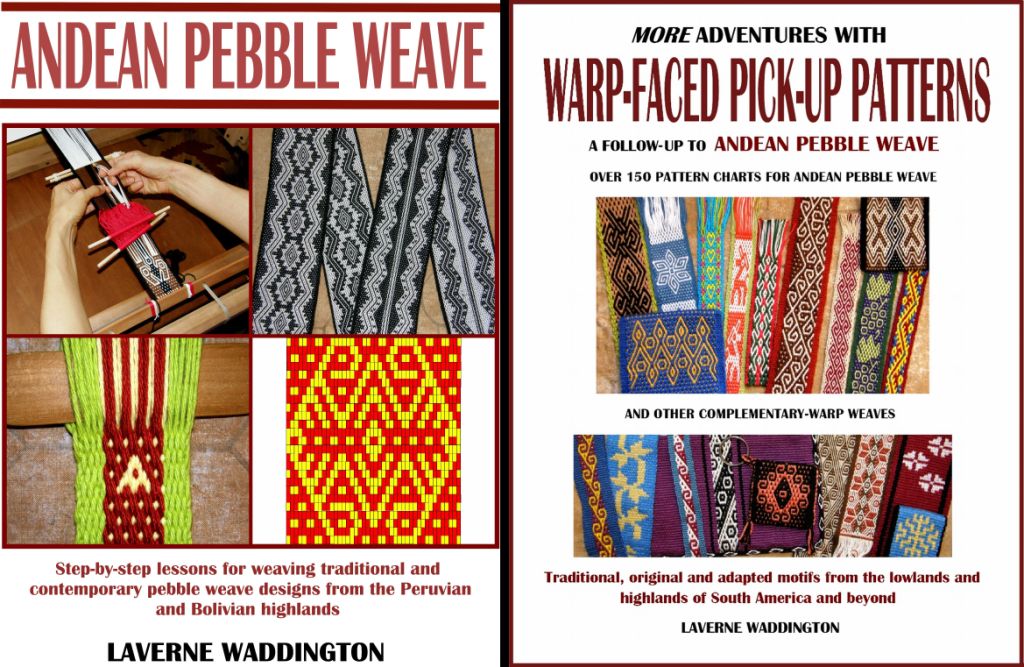
It is not a beginner technique. With some warp-faced band-weaving experience and a bit of pick-up under your belt, you can start with my first book to learn the basics of the Andean Pebble Weave structure. Then you can go on to the second volume to deepen your understanding of Andean Pebble Weave and other complementary-warp structures while learning how to design and chart your own two-color pebble weave patterns. If you are new to warp-faced band weaving there are plenty of free tutorials here on my blog to get you started. Don’t rush into pebble weave.
Jennifer is enjoying the simple pleasure of creating plain weave without ridges (there has been much written on this blog about the pesky ridging problem and the final logical solution!)
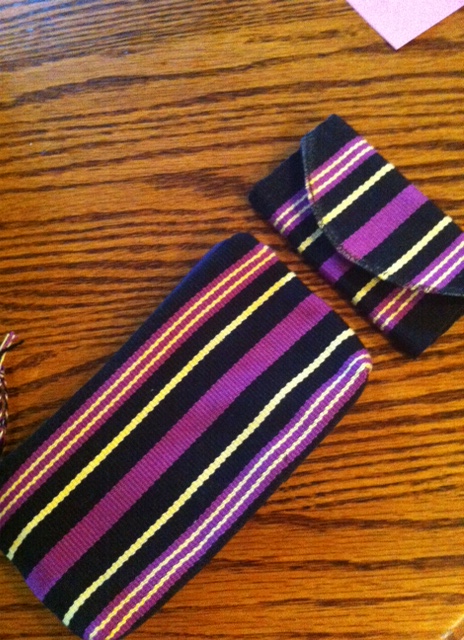 Here are her pieces ready for finishing touches. The small needle case will have a tubular band edging. Jennifer followed my Cutting Corners tutorial but notes that the wood glue she used does not dry clear (the glue I get here known as carpenters’ glue does). Look at that lovely smooth plain weave.
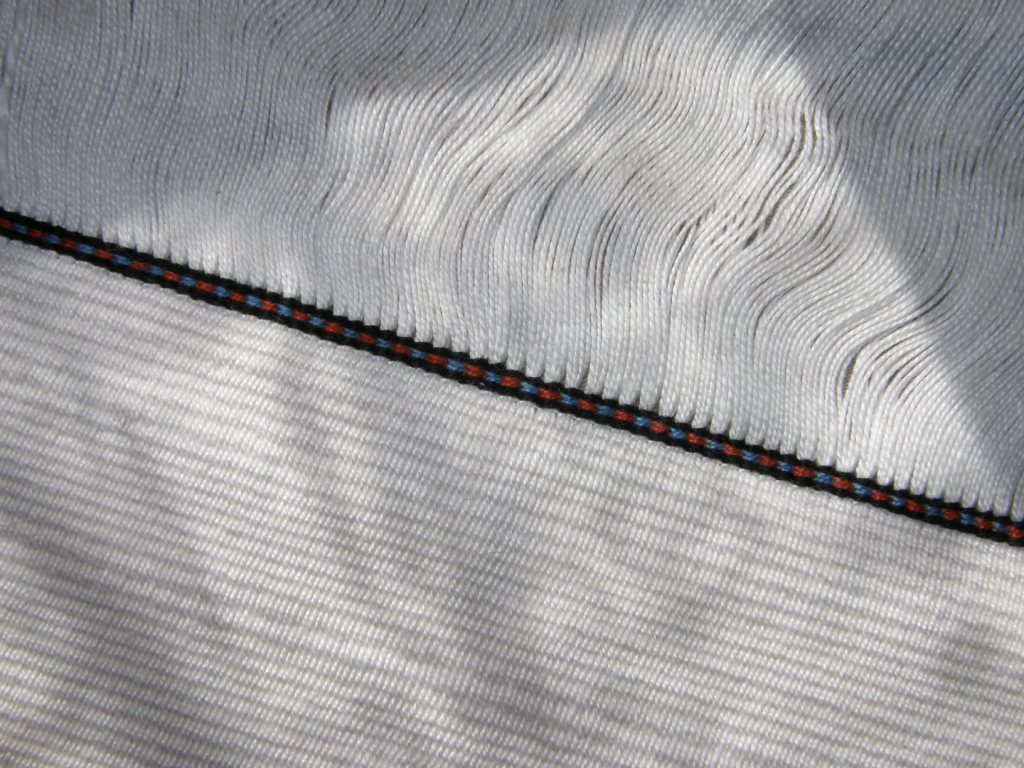
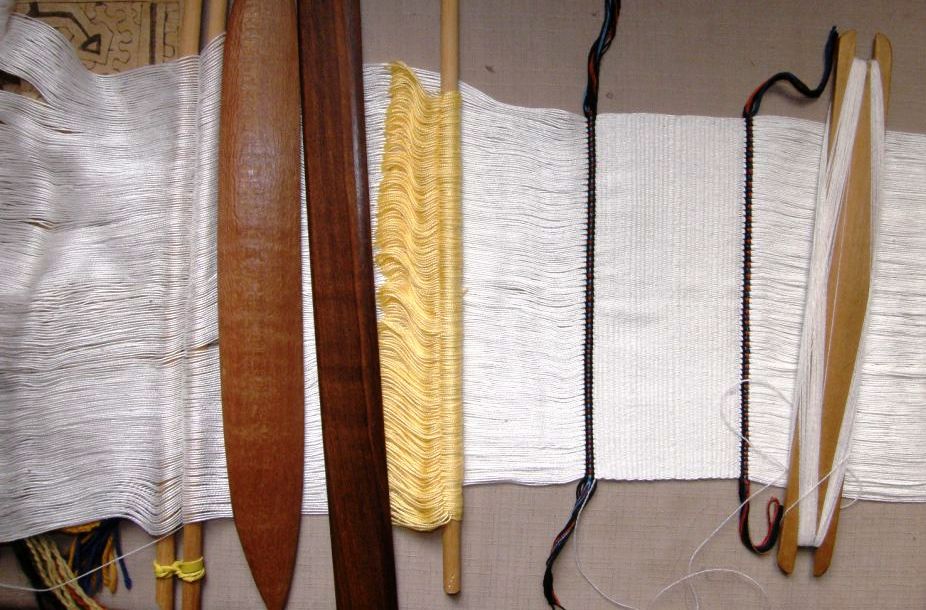
I have added a coil rod to my two red panels to eliminate the ridging that often occurs in warp-faced cotton pieces on the backstrap loom. Coil rods are often applied by backstrap weavers to circular warps. Mine is not circular but I am using one anyway. The most common way to eliminate ridging on cotton single-plane warps is to weave an inch or so at the “wrong” end of the loom to lock everything into place before starting to weave at the “right” end. However, I didn’t want to do that on this project because I believe that it will make my planned finishing and joining technique for the three panels more awkward. The coil rod is doing the trick…what a marvellous piece of equipment!
Curious about the coil rod? Read here.
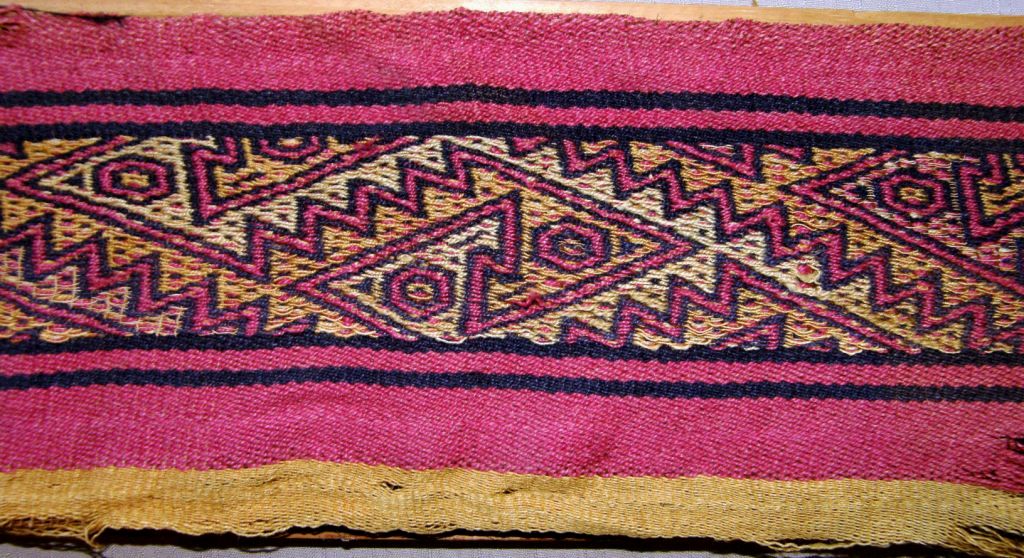
Until next week, let’s enjoy this beautiful old four-color piece that I found in an antique store right here in Santa Cruz about ten years ago…
 And here is a last minute addition because I just went to Facebook and this leaped right off the page at me!
 These are sashes woven by the Pueblo weavers and owners of Woven Dreams Textiles. This is part of their inventory for the Santa Fe Indian Market this week. One year I will get to that! Go to their Facebook page and take a look at the kilts they make.