Sometimes I get ideas for new weaving projects in the oddest places and from the most unlikely sources. While browsing the American Airlines inflight magazine on one of my flights over a year ago, I came across something which planted the seed of an idea. No, it wasn’t an article showing stunning landscapes from some exotic holiday destination, nor was it an article about textiles and fashion or a gallery review. It was a simple image on the title page of the Passenger Information section of the magazine.
I didn’t want to have to lug the entire a magazine around with me so, out came the page, and I added the idea to THE LIST…that collection of scribblings in my note pad of ideas for future projects. I liked the idea of having a collection of tiny motifs contained within a shape…not necessarily a hand…but some kind of shape.
Ikat Cat by Budi Satria Kwan fineartamerica.com
Later, while Googling around for ikat images I came across the fun image of a cat on fineartamerica.com.
All those colors contained within a shape on a black background fascinated me. I started to think about weaving motifs in three or four-color pebble weave or brocade within a shape.
I love the way the colors leap out from the solid-color background.
I had made some practice pieces in three and four-color pebble some time ago, trying to use the technique in some unconventional ways…
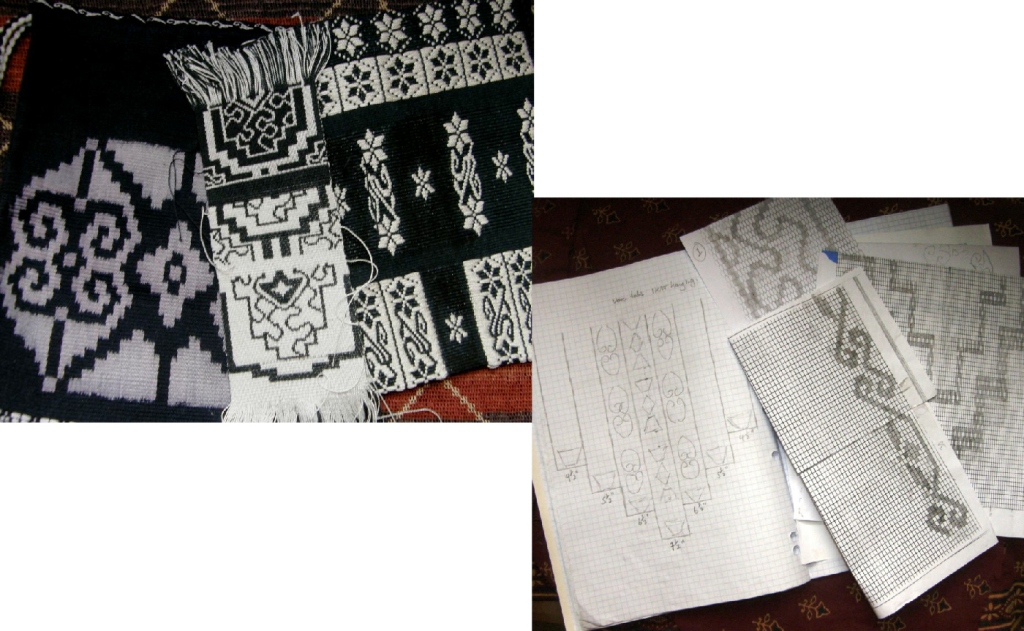
Imagine something like this, a four-color pebble weave, which I wove back in the late 1990s…
contained within a large circle against a black background.
I would create the shape with ikat. I wondered if anyone else had had the idea of doing pick-up within an ikat shape and Googled to see what I might find. It was pretty funny when my search based on the key words ‘ikat’ and ‘pick-up’ yielded this! (from this page of the Dallas Morning News)…
Michelle Nussbaumer’s ikat pickup truck from the Dallas Morning News.
It isn’t quite what I had in mind. This is ikat within a pickup (truck). I want to do pick-up within ikat!
I was silly enough, while working on my most recent wall hangings, to think for a second that I was being innovative by using brocade and ikat on the same piece. Of course I wasn’t!!
And here’s an example….Chris Buckely was kind enough to send me a copy of the September 2014 issue of Textiles Asia Journal for which he wrote an article on the the ikat textiles of the Li people of Hainan Island. There on the front cover was Chris Buckley’s image of a Meifu Li skirt with ikat and multi-color brocade…
Textiles Asia Journal September 2014.
There are many things to sample and be decided before I can bring this idea of mine into action. Firstly, what shape do I want to create with the ikat? Here is my first experiment on a narrow warp to see what would be involved with creating a circle and then doing some pick-up within…
The actual ikat process had its usual set of challenges. The black dye seeped and stained some of the white thread yellow. I have gotten purple stains from black dye before, never yellow. But I have to say that I was pretty happy with the circle that I was able to create on a relatively small amount of warp ends.
Now I am preparing a larger warp and a larger shape. I am keeping the shape simple…no curves or fiddly curls like my other recent experiments below…
This new experiment will have big, bold, simple shapes so that I can simply concentrate on what I need to do to improve the way I apply the ties and reduce seepage.
Here is the new warp ready for tying…
I watched a video on ikat artisans in Uzbekistan. One of the design masters marked the pattern on the white warp as a guide for the people who would later apply the ties. He simply eyeballed the spacing and quickly and efficiently touched his marking stick to the warp.
Here is the video if you would like to see for yourself…
Maybe after a few more decades of practice I will be able to do that too! Meanwhile, here I am armed with ruler and set square. I don’t feel I can simply eyeball the pattern even though it is a ridiculously simple one. The thing that drives me crazy is that my eyes do not want to trust what the ruler and set square are telling me and I find myself measuring and marking and then measuring again.
I have a new frame for stretching the warp and have set it up so that I can sit in front of it and have it at eye level (as the lady in this picture is doing) rather than having it lie horizontally with me doubled over it.
The ikat frame, above, is one that was on display in the Timor Leste stand at the Santa Fe International Folk Art Market in 2013.
I see a couple more days of tying ahead. I am quite comfortable sitting up in front of my new frame. I am playing with a couple of other things on backstrap looms on the side as the tying is quite tedious and not something I can work on for hours at a time.
Hopefully, I will have this warp on a loom with something to show you next week. Next Thursday…that will be Christmas Day…I almost forgot! I wish you all the very best.
There are many things to remind me that I am no longer in the US and am back in the tropics…that we are heading into summer while the northern hemisphere rolls into winter. There’s this picture that was taken by an online weaving friend in Vermont today….
I keep scrolling back to gaze at it as I write my post in the heat. I lived 6 years in ski resorts and can sense the strange way that sound gets muffled when snow has fallen as I look at this picture. I love its cool blueness.
I have been pulling my hair out all day because my internet connection has been particularly horrible…on and off every 30 seconds….while poor Susan in Vermont is without power in a snowstorm. I wonder how my Californian friends are doing with the massive rain storm that was predicted.
It’s been one of those weeks where I spent far more time online than at the loom. That is not such a bad thing. I got a lot done even if it was at a very slow speed. And, while emailing away and doing research, I ran across a very cool video.
Last year, while visiting with my weaving friend, Dorothy, (the one who recently studied with Peruvian tapestry artist, Maximo Laura) I saw some of the textiles that she had collected on a previous visit to Peru.
One such piece was a pillow cover with some beautiful embroidery. Both Dorothy and I were curious about the embroidery stitch that was used to create the stems and filled-in areas. I posted pictures in a post following the visit and readers wrote to tell me of the origin of the piece…the province of Ayacucho.
I had been to the city of Ayacucho in 1996. That was shortly after the capture and imprisonment of the leader of the Shining Path movement which had used Ayacucho as the base for its terror activities. The city was a sad, depressed and desolate place at that time with few signs of activity and a mere handful of weavers still at their floor looms in the Santa Ana area. I hear that the city’s artisans have long been back at work producing all kinds of both traditional and contemporary handcrafts.
Mariana Venegas wrote to me immediately after I posted these pictures last year and sent me diagrams of what she believed the stitch to be. She was right. But it was one of those things that I did not examine very closely, filed away and forgot about. Thank you so much, Mariana! Coming across the aformentioned video reminded me that I had wanted to learn how to do the stitch. In the video it has been named punto crespo. In Bolivia, hair that is curly or frizzy is described as being crespo so, I guess I could safely say that it is the “curly stitch”.
Anyway, here is the video for anyone who is also curious. I would like to use this stitch in some way in my work.
Ayacucho is one of the places I would very much like to revisit as I see so much beautiful handwork coming from that area online. …not that I want to buy anything, photos will do…I am busy trying to find new homes for some of my things these days!
Here is a picture of some paintings done in Ayacucho from the Facebook page of Folt Bolt. I recommend going to Facebook and “liking” that page. The things that are posted there are a constant source of inspiration.
Here is Folt Bolt’s description that accompanies the picture…
Sarhua is a village in Ayacucho, Peru. Tablas (boards made from the stock of the century plant) are painted using natural pigments extracted from the earth around the village and also from the leaves/flowers and roots of plants. Each member of the family must be reflected in the tablas, performing their every day work or enjoying a special day or festival. A tradition is gift-giving of a tabla to a friend or family member building a new home. These are usually 6 – 8 inches wide and up to 10 feet long and are attached along a ceiling beam on the second floor for good luck and protection.
I do remember these marvelous ceramic churches in Ayacucho. Not only were miniature versions offered for sale in some of the stores in the city, but large ones sat on the rooftops of many of the houses in the surrounding suburbs. The examples, above, are part of Gay’s collection of textiles and folk art that I saw in her home in San Diego on my recent fall trip. Gay, by the way, is very keen to sell most of the items in the collection and would welcome any enquiries. Just leave me a message here on my blog.
As for the title of this post, Plain Tales,…that is what I have decided to call my second series of three red-black-and-white wall hangings. Why “plain”? Because they are all based on warp-faced plain weave….. a black warp-faced plain-weave panel patterned with white supplemental weft, two bonded layers of warp-faced plain weave, or double weave, and warp ikat, a tie-dyed warp woven in plain weave.
Each has a tale to tell but not only about what was involved in creating it.
Each has a story of the encounters and experiences I have had here in South America, and beyond, learning to weave on simple looms.
From the time spent at a raucous highland festival in the town of Calcha where I first spotted the women’s tiny floral hat bands amongst the dancing and celebration, to my first encounter with ikat in the form of my weaving teacher’s martital bedspread. The tied pattern included her name and her husband’s.
The Shipibo-inspired piece reminds me of the three weeks I spent on my knees doubled over at the horizontal ground loom learning double weave with my teacher laughingly telling me q’ella! (lazy!) and jokingly threatening to slap me when I didn’t beat hard enough!
As I sit twining, I am taken back to afternoons spent with my Montagnard teacher, listening to her stories about her overpowering desire as a child to learn to twine, abandoning her chores and risking her mother’s anger to run off secretly to another village to sit and study with her sister-in-law.
All three Plain Tales are off the loom now but not finished. There will be a great deal of tv time spent braiding and twisting fringe.
I re-did the red panels on the first of the three pieces to be completed and had, therefore, to re-do the weft twining that connects the them to the central black-and-white one. Each row of weft twining took 40 minutes! Now all the red panels match in structure and color.
It has been so exciting to see this blank slate….
…turn into this…
And to see these experiments….
become this….
I keep the woven samples, tests and trials and notes. Some of the samples can be fashioned into something useful, others not…
After completing the relatively chaotic black-and-white center panels for each hanging it was always been soothing to then be able to sit at the loom and turn out plain red cloth with simple warp-float motifs. These quiet red panels flank the black-and white ones.
What’s next?…more ikat! I am in the process of figuring out a new frame so that I can sit in a more comfortable positon while doing all the tying. I have a new idea for the ikat which will need sampling and I am pretty excited about it as I really don’t know what to expect. I brought back LOTS of black dye from the US this time so there will be lots of room for error and adjustment in the sampling.
I will leave you with a fun original design by David. He wove some star patterns using the Andean Pebble Weave structure based on Guaraní designs that I charted in my second book. Then he went on to use the tutorials on designing to create his own cat motifs. They are adorable!
It’s amazing how quickly it can all become a blur. Here I am back in the tropics…bananas, palm trees and clinging humidity. It is hard to imagine how it had felt being amongst the redwoods experiencing autumnal coolness and colors just a few days ago, snuggling under the covers at night and listening to the chirping crickets.
View from the weaving room at one of the backstrap weaving gatherings at Ace and Pam’s place in Humboldt County a couple of weeks ago.Not too cold yet to be warping outdoors under the big ol’ oak tree at Janet’s place.The view from my bedroom! at Cheryl’s place.
Although I haven’t settled back into my full Bolivian home routine, some parts were easier than others to pick up again….weaving and writing a blog post, for example.
I have managed to get back to the loom since I got home last Thursday and here I am back at the blog. I wove off the plain fabric on the ikat warp that I had taken as a display loom on my US trip.
I decided that this fabric could be sewn into a nice bag for the wee Kindle that I recently bought.
I thought that the top of the bag looked a bit plain and so I wove a teeny pick-up band and attached that to the rim. It was fun weaving that band in fine cotton. I have always liked all things miniature. The finished fabric was just long enough to make a pouch with a drawstring top.
Now it’s time to survey the three wall hangings on which I had been working before the Fall trip and finish them off.
There are twined ends to be tidied, fringes to be cut, and a new set of red panels to be woven for the first flower panel. Yes, I will be undoing all that weft twining on that piece, removing the current red panels, which are darker and finer than the others, and replacing them with new ones. In that way, all three hangings will have identical red panels each with its own red-on-red pick-up pattern. It wasn’t something that I had had the courage to face before I traveled, but I have been away from my loom for so long and have been missing it so much that I feel I can attack this now with gusto!
And what about the blur and whir of activity in those last weeks of my trip?…
I stayed with Kathleen in California where she gathered a small group to weave supplementary-weft techniques using fine thread. We played with Guatemalan techniques with traditional patterns which some people used for creating patterns outside the box such as autumn leaves and pre-columbian motifs of South America.
I have woven with all these ladies on several occasions on past trips and it was great to see them all again.
Dorothy had spent many weeks over the summer in Peru studying tapestry techniques with the internationally recognized Peruvian tapestry weaver, Maximo Laura. She brought the piece on which she had been working to show us at my insistence.
I imagine that the teacher must be very proud of this student! We all urged Dorothy to have this piece prepared for hanging and professionally photographed.
The design is Dorothy’s own composition. You really have to see it in person to appreciate how much of it is also about texture. Various sections showcase different techniques of color blending and texture.
Dorothy’s stories of her hours spent at the loom in the loud busy-ness of Maximo Laura’s workshop are priceless…the sounds, the colors, the characters, the excitement of it all…as well as the feelings of isolation and occasional loneliness associated with being far from home for such a long time and unable to communicate fluently. I hope that she is able to present her work and tell her stories at her guild.
Kathy and Dorothy also brought along large backstrap pieces which we had started in other gatherings in which we challenged ourselves to go wider. Sometimes, when weavers leave their work untouched for some time, they need a little kick start to get back under way. We can see the value of going away to some foreign land for a six-week intensive weaving retreat where life does not get in the way of our weaving! Kathy tells me that her red and black backstrap in Plymouth Fantasy Naturale, pictured above, is now fnished.
I helped get Dorothy back on track with her piece. She is using Tahki Cotton Classic with three columns of bird motifs which are charted in my first book.
From there I headed up to Humboldt County to my friend Janet. Again, there were lots of familiar faces to greet me…people I had met on previous visits as well as those with whom I had spent time at CNCH.
There was a weaving gathering at the mill followed by another session at Ace’s and lots of time in between to hang out weave alone. Above, you can see Amber practicing the supplementary-weft technique we wove together. She chose a pattern that I based on a traditional Bedouin motif to decorate her black bookmark. Janet can be seen refreshing her ñawi awapa skills using her own beautiful handspun wool.
During the weaving get together, Janet wove a piece with her handspun (of course) and indigo-dyed yarn using the intermesh technique. She chose a Mexican motif that is charted in my second book.
Once done with that, she was ready to warp another wider intermesh project. You see, she now has quite a stash of yarn that she has spun specially for warp-faced weaving and dyed with natural substances. In the past she has used both synthetic and natural dyes but has now decided to stick with natural. Lucky me, I was given some of her gorgeous yarn to take home.
I got into the dyepot with some synthetic dye and dyed some wool that Virginia in Arizona had given me…red and black…no surprises there. This is ready for another series of wall hangings using the ticlla, or discontinuous-warp technique. It is funny that this was what I had chosen to study last summer too. Wait until the weather gets hot and sticky and then let’s bring out the wool! Janet has a nice dye kitchen set-up on the porch outside her mill. These wool projects will be competing with more ikat studies that I have in mind.
One of my discontinuous-warp studies from last summer.Another ‘ticlla’ study with some pick-up patterning included.
On the second weekend, we went out to Ace and Pam’s place (the place that has that gorgeous view in the first picture in this post). It was nice attaching our warps to the wooden posts in Ace’s living room and extending them from there in a spoke-like fashion.
We used lots of Janet’s wool bands around the posts for attaching our warps. There was time spent weaving but also time spent looking st woven motifs and figuring out how to chart them.
Tracy was using a backstrap brought for her from Guatemala patterned with a beautiful double-faced supplementary-weft technique…
The guild meeting was wonderfully busy and entertaining. There had been two workshops the previous weekend on mushroom dyeing and eco-printing which resulted in lots of Show-and-Tell.
Onward to Diane’s place with a fun day of weaving with folks who had woven with me on previous occasions. Even Jen, who had woven with me over in Truckee and South Tahoe, was able to make it. It was wonderful to be able to see what everyone was working on. Some people were finishing off the samples that we had started in our last get together while others were well into new projects.
In previous sessions, Cheryl had warped, with Jane’s help, for a backstrap decorated with a pattern in the Andean Pebble Weave structure. She was able to almost finish weaving it in this time. Calculating to get the motif centered was tricky considering that Cheryl had not woven a sample with this yarn which we could use as a guide of her beat and take-up. We got close. The motif is charted in my second book. Cheryl uses the “thick border” structure that I describe in my first book and has created a thick and cushy backstrap. I call the backstrap that I made for myself with this structure my ”Rolls Royce”.
From top left to bottom right, you can see Jane, Shan, Wendy and Jen weaving. Diane showed me the finished band that we had warped at the end of our last time together…the red, black and white one, below, (motif from the second book)…
With Cheryl and Ken’s ‘wee’ pup, Trace.
…and I loved Jen’s idea of combining solid color yarn with variegated for the plain Andean Pebble Weave section of her backstrap. She has a solid green “background” through which multi-colored pebble spots appear in the variegated yarn.
This is a solid group that gets together frequently to weave at Diane’s place. I am so happy that I was able to be part of one gathering and offer help and advice.I often long to be able to jump through my computer here in Bolivia to be able to help people who write with questions about their projects.
While revisiting this group of friends and staying with Cheryl at her gorgeous lake house, Diane, Cheryl and I were invited by renowned fiber artist, Sara Lamb, to visit her home and yurt studio.
This had long been a wish of mine!
Being familiar with some of Sara’s work from her online presence, her magazine articles, and from having seen her in her own woven garments made from her own exquisite handspun and painted yarns, I had an inkling of what I might expect to see within that enticing yurt. Of course, what lay within was beyond my expectations and I am not even sure that I can begin to describe that space filled with the richness of colorful yarn and tools, and crammed with the signs and sources of creativity, production and inspiration. Where to focus, where to start…so much to see and touch and so many stories to hear. It was an impossible space to photograph…at least for me. I would never have been able to contain all that magic in one frame.
Then, we moved into the house where a simple glass-fronted cabinet, with just the right kind of magical muted lighting, revealed an Aladdin’s cave of woven treasures (of course, Woven Treasures, the name of one of Sara’s books…there could be no other name for her work as that is the phrase and vision that immediately springs to mind when you are approaching the display).
Flash photography of course spoils the mood of that muted lighting. Cheryl’s picture is closer to reality than mine.
Picture by Cheryl Taylor.
It was fun to be able to spot a backstrap-woven band used as trim amongst the treasures which resulted from a class Sara had taken with Ed Franquemont.
Each piece had its story. It is an astounding body of work and we didn’t even scrape the surface. We are so grateful to Sara for having invited us over.
The beautiful mansion that houses the Sacramento Youth Hostel
Last stop was Sacramento and a chance to stay with Vonnie and her family again and see long-time online weaving buddy, Franco.
There was a nice combination of known, familiar and new faces in the group…people who had woven with me before, people I had met at CNCH and new people with whom I hope to be able to weave again.
I enjoyed the guild meeting and having people thank me for bringing back memories of their trips to Peru from years gone by. I hope that my pictures might inspire in people another visit to South America…maybe Bolivia next time…to see the weavers and the textiles with new eyes. And the guild meeting was a chance to see weaving friends again…not only from Sacramento but from other places in the area.
Vonnie took me to a great local yarn store called Babetta’sYarn. We shopped for Plymouth Fantasy Naurale so that Vonnie could make her backstrap.
Vonnie started her backstrap the next night, I set my alarm for 2am for the pick-up by Super Shuttle, and my trip was done!
So, there you have the blur of those last weeks. While all that was going on, backstrap weavers from various countries were posting their projects online and sending me pictures by email…evoking lots of smiles!
Cheryl wove with me on this trip and has already finished making her backstrap. It’s one of the things that I like to emphasise…warping and setting up to create good plain weave.
Ruth, in Chile, used the Backstrap Basics article, which I have online in Spanish as well as in English, to weave her own backstrap. She has done a beautiful job!
Ximena, also from Chile, often sends me updates on her Andean Pebble Weave work. Here is a set of bookmarks that she made…
Father Kyriakos, in Australia, wove a wool piece of fabric decorated with Andean Pebble Weave patterns using a four-shaft table loom (instructions are in my first book). He included some soumak and weft twining and used a band woven on an inkle loom for a strap for his finished product….a gorgeous satchel.
And, speaking of gorgeous bags and straps, Julia is constructing one using several bands and wide pieces. She has two other bands off the loom as well and I can’t wait to see how she uses them. All these motifs are charted in my second book.
Father Kyriakos also sent me an update on his bookmark project. These he made using a backstrap loom…
Gwendolyn shows how she can comfortably set up to weave both indoors and out. She is weaving a plain weave band and decorating it with a pattern using a supplementary weft. The pattern is one that I have adapted from textiles of Central Asia that were woven using completely different structures. You can find that pattern charted here.
That piece is now off the loom with lining attached and ready to be made into a bag…
Camilla, in Sweden, is using both string heddles and a rigid heddle to operate her looms for Andean Pebble Weave, with its two sets of string heddles, and basic complementary-warp pick-up which is based on two sheds.
Amanda wanted to weave a banner band for her mother’s craft business, Crafted by Rozella, and used the lettering techniquethat I learned from the Montagnard (Vietnamese hilltribe) backstrap weavers in North Carolina. It always makes me happy to see those tutorials being used.
The critters on the table are wine bottle toppers.
Finally, Valtricot showed us a way to wind a warp if you don’t have pegs or clamps…
If you have managed to get all the way to the end of this long post, I imagine that you might also be feeling like everything is blur. That is what happens when I leave off posting for a while. I just couldn’t manage to squeeze in a space for it while on the road for the last part of my trip.
And speaking of blurs…as in objects moving at great speed…my nephew, Ryan, recently took third place in his first ever professional appearance in long-distance triathlon.
You may remember that he brought home the gold in the World Amateur Champonships in China in September. Once again he thanks all the supporters from the weaving world who visited and liked his Facebook page.
 I didn’t want to have to lug the entire a magazine around with me so, out came the page, and I added the idea to THE LIST…that collection of scribblings in my note pad of ideas for future projects. I liked the idea of having a collection of tiny motifs contained within a shape…not necessarily a hand…but some kind of shape.
 Imagine something like this, a four-color pebble weave, which I wove back in the late 1990s…
 contained within a large circle against a black background.
 And here’s an example….Chris Buckely was kind enough to send me a copy of the September 2014 issue of Textiles Asia Journal for which he wrote an article on the the ikat textiles of the Li people of Hainan Island. There on the front cover was Chris Buckley’s image of a Meifu Li skirt with ikat and multi-color brocade…
 The actual ikat process had its usual set of challenges. The black dye seeped and stained some of the white thread yellow. I have gotten purple stains from black dye before, never yellow. But I have to say that I was pretty happy with the circle that I was able to create on a relatively small amount of warp ends.
 This new experiment will have big, bold, simple shapes so that I can simply concentrate on what I need to do to improve the way I apply the ties and reduce seepage.
 I watched a video on ikat artisans in Uzbekistan. One of the design masters marked the pattern on the white warp as a guide for the people who would later apply the ties. He simply eyeballed the spacing and quickly and efficiently touched his marking stick to the warp.
 I have a new frame for stretching the warp and have set it up so that I can sit in front of it and have it at eye level (as the lady in this picture is doing) rather than having it lie horizontally with me doubled over it.