Backstrap Weaving – Highland Holiday

From the town of Quillacollo just outside Cochabamba city we head straight for the mountains and in under an hour we had zig-zagged our way up to around 3700m leaving the city of Cochabamba a mere blur in the distance on the valley floor.
How such a wickedly steep street can look so mild in this photo is beyond me!
These rocky streets in town become slippery with mud after rain but dry up miraculously quickly.
Charqui (jerky) on the washing line in the patio in front of a nice view across the valley.
I mashed overripe bananas with Maxima and little Mayra for the indigo dye bath.
Maxima and daughter, Vilma, showing off the aguayo (carrying cloth) Maxima wove for a custom order from the USA. Indigo-dyed yarn from the first attempt can be seen in the stripes. This cloth is gorgeous! The colors are so rich and Maxima has included a stunning variety of figures. It’s all Maxima’s work except for the tubular edging.
A close-up view of a small section of the center of the aguayo where you can see some of the indigo-dyed yarn in the decorative joining stitch.
We made skeins. I’d never made skeins just on my hands before and was happy not to have mine end up in a tangled mess. The singles yarn immediately kinks back on itself when not under tension and can make things difficult to control.
Immersing skeins in the indigo dye pot with Dorinda, granddaughter Emily and little Mayra always there in the mix. We wore gloves but still managed to get the dye on places where it didn’t belong.
First results once again against that lovely backdrop. One of those skeins became mine 🙂
On the following days, Maxima continued experimenting on her own and tried over-dyeing some naturally-dyed yellow to produce that pretty green.
And yet more on another day. This time over-dyeing a cochineal-dyed skein.
Plying all this yarn will keep me busy for a while. As if I need even more stuff to lug back to Australia but who in their right mind could resist?
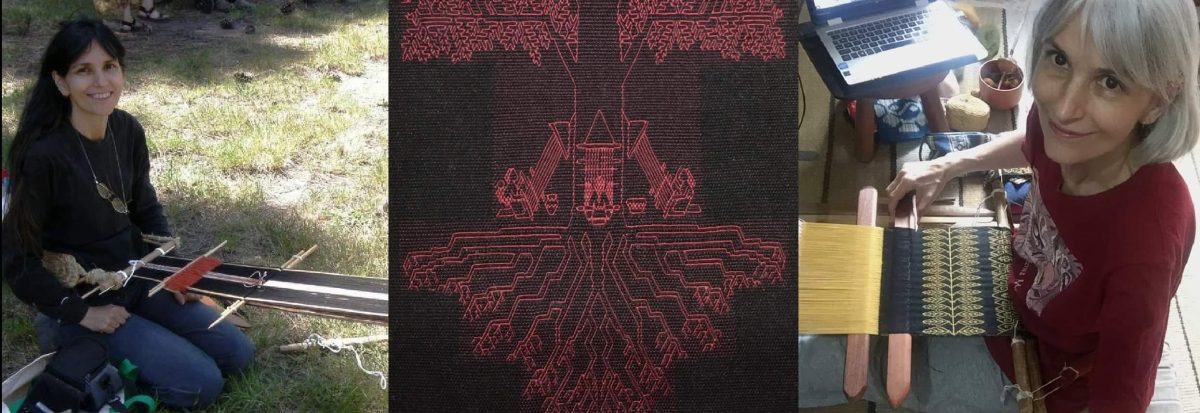
Back in 2017 I went to Huancarani and can be seen here with that long dark hair guiding Maxima’s sister Narciza through the steps to weaving a pattern from my More Adventures with warp-faced Pick-up Patterns book. It’s a motif from a Central Asian textile that I had adapted to the structure that I call Andean Pebble Weave. It had caught Narciza’s eye and she was keen to learn it and not let me go until she had conquered one repeat.
We just managed to get through one repeat before it was time to leave and I left wondering if she would ever use the pattern. I did leave behind a woven sample just in case.
Maxima and a group of weavers are seen here studying and discussing images in the book shortly after my visit.
It’s a belt that she wove for daughter, Vilma, to wear on festival days. It’s woven in the bright tightly twisted acrylic yarn that the weavers here love to use.
The ladies love to be able to show off “new” patterns in items they use for special occasions.
Maxima preparing a cotton warp for our first session together. The end of the warp is temporarily tucked into the waistband of her skirt while she uses two hands to make heddles, Later the end will be suspended on her index finger. Anything that happens to be lying close by such as this comb can be called into use to hold the cross.
Starting with a little plain pebble weave.
Meanwhile Mayra and Ana who seem to see all forms of household chores as play, were happily washing their toys. At one point I saw them playing chop-the-head-off-the-chicken-for-the-pot with the cat!
Starting with a fresh warp of respun acrylic thread for wider, more complicated patterns.
The young ladies on this morning were on chicken duty…..that is, keeping the chickens from wandering from the yard into the kitchen.
One of the four running-horse patterns that creator Deanna Johnson calls Elmy’s Mustangs, is almost complete.
She also selected the viscacha pattern from my book. I’d charted that pattern from a fragment of pre-columbian cloth that I’d seen online. I’d been able to track down the owner of the fragment and get him to send me close-ups so that I could decipher it.
This is what I was doing in the evenings to entertain myself. I was using Alison Irwin’s idea for weaving letters in the structure that I call Andean Pebble Weave to make a key fob for the lady who ran the hotel in which I was staying. Inti means sun in the Quechua language and Wasi means house.
I think she liked it!
Squeezed onto the balcony of the hotel, I showed the ladies any woven thing that I happened to have. Here they’re examining my double weave belt with its Bedouin patterns which are completely foreign to them.
I brought out my cotton spinning bag and everyone fell in love with the tiny takli spindle and wanted to take it home. Only Justina was “brave” enough to try spinning cotton with it and she did a great job.
Gathered the next day in Vilma’s sewing workshop with Justina deciding that she had enough time to teach me if I could bring some yarn. So, out came the crochet cotton again to the rescue…not ideal, but good enough for learning.
Creating a fresh ñawi awapa warp while Maxima went out to look for a forked twig to use. It holds the cross….more about that later. On the floor you can see another stick that is used to save one of the picked-up sheds for later use. The weavers here call this stick “el muchacho“.
Justina guiding me. Yes, I learned it! Maxima and Vilma looked on. I wonder if Maxima absorbed enough by watching to be able to do it on her own. Wouldn’t surprise me. I offered to let her sit in my place and try but she declined.
When I got home of course I had to weave one straight away. I still have lengths of fabric that I bought from the ladies back in 2019 and I used some of Verna’s cloth to make a little pouch that I could edge using the Huancarani set-up and color-changing method.
A closer look. You can see that the color arrangement in the tube along the base of the pouch is different from that along the side. This is a much nicer photo of the beautiful natural dye colors used by the ladies in these textiles. I used commercial wool from my workshop stash for the edging.
Got my nose burned on day one in the high altitude sun and so did not go out hatless ever again after that.
We all got filthy. The quiet sleepy group of passengers up to this point turned into a happy chatty group after successfully getting the van out of the mud and back on its way. How was I going to get on a plane with my feet in this filthy state? Never mind, there were flooded streets to walk through further along once we hit the outskirts of town and had to get out and walk due to the roadblocks. Feet were squeaky clean by the time I got to the airport.
The top left bunch of thread was dyed in the indigo pot. At bottom right you can see a tiny pouch I made using the Dosapey pattern. That tiny bag holds a tiny booklet and mini pencil. Now to decide how to combine colors in a new project. Roció, my Ayoreo teacher, contacted me for a class while I was away. I’ll have to let her know that I’m back.
This is the start of a larger Dosapey pattern that I finished just before traveling to Independencia. I dyed the black for this project.
I just had enough garabatá thread to create one face of a pouch. I wove the other face in cotton and sewed the two together. This pouch held my passport, tickets and money purse and went with me on the trip. I used the edging stitch used by the Weenhayek artisans along the top.
Using the Moisy technique which is one of the two pick-up patterning structures that the Guaraní weavers use. I set this up all ready to go before I left on the highland holiday.

Backstrap Weaving – Confused!

The “Confused” title doesn’t refer to my backstrap loom weaving but rather to the back-and-forthing that I have been doing between Bolivia and Australia these last two months. After a ten-day break following the first trip, I headed back again and now here I am back in Bolivia. Now you might imagine my confusion as I struggle to figure out which place is home in my heart and which place I am visiting.

One of the 85 “Hellokoala” sculptures hand painted by local artists and scattered around the Port Macquarie area.

The second trip to visit my brother and sister-in-law in Port Macquarie went smoothly. I got a seat on my first attempt on all my standby flights and so the inflatable mattress and blanket that I carried just in case I needed to overnight on the airport floor weren’t called into use. On the long Sydney-to-Dallas return flight I found myself thinking of Australia as home and of Bolivia as a place I was going to visit. That’s quite a change of mind-set! However, I was only back in Bolivia for a day and a half before all that changed and I felt once again happily “at home”. Yes, it’s confusing!

Amazingly, I bumped into Dorinda in Santa Cruz airport on the way out. She had been in Cochabamba visiting with Maxima and the other weavers and we both happened to pick the same day to leave. We had time to catch up departing Bolivia and on arrival in Miami and then went our separate ways. I wonder how she feels about zipping between the two countries after having lived here for so long.

Dorinda and Maxima at the Tinkuy in 2010 where I first met them. In 2009 I found Dorinda in the WARP membership directory and we had begun emailing back and forth.

I tried out one of those super budget airlines to get from Dallas to Miami…Frontier. It’s really very good as long as you are aware of all the “extras” that can be charged on top of the basic airfare. For that reason I did away with a carry-on bag and opted for a very large “personal item”. I was pleased to at last have a chance to put my large handwoven shoulder bag to use. It qualified as a personal item and saved me $60. Here it is along with some of the other woven items that accompanied me on this trip….all so very useful.

The belt exploded when I removed it for the final TSA check of the journey! No wonder…lazy me had simply glued down the end that feeds through the buckle. It’s a wonder it didn’t fall apart sooner. It is now well sewn by hand.

And of course, I also took the new passport pouch. It was perfect.

When I arrive in Australia I find myself delighting in all that is around me (except for the cost of living. I could get five haircuts here for the price of one over there.) I suppose the delight that I feel in spotting a kookaburra will eventually wear off….but I hope it never does.

For those familiar with the song, no, he wasn’t sitting in “the old gum tree”. I don’t know what kind of tree that was.

On this second trip, I didn’t gloomily fixate on the cost of things I was buying at the supermarket. Instead, I joyously did so when I got back to Bolivia. This is something that I completely take for granted and I need to remind myself of just how awesome it is that I can get all of this for thirteen U.S dollars.

I know that you’ll be far more interested in the woven cloth than the food! It’s a fine wool poncho from Calcha, Bolivia. The colors are all from natural sources. It has some very narrow strips of pick-up which are hidden in the photo but you’ll be able to make out some strips of simple ikat.

And that is that for Australia for the time being. I hope to make another trip in August to house-sit but various things still need to fall into place before that can happen. I have already checked out possible places for anchoring my backstrap loom while there. As you know, I like to sit on a cushion on the floor and strap the warp beam to the base of my wooden bed. There happens to be such a bed in the guest room at my brother’s place. I can be happily installed there for a month of house-sitting with weaving projects underway.

Thank goodness for wooden bed bases like these.

And so I find myself back in Bolivia in that strange Limbo Land between weaving projects. As I have mentioned before, I am trying to work exclusively from my pre-Covid stash and so the materials on hand will determine my next project. I don’t have any need for another woven item (well, maybe a black and brown bag for those times when I am not wearing blue) but there are always new things to try.

I find myself with a large quantity of black 60/2 silk for some reason. Obviously there was a plan for something at some point about which I have completely forgotten. I am wondering if now is the time to think about weaving yardage. I might get closer to my dream of creating a piece of clothing from my woven cloth if I do so..

I need to put some thought into how I will decorate the black silk cloth and what would be the ideal width. In the meantime I have a new toy….

This followed me home from Australia. It was a gift from a friend. She had mentioned giving it to me on my previous visit and I admit that although I really appreciated the kind offer, I wasn’t immediately enthusiastic. But then I gave it some thought and came up with an idea for doing something that is possibly unique with these little woven squares and so here I am the happy owner of a pin loom. I particularly like the weaving needle that came with it as it has a nicely curved tip. It reminds me of the battens that I used to use for Navajo-style weaving with their cleverly curved ends.

This is just the kind of activity I need in my brain-fogged, jet-lagged state. I am trying out every kind of thick material that I have on hand…it came warped with acrylic and I have since tried cotton and several kinds of wool. This is perfect for my stash which has all kinds of odds and ends of wool that I used to use in my workshops on finishing techniques. The small quantities are perfect for this little pin loom.

One of the decorative finishing techniques for which I use small quantities of wool….coil stitches sewn to the edges of hand woven cloth. I used a little left over piece of fabric woven by my Bolivian teachers to make a case for the tiny Ipod Nano.

As for the black and brown bag that I mentioned above, I don’t think I can get enthusiastic about such a project unless it involves something new. There has to be something interesting about the process…a new bag shape perhaps or a challenging weaving technique. I am thinking that maybe I can create a piece of fabric using the discontinuous-warp technique. I have used this technique before but maybe I can go go just one little step further in its complexity this time.

One of my discontinuous-warp studies using hard-spun wool singles yarn that was designed to be used as warp for Navajo-style weaving.
Another ‘ticlla’ (discontinuous warp) study with some pick-up patterning included. I’m very proud of those four selvedges. 🙂 Technically there are eight but the four outer ones are the most noticeable.

I can use this wool singles yarn. It’s not as hard spun as the Navajo warp and a little trickier to work with but I have enjoyed using it in the two projects I have made so far.

I’m as clueless about what will be next on my backstrap loom as you are. Let’s see what turns up in the next blog post….a whacky pin loom project, yards of unwoven black silk warp or the makings of another bag! By the way, HandyMum on Facebook makes awesome bag construction videos (no talking!) and quite a lot of her sewing is done by hand. My only criticism is that she very often doesn’t show the finished product before she starts which leaves you watching with no idea of what to expect at the end.

I’ll be at my loom taking a break from trying to figure which place is “home” to me. I’m just really confused right now!

Backstrap Weaving – One Step at a Time

Stage One of the eventual move back to Australia is complete. I got back last week and have been struggling with the usual jet lag ever since. There are so many time zones to cross between Australia and Bolivia. Going forward in time on the way over there is really not that bad. It’s the return journey when you gain back the time you lost that really knocks me about.

I took a whole bunch of my weaving books over to Australia as this first part of my move. I can’t sell them here and don’t know anyone who would be interested in them. I know that once I am resettled in Australia I will be so grateful for the effort I made to carry them all that way. I also did some business and laid the ground work for the eventual move but I still don’t see it happening until well into 2024.

I spent most of the time with my brother and sister-in-law on the mid north coast of NSW. It was novel being there in the summer, something that I hadn’t done since 2014. There was a lot of pool and beach time, barbecues and picnics. I brought back a tan and a stronger Australian accent according to an English-speaking friend of mine here.

While breakfasting by the pool, I did a repair job on this bag that I wove for my sister-in-law back in 2006. It’s been around the world with her and is still in pretty good shape.

While I was over there, the latest issue of Tiny Studio Creative Life digital magazine was published with my article on ikat. The theme of the issue is Timey Wimey (it sounded odd to me at first but then I discovered that this is a quote from Doctor Who). The invitation was to consider topics on how tools and techniques have evolved over time, or perhaps something about putting a new spin on ancient practices. I described my various experiments with the ancient technique of ikat on my backstrap loom and the way I have given it my own unique twist in some of my more recent projects. Suzy always does such a nice job of laying out the text and images. I give her a lot of images to work with which I am sure makes it very challenging.

I took my new cotton spinning tool bag and enjoyed a lot of laid back family time spinning my stash of upland cotton and catching up.We hadn’t seen each other since September 2019.

Spinning kept me sane while on the road…I had a 22-hour layover in Los Angeles on the way home and was grateful for something to do while sitting in the airport. The ball of thread grew and grew!

My brother’s cars were in the workshop and so we had outings on the motorcycle and sidecar. That’s a unique way to see the countryside…watch out for crossing koalas.

I got to see at last some things that I’d had sent to my brother’s place in Australia for safe-keeping until I could come and claim them.

A book sent to me by Yingyu Hung in Taiwan on the style of backstrap loom used by one of the ethnic groups in her country. On the left is material used by some groups in Indonesia to wrap their ikat warps. I was curious about it and Sue Richardson kindly organized to have that sent to me so that I could try it.

My spinning tool bag doubled as a handbag when I was out and about. It went exploring with me when I was with my weaving friend Emerald in Sydney at the tail end of the visit.

Weaving with Emerald in Sydney many years ago. We met via his blog and have woven together on almost every one of my visits to Australia since then.

She lives just a stone’s throw away from the harbor and we walked our legs off one day touring the harbor and surrounds. It’s weird feeling like a tourist in the city in which you grew up. So much has changed!

Some things never change, though….the Sydney Opera House and the majestic Moreton Bay Figs atop Observatory Hill.

Airport-sitting time also leads to lots of screen scrolling. I watched a video of weavers from the Apurimac region of Peru and was astonished to see sash weavers using reeds on backstrap looms. I have never seen reeds in use like this here before and I hope that I can track down more information about that…..why have they chosen to use them, who makes them and what are they made from? Does their use pre-date the Conquest? Here is a screen shot that I took from the video which was posted to the Cconchaccota Progreso Grau Apurimac Facebook page.

I spent a week doing goodness-knows-what when I returned between bouts of nodding off due to the jet lag. Finally I was able to get my head together and plan a new project for Stage Two of the repatriation which is happening, believe it or not, next Monday. Aargh, I think I may be getting too old for this kind of thing. I’ll be back on flights to Sydney…on standby this time…trying to squeeze in just one more trip before high season prices kick in.

I decided to make a case for my passport…actually passports, in plural, because my residency sticker is in an old one and has to be carried on every trip…alongside vaccine and yellow fever certificates and ESTA document. I wanted a decent pouch to put all those bits and pieces in and hey, I am always happy for an excuse to weave.

I decided to use the mill-spun wool singles that I had bought a few years ago on a farm in California. The farmer had allowed my weaving friends and me to gather in his barn for a weekend of backstrap weaving and I was grateful.

Fond memories of gathering with my Petaluma friends in the farm co-op barn.

I really had no idea of what I would do with wool singles but it was nice to know that the wool had come from this farmer’s very own sheep. It’s a pretty blend of black and white.

I had taken the plunge and woven with it as singles some time ago when I created a slip case for my phone and was surprised at how well it performed in warp-faced weaving which can be quite hard on yarn.

I had used my handspun plied wool as the supplementary weft to create the pattern.

I was able to take the measurements from this project and use them to plan and create a wider and shorter piece of fabric for my passport pouch.

The warp for the passport pouch ready to receive its heddles. I fell asleep several times while making the heddles…jet lag is terrible! On the left is the felt airline freebie that I had been using which really isn’t big enough to hold everything I need any more.

I liked the pattern on the phone case so much that I re-designed it sideways to span the width of the warp. I again used my own handspun plied wool as the supplementary weft. So, that part of the Stage Two journey is done. Now I need to decide which treasured possessions will get taken over this time, the ones that I can live without here for the next year or so. There are actually still a lot more books but I just don’t feel like dealing with those right now.

While out and about wearing jeans in Australia, I suddenly became aware of just how worn and tired-looking my handwoven belt had become. I have been using this one belt exclusively since I wove it back in 2010. I wove a bunch of other belts at that time but this particular black-and-white became a favorite. I am actually pretty amazed at how well the rather soft cotton from which it is made has stood up all these years.

Belts that I wove years ago. The upper rolled up one became the favorite. The double weave one in the center will now take its place.

It has only taken me twelve years or so, but I finally walked the three blocks down to the sewing and fabric section of the market and got the holes punched in the double weave belt that I had woven but never completed all those years ago. The fact that I can walk a handful of blocks in either direction and find pretty much everything I need is something that I will certainly miss when I move back to Australia.

There you can see the double weave belt with its freshly punched holes, ready to use. The motifs were taken from Bedouin textiles that I had come across in my studies. I would check my understanding of the structures by weaving replicas of the motifs.. Even though the belt is in sturdy double weave, I still prefer to mount it on webbing for extra strength. I used a finer and “harder” thread for this belt than the thread I used for the old worn out one. I guess it will be with me for at least the next ten years or so. Somehow, I can’t see myself still wearing jeans ten years down the track, though!

The collection of metal “corners” in the photo are used I guess to protect the bottoms of handbags or perhaps the corners of leather wallets? I had seen them being used by a weaver who had covered books with hand woven cloth. The corners on the books that I’ve covered with cloth don’t need that kind of protection but I think that these metal corners nevertheless make a really interesting decorative finish on certain kinds of book covers. I spotted them in the stall while I was having the holes punched in the belt. Now that I have them, I have the urge to make more book covers. As if I need more books to lug to the other side of the world! Maybe that will be my first project when I get settled over there in Australia.

Oh my gosh, my head spins with all that needs doing before I can declare myself truly re-settled! High anxiety. One step at a time….

Backstrap Weaving – Flying Visits

Flying visits…I’ve been zipping here and there in the southern hemisphere starting with a three-stop visit in Aotearoa, land of the long white cloud, followed by stops on both the east and west coasts of that other great southern land, Australia.

It all started with a flying visit to Santiago, Chile where I was happy to run into Mapuche textiles in a store in the airport during my three-hour wait for the flight to New Zealand. Being in the airport and hearing the Chilean accents was enough to have me feeling a tug on the old heart strings. I had lived in the far south of Chile in the Chilean Patagonia for five years before I moved to Bolivia in 1998.

I loved seeing this heavy wool Mapuche poncho in one of the stores with its very precise ikat pattern. It is these incredibly precise patterns that are created by the Mapuche weavers with little or no shift in the warp threads that inspired my own recent ikat experiments in silk.


The pieces on display in the store included pillow covers with patterning in complementary-warp pick-up as well as belts in double weave. The balls of hand-spun wool were tempting but the yarn was far too heavy for the kind of work that I like to do and the climate in which I live.

I met lots of backstrap weavers in New Zealand. This is a group of friends in Auckland forming a huddle.

The weavers settled very quickly into the rhythm and there were even occasions when they could pause for a smile between sessions of silent concentration.

A little to the south, in beautiful Tauranga in the Bay of Plenty I wove with even more budding backstrap weavers and was taken by Colleen and Lynne to visit the famous Mount and other picturesque places along the shore.

On a drive out to visit the folk at Majacraft, one of New Zealand’s makers of spinning wheels and fibre tools, I was taken with the sight of a Maori pouwhenua – a carved land post that marks Maori territorial boundaries or places of significance. Between the fields of kiwifruit surrounded by thick high hedges protecting them from the wind, an open untouched green field suddenly appeared. It seemed strangely out of place, open to the elements and vulnerable next to all the other fields with their thick protective walls of hedges. This field was, however, guarded in one corner by a stately but raw and rather weather-beaten wooden pouwhenua. I was told that this one most likely stands to watch over the site of a battle.

A series of seven beautiful pouwhenua stand on the shore near the Mount. They represent Te Kahui Matariki (the Pleiades cluster of stars, or the Seven Sisters) and are much photographed and visited. But I have to say that I much preferred the weather-beaten but powerful single powhenua standing alone in the corner of that wind-swept field in the country.

I got a scarf with Koru motif in the super-soft possum-merino blend for which New Zealand has become known as well as a Maori Koru pendant which will soon swing from a silk neck ribbon that I plan to weave. The Koru is a Maori spiral-shaped motif that is based on the appearance of an unfurling frond of the silver fern.

Air New Zealand aircraft sport an image of the silver fern and  Koru motif…

I flew over snowy peaks (it’s winter at this end of the world) on the way down from Tauranga to Wellington, the last stop on this visit to New Zealand…

Wellington is a gorgeous city. I have been to New Zealand three times before, the last time being thirty years ago. On all three visits we simply drove through Wellington to take the ferry over to the south island. I was so happy to be able to stop and stay this time and enjoy, thanks to my friends Fiona and Sandra, the views across the Cook Strait (see below) and from the top of Mount Victoria, a stay in one of the many homes that cling to the steep Wellington hill sides and a visit to the Te Papa museum with objects from not only Maori but many other Pacific island cultures.

Onward to Australia and the far south coast of NSW where my old backstrap weaving friends gathered once again for a few days of weaving fun. Driving down the final descent to the fishing club where we always gather to weave, a kangaroo nonchalantly hopped across the road. Yes, I am Australian, but I can still get excited about kangaroos.

Once again we enjoyed the pretty view of the ocean with its changing moods right from the door of our weaving venue. We usually step outside in the winter sun to wind warps on the table outside. This time I found it occupied by a group of kookaburras all fluffed up with the cold. Yes, I get excited by kookaburras too! The mural of Spirit Dancers painted on the side of a local water tank is one of several in the area.

At home with my friend, Mog, I found her weaving these beautiful golf towels with lettering and golf ball motif that she designed herself. I don’t think I have heard of anyone weaving golf towels before. It might become a ”thing”.

Then it was off to Western Australia where I met with weavers in Perth city, the Perth hills, and then later up north in Geraldton. I got to spend an evening with weaver Wendy Garrity. If you have been a long-time follower of my blog you will know that Wendy and I first met online via her blog on Bhutanese weaving techniques. We then met up in our travels in Bolivia and Santa Fe in the USA and have maintained a correspondence over the years since then. It was nice to see her this time in her home city. That day just happened to be my birthday and Wendy made sure it was celebrated with dinner at a Perth beach with its beautiful fine white sands to watch an Indian Ocean sunset, a tour around the city and gelato complete with birthday candle. Thank you, Wendy!

Brenda, provided me with crumpets for breakfast and other Australian treats that I often miss when in Bolivia. This picture is for all the Americans to whom I have ever tried in vain to describe a crumpet!

Brenda’s husband, Geoff, made me a bunch of beautiful swords in Western Australian jarrah, also known as, Swan River mahogany. The card that accompanied the gift shows the numbat, a termite-eating marsupial that is native to Western Australia.

In the Perth hills I stayed with Maggie and husband Peter. It was lovely  to get outside and stretch with a stroll around in the bush in the low evening sun spotting tiny native orchids. Peter just happens to be an expert in them.

In Geraldton, I visited Lynne and Max who offered me a bedroom right on the Indian Ocean. I was treated to a glorious sunset almost every evening. That was the view from my bedroom.

And weren’t we spoiled for lunch?! Geraldton, apart from lying in the wheat belt of Western Australia, is also the center of the rock lobster industry. Lynne’s husband Max provided a lunch of luscious lobster from his own catch.

Now I have time to spend with my brother and sister-in-law in their new home on the mid north coast of NSW. They have been taking me around the local beaches and lookouts…

…and into the bush.

Protests in the main square of Santa Cruz city. (Picture from The Bohemian Diaries).

See you next time back at home in Bolivia. My home province of Santa Cruz has been in the news lately in connection with the fires in the Brazilian and eastern Bolivian jungles. September is typically the month when farmers burn-off in preparation for the new planting season. It’s usually a smoky and unpleasant time of year. Smoke descends in the cooler evening temperatures and still air and is thick and fog-like in the streets at night. Apparently, this year, many of the fires are burning out of control and destroying vast areas of jungle. I’ll reserve further comment until I get home and see for myself what is happening.


Backstrap Weaving – The View from the Driver’s Seat

Twice during my recent trip away I got to sit in the ”driver’s seat” to experience what a weaver from another culture sees as they sit at their backstrap loom gazing down the length of their warp.

First, I got to spend the day with Yan Zhang, a woman from mainland China who went to study with backstrap weavers of the Li minority group who live on Hainan Island, China. She kindly brought her loom and warping frame and we, along with my good friend Deanna, talked about all things backstrappy for a good part of the day. You may remember Yan from a previous post of mine in which I embedded a beautiful video that she made of herself warping and  weaving with her teacher on Hainan Island. I had also written about a loom and patterning process from Hainan Island when I crossed paths with Megan in this post. some time ago.

Unrolling the warp and feeling excited as the beautiful cloth and tools are revealed.

Soaking up everything Yan has to tell me about the process…and hoping that I might have a chance to try!

Here’s my view as I sit at Yan’s foot-tensioned loom with its circular warp. While I have woven many a time using my big toe to tension my warp, this was the first time I had had the opportunity to sit at one of these awesome foot-tensioned backstrap looms. Yan’s legs are shorter than mine which meant that we needed to unroll the woven cloth from the beam and adjust length. We didn’t take the time to get it quite right and, as a result, I didn’t have the full range of movement in my feet that was necessary to be able to operate the loom comfortably. Nevertheless I got to use the loom and throw some shots of weft and it was thrilling!

The pattern structure is what I call ”simple warp-floats”. Floats form the patterns on one face of the cloth but not on the other. The loom was set up to create all the pattern sheds with heddle rods and other sticks in place and so no pick-up was required. I loved having my feet be part of the loom. I loved the feeling of curling my toes around the beams. Of course it requires lots of practice to make just the right amount of tension adjustments with movements of the feet. Quite often, I moved my feet too much and had the far beam slide down off the balls of my feet.

Look at Yan’s feet flexed toward her so that she can relax tension enough on the warp to enable her to raise a heddled shed.  She is adding the threads that are held on her pattern stick to the main heddled shed.

The tools that Yan used were all beautiful in their simplicity. She told us that some weavers on Hainan Island have introduced materials such as pvc pipe and I often see these also being used in the highlands here in Bolivia and Peru. Yan’s tools are all natural traditional materials.

Like backstrap weavers in many regions around the world, the shuttle is a simple stick. I  love the shape the yarn takes as it is wound onto the shuttle and Yan showed us how the Li weavers create that. Look at that gorgeous sword on the floor! The heddle rods are doubled pieces of bamboo and weavers look long and hard to find bamboo that grows in such a way. Once found, these pieces very much cherished. They are formed when a thin off-shoot of bamboo grows parallel to a piece of larger girth. The larger piece holds the heddles  while the thinner piece closes around them and secures them. Yan does not use a temple. When I asked her about that, she indicated that the coil rod is what is used to help maintain consistent width.

When we asked Yan about the thread she was using we all had a chuckle when she said it came from the craft chain store Joann! My Vietnamese weaving friends in the USA were never quite comfortable with the thread that they bought locally. Whenever a family member traveled back to Vietnam they were asked to bring back thread.

Yan showed us her handwoven skirt fabric and the way it is wrapped and pleated to fit the user.

Yan also learned how to spin cotton with her Li teachers and showed us a beautiful piece that she has woven using her own hand spun cotton. Here it is removed from the loom still in its uncut circle…

One of the other many fascinating things for me was the frame that Li weavers use to measure their warps. The loom can be set up anywhere and held between the body and the feet. In the same way, the warp can be measured anywhere on a simple hand-held device!

The particular warping path shown in my photo is what Yan calls ”four point” and creates the shortest possible warp. She showed me how to wind this shortest warp for what she says might be used to make a scarf. We separated the colors at the cross sticks in much the same way I was taught to do using my four warping stakes. The heddles are only made once the warp is off the frame and on the beams. However, the threads are turned in such a way as the warp is wound on the frame to allow the immediate insertion of the coil rod when the warp is removed. You can see the way the warp threads wrap around the upper right corner of the frame.

I shared some of my weaving with Yan and we compared warp-float techniques as well as the techniques used to create patterns using supplementary weft. She liked my wrist band with my leaf pattern in supplementary weft and I was happy that she accepted it as a gift. Here she is wearing it while warping.

She showed us some fabric that was woven by her teacher which is considered particularly precious because it is embedded with slivers of mica. You can see one sliver glinting in the light in the next picture. Follow that column down and you will clearly see the pieces of mica sitting under the red warp threads.

It was an absolute delight meeting and weaving with Yan. It was just a few months ago that I first saw her beautiful video on Youtube. I am grateful to my friend Deanna for opening up her home for this visit. Deanna is my backstrap weaving buddy and she of course was just as interested to meet Yan and spend the day with her.

A week or so later, I got to sit in the driver’s seat at another backstrap loom, this time from Guatemala. Susan had been to Guatemala and bought a loom with a couple of yards of cotton cloth already woven and wound onto its beam. She asked me to give her some tips on how to operate the loom so that she could finish off the weaving.

Single-layer warps are used in Guatemala rather than the circular ones that the Li weavers use. This one is made up of lively cotton stripes. Two colors have been used to create horizontal bars on one half of the warp. There is even some variegated thread in use on one edge.  Variegated thread was also used to make the colorful heddles. Susan did not know for what this piece of cloth was intended but I think the sturdy cotton fabric could be made into tote bags.

Unlike the Li weavers, Guatemalan weavers use a simple temple which is made up of a length of bamboo with open ends that spans the width of the cloth and two small nails. The piece of bamboo sits below the fabric. The nails are pushed through the edges of the fabric from top to bottom and then turned into the open ends of the bamboo.

The loom came with a good ol’ hefty sword…not as smooth and polished with use as the sword Yan was using but it certainly does its job in propping open the sheds and beating the weft firmly into place. I used the two cross sticks that are typical in Guatemalan backstrap looms as ”twisty sticks” to help raise the heddle shed.

One thing I found particularly interesting was the way the weaver had settled the far end of her warp. This is the second time I have seen this. My Guatemalan teachers taught me to start out by weaving an inch or so at the far end of the loom before turning it around and starting from the other end. The inch of weaving at the far end locks the two layers of threads together around the far beam and also sets the width at the far end of the loom. I noticed that the weaver who was using the loom that Susan bought had simply placed a metal rod in the second cross, lodged it up against the far beam and firmly lashed it into place. This is a quicker and far less fiddly way of achieving the same result, although perhaps not quite as pretty!

Yes, I had a very nice time sitting in the driver’s seat of these two looms and am so grateful for these opportunities. I think both Yan and I show it in our faces…the joy of weaving on a backstrap loom! The wonder of “being the loom”!

Right now, I am happily weaving on a 180-inch-long narrow warp, creating the straps for my blue pocket bag. I bought the wool yarn I needed to finish the project while I was away. It’s just a plain blue strap in the sturdy intermesh structure and it is a nice way to get back into the loom with an easy task which gives me head space to plan out my next project while I weave. I will get to use my shoulder bag with its quirky pocket on my next trip away in late July.

Oh, and if you happen to subscribe to Spin Off magazine, the summer issue has an article by Devin Helman to which I was excited to be invited to contribute.

You will also see Sara Lamb’s contribution to Devin’s article, Honest Cloth, as well as words of spinning wisdom from Kristin Merritt whose work I often show here on my blog.

And…here’s the ten-month grey hair update.

DON’T FORGET: While Patternfish sales will cease on May 31st, you still have until June 30 to download and save your purchases to a safe place. I’ll be announcing the new home for my ebooks in my next post.